Jarvis AI
Presented By :
Vishal Rathore
Sandeep kumar Paswan
Abhishek kumar
Guided By :
Assistant Prof. Praveen Kumar
College:
B. P. Mandal College of Engineering,
Madhepura
JarvisAi
Project
Overview
JarvisAi
The Jarvis AI project, built using Python, includes
diverse functions like voice commands, app/web
control, reminders, news updates, personalized
playlists, internet speed checks, focus tools, and more.
02
JarvisAi
Problem
Statement
The problem statement for the Jarvis AI project is to
develop an intelligent assistant using Python that
automates daily tasks, provides information, controls
applications, and enhances productivity through voice
commands and various integrated functions, creating a
seamless user experience.
03
JarvisAi
Working
04
1. Voice Recognition and Command Processing
Speech Recognition: The AI uses Python’s speech_recognition
library to capture audio input from the user. This input is
converted into text for processing.
2. Function Implementations
Speak Function: Uses text-to-speech (TTS) to convert text
responses back into speech using libraries like pyttsx3.
Greet Me Function: Provides personalized greetings based on
the time of day.
JarvisAi
Working
04
2. Function Implementations
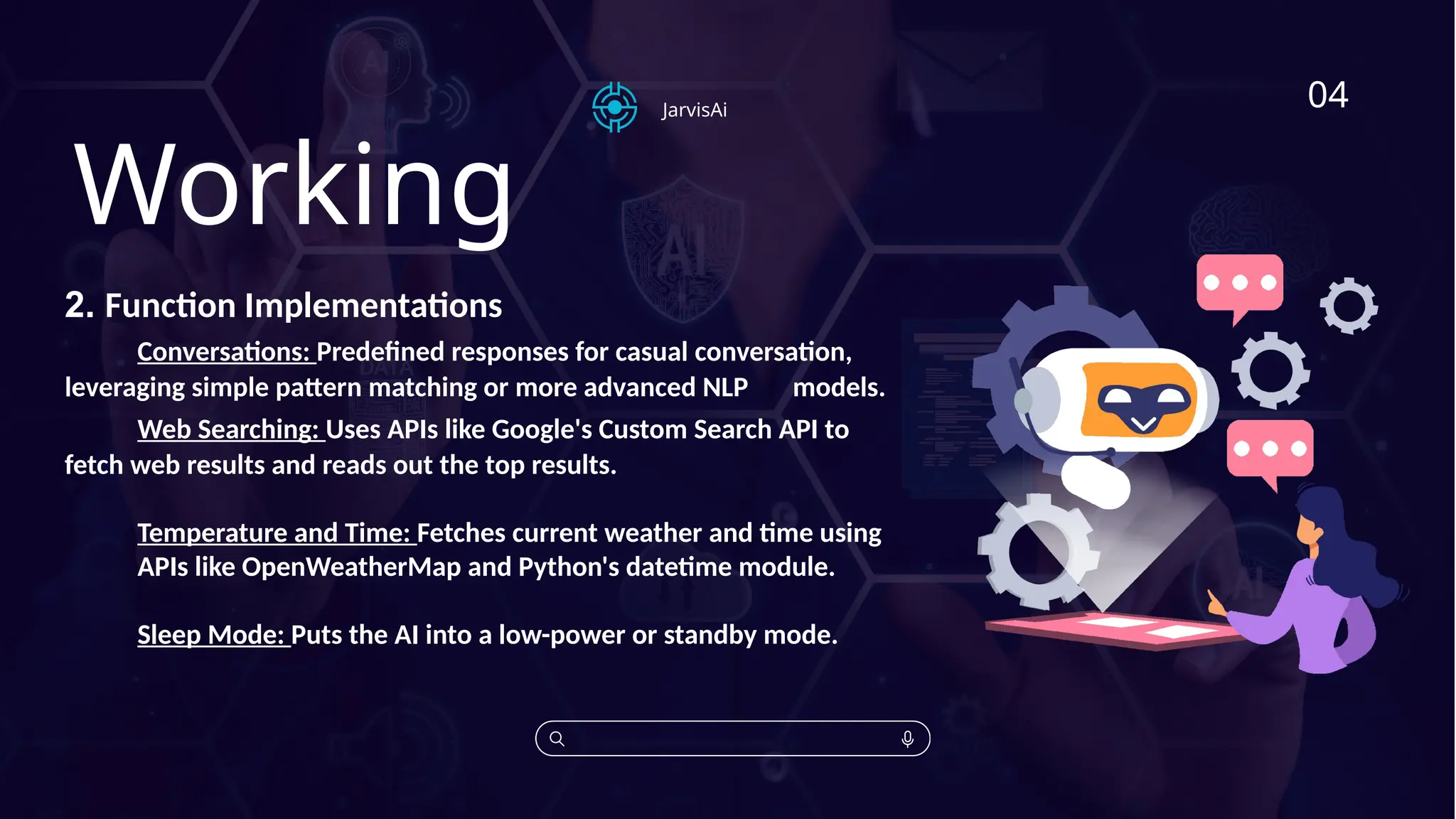
Conversations: Predefined responses for casual conversation,
leveraging simple pattern matching or more advanced NLP models.
Web Searching: Uses APIs like Google's Custom Search API to
fetch web results and reads out the top results.
Temperature and Time: Fetches current weather and time using
APIs like OpenWeatherMap and Python's datetime module.
Sleep Mode: Puts the AI into a low-power or standby mode.
JarvisAi
Working
04
2. Function Implementations
App/Web Control: Uses libraries like os for system-level
commands to open/close applications or websites.
Alarm: Implements alarm functionality using Python's time
module.
YouTube Controls: Controls YouTube playback using web
automation tools like pyautogui.
Reminders: Manages reminders using a combination of datetime
and storage (e.g., a text file or database).
JarvisAi
Working
04
2. Function Implementations
Personalized Playlist:Plays music from a predefined playlist
using a media player library like pygame.
Calculator: Performs arithmetic operations using basic Python
arithmetic.
System Shutdown: Shuts down the system using OS-specific
commands (os.system("shutdown /s") for Windows).
Password Protection: Secures certain commands behind a
password prompt.
JarvisAi
Working
04
2. Function Implementations
Schedule My Day: Provides a summary of the user's schedule.
Open Any App: Opens specified applications using system commands
Internet Speed Function: Checks internet speed using speedtest-cli.
JarvisAi
Advatages
04
Convenience: Offers voice-activated control over various
applications, making it easy to perform tasks hands-free.
Versatility: Provides a wide range of functions, from playing
music to setting reminders and even controlling devices.
Automation: Automates daily tasks like scheduling, opening
apps, and providing news updates, saving time and effort.
JarvisAi
Disadvantages
04
Dependency on Internet: Many features, like web searching
and news updates, require an internet connection, limiting
functionality offline.
Background voice can interfere
Misinterpretation because of accents and may cause inaccurate
results.
JarvisAi
Result and
Impact
The Jarvis AI project enhances daily productivity by automating
tasks, providing quick access to information, and offering
personalized assistance through voice commands. Its wide
range of functions, from web searching to app control,
significantly simplifies routine activities, making technology
interaction more seamless and efficient for users.
08
JarvisAi
Future
Trends
• Future trends for the Jarvis AI project include advanced NLP for natural
conversations, machine learning for personalized user experiences, and
integration with IoT devices for smart home automation. Additionally,
incorporating augmented reality (AR) and virtual reality (VR) for immersive
interactions, and enhancing security with biometric authentication, will make
the AI assistant more intuitive, secure, and integrated into daily life.
Thank You!
JarvisAi
Get in touch with us

Jarvis AI Project FinalWeTalkWith ai.pptx

  • 1.
    Jarvis AI Presented By: Vishal Rathore Sandeep kumar Paswan Abhishek kumar Guided By : Assistant Prof. Praveen Kumar College: B. P. Mandal College of Engineering, Madhepura JarvisAi
  • 2.
    Project Overview JarvisAi The Jarvis AIproject, built using Python, includes diverse functions like voice commands, app/web control, reminders, news updates, personalized playlists, internet speed checks, focus tools, and more. 02
  • 3.
    JarvisAi Problem Statement The problem statementfor the Jarvis AI project is to develop an intelligent assistant using Python that automates daily tasks, provides information, controls applications, and enhances productivity through voice commands and various integrated functions, creating a seamless user experience. 03
  • 4.
    JarvisAi Working 04 1. Voice Recognitionand Command Processing Speech Recognition: The AI uses Python’s speech_recognition library to capture audio input from the user. This input is converted into text for processing. 2. Function Implementations Speak Function: Uses text-to-speech (TTS) to convert text responses back into speech using libraries like pyttsx3. Greet Me Function: Provides personalized greetings based on the time of day.
  • 5.
    JarvisAi Working 04 2. Function Implementations Conversations:Predefined responses for casual conversation, leveraging simple pattern matching or more advanced NLP models. Web Searching: Uses APIs like Google's Custom Search API to fetch web results and reads out the top results. Temperature and Time: Fetches current weather and time using APIs like OpenWeatherMap and Python's datetime module. Sleep Mode: Puts the AI into a low-power or standby mode.
  • 6.
    JarvisAi Working 04 2. Function Implementations App/WebControl: Uses libraries like os for system-level commands to open/close applications or websites. Alarm: Implements alarm functionality using Python's time module. YouTube Controls: Controls YouTube playback using web automation tools like pyautogui. Reminders: Manages reminders using a combination of datetime and storage (e.g., a text file or database).
  • 7.
    JarvisAi Working 04 2. Function Implementations PersonalizedPlaylist:Plays music from a predefined playlist using a media player library like pygame. Calculator: Performs arithmetic operations using basic Python arithmetic. System Shutdown: Shuts down the system using OS-specific commands (os.system("shutdown /s") for Windows). Password Protection: Secures certain commands behind a password prompt.
  • 8.
    JarvisAi Working 04 2. Function Implementations ScheduleMy Day: Provides a summary of the user's schedule. Open Any App: Opens specified applications using system commands Internet Speed Function: Checks internet speed using speedtest-cli.
  • 9.
    JarvisAi Advatages 04 Convenience: Offers voice-activatedcontrol over various applications, making it easy to perform tasks hands-free. Versatility: Provides a wide range of functions, from playing music to setting reminders and even controlling devices. Automation: Automates daily tasks like scheduling, opening apps, and providing news updates, saving time and effort.
  • 10.
    JarvisAi Disadvantages 04 Dependency on Internet:Many features, like web searching and news updates, require an internet connection, limiting functionality offline. Background voice can interfere Misinterpretation because of accents and may cause inaccurate results.
  • 11.
    JarvisAi Result and Impact The JarvisAI project enhances daily productivity by automating tasks, providing quick access to information, and offering personalized assistance through voice commands. Its wide range of functions, from web searching to app control, significantly simplifies routine activities, making technology interaction more seamless and efficient for users. 08
  • 12.
    JarvisAi Future Trends • Future trendsfor the Jarvis AI project include advanced NLP for natural conversations, machine learning for personalized user experiences, and integration with IoT devices for smart home automation. Additionally, incorporating augmented reality (AR) and virtual reality (VR) for immersive interactions, and enhancing security with biometric authentication, will make the AI assistant more intuitive, secure, and integrated into daily life.
  • 13.