Voice Assistant
using AI/ML & Python
(Subtitle: Bringing Human–Computer Interaction to Life)
Mentored by: Presented By:-
Mr.Vipin Maurya Abhijeet Kumar Rawat(MCA2423001)
Kritika Pandey(MCA2423018)
Introduction
What is a Voice Assistant?
A voice assistant is an AI-powered software
that understands spoken commands to
perform tasks, answer questions, and control
devices.
Examples: Siri, Alexa, Google Assistant
Core Technologies
 Artificial Intelligence (AI): Enables decision-
making
 Machine Learning (ML): Improves accuracy
with data
 Natural Language Processing (NLP):
Understands human speech
 Python: Popular language with rich libraries
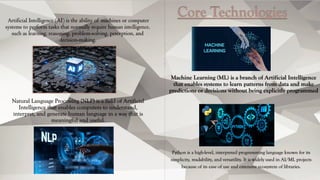
Artificial Intelligence (AI) is the ability of machines or computer
systems to perform tasks that normally require human intelligence,
such as learning, reasoning, problem-solving, perception, and
decision-making.
Core Technologies
Machine Learning (ML) is a branch of Artificial Intelligence
that enables systems to learn patterns from data and make
predictions or decisions without being explicitly programmed
Natural Language Processing (NLP) is a field of Artificial
Intelligence that enables computers to understand,
interpret, and generate human language in a way that is
meaningful and useful.
Python is a high-level, interpreted programming language known for its
simplicity, readability, and versatility. It is widely used in AI/ML projects
because of its ease of use and extensive ecosystem of libraries.
Workflow of a Voice
Assistant
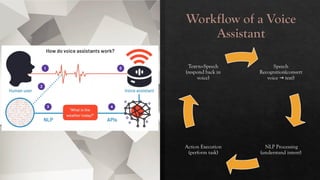
Speech
Recognition(convert
voice text)
→
NLP Processing
(understand intent)
Action Execution
(perform task)
Text-to-Speech
(respond back in
voice)
Python Libraries
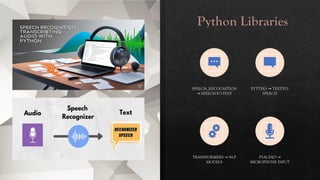
SPEECH_RECOGNITION
SPEECH-TO-TEXT
→
PYTTSX3 TEXT-TO-
→
SPEECH
TRANSFORMERS NLP
→
MODELS
PYAUDIO →
MICROPHONE INPUT
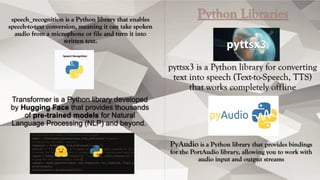
speech_recognition is a Python library that enables
speech-to-text conversion, meaning it can take spoken
audio from a microphone or file and turn it into
written text.
Python Libraries
pyttsx3 is a Python library for converting
text into speech (Text-to-Speech, TTS)
that works completely offline
Transformer is a Python library developed
by Hugging Face that provides thousands
of pre-trained models for Natural
Language Processing (NLP) and beyond.
PyAudio is a Python library that provides bindings
for the PortAudio library, allowing you to work with
audio input and output streams
Applications
1. Convenience & Hands-Free Control
2. Accessibility & Inclusivity
3. Personalization
4. Smart Home & IoT Integration
5. Healthcare & Wellness
6. Entertainment & Lifestyle
Challenges
 1. Privacy & Data Security
 2. Speech Recognition Accuracy
 3. Contextual Understanding
 4. Limited Offline Functionality
Future Scope
 1. Enhanced Natural Language Understanding:
Voice assistants will move beyond simple commands to full
conversational intelligence. Support for regional languages
and dialects will expand accessibility worldwide.
 2. Personalized & Adaptive Assistants
AI/ML will enable assistants to learn user habits,
preferences, and routines. Emotional intelligence:
detecting tone, mood, and sentiment for empathetic
responses.
 3. Healthcare & Accessibility
Voice-based diagnostics and symptom
monitoring.Assisting elderly or differently-abled
individuals with daily tasks.
Conclusion
Voice assistants have transformed the way humans interact with technology by enabling hands-
free, natural communication through speech recognition, natural language processing, and
machine learning. They offer convenience, accessibility, and personalization, making them
valuable in everyday life—from smart homes and education to healthcare and enterprise
applications.
“Voice assistants are paving the way toward a smarter, more connected, and human-centered digital
future."
THANK YOU

Voice_Assitant.pptx a AI/ML Presentation by Python

  • 1.
    Voice Assistant using AI/ML& Python (Subtitle: Bringing Human–Computer Interaction to Life) Mentored by: Presented By:- Mr.Vipin Maurya Abhijeet Kumar Rawat(MCA2423001) Kritika Pandey(MCA2423018)
  • 2.
    Introduction What is aVoice Assistant? A voice assistant is an AI-powered software that understands spoken commands to perform tasks, answer questions, and control devices. Examples: Siri, Alexa, Google Assistant
  • 4.
    Core Technologies  ArtificialIntelligence (AI): Enables decision- making  Machine Learning (ML): Improves accuracy with data  Natural Language Processing (NLP): Understands human speech  Python: Popular language with rich libraries
  • 5.
    Artificial Intelligence (AI)is the ability of machines or computer systems to perform tasks that normally require human intelligence, such as learning, reasoning, problem-solving, perception, and decision-making. Core Technologies Machine Learning (ML) is a branch of Artificial Intelligence that enables systems to learn patterns from data and make predictions or decisions without being explicitly programmed Natural Language Processing (NLP) is a field of Artificial Intelligence that enables computers to understand, interpret, and generate human language in a way that is meaningful and useful. Python is a high-level, interpreted programming language known for its simplicity, readability, and versatility. It is widely used in AI/ML projects because of its ease of use and extensive ecosystem of libraries.
  • 6.
    Workflow of aVoice Assistant Speech Recognition(convert voice text) → NLP Processing (understand intent) Action Execution (perform task) Text-to-Speech (respond back in voice)
  • 7.
  • 8.
    speech_recognition is aPython library that enables speech-to-text conversion, meaning it can take spoken audio from a microphone or file and turn it into written text. Python Libraries pyttsx3 is a Python library for converting text into speech (Text-to-Speech, TTS) that works completely offline Transformer is a Python library developed by Hugging Face that provides thousands of pre-trained models for Natural Language Processing (NLP) and beyond. PyAudio is a Python library that provides bindings for the PortAudio library, allowing you to work with audio input and output streams
  • 9.
    Applications 1. Convenience &Hands-Free Control 2. Accessibility & Inclusivity 3. Personalization 4. Smart Home & IoT Integration 5. Healthcare & Wellness 6. Entertainment & Lifestyle
  • 10.
    Challenges  1. Privacy& Data Security  2. Speech Recognition Accuracy  3. Contextual Understanding  4. Limited Offline Functionality
  • 11.
    Future Scope  1.Enhanced Natural Language Understanding: Voice assistants will move beyond simple commands to full conversational intelligence. Support for regional languages and dialects will expand accessibility worldwide.  2. Personalized & Adaptive Assistants AI/ML will enable assistants to learn user habits, preferences, and routines. Emotional intelligence: detecting tone, mood, and sentiment for empathetic responses.  3. Healthcare & Accessibility Voice-based diagnostics and symptom monitoring.Assisting elderly or differently-abled individuals with daily tasks.
  • 12.
    Conclusion Voice assistants havetransformed the way humans interact with technology by enabling hands- free, natural communication through speech recognition, natural language processing, and machine learning. They offer convenience, accessibility, and personalization, making them valuable in everyday life—from smart homes and education to healthcare and enterprise applications. “Voice assistants are paving the way toward a smarter, more connected, and human-centered digital future."
  • 13.