Data reporting by enterprises
Yuko Yamashita 山下裕子
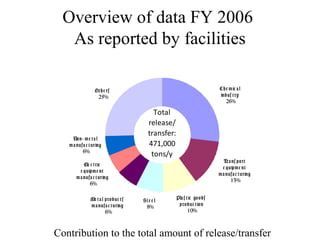
Overview of data FY 2006
As reported by facilities
Che mic al
indus try
26%
Trans port
e quipme nt
manufac turing
13%
Plas tic goods
produc tion
10%
Ste e l
8%
Me tal produc ts
manufac turing
6%
Ele c tric
e quipme nt
manufac turing
6%
Non- me tal
manufac turing
6%
Othe rs
25%
Total
release/
transfer:
471,000
tons/y
Contribution to the total amount of release/transfer
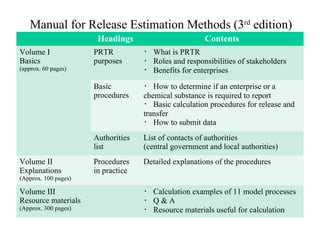
Manual for Release Estimation Methods (3rd
edition)
Headings Contents
Volume I
Basics
(approx. 60 pages)
PRTR
purposes
・ What is PRTR
・ Roles and responsibilities of stakeholders
・ Benefits for enterprises
Basic
procedures
・ How to determine if an enterprise or a
chemical substance is required to report
・ Basic calculation procedures for release and
transfer
・ How to submit data
Authorities
list
List of contacts of authorities
(central government and local authorities)
Volume II
Explanations
(Approx. 100 pages)
Procedures
in practice
Detailed explanations of the procedures
Volume III
Resource materials
(Approx. 300 pages)
・ Calculation examples of 11 model processes
・ Q & A
・ Resource materials useful for calculation
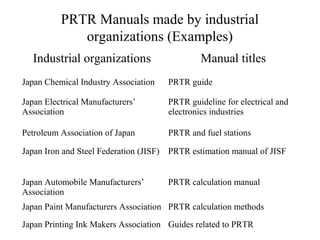
PRTR Manuals made by industrial
organizations (Examples)
Industrial organizations Manual titles
Japan Chemical Industry Association PRTR guide
Japan Electrical Manufacturers’
Association
PRTR guideline for electrical and
electronics industries
Petroleum Association of Japan PRTR and fuel stations
Japan Iron and Steel Federation (JISF) PRTR estimation manual of JISF
Japan Automobile Manufacturers’
Association
PRTR calculation manual
Japan Paint Manufacturers Association PRTR calculation methods
Japan Printing Ink Makers Association Guides related to PRTR
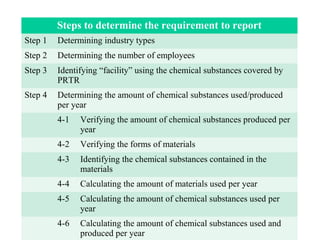
Steps to determine the requirement to report
Step 1 Determining industry types
Step 2 Determining the number of employees
Step 3 Identifying “facility” using the chemical substances covered by
PRTR
Step 4 Determining the amount of chemical substances used/produced
per year
4-1 Verifying the amount of chemical substances produced per
year
4-2 Verifying the forms of materials
4-3 Identifying the chemical substances contained in the
materials
4-4 Calculating the amount of materials used per year
4-5 Calculating the amount of chemical substances used per
year
4-6 Calculating the amount of chemical substances used and
produced per year
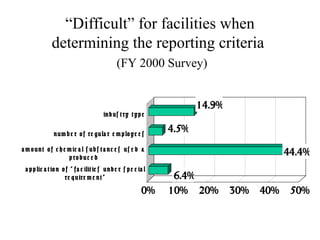
“Difficult” for facilities when
determining the reporting criteria
(FY 2000 Survey)
6.4%
44.4%
4.5%
14.9%
0% 10% 20% 30% 40% 50%
a pp lic a t io n o f " fa c ilit ie s unde r s pe c ia l
re quire m e nt "
a m ount o f c he m ic a l s ub s t a nc e s us e d &
p ro duc e d
num b e r of re gula r e m ploye e s
ind us t ry t yp e
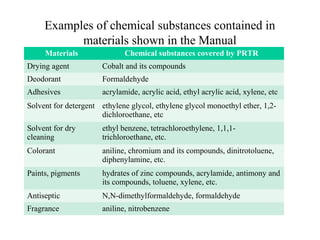
Materials Chemical substances covered by PRTR
Drying agent Cobalt and its compounds
Deodorant Formaldehyde
Adhesives acrylamide, acrylic acid, ethyl acrylic acid, xylene, etc
Solvent for detergent ethylene glycol, ethylene glycol monoethyl ether, 1,2-
dichloroethane, etc
Solvent for dry
cleaning
ethyl benzene, tetrachloroethylene, 1,1,1-
trichloroethane, etc.
Colorant aniline, chromium and its compounds, dinitrotoluene,
diphenylamine, etc.
Paints, pigments hydrates of zinc compounds, acrylamide, antimony and
its compounds, toluene, xylene, etc.
Antiseptic N,N-dimethylformaldehyde, formaldehyde
Fragrance aniline, nitrobenzene
Examples of chemical substances contained in
materials shown in the Manual
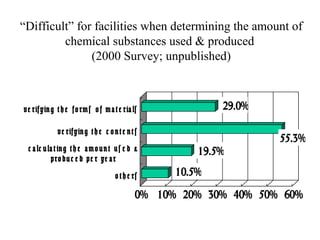
“Difficult” for facilities when determining the amount of
chemical substances used & produced
(2000 Survey; unpublished)
10.5%
19.5%
55.3%
29.0%
0% 10% 20% 30% 40% 50% 60%
o t h e rs
c a lc ulat ing t h e amo unt us e d &
pro duc e d pe r ye ar
ve rifying t h e c o nt e nt s
ve rifying t h e forms o f ma t e ria ls
MSDS System
[MSDS System]
MSDS (Material Safety Data Sheet) is required for
an enterprise when it gives/provides a chemical
substance covered by PRTR or a product
containing such chemical substance to other
enterprises
[Scope of enterprises subject to MSDS System]
All enterprises which use/produce the chemical
substances covered by PRTR
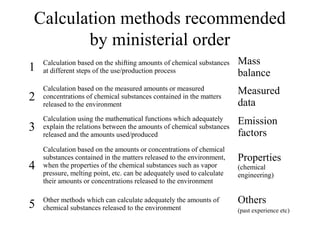
Calculation methods recommended
by ministerial order
1 Calculation based on the shifting amounts of chemical substances
at different steps of the use/production process
Mass
balance
2
Calculation based on the measured amounts or measured
concentrations of chemical substances contained in the matters
released to the environment
Measured
data
3
Calculation using the mathematical functions which adequately
explain the relations between the amounts of chemical substances
released and the amounts used/produced
Emission
factors
4
Calculation based on the amounts or concentrations of chemical
substances contained in the matters released to the environment,
when the properties of the chemical substances such as vapor
pressure, melting point, etc. can be adequately used to calculate
their amounts or concentrations released to the environment
Properties
(chemical
engineering)
5 Other methods which can calculate adequately the amounts of
chemical substances released to the environment
Others
(past experience etc)
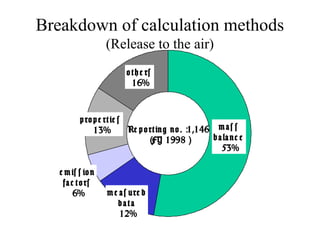
Breakdown of calculation methods
(Release to the air)
Re porting no. 1,146:
FY 1998( )
m as s
balanc e
53%
othe rs
16%
prope rtie s
13%
e m is s ion
fac tors
6% m e as ure d
data
12%
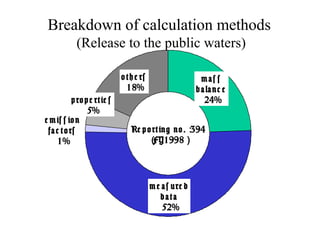
Breakdown of calculation methods
(Release to the public waters)
Re porting no. 394:
FY1998( )
m as s
balanc e
24%
m e as ure d
data
52%
othe rs
18%
prope rtie s
5%
e m is s ion
fac tors
1%
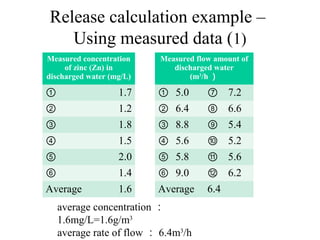
Release calculation example –
Using measured data (1)
Measured concentration
of zinc (Zn) in
discharged water (mg/L)
① 1.7
② 1.2
③ 1.8
④ 1.5
⑤ 2.0
⑥ 1.4
Average 1.6
Measured flow amount of
discharged water
(m3
/h )
① 5.0 ⑦ 7.2
② 6.4 ⑧ 6.6
③ 8.8 ⑨ 5.4
④ 5.6 ⑩ 5.2
⑤ 5.8 ⑪ 5.6
⑥ 9.0 ⑫ 6.2
Average 6.4
average concentration :
1.6mg/L=1.6g/m3
average rate of flow : 6.4m3
/h
Release calculation example –
Using measured data (2)
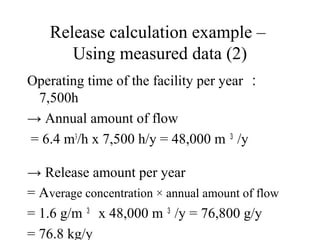
Operating time of the facility per year :
7,500h
→ Annual amount of flow
= 6.4 m3
/h x 7,500 h/y = 48,000 m 3
/y
→ Release amount per year
= Average concentration × annual amount of flow
= 1.6 g/m 3
x 48,000 m 3
/y = 76,800 g/y
= 76.8 kg/y
Release calculations – Comparison
(Assumptions)
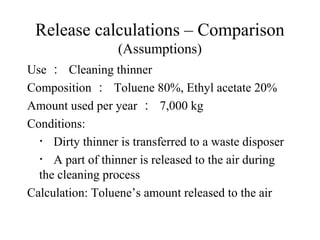
Use : Cleaning thinner
Composition : Toluene 80%, Ethyl acetate 20%
Amount used per year : 7,000 kg
Conditions:
・ Dirty thinner is transferred to a waste disposer
・ A part of thinner is released to the air during
the cleaning process
Calculation: Toluene’s amount released to the air
Release calculation example –
Using measured data
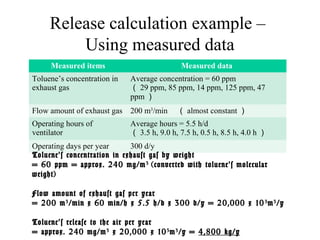
Measured items Measured data
Toluene’s concentration in
exhaust gas
Average concentration = 60 ppm
( 29 ppm, 85 ppm, 14 ppm, 125 ppm, 47
ppm )
Flow amount of exhaust gas 200 m3
/min  ( almost constant )
Operating hours of
ventilator
Average hours = 5.5 h/d
( 3.5 h, 9.0 h, 7.5 h, 0.5 h, 8.5 h, 4.0 h )
Operating days per year 300 d/y
Toluene’s concentration in exhaust gas by weight
= 60 ppm = approx. 240 mg/m3
(converted with toluene’s molecular
weight)
Flow amount of exhaust gas per year
= 200 m3
/min x 60 min/h x 5.5 h/d x 300 d/y = 20,000 x 103
m3
/y
Toluene’s release to the air per year
= approx. 240 mg/m3
x 20,000 x 103
m3
/y = 4,800 kg/y
Release calculation example –
Using mass balance
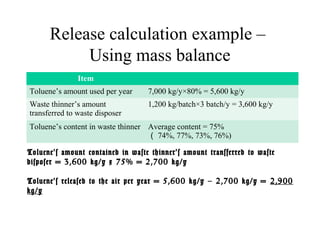
Item
Toluene’s amount used per year 7,000 kg/y×80% = 5,600 kg/y
Waste thinner’s amount
transferred to waste disposer
1,200 kg/batch×3 batch/y = 3,600 kg/y
Toluene’s content in waste thinner Average content = 75%
( 74%, 77%, 73%, 76%)
Toluene’s amount contained in waste thinner’s amount transferred to waste
disposer = 3,600 kg/y x 75% = 2,700 kg/y
Toluene’s released to the air per year = 5,600 kg/y – 2,700 kg/y = 2,900
kg/y
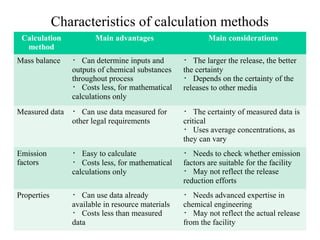
Characteristics of calculation methods
Calculation
method
Main advantages Main considerations
Mass balance ・ Can determine inputs and
outputs of chemical substances
throughout process
・ Costs less, for mathematical
calculations only
・ The larger the release, the better
the certainty
・ Depends on the certainty of the
releases to other media
Measured data ・ Can use data measured for
other legal requirements
・ The certainty of measured data is
critical
・ Uses average concentrations, as
they can vary
Emission
factors
・ Easy to calculate
・ Costs less, for mathematical
calculations only
・ Needs to check whether emission
factors are suitable for the facility
・ May not reflect the release
reduction efforts
Properties ・ Can use data already
available in resource materials
・ Costs less than measured
data
・ Needs advanced expertise in
chemical engineering
・ May not reflect the actual release
from the facility
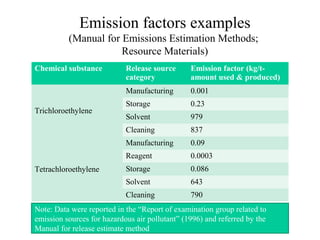
Emission factors examples
(Manual for Emissions Estimation Methods;
Resource Materials)
Chemical substance Release source
category
Emission factor (kg/t-
amount used & produced)
Trichloroethylene
Manufacturing 0.001
Storage 0.23
Solvent 979
Cleaning 837
Tetrachloroethylene
Manufacturing 0.09
Reagent 0.0003
Storage 0.086
Solvent 643
Cleaning 790
Note: Data were reported in the “Report of examination group related to
emission sources for hazardous air pollutant” (1996) and referred by the
Manual for release estimate method
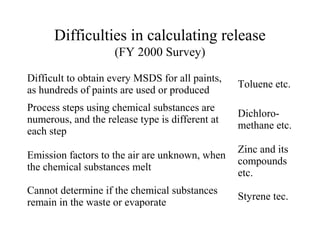
Difficulties in calculating release
(FY 2000 Survey)
Difficult to obtain every MSDS for all paints,
as hundreds of paints are used or produced
Toluene etc.
Process steps using chemical substances are
numerous, and the release type is different at
each step
Dichloro-
methane etc.
Emission factors to the air are unknown, when
the chemical substances melt
Zinc and its
compounds
etc.
Cannot determine if the chemical substances
remain in the waste or evaporate
Styrene tec.
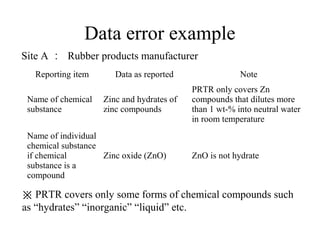
Data error example
Reporting item Data as reported Note
Name of chemical
substance
Zinc and hydrates of
zinc compounds
PRTR only covers Zn
compounds that dilutes more
than 1 wt-% into neutral water
in room temperature
Name of individual
chemical substance
if chemical
substance is a
compound
Zinc oxide (ZnO) ZnO is not hydrate
※ PRTR covers only some forms of chemical compounds such
as “hydrates” “inorganic” “liquid” etc.
Site A : Rubber products manufacturer
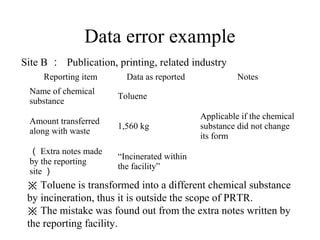
Data error example
Reporting item Data as reported Notes
Name of chemical
substance
Toluene
Amount transferred
along with waste
1,560 kg
Applicable if the chemical
substance did not change
its form
( Extra notes made
by the reporting
site )
“Incinerated within
the facility”
※ Toluene is transformed into a different chemical substance
by incineration, thus it is outside the scope of PRTR.
※ The mistake was found out from the extra notes written by
the reporting facility.
Site B : Publication, printing, related industry
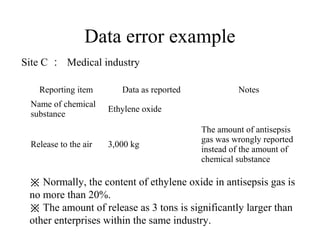
Data error example
Reporting item Data as reported Notes
Name of chemical
substance
Ethylene oxide
Release to the air 3,000 kg
The amount of antisepsis
gas was wrongly reported
instead of the amount of
chemical substance
※ Normally, the content of ethylene oxide in antisepsis gas is
no more than 20%.
※ The amount of release as 3 tons is significantly larger than
other enterprises within the same industry.
Site C : Medical industry
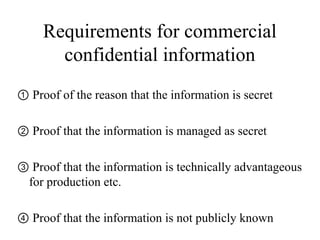
Requirements for commercial
confidential information
① Proof of the reason that the information is secret
② Proof that the information is managed as secret
③ Proof that the information is technically advantageous
for production etc.
④ Proof that the information is not publicly known

Japan 2 data reporting by enterprises08.12.08

  • 1.
    Data reporting byenterprises Yuko Yamashita 山下裕子
  • 2.
    Overview of dataFY 2006 As reported by facilities Che mic al indus try 26% Trans port e quipme nt manufac turing 13% Plas tic goods produc tion 10% Ste e l 8% Me tal produc ts manufac turing 6% Ele c tric e quipme nt manufac turing 6% Non- me tal manufac turing 6% Othe rs 25% Total release/ transfer: 471,000 tons/y Contribution to the total amount of release/transfer
  • 3.
    Manual for ReleaseEstimation Methods (3rd edition) Headings Contents Volume I Basics (approx. 60 pages) PRTR purposes ・ What is PRTR ・ Roles and responsibilities of stakeholders ・ Benefits for enterprises Basic procedures ・ How to determine if an enterprise or a chemical substance is required to report ・ Basic calculation procedures for release and transfer ・ How to submit data Authorities list List of contacts of authorities (central government and local authorities) Volume II Explanations (Approx. 100 pages) Procedures in practice Detailed explanations of the procedures Volume III Resource materials (Approx. 300 pages) ・ Calculation examples of 11 model processes ・ Q & A ・ Resource materials useful for calculation
  • 4.
    PRTR Manuals madeby industrial organizations (Examples) Industrial organizations Manual titles Japan Chemical Industry Association PRTR guide Japan Electrical Manufacturers’ Association PRTR guideline for electrical and electronics industries Petroleum Association of Japan PRTR and fuel stations Japan Iron and Steel Federation (JISF) PRTR estimation manual of JISF Japan Automobile Manufacturers’ Association PRTR calculation manual Japan Paint Manufacturers Association PRTR calculation methods Japan Printing Ink Makers Association Guides related to PRTR
  • 5.
    Steps to determinethe requirement to report Step 1 Determining industry types Step 2 Determining the number of employees Step 3 Identifying “facility” using the chemical substances covered by PRTR Step 4 Determining the amount of chemical substances used/produced per year 4-1 Verifying the amount of chemical substances produced per year 4-2 Verifying the forms of materials 4-3 Identifying the chemical substances contained in the materials 4-4 Calculating the amount of materials used per year 4-5 Calculating the amount of chemical substances used per year 4-6 Calculating the amount of chemical substances used and produced per year
  • 6.
    “Difficult” for facilitieswhen determining the reporting criteria (FY 2000 Survey) 6.4% 44.4% 4.5% 14.9% 0% 10% 20% 30% 40% 50% a pp lic a t io n o f " fa c ilit ie s unde r s pe c ia l re quire m e nt " a m ount o f c he m ic a l s ub s t a nc e s us e d & p ro duc e d num b e r of re gula r e m ploye e s ind us t ry t yp e
  • 7.
    Materials Chemical substancescovered by PRTR Drying agent Cobalt and its compounds Deodorant Formaldehyde Adhesives acrylamide, acrylic acid, ethyl acrylic acid, xylene, etc Solvent for detergent ethylene glycol, ethylene glycol monoethyl ether, 1,2- dichloroethane, etc Solvent for dry cleaning ethyl benzene, tetrachloroethylene, 1,1,1- trichloroethane, etc. Colorant aniline, chromium and its compounds, dinitrotoluene, diphenylamine, etc. Paints, pigments hydrates of zinc compounds, acrylamide, antimony and its compounds, toluene, xylene, etc. Antiseptic N,N-dimethylformaldehyde, formaldehyde Fragrance aniline, nitrobenzene Examples of chemical substances contained in materials shown in the Manual
  • 8.
    “Difficult” for facilitieswhen determining the amount of chemical substances used & produced (2000 Survey; unpublished) 10.5% 19.5% 55.3% 29.0% 0% 10% 20% 30% 40% 50% 60% o t h e rs c a lc ulat ing t h e amo unt us e d & pro duc e d pe r ye ar ve rifying t h e c o nt e nt s ve rifying t h e forms o f ma t e ria ls
  • 9.
    MSDS System [MSDS System] MSDS(Material Safety Data Sheet) is required for an enterprise when it gives/provides a chemical substance covered by PRTR or a product containing such chemical substance to other enterprises [Scope of enterprises subject to MSDS System] All enterprises which use/produce the chemical substances covered by PRTR
  • 10.
    Calculation methods recommended byministerial order 1 Calculation based on the shifting amounts of chemical substances at different steps of the use/production process Mass balance 2 Calculation based on the measured amounts or measured concentrations of chemical substances contained in the matters released to the environment Measured data 3 Calculation using the mathematical functions which adequately explain the relations between the amounts of chemical substances released and the amounts used/produced Emission factors 4 Calculation based on the amounts or concentrations of chemical substances contained in the matters released to the environment, when the properties of the chemical substances such as vapor pressure, melting point, etc. can be adequately used to calculate their amounts or concentrations released to the environment Properties (chemical engineering) 5 Other methods which can calculate adequately the amounts of chemical substances released to the environment Others (past experience etc)
  • 11.
    Breakdown of calculationmethods (Release to the air) Re porting no. 1,146: FY 1998( ) m as s balanc e 53% othe rs 16% prope rtie s 13% e m is s ion fac tors 6% m e as ure d data 12%
  • 12.
    Breakdown of calculationmethods (Release to the public waters) Re porting no. 394: FY1998( ) m as s balanc e 24% m e as ure d data 52% othe rs 18% prope rtie s 5% e m is s ion fac tors 1%
  • 13.
    Release calculation example– Using measured data (1) Measured concentration of zinc (Zn) in discharged water (mg/L) ① 1.7 ② 1.2 ③ 1.8 ④ 1.5 ⑤ 2.0 ⑥ 1.4 Average 1.6 Measured flow amount of discharged water (m3 /h ) ① 5.0 ⑦ 7.2 ② 6.4 ⑧ 6.6 ③ 8.8 ⑨ 5.4 ④ 5.6 ⑩ 5.2 ⑤ 5.8 ⑪ 5.6 ⑥ 9.0 ⑫ 6.2 Average 6.4 average concentration : 1.6mg/L=1.6g/m3 average rate of flow : 6.4m3 /h
  • 14.
    Release calculation example– Using measured data (2) Operating time of the facility per year : 7,500h → Annual amount of flow = 6.4 m3 /h x 7,500 h/y = 48,000 m 3 /y → Release amount per year = Average concentration × annual amount of flow = 1.6 g/m 3 x 48,000 m 3 /y = 76,800 g/y = 76.8 kg/y
  • 15.
    Release calculations –Comparison (Assumptions) Use : Cleaning thinner Composition : Toluene 80%, Ethyl acetate 20% Amount used per year : 7,000 kg Conditions: ・ Dirty thinner is transferred to a waste disposer ・ A part of thinner is released to the air during the cleaning process Calculation: Toluene’s amount released to the air
  • 16.
    Release calculation example– Using measured data Measured items Measured data Toluene’s concentration in exhaust gas Average concentration = 60 ppm ( 29 ppm, 85 ppm, 14 ppm, 125 ppm, 47 ppm ) Flow amount of exhaust gas 200 m3 /min  ( almost constant ) Operating hours of ventilator Average hours = 5.5 h/d ( 3.5 h, 9.0 h, 7.5 h, 0.5 h, 8.5 h, 4.0 h ) Operating days per year 300 d/y Toluene’s concentration in exhaust gas by weight = 60 ppm = approx. 240 mg/m3 (converted with toluene’s molecular weight) Flow amount of exhaust gas per year = 200 m3 /min x 60 min/h x 5.5 h/d x 300 d/y = 20,000 x 103 m3 /y Toluene’s release to the air per year = approx. 240 mg/m3 x 20,000 x 103 m3 /y = 4,800 kg/y
  • 17.
    Release calculation example– Using mass balance Item Toluene’s amount used per year 7,000 kg/y×80% = 5,600 kg/y Waste thinner’s amount transferred to waste disposer 1,200 kg/batch×3 batch/y = 3,600 kg/y Toluene’s content in waste thinner Average content = 75% ( 74%, 77%, 73%, 76%) Toluene’s amount contained in waste thinner’s amount transferred to waste disposer = 3,600 kg/y x 75% = 2,700 kg/y Toluene’s released to the air per year = 5,600 kg/y – 2,700 kg/y = 2,900 kg/y
  • 18.
    Characteristics of calculationmethods Calculation method Main advantages Main considerations Mass balance ・ Can determine inputs and outputs of chemical substances throughout process ・ Costs less, for mathematical calculations only ・ The larger the release, the better the certainty ・ Depends on the certainty of the releases to other media Measured data ・ Can use data measured for other legal requirements ・ The certainty of measured data is critical ・ Uses average concentrations, as they can vary Emission factors ・ Easy to calculate ・ Costs less, for mathematical calculations only ・ Needs to check whether emission factors are suitable for the facility ・ May not reflect the release reduction efforts Properties ・ Can use data already available in resource materials ・ Costs less than measured data ・ Needs advanced expertise in chemical engineering ・ May not reflect the actual release from the facility
  • 19.
    Emission factors examples (Manualfor Emissions Estimation Methods; Resource Materials) Chemical substance Release source category Emission factor (kg/t- amount used & produced) Trichloroethylene Manufacturing 0.001 Storage 0.23 Solvent 979 Cleaning 837 Tetrachloroethylene Manufacturing 0.09 Reagent 0.0003 Storage 0.086 Solvent 643 Cleaning 790 Note: Data were reported in the “Report of examination group related to emission sources for hazardous air pollutant” (1996) and referred by the Manual for release estimate method
  • 20.
    Difficulties in calculatingrelease (FY 2000 Survey) Difficult to obtain every MSDS for all paints, as hundreds of paints are used or produced Toluene etc. Process steps using chemical substances are numerous, and the release type is different at each step Dichloro- methane etc. Emission factors to the air are unknown, when the chemical substances melt Zinc and its compounds etc. Cannot determine if the chemical substances remain in the waste or evaporate Styrene tec.
  • 21.
    Data error example Reportingitem Data as reported Note Name of chemical substance Zinc and hydrates of zinc compounds PRTR only covers Zn compounds that dilutes more than 1 wt-% into neutral water in room temperature Name of individual chemical substance if chemical substance is a compound Zinc oxide (ZnO) ZnO is not hydrate ※ PRTR covers only some forms of chemical compounds such as “hydrates” “inorganic” “liquid” etc. Site A : Rubber products manufacturer
  • 22.
    Data error example Reportingitem Data as reported Notes Name of chemical substance Toluene Amount transferred along with waste 1,560 kg Applicable if the chemical substance did not change its form ( Extra notes made by the reporting site ) “Incinerated within the facility” ※ Toluene is transformed into a different chemical substance by incineration, thus it is outside the scope of PRTR. ※ The mistake was found out from the extra notes written by the reporting facility. Site B : Publication, printing, related industry
  • 23.
    Data error example Reportingitem Data as reported Notes Name of chemical substance Ethylene oxide Release to the air 3,000 kg The amount of antisepsis gas was wrongly reported instead of the amount of chemical substance ※ Normally, the content of ethylene oxide in antisepsis gas is no more than 20%. ※ The amount of release as 3 tons is significantly larger than other enterprises within the same industry. Site C : Medical industry
  • 24.
    Requirements for commercial confidentialinformation ① Proof of the reason that the information is secret ② Proof that the information is managed as secret ③ Proof that the information is technically advantageous for production etc. ④ Proof that the information is not publicly known

Editor's Notes

  • #23 他の物質に転化していることは分かっていたはずだが、移動量等の定義を誤解していたと思われる。