A Summer Internship Report
On
AWS-AI/ML Virtual Internship
Bachelor of Engineering
in
Electronics & Communication Engineering
By
JANNU SAHITHI
ROLL NO.2451-21-735-161
Department of Electronics & Communication Engineering
MATURI VENKATA SUBBA RAO ENGINEERING COLLEGE (Autonomous)
(Sponsored by Matrusri Education Society, Estd 1981)
(Approved by AICTE & Affiliated to OU)
(Accredited by NBA & NAAC)
Nadergul (P.O.), Hyderabad, 501510.
A Summer Internship Report
on
AWS-AI/ML Virtual Internship
submitted
in partial fulfilment of the requirements for
the award of the degree of
Bachelor of Engineering
in
Electronics & Communication Engineering
JANNU SAHITHI
R.No.2451-21-735-161
Department of Electronics & Communication Engineering
MATURI VENKATA SUBBA RAO
ENGINEERING COLLEGE
(AUTONOMOUS)
(Sponsored by Matrusri Education Society, Estd 1981)
(Approved by AICTE & Affiliated to OU)
(Accredited by NBA & NAAC)
2023
CERTIFICATE
This is to certify that the Summer Internship Report entitled “AWS-AI/ML Virtual
Internship” is the Bonafide record of the summer internship carried out under my
Guidance and Supervision by JANNU SAHITHI(2451-21-735-161) In partial fulfilment
of requirements for the award of degree of B. E. (Electronics & Communication
Engineering) submitted in the Department of Electronics & Communication, Maturi
Venkata Subba Rao Engineering College (Autonomous), Hyderabad.
……………………… …………………………
N.Kavitha Nuli Namassivaya
Assistant Professor, ECED Associate Professor, ECED
Incharge Incharge
……………...........… …………...................…
E.V.Nagalakshmi Dr.S.Suryanarayana
Assistant Professor Head, ECED
Coordinator
CANDIDATE'S DECLARATION
We hereby certify that the work which is being presented in the report entitled “AWS-
AI/ML Virtual Internship” in partial fulfilment of requirements for the award of degree of B.
E. (Electronics & Communication Engineering) submitted in the Department of Electronics &
Communication at MATURI VENKATA SUBBA RAO (MVSR) ENGINEERING COLLEGE
under OSMANIA UNIVERSITY, Hyderabad, is an authentic record of our own work carried
out under the supervision of N.KAVITHA The matter presented in this report has not been
submitted by us in any other University / Institute for the award of any degree
Signature of the Student
(Jannu Sahithi)
ACKNOWLEDGEMENTS
This is an acknowledgement of the intensive drive and technical competence of many
individuals who have contributed to the success of our Summer Internship.
This is with sincere gratitude that we would like to express our profound thanks to our
guide NULI NAMASSIVAYA, Designation, Department of Electronics and Communication
Engineering, for his/her valuable guidance and support. He / She has been a constant source of
encouragement and inspiration for us in completing this Summer Internship.
A special note of thanks to our Summer Internship Coordinator E.V. Naga Lakshmi
and Incharges Nuli Namassivaya & N.Kavitha for their deep sense of involvement and for
helping us in overcoming the hurdles at various stages of the Summer Internship.
We extend our sincere thanks to Dr.S.Suryanarayana , Head, Department of ECE, MVSR
Engineering College, for his timely suggestions and co-operation in the completion of the
Summer Internship.
We express our sincere thanks to Dr.G.Kanaka Durga, Principal, MVSR Engineering
College, for facilitating us to carry out our Summer Internship work and for providing us with
all the necessary facilities and for her constant encouragement.
Finally, we express our sincere thanks to our family members for their continuous co-
operation and encouragement extended during the Summer Internship.
Name of the student
Jannu Sahithi
ABSTRACT
The AWS AI/ML Internship program offers a unique and immersive experience for aspiring
data scientists and machine learning enthusiasts. This abstract provides an overview of the
program's objectives, structure, and benefits, shedding light on the invaluable opportunities it
presents to participants.
The AWS AI/ML Internship program is designed to bridge the gap between theoretical
knowledge and practical application. Interns gain hands-on experience working with AWS's
state-of-the-art AI and ML tools and services. This includes exposure to SageMaker,
Recognition, Comprehend, and other cutting-edge technologies. Through real-world projects,
interns tackle complex problems, learning to design, implement, and optimizeAI/MLsolutions.
The internship offers a supportive learning environment with access to AWS experts and
mentors who guide interns throughout their journey. Participants also benefit from the vast
AWS customer base, which provides them with real-world datasets and use cases, ensuring that
their work aligns with industry demands.
In recent years, the fields of Artificial Intelligence (AI) and Machine Learning (ML) have
witnessed remarkable growth, revolutionizing industries across the globe. Amazon Web
Services (AWS), a frontrunner in cloud computing, recognizes the importance of AI and ML
and has designed an internship program to nurture talent and foster innovation in these
domains.
In conclusion, the AWS AI/ML Internship program is a transformative experience that equips
participants with the skills, knowledge, and confidence to excel in the field of AI and ML. It is
a testament to AWS's commitment to nurturing talent, fostering innovation, and shaping the
future of AI and ML technology.
LIST OF CONTENTS
CHAPTER I:
Introduction
1.1 Background on AWS
1.2 Significance of AI/ML
1.3 Layout of chapters
CHAPTER II:
Basics of artificial intelligence/machine learning
2.1 Introduction of AI/ML
2.2. Supervised and unsupervised learning
CHAPTER III: Overview of AWS Software
3.1 Introduction to AWS
CHAPTER IV: Amazon SageMaker for Machine Learning
4.1 Amazon SageMaker for Machine Learning process
4.2 Creating amazon lex bot
CHAPTER V: Conclusion
5.1 Conclusion
References
CHAPTER I
INTRODUCTION
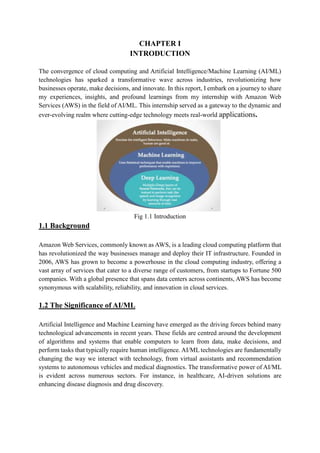
The convergence of cloud computing and Artificial Intelligence/Machine Learning (AI/ML)
technologies has sparked a transformative wave across industries, revolutionizing how
businesses operate, make decisions, and innovate. In this report, I embark on a journey to share
my experiences, insights, and profound learnings from my internship with Amazon Web
Services (AWS) in the field of AI/ML. This internship served as a gateway to the dynamic and
ever-evolving realm where cutting-edge technology meets real-world applications.
Fig 1.1 Introduction
1.1 Background
Amazon Web Services, commonly known as AWS, is a leading cloud computing platform that
has revolutionized the way businesses manage and deploy their IT infrastructure. Founded in
2006, AWS has grown to become a powerhouse in the cloud computing industry, offering a
vast array of services that cater to a diverse range of customers, from startups to Fortune 500
companies. With a global presence that spans data centers across continents, AWS has become
synonymous with scalability, reliability, and innovation in cloud services.
1.2 The Significance of AI/ML
Artificial Intelligence and Machine Learning have emerged as the driving forces behind many
technological advancements in recent years. These fields are centred around the development
of algorithms and systems that enable computers to learn from data, make decisions, and
perform tasks that typically require human intelligence. AI/ML technologies are fundamentally
changing the way we interact with technology, from virtual assistants and recommendation
systems to autonomous vehicles and medical diagnostics. The transformative power of AI/ML
is evident across numerous sectors. For instance, in healthcare, AI-driven solutions are
enhancing disease diagnosis and drug discovery.
CHAPTER II
BASICS OF ARTIFICIAL INTELLIGENCE
AND MACHINE LEARNING
2.1 INTRODUCTION OF AI/ML:
Artificial Intelligence (AI) and Machine Learning (ML) are closely related fields, but they
have distinct concepts.
2.1.1. Artificial Intelligence (AI):
AI is a broad area of computer science that aims to create systems or machines that can
perform tasks that would typically require human intelligence. These tasks include reasoning,
problem-solving, understanding natural language, and more. AI can be divided into two
categories: Narrow or Weak AI and General or Strong AI. Narrow AI is designed for specific
tasks, like voice assistants, chatbots, or recommendation systems, while General AI would
possess human-like intelligence and adaptability, which is still a theoretical concept.
2.1.2. Machine Learning (ML):
ML is a subfield of AI that focuses on developing algorithms and models that allow
computers to learn from data and make predictions or decisions based on that learning. Instead
of explicitly programming instructions, ML systems improve their performance through
experience.
ML can be categorized into three main types:
a) Supervised Learning: In this type, the algorithm is trained on labelled data, where learns
to make predictions based on input-output pairs. It's used for tasks like classification
and regression.
b) Unsupervised Learning: Here, the algorithm is given unlabelled data and must find
pattern or structure within it. Clustering and dimensionality reduction are common
applications.
c) Reinforcement Learning: This is about training agents to take actions in an environment
to maximize a reward. It's commonly used in robotics and game-playing AI.
In summary, AI is the overarching field that encompasses the development of intelligent
systems, while ML is a subset of AI that specifically deals with the development of algorithms
that can learn and improve from data. ML techniques and models are often used to implement
AI applications, making them essential components of the AI landscape.
Supervised and unsupervised learning
2.2.1 Supervised learning
Supervised learning is a foundational concept in machine learning, playing a crucial role in
various applications across industries. This paradigm revolves around the idea of learning from
labelled data to make predictions or decisions. In this section, we will delve into the core
principles and applications of supervised learning.
Fig 2.1 Supervised and unsupervised learning
a) Principle of Supervised Learning:
At the heart of supervised learning lies the concept of a "supervisor" or "teacher" that guides
the algorithm during its learning process. This guidance is provided through a training dataset
that contains pairs of input data (features) and their corresponding output labels or target values.
The algorithm's objective is to learn a mapping from inputs to outputs that allows it to make
accurate predictions on new, unseen data.
b) Key Components:
1. Training Data: The training dataset is the foundation of supervised learning. It consists of a
collection of input-output pairs. For example, in a spam email classifier, each email in the
dataset is associated with a label: "spam" or "not spam." These labelled examples are used to
teach the algorithm.
2. Model: A model is the mathematical or algorithmic representation that the supervised
learning algorithm uses to learn the relationship between inputs and outputs. Popular models
include decision trees, neural networks, and support vector machines.
3. Training Algorithm: The training algorithm is responsible for adjusting the model's
parameters to minimize the loss function. It iteratively processes the training data, updating the
model's parameters to make better predictions.
c)Applications of Supervised Learning:
Supervised learning has a wide range of applications, including:
Classifying data into predefined categories. Examples include email spam detection, image
classification (e.g., identifying objects in images), and sentiment analysis.
Regression: Predicting numerical values. Examples include predicting house prices based on
features like square footage and location or forecasting stock prices.
Recommendation Systems: Recommending products, movies, or content based on user
preferences and historical data.
Natural Language Processing (NLP): Translating languages, generating text, or understanding
sentiment in text data.
Medical Diagnosis: Identifying diseases or conditions based on patient data and medical
records.
In summary, supervised learning is a fundamental approach that leverages labelled data to build
predictive models, making it a valuable tool across numerous domains and industries.
2.2.2. Unsupervised Learning:
Unsupervised learning, in contrast to supervised learning, is a machine learning paradigm
where algorithms are tasked with finding patterns or structures in unlabelled data. This section
will explore the principles and applications of unsupervised learning.
a) Principle of Unsupervised Learning:
In unsupervised learning, there is no explicit guidance or labelled output provided to the
algorithm. Instead, it must autonomously discover inherent structures or relationships within
the input data. This often involves grouping similar data points together or reducing the
dimensionality of the data.
b) Key Components:
1. Input Data: Unsupervised learning algorithms are fed with raw data, which may consist of
various features or attributes. This data may represent text, images, customer behaviour, or any
other type of information.
2. Clustering: One common task in unsupervised learning is clustering, where the algorithm
groups data points into clusters based on their similarity. Examples include grouping customers
with similar purchase behaviour or clustering documents by topic.
3. Dimensionality Reduction: Another key task is dimensionality reduction, where the
algorithm reduces the number of features in the data while preserving essential information.
Principal Component Analysis (PCA) is a classic example of a dimensionality reduction
technique.
4. Anomaly Detection: Unsupervised learning can also be used for identifying rare or
anomalous data points that deviate significantly from the norm. This is crucial in fraud
detection or quality control.
c)Applications of Unsupervised Learning:
Unsupervised learning has a diverse range of applications:
Clustering: Market segmentation for targeted marketing, grouping genes with similar
expression patterns, or organizing image databases.
Dimensionality Reduction: Reducing the dimensionality of data for visualization, feature
selection, or speeding up subsequent supervised learning tasks.
Anomaly Detection: Detecting fraudulent transactions in financial data, identifying defects in
manufacturing processes, or spotting unusual patterns in network traffic.
Generative Models: Generating realistic data samples, such as creating synthetic images or text
based on patterns learned from existing data.
Recommendation Systems: Discovering latent patterns in user behaviour for personalized
recommendations.
In summary, unsupervised learning is a versatile approach that enables the discovery of hidden
structures and insights within data, making it valuable in various domains where labelled data
may be scarce or unavailable.
Page 3: Key Differences and Challenges
Understanding the differences between supervised and unsupervised learning is essential for
selecting the right approach for a given problem and recognizing their respective challenges.
Key Differences:
1.Labeled vs. Unlabelled Data: The primary distinction is the presence of labelled data in
supervised learning and its absence in unsupervised learning.
2. Objective: Supervised learning aims to make predictions or classifications, while
unsupervised learning focuses on finding patterns or structures.
3. Training Process: In supervised learning, the model is trained to minimize prediction errors
based on known labels. In unsupervised learning, the model explores data without explicit
guidance.
Challenges:
Labelling Data: Collecting and labelling a large dataset for supervised learning can be time-
consuming and expensive.
Choosing the Right Algorithm: Selecting the appropriate algorithm and model architecture is
critical for both approaches.
Evaluation: Assessing the performance of unsupervised models can be challenging since there
are no clear labels to measure against.
Scalability: Handling large datasets in both supervised and unsupervised learning can be
computationally intensive.
In conclusion, supervised and unsupervised learning are two fundamental paradigms in
machine learning, each with its unique principles, applications, and challenges. Supervised
learning relies on labelled data to make predictions, making it suitable for a wide range of tasks,
from image recognition to medical diagnosis. In contrast, unsupervised learning discovers
hidden patterns in unlabelled data, aiding in tasks such as clustering, dimensionality reduction,
and anomaly detection.
CHAPTER III
OVERVIEW OF AWS SOFTWARE
3.1 Introduction to Amazon Web Services (AWS)
In the ever-evolving landscape of technology and cloud computing, Amazon Web Services
(AWS) has emerged as a pioneering force that has revolutionized the way businesses,
organizations, and individuals leverage the power of the cloud. AWS is a subsidiary of
Amazon.com, Inc., and it has grown to become the leading provider of cloud infrastructure and
services since its inception in 2006. This two-page introduction aims to provide a
comprehensive overview of AWS, its core services, and its significance in the digital age.
3.1.1 The Rise of Cloud Computing:
The concept of cloud computing fundamentally transformed the traditional IT landscape. It
replaced the need for on-premises servers, data centres, and costly hardware with scalable and
on-demand cloud services. AWS played a pivotal role in popularizing this paradigm shift,
making it accessible to a global audience.
3.1.2 AWS Global Infrastructure:
One of the standout features of AWS is its extensive global infrastructure. AWS operates in 25
geographic regions across the world, comprising 80 availability zones. These regions are
strategically located to ensure low-latency access and data redundancy. This infrastructure
allows businesses to deploy their applications and services with high availability and fault
tolerance.
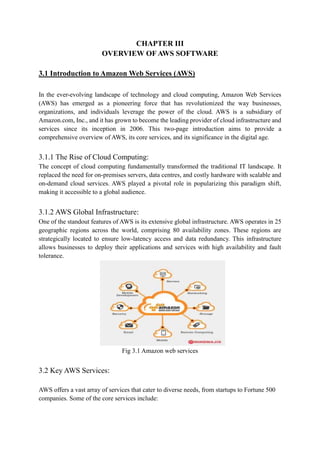
Fig 3.1 Amazon web services
3.2 Key AWS Services:
AWS offers a vast array of services that cater to diverse needs, from startups to Fortune 500
companies. Some of the core services include:
1. Compute Services: AWS EC2 (Elastic Compute Cloud) provides scalable virtual
machines, while AWS Lambda allows for serverless computing.
2. Storage Services: Amazon S3 (Simple Storage Service) offers scalable and durable object
storage, while Amazon EBS (Elastic Block Store) provides block-level storage for EC2
instances.
3. Database Services: AWS offers managed database services likeAmazon RDS (Relational
Database Service) and Amazon DynamoDB for NoSQL databases.
4. Networking Services: AWS provides Virtual Private Cloud (VPC) for network isolation,
AWS Direct Connect for dedicated network connections, and Amazon Route 53 for domain
name services.
5. AI and Machine Learning: AWS offers services like Amazon SageMaker, Polly, and
Recognition for AI and ML applications.
6. DevOps Tools: AWS provides tools like AWS Code Pipeline, Code Build, and Code
Deploy for DevOps and continuous integration/continuous delivery (CI/CD).
7. Security and Identity: AWS Identity and Access Management (IAM) enables secure
access control, while AWS Key Management Service (KMS) helps manage encryption keys.
CHAPTER IV
AMAZON SAGEMAKER FOR MACHINE LEARNING
4.1 Amazon SageMaker for Machine Learning PROCESS:
Amazon SageMaker is a powerful service that simplifies the process of building, training, and
deploying machine learning models. In this example, we'll walk through a high-level process
of using SageMaker to create a sentiment analysis model for customer reviews.
1. Data Preparation:
- Collect and prepare your dataset of customer reviews. It should include text data and
corresponding sentiment labels (e.g., positive, negative, neutral).
2. Data Upload to S3:
- Upload your dataset to an Amazon S3 bucket, which will serve as your data source for
SageMaker.
3. Notebook Creation:
- Create a Jupyter notebook instance within SageMaker to build and test your machine
learning model. You can choose from predefined SageMaker notebooks or create your own.
4. Data Processing:
- In the notebook, preprocess and clean the data. You may use libraries like Pandas and NLTK
to tokenize and transform text data.
5. Model Training:
- Utilize SageMaker's built-in algorithms or custom algorithms. Define a training script and
specify hyperparameters. SageMaker will take care of provisioning and managing the training
infrastructure.
6. Model Evaluation:
- Evaluate the trained model's performance using validation data. Common metrics include
accuracy, precision, recall, and F1-score.
7. Model Deployment:
- Once satisfied with the model's performance, deploy it as an API endpoint. SageMaker
handles the deployment, scaling, and monitoring of the model.
8. Real-time Inference:
- Use the deployed endpoint to perform real-time sentiment analysis on new customer
reviews. Send HTTP requests to the endpoint and receive predictions.
9. Batch Transform (Optional):
- For large-scale inference on a batch of data, you can use SageMaker's batch transform
feature, which processes data stored in S3 and provides predictions in bulk.
10. Model Monitoring and Maintenance:
- Continuously monitor the deployed model's performance and retrain it periodically with
new data to maintain accuracy.
11. Cost Management:
- SageMaker offers tools to monitor and optimize costs, such as SageMaker Debugger for
profiling and Amazon CloudWatch for cost and usage monitoring.
12.Scaling and Customization:
-As your needs evolve, you can customize SageMaker workflows, incorporate other AWS
services, or scale your infrastructure to handle increased workloads.
SageMaker simplifies the end-to-end machine learning process, from data preparation to
model deployment and maintenance, while offering flexibility for customization and
scalability. This example showcases a sentiment analysis use case, but SageMaker supports a
wide range of machine learning tasks, making it a versatile tool for ML practitioners and data
scientists.
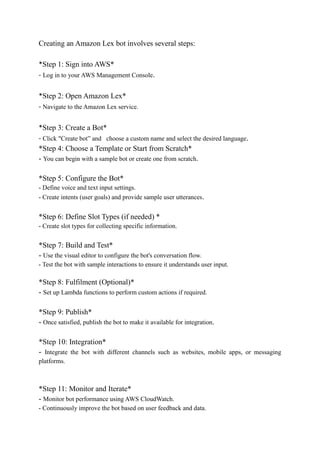
4.1 Creating an Amazon Lex bot
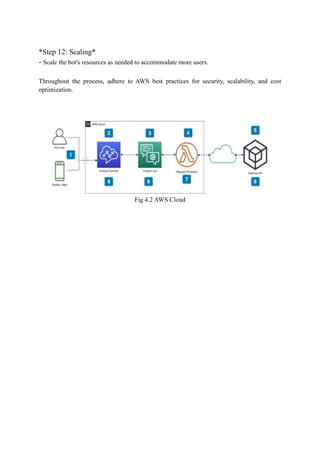
Creating an Amazon Lex bot involves several steps:
*Step 1: Sign into AWS*
- Log in to your AWS Management Console.
*Step 2: Open Amazon Lex*
- Navigate to the Amazon Lex service.
*Step 3: Create a Bot*
- Click "Create bot” and choose a custom name and select the desired language.
*Step 4: Choose a Template or Start from Scratch*
- You can begin with a sample bot or create one from scratch.
*Step 5: Configure the Bot*
- Define voice and text input settings.
- Create intents (user goals) and provide sample user utterances.
*Step 6: Define Slot Types (if needed) *
- Create slot types for collecting specific information.
*Step 7: Build and Test*
- Use the visual editor to configure the bot's conversation flow.
- Test the bot with sample interactions to ensure it understands user input.
*Step 8: Fulfilment (Optional)*
- Set up Lambda functions to perform custom actions if required.
*Step 9: Publish*
- Once satisfied, publish the bot to make it available for integration.
*Step 10: Integration*
- Integrate the bot with different channels such as websites, mobile apps, or messaging
platforms.
*Step 11: Monitor and Iterate*
- Monitor bot performance using AWS CloudWatch.
- Continuously improve the bot based on user feedback and data.
*Step 12: Scaling*
- Scale the bot's resources as needed to accommodate more users.
Throughout the process, adhere to AWS best practices for security, scalability, and cost
optimization.
Fig 4.2 AWS Cloud
CHAPTER V
CONCLUSION
In conclusion, the advent of artificial intelligence (AI) and machine learning (ML) represents
a significant milestone in the field of technology and has far-reaching implications for our
society. This report has provided an overview of the key concepts, applications, challenges,
and potential benefits associated with AI and ML. MyAI and MLinternship has been a valuable
and enriching experience that has provided me with numerous insights and skills in the field.
Over the course of this internship, I had the opportunity to work on various projects, collaborate
with a talented team, and gain practical knowledge in the application of artificial intelligence
and machine learning techniques.
REFERENCE:
[1] AMAZON EC2:
https://docs.aws.amazon.com/ec2/?icmpid=docs_homepage_featuredsvcs
[2] AWS: https://docs.aws.amazon.com/
[3]Akgun, S., Greenhow, C. (2022).Artificial intelligence in education:Addressing ethical
challenges in K-12 settings. AI Ethics, 2, 431–440. https://doi.org/10.1007/s43681-021-
00096-7
[4] Baker, R.S., Esbenshade, L., Vitale, J., & Karumbaiah, S. (2022). Using demographic
data as predictor variables: A questionable choice. https://doi.org/10.35542/osf.io/y4wvj
[5] Black, P. & Wiliam, D. (1998). Inside the black box: Raising standards
through classroom.

JannuSahithi_internship Report.docx

  • 1.
    A Summer InternshipReport On AWS-AI/ML Virtual Internship Bachelor of Engineering in Electronics & Communication Engineering By JANNU SAHITHI ROLL NO.2451-21-735-161 Department of Electronics & Communication Engineering MATURI VENKATA SUBBA RAO ENGINEERING COLLEGE (Autonomous) (Sponsored by Matrusri Education Society, Estd 1981) (Approved by AICTE & Affiliated to OU) (Accredited by NBA & NAAC) Nadergul (P.O.), Hyderabad, 501510.
  • 2.
    A Summer InternshipReport on AWS-AI/ML Virtual Internship submitted in partial fulfilment of the requirements for the award of the degree of Bachelor of Engineering in Electronics & Communication Engineering JANNU SAHITHI R.No.2451-21-735-161 Department of Electronics & Communication Engineering MATURI VENKATA SUBBA RAO ENGINEERING COLLEGE (AUTONOMOUS) (Sponsored by Matrusri Education Society, Estd 1981) (Approved by AICTE & Affiliated to OU) (Accredited by NBA & NAAC) 2023
  • 3.
    CERTIFICATE This is tocertify that the Summer Internship Report entitled “AWS-AI/ML Virtual Internship” is the Bonafide record of the summer internship carried out under my Guidance and Supervision by JANNU SAHITHI(2451-21-735-161) In partial fulfilment of requirements for the award of degree of B. E. (Electronics & Communication Engineering) submitted in the Department of Electronics & Communication, Maturi Venkata Subba Rao Engineering College (Autonomous), Hyderabad. ……………………… ………………………… N.Kavitha Nuli Namassivaya Assistant Professor, ECED Associate Professor, ECED Incharge Incharge ……………...........… …………...................… E.V.Nagalakshmi Dr.S.Suryanarayana Assistant Professor Head, ECED Coordinator
  • 5.
    CANDIDATE'S DECLARATION We herebycertify that the work which is being presented in the report entitled “AWS- AI/ML Virtual Internship” in partial fulfilment of requirements for the award of degree of B. E. (Electronics & Communication Engineering) submitted in the Department of Electronics & Communication at MATURI VENKATA SUBBA RAO (MVSR) ENGINEERING COLLEGE under OSMANIA UNIVERSITY, Hyderabad, is an authentic record of our own work carried out under the supervision of N.KAVITHA The matter presented in this report has not been submitted by us in any other University / Institute for the award of any degree Signature of the Student (Jannu Sahithi)
  • 6.
    ACKNOWLEDGEMENTS This is anacknowledgement of the intensive drive and technical competence of many individuals who have contributed to the success of our Summer Internship. This is with sincere gratitude that we would like to express our profound thanks to our guide NULI NAMASSIVAYA, Designation, Department of Electronics and Communication Engineering, for his/her valuable guidance and support. He / She has been a constant source of encouragement and inspiration for us in completing this Summer Internship. A special note of thanks to our Summer Internship Coordinator E.V. Naga Lakshmi and Incharges Nuli Namassivaya & N.Kavitha for their deep sense of involvement and for helping us in overcoming the hurdles at various stages of the Summer Internship. We extend our sincere thanks to Dr.S.Suryanarayana , Head, Department of ECE, MVSR Engineering College, for his timely suggestions and co-operation in the completion of the Summer Internship. We express our sincere thanks to Dr.G.Kanaka Durga, Principal, MVSR Engineering College, for facilitating us to carry out our Summer Internship work and for providing us with all the necessary facilities and for her constant encouragement. Finally, we express our sincere thanks to our family members for their continuous co- operation and encouragement extended during the Summer Internship. Name of the student Jannu Sahithi
  • 7.
    ABSTRACT The AWS AI/MLInternship program offers a unique and immersive experience for aspiring data scientists and machine learning enthusiasts. This abstract provides an overview of the program's objectives, structure, and benefits, shedding light on the invaluable opportunities it presents to participants. The AWS AI/ML Internship program is designed to bridge the gap between theoretical knowledge and practical application. Interns gain hands-on experience working with AWS's state-of-the-art AI and ML tools and services. This includes exposure to SageMaker, Recognition, Comprehend, and other cutting-edge technologies. Through real-world projects, interns tackle complex problems, learning to design, implement, and optimizeAI/MLsolutions. The internship offers a supportive learning environment with access to AWS experts and mentors who guide interns throughout their journey. Participants also benefit from the vast AWS customer base, which provides them with real-world datasets and use cases, ensuring that their work aligns with industry demands. In recent years, the fields of Artificial Intelligence (AI) and Machine Learning (ML) have witnessed remarkable growth, revolutionizing industries across the globe. Amazon Web Services (AWS), a frontrunner in cloud computing, recognizes the importance of AI and ML and has designed an internship program to nurture talent and foster innovation in these domains. In conclusion, the AWS AI/ML Internship program is a transformative experience that equips participants with the skills, knowledge, and confidence to excel in the field of AI and ML. It is a testament to AWS's commitment to nurturing talent, fostering innovation, and shaping the future of AI and ML technology.
  • 8.
    LIST OF CONTENTS CHAPTERI: Introduction 1.1 Background on AWS 1.2 Significance of AI/ML 1.3 Layout of chapters CHAPTER II: Basics of artificial intelligence/machine learning 2.1 Introduction of AI/ML 2.2. Supervised and unsupervised learning CHAPTER III: Overview of AWS Software 3.1 Introduction to AWS CHAPTER IV: Amazon SageMaker for Machine Learning 4.1 Amazon SageMaker for Machine Learning process 4.2 Creating amazon lex bot CHAPTER V: Conclusion 5.1 Conclusion References
  • 9.
    CHAPTER I INTRODUCTION The convergenceof cloud computing and Artificial Intelligence/Machine Learning (AI/ML) technologies has sparked a transformative wave across industries, revolutionizing how businesses operate, make decisions, and innovate. In this report, I embark on a journey to share my experiences, insights, and profound learnings from my internship with Amazon Web Services (AWS) in the field of AI/ML. This internship served as a gateway to the dynamic and ever-evolving realm where cutting-edge technology meets real-world applications. Fig 1.1 Introduction 1.1 Background Amazon Web Services, commonly known as AWS, is a leading cloud computing platform that has revolutionized the way businesses manage and deploy their IT infrastructure. Founded in 2006, AWS has grown to become a powerhouse in the cloud computing industry, offering a vast array of services that cater to a diverse range of customers, from startups to Fortune 500 companies. With a global presence that spans data centers across continents, AWS has become synonymous with scalability, reliability, and innovation in cloud services. 1.2 The Significance of AI/ML Artificial Intelligence and Machine Learning have emerged as the driving forces behind many technological advancements in recent years. These fields are centred around the development of algorithms and systems that enable computers to learn from data, make decisions, and perform tasks that typically require human intelligence. AI/ML technologies are fundamentally changing the way we interact with technology, from virtual assistants and recommendation systems to autonomous vehicles and medical diagnostics. The transformative power of AI/ML is evident across numerous sectors. For instance, in healthcare, AI-driven solutions are enhancing disease diagnosis and drug discovery.
  • 10.
    CHAPTER II BASICS OFARTIFICIAL INTELLIGENCE AND MACHINE LEARNING 2.1 INTRODUCTION OF AI/ML: Artificial Intelligence (AI) and Machine Learning (ML) are closely related fields, but they have distinct concepts. 2.1.1. Artificial Intelligence (AI): AI is a broad area of computer science that aims to create systems or machines that can perform tasks that would typically require human intelligence. These tasks include reasoning, problem-solving, understanding natural language, and more. AI can be divided into two categories: Narrow or Weak AI and General or Strong AI. Narrow AI is designed for specific tasks, like voice assistants, chatbots, or recommendation systems, while General AI would possess human-like intelligence and adaptability, which is still a theoretical concept. 2.1.2. Machine Learning (ML): ML is a subfield of AI that focuses on developing algorithms and models that allow computers to learn from data and make predictions or decisions based on that learning. Instead of explicitly programming instructions, ML systems improve their performance through experience. ML can be categorized into three main types: a) Supervised Learning: In this type, the algorithm is trained on labelled data, where learns to make predictions based on input-output pairs. It's used for tasks like classification and regression. b) Unsupervised Learning: Here, the algorithm is given unlabelled data and must find pattern or structure within it. Clustering and dimensionality reduction are common applications. c) Reinforcement Learning: This is about training agents to take actions in an environment to maximize a reward. It's commonly used in robotics and game-playing AI. In summary, AI is the overarching field that encompasses the development of intelligent systems, while ML is a subset of AI that specifically deals with the development of algorithms that can learn and improve from data. ML techniques and models are often used to implement AI applications, making them essential components of the AI landscape.
  • 11.
    Supervised and unsupervisedlearning 2.2.1 Supervised learning Supervised learning is a foundational concept in machine learning, playing a crucial role in various applications across industries. This paradigm revolves around the idea of learning from labelled data to make predictions or decisions. In this section, we will delve into the core principles and applications of supervised learning. Fig 2.1 Supervised and unsupervised learning a) Principle of Supervised Learning: At the heart of supervised learning lies the concept of a "supervisor" or "teacher" that guides the algorithm during its learning process. This guidance is provided through a training dataset that contains pairs of input data (features) and their corresponding output labels or target values. The algorithm's objective is to learn a mapping from inputs to outputs that allows it to make accurate predictions on new, unseen data. b) Key Components: 1. Training Data: The training dataset is the foundation of supervised learning. It consists of a collection of input-output pairs. For example, in a spam email classifier, each email in the dataset is associated with a label: "spam" or "not spam." These labelled examples are used to teach the algorithm. 2. Model: A model is the mathematical or algorithmic representation that the supervised learning algorithm uses to learn the relationship between inputs and outputs. Popular models include decision trees, neural networks, and support vector machines.
  • 12.
    3. Training Algorithm:The training algorithm is responsible for adjusting the model's parameters to minimize the loss function. It iteratively processes the training data, updating the model's parameters to make better predictions. c)Applications of Supervised Learning: Supervised learning has a wide range of applications, including: Classifying data into predefined categories. Examples include email spam detection, image classification (e.g., identifying objects in images), and sentiment analysis. Regression: Predicting numerical values. Examples include predicting house prices based on features like square footage and location or forecasting stock prices. Recommendation Systems: Recommending products, movies, or content based on user preferences and historical data. Natural Language Processing (NLP): Translating languages, generating text, or understanding sentiment in text data. Medical Diagnosis: Identifying diseases or conditions based on patient data and medical records. In summary, supervised learning is a fundamental approach that leverages labelled data to build predictive models, making it a valuable tool across numerous domains and industries. 2.2.2. Unsupervised Learning: Unsupervised learning, in contrast to supervised learning, is a machine learning paradigm where algorithms are tasked with finding patterns or structures in unlabelled data. This section will explore the principles and applications of unsupervised learning. a) Principle of Unsupervised Learning: In unsupervised learning, there is no explicit guidance or labelled output provided to the algorithm. Instead, it must autonomously discover inherent structures or relationships within the input data. This often involves grouping similar data points together or reducing the dimensionality of the data. b) Key Components: 1. Input Data: Unsupervised learning algorithms are fed with raw data, which may consist of various features or attributes. This data may represent text, images, customer behaviour, or any other type of information.
  • 13.
    2. Clustering: Onecommon task in unsupervised learning is clustering, where the algorithm groups data points into clusters based on their similarity. Examples include grouping customers with similar purchase behaviour or clustering documents by topic. 3. Dimensionality Reduction: Another key task is dimensionality reduction, where the algorithm reduces the number of features in the data while preserving essential information. Principal Component Analysis (PCA) is a classic example of a dimensionality reduction technique. 4. Anomaly Detection: Unsupervised learning can also be used for identifying rare or anomalous data points that deviate significantly from the norm. This is crucial in fraud detection or quality control. c)Applications of Unsupervised Learning: Unsupervised learning has a diverse range of applications: Clustering: Market segmentation for targeted marketing, grouping genes with similar expression patterns, or organizing image databases. Dimensionality Reduction: Reducing the dimensionality of data for visualization, feature selection, or speeding up subsequent supervised learning tasks. Anomaly Detection: Detecting fraudulent transactions in financial data, identifying defects in manufacturing processes, or spotting unusual patterns in network traffic. Generative Models: Generating realistic data samples, such as creating synthetic images or text based on patterns learned from existing data. Recommendation Systems: Discovering latent patterns in user behaviour for personalized recommendations. In summary, unsupervised learning is a versatile approach that enables the discovery of hidden structures and insights within data, making it valuable in various domains where labelled data may be scarce or unavailable. Page 3: Key Differences and Challenges Understanding the differences between supervised and unsupervised learning is essential for selecting the right approach for a given problem and recognizing their respective challenges.
  • 14.
    Key Differences: 1.Labeled vs.Unlabelled Data: The primary distinction is the presence of labelled data in supervised learning and its absence in unsupervised learning. 2. Objective: Supervised learning aims to make predictions or classifications, while unsupervised learning focuses on finding patterns or structures. 3. Training Process: In supervised learning, the model is trained to minimize prediction errors based on known labels. In unsupervised learning, the model explores data without explicit guidance. Challenges: Labelling Data: Collecting and labelling a large dataset for supervised learning can be time- consuming and expensive. Choosing the Right Algorithm: Selecting the appropriate algorithm and model architecture is critical for both approaches. Evaluation: Assessing the performance of unsupervised models can be challenging since there are no clear labels to measure against. Scalability: Handling large datasets in both supervised and unsupervised learning can be computationally intensive. In conclusion, supervised and unsupervised learning are two fundamental paradigms in machine learning, each with its unique principles, applications, and challenges. Supervised learning relies on labelled data to make predictions, making it suitable for a wide range of tasks, from image recognition to medical diagnosis. In contrast, unsupervised learning discovers hidden patterns in unlabelled data, aiding in tasks such as clustering, dimensionality reduction, and anomaly detection.
  • 15.
    CHAPTER III OVERVIEW OFAWS SOFTWARE 3.1 Introduction to Amazon Web Services (AWS) In the ever-evolving landscape of technology and cloud computing, Amazon Web Services (AWS) has emerged as a pioneering force that has revolutionized the way businesses, organizations, and individuals leverage the power of the cloud. AWS is a subsidiary of Amazon.com, Inc., and it has grown to become the leading provider of cloud infrastructure and services since its inception in 2006. This two-page introduction aims to provide a comprehensive overview of AWS, its core services, and its significance in the digital age. 3.1.1 The Rise of Cloud Computing: The concept of cloud computing fundamentally transformed the traditional IT landscape. It replaced the need for on-premises servers, data centres, and costly hardware with scalable and on-demand cloud services. AWS played a pivotal role in popularizing this paradigm shift, making it accessible to a global audience. 3.1.2 AWS Global Infrastructure: One of the standout features of AWS is its extensive global infrastructure. AWS operates in 25 geographic regions across the world, comprising 80 availability zones. These regions are strategically located to ensure low-latency access and data redundancy. This infrastructure allows businesses to deploy their applications and services with high availability and fault tolerance. Fig 3.1 Amazon web services 3.2 Key AWS Services: AWS offers a vast array of services that cater to diverse needs, from startups to Fortune 500 companies. Some of the core services include:
  • 16.
    1. Compute Services:AWS EC2 (Elastic Compute Cloud) provides scalable virtual machines, while AWS Lambda allows for serverless computing. 2. Storage Services: Amazon S3 (Simple Storage Service) offers scalable and durable object storage, while Amazon EBS (Elastic Block Store) provides block-level storage for EC2 instances. 3. Database Services: AWS offers managed database services likeAmazon RDS (Relational Database Service) and Amazon DynamoDB for NoSQL databases. 4. Networking Services: AWS provides Virtual Private Cloud (VPC) for network isolation, AWS Direct Connect for dedicated network connections, and Amazon Route 53 for domain name services. 5. AI and Machine Learning: AWS offers services like Amazon SageMaker, Polly, and Recognition for AI and ML applications. 6. DevOps Tools: AWS provides tools like AWS Code Pipeline, Code Build, and Code Deploy for DevOps and continuous integration/continuous delivery (CI/CD). 7. Security and Identity: AWS Identity and Access Management (IAM) enables secure access control, while AWS Key Management Service (KMS) helps manage encryption keys.
  • 17.
    CHAPTER IV AMAZON SAGEMAKERFOR MACHINE LEARNING 4.1 Amazon SageMaker for Machine Learning PROCESS: Amazon SageMaker is a powerful service that simplifies the process of building, training, and deploying machine learning models. In this example, we'll walk through a high-level process of using SageMaker to create a sentiment analysis model for customer reviews. 1. Data Preparation: - Collect and prepare your dataset of customer reviews. It should include text data and corresponding sentiment labels (e.g., positive, negative, neutral). 2. Data Upload to S3: - Upload your dataset to an Amazon S3 bucket, which will serve as your data source for SageMaker. 3. Notebook Creation: - Create a Jupyter notebook instance within SageMaker to build and test your machine learning model. You can choose from predefined SageMaker notebooks or create your own. 4. Data Processing: - In the notebook, preprocess and clean the data. You may use libraries like Pandas and NLTK to tokenize and transform text data. 5. Model Training: - Utilize SageMaker's built-in algorithms or custom algorithms. Define a training script and specify hyperparameters. SageMaker will take care of provisioning and managing the training infrastructure. 6. Model Evaluation: - Evaluate the trained model's performance using validation data. Common metrics include accuracy, precision, recall, and F1-score. 7. Model Deployment:
  • 18.
    - Once satisfiedwith the model's performance, deploy it as an API endpoint. SageMaker handles the deployment, scaling, and monitoring of the model. 8. Real-time Inference: - Use the deployed endpoint to perform real-time sentiment analysis on new customer reviews. Send HTTP requests to the endpoint and receive predictions. 9. Batch Transform (Optional): - For large-scale inference on a batch of data, you can use SageMaker's batch transform feature, which processes data stored in S3 and provides predictions in bulk. 10. Model Monitoring and Maintenance: - Continuously monitor the deployed model's performance and retrain it periodically with new data to maintain accuracy. 11. Cost Management: - SageMaker offers tools to monitor and optimize costs, such as SageMaker Debugger for profiling and Amazon CloudWatch for cost and usage monitoring. 12.Scaling and Customization: -As your needs evolve, you can customize SageMaker workflows, incorporate other AWS services, or scale your infrastructure to handle increased workloads. SageMaker simplifies the end-to-end machine learning process, from data preparation to model deployment and maintenance, while offering flexibility for customization and scalability. This example showcases a sentiment analysis use case, but SageMaker supports a wide range of machine learning tasks, making it a versatile tool for ML practitioners and data scientists. 4.1 Creating an Amazon Lex bot
  • 19.
    Creating an AmazonLex bot involves several steps: *Step 1: Sign into AWS* - Log in to your AWS Management Console. *Step 2: Open Amazon Lex* - Navigate to the Amazon Lex service. *Step 3: Create a Bot* - Click "Create bot” and choose a custom name and select the desired language. *Step 4: Choose a Template or Start from Scratch* - You can begin with a sample bot or create one from scratch. *Step 5: Configure the Bot* - Define voice and text input settings. - Create intents (user goals) and provide sample user utterances. *Step 6: Define Slot Types (if needed) * - Create slot types for collecting specific information. *Step 7: Build and Test* - Use the visual editor to configure the bot's conversation flow. - Test the bot with sample interactions to ensure it understands user input. *Step 8: Fulfilment (Optional)* - Set up Lambda functions to perform custom actions if required. *Step 9: Publish* - Once satisfied, publish the bot to make it available for integration. *Step 10: Integration* - Integrate the bot with different channels such as websites, mobile apps, or messaging platforms. *Step 11: Monitor and Iterate* - Monitor bot performance using AWS CloudWatch. - Continuously improve the bot based on user feedback and data.
  • 20.
    *Step 12: Scaling* -Scale the bot's resources as needed to accommodate more users. Throughout the process, adhere to AWS best practices for security, scalability, and cost optimization. Fig 4.2 AWS Cloud
  • 21.
    CHAPTER V CONCLUSION In conclusion,the advent of artificial intelligence (AI) and machine learning (ML) represents a significant milestone in the field of technology and has far-reaching implications for our society. This report has provided an overview of the key concepts, applications, challenges, and potential benefits associated with AI and ML. MyAI and MLinternship has been a valuable and enriching experience that has provided me with numerous insights and skills in the field. Over the course of this internship, I had the opportunity to work on various projects, collaborate with a talented team, and gain practical knowledge in the application of artificial intelligence and machine learning techniques. REFERENCE: [1] AMAZON EC2: https://docs.aws.amazon.com/ec2/?icmpid=docs_homepage_featuredsvcs [2] AWS: https://docs.aws.amazon.com/ [3]Akgun, S., Greenhow, C. (2022).Artificial intelligence in education:Addressing ethical challenges in K-12 settings. AI Ethics, 2, 431–440. https://doi.org/10.1007/s43681-021- 00096-7 [4] Baker, R.S., Esbenshade, L., Vitale, J., & Karumbaiah, S. (2022). Using demographic data as predictor variables: A questionable choice. https://doi.org/10.35542/osf.io/y4wvj [5] Black, P. & Wiliam, D. (1998). Inside the black box: Raising standards through classroom.