Title Page
Objectives
Introduction
Content
Over to you
Summary
Reference
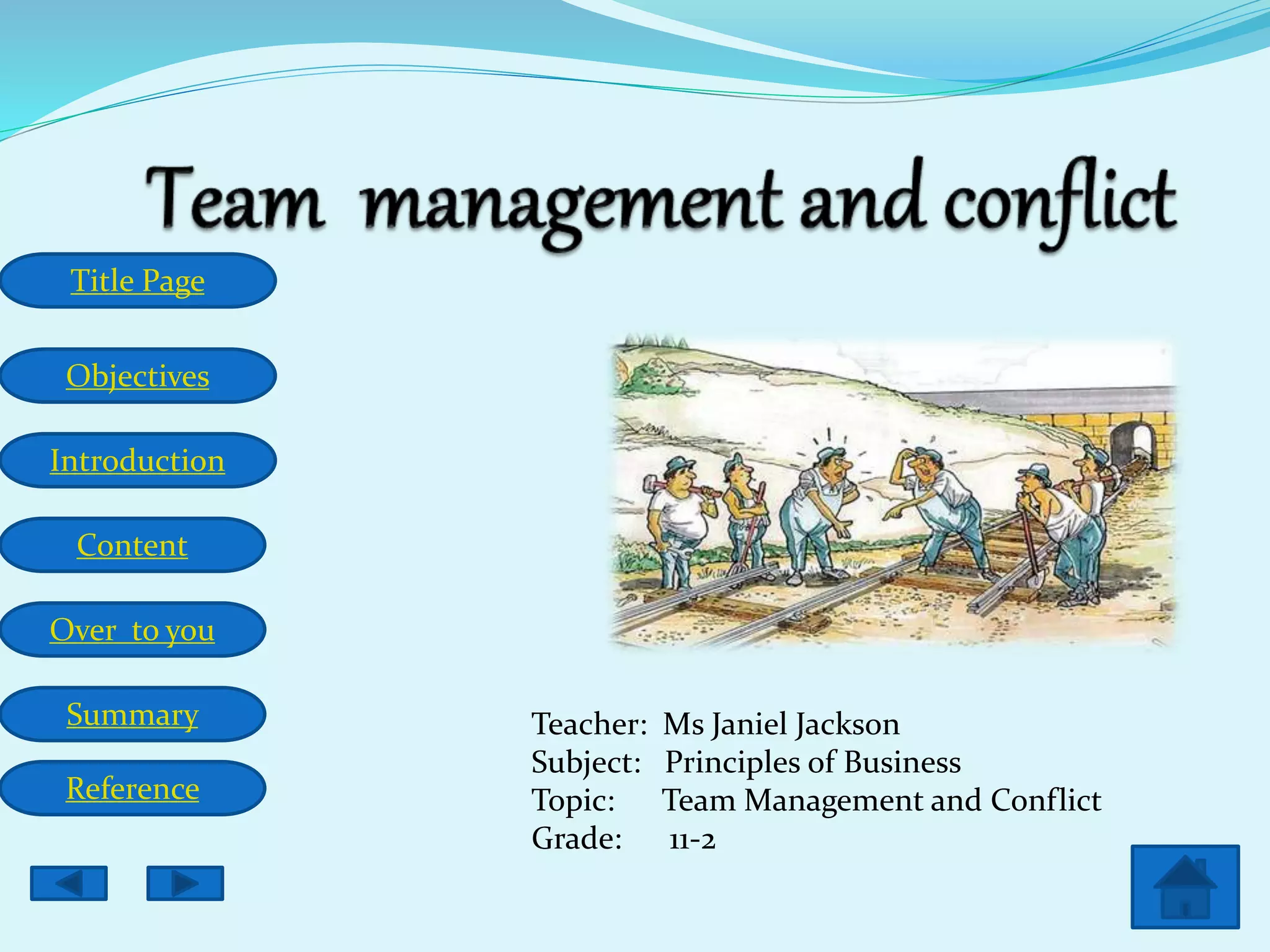
Teacher: Ms Janiel Jackson
Subject: Principles of Business
Topic: Team Management and Conflict
Grade: 11-2
Title Page
Objectives
Introduction
Content
Over to you
Summary
Reference
Objectives
At the end of this lesson students should:
Understand the nature and characteristics of
an effective team.
Know the advantages and disadvantages of
teamworking.
Identify and analyze the most likely causes of
conflict within a team.
Be able to explain the main strategies for
dealing with conflicts within a team.
Explain the benefits of teamworking to the
business organization.
Title Page
Objectives
Introduction
Content
Over to you
Summary
Reference
Introduction
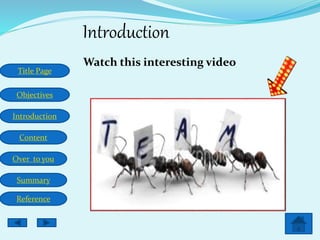
Watch this interesting video
Title Page
Objectives
Introduction
Content
Over to you
Summary
Reference
Introduction Continue
There has been a major trend towards team working
in the many business organizations in recent years. It
is most widely and effectively used in Japanese
companies but its potential benefits are now
recognized worldwide. Teams are created to
undertake a lager unit of work compared with
complete ‘division of labour’ where each individual
worker specializes in a small unit of work.
Title Page
Objectives
Introduction
Content
Over to you
Summary
Reference
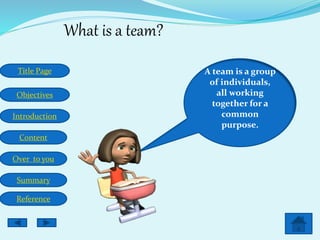
What is a team?
A team is a group
of individuals,
all working
together for a
common
purpose.
Title Page
Objectives
Introduction
Content
Over to you
Summary
Reference
The nature of teams
Composition
Interaction
Shared Objectives
Follow this link for additional information
The nature of teams.docx
Title Page
Objectives
Introduction
Content
Over to you
Summary
Reference
Characteristics of effective teams
 COMMITMENT- With the total commitment from
team members, achieving organizational goals becomes
easier.
 TRUST- Mutual trust and respect is highly important for
the team. This is the only way to achieve the
organization goals.
 SUPPORT-Appreciation as well as appraisal is required
to keep the morale of the team high.
Title Page
Objectives
Introduction
Content
Over to you
Summary
Reference
Characteristics of effective teams cont.
 CONSENSUS DECISIONS. The team arrives at its decisions
through discussion of each member’s ideas.
 PARTICIPATION- Teamworking is likely to work best with a
participative management style and culture.
 ENCOURAGEMENT- Team spirit can be a very powerful
influence and identifying with one’s team can lead to great
loyalty and mutual support.
Follow this link for additional information
Characteristics of effective teams.docx
Title Page
Objectives
Introduction
Content
Over to you
Summary
Reference
Advantages of working in teams
 Workers are likely to be better motivated as social needs and
esteem are more likely to be met.
 Better motivated staff should increase productivity and reduce
labour turnover.
 Team work makes better use of the workforce. Better solutions to
problems will be found as those most closely connected with the
work participate in suggested answers.
 Team working can reduce management cost as it is often
associated with delayering of the organization-fewer middle
managers will be needed.
Title Page
Objectives
Introduction
Content
Over to you
Summary
Reference
Disadvantages of working in teams
 Not everyone is a team player- some individuals are more
effective working alone.
 Teams can develop a set of values and attitudes that may
contrast or conflict with those of the organization itself.
 The introduction of teamworking will require training cost
to be incurred and there may be some disruption to
production as the teams establish themselves.
Title Page
Objectives
Introduction
Content
Over to you
Summary
Reference
One more interesting video on
teamwork
Title Page
Objectives
Introduction
Content
Over to you
Summary
Reference
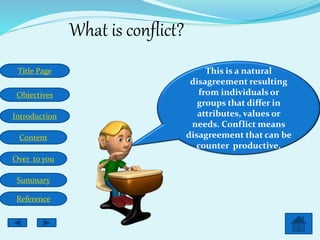
What is conflict?
This is a natural
disagreement resulting
from individuals or
groups that differ in
attributes, values or
needs. Conflict means
disagreement that can be
counter productive.
Title Page
Objectives
Introduction
Content
Over to you
Summary
Reference
Possible Causes of conflict
 Managerial expectation- It is the job of an
employee to meet the expectations of his
manager, but if those expectations are
misunderstood, conflict can arise.
 Competition for scarce resources – If resources
are limited this will cause conflict as each team or
department will want to achieve their objectives.
Title Page
Objectives
Introduction
Content
Over to you
Summary
Reference
Causes of conflict Continue
 Lack of communication- poor communication channels
often associated with directive styles of management can lead
to conflict
 Clash of personalities- Personality conflicts which happen
when people clash with each other due to different styles of
interaction or differing values or beliefs.
Follow this link for additional information.
Possible causes of conflict.docx
Title Page
Objectives
Introduction
Content
Over to you
Summary
Reference
Strategies to manage conflict
 Accommodating
 Avoidance
 Collaborating
 Smoothing
 Compromising
Follow this link for additional information
Strategies to manage conflict.docx
Title Page
Objectives
Introduction
Content
Over to you
Summary
Reference
Benefits of team management to the organization
 Team spirit should improve motivation for staff.
 Teams are more flexible than hierarchical system.
 New teams can be formed and redundant teams
disbanded as the needs of the organization changes.
 Management cost may be reduced as fewer middle
managers and supervisory staff are needed.
Title Page
Objectives
Introduction
Content
Over to you
Summary
Reference
over to you
Question 1
Chose the most appropriate response for the
following
1. All of the following are characteristics of
good teams EXCEPT
a. Flexibility and ability to respond to new
situations.
b. Participation of all members.
c. A directive leader who discourages
involvement .
d. Trust between the members.
Title Page
Objectives
Introduction
Content
Over to you
Summary
Reference
Question 2
Which of the following is a common benefit
of team working?
a. It allows effective use of directive
leadership styles
b. No time is spent on discussing issues of
common concern.
c. Team work makes better use of the
workforce.
d. Not everyone is a team player.
Title Page
Objectives
Introduction
Content
Over to you
Summary
Reference
Question 3
One strategy to manage conflict at work is
compromise. This means:
a. Not discussing the problem because it is
very minor and unimportant.
b. One of the person involved backs down
and accepts the others point of view.
c. A mid-way solution is found that does
not fully satisfy either side.
d. Both parties refuse to back down, so
there will be an eventual winner or loser.
Title Page
Objectives
Introduction
Content
Over to you
Summary
Reference
One of the potential drawbacks of
teamworking is:
a. It does not help to satisfy worker
social needs.
b. It does not make use of all the
talents of each member of the
group.
c. It needs more managers to supervise
and control teams within an
organization.
d. It allows for easy decision making.
Question 4
Title Page
Objectives
Introduction
Content
Over to you
Summary
Reference
Question 5
Each of the following is a strategy to
deal with conflict at work, EXCEPT:
a. Collaboration
b. Decentralization
c. Smoothing
d. Avoidance
Title Page
Objectives
Introduction
Content
Over to you
Summary
Reference
You are correct keep up the
good work !!!!
1 2 3 4 5
Select Question
below
Title Page
Objectives
Introduction
Content
Over to you
Summary
Reference
5
Wrong answer, try again
1 2 3 4
Select Question
below
Title Page
Objectives
Introduction
Content
Over to you
Summary
Reference
Summary
In this lesson we learnt that :
 Building effectives teams must involve the
consideration of ‘composition” ‘interaction’ and
‘shared objectives.’
 There are seven characteristics of effective teams.
 There are several different strategies that can be
adopted to manage conflict in business.
 There are both advantages and disadvantages to
organizing a workforce into teams.
Title Page
Objectives
Introduction
Content
Over to you
Summary
Reference
Reference
K. Singh, P. Stimpson . (2007). Management of Business
unit 1. New York: Cambridge University Press.
Management Study Guide. Corodus, J. (2011). Importance of
Team and Team Work. Retrieved from:
http://www.managementstudyguide.com/importance-of-
team.htm
Mission Stabilizer. Krane F. (2010). Conflict Management
Strategies. Retrieved from:
https://home.snu.edu/~hculbert/conflict.htm
Title Page
Objectives
Introduction
Content
Over to you
Summary
Reference
Feel freeto sing along.

Janiel jackson

  • 1.
    Title Page Objectives Introduction Content Over toyou Summary Reference Teacher: Ms Janiel Jackson Subject: Principles of Business Topic: Team Management and Conflict Grade: 11-2
  • 2.
    Title Page Objectives Introduction Content Over toyou Summary Reference Objectives At the end of this lesson students should: Understand the nature and characteristics of an effective team. Know the advantages and disadvantages of teamworking. Identify and analyze the most likely causes of conflict within a team. Be able to explain the main strategies for dealing with conflicts within a team. Explain the benefits of teamworking to the business organization.
  • 3.
    Title Page Objectives Introduction Content Over toyou Summary Reference Introduction Watch this interesting video
  • 4.
    Title Page Objectives Introduction Content Over toyou Summary Reference Introduction Continue There has been a major trend towards team working in the many business organizations in recent years. It is most widely and effectively used in Japanese companies but its potential benefits are now recognized worldwide. Teams are created to undertake a lager unit of work compared with complete ‘division of labour’ where each individual worker specializes in a small unit of work.
  • 5.
    Title Page Objectives Introduction Content Over toyou Summary Reference What is a team? A team is a group of individuals, all working together for a common purpose.
  • 6.
    Title Page Objectives Introduction Content Over toyou Summary Reference The nature of teams Composition Interaction Shared Objectives Follow this link for additional information The nature of teams.docx
  • 7.
    Title Page Objectives Introduction Content Over toyou Summary Reference Characteristics of effective teams  COMMITMENT- With the total commitment from team members, achieving organizational goals becomes easier.  TRUST- Mutual trust and respect is highly important for the team. This is the only way to achieve the organization goals.  SUPPORT-Appreciation as well as appraisal is required to keep the morale of the team high.
  • 8.
    Title Page Objectives Introduction Content Over toyou Summary Reference Characteristics of effective teams cont.  CONSENSUS DECISIONS. The team arrives at its decisions through discussion of each member’s ideas.  PARTICIPATION- Teamworking is likely to work best with a participative management style and culture.  ENCOURAGEMENT- Team spirit can be a very powerful influence and identifying with one’s team can lead to great loyalty and mutual support. Follow this link for additional information Characteristics of effective teams.docx
  • 9.
    Title Page Objectives Introduction Content Over toyou Summary Reference Advantages of working in teams  Workers are likely to be better motivated as social needs and esteem are more likely to be met.  Better motivated staff should increase productivity and reduce labour turnover.  Team work makes better use of the workforce. Better solutions to problems will be found as those most closely connected with the work participate in suggested answers.  Team working can reduce management cost as it is often associated with delayering of the organization-fewer middle managers will be needed.
  • 10.
    Title Page Objectives Introduction Content Over toyou Summary Reference Disadvantages of working in teams  Not everyone is a team player- some individuals are more effective working alone.  Teams can develop a set of values and attitudes that may contrast or conflict with those of the organization itself.  The introduction of teamworking will require training cost to be incurred and there may be some disruption to production as the teams establish themselves.
  • 11.
    Title Page Objectives Introduction Content Over toyou Summary Reference One more interesting video on teamwork
  • 12.
    Title Page Objectives Introduction Content Over toyou Summary Reference What is conflict? This is a natural disagreement resulting from individuals or groups that differ in attributes, values or needs. Conflict means disagreement that can be counter productive.
  • 13.
    Title Page Objectives Introduction Content Over toyou Summary Reference Possible Causes of conflict  Managerial expectation- It is the job of an employee to meet the expectations of his manager, but if those expectations are misunderstood, conflict can arise.  Competition for scarce resources – If resources are limited this will cause conflict as each team or department will want to achieve their objectives.
  • 14.
    Title Page Objectives Introduction Content Over toyou Summary Reference Causes of conflict Continue  Lack of communication- poor communication channels often associated with directive styles of management can lead to conflict  Clash of personalities- Personality conflicts which happen when people clash with each other due to different styles of interaction or differing values or beliefs. Follow this link for additional information. Possible causes of conflict.docx
  • 15.
    Title Page Objectives Introduction Content Over toyou Summary Reference Strategies to manage conflict  Accommodating  Avoidance  Collaborating  Smoothing  Compromising Follow this link for additional information Strategies to manage conflict.docx
  • 16.
    Title Page Objectives Introduction Content Over toyou Summary Reference Benefits of team management to the organization  Team spirit should improve motivation for staff.  Teams are more flexible than hierarchical system.  New teams can be formed and redundant teams disbanded as the needs of the organization changes.  Management cost may be reduced as fewer middle managers and supervisory staff are needed.
  • 17.
    Title Page Objectives Introduction Content Over toyou Summary Reference over to you Question 1 Chose the most appropriate response for the following 1. All of the following are characteristics of good teams EXCEPT a. Flexibility and ability to respond to new situations. b. Participation of all members. c. A directive leader who discourages involvement . d. Trust between the members.
  • 18.
    Title Page Objectives Introduction Content Over toyou Summary Reference Question 2 Which of the following is a common benefit of team working? a. It allows effective use of directive leadership styles b. No time is spent on discussing issues of common concern. c. Team work makes better use of the workforce. d. Not everyone is a team player.
  • 19.
    Title Page Objectives Introduction Content Over toyou Summary Reference Question 3 One strategy to manage conflict at work is compromise. This means: a. Not discussing the problem because it is very minor and unimportant. b. One of the person involved backs down and accepts the others point of view. c. A mid-way solution is found that does not fully satisfy either side. d. Both parties refuse to back down, so there will be an eventual winner or loser.
  • 20.
    Title Page Objectives Introduction Content Over toyou Summary Reference One of the potential drawbacks of teamworking is: a. It does not help to satisfy worker social needs. b. It does not make use of all the talents of each member of the group. c. It needs more managers to supervise and control teams within an organization. d. It allows for easy decision making. Question 4
  • 21.
    Title Page Objectives Introduction Content Over toyou Summary Reference Question 5 Each of the following is a strategy to deal with conflict at work, EXCEPT: a. Collaboration b. Decentralization c. Smoothing d. Avoidance
  • 22.
    Title Page Objectives Introduction Content Over toyou Summary Reference You are correct keep up the good work !!!! 1 2 3 4 5 Select Question below
  • 23.
    Title Page Objectives Introduction Content Over toyou Summary Reference 5 Wrong answer, try again 1 2 3 4 Select Question below
  • 24.
    Title Page Objectives Introduction Content Over toyou Summary Reference Summary In this lesson we learnt that :  Building effectives teams must involve the consideration of ‘composition” ‘interaction’ and ‘shared objectives.’  There are seven characteristics of effective teams.  There are several different strategies that can be adopted to manage conflict in business.  There are both advantages and disadvantages to organizing a workforce into teams.
  • 25.
    Title Page Objectives Introduction Content Over toyou Summary Reference Reference K. Singh, P. Stimpson . (2007). Management of Business unit 1. New York: Cambridge University Press. Management Study Guide. Corodus, J. (2011). Importance of Team and Team Work. Retrieved from: http://www.managementstudyguide.com/importance-of- team.htm Mission Stabilizer. Krane F. (2010). Conflict Management Strategies. Retrieved from: https://home.snu.edu/~hculbert/conflict.htm
  • 26.
    Title Page Objectives Introduction Content Over toyou Summary Reference Feel freeto sing along.