‘ Me as a Briton, what it means to be Stereotyped’ By  James Busby
My Key Concepts  Representation - This is can define what certain cultures or people are defined as. In this case how I am represented through the stereotype of being British. For example what makes me British? How am I represented through the media? I will discuss these stereotypes further in my presentation.  Identity - Is shown through how I look, what I do, what my mannerisms are and even how I talk, These are the foundations that make me what I am. We can create an identity through what we watch in the media for example’ Role models or celebrities. Or we are given an Identity, this can be an individual one or a national identity. I will talk about how I am given a stereotyped identity through the conventions I have used.
Guess the stereotype? France Germany Britain Japan Italy America Mexico Jamaica Click to reveal the answers
So what are these stereotypes?   I talk with a posh upper class accent such as Received pronunciation. for example I am constantly drinking tea. I live in a luxury manor house in the country. I wear a bowler hat.  I love Victorian literature.  I'm incredibly sarcastic.
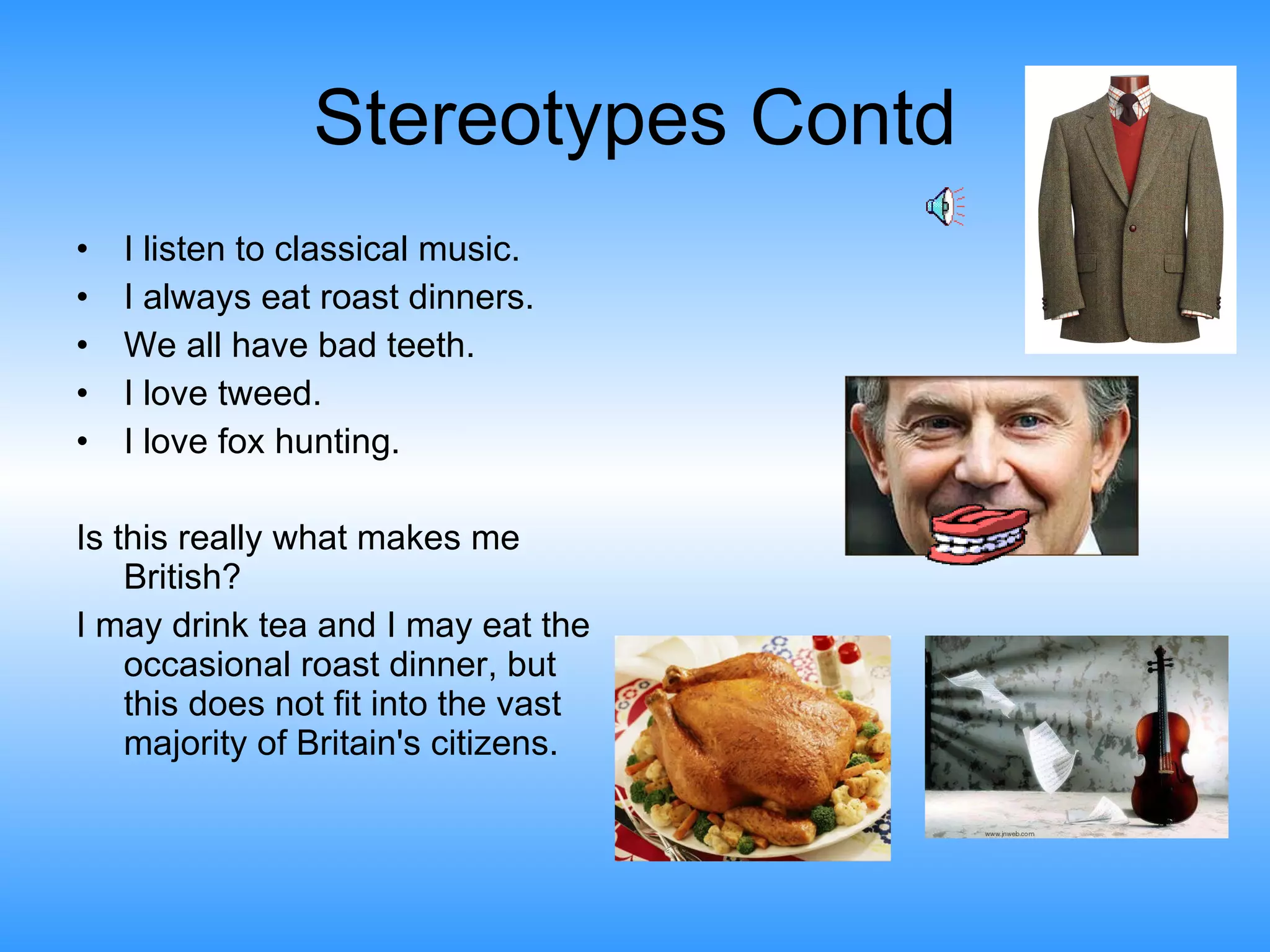
Stereotypes Contd I listen to classical music.  I always eat roast dinners. We all have bad teeth. I love tweed. I love fox hunting.  Is this really what makes me British?  I may drink tea and I may eat the occasional roast dinner, but this does not fit into the vast majority of Britain's citizens.
How are these Stereotypes shown in the Media? The possible reasons for these stereotypes are seen through certain programmes shown in the media. I however do not feel these are correct perceptions of the British public nor are they accurate. Now I want you to watch the following clip of Eastenders, which most of you know that it’s famous for it’s fighting, over dramatic deaths, weddings that never go to plan, and unforgettable Christmases. Now while you watch this clip, I want you to think how accurate this stereotype is!  Click Here
How can I relate to these stereotypes   Well personally I don’t feel I can relate to these stereotypes, It is neither accurate nor fair to label a whole country on its stereotypical characteristics. I however do agree with some of the stereotypes as I do drink tea and enjoy playing typically British sports, such as tennis and cricket. This can be categorised under syntagms; these are a set of signs from which a group of items can be chosen to show that I am labeled as British; such as the tweed jacket or combed over haircut.
What are other countries perceptions of Britain and its people? I have found some interesting comments on a forum from yahoo.com, where a British person asked the following question  ‘How do non-British people perceive British people? Stereotypes etc.?’  here are some of the best answers! user: blixa22 said we are ‘Witty, colourful, coarse, oblique way of speaking, sweater-wearing’. (I'm from the US) Possibly the best answer was from user: Moe Syzlack ‘You all drink tea and live in castles’.
Cooley’s ‘Looking-glass theory’ Cooley's ‘Looking-glass theory’ can be used to show how we project ourselves in the media and the world around us. Cooley suggest how ‘we modify our behaviour’ to make a difference between our ‘reflections’. In this case we may see these stereotypes and go against them intentionally. For example we may be perceived as crumpet eating, tea drinking, upper class people, but I feel that this is just a bad representation.
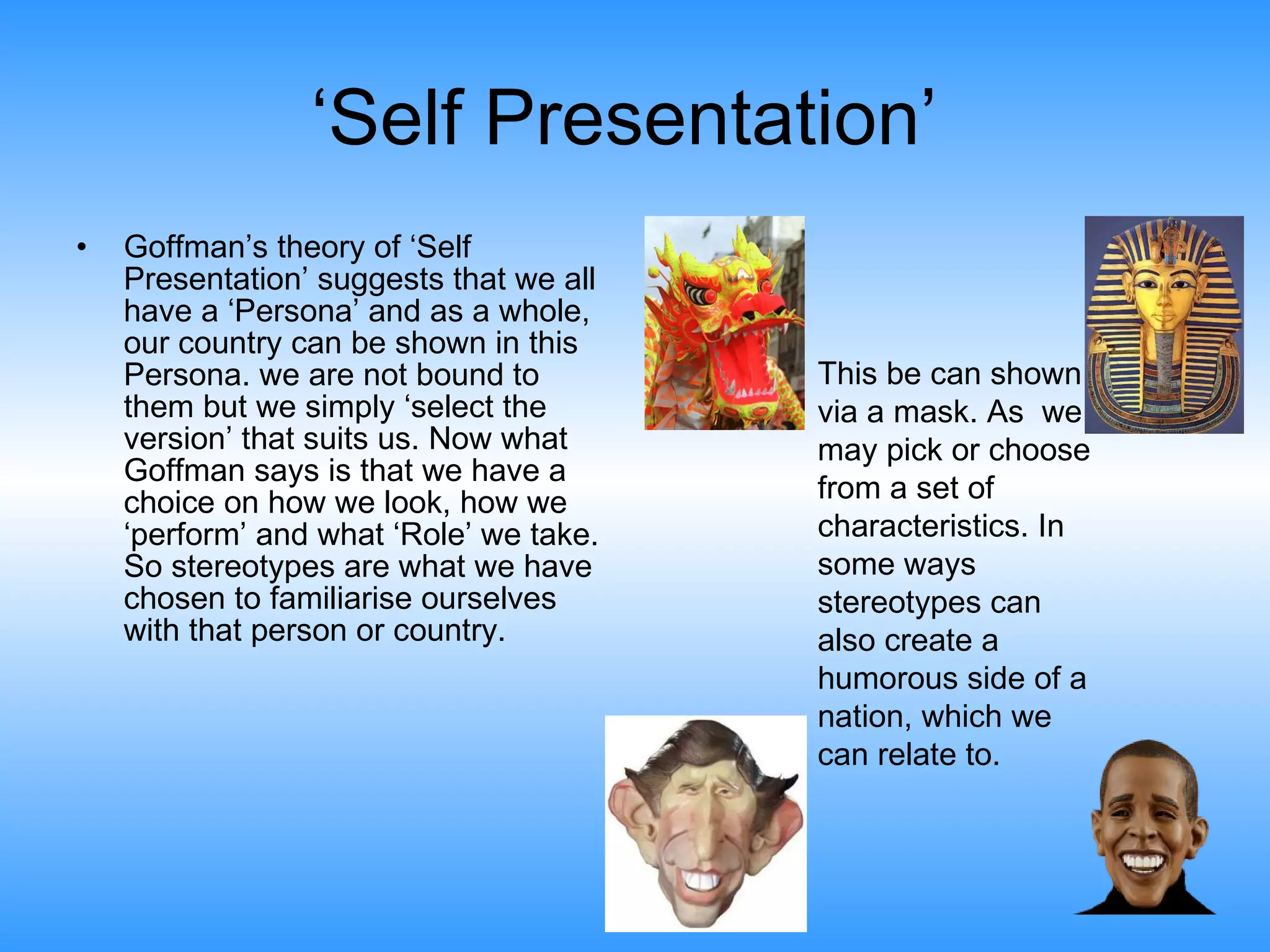
‘ Self Presentation’  Goffman’s theory of ‘Self Presentation’ suggests that we all have a ‘Persona’ and as a whole, our country can be shown in this Persona. we are not bound to them but we simply ‘select the version’ that suits us. Now what Goffman says is that we have a choice on how we look, how we ‘perform’ and what ‘Role’ we take. So stereotypes are what we have chosen to familiarise ourselves with that person or country.  This be can shown via a mask. As  we may pick or choose from a set of characteristics. In some ways stereotypes can also create a humorous side of a nation, which we can relate to.
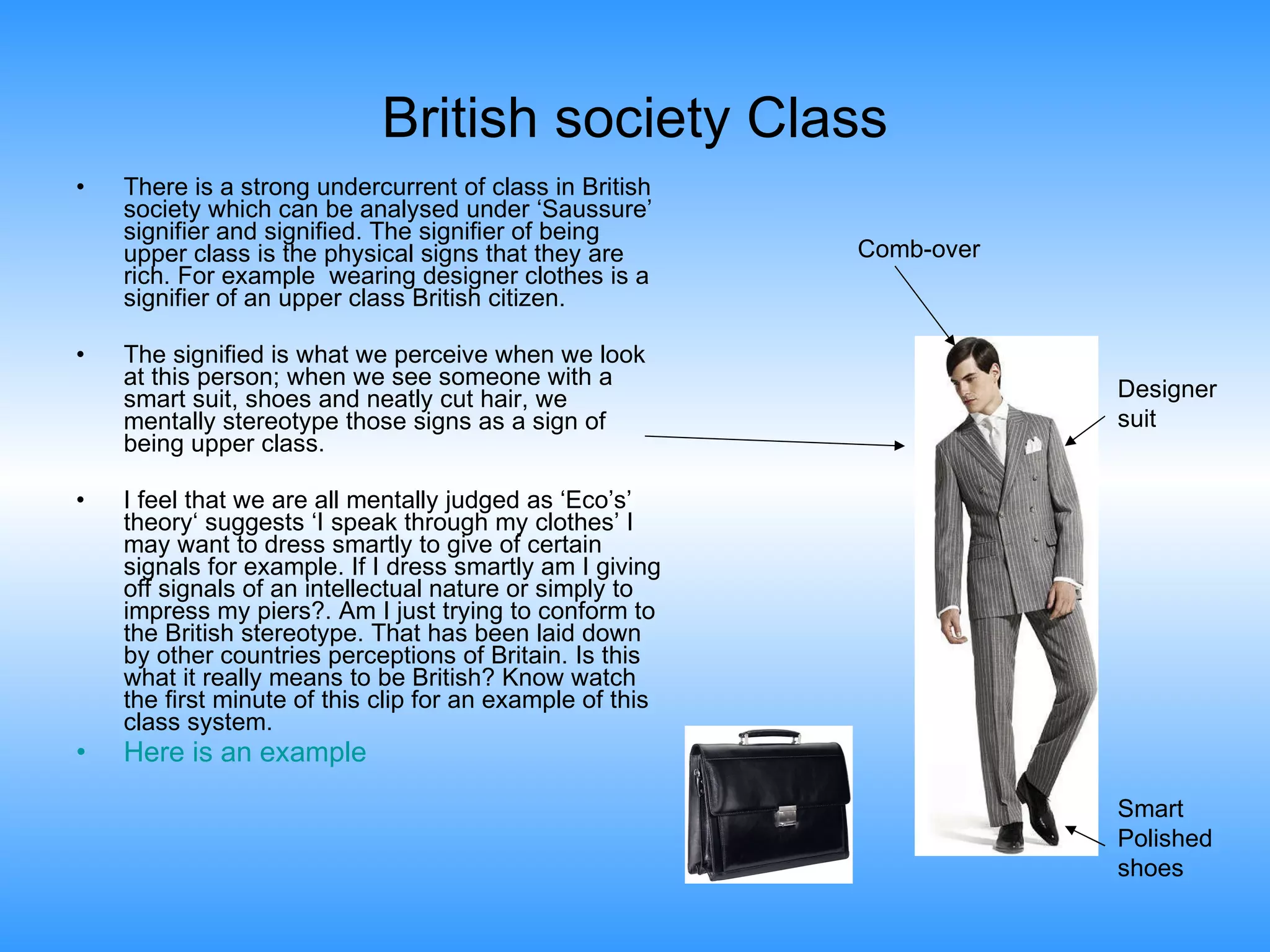
British society Class There is a strong undercurrent of class in British society which can be analysed under ‘Saussure’ signifier and signified. The signifier of being upper class is the physical signs that they are rich. For example  wearing designer clothes is a signifier of an upper class British citizen. The signified is what we perceive when we look at this person; when we see someone with a smart suit, shoes and neatly cut hair, we mentally stereotype those signs as a sign of being upper class.  I feel that we are all mentally judged as ‘Eco’s’ theory‘ suggests ‘I speak through my clothes’ I may want to dress smartly to give of certain signals for example. If I dress smartly am I giving off signals of an intellectual nature or simply to impress my piers?. Am I just trying to conform to the British stereotype. That has been laid down by other countries perceptions of Britain. Is this what it really means to be British? Know watch the first minute of this clip for an example of this class system. Here is an example Comb-over Designer suit Smart Polished shoes
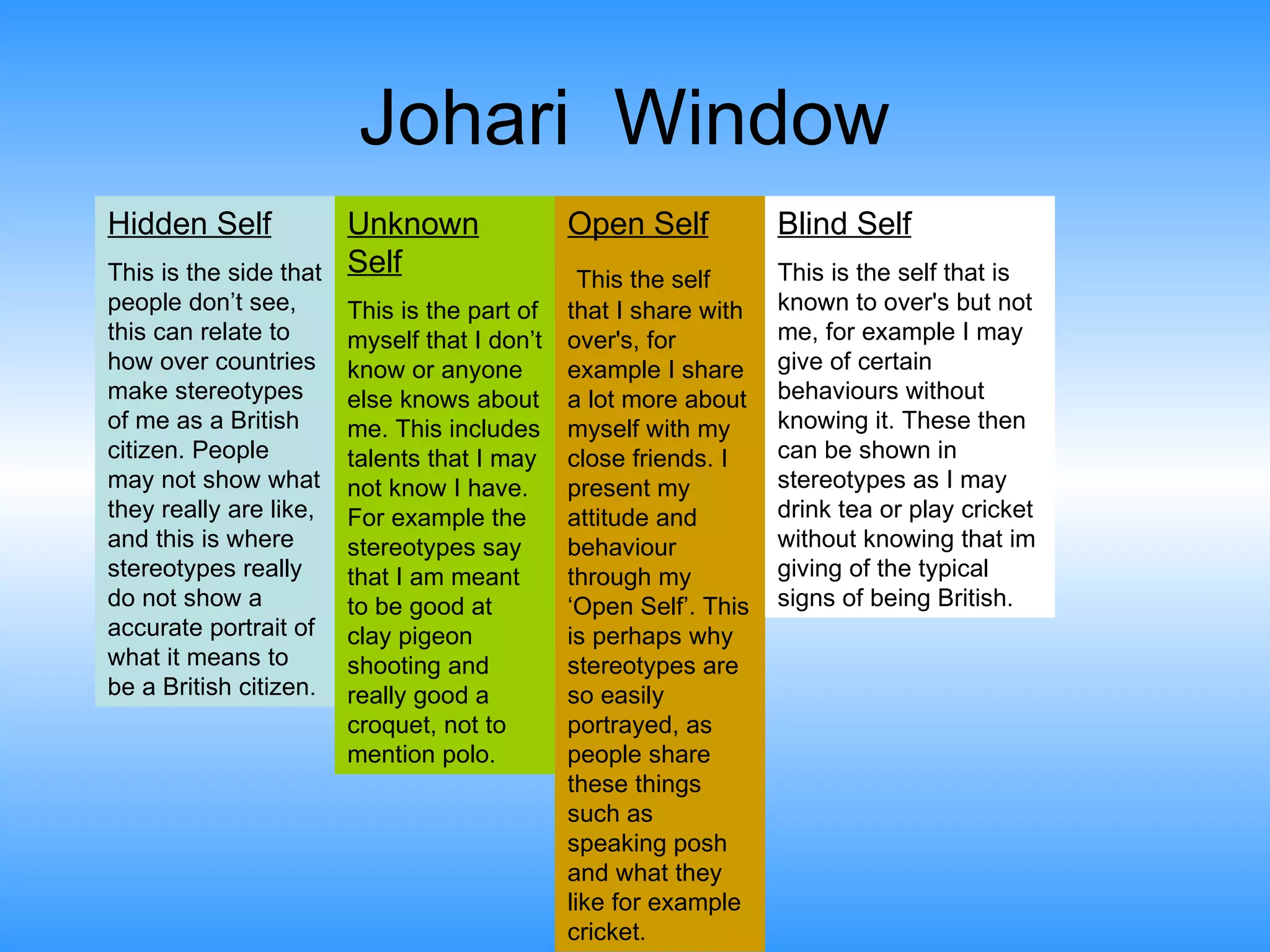
Johari  Window   Hidden Self This is the side that people don’t see, this can relate to how over countries make stereotypes of me as a British citizen. People may not show what they really are like, and this is where stereotypes really do not show a accurate portrait of what it means to be a British citizen. Unknown Self This is the part of myself that I don’t know or anyone else knows about me. This includes talents that I may not know I have. For example the stereotypes say that I am meant to be good at clay pigeon shooting and really good a croquet, not to mention polo.  Open Self This the self that I share with over's, for example I share a lot more about myself with my close friends. I present my attitude and behaviour through my ‘Open Self’. This is perhaps why stereotypes are so easily portrayed, as people share these things such as speaking posh and what they like for example cricket.  Blind Self This is the self that is known to over's but not me, for example I may give of certain behaviours without knowing it. These then can be shown in stereotypes as I may drink tea or play cricket without knowing that im giving of the typical signs of being British.
Self Concept  Self concept is the idea of how we portray and view ourselves as an individual. There are three points I consider about myself when analyzing how I am represented as a Britain. Self Image  I like to think of myself as a well brought up individual. With good etiquette and conduct myself through my morals and pronunciation.  Ideal self My Ideal self would be to take certain parts of the stereotypical Britain, and use it to my own advantage. For example the education system we have is one of the best in the world, and I am able to use this.  Self esteem  I feel that I can achieve the goals that are set before me, because of my British upbringing and standards. I hope that my generation can make changes to this stereotype and to get rid of this perception of us just being; tea drinking, boat racing, upper class citizens.
Evaluation  To conclude I feel that being stereotyped as British has its good points and bad points, it can help me to familiarize myself with a country, Dyer suggests that it is a form of ‘Shorthand’ which is used in the media and the world around us to represent a country. But I feel it does not   represent me correctly. Dyer asks ‘which views are being put forward?’. In this case I feel the media’s views of social groups and countries are sadly more apparent than me an actual citizen of Britain.
Bibliography http://uk.answers.yahoo.com/question/index?qid=20061113091551AAsSUt4 AS Communication and culture The Essential Introduction (2008 Specification) http://www.google.co.uk/imghp  (google images) http://www.youtube.com/

James busby

  • 1.
    ‘ Me asa Briton, what it means to be Stereotyped’ By James Busby
  • 2.
    My Key Concepts Representation - This is can define what certain cultures or people are defined as. In this case how I am represented through the stereotype of being British. For example what makes me British? How am I represented through the media? I will discuss these stereotypes further in my presentation. Identity - Is shown through how I look, what I do, what my mannerisms are and even how I talk, These are the foundations that make me what I am. We can create an identity through what we watch in the media for example’ Role models or celebrities. Or we are given an Identity, this can be an individual one or a national identity. I will talk about how I am given a stereotyped identity through the conventions I have used.
  • 3.
    Guess the stereotype?France Germany Britain Japan Italy America Mexico Jamaica Click to reveal the answers
  • 4.
    So what arethese stereotypes? I talk with a posh upper class accent such as Received pronunciation. for example I am constantly drinking tea. I live in a luxury manor house in the country. I wear a bowler hat. I love Victorian literature. I'm incredibly sarcastic.
  • 5.
    Stereotypes Contd Ilisten to classical music. I always eat roast dinners. We all have bad teeth. I love tweed. I love fox hunting. Is this really what makes me British? I may drink tea and I may eat the occasional roast dinner, but this does not fit into the vast majority of Britain's citizens.
  • 6.
    How are theseStereotypes shown in the Media? The possible reasons for these stereotypes are seen through certain programmes shown in the media. I however do not feel these are correct perceptions of the British public nor are they accurate. Now I want you to watch the following clip of Eastenders, which most of you know that it’s famous for it’s fighting, over dramatic deaths, weddings that never go to plan, and unforgettable Christmases. Now while you watch this clip, I want you to think how accurate this stereotype is! Click Here
  • 7.
    How can Irelate to these stereotypes Well personally I don’t feel I can relate to these stereotypes, It is neither accurate nor fair to label a whole country on its stereotypical characteristics. I however do agree with some of the stereotypes as I do drink tea and enjoy playing typically British sports, such as tennis and cricket. This can be categorised under syntagms; these are a set of signs from which a group of items can be chosen to show that I am labeled as British; such as the tweed jacket or combed over haircut.
  • 8.
    What are othercountries perceptions of Britain and its people? I have found some interesting comments on a forum from yahoo.com, where a British person asked the following question ‘How do non-British people perceive British people? Stereotypes etc.?’ here are some of the best answers! user: blixa22 said we are ‘Witty, colourful, coarse, oblique way of speaking, sweater-wearing’. (I'm from the US) Possibly the best answer was from user: Moe Syzlack ‘You all drink tea and live in castles’.
  • 9.
    Cooley’s ‘Looking-glass theory’Cooley's ‘Looking-glass theory’ can be used to show how we project ourselves in the media and the world around us. Cooley suggest how ‘we modify our behaviour’ to make a difference between our ‘reflections’. In this case we may see these stereotypes and go against them intentionally. For example we may be perceived as crumpet eating, tea drinking, upper class people, but I feel that this is just a bad representation.
  • 10.
    ‘ Self Presentation’ Goffman’s theory of ‘Self Presentation’ suggests that we all have a ‘Persona’ and as a whole, our country can be shown in this Persona. we are not bound to them but we simply ‘select the version’ that suits us. Now what Goffman says is that we have a choice on how we look, how we ‘perform’ and what ‘Role’ we take. So stereotypes are what we have chosen to familiarise ourselves with that person or country. This be can shown via a mask. As we may pick or choose from a set of characteristics. In some ways stereotypes can also create a humorous side of a nation, which we can relate to.
  • 11.
    British society ClassThere is a strong undercurrent of class in British society which can be analysed under ‘Saussure’ signifier and signified. The signifier of being upper class is the physical signs that they are rich. For example wearing designer clothes is a signifier of an upper class British citizen. The signified is what we perceive when we look at this person; when we see someone with a smart suit, shoes and neatly cut hair, we mentally stereotype those signs as a sign of being upper class. I feel that we are all mentally judged as ‘Eco’s’ theory‘ suggests ‘I speak through my clothes’ I may want to dress smartly to give of certain signals for example. If I dress smartly am I giving off signals of an intellectual nature or simply to impress my piers?. Am I just trying to conform to the British stereotype. That has been laid down by other countries perceptions of Britain. Is this what it really means to be British? Know watch the first minute of this clip for an example of this class system. Here is an example Comb-over Designer suit Smart Polished shoes
  • 12.
    Johari Window Hidden Self This is the side that people don’t see, this can relate to how over countries make stereotypes of me as a British citizen. People may not show what they really are like, and this is where stereotypes really do not show a accurate portrait of what it means to be a British citizen. Unknown Self This is the part of myself that I don’t know or anyone else knows about me. This includes talents that I may not know I have. For example the stereotypes say that I am meant to be good at clay pigeon shooting and really good a croquet, not to mention polo. Open Self This the self that I share with over's, for example I share a lot more about myself with my close friends. I present my attitude and behaviour through my ‘Open Self’. This is perhaps why stereotypes are so easily portrayed, as people share these things such as speaking posh and what they like for example cricket. Blind Self This is the self that is known to over's but not me, for example I may give of certain behaviours without knowing it. These then can be shown in stereotypes as I may drink tea or play cricket without knowing that im giving of the typical signs of being British.
  • 13.
    Self Concept Self concept is the idea of how we portray and view ourselves as an individual. There are three points I consider about myself when analyzing how I am represented as a Britain. Self Image I like to think of myself as a well brought up individual. With good etiquette and conduct myself through my morals and pronunciation. Ideal self My Ideal self would be to take certain parts of the stereotypical Britain, and use it to my own advantage. For example the education system we have is one of the best in the world, and I am able to use this. Self esteem I feel that I can achieve the goals that are set before me, because of my British upbringing and standards. I hope that my generation can make changes to this stereotype and to get rid of this perception of us just being; tea drinking, boat racing, upper class citizens.
  • 14.
    Evaluation Toconclude I feel that being stereotyped as British has its good points and bad points, it can help me to familiarize myself with a country, Dyer suggests that it is a form of ‘Shorthand’ which is used in the media and the world around us to represent a country. But I feel it does not represent me correctly. Dyer asks ‘which views are being put forward?’. In this case I feel the media’s views of social groups and countries are sadly more apparent than me an actual citizen of Britain.
  • 15.
    Bibliography http://uk.answers.yahoo.com/question/index?qid=20061113091551AAsSUt4 ASCommunication and culture The Essential Introduction (2008 Specification) http://www.google.co.uk/imghp (google images) http://www.youtube.com/

Editor's Notes

  • #4 Put answers on time delay
  • #15 Dyer suggests 4 ways of viewing representation: A selective re-presentation of reality: creating the illusion of a transparent window on the world Media often use stereotypes to typify particular social groups as a form of shorthand The process of speaking on behalf of or as a representative of a particular position. Whose views are being put forward in particular messages? The meanings which media messages represent for audiences. What do readers bring to messages which affects how they interpret them? What actual sense is made when particular messages are understood?