1
9th
International Conference Zaragoza-Pau
on Applied Mathematics and Statistics
On heat wave definition
Abaurrea J., Cebrián A.C., Asín J., Centelles A.
19-21 September 2005
2
Introduction (1)
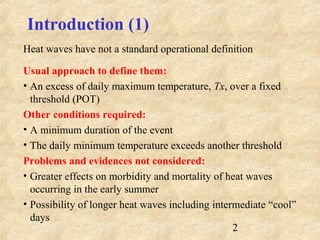
Heat waves have not a standard operational definition
Usual approach to define them:
• An excess of daily maximum temperature, Tx, over a fixed
threshold (POT)
Other conditions required:
• A minimum duration of the event
• The daily minimum temperature exceeds another threshold
Problems and evidences not considered:
• Greater effects on morbidity and mortality of heat waves
occurring in the early summer
• Possibility of longer heat waves including intermediate “cool”
days
3
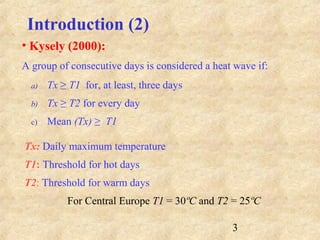
• Kysely (2000):
A group of consecutive days is considered a heat wave if:
a) Tx ≥ T1 for, at least, three days
b) Tx ≥ T2 for every day
c) Mean (Tx) ≥ T1
Tx: Daily maximum temperature
T1: Threshold for hot days
T2: Threshold for warm days
For Central Europe T1 = 30ºC and T2 = 25ºC
Introduction (2)
4
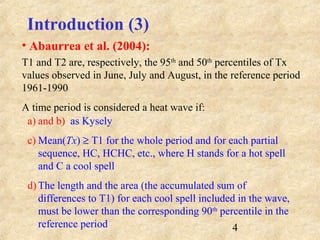
a) and b) as Kysely
c) Mean(Tx) ≥ T1 for the whole period and for each partial
sequence, HC, HCHC, etc., where H stands for a hot spell
and C a cool spell
d) The length and the area (the accumulated sum of
differences to T1) for each cool spell included in the wave,
must be lower than the corresponding 90th
percentile in the
reference period
T1 and T2 are, respectively, the 95th
and 50th
percentiles of Tx
values observed in June, July and August, in the reference period
1961-1990
A time period is considered a heat wave if:
Introduction (3)
• Abaurrea et al. (2004):
5
Heat wave: A period of arbitrary length where Tx exceeds a “shot
temperature”
Shot temperature = extraordinary increase of mortality
– Madrid (36.5ºC)
– Barcelona (30.3ºC)
Introduction (4)
• Díaz et al. (2003):
–Sevilla (41ºC)
–Lisboa (33.5ºC)
These thresholds are the 95th
percentiles of the corresponding
Tx value distributions in JJAS, 1991-2002
In this way, they obtain the heat wave thresholds for main
Spanish towns: Zaragoza (37.3ºC), Huesca (36.1ºC)
6
Data and preliminary analysis
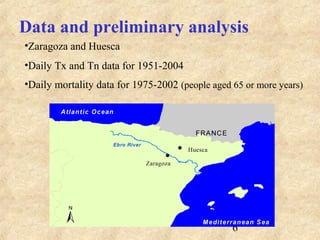
•Zaragoza and Huesca
•Daily Tx and Tn data for 1951-2004
•Daily mortality data for 1975-2002 (people aged 65 or more years)
7
Temperature
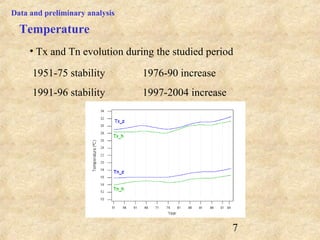
• Tx and Tn evolution during the studied period
1951-75 stability 1976-90 increase
1991-96 stability 1997-2004 increase
Data and preliminary analysis
8
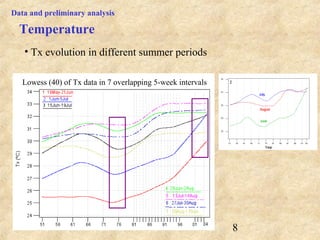
• Tx evolution in different summer periods
Temperature
Data and preliminary analysis
Lowess (40) of Tx data in 7 overlapping 5-week intervals
9
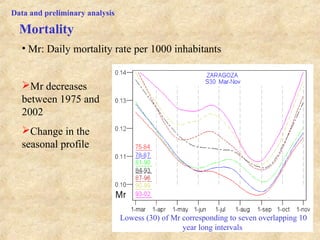
Lowess (30) of Mr corresponding to seven overlapping 10
year long intervals
Mr decreases
between 1975 and
2002
Change in the
seasonal profile
Mortality
Data and preliminary analysis
• Mr: Daily mortality rate per 1000 inhabitants
10
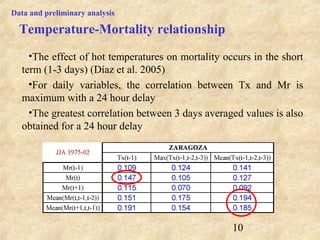
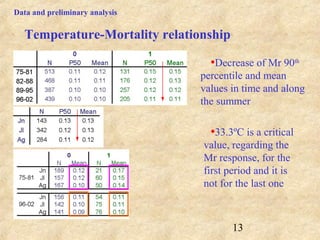
•The effect of hot temperatures on mortality occurs in the short
term (1-3 days) (Díaz et al. 2005)
•For daily variables, the correlation between Tx and Mr is
maximum with a 24 hour delay
•The greatest correlation between 3 days averaged values is also
obtained for a 24 hour delay
Temperature-Mortality relationship
Data and preliminary analysis
11
Data and preliminary analysis
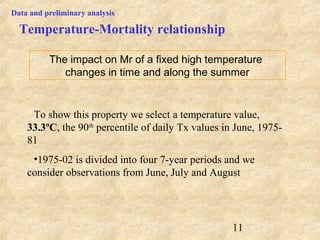
The impact on Mr of a fixed high temperature
changes in time and along the summer
To show this property we select a temperature value,
33.3ºC, the 90th
percentile of daily Tx values in June, 1975-
81
•1975-02 is divided into four 7-year periods and we
consider observations from June, July and August
Temperature-Mortality relationship
12
Data and preliminary analysis
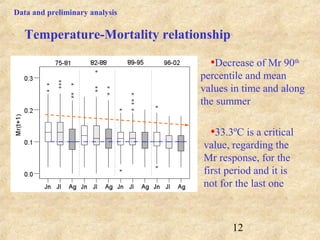
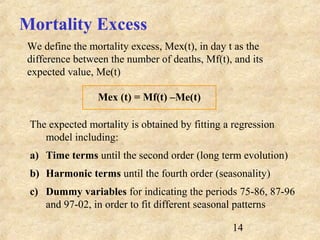
•Decrease of Mr 90th
percentile and mean
values in time and along
the summer
•33.3ºC is a critical
value, regarding the
Mr response, for the
first period and it is
not for the last one
Temperature-Mortality relationship
13
Data and preliminary analysis
•Decrease of Mr 90th
percentile and mean
values in time and along
the summer
•33.3ºC is a critical
value, regarding the
Mr response, for the
first period and it is
not for the last one
Temperature-Mortality relationship
14
Mortality Excess
We define the mortality excess, Mex(t), in day t as the
difference between the number of deaths, Mf(t), and its
expected value, Me(t)
Mex (t) = Mf(t) –Me(t)
The expected mortality is obtained by fitting a regression
model including:
a) Time terms until the second order (long term evolution)
b) Harmonic terms until the fourth order (seasonality)
c) Dummy variables for indicating the periods 75-86, 87-96
and 97-02, in order to fit different seasonal patterns
15
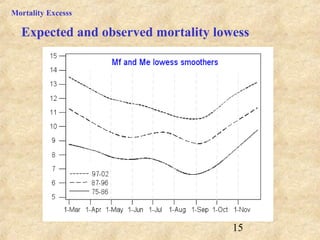
Expected and observed mortality lowess
Mortality Excesss
16
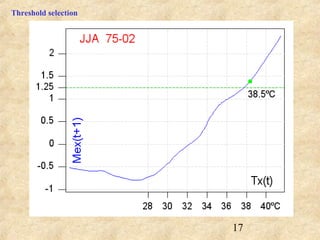
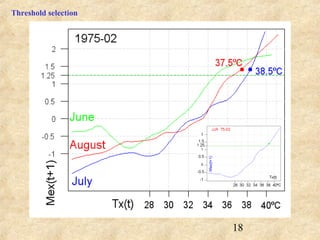
•We try to identify the ‘shot temperature’ for each 7-year
period and summer interval, looking for the change point in
the lowess smoother of Mex vs. Tx
PROBLEMS
Smoothed curves are frequently erratic because of small
sample sizes
A proper shot temperature doesn’t appear in many
graphs
Threshold selection
17
Threshold selection
18
Threshold selection
19
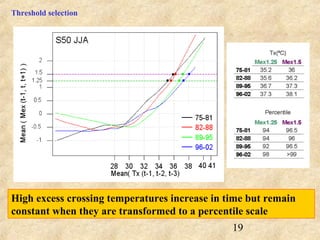
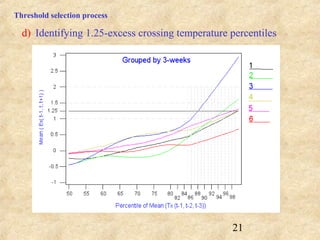
High excess crossing temperatures increase in time but remain
constant when they are transformed to a percentile scale
Threshold selection
20
Threshold selection process
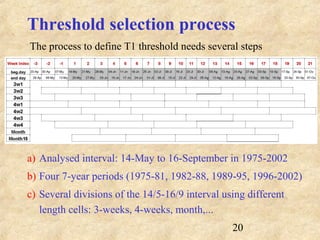
The process to define T1 threshold needs several steps
a) Analysed interval: 14-May to 16-September in 1975-2002
b) Four 7-year periods (1975-81, 1982-88, 1989-95, 1996-2002)
c) Several divisions of the 14/5-16/9 interval using different
length cells: 3-weeks, 4-weeks, month,...
21
d) Identifying 1.25-excess crossing temperature percentiles
Threshold selection process
22
Threshold selection process
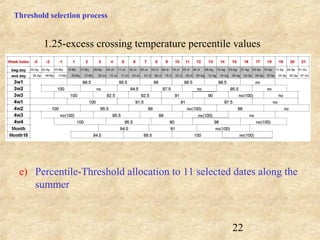
e) Percentile-Threshold allocation to 11 selected dates along the
summer
1.25-excess crossing temperature percentile values
23
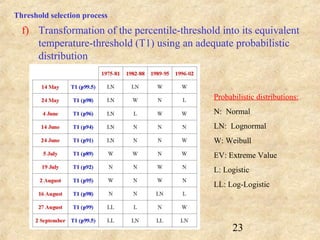
f) Transformation of the percentile-threshold into its equivalent
temperature-threshold (T1) using an adequate probabilistic
distribution
Threshold selection process
Probabilistic distributions:
N: Normal
LN: Lognormal
W: Weibull
EV: Extreme Value
L: Logistic
LL: Log-Logistic
24
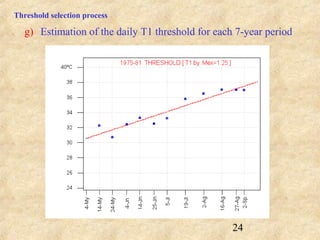
g) Estimation of the daily T1 threshold for each 7-year period
Threshold selection process
25
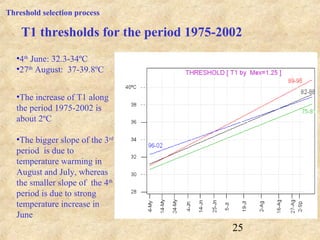
•4th
June: 32.3-34ºC
•27th
August: 37-39.8ºC
•The increase of T1 along
the period 1975-2002 is
about 2ºC
•The bigger slope of the 3rd
period is due to
temperature warming in
August and July, whereas
the smaller slope of the 4th
period is due to strong
temperature increase in
June
Threshold selection process
T1 thresholds for the period 1975-2002
26
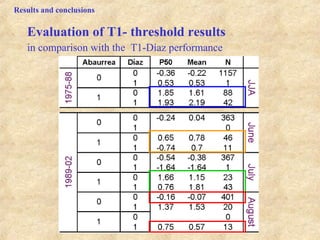
in comparison with the T1-Díaz performance
Results and conclusions
Evaluation of T1- threshold results
27
References
Abaurrea, J., et al. (2004). Modelling hot extreme temperature events using a
non homogeneous Poisson model. 6th World Congress of Bernoulli Society for
Mathematical Statistics and Probability, Barcelona.
Díaz, J., et al. (2002). Effects of extremely hot days on people older than 65
years in Seville (Spain) from 1986 to 1997. Int. J. Biometeorology, 46, 145-
149.
Díaz, J., Linares, C., García-Herrera, R. (2005). Impacto de las temperaturas
extremas en la salud pública. Futuras actuaciones. Rev. Esp. Salud Pública, 79,
145-157.
Kysely, J. (2002). Temporal fluctuations in heat waves at Prague, the Czech
republic, from 1901-97 and their relationship to atmospheric circulation. Int. J.
Climatol., 22, 33-50.
Robinson, P. J. (2001). On the definition of a heat wave. J. of Applied
Meteorology, 40, 762-75.

Jaca05heatw

  • 1.
    1 9th International Conference Zaragoza-Pau onApplied Mathematics and Statistics On heat wave definition Abaurrea J., Cebrián A.C., Asín J., Centelles A. 19-21 September 2005
  • 2.
    2 Introduction (1) Heat waveshave not a standard operational definition Usual approach to define them: • An excess of daily maximum temperature, Tx, over a fixed threshold (POT) Other conditions required: • A minimum duration of the event • The daily minimum temperature exceeds another threshold Problems and evidences not considered: • Greater effects on morbidity and mortality of heat waves occurring in the early summer • Possibility of longer heat waves including intermediate “cool” days
  • 3.
    3 • Kysely (2000): Agroup of consecutive days is considered a heat wave if: a) Tx ≥ T1 for, at least, three days b) Tx ≥ T2 for every day c) Mean (Tx) ≥ T1 Tx: Daily maximum temperature T1: Threshold for hot days T2: Threshold for warm days For Central Europe T1 = 30ºC and T2 = 25ºC Introduction (2)
  • 4.
    4 a) and b)as Kysely c) Mean(Tx) ≥ T1 for the whole period and for each partial sequence, HC, HCHC, etc., where H stands for a hot spell and C a cool spell d) The length and the area (the accumulated sum of differences to T1) for each cool spell included in the wave, must be lower than the corresponding 90th percentile in the reference period T1 and T2 are, respectively, the 95th and 50th percentiles of Tx values observed in June, July and August, in the reference period 1961-1990 A time period is considered a heat wave if: Introduction (3) • Abaurrea et al. (2004):
  • 5.
    5 Heat wave: Aperiod of arbitrary length where Tx exceeds a “shot temperature” Shot temperature = extraordinary increase of mortality – Madrid (36.5ºC) – Barcelona (30.3ºC) Introduction (4) • Díaz et al. (2003): –Sevilla (41ºC) –Lisboa (33.5ºC) These thresholds are the 95th percentiles of the corresponding Tx value distributions in JJAS, 1991-2002 In this way, they obtain the heat wave thresholds for main Spanish towns: Zaragoza (37.3ºC), Huesca (36.1ºC)
  • 6.
    6 Data and preliminaryanalysis •Zaragoza and Huesca •Daily Tx and Tn data for 1951-2004 •Daily mortality data for 1975-2002 (people aged 65 or more years)
  • 7.
    7 Temperature • Tx andTn evolution during the studied period 1951-75 stability 1976-90 increase 1991-96 stability 1997-2004 increase Data and preliminary analysis
  • 8.
    8 • Tx evolutionin different summer periods Temperature Data and preliminary analysis Lowess (40) of Tx data in 7 overlapping 5-week intervals
  • 9.
    9 Lowess (30) ofMr corresponding to seven overlapping 10 year long intervals Mr decreases between 1975 and 2002 Change in the seasonal profile Mortality Data and preliminary analysis • Mr: Daily mortality rate per 1000 inhabitants
  • 10.
    10 •The effect ofhot temperatures on mortality occurs in the short term (1-3 days) (Díaz et al. 2005) •For daily variables, the correlation between Tx and Mr is maximum with a 24 hour delay •The greatest correlation between 3 days averaged values is also obtained for a 24 hour delay Temperature-Mortality relationship Data and preliminary analysis
  • 11.
    11 Data and preliminaryanalysis The impact on Mr of a fixed high temperature changes in time and along the summer To show this property we select a temperature value, 33.3ºC, the 90th percentile of daily Tx values in June, 1975- 81 •1975-02 is divided into four 7-year periods and we consider observations from June, July and August Temperature-Mortality relationship
  • 12.
    12 Data and preliminaryanalysis •Decrease of Mr 90th percentile and mean values in time and along the summer •33.3ºC is a critical value, regarding the Mr response, for the first period and it is not for the last one Temperature-Mortality relationship
  • 13.
    13 Data and preliminaryanalysis •Decrease of Mr 90th percentile and mean values in time and along the summer •33.3ºC is a critical value, regarding the Mr response, for the first period and it is not for the last one Temperature-Mortality relationship
  • 14.
    14 Mortality Excess We definethe mortality excess, Mex(t), in day t as the difference between the number of deaths, Mf(t), and its expected value, Me(t) Mex (t) = Mf(t) –Me(t) The expected mortality is obtained by fitting a regression model including: a) Time terms until the second order (long term evolution) b) Harmonic terms until the fourth order (seasonality) c) Dummy variables for indicating the periods 75-86, 87-96 and 97-02, in order to fit different seasonal patterns
  • 15.
    15 Expected and observedmortality lowess Mortality Excesss
  • 16.
    16 •We try toidentify the ‘shot temperature’ for each 7-year period and summer interval, looking for the change point in the lowess smoother of Mex vs. Tx PROBLEMS Smoothed curves are frequently erratic because of small sample sizes A proper shot temperature doesn’t appear in many graphs Threshold selection
  • 17.
  • 18.
  • 19.
    19 High excess crossingtemperatures increase in time but remain constant when they are transformed to a percentile scale Threshold selection
  • 20.
    20 Threshold selection process Theprocess to define T1 threshold needs several steps a) Analysed interval: 14-May to 16-September in 1975-2002 b) Four 7-year periods (1975-81, 1982-88, 1989-95, 1996-2002) c) Several divisions of the 14/5-16/9 interval using different length cells: 3-weeks, 4-weeks, month,...
  • 21.
    21 d) Identifying 1.25-excesscrossing temperature percentiles Threshold selection process
  • 22.
    22 Threshold selection process e)Percentile-Threshold allocation to 11 selected dates along the summer 1.25-excess crossing temperature percentile values
  • 23.
    23 f) Transformation ofthe percentile-threshold into its equivalent temperature-threshold (T1) using an adequate probabilistic distribution Threshold selection process Probabilistic distributions: N: Normal LN: Lognormal W: Weibull EV: Extreme Value L: Logistic LL: Log-Logistic
  • 24.
    24 g) Estimation ofthe daily T1 threshold for each 7-year period Threshold selection process
  • 25.
    25 •4th June: 32.3-34ºC •27th August: 37-39.8ºC •Theincrease of T1 along the period 1975-2002 is about 2ºC •The bigger slope of the 3rd period is due to temperature warming in August and July, whereas the smaller slope of the 4th period is due to strong temperature increase in June Threshold selection process T1 thresholds for the period 1975-2002
  • 26.
    26 in comparison withthe T1-Díaz performance Results and conclusions Evaluation of T1- threshold results
  • 27.
    27 References Abaurrea, J., etal. (2004). Modelling hot extreme temperature events using a non homogeneous Poisson model. 6th World Congress of Bernoulli Society for Mathematical Statistics and Probability, Barcelona. Díaz, J., et al. (2002). Effects of extremely hot days on people older than 65 years in Seville (Spain) from 1986 to 1997. Int. J. Biometeorology, 46, 145- 149. Díaz, J., Linares, C., García-Herrera, R. (2005). Impacto de las temperaturas extremas en la salud pública. Futuras actuaciones. Rev. Esp. Salud Pública, 79, 145-157. Kysely, J. (2002). Temporal fluctuations in heat waves at Prague, the Czech republic, from 1901-97 and their relationship to atmospheric circulation. Int. J. Climatol., 22, 33-50. Robinson, P. J. (2001). On the definition of a heat wave. J. of Applied Meteorology, 40, 762-75.