Learner
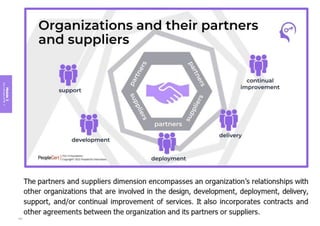
Workbook
ITIL®
4 Foundation
Official Training Materials
1
About thismaterial
Modules
Axle Car Hire
2.1 The concept of value
5.1 Purpose of the ITIL practices
3.1 Four dimensions of service management
4.1 Introduction to the guiding principles
2.3 Service offerings
5.3 Key management practices – Part 1
3.3 Service value chain
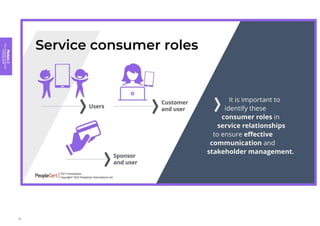
2.2 Stakeholder and service consumer roles
5.2 Overview of eight ITIL practices
3.2 ITIL service value system
4.2 Using the guiding principles
2.4 Creating value with services
5.4 Key management practices – Part 2
5.5 Key management practices – Part 3
1. Introduction
2. Keyconceptsof service management
5. ITIL 4 management practices
6. Course review
3. Keyconceptsof ITIL 4
4. The guiding principles
Service value chain
Value chain activities
Key conceptsof ITIL
Guiding principles
ITILmanagement practices
Appendix1– Handouts/activitysheets
453
9
230
92
159
39
299
132
19
255
119
211
53
341
383
5
8
229
424
91
158
455
459
454
466
471
3
452
Candidate syllabusand index
Sample papers
Glossary
Appendix2– Resources
Index
475
480
538
474
557
Unlocking your
potential to
achieve more
Contents
Copyright 2023 PeopleCertInternational Ltd.
©
All rightsreserved.No partofthispublication maybe reproduced or transmitted inanyform and byanymeans(electronic,photocopying,recording orotherwise) except
aspermitted in writing byPeopleCertInternational Ltd.Enquiriesfor permissionto reproduce,transmitor use for anypurposethismaterialshould be directed to the
publisher.
D
isclaimer
Thispublication isdesigned to provide helpful information to the reader.Although everycarehasbeen taken byPeopleCertInternational Ltd in the preparation ofthis
publication,no representation orwarranty(expressorimplied)isgiven byPeopleCertInternational Ltd aspublisher with respectasto the completeness,accuracy,
reliability,suitabilityor availabilityofthe information contained within itandneithershallPeopleCertInternational Ltd be responsibleor liable for anylossordamage
whatsoever(indicativelybutnotlimited to,special,indirect,consequential) arising orresultingofvirtueofinformation.instructionsor advice containedwithinthis
publication.
Powering
Best
P ractice
Welcome to the Learner
Workbook for the ITIL®
4
FoundationOfficialTraining
Materials.
PeopleCertdevelops global best practice
frameworks and certifications,manages
exams, and delivers certifications.
Its product portfolioof more than
700 certifications inIT& Digital
Transformation, ProjectManagement,
Business, and Languages includes ITIL®
and PRINCE2®
- two ofthe most globally
recognisedIP-protectedframeworks,
developed and evolvedby the UK
Government over a 30-year period.
The Official TrainingMaterials forour
courses enhance the learningexperience
for both trainers and learners, enabling
high quality andeffective delivery of
training. PeopleCertproducts combine
the knowledge and experience of experts
from around the world.
Our courses use that knowledge to
transform learners from beginner
to practitioner, utilizingreal-world
experience, product expertise, andyears
of trainingknowledge to bring the topic
alive.
Consequently, learners will developa
solidfoundation on whichto develop
their businesses and improve their
careers.
2
Discover more at my.axelos.com
yone who is To help you identify what is core
TIL 4 Foundation content and what is extended content,
is to provide the module slide decks feature colour-
nderstanding of coded borders. The slides that feature
mmon language, a purple border are core content
ices that enable and those with a grey border are
anagement. optional extended content such as
ok has been activities and quizzes that will allow
prepare for you test your knowledge.
examination. It
nd an overview
inable content.
ook also includes
ctivities, and
nswers and
book is designed
and add value
rience. The
des valuable
enhance your
tanding of the
the Official Book
it provides
n the modules
ner Workbook.
rovided at the
will help you
f the Οfficial
oughout the
This course is for an
preparing to sit the I
examination. The aim
you with a practical u
the key concepts, co
principles, and pract
successful service m
The Learner Workbo
designed to help you
the ITIL 4 Foundation
provides guidance a
of the course’s exam
This Learner Workb
questions/quizzes, a
sample papers with a
rationales. The work
to reinforce learning
to your course expe
workbook also inclu
resources, which will
learning and unders
material.
Do not forget to use
during the course, as
further information o
explored in the Lear
The Syllabus Index p
end of the workbook
identify the sections o
Βook referenced thr
material.
About
this material
3
A ims of the c ourse
The overall aim of this course is to enable you
to gain a pass mark in the ITIL 4 Foundation
examination. To pass the exam, you will need to:
• understand how the ITIL 4 service management
framework has evolved to adopt modern
technologies and ways of working
• recall the common language and the key
concepts of ITIL
• gain an overall understanding of how to manage
modern IT-enabled services
• know how to use the ITIL 4 guidance to improve
your work and the work of the organization.
•
The ITIL® 4 F oundation
examination
The examination is designed to assess whether you
can demonstrate sufficient recall and understanding
of the ITIL 4 service management framework, as
described in the syllabus. The ITIL 4 Foundation
certification is a prerequisite for studying ITIL 4 at a
higher level.
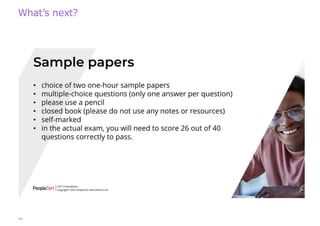
Two sample Foundation papers are available for you
to practise during the course. These will help you to
become confident in your understanding of ITIL 4,
and familiarize you with the style and structure of
the exams.
Take advantage of the mock exams and set yourself
up for success! Mock exams are one of the best
ways to engage in practice and tackle exam anxiety.
You will sit a one-hour examination. All questions
are multiple-choice and there is only one correct
answer per question.
Remember, this is a closed book exam, so you must
not have any notes or resources available.
You will n eed to an swer 26 out of 4 0
quest ions correctly to pass.
You can always use the Take2
resit option, which is
available at a fraction of the original exam price, if
you require another attempt.
Information icons
Objectives
Timed activity
Discuss/reflect/activity
Think about/question and answer
Key learning points
Detailed ITIL practice
Review or multiple choice question
The slides that feature a purple border are core content
The slides that feature a grey border are optional extended
content
4
Discover more at my.axelos.com
Discover more at my
.axelos.com
Module 1
Introduction
5
Module
1
Introduction
1. Introduction
ITIL has led the ITSM industry with the provision of guidance, training,
and certification programmes for more than 30 years. ITIL 4 brings ITIL
up-to-date, by reshaping much of the established ITSM practices within
the wider context of the customer experience, value streams, and digital
transformation, as well as embracing new ways of working, such as
Lean, Agile, and DevOps.
The ITIL 4 Foundation qualification is intended to introduce learners to
the management of modern IT-enabled services, to provide them with an
understanding of the common language and key concepts, and to show
them how they can improve their work and the work of their organization
with ITIL 4 guidance.
6
Module
1
Introduction
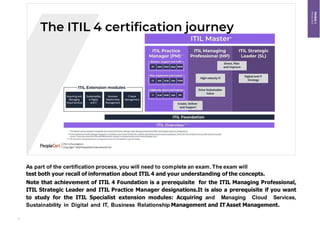
As part of the certification process, you will need to complete an exam. The exam will
test both your recall of information about ITIL 4 and your understanding of the concepts.
Note that achievement of ITIL 4 Foundation is a prerequisite for the ITIL Managing Professional,
ITIL Strategic Leader and ITIL Practice Manager designations.It is also a prerequisite if you want
to study for the ITIL Specialist extension modules: Acquiring and Managing Cloud Services,
Sustainability in Digital and IT, Business Relationship Management and IT Asset Management.
7
Discover
Discover more
moreat
at
my.axelos.com
my
.axelos.com
Module 2
Key concepts of service
management
Discover more at my
.axelos.com
1.The concept of value
2.Stakeholder and service
consumer roles
3. Service offerings
4. Creating value with
services
8
Module
2
Key
concepts
of
service
management
Module
2
Key
concepts
of
service
management
2.1 The concept of value
9
Module
2
Key
concepts
of
service
management
2.1 The concept of value
10
Module
2
Key
concepts
of
service
management
2.1 The concept of value
11
Module
2
Key
concepts
of
service
management
2.1 The concept of value
12
Module
2
Key
concepts
of
service
management
13
Module
2
Key
concepts
of
service
management
14
Module
2
Key
concepts
of
service
management
15
16
17
18
Module
2
Key
concepts
of
service
management
2.2 Stakeholder and service consumer roles
19
Module
2
Key
concepts
of
service
management
2.2 Stakeholder and service consumer roles
20
Module
2
Key
concepts
of
service
management
2.2 Stakeholder and service consumer roles
21
Module
2
Key
concepts
of
service
management
22
Module
2
Key
concepts
of
service
management
23
Module
2
Key
concepts
of
service
management
24
Module
2
Key
concepts
of
service
management
25
Module
2
Key
concepts
of
service
management
26
Module
2
Key
concepts
of
service
management
27
Module
2
Key
concepts
of
service
management
28
Module
2
Key
concepts
of
service
management
29
Module
2
Key
concepts
of
service
management
30
Module
2
Key
concepts
of
service
management
31
Module
2
Key
concepts
of
service
management
32
Module
2
Key
concepts
of
service
management
33
Module
2
Key
concepts
of
service
management
34
Module
2
Key
concepts
of
service
management
35
Module
2
Key
concepts
of
service
management
36
Module
2
Key
concepts
of
service
management
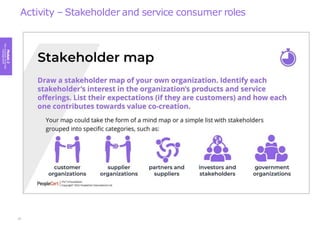
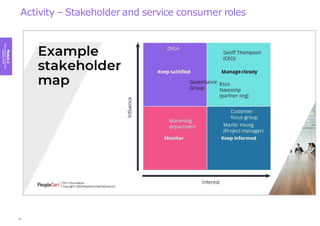
Activity – Stakeholder and service consumer roles
37
Module
2
Key
concepts
of
service
management
Activity – Stakeholder and service consumer roles
38
Module
2
Key
concepts
of
service
management
2.3 Service offerings
39
Module
2
Key
concepts
of
service
management
2.3 Service offerings
40
Module
2
Key
concepts
of
service
management
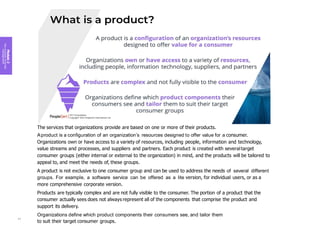
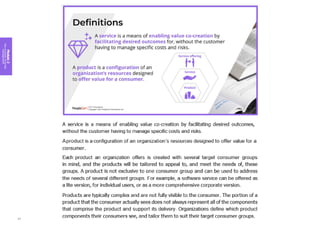
The services that organizations provide are based on one or more of their products.
Aproduct is a configuration of an organization’s resources designed to offer value for a consumer.
Organizations own or have access to a variety of resources, including people, information and technology,
value streams and processes, and suppliers and partners. Each product is created with several target
consumer groups (either internal or external to the organization) in mind, and the products will be tailored to
appeal to, and meet the needs of, these groups.
A product is not exclusive to one consumer group and can be used to address the needs of several different
groups. For example, a software service can be offered as a lite version, for individual users, or as a
more comprehensive corporate version.
Products are typically complex and are not fully visible to the consumer. The portion of a product that the
consumer actually sees does not always represent all of the components that comprise the product and
support its delivery.
Organizations define which product components their consumers see, and tailor them
to suit their target consumer groups.
41
Module
2
Key
concepts
of
service
management
42
Module
2
Key
concepts
of
service
management
43
Module
2
Key
concepts
of
service
management
44
Module
2
Key
concepts
of
service
management
45
Module
2
Key
concepts
of
service
management
46
Module
2
Key
concepts
of
service
management
47
Module
2
Key
concepts
of
service
management
48
Module
2
Key
concepts
of
service
management
49
Module
2
Key
concepts
of
service
management
50
Module
2
Key
concepts
of
service
management
51
Module
2
Key
concepts
of
service
management
52
Module
2
Key
concepts
of
service
management
2.4 Creating value with services
53
Module
2
Key
concepts
of
service
management
2.4 Creating value with services
54
Module
2
Key
concepts
of
service
management
2.4 Creating value with services
55
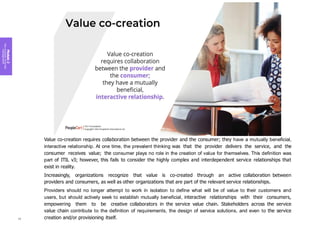
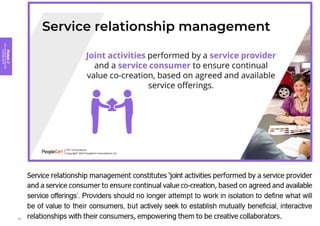
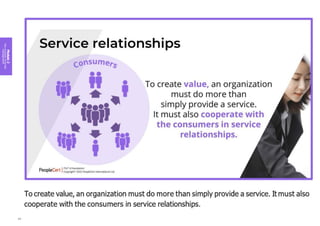
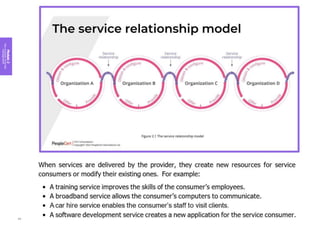
Value co-creation requires collaboration between the provider and the consumer; they have a mutually beneficial,
interactive relationship. At one time, the prevalent thinking was that the provider delivers the service, and the
consumer receives value; the consumer plays no role in the creation of value for themselves. This definition was
part of ITIL v3; however, this fails to consider the highly complex and interdependent service relationships that
exist in reality.
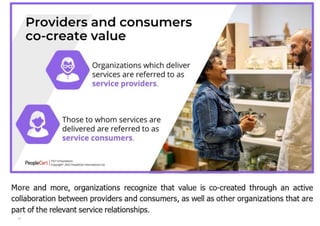
Increasingly, organizations recognize that value is co-created through an active collaboration between
providers and consumers, as well as other organizations that are part of the relevant service relationships.
Providers should no longer attempt to work in isolation to define what will be of value to their customers and
users, but should actively seek to establish mutually beneficial, interactive relationships with their consumers,
empowering them to be creative collaborators in the service value chain. Stakeholders across the service
value chain contribute to the definition of requirements, the design of service solutions, and even to the service
creation and/or provisioning itself.
Module
2
Key
concepts
of
service
management
56
Module
2
Key
concepts
of
service
management
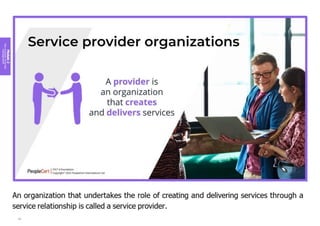
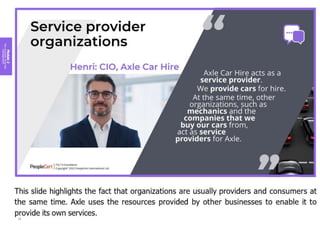
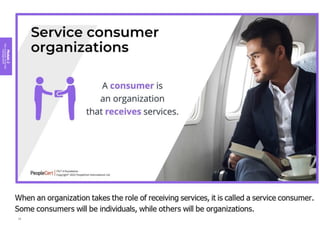
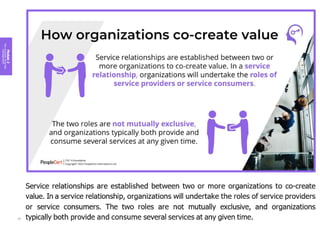
When provisioning services, an organization undertakes the role of the service provider. The provider can be
external to the consumer’s organization, or they can both be part of the same organization. In more traditional
views of ITSM, the provider organization is seen as the IT department of a company, and the other departments or
other functional units in the company are regarded as the consumers. This is, however, only one very simple
provider, the consumer model.
A provider could be selling services on the open market to other businesses, to individual consumers, or it could be
part of a service alliance, collaborating to provide services to consumer organizations. The key is that the
organization in the provider role has a clear understanding of who its consumers are in a given situation, and who
the other stakeholders are in the associated service relationships.
57
Module
2
Key
concepts
of
service
management
58
Module
2
Key
concepts
of
service
management
59
Module
2
Key
concepts
of
service
management
60
Module
2
Key
concepts
of
service
management
61
Module
2
Key
concepts
of
service
management
62
Module
2
Key
concepts
of
service
management
63
Module
2
Key
concepts
of
service
management
64
Module
2
Key
concepts
of
service
management
65
Module
2
Key
concepts
of
service
management
66
Module
2
Key
concepts
of
service
management
67
Module
2
Key
concepts
of
service
management
68
Module
2
Key
concepts
of
service
management
69
Module
2
Key
concepts
of
service
management
70
Module
2
Key
concepts
of
service
management
71
Module
2
Key
concepts
of
service
management
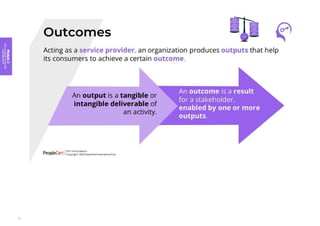
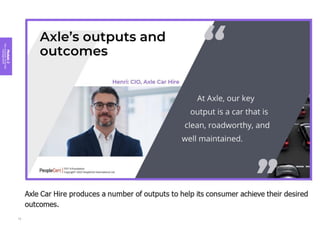
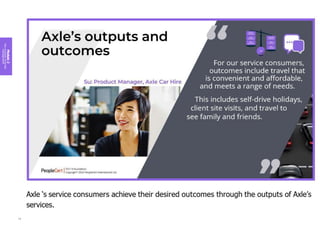
Acting as a service provider, an organization produces outputs that help its consumers to achieve a certain
outcome.
An output is a tangible or intangible deliverable of an activity.
An outcome is a result for a stakeholder enabled by one or more outputs.
It is important to be clear about the difference between outputs and outcomes. For example, one output of a
wedding photography service might be an album in which selected photos are artfully arranged. The
outcome of the service, however, is the preservation of memories and the ability of the couple and their
family and friends to easily recall those memories by looking at the album. Depending on the relationship
between the provider and the consumer, it can be difficult for the provider to fully understand the
outcomes that the consumer wants to achieve. In some cases, they will collaborate to define the desired
outcomes.
For example, business relationship managers (BRMs) in internal IT or HR departments might regularly talk with
customers and discuss their needs and expectations. In other cases, the consumers articulate their expectations
quite clearly, and the provider expects them to do so, such as when standardized services are offered to a wide
consumer group. This is how mobile operators, broadband service providers, and transport companies usually
operate. Finally, some service providers predict or even create demand for certain outcomes, forming a target
group for their services. This might happen with innovative services, addressing needs that consumers were not
even aware of before. Examples of this include social networks or smart home solutions.
72
Module
2
Key
concepts
of
service
management
73
Module
2
Key
concepts
of
service
management
74
Module
2
Key
concepts
of
service
management
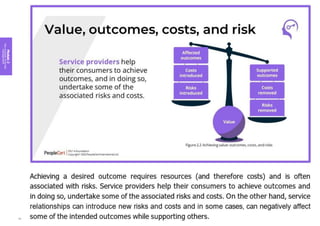
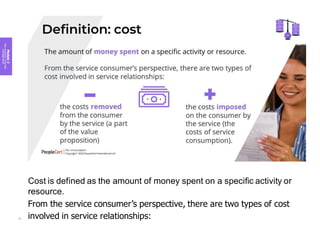
Cost is defined as the amount of money spent on a specific activity or
resource.
From the service consumer’s perspective, there are two types of cost
involved in service relationships:
75
Module
2
Key
concepts
of
service
management
•Costs removed from the consumer by the service (a part of the value
proposition). This might include the costs of staff, technology, and other
resources, which the consumer does not need to provide.
•Costs that are imposed on the consumer by the service (the costs of
service consumption).
•The total cost of consuming a service includes the price charged by the service
provider (if applicable), plus other costs such as staff training, costs of
network utilization, procurement, and so on. Some consumers describe this as
what they must ‘invest’ to consume the service.
Both types of cost are considered when the consumer assesses the value, which
they expect the service to create. To ensure that the correct decisions are made
about the service relationship, it is important that both types of cost are fully
understood.
From the provider’s perspective, a full understanding of the cost of service
provision is essential. Providers need to ensure that services are delivered within
budget constraints and meet the financial expectations of the organization.
76
Module
2
Key
concepts
of
service
management
77
Module
2
Key
concepts
of
service
management
78
Module
2
Key
concepts
of
service
management
79
Module
2
Key
concepts
of
service
management
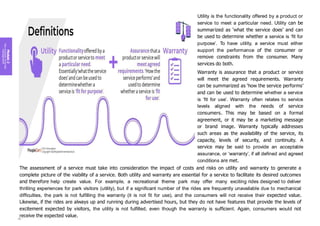
Utility is the functionality offered by a product or
service to meet a particular need. Utility can be
summarized as ‘what the service does’ and can
be used to determine whether a service is ‘fit for
purpose’. To have utility, a service must either
support the performance of the consumer or
remove constraints from the consumer. Many
services do both.
Warranty is assurance that a product or service
will meet the agreed requirements. Warranty
can be summarized as ‘how the service performs’
and can be used to determine whether a service
is ‘fit for use’. Warranty often relates to service
levels aligned with the needs of service
consumers. This may be based on a formal
agreement, or it may be a marketing message
or brand image. Warranty typically addresses
such areas as the availability of the service, its
capacity, levels of security, and continuity. A
service may be said to provide an acceptable
assurance, or ‘warranty’, if all defined and agreed
conditions are met.
The assessment of a service must take into consideration the impact of costs and risks on utility and warranty to generate a
complete picture of the viability of a service. Both utility and warranty are essential for a service to facilitate its desired outcomes
and therefore help create value. For example, a recreational theme park may offer many exciting rides designed to deliver
thrilling experiences for park visitors (utility), but if a significant number of the rides are frequently unavailable due to mechanical
difficulties, the park is not fulfilling the warranty (it is not fit for use), and the consumers will not receive their expected value.
Likewise, if the rides are always up and running during advertised hours, but they do not have features that provide the levels of
excitement expected by visitors, the utility is not fulfilled, even though the warranty is sufficient. Again, consumers would not
receive the expected value.
80
Module
2
Key
concepts
of
service
management
81
Module
2
Key
concepts
of
service
management
82
Module
2
Key
concepts
of
service
management
83
Module
2
Key
concepts
of
service
management
84
Module
2
Key
concepts
of
service
management
85
Module
2
Key
concepts
of
service
management
86
Module
2
Key
concepts
of
service
management
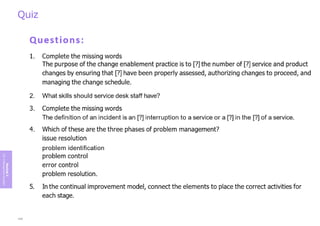
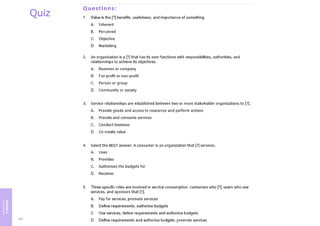
Quiz
87
Module
2
Key
concepts
of
service
management
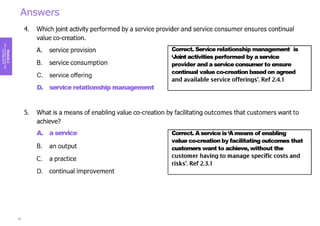
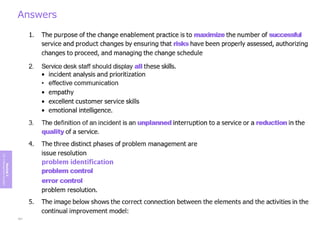
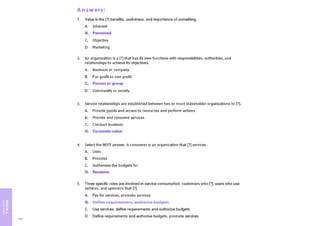
Answers
88
Module
2
Key
concepts
of
service
management
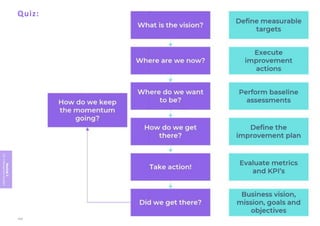
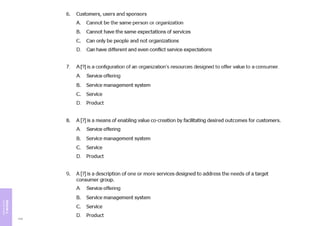
Quiz
89
Module
2
Key
concepts
of
service
management
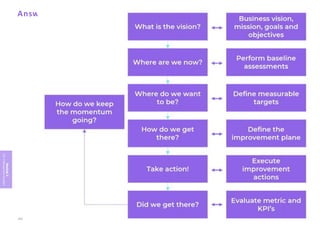
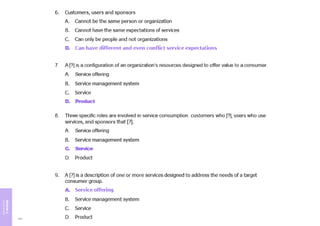
Answers
90
Discover more at my.axelos.com
Module 3
Key concepts of ITIL 4
Discover more at my
.axelos.com
1.Four dimensions of
service management
2.ITIL service value
system
3.Service value chain
91
Module
3
Key
concepts
of
ITIL
4
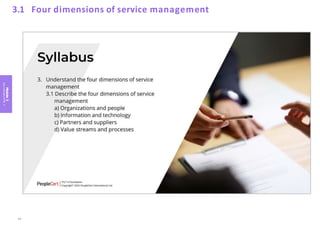
3.1 Four dimensions of service management
92
Module
3
Key
concepts
of
ITIL
4
3.1 Four dimensions of service management
93
Module
3
Key
concepts
of
ITIL
4
3.1 Four dimensions of service management
94
Module
3
Key
concepts
of
ITIL
4
95
Module
3
Key
concepts
of
ITIL
4
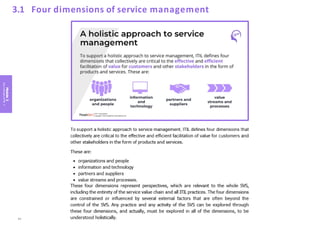
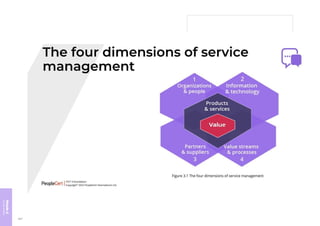
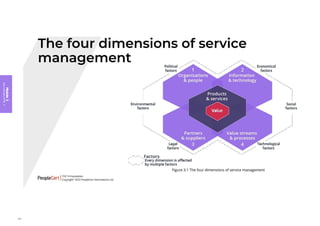
Failing to address all four dimensions properly may result in services becoming
undeliverable, or not meeting the expectations for quality or efficiency. For example, failing to
consider the value streams and processes dimension holistically can lead to wasteful work,
duplication of efforts, or worse, work that conflicts with what is being done elsewhere in the
organization. Equally, ignoring the partners and suppliers dimension could mean that outsourced
services are misaligned with the needs of the organization. The four dimensions do not have sharp
boundaries and may overlap. They will sometimes interact in unpredictable ways, depending on the
level of complexity and uncertainty in which an organization operates.
It is important to note that the four dimensions of service management apply to all services being
managed, as well as to the SVS in general. It is therefore essential that these perspectives should be
considered for every service and that each one should be addressed when managing and improving
the SVS at all levels.
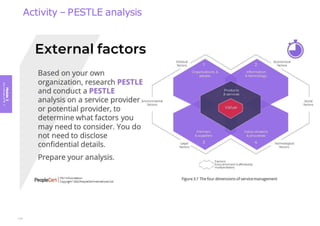
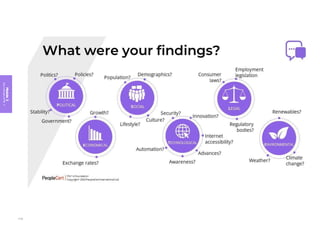
The PESTLE external factors surround Figure 3.1. These can all be relevant to any of the four
dimensions; do not assume they refer only to the ones they are close to. For example: asking a
public sector client which of the dimensions was their weakest, they identified information and
technology, explaining that they had servers still running an unsupported, unpatched version of
Windows Server. These server issues had been caused by budget cuts, which were an economic
fact. The city was in financial difficulty, which created a social climate of desire for fiscal responsibility,
which created a political factor. A new mayor was elected on a promise to slash budgets, and did so.
All of these external factors caused push and pull and resulted in a big weakness for the organization
in information and technology. Those weaknesses then have the potential to further influence
political, social, and legal factors, should they causedatabreaches, for example.
These external factors will be different in nature and in chain of cause and effect in each
situation, and they allow you to understand where the internal situation came from.
96
Module
3
Key
concepts
of
ITIL
4
97
Module
3
Key
concepts
of
ITIL
4
98
Module
3
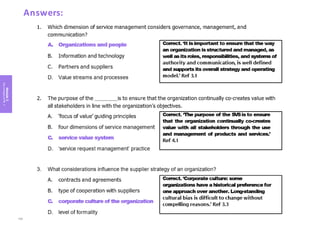
Key
concepts
of
ITIL
4
99
Module
3
Key
concepts
of
ITIL
4
100
Module
3
Key
concepts
of
ITIL
4
101
Module
3
Key
concepts
of
ITIL
4
102
Module
3
Key
concepts
of
ITIL
4
103
Module
3
Key
concepts
of
ITIL
4
104
Module
3
Key
concepts
of
ITIL
4
105
Module
3
Key
concepts
of
ITIL
4
106
Module
3
Key
concepts
of
ITIL
4
107
Module
3
Key
concepts
of
ITIL
4
108
Module
3
Key
concepts
of
ITIL
4
109
Module
3
Key
concepts
of
ITIL
4
110
Module
3
Key
concepts
of
ITIL
4
111
Module
3
Key
concepts
of
ITIL
4
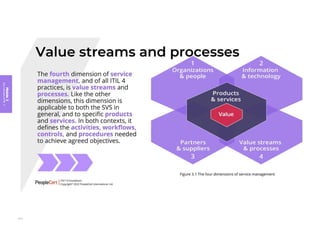
The fourth dimension of service management, and of all ITIL 4 practices, is value streams and processes.
Like the other dimensions, this dimension is applicable to both the SVS in general, and to specific
products and services. In both contexts, it defines the activities, workflows, controls, and procedures
needed to achieve agreed objectives.
An example of a one dimensional approach to service management is an organization that focuses only
on processes. They create a process for every situation, but they neglect to consider who would be
delivering those processes. Without that focus on organizations and people, compliance to the
processes and sensible decision-making when problems arise can cause service management to come
off the rails.
People need to be properly engaged with the reasons for the processes, and the ultimate outcomes they
serve, because processes are not autonomous, nor can they predict every situation. They have to be
executed by humans, and when inevitable exceptions occur, those humans need to make good,
informed decisions to get the right outcomes. ITIL provides organizations, acting as service providers, an
operating model that covers all the key activities required to manage products and services effectively.
This is referred to as the ITIL service value chain. The service value chain operating model is generic and
in practice can follow different patterns. These patterns within the value chain operation are called value
streams.
We can understand ITIL 4 in relation to the universe. The entire universe is too hard to discuss; it is
ever expanding, so whatever we say is out of date by the time we have finished saying it. It can,
however, be broken down into galaxies, solar systems, planets, continents, nations, states, counties,
towns. These levels of granularity make the universe understandable. The universal level of ITIL 4 is the
SVS. Zoom in to a galaxy, the SVC, and closer still, to value streams, and those value streams are made
up of practices. They can be considered as a bucket of blocks, which can be combined to make
structures, architectures, or in ITIL 4 language, value streams. Contained within the practices are all
four dimensions, including processes. These are made up of standard operating procedures. From this,
zoom back out to the SVS.
112
Module
3
Key
concepts
of
ITIL
4
113
Module
3
Key
concepts
of
ITIL
4
114
Module
3
Key
concepts
of
ITIL
4
115
Module
3
Key
concepts
of
ITIL
4
116
Module
3
Key
concepts
of
ITIL
4
Activity – PESTLE analysis
117
Module
3
Key
concepts
of
ITIL
4
118
Module
3
Key
concepts
of
ITIL
4
3.2 ITIL service value system
This slide outlines the key learning points that will be covered in this topic.
119
Module
3
Key
concepts
of
ITIL
4
120
Module
3
Key
concepts
of
ITIL
4
121
Module
3
Key
concepts
of
ITIL
4
122
Module
3
Key
concepts
of
ITIL
4
123
Module
3
Key
concepts
of
ITIL
4
124
Module
3
Key
concepts
of
ITIL
4
125
Module
3
Key
concepts
of
ITIL
4
126
Module
3
Key
concepts
of
ITIL
4
127
Module
3
Key
concepts
of
ITIL
4
128
Module
3
Key
concepts
of
ITIL
4
129
Module
3
Key
concepts
of
ITIL
4
Consider the questions on the slide and how these would apply to your
organization.
130
Module
3
Key
concepts
of
ITIL
4
This slide outlines the key learning points that were covered in this topic.
131
Module
3
Key
concepts
of
ITIL
4
3.3 Service value chain
132
Module
3
Key
concepts
of
ITIL
4
This slide outlines the key learning points that will be covered in this topic.
133
Module
3
Key
concepts
of
ITIL
4
134
Module
3
Key
concepts
of
ITIL
4
135
Module
3
Key
concepts
of
ITIL
4
136
Module
3
Key
concepts
of
ITIL
4
137
Module
3
Key
concepts
of
ITIL
4
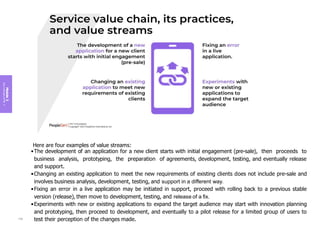
Here are four examples of value streams:
•The development of an application for a new client starts with initial engagement (pre-sale), then proceeds to
business analysis, prototyping, the preparation of agreements, development, testing, and eventually release
and support.
•Changing an existing application to meet the new requirements of existing clients does not include pre-sale and
involves business analysis, development, testing, and support in a different way.
•Fixing an error in a live application may be initiated in support, proceed with rolling back to a previous stable
version (release), then move to development, testing, and release of a fix.
•Experiments with new or existing applications to expand the target audience may start with innovation planning
and prototyping, then proceed to development, and eventually to a pilot release for a limited group of users to
test their perception of the changes made.
138
Module
3
Key
concepts
of
ITIL
4
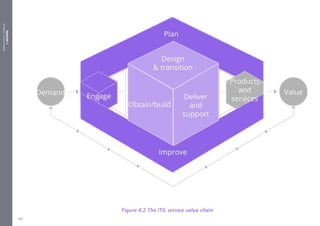
These example value streams may combine any number of practices and value
chain activities in various ways to improve products and services and increase
potential value for the consumers and the organization. Value streams are
designed and documented based on specific situations. There is no requirement
that a value stream must include all six activities. Some situations can be
addressed in a more straightforward manner. Also, any SVC activity can be used
several times as required by the situation, depending on how involved or complex
it is. It is also possible that a provider may need to engage with consumers
multiple times in a single value stream.
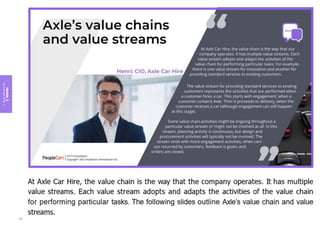
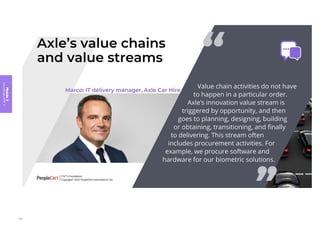
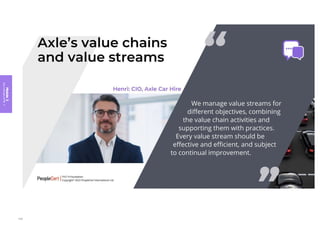
The following slides outline Axle’s value chain and value streams.
139
Module
3
Key
concepts
of
ITIL
4
140
Module
3
Key
concepts
of
ITIL
4
141
Module
3
Key
concepts
of
ITIL
4
142
Module
3
Key
concepts
of
ITIL
4
143
Module
3
Key
concepts
of
ITIL
4
144
Module
3
Key
concepts
of
ITIL
4
145
Module
3
Key
concepts
of
ITIL
4
146
Module
3
Key
concepts
of
ITIL
4
147
Module
3
Key
concepts
of
ITIL
4
148
Module
3
Key
concepts
of
ITIL
4
149
Module
3
Key
concepts
of
ITIL
4
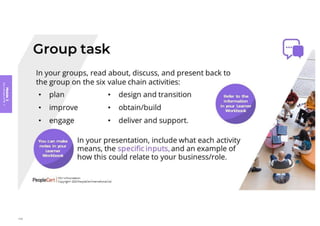
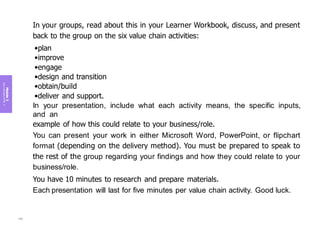
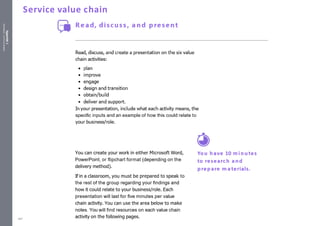
In your groups, read about this in your Learner Workbook, discuss, and present
back to the group on the six value chain activities:
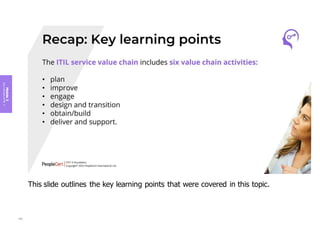
•plan
•improve
•engage
•design and transition
•obtain/build
•deliver and support.
In your presentation, include what each activity means, the specific inputs,
and an
example of how this could relate to your business/role.
You can present your work in either Microsoft Word, PowerPoint, or flipchart
format (depending on the delivery method). You must be prepared to speak to
the rest of the group regarding your findings and how they could relate to your
business/role.
You have 10 minutes to research and prepare materials.
Each presentation will last for five minutes per value chain activity. Good luck.
150
Module
3
Key
concepts
of
ITIL
4
151
Module
3
Key
concepts
of
ITIL
4
This slide outlines the key learning points that were covered in this topic.
152
Module
3
Key
concepts
of
ITIL
4
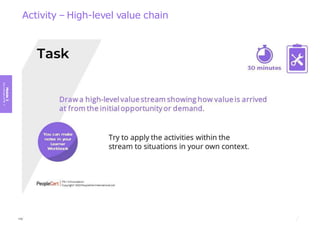
Activity – High-level value chain
114
153
Module
3
Key
concepts
of
ITIL
4
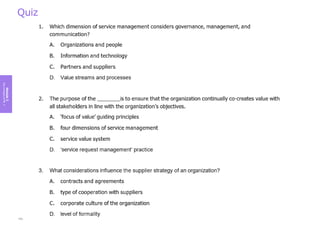
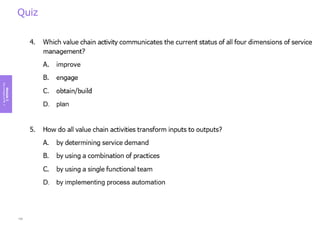
Quiz
154
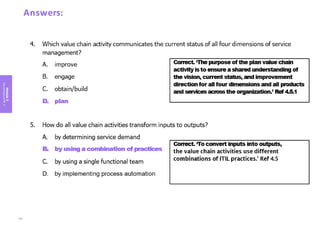
Answers:
Module
3
Key
concepts
of
ITIL
4
155
Module
3
Key
concepts
of
ITIL
4
Quiz
156
Answers:
Module
3
Key
concepts
of
ITIL
4
157
Discover more at my.axelos.com
Module 4
The guiding principles
Discover more at my
.axelos.com
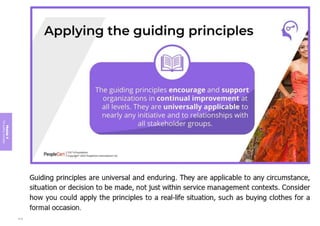
1.Introduction to
the guiding
principles
2.Using the
guiding
principles
158
Module
4
The
guiding
principles
4.1 Introduction to the guiding principles
159
This slide outlines the key learning points that will be covered in this topic.
Module
4
The
guiding
principles
160
Module
4
The
guiding
principles
161
Module
4
The
guiding
principles
162
Module
4
The
guiding
principles
163
Module
4
The
guiding
principles
164
Module
4
The
guiding
principles
165
Module
4
The
guiding
principles
166
Module
4
The
guiding
principles
167
Module
4
The
guiding
principles
168
Module
4
The
guiding
principles
169
Module
4
The
guiding
principles
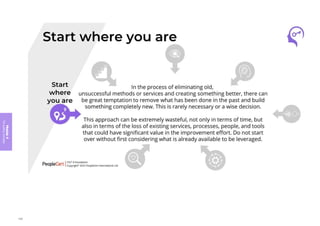
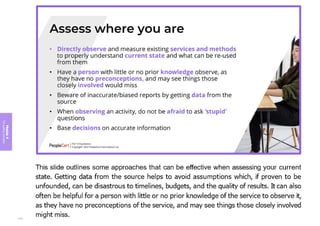
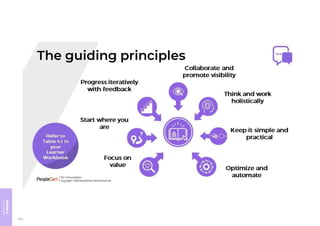
The key message of the start where you are principle is: ‘Do not start from scratch
and build something new without considering what is already available to be
leveraged. There is likely to be a great deal in the current services, processes,
programmes, projects, and people that can be used to create the desired outcome.’
In the process of eliminating old, unsuccessful methods or services and
creating something better, there can be great temptation to remove what has been
done in the past and build something completely new. This is rarely necessary or a
wise decision. This approach can be extremely wasteful, not only in terms of time,
but also in terms of the loss of existing services, processes, people, and tools that
could have significant value in the improvement effort. Do not start over without first
considering what is already available to be leveraged.
Consider this scenario: You are running a company that is growing from small to
medium sized, and you want to replace your old service approach. You have a
helpline which is answered by whoever happens to be free, and they usually send
someone directly to the desk of the person with the issue. You also have an open
door policy, whereby anyone can pop into the IT department to ask for help. You are
going to move to a service desk model with ticketing. What would you want to throw
out, and is there anything about the old system that is worth keeping?
170
Module
4
The
guiding
principles
171
Module
4
The
guiding
principles
172
Module
4
The
guiding
principles
173
Module
4
The
guiding
principles
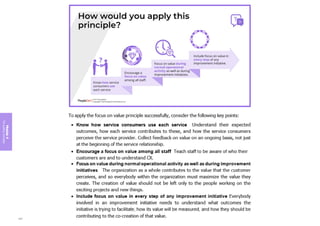
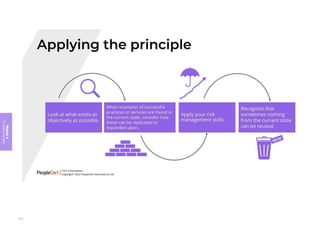
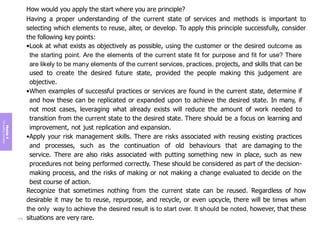
How would you apply the start where you are principle?
Having a proper understanding of the current state of services and methods is important to
selecting which elements to reuse, alter, or develop. To apply this principle successfully, consider
the following key points:
•Look at what exists as objectively as possible, using the customer or the desired outcome as
the starting point. Are the elements of the current state fit for purpose and fit for use? There
are likely to be many elements of the current services, practices, projects, and skills that can be
used to create the desired future state, provided the people making this judgement are
objective.
•When examples of successful practices or services are found in the current state, determine if
and how these can be replicated or expanded upon to achieve the desired state. In many, if
not most cases, leveraging what already exists will reduce the amount of work needed to
transition from the current state to the desired state. There should be a focus on learning and
improvement, not just replication and expansion.
•Apply your risk management skills. There are risks associated with reusing existing practices
and processes, such as the continuation of old behaviours that are damaging to the
service. There are also risks associated with putting something new in place, such as new
procedures not being performed correctly. These should be considered as part of the decision-
making process, and the risks of making or not making a change evaluated to decide on the
best course of action.
Recognize that sometimes nothing from the current state can be reused. Regardless of how
desirable it may be to reuse, repurpose, and recycle, or even upcycle, there will be times when
the only way to achieve the desired result is to start over. It should be noted, however, that these
situations are very rare.
174
Module
4
The
guiding
principles
175
Module
4
The
guiding
principles
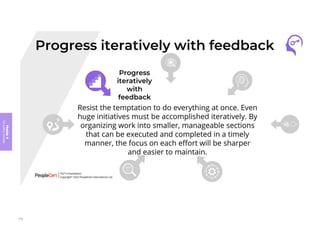
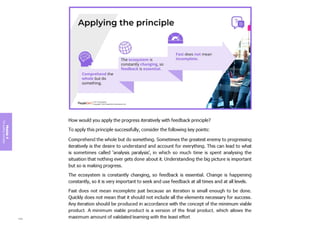
The key message of the progress iteratively with feedback principle is, ‘do not attempt to
do everything at once. Even huge initiatives must be accomplished iteratively. By
organizing work into smaller, manageable sections that can be executed and completed in a
timely manner, it is easier to maintain a sharper focus on each effort.’
Improvement iterations can be sequential or simultaneous, based on the requirements of
the improvement and what resources are available. Each individual iteration should be both
manageable and managed, ensuring that tangible results are returned in a timely manner
and developed to create further improvement. A major improvement initiative or
programme might be organized into several significant improvement initiatives, and each of
these may, in turn, comprise smaller improvement efforts. The overall initiative or
programme, as well as its component iterations, must be continually re-evaluated and
potentially revised to reflect any changes in circumstances and ensure that the focus on
value has not been lost. This re-evaluation should utilize a wide range of feedback channels
and methods to ensure that the status of the initiative and its progress are properly
understood.
A good axiom here is ‘how do you eat an elephant? One bite at a time’. The entire
elephant is a meal none of us can manage. Try to think of a large initiative that needs to be
undertaken or is being undertaken in your organization. Consider how the elements of that
initiative can be broken down, and how those smaller elements can be safely tested.
176
Module
4
The
guiding
principles
177
Module
4
The
guiding
principles
178
Module
4
The
guiding
principles
179
Module
4
The
guiding
principles
180
Module
4
The
guiding
principles
181
Module
4
The
guiding
principles
182
Module
4
The
guiding
principles
183
Module
4
The
guiding
principles
184
Module
4
The
guiding
principles
185
Module
4
The
guiding
principles
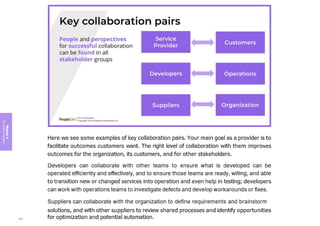
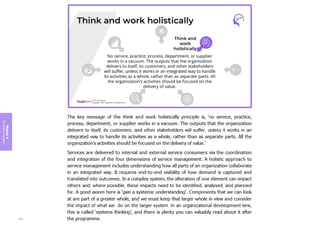
The key message of the collaborate and promote visibility principle is, ‘when initiatives involve the
right people in the correct roles, efforts benefit from better buy-in, greater relevance (because
better information is available for decision-making), and increased likelihood of long-term success.’
Creative solutions, enthusiastic contributions, and important perspectives can be obtained
from unexpected sources, so inclusion is generally a better policy than exclusion. Cooperation and
collaboration are better than isolated work, which is frequently referred to as ‘silo activity’. Silos can
occur through the behaviour of individuals and teams, but also through structural causes. This
typically happens where functions or business units in an organization are impeded or unable to
collaborate, because their processes, systems, documentation, and communications are designed
to fulfil the needs of only a specific part of the organization. Applying the guiding principle of think
and work holistically can help organizations to remove barriers between silos of work. The
recognition of the need for genuine collaboration has been one of the driving factors in the
evolution of what is now known as DevOps. Without effective collaboration, neither Agile, Lean, nor
any other ITSM framework or method will work.
A good axiom here is ‘inclusion is always better than exclusion’. The more people we include in a
decision, the better the decision and the better the end result generally, and also the higher level
of buy-in. The concomitant reality is a probable longer process, particularly if we seek consensus.
However, we do not need to seek consensus, only to be clear that we value people’s input, without
guaranteeing them a sign-off of agreement with the outcome.
186
Module
4
The
guiding
principles
187
Module
4
The
guiding
principles
The contribution to the improvement of each stakeholder group at each level should be
understood. It is also important to define the most effective methods to engage with them. For
example, the contribution to improvement from customers of a public cloud service may be
through a survey or checklist of options for different functionalities. For an internal customer
group, the contribution to improvement may come from feedback solicited via a workshop or
a collaboration tool on the organization’s intranet.
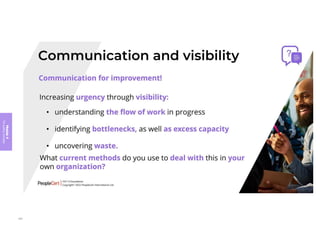
When stakeholders have poor visibility of the workload and progression of work, there is a
risk of creating the impression that the work is not a priority. If an initiative is
communicated to a team, department, or another organization and then is never, or rarely,
mentioned again, the perception will be that the change is not important. Equally, when staff
members attempt to prioritize improvement work versus other tasks that have daily urgency,
improvement work may seem to be a low-priority activity, unless its importance has been
made transparent and is supported by the organization’s management. The insufficient
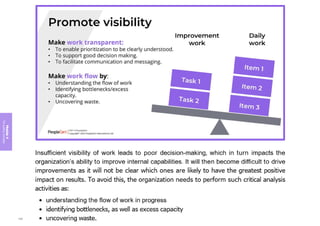
visibility of work leads to poor decision-making, which impacts the organization’s ability to
improve internal capabilities.
To avoid this, the organization needs to perform critical analysis activities, such as:
•understanding the flow of work in progress
•identifying bottlenecks, as well as excess capacity
•uncovering waste.
Consider what current methods you use to deal with this in your own organization.
188
Module
4
The
guiding
principles
189
Module
4
The
guiding
principles
190
Module
4
The
guiding
principles
191
Module
4
The
guiding
principles
192
Module
4
The
guiding
principles
193
Module
4
The
guiding
principles
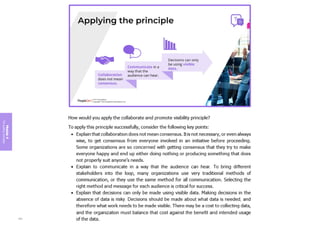
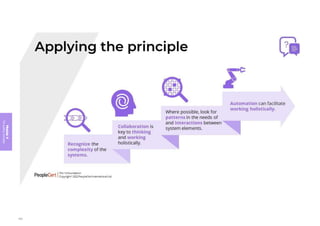
How would you apply the think and work holistically principle?
To apply this principle successfully, consider the following key points:
•Recognize the complexity of the systems. Different levels of complexity
require different heuristics for decision-making. Applying the methods and rules
designed for a simple system can be ineffective or even harmful in a complex
system, where relationships between components are complicated and change
more frequently.
•Collaboration is key to thinking and working holistically. If the right mechanisms
are established for all of the relevant stakeholders to collaborate in a timely
manner, issues can be addressed holistically without delay.
•Where possible, look for patterns in the needs of and interactions between
system elements. Use knowledge in each area to identify what is essential for
success, and which relationships between elements influence the outcomes. With
this information, needs can be anticipated, standards can be set, and a holistic
viewpoint can be achieved.
•Automation can facilitate working holistically. Where the opportunity and
sufficient resources are available, automation can support end-to-end
visibility for the organization and provide an efficient means of integrated
management.
194
Module
4
The
guiding
principles
195
Module
4
The
guiding
principles
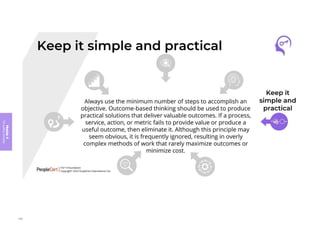
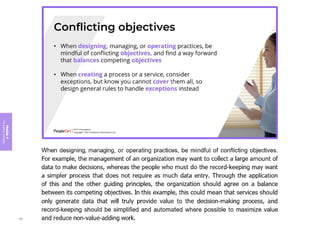
The key message of the keep it simple and practical principle is: `The minimum number of
steps should always be used to accomplish an objective. Outcome-based thinking should be
used to produce practical solutions that deliver valuable outcomes. If a process, service,
action, or metric fails to provide value or produce a useful outcome, then eliminate it.
Although this principle may seem obvious, it is frequently ignored, resulting in overly complex
methods of work that rarely maximize outcomes or minimize cost.’
Trying to provide a solution for every exception is excessive. When creating a process or a
service, designers need to think about exceptions, but they cannot cover them all. Instead,
rules should be designed that can be used to handle general exceptions. A good axiom here is
`simplicity is the ultimate in sophistication’. Apple has made a fortune by creating simple
looking products with simple interfaces which people can interact with easily to get great
results.
It is tough to take something that started off simple and keep it simple over time. We start off
with a simple idea or procedure, and someone develops an exception, and we add and add
those ‘what if’ sidelines, making our procedure complex and unwieldy. Away from IT, you can
see this in the huge books of expenses rules that companies create to avoid having to
manage people. We should be able to sit down with our employees and take them to task if
they spend excessively on their expenses. Instead, we create enormous books of rules to
spare our managers from doing that part of their job.
196
Module
4
The
guiding
principles
197
Module
4
The
guiding
principles
198
Module
4
The
guiding
principles
199
Module
4
The
guiding
principles
200
Module
4
The
guiding
principles
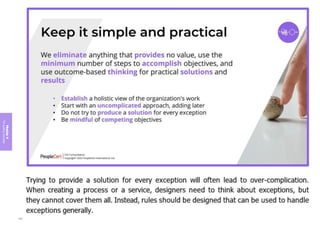
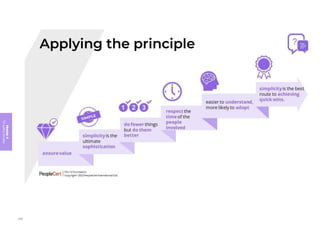
How would you apply the keep it simple and practical principle?
To apply this principle successfully, consider the following key points:
•Ensure that every activity contributes to the creation of value.
•Simplicity is the ultimate sophistication. It may seem harder to simplify, but it is
often
more effective.
•Do fewer things but do them better. Minimize activities to only include those
that have value for one or more stakeholders. This will enable stakeholders to
focus on creating the greatest value from those activities.
•Respect the time of the people involved: A process that is too complicated
and bureaucratic is a poor use of the time of the people involved.
•Easier to understand, more likely to adopt: To embed a practice, make sure it is
easy to follow.
•Simplicity is the best route to achieving quick wins: Whether in a project, or
when improving daily operations activities, quick wins allow organizations to
demonstrate progress and manage stakeholder expectations. Working in an
iterative way with
feedback will quickly deliver incremental value at regular intervals.
201
Module
4
The
guiding
principles
202
Module
4
The
guiding
principles
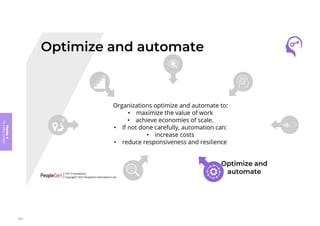
The key message of the optimize and automate principle is, ‘organizations must maximize the
value of the work performed by their human and technical resources.’ The four dimensions
model provides a holistic view of the various constraints, resource types, and other areas that
should be considered when designing, managing, or operating an organization. Technology can
help organizations to expand and undertake frequent and repetitive tasks, allowing human
resources to be used for more complex decision- making. However, technology should not
always be relied upon without the capability of human intervention, as automation for
automation’s sake can increase costs and reduce organizational robustness and resilience.
Optimization means to make something as effective and useful as it needs to be. Before an
activity can be effectively automated, it should be optimized to whatever degree is possible and
reasonable. It is essential that limits are set on the optimization of services and practices, as
they exist within a set of constraints which may include financial limitations, compliance
requirements, time constraints, and resource availability.
A useful definition of automation is ‘having technology do something that a human being once
did,’ but we could also think of it as ‘giving people limits or boundaries,’ in that if, for example, you
want to request a smartphone, we will go through a series of qualification procedures (are you a
manager, do you need to access certain systems) so that the process is objective and
repeatable, rather than subjective and easy to challenge.
203
Module
4
The
guiding
principles
204
Module
4
The
guiding
principles
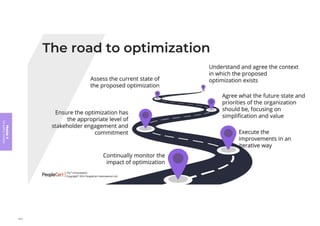
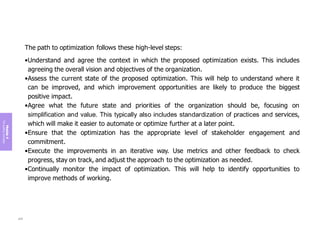
The path to optimization follows these high-level steps:
•Understand and agree the context in which the proposed optimization exists. This includes
agreeing the overall vision and objectives of the organization.
•Assess the current state of the proposed optimization. This will help to understand where it
can be improved, and which improvement opportunities are likely to produce the biggest
positive impact.
•Agree what the future state and priorities of the organization should be, focusing on
simplification and value. This typically also includes standardization of practices and services,
which will make it easier to automate or optimize further at a later point.
•Ensure that the optimization has the appropriate level of stakeholder engagement and
commitment.
•Execute the improvements in an iterative way. Use metrics and other feedback to check
progress, stay on track, and adjust the approach to the optimization as needed.
•Continually monitor the impact of optimization. This will help to identify opportunities to
improve methods of working.
205
Module
4
The
guiding
principles
206
Module
4
The
guiding
principles
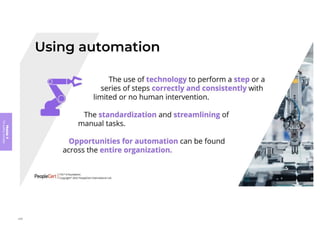
Automation typically refers to the use of technology to perform a step or a
series of steps correctly and consistently with limited or no human
intervention. For example, in organizations adopting continuous deployment,
it refers to the automatic and continuous release of code from development
through to live, and often automatic testing occurring in each environment. In
its simplest form, however, automation could also mean the standardization
and streamlining of manual tasks, such as defining the rules of part o f a
process to allow decisions to be made ‘automatically.’
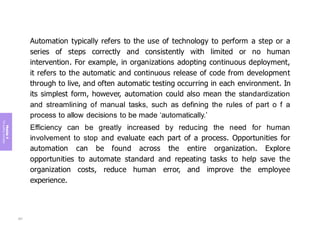
Efficiency can be greatly increased by reducing the need for human
involvement to stop and evaluate each part of a process. Opportunities for
automation can be found across the entire organization. Explore
opportunities to automate standard and repeating tasks to help save the
organization costs, reduce human error, and improve the employee
experience.
207
Module
4
The
guiding
principles
208
Module
4
The
guiding
principles
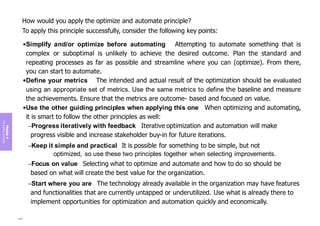
How would you apply the optimize and automate principle?
To apply this principle successfully, consider the following key points:
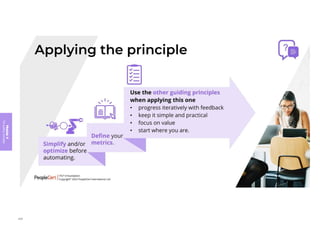
•Simplify and/or optimize before automating Attempting to automate something that is
complex or suboptimal is unlikely to achieve the desired outcome. Plan the standard and
repeating processes as far as possible and streamline where you can (optimize). From there,
you can start to automate.
•Define your metrics The intended and actual result of the optimization should be evaluated
using an appropriate set of metrics. Use the same metrics to define the baseline and measure
the achievements. Ensure that the metrics are outcome- based and focused on value.
•Use the other guiding principles when applying this one When optimizing and automating,
it is smart to follow the other principles as well:
–Progress iteratively with feedback Iterative optimization and automation will make
progress visible and increase stakeholder buy-in for future iterations.
–Keep it simple and practical It is possible for something to be simple, but not
optimized, so use these two principles together when selecting improvements.
–Focus on value Selecting what to optimize and automate and how to do so should be
based on what will create the best value for the organization.
–Start where you are The technology already available in the organization may have features
and functionalities that are currently untapped or underutilized. Use what is already there to
implement opportunities for optimization and automation quickly and economically.
209
Module
4
The
guiding
principles
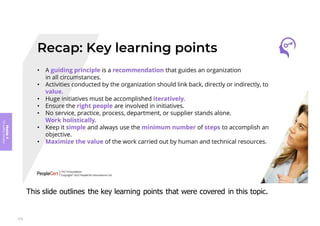
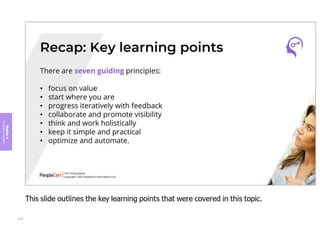
This slide outlines the key learning points that were covered in this topic.
210
Module
4
The
guiding
principles
4.2 Using the guiding principles
211
This slide outlines the key learning points that will be covered in this topic.
Module
4
The
guiding
principles
212
Module
4
The
guiding
principles
213
Module
4
The
guiding
principles
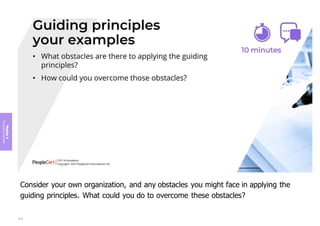
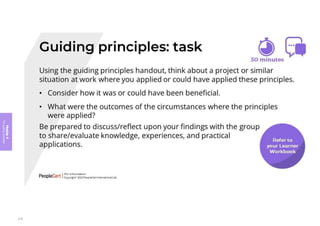
Consider your own organization, and any obstacles you might face in applying the
guiding principles. What could you do to overcome these obstacles?
214
Module
4
The
guiding
principles
215
Module
4
The
guiding
principles
216
Module
4
The
guiding
principles
217
Module
4
The
guiding
principles
218
Module
4
The
guiding
principles
219
Module
4
The
guiding
principles
220
Module
4
The
guiding
principles
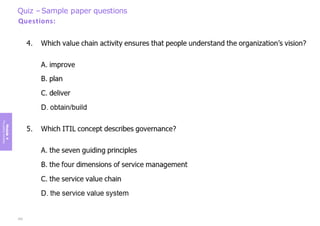
Quiz –Sample paper questions
Questions:
221
Module
4
The
guiding
principles
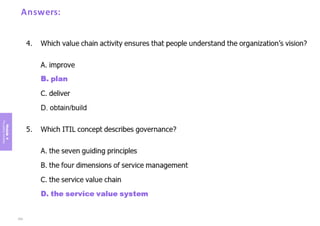
Answers:
222
Module
4
The
guiding
principles
Quiz –Sample paper questions
Questions:
223
Module
4
The
guiding
principles
Answers:
224
Module
4
The
guiding
principles
225
Module
4
The
guiding
principles
226
Module
4
The
guiding
principles
227
Module
4
The
guiding
principles
228
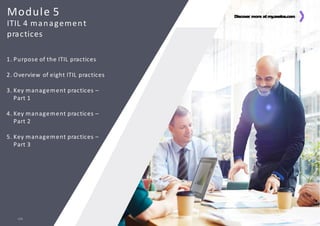
Discover more at my.axelos.com
Module 5
ITIL 4 management
practices
Discover more at my
.axelos.com
1. Purpose of the ITIL practices
2. Overview of eight ITIL practices
3. Key management practices –
Part 1
4. Key management practices –
Part 2
5. Key management practices –
Part 3
229
Module
5
ITIL
4
Management
practices
5.1 Purpose of the ITIL practices
230
Module
5
ITIL
4
Management
practices
This slide outlines the key learning points that will be covered in this topic.
231
Module
5
ITIL
4
Management
practices
232
Module
5
ITIL
4
Management
practices
233
Module
5
ITIL
4
Management
practices
234
Module
5
ITIL
4
Management
practices
235
Module
5
ITIL
4
Management
practices
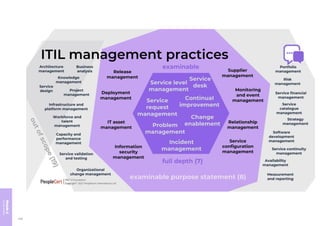
General management practices
236
Module
5
ITIL
4
Management
practices
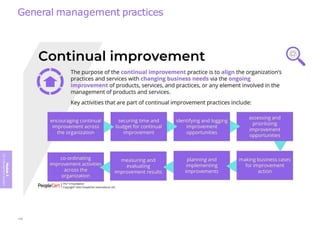
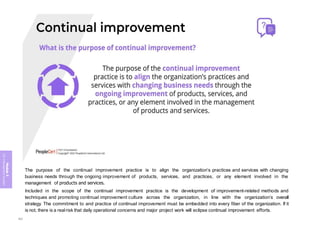
The purpose of the continual improvement practice is to align the organization’s practices and
services with changing business needs via the ongoing improvement of products, services, and
practices, or any element involved in the management of products and services.
The key activities of continual improvement practices include:
•encouraging continual improvement across the organization
•securing time and budget for continual improvement
•identifying and logging improvement opportunities
•assessing and prioritizing improvement opportunities
•making business cases for improvement action
•planning and implementing improvements
•measuring and evaluating improvement results
•coordinating improvement activities across the organization.
Included in the scope of the continual improvement practice is the development of
improvement-related methods and techniques and the propagation of a continual
improvement culture across the organization, in alignment with the organization’s overall strategy.
The commitment to and practice of continual improvement must be embedded into every fibre of
the organization. If it is not, there is a real risk that daily operational concerns and major project
work will eclipse continual improvement efforts.
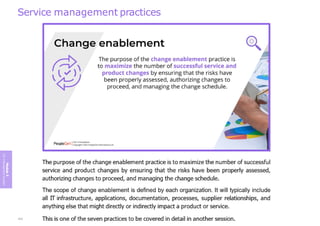
The ‘detailed practice’ icon on the slide denotes that this is one of the seven practices to be
covered in detail in another topic. This icon will be used throughout this topic to highlight the
other detailed practices.
237
Module
5
ITIL
4
Management
practices
238
Module
5
ITIL
4
Management
practices
239
Module
5
ITIL
4
Management
practices
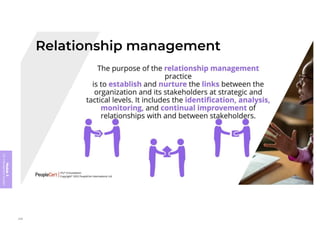
The purpose of the relationship management practice is to establish and nurture the links
between the organization and its stakeholders at strategic and tactical levels. It includes the
identification, analysis, monitoring, and continual improvement of relationships with and between
stakeholders.
The relationship management practice ensures:
•stakeholders’ needs and drivers are understood, and products and services are prioritized
appropriately
•stakeholders’ satisfaction is high, and a constructive relationship between the
organization and the stakeholders is established and maintained
•customers’ priorities for new or changed products and services, in alignment with
desired business outcomes, are effectively established and articulated
•any stakeholders’ complaints and escalations are handled well through a sympathetic (yet
formal) process
•products and services facilitate value creation for the service consumers, as well as for the
organization
•the organization facilitates value creation for all stakeholders, in line with its strategy and
priorities
•conflicting stakeholder requirements are mediated appropriately.
240
Module
5
ITIL
4
Management
practices
241
Module
5
ITIL
4
Management
practices
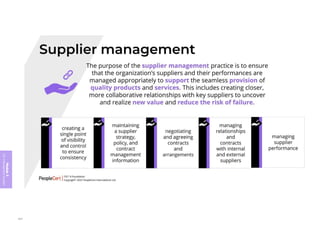
The purpose of the supplier management practice is to ensure that the organization’s
suppliers and their performances are managed appropriately to support the seamless
provision of quality products and services. This includes creating closer, more collaborative
relationships with key suppliers to uncover and realize new value and reduce the risk of
failure.
The activities that are central to the practice include:
•Creating a single point of visibility and control to ensure consistency This should be
across all products, services, service components, and procedures provided or operated by
internal and external suppliers, including customers acting as suppliers.
•Maintaining a supplier strategy, policy, and contract management information
•Negotiating and agreeing contracts and arrangements Agreements need to be aligned
with the business needs and service targets. Contracts with external suppliers might need to
be negotiated or agreed through the legal, procurement, commercial, or contracts functions
of the organization. For an internal supplier, there will need to be an internal agreement.
•Managing relationships and contracts with internal and external suppliers This should
be done when planning, designing, building, orchestrating, transitioning, and operating
products and services, working closely with procurement and performance management.
•Managing supplier performance Supplier performance should be monitored to
ensure that they meet the terms, conditions, and targets of their contracts and
agreements, while aiming to increase the value for money obtained from suppliers and the
products/services they provide.
242
Module
5
ITIL
4
Management
practices
Service management practices
243
Module
5
ITIL
4
Management
practices
244
Module
5
ITIL
4
Management
practices
245
Module
5
ITIL
4
Management
practices
246
247
248
Module
5
ITIL
4
Management
practices
249
Module
5
ITIL
4
Management
practices
250
Module
5
ITIL
4
Management
practices
251
Module
5
ITIL
4
Management
practices
252
Technical management practices
Module
5
ITIL
4
Management
practices
253
Module
5
ITIL
4
Management
practices
254
Module
5
ITIL
4
Management
practices
5.2 Overview of eight ITIL practices
255
This slide outlines the key learning points that will be covered in this topic.
Module
5
ITIL
4
Management
practices
256
Module
5
ITIL
4
Management
practices
257
Module
5
ITIL
4
Management
practices
258
Module
5
ITIL
4
Management
practices
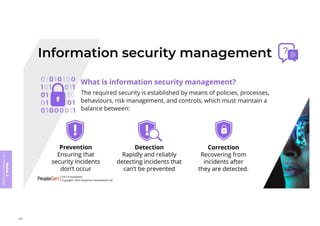
The necessary security is established by means of policies, processes, behaviours, risk
management, and controls, which must maintain a balance between:
•Prevention Ensuring that security incidents do not occur.
•Detection Rapidly and reliably detecting incidents that cannot be prevented.
•Correction Recovering from incidents after they are detected.
It is also important to achieve a balance between protecting the organization from harm and
allowing it to innovate. Information security controls that are too restrictive may do more harm
than good or may be circumvented by people trying to do work more easily. Information security
controls should consider all aspects of the organization and align with its risk appetite.
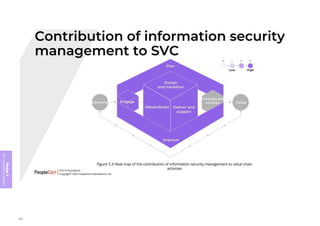
Consider what level of contribution you think information security management has to
the entire service value chain (SVC).
The following example acts as a reminder of the four-dimensional nature of the ITIL
practices: Security practitioners always create layers of security, so that if one fails, another
is waiting. A defensive in-depth approach to security does the job of giving you time to deal with a
serious security attack before it becomes a breach. Consider an organization that spends
hundreds of thousands of dollars on security measures, but does not invest in training the
people. So, there are many security tools in place, which can all be undone by a single user who
falls prey to a phishing attack and hands over their username and password to an outside person,
who then has no need to deal with any of the hundreds of thousands of dollars’ worth of security
measures.
259
Module
5
ITIL
4
Management
practices
260
Module
5
ITIL
4
Management
practices
261
Module
5
ITIL
4
Management
practices
262
Module
5
ITIL
4
Management
practices
263
Module
5
ITIL
4
Management
practices
264
Module
5
ITIL
4
Management
practices
265
Module
5
ITIL
4
Management
practices
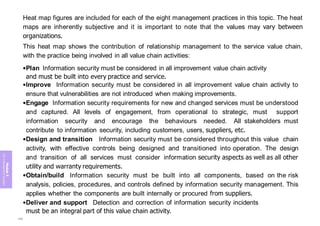
Heat map figures are included for each of the eight management practices in this topic. The heat
maps are inherently subjective and it is important to note that the values may vary between
organizations.
This heat map shows the contribution of relationship management to the service value chain,
with the practice being involved in all value chain activities:
•Plan Information security must be considered in all improvement value chain activity
and must be built into every practice and service.
•Improve Information security must be considered in all improvement value chain activity to
ensure that vulnerabilities are not introduced when making improvements.
•Engage Information security requirements for new and changed services must be understood
and captured. All levels of engagement, from operational to strategic, must support
information security and encourage the behaviours needed. All stakeholders must
contribute to information security, including customers, users, suppliers, etc.
•Design and transition Information security must be considered throughout this value chain
activity, with effective controls being designed and transitioned into operation. The design
and transition of all services must consider information security aspects as well as all other
utility and warranty requirements.
•Obtain/build Information security must be built into all components, based on the risk
analysis, policies, procedures, and controls defined by information security management. This
applies whether the components are built internally or procured from suppliers.
•Deliver and support Detection and correction of information security incidents
must be an integral part of this value chain activity.
266
Module
5
ITIL
4
Management
practices
267
Module
5
ITIL
4
Management
practices
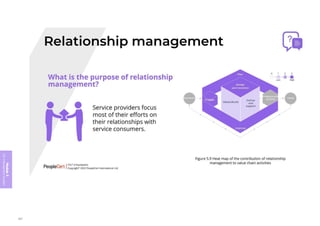
Regarding relationship management, there is a need to establish/maintain relationships
between the organization and its stakeholders. Service providers quite naturally focus most of
their efforts on their relationships with service consumers (sponsors, customers, and users).
Figure 5.9 shows the contribution of relationship management to the service value chain, with
the practice being involved in all value chain activities:
•Plan Relationship management provides information on the requirements and
expectations of internal and external customers. It also assists with strategic
assessment and prioritization across portfolios, as well as evaluating current and future
market spaces, which are essential aspects of planning.
•Improve Relationship management seeks to harmonize and synergize different
organizational relationships with internal and external customers to realize targeted benefits
through continual improvement.
•Engage Relationship management is the practice responsible for engaging with internal
and external customers to understand their requirements and priorities.
•Design and transition Relationship management plays a key role in coordinating feedback
from internal and external customers as part of design. It also ensures that inconvenience
and adverse impacts to customers during transition are prevented or minimized.
•Obtain/build Relationship management provides the customer requirements and priorities
to help select products, services, or service components to be obtained or built.
•Deliver and support Relationship management is responsible for ensuring that a high
level of customer satisfaction and a constructive relationship between the organization and
its customers is established and maintained.
268
Module
5
ITIL
4
Management
practices
269
Module
5
ITIL
4
Management
practices
270
Module
5
ITIL
4
Management
practices
271
Module
5
ITIL
4
Management
practices
Figure 5.13 shows the contribution of supplier management to the service value chain, with the
practice being involved in all value chain activities:
•Plan Supplier management provides the organization’s approved sourcing strategy
and plan.
•Improve This practice identifies opportunities for improvement with existing suppliers,
is involved in the selection of new suppliers, and provides ongoing supplier performance
management.
•Engage Supplier management is responsible for engaging with all suppliers and for the
evaluation and selection of suppliers; for negotiating and agreeing contracts and agreements;
and for ongoing management of supplier relationships.
•Design and transition Supplier management is responsible for defining
requirements for contracts and agreements related to new or changed products or services, in
alignment with the organization’s needs and service targets.
•Obtain/build Supplier management supports the procurement or obtaining of products,
services, and service components from third parties.
•Deliver and support Supplier performance for live services is managed by this practice
to ensure that suppliers meet the terms, conditions, and targets of their contracts and
agreements.
Can you think of any personal examples of supplier management from your own
experience?
272
Module
5
ITIL
4
Management
practices
273
Module
5
ITIL
4
Management
practices
274
Figure 5.21 shows the contribution of IT asset management to the service value chain, with the
practice being applied mainly to the design and transition, and obtain/build value chain activities:
•Plan Most policies and guidance for IT asset management comes from the service financial
management practice. Some asset management policies are driven by governance, and
some are driven by other practices, such as information security management. IT asset
management can be considered a strategic practice that helps the organization to understand
and manage cost and value.
•Improve This value chain activity must consider the impact on IT assets, and some
improvements will directly involve IT asset management in helping to understand and manage
costs.
•Engage There may be some demand for IT asset management from stakeholders. For
example, a user may report a lost or stolen mobile phone, or a customer may require reports
on the value of IT assets.
•Design and transition This value chain activity changes the status of IT assets and
so drives most IT asset management activity.
•Obtain/build IT asset management supports asset procurement to ensure that
assets are traceable from the beginning of their lifecycle.
•Deliver and support IT asset management helps to locate IT assets, trace their
movements, and control their status in the organization.
Module
5
ITIL
4
Management
practices
275
Module
5
ITIL
4
Management
practices
276
The definition of a configuration item (CI) is any component that needs to be managed to
deliver an IT service. Service configuration management collects and manages information
about a wide variety of CIs, typically including hardware, software, networks, buildings,
people, suppliers, and documentation. Services are also treated as CIs, and configuration
management helps the organization to understand how the many CIs that contribute to
each service collaborate.
Some items can be both CIs and IT assets, and some items are specifically just an asset or
just a CI. There is no single rule as to how these should be defined. Whether something is
considered to be an IT asset or a CI is not an inherent property of the item. Who makes that
distinction? Not ITIL, but the customer, making it a somewhat subjective conversation. Achair
is an asset, but isn’t really ever considered to be a CI, whereas a laptop will always be a CI.
But what about a server rack? Is it an asset? There might be a tag on it, but there will
certainly be a listing that we own it. We might think that the rack is just a lockable storage
unit and therefore only an asset. If, however, you have responsibility for what goes into the
rack, if you have a design document and a configuration of how that rack is supposed to be,
then it is a CI. Neither of these views is wrong, and decisions must be made over what falls
into which category.
Module
5
ITIL
4
Management
practices
277
Module
5
ITIL
4
Management
practices
278
Module
5
ITIL
4
Management
practices
Figure 5.30 shows the contribution of configuration management to the service value chain, with
the practice being involved in all value chain activities:
•Plan Configuration management is used for planning new or changed services.
•Improve Configuration management, like every other aspect of service management, should be
subject to measurement and continual improvement. Since the value of configuration
management typically comes from how it facilitates other practices, it is important to
understand how these practices use configuration information and then identify how this can
be improved.
•Engage Some stakeholders (partners and suppliers, consumers, regulators, and so on) may
require and use configuration information, or provide their configuration information to the
organization.
•Design and transition Configuration management documents how assets collaborate
to create a service. This information is used to support many value chain activities and is
updated as part of the transition activity.
•Obtain/build Configuration records may be created during this value chain activity, describing
new or changed services and components. Sometimes, configuration records are used to
create the code or artefact that is being built.
•Deliver and support Information on configuration items is essential to support service
restoration. Configuration information is used to support activities of the incident
management and problem management practices.
279
Module
5
ITIL
4
Management
practices
280
Module
5
ITIL
4
Management
practices
281
Module
5
ITIL
4
Management
practices
Figure 5.22 shows the contribution of monitoring and event management to the service value
chain, with the practice being involved in all value chain activities except plan:
•Improve The monitoring and event management practice is essential to the close observation
of the environment to evaluate and proactively improve its health and stability.
•Engage Monitoring and event management may be the source of internal engagement
for action.
•Design and transition Monitoring data informs design decisions. Monitoring is an
essential component of transition; it provides information about the transition success in all
environments.
•Obtain/build Monitoring and event management supports development
environments, ensuring their transparency and manageability.
•Deliver and support The practice guides how the organization manages internal support of
identified events, initiating other practices as appropriate.
So how much monitoring is enough? IT professionals love to make the most out of the resources
they’re given. You might install an open source system to monitor server processor,
memory utilization, routers and so on. If you have not created a threshold for when you want
notifications, you might get over 600 emails from your system warning you about things
which are actually not a problem for your system. If you do not fix that threshold issue, your
analysts will very soon create inbox rules to put the notifications in a separate inbox to see later,
and they will never be looked at. Later, a server might fail, and you might miss it because the
signal was lost in the noise of 600 to 800 notifications a day. In fact, you might have missed all
the warning signs during the build-up to the failure for the same way. Your monitoring solution
needs to warn you about things which actually matter, rather than about every possible thing. You
need to identify how much monitoring will generate the amount of value that you need.
282
Module
5
ITIL
4
Management
practices
283
Module
5
ITIL
4
Management
practices
Deployment management works closely with release management and change
enablement but is a separate practice. In some organizations, the term ‘provisioning’ is used
to describe the deployment of infrastructure, and deployment is only used to mean software
deployment, but in this case the term deployment is used to mean both. We deploy to an
environment, whereas we release things into the hands of users. Therefore, we deploy all of
the elements of the service first, and then we release the service into the hands of the users.
In the waterfall method, we deploy everything in one big, heavy lift of deployment and then
release everything at once. If anything goes wrong, or isn’t quite right, the entire
deployment or release is stopped. Agile breaks these services and provisions down and
allows us to deploy each part whenever it is ready, even if that’s before the other parts. Also,
we do not have to release all in one shot; we can run a small test with some users, which
could even happen in parallel with full releases of other parts, while deployment of some of
the other services is still happening. We would still prefer to keep that window of time as
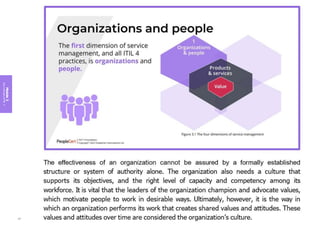
short as possible, but we have the flexibility to do it in a way that works for our resources,
without bringing the project to a halt.
284
Module
5
ITIL
4
Management
practices
285
Module
5
ITIL
4
Management
practices
There are several distinct approaches that can be used for deployment. Many
organizations use a combination of these approaches, depending on their specific services
and requirements as well as the release sizes, types, and impact:
•Phased deployment The new or changed components are deployed to a section of the
production environment at any time, for example to users in one office or one country. This
operation is repeated as many times as needed until the deployment is complete.
•Continuous delivery Components are integrated, tested, and deployed when they are
needed, providing frequent opportunities for customer feedback loops.
•Big bang deployment New or changed components are deployed to all targets at the same
time. This approach is sometimes needed when dependencies prevent the simultaneous use
of both the old and new components. For example, there could be a database schema
change that is not compatible with previous versions of some components.
•Pull deployment New or changed software is made available in a controlled
repository, and users download the software to client devices when they choose. This allows
users to control the timing of updates and can be integrated with service request management
to enable users to request software only when it is needed.
286
Module
5
ITIL
4
Management
practices
287
Module
5
ITIL
4
Management
practices
288
Module
5
ITIL
4
Management
practices
289
Module
5
ITIL
4
Management
practices
290
Module
5
ITIL
4
Management
practices
291
Module
5
ITIL
4
Management
practices
292
Module
5
ITIL
4
Management
practices
293
Module
5
ITIL
4
Management
practices
294
Module
5
ITIL
4
Management
practices
295
Module
5
ITIL
4
Management
practices
296
Module
5
ITIL
4
Management
practices
Figure 5.27 shows the contribution of release management to the service value chain, with the
practice being involved in all value chain activities:
•Plan Policies, guidance, and timelines for releases are driven by the organizational strategy
and service portfolio. The size, scope, and content of each release should be planned and
managed.
•Improve New or changed releases may be required to deliver improvements, and these
should be planned and managed in the same way as any other release.
•Engage The content and cadence of releases must be designed to match the needs
and expectations of customers and users.
•Design and transition Release management ensures that new or changed services
are made available to customers in a controlled way.
•Obtain/build Changes to components are normally included in a release and
delivered in a controlled way.
•Deliver and support Releases may impact on delivery and support. Training,
documentation, release notes, known errors, user guides, support scripts, and so on are
provided by this practice to facilitate service restoration.
297
Module
5
ITIL
4
Management
practices
298
Module
5
ITIL
4
Management
practices
5.3 Key management practices – Part 1
299
Module
5
ITIL
4
Management
practices
300
Module
5
ITIL
4
Management
practices
301
Module
5
ITIL
4
Management
practices
302
Module
5
ITIL
4
Management
practices
303
Module
5
ITIL
4
Management
practices
304
Module
5
ITIL
4
Management
practices
305
Module
5
ITIL
4
Management
practices
306
Module
5
ITIL
4
Management
practices
307
Module
5
ITIL
4
Management
practices
308
Module
5
ITIL
4
Management
practices
309
Module
5
ITIL
4
Management
practices
310
Module
5
ITIL
4
Management
practices
311
Module
5
ITIL
4
Management
practices
312
Module
5
ITIL
4
Management
practices
313
Module
5
ITIL
4
Management
practices
314
Module
5
ITIL
4
Management
practices
315
Module
5
ITIL
4
Management
practices
316
Module
5
ITIL
4
Management
practices
317
318
319
320
Module
5
ITIL
4
Management
practices
321
Module
5
ITIL
4
Management
practices
322
Module
5
ITIL
4
Management
practices
323
Module
5
ITIL
4
Management
practices
324
Module
5
ITIL
4
Management
practices
Figure 5.35 shows the contribution of service request management to the service value
chain, with the practice being involved in all service value chain activities except the plan
activity:
325
Module
5
ITIL
4
Management
practices
326
Module
5
ITIL
4
Management
practices
327
Module
5
ITIL
4
Management
practices
328
Module
5
ITIL
4
Management
practices
329
Module
5
ITIL
4
Management
practices
With the increased automation and the gradual removal of technical debt, the focus of the service desk is
to provide support for people and business rather than simply resolve technical issues. Part of this role is
to capture and redirect issues that are out of scope for them. They need to be a one-stop shop so that
users feel comfortable approaching them for whatever they need, from a very complex query to a request
for a smartphone.
To create a good customer experience, they need good processes to deal with issues that are not theirs.
For instance, if the service desk gets a call to say that a toilet on the third floor is out of paper, they
could simply tell the caller to call building maintenance. Alternatively, they could offer to contact business
maintenance for them, get the issue dealt with, and find out whether they would like feedback. In being
prepared to do this, the service desk greatly increases the chances of being seen as helpful, and
therefore will receive all of the requests which are in scope for them, and would otherwise be lost.
330
Module
5
ITIL
4
Management
practices
Consider what the key aspects of a good service desk are, and what services a good service
desk should deliver.
331
Module
5
ITIL
4
Management
practices
Service desks are increasingly being used to have various matters arranged, explained, and
coordinated, rather than just to get broken technology fixed. The service desk has become a vital part of
any service operation.
They also have a major influence on the user experience and how the service provider is perceived by
the users. Another key aspect of a good service desk is its practical understanding of the wider
organization, the business processes, and the users. Service desks add value by understanding and
acting on the business actions. The service desk should provide an empathetic and informed link
between the service provider and its users.
332
Module
5
ITIL
4
Management
practices
333
Module
5
ITIL
4
Management
practices
Service desks provide a variety of channels for access. These include:
•Phone calls, which can include specialized technology, such as
interactive voice response (IVR), conference calls, voice recognition, and
others.
•Service portals and mobile applications, supported by service and request
catalogues,
and knowledge bases.
•Chat, through live chat and chatbots.
•Email for logging and updating, and for follow-up surveys and
confirmations. Unstructured emails can be difficult to process, but emerging
technologies based on AI and machine learning are starting to address this.
•Walk-in service desks are becoming more prevalent in some sectors, for
example higher education, where there are high peaks of activity that
demand physical presence.
•Text and social media messaging, which are useful for notifications in case of
major incidents and for contacting specific stakeholder groups, but can also
be used to allow users to request support.
•Public and corporate social media and discussion forums for contacting the
service
provider and for peer-to-peer support.
334
Module
5
ITIL
4
Management
practices
335
Module
5
ITIL
4
Management
practices
Some service desks have a limited support window where service cover is available (for
example, 08.00 to 20.00, Monday to Friday). Staff are therefore expected to work in
shift patterns to provide consistent support levels. In some cases, the service desk is a
tangible team, working in a single location. A centralized service desk requires supporting
technologies, such as:
•intelligent telephony systems, incorporating computer-telephony integration, IVR,
and automatic call distribution
•workflow systems for routing and escalation
•workforce management and resource planning systems
•a knowledge base
•call recording and quality control
•remote access tools
•dashboard and monitoring tools
•configuration management systems.
In other cases, a virtual service desk allows agents to work from many locations. A virtual
service desk requires more sophisticated supporting technology, involving more complex
routing and escalation; these solutions are often cloud-based.
336
Module
5
ITIL
4
Management
practices
Key skills for service desk staff include:
•excellent customer service skills
•empathy
•incident analysis and prioritization
•effective communication
•emotional intelligence.
337
Module
5
ITIL
4
Management
practices
338
Module
5
ITIL
4
Management
practices
339
Module
5
ITIL
4
Management
practices
This slide outlines the key learning points that were covered in this topic.
340
Module
5
ITIL
4
Management
practices
5.4 Key management practices – Part 2
341
Module
5
ITIL
4
Management
practices
This slide outlines the key learning points that will be covered in this topic.
342
Module
5
ITIL
4
Management
practices
The purpose of the problem management practice is to reduce the likelihood and impact of
incidents by identifying actual and potential causes of incidents and managing workarounds and
known errors. Remember that incidents may point to problems, or not. An incident might be an
isolated issue that can be solved acceptably with a quick fix or workaround, or it might point to a
more enduring, pervasive, or systemic issue that requires a deeper root cause analysis. Not every
incident indicates a problem or requires a root cause analysis (RCA).
343
Module
5
ITIL
4
Management
practices
344
Module
5
ITIL
4
Management
practices
A problem is a cause, or potential cause, of one or more incidents.
A known error is a problem that has been analysed but has not been resolved.
There are three ways that an incident could indicate a problem, and the need for a root cause
analysis. As an IT professional or service provider, you may notice that something appears to be
significantly wrong and requires a deep dive investigation. The second is that your customer
could recognize the same thing and let you know. These could be major incidents, which have
had a significant impact on customers, have caused sufficient concern for the service provider to
want to make that deep dive, or require a root cause analysis due to their level of severity.
Both of these ways are human oriented and require human wisdom.
Thirdly, a tool can help you out. For instance, imagine that your service desk has 100 analysts.
Each of them sees an incident today, and to each of them, their incident doesn’t seem like a big
deal, because it was just one. If, however, you could look at all their 100 incidents, you might find
that actually you had 100 incidents with common factors – a very different interpretation than
each analyst had individually. Root cause analyses and the opening of a problem usually happen
as a result of recurring incidents or major incidents. The major ones cause such an impact that
everyone wants them fixed. The recurring ones might be solvable with a workaround, but if we
had 100 incidents today, and we might have 100 incidents tomorrow, it is probably cheaper to dive
deep and raise a problem record.
345
Module
5
ITIL
4
Management
practices
Every service has errors, flaws, or vulnerabilities that could cause incidents. They may include errors in any of the
four dimensions of service management. Many errors are identified and resolved before a service goes live. However,
some remain unidentified or unresolved, and may be a risk to live services. In ITIL, these errors are called problems
and they are addressed by the problem management practice. Problem management involves three distinct phases.
These phases are problem identification, problem control, and error control. We will look at each phase in turn in the
following slides.
346
Module
5
ITIL
4
Management
practices
Problem identify activities identify and log problems. These include:
•performing trend analysis on incident records
•detection of duplicate and recurring issues by users, service desk, and technical support staff
•during major incident management, identifying a risk that an incident could recur
•analysing information received from suppliers and partners
•analysing information received from internal software developers, test teams, and
project teams.
347
Module
5
ITIL
4
Management
practices
348
Module
5
ITIL
4
Management
practices
349
Module
5
ITIL
4
Management
practices
350
Module
5
ITIL
4
Management
practices
For other problems, a way to fix the error should be found. This is a part of error control.
Error control activities include:
•manage known errors, which are problems where initial analysis
has been completed
•identify potential permanent solutions
•regularly reassess the status of known errors
•assess the impact on customers
•identify the availability and cost of permanent resolutions.
351
Module
5
ITIL
4
Management
practices
352
Module
5
ITIL
4
Management
practices
353
Module
5
ITIL
4
Management
practices
Problem management activities interface with other practices such as:
•risk management
•change enablement
•knowledge management
•continual improvement.
Problem management activities can be organized as a specific case of risk management.
They aim to identify, assess, and control risks in any of the four dimensions of service
management. It is useful to adopt risk management tools and techniques for problem
management.
Implementation of problem resolution is often outside the scope of problem management.
Problem management typically initiates resolution via change enablement and
participates in the postimplementation review. However, approving and implementing
changes is out of scope for the problem management practice.
Output from the problem management practice includes information and documentation
concerning workarounds and known errors. In addition, problem management may
utilize information in a knowledge management system to investigate, diagnose, and
resolve problems.
Problem management activities can identify improvement opportunities in all four
dimensions of service management. Solutions can, in some cases, be treated as
improvement opportunities, so they are included in a continual improvement register (CIR),
and continual improvement techniques are used to prioritize and manage them,
sometimes as part of a product backlog.
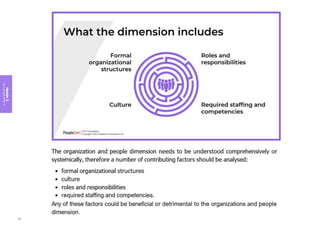
354
Module
5
ITIL
4
Management
practices
Axle Car Hire needs to be ready to handle any problems that arise with their services. The following slides outlines how they deal with problems.
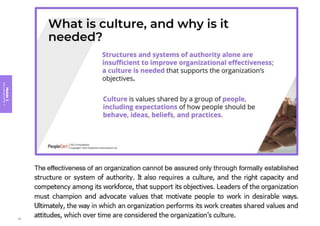
355
Module
5
ITIL
4
Management
practices
356
Module
5
ITIL
4
Management
practices
357
Module
5
ITIL
4
Management
practices
358
Module
5
ITIL
4
Management
practices
359
Module
5
ITIL
4
Management
practices
360
Module
5
ITIL
4
Management
practices
Figure 5.24 shows the contribution of problem management to the service value chain, with
the practice being applied mainly to the improve and deliver and support value chain
activities:
•Improve This is the main focus area for problem management. Effective problem
management provides the understanding needed to reduce the number of incidents and the
impact of incidents that cannot be prevented.
•Engage Problems that have a significant impact on services will be visible to
customers and users. In some cases, customers may wish to be involved in
problem prioritization, and the status and plans for managing problems should be
communicated. Workarounds are often presented to users via a service portal.
•Design and transition Problem management provides information that helps to
improve testing and knowledge transfer.
•Obtain/build Product defects may be identified by problem management; these are then
managed as part of this value chain activity.
•Deliver and support Problem management makes a significant contribution by
preventing incident repetition and supporting timely incident resolution.
361
Module
5
ITIL
4
Management
practices
The purpose of the continual improvement practice is to align the organization’s practices and services with changing
business needs through the ongoing improvement of products, services, and practices, or any element involved in the
management of products and services.
Included in the scope of the continual improvement practice is the development of improvement-related methods and
techniques and promoting continual improvement culture across the organization, in line with the organization’s overall
strategy. The commitment to and practice of continual improvement must be embedded into every fiber of the organization. If it
is not, there is a realrisk that daily operational concerns and major project work will eclipse continual improvement efforts.
362
Module
5
ITIL
4
Management
practices
The continual improvement process can be applied to any situation.
363
Module
5
ITIL
4
Management
practices
364
Module
5
ITIL
4
Management
practices
Continual improvement is featured in the SVS strategically, is a tactical
SVC activity, and it is a practice to be used daily or operationally. To
maximize the effectiveness of services, each person who contributes
to the provision of a service should keep continual improvement
in mind and should always be looking for opportunities to
improve. The continual improvement model applies to the SVS in its
entirety, as well as to all the organization’s products, services, service
components, and relationships.
The ITIL continual improvement model can be used as a high-level
guide to support improvement initiatives. Use of the model increases
the likelihood that ITSM initiatives will be successful, puts a strong
focus on customer value, and ensures that improvement efforts can be
linked back to the organization’s vision. The model supports an
iterative approach to improvement, dividing work into manageable
pieces with separate goals that can be achieved incrementally.
365
Module
5
ITIL
4
Management
practices
The continual improvement model is a structured approach to making improvements you can
use to increase the chance of your initiative’s success, as it puts the focus on customer value,
and ensures improvement efforts can be linked back to what came before. Use it as a
workflow, and a high-level reminder to ensure improvements are properly managed, linked to
goals and priorities, and producing sustainable results.
366
Module
5
ITIL
4
Management
practices
Step 1 is ‘what is the vision?’ What improvement do you envision, and how does it support the
organization’s vision, strategies and objectives? This step focuses on articulating how the
initiative supports the organization’s vision and objectives and creating a high-level vision for
the improvement. If you skip this step, improvements might only be optimized for people or
teams involved and not for the whole organization, or focus on non-value- adding activities.
367
Module
5
ITIL
4
Management
practices
Step 2 is ‘where are we now?’ Improvement is a journey from the current state (Point A) to a
future state (Point B); this step clearly defines what the current state looks like by assessing,
for example, services, users’ perception of value received, people’s competencies and skills,
culture, processes and procedures, and capabilities of available technology solutions. If you skip this
step, it will be hard to show progress, as you’ll have no baseline to compare to.
368
Module
5
ITIL
4
Management
practices
Step 3 is ‘where do we want to be?’ Here you outline ‘Point B’, the target state, by specifying objectives
following the SMART principle, making them Specific, Measurable, Achievable, Relevant, and Timebound, and
determine critical success factors (CSFs) and key performance indicators (KPIs). If you skip this step, the target
state will be unclear, and it will be hard to explain to stakeholders what they may gain from the initiative,
resulting in low support for or even resistanceto your initiative.
369
Module
5
ITIL
4
Management
practices
Critical success factors or CSFs are things without which something does not exist. To grown an oak
tree, for example, CSFs include an acorn, sunlight, water, and soil. Key performance indicators or
KPIs are metrics that fall under each CSF, for example, how much sunlight and water? What
must the PH of the soil be? Identify CSF for your initiatives to know what you must have to succeed,
and KPIs under each to understand what success will look like.
370
Module
5
ITIL
4
Management
practices
Step 4 is ‘how do we get there?’ where you agree a specific route from point A to point B and create
a plan to do so. The plan may be a straightforward and direct, or it may be more involved. You may
have to design experiments to test which options are best. You may find it most effective to work
iteratively. If so, with each iteration, check progress, re-evaluate the approach, and change direction if
appropriate. If you skip this step, you are likely to flounder and fail to achieve objectives, making it
harder to get support for future improvements.
371
Module
5
ITIL
4
Management
practices
Step 5 is to ‘take action’ to implement the plan. Remain focused on the objective and open to change
in how you reach it, rather than rigidly adhering to the plan. Maintain focus on measuring progress
towards the vision, managing risks, and ensuring visibility and awareness of the initiative. Draw on
ITIL practices, for example, organizational change management, measurement and reporting, risk
management to succeed here. When the step is done, if you succeed you will be at the journey’s
end, in the new current state.
372
Module
5
ITIL
4
Management
practices
Step 6 is ‘did we get there?’, where you validate success and check and confirm progress (against
original objectives) and the continued relevance of the intended value of the initiative. If you
haven’t achieved the desired result, you might select additional actions, resulting in a new iteration.
If you skip this step, it will be hard to know if you have achieved desired or promised outcomes, and
you would lose any lessons from this iteration that would support course corrections.
373
Module
5
ITIL
4
Management
practices
Step 7 is ‘how do we keep the momentum going?’, where we work to market successes and reinforce
new methods, to ensure progress made is not lost and that support exists for future initiatives. Use
the organizational change and knowledge management practices to embed the improvements and
changed behaviors in the organization so that they are not at risk of reversion. If you did not achieve
expected results, tell stakeholders why and communicate lessons learned. If you skip this step,
progress made will be lost over time and it may be difficult to get support for future initiatives.
374
Module
5
ITIL
4
Management
practices
Axle Car Hire is always looking for ways to continually improve its services.
375
Module
5
ITIL
4
Management
practices
376
Module
5
ITIL
4
Management
practices
There are many methods, models, and techniques that can be employed for making
improvements. It is not a requirement for an organization to specifically use the ITIL 4
continual improvement model. Different types of improvement may call for different
improvement methods. For example, some improvements may be best organized into a
multiphase project, while others may be more appropriate as a single quick effort.
Although there are numerous methods or techniques that exist (many of which are
contained in other sources of service management thought leadership such as Lean,
Agile and DevOps) there is also no requirement for an organization to apply all of them.
The Lean theory of constraint helps us see where we need to focus; we focus our
resource on the thing which is constraining us first. If we run a cart repair shop, and a cart
comes in making a squealing sound, we want to make it work better. If we have a small
amount of grease, we would traditionally apply it to the wheel which is making the loudest
noise (the squeaky wheel gets the grease), but in fact, we should identify which wheel is
holding the cart back the most, and grease that one, even if that leaves the squeakiest
one still squeaking. ITIL 4 is very agnostic when it comes to frameworks, so borrowing
ideas from Lean is fine; we do not reinvent the wheel (squeaky or otherwise) if a
framework already exists to do what we need.
Ultimately, an organization should only implement continual improvement methods and
techniques that are most compatible with their own needs, ways of working and types of
improvement to be undertaken.
377
Module
5
ITIL
4
Management
practices
Use the ITIL SVS continual improvement model shown to develop a health goal and
plan.
378
Module
5
ITIL
4
Management
practices
To track and manage improvement ideas from identification through to final action, organizations use a database
or structured document called a continual improvement register (CIR). There can be more than one CIR in an
organization, as multiple CIRs can be maintained on individual, team, departmental, business unit, and organizational
levels.
Some organizations maintain a single master CIR but divide how it is used and by who at a more granular level.
Improvement ideas can also initially be captured in other places and via other practices, such as during project
execution or software development activities. In this case, it is important to document for attention the improvement
ideas that arise as part of ongoing continual improvement.
379
Module
5
ITIL
4
Management
practices
The highest levels of the organization need to take responsibility for embedding continual improvement into the way that
people think and work. Without their leadership and visible commitment to continual improvement, attitudes,
behaviour, and culture will not evolve to a point where improvements are considered in everything that is done, at all
levels.
However, training and other enablement assistance should be provided to staff members to help them feel prepared to
contribute to continual improvement. Most people would say that it is everyone’s responsibility to continually improve and
contribute in some way. However, there should at least be a small team dedicated full time to leading continual
improvement efforts and advocating the practice across the organization.
380
Module
5
ITIL
4
Management
practices
Figure 5.2 shows the contribution of continual improvement to the service value chain, with the practice being
involved in all value chain activities:
•Plan The continual improvement practice is applied to planning activities, methods, and techniques to ensure that
they are relevant to the organization’s current objectives and context.
•Improve The continual improvement practice is key to this value chain activity. It structures resources and
activities, enabling improvement at all levels of the organization and the SVS.
•Engage, design and transition, obtain/build, and deliver and support Each of these value chain activities is
subject to continual improvement, and the continual improvement practice is applied to all of them.
381
Module
5
ITIL
4
Management
practices
This slide outlines the key learning points that were covered in this topic.
382
Module
5
ITIL
4
Management
practices
5.5 Key management practices – Part 3
383
Module
5
ITIL
4
Management
practices
This slide outlines the key learning points that will be covered in this topic.
384
Module
5
ITIL
4
Management
practices
The purpose of the service level management practice is to set clear business-
based targets for service levels, and to ensure that delivery of services is
properly assessed, monitored, and managed against these targets.
385
Module
5
ITIL
4
Management
practices
A service level is defined as one or more metrics that define expected or
achieved service quality.
386
Module
5
ITIL
4
Management
practices
387
Module
5
ITIL
4
Management
practices
Service level management provides the end-to-end visibility of the organization’s
services.
To achieve this, service level management:
•establishes a shared view of the services and target service levels with
customers
•ensures that the organization meets the defined service levels through the
collection, analysis, storage, and reporting of the relevant metrics for the
identified services
•performs service reviews to ensure that the current set of services continues to
meet
the needs of the organization and its customers
•captures and reports on service issues, including performance against
defined
service levels.
The practice requires a holistic focus on the whole service and not simply its
constituent parts; for example, simple individual metrics (such as percentage
system availability) should not be taken to represent the whole service.
388
Module
5
ITIL
4
Management
practices
389
Module
5
ITIL
4
Management
practices
390
Module
5
ITIL
4
Management
practices
A service level agreement is a documented agreement between a service provider
and a customer that identifies both the services required and the expected level of
service. Service level agreements (SLAs) have long been used as a tool to measure the
performance of services from the customer’s point of view, and it is important that they
are agreed in the wider business context.
Using SLAs may present many challenges; often, they do not fully reflect the wider
service performance and the user experience. SLAs can only be created through
customer collaboration, or you are simply imposing them. This means you are
defining success, and you might be doing it in a completely different way to your
customer. You could be fulfilling your SLAs at all times and constantly disappointing
your customer. These are ‘watermelon SLAs’; they show up as green on your SLA
chart, but if the customer is actually unhappy with what you are delivering, then they
are red on the inside.
If your customers show up to SLA meetings and do not talk, you can ask them two
really good questions. ‘Tell me about your worst day ever,’ and ‘tell me about your
best day ever.’ As they describe what can go wrong for them, and what it’s like when
things go well, you can start to understand and probe into how your services can
contribute to providing those good days, and avoiding the bad ones, and set SLAs
accordingly.
391
Module
5
ITIL
4
Management
practices
Here we see the definition of ‘service level agreements (or SLAs) up top, and four key requirements for successful
SLAs at the bottom. SLAs have long been used to measure the performance of services from the customer’s point
of view, and it is vital that they are agreed in the wider business context. Using SLAs presents many challenges, as
often they do not fully reflect the wider service performance and the user experience. It is important to
remember that SLAs are a means to an end, and that end is setting good expectations and garnering good
perceptions from customers and users. SLA documents and practices that have become a routine formality and that
do not deliver on the needs of the customer should be rethought and adjusted to do so.
392
Module
5
ITIL
4
Management
practices
Here we see a definition of the watermelon SLA effect. For example, system availability may have met a 99.6%
commitment, with an acceptable unavailability of just 0.4%. However, that 0.4% occurrence could happen just when a key
process is in play (e.g. when a key commercial transaction is in process, an operating theatre is in use, or when point-of-sale
terminals are in use). In this scenario customer/user satisfaction will be low, even though the SLA has been met. This is the
watermelon effect, where the provider thinks they are doing a great job (reports are green on the outside, like a watermelon’s
skin), but customers are frustrated with the service (that is the red on the inside). To avoid this, metrics and measures that are a
true reflection of the customer’s actual experience and satisfaction level with the entire service must be identified and used; the
only way to learn what they are is directly from customers.
393
Module
5
ITIL
4
Management
practices
Service level management involves collating and analysing information from a number of sources. Let us look at customer
engagement. When establishing and defining SLAs with customers, this will involve initial ‘active’ listening, discovery, and
information capture on which to base metrics, measurement, and ongoing progress discussions. Active listening is
employed in service level management to understand as well as simply hear what is being said. Active listening is also
required for optimal success in the example described on the previous slide.
394
Module
5
ITIL
4
Management
practices
Another key contributing factor towards service level agreement is customer feedback. This is ideally gathered from several
sources, both formal and informal, including:
• Surveys These can be from immediate feedback such as follow-up questions to incidents or from more reflective periodic
surveys that gauge feedback on the overall service experience. Both are event-based.
• Key business-related measures These are measures agreed between the service provider and its customer, based on what
the customer values as important. This could be a bundle of SLA metrics or a very specific business activity, such as a
sales transaction, project completion, or operational function, for example getting an ambulance to the site of an accident
within x minutes.
395
Module
5
ITIL
4
Management
practices
396
Module
5
ITIL
4
Management
practices
In this case there are two types of metrics we are looking at:
•Operational metrics These are the low-level indicators of various operational
activities. They might include system availability, incident response and fix times,
change and request processing times, and system response times.
•Business metrics These can be any business activity that is deemed useful or
valuable by the customer and used as a means of gauging the success of the service.
These can vary from some simple transactional binary measures such as ATM or POS
terminal availability during business hours (09.00–17.00 daily) or successful
completion of business activities such as passenger check-in.
When this feedback is gathered and collated for ongoing review, it can be used
as input to design suitable measurement and reporting models and practices. SLAs
must be understandable to all involved parties, which means that they must be written
to be customer-friendly. Therefore, service-based or business-based metrics are
more relevant for inclusion in SLAs. Operational metrics are most often used by IT
service providers to manage conditions that support the success as defined by service-
based or business-based metrics.
397
Module
5
ITIL
4
Management
practices
Figure 5.34 shows the contribution of service level management to the service value chain,
with the practice being applied mainly to the plan and engage activities:
398
Module
5
ITIL
4
Management
practices
•Plan Service level management supports planning of the product
and service portfolio and service offerings with information about the
actual service performance and trends.
•Improve Service feedback from users, as well as requirements from
customers, can
be a driving force for service improvement.
•Engage Service level management ensures ongoing engagement
with customers and users through feedback processing and continual
service review.
•Design and transition The design and development of new and
changed services receives input from this practice, both through
interaction with customers and as part of the feedback loop in
transition.
•Obtain/build Service level management provides objectives for
components and service performance, as well as for measurement
and reporting capabilities of the products and services.
•Deliver and support Service level management communicates service
performance objectives to the operations and support teams and
collects their feedback as an input for service improvement.
399
Module
5
ITIL
4
Management
practices
Axle Car Hire regularly gathers feedback from its customers to ensure its service level
agreements are being met. The following slides outline how they go about gathering
feedback.
400
Module
5
ITIL
4
Management
practices
401
Module
5
ITIL
4
Management
practices
402
Module
5
ITIL
4
Management
practices
The purpose of the change enablement practice is to maximize the number of successful service
and product changes by ensuring that risks have been properly assessed, authorizing
changes to proceed, and managing the change schedule. Mostly, people would prefer not to
change. Change often feels like it’s being imposed on people, who will see it as complicating their
lives and making their jobs harder, adding constraints and rules. A study from some time ago
identified that 80% of the incidents that organizations in the study experienced were a result of
unauthorized change. This tells us that change enablement can have a huge positive impact.
403
Module
5
ITIL
4
Management
practices
Change control must balance the need to make beneficial changes that will deliver additional
value with the need to protect customers and users from the adverse effect of changes. All changes
should be assessed by people who are able to understand the risks and the expected benefits; the
changes must then be authorized before they are deployed. This assessment, however, should not
introduce unnecessary delay.
404
Module
5
ITIL
4
Management
practices
A change is the addition, modification, or removal of anything that could have a
direct or indirect effect on services.
405
Module
5
ITIL
4
Management
practices
What is in scope for the change enablement practice? For example, if you want to re-index a database, is that a
change that requires a Request for Change (RFC) and to go through the change process, or is that just
‘maintenance’? Notice that the suggested scope includes not just the infrastructure and applications involved but
also things like documentation and processes. The idea here is to ‘think holistically’ and not, for example, make a
change to the network infrastructure, and to neglect updating the network documentation.
406
Module
5
ITIL
4
Management
practices
The scope of change enablement is defined by each organization. It will typically include all IT infrastructure,
applications, documentation, processes, supplier relationships, and anything else that might directly or indirectly
impact a product or service. It is important to distinguish change enablement from organizational change management.
Organizational change management manages the people aspects of changes to ensure that improvements and
organizationaltransformationinitiativesare implemented successfully.
Change enablement is usually focused on changes in products and services.
407
Module
5
ITIL
4
Management
practices
The person or group who authorizes a change is known as a change authority. It is essential that the correct change
authority is assigned to each type of change to ensure that change enablement is both efficient and effective. In organizations
responsible for core products, services, or critical processes, it is a common practice to decentralize change approval,
making the peer review a top predictor of high performance.
We can make routine changes much simpler if we recognize those with similar features, and delegate those for example
service level management, with a clear set of rules. This clears space for change enablement to focus on the changes that
really need their skills. Transferring that change authority, however, requires a very carefully stated set of rules and conditions
so that we do not create an entirely new change enablement function somewhere else, but rather allow the other practice to
simply process the thinking and standards that change enablement creates.
408
Module
5
ITIL
4
Management
practices
There are three types of change that are each managed in different ways:
•standard changes
•normal changes
•emergency changes.
409
Module
5
ITIL
4
Management
practices
The change schedule is used to help plan changes, assist in communication, avoid
conflicts, and assign resources. It can also be used after changes have been deployed to
provide information needed for incident management, problem management, and
improvement planning.
410
Module
5
ITIL
4
Management
practices
Figure 5.19 shows the contribution of change enablement to the service value chain, with the
practice being involved in all value chain activities:
411
Module
5
ITIL
4
Management
practices
•Plan Changes to product and service portfolios, policies, and practices
all require a certain level of control, and the change enablement practice
is used to provide it.
•Improve Many improvements will require changes to be made, and
these should be assessed and authorized in the same way as all other
changes.
•Engage Customers and users may need to be consulted or informed
about changes,
depending on the nature of the change.
•Design and transition Many changes are initiated due to new or
changed services. The change enablement activity is a major contributor
to transition.
•Obtain/build Changes to components are subject to change
enablement, whether they are built in-house or obtained from suppliers.
•Deliver and support Changes may have an impact on delivery and
support, and information about changes must be communicated to
personnel who perform this value chain activity. These people may also
play a part in assessing and authorizing changes.
412
Module
5
ITIL
4
Management
practices
To ensure that Axle meets customer demands and capitalizes on opportunities, the organization
needs to be positioned to enable change where needed. The following slides outline what Axle does to
enable change.
413
Module
5
ITIL
4
Management
practices
414
Module
5
ITIL
4
Management
practices
415
Module
5
ITIL
4
Management
practices
416
Module
5
ITIL
4
Management
practices
417
This slide outlines the key learning points that were covered in this topic.
Module
5
ITIL
4
Management
practices
418
Module
5
ITIL
4
Management
practices
Module
5
ITIL
4
Management
practices
A nsw ers:
1. The purpose of the change enablement practice is to maximize the number of successful
service and product changes by ensuring that risks have been properly assessed, authorizing
changes to proceed, and managing the change schedule
2. Service desk staff should display all these skills.
• incident analysis and prioritization
• effective communication
• empathy
• excellent customer service skills
• emotional intelligence.
3. The definition of an incident is an unplanned interruption to a service or a reduction in the
quality of a service.
4. The three distinct phases of problem management are
issue resolution
problemidentification
problem control
error control
problem resolution.
5. The image below shows the correct connection between the elements and the activities in the
continual improvement model:
Quiz
Questions:
1. Complete the missing words
The purpose of the change enablement practice is to [?] the number of [?] service and product
changes by ensuring that [?] have been properly assessed, authorizing changes to proceed, and
managing the change schedule.
2. What skills should service desk staff have?
3. Complete the missing words
The definition of an incident is an [?] interruption to a service or a [?] in the [?] of a service.
4. Which of these are the three phases of problem management?
issue resolution
problem identification
problem control
error control
problem resolution.
5. In the continual improvement model, connect the elements to place the correct activities for
each stage.
300 301
ITIL®
4 Foundation | Copyright©
PeopleCert InternationalLtd.
419
Quiz
Module
5
ITIL
4
Management
practices
420
Answers
Module
5
ITIL
4
Management
practices
421
Quiz:
Module
5
ITIL
4
Management
practices
422
Answers:
Module
5
ITIL
4
Management
practices
423
Discover more at my.axelos.com
Discover more at my
.axelos.com
Module 6
Course review
424
Module
6
Course
review
425
Module
6
Course
review
426
Module
6
Course
review
427
Module
6
Course
review
428
Module
6
Course
review
429
Module
6
Course
review
430
Module
6
Course
review
431
Module
6
Course
review
432
Module
6
Course
review
433
Module
6
Course
review
434
Module
6
Course
review
435
What’s next?
436
437
438
Module
6
Course
review
439
Module
6
Course
review
440
Module
6
Course
review
441
Module
6
Course
review
442
Module
6
Course
review
443
Module
6
Course
review
444
Module
6
Course
review
445
C
ourM
odule
se
r
e
vie
w 6
ITIL®
4 Foundation | Copyright©
PeopleCert InternationalLtd. 319
Module
6
Course
review
Here is your opportunity to give
PeopleCert some feedback on the course
materials. Y can choose to email
PeopleCert team directly or just scan the
QR code with your pho and complete the
survey.
446
Module
6
Course
review
Module
6
Course
review
Quiz
Questions:
320 321
ITIL®
4 Foundation | Copyright©
PeopleCert InternationalLtd.
1. Value is the [?] benefits, usefulness, and importance of something.
A. Inherent
B. Perceived
C. Objective
D. Marketing
2. An organization is a [?] that has its own functions with responsibilities, authorities, and
relationships to achieve its objectives.
A. Business or company
B. For-profit or non-profit
C. Person or group
D. Community or society
3. Service relationships are established between two or more stakeholder organizations to [?].
A. Provide goods and access to resources and perform actions
B. Provide and consume services
C. Conduct business
D. Co-create value
4. Select the BEST answer. A consumer is an organization that [?] services.
A. Uses
B. Provides
C. Authorises the budgets for
D. Receives
5. Three specific roles are involved in service consumption: customers who [?], users who use
services, and sponsors that [?].
A. Pay for services, promote services
B. Define requirements, authorise budgets
C. Use services, define requirements and authorize budgets
D. Define requirements and authorise budgets, promote services
6. Customers, users and sponsors
A. Cannot be the same person or organization
B. Cannot have the same expectations of services
C. Can only be people and not organizations
D. Can have different and even conflict service expectations
7. A [?] is a configuration of an organization’s resources designed to offer value to a consumer.
A. Service offering
B. Service management system
C. Service
D. Product
8. A [?] is a means of enabling value co-creation by facilitating desired outcomes for customers.
A. Service offering
B. Service management system
C. Service
D. Product
9. A [?] is a description of one or more services designed to address the needs of a target
consumer group.
A. Service offering
B. Service management system
C. Service
D. Product
447
Module
6
Course
review
Quiz
448
Module
6
Course
review
449
Module
6
Course
review
450
Module
6
Course
review
451
Discover more at my.axelos.com
ut the
use a
Axle C ar
vide
f or
r
ting ITIL
ithin
nization.
den thread in
e. There are also
Axle Car Hire
periences with you.
ngagement and
that you take on
he character text
ed.
Appendix 1
Handouts/
activity sheets
Through o
c ourse, w e
c o m pany ‘
Hire’ to pro
example s o
the ne e d fo
imple me n
processes w
their orga
This serves as a gol
almost every modul
several characters in
who share their ex
To maintain your e
fun, it is a good idea
the role of or read t
as and when requir
Axle Car Hire
Key concepts of ITIL
Service value chain
Value chain activities
Guiding principles
ITIL management practices
452
Appendix
1
Handouts
/
Activity
sheets
Appendix
1
Handouts
/
Activity
sheets
Axle Car Hire employees
As previously mentioned, there are several members of
this team who share their experiences throughout the
course. They provide the real-world examples and an
opportunity for learner discussion. This is another
reason whyit is a good idea for the learners to read out
the text. Here are the four key team members:
Henri Is the new CIO of Axle Car Hire. He is a successful
business executive who is prepared to shake things up.
He believes in an integrated approach to ITSM.
Su Is the Axle Car Hire product manager for travel
experience and has worked for Axle for the past five
years.Su is smart, meticulous,and passionate about the
environment.
Radhika Is the Axle Car Hire IT business analyst, and it is
her job to understand the user requirements of Axle Car
Hire staff and customers. She is inquisitive and energetic
and strives to maintain a positive relationship with all
her customers, both internal and external. Radhika
works mostly on discovery and planning activities, rather
than in IT operations. She asks a lot of questions and is
great at spotting patterns and trends.
Marco Is the Axle Car Hire IT delivery manager. He is
process-driven and continually references the ITIL
framework to help him manage positive service
relationships. However, Marco has had little exposure to
a blended or collaborative approach to service
management.
Henri,
CIO Axle Car
Hire
Su,
Axle Car Hire Project
Manager
Radhika,
Axle Car Hire IT Business
Analyst
Marco,
Axle Car Hire IT Delivery
Manager
Axle Car
Hire
Here is a bit of a background to Axle Car
Hire and its situation:
Axle Car Hire is a global company, with its headquarters based in
Seattle. Axle was formed 10 years ago and currently employs
approximately 400 staff across Europe,the US, and Asia-Pacific.
Initially, the company experienced strong growth and consistently
high customer satisfaction ratings. For the first six years,repeat
business accounted for around 30% of all bookings. Shareholders
could expecthandsome quarterly dividends. However, over the past
four
years, the company has experienced a downturn. Customer
satisfaction ratingshave consistently declined and repeat bookings
are rare. Competitors are offering new and innovative options to
traditional vehicle hire. Carpooling, ride-share, and driverless cars are
big draws. Customers have also come to expect online and app
interfaces as standard for the company’s services. In this evolving
market, Axle Car Hire faces an uncertain future.
The board is keen to improve customer satisfaction levels. They
want to attract and retain customers and improve the company’s
bottom line. They have appointed a new CIO, Henri. Henri was
chosen for his experience
in digitalized services and his track record in successful, large-scale
IT transformations. He understands the impact of digital service
offerings, not only for customer satisfaction levels, but also for
employee retention rates. Henri’s strong background in ITIL and
ITSM means that he values ITILcertification, and his hiring policy
reflects this.
Having worked with DesignThinking,DevOps,and Agile
methodologies, he believes sustainable business requires a blended
approach to ITSM.
Henri is keen to see how his team can redefine the car-hire experience
and ensure that Axle Car Hire is the first choice for new and existing
customers.
453
Appendix
1
Handouts
/
Activity
sheets
Key concepts of ITIL
454
Appendix
1
Handouts
/
Activity
sheets
455
Appendix
1
Handouts
/
Activity
sheets
456
Appendix
1
Handouts
/
Activity
sheets
Service value chain
457
Appendix
1
Handouts
/
Activity
sheets
458
Value chain activities
Appendix
1
Handouts
/
Activity
sheets
459
Appendix
1
Handouts
/
Activity
sheets
460
Appendix
1
Handouts
/
Activity
sheets
The purpose of the improve value chain activity is to
ensure continual improvement of products, services,
and practices across all value chain activities and the
four dimensions of service management.
Discover more at my
.axelos.com
334
461
Appendix
1
Handouts
/
Activity
sheets
The purpose of the engage value chain activity is to
provide a good understanding of stakeholder needs,
transparency, and continual engagement and good
relationships with all stakeholders.
Discover more at my
.axelos.com
336
462
Appendix
1
Handouts
/
Activity
sheets
The purposeof the design and transition value
chain activity is to ensure that products and
servicescontinually meet stakeholder
expectations for quality, costs, and time to market.
Discover more at my
.axelos.com
338
463
Handouts
Appen
/
A
c
tivit
dix
y
shee
ts1
Appendix
1
Handouts
/
Activity
sheets
The purpose of the obtain/build value chain
activity is to ensure that service components are
available when and where they are needed, and
meet agreed specifications.
Discover more at my
.axelos.com
340
464
Appendix
1
Handouts
/
Activity
sheets
The purpose of the deliver and support value chain activity
is to ensure that services are delivered and supported
according to agreed specifications and stakeholders’
expectations.
Discover more at my
.axelos.com
342
465
Guiding principles
Appendix
1
Handouts
/
Activity
sheets
466
Appendix
1
Handouts
/
Activity
sheets
Guiding Descriptionprinciple
Focus on value Everything that the organization does must result either directly or indirectly, to value for the
stakeholders.
The focus on value principle encompasses many perspectives, including the experience of
customers and users.
Start where you are Do not start from scratch and build something new without considering what is already available to
be leveraged. There is likely to be a great deal in the current services, processes, programmes,
projects, and people that can be used to create the desired outcome.
The current state should be investigated and observed directly to ensure that it is fully understood.
Progress iteratively
with feedback
Do not attempt to do everything at once. Even small initiatives must be accomplished iteratively.
By organizing work into smaller, more manageable chunks that can be executed and completed in
a timely manner, it is easier to maintain a sharper focus.
Using feedback before, throughout, and after each iteration will ensure that actions are focused
and appropriate, even if circumstances change.
Collaborate and
promote visibility
Working together across boundaries will produce results that have a greater buy-in, more
relevance to the objectives, and an increased likelihood of long- term success.
Achieving objectives requires information, understanding, and trust. The work and its
consequences should be visible, hidden agendas avoided, and information shared to the greatest
degree possible.
Think and work
holistically
No service or element used to provide a service, works in a vacuum. The outcomes achieved by
the service provider and service consumer will suffer unless the organization works on the service
as a whole, not just on its parts.
Results are delivered to internal and external customers by the effective and efficient
management and dynamic integration of information, technology, organization, people, practices,
partners, and agreements, which should all be coordinated to provide a defined value.
Keep it simple and
practical
If a process, service, action or metric fails to provide value or produce a useful outcome, eliminate
it. In a process or procedure, use the minimum number of steps necessary to accomplish the
objective(s). Always use outcome-based thinking to produce practical solutions that deliver results.
Optimize and automate Resources of all types, particularly HR, should be used to their best effect. Eliminate anything
that is wasteful and use technology to achieve objectives. Human intervention should only
happen where it contributes value.
Table 4.1 Overview of the guiding principles
467
Appendix
1
Handouts
/
Activity
sheets
Appendix
1
Handouts
/
Activity
sheets
346 ITIL®
4 Foundation | Copyright©
PeopleCert International Ltd.
347
ITIL®
4 Foundation | Copyright©
PeopleCert InternationalLtd.
This section will explore various case studies to
illustrate how the guiding principles can be
applied.
Please answer the questions
at the end of each case study
and make notes in the space
provided.
Case studies The sales director and managers
of a shoe company identify the
need for a new website that
allows customers to design and
order personalized shoes. The
sales director and business
relationship manager (BRM)
discuss the new website and
agree to investigate the value,
outcomes, costs, and risks to
see if it is feasible.
The creation of the new service is
discussed, and the costs and risks
of various approaches are
identified. This opportunity is
prioritized above other work that
is being done to decide if the
resources are available to perform
it. The potential costs and risks of
various approaches are discussed,
and input is provided to portfolio
management.
The potential costs and
risks of various approaches
are discussed, and input is
provided to portfolio
management. The sales director
and BRM discuss the expected
value, outcomes, costs, and risks
for the new service and agree
that they want to continue.
The project manager and
development manager start to
plan the work needed to create
the new service. People are
assigned to do the necessary
work.
The software development team
build a backlog, identify the
minimum viable product, and
develop sufficient functionality
that the business can review.
• Which guiding principles are (or
can be) applied here?
• How will these principles
enable value for customers
and other stakeholders?
Case study 1
Do something now
Discover more at my
.axelos.com
Guiding principles
468
Handouts
Appen
/
A
tivit di
x
y
shee
ts1
ITIL®
4 Foundation | Copyright©
PeopleCert InternationalLtd. 349
Appendix
1
Handouts
/
Activity
sheets
Element in
case study
Guiding
principle Rationale
Discover more at my
.axelos.com
469
Appendix
1
Handouts
/
Activity
sheets
Appendix
1
Handouts
/
Activity
sheets
ITIL®
4 Foundation | Copyright©
PeopleCert InternationalLtd. 351
Do something now
Discover more at my
.axelos.com
Several IT services need to be
updated to meet new regulatory
requirements. The new
requirements are discussed, and it
is agreed that a project will be
created to manage the
implementation.
Planning begins. People are
assigned to the work. A
communication plan is created and
all staff who need to be involved are
notified.
Each software team manages a
backlog and develops code for the
areas assigned to them. Each
team also develops tests for
inclusion in the automated pipeline.
All code is automatically integrated
and tested twice a day, ensuring that
code written by different teams
works together.
The deployment of new software is
triggered as soon as it is ready.
Individual change requests are not
required for this, as the risk
assessment was performed earlier.
Moreover, the automation ensures
that the code is deployed
exactly as planned.
Configuration data is
used to drive the
deployment, so a
separate activity to
update the data is not
needed.
•Which guiding
principles are (or
can be) applied
here?
•How will these
principles enable
value for customers
and other
stakeholders?
Case study 2
Element in
case study
Guiding
principle Rationale
470
Appendix
1
Handouts
/
Activity
sheets
Appendix
1
Handouts
/
Activity
sheets
352 ITIL®
4 Foundation | Copyright©
PeopleCert International Ltd.
Do something now
Match the terms and definitions
together. If in a classroom,
you can discuss this with other
learners.
However, try not to refer to any
notes or publications.
To help with your learning, you can
draw lines to connect
the terms with their definition.
Terms and definition matching activity
Discover more at my
.axelos.com
ITIL
management
practices
IT asset An unplanned interruption to a service or reduction
in the quality of a service.
Practice A version of a service or other configuration item,
or a collection of configuration items, that is made
available for use.
Configuration
item A request from a user or a user’s authorized
representative that initiates a service action which
has been agreed as a normal part of service
delivery.
Event Any financially valuable component that can
contribute to the delivery
of an IT product or service.
Release A solution that reduces or eliminates the impact
of an incident or problem for which a full
resolution is not yet available. Some
workarounds reduce the likelihood of incidents.
Request A cause, or potential cause, of one or more incidents.
Incident Any component that needs to be managed in
order to deliver an IT service.
Problem Any change of state that has significance for the
management of a service or other configuration item
(CI). Events are typically recognized through
notifications created by an IT service, CI, or
monitoring tool.
Workaround One or more metrics that define expected or
achieved service quality.
Service level
management The addition, modification, or removal of anything
that could have a direct or indirect effect on
services.
Service level
agreement A set of resources designed for performing work or
accomplishing an objective.
Change
enablement A documented agreement between a service
provider and a customer that identifies both the
services required and the expected level of service.
471
Appendix
1
Handouts
/
Activity
sheets
Appendix
1
Handouts
/
Activity
sheets
ITIL management practices
354
Value chain
activity
Input/outco
mes
Practices Roles Activities
Demand Admin assistant An admin assistant in an office is
unable to enter an appointment
in their calendar
due to a bug in the software
they are using. The software will
not allow a non- standard
character to be used in a room
name.
Engage Service desk,
incident
management
Admin
assistant,
service desk
agent
The admin assistant phones the
service desk and describes the
issue. It is agreed that this is a
priority 3 incident, and the
admin assistant
is notified of the expected
resolution time.
Information about this incident is
logged by the service desk agent.
Deliver and
support
Incident
management
Service desk
agent
The service desk agent
researches the vendor website
and discovers that this particular
issue is resolved in the latest
version of the client software.
Deliver
and
support,
obtain/
build,
engage
Incident
management,
service request
management,
deployment
management,
service
validation and
testing
Second-line
support, admin
assistant
Second-line support contacts the
user andarranges for them to test
the new version of theclient
software to see if this resolves
their issue.
They then add this version to the
service portal so that the user
can instal it.
472
Appendix
1
Handouts
/
Activity
sheets
473
Discover more at my.axelos.com
Appendix 2
Resources
Discover more at my
.axelos.com
Candidate syllabus and
index Sample papers
Glossary
474
Appendix
2
Resources
475
Appendix
2
Resources
476
Appendix
2
Resources
4. Syllabus
The table below specifies the learning outcomes of the ITIL 4 Foundation qualification, and the assessment criteria used to assess a candidate’s achievement
of these learning outcomes, subsequentto a course of study.
Note: Official Book references are in parentheses. These refer to the section, but not the subsections within it. The verb for each assessment criterion
indicates the Bloom’s level (BL): ‘Recall’/‘Define’ indicates Level 1 basic recall and recognition, ‘Describe’/‘Explain’, indicates Level 2 understanding/comprehension.
Learning Outcome Assessment Criteria Bloom’s
Level
No. marks Learner
Workbook page
no.
1. Understand the key
concepts of service
management
1. Recall the definition of:
a)Service (2.3.1)
b) Utility (2.5.4)
c) Warranty (2.5.4)
d)Customer (2.2.2) e) User (2.2.2)
f) Service management (2.0)
g) Sponsor (2.2.2)
BL1 2
2. Describe the key concepts of creating value with services
(2.1, 2.1.1, 2.2 and all subsections of 2.5):
a)Cost
b)Value
c)Organization
d)Outcome
e)Output
f) Risk
g)Utility
h)Warranty
BL2 2
3. Describe the key concepts of service relationships:
(2.3.2, 2.4, 2.4.1):
a)Service offering
b)Service relationship
management
c)Service provision
d)Service consumption
BL2 1
2. Understand how the ITIL
guiding principles can
help an organization
adopt and adapt service
management
2.1 Describe the nature, use and interaction of the
guiding principles (4.3, 4.3.8)
BL2 1
2. Explain the use of the guiding principles (4.3):
a) Focus on value (4.3.1 – 4.3.1.4)
b) Start where you are (4.3.2 – 4.3.2.3)
c)Progress iteratively with
BL2 5
477
Appendix
2
Resources
Learning
Outcome
Assessment Criteria Bloom’s
Level
No.
marks
Learner
Workbook page
no.
feedback (4.3.3 – 4.3.3.3)
d)Collaborate and promote visibility (4.3.4 –
4.3.4.4)
e) Think and work holistically (4.3.5 – 4.3.5.1)
f) Keep it simple and practical (4.3.6 – 4.3.6.3)
g)Optimize and automate (4.3.7
– 4.3.7.3)
3. Understand the four
dimensions of service
management
1. Describe the four dimensions of service
management (3):
a) Organizations and people (3.1)
b) Information and technology (3.2)
c)Partners and suppliers (3.3)
d) Value streams and processes (3.4-3.4.2)
BL2 2
4. Understand the
purpose and
components of the ITIL
service value system
4.1 Describe the ITIL service value system (4.1) BL2 1
5. Understand the
activities of the service
value chain, and how
they interconnect
5.1 Describe the interconnected nature of the service
value chain and how this supports value streams
(4.5)
BL2 1
2. Describe the purpose of each value chain activity:
a) Plan (4.5.1)
b) Improve (4.5.2)
c) Engage (4.5.3)
d) Design & transition (4.5.4)
e) Obtain/build (4.5.5)
f) Deliver & support (4.5.6)
BL2 1
6. Know the purpose
and key terms of 15
ITIL practices
1. Recall the purpose of the following ITIL
practices:
a) Information security management (5.1.3)
b) Relationship management (5.1.9)
c) Supplier management
(5.1.13)
d) IT asset management (5.2.6)
e) Monitoring and event management (5.2.7)
BL1 5
478
Appendix
2
Resources
Learning Outcome Assessment Criteria Bloom’s
Level
No.
marks
f) Release management (5.2.9)
g) Service configuration management (5.2.11)
h) Deployment management (5.3.1)
i) Continual improvement (5.1.2)
j) Change enablement (5.2.4)
k) Incident management (5.2.5)
l) Problem management (5.2.8)
m)Service request management (5.2.16)
n) Service desk (5.2.14)
o) Service level management (5.2.15)
2. Recall definitions of the following ITIL terms:
a) IT asset (5.2.6)
b) Event (5.2.7)
c) Configuration item (5.2.11)
d) Change (5.2.4)
e) Incident (5.2.5)
f) Problem (5.2.8)
g) Known error (5.2.8)
BL1 2
7. Understand 7 ITIL
practices
1. Explain the following ITIL practices in detail,
excluding how they fit within the service value
chain:
a) Continual improvement (5.1.2) including: t he
continual improvement model (4.6, fig 4.3)
b) Change enablement (5.2.4)
c) Incident management (5.2.5)
d) Problem management (5.2.8)
e) Service request management (5.2.16)
f) Service desk (5.2.14)
g) Service level management (5.2.15 – 5.2.15.1)
BL2 17
Learner
Workbook
page no.
479
Appendix
2
Resources
480
Appendix
2
Resources
1. Which practice is responsible for moving components to live environments?
A.Change enablement
B.Release management
C.IT asset management
D.Deployment management
2. Which practice includes the classification and ownership of queries and requests from users?
A.Service desk
B.Incident management
C.Change enablement
D.Service level management
3. Which practice identifies metrics that reflect the customer’s experience of a service?
A.Continual improvement
B.Service desk
C.Service level management
D.Problem management
4. What is the PRIMARY use of a change schedule?
A.To support 'incident management' and improvement planning
B.To manage emergency changes
C.To plan changes and help avoid conflicts
D.To manage standard changes
481
Appendix
2
Resources
5. Which service management dimension is focused on activities and how these are coordinated?
A.Organizations and people
B.Information and technology
C.Partners and suppliers
D.Value streams and processes
6. How does categorization of incidents assist the ‘incidentmanagement’practice?
A.It helps direct the incident to the correct support area
B.It determines the priority assigned to the incident
C.It ensures that incidents are resolved in timescales agreed with the customer
D.It determines how the service provider is perceived
7. Identify the missing word(s) in the following sentence.
A service is a means of enabling value co-creation by facilitating [?] that customers want to achieve.
A.the warranty
B.outcomes
C.the utility
D.outputs
8. Which is a recommendation of the ‘continual improvement’practice?
A.There should at least be a small team dedicated to leading ‘continual improvement’efforts
B.All improvements should be managed as multi-phase projects
C.‘Continual improvement' should be isolated from other practices
D.External suppliers should be excluded from improvementinitiatives
482
Appendix
2
Resources
9. Which is a potential benefit of using an IT service management tool to support the 'incident management'
practice?
A.It may ensure that the cause of incidents is identified within agreed times
B.It may provide automated matching of incidents to problems or known errors
C.It may ensure that supplier contracts are aligned with the needs of the service provider
D.It may provide automated resolution and closure of complex incidents
10.Which role submits service requests?
A.The user, or their authorized representative
B.The customer, or their authorized representative
C.The sponsor, or their authorized representative
D.The supplier, or their authorized representative
11.Which practice provides a single point of contact for users?
A.Incident management
B.Change enablement
C.Service desk
D.Service request management
12.Which guiding principle recommends that the four dimensions of service management are considered?
A.Think and work holistically
B.Progress iteratively with feedback
C.Focus on value
D.Keep it simple and practical
483
Appendix
2
Resources
13.Which would be supported by the ‘service request management’practice?
A.A request to authorize a change that could have an effect on a service
B.A request from a user for something which is a normal part of service delivery
C.A request to restore service after a service interruption
D.A request to investigate the cause of multiple related incidents
14.Which practice is the responsibility of everyone in the organization?
A.Service level management
B.Change enablement
C.Problem management
D.Continual improvement
15.Identify the missing word in the following sentence.
The purpose of the ‘information security management’ practice is to [?] the organization’s information.
A.store
B.provide
C.audit
D.protect
16.Which guiding principle recommends collecting data before deciding what can be re-used?
A.Focus on value
B.Start where you are
C.Keep it simple and practical
D.Progress iteratively with feedback
484
Appendix
2
Resources
17.Which is NOT usually included as part of incident management?
A.Scripts for collecting initial information about incidents
B.Formalized procedures for logging incidents
C.Detailed procedures for the diagnosis of incidents
D.The use of specialized knowledge for complicated incidents
18.Which describes the nature of the guiding principles?
A.Guiding principles can guide an organization in all circumstances
B.Each guiding principle mandates specific actions and decisions
C.An organization will select and adopt only one of the seven guiding principles
D.Guiding principles describe the processes that all organizations must adopt
19.Which statement about a change authority is CORRECT?
A.A single change authority should be assigned to authorize all types of change and change models
B.A change authority should be assigned for each type of change and change model
C.Normal changes are pre-authorized and do not need a change authority
D.Emergency changes can be implemented without authorization from a change authority
20.Which practice has the purpose of making new and changed services and features available for use?
A.Change enablement
B.Service request management
C.Release management
D.Deployment management
485
Appendix
2
Resources
21.Which value chain activity ensures people understand the organization’s vision?
A.Improve
B.Plan
C.Deliver and support
D.Obtain/build
22.Which statement about the value chain activities is CORRECT?
A.Every practice belongs to a specific value chain activity
B.A specific combination of value chain activities and practices forms a service relationship
C.Service value chain activities form a single workflow that enables value creation
D.Each value chain activity contributes to the value chain by transforming specific inputs into outputs
23.What is the purpose of the ‘supplier management’ practice?
A.To ensure that the organization‘s suppliers and their performance are managed appropriately to support
the seamless provision of quality products and services
B.To align the organization's practices and services with changing business needs through the ongoing
identification and improvement of services
C.To ensure that the organization’s suppliers and their performance are managed appropriately at strategic
and tactical levels through coordinated marketing, selling, and delivery activities
D.To ensure that accurate and reliable information about the configuration of suppliers' services is available
when and where it is needed
486
Appendix
2
Resources
24. What are the two types of cost that a service consumer should evaluate?
A.The price of the service, and the cost of creating the service
B.The costs removed by the service, and the costs imposed by the service
C.The cost of provisioning the service, and the cost of improving the service
D.The cost of software, and the cost of hardware
25.Which is a purpose of the ‘service desk’ practice?
A.To reduce the likelihood and impact of incidents by identifying actual and potential causes of
incidents
B.To maximize the number of successful IT changes by ensuring risks are properly assessed
C.To capture demand for incident resolution and service requests
D.To set clear business-based targets for service performance
26.How should an organization adopt continual improvement methods?
A.Use a new method for each improvement the organization handles
B.Select a few key methods for the types of improvement that the organization handles
C.Build the capability to use as many improvement methods as possible
D.Select a single method for all improvements that the organization handles
27.Which ITIL concept describes governance?
A.The seven guiding principles
B.The four dimensions of service management
C.The service value chain
D.The service value system
487
Appendix
2
Resources
28.Which is a recommendation of the ‘service desk’ practice?
A.Service desks should avoid the use of automation
B.Service desks should be highly technical
C.Service desks should understand the wider organization
D.Service desks should be a physical team in a single fixed location
29.Which guiding principle recommends organizing work into smaller, manageable sections that
can be executed and completed in a timely manner?
A.Focus on value
B.Start where you are
C.Progress iteratively with feedback
D.Collaborate and promote visibility
30.What is a standard change?
A.A change that is well understood, fully documented and pre-authorized
B.A change that needs to be assessed, authorized, and scheduled by a change authority
C.A change that doesn’t need a risk assessment because it is required to resolve an incident
D.A change that is assessed, authorized, and scheduled as part of ‘continual improvement’
31.What happens if a workaround becomes the permanent way of dealing with a problem that
cannot be resolved cost-effectively?
A.A change request is submitted to change enablement
B.Problem management restores the service as soon as possible
C.The problem remains in the known error status
D.The problem record is deleted
488
Appendix
2
Resources
32.What is the definition of change?
A.To add, modify or remove anything that could have a direct or indirect effect on services
B.To ensure that accurate and reliable information about the configuration of services is available
C.To make new and changed services and features available for use
D.To move new or changed hardware, software, or any other component to live environments
33.What is the definition of an event?
A.Any change of state that has significance for the management of a service or other configuration item
B.Any component that needs to be managed in order to deliver an IT service
C.An unplanned interruption to a service or reduction in the quality of a service
D.Any financially valuable component that can contribute to the delivery of an IT product or service
34.Which describes outcomes?
A.Tangible or intangible deliverables
B.Functionality offered by a product or service
C.Results desired by a stakeholder
D.Configuration of an organization’s resources
35.Which is NOT a key focus of the ‘information and technology’ dimension?
A.Security and compliance
B.Communication systems and knowledge bases
C.Workflow management and inventory systems
D.Roles and responsibilities
489
Appendix
2
Resources
36.Which practices are typically involved in the implementation of a problem resolution
1.Continual improvement
2.Service request management
3.Service level management
4.Change enablement
A.1 and 2
B.2 and 3
C.3 and 4
D.1 and 4
37.Which is a key consideration for the guiding principle ‘keep it simple and practical’ ?
A.Try to create a solution for every exception
B.Understand how each element contributes to value creation
C.Ignore the conflicting objectives of different stakeholders
D.Start with a complex solution, then simplify
38.What should be done first when applying the ‘focus on value’guiding principle?
A.Identify the outcomes that the service facilitates
B.Identify all suppliers and partners involved in the service
C.Determine who the service consumer is in each situation
D.Determine the cost of providing the service
39.A service provider describes a package that includes a laptop with software, licenses support. What is this package an example of?
A.Value
B.An outcome
C.Warranty
D.A service offering
40.What is the definition of warranty?
A.A tangible or intangible deliverable that is produced by carrying out an activity
B.The assurance that a product or service will meet agreed requirements
C.A possible event that could cause harm or loss, or make it more difficult to achieve objectives
D.The functionality offered by a product or service to meet a particular need
490
Appendix
2
Resources
Sample Paper 1: Answers and Rationales
Q A Syllabus Ref Rationale
1 D 6.1.h A.Incorrect. “The purpose of the change enablement practice is to maximize the
number of successful service and product changes by ensuring that risks have been
properly assessed, authorizing changes to proceed, and managing the change
schedule”. Ref 5.2.4
B.Incorrect. “The purpose of the release management practice is to make new
and changed services and features available for use.” Ref 5.2.9
C.Incorrect. “The purpose of the IT asset management practice is to plan and
manage the full lifecycle of all IT assets”. Ref 5.2.6
D. Correct. “The purpose of the deployment management
practice is to move new or changed hardware, software, documentation,
processes, or any other component to live environments.” Ref 5.3.1
2 A 7.1.f A. Correct. “Service desks provide a clear path for users to report issues,
queries, and requests, and have them acknowledged, classified, owned,
and actioned”. Ref 5.2.14
B.Incorrect. The ‘incident management’ practice deals only with incidents,
not queries and requests. “The purpose of the incident management practice is
to minimize the negative impact of incidents by restoring normal service operation as
quickly as possible”. Ref 5.2.5
C.Incorrect. The ‘change enablement’ practice deals only with
change requests, not other queries and requests. “The purpose of the change
enablement practice is to maximize the number of successful service and product
changes by ensuring that risks have been properly assessed, authorizing changes to
proceed, and managing the change schedule”. Ref 5.2.4
D.Incorrect. The ‘service level management’ practice ensures service targets are
met. It does not manage queries and
requests from users. “The purpose of the service level management practice is
to set clear business-based targets for service performance, so that the delivery of a
service can be properly assessed, monitored, and managed against these targets”.
Ref 5.2.15
491
Appendix
2
Resources
Q A Syllabus Ref Rationale
3 C 7.1.g A.Incorrect. "The purpose of the continual improvement practice is to align the
organization’s practices and services with changing business needs through the
ongoing improvement of products, services, and practices, or any element involved in
the management of products and services." Ref 5.1.2
B.Incorrect. "The purpose of the service desk practice is to capture demand for incident
resolution and service requests. It should also be the entry point and single point of
contact for the service provider with all of its users." Ref 5.2.14
C. Correct. "Service level management identifies metrics and measures that
are a truthful reflection of the customer’s actual experience and level of
satisfaction with the whole service," and "Engagement is needed to
understand and confirm the actual ongoing needs and requirements of
customers, not simply what is interpreted by the service provider or has been
agreed several years before." Ref 5.2.15.1
D. Incorrect. "The purpose of the problem management
practice is to reduce the likelihood and impact of incidents by identifying actual and
potential causes of incidents, and managing workarounds and known errors". Ref 5.2.8
4 C 7.1.b A.Incorrect. While it can be used after deploying a change, this is not the main use of
the change schedule. "The change schedule is used to help plan changes, assist in
communication, avoid conflicts, and assign resources. It can also be used after changes
have been deployed to provide information needed for incident management, problem
management, and improvement planning." Ref 5.2.4
B.Incorrect. "Emergency changes: These are changes that must be implemented as soon
as possible; for example, to resolve an incident or implement a security patch.
Emergency changes are not typically included in a change schedule, and the process for
assessment and authorization is expedited to ensure they can be implemented quickly."
Ref 5.2.4
C. Correct. "The change schedule is used to help plan changes, assist in
communication, avoid conflicts, and assign resources." Ref 5.2.4
D. Incorrect. Standard changes are already pre-authorized and
do not need to be included on a change schedule. "These are low-risk, pre-authorized
changes that are well understood and fully documented, and can be implemented
without needing additional authorization." Ref 5.2.4
492
Appendix
2
Resources
Q A Syllabus Ref Rationale
5 D 3.1.d A.Incorrect. The ‘organizations and people’ dimension describes “roles and
responsibilities, formal organizational structures, culture, and required staffing and
competencies.” Ref 3.1
B.Incorrect. The ‘information and technology’ dimension includes “the information and
knowledge necessary for the management of services, as well as the technologies
required” and “the information created, managed, and used in the course of service
provision and consumption, and the technologies that support and enable that
service.” Ref 3.2
C.Incorrect. “The partners and suppliers dimension encompasses an organization’s
relationships with other organizations that are involved in the design, development,
deployment, delivery, support and/or continual improvement of services. It also
incorporates contracts and other agreements between the organization and its
partners or suppliers”. Ref 3.3
D. Correct. The ‘value streams and processes’ dimension “focuses on what
activities the organization undertakes and how they are organized, as well
as how the organization ensures that it is enabling value creation for all
stakeholders efficiently and effectively.” Ref 3.4
6 A 7.1.c A. Correct. “More complex incidents will usually be escalated to a support
team for resolution. Typically, the routing is based on the incident
category, which should help to identify the correct team.” Ref 5.2.5
B.Incorrect. The category is concerned with the type of incident whereas priority is
determined by business impact. “Incidents are prioritized based on agreed
classification to ensure that incidents with the highest business impact are resolved
first.” Ref 5.2.5
C.Incorrect. “Every incident should be logged and managed to ensure that it is
resolved in a time that meets the expectations of the customer and user.”
Categorization by itself will not ensure this. Ref 5.2.5
D.Incorrect. Customer and user satisfaction determines how the service provider is
perceived. “Incident management can have an enormous impact on customer and
user satisfaction, and on how customers and users perceive the service provider.”
Ref 5.2.5
493
Appendix
2
Resources
Q A Syllabus Rationale
7 B 1.1.a A. Incorrect. Warranty is “assurance that a product or service will meet agreed requirements.” Warranty of
a service is necessary, but not sufficient to enable value co-creation. Ref 2.5.4
B. Correct. A service is “a means of enabling value co- creation by facilitating outcomes that customers
want to achieve, without the customer having to manage specific costs and risks”. Ref 2.3.1
C.Incorrect. Utility is “the functionality offered by a product or service”. Utility of a service is necessary,
but not sufficient to enable value co-creation. Ref 2.5.4
D.Incorrect. An output is “a tangible or intangible deliverable
of an activity.” The output of a service is necessary, but not sufficient to enable value co-creation. Ref 2.5.1
8 A 7.1.a A. Correct. “Although everyone should contribute in some way, there should at least be a small team
dedicated full- time to leading continual improvement efforts and advocating the practice across the
organization.” Ref 5.1.2
B.Incorrect. “Different types of improvements may call for different improvement methods. For example,
some improvements may be best organized into a multi-phase project, while others may be more appropriate as a
single quick effort.” Ref 5.1.2
C.Incorrect. “The continual improvement practice is integral to
the development and maintenance of every other practice.” Ref 5.1.2
D.Incorrect. “When third-party suppliers form part of the service landscape, they should also be part of the
improvement effort.” Ref 5.1.2
9 B 7.1.c A. Incorrect. “Target resolution times are agreed, documented, and communicated to ensure that expectations
are realistic.” A good IT service management tool may help the organization to meet these times, but the tool
cannot ensure that this happens. Furthermore, identifying the causes of incidents is
a 'problem management' activity Ref 5.2.5
B. Correct. “Modern IT service management tools can
provide automated matching of incidents to other incidents, problems or known errors”. Ref 5.2.5
C.Incorrect. ‘Incident management’ requires supplier contracts
to be correctly aligned, but ensuring that the contracts are aligned is a purpose of the ‘supplier management’
practice. Ref 5.1.13
D.Incorrect. “The most complex incidents, and all major
incidents, often require a temporary team to work together to identify the resolution”. “Investigation of more
complicated incidents often requires knowledge and expertise, rather than procedural steps.” Ref 5.2.5
494
Appendix
2
Resources
Q A Syllabus Ref Rationale
10 A 7.1.e A. Correct. “The purpose of the service request management practice is to support the
agreed quality of a service by handling all pre-defined, user-initiated service requests...” and
a service request is defined as “a request from a user or a user’s authorized
representative that initiates a service action”. Ref 5.2.16
B.Incorrect. A customer is “the role that defines the requirements for a service and takes
responsibility for the outcomes of service consumption”. A customer could also be a user,
and in that role they may submit a service request. Ref 2.2.2
C.Incorrect. A sponsor is “the role that authorizes budget for
service consumption.” A sponsor could also be a user, and in that role they may submit a
service request. Ref 2.2.2
D.Incorrect. “The partners and suppliers dimension encompasses an organization’s
relationships with other organizations that are involved in the design, development, deployment,
delivery, support, and/or continual improvement of services.”. This does not include
consumption of services, and “The purpose of the service request management practice is to
support the agreed quality of a service by handling all pre- defined, user-initiated service
requests.” Ref 3.3, 5.2.16
11 C 7.1.f A.Incorrect. “The purpose of the incident management practice is to minimize the negative
impact of incidents by restoring normal service operation as quickly as possible.” The
‘incident management’ practice does not provide a single point of contact for service users. Ref
5.2.5
B.Incorrect. “The purpose of the change enablement practice is to maximize the number of
successful service and product
changes by ensuring that risks have been properly assessed, authorizing changes to proceed, and
managing the change schedule.” The ‘change enablement’ practice does not provide a single
point of contact for service users. Ref 5.2.4
C. Correct. “The purpose of the service desk practice is to capture demand for incident
resolution and service requests. It should also be the entry point and single point of contact
for the service provider with all of its users.” Ref 5.2.14
D. Incorrect. “The purpose of the service request management
practice is to support the agreed quality of a service by handling all pre-defined, user-initiated
service requests in an effective and user-friendly manner.” The ‘service request management’
practice does not provide a single point of contact for service users. Ref 5.2.16
495
Appendix
2
Resources
Q A Syllabus Ref Rationale
12 A 2.2.e A. Correct. The ‘think and work holistically’ guiding principle advises that all
aspects of an organization are considered when providing value in the form of
services. This includes all four dimensions of service management (organizations
and people; information and technology; partners and suppliers; value streams and
processes). “Services are delivered to internal and external service consumers
through the coordination and integration of the four dimensions of service
management.” Ref 4.3.5
B.Incorrect. The ‘progress iteratively with feedback’ guiding
principle is concerned with breaking initiatives into manageable sections that can be
executed more easily. It is not primarily concerned with addressing the four dimensions of
service management. Ref 4.3.3
C.Incorrect. The ‘focus on value’ guiding principle ensures that everything that the
organization does links back to providing value to service consumers. It is not primarily
concerned with addressing the four dimensions of service management. Ref 4.3.1
D.Incorrect. The ‘keep it simple and practical’ guiding principle focuses on keeping things
simple by reducing complexity and eliminating unnecessary activities and steps. It is not
primarily concerned with addressing the four dimensions of service management. Ref 4.3.6
13 B 7.1.e A. Incorrect. This would be supported by the ‘change enablement’ practice. A change is
“the addition, modification, or removal of anything that could have a direct or indirect
effect on services.” Normal changes “need to be scheduled, assessed, and authorized”. Ref
5.2.4
B. Correct. A service request is “a request from a user or a user’s authorized
representative that initiates a service action which has been agreed as a normal part
of service delivery.” Ref 5.2.16
C.Incorrect. This would be supported by the ‘incident management’ practice. An
incident is “an unplanned interruption to a service or reduction in the quality of a
service.” Ref 5.2.5
D.Incorrect. This would be supported by the ‘problem management’ practice. A problem
is “a cause, or potential cause, of one or more incidents”. Ref 5.2.8
496
Appendix
2
Resources
Q A Syllabus Ref Rationale
14 D 7.1.a A.Incorrect. The ‘service level management’ practice is not the responsibility of everyone in
the organization. A number of roles are required but there is no fixed structure. It is
recommended that there is an independent and non-aligned role where possible. Ref 5.2.15
B.Incorrect. The ‘change enablement’ practice is not the
responsibility of everyone in the organization. Many roles can be assigned to change enablement
such as change authority. It also requires input from people with specialist knowledge. Ref 5.2.4
C.Incorrect. The ‘problem management’ practice is not the responsibility of everyone in the
organization. Most problem management activity relies on the knowledge and experience of
staff. Ref 5.2.8
D. Correct. “continual improvement is everyone’s responsibility” and “The
commitment to and practice of continual improvement must be embedded into
every fibre of the organization”. Ref 5.1.2
497
Appendix
2
Resources
Q A Syllabus Ref Rationale
15 D 6.1.a A.Incorrect. “The purpose of the information security management practice is to
protect the information needed by the organization to conduct its business. This
includes understanding and managing risks to the confidentiality, integrity, and
availability of information, as well as other aspects of information security such as
authentication (ensuring someone is who they claim to be) and non- repudiation
(ensuring that someone can’t deny that they took an action).” Ref 5.1.3
B.Incorrect. “The purpose of the information security
management practice is to protect the information needed by the organization to
conduct its business. This includes understanding and managing risks to the
confidentiality, integrity and availability of information, as well as other aspects of
information security such as authentication (ensuring someone is who they claim to be)
and non- repudiation (ensuring that someone can’t deny that they took an
action).” Ref 5.1.3
C.Incorrect. “The purpose of the information security
management practice is to protect the information needed by the organization to
conduct its business. This includes understanding and managing risks to the
confidentiality, integrity and availability of information, as well as other aspects of
information security such as authentication (ensuring someone is who they claim to be)
and non- repudiation (ensuring that someone can’t deny that they took an
action).” Ref 5.1.3
D. Correct. “The purpose of the information security management practice is to
protect the information needed by the organization to conduct its business. This
includes understanding and managing risks to the confidentiality, integrity and
availability of information, as well as other aspects of information security such
as authentication (ensuring someone is who they claim to be) and non-
repudiation (ensuring that someone can’t deny that they took an action).” Ref
5.1.3
498
Appendix
2
Resources
Q A Syllabus Ref Rationale
16 B 2.2.b A. Incorrect. The 'focus on value' guiding principle states that "All activities conducted by the
organization should link back, directly or indirectly, to value for itself, its customers, and other
stakeholders." Ref 4.3.1
B. Correct. The 'start where you are' guiding principle recommends that "Services and
methods already in place should be measured and/or observed directly to properly
understand their current state and what can be reused from them... Getting data from the
source helps to avoid assumptions which, if proven to be unfounded, can be disastrous to
timelines, budgets and the quality of results." Ref 4.3.2
C.Incorrect. The 'keep it simple and practical' guiding principle states that an organization
should "Always use the minimum number of steps needed to accomplish an objective." Ref
4.3.6
D.Incorrect. The 'progress iteratively with feedback principle
states that "By organizing work into smaller, manageable sections that can be executed and
completed in a timely manner, the focus on each effort will be sharper and easier to maintain."
Ref 4.3.3
17 C 7.1.c A.Incorrect. “There may be scripts for collecting information from users during initial
contact”. Ref 5.2.5
B.Incorrect. “There should be a formal process for logging and managing incidents.” Ref
5.2.5
C. Correct. “This process does NOT usually include detailed
procedures for how to diagnose, investigate, and resolve incidents.” Ref 5.2.5
D. Incorrect. “Investigation of more complicated incidents often
requires knowledge and expertise, rather than procedural steps.” Ref 5.2.5
18 A 2.1 A. Correct. A guiding principle is defined as a recommendation that can guide an
organization in all circumstances and will guide organizations when adopting service
management. They are not described as prescriptive or mandatory. Ref 4.3
B.Incorrect. The guiding principles will be reviewed and adopted by organizations. The guiding
principles guide organizations to make decisions and adopt actions. They do not mandate
specific actions and decisions. Ref 4.3.8
C.Incorrect. Organizations will use the principles relevant to them and are not mandated to use
a given number. Ref 4.3
D.Incorrect. The guiding principles guide organizations to
make decisions and adopt actions. They are not mandatory. Ref 4.3
499
Appendix
2
Resources
Q A Syllabus Ref Rationale
19 B 7.1.b A. Incorrect. “It is essential that the correct change authority is assigned to each type of change
to ensure that change enablement is both efficient and effective.” For normal changes, “change
models based on the type of change determine the roles for assessment and authorization”. A
single change authority is inadequate. Ref 5.2.4
B. Correct. “It is essential that the correct change authority is assigned to each type of
change to ensure that change enablement is both efficient and effective.” For normal
changes, “change models based on the type of change determine the roles for assessment
and authorization”. Ref 5.2.4
C.Incorrect. Normal changes are “changes that need to be scheduled, assessed, and authorized
following a process.” Thus, all normal changes will be authorized by a change authority. Standard
changes can be pre-authorized: “These are low-risk, pre-authorized changes that are well
understood and fully documented, and can be implemented without needing additional
authorization”. Ref 5.2.4
D.Incorrect. “Emergency changes are not typically included in a change schedule, and the process
for assessment and authorization is expedited to ensure they can be implemented quickly.”
Therefore, all emergency changes will be authorized by a change authority. Ref 5.2.4
20 C 6.1.f A.Incorrect. “The purpose of the change enablement practice is to maximize the number of
successful service and product changes by ensuring that risks have been properly assessed,
authorizing changes to proceed, and managing the change schedule.” Ref 5.2.4
B.Incorrect. “The purpose of the service request management practice is to support the agreed
quality of a service by handling all pre-defined, user-initiated service requests in an effective and
user-friendly manner”. Ref 5.2.16
C. Correct. “The purpose of the release management practice is to make new and
changed services and features available for use”. Ref 5.2.9
D. Incorrect. “The purpose of the deployment management
practice is to move new or changed hardware, software, documentation, processes, or any
other component to live environments.” Ref 5.3.1
500
Appendix
2
Resources
Q A Syllabus Ref Rationale
21 B 5.2.a A. Incorrect. The purpose of the ‘improve’ value chain activity is “to ensure continual
improvement of products, services, and practices across all value chain activities
and the four dimensions of service management.” Ref 4.5.2
B. Correct. The purpose of the ‘plan’ value chain activity is “to ensure a
shared understanding of the vision, current status, and improvement
direction for all four dimensions and all products and services across the
organization.” Ref 4.5.1
C.Incorrect. The purpose of the ‘deliver and support’ value
chain activity is “to ensure that services are delivered and supported according to
agreed specifications and stakeholders’ expectations.” Ref 4.5.6
D.Incorrect. The purpose of the ‘obtain/build’ value chain
activity is “to ensure that service components are available when and where they
are needed, and meet agreed specifications.” Ref 4.5.5
22 D 5.1 A.Incorrect. “Value chain activities use different combinations of ITIL practices”. No
practice belongs to a single value chain activity. Ref 4.5
B.Incorrect. Service value streams are “specific combinations of activities and
practices, and each one is designed for a particular scenario” and “Service
relationships include service provision, service consumption, and service
relationship management.” Ref 4.5, 2.4.1
C.Incorrect. Service value streams are “specific combinations
of activities and practices, and each one is designed for a particular scenario.”
There can be multiple service value streams within one service value chain. Ref
4.5
D. Correct. “These activities represent the steps an organization takes in
the creation of value. Each activity transforms inputs into outputs. These
inputs can be demand from outside the value chain or outputs of other
activities. All the activities are interconnected, with each activity receiving
and providing triggers for further action.” Ref 4.5
501
Appendix
2
Resources
Q A Syllabus Ref Rationale
23 A 6.1.c A. Correct. “The purpose of the supplier management practice is to ensure that the
organization’s suppliers and their performance are managed appropriately to support the
seamless provision of quality products and services”. Ref 5.1.13
B.Incorrect. “The purpose of the continual improvement
practice is to align the organization’s practices and services with changing business needs through
the ongoing improvement of products, services, and practices, or any element involved in the
management of products and services.” This is not the purpose of the ‘supplier management’
practice. An organization is unlikely to change its practices to suit a supplier’s needs. Ref 5.1.2
C.Incorrect. “The purpose of the relationship management
practice is to establish and nurture the links between the organization and its stakeholders at
strategic and tactical levels”. This is not the purpose of the ‘supplier management’ practice. Ref
5.1.9
D.Incorrect. “The purpose of the service configuration
management practice is to ensure that accurate and reliable information about the configuration
of services, and the CIs that support them, is available when and where it is needed”. This is not
the purpose of the ‘supplier management’ practice. Ref 5.2.11
24 B 1.2.a A. Incorrect. The price of the service is only part of the costs imposed on the consumer. The cost
of creating the service is a concern of the service provider, not the service consumer. The service
consumer should also evaluate the costs removed from the consumer. Ref 2.5.2
B.Correct. From the service consumer’s perspective, there are two types of costs
involved in service relationships:
1.Costs removed from the service consumer by the service (a part of the value
proposition). This may include costs of staff, technology, and other resources which are
not needed by the consumer.
2.Costs imposed on the consumer by the service (the costs of service consumption). The
total cost of consuming a service includes the price charged by the service provider (if
any), plus other costs such as staff training, costs of network utilization, procurement, etc.
Ref 2.5.2
C.Incorrect. The cost of provisioning the service, and the cost
of improving the service are concerns of the service provider, not the service consumer. The
service consumer should evaluate the costs removed from the consumer and the costs imposed
on the consumer. Ref 2.5.2
D.Incorrect. The two types of cost that a service consumer should evaluate are costs removed
from the consumer and costs imposed on consumers. The cost of hardware and software may
be included in either of these, but will only be part of that cost. Ref 2.5.2
502
Appendix
2
Resources
Q A Syllabus Ref Rationale
25 C 6.1.n A.Incorrect. “The purpose of the problem management practice is to reduce the
likelihood and impact of incidents by identifying actual and potential causes of
incidents, and managing workarounds and known errors.” Ref 5.2.8
B.Incorrect. “The purpose of the change enablement practice is to maximize the
number of successful service and product changes by ensuring that risks have been
properly assessed, authorizing changes to proceed, and managing the change
schedule.” Ref 5.2.4
C. Correct. “The purpose of the service desk practice is to
capture demand for incident resolution and service requests. It should also be
the entry point and single point of contact for the service provider with all of its
users.” Ref 5.2.14
D. Incorrect. “The purpose of the service level management practice is to set clear
business-based targets for service performance, so that the delivery of a service can
be properly assessed, monitored, and managed against these targets.” Ref
5.2.15
26 B 7.1.a A. Incorrect. The guidance describes how there are many methods that can be used
for improvement initiatives and warns against using too many. It further states
that “Different types of improvement may call for different improvement methods”.
Therefore, using a new method each time is inappropriate. Ref 5.1.2
B. Correct. The guidance describes how there are many
methods that can be used for improvement initiatives and warns against using
too many. The guidance states “It is a good idea to select a few key methods
that are appropriate to the types of improvement the organization typically
handles and to cultivate those methods”. Ref 5.1.2
C.Incorrect. The guidance describes how there are many methods that can used for
improvement initiatives and warns against using too many. Ref 5.1.2
D.Incorrect. The guidance describes how there are many
methods that can be used for improvement initiatives and warns against using too
many. It further states that “Different types of improvements may call for different
improvement methods”. Therefore, selecting a single method is inappropriate. Ref
5.1.2
503
Appendix
2
Resources
Q A Syllabus Ref Rationale
27 D 4.1 A.Incorrect. The seven guiding principles are ‘focus on value’, ‘start where you are’, ‘progress
iteratively with feedback’, ‘collaborate and promote visibility’, ‘think and work holistically’, ‘keep it
simple and practical’ and ‘optimize and automate’. Ref 4.3
B.Incorrect. The four dimensions of service management are
‘organizations and people’, ‘information and technology’, ‘partners and suppliers’, and ‘value streams
and processes’. Ref 3.1-3.4
C.Incorrect. The activities of the service value chain are ‘plan’,
‘improve’, ‘engage’, ‘design and transition’, ‘obtain/build’, and ‘deliver and support’. Ref 4.5
D. Correct. The components of the service value system are ‘guiding principles’,
‘governance’, ‘service value chain’, ‘practices’, and ‘continual improvement’. Ref 4.1
28 C 7.1.f A.Incorrect. “With increased automation, AI, robotic process automation (RPA), and chatbots,
service desks are moving to provide more self-service logging and resolution directly via online
portals and mobile applications.” Ref 5.2.14
B.Incorrect. “The service desk may not need to be highly technical, although some are.” Ref
5.2.14
C. Correct. “Another key aspect of a good service desk is its
practical understanding of the wider organization, the business processes, and the
users.” Ref 5.2.14
D. Incorrect. “In some cases, the service desk is a tangible team, working in a single location... In
other cases, a virtual service desk allows agents to work from multiple locations, geographically
dispersed.” Ref 5.2.14
29 C 2.2.c A.Incorrect. The ‘Focus on value’ guiding principle helps to ensure that you consider all aspects of
value for the service consumer, as well as the service provider and other stakeholders. It does not
specifically describe organizing work into smaller, manageable sections that can be executed and
completed in a timely manner. Ref 4.3.1
B.Incorrect. The ‘Start where you are’ guiding principle helps to avoid waste and leverage existing
services, processes, people, tools, etc. It does not specifically describe organizing work into smaller,
manageable sections that can be executed and completed in a timely manner. Ref 4.3.2
C. Correct. The description of the ‘progress iteratively with feedback’ guiding principle
says “by organizing work into smaller, manageable sections that can be executed and
completed in a timely manner, the focus on each effort will be sharper and easier to
maintain.” Ref 4.3.3
D. Incorrect. The ‘collaborate and promote visibility’ guiding
principle helps to involve the right people and provide better decision-making and greater likelihood
of success. It does not specifically describe organizing work into smaller, manageable sections that
can be executed and completed in a timely manner. Ref 4.3.4
504
Appendix
2
Resources
Q A Syllabus Ref Rationale
30 A 7.1.b A. Correct. “These are low-risk, pre-authorized changes that are well understood
and fully documented, and can be implemented without needing additional
authorization. They are often initiated as service requests, but may also be
operational changes. When the procedure for a standard change is created or
modified, there should be a full risk assessment and authorization as for any other
change. This risk assessment does not need to be repeated each time the standard
change is implemented; it only needs to be done if there is a modification to the
way it is carried out.” Ref 5.2.4
B.Incorrect. Normal changes are “changes that need to be scheduled, assessed, and
authorized.” Ref 5.2.4
C.Incorrect. An emergency change that is needed to resolve an
incident should still be assessed and authorized. “As far as possible, emergency changes
should be subject to the same testing, assessment, and authorization as normal
changes”. Ref 5.2.4
D.Incorrect. This is a description of a normal change: “changes that need to be
scheduled, assessed, and authorized”. Ref 5.2.4
31 C 7.1.d A.Incorrect. A change request is only raised if it is justified. “Error control also includes
identification of potential permanent solutions which may result in a change request for
implementation of a solution, but only if this can be justified in terms of cost, risks, and
benefits”. Ref 5.2.8
B.Incorrect. The ‘incident management’ practice restores
service not the ‘problem management’ practice. “The purpose of the incident
management practice is to minimize the negative impact of incidents by restoring normal
service operation as quickly as possible.”. Ref 5.2.5
C. Correct. “An effective incident workaround can become
a permanent way of dealing with some problems when resolving the problem is not
viable or cost-effective. In this case, the problem remains in the known error
status, and the documented workaround is applied should related incidents
occur”. Ref 5.2.8
D. Incorrect. The problem record is not deleted. “Workarounds
are documented in problem records”. “.. the problem remains in the known error status,
and the documented workaround is applied should related incidents occur”. Ref 5.2.8
505
Appendix
2
Resources
Q A Syllabus Ref Rationale
32 A 6.2.d A. Correct. A change is the “addition, modification, or removal of anything that
could have a direct or indirect effect on services”. Ref 5.2.4
B.Incorrect. “The purpose of the service configuration
management practice is to ensure that accurate and reliable information about
the configuration of services, and the CIs that support them, is available when and
where it is needed.” Ref 5.2.11
C.Incorrect. “The purpose of the release management practice is to make new and
changed services and features available for use”. Ref 5.2.9
D.Incorrect. “The purpose of the deployment management
practice is to move new or changed hardware, software, documentation,
processes, or any other component to live environments.” Ref 5.3.1
33 A 6.2.b A. Correct. “An event can be defined as any change of state that has significance
for the management of a service or other configuration item (CI)”. Ref 5.2.7
B.Incorrect. The definition of a configuration item is “any component that needs to
be managed in order to deliver an IT service.” Ref 5.2.11
C.Incorrect. An incident is “An unplanned interruption to a service or reduction in
the quality of a service.” Ref 5.2.5
D.Incorrect. An IT asset is “Any financially valuable component
that can contribute to the delivery of an IT product or service.” Ref 5.2.11
34 C 1.2.d A.Incorrect. “A tangible or intangible deliverable of an activity” is the definition of an
output, not an outcome. Ref 2.5.1
B.Incorrect. “The functionality offered by a product or service to meet a particular need”
is the definition of utility, not an outcome. The utility of the service may facilitate
outcomes. Ref 2.5.4
C. Correct. An outcome is “a result for a stakeholder enabled by one or more
outputs”. The definition of a service describes how the value of a service enables
value co-creation by facilitating outcomes that customers want to achieve. Ref
2.5.1
D. Incorrect. A product is “a configuration of an organization’s resources designed to
offer value for a consumer.” Ref 2.3.1
506
Appendix
2
Resources
Q A Syllabus Ref Rationale
35 D 3.1.b A.Incorrect. “The challenges of information management, such as those
presented by security and regulatory compliance requirements, are also a focus
of [the ‘information and technology] dimension”. Ref 3.2
B.Incorrect. “The technologies that support service management include, but
are not limited to, workflow management systems,knowledge bases, inventory
systems, communication systems, and analytical tools”. Ref 3.2
C.Incorrect. “The technologies that support service management include, but
are not limited to, workflow management systems, knowledge bases, inventory
systems, communication systems, and analytical tools.” Ref 3.2
D. Correct. “The organizations and people dimension of a service covers roles
and responsibilities, formal organizational structures, culture, and required
staffing and competencies, all of which are related to the creation, delivery,
and improvement of a service.” Ref 3.1
36 D 7.1.d D. Correct.
(1) “Problem management activities can identify improvement opportunities in
all four dimensions of service management. Solutions can in some cases
be treated as improvement opportunities, so they are included in a
continual improvement register (CIR), and continual improvement
techniques are used to prioritize and manage them.”
(4) “Error control also includes identification of potential
permanent solutions which may result in a change request for
implementation of a solution.” Ref 5.2.8
A, B C. Incorrect.
(2)“The purpose of the service request management practice is to support the
agreed quality of a service by handling all pre- defined, user-initiated service
requests in an effective and
user-friendly manner.” Ref 5.2.16
(3)“The purpose of the service level management practice is to set clear
business-based targets for service levels, and to ensure that delivery of services
is properlyassessed, monitored, and managed against these targets.” Ref
5.2.15
507
Appendix
2
Resources
Q A Syllabus Ref Rationale
37 B 2.2.f A. Incorrect. “Trying to provide a solution for every exception will often lead to over-complication. When
creating a process or a service, designers need to think about exceptions, but they cannot cover them all.
Instead, rules should be designed that can be used to handle exceptions generally.” Ref 4.3.6
B. Correct. The ‘keep it simple and practical’ guiding
principle states: “When analyzing a practice, process, service, metric, or other improvement
target, alwaysask whether it contributes to value creation.” Ref 4.3.6.1
C.Incorrect. “When designing, managing, or operating
practices, be mindfulof conflicting objectives ... the organization should agree on a balance between its
competing objectives.” Ref 4.3.6.2
D.Incorrect. “It is better to start with an uncomplicated
approach and then carefully add controls, activities, or metrics when it is seen that they are truly needed.”
Ref 4.3.6.1
38 C 2.2.a A.Incorrect. It is essential to determine who the service consumer is, and what they value. The outcomes
should be based on this understanding, rather than determining them. “The first step in focusingon value is
knowing who is being served. In each situation the service provider must, therefore, determinewho the
serviceconsumer is”. Ref 4.3.1.1
B.Incorrect. Suppliersand partnersare possible stakeholders, but it is important to identify the service
consumerfirst. “The first step in focusing on value is knowing who is being served. In each situation the
service provider must, therefore, determine who the service consumer is”. Ref 4.3.1.1
C. Correct. “The first step in focusing on value is knowing who is being served. In each situation
the service provider
must, therefore, determine who the service consumer is”. Ref 4.3.1.1
D. Incorrect. The cost of providing the service may have some impact on the value from the perspective of the
service provider. But “The first step in focusing on value is knowing who is being served. In each situation
the service provider must, therefore, determine who the service consumer is”. Ref 4.3.1.1
39 D 1.3.a A.Incorrect. The combination of things described in this option may help to create value, but it is not an example
of value. Value is “the perceived benefits, usefulness and importance of something.” Ref 2.1
B.Incorrect. The combination of things described in this option may help to create an outcome, but it is not an
example of an outcome. Outcomeis “a result for a stakeholder enabled by one or more outputs.” Ref
2.5.1
C.Incorrect. Warranty is “assurance that a productor service will meet agreed requirements.” New
functionality may or may not affect warranty. Ref 2.5.4
D. Correct. Serviceprovidersdefinecombinationsof goods,
access to resourcesand service actions, to address the needs of different consumer groups.
These combinations are called service offerings. Ref 2.3.2
508
Appendix
2
Resources
509
Appendix
2
Resources
1. What is the effect of increased automation on the 'service desk' practice?
A.Greater ability to focus on customer experience when personal contact is needed
B.Decrease in self-service incident logging and resolution
C.Increased ability to focus on fixing technology instead of supporting people
D.Elimination of the need to escalate incidents to support teams
2. Which term describes the functionality offered by a service?
A.Cost
B.Utility
C.Warranty
D.Risk
3. Which is the purpose of the 'monitoring and event management' practice?
A.To ensure that accurate and reliable information about the configuration of services is available when and
where it is needed
B.To systematically observe services and service components,and record and report selected changes of state
C.To protect the information needed by the organization to conduct its business
D.To minimize the negative impact of incidents by restoring normal service operation as quickly as possible
510
Appendix
2
Resources
4. What should all 'continual improvement' decisions be based on?
A.Details of how services are measured
B.Accurate and carefully analyzed data
C.An up-to-date balanced scorecard
D.A recent maturity assessment
5. How do all value chain activities transform inputs to outputs?
A.By determining service demand
B.By using a combination of practices
C.By using a single functional team
D.By implementing process automation
6. How does customer engagement contribute to the 'service level management' practice?
1.It captures information that metrics can be based on
2.It ensures the organization meets defined service levels
3.It defines the workflows for service requests
4.It supports progress discussions
A.1 and 2
B.2 and 3
C.3 and 4
D.1 and 4
7. What is the starting point for optimization?
A.Securing stakeholder engagement
B.Understanding the vision and objectives of the organization
C.Determining where the most positive impact would be
D.Standardizing practices and services
511
Appendix
2
Resources
8. Identify the missing words in the following sentence.
The purpose of the [?] is to ensure that the organization continually co-creates value with all stakeholders in
line with the organization's objectives.
A.‘focus on value’guiding principle
B.four dimensions of service management
C.service value system
D.‘service request management’practice
9. Which practice provides support for managing feedback, compliments and complaints from users?
A.Change enablement
B.Service request management
C.Problem management
D.Incident management
10.Which joint activity performed by a service provider and service consumer ensures continual value co-creation?
A.Service provision
B.Service consumption
C.Service offering
D.Service relationship management
11.Which practice may involve the initiation of disaster recovery?
A.Incident management
B.Service request management
C.Service level management
D.IT asset management
512
Appendix
2
Resources
12.What type of change is MOST likely to be managed by the 'service request management' practice?
A.A normal change
B.An emergency change
C.A standard change
D.An application change
13.Which guiding principle emphasizes the need to understand the flow of work in progress, identify bottlenecks,
and uncover waste?
A.Focus on value
B.Collaborate and promote visibility
C.Think and work holistically
D.Keep it simple and practical
14.What is a means of enabling value co-creation by facilitating outcomes that customers want to achieve?
A.A service
B.An output
C.A practice
D.Continual improvement
15.Which statementabout change authorization is CORRECT?
A.A change authorityshould be assigned to each type of change and change model
B.Centralizing change authorization to a single person is the most effectivemeans of authorization
C.The authorization of normal changes should be expedited to ensure they can be
implemented quickly
D.Standard changes are high riskand should be authorized by the highest level of change authority
513
Appendix
2
Resources
16.Which dimension of service managementconsiders governance, management, and
communication?
A.Organizations and people
B.Information and technology
C.Partners and suppliers
D.Value streams and processes
17.Identify themissing word in the following sentence.
A known error is a problem that has been [?] and has not been resolved.
A.logged
B.analyzed
C.escalated
D.closed
18.Which statementabout known errors and problems is CORRECT?
A.Known error is thestatus assigned to a problem after it has been analyzed
B.A known error is the cause of one or more problems
C.Known errors cause vulnerabilities, problems cause incidents
D.Known errors are managed by technical staff, problems are managed by service management
staff
19.What does the 'service request management' practice dependon for maximum efficiency?
A.Compliments and complaints
B.Self-service tools
C.Processes and procedures
D.Incidentmanagement
514
Appendix
2
Resources
20.Which statementabout the 'service desk' practice is CORRECT?
A.It provides a link with stakeholders at strategic and tactical levels
B.It carries out change assessmentand authorization
C.It investigates the cause of incidents
D.It needs a practical understanding of the business processes
21.Which practice ensures that accurate and reliable information is availableabout
configuration items and therelationships between them?
A.Service configuration management
B.Service desk
C.IT asset management
D.Monitoring and event management
22.Which practice has a purpose that includes restoring normal service operation as quickly as
possible?
A.Supplier management
B.Deployment management
C.Problem management
D.Incident management
23. Identify the missing word in the following sentence.
A customer is the role that defines the requirements for a service and takes responsibility for the [?]
of service consumption.
A.outputs
B.outcomes
C.costs
D.risks
515
Appendix
2
Resources
24.Which guiding principle describes the importance of doing something, instead of spending a long time analyzing
different options?
A.Optimize and automate
B.Start where you are
C.Focus on value
D.Progress iteratively with feedback
25.What should be done for every problem?
A.It should be diagnosed to identify possible solutions
B.It should be prioritized based on its potential impact and probability
C.It should be resolved so that it can be closed
26.How should an organization include third-party suppliers in the continual improvement of services?
A.Ensure suppliers include details of their approach to service improvement in contracts
B.Require evidence that the supplier uses agile development methods
C.Require evidence that the supplier implements all improvements using project management
practices
D.Ensure that all supplier problem managementactivities result in improvements
27.What considerations influence the supplier strategy of an organization?
A.Contracts and agreements
B.Type of cooperation with suppliers
C.Corporate culture of the organization
D.Level of formality
516
Appendix
2
Resources
28.What is a problem?
A.An addition or modification that could have an effect on services
B.Any change of state that has significance for the management of a configuration item
C.A cause or potential cause of one or more incidents
D.An unplanned reduction in the quality of a service
29.What is the purpose of the 'relationship management' practice?
A.To align the organization's practices and services with changing business needs
B.To establish and nurture the links between the organization and its stakeholders at strategic and
tactical levels
C.To reduce the likelihood and impact of incidents by identifying actual and potential
causes of incidents, and managing workarounds and known errors
D.To minimize the negative impact of incidents by restoring normal service operation as quickly as
possible
30.Which is intended to help an organization adopt and adapt ITIL guidance?
A.The four dimensions of service management
B.The guiding principles
C.The service value chain
D.Practices
31.What is an output?
A.A change of state that has significance for the management of a configuration item
B.A possible event that could cause harm or loss
C.A result for a stakeholder
D.Something created by carrying out an activity
517
Appendix
2
Resources
32.What is the reason for using a balanced bundle of service metrics?
A.It reduces the number of metrics that need to be collected
B.It reports each service element separately
C.It provides an outcome-based view of services
D.It facilitates the automatic collection of metrics
33.Why should incidents be prioritized?
A.To help automated matching of incidents to problems or known errors
B.To identify which support team the incident should be escalated to
C.To ensure that incidents with the highest business impact are resolved first
D.To encourage a high level of collaboration within and between teams
34.Which practice has a purpose that includes helping the organization to maximize value, control costs and
manage risks?
A.Relationship management
B.IT asset management
C.Release management
D.Service desk
35.Why should service desk staff detect recurring issues?
A.To help identify problems
B.To escalate incidents to the correct support team
C.To ensure effective handling of service requests
D.To engage the correct change authority
518
Appendix
2
Resources
36.Which value chain activity communicates the current status of all four dimensions of service management?
A.Improve
B.Engage
C.Obtain/build
D.Plan
37.Which guiding principle is PRIMARILY concerned with consumer's revenue and growth
A.Keep it simple and practical
B.Optimize and automate
C.Progress iteratively with feedback
D.Focus on value
38.Which practice provides visibility of the organization's services by capturing and reporting on service
performance?
A.Service desk
B.Service level management
C.Service request management
D.Service configuration management
39.Which is the BEST example of an emergency change?
A.The implementation of a planned new release of a software application
B.A low-risk computer upgrade implemented as a service request
C.The implementation of a security patch to a critical software application
D.A scheduled major hardware and software implementation
40.Which guiding principle recommends assessing the current state and deciding what can be reused?
A.Focus on value
B.Start where you are
C.Collaborate and promote visibility
D.Progress iteratively with feedback
519
Appendix
2
Resources
Sample Paper 2: Answers and Rationales
Q A Syllabus Ref Rationale
1 A 7.1.f A. Correct. "With increased automation… The impact on service desks is reduced phone
contact, less low-level work, and a greater ability to focus on excellent CX when personal
contact is needed". Ref 5.2.14
B.Incorrect. The effect of automation is to increase self-
service, not to decrease it. "With increased automation, AI, robotic process automation (RPA), and
chatbots, service desks are moving to provide more self-service logging and resolution directly via
online portals and mobile applications". Ref 5.2.14
C.Incorrect. The opposite is true. "With increased automation and the gradual removal of technical
debt, the focus of the service desk is to provide support for ‘people and business’ rather than
simply technical issues". Ref 5.2.14
D.Incorrect. The use of automation will not eliminate the need to escalate incidents. "A key point to
be understood is that, no matter how efficient the service desk and its people are, there will always
be issues that need escalation and underpinning support from other teams". Ref 5.2.14
2 B 1.2.g A. Incorrect. Cost is "The amount of money spent on a specific activity or resource." Ref 2.5.2
B. Correct. Utility is "The functionality offered by a product or service." Ref 2.5.4
C.Incorrect. Warranty is "Assurance that a product or service
will meet agreed requirements". Ref 2.5.4
D.Incorrect. A risk is "A possible event that could cause harm or loss, or make it more difficult to
achieve objectives". Ref 2.5.3
3 B 6.1.e A. Incorrect. "The purpose of the service configuration management practice is to ensure that
accurate and reliable information about the configuration of services, and the CIs that support
them, is available when and where it is needed". Ref 5.2.11
B. Correct. "The purpose of the monitoring and event management practice is to
systematically observe services and service components, and record and report selected
changes of state identified as events". Ref 5.2.7
C. Incorrect. "The purpose of the information security management practice is to protect the
information needed by the organization to conduct its business". Ref 5.1.3
C. Incorrect. "The purpose of the incident management practice is to minimize the
negative impact of incidents by restoring normal service
operation as quickly as possible". Ref 5.2.5
520
Appendix
2
Resources
Q A Syllabus Ref Rationale
4 B 7.1.a A. Incorrect. How services are measured is important,however only accurate
data can drive fact-based decisions for improvement. Ref 5.1.2
B. Correct. "Accurate data, carefully analyzed and
understood, is the foundation of fact-based decision- making for improvement."
The 'continual improvement' practice should be supported by relevant data
sources and by skilled data analytics to ensure that each potential improvement
situation is sufficiently understood. Ref 5.1.2
C.Incorrect. A balanced scorecard is one input to making a
decision, but on its own it does not serve as the foundation for fact-based
decisions. Ref 5.1.2
D.Incorrect. Maturity assessments are useful but they provide only one piece of
information, as opposed to providing the foundations for decision-making in
the continual improvement practice. Ref 5.1.2
5 B 5.1 A. Incorrect. Demand is the input to the service value chain. Value chain
activities "represent the steps an organization takes in the creation of value.
Each activity contributes to the value chain by transforming specific inputs
into outputs." Ref 4.5
B. Correct. "To convert inputs into outputs, the value chain
activities use different combinations of ITIL practices." Ref 4.5
C.Incorrect. It uses various resources from different practices when needed.
"To convert inputs into outputs, the value chain activities use different
combinations of ITIL practices (sets of resources for performing certain types
of work), drawing on internal or third-party resources, processes,skills, and
competencies as required.” Ref 4.5
D.Incorrect. The 'optimize and automate' guiding principle
recommends that activities should be automated where this is practical but the
service value chain does not require automation. "Technology should not
always be relied upon without the capabilityof human intervention, as
automation for automation's sake can increase costs and reduce organizational
robustness and resilience." Ref 4.3.7
521
Appendix
2
Resources
Q A Syllabus Ref Rationale
6 D 7.1.g D. Correct.
(1)(4) "Customer engagement: This involves initial
listening, discovery, and information capture on which to base metrics,
measurement, and ongoing progress discussions." Ref 5.2.15
A, B, C. Incorrect.
(2)Service level management "ensures the organization meets the defined service levels
through the collection, analysis, storage, and reporting of the relevant metrics for the
identified services," not just through customer engagement. Ref 5.2.15
It may define the requirements for service requests but
defining the workflow is part of ‘service request management’. "When new service
requests need to be added to the service catalogue, existing workflow models should be
leveraged whenever possible." Ref 5.2.16
7 B 2.2.g A. Incorrect. This is step 4 of the principle 'optimize and automate': "Ensure the
optimization has the appropriate level of stakeholder engagement and commitment."
Ref 4.3.7.1
B. Correct. The first step of the principle 'optimize and
automate' is: "Understand and agree the context in which the proposed
optimization exists. This includes agreeing the overall vision and objectives of
the organization." Ref 4.3.7.1
C.Incorrect. This is step 2 of the principle 'optimize and automate': "Assess the current
state of the proposed optimization. This will help to understand where it can be
improved and which improvement opportunities are likely to produce the biggest
positive impact." Ref 4.3.7.1
D.Incorrect. This is step 3 of the principle 'optimize and automate': "Agree what the
future state and priorities of the organization should be, focusing on simplification and
value. This typically also includes standardization of practices and services, which will
make it easier to automate or optimize further at a later point." Ref 4.3.7.1
522
Appendix
2
Resources
Q A Syllabus Ref Rationale
8 C 4.1 A.Incorrect. The 'focus on value' guiding principle guides an organization to consider
the needs of the service consumer. It cannot ensure that the organization continually
co-creates value with all stakeholders. Ref 4.3.1
B.Incorrect. The four dimensions "represent perspectives which are relevant to the
whole SVS, including the entirety of the service value chain and all ITIL practices."
They do not ensure that the organization continually co-creates value with all
stakeholders. Ref 3
C. Correct. "The purpose of the SVS is to ensure that the
organization continually co-creates value with all stakeholders
through the use and management of products and services." Ref 4.1
D. Incorrect. The purpose of the 'service request management'
practice is to "support the agreed quality of a service by handling all pre-defined,
user-initiated service requests in an effective and user-friendly manner." It doesn't
ensure that the organization continually co-creates value with all stakeholders. Ref
5.2.16
9 B 7.1.e A. Incorrect. "The purpose of the change enablement practice is to maximize the
number of successful service and product changes by ensuring that risks have been
properly assessed, authorizing changes to proceed, and managing the change
schedule.” Ref 5.2.4
B. Correct. "The purpose of the service request management practice is
to support the agreed quality of a service by handling all pre-defined,
user-initiated service requests in an effective and user-friendly manner,"
and "Each service request may include one or more of the following: ...
feedback, compliments, and complaints (for example, complaints about a
new interface or compliments to a support team)." Ref 5.2.16
C.Incorrect. "The purpose of the problem management
practice is to reduce the likelihood and impact of incidents by identifying actual and
potential causes of incidents, and managing workarounds and known errors." Ref
5.2.8
D.Incorrect. "The purpose of the incident management
practice is to minimize the negative impact of incidents by restoring normal service
operation as quickly as possible." Ref 5.2.5
523
Appendix
2
Resources
Q A Syllabus Ref Rationale
10 D 1.3.b A.Incorrect. Service provision is not a joint activity; it is performed by a service provider. Ref 2.4.1
B.Incorrect. Service consumption is not a joint activity; it is performed by a service consumer. Ref 2.4.1
C.Incorrect. Service offering is not an activity; it is "A description of one or more services, designed to address
the needs of a target consumer group. A service offering may include goods, access to resources, and service
actions". Ref 2.3.2
D. Correct. Servicerelationshipmanagementis"Joint
activitiesperformed by a serviceproviderand a service consumerto ensure continualvalueco-
creation based on agreed and availableserviceofferings". Ref 2.4.1
11 A 7.1.c A. Correct. "In some extreme cases, disaster recovery plansmay be invokedto resolvean
incident." Ref 5.2.5
B.Incorrect. "Service requests are a normal partof service
delivery and are not a failure or degradation of service, which are handled as incidents." Ref 5.2.16
C.Incorrect. "The purpose of the service level management practice is to set clear business-based targets for
service levels, and to ensure that delivery of services is properlyassessed, monitored, and managed against
these targets." Ref 5.2.15
D.Incorrect. "The purpose of the IT asset managementpractice is to plan and manage the full lifecycle of all IT
assets." Asset management"includesthe acquisition, operation, care and disposal of organizational assets." Ref
5.2.6
12 C 7.1.e A.Incorrect. "Normal changes: These are changesthat need to be scheduled, assessed, and authorized". This is
supported by the ‘change enablement’ practice, not by 'service request management'.Ref 5.2.4
B.Incorrect. "As far as possible, emergencychangesshould be subject to the same testing, assessment, and
authorization as normalchanges." This is supported by the ‘change enablement’ practice, not by 'service
request management'. Ref 5.2.4
C. Correct. "Fulfilment of service requests may include changesto services or their components;
usually these are standard changes." and "Standard changes: These are low- risk, pre-
authorized changesthat arewell understoodand fully documented, and can be implemented
without needingadditionalauthorization. They are often initiated as service requests". Ref
5.2.16, 5.2.4
D. Incorrect. "The scope of change enablementis defined by each organization. It will typically include all IT
infrastructure, applications, documentation,processes". Some application changesmay be managed as
standard changes, butothers will be normal or emergencychangesand will be supported by the 'change
enablement' practice. Ref 5.2.4
524
Appendix
2
Resources
Q A Syllabus Ref Rationale
13 B 2.2.d A. Incorrect. 'Focus on value' states that all improvement work should deliver measurable
value for customers and other stakeholders, but it does not specifically highlight the need
to understand the flow of work, identify bottlenecks, and uncover waste. Ref 4.3.1
B. Correct. ‘Collaborate and promote’ visibility states
"Insufficient visibility of work leads to poor decision- making, which in turn
impacts the organization’s ability to improve internal capabilities. It will then
become difficult to drive improvements as it will not be clear which ones are likely
to have the greatest positive impact on results. To avoid this, the organization
needs to perform such critical analysis activities as: understanding the flow of
work in progress; identifying bottlenecks, as well as excess capacity; and
uncovering waste". Ref 4.3.4.3
C.Incorrect. 'Think and work holistically' states that the organization should work in an
integrated way on the whole,
not just on the parts, but it does not specifically highlight the need to understand the
flow of work, identify bottlenecks, and uncover waste. Ref 4.3.5
D.Incorrect. 'Keep it simple and practical' states that the
organization should use the minimum number of steps, and eliminate steps that produce
no useful outcome. This does imply that you should uncover waste, but it does not
specifically highlight the need to understand the flow of work and identify bottlenecks.
Ref 4.3.6
14 A 1.1.a A. Correct. A service is "A means of enabling value co- creation by facilitating
outcomes that customers want to achieve, without the customer having to
manage specific costs and risks." Ref 2.3.1
B.Incorrect. An output is "A tangible or intangible deliverable of an activity." Ref 2.5.1
C.Incorrect. Practices are "Sets of organizational resources
designed for performing work or accomplishing an objective." Ref 4.1
D.Incorrect. 'Continual improvement' is a practice "to align the organization’s practices
and services with changing business needs." Ref 5.1.2
525
Appendix
2
Resources
Q A Syllabus Ref Rationale
15 A 7.1.b A. Correct. "It is essential that the correct change authority is assigned to each
type of change to ensure that change enablement is both efficient and effective."
Ref 5.2.4
B.Incorrect. There is no rule that centralizing change authority is the most effective
method. In some cases, decentralizing decision-making is better: "In high-velocity
organizations, it is a common practice to decentralize change approval, making the peer
review a top predictor of high performance." Ref 5.2.4
C.Incorrect. This answer confuses normal changes with
emergency changes. "Emergency changes are not typically included in a change
schedule, and the process for assessment and authorization is expedited to ensure they
can be implemented quickly." Ref 5.2.4
D.Incorrect. Standard changes are usually low risk and pre- authorized. "These are
low-risk, pre-authorized changes that are well understood and fully documented, and
can be implemented without needing additional authorization." Ref 5.2.4
16 A 3.1.a A. Correct. "It is important to ensure that the way an organization is structured
and managed, as well as its roles, responsibilities, and systems of authority and
communication, is well defined and supports its overall strategy and operating
model." Ref 3.1
B.Incorrect. The 'information and technology' dimension "includes the information and
knowledge necessary for the management of services, as well as the technologies
required. It also incorporates the relationships between different components of the
SVS, such as the inputs and outputs of activities and practices." Ref 3.2
C.Incorrect. "The partners and suppliers dimension
encompasses an organization’s relationships with other organizations that are involved
in the design, development, deployment, delivery, support and/or continual
improvement of services. It also incorporates contracts and other agreements between
the organization and its partners or suppliers." Ref 3.3
D.Incorrect. The 'value streams and processes' dimension "is concerned with how the
various parts of the organization work in an integrated and coordinated way to enable
value creation through products and services." Ref 3.4
526
Appendix
2
Resources
Q A Syllabus Ref Rationale
17 B 6.2.g A. Incorrect. A known error is ”A problem that has been analyzed but has not been resolved". If a problem
has been logged but not analyzed, it would not be considered a known error. Ref 5.2.8
B. Correct. A known error is ”A problem thathasbeen analyzedbut hasnot been resolved". Ref
5.2.8
C.Incorrect. A known error is ”A problem that has been analyzed but has not been resolved" – it may or
may not be escalated. Ref 5.2.8
D.Incorrect. A known error is ”A problem that has been
analyzed but has not been resolved". If a problem has been closed, it would not be considered a known
error. Ref 5.2.8
18 A 7.1.d A. Correct. Known errors"areproblemswhere initial analysishasbeen completed; it usually means
that faulty components have been identified… the problem remains in the known error status, and
the documented workaroundis applied". Ref 5.2.8
B.Incorrect. A problem is "A cause, or potential cause, of one
or more incidents." A known error is "A problem that has been analyzed but has not been resolved." Known
errors do not cause problems; they are problems that have been analyzed but not yet resolved. Ref 5.2.8
C.Incorrect. Both known errors and problems cause incidents. A problem is "A cause, or potential cause, of
one or more incidents." A known error is "A problem that has been analyzed but has not been resolved."
Both problems and known errors may be vulnerabilities: "Every servicehas errors, flaws, or vulnerabilities
that may cause incidents." Ref 5.2.8
D.Incorrect. "Many problem management activities rely on the
knowledgeand experienceof staff, rather than on following detailed procedures. Peopleresponsiblefor
diagnosing problemsoften need the ability to understand complex systems, and to think about how
different failures might have occurred. Developing this combination of analytic and creative ability requires
mentoring and time, as well as suitable training." These people might work in a technical role, or in a
servicemanagement role. Ref 5.2.8
19 C 7.1.e A.Incorrect. Complimentsand complaints are examples of servicerequests. Theefficiency of the
practicedoes not depend on them. Ref 5.2.16
B.Incorrect. Many servicerequestsare initiated and fulfilled
using self-servicetools, but not all are appropriatefor this approach. Ref 5.2.16
C. Correct. "Service request management isdependent uponwell-designed processesand
procedures, which are operationalized throughtracking and automation toolsto maximizethe
efficiency of thepractice."Ref 5.2.16
D. Incorrect. "Servicerequests are a normal part of service delivery and are not a failureor degradation of
service, which arehandled as incidents." Ref 5.2.16
527
Appendix
2
Resources
Q A Syllabus Ref Rationale
20 D 7.1.f A.Incorrect. This is a purpose of 'relationship management': "to establish and nurture the
links between the organization and its stakeholders at strategic and tactical levels." Ref
5.1.9
B.Incorrect. "Service desks provide a clear path for users to
report issues, queries, and requests, and have them acknowledged, classified, owned, and
actioned." This does not include the assessment and authorization of changes. This will be
provided by the 'change enablement' practice. Ref 5.2.14
C.Incorrect. Investigating the cause of incidents is a purpose of ‘problem management’.
“The purpose of the problem management practice is to reduce the likelihood and impact of
incidents by identifying actual and potential causes of incidents.” Ref 5.2.8
D. Correct. "Another key aspect of a good service desk is its
practical understanding of the wider organization, the business processes, and
the users." Ref 5.2.14
21 A 6.1.g A. Correct. "The purpose of the service configuration management practice is to
ensure that accurate and reliable information about the configuration of services,
and the CIs that support them, is available when and where it is needed. This
includes information on how CIs are configured and the relationships between
them". Ref 5.2.11
B. Incorrect. "The purpose of the service desk practice is to
capture demand for incident resolution and service requests". Ref 5.2.14
C, Incorrect. "The purpose of the IT asset management practice is to plan and manage the
full lifecycle of all IT assets, to help the organization: maximize value, control costs,
manage risks, support decision-making about purchase, re- use, and disposal of assets".
Ref 5.2.6
D. Incorrect. "The purpose of the monitoring and event management practice is to
systematically observe services and service components, and record and report selected
changes of state identified as events". Ref 5.2.7
528
Appendix
2
Resources
Q A Syllabus Ref Rationale
22 D 6.1.k A.Incorrect. "The purpose of the supplier management practice is to
ensure that the organization’s suppliers and their performances are
managed appropriately to support the seamless provision of quality
products and services." Ref 5.1.13
B.Incorrect. "The purpose of the deployment management
practice is to move new or changed hardware, software, documentation,
processes, or any other component to live environments. It may also be
involved in deploying components to other environments, for testing or
staging." Ref 5.3.1
C.Incorrect. "The purpose of the problem management
practice is to reduce the likelihood and impact of incidents by
identifying actual and potential causes of incidents, and managing
workarounds and known errors." Ref 5.2.8
D. Correct. "The purpose of the incident management practice is to
minimize the negative impact of incidents by
restoring normal service operation as quickly as possible." Ref 5.2.5
23 B 1.1.d A. Incorrect. "Customer: The role that defines the requirements for a
service and takes responsibility for the outcomes of service
consumption." Ref 2.2.2
B. Correct. "Customer: The role that defines the requirements for a
service and takes responsibility for the outcomes of service
consumption." Ref 2.2.2
C.Incorrect. "Customer: The role that defines the requirements
for a service and takes responsibility for the outcomes of service
consumption." Ref 2.2.2
D.Incorrect. "Customer: The role that defines the requirements
for a service and takes responsibility for the outcomes of service
consumption." Ref 2.2.2
529
Appendix
2
Resources
Q A Syllabus Ref Rationale
24 D 2.2.c A.Incorrect. 'Optimize and automate' says that you should understand and optimize
something before you automate it. "Attempting to automate something that is
complex or suboptimal is unlikely to achieve the desired outcome." Ref 4.3.7.3
B.Incorrect. 'Start where you are' says that you should
understand the current situation before making changes. "Services and methods
already in place should be measured and/or observed directly to properly understand
their current state and what can be re-used from them. Decisions on how to proceed
should be based on information that is as accurate as possible." Ref 4.3.2.1
C.Incorrect. 'Focus on value' says that each improvement iteration should create
value for stakeholders "All activities conducted by the organization should link back,
directly or indirectly, to value for itself, its customers, and other stakeholders." Ref
4.3.1
D. Correct. ‘Progress iteratively with feedback’ recommends
comprehending "the whole, but do something: Sometimes the greatest
enemy to progressing iteratively is the desire to understand and account
for everything. This can lead to what has sometimes been called ‘analysis
paralysis’, in which so much time is spent analyzing the situation that
nothing ever gets done about it." Ref 4.3.3.3
25 B 7.1.d A. Incorrect. "It is not essential to analyze every problem; it is more valuable to make
significant progress on the highest- priority problems than to investigate every minor
problem that the organization is aware of." Ref 5.2.8
B. Correct. "Problems are prioritized for analysis based on the risk that
they pose, and are managed as risks based on their potential impact and
probability." Ref 5.2.8
C.Incorrect. "Error control also includes identification of
potential permanent solutions which may result in a change request for
implementation of a solution, but only if this can be justified in terms of cost, risks,
and benefits." Ref 5.2.8
D.Incorrect. "When a problem cannot be resolved quickly, it is
often useful to find and document a workaround for future incidents, based on an
understanding of the problem." Ref 5.2.8
530
Appendix
2
Resources
Q A Syllabus Ref Rationale
26 A 7.1.a A. Correct "When contracting for a supplier’s service, the contract should include details
of how they will measure, report on, and improve their services over the life of the contract."
Ref 5.1.2
B.Incorrect. Agile methods do take an incremental approach, as they "focus on making
improvements incrementally at a cadence"; however, this alone would not guarantee a supplier is
committed to continual improvement. Ref 5.1.2
C.Incorrect. Many improvement initiatives use project management practices, but it may not be
practical to do so for some. "Many improvement initiatives will use project management practices to
organize and manage their execution", but not all improvement initiatives. Ref 5.1.2
D.Incorrect. Many 'problem management' activities will result
in improvements, however not all supplier problems will result in improvements, so this is not a
sensible approach. "It is not essential to analyze every problem; it is more valuable to make
significant progress on the highest-priority problems than to investigate every minor problem that the
organization is aware of." Ref 5.2.8
27 C 3.1.c A.Incorrect. "The partners and suppliers dimension encompasses an organization’s relationships
with other organizations that are involved in the design, development, deployment, delivery, support
and/or continual improvement of services. It also incorporates contracts and other agreements
between the organization and its partners or suppliers." These considerations depend on the
supplier strategy, rather than influence it. Ref 3.3
B.Incorrect. The type of cooperation with suppliers depends
on the supplier strategy, rather than influence it. The forms of cooperation "are not fixed but exist as a
spectrum. An organization acting as a service provider will have a position on this spectrum, which
will vary depending on its strategy and objectives for customer relationships." Ref 3.3
C. Correct. "Corporate culture: some organizations have a
historical preference for one approach over another. Long- standing cultural bias is difficult to
change without compelling reasons." Ref 3.3
D. Incorrect. The level of formality depends on the form of
cooperation, which in turn depends on the supplier strategy. The forms of cooperation "are not fixed
but exist as a spectrum. An organization acting as a service provider will have a position on this
spectrum, which will vary depending on its strategy and objectives for customer relationships." Ref 3.3
531
Appendix
2
Resources
Q A Syllabus
Ref
Rationale
28 C 6.2.f A.Incorrect. Change is "The addition, modification, or removal of anything
that could have a direct or indirect effect on services." Ref 5.2.4
B.Incorrect. An event is "Any change of state that has
significance for the management of a service or other configuration item
(CI). Events are typically recognized through notifications created by an IT
service, CI, or monitoring tool." Ref 5.2.7
C. Correct. A problem is "a cause, or potentialcause, of one or more
incidents." Ref 5.2.8
D. Incorrect. An incident is ”An unplanned interruption to a service or
reduction in the quality of a service." Ref 5.2.5
29 B 6.1.b A. Incorrect. "The purpose of the continual improvement practice is to
align the organization’s practices and services with changing business
needs through the ongoing improvement of products, services, and
practices, or any element involved in the management of products and
services." Ref 5.1.2
B. Correct. "The purpose of the relationship management practice is
to establish and nurture the linksbetween the organization and its
stakeholders at strategic and tactical levels. It includes the
identification, analysis, monitoring, and continual improvement of
relationships with and between stakeholders." Ref 5.1.9
C.Incorrect. "The purpose of the problem management practice is to reduce
the likelihood and impact of incidents by identifying actual and potential
causes of incidents, and managing workarounds and known errors." Ref
5.2.8
D.Incorrect. "The purpose of the incident management
practice is to minimize the negative impact of incidents by restoring normal
service operation as quickly as possible." Ref 5.2.5
532
Appendix
2
Resources
Q A Syllabus Ref Rationale
30 B 2.1 A. Incorrect. "To support a holistic approach to service management, ITIL
defines four dimensions that collectively are critical to the effective and
efficient facilitation of value for customers and other stakeholders in the form
of products and services." Adopting ITIL to address these four dimensions of
ITSM helps to facilitate value but does not help the organization to adapt ITIL
guidance to its organization. Ref 3
B. Correct. The guiding principles can "guide organizations
in their work as they adopt a service management approach and adapt ITIL
guidance to their own specific needs and circumstances." Ref 4.3
C.Incorrect. "Service value chain: A set of interconnected
activities that an organization performs to deliver a valuable product or service
to its consumers and to facilitate value realization." Adopting a service value
chain helps to facilitate value but does not help the organization to adapt ITIL
guidance to its organization. Ref 4.1
D.Incorrect. Practices are sets of organizational resources designed for
performing work or accomplishing an objective. They do not help the
organization to adapt ITIL guidance to its organization. Ref 4.1
31 D 1.2.e A.Incorrect. An event is: "Any change of state that has significance for the
management of a service or other configuration item (CI). Events are typically
recognized through notifications created by an IT service, CI, or monitoring
tool." Ref 5.2.7
B.Incorrect. Risk is "A possible event that could cause harm or loss, or make it
more difficult to achieve objectives." Ref 2.5.3
C.Incorrect. An outcome is "A result for a stakeholder enabled by one or more
outputs." Ref 2.5.1
D. Correct. An output is "A tangible or intangible
deliverable of an activity". Ref 2.5.1
533
Appendix
2
Resources
Q A Syllabus Ref Rationale
32 C 7.1.g A.Incorrect. There would not be fewer metrics gathered, although it would combine and
aggregate them to provide clearer information. "The practice requires pragmatic focus on
the whole service and not simply its constituent parts; for example, simple individual
metrics (such as percentage system availability) should not be taken to represent the whole
service." Ref 5.2.15
B.Incorrect. The reason is to reduce reporting of the individual
system-based metrics which are not meaningful to the customer. "They should relate to
defined outcomes and not simply operational metrics. This can be achieved with balanced
bundles of metrics." Ref 5.2.15.1
C. Correct. "They should relate to defined outcomes and not simply operational metrics. This
can be achieved with balanced bundles of metrics." Ref 5.2.15.1
D. Incorrect. This does not affect the mechanism for metric collection. "The practice requires
pragmatic focus on the whole
service and not simply its constituent parts; for example, simple individual metrics (such
as percentage system availability) should not be taken to represent the whole service."
Ref 5.2.15
33 C 7.1.c A.Incorrect. "Modern IT service management tools can provide automated matching of
incidents to other incidents, problems or known errors," but this is not dependent on the
incident priority, which is used to ensure that incidents with the highest business impact are
resolved first. Ref 5.2.5
B.Incorrect. "More complex incidents will usually be escalated to a support team for
resolution. Typically, the routing is based on the incident category, which should help to
identify the correct team." Ref 5.2.5
C. Correct. "Incidents are prioritized based on an agreed
classification to ensure that incidents with the highest business impact are resolved first."
Ref 5.2.5
D. Incorrect. "Effective incident management often requires a high level of collaboration
within and between teams." However, this is not dependent on the incident priority, which is
used to "ensure that incidents with the highest business impact are resolved first". Ref 5.2.5
534
535
Q A Syllabus Ref Rationale
34 B 6.1.d A. Incorrect. "The purpose of the relationship management practice is to establish and nurture the
links between the organization and its stakeholders at strategic and tactical levels." Ref 5.1.9
B. Correct. "The purpose of the IT asset management practice is to plan and manage the full
lifecycle of all IT assets, to help the organization: maximize value, control costs, manage
risks." Ref 5.2.6
C.Incorrect. "The purpose of the release management practice is to make new and changed services
and features available for use." Ref 5.2.9
D.Incorrect. "The purpose of the service desk practice is to capture demand for incident resolution
and service requests." Ref 5.2.14
35 A 7.1.d A. Correct. "Problem identification activities identify and log problems. These include:...
detection of duplicate and recurring issues by users, service desk, and technical support
staff." Ref 5.2.8
B.Incorrect. Identifying the correct team for escalating an incident is based on incident category, not
recurring incidents. "More complex incidents will usually be escalated to a support team for
resolution. Typically, the routing is based on the incident category, which should help to identify the
correct team." Ref 5.2.5
C.Incorrect. "The purpose of the service request management practice is to support the agreed
quality of a service by handling all pre-defined, user-initiated service requests in an effective and
user-friendly manner." Detection of recurring issues by the service desk is not required to do this.
Ref 5.2.16
D.Incorrect. "The person or group who authorizes a change is known as a change authority. It is
essential that the correct change authority is assigned to each type of change to ensure that change
enablement is both efficient and effective." This assignment is based on the type of change, and
detection of recurring issues by the service desk is not required to do this. Ref 5.2.4
36 D 5.2.a A.Incorrect. "The purpose of the improve value chain activity is to ensure continual improvement of
products, services, and practices across all value chain activities and the four dimensions of service
management." Ref 4.5.2
B.Incorrect. "The purpose of the engage value chain activity is to provide a good understanding of
stakeholder needs, transparency, and continual engagement and good relationships with all
stakeholders." Ref 4.5.3
C.Incorrect. "The purpose of the obtain/build value chain activity is to ensure that service
components are available when and where they are needed, and meet agreed specifications."
Ref 4.5.5
D. Correct. "The purpose of the plan value chain activity is to ensure a shared understanding
of the vision, current status, and improvement direction for all four dimensions and all
products and services across the organization." Ref 4.5.1
536
Q A Syllabus Ref Rationale
37 D 2.2.a A.Incorrect. The emphasis of this principle is on how to approach activities:
"Always use the minimum number of steps to accomplish an objective. Outcome-
based thinking should be used to produce practical solutions that deliver valuable
outcomes." Ref 4.3.6
B.Incorrect. This principle is focused on increased effectiveness and efficiency.
"Organizationsmust maximize the value of the work carried out by their human
and technical resources." Ref 4.3.7
C.Incorrect. This shows how to approach making changes. "Resist the temptation
to do everything at once. Even huge initiatives must be accomplished iteratively.
By organizing work into smaller, manageable sections that can be executed and
completed in a timely manner, the focus on each effort will be sharper and easier
to maintain." Ref 4.3.3
D. Correct. "This section is mostly focused on the creation of value for
serviceconsumers... This value may come in various forms, such as
revenue, customer loyalty, lower cost, or growth opportunities." Ref
4.3.1
38 B 7.1.g A. Incorrect. "Service desks provide a clear path for users to report issues,
queries, and requests, and have them acknowledged, classified, owned, and
actioned." Ref 5.2.14
B. Correct. "Service level management provides the end- to-end
visibility of the organization’s services. To achieve this, service level
management:... captures and reports on service issues, including
performanceagainst defined service levels." Ref 5.2.14
C.Incorrect. "A request from a user or a user’s authorized representative that
initiates a service action which has been agreed as a normal part of service
delivery." Ref 5.2.15
D.Incorrect. "Service configuration managementcollects and manages
informationabout a wide variety of CIs, typically including hardware, software,
networks, buildings, people, suppliers, and documentation."Ref 5.2.11
537
Q A Syllabus
Ref
Rationale
39 C 7.1.b A.Incorrect. Emergency changes "are changes that must be implemented as soon as possible; for
example, to resolve an incident or implement a security patch." The implementation of a planned new
release of a software application does not fall into this category and would be planned and implemented
as a normal change. Ref 5.2.4
B.Incorrect. Emergency changes "are changes that must be implemented as soon as possible; for
example, to resolve an incident or implement a security patch." A low-risk computer upgrade
implemented as a service request does not fall into this category. Using a service request implies that
this is a standard change, as standard changes "are often initiated as service requests." Ref 5.2.4
C. Correct. Emergency changes are "Changes that must be implemented as soon as possible;
for example, to resolve an incident or implement a security patch." Ref 5.2.4
D. Incorrect. Emergency changes "must be implemented as soon as possible; for example, to resolve
an incident or implement a security patch. Emergency changes are not typically included in a change
schedule, and the process for assessment and authorization is expedited to ensure they can be
implemented quickly." A scheduled major hardware and software implementation does not fall into this
category and would be planned and implemented as a normal change. Ref 5.2.4
40 B 2.2.b A. Incorrect. The guiding principle 'focus on value' advises "All activities conducted by the organization
should link back, directly or indirectly, to value for itself, its customers, and other stakeholders." This is
not the main concern of the guiding principle 'start where you are'. Ref 4.3.1
B. Correct. The guiding principle 'start where you are' advises "Having a proper understanding
of the current state of services and methods is important to selecting which elements to re-use,
alter, or build upon." Ref 4.3.2.3
C.Incorrect. The focus of the guiding principle 'collaborate and promote visibility' is on involving the
right stakeholders and communicating with them. "When initiatives involve the right people in the
correct roles, efforts benefit from better buy-in, more relevance (because better information is available
for decision-making) and increased likelihood of long-term success". This is not the main concern of the
guiding principle 'start where you are'. Ref 4.3.4
D.Incorrect. The main concern of the guiding principle 'progress iteratively with feedback' is breaking
initiatives into smaller parts. "By organizing work into smaller, manageable sections that can be
executed and completed in a timely manner, the focus on each effort will be sharper and easier to
maintain." This is not the main concern of the guiding principle 'start where you are'. Ref 4.3.3
Appendix
2
Resources
Glossary
acceptance criteria
A list of minimum requirements that a service or service component
must meet for it to be acceptable to key stakeholders.
Agile
An umbrella term for a collection of frameworks and techniques that
together enable teams and individuals to work in a way that is typified by
collaboration, prioritization, iterative and incremental delivery, and
timeboxing. There are several specific methods (or frameworks) that are
classed as Agile, such as Scrum, Lean, and Kanban.
architecture management practice
The practice of providing an understanding
of all the different elements that make up an organization and how
those elements relate to one another.
asset register
A database or list of assets, capturing key attributes such as
ownership and financial value.
availability
The ability of an IT service or other configuration item to
perform its agreed function when required.
availability management practice
The practice of ensuring that services deliver agreed levels of
availability to meet the needs of customers and users.
baseline
A report or metric that serves as a starting point against which progress
or change can be assessed.
best practice
A way of working that has been proven to be successful by multiple
organizations.
big data
The use of very large volumes of structured and unstructured data from
a variety of sources to gain new insights.
business analysis practice
The practice of analysing a business or some element of a business,
defining its needs and recommending solutions to address these needs
and/or solve a business problem, and create value for stakeholders.
business case
A justification for expenditure of organizational resources, providing
information about costs, benefits, options, risks, and issues.
business impact analysis (BIA)
A key activity in the practice of service continuity management that
identifies vital business functions and their dependencies.
business relationship manager (BRM)
A role responsible for maintaining good relationships with one or
more customers.
call
An interaction (e.g. a telephone call) with the service desk. A call could result
in an incident or a service request being logged.
call/contact centre
An organization or business unit that handles large numbers of incoming
and outgoing calls and other interactions.
capability
The ability of an organization, person, process, application, configuration
item, or IT service to carry out an activity.
capacity and performance management practice
The practice of ensuring that services achieve agreed and expected
performance levels, satisfying current and future demand in a cost-
effective way.
capacity planning
The activity of creating a plan that manages resources to meet
demand for services.
change
The addition, modification, or removal of anything that could have a
direct or indirect effect on services.
change authority
A person or group responsible for authorizing a change.
538
Appendix
2
Resources
change enablement practice
The practice of ensuring that risks are properly assessed, authorizing
changes to proceed
and managing a change schedule in order to maximize the number of
successful service and product changes.
change model
A repeatable approach to the management of a particular type of
change.
change schedule
A calendar that shows planned and historical changes.
charging
The activity that assigns a price for services.
cloud computing
A model for enabling on-demand network access to a shared pool
of configurable computing resources that can be rapidly provided
with minimal management effort or provider interaction.
compliance
The act of ensuring that a standard or set of guidelines is
followed, or that proper,
consistent accounting or other practices are being employed.
confidentiality
A security objective that ensures information is not made available
or disclosed to unauthorized entities.
configuration
An arrangement of configuration items (CIs) or other resources that
work together to deliver a product or service. Can also be used to
describe the parameter settings for one or more CIs.
configuration item (CI)
Any component that needs to be managed in order to deliver an IT
service.
configuration management database (CMDB)
A database used to store configuration records throughout their
lifecycle. The CMDB also maintains the relationships between
configuration records.
configuration management system (CMS)
A set of tools, data, and information that is used
to support service configuration management.
configuration record
A record containing the details of a configuration item (CI). Each
configuration record documents the lifecycle of a single CI.
Configuration records are stored in a configuration management
database.
continual improvement practice
The practice of aligning an organization’s practices and services with
changing business needs through the ongoing identification
and improvement of all elements involved in the effective management of
products and services.
continuous deployment
An integrated set of practices and tools used to deploy software changes into
the production environment. These software changes have already passed pre-
defined automated tests.
continuous integration/continuous delivery An integrated set of practices
and tools used to merge developers’ code, build and test the resulting
software, and package it so that it is ready for deployment.
control
The means of managing a risk, ensuring that a business objective is
achieved, or that a process is followed.
cost
The amount of money spent on a specific
activity or resource.
cost centre
A business unit or project to which costs are assigned.
critical success factor (CSF)
A necessary precondition for the achievement of intended results.
culture
A set of values that is shared by a group of people, including
expectations about how people should behave, ideas, beliefs, and
practices.
customer
The role that defines the requirements for a service and takes
responsibility for the outcomes of service consumption.
customer experience (CX)
The sum of functional and emotional interactions with a service and service
provider as perceived by a service customer.
539
Appendix
2
Resources
dashboard
A real-time graphical representation of data.
deliver and support
The value chain activity that ensures services
are delivered and supported according to
agreed specifications and stakeholders’
expectations.
demand
Input to the service value system based on
opportunities and needs from internal and
external stakeholders.
deployment
The movement of any service component into
any environment.
deployment management practice
The practice of moving new or changed
hardware, software, documentation, processes,
or any other service component to live
environments.
design and transition
The value chain activity that ensures products
and services continually meet stakeholder
expectations for quality, costs, and time to
market.
disaster recovery plans
Aset of clearly defined plans related to how
an organization will recover from a disaster
as well as return to a pre-disaster condition,
considering the four dimensions of service
management.
driver
Something that influences strategy, objectives,
or requirements.
effectiveness
A measure of whether the objectives of a
practice, service or activity have been achieved.
efficiency
A measure of whether the right amount of
resources have been used by a practice,
service, or activity.
emergency change
A change that must be introduced as soon as
possible.
engage
The value chain activity that provides a good
understanding of stakeholder needs,
transparency, continual engagement, and good
relationships with all stakeholders.
540
Appendix
2
Resources
design thinking
A practical and human-centred approach used by
product and service designers to solve complex
problems and find practical and creative solutions
that meet the needs of an organization and its
customers.
development environment
An environment used to create or modify IT
services or applications.
DevOps
An organizational culture that aims to improve the
flow of value to customers. DevOps focuses on
culture, automation, Lean, measurement, and sharing
(CALMS).
digital transformation
The evolution of traditional business models to meet
the needs of highly empowered
customers, with technology playing an enabling role.
disaster
A sudden unplanned event that causes great
damage or serious loss to an organization. A
disaster results in an organization failing to provide
critical business functions for some predetermined
minimum period of time.
environment
A subset of the IT infrastructure that is used for a
particular purpose, for example a live environment or
test environment. Can also mean the external
conditions that influence or affect something.
error
Aflaw or vulnerability that may cause incidents.
error control
Problem management activities used to
manage known errors.
escalation
The act of sharing awareness or transferring
ownership of an issue or work item.
event
Any change of state that has significance for the
management of a service or other configuration item.
external customer
A customer who works for an organization other
than the service provider.
541
Appendix
2
Resources
failure
Aloss of ability to operate to specification, or to
deliver the required output or outcome.
feedback loop
A technique whereby the outputs of one part of a
system are used as inputs to the same part of the
system.
four dimensions of service management The four
perspectives that are critical to the effective and
efficient facilitation of value for customers and other
stakeholders in the form of products and services.
goods
Tangible resources that are transferred or available
for transfer from a service provider to a service
consumer, together with ownership and associated
rights and responsibilities.
governance
The means by which an organization is directed and
controlled.
identity
A unique name that is used to identify and grant
system access rights to a user, person, or role.
information security policy
The policy that governs an organization’s approach to
information security management.
infrastructure and platform management
practice
The practice of overseeing the infrastructure and
platforms used by an organization. This enables the
monitoring of technology solutions available, including
solutions from third parties.
integrity
A security objective that ensures information is only
modified by authorized personnel and activities.
internal customer
A customer who works for the same
organization as the service provider.
Internet of Things
The interconnection of devices via the internet that
were not traditionally thought of as IT assets, but
now include embedded computing capability and
network connectivity.
IT asset
Any financially valuable component that can
contribute to the delivery of an IT product or
service.
542
Appendix
2
Resources
improve
The value chain activity that ensures continual
improvement of products, services, and practices
across all value chain activities and the four
dimensions of service management.
incident
An unplanned interruption to a service or
reduction in the quality of a service.
incident management
The practice of minimizing the negative impact of
incidents by restoring normal service operation as
quickly as possible.
information and technology
One of the four dimensions of service management.
It includes the information and knowledge used to
deliver services, and the information and
technologies used to manage all aspects of the
service value system.
information security management practice
The practice of protecting an organization by
understanding and managing risks to the
confidentiality, integrity, and availability of
information.
IT asset management practice
The practice of planning and managing the full
lifecycle of all IT assets.
IT infrastructure
All of the hardware, software,networks, and
facilities that are required to develop, test,
deliver, monitor, manage, and support IT services.
IT service
A service based on the use of information
technology.
ITIL
Best-practice guidance for IT service
management.
ITIL guiding principles
Recommendations that can guide an organization in
all circumstances, regardless of changes in its goals,
strategies, type of work, or management structure.
ITIL servicevalue chain
An operating model for service providers that
covers all the key activities required to
effectively manage products and services.
543
Appendix
2
Resources
ITIL value chain activity
A step of the value chain that an organization takes in
the creation of value.
Kanban
A method for visualizing work, identifying potential
blockages and resource conflicts, and managing work in
progress.
key performance indicator (KPI)
An important metric used to evaluate the success
in meeting an objective.
knowledge management practice
The practice of maintaining and improving the
effective, efficient, and convenient use of
information and knowledge across an organization.
known error
A problem that has been analysed but has not been
resolved.
Lean
An approach that focuses on improving workflows
by maximizing value through the elimination of
waste.
lifecycle
The full set of stages, transitions, and associated
statuses in the life of a service, product, practice,
or other entity.
mean time between failures (MTBF)
A metric of how frequently a service or other
configuration item fails.
mean time to restore service (MTRS)
A metric of how quickly a service is restored after a
failure.
measurement and reporting
The practice of supporting good decision- making
and continual improvement by decreasing levels of
uncertainty.
metric
A measurement or calculation that is monitored or
reported for management and improvement.
minimum viable product (MVP)
A product with just enough features to satisfy early
customers, and to provide feedback for future product
development.
mission
A short but complete description of the overall purpose
and intentions of an organization
model
A representation of a system, practice, process,
service, or other entity that is used to understand
and predict its behaviour and relationships.
544
Appendix
2
Resources
live
Refers to a service or other configuration item
operating in the live environment.
live environment
A controlled environment used in the delivery of IT
services to service consumers.
maintainability
The ease with which a service or other entity
can be repaired or modified.
major incident
An incident with significant business impact,
requiring an immediate coordinated resolution.
management system
Interrelated or interacting elements that establish
policy and objectives and enable the achievement of
those objectives.
maturity
Ameasure of the reliability, efficiency and
effectiveness of an organization, practice, or
process.
modelling
The activity of creating, maintaining, and
utilizing models.
monitoring
Repeated observation of a system, practice, process,
service, or other entity to detect events and to ensure
that the current status is known.
monitoring and event management practice The
practice of systematically observing services and
service components, and recording and reporting
selected changes of state identified as events.
obtain/build
The value chain activity that ensures service
components are available when and where they
are needed, and that they meet agreed
specifications.
operation
The routinerunningand managementof an activity,
product, service, or other configurationitem.
545
Appendix
2
Resources
operational technology
The hardware and software solutions that detect or
cause changes in physical processes through direct
monitoring and/or control of physical devices such as
valves, pumps, etc.
organization
A person or a group of people that has its own
functions with responsibilities, authorities, and
relationships to achieve its objectives.
organizational change management practice
The practice of ensuring that changes in an
organization are smoothly and successfully
implemented and that lasting benefits are achieved
by managing the human aspects of the changes.
organizational resilience
The ability of an organization to anticipate,
prepare for, respond to, and adapt to unplanned
external influences.
organizational velocity
The speed, effectiveness, and efficiency with which an
organization operates. Organizational velocity
influences time to market, quality, safety,costs, and
risks.
partnership
A relationship between two organizations that
involves working closely together to achieve common
goals and objectives.
performance
A measure of what is achieved or delivered by a system,
person, team, practice, or service.
pilot
A test implementation of a service with a
limited scope in a live environment.
plan
The value chain activity that ensures a shared
understanding of the vision, current status, and
improvement direction for all four dimensions and all
products and services across an organization.
policy
Formally documented management expectations
and intentions, used to direct decisions and
activities.
portfolio management practice
The practice of ensuring that an organization has the
right mix of programmes, projects, products, and
services to execute its strategy within its funding and
resource constraints.
546
Appendix
2
Resources
organizations and people
One of the four dimensions of service management. It
ensures that the way an organization is structured and
managed, as well as its roles, responsibilities, and
systems of authority and communication, is well
defined and supports its overall strategy and operating
model.
outcome
A result for a stakeholder enabled by one or more
outputs.
output
A tangible or intangible deliverable of an
activity.
outsourcing
The process of having external suppliers
provide products and services that were
previously provided internally.
partners and suppliers
One of the four dimensions of service management. It
encompasses the relationships an organization has with
other organizations that are involved in the design,
development, deployment, delivery, support, and/or
continual improvement of services.
post-implementation review (PIR)
A review after the implementation of a change, to
evaluate success and identify opportunities for
improvement.
practice
A set of organizational resources designed for
performing work or accomplishing an objective.
problem
A cause, or potential cause, of one or more
incidents.
problem management practice
The practice of reducing the likelihood and impact
of incidents by identifying actual and potential
causes of incidents, and managing workarounds
and known errors.
procedure
A documented way to carry out an activity or a
process.
process
A set of interrelated or interacting activities that
transform inputs into outputs. Processes define the
sequence of activities and their dependencies.
547
Appendix
2
Resources
product
Aconfiguration of an organization’s resources
designed to offer value for a consumer.
production environment
See live environment.
programme
A set of related projects and activities, and an
organization structure created to direct and oversee
them.
project
A temporary structure that is created for the purpose
of delivering one or more outputs (or products)
according to an agreed business case.
project management practice
The practice of ensuring that all an
organization’s proects are successfully
delivered.
quick win
An improvement that is expected to provide a return
on investment in a short period of time with relatively
small cost and effort.
record
A document stating results achieved and
providing evidence of activities performed.
release management practice
The practice of making new and changed
services and features available for use.
reliability
The ability of a product, service, or other
configuration item to perform its intended
function for a specified period of time or number
of cycles.
request catalogue
A view of the service catalogue, providing details on
service requests for existing and new services, which is
made available for the user.
request for change (RFC)
A description of a proposed change used to initiate
change enablement.
resolution
The action of solving an incident or problem.
resource
Personnel, material, finance, or other entity that is
required for the execution of an activity or the
achievement of an objective. Resources used by an
organization may be owned by
the organization or used according to an
agreement with the resource owner.
retire
The act of permanently withdrawing a product,
service, or other configuration item from use.
548
Appendix
2
Resources
recovery
The activity of returning a configuration item to
normal operation after a failure.
recovery point objective (RPO)
The point to which information used by an activity
must be restored to enable the activity to operate on
resumption.
recovery time objective (RTO)
The maximum acceptable period of time following a
service disruption that can elapse before the lack of
business functionality severely impacts the
organization.
relationship management practice
The practice of establishing and nurturing links between
an organization and its stakeholders at strategic and
tactical levels.
release
Aversion of a service or other configuration item, or a
collection of configuration items, that is made available
for use.
risk
A possible event that could cause harm or loss, or make
it more difficult to achieve objectives. Can also be
defined as uncertainty of outcome, and can be used in
the context of measuring the probability of positive
outcomes as well as negative outcomes.
risk assessment
An activity to identify, analyse, and evaluate risks.
risk management practice
The practice of ensuring that an organization
understands and effectively handles risks.
service
A means of enabling value co-creation by
facilitating outcomes that customers want to
achieve, without the customer having to manage
specific costs and risks.
549
Appendix
2
Resources
service action
Any action required to deliver a service output to a user.
Service actions may be performed by a service provider
resource, by service users, or jointly.
service architecture
A view of all the services provided by an organization.
It includes interactions between the services, and
service models that describe the structure and
dynamics of each service.
service catalogue
Structured information about all the services and
service offerings of a service provider, relevant for a
specific target audience.
service catalogue management practice The
practice of providing a single source of consistent
information on all services and service offerings,
and ensuring that it is available to the relevant
audience.
service configuration management practice The
practice of ensuring that accurate and reliable
information about the configuration
of services, and the configuration items that support
them, is available when and where needed.
service financial management practice The
practice of supporting an organization’s strategies
and plans for service management by ensuring that
the organization’s financial resources and
investments are being used effectively.
service level
One or more metrics that define expected or
achieved service quality.
service level agreement (SLA)
A documented agreement between a service
provider and a customer that identifies both services
required and the expected level of service.
service level management practice
The practice of setting clear business-based targets for
service performance so that the delivery of a service can
be properly assessed, monitored, and managed against
these targets.
service management
A set of specialized organizational capabilities for
enabling value for customers in the form of services.
550
Appendix
2
Resources
service consumption
Activities performed by an organization to consume
services. It includes the management of the
consumer’s resources needed to use the service,
service actions performed by users, and the receiving
(acquiring) of goods (if required).
service continuity management practice The
practice of ensuring that service availability and
performance are maintained at a sufficient level in case
of a disaster.
service design practice
The practice of designing products and services
that are fit for purpose, fit for use, and that can be
delivered by the organization and its ecosystem.
service desk
The point of communication between the
service provider and all its users.
service desk practice
The practice of capturing demand for incident
resolution and service requests.
service offering
A formal description of one or more services, designed
to address the needs of a target consumer group. A
service offering may include goods, access to resources,
and service actions.
service owner
A role that is accountable for the delivery of a
specific service.
service portfolio
A complete set of products and services that are
managed throughout their lifecycles by an
organization.
service provider
A role performed by an organization in a service
relationship to provide services to consumers.
service provision
Activities performed by an organization to provide
services. It includes management of the provider’s
resources, configured to deliver the service; ensuring
access to these resources for users; fulfilment of the
agreed service actions; service level management; and
continual improvement. It may also include the supply
of goods.
551
Appendix
2
Resources
service relationship
A cooperation between a service provider and service
consumer. Service relationships include
service provision,
service consumption, and service relationship
management.
service relationship management
Joint activities performed by a service provider and a
service consumer to ensure continual value co-creation
based on agreed and available service offerings.
service request
A request from a user or a user’s authorized
representative that initiates a service action which
has been agreed as a normal part of service delivery.
service request management practice
The practice of supporting the agreed quality of a
service by handling all pre-defined, user- initiated
service requests in an effective and user-friendly
manner.
service validation and testing practice
The practice of ensuring that new or changed
products and services meet defined requirements.
stakeholder
A person or organization that has an interest or
involvement in an organization, product, service,
practice, or other entity.
standard
A document, established by consensus and approved
by a recognized body, that provides for common and
repeated use, mandatory requirements, guidelines, or
characteristics for its subject.
standard change
A low-risk, pre-authorized change that is well
understood and fully documented, and which can be
implemented without needing additional
authorization.
status
Adescription of the specific states an entity can
have at a given time.
strategy management practice
The practice of formulating the goals of an organization
and adopting the courses of action and allocation of
resources necessary for achieving those goals.
552
Appendix
2
Resources
service value system (SVS)
A model representing how all the components and
activities of an organization work together to facilitate
value creation.
software development and management practice
The practice of ensuring that applications meet
stakeholder needs in terms of functionality, reliability,
maintainability, compliance, and auditability.
sourcing
The activity of planning and obtaining resources from a
particular source type, which could be internal or
external, centralized or distributed, and open or
proprietary.
specification
A documented description of the properties of
a product, service, or other configuration item.
sponsor
The role that authorizes budget for service
consumption. Can also be used to describe an
organization or individual that provides financial or
other support for an initiative.
supplier
A stakeholder responsible for providing services
that are used by an organization.
supplier management practice
The practice of ensuring that an organization’s
suppliers and their performance levels
are managed appropriately to support the provision
of seamless quality products and services.
support team
A team with the responsibility to maintain normal
operations, address users’ requests, and resolve
incidents and problems related to specified
products, services, or other configuration items.
system
A combination of interacting elements organized and
maintained to achieve one or more stated purposes.
systems thinking
A holistic approach to analysis that focuses on the way
that a system’s constituent parts work, interrelate, and
interact over time, and within the context of other
systems.
553
Appendix
2
Resources
technical debt
The total rework backlog accumulated by
choosing workarounds instead of system
solutions that would take longer.
test environment
A controlled environment established to test
products, services, and other configuration items.
third party
A stakeholder external to an organization.
throughput
A measure of the amount of work performed by a
product, service, or other system over a given period
of time.
transaction
A unit of work consisting of an exchange between two
or more participants or systems.
use case
A technique using realistic practical scenarios to define
functional requirements and to design tests.
user
The role that uses services.
value stream
A series of steps an organization undertakes to create
and deliver products and services to consumers.
value streams and processes
One of the four dimensions of service management. It
defines the activities, workflows, controls, and
procedures needed to achieve the agreed objectives.
vision
Adefined aspiration of what an organization
would like to become in the future.
warranty
Assurance that a product or service will meet agreed
requirements. Warranty can be summarized as ‘how
the service performs’ and can be used to determine
whether a
service is ‘fit for use’. Warranty often relates to service
levels aligned with the needs of service consumers.
This may be based on a formal agreement, or it may
be a marketing message or brand image. Warranty
typically addresses such areas as the availability of the
service,
its capacity, levels of security, and continuity. A service
may be said to provide acceptable assurance, or
‘warranty’, if all defined and agreed conditions are
met.
554
Appendix
2
Resources
user experience (UX)
The sum of the functional and emotional interactions
with a service and service provider as perceived by a
user.
utility
The functionality offered by a product or service to
meet a particular need. Utility can be summarized as
‘what the service does’ and can be used to determine
whether a service is ‘fit for purpose’. To have utility, a
service must either support the performance of the
consumer or remove constraints from the consumer.
Many services
do both.
utility requirements
Functional requirements which have been defined by
the customer and are unique to a specific product.
validation
Confirmation that the system, product, service, or other
entity meets the agreed specification.
value
The perceived benefits, usefulness, and
importance of something.
warranty requirements
Typically non-functional requirements captured as
inputs from key stakeholders and other practices.
waterfall method
A development approach that is linear and
sequential with distinct objectives for each phase
of development.
work instruction
A detailed description to be followed in order to
perform an activity.
workaround
A solution that reduces or eliminates the impact of an
incident or problem for which a full resolution is not
yet available. Some
workarounds reduce the likelihood of incidents.
workforce and talent management practice The
practice of ensuring that an organization has the right
people with the appropriate skills and knowledge and
in the correct roles to support its business objectives.
555
Discover more at my.axelos.com
Index
Discover more at my
.axelos.com
556
Index
Index
A
Agile,10, 76, 95, 140, 157, 207, 269
availability, 2, 57, 59, 151, 175, 251, 253, 278,
282, 285
B
baseline,154, 264
best practice, 2, 317
BRM, 53
business analysis,102–103, 279
business case,174
business relationship manager,53
C
call,238, 241–242, 269
capability,16, 75, 141, 143, 151, 172, 220, 264,
286
change,90, 95, 103, 117, 121, 131–133, 139,
141, 146, 163, 178, 181, 187–188, 202, 205,
207–209, 211, 214, 220–221, 233, 255, 265–
267, 285, 289–296, 300–301
change authority, 293
change enablement,178, 188, 207, 255, 289,
291–293, 295, 300–301
change schedule,178, 289, 294, 300–301
CI, 184, 203, 205, 212, 220–222
compliance,83, 94, 148, 151
confidentiality, 175
configuration, 32–33, 46, 184, 203–205, 242,
321, 323
configuration item, 203–205
configuration management system, 242
configuration record, 204
continual improvement practice, 174, 260,
274
continuous delivery,208
continuous deployment, 153
continuous integration, 211
control, 36, 69, 83, 94, 96, 135, 177, 180, 192,
196, 198, 202, 205, 208, 242, 249, 251, 253,
255, 290, 295, 300–301
cost, 16, 33–34, 46, 52, 55, 57, 59, 64–65, 81,
95, 109, 123, 144, 147, 151, 153, 180, 199, 202,
223, 251–253, 312
critical success factor, 58, 264–265
CSF, 58, 264–265
428 429
ITIL®
4 Foundation | Copyright©
PeopleCert InternationalLtd.
culture, 71–74, 81, 96, 116–117, 166, 174, 260,
264, 273
customer, 10, 15–16, 26, 33–34, 41–42, 44,
46, 53, 60, 64–65, 69, 75, 80, 89, 100, 108, 111,
123–127, 131, 135–136, 141–142, 145, 160,
167, 176–177, 179, 186, 193, 196–197, 202–
203, 208, 214, 218, 226–227, 234, 237–238,
243, 248, 251, 253, 259, 262–263, 278, 280–
287, 290, 295–296, 301, 320–323
customer experience,10, 125, 237–238
CX, 125–126
D
dashboard, 242
deliver and support, 99, 111–112, 167,
196–197, 200, 202, 204, 206, 214, 227, 235,
244, 259, 274, 286, 295
demand, 53, 81, 93, 99–101, 116–117, 135,
145, 185, 202, 237, 241, 296
deployment, 79, 153, 166, 188, 207–208, 211,
227
deployment management, 188, 207, 211
design and transition, 99, 109, 112, 167,
196–197, 200, 202, 204, 206, 211, 214, 227,
235, 244, 259, 274, 286, 295
development environment, 206, 227
DevOps, 10, 140, 157, 211, 269
digital transformation, 10
disaster, 223
disaster recovery plans, 223
driver, 176
E
effectiveness, 71, 73, 135, 251, 262
efficiency, 70, 84, 95, 135, 153, 234
emergency change,294
engage,6, 99, 101, 103, 108, 112, 116–117,
141, 167, 196–197, 200, 202, 204, 206, 214,
227, 235, 244, 259, 274, 286, 295
environment, 81, 133, 153, 188, 199, 206–208,
211, 227, 235
error, 103, 153, 182, 214, 220–221, 247–249,
251–253, 255, 300–301
error control, 249, 251, 253, 300–301
escalation,176, 242
event, 56, 181, 205–206, 284
external customer, 197
F
failure, 57, 136, 177, 187, 206, 233
feedback loop, 134, 136, 208, 286
four dimensions of service management, 3,
66, 68, 70, 107, 116–117, 145, 164–167, 182,
249, 251, 255
G
goods, 36–38, 48–49, 65, 320, 322
governance,90–91, 94, 116–117, 135, 164–
165, 167, 202
I
improve, 6, 10, 51, 60, 85, 93, 99, 103, 107,
112, 116–117, 133, 137, 141–143, 152–153,
164–165, 167, 196–197, 200, 202, 204, 206,
211, 214, 227, 235, 244, 259, 262, 268, 273–
274, 286, 295
incident, 95, 108, 179, 181–182, 185, 187, 192,
196, 204, 217–228, 233, 237, 241, 243–244,
247–252, 254, 259, 284–285, 289, 294, 300–
301
incident management, 95, 179, 204, 217–221,
223–227, 250, 254, 294
information and technology, 32, 69–70,
77–78, 116–117, 164–167
information security management, 175, 192,
196, 202
infrastructure, 178, 181, 183, 188, 207, 212,
291–292
integrity, 175
internal customer, 141
IT asset, 11, 180, 184, 201–203
IT asset management, 11, 180, 184, 201–202
IT infrastructure, 178, 292
IT service,180, 201, 203, 205, 237, 285
ITIL,1–3, 5–7, 10–11, 14–62, 64–66, 68–117,
120–168, 170–301, 304–323
ITIL guiding principles,96, 160
ITIL service value chain,83, 99
K
key performance indicator, 264–265
knowledge management, 255, 267
known error, 182, 214, 220–221, 247–248,
251–253, 255
KPI, 264–265
L
Lean,10, 140, 157, 269
lifecycle,180–181, 202, 205
live,103, 153, 182, 188, 200, 211, 235, 241,
249, 289, 311
live environment, 188, 211, 235
M
major incident, 219–220, 223, 225, 241, 248,
250
management system, 89, 242, 255, 321, 323
measurement and reporting, 266, 285–286
metric, 130, 147, 152, 154, 186, 265, 277–278,
282–285
minimum viable product, 139
model, 43, 76, 83, 89, 92, 96, 117, 128, 151,
185, 237, 262–263, 269–270, 285, 300–301
monitoring, 94, 176, 181, 205–206, 242
monitoring and event management, 181,
205–206
O
obtain/build, 99, 110, 112, 116–117, 164–165,
167, 196–197, 200, 202, 204, 206, 211, 214,
227, 235, 244, 259, 274, 286, 295
operation, 83, 96, 142, 150, 179, 196, 208, 218,
240, 286
organization, 6, 10, 16–18, 22–25, 32–33,
41–46, 48–50, 53, 55, 69–73, 75–76, 78–83, 86,
89–97, 99–100, 103, 106, 116–117, 121–126,
132, 134–135, 140–146, 149–154, 157–158,
160, 163–167, 172, 174–178, 180, 184, 186,
188, 192, 196–200, 202–208, 219, 233, 237,
240, 260, 262–263, 267, 269, 271, 273–274,
278, 289, 292–293, 296, 313, 320–323
organizational change management,95, 266,
292
organizations and people, 69, 72, 79, 83,
116–117, 164–167
outcome, 16, 26, 33, 46, 52–54, 56, 58–60,
64–65, 80, 83–84, 93, 110, 124, 126, 128,
130–131, 136, 140, 142, 145–147, 154, 176,
223, 266, 321
output, 53–54, 64–65, 77, 84, 94, 99, 101,
106–111, 116–117, 134, 136, 145, 255
outsourcing, 198
P
partners and suppliers, 25, 69–70, 79, 81,
116–117, 164–167, 204
partnership, 80, 198
performance, 59, 82, 92, 94, 106–107, 177,
186, 198–200, 264–265, 278, 280–281, 286,
293
557
Index
Index
pilot, 103
plan, 99, 106, 112, 116–117, 154, 164–165,
167, 180, 196–197, 200, 202, 204, 206, 214,
223, 227, 235, 244, 259, 265–266, 270, 274,
286, 294–295, 313
policy,81, 94, 128, 140, 177, 192, 196, 202,
214, 233, 295
practice, 2–3, 5–7, 10, 26, 44, 64–65, 69, 75,
77, 79, 83–84, 91–92, 94–96, 101–103, 107,
116–117, 131, 133, 145, 149–152, 167–168,
170–301, 311, 317
problem, 83, 182, 204, 206, 220–221, 227,
247–256, 259, 294, 300–301
problem management, 182, 204, 247, 249,
254–255, 259, 294, 300–301
procedure, 83, 131, 147, 151, 172, 177, 196,
233–234, 264
process, 11, 32, 69–70, 83–84, 94, 101, 116–
117, 128, 131, 133, 136, 140, 142, 145, 147–
151, 153–154, 164–167, 172, 176, 178, 181,
183, 188, 192, 212, 219–220, 223, 234, 238,
240–241, 261, 264, 282, 291–293
product, 2, 25, 32–33, 45–46, 59, 65, 69, 79,
82–83, 90–91, 93–94, 99, 101–103, 106–109,
117, 125, 135, 139, 147, 167, 174, 176–178,
197, 200–201, 223, 226, 252, 255, 259–260,
262, 286, 289, 292–293, 295, 300–301, 321, 323
production environment, 208
programme, 2, 10, 128, 132, 145
project, 2, 126, 128, 131, 150, 174, 207, 250,
260, 269, 271, 284
Q
quick win, 150, 313
R
record, 149, 181, 204, 221, 223, 227, 248,
250–251
recovery, 223
relationship management, 11, 47, 49, 64–65,
101, 176, 196–197, 279
release,102–103, 153, 183, 188, 207–209, 212,
214, 227, 244
release management,102, 183, 188, 207, 214
reliability,2
request catalogue,241
request for change,291
resolution, 185, 218, 223, 237, 251–255, 259,
300–301
resource, 3, 5–6, 23, 32–33, 36–38, 46, 48–49,
431
ITIL®
4 Foundation | Copyright©
PeopleCert InternationalLtd.
51–52, 55, 58, 65, 79, 81, 92, 95, 101–102, 132,
146, 151, 171, 206–207, 219, 232, 242, 269,
274, 294, 316, 320–323
RFC, 291
risk, 16, 33–34, 46, 52, 56–59, 64–65, 80, 95,
131, 141, 174–175, 177–178, 180, 182, 192,
196, 199, 223, 249–251, 255, 260, 266–267,
289–290, 301
risk management, 131, 192, 255, 266
S
service, 2–3, 5–6, 10–12, 14–62, 64–66, 68–70,
75, 77–79, 82–83, 85–86, 88–91, 93–94, 96,
98–103, 106–111, 116–117, 122–123, 125–126,
128–129, 131, 133, 135, 137, 141–142, 145,
147–149, 151–152, 157–158, 164–167, 174,
176–187, 192–193, 196–197, 199–208, 211–
212, 214, 218–219, 223–224, 226–227, 230–
244, 248–251, 254–256, 259–260, 262, 264,
268–269, 274, 277–287, 289–290, 292–293,
295, 300–301, 320–323
service action, 36, 38, 48–49, 65, 232
service configuration management, 184, 203
service consumption, 26, 36, 44, 47, 49, 55,
57, 64–65, 320, 322–323
service continuity management, 223
service desk, 101–102, 128, 185, 223–224,
226, 236–244, 248, 250, 300–301
service financial management, 202
service level,48, 59, 186, 277–281, 283–284,
286–287, 293
service level agreement,280–281, 284, 287
service level management,48, 186, 277–279,
283, 286, 293
service management, 3, 5–6, 12, 14–62,
64–66, 68–70, 77, 79, 83, 107, 116–117, 122,
133, 145, 148, 157–158, 164–167, 178, 182,
204, 249, 251, 255, 269, 321, 323
service offering, 3, 12, 31, 35–36, 49, 64–65,
79, 102, 286, 321, 323
service portfolio, 214, 286, 295
service provider, 16, 18, 22–23, 28, 35–36, 41,
43–44, 47, 49–53, 55, 57–58, 64–65, 83, 100,
126, 179, 183, 185, 197, 218, 223, 226, 237,
240–241, 248, 280, 284–285
service provision, 47–48, 55, 64–65, 89, 166
service relationship, 18, 22–23, 28, 42–44, 47,
49–52, 55, 58, 64–65, 75, 126, 320, 322
service relationship management, 47, 49,
64–65
service request, 101, 108, 116–117, 185, 187,
208, 230–237, 244
service request management, 101, 116–117,
187, 208, 230–231, 234–235
service validation and testing, 102
service value system, 3, 66, 77, 88–89, 116–
117, 164–165, 167
SLA, 280–285
software development and management,
102
sourcing, 80, 198, 200
specification, 110–111, 167
sponsor, 26, 44, 197, 320–323
stakeholder, 3, 12, 16, 20–22, 25, 28, 30,
42–43, 53, 69, 75, 89–90, 92–93, 100–101,
108–109, 111, 116–117, 121, 123–124, 141–
142, 144–146, 150, 152, 154, 157, 166–167,
176, 196–197, 202, 204, 223, 225, 241, 264,
267, 320, 322
standard, 83, 146, 153–154, 157, 187, 233,
235, 293–294
standard change,187, 233, 294
status, 106, 116–117, 132, 167, 202, 227, 233,
235, 251–253, 259
supplier, 25, 32, 60, 69–70, 75, 79–81, 101,
116–117, 135, 142, 145, 164–167, 177–178,
184, 196, 198–200, 203–204, 223, 226, 250,
279, 292, 295
supplier management, 80, 101, 177, 200, 279
support team, 223, 232, 286
SVS,69–70, 83, 89–90, 93, 96, 100, 117, 262,
270, 274
system, 3, 66, 71, 73, 76–77, 83, 88–89, 100,
116–117, 128, 140, 145–146, 151, 164–165,
167, 206, 221, 225, 233, 242, 255, 278, 282,
285, 321, 323
systems thinking, 145
T
technical debt, 238
test environment, 227
third party, 79, 183, 200
transaction, 282, 284
U
user, 26, 32, 36, 42, 44, 46, 48–49, 84, 103, 108,
111, 124–125, 135, 179, 183, 185, 187, 192,
196–197, 202, 207–208, 212, 214, 218, 223,
227, 231–235, 237–238, 240–241, 244, 250,
259, 264, 280–282, 286, 290, 295, 320–323
user experience,84, 124–125, 234, 240,
280–281
utility, 59–60, 64–65, 196
UX, 125
V
validation,102
value,3, 5, 10, 12, 14–18, 21–22, 25–26, 28,
32–33, 40–42, 46, 49–50, 55, 57, 59, 64–66, 69–
71, 73–75, 77, 82–84, 88–91, 93, 96, 98–104,
106–112, 114, 116–117, 123–124, 126–128,
130, 132, 134–135, 140, 145, 147–152, 154,
157, 163–167, 176–177, 180, 185, 192, 196–
197, 199–202, 204, 206, 211, 214, 223, 227,
235, 237, 240, 244, 254, 259, 262–264, 266,
274, 284, 286, 290, 295, 313, 320–323
value stream, 10, 32, 69–70, 82–84, 96,
103–104, 116–117, 164–167
value streams and processes, 32, 69–70, 83,
116–117, 164–167
vision, 95, 106, 117, 152, 164–165, 167,
262–263, 266
W
warranty, 2, 59–60, 64–65, 196
warranty requirements, 196
waterfall method, 207
workaround, 142, 182, 247–248, 251–252,
255, 259
558
Thank youfor completing the ITIL® 4
Foundationcourse.
Please take a few minutes to give us your
feedback on your experiences and learning
from the course by completing the online
course evaluation survey here.
Powering Best
P ractice
559

ITIL4 Foundation Workbook (SoftCopy).pdf

  • 1.
  • 2.
    About thismaterial Modules Axle CarHire 2.1 The concept of value 5.1 Purpose of the ITIL practices 3.1 Four dimensions of service management 4.1 Introduction to the guiding principles 2.3 Service offerings 5.3 Key management practices – Part 1 3.3 Service value chain 2.2 Stakeholder and service consumer roles 5.2 Overview of eight ITIL practices 3.2 ITIL service value system 4.2 Using the guiding principles 2.4 Creating value with services 5.4 Key management practices – Part 2 5.5 Key management practices – Part 3 1. Introduction 2. Keyconceptsof service management 5. ITIL 4 management practices 6. Course review 3. Keyconceptsof ITIL 4 4. The guiding principles Service value chain Value chain activities Key conceptsof ITIL Guiding principles ITILmanagement practices Appendix1– Handouts/activitysheets 453 9 230 92 159 39 299 132 19 255 119 211 53 341 383 5 8 229 424 91 158 455 459 454 466 471 3 452 Candidate syllabusand index Sample papers Glossary Appendix2– Resources Index 475 480 538 474 557 Unlocking your potential to achieve more Contents Copyright 2023 PeopleCertInternational Ltd. © All rightsreserved.No partofthispublication maybe reproduced or transmitted inanyform and byanymeans(electronic,photocopying,recording orotherwise) except aspermitted in writing byPeopleCertInternational Ltd.Enquiriesfor permissionto reproduce,transmitor use for anypurposethismaterialshould be directed to the publisher. D isclaimer Thispublication isdesigned to provide helpful information to the reader.Although everycarehasbeen taken byPeopleCertInternational Ltd in the preparation ofthis publication,no representation orwarranty(expressorimplied)isgiven byPeopleCertInternational Ltd aspublisher with respectasto the completeness,accuracy, reliability,suitabilityor availabilityofthe information contained within itandneithershallPeopleCertInternational Ltd be responsibleor liable for anylossordamage whatsoever(indicativelybutnotlimited to,special,indirect,consequential) arising orresultingofvirtueofinformation.instructionsor advice containedwithinthis publication. Powering Best P ractice Welcome to the Learner Workbook for the ITIL® 4 FoundationOfficialTraining Materials. PeopleCertdevelops global best practice frameworks and certifications,manages exams, and delivers certifications. Its product portfolioof more than 700 certifications inIT& Digital Transformation, ProjectManagement, Business, and Languages includes ITIL® and PRINCE2® - two ofthe most globally recognisedIP-protectedframeworks, developed and evolvedby the UK Government over a 30-year period. The Official TrainingMaterials forour courses enhance the learningexperience for both trainers and learners, enabling high quality andeffective delivery of training. PeopleCertproducts combine the knowledge and experience of experts from around the world. Our courses use that knowledge to transform learners from beginner to practitioner, utilizingreal-world experience, product expertise, andyears of trainingknowledge to bring the topic alive. Consequently, learners will developa solidfoundation on whichto develop their businesses and improve their careers. 2
  • 3.
    Discover more atmy.axelos.com yone who is To help you identify what is core TIL 4 Foundation content and what is extended content, is to provide the module slide decks feature colour- nderstanding of coded borders. The slides that feature mmon language, a purple border are core content ices that enable and those with a grey border are anagement. optional extended content such as ok has been activities and quizzes that will allow prepare for you test your knowledge. examination. It nd an overview inable content. ook also includes ctivities, and nswers and book is designed and add value rience. The des valuable enhance your tanding of the the Official Book it provides n the modules ner Workbook. rovided at the will help you f the Οfficial oughout the This course is for an preparing to sit the I examination. The aim you with a practical u the key concepts, co principles, and pract successful service m The Learner Workbo designed to help you the ITIL 4 Foundation provides guidance a of the course’s exam This Learner Workb questions/quizzes, a sample papers with a rationales. The work to reinforce learning to your course expe workbook also inclu resources, which will learning and unders material. Do not forget to use during the course, as further information o explored in the Lear The Syllabus Index p end of the workbook identify the sections o Βook referenced thr material. About this material 3
  • 4.
    A ims ofthe c ourse The overall aim of this course is to enable you to gain a pass mark in the ITIL 4 Foundation examination. To pass the exam, you will need to: • understand how the ITIL 4 service management framework has evolved to adopt modern technologies and ways of working • recall the common language and the key concepts of ITIL • gain an overall understanding of how to manage modern IT-enabled services • know how to use the ITIL 4 guidance to improve your work and the work of the organization. • The ITIL® 4 F oundation examination The examination is designed to assess whether you can demonstrate sufficient recall and understanding of the ITIL 4 service management framework, as described in the syllabus. The ITIL 4 Foundation certification is a prerequisite for studying ITIL 4 at a higher level. Two sample Foundation papers are available for you to practise during the course. These will help you to become confident in your understanding of ITIL 4, and familiarize you with the style and structure of the exams. Take advantage of the mock exams and set yourself up for success! Mock exams are one of the best ways to engage in practice and tackle exam anxiety. You will sit a one-hour examination. All questions are multiple-choice and there is only one correct answer per question. Remember, this is a closed book exam, so you must not have any notes or resources available. You will n eed to an swer 26 out of 4 0 quest ions correctly to pass. You can always use the Take2 resit option, which is available at a fraction of the original exam price, if you require another attempt. Information icons Objectives Timed activity Discuss/reflect/activity Think about/question and answer Key learning points Detailed ITIL practice Review or multiple choice question The slides that feature a purple border are core content The slides that feature a grey border are optional extended content 4
  • 5.
    Discover more atmy.axelos.com Discover more at my .axelos.com Module 1 Introduction 5
  • 6.
    Module 1 Introduction 1. Introduction ITIL hasled the ITSM industry with the provision of guidance, training, and certification programmes for more than 30 years. ITIL 4 brings ITIL up-to-date, by reshaping much of the established ITSM practices within the wider context of the customer experience, value streams, and digital transformation, as well as embracing new ways of working, such as Lean, Agile, and DevOps. The ITIL 4 Foundation qualification is intended to introduce learners to the management of modern IT-enabled services, to provide them with an understanding of the common language and key concepts, and to show them how they can improve their work and the work of their organization with ITIL 4 guidance. 6
  • 7.
    Module 1 Introduction As part ofthe certification process, you will need to complete an exam. The exam will test both your recall of information about ITIL 4 and your understanding of the concepts. Note that achievement of ITIL 4 Foundation is a prerequisite for the ITIL Managing Professional, ITIL Strategic Leader and ITIL Practice Manager designations.It is also a prerequisite if you want to study for the ITIL Specialist extension modules: Acquiring and Managing Cloud Services, Sustainability in Digital and IT, Business Relationship Management and IT Asset Management. 7
  • 8.
    Discover Discover more moreat at my.axelos.com my .axelos.com Module 2 Keyconcepts of service management Discover more at my .axelos.com 1.The concept of value 2.Stakeholder and service consumer roles 3. Service offerings 4. Creating value with services 8
  • 9.
  • 10.
  • 11.
  • 12.
  • 13.
  • 14.
  • 15.
  • 16.
  • 17.
  • 18.
  • 19.
  • 20.
  • 21.
  • 22.
  • 23.
  • 24.
  • 25.
  • 26.
  • 27.
  • 28.
  • 29.
  • 30.
  • 31.
  • 32.
  • 33.
  • 34.
  • 35.
  • 36.
  • 37.
  • 38.
  • 39.
  • 40.
  • 41.
    Module 2 Key concepts of service management The services thatorganizations provide are based on one or more of their products. Aproduct is a configuration of an organization’s resources designed to offer value for a consumer. Organizations own or have access to a variety of resources, including people, information and technology, value streams and processes, and suppliers and partners. Each product is created with several target consumer groups (either internal or external to the organization) in mind, and the products will be tailored to appeal to, and meet the needs of, these groups. A product is not exclusive to one consumer group and can be used to address the needs of several different groups. For example, a software service can be offered as a lite version, for individual users, or as a more comprehensive corporate version. Products are typically complex and are not fully visible to the consumer. The portion of a product that the consumer actually sees does not always represent all of the components that comprise the product and support its delivery. Organizations define which product components their consumers see, and tailor them to suit their target consumer groups. 41
  • 42.
  • 43.
  • 44.
  • 45.
  • 46.
  • 47.
  • 48.
  • 49.
  • 50.
  • 51.
  • 52.
  • 53.
  • 54.
  • 55.
  • 56.
    Value co-creation requirescollaboration between the provider and the consumer; they have a mutually beneficial, interactive relationship. At one time, the prevalent thinking was that the provider delivers the service, and the consumer receives value; the consumer plays no role in the creation of value for themselves. This definition was part of ITIL v3; however, this fails to consider the highly complex and interdependent service relationships that exist in reality. Increasingly, organizations recognize that value is co-created through an active collaboration between providers and consumers, as well as other organizations that are part of the relevant service relationships. Providers should no longer attempt to work in isolation to define what will be of value to their customers and users, but should actively seek to establish mutually beneficial, interactive relationships with their consumers, empowering them to be creative collaborators in the service value chain. Stakeholders across the service value chain contribute to the definition of requirements, the design of service solutions, and even to the service creation and/or provisioning itself. Module 2 Key concepts of service management 56
  • 57.
    Module 2 Key concepts of service management When provisioning services,an organization undertakes the role of the service provider. The provider can be external to the consumer’s organization, or they can both be part of the same organization. In more traditional views of ITSM, the provider organization is seen as the IT department of a company, and the other departments or other functional units in the company are regarded as the consumers. This is, however, only one very simple provider, the consumer model. A provider could be selling services on the open market to other businesses, to individual consumers, or it could be part of a service alliance, collaborating to provide services to consumer organizations. The key is that the organization in the provider role has a clear understanding of who its consumers are in a given situation, and who the other stakeholders are in the associated service relationships. 57
  • 58.
  • 59.
  • 60.
  • 61.
  • 62.
  • 63.
  • 64.
  • 65.
  • 66.
  • 67.
  • 68.
  • 69.
  • 70.
  • 71.
  • 72.
    Module 2 Key concepts of service management Acting as aservice provider, an organization produces outputs that help its consumers to achieve a certain outcome. An output is a tangible or intangible deliverable of an activity. An outcome is a result for a stakeholder enabled by one or more outputs. It is important to be clear about the difference between outputs and outcomes. For example, one output of a wedding photography service might be an album in which selected photos are artfully arranged. The outcome of the service, however, is the preservation of memories and the ability of the couple and their family and friends to easily recall those memories by looking at the album. Depending on the relationship between the provider and the consumer, it can be difficult for the provider to fully understand the outcomes that the consumer wants to achieve. In some cases, they will collaborate to define the desired outcomes. For example, business relationship managers (BRMs) in internal IT or HR departments might regularly talk with customers and discuss their needs and expectations. In other cases, the consumers articulate their expectations quite clearly, and the provider expects them to do so, such as when standardized services are offered to a wide consumer group. This is how mobile operators, broadband service providers, and transport companies usually operate. Finally, some service providers predict or even create demand for certain outcomes, forming a target group for their services. This might happen with innovative services, addressing needs that consumers were not even aware of before. Examples of this include social networks or smart home solutions. 72
  • 73.
  • 74.
  • 75.
    Module 2 Key concepts of service management Cost is definedas the amount of money spent on a specific activity or resource. From the service consumer’s perspective, there are two types of cost involved in service relationships: 75
  • 76.
    Module 2 Key concepts of service management •Costs removed fromthe consumer by the service (a part of the value proposition). This might include the costs of staff, technology, and other resources, which the consumer does not need to provide. •Costs that are imposed on the consumer by the service (the costs of service consumption). •The total cost of consuming a service includes the price charged by the service provider (if applicable), plus other costs such as staff training, costs of network utilization, procurement, and so on. Some consumers describe this as what they must ‘invest’ to consume the service. Both types of cost are considered when the consumer assesses the value, which they expect the service to create. To ensure that the correct decisions are made about the service relationship, it is important that both types of cost are fully understood. From the provider’s perspective, a full understanding of the cost of service provision is essential. Providers need to ensure that services are delivered within budget constraints and meet the financial expectations of the organization. 76
  • 77.
  • 78.
  • 79.
  • 80.
    Module 2 Key concepts of service management Utility is thefunctionality offered by a product or service to meet a particular need. Utility can be summarized as ‘what the service does’ and can be used to determine whether a service is ‘fit for purpose’. To have utility, a service must either support the performance of the consumer or remove constraints from the consumer. Many services do both. Warranty is assurance that a product or service will meet the agreed requirements. Warranty can be summarized as ‘how the service performs’ and can be used to determine whether a service is ‘fit for use’. Warranty often relates to service levels aligned with the needs of service consumers. This may be based on a formal agreement, or it may be a marketing message or brand image. Warranty typically addresses such areas as the availability of the service, its capacity, levels of security, and continuity. A service may be said to provide an acceptable assurance, or ‘warranty’, if all defined and agreed conditions are met. The assessment of a service must take into consideration the impact of costs and risks on utility and warranty to generate a complete picture of the viability of a service. Both utility and warranty are essential for a service to facilitate its desired outcomes and therefore help create value. For example, a recreational theme park may offer many exciting rides designed to deliver thrilling experiences for park visitors (utility), but if a significant number of the rides are frequently unavailable due to mechanical difficulties, the park is not fulfilling the warranty (it is not fit for use), and the consumers will not receive their expected value. Likewise, if the rides are always up and running during advertised hours, but they do not have features that provide the levels of excitement expected by visitors, the utility is not fulfilled, even though the warranty is sufficient. Again, consumers would not receive the expected value. 80
  • 81.
  • 82.
  • 83.
  • 84.
  • 85.
  • 86.
  • 87.
  • 88.
  • 89.
  • 90.
  • 91.
    Discover more atmy.axelos.com Module 3 Key concepts of ITIL 4 Discover more at my .axelos.com 1.Four dimensions of service management 2.ITIL service value system 3.Service value chain 91
  • 92.
  • 93.
  • 94.
  • 95.
  • 96.
    Module 3 Key concepts of ITIL 4 Failing to addressall four dimensions properly may result in services becoming undeliverable, or not meeting the expectations for quality or efficiency. For example, failing to consider the value streams and processes dimension holistically can lead to wasteful work, duplication of efforts, or worse, work that conflicts with what is being done elsewhere in the organization. Equally, ignoring the partners and suppliers dimension could mean that outsourced services are misaligned with the needs of the organization. The four dimensions do not have sharp boundaries and may overlap. They will sometimes interact in unpredictable ways, depending on the level of complexity and uncertainty in which an organization operates. It is important to note that the four dimensions of service management apply to all services being managed, as well as to the SVS in general. It is therefore essential that these perspectives should be considered for every service and that each one should be addressed when managing and improving the SVS at all levels. The PESTLE external factors surround Figure 3.1. These can all be relevant to any of the four dimensions; do not assume they refer only to the ones they are close to. For example: asking a public sector client which of the dimensions was their weakest, they identified information and technology, explaining that they had servers still running an unsupported, unpatched version of Windows Server. These server issues had been caused by budget cuts, which were an economic fact. The city was in financial difficulty, which created a social climate of desire for fiscal responsibility, which created a political factor. A new mayor was elected on a promise to slash budgets, and did so. All of these external factors caused push and pull and resulted in a big weakness for the organization in information and technology. Those weaknesses then have the potential to further influence political, social, and legal factors, should they causedatabreaches, for example. These external factors will be different in nature and in chain of cause and effect in each situation, and they allow you to understand where the internal situation came from. 96
  • 97.
  • 98.
  • 99.
  • 100.
  • 101.
  • 102.
  • 103.
  • 104.
  • 105.
  • 106.
  • 107.
  • 108.
  • 109.
  • 110.
  • 111.
  • 112.
    Module 3 Key concepts of ITIL 4 The fourth dimensionof service management, and of all ITIL 4 practices, is value streams and processes. Like the other dimensions, this dimension is applicable to both the SVS in general, and to specific products and services. In both contexts, it defines the activities, workflows, controls, and procedures needed to achieve agreed objectives. An example of a one dimensional approach to service management is an organization that focuses only on processes. They create a process for every situation, but they neglect to consider who would be delivering those processes. Without that focus on organizations and people, compliance to the processes and sensible decision-making when problems arise can cause service management to come off the rails. People need to be properly engaged with the reasons for the processes, and the ultimate outcomes they serve, because processes are not autonomous, nor can they predict every situation. They have to be executed by humans, and when inevitable exceptions occur, those humans need to make good, informed decisions to get the right outcomes. ITIL provides organizations, acting as service providers, an operating model that covers all the key activities required to manage products and services effectively. This is referred to as the ITIL service value chain. The service value chain operating model is generic and in practice can follow different patterns. These patterns within the value chain operation are called value streams. We can understand ITIL 4 in relation to the universe. The entire universe is too hard to discuss; it is ever expanding, so whatever we say is out of date by the time we have finished saying it. It can, however, be broken down into galaxies, solar systems, planets, continents, nations, states, counties, towns. These levels of granularity make the universe understandable. The universal level of ITIL 4 is the SVS. Zoom in to a galaxy, the SVC, and closer still, to value streams, and those value streams are made up of practices. They can be considered as a bucket of blocks, which can be combined to make structures, architectures, or in ITIL 4 language, value streams. Contained within the practices are all four dimensions, including processes. These are made up of standard operating procedures. From this, zoom back out to the SVS. 112
  • 113.
  • 114.
  • 115.
  • 116.
  • 117.
  • 118.
  • 119.
    Module 3 Key concepts of ITIL 4 3.2 ITIL servicevalue system This slide outlines the key learning points that will be covered in this topic. 119
  • 120.
  • 121.
  • 122.
  • 123.
  • 124.
  • 125.
  • 126.
  • 127.
  • 128.
  • 129.
  • 130.
    Module 3 Key concepts of ITIL 4 Consider the questionson the slide and how these would apply to your organization. 130
  • 131.
    Module 3 Key concepts of ITIL 4 This slide outlinesthe key learning points that were covered in this topic. 131
  • 132.
  • 133.
    Module 3 Key concepts of ITIL 4 This slide outlinesthe key learning points that will be covered in this topic. 133
  • 134.
  • 135.
  • 136.
  • 137.
  • 138.
    Module 3 Key concepts of ITIL 4 Here are fourexamples of value streams: •The development of an application for a new client starts with initial engagement (pre-sale), then proceeds to business analysis, prototyping, the preparation of agreements, development, testing, and eventually release and support. •Changing an existing application to meet the new requirements of existing clients does not include pre-sale and involves business analysis, development, testing, and support in a different way. •Fixing an error in a live application may be initiated in support, proceed with rolling back to a previous stable version (release), then move to development, testing, and release of a fix. •Experiments with new or existing applications to expand the target audience may start with innovation planning and prototyping, then proceed to development, and eventually to a pilot release for a limited group of users to test their perception of the changes made. 138
  • 139.
    Module 3 Key concepts of ITIL 4 These example valuestreams may combine any number of practices and value chain activities in various ways to improve products and services and increase potential value for the consumers and the organization. Value streams are designed and documented based on specific situations. There is no requirement that a value stream must include all six activities. Some situations can be addressed in a more straightforward manner. Also, any SVC activity can be used several times as required by the situation, depending on how involved or complex it is. It is also possible that a provider may need to engage with consumers multiple times in a single value stream. The following slides outline Axle’s value chain and value streams. 139
  • 140.
  • 141.
  • 142.
  • 143.
  • 144.
  • 145.
  • 146.
  • 147.
  • 148.
  • 149.
  • 150.
    Module 3 Key concepts of ITIL 4 In your groups,read about this in your Learner Workbook, discuss, and present back to the group on the six value chain activities: •plan •improve •engage •design and transition •obtain/build •deliver and support. In your presentation, include what each activity means, the specific inputs, and an example of how this could relate to your business/role. You can present your work in either Microsoft Word, PowerPoint, or flipchart format (depending on the delivery method). You must be prepared to speak to the rest of the group regarding your findings and how they could relate to your business/role. You have 10 minutes to research and prepare materials. Each presentation will last for five minutes per value chain activity. Good luck. 150
  • 151.
  • 152.
    Module 3 Key concepts of ITIL 4 This slide outlinesthe key learning points that were covered in this topic. 152
  • 153.
  • 154.
  • 155.
  • 156.
  • 157.
  • 158.
    Discover more atmy.axelos.com Module 4 The guiding principles Discover more at my .axelos.com 1.Introduction to the guiding principles 2.Using the guiding principles 158
  • 159.
  • 160.
    This slide outlinesthe key learning points that will be covered in this topic. Module 4 The guiding principles 160
  • 161.
  • 162.
  • 163.
  • 164.
  • 165.
  • 166.
  • 167.
  • 168.
  • 169.
  • 170.
    Module 4 The guiding principles The key messageof the start where you are principle is: ‘Do not start from scratch and build something new without considering what is already available to be leveraged. There is likely to be a great deal in the current services, processes, programmes, projects, and people that can be used to create the desired outcome.’ In the process of eliminating old, unsuccessful methods or services and creating something better, there can be great temptation to remove what has been done in the past and build something completely new. This is rarely necessary or a wise decision. This approach can be extremely wasteful, not only in terms of time, but also in terms of the loss of existing services, processes, people, and tools that could have significant value in the improvement effort. Do not start over without first considering what is already available to be leveraged. Consider this scenario: You are running a company that is growing from small to medium sized, and you want to replace your old service approach. You have a helpline which is answered by whoever happens to be free, and they usually send someone directly to the desk of the person with the issue. You also have an open door policy, whereby anyone can pop into the IT department to ask for help. You are going to move to a service desk model with ticketing. What would you want to throw out, and is there anything about the old system that is worth keeping? 170
  • 171.
  • 172.
  • 173.
  • 174.
    Module 4 The guiding principles How would youapply the start where you are principle? Having a proper understanding of the current state of services and methods is important to selecting which elements to reuse, alter, or develop. To apply this principle successfully, consider the following key points: •Look at what exists as objectively as possible, using the customer or the desired outcome as the starting point. Are the elements of the current state fit for purpose and fit for use? There are likely to be many elements of the current services, practices, projects, and skills that can be used to create the desired future state, provided the people making this judgement are objective. •When examples of successful practices or services are found in the current state, determine if and how these can be replicated or expanded upon to achieve the desired state. In many, if not most cases, leveraging what already exists will reduce the amount of work needed to transition from the current state to the desired state. There should be a focus on learning and improvement, not just replication and expansion. •Apply your risk management skills. There are risks associated with reusing existing practices and processes, such as the continuation of old behaviours that are damaging to the service. There are also risks associated with putting something new in place, such as new procedures not being performed correctly. These should be considered as part of the decision- making process, and the risks of making or not making a change evaluated to decide on the best course of action. Recognize that sometimes nothing from the current state can be reused. Regardless of how desirable it may be to reuse, repurpose, and recycle, or even upcycle, there will be times when the only way to achieve the desired result is to start over. It should be noted, however, that these situations are very rare. 174
  • 175.
  • 176.
    Module 4 The guiding principles The key messageof the progress iteratively with feedback principle is, ‘do not attempt to do everything at once. Even huge initiatives must be accomplished iteratively. By organizing work into smaller, manageable sections that can be executed and completed in a timely manner, it is easier to maintain a sharper focus on each effort.’ Improvement iterations can be sequential or simultaneous, based on the requirements of the improvement and what resources are available. Each individual iteration should be both manageable and managed, ensuring that tangible results are returned in a timely manner and developed to create further improvement. A major improvement initiative or programme might be organized into several significant improvement initiatives, and each of these may, in turn, comprise smaller improvement efforts. The overall initiative or programme, as well as its component iterations, must be continually re-evaluated and potentially revised to reflect any changes in circumstances and ensure that the focus on value has not been lost. This re-evaluation should utilize a wide range of feedback channels and methods to ensure that the status of the initiative and its progress are properly understood. A good axiom here is ‘how do you eat an elephant? One bite at a time’. The entire elephant is a meal none of us can manage. Try to think of a large initiative that needs to be undertaken or is being undertaken in your organization. Consider how the elements of that initiative can be broken down, and how those smaller elements can be safely tested. 176
  • 177.
  • 178.
  • 179.
  • 180.
  • 181.
  • 182.
  • 183.
  • 184.
  • 185.
  • 186.
    Module 4 The guiding principles The key messageof the collaborate and promote visibility principle is, ‘when initiatives involve the right people in the correct roles, efforts benefit from better buy-in, greater relevance (because better information is available for decision-making), and increased likelihood of long-term success.’ Creative solutions, enthusiastic contributions, and important perspectives can be obtained from unexpected sources, so inclusion is generally a better policy than exclusion. Cooperation and collaboration are better than isolated work, which is frequently referred to as ‘silo activity’. Silos can occur through the behaviour of individuals and teams, but also through structural causes. This typically happens where functions or business units in an organization are impeded or unable to collaborate, because their processes, systems, documentation, and communications are designed to fulfil the needs of only a specific part of the organization. Applying the guiding principle of think and work holistically can help organizations to remove barriers between silos of work. The recognition of the need for genuine collaboration has been one of the driving factors in the evolution of what is now known as DevOps. Without effective collaboration, neither Agile, Lean, nor any other ITSM framework or method will work. A good axiom here is ‘inclusion is always better than exclusion’. The more people we include in a decision, the better the decision and the better the end result generally, and also the higher level of buy-in. The concomitant reality is a probable longer process, particularly if we seek consensus. However, we do not need to seek consensus, only to be clear that we value people’s input, without guaranteeing them a sign-off of agreement with the outcome. 186
  • 187.
  • 188.
    Module 4 The guiding principles The contribution tothe improvement of each stakeholder group at each level should be understood. It is also important to define the most effective methods to engage with them. For example, the contribution to improvement from customers of a public cloud service may be through a survey or checklist of options for different functionalities. For an internal customer group, the contribution to improvement may come from feedback solicited via a workshop or a collaboration tool on the organization’s intranet. When stakeholders have poor visibility of the workload and progression of work, there is a risk of creating the impression that the work is not a priority. If an initiative is communicated to a team, department, or another organization and then is never, or rarely, mentioned again, the perception will be that the change is not important. Equally, when staff members attempt to prioritize improvement work versus other tasks that have daily urgency, improvement work may seem to be a low-priority activity, unless its importance has been made transparent and is supported by the organization’s management. The insufficient visibility of work leads to poor decision-making, which impacts the organization’s ability to improve internal capabilities. To avoid this, the organization needs to perform critical analysis activities, such as: •understanding the flow of work in progress •identifying bottlenecks, as well as excess capacity •uncovering waste. Consider what current methods you use to deal with this in your own organization. 188
  • 189.
  • 190.
  • 191.
  • 192.
  • 193.
  • 194.
    Module 4 The guiding principles How would youapply the think and work holistically principle? To apply this principle successfully, consider the following key points: •Recognize the complexity of the systems. Different levels of complexity require different heuristics for decision-making. Applying the methods and rules designed for a simple system can be ineffective or even harmful in a complex system, where relationships between components are complicated and change more frequently. •Collaboration is key to thinking and working holistically. If the right mechanisms are established for all of the relevant stakeholders to collaborate in a timely manner, issues can be addressed holistically without delay. •Where possible, look for patterns in the needs of and interactions between system elements. Use knowledge in each area to identify what is essential for success, and which relationships between elements influence the outcomes. With this information, needs can be anticipated, standards can be set, and a holistic viewpoint can be achieved. •Automation can facilitate working holistically. Where the opportunity and sufficient resources are available, automation can support end-to-end visibility for the organization and provide an efficient means of integrated management. 194
  • 195.
  • 196.
    Module 4 The guiding principles The key messageof the keep it simple and practical principle is: `The minimum number of steps should always be used to accomplish an objective. Outcome-based thinking should be used to produce practical solutions that deliver valuable outcomes. If a process, service, action, or metric fails to provide value or produce a useful outcome, then eliminate it. Although this principle may seem obvious, it is frequently ignored, resulting in overly complex methods of work that rarely maximize outcomes or minimize cost.’ Trying to provide a solution for every exception is excessive. When creating a process or a service, designers need to think about exceptions, but they cannot cover them all. Instead, rules should be designed that can be used to handle general exceptions. A good axiom here is `simplicity is the ultimate in sophistication’. Apple has made a fortune by creating simple looking products with simple interfaces which people can interact with easily to get great results. It is tough to take something that started off simple and keep it simple over time. We start off with a simple idea or procedure, and someone develops an exception, and we add and add those ‘what if’ sidelines, making our procedure complex and unwieldy. Away from IT, you can see this in the huge books of expenses rules that companies create to avoid having to manage people. We should be able to sit down with our employees and take them to task if they spend excessively on their expenses. Instead, we create enormous books of rules to spare our managers from doing that part of their job. 196
  • 197.
  • 198.
  • 199.
  • 200.
  • 201.
    Module 4 The guiding principles How would youapply the keep it simple and practical principle? To apply this principle successfully, consider the following key points: •Ensure that every activity contributes to the creation of value. •Simplicity is the ultimate sophistication. It may seem harder to simplify, but it is often more effective. •Do fewer things but do them better. Minimize activities to only include those that have value for one or more stakeholders. This will enable stakeholders to focus on creating the greatest value from those activities. •Respect the time of the people involved: A process that is too complicated and bureaucratic is a poor use of the time of the people involved. •Easier to understand, more likely to adopt: To embed a practice, make sure it is easy to follow. •Simplicity is the best route to achieving quick wins: Whether in a project, or when improving daily operations activities, quick wins allow organizations to demonstrate progress and manage stakeholder expectations. Working in an iterative way with feedback will quickly deliver incremental value at regular intervals. 201
  • 202.
  • 203.
    Module 4 The guiding principles The key messageof the optimize and automate principle is, ‘organizations must maximize the value of the work performed by their human and technical resources.’ The four dimensions model provides a holistic view of the various constraints, resource types, and other areas that should be considered when designing, managing, or operating an organization. Technology can help organizations to expand and undertake frequent and repetitive tasks, allowing human resources to be used for more complex decision- making. However, technology should not always be relied upon without the capability of human intervention, as automation for automation’s sake can increase costs and reduce organizational robustness and resilience. Optimization means to make something as effective and useful as it needs to be. Before an activity can be effectively automated, it should be optimized to whatever degree is possible and reasonable. It is essential that limits are set on the optimization of services and practices, as they exist within a set of constraints which may include financial limitations, compliance requirements, time constraints, and resource availability. A useful definition of automation is ‘having technology do something that a human being once did,’ but we could also think of it as ‘giving people limits or boundaries,’ in that if, for example, you want to request a smartphone, we will go through a series of qualification procedures (are you a manager, do you need to access certain systems) so that the process is objective and repeatable, rather than subjective and easy to challenge. 203
  • 204.
  • 205.
    Module 4 The guiding principles The path tooptimization follows these high-level steps: •Understand and agree the context in which the proposed optimization exists. This includes agreeing the overall vision and objectives of the organization. •Assess the current state of the proposed optimization. This will help to understand where it can be improved, and which improvement opportunities are likely to produce the biggest positive impact. •Agree what the future state and priorities of the organization should be, focusing on simplification and value. This typically also includes standardization of practices and services, which will make it easier to automate or optimize further at a later point. •Ensure that the optimization has the appropriate level of stakeholder engagement and commitment. •Execute the improvements in an iterative way. Use metrics and other feedback to check progress, stay on track, and adjust the approach to the optimization as needed. •Continually monitor the impact of optimization. This will help to identify opportunities to improve methods of working. 205
  • 206.
  • 207.
    Module 4 The guiding principles Automation typically refersto the use of technology to perform a step or a series of steps correctly and consistently with limited or no human intervention. For example, in organizations adopting continuous deployment, it refers to the automatic and continuous release of code from development through to live, and often automatic testing occurring in each environment. In its simplest form, however, automation could also mean the standardization and streamlining of manual tasks, such as defining the rules of part o f a process to allow decisions to be made ‘automatically.’ Efficiency can be greatly increased by reducing the need for human involvement to stop and evaluate each part of a process. Opportunities for automation can be found across the entire organization. Explore opportunities to automate standard and repeating tasks to help save the organization costs, reduce human error, and improve the employee experience. 207
  • 208.
  • 209.
    Module 4 The guiding principles How would youapply the optimize and automate principle? To apply this principle successfully, consider the following key points: •Simplify and/or optimize before automating Attempting to automate something that is complex or suboptimal is unlikely to achieve the desired outcome. Plan the standard and repeating processes as far as possible and streamline where you can (optimize). From there, you can start to automate. •Define your metrics The intended and actual result of the optimization should be evaluated using an appropriate set of metrics. Use the same metrics to define the baseline and measure the achievements. Ensure that the metrics are outcome- based and focused on value. •Use the other guiding principles when applying this one When optimizing and automating, it is smart to follow the other principles as well: –Progress iteratively with feedback Iterative optimization and automation will make progress visible and increase stakeholder buy-in for future iterations. –Keep it simple and practical It is possible for something to be simple, but not optimized, so use these two principles together when selecting improvements. –Focus on value Selecting what to optimize and automate and how to do so should be based on what will create the best value for the organization. –Start where you are The technology already available in the organization may have features and functionalities that are currently untapped or underutilized. Use what is already there to implement opportunities for optimization and automation quickly and economically. 209
  • 210.
    Module 4 The guiding principles This slide outlinesthe key learning points that were covered in this topic. 210
  • 211.
  • 212.
    This slide outlinesthe key learning points that will be covered in this topic. Module 4 The guiding principles 212
  • 213.
  • 214.
    Module 4 The guiding principles Consider your ownorganization, and any obstacles you might face in applying the guiding principles. What could you do to overcome these obstacles? 214
  • 215.
  • 216.
  • 217.
  • 218.
  • 219.
  • 220.
  • 221.
  • 222.
  • 223.
  • 224.
  • 225.
  • 226.
  • 227.
  • 228.
  • 229.
    Discover more atmy.axelos.com Module 5 ITIL 4 management practices Discover more at my .axelos.com 1. Purpose of the ITIL practices 2. Overview of eight ITIL practices 3. Key management practices – Part 1 4. Key management practices – Part 2 5. Key management practices – Part 3 229
  • 230.
  • 231.
    Module 5 ITIL 4 Management practices This slide outlinesthe key learning points that will be covered in this topic. 231
  • 232.
  • 233.
  • 234.
  • 235.
  • 236.
  • 237.
    Module 5 ITIL 4 Management practices The purpose ofthe continual improvement practice is to align the organization’s practices and services with changing business needs via the ongoing improvement of products, services, and practices, or any element involved in the management of products and services. The key activities of continual improvement practices include: •encouraging continual improvement across the organization •securing time and budget for continual improvement •identifying and logging improvement opportunities •assessing and prioritizing improvement opportunities •making business cases for improvement action •planning and implementing improvements •measuring and evaluating improvement results •coordinating improvement activities across the organization. Included in the scope of the continual improvement practice is the development of improvement-related methods and techniques and the propagation of a continual improvement culture across the organization, in alignment with the organization’s overall strategy. The commitment to and practice of continual improvement must be embedded into every fibre of the organization. If it is not, there is a real risk that daily operational concerns and major project work will eclipse continual improvement efforts. The ‘detailed practice’ icon on the slide denotes that this is one of the seven practices to be covered in detail in another topic. This icon will be used throughout this topic to highlight the other detailed practices. 237
  • 238.
  • 239.
  • 240.
    Module 5 ITIL 4 Management practices The purpose ofthe relationship management practice is to establish and nurture the links between the organization and its stakeholders at strategic and tactical levels. It includes the identification, analysis, monitoring, and continual improvement of relationships with and between stakeholders. The relationship management practice ensures: •stakeholders’ needs and drivers are understood, and products and services are prioritized appropriately •stakeholders’ satisfaction is high, and a constructive relationship between the organization and the stakeholders is established and maintained •customers’ priorities for new or changed products and services, in alignment with desired business outcomes, are effectively established and articulated •any stakeholders’ complaints and escalations are handled well through a sympathetic (yet formal) process •products and services facilitate value creation for the service consumers, as well as for the organization •the organization facilitates value creation for all stakeholders, in line with its strategy and priorities •conflicting stakeholder requirements are mediated appropriately. 240
  • 241.
  • 242.
    Module 5 ITIL 4 Management practices The purpose ofthe supplier management practice is to ensure that the organization’s suppliers and their performances are managed appropriately to support the seamless provision of quality products and services. This includes creating closer, more collaborative relationships with key suppliers to uncover and realize new value and reduce the risk of failure. The activities that are central to the practice include: •Creating a single point of visibility and control to ensure consistency This should be across all products, services, service components, and procedures provided or operated by internal and external suppliers, including customers acting as suppliers. •Maintaining a supplier strategy, policy, and contract management information •Negotiating and agreeing contracts and arrangements Agreements need to be aligned with the business needs and service targets. Contracts with external suppliers might need to be negotiated or agreed through the legal, procurement, commercial, or contracts functions of the organization. For an internal supplier, there will need to be an internal agreement. •Managing relationships and contracts with internal and external suppliers This should be done when planning, designing, building, orchestrating, transitioning, and operating products and services, working closely with procurement and performance management. •Managing supplier performance Supplier performance should be monitored to ensure that they meet the terms, conditions, and targets of their contracts and agreements, while aiming to increase the value for money obtained from suppliers and the products/services they provide. 242
  • 243.
  • 244.
  • 245.
  • 246.
  • 247.
  • 248.
  • 249.
  • 250.
  • 251.
  • 252.
  • 253.
  • 254.
  • 255.
  • 256.
    This slide outlinesthe key learning points that will be covered in this topic. Module 5 ITIL 4 Management practices 256
  • 257.
  • 258.
  • 259.
    Module 5 ITIL 4 Management practices The necessary securityis established by means of policies, processes, behaviours, risk management, and controls, which must maintain a balance between: •Prevention Ensuring that security incidents do not occur. •Detection Rapidly and reliably detecting incidents that cannot be prevented. •Correction Recovering from incidents after they are detected. It is also important to achieve a balance between protecting the organization from harm and allowing it to innovate. Information security controls that are too restrictive may do more harm than good or may be circumvented by people trying to do work more easily. Information security controls should consider all aspects of the organization and align with its risk appetite. Consider what level of contribution you think information security management has to the entire service value chain (SVC). The following example acts as a reminder of the four-dimensional nature of the ITIL practices: Security practitioners always create layers of security, so that if one fails, another is waiting. A defensive in-depth approach to security does the job of giving you time to deal with a serious security attack before it becomes a breach. Consider an organization that spends hundreds of thousands of dollars on security measures, but does not invest in training the people. So, there are many security tools in place, which can all be undone by a single user who falls prey to a phishing attack and hands over their username and password to an outside person, who then has no need to deal with any of the hundreds of thousands of dollars’ worth of security measures. 259
  • 260.
  • 261.
  • 262.
  • 263.
  • 264.
  • 265.
  • 266.
    Module 5 ITIL 4 Management practices Heat map figuresare included for each of the eight management practices in this topic. The heat maps are inherently subjective and it is important to note that the values may vary between organizations. This heat map shows the contribution of relationship management to the service value chain, with the practice being involved in all value chain activities: •Plan Information security must be considered in all improvement value chain activity and must be built into every practice and service. •Improve Information security must be considered in all improvement value chain activity to ensure that vulnerabilities are not introduced when making improvements. •Engage Information security requirements for new and changed services must be understood and captured. All levels of engagement, from operational to strategic, must support information security and encourage the behaviours needed. All stakeholders must contribute to information security, including customers, users, suppliers, etc. •Design and transition Information security must be considered throughout this value chain activity, with effective controls being designed and transitioned into operation. The design and transition of all services must consider information security aspects as well as all other utility and warranty requirements. •Obtain/build Information security must be built into all components, based on the risk analysis, policies, procedures, and controls defined by information security management. This applies whether the components are built internally or procured from suppliers. •Deliver and support Detection and correction of information security incidents must be an integral part of this value chain activity. 266
  • 267.
  • 268.
    Module 5 ITIL 4 Management practices Regarding relationship management,there is a need to establish/maintain relationships between the organization and its stakeholders. Service providers quite naturally focus most of their efforts on their relationships with service consumers (sponsors, customers, and users). Figure 5.9 shows the contribution of relationship management to the service value chain, with the practice being involved in all value chain activities: •Plan Relationship management provides information on the requirements and expectations of internal and external customers. It also assists with strategic assessment and prioritization across portfolios, as well as evaluating current and future market spaces, which are essential aspects of planning. •Improve Relationship management seeks to harmonize and synergize different organizational relationships with internal and external customers to realize targeted benefits through continual improvement. •Engage Relationship management is the practice responsible for engaging with internal and external customers to understand their requirements and priorities. •Design and transition Relationship management plays a key role in coordinating feedback from internal and external customers as part of design. It also ensures that inconvenience and adverse impacts to customers during transition are prevented or minimized. •Obtain/build Relationship management provides the customer requirements and priorities to help select products, services, or service components to be obtained or built. •Deliver and support Relationship management is responsible for ensuring that a high level of customer satisfaction and a constructive relationship between the organization and its customers is established and maintained. 268
  • 269.
  • 270.
  • 271.
  • 272.
    Module 5 ITIL 4 Management practices Figure 5.13 showsthe contribution of supplier management to the service value chain, with the practice being involved in all value chain activities: •Plan Supplier management provides the organization’s approved sourcing strategy and plan. •Improve This practice identifies opportunities for improvement with existing suppliers, is involved in the selection of new suppliers, and provides ongoing supplier performance management. •Engage Supplier management is responsible for engaging with all suppliers and for the evaluation and selection of suppliers; for negotiating and agreeing contracts and agreements; and for ongoing management of supplier relationships. •Design and transition Supplier management is responsible for defining requirements for contracts and agreements related to new or changed products or services, in alignment with the organization’s needs and service targets. •Obtain/build Supplier management supports the procurement or obtaining of products, services, and service components from third parties. •Deliver and support Supplier performance for live services is managed by this practice to ensure that suppliers meet the terms, conditions, and targets of their contracts and agreements. Can you think of any personal examples of supplier management from your own experience? 272
  • 273.
  • 274.
  • 275.
    Figure 5.21 showsthe contribution of IT asset management to the service value chain, with the practice being applied mainly to the design and transition, and obtain/build value chain activities: •Plan Most policies and guidance for IT asset management comes from the service financial management practice. Some asset management policies are driven by governance, and some are driven by other practices, such as information security management. IT asset management can be considered a strategic practice that helps the organization to understand and manage cost and value. •Improve This value chain activity must consider the impact on IT assets, and some improvements will directly involve IT asset management in helping to understand and manage costs. •Engage There may be some demand for IT asset management from stakeholders. For example, a user may report a lost or stolen mobile phone, or a customer may require reports on the value of IT assets. •Design and transition This value chain activity changes the status of IT assets and so drives most IT asset management activity. •Obtain/build IT asset management supports asset procurement to ensure that assets are traceable from the beginning of their lifecycle. •Deliver and support IT asset management helps to locate IT assets, trace their movements, and control their status in the organization. Module 5 ITIL 4 Management practices 275
  • 276.
  • 277.
    The definition ofa configuration item (CI) is any component that needs to be managed to deliver an IT service. Service configuration management collects and manages information about a wide variety of CIs, typically including hardware, software, networks, buildings, people, suppliers, and documentation. Services are also treated as CIs, and configuration management helps the organization to understand how the many CIs that contribute to each service collaborate. Some items can be both CIs and IT assets, and some items are specifically just an asset or just a CI. There is no single rule as to how these should be defined. Whether something is considered to be an IT asset or a CI is not an inherent property of the item. Who makes that distinction? Not ITIL, but the customer, making it a somewhat subjective conversation. Achair is an asset, but isn’t really ever considered to be a CI, whereas a laptop will always be a CI. But what about a server rack? Is it an asset? There might be a tag on it, but there will certainly be a listing that we own it. We might think that the rack is just a lockable storage unit and therefore only an asset. If, however, you have responsibility for what goes into the rack, if you have a design document and a configuration of how that rack is supposed to be, then it is a CI. Neither of these views is wrong, and decisions must be made over what falls into which category. Module 5 ITIL 4 Management practices 277
  • 278.
  • 279.
    Module 5 ITIL 4 Management practices Figure 5.30 showsthe contribution of configuration management to the service value chain, with the practice being involved in all value chain activities: •Plan Configuration management is used for planning new or changed services. •Improve Configuration management, like every other aspect of service management, should be subject to measurement and continual improvement. Since the value of configuration management typically comes from how it facilitates other practices, it is important to understand how these practices use configuration information and then identify how this can be improved. •Engage Some stakeholders (partners and suppliers, consumers, regulators, and so on) may require and use configuration information, or provide their configuration information to the organization. •Design and transition Configuration management documents how assets collaborate to create a service. This information is used to support many value chain activities and is updated as part of the transition activity. •Obtain/build Configuration records may be created during this value chain activity, describing new or changed services and components. Sometimes, configuration records are used to create the code or artefact that is being built. •Deliver and support Information on configuration items is essential to support service restoration. Configuration information is used to support activities of the incident management and problem management practices. 279
  • 280.
  • 281.
  • 282.
    Module 5 ITIL 4 Management practices Figure 5.22 showsthe contribution of monitoring and event management to the service value chain, with the practice being involved in all value chain activities except plan: •Improve The monitoring and event management practice is essential to the close observation of the environment to evaluate and proactively improve its health and stability. •Engage Monitoring and event management may be the source of internal engagement for action. •Design and transition Monitoring data informs design decisions. Monitoring is an essential component of transition; it provides information about the transition success in all environments. •Obtain/build Monitoring and event management supports development environments, ensuring their transparency and manageability. •Deliver and support The practice guides how the organization manages internal support of identified events, initiating other practices as appropriate. So how much monitoring is enough? IT professionals love to make the most out of the resources they’re given. You might install an open source system to monitor server processor, memory utilization, routers and so on. If you have not created a threshold for when you want notifications, you might get over 600 emails from your system warning you about things which are actually not a problem for your system. If you do not fix that threshold issue, your analysts will very soon create inbox rules to put the notifications in a separate inbox to see later, and they will never be looked at. Later, a server might fail, and you might miss it because the signal was lost in the noise of 600 to 800 notifications a day. In fact, you might have missed all the warning signs during the build-up to the failure for the same way. Your monitoring solution needs to warn you about things which actually matter, rather than about every possible thing. You need to identify how much monitoring will generate the amount of value that you need. 282
  • 283.
  • 284.
    Module 5 ITIL 4 Management practices Deployment management worksclosely with release management and change enablement but is a separate practice. In some organizations, the term ‘provisioning’ is used to describe the deployment of infrastructure, and deployment is only used to mean software deployment, but in this case the term deployment is used to mean both. We deploy to an environment, whereas we release things into the hands of users. Therefore, we deploy all of the elements of the service first, and then we release the service into the hands of the users. In the waterfall method, we deploy everything in one big, heavy lift of deployment and then release everything at once. If anything goes wrong, or isn’t quite right, the entire deployment or release is stopped. Agile breaks these services and provisions down and allows us to deploy each part whenever it is ready, even if that’s before the other parts. Also, we do not have to release all in one shot; we can run a small test with some users, which could even happen in parallel with full releases of other parts, while deployment of some of the other services is still happening. We would still prefer to keep that window of time as short as possible, but we have the flexibility to do it in a way that works for our resources, without bringing the project to a halt. 284
  • 285.
  • 286.
    Module 5 ITIL 4 Management practices There are severaldistinct approaches that can be used for deployment. Many organizations use a combination of these approaches, depending on their specific services and requirements as well as the release sizes, types, and impact: •Phased deployment The new or changed components are deployed to a section of the production environment at any time, for example to users in one office or one country. This operation is repeated as many times as needed until the deployment is complete. •Continuous delivery Components are integrated, tested, and deployed when they are needed, providing frequent opportunities for customer feedback loops. •Big bang deployment New or changed components are deployed to all targets at the same time. This approach is sometimes needed when dependencies prevent the simultaneous use of both the old and new components. For example, there could be a database schema change that is not compatible with previous versions of some components. •Pull deployment New or changed software is made available in a controlled repository, and users download the software to client devices when they choose. This allows users to control the timing of updates and can be integrated with service request management to enable users to request software only when it is needed. 286
  • 287.
  • 288.
  • 289.
  • 290.
  • 291.
  • 292.
  • 293.
  • 294.
  • 295.
  • 296.
  • 297.
    Module 5 ITIL 4 Management practices Figure 5.27 showsthe contribution of release management to the service value chain, with the practice being involved in all value chain activities: •Plan Policies, guidance, and timelines for releases are driven by the organizational strategy and service portfolio. The size, scope, and content of each release should be planned and managed. •Improve New or changed releases may be required to deliver improvements, and these should be planned and managed in the same way as any other release. •Engage The content and cadence of releases must be designed to match the needs and expectations of customers and users. •Design and transition Release management ensures that new or changed services are made available to customers in a controlled way. •Obtain/build Changes to components are normally included in a release and delivered in a controlled way. •Deliver and support Releases may impact on delivery and support. Training, documentation, release notes, known errors, user guides, support scripts, and so on are provided by this practice to facilitate service restoration. 297
  • 298.
  • 299.
  • 300.
  • 301.
  • 302.
  • 303.
  • 304.
  • 305.
  • 306.
  • 307.
  • 308.
  • 309.
  • 310.
  • 311.
  • 312.
  • 313.
  • 314.
  • 315.
  • 316.
  • 317.
  • 318.
  • 319.
  • 320.
  • 321.
  • 322.
  • 323.
  • 324.
  • 325.
    Module 5 ITIL 4 Management practices Figure 5.35 showsthe contribution of service request management to the service value chain, with the practice being involved in all service value chain activities except the plan activity: 325
  • 326.
  • 327.
  • 328.
  • 329.
  • 330.
    Module 5 ITIL 4 Management practices With the increasedautomation and the gradual removal of technical debt, the focus of the service desk is to provide support for people and business rather than simply resolve technical issues. Part of this role is to capture and redirect issues that are out of scope for them. They need to be a one-stop shop so that users feel comfortable approaching them for whatever they need, from a very complex query to a request for a smartphone. To create a good customer experience, they need good processes to deal with issues that are not theirs. For instance, if the service desk gets a call to say that a toilet on the third floor is out of paper, they could simply tell the caller to call building maintenance. Alternatively, they could offer to contact business maintenance for them, get the issue dealt with, and find out whether they would like feedback. In being prepared to do this, the service desk greatly increases the chances of being seen as helpful, and therefore will receive all of the requests which are in scope for them, and would otherwise be lost. 330
  • 331.
    Module 5 ITIL 4 Management practices Consider what thekey aspects of a good service desk are, and what services a good service desk should deliver. 331
  • 332.
    Module 5 ITIL 4 Management practices Service desks areincreasingly being used to have various matters arranged, explained, and coordinated, rather than just to get broken technology fixed. The service desk has become a vital part of any service operation. They also have a major influence on the user experience and how the service provider is perceived by the users. Another key aspect of a good service desk is its practical understanding of the wider organization, the business processes, and the users. Service desks add value by understanding and acting on the business actions. The service desk should provide an empathetic and informed link between the service provider and its users. 332
  • 333.
  • 334.
    Module 5 ITIL 4 Management practices Service desks providea variety of channels for access. These include: •Phone calls, which can include specialized technology, such as interactive voice response (IVR), conference calls, voice recognition, and others. •Service portals and mobile applications, supported by service and request catalogues, and knowledge bases. •Chat, through live chat and chatbots. •Email for logging and updating, and for follow-up surveys and confirmations. Unstructured emails can be difficult to process, but emerging technologies based on AI and machine learning are starting to address this. •Walk-in service desks are becoming more prevalent in some sectors, for example higher education, where there are high peaks of activity that demand physical presence. •Text and social media messaging, which are useful for notifications in case of major incidents and for contacting specific stakeholder groups, but can also be used to allow users to request support. •Public and corporate social media and discussion forums for contacting the service provider and for peer-to-peer support. 334
  • 335.
  • 336.
    Module 5 ITIL 4 Management practices Some service deskshave a limited support window where service cover is available (for example, 08.00 to 20.00, Monday to Friday). Staff are therefore expected to work in shift patterns to provide consistent support levels. In some cases, the service desk is a tangible team, working in a single location. A centralized service desk requires supporting technologies, such as: •intelligent telephony systems, incorporating computer-telephony integration, IVR, and automatic call distribution •workflow systems for routing and escalation •workforce management and resource planning systems •a knowledge base •call recording and quality control •remote access tools •dashboard and monitoring tools •configuration management systems. In other cases, a virtual service desk allows agents to work from many locations. A virtual service desk requires more sophisticated supporting technology, involving more complex routing and escalation; these solutions are often cloud-based. 336
  • 337.
    Module 5 ITIL 4 Management practices Key skills forservice desk staff include: •excellent customer service skills •empathy •incident analysis and prioritization •effective communication •emotional intelligence. 337
  • 338.
  • 339.
  • 340.
    Module 5 ITIL 4 Management practices This slide outlinesthe key learning points that were covered in this topic. 340
  • 341.
  • 342.
    Module 5 ITIL 4 Management practices This slide outlinesthe key learning points that will be covered in this topic. 342
  • 343.
    Module 5 ITIL 4 Management practices The purpose ofthe problem management practice is to reduce the likelihood and impact of incidents by identifying actual and potential causes of incidents and managing workarounds and known errors. Remember that incidents may point to problems, or not. An incident might be an isolated issue that can be solved acceptably with a quick fix or workaround, or it might point to a more enduring, pervasive, or systemic issue that requires a deeper root cause analysis. Not every incident indicates a problem or requires a root cause analysis (RCA). 343
  • 344.
  • 345.
    Module 5 ITIL 4 Management practices A problem isa cause, or potential cause, of one or more incidents. A known error is a problem that has been analysed but has not been resolved. There are three ways that an incident could indicate a problem, and the need for a root cause analysis. As an IT professional or service provider, you may notice that something appears to be significantly wrong and requires a deep dive investigation. The second is that your customer could recognize the same thing and let you know. These could be major incidents, which have had a significant impact on customers, have caused sufficient concern for the service provider to want to make that deep dive, or require a root cause analysis due to their level of severity. Both of these ways are human oriented and require human wisdom. Thirdly, a tool can help you out. For instance, imagine that your service desk has 100 analysts. Each of them sees an incident today, and to each of them, their incident doesn’t seem like a big deal, because it was just one. If, however, you could look at all their 100 incidents, you might find that actually you had 100 incidents with common factors – a very different interpretation than each analyst had individually. Root cause analyses and the opening of a problem usually happen as a result of recurring incidents or major incidents. The major ones cause such an impact that everyone wants them fixed. The recurring ones might be solvable with a workaround, but if we had 100 incidents today, and we might have 100 incidents tomorrow, it is probably cheaper to dive deep and raise a problem record. 345
  • 346.
    Module 5 ITIL 4 Management practices Every service haserrors, flaws, or vulnerabilities that could cause incidents. They may include errors in any of the four dimensions of service management. Many errors are identified and resolved before a service goes live. However, some remain unidentified or unresolved, and may be a risk to live services. In ITIL, these errors are called problems and they are addressed by the problem management practice. Problem management involves three distinct phases. These phases are problem identification, problem control, and error control. We will look at each phase in turn in the following slides. 346
  • 347.
    Module 5 ITIL 4 Management practices Problem identify activitiesidentify and log problems. These include: •performing trend analysis on incident records •detection of duplicate and recurring issues by users, service desk, and technical support staff •during major incident management, identifying a risk that an incident could recur •analysing information received from suppliers and partners •analysing information received from internal software developers, test teams, and project teams. 347
  • 348.
  • 349.
  • 350.
  • 351.
    Module 5 ITIL 4 Management practices For other problems,a way to fix the error should be found. This is a part of error control. Error control activities include: •manage known errors, which are problems where initial analysis has been completed •identify potential permanent solutions •regularly reassess the status of known errors •assess the impact on customers •identify the availability and cost of permanent resolutions. 351
  • 352.
  • 353.
  • 354.
    Module 5 ITIL 4 Management practices Problem management activitiesinterface with other practices such as: •risk management •change enablement •knowledge management •continual improvement. Problem management activities can be organized as a specific case of risk management. They aim to identify, assess, and control risks in any of the four dimensions of service management. It is useful to adopt risk management tools and techniques for problem management. Implementation of problem resolution is often outside the scope of problem management. Problem management typically initiates resolution via change enablement and participates in the postimplementation review. However, approving and implementing changes is out of scope for the problem management practice. Output from the problem management practice includes information and documentation concerning workarounds and known errors. In addition, problem management may utilize information in a knowledge management system to investigate, diagnose, and resolve problems. Problem management activities can identify improvement opportunities in all four dimensions of service management. Solutions can, in some cases, be treated as improvement opportunities, so they are included in a continual improvement register (CIR), and continual improvement techniques are used to prioritize and manage them, sometimes as part of a product backlog. 354
  • 355.
    Module 5 ITIL 4 Management practices Axle Car Hireneeds to be ready to handle any problems that arise with their services. The following slides outlines how they deal with problems. 355
  • 356.
  • 357.
  • 358.
  • 359.
  • 360.
  • 361.
    Module 5 ITIL 4 Management practices Figure 5.24 showsthe contribution of problem management to the service value chain, with the practice being applied mainly to the improve and deliver and support value chain activities: •Improve This is the main focus area for problem management. Effective problem management provides the understanding needed to reduce the number of incidents and the impact of incidents that cannot be prevented. •Engage Problems that have a significant impact on services will be visible to customers and users. In some cases, customers may wish to be involved in problem prioritization, and the status and plans for managing problems should be communicated. Workarounds are often presented to users via a service portal. •Design and transition Problem management provides information that helps to improve testing and knowledge transfer. •Obtain/build Product defects may be identified by problem management; these are then managed as part of this value chain activity. •Deliver and support Problem management makes a significant contribution by preventing incident repetition and supporting timely incident resolution. 361
  • 362.
    Module 5 ITIL 4 Management practices The purpose ofthe continual improvement practice is to align the organization’s practices and services with changing business needs through the ongoing improvement of products, services, and practices, or any element involved in the management of products and services. Included in the scope of the continual improvement practice is the development of improvement-related methods and techniques and promoting continual improvement culture across the organization, in line with the organization’s overall strategy. The commitment to and practice of continual improvement must be embedded into every fiber of the organization. If it is not, there is a realrisk that daily operational concerns and major project work will eclipse continual improvement efforts. 362
  • 363.
    Module 5 ITIL 4 Management practices The continual improvementprocess can be applied to any situation. 363
  • 364.
  • 365.
    Module 5 ITIL 4 Management practices Continual improvement isfeatured in the SVS strategically, is a tactical SVC activity, and it is a practice to be used daily or operationally. To maximize the effectiveness of services, each person who contributes to the provision of a service should keep continual improvement in mind and should always be looking for opportunities to improve. The continual improvement model applies to the SVS in its entirety, as well as to all the organization’s products, services, service components, and relationships. The ITIL continual improvement model can be used as a high-level guide to support improvement initiatives. Use of the model increases the likelihood that ITSM initiatives will be successful, puts a strong focus on customer value, and ensures that improvement efforts can be linked back to the organization’s vision. The model supports an iterative approach to improvement, dividing work into manageable pieces with separate goals that can be achieved incrementally. 365
  • 366.
    Module 5 ITIL 4 Management practices The continual improvementmodel is a structured approach to making improvements you can use to increase the chance of your initiative’s success, as it puts the focus on customer value, and ensures improvement efforts can be linked back to what came before. Use it as a workflow, and a high-level reminder to ensure improvements are properly managed, linked to goals and priorities, and producing sustainable results. 366
  • 367.
    Module 5 ITIL 4 Management practices Step 1 is‘what is the vision?’ What improvement do you envision, and how does it support the organization’s vision, strategies and objectives? This step focuses on articulating how the initiative supports the organization’s vision and objectives and creating a high-level vision for the improvement. If you skip this step, improvements might only be optimized for people or teams involved and not for the whole organization, or focus on non-value- adding activities. 367
  • 368.
    Module 5 ITIL 4 Management practices Step 2 is‘where are we now?’ Improvement is a journey from the current state (Point A) to a future state (Point B); this step clearly defines what the current state looks like by assessing, for example, services, users’ perception of value received, people’s competencies and skills, culture, processes and procedures, and capabilities of available technology solutions. If you skip this step, it will be hard to show progress, as you’ll have no baseline to compare to. 368
  • 369.
    Module 5 ITIL 4 Management practices Step 3 is‘where do we want to be?’ Here you outline ‘Point B’, the target state, by specifying objectives following the SMART principle, making them Specific, Measurable, Achievable, Relevant, and Timebound, and determine critical success factors (CSFs) and key performance indicators (KPIs). If you skip this step, the target state will be unclear, and it will be hard to explain to stakeholders what they may gain from the initiative, resulting in low support for or even resistanceto your initiative. 369
  • 370.
    Module 5 ITIL 4 Management practices Critical success factorsor CSFs are things without which something does not exist. To grown an oak tree, for example, CSFs include an acorn, sunlight, water, and soil. Key performance indicators or KPIs are metrics that fall under each CSF, for example, how much sunlight and water? What must the PH of the soil be? Identify CSF for your initiatives to know what you must have to succeed, and KPIs under each to understand what success will look like. 370
  • 371.
    Module 5 ITIL 4 Management practices Step 4 is‘how do we get there?’ where you agree a specific route from point A to point B and create a plan to do so. The plan may be a straightforward and direct, or it may be more involved. You may have to design experiments to test which options are best. You may find it most effective to work iteratively. If so, with each iteration, check progress, re-evaluate the approach, and change direction if appropriate. If you skip this step, you are likely to flounder and fail to achieve objectives, making it harder to get support for future improvements. 371
  • 372.
    Module 5 ITIL 4 Management practices Step 5 isto ‘take action’ to implement the plan. Remain focused on the objective and open to change in how you reach it, rather than rigidly adhering to the plan. Maintain focus on measuring progress towards the vision, managing risks, and ensuring visibility and awareness of the initiative. Draw on ITIL practices, for example, organizational change management, measurement and reporting, risk management to succeed here. When the step is done, if you succeed you will be at the journey’s end, in the new current state. 372
  • 373.
    Module 5 ITIL 4 Management practices Step 6 is‘did we get there?’, where you validate success and check and confirm progress (against original objectives) and the continued relevance of the intended value of the initiative. If you haven’t achieved the desired result, you might select additional actions, resulting in a new iteration. If you skip this step, it will be hard to know if you have achieved desired or promised outcomes, and you would lose any lessons from this iteration that would support course corrections. 373
  • 374.
    Module 5 ITIL 4 Management practices Step 7 is‘how do we keep the momentum going?’, where we work to market successes and reinforce new methods, to ensure progress made is not lost and that support exists for future initiatives. Use the organizational change and knowledge management practices to embed the improvements and changed behaviors in the organization so that they are not at risk of reversion. If you did not achieve expected results, tell stakeholders why and communicate lessons learned. If you skip this step, progress made will be lost over time and it may be difficult to get support for future initiatives. 374
  • 375.
    Module 5 ITIL 4 Management practices Axle Car Hireis always looking for ways to continually improve its services. 375
  • 376.
  • 377.
    Module 5 ITIL 4 Management practices There are manymethods, models, and techniques that can be employed for making improvements. It is not a requirement for an organization to specifically use the ITIL 4 continual improvement model. Different types of improvement may call for different improvement methods. For example, some improvements may be best organized into a multiphase project, while others may be more appropriate as a single quick effort. Although there are numerous methods or techniques that exist (many of which are contained in other sources of service management thought leadership such as Lean, Agile and DevOps) there is also no requirement for an organization to apply all of them. The Lean theory of constraint helps us see where we need to focus; we focus our resource on the thing which is constraining us first. If we run a cart repair shop, and a cart comes in making a squealing sound, we want to make it work better. If we have a small amount of grease, we would traditionally apply it to the wheel which is making the loudest noise (the squeaky wheel gets the grease), but in fact, we should identify which wheel is holding the cart back the most, and grease that one, even if that leaves the squeakiest one still squeaking. ITIL 4 is very agnostic when it comes to frameworks, so borrowing ideas from Lean is fine; we do not reinvent the wheel (squeaky or otherwise) if a framework already exists to do what we need. Ultimately, an organization should only implement continual improvement methods and techniques that are most compatible with their own needs, ways of working and types of improvement to be undertaken. 377
  • 378.
    Module 5 ITIL 4 Management practices Use the ITILSVS continual improvement model shown to develop a health goal and plan. 378
  • 379.
    Module 5 ITIL 4 Management practices To track andmanage improvement ideas from identification through to final action, organizations use a database or structured document called a continual improvement register (CIR). There can be more than one CIR in an organization, as multiple CIRs can be maintained on individual, team, departmental, business unit, and organizational levels. Some organizations maintain a single master CIR but divide how it is used and by who at a more granular level. Improvement ideas can also initially be captured in other places and via other practices, such as during project execution or software development activities. In this case, it is important to document for attention the improvement ideas that arise as part of ongoing continual improvement. 379
  • 380.
    Module 5 ITIL 4 Management practices The highest levelsof the organization need to take responsibility for embedding continual improvement into the way that people think and work. Without their leadership and visible commitment to continual improvement, attitudes, behaviour, and culture will not evolve to a point where improvements are considered in everything that is done, at all levels. However, training and other enablement assistance should be provided to staff members to help them feel prepared to contribute to continual improvement. Most people would say that it is everyone’s responsibility to continually improve and contribute in some way. However, there should at least be a small team dedicated full time to leading continual improvement efforts and advocating the practice across the organization. 380
  • 381.
    Module 5 ITIL 4 Management practices Figure 5.2 showsthe contribution of continual improvement to the service value chain, with the practice being involved in all value chain activities: •Plan The continual improvement practice is applied to planning activities, methods, and techniques to ensure that they are relevant to the organization’s current objectives and context. •Improve The continual improvement practice is key to this value chain activity. It structures resources and activities, enabling improvement at all levels of the organization and the SVS. •Engage, design and transition, obtain/build, and deliver and support Each of these value chain activities is subject to continual improvement, and the continual improvement practice is applied to all of them. 381
  • 382.
    Module 5 ITIL 4 Management practices This slide outlinesthe key learning points that were covered in this topic. 382
  • 383.
  • 384.
    Module 5 ITIL 4 Management practices This slide outlinesthe key learning points that will be covered in this topic. 384
  • 385.
    Module 5 ITIL 4 Management practices The purpose ofthe service level management practice is to set clear business- based targets for service levels, and to ensure that delivery of services is properly assessed, monitored, and managed against these targets. 385
  • 386.
    Module 5 ITIL 4 Management practices A service levelis defined as one or more metrics that define expected or achieved service quality. 386
  • 387.
  • 388.
    Module 5 ITIL 4 Management practices Service level managementprovides the end-to-end visibility of the organization’s services. To achieve this, service level management: •establishes a shared view of the services and target service levels with customers •ensures that the organization meets the defined service levels through the collection, analysis, storage, and reporting of the relevant metrics for the identified services •performs service reviews to ensure that the current set of services continues to meet the needs of the organization and its customers •captures and reports on service issues, including performance against defined service levels. The practice requires a holistic focus on the whole service and not simply its constituent parts; for example, simple individual metrics (such as percentage system availability) should not be taken to represent the whole service. 388
  • 389.
  • 390.
  • 391.
    Module 5 ITIL 4 Management practices A service levelagreement is a documented agreement between a service provider and a customer that identifies both the services required and the expected level of service. Service level agreements (SLAs) have long been used as a tool to measure the performance of services from the customer’s point of view, and it is important that they are agreed in the wider business context. Using SLAs may present many challenges; often, they do not fully reflect the wider service performance and the user experience. SLAs can only be created through customer collaboration, or you are simply imposing them. This means you are defining success, and you might be doing it in a completely different way to your customer. You could be fulfilling your SLAs at all times and constantly disappointing your customer. These are ‘watermelon SLAs’; they show up as green on your SLA chart, but if the customer is actually unhappy with what you are delivering, then they are red on the inside. If your customers show up to SLA meetings and do not talk, you can ask them two really good questions. ‘Tell me about your worst day ever,’ and ‘tell me about your best day ever.’ As they describe what can go wrong for them, and what it’s like when things go well, you can start to understand and probe into how your services can contribute to providing those good days, and avoiding the bad ones, and set SLAs accordingly. 391
  • 392.
    Module 5 ITIL 4 Management practices Here we seethe definition of ‘service level agreements (or SLAs) up top, and four key requirements for successful SLAs at the bottom. SLAs have long been used to measure the performance of services from the customer’s point of view, and it is vital that they are agreed in the wider business context. Using SLAs presents many challenges, as often they do not fully reflect the wider service performance and the user experience. It is important to remember that SLAs are a means to an end, and that end is setting good expectations and garnering good perceptions from customers and users. SLA documents and practices that have become a routine formality and that do not deliver on the needs of the customer should be rethought and adjusted to do so. 392
  • 393.
    Module 5 ITIL 4 Management practices Here we seea definition of the watermelon SLA effect. For example, system availability may have met a 99.6% commitment, with an acceptable unavailability of just 0.4%. However, that 0.4% occurrence could happen just when a key process is in play (e.g. when a key commercial transaction is in process, an operating theatre is in use, or when point-of-sale terminals are in use). In this scenario customer/user satisfaction will be low, even though the SLA has been met. This is the watermelon effect, where the provider thinks they are doing a great job (reports are green on the outside, like a watermelon’s skin), but customers are frustrated with the service (that is the red on the inside). To avoid this, metrics and measures that are a true reflection of the customer’s actual experience and satisfaction level with the entire service must be identified and used; the only way to learn what they are is directly from customers. 393
  • 394.
    Module 5 ITIL 4 Management practices Service level managementinvolves collating and analysing information from a number of sources. Let us look at customer engagement. When establishing and defining SLAs with customers, this will involve initial ‘active’ listening, discovery, and information capture on which to base metrics, measurement, and ongoing progress discussions. Active listening is employed in service level management to understand as well as simply hear what is being said. Active listening is also required for optimal success in the example described on the previous slide. 394
  • 395.
    Module 5 ITIL 4 Management practices Another key contributingfactor towards service level agreement is customer feedback. This is ideally gathered from several sources, both formal and informal, including: • Surveys These can be from immediate feedback such as follow-up questions to incidents or from more reflective periodic surveys that gauge feedback on the overall service experience. Both are event-based. • Key business-related measures These are measures agreed between the service provider and its customer, based on what the customer values as important. This could be a bundle of SLA metrics or a very specific business activity, such as a sales transaction, project completion, or operational function, for example getting an ambulance to the site of an accident within x minutes. 395
  • 396.
  • 397.
    Module 5 ITIL 4 Management practices In this casethere are two types of metrics we are looking at: •Operational metrics These are the low-level indicators of various operational activities. They might include system availability, incident response and fix times, change and request processing times, and system response times. •Business metrics These can be any business activity that is deemed useful or valuable by the customer and used as a means of gauging the success of the service. These can vary from some simple transactional binary measures such as ATM or POS terminal availability during business hours (09.00–17.00 daily) or successful completion of business activities such as passenger check-in. When this feedback is gathered and collated for ongoing review, it can be used as input to design suitable measurement and reporting models and practices. SLAs must be understandable to all involved parties, which means that they must be written to be customer-friendly. Therefore, service-based or business-based metrics are more relevant for inclusion in SLAs. Operational metrics are most often used by IT service providers to manage conditions that support the success as defined by service- based or business-based metrics. 397
  • 398.
    Module 5 ITIL 4 Management practices Figure 5.34 showsthe contribution of service level management to the service value chain, with the practice being applied mainly to the plan and engage activities: 398
  • 399.
    Module 5 ITIL 4 Management practices •Plan Service levelmanagement supports planning of the product and service portfolio and service offerings with information about the actual service performance and trends. •Improve Service feedback from users, as well as requirements from customers, can be a driving force for service improvement. •Engage Service level management ensures ongoing engagement with customers and users through feedback processing and continual service review. •Design and transition The design and development of new and changed services receives input from this practice, both through interaction with customers and as part of the feedback loop in transition. •Obtain/build Service level management provides objectives for components and service performance, as well as for measurement and reporting capabilities of the products and services. •Deliver and support Service level management communicates service performance objectives to the operations and support teams and collects their feedback as an input for service improvement. 399
  • 400.
    Module 5 ITIL 4 Management practices Axle Car Hireregularly gathers feedback from its customers to ensure its service level agreements are being met. The following slides outline how they go about gathering feedback. 400
  • 401.
  • 402.
  • 403.
    Module 5 ITIL 4 Management practices The purpose ofthe change enablement practice is to maximize the number of successful service and product changes by ensuring that risks have been properly assessed, authorizing changes to proceed, and managing the change schedule. Mostly, people would prefer not to change. Change often feels like it’s being imposed on people, who will see it as complicating their lives and making their jobs harder, adding constraints and rules. A study from some time ago identified that 80% of the incidents that organizations in the study experienced were a result of unauthorized change. This tells us that change enablement can have a huge positive impact. 403
  • 404.
    Module 5 ITIL 4 Management practices Change control mustbalance the need to make beneficial changes that will deliver additional value with the need to protect customers and users from the adverse effect of changes. All changes should be assessed by people who are able to understand the risks and the expected benefits; the changes must then be authorized before they are deployed. This assessment, however, should not introduce unnecessary delay. 404
  • 405.
    Module 5 ITIL 4 Management practices A change isthe addition, modification, or removal of anything that could have a direct or indirect effect on services. 405
  • 406.
    Module 5 ITIL 4 Management practices What is inscope for the change enablement practice? For example, if you want to re-index a database, is that a change that requires a Request for Change (RFC) and to go through the change process, or is that just ‘maintenance’? Notice that the suggested scope includes not just the infrastructure and applications involved but also things like documentation and processes. The idea here is to ‘think holistically’ and not, for example, make a change to the network infrastructure, and to neglect updating the network documentation. 406
  • 407.
    Module 5 ITIL 4 Management practices The scope ofchange enablement is defined by each organization. It will typically include all IT infrastructure, applications, documentation, processes, supplier relationships, and anything else that might directly or indirectly impact a product or service. It is important to distinguish change enablement from organizational change management. Organizational change management manages the people aspects of changes to ensure that improvements and organizationaltransformationinitiativesare implemented successfully. Change enablement is usually focused on changes in products and services. 407
  • 408.
    Module 5 ITIL 4 Management practices The person orgroup who authorizes a change is known as a change authority. It is essential that the correct change authority is assigned to each type of change to ensure that change enablement is both efficient and effective. In organizations responsible for core products, services, or critical processes, it is a common practice to decentralize change approval, making the peer review a top predictor of high performance. We can make routine changes much simpler if we recognize those with similar features, and delegate those for example service level management, with a clear set of rules. This clears space for change enablement to focus on the changes that really need their skills. Transferring that change authority, however, requires a very carefully stated set of rules and conditions so that we do not create an entirely new change enablement function somewhere else, but rather allow the other practice to simply process the thinking and standards that change enablement creates. 408
  • 409.
    Module 5 ITIL 4 Management practices There are threetypes of change that are each managed in different ways: •standard changes •normal changes •emergency changes. 409
  • 410.
    Module 5 ITIL 4 Management practices The change scheduleis used to help plan changes, assist in communication, avoid conflicts, and assign resources. It can also be used after changes have been deployed to provide information needed for incident management, problem management, and improvement planning. 410
  • 411.
    Module 5 ITIL 4 Management practices Figure 5.19 showsthe contribution of change enablement to the service value chain, with the practice being involved in all value chain activities: 411
  • 412.
    Module 5 ITIL 4 Management practices •Plan Changes toproduct and service portfolios, policies, and practices all require a certain level of control, and the change enablement practice is used to provide it. •Improve Many improvements will require changes to be made, and these should be assessed and authorized in the same way as all other changes. •Engage Customers and users may need to be consulted or informed about changes, depending on the nature of the change. •Design and transition Many changes are initiated due to new or changed services. The change enablement activity is a major contributor to transition. •Obtain/build Changes to components are subject to change enablement, whether they are built in-house or obtained from suppliers. •Deliver and support Changes may have an impact on delivery and support, and information about changes must be communicated to personnel who perform this value chain activity. These people may also play a part in assessing and authorizing changes. 412
  • 413.
    Module 5 ITIL 4 Management practices To ensure thatAxle meets customer demands and capitalizes on opportunities, the organization needs to be positioned to enable change where needed. The following slides outline what Axle does to enable change. 413
  • 414.
  • 415.
  • 416.
  • 417.
  • 418.
    This slide outlinesthe key learning points that were covered in this topic. Module 5 ITIL 4 Management practices 418
  • 419.
    Module 5 ITIL 4 Management practices Module 5 ITIL 4 Management practices A nsw ers: 1.The purpose of the change enablement practice is to maximize the number of successful service and product changes by ensuring that risks have been properly assessed, authorizing changes to proceed, and managing the change schedule 2. Service desk staff should display all these skills. • incident analysis and prioritization • effective communication • empathy • excellent customer service skills • emotional intelligence. 3. The definition of an incident is an unplanned interruption to a service or a reduction in the quality of a service. 4. The three distinct phases of problem management are issue resolution problemidentification problem control error control problem resolution. 5. The image below shows the correct connection between the elements and the activities in the continual improvement model: Quiz Questions: 1. Complete the missing words The purpose of the change enablement practice is to [?] the number of [?] service and product changes by ensuring that [?] have been properly assessed, authorizing changes to proceed, and managing the change schedule. 2. What skills should service desk staff have? 3. Complete the missing words The definition of an incident is an [?] interruption to a service or a [?] in the [?] of a service. 4. Which of these are the three phases of problem management? issue resolution problem identification problem control error control problem resolution. 5. In the continual improvement model, connect the elements to place the correct activities for each stage. 300 301 ITIL® 4 Foundation | Copyright© PeopleCert InternationalLtd. 419
  • 420.
  • 421.
  • 422.
  • 423.
  • 424.
    Discover more atmy.axelos.com Discover more at my .axelos.com Module 6 Course review 424
  • 425.
  • 426.
  • 427.
  • 428.
  • 429.
  • 430.
  • 431.
  • 432.
  • 433.
  • 434.
  • 435.
  • 436.
  • 437.
  • 438.
  • 439.
  • 440.
  • 441.
  • 442.
  • 443.
  • 444.
  • 445.
  • 446.
    C ourM odule se r e vie w 6 ITIL® 4 Foundation| Copyright© PeopleCert InternationalLtd. 319 Module 6 Course review Here is your opportunity to give PeopleCert some feedback on the course materials. Y can choose to email PeopleCert team directly or just scan the QR code with your pho and complete the survey. 446
  • 447.
    Module 6 Course review Module 6 Course review Quiz Questions: 320 321 ITIL® 4 Foundation| Copyright© PeopleCert InternationalLtd. 1. Value is the [?] benefits, usefulness, and importance of something. A. Inherent B. Perceived C. Objective D. Marketing 2. An organization is a [?] that has its own functions with responsibilities, authorities, and relationships to achieve its objectives. A. Business or company B. For-profit or non-profit C. Person or group D. Community or society 3. Service relationships are established between two or more stakeholder organizations to [?]. A. Provide goods and access to resources and perform actions B. Provide and consume services C. Conduct business D. Co-create value 4. Select the BEST answer. A consumer is an organization that [?] services. A. Uses B. Provides C. Authorises the budgets for D. Receives 5. Three specific roles are involved in service consumption: customers who [?], users who use services, and sponsors that [?]. A. Pay for services, promote services B. Define requirements, authorise budgets C. Use services, define requirements and authorize budgets D. Define requirements and authorise budgets, promote services 6. Customers, users and sponsors A. Cannot be the same person or organization B. Cannot have the same expectations of services C. Can only be people and not organizations D. Can have different and even conflict service expectations 7. A [?] is a configuration of an organization’s resources designed to offer value to a consumer. A. Service offering B. Service management system C. Service D. Product 8. A [?] is a means of enabling value co-creation by facilitating desired outcomes for customers. A. Service offering B. Service management system C. Service D. Product 9. A [?] is a description of one or more services designed to address the needs of a target consumer group. A. Service offering B. Service management system C. Service D. Product 447
  • 448.
  • 449.
  • 450.
  • 451.
  • 452.
    Discover more atmy.axelos.com ut the use a Axle C ar vide f or r ting ITIL ithin nization. den thread in e. There are also Axle Car Hire periences with you. ngagement and that you take on he character text ed. Appendix 1 Handouts/ activity sheets Through o c ourse, w e c o m pany ‘ Hire’ to pro example s o the ne e d fo imple me n processes w their orga This serves as a gol almost every modul several characters in who share their ex To maintain your e fun, it is a good idea the role of or read t as and when requir Axle Car Hire Key concepts of ITIL Service value chain Value chain activities Guiding principles ITIL management practices 452
  • 453.
    Appendix 1 Handouts / Activity sheets Appendix 1 Handouts / Activity sheets Axle Car Hireemployees As previously mentioned, there are several members of this team who share their experiences throughout the course. They provide the real-world examples and an opportunity for learner discussion. This is another reason whyit is a good idea for the learners to read out the text. Here are the four key team members: Henri Is the new CIO of Axle Car Hire. He is a successful business executive who is prepared to shake things up. He believes in an integrated approach to ITSM. Su Is the Axle Car Hire product manager for travel experience and has worked for Axle for the past five years.Su is smart, meticulous,and passionate about the environment. Radhika Is the Axle Car Hire IT business analyst, and it is her job to understand the user requirements of Axle Car Hire staff and customers. She is inquisitive and energetic and strives to maintain a positive relationship with all her customers, both internal and external. Radhika works mostly on discovery and planning activities, rather than in IT operations. She asks a lot of questions and is great at spotting patterns and trends. Marco Is the Axle Car Hire IT delivery manager. He is process-driven and continually references the ITIL framework to help him manage positive service relationships. However, Marco has had little exposure to a blended or collaborative approach to service management. Henri, CIO Axle Car Hire Su, Axle Car Hire Project Manager Radhika, Axle Car Hire IT Business Analyst Marco, Axle Car Hire IT Delivery Manager Axle Car Hire Here is a bit of a background to Axle Car Hire and its situation: Axle Car Hire is a global company, with its headquarters based in Seattle. Axle was formed 10 years ago and currently employs approximately 400 staff across Europe,the US, and Asia-Pacific. Initially, the company experienced strong growth and consistently high customer satisfaction ratings. For the first six years,repeat business accounted for around 30% of all bookings. Shareholders could expecthandsome quarterly dividends. However, over the past four years, the company has experienced a downturn. Customer satisfaction ratingshave consistently declined and repeat bookings are rare. Competitors are offering new and innovative options to traditional vehicle hire. Carpooling, ride-share, and driverless cars are big draws. Customers have also come to expect online and app interfaces as standard for the company’s services. In this evolving market, Axle Car Hire faces an uncertain future. The board is keen to improve customer satisfaction levels. They want to attract and retain customers and improve the company’s bottom line. They have appointed a new CIO, Henri. Henri was chosen for his experience in digitalized services and his track record in successful, large-scale IT transformations. He understands the impact of digital service offerings, not only for customer satisfaction levels, but also for employee retention rates. Henri’s strong background in ITIL and ITSM means that he values ITILcertification, and his hiring policy reflects this. Having worked with DesignThinking,DevOps,and Agile methodologies, he believes sustainable business requires a blended approach to ITSM. Henri is keen to see how his team can redefine the car-hire experience and ensure that Axle Car Hire is the first choice for new and existing customers. 453
  • 454.
  • 455.
  • 456.
  • 457.
  • 458.
  • 459.
  • 460.
  • 461.
    Appendix 1 Handouts / Activity sheets The purpose ofthe improve value chain activity is to ensure continual improvement of products, services, and practices across all value chain activities and the four dimensions of service management. Discover more at my .axelos.com 334 461
  • 462.
    Appendix 1 Handouts / Activity sheets The purpose ofthe engage value chain activity is to provide a good understanding of stakeholder needs, transparency, and continual engagement and good relationships with all stakeholders. Discover more at my .axelos.com 336 462
  • 463.
    Appendix 1 Handouts / Activity sheets The purposeof thedesign and transition value chain activity is to ensure that products and servicescontinually meet stakeholder expectations for quality, costs, and time to market. Discover more at my .axelos.com 338 463
  • 464.
    Handouts Appen / A c tivit dix y shee ts1 Appendix 1 Handouts / Activity sheets The purpose ofthe obtain/build value chain activity is to ensure that service components are available when and where they are needed, and meet agreed specifications. Discover more at my .axelos.com 340 464
  • 465.
    Appendix 1 Handouts / Activity sheets The purpose ofthe deliver and support value chain activity is to ensure that services are delivered and supported according to agreed specifications and stakeholders’ expectations. Discover more at my .axelos.com 342 465
  • 466.
  • 467.
    Appendix 1 Handouts / Activity sheets Guiding Descriptionprinciple Focus onvalue Everything that the organization does must result either directly or indirectly, to value for the stakeholders. The focus on value principle encompasses many perspectives, including the experience of customers and users. Start where you are Do not start from scratch and build something new without considering what is already available to be leveraged. There is likely to be a great deal in the current services, processes, programmes, projects, and people that can be used to create the desired outcome. The current state should be investigated and observed directly to ensure that it is fully understood. Progress iteratively with feedback Do not attempt to do everything at once. Even small initiatives must be accomplished iteratively. By organizing work into smaller, more manageable chunks that can be executed and completed in a timely manner, it is easier to maintain a sharper focus. Using feedback before, throughout, and after each iteration will ensure that actions are focused and appropriate, even if circumstances change. Collaborate and promote visibility Working together across boundaries will produce results that have a greater buy-in, more relevance to the objectives, and an increased likelihood of long- term success. Achieving objectives requires information, understanding, and trust. The work and its consequences should be visible, hidden agendas avoided, and information shared to the greatest degree possible. Think and work holistically No service or element used to provide a service, works in a vacuum. The outcomes achieved by the service provider and service consumer will suffer unless the organization works on the service as a whole, not just on its parts. Results are delivered to internal and external customers by the effective and efficient management and dynamic integration of information, technology, organization, people, practices, partners, and agreements, which should all be coordinated to provide a defined value. Keep it simple and practical If a process, service, action or metric fails to provide value or produce a useful outcome, eliminate it. In a process or procedure, use the minimum number of steps necessary to accomplish the objective(s). Always use outcome-based thinking to produce practical solutions that deliver results. Optimize and automate Resources of all types, particularly HR, should be used to their best effect. Eliminate anything that is wasteful and use technology to achieve objectives. Human intervention should only happen where it contributes value. Table 4.1 Overview of the guiding principles 467
  • 468.
    Appendix 1 Handouts / Activity sheets Appendix 1 Handouts / Activity sheets 346 ITIL® 4 Foundation| Copyright© PeopleCert International Ltd. 347 ITIL® 4 Foundation | Copyright© PeopleCert InternationalLtd. This section will explore various case studies to illustrate how the guiding principles can be applied. Please answer the questions at the end of each case study and make notes in the space provided. Case studies The sales director and managers of a shoe company identify the need for a new website that allows customers to design and order personalized shoes. The sales director and business relationship manager (BRM) discuss the new website and agree to investigate the value, outcomes, costs, and risks to see if it is feasible. The creation of the new service is discussed, and the costs and risks of various approaches are identified. This opportunity is prioritized above other work that is being done to decide if the resources are available to perform it. The potential costs and risks of various approaches are discussed, and input is provided to portfolio management. The potential costs and risks of various approaches are discussed, and input is provided to portfolio management. The sales director and BRM discuss the expected value, outcomes, costs, and risks for the new service and agree that they want to continue. The project manager and development manager start to plan the work needed to create the new service. People are assigned to do the necessary work. The software development team build a backlog, identify the minimum viable product, and develop sufficient functionality that the business can review. • Which guiding principles are (or can be) applied here? • How will these principles enable value for customers and other stakeholders? Case study 1 Do something now Discover more at my .axelos.com Guiding principles 468
  • 469.
    Handouts Appen / A tivit di x y shee ts1 ITIL® 4 Foundation| Copyright© PeopleCert InternationalLtd. 349 Appendix 1 Handouts / Activity sheets Element in case study Guiding principle Rationale Discover more at my .axelos.com 469
  • 470.
    Appendix 1 Handouts / Activity sheets Appendix 1 Handouts / Activity sheets ITIL® 4 Foundation |Copyright© PeopleCert InternationalLtd. 351 Do something now Discover more at my .axelos.com Several IT services need to be updated to meet new regulatory requirements. The new requirements are discussed, and it is agreed that a project will be created to manage the implementation. Planning begins. People are assigned to the work. A communication plan is created and all staff who need to be involved are notified. Each software team manages a backlog and develops code for the areas assigned to them. Each team also develops tests for inclusion in the automated pipeline. All code is automatically integrated and tested twice a day, ensuring that code written by different teams works together. The deployment of new software is triggered as soon as it is ready. Individual change requests are not required for this, as the risk assessment was performed earlier. Moreover, the automation ensures that the code is deployed exactly as planned. Configuration data is used to drive the deployment, so a separate activity to update the data is not needed. •Which guiding principles are (or can be) applied here? •How will these principles enable value for customers and other stakeholders? Case study 2 Element in case study Guiding principle Rationale 470
  • 471.
    Appendix 1 Handouts / Activity sheets Appendix 1 Handouts / Activity sheets 352 ITIL® 4 Foundation| Copyright© PeopleCert International Ltd. Do something now Match the terms and definitions together. If in a classroom, you can discuss this with other learners. However, try not to refer to any notes or publications. To help with your learning, you can draw lines to connect the terms with their definition. Terms and definition matching activity Discover more at my .axelos.com ITIL management practices IT asset An unplanned interruption to a service or reduction in the quality of a service. Practice A version of a service or other configuration item, or a collection of configuration items, that is made available for use. Configuration item A request from a user or a user’s authorized representative that initiates a service action which has been agreed as a normal part of service delivery. Event Any financially valuable component that can contribute to the delivery of an IT product or service. Release A solution that reduces or eliminates the impact of an incident or problem for which a full resolution is not yet available. Some workarounds reduce the likelihood of incidents. Request A cause, or potential cause, of one or more incidents. Incident Any component that needs to be managed in order to deliver an IT service. Problem Any change of state that has significance for the management of a service or other configuration item (CI). Events are typically recognized through notifications created by an IT service, CI, or monitoring tool. Workaround One or more metrics that define expected or achieved service quality. Service level management The addition, modification, or removal of anything that could have a direct or indirect effect on services. Service level agreement A set of resources designed for performing work or accomplishing an objective. Change enablement A documented agreement between a service provider and a customer that identifies both the services required and the expected level of service. 471
  • 472.
    Appendix 1 Handouts / Activity sheets Appendix 1 Handouts / Activity sheets ITIL management practices 354 Valuechain activity Input/outco mes Practices Roles Activities Demand Admin assistant An admin assistant in an office is unable to enter an appointment in their calendar due to a bug in the software they are using. The software will not allow a non- standard character to be used in a room name. Engage Service desk, incident management Admin assistant, service desk agent The admin assistant phones the service desk and describes the issue. It is agreed that this is a priority 3 incident, and the admin assistant is notified of the expected resolution time. Information about this incident is logged by the service desk agent. Deliver and support Incident management Service desk agent The service desk agent researches the vendor website and discovers that this particular issue is resolved in the latest version of the client software. Deliver and support, obtain/ build, engage Incident management, service request management, deployment management, service validation and testing Second-line support, admin assistant Second-line support contacts the user andarranges for them to test the new version of theclient software to see if this resolves their issue. They then add this version to the service portal so that the user can instal it. 472
  • 473.
  • 474.
    Discover more atmy.axelos.com Appendix 2 Resources Discover more at my .axelos.com Candidate syllabus and index Sample papers Glossary 474
  • 475.
  • 476.
  • 477.
    Appendix 2 Resources 4. Syllabus The tablebelow specifies the learning outcomes of the ITIL 4 Foundation qualification, and the assessment criteria used to assess a candidate’s achievement of these learning outcomes, subsequentto a course of study. Note: Official Book references are in parentheses. These refer to the section, but not the subsections within it. The verb for each assessment criterion indicates the Bloom’s level (BL): ‘Recall’/‘Define’ indicates Level 1 basic recall and recognition, ‘Describe’/‘Explain’, indicates Level 2 understanding/comprehension. Learning Outcome Assessment Criteria Bloom’s Level No. marks Learner Workbook page no. 1. Understand the key concepts of service management 1. Recall the definition of: a)Service (2.3.1) b) Utility (2.5.4) c) Warranty (2.5.4) d)Customer (2.2.2) e) User (2.2.2) f) Service management (2.0) g) Sponsor (2.2.2) BL1 2 2. Describe the key concepts of creating value with services (2.1, 2.1.1, 2.2 and all subsections of 2.5): a)Cost b)Value c)Organization d)Outcome e)Output f) Risk g)Utility h)Warranty BL2 2 3. Describe the key concepts of service relationships: (2.3.2, 2.4, 2.4.1): a)Service offering b)Service relationship management c)Service provision d)Service consumption BL2 1 2. Understand how the ITIL guiding principles can help an organization adopt and adapt service management 2.1 Describe the nature, use and interaction of the guiding principles (4.3, 4.3.8) BL2 1 2. Explain the use of the guiding principles (4.3): a) Focus on value (4.3.1 – 4.3.1.4) b) Start where you are (4.3.2 – 4.3.2.3) c)Progress iteratively with BL2 5 477
  • 478.
    Appendix 2 Resources Learning Outcome Assessment Criteria Bloom’s Level No. marks Learner Workbookpage no. feedback (4.3.3 – 4.3.3.3) d)Collaborate and promote visibility (4.3.4 – 4.3.4.4) e) Think and work holistically (4.3.5 – 4.3.5.1) f) Keep it simple and practical (4.3.6 – 4.3.6.3) g)Optimize and automate (4.3.7 – 4.3.7.3) 3. Understand the four dimensions of service management 1. Describe the four dimensions of service management (3): a) Organizations and people (3.1) b) Information and technology (3.2) c)Partners and suppliers (3.3) d) Value streams and processes (3.4-3.4.2) BL2 2 4. Understand the purpose and components of the ITIL service value system 4.1 Describe the ITIL service value system (4.1) BL2 1 5. Understand the activities of the service value chain, and how they interconnect 5.1 Describe the interconnected nature of the service value chain and how this supports value streams (4.5) BL2 1 2. Describe the purpose of each value chain activity: a) Plan (4.5.1) b) Improve (4.5.2) c) Engage (4.5.3) d) Design & transition (4.5.4) e) Obtain/build (4.5.5) f) Deliver & support (4.5.6) BL2 1 6. Know the purpose and key terms of 15 ITIL practices 1. Recall the purpose of the following ITIL practices: a) Information security management (5.1.3) b) Relationship management (5.1.9) c) Supplier management (5.1.13) d) IT asset management (5.2.6) e) Monitoring and event management (5.2.7) BL1 5 478
  • 479.
    Appendix 2 Resources Learning Outcome AssessmentCriteria Bloom’s Level No. marks f) Release management (5.2.9) g) Service configuration management (5.2.11) h) Deployment management (5.3.1) i) Continual improvement (5.1.2) j) Change enablement (5.2.4) k) Incident management (5.2.5) l) Problem management (5.2.8) m)Service request management (5.2.16) n) Service desk (5.2.14) o) Service level management (5.2.15) 2. Recall definitions of the following ITIL terms: a) IT asset (5.2.6) b) Event (5.2.7) c) Configuration item (5.2.11) d) Change (5.2.4) e) Incident (5.2.5) f) Problem (5.2.8) g) Known error (5.2.8) BL1 2 7. Understand 7 ITIL practices 1. Explain the following ITIL practices in detail, excluding how they fit within the service value chain: a) Continual improvement (5.1.2) including: t he continual improvement model (4.6, fig 4.3) b) Change enablement (5.2.4) c) Incident management (5.2.5) d) Problem management (5.2.8) e) Service request management (5.2.16) f) Service desk (5.2.14) g) Service level management (5.2.15 – 5.2.15.1) BL2 17 Learner Workbook page no. 479
  • 480.
  • 481.
    Appendix 2 Resources 1. Which practiceis responsible for moving components to live environments? A.Change enablement B.Release management C.IT asset management D.Deployment management 2. Which practice includes the classification and ownership of queries and requests from users? A.Service desk B.Incident management C.Change enablement D.Service level management 3. Which practice identifies metrics that reflect the customer’s experience of a service? A.Continual improvement B.Service desk C.Service level management D.Problem management 4. What is the PRIMARY use of a change schedule? A.To support 'incident management' and improvement planning B.To manage emergency changes C.To plan changes and help avoid conflicts D.To manage standard changes 481
  • 482.
    Appendix 2 Resources 5. Which servicemanagement dimension is focused on activities and how these are coordinated? A.Organizations and people B.Information and technology C.Partners and suppliers D.Value streams and processes 6. How does categorization of incidents assist the ‘incidentmanagement’practice? A.It helps direct the incident to the correct support area B.It determines the priority assigned to the incident C.It ensures that incidents are resolved in timescales agreed with the customer D.It determines how the service provider is perceived 7. Identify the missing word(s) in the following sentence. A service is a means of enabling value co-creation by facilitating [?] that customers want to achieve. A.the warranty B.outcomes C.the utility D.outputs 8. Which is a recommendation of the ‘continual improvement’practice? A.There should at least be a small team dedicated to leading ‘continual improvement’efforts B.All improvements should be managed as multi-phase projects C.‘Continual improvement' should be isolated from other practices D.External suppliers should be excluded from improvementinitiatives 482
  • 483.
    Appendix 2 Resources 9. Which isa potential benefit of using an IT service management tool to support the 'incident management' practice? A.It may ensure that the cause of incidents is identified within agreed times B.It may provide automated matching of incidents to problems or known errors C.It may ensure that supplier contracts are aligned with the needs of the service provider D.It may provide automated resolution and closure of complex incidents 10.Which role submits service requests? A.The user, or their authorized representative B.The customer, or their authorized representative C.The sponsor, or their authorized representative D.The supplier, or their authorized representative 11.Which practice provides a single point of contact for users? A.Incident management B.Change enablement C.Service desk D.Service request management 12.Which guiding principle recommends that the four dimensions of service management are considered? A.Think and work holistically B.Progress iteratively with feedback C.Focus on value D.Keep it simple and practical 483
  • 484.
    Appendix 2 Resources 13.Which would besupported by the ‘service request management’practice? A.A request to authorize a change that could have an effect on a service B.A request from a user for something which is a normal part of service delivery C.A request to restore service after a service interruption D.A request to investigate the cause of multiple related incidents 14.Which practice is the responsibility of everyone in the organization? A.Service level management B.Change enablement C.Problem management D.Continual improvement 15.Identify the missing word in the following sentence. The purpose of the ‘information security management’ practice is to [?] the organization’s information. A.store B.provide C.audit D.protect 16.Which guiding principle recommends collecting data before deciding what can be re-used? A.Focus on value B.Start where you are C.Keep it simple and practical D.Progress iteratively with feedback 484
  • 485.
    Appendix 2 Resources 17.Which is NOTusually included as part of incident management? A.Scripts for collecting initial information about incidents B.Formalized procedures for logging incidents C.Detailed procedures for the diagnosis of incidents D.The use of specialized knowledge for complicated incidents 18.Which describes the nature of the guiding principles? A.Guiding principles can guide an organization in all circumstances B.Each guiding principle mandates specific actions and decisions C.An organization will select and adopt only one of the seven guiding principles D.Guiding principles describe the processes that all organizations must adopt 19.Which statement about a change authority is CORRECT? A.A single change authority should be assigned to authorize all types of change and change models B.A change authority should be assigned for each type of change and change model C.Normal changes are pre-authorized and do not need a change authority D.Emergency changes can be implemented without authorization from a change authority 20.Which practice has the purpose of making new and changed services and features available for use? A.Change enablement B.Service request management C.Release management D.Deployment management 485
  • 486.
    Appendix 2 Resources 21.Which value chainactivity ensures people understand the organization’s vision? A.Improve B.Plan C.Deliver and support D.Obtain/build 22.Which statement about the value chain activities is CORRECT? A.Every practice belongs to a specific value chain activity B.A specific combination of value chain activities and practices forms a service relationship C.Service value chain activities form a single workflow that enables value creation D.Each value chain activity contributes to the value chain by transforming specific inputs into outputs 23.What is the purpose of the ‘supplier management’ practice? A.To ensure that the organization‘s suppliers and their performance are managed appropriately to support the seamless provision of quality products and services B.To align the organization's practices and services with changing business needs through the ongoing identification and improvement of services C.To ensure that the organization’s suppliers and their performance are managed appropriately at strategic and tactical levels through coordinated marketing, selling, and delivery activities D.To ensure that accurate and reliable information about the configuration of suppliers' services is available when and where it is needed 486
  • 487.
    Appendix 2 Resources 24. What arethe two types of cost that a service consumer should evaluate? A.The price of the service, and the cost of creating the service B.The costs removed by the service, and the costs imposed by the service C.The cost of provisioning the service, and the cost of improving the service D.The cost of software, and the cost of hardware 25.Which is a purpose of the ‘service desk’ practice? A.To reduce the likelihood and impact of incidents by identifying actual and potential causes of incidents B.To maximize the number of successful IT changes by ensuring risks are properly assessed C.To capture demand for incident resolution and service requests D.To set clear business-based targets for service performance 26.How should an organization adopt continual improvement methods? A.Use a new method for each improvement the organization handles B.Select a few key methods for the types of improvement that the organization handles C.Build the capability to use as many improvement methods as possible D.Select a single method for all improvements that the organization handles 27.Which ITIL concept describes governance? A.The seven guiding principles B.The four dimensions of service management C.The service value chain D.The service value system 487
  • 488.
    Appendix 2 Resources 28.Which is arecommendation of the ‘service desk’ practice? A.Service desks should avoid the use of automation B.Service desks should be highly technical C.Service desks should understand the wider organization D.Service desks should be a physical team in a single fixed location 29.Which guiding principle recommends organizing work into smaller, manageable sections that can be executed and completed in a timely manner? A.Focus on value B.Start where you are C.Progress iteratively with feedback D.Collaborate and promote visibility 30.What is a standard change? A.A change that is well understood, fully documented and pre-authorized B.A change that needs to be assessed, authorized, and scheduled by a change authority C.A change that doesn’t need a risk assessment because it is required to resolve an incident D.A change that is assessed, authorized, and scheduled as part of ‘continual improvement’ 31.What happens if a workaround becomes the permanent way of dealing with a problem that cannot be resolved cost-effectively? A.A change request is submitted to change enablement B.Problem management restores the service as soon as possible C.The problem remains in the known error status D.The problem record is deleted 488
  • 489.
    Appendix 2 Resources 32.What is thedefinition of change? A.To add, modify or remove anything that could have a direct or indirect effect on services B.To ensure that accurate and reliable information about the configuration of services is available C.To make new and changed services and features available for use D.To move new or changed hardware, software, or any other component to live environments 33.What is the definition of an event? A.Any change of state that has significance for the management of a service or other configuration item B.Any component that needs to be managed in order to deliver an IT service C.An unplanned interruption to a service or reduction in the quality of a service D.Any financially valuable component that can contribute to the delivery of an IT product or service 34.Which describes outcomes? A.Tangible or intangible deliverables B.Functionality offered by a product or service C.Results desired by a stakeholder D.Configuration of an organization’s resources 35.Which is NOT a key focus of the ‘information and technology’ dimension? A.Security and compliance B.Communication systems and knowledge bases C.Workflow management and inventory systems D.Roles and responsibilities 489
  • 490.
    Appendix 2 Resources 36.Which practices aretypically involved in the implementation of a problem resolution 1.Continual improvement 2.Service request management 3.Service level management 4.Change enablement A.1 and 2 B.2 and 3 C.3 and 4 D.1 and 4 37.Which is a key consideration for the guiding principle ‘keep it simple and practical’ ? A.Try to create a solution for every exception B.Understand how each element contributes to value creation C.Ignore the conflicting objectives of different stakeholders D.Start with a complex solution, then simplify 38.What should be done first when applying the ‘focus on value’guiding principle? A.Identify the outcomes that the service facilitates B.Identify all suppliers and partners involved in the service C.Determine who the service consumer is in each situation D.Determine the cost of providing the service 39.A service provider describes a package that includes a laptop with software, licenses support. What is this package an example of? A.Value B.An outcome C.Warranty D.A service offering 40.What is the definition of warranty? A.A tangible or intangible deliverable that is produced by carrying out an activity B.The assurance that a product or service will meet agreed requirements C.A possible event that could cause harm or loss, or make it more difficult to achieve objectives D.The functionality offered by a product or service to meet a particular need 490
  • 491.
    Appendix 2 Resources Sample Paper 1:Answers and Rationales Q A Syllabus Ref Rationale 1 D 6.1.h A.Incorrect. “The purpose of the change enablement practice is to maximize the number of successful service and product changes by ensuring that risks have been properly assessed, authorizing changes to proceed, and managing the change schedule”. Ref 5.2.4 B.Incorrect. “The purpose of the release management practice is to make new and changed services and features available for use.” Ref 5.2.9 C.Incorrect. “The purpose of the IT asset management practice is to plan and manage the full lifecycle of all IT assets”. Ref 5.2.6 D. Correct. “The purpose of the deployment management practice is to move new or changed hardware, software, documentation, processes, or any other component to live environments.” Ref 5.3.1 2 A 7.1.f A. Correct. “Service desks provide a clear path for users to report issues, queries, and requests, and have them acknowledged, classified, owned, and actioned”. Ref 5.2.14 B.Incorrect. The ‘incident management’ practice deals only with incidents, not queries and requests. “The purpose of the incident management practice is to minimize the negative impact of incidents by restoring normal service operation as quickly as possible”. Ref 5.2.5 C.Incorrect. The ‘change enablement’ practice deals only with change requests, not other queries and requests. “The purpose of the change enablement practice is to maximize the number of successful service and product changes by ensuring that risks have been properly assessed, authorizing changes to proceed, and managing the change schedule”. Ref 5.2.4 D.Incorrect. The ‘service level management’ practice ensures service targets are met. It does not manage queries and requests from users. “The purpose of the service level management practice is to set clear business-based targets for service performance, so that the delivery of a service can be properly assessed, monitored, and managed against these targets”. Ref 5.2.15 491
  • 492.
    Appendix 2 Resources Q A SyllabusRef Rationale 3 C 7.1.g A.Incorrect. "The purpose of the continual improvement practice is to align the organization’s practices and services with changing business needs through the ongoing improvement of products, services, and practices, or any element involved in the management of products and services." Ref 5.1.2 B.Incorrect. "The purpose of the service desk practice is to capture demand for incident resolution and service requests. It should also be the entry point and single point of contact for the service provider with all of its users." Ref 5.2.14 C. Correct. "Service level management identifies metrics and measures that are a truthful reflection of the customer’s actual experience and level of satisfaction with the whole service," and "Engagement is needed to understand and confirm the actual ongoing needs and requirements of customers, not simply what is interpreted by the service provider or has been agreed several years before." Ref 5.2.15.1 D. Incorrect. "The purpose of the problem management practice is to reduce the likelihood and impact of incidents by identifying actual and potential causes of incidents, and managing workarounds and known errors". Ref 5.2.8 4 C 7.1.b A.Incorrect. While it can be used after deploying a change, this is not the main use of the change schedule. "The change schedule is used to help plan changes, assist in communication, avoid conflicts, and assign resources. It can also be used after changes have been deployed to provide information needed for incident management, problem management, and improvement planning." Ref 5.2.4 B.Incorrect. "Emergency changes: These are changes that must be implemented as soon as possible; for example, to resolve an incident or implement a security patch. Emergency changes are not typically included in a change schedule, and the process for assessment and authorization is expedited to ensure they can be implemented quickly." Ref 5.2.4 C. Correct. "The change schedule is used to help plan changes, assist in communication, avoid conflicts, and assign resources." Ref 5.2.4 D. Incorrect. Standard changes are already pre-authorized and do not need to be included on a change schedule. "These are low-risk, pre-authorized changes that are well understood and fully documented, and can be implemented without needing additional authorization." Ref 5.2.4 492
  • 493.
    Appendix 2 Resources Q A SyllabusRef Rationale 5 D 3.1.d A.Incorrect. The ‘organizations and people’ dimension describes “roles and responsibilities, formal organizational structures, culture, and required staffing and competencies.” Ref 3.1 B.Incorrect. The ‘information and technology’ dimension includes “the information and knowledge necessary for the management of services, as well as the technologies required” and “the information created, managed, and used in the course of service provision and consumption, and the technologies that support and enable that service.” Ref 3.2 C.Incorrect. “The partners and suppliers dimension encompasses an organization’s relationships with other organizations that are involved in the design, development, deployment, delivery, support and/or continual improvement of services. It also incorporates contracts and other agreements between the organization and its partners or suppliers”. Ref 3.3 D. Correct. The ‘value streams and processes’ dimension “focuses on what activities the organization undertakes and how they are organized, as well as how the organization ensures that it is enabling value creation for all stakeholders efficiently and effectively.” Ref 3.4 6 A 7.1.c A. Correct. “More complex incidents will usually be escalated to a support team for resolution. Typically, the routing is based on the incident category, which should help to identify the correct team.” Ref 5.2.5 B.Incorrect. The category is concerned with the type of incident whereas priority is determined by business impact. “Incidents are prioritized based on agreed classification to ensure that incidents with the highest business impact are resolved first.” Ref 5.2.5 C.Incorrect. “Every incident should be logged and managed to ensure that it is resolved in a time that meets the expectations of the customer and user.” Categorization by itself will not ensure this. Ref 5.2.5 D.Incorrect. Customer and user satisfaction determines how the service provider is perceived. “Incident management can have an enormous impact on customer and user satisfaction, and on how customers and users perceive the service provider.” Ref 5.2.5 493
  • 494.
    Appendix 2 Resources Q A SyllabusRationale 7 B 1.1.a A. Incorrect. Warranty is “assurance that a product or service will meet agreed requirements.” Warranty of a service is necessary, but not sufficient to enable value co-creation. Ref 2.5.4 B. Correct. A service is “a means of enabling value co- creation by facilitating outcomes that customers want to achieve, without the customer having to manage specific costs and risks”. Ref 2.3.1 C.Incorrect. Utility is “the functionality offered by a product or service”. Utility of a service is necessary, but not sufficient to enable value co-creation. Ref 2.5.4 D.Incorrect. An output is “a tangible or intangible deliverable of an activity.” The output of a service is necessary, but not sufficient to enable value co-creation. Ref 2.5.1 8 A 7.1.a A. Correct. “Although everyone should contribute in some way, there should at least be a small team dedicated full- time to leading continual improvement efforts and advocating the practice across the organization.” Ref 5.1.2 B.Incorrect. “Different types of improvements may call for different improvement methods. For example, some improvements may be best organized into a multi-phase project, while others may be more appropriate as a single quick effort.” Ref 5.1.2 C.Incorrect. “The continual improvement practice is integral to the development and maintenance of every other practice.” Ref 5.1.2 D.Incorrect. “When third-party suppliers form part of the service landscape, they should also be part of the improvement effort.” Ref 5.1.2 9 B 7.1.c A. Incorrect. “Target resolution times are agreed, documented, and communicated to ensure that expectations are realistic.” A good IT service management tool may help the organization to meet these times, but the tool cannot ensure that this happens. Furthermore, identifying the causes of incidents is a 'problem management' activity Ref 5.2.5 B. Correct. “Modern IT service management tools can provide automated matching of incidents to other incidents, problems or known errors”. Ref 5.2.5 C.Incorrect. ‘Incident management’ requires supplier contracts to be correctly aligned, but ensuring that the contracts are aligned is a purpose of the ‘supplier management’ practice. Ref 5.1.13 D.Incorrect. “The most complex incidents, and all major incidents, often require a temporary team to work together to identify the resolution”. “Investigation of more complicated incidents often requires knowledge and expertise, rather than procedural steps.” Ref 5.2.5 494
  • 495.
    Appendix 2 Resources Q A SyllabusRef Rationale 10 A 7.1.e A. Correct. “The purpose of the service request management practice is to support the agreed quality of a service by handling all pre-defined, user-initiated service requests...” and a service request is defined as “a request from a user or a user’s authorized representative that initiates a service action”. Ref 5.2.16 B.Incorrect. A customer is “the role that defines the requirements for a service and takes responsibility for the outcomes of service consumption”. A customer could also be a user, and in that role they may submit a service request. Ref 2.2.2 C.Incorrect. A sponsor is “the role that authorizes budget for service consumption.” A sponsor could also be a user, and in that role they may submit a service request. Ref 2.2.2 D.Incorrect. “The partners and suppliers dimension encompasses an organization’s relationships with other organizations that are involved in the design, development, deployment, delivery, support, and/or continual improvement of services.”. This does not include consumption of services, and “The purpose of the service request management practice is to support the agreed quality of a service by handling all pre- defined, user-initiated service requests.” Ref 3.3, 5.2.16 11 C 7.1.f A.Incorrect. “The purpose of the incident management practice is to minimize the negative impact of incidents by restoring normal service operation as quickly as possible.” The ‘incident management’ practice does not provide a single point of contact for service users. Ref 5.2.5 B.Incorrect. “The purpose of the change enablement practice is to maximize the number of successful service and product changes by ensuring that risks have been properly assessed, authorizing changes to proceed, and managing the change schedule.” The ‘change enablement’ practice does not provide a single point of contact for service users. Ref 5.2.4 C. Correct. “The purpose of the service desk practice is to capture demand for incident resolution and service requests. It should also be the entry point and single point of contact for the service provider with all of its users.” Ref 5.2.14 D. Incorrect. “The purpose of the service request management practice is to support the agreed quality of a service by handling all pre-defined, user-initiated service requests in an effective and user-friendly manner.” The ‘service request management’ practice does not provide a single point of contact for service users. Ref 5.2.16 495
  • 496.
    Appendix 2 Resources Q A SyllabusRef Rationale 12 A 2.2.e A. Correct. The ‘think and work holistically’ guiding principle advises that all aspects of an organization are considered when providing value in the form of services. This includes all four dimensions of service management (organizations and people; information and technology; partners and suppliers; value streams and processes). “Services are delivered to internal and external service consumers through the coordination and integration of the four dimensions of service management.” Ref 4.3.5 B.Incorrect. The ‘progress iteratively with feedback’ guiding principle is concerned with breaking initiatives into manageable sections that can be executed more easily. It is not primarily concerned with addressing the four dimensions of service management. Ref 4.3.3 C.Incorrect. The ‘focus on value’ guiding principle ensures that everything that the organization does links back to providing value to service consumers. It is not primarily concerned with addressing the four dimensions of service management. Ref 4.3.1 D.Incorrect. The ‘keep it simple and practical’ guiding principle focuses on keeping things simple by reducing complexity and eliminating unnecessary activities and steps. It is not primarily concerned with addressing the four dimensions of service management. Ref 4.3.6 13 B 7.1.e A. Incorrect. This would be supported by the ‘change enablement’ practice. A change is “the addition, modification, or removal of anything that could have a direct or indirect effect on services.” Normal changes “need to be scheduled, assessed, and authorized”. Ref 5.2.4 B. Correct. A service request is “a request from a user or a user’s authorized representative that initiates a service action which has been agreed as a normal part of service delivery.” Ref 5.2.16 C.Incorrect. This would be supported by the ‘incident management’ practice. An incident is “an unplanned interruption to a service or reduction in the quality of a service.” Ref 5.2.5 D.Incorrect. This would be supported by the ‘problem management’ practice. A problem is “a cause, or potential cause, of one or more incidents”. Ref 5.2.8 496
  • 497.
    Appendix 2 Resources Q A SyllabusRef Rationale 14 D 7.1.a A.Incorrect. The ‘service level management’ practice is not the responsibility of everyone in the organization. A number of roles are required but there is no fixed structure. It is recommended that there is an independent and non-aligned role where possible. Ref 5.2.15 B.Incorrect. The ‘change enablement’ practice is not the responsibility of everyone in the organization. Many roles can be assigned to change enablement such as change authority. It also requires input from people with specialist knowledge. Ref 5.2.4 C.Incorrect. The ‘problem management’ practice is not the responsibility of everyone in the organization. Most problem management activity relies on the knowledge and experience of staff. Ref 5.2.8 D. Correct. “continual improvement is everyone’s responsibility” and “The commitment to and practice of continual improvement must be embedded into every fibre of the organization”. Ref 5.1.2 497
  • 498.
    Appendix 2 Resources Q A SyllabusRef Rationale 15 D 6.1.a A.Incorrect. “The purpose of the information security management practice is to protect the information needed by the organization to conduct its business. This includes understanding and managing risks to the confidentiality, integrity, and availability of information, as well as other aspects of information security such as authentication (ensuring someone is who they claim to be) and non- repudiation (ensuring that someone can’t deny that they took an action).” Ref 5.1.3 B.Incorrect. “The purpose of the information security management practice is to protect the information needed by the organization to conduct its business. This includes understanding and managing risks to the confidentiality, integrity and availability of information, as well as other aspects of information security such as authentication (ensuring someone is who they claim to be) and non- repudiation (ensuring that someone can’t deny that they took an action).” Ref 5.1.3 C.Incorrect. “The purpose of the information security management practice is to protect the information needed by the organization to conduct its business. This includes understanding and managing risks to the confidentiality, integrity and availability of information, as well as other aspects of information security such as authentication (ensuring someone is who they claim to be) and non- repudiation (ensuring that someone can’t deny that they took an action).” Ref 5.1.3 D. Correct. “The purpose of the information security management practice is to protect the information needed by the organization to conduct its business. This includes understanding and managing risks to the confidentiality, integrity and availability of information, as well as other aspects of information security such as authentication (ensuring someone is who they claim to be) and non- repudiation (ensuring that someone can’t deny that they took an action).” Ref 5.1.3 498
  • 499.
    Appendix 2 Resources Q A SyllabusRef Rationale 16 B 2.2.b A. Incorrect. The 'focus on value' guiding principle states that "All activities conducted by the organization should link back, directly or indirectly, to value for itself, its customers, and other stakeholders." Ref 4.3.1 B. Correct. The 'start where you are' guiding principle recommends that "Services and methods already in place should be measured and/or observed directly to properly understand their current state and what can be reused from them... Getting data from the source helps to avoid assumptions which, if proven to be unfounded, can be disastrous to timelines, budgets and the quality of results." Ref 4.3.2 C.Incorrect. The 'keep it simple and practical' guiding principle states that an organization should "Always use the minimum number of steps needed to accomplish an objective." Ref 4.3.6 D.Incorrect. The 'progress iteratively with feedback principle states that "By organizing work into smaller, manageable sections that can be executed and completed in a timely manner, the focus on each effort will be sharper and easier to maintain." Ref 4.3.3 17 C 7.1.c A.Incorrect. “There may be scripts for collecting information from users during initial contact”. Ref 5.2.5 B.Incorrect. “There should be a formal process for logging and managing incidents.” Ref 5.2.5 C. Correct. “This process does NOT usually include detailed procedures for how to diagnose, investigate, and resolve incidents.” Ref 5.2.5 D. Incorrect. “Investigation of more complicated incidents often requires knowledge and expertise, rather than procedural steps.” Ref 5.2.5 18 A 2.1 A. Correct. A guiding principle is defined as a recommendation that can guide an organization in all circumstances and will guide organizations when adopting service management. They are not described as prescriptive or mandatory. Ref 4.3 B.Incorrect. The guiding principles will be reviewed and adopted by organizations. The guiding principles guide organizations to make decisions and adopt actions. They do not mandate specific actions and decisions. Ref 4.3.8 C.Incorrect. Organizations will use the principles relevant to them and are not mandated to use a given number. Ref 4.3 D.Incorrect. The guiding principles guide organizations to make decisions and adopt actions. They are not mandatory. Ref 4.3 499
  • 500.
    Appendix 2 Resources Q A SyllabusRef Rationale 19 B 7.1.b A. Incorrect. “It is essential that the correct change authority is assigned to each type of change to ensure that change enablement is both efficient and effective.” For normal changes, “change models based on the type of change determine the roles for assessment and authorization”. A single change authority is inadequate. Ref 5.2.4 B. Correct. “It is essential that the correct change authority is assigned to each type of change to ensure that change enablement is both efficient and effective.” For normal changes, “change models based on the type of change determine the roles for assessment and authorization”. Ref 5.2.4 C.Incorrect. Normal changes are “changes that need to be scheduled, assessed, and authorized following a process.” Thus, all normal changes will be authorized by a change authority. Standard changes can be pre-authorized: “These are low-risk, pre-authorized changes that are well understood and fully documented, and can be implemented without needing additional authorization”. Ref 5.2.4 D.Incorrect. “Emergency changes are not typically included in a change schedule, and the process for assessment and authorization is expedited to ensure they can be implemented quickly.” Therefore, all emergency changes will be authorized by a change authority. Ref 5.2.4 20 C 6.1.f A.Incorrect. “The purpose of the change enablement practice is to maximize the number of successful service and product changes by ensuring that risks have been properly assessed, authorizing changes to proceed, and managing the change schedule.” Ref 5.2.4 B.Incorrect. “The purpose of the service request management practice is to support the agreed quality of a service by handling all pre-defined, user-initiated service requests in an effective and user-friendly manner”. Ref 5.2.16 C. Correct. “The purpose of the release management practice is to make new and changed services and features available for use”. Ref 5.2.9 D. Incorrect. “The purpose of the deployment management practice is to move new or changed hardware, software, documentation, processes, or any other component to live environments.” Ref 5.3.1 500
  • 501.
    Appendix 2 Resources Q A SyllabusRef Rationale 21 B 5.2.a A. Incorrect. The purpose of the ‘improve’ value chain activity is “to ensure continual improvement of products, services, and practices across all value chain activities and the four dimensions of service management.” Ref 4.5.2 B. Correct. The purpose of the ‘plan’ value chain activity is “to ensure a shared understanding of the vision, current status, and improvement direction for all four dimensions and all products and services across the organization.” Ref 4.5.1 C.Incorrect. The purpose of the ‘deliver and support’ value chain activity is “to ensure that services are delivered and supported according to agreed specifications and stakeholders’ expectations.” Ref 4.5.6 D.Incorrect. The purpose of the ‘obtain/build’ value chain activity is “to ensure that service components are available when and where they are needed, and meet agreed specifications.” Ref 4.5.5 22 D 5.1 A.Incorrect. “Value chain activities use different combinations of ITIL practices”. No practice belongs to a single value chain activity. Ref 4.5 B.Incorrect. Service value streams are “specific combinations of activities and practices, and each one is designed for a particular scenario” and “Service relationships include service provision, service consumption, and service relationship management.” Ref 4.5, 2.4.1 C.Incorrect. Service value streams are “specific combinations of activities and practices, and each one is designed for a particular scenario.” There can be multiple service value streams within one service value chain. Ref 4.5 D. Correct. “These activities represent the steps an organization takes in the creation of value. Each activity transforms inputs into outputs. These inputs can be demand from outside the value chain or outputs of other activities. All the activities are interconnected, with each activity receiving and providing triggers for further action.” Ref 4.5 501
  • 502.
    Appendix 2 Resources Q A SyllabusRef Rationale 23 A 6.1.c A. Correct. “The purpose of the supplier management practice is to ensure that the organization’s suppliers and their performance are managed appropriately to support the seamless provision of quality products and services”. Ref 5.1.13 B.Incorrect. “The purpose of the continual improvement practice is to align the organization’s practices and services with changing business needs through the ongoing improvement of products, services, and practices, or any element involved in the management of products and services.” This is not the purpose of the ‘supplier management’ practice. An organization is unlikely to change its practices to suit a supplier’s needs. Ref 5.1.2 C.Incorrect. “The purpose of the relationship management practice is to establish and nurture the links between the organization and its stakeholders at strategic and tactical levels”. This is not the purpose of the ‘supplier management’ practice. Ref 5.1.9 D.Incorrect. “The purpose of the service configuration management practice is to ensure that accurate and reliable information about the configuration of services, and the CIs that support them, is available when and where it is needed”. This is not the purpose of the ‘supplier management’ practice. Ref 5.2.11 24 B 1.2.a A. Incorrect. The price of the service is only part of the costs imposed on the consumer. The cost of creating the service is a concern of the service provider, not the service consumer. The service consumer should also evaluate the costs removed from the consumer. Ref 2.5.2 B.Correct. From the service consumer’s perspective, there are two types of costs involved in service relationships: 1.Costs removed from the service consumer by the service (a part of the value proposition). This may include costs of staff, technology, and other resources which are not needed by the consumer. 2.Costs imposed on the consumer by the service (the costs of service consumption). The total cost of consuming a service includes the price charged by the service provider (if any), plus other costs such as staff training, costs of network utilization, procurement, etc. Ref 2.5.2 C.Incorrect. The cost of provisioning the service, and the cost of improving the service are concerns of the service provider, not the service consumer. The service consumer should evaluate the costs removed from the consumer and the costs imposed on the consumer. Ref 2.5.2 D.Incorrect. The two types of cost that a service consumer should evaluate are costs removed from the consumer and costs imposed on consumers. The cost of hardware and software may be included in either of these, but will only be part of that cost. Ref 2.5.2 502
  • 503.
    Appendix 2 Resources Q A SyllabusRef Rationale 25 C 6.1.n A.Incorrect. “The purpose of the problem management practice is to reduce the likelihood and impact of incidents by identifying actual and potential causes of incidents, and managing workarounds and known errors.” Ref 5.2.8 B.Incorrect. “The purpose of the change enablement practice is to maximize the number of successful service and product changes by ensuring that risks have been properly assessed, authorizing changes to proceed, and managing the change schedule.” Ref 5.2.4 C. Correct. “The purpose of the service desk practice is to capture demand for incident resolution and service requests. It should also be the entry point and single point of contact for the service provider with all of its users.” Ref 5.2.14 D. Incorrect. “The purpose of the service level management practice is to set clear business-based targets for service performance, so that the delivery of a service can be properly assessed, monitored, and managed against these targets.” Ref 5.2.15 26 B 7.1.a A. Incorrect. The guidance describes how there are many methods that can be used for improvement initiatives and warns against using too many. It further states that “Different types of improvement may call for different improvement methods”. Therefore, using a new method each time is inappropriate. Ref 5.1.2 B. Correct. The guidance describes how there are many methods that can be used for improvement initiatives and warns against using too many. The guidance states “It is a good idea to select a few key methods that are appropriate to the types of improvement the organization typically handles and to cultivate those methods”. Ref 5.1.2 C.Incorrect. The guidance describes how there are many methods that can used for improvement initiatives and warns against using too many. Ref 5.1.2 D.Incorrect. The guidance describes how there are many methods that can be used for improvement initiatives and warns against using too many. It further states that “Different types of improvements may call for different improvement methods”. Therefore, selecting a single method is inappropriate. Ref 5.1.2 503
  • 504.
    Appendix 2 Resources Q A SyllabusRef Rationale 27 D 4.1 A.Incorrect. The seven guiding principles are ‘focus on value’, ‘start where you are’, ‘progress iteratively with feedback’, ‘collaborate and promote visibility’, ‘think and work holistically’, ‘keep it simple and practical’ and ‘optimize and automate’. Ref 4.3 B.Incorrect. The four dimensions of service management are ‘organizations and people’, ‘information and technology’, ‘partners and suppliers’, and ‘value streams and processes’. Ref 3.1-3.4 C.Incorrect. The activities of the service value chain are ‘plan’, ‘improve’, ‘engage’, ‘design and transition’, ‘obtain/build’, and ‘deliver and support’. Ref 4.5 D. Correct. The components of the service value system are ‘guiding principles’, ‘governance’, ‘service value chain’, ‘practices’, and ‘continual improvement’. Ref 4.1 28 C 7.1.f A.Incorrect. “With increased automation, AI, robotic process automation (RPA), and chatbots, service desks are moving to provide more self-service logging and resolution directly via online portals and mobile applications.” Ref 5.2.14 B.Incorrect. “The service desk may not need to be highly technical, although some are.” Ref 5.2.14 C. Correct. “Another key aspect of a good service desk is its practical understanding of the wider organization, the business processes, and the users.” Ref 5.2.14 D. Incorrect. “In some cases, the service desk is a tangible team, working in a single location... In other cases, a virtual service desk allows agents to work from multiple locations, geographically dispersed.” Ref 5.2.14 29 C 2.2.c A.Incorrect. The ‘Focus on value’ guiding principle helps to ensure that you consider all aspects of value for the service consumer, as well as the service provider and other stakeholders. It does not specifically describe organizing work into smaller, manageable sections that can be executed and completed in a timely manner. Ref 4.3.1 B.Incorrect. The ‘Start where you are’ guiding principle helps to avoid waste and leverage existing services, processes, people, tools, etc. It does not specifically describe organizing work into smaller, manageable sections that can be executed and completed in a timely manner. Ref 4.3.2 C. Correct. The description of the ‘progress iteratively with feedback’ guiding principle says “by organizing work into smaller, manageable sections that can be executed and completed in a timely manner, the focus on each effort will be sharper and easier to maintain.” Ref 4.3.3 D. Incorrect. The ‘collaborate and promote visibility’ guiding principle helps to involve the right people and provide better decision-making and greater likelihood of success. It does not specifically describe organizing work into smaller, manageable sections that can be executed and completed in a timely manner. Ref 4.3.4 504
  • 505.
    Appendix 2 Resources Q A SyllabusRef Rationale 30 A 7.1.b A. Correct. “These are low-risk, pre-authorized changes that are well understood and fully documented, and can be implemented without needing additional authorization. They are often initiated as service requests, but may also be operational changes. When the procedure for a standard change is created or modified, there should be a full risk assessment and authorization as for any other change. This risk assessment does not need to be repeated each time the standard change is implemented; it only needs to be done if there is a modification to the way it is carried out.” Ref 5.2.4 B.Incorrect. Normal changes are “changes that need to be scheduled, assessed, and authorized.” Ref 5.2.4 C.Incorrect. An emergency change that is needed to resolve an incident should still be assessed and authorized. “As far as possible, emergency changes should be subject to the same testing, assessment, and authorization as normal changes”. Ref 5.2.4 D.Incorrect. This is a description of a normal change: “changes that need to be scheduled, assessed, and authorized”. Ref 5.2.4 31 C 7.1.d A.Incorrect. A change request is only raised if it is justified. “Error control also includes identification of potential permanent solutions which may result in a change request for implementation of a solution, but only if this can be justified in terms of cost, risks, and benefits”. Ref 5.2.8 B.Incorrect. The ‘incident management’ practice restores service not the ‘problem management’ practice. “The purpose of the incident management practice is to minimize the negative impact of incidents by restoring normal service operation as quickly as possible.”. Ref 5.2.5 C. Correct. “An effective incident workaround can become a permanent way of dealing with some problems when resolving the problem is not viable or cost-effective. In this case, the problem remains in the known error status, and the documented workaround is applied should related incidents occur”. Ref 5.2.8 D. Incorrect. The problem record is not deleted. “Workarounds are documented in problem records”. “.. the problem remains in the known error status, and the documented workaround is applied should related incidents occur”. Ref 5.2.8 505
  • 506.
    Appendix 2 Resources Q A SyllabusRef Rationale 32 A 6.2.d A. Correct. A change is the “addition, modification, or removal of anything that could have a direct or indirect effect on services”. Ref 5.2.4 B.Incorrect. “The purpose of the service configuration management practice is to ensure that accurate and reliable information about the configuration of services, and the CIs that support them, is available when and where it is needed.” Ref 5.2.11 C.Incorrect. “The purpose of the release management practice is to make new and changed services and features available for use”. Ref 5.2.9 D.Incorrect. “The purpose of the deployment management practice is to move new or changed hardware, software, documentation, processes, or any other component to live environments.” Ref 5.3.1 33 A 6.2.b A. Correct. “An event can be defined as any change of state that has significance for the management of a service or other configuration item (CI)”. Ref 5.2.7 B.Incorrect. The definition of a configuration item is “any component that needs to be managed in order to deliver an IT service.” Ref 5.2.11 C.Incorrect. An incident is “An unplanned interruption to a service or reduction in the quality of a service.” Ref 5.2.5 D.Incorrect. An IT asset is “Any financially valuable component that can contribute to the delivery of an IT product or service.” Ref 5.2.11 34 C 1.2.d A.Incorrect. “A tangible or intangible deliverable of an activity” is the definition of an output, not an outcome. Ref 2.5.1 B.Incorrect. “The functionality offered by a product or service to meet a particular need” is the definition of utility, not an outcome. The utility of the service may facilitate outcomes. Ref 2.5.4 C. Correct. An outcome is “a result for a stakeholder enabled by one or more outputs”. The definition of a service describes how the value of a service enables value co-creation by facilitating outcomes that customers want to achieve. Ref 2.5.1 D. Incorrect. A product is “a configuration of an organization’s resources designed to offer value for a consumer.” Ref 2.3.1 506
  • 507.
    Appendix 2 Resources Q A SyllabusRef Rationale 35 D 3.1.b A.Incorrect. “The challenges of information management, such as those presented by security and regulatory compliance requirements, are also a focus of [the ‘information and technology] dimension”. Ref 3.2 B.Incorrect. “The technologies that support service management include, but are not limited to, workflow management systems,knowledge bases, inventory systems, communication systems, and analytical tools”. Ref 3.2 C.Incorrect. “The technologies that support service management include, but are not limited to, workflow management systems, knowledge bases, inventory systems, communication systems, and analytical tools.” Ref 3.2 D. Correct. “The organizations and people dimension of a service covers roles and responsibilities, formal organizational structures, culture, and required staffing and competencies, all of which are related to the creation, delivery, and improvement of a service.” Ref 3.1 36 D 7.1.d D. Correct. (1) “Problem management activities can identify improvement opportunities in all four dimensions of service management. Solutions can in some cases be treated as improvement opportunities, so they are included in a continual improvement register (CIR), and continual improvement techniques are used to prioritize and manage them.” (4) “Error control also includes identification of potential permanent solutions which may result in a change request for implementation of a solution.” Ref 5.2.8 A, B C. Incorrect. (2)“The purpose of the service request management practice is to support the agreed quality of a service by handling all pre- defined, user-initiated service requests in an effective and user-friendly manner.” Ref 5.2.16 (3)“The purpose of the service level management practice is to set clear business-based targets for service levels, and to ensure that delivery of services is properlyassessed, monitored, and managed against these targets.” Ref 5.2.15 507
  • 508.
    Appendix 2 Resources Q A SyllabusRef Rationale 37 B 2.2.f A. Incorrect. “Trying to provide a solution for every exception will often lead to over-complication. When creating a process or a service, designers need to think about exceptions, but they cannot cover them all. Instead, rules should be designed that can be used to handle exceptions generally.” Ref 4.3.6 B. Correct. The ‘keep it simple and practical’ guiding principle states: “When analyzing a practice, process, service, metric, or other improvement target, alwaysask whether it contributes to value creation.” Ref 4.3.6.1 C.Incorrect. “When designing, managing, or operating practices, be mindfulof conflicting objectives ... the organization should agree on a balance between its competing objectives.” Ref 4.3.6.2 D.Incorrect. “It is better to start with an uncomplicated approach and then carefully add controls, activities, or metrics when it is seen that they are truly needed.” Ref 4.3.6.1 38 C 2.2.a A.Incorrect. It is essential to determine who the service consumer is, and what they value. The outcomes should be based on this understanding, rather than determining them. “The first step in focusingon value is knowing who is being served. In each situation the service provider must, therefore, determinewho the serviceconsumer is”. Ref 4.3.1.1 B.Incorrect. Suppliersand partnersare possible stakeholders, but it is important to identify the service consumerfirst. “The first step in focusing on value is knowing who is being served. In each situation the service provider must, therefore, determine who the service consumer is”. Ref 4.3.1.1 C. Correct. “The first step in focusing on value is knowing who is being served. In each situation the service provider must, therefore, determine who the service consumer is”. Ref 4.3.1.1 D. Incorrect. The cost of providing the service may have some impact on the value from the perspective of the service provider. But “The first step in focusing on value is knowing who is being served. In each situation the service provider must, therefore, determine who the service consumer is”. Ref 4.3.1.1 39 D 1.3.a A.Incorrect. The combination of things described in this option may help to create value, but it is not an example of value. Value is “the perceived benefits, usefulness and importance of something.” Ref 2.1 B.Incorrect. The combination of things described in this option may help to create an outcome, but it is not an example of an outcome. Outcomeis “a result for a stakeholder enabled by one or more outputs.” Ref 2.5.1 C.Incorrect. Warranty is “assurance that a productor service will meet agreed requirements.” New functionality may or may not affect warranty. Ref 2.5.4 D. Correct. Serviceprovidersdefinecombinationsof goods, access to resourcesand service actions, to address the needs of different consumer groups. These combinations are called service offerings. Ref 2.3.2 508
  • 509.
  • 510.
    Appendix 2 Resources 1. What isthe effect of increased automation on the 'service desk' practice? A.Greater ability to focus on customer experience when personal contact is needed B.Decrease in self-service incident logging and resolution C.Increased ability to focus on fixing technology instead of supporting people D.Elimination of the need to escalate incidents to support teams 2. Which term describes the functionality offered by a service? A.Cost B.Utility C.Warranty D.Risk 3. Which is the purpose of the 'monitoring and event management' practice? A.To ensure that accurate and reliable information about the configuration of services is available when and where it is needed B.To systematically observe services and service components,and record and report selected changes of state C.To protect the information needed by the organization to conduct its business D.To minimize the negative impact of incidents by restoring normal service operation as quickly as possible 510
  • 511.
    Appendix 2 Resources 4. What shouldall 'continual improvement' decisions be based on? A.Details of how services are measured B.Accurate and carefully analyzed data C.An up-to-date balanced scorecard D.A recent maturity assessment 5. How do all value chain activities transform inputs to outputs? A.By determining service demand B.By using a combination of practices C.By using a single functional team D.By implementing process automation 6. How does customer engagement contribute to the 'service level management' practice? 1.It captures information that metrics can be based on 2.It ensures the organization meets defined service levels 3.It defines the workflows for service requests 4.It supports progress discussions A.1 and 2 B.2 and 3 C.3 and 4 D.1 and 4 7. What is the starting point for optimization? A.Securing stakeholder engagement B.Understanding the vision and objectives of the organization C.Determining where the most positive impact would be D.Standardizing practices and services 511
  • 512.
    Appendix 2 Resources 8. Identify themissing words in the following sentence. The purpose of the [?] is to ensure that the organization continually co-creates value with all stakeholders in line with the organization's objectives. A.‘focus on value’guiding principle B.four dimensions of service management C.service value system D.‘service request management’practice 9. Which practice provides support for managing feedback, compliments and complaints from users? A.Change enablement B.Service request management C.Problem management D.Incident management 10.Which joint activity performed by a service provider and service consumer ensures continual value co-creation? A.Service provision B.Service consumption C.Service offering D.Service relationship management 11.Which practice may involve the initiation of disaster recovery? A.Incident management B.Service request management C.Service level management D.IT asset management 512
  • 513.
    Appendix 2 Resources 12.What type ofchange is MOST likely to be managed by the 'service request management' practice? A.A normal change B.An emergency change C.A standard change D.An application change 13.Which guiding principle emphasizes the need to understand the flow of work in progress, identify bottlenecks, and uncover waste? A.Focus on value B.Collaborate and promote visibility C.Think and work holistically D.Keep it simple and practical 14.What is a means of enabling value co-creation by facilitating outcomes that customers want to achieve? A.A service B.An output C.A practice D.Continual improvement 15.Which statementabout change authorization is CORRECT? A.A change authorityshould be assigned to each type of change and change model B.Centralizing change authorization to a single person is the most effectivemeans of authorization C.The authorization of normal changes should be expedited to ensure they can be implemented quickly D.Standard changes are high riskand should be authorized by the highest level of change authority 513
  • 514.
    Appendix 2 Resources 16.Which dimension ofservice managementconsiders governance, management, and communication? A.Organizations and people B.Information and technology C.Partners and suppliers D.Value streams and processes 17.Identify themissing word in the following sentence. A known error is a problem that has been [?] and has not been resolved. A.logged B.analyzed C.escalated D.closed 18.Which statementabout known errors and problems is CORRECT? A.Known error is thestatus assigned to a problem after it has been analyzed B.A known error is the cause of one or more problems C.Known errors cause vulnerabilities, problems cause incidents D.Known errors are managed by technical staff, problems are managed by service management staff 19.What does the 'service request management' practice dependon for maximum efficiency? A.Compliments and complaints B.Self-service tools C.Processes and procedures D.Incidentmanagement 514
  • 515.
    Appendix 2 Resources 20.Which statementabout the'service desk' practice is CORRECT? A.It provides a link with stakeholders at strategic and tactical levels B.It carries out change assessmentand authorization C.It investigates the cause of incidents D.It needs a practical understanding of the business processes 21.Which practice ensures that accurate and reliable information is availableabout configuration items and therelationships between them? A.Service configuration management B.Service desk C.IT asset management D.Monitoring and event management 22.Which practice has a purpose that includes restoring normal service operation as quickly as possible? A.Supplier management B.Deployment management C.Problem management D.Incident management 23. Identify the missing word in the following sentence. A customer is the role that defines the requirements for a service and takes responsibility for the [?] of service consumption. A.outputs B.outcomes C.costs D.risks 515
  • 516.
    Appendix 2 Resources 24.Which guiding principledescribes the importance of doing something, instead of spending a long time analyzing different options? A.Optimize and automate B.Start where you are C.Focus on value D.Progress iteratively with feedback 25.What should be done for every problem? A.It should be diagnosed to identify possible solutions B.It should be prioritized based on its potential impact and probability C.It should be resolved so that it can be closed 26.How should an organization include third-party suppliers in the continual improvement of services? A.Ensure suppliers include details of their approach to service improvement in contracts B.Require evidence that the supplier uses agile development methods C.Require evidence that the supplier implements all improvements using project management practices D.Ensure that all supplier problem managementactivities result in improvements 27.What considerations influence the supplier strategy of an organization? A.Contracts and agreements B.Type of cooperation with suppliers C.Corporate culture of the organization D.Level of formality 516
  • 517.
    Appendix 2 Resources 28.What is aproblem? A.An addition or modification that could have an effect on services B.Any change of state that has significance for the management of a configuration item C.A cause or potential cause of one or more incidents D.An unplanned reduction in the quality of a service 29.What is the purpose of the 'relationship management' practice? A.To align the organization's practices and services with changing business needs B.To establish and nurture the links between the organization and its stakeholders at strategic and tactical levels C.To reduce the likelihood and impact of incidents by identifying actual and potential causes of incidents, and managing workarounds and known errors D.To minimize the negative impact of incidents by restoring normal service operation as quickly as possible 30.Which is intended to help an organization adopt and adapt ITIL guidance? A.The four dimensions of service management B.The guiding principles C.The service value chain D.Practices 31.What is an output? A.A change of state that has significance for the management of a configuration item B.A possible event that could cause harm or loss C.A result for a stakeholder D.Something created by carrying out an activity 517
  • 518.
    Appendix 2 Resources 32.What is thereason for using a balanced bundle of service metrics? A.It reduces the number of metrics that need to be collected B.It reports each service element separately C.It provides an outcome-based view of services D.It facilitates the automatic collection of metrics 33.Why should incidents be prioritized? A.To help automated matching of incidents to problems or known errors B.To identify which support team the incident should be escalated to C.To ensure that incidents with the highest business impact are resolved first D.To encourage a high level of collaboration within and between teams 34.Which practice has a purpose that includes helping the organization to maximize value, control costs and manage risks? A.Relationship management B.IT asset management C.Release management D.Service desk 35.Why should service desk staff detect recurring issues? A.To help identify problems B.To escalate incidents to the correct support team C.To ensure effective handling of service requests D.To engage the correct change authority 518
  • 519.
    Appendix 2 Resources 36.Which value chainactivity communicates the current status of all four dimensions of service management? A.Improve B.Engage C.Obtain/build D.Plan 37.Which guiding principle is PRIMARILY concerned with consumer's revenue and growth A.Keep it simple and practical B.Optimize and automate C.Progress iteratively with feedback D.Focus on value 38.Which practice provides visibility of the organization's services by capturing and reporting on service performance? A.Service desk B.Service level management C.Service request management D.Service configuration management 39.Which is the BEST example of an emergency change? A.The implementation of a planned new release of a software application B.A low-risk computer upgrade implemented as a service request C.The implementation of a security patch to a critical software application D.A scheduled major hardware and software implementation 40.Which guiding principle recommends assessing the current state and deciding what can be reused? A.Focus on value B.Start where you are C.Collaborate and promote visibility D.Progress iteratively with feedback 519
  • 520.
    Appendix 2 Resources Sample Paper 2:Answers and Rationales Q A Syllabus Ref Rationale 1 A 7.1.f A. Correct. "With increased automation… The impact on service desks is reduced phone contact, less low-level work, and a greater ability to focus on excellent CX when personal contact is needed". Ref 5.2.14 B.Incorrect. The effect of automation is to increase self- service, not to decrease it. "With increased automation, AI, robotic process automation (RPA), and chatbots, service desks are moving to provide more self-service logging and resolution directly via online portals and mobile applications". Ref 5.2.14 C.Incorrect. The opposite is true. "With increased automation and the gradual removal of technical debt, the focus of the service desk is to provide support for ‘people and business’ rather than simply technical issues". Ref 5.2.14 D.Incorrect. The use of automation will not eliminate the need to escalate incidents. "A key point to be understood is that, no matter how efficient the service desk and its people are, there will always be issues that need escalation and underpinning support from other teams". Ref 5.2.14 2 B 1.2.g A. Incorrect. Cost is "The amount of money spent on a specific activity or resource." Ref 2.5.2 B. Correct. Utility is "The functionality offered by a product or service." Ref 2.5.4 C.Incorrect. Warranty is "Assurance that a product or service will meet agreed requirements". Ref 2.5.4 D.Incorrect. A risk is "A possible event that could cause harm or loss, or make it more difficult to achieve objectives". Ref 2.5.3 3 B 6.1.e A. Incorrect. "The purpose of the service configuration management practice is to ensure that accurate and reliable information about the configuration of services, and the CIs that support them, is available when and where it is needed". Ref 5.2.11 B. Correct. "The purpose of the monitoring and event management practice is to systematically observe services and service components, and record and report selected changes of state identified as events". Ref 5.2.7 C. Incorrect. "The purpose of the information security management practice is to protect the information needed by the organization to conduct its business". Ref 5.1.3 C. Incorrect. "The purpose of the incident management practice is to minimize the negative impact of incidents by restoring normal service operation as quickly as possible". Ref 5.2.5 520
  • 521.
    Appendix 2 Resources Q A SyllabusRef Rationale 4 B 7.1.a A. Incorrect. How services are measured is important,however only accurate data can drive fact-based decisions for improvement. Ref 5.1.2 B. Correct. "Accurate data, carefully analyzed and understood, is the foundation of fact-based decision- making for improvement." The 'continual improvement' practice should be supported by relevant data sources and by skilled data analytics to ensure that each potential improvement situation is sufficiently understood. Ref 5.1.2 C.Incorrect. A balanced scorecard is one input to making a decision, but on its own it does not serve as the foundation for fact-based decisions. Ref 5.1.2 D.Incorrect. Maturity assessments are useful but they provide only one piece of information, as opposed to providing the foundations for decision-making in the continual improvement practice. Ref 5.1.2 5 B 5.1 A. Incorrect. Demand is the input to the service value chain. Value chain activities "represent the steps an organization takes in the creation of value. Each activity contributes to the value chain by transforming specific inputs into outputs." Ref 4.5 B. Correct. "To convert inputs into outputs, the value chain activities use different combinations of ITIL practices." Ref 4.5 C.Incorrect. It uses various resources from different practices when needed. "To convert inputs into outputs, the value chain activities use different combinations of ITIL practices (sets of resources for performing certain types of work), drawing on internal or third-party resources, processes,skills, and competencies as required.” Ref 4.5 D.Incorrect. The 'optimize and automate' guiding principle recommends that activities should be automated where this is practical but the service value chain does not require automation. "Technology should not always be relied upon without the capabilityof human intervention, as automation for automation's sake can increase costs and reduce organizational robustness and resilience." Ref 4.3.7 521
  • 522.
    Appendix 2 Resources Q A SyllabusRef Rationale 6 D 7.1.g D. Correct. (1)(4) "Customer engagement: This involves initial listening, discovery, and information capture on which to base metrics, measurement, and ongoing progress discussions." Ref 5.2.15 A, B, C. Incorrect. (2)Service level management "ensures the organization meets the defined service levels through the collection, analysis, storage, and reporting of the relevant metrics for the identified services," not just through customer engagement. Ref 5.2.15 It may define the requirements for service requests but defining the workflow is part of ‘service request management’. "When new service requests need to be added to the service catalogue, existing workflow models should be leveraged whenever possible." Ref 5.2.16 7 B 2.2.g A. Incorrect. This is step 4 of the principle 'optimize and automate': "Ensure the optimization has the appropriate level of stakeholder engagement and commitment." Ref 4.3.7.1 B. Correct. The first step of the principle 'optimize and automate' is: "Understand and agree the context in which the proposed optimization exists. This includes agreeing the overall vision and objectives of the organization." Ref 4.3.7.1 C.Incorrect. This is step 2 of the principle 'optimize and automate': "Assess the current state of the proposed optimization. This will help to understand where it can be improved and which improvement opportunities are likely to produce the biggest positive impact." Ref 4.3.7.1 D.Incorrect. This is step 3 of the principle 'optimize and automate': "Agree what the future state and priorities of the organization should be, focusing on simplification and value. This typically also includes standardization of practices and services, which will make it easier to automate or optimize further at a later point." Ref 4.3.7.1 522
  • 523.
    Appendix 2 Resources Q A SyllabusRef Rationale 8 C 4.1 A.Incorrect. The 'focus on value' guiding principle guides an organization to consider the needs of the service consumer. It cannot ensure that the organization continually co-creates value with all stakeholders. Ref 4.3.1 B.Incorrect. The four dimensions "represent perspectives which are relevant to the whole SVS, including the entirety of the service value chain and all ITIL practices." They do not ensure that the organization continually co-creates value with all stakeholders. Ref 3 C. Correct. "The purpose of the SVS is to ensure that the organization continually co-creates value with all stakeholders through the use and management of products and services." Ref 4.1 D. Incorrect. The purpose of the 'service request management' practice is to "support the agreed quality of a service by handling all pre-defined, user-initiated service requests in an effective and user-friendly manner." It doesn't ensure that the organization continually co-creates value with all stakeholders. Ref 5.2.16 9 B 7.1.e A. Incorrect. "The purpose of the change enablement practice is to maximize the number of successful service and product changes by ensuring that risks have been properly assessed, authorizing changes to proceed, and managing the change schedule.” Ref 5.2.4 B. Correct. "The purpose of the service request management practice is to support the agreed quality of a service by handling all pre-defined, user-initiated service requests in an effective and user-friendly manner," and "Each service request may include one or more of the following: ... feedback, compliments, and complaints (for example, complaints about a new interface or compliments to a support team)." Ref 5.2.16 C.Incorrect. "The purpose of the problem management practice is to reduce the likelihood and impact of incidents by identifying actual and potential causes of incidents, and managing workarounds and known errors." Ref 5.2.8 D.Incorrect. "The purpose of the incident management practice is to minimize the negative impact of incidents by restoring normal service operation as quickly as possible." Ref 5.2.5 523
  • 524.
    Appendix 2 Resources Q A SyllabusRef Rationale 10 D 1.3.b A.Incorrect. Service provision is not a joint activity; it is performed by a service provider. Ref 2.4.1 B.Incorrect. Service consumption is not a joint activity; it is performed by a service consumer. Ref 2.4.1 C.Incorrect. Service offering is not an activity; it is "A description of one or more services, designed to address the needs of a target consumer group. A service offering may include goods, access to resources, and service actions". Ref 2.3.2 D. Correct. Servicerelationshipmanagementis"Joint activitiesperformed by a serviceproviderand a service consumerto ensure continualvalueco- creation based on agreed and availableserviceofferings". Ref 2.4.1 11 A 7.1.c A. Correct. "In some extreme cases, disaster recovery plansmay be invokedto resolvean incident." Ref 5.2.5 B.Incorrect. "Service requests are a normal partof service delivery and are not a failure or degradation of service, which are handled as incidents." Ref 5.2.16 C.Incorrect. "The purpose of the service level management practice is to set clear business-based targets for service levels, and to ensure that delivery of services is properlyassessed, monitored, and managed against these targets." Ref 5.2.15 D.Incorrect. "The purpose of the IT asset managementpractice is to plan and manage the full lifecycle of all IT assets." Asset management"includesthe acquisition, operation, care and disposal of organizational assets." Ref 5.2.6 12 C 7.1.e A.Incorrect. "Normal changes: These are changesthat need to be scheduled, assessed, and authorized". This is supported by the ‘change enablement’ practice, not by 'service request management'.Ref 5.2.4 B.Incorrect. "As far as possible, emergencychangesshould be subject to the same testing, assessment, and authorization as normalchanges." This is supported by the ‘change enablement’ practice, not by 'service request management'. Ref 5.2.4 C. Correct. "Fulfilment of service requests may include changesto services or their components; usually these are standard changes." and "Standard changes: These are low- risk, pre- authorized changesthat arewell understoodand fully documented, and can be implemented without needingadditionalauthorization. They are often initiated as service requests". Ref 5.2.16, 5.2.4 D. Incorrect. "The scope of change enablementis defined by each organization. It will typically include all IT infrastructure, applications, documentation,processes". Some application changesmay be managed as standard changes, butothers will be normal or emergencychangesand will be supported by the 'change enablement' practice. Ref 5.2.4 524
  • 525.
    Appendix 2 Resources Q A SyllabusRef Rationale 13 B 2.2.d A. Incorrect. 'Focus on value' states that all improvement work should deliver measurable value for customers and other stakeholders, but it does not specifically highlight the need to understand the flow of work, identify bottlenecks, and uncover waste. Ref 4.3.1 B. Correct. ‘Collaborate and promote’ visibility states "Insufficient visibility of work leads to poor decision- making, which in turn impacts the organization’s ability to improve internal capabilities. It will then become difficult to drive improvements as it will not be clear which ones are likely to have the greatest positive impact on results. To avoid this, the organization needs to perform such critical analysis activities as: understanding the flow of work in progress; identifying bottlenecks, as well as excess capacity; and uncovering waste". Ref 4.3.4.3 C.Incorrect. 'Think and work holistically' states that the organization should work in an integrated way on the whole, not just on the parts, but it does not specifically highlight the need to understand the flow of work, identify bottlenecks, and uncover waste. Ref 4.3.5 D.Incorrect. 'Keep it simple and practical' states that the organization should use the minimum number of steps, and eliminate steps that produce no useful outcome. This does imply that you should uncover waste, but it does not specifically highlight the need to understand the flow of work and identify bottlenecks. Ref 4.3.6 14 A 1.1.a A. Correct. A service is "A means of enabling value co- creation by facilitating outcomes that customers want to achieve, without the customer having to manage specific costs and risks." Ref 2.3.1 B.Incorrect. An output is "A tangible or intangible deliverable of an activity." Ref 2.5.1 C.Incorrect. Practices are "Sets of organizational resources designed for performing work or accomplishing an objective." Ref 4.1 D.Incorrect. 'Continual improvement' is a practice "to align the organization’s practices and services with changing business needs." Ref 5.1.2 525
  • 526.
    Appendix 2 Resources Q A SyllabusRef Rationale 15 A 7.1.b A. Correct. "It is essential that the correct change authority is assigned to each type of change to ensure that change enablement is both efficient and effective." Ref 5.2.4 B.Incorrect. There is no rule that centralizing change authority is the most effective method. In some cases, decentralizing decision-making is better: "In high-velocity organizations, it is a common practice to decentralize change approval, making the peer review a top predictor of high performance." Ref 5.2.4 C.Incorrect. This answer confuses normal changes with emergency changes. "Emergency changes are not typically included in a change schedule, and the process for assessment and authorization is expedited to ensure they can be implemented quickly." Ref 5.2.4 D.Incorrect. Standard changes are usually low risk and pre- authorized. "These are low-risk, pre-authorized changes that are well understood and fully documented, and can be implemented without needing additional authorization." Ref 5.2.4 16 A 3.1.a A. Correct. "It is important to ensure that the way an organization is structured and managed, as well as its roles, responsibilities, and systems of authority and communication, is well defined and supports its overall strategy and operating model." Ref 3.1 B.Incorrect. The 'information and technology' dimension "includes the information and knowledge necessary for the management of services, as well as the technologies required. It also incorporates the relationships between different components of the SVS, such as the inputs and outputs of activities and practices." Ref 3.2 C.Incorrect. "The partners and suppliers dimension encompasses an organization’s relationships with other organizations that are involved in the design, development, deployment, delivery, support and/or continual improvement of services. It also incorporates contracts and other agreements between the organization and its partners or suppliers." Ref 3.3 D.Incorrect. The 'value streams and processes' dimension "is concerned with how the various parts of the organization work in an integrated and coordinated way to enable value creation through products and services." Ref 3.4 526
  • 527.
    Appendix 2 Resources Q A SyllabusRef Rationale 17 B 6.2.g A. Incorrect. A known error is ”A problem that has been analyzed but has not been resolved". If a problem has been logged but not analyzed, it would not be considered a known error. Ref 5.2.8 B. Correct. A known error is ”A problem thathasbeen analyzedbut hasnot been resolved". Ref 5.2.8 C.Incorrect. A known error is ”A problem that has been analyzed but has not been resolved" – it may or may not be escalated. Ref 5.2.8 D.Incorrect. A known error is ”A problem that has been analyzed but has not been resolved". If a problem has been closed, it would not be considered a known error. Ref 5.2.8 18 A 7.1.d A. Correct. Known errors"areproblemswhere initial analysishasbeen completed; it usually means that faulty components have been identified… the problem remains in the known error status, and the documented workaroundis applied". Ref 5.2.8 B.Incorrect. A problem is "A cause, or potential cause, of one or more incidents." A known error is "A problem that has been analyzed but has not been resolved." Known errors do not cause problems; they are problems that have been analyzed but not yet resolved. Ref 5.2.8 C.Incorrect. Both known errors and problems cause incidents. A problem is "A cause, or potential cause, of one or more incidents." A known error is "A problem that has been analyzed but has not been resolved." Both problems and known errors may be vulnerabilities: "Every servicehas errors, flaws, or vulnerabilities that may cause incidents." Ref 5.2.8 D.Incorrect. "Many problem management activities rely on the knowledgeand experienceof staff, rather than on following detailed procedures. Peopleresponsiblefor diagnosing problemsoften need the ability to understand complex systems, and to think about how different failures might have occurred. Developing this combination of analytic and creative ability requires mentoring and time, as well as suitable training." These people might work in a technical role, or in a servicemanagement role. Ref 5.2.8 19 C 7.1.e A.Incorrect. Complimentsand complaints are examples of servicerequests. Theefficiency of the practicedoes not depend on them. Ref 5.2.16 B.Incorrect. Many servicerequestsare initiated and fulfilled using self-servicetools, but not all are appropriatefor this approach. Ref 5.2.16 C. Correct. "Service request management isdependent uponwell-designed processesand procedures, which are operationalized throughtracking and automation toolsto maximizethe efficiency of thepractice."Ref 5.2.16 D. Incorrect. "Servicerequests are a normal part of service delivery and are not a failureor degradation of service, which arehandled as incidents." Ref 5.2.16 527
  • 528.
    Appendix 2 Resources Q A SyllabusRef Rationale 20 D 7.1.f A.Incorrect. This is a purpose of 'relationship management': "to establish and nurture the links between the organization and its stakeholders at strategic and tactical levels." Ref 5.1.9 B.Incorrect. "Service desks provide a clear path for users to report issues, queries, and requests, and have them acknowledged, classified, owned, and actioned." This does not include the assessment and authorization of changes. This will be provided by the 'change enablement' practice. Ref 5.2.14 C.Incorrect. Investigating the cause of incidents is a purpose of ‘problem management’. “The purpose of the problem management practice is to reduce the likelihood and impact of incidents by identifying actual and potential causes of incidents.” Ref 5.2.8 D. Correct. "Another key aspect of a good service desk is its practical understanding of the wider organization, the business processes, and the users." Ref 5.2.14 21 A 6.1.g A. Correct. "The purpose of the service configuration management practice is to ensure that accurate and reliable information about the configuration of services, and the CIs that support them, is available when and where it is needed. This includes information on how CIs are configured and the relationships between them". Ref 5.2.11 B. Incorrect. "The purpose of the service desk practice is to capture demand for incident resolution and service requests". Ref 5.2.14 C, Incorrect. "The purpose of the IT asset management practice is to plan and manage the full lifecycle of all IT assets, to help the organization: maximize value, control costs, manage risks, support decision-making about purchase, re- use, and disposal of assets". Ref 5.2.6 D. Incorrect. "The purpose of the monitoring and event management practice is to systematically observe services and service components, and record and report selected changes of state identified as events". Ref 5.2.7 528
  • 529.
    Appendix 2 Resources Q A SyllabusRef Rationale 22 D 6.1.k A.Incorrect. "The purpose of the supplier management practice is to ensure that the organization’s suppliers and their performances are managed appropriately to support the seamless provision of quality products and services." Ref 5.1.13 B.Incorrect. "The purpose of the deployment management practice is to move new or changed hardware, software, documentation, processes, or any other component to live environments. It may also be involved in deploying components to other environments, for testing or staging." Ref 5.3.1 C.Incorrect. "The purpose of the problem management practice is to reduce the likelihood and impact of incidents by identifying actual and potential causes of incidents, and managing workarounds and known errors." Ref 5.2.8 D. Correct. "The purpose of the incident management practice is to minimize the negative impact of incidents by restoring normal service operation as quickly as possible." Ref 5.2.5 23 B 1.1.d A. Incorrect. "Customer: The role that defines the requirements for a service and takes responsibility for the outcomes of service consumption." Ref 2.2.2 B. Correct. "Customer: The role that defines the requirements for a service and takes responsibility for the outcomes of service consumption." Ref 2.2.2 C.Incorrect. "Customer: The role that defines the requirements for a service and takes responsibility for the outcomes of service consumption." Ref 2.2.2 D.Incorrect. "Customer: The role that defines the requirements for a service and takes responsibility for the outcomes of service consumption." Ref 2.2.2 529
  • 530.
    Appendix 2 Resources Q A SyllabusRef Rationale 24 D 2.2.c A.Incorrect. 'Optimize and automate' says that you should understand and optimize something before you automate it. "Attempting to automate something that is complex or suboptimal is unlikely to achieve the desired outcome." Ref 4.3.7.3 B.Incorrect. 'Start where you are' says that you should understand the current situation before making changes. "Services and methods already in place should be measured and/or observed directly to properly understand their current state and what can be re-used from them. Decisions on how to proceed should be based on information that is as accurate as possible." Ref 4.3.2.1 C.Incorrect. 'Focus on value' says that each improvement iteration should create value for stakeholders "All activities conducted by the organization should link back, directly or indirectly, to value for itself, its customers, and other stakeholders." Ref 4.3.1 D. Correct. ‘Progress iteratively with feedback’ recommends comprehending "the whole, but do something: Sometimes the greatest enemy to progressing iteratively is the desire to understand and account for everything. This can lead to what has sometimes been called ‘analysis paralysis’, in which so much time is spent analyzing the situation that nothing ever gets done about it." Ref 4.3.3.3 25 B 7.1.d A. Incorrect. "It is not essential to analyze every problem; it is more valuable to make significant progress on the highest- priority problems than to investigate every minor problem that the organization is aware of." Ref 5.2.8 B. Correct. "Problems are prioritized for analysis based on the risk that they pose, and are managed as risks based on their potential impact and probability." Ref 5.2.8 C.Incorrect. "Error control also includes identification of potential permanent solutions which may result in a change request for implementation of a solution, but only if this can be justified in terms of cost, risks, and benefits." Ref 5.2.8 D.Incorrect. "When a problem cannot be resolved quickly, it is often useful to find and document a workaround for future incidents, based on an understanding of the problem." Ref 5.2.8 530
  • 531.
    Appendix 2 Resources Q A SyllabusRef Rationale 26 A 7.1.a A. Correct "When contracting for a supplier’s service, the contract should include details of how they will measure, report on, and improve their services over the life of the contract." Ref 5.1.2 B.Incorrect. Agile methods do take an incremental approach, as they "focus on making improvements incrementally at a cadence"; however, this alone would not guarantee a supplier is committed to continual improvement. Ref 5.1.2 C.Incorrect. Many improvement initiatives use project management practices, but it may not be practical to do so for some. "Many improvement initiatives will use project management practices to organize and manage their execution", but not all improvement initiatives. Ref 5.1.2 D.Incorrect. Many 'problem management' activities will result in improvements, however not all supplier problems will result in improvements, so this is not a sensible approach. "It is not essential to analyze every problem; it is more valuable to make significant progress on the highest-priority problems than to investigate every minor problem that the organization is aware of." Ref 5.2.8 27 C 3.1.c A.Incorrect. "The partners and suppliers dimension encompasses an organization’s relationships with other organizations that are involved in the design, development, deployment, delivery, support and/or continual improvement of services. It also incorporates contracts and other agreements between the organization and its partners or suppliers." These considerations depend on the supplier strategy, rather than influence it. Ref 3.3 B.Incorrect. The type of cooperation with suppliers depends on the supplier strategy, rather than influence it. The forms of cooperation "are not fixed but exist as a spectrum. An organization acting as a service provider will have a position on this spectrum, which will vary depending on its strategy and objectives for customer relationships." Ref 3.3 C. Correct. "Corporate culture: some organizations have a historical preference for one approach over another. Long- standing cultural bias is difficult to change without compelling reasons." Ref 3.3 D. Incorrect. The level of formality depends on the form of cooperation, which in turn depends on the supplier strategy. The forms of cooperation "are not fixed but exist as a spectrum. An organization acting as a service provider will have a position on this spectrum, which will vary depending on its strategy and objectives for customer relationships." Ref 3.3 531
  • 532.
    Appendix 2 Resources Q A Syllabus Ref Rationale 28C 6.2.f A.Incorrect. Change is "The addition, modification, or removal of anything that could have a direct or indirect effect on services." Ref 5.2.4 B.Incorrect. An event is "Any change of state that has significance for the management of a service or other configuration item (CI). Events are typically recognized through notifications created by an IT service, CI, or monitoring tool." Ref 5.2.7 C. Correct. A problem is "a cause, or potentialcause, of one or more incidents." Ref 5.2.8 D. Incorrect. An incident is ”An unplanned interruption to a service or reduction in the quality of a service." Ref 5.2.5 29 B 6.1.b A. Incorrect. "The purpose of the continual improvement practice is to align the organization’s practices and services with changing business needs through the ongoing improvement of products, services, and practices, or any element involved in the management of products and services." Ref 5.1.2 B. Correct. "The purpose of the relationship management practice is to establish and nurture the linksbetween the organization and its stakeholders at strategic and tactical levels. It includes the identification, analysis, monitoring, and continual improvement of relationships with and between stakeholders." Ref 5.1.9 C.Incorrect. "The purpose of the problem management practice is to reduce the likelihood and impact of incidents by identifying actual and potential causes of incidents, and managing workarounds and known errors." Ref 5.2.8 D.Incorrect. "The purpose of the incident management practice is to minimize the negative impact of incidents by restoring normal service operation as quickly as possible." Ref 5.2.5 532
  • 533.
    Appendix 2 Resources Q A SyllabusRef Rationale 30 B 2.1 A. Incorrect. "To support a holistic approach to service management, ITIL defines four dimensions that collectively are critical to the effective and efficient facilitation of value for customers and other stakeholders in the form of products and services." Adopting ITIL to address these four dimensions of ITSM helps to facilitate value but does not help the organization to adapt ITIL guidance to its organization. Ref 3 B. Correct. The guiding principles can "guide organizations in their work as they adopt a service management approach and adapt ITIL guidance to their own specific needs and circumstances." Ref 4.3 C.Incorrect. "Service value chain: A set of interconnected activities that an organization performs to deliver a valuable product or service to its consumers and to facilitate value realization." Adopting a service value chain helps to facilitate value but does not help the organization to adapt ITIL guidance to its organization. Ref 4.1 D.Incorrect. Practices are sets of organizational resources designed for performing work or accomplishing an objective. They do not help the organization to adapt ITIL guidance to its organization. Ref 4.1 31 D 1.2.e A.Incorrect. An event is: "Any change of state that has significance for the management of a service or other configuration item (CI). Events are typically recognized through notifications created by an IT service, CI, or monitoring tool." Ref 5.2.7 B.Incorrect. Risk is "A possible event that could cause harm or loss, or make it more difficult to achieve objectives." Ref 2.5.3 C.Incorrect. An outcome is "A result for a stakeholder enabled by one or more outputs." Ref 2.5.1 D. Correct. An output is "A tangible or intangible deliverable of an activity". Ref 2.5.1 533
  • 534.
    Appendix 2 Resources Q A SyllabusRef Rationale 32 C 7.1.g A.Incorrect. There would not be fewer metrics gathered, although it would combine and aggregate them to provide clearer information. "The practice requires pragmatic focus on the whole service and not simply its constituent parts; for example, simple individual metrics (such as percentage system availability) should not be taken to represent the whole service." Ref 5.2.15 B.Incorrect. The reason is to reduce reporting of the individual system-based metrics which are not meaningful to the customer. "They should relate to defined outcomes and not simply operational metrics. This can be achieved with balanced bundles of metrics." Ref 5.2.15.1 C. Correct. "They should relate to defined outcomes and not simply operational metrics. This can be achieved with balanced bundles of metrics." Ref 5.2.15.1 D. Incorrect. This does not affect the mechanism for metric collection. "The practice requires pragmatic focus on the whole service and not simply its constituent parts; for example, simple individual metrics (such as percentage system availability) should not be taken to represent the whole service." Ref 5.2.15 33 C 7.1.c A.Incorrect. "Modern IT service management tools can provide automated matching of incidents to other incidents, problems or known errors," but this is not dependent on the incident priority, which is used to ensure that incidents with the highest business impact are resolved first. Ref 5.2.5 B.Incorrect. "More complex incidents will usually be escalated to a support team for resolution. Typically, the routing is based on the incident category, which should help to identify the correct team." Ref 5.2.5 C. Correct. "Incidents are prioritized based on an agreed classification to ensure that incidents with the highest business impact are resolved first." Ref 5.2.5 D. Incorrect. "Effective incident management often requires a high level of collaboration within and between teams." However, this is not dependent on the incident priority, which is used to "ensure that incidents with the highest business impact are resolved first". Ref 5.2.5 534
  • 535.
    535 Q A SyllabusRef Rationale 34 B 6.1.d A. Incorrect. "The purpose of the relationship management practice is to establish and nurture the links between the organization and its stakeholders at strategic and tactical levels." Ref 5.1.9 B. Correct. "The purpose of the IT asset management practice is to plan and manage the full lifecycle of all IT assets, to help the organization: maximize value, control costs, manage risks." Ref 5.2.6 C.Incorrect. "The purpose of the release management practice is to make new and changed services and features available for use." Ref 5.2.9 D.Incorrect. "The purpose of the service desk practice is to capture demand for incident resolution and service requests." Ref 5.2.14 35 A 7.1.d A. Correct. "Problem identification activities identify and log problems. These include:... detection of duplicate and recurring issues by users, service desk, and technical support staff." Ref 5.2.8 B.Incorrect. Identifying the correct team for escalating an incident is based on incident category, not recurring incidents. "More complex incidents will usually be escalated to a support team for resolution. Typically, the routing is based on the incident category, which should help to identify the correct team." Ref 5.2.5 C.Incorrect. "The purpose of the service request management practice is to support the agreed quality of a service by handling all pre-defined, user-initiated service requests in an effective and user-friendly manner." Detection of recurring issues by the service desk is not required to do this. Ref 5.2.16 D.Incorrect. "The person or group who authorizes a change is known as a change authority. It is essential that the correct change authority is assigned to each type of change to ensure that change enablement is both efficient and effective." This assignment is based on the type of change, and detection of recurring issues by the service desk is not required to do this. Ref 5.2.4 36 D 5.2.a A.Incorrect. "The purpose of the improve value chain activity is to ensure continual improvement of products, services, and practices across all value chain activities and the four dimensions of service management." Ref 4.5.2 B.Incorrect. "The purpose of the engage value chain activity is to provide a good understanding of stakeholder needs, transparency, and continual engagement and good relationships with all stakeholders." Ref 4.5.3 C.Incorrect. "The purpose of the obtain/build value chain activity is to ensure that service components are available when and where they are needed, and meet agreed specifications." Ref 4.5.5 D. Correct. "The purpose of the plan value chain activity is to ensure a shared understanding of the vision, current status, and improvement direction for all four dimensions and all products and services across the organization." Ref 4.5.1
  • 536.
    536 Q A SyllabusRef Rationale 37 D 2.2.a A.Incorrect. The emphasis of this principle is on how to approach activities: "Always use the minimum number of steps to accomplish an objective. Outcome- based thinking should be used to produce practical solutions that deliver valuable outcomes." Ref 4.3.6 B.Incorrect. This principle is focused on increased effectiveness and efficiency. "Organizationsmust maximize the value of the work carried out by their human and technical resources." Ref 4.3.7 C.Incorrect. This shows how to approach making changes. "Resist the temptation to do everything at once. Even huge initiatives must be accomplished iteratively. By organizing work into smaller, manageable sections that can be executed and completed in a timely manner, the focus on each effort will be sharper and easier to maintain." Ref 4.3.3 D. Correct. "This section is mostly focused on the creation of value for serviceconsumers... This value may come in various forms, such as revenue, customer loyalty, lower cost, or growth opportunities." Ref 4.3.1 38 B 7.1.g A. Incorrect. "Service desks provide a clear path for users to report issues, queries, and requests, and have them acknowledged, classified, owned, and actioned." Ref 5.2.14 B. Correct. "Service level management provides the end- to-end visibility of the organization’s services. To achieve this, service level management:... captures and reports on service issues, including performanceagainst defined service levels." Ref 5.2.14 C.Incorrect. "A request from a user or a user’s authorized representative that initiates a service action which has been agreed as a normal part of service delivery." Ref 5.2.15 D.Incorrect. "Service configuration managementcollects and manages informationabout a wide variety of CIs, typically including hardware, software, networks, buildings, people, suppliers, and documentation."Ref 5.2.11
  • 537.
    537 Q A Syllabus Ref Rationale 39C 7.1.b A.Incorrect. Emergency changes "are changes that must be implemented as soon as possible; for example, to resolve an incident or implement a security patch." The implementation of a planned new release of a software application does not fall into this category and would be planned and implemented as a normal change. Ref 5.2.4 B.Incorrect. Emergency changes "are changes that must be implemented as soon as possible; for example, to resolve an incident or implement a security patch." A low-risk computer upgrade implemented as a service request does not fall into this category. Using a service request implies that this is a standard change, as standard changes "are often initiated as service requests." Ref 5.2.4 C. Correct. Emergency changes are "Changes that must be implemented as soon as possible; for example, to resolve an incident or implement a security patch." Ref 5.2.4 D. Incorrect. Emergency changes "must be implemented as soon as possible; for example, to resolve an incident or implement a security patch. Emergency changes are not typically included in a change schedule, and the process for assessment and authorization is expedited to ensure they can be implemented quickly." A scheduled major hardware and software implementation does not fall into this category and would be planned and implemented as a normal change. Ref 5.2.4 40 B 2.2.b A. Incorrect. The guiding principle 'focus on value' advises "All activities conducted by the organization should link back, directly or indirectly, to value for itself, its customers, and other stakeholders." This is not the main concern of the guiding principle 'start where you are'. Ref 4.3.1 B. Correct. The guiding principle 'start where you are' advises "Having a proper understanding of the current state of services and methods is important to selecting which elements to re-use, alter, or build upon." Ref 4.3.2.3 C.Incorrect. The focus of the guiding principle 'collaborate and promote visibility' is on involving the right stakeholders and communicating with them. "When initiatives involve the right people in the correct roles, efforts benefit from better buy-in, more relevance (because better information is available for decision-making) and increased likelihood of long-term success". This is not the main concern of the guiding principle 'start where you are'. Ref 4.3.4 D.Incorrect. The main concern of the guiding principle 'progress iteratively with feedback' is breaking initiatives into smaller parts. "By organizing work into smaller, manageable sections that can be executed and completed in a timely manner, the focus on each effort will be sharper and easier to maintain." This is not the main concern of the guiding principle 'start where you are'. Ref 4.3.3
  • 538.
    Appendix 2 Resources Glossary acceptance criteria A listof minimum requirements that a service or service component must meet for it to be acceptable to key stakeholders. Agile An umbrella term for a collection of frameworks and techniques that together enable teams and individuals to work in a way that is typified by collaboration, prioritization, iterative and incremental delivery, and timeboxing. There are several specific methods (or frameworks) that are classed as Agile, such as Scrum, Lean, and Kanban. architecture management practice The practice of providing an understanding of all the different elements that make up an organization and how those elements relate to one another. asset register A database or list of assets, capturing key attributes such as ownership and financial value. availability The ability of an IT service or other configuration item to perform its agreed function when required. availability management practice The practice of ensuring that services deliver agreed levels of availability to meet the needs of customers and users. baseline A report or metric that serves as a starting point against which progress or change can be assessed. best practice A way of working that has been proven to be successful by multiple organizations. big data The use of very large volumes of structured and unstructured data from a variety of sources to gain new insights. business analysis practice The practice of analysing a business or some element of a business, defining its needs and recommending solutions to address these needs and/or solve a business problem, and create value for stakeholders. business case A justification for expenditure of organizational resources, providing information about costs, benefits, options, risks, and issues. business impact analysis (BIA) A key activity in the practice of service continuity management that identifies vital business functions and their dependencies. business relationship manager (BRM) A role responsible for maintaining good relationships with one or more customers. call An interaction (e.g. a telephone call) with the service desk. A call could result in an incident or a service request being logged. call/contact centre An organization or business unit that handles large numbers of incoming and outgoing calls and other interactions. capability The ability of an organization, person, process, application, configuration item, or IT service to carry out an activity. capacity and performance management practice The practice of ensuring that services achieve agreed and expected performance levels, satisfying current and future demand in a cost- effective way. capacity planning The activity of creating a plan that manages resources to meet demand for services. change The addition, modification, or removal of anything that could have a direct or indirect effect on services. change authority A person or group responsible for authorizing a change. 538
  • 539.
    Appendix 2 Resources change enablement practice Thepractice of ensuring that risks are properly assessed, authorizing changes to proceed and managing a change schedule in order to maximize the number of successful service and product changes. change model A repeatable approach to the management of a particular type of change. change schedule A calendar that shows planned and historical changes. charging The activity that assigns a price for services. cloud computing A model for enabling on-demand network access to a shared pool of configurable computing resources that can be rapidly provided with minimal management effort or provider interaction. compliance The act of ensuring that a standard or set of guidelines is followed, or that proper, consistent accounting or other practices are being employed. confidentiality A security objective that ensures information is not made available or disclosed to unauthorized entities. configuration An arrangement of configuration items (CIs) or other resources that work together to deliver a product or service. Can also be used to describe the parameter settings for one or more CIs. configuration item (CI) Any component that needs to be managed in order to deliver an IT service. configuration management database (CMDB) A database used to store configuration records throughout their lifecycle. The CMDB also maintains the relationships between configuration records. configuration management system (CMS) A set of tools, data, and information that is used to support service configuration management. configuration record A record containing the details of a configuration item (CI). Each configuration record documents the lifecycle of a single CI. Configuration records are stored in a configuration management database. continual improvement practice The practice of aligning an organization’s practices and services with changing business needs through the ongoing identification and improvement of all elements involved in the effective management of products and services. continuous deployment An integrated set of practices and tools used to deploy software changes into the production environment. These software changes have already passed pre- defined automated tests. continuous integration/continuous delivery An integrated set of practices and tools used to merge developers’ code, build and test the resulting software, and package it so that it is ready for deployment. control The means of managing a risk, ensuring that a business objective is achieved, or that a process is followed. cost The amount of money spent on a specific activity or resource. cost centre A business unit or project to which costs are assigned. critical success factor (CSF) A necessary precondition for the achievement of intended results. culture A set of values that is shared by a group of people, including expectations about how people should behave, ideas, beliefs, and practices. customer The role that defines the requirements for a service and takes responsibility for the outcomes of service consumption. customer experience (CX) The sum of functional and emotional interactions with a service and service provider as perceived by a service customer. 539
  • 540.
    Appendix 2 Resources dashboard A real-time graphicalrepresentation of data. deliver and support The value chain activity that ensures services are delivered and supported according to agreed specifications and stakeholders’ expectations. demand Input to the service value system based on opportunities and needs from internal and external stakeholders. deployment The movement of any service component into any environment. deployment management practice The practice of moving new or changed hardware, software, documentation, processes, or any other service component to live environments. design and transition The value chain activity that ensures products and services continually meet stakeholder expectations for quality, costs, and time to market. disaster recovery plans Aset of clearly defined plans related to how an organization will recover from a disaster as well as return to a pre-disaster condition, considering the four dimensions of service management. driver Something that influences strategy, objectives, or requirements. effectiveness A measure of whether the objectives of a practice, service or activity have been achieved. efficiency A measure of whether the right amount of resources have been used by a practice, service, or activity. emergency change A change that must be introduced as soon as possible. engage The value chain activity that provides a good understanding of stakeholder needs, transparency, continual engagement, and good relationships with all stakeholders. 540
  • 541.
    Appendix 2 Resources design thinking A practicaland human-centred approach used by product and service designers to solve complex problems and find practical and creative solutions that meet the needs of an organization and its customers. development environment An environment used to create or modify IT services or applications. DevOps An organizational culture that aims to improve the flow of value to customers. DevOps focuses on culture, automation, Lean, measurement, and sharing (CALMS). digital transformation The evolution of traditional business models to meet the needs of highly empowered customers, with technology playing an enabling role. disaster A sudden unplanned event that causes great damage or serious loss to an organization. A disaster results in an organization failing to provide critical business functions for some predetermined minimum period of time. environment A subset of the IT infrastructure that is used for a particular purpose, for example a live environment or test environment. Can also mean the external conditions that influence or affect something. error Aflaw or vulnerability that may cause incidents. error control Problem management activities used to manage known errors. escalation The act of sharing awareness or transferring ownership of an issue or work item. event Any change of state that has significance for the management of a service or other configuration item. external customer A customer who works for an organization other than the service provider. 541
  • 542.
    Appendix 2 Resources failure Aloss of abilityto operate to specification, or to deliver the required output or outcome. feedback loop A technique whereby the outputs of one part of a system are used as inputs to the same part of the system. four dimensions of service management The four perspectives that are critical to the effective and efficient facilitation of value for customers and other stakeholders in the form of products and services. goods Tangible resources that are transferred or available for transfer from a service provider to a service consumer, together with ownership and associated rights and responsibilities. governance The means by which an organization is directed and controlled. identity A unique name that is used to identify and grant system access rights to a user, person, or role. information security policy The policy that governs an organization’s approach to information security management. infrastructure and platform management practice The practice of overseeing the infrastructure and platforms used by an organization. This enables the monitoring of technology solutions available, including solutions from third parties. integrity A security objective that ensures information is only modified by authorized personnel and activities. internal customer A customer who works for the same organization as the service provider. Internet of Things The interconnection of devices via the internet that were not traditionally thought of as IT assets, but now include embedded computing capability and network connectivity. IT asset Any financially valuable component that can contribute to the delivery of an IT product or service. 542
  • 543.
    Appendix 2 Resources improve The value chainactivity that ensures continual improvement of products, services, and practices across all value chain activities and the four dimensions of service management. incident An unplanned interruption to a service or reduction in the quality of a service. incident management The practice of minimizing the negative impact of incidents by restoring normal service operation as quickly as possible. information and technology One of the four dimensions of service management. It includes the information and knowledge used to deliver services, and the information and technologies used to manage all aspects of the service value system. information security management practice The practice of protecting an organization by understanding and managing risks to the confidentiality, integrity, and availability of information. IT asset management practice The practice of planning and managing the full lifecycle of all IT assets. IT infrastructure All of the hardware, software,networks, and facilities that are required to develop, test, deliver, monitor, manage, and support IT services. IT service A service based on the use of information technology. ITIL Best-practice guidance for IT service management. ITIL guiding principles Recommendations that can guide an organization in all circumstances, regardless of changes in its goals, strategies, type of work, or management structure. ITIL servicevalue chain An operating model for service providers that covers all the key activities required to effectively manage products and services. 543
  • 544.
    Appendix 2 Resources ITIL value chainactivity A step of the value chain that an organization takes in the creation of value. Kanban A method for visualizing work, identifying potential blockages and resource conflicts, and managing work in progress. key performance indicator (KPI) An important metric used to evaluate the success in meeting an objective. knowledge management practice The practice of maintaining and improving the effective, efficient, and convenient use of information and knowledge across an organization. known error A problem that has been analysed but has not been resolved. Lean An approach that focuses on improving workflows by maximizing value through the elimination of waste. lifecycle The full set of stages, transitions, and associated statuses in the life of a service, product, practice, or other entity. mean time between failures (MTBF) A metric of how frequently a service or other configuration item fails. mean time to restore service (MTRS) A metric of how quickly a service is restored after a failure. measurement and reporting The practice of supporting good decision- making and continual improvement by decreasing levels of uncertainty. metric A measurement or calculation that is monitored or reported for management and improvement. minimum viable product (MVP) A product with just enough features to satisfy early customers, and to provide feedback for future product development. mission A short but complete description of the overall purpose and intentions of an organization model A representation of a system, practice, process, service, or other entity that is used to understand and predict its behaviour and relationships. 544
  • 545.
    Appendix 2 Resources live Refers to aservice or other configuration item operating in the live environment. live environment A controlled environment used in the delivery of IT services to service consumers. maintainability The ease with which a service or other entity can be repaired or modified. major incident An incident with significant business impact, requiring an immediate coordinated resolution. management system Interrelated or interacting elements that establish policy and objectives and enable the achievement of those objectives. maturity Ameasure of the reliability, efficiency and effectiveness of an organization, practice, or process. modelling The activity of creating, maintaining, and utilizing models. monitoring Repeated observation of a system, practice, process, service, or other entity to detect events and to ensure that the current status is known. monitoring and event management practice The practice of systematically observing services and service components, and recording and reporting selected changes of state identified as events. obtain/build The value chain activity that ensures service components are available when and where they are needed, and that they meet agreed specifications. operation The routinerunningand managementof an activity, product, service, or other configurationitem. 545
  • 546.
    Appendix 2 Resources operational technology The hardwareand software solutions that detect or cause changes in physical processes through direct monitoring and/or control of physical devices such as valves, pumps, etc. organization A person or a group of people that has its own functions with responsibilities, authorities, and relationships to achieve its objectives. organizational change management practice The practice of ensuring that changes in an organization are smoothly and successfully implemented and that lasting benefits are achieved by managing the human aspects of the changes. organizational resilience The ability of an organization to anticipate, prepare for, respond to, and adapt to unplanned external influences. organizational velocity The speed, effectiveness, and efficiency with which an organization operates. Organizational velocity influences time to market, quality, safety,costs, and risks. partnership A relationship between two organizations that involves working closely together to achieve common goals and objectives. performance A measure of what is achieved or delivered by a system, person, team, practice, or service. pilot A test implementation of a service with a limited scope in a live environment. plan The value chain activity that ensures a shared understanding of the vision, current status, and improvement direction for all four dimensions and all products and services across an organization. policy Formally documented management expectations and intentions, used to direct decisions and activities. portfolio management practice The practice of ensuring that an organization has the right mix of programmes, projects, products, and services to execute its strategy within its funding and resource constraints. 546
  • 547.
    Appendix 2 Resources organizations and people Oneof the four dimensions of service management. It ensures that the way an organization is structured and managed, as well as its roles, responsibilities, and systems of authority and communication, is well defined and supports its overall strategy and operating model. outcome A result for a stakeholder enabled by one or more outputs. output A tangible or intangible deliverable of an activity. outsourcing The process of having external suppliers provide products and services that were previously provided internally. partners and suppliers One of the four dimensions of service management. It encompasses the relationships an organization has with other organizations that are involved in the design, development, deployment, delivery, support, and/or continual improvement of services. post-implementation review (PIR) A review after the implementation of a change, to evaluate success and identify opportunities for improvement. practice A set of organizational resources designed for performing work or accomplishing an objective. problem A cause, or potential cause, of one or more incidents. problem management practice The practice of reducing the likelihood and impact of incidents by identifying actual and potential causes of incidents, and managing workarounds and known errors. procedure A documented way to carry out an activity or a process. process A set of interrelated or interacting activities that transform inputs into outputs. Processes define the sequence of activities and their dependencies. 547
  • 548.
    Appendix 2 Resources product Aconfiguration of anorganization’s resources designed to offer value for a consumer. production environment See live environment. programme A set of related projects and activities, and an organization structure created to direct and oversee them. project A temporary structure that is created for the purpose of delivering one or more outputs (or products) according to an agreed business case. project management practice The practice of ensuring that all an organization’s proects are successfully delivered. quick win An improvement that is expected to provide a return on investment in a short period of time with relatively small cost and effort. record A document stating results achieved and providing evidence of activities performed. release management practice The practice of making new and changed services and features available for use. reliability The ability of a product, service, or other configuration item to perform its intended function for a specified period of time or number of cycles. request catalogue A view of the service catalogue, providing details on service requests for existing and new services, which is made available for the user. request for change (RFC) A description of a proposed change used to initiate change enablement. resolution The action of solving an incident or problem. resource Personnel, material, finance, or other entity that is required for the execution of an activity or the achievement of an objective. Resources used by an organization may be owned by the organization or used according to an agreement with the resource owner. retire The act of permanently withdrawing a product, service, or other configuration item from use. 548
  • 549.
    Appendix 2 Resources recovery The activity ofreturning a configuration item to normal operation after a failure. recovery point objective (RPO) The point to which information used by an activity must be restored to enable the activity to operate on resumption. recovery time objective (RTO) The maximum acceptable period of time following a service disruption that can elapse before the lack of business functionality severely impacts the organization. relationship management practice The practice of establishing and nurturing links between an organization and its stakeholders at strategic and tactical levels. release Aversion of a service or other configuration item, or a collection of configuration items, that is made available for use. risk A possible event that could cause harm or loss, or make it more difficult to achieve objectives. Can also be defined as uncertainty of outcome, and can be used in the context of measuring the probability of positive outcomes as well as negative outcomes. risk assessment An activity to identify, analyse, and evaluate risks. risk management practice The practice of ensuring that an organization understands and effectively handles risks. service A means of enabling value co-creation by facilitating outcomes that customers want to achieve, without the customer having to manage specific costs and risks. 549
  • 550.
    Appendix 2 Resources service action Any actionrequired to deliver a service output to a user. Service actions may be performed by a service provider resource, by service users, or jointly. service architecture A view of all the services provided by an organization. It includes interactions between the services, and service models that describe the structure and dynamics of each service. service catalogue Structured information about all the services and service offerings of a service provider, relevant for a specific target audience. service catalogue management practice The practice of providing a single source of consistent information on all services and service offerings, and ensuring that it is available to the relevant audience. service configuration management practice The practice of ensuring that accurate and reliable information about the configuration of services, and the configuration items that support them, is available when and where needed. service financial management practice The practice of supporting an organization’s strategies and plans for service management by ensuring that the organization’s financial resources and investments are being used effectively. service level One or more metrics that define expected or achieved service quality. service level agreement (SLA) A documented agreement between a service provider and a customer that identifies both services required and the expected level of service. service level management practice The practice of setting clear business-based targets for service performance so that the delivery of a service can be properly assessed, monitored, and managed against these targets. service management A set of specialized organizational capabilities for enabling value for customers in the form of services. 550
  • 551.
    Appendix 2 Resources service consumption Activities performedby an organization to consume services. It includes the management of the consumer’s resources needed to use the service, service actions performed by users, and the receiving (acquiring) of goods (if required). service continuity management practice The practice of ensuring that service availability and performance are maintained at a sufficient level in case of a disaster. service design practice The practice of designing products and services that are fit for purpose, fit for use, and that can be delivered by the organization and its ecosystem. service desk The point of communication between the service provider and all its users. service desk practice The practice of capturing demand for incident resolution and service requests. service offering A formal description of one or more services, designed to address the needs of a target consumer group. A service offering may include goods, access to resources, and service actions. service owner A role that is accountable for the delivery of a specific service. service portfolio A complete set of products and services that are managed throughout their lifecycles by an organization. service provider A role performed by an organization in a service relationship to provide services to consumers. service provision Activities performed by an organization to provide services. It includes management of the provider’s resources, configured to deliver the service; ensuring access to these resources for users; fulfilment of the agreed service actions; service level management; and continual improvement. It may also include the supply of goods. 551
  • 552.
    Appendix 2 Resources service relationship A cooperationbetween a service provider and service consumer. Service relationships include service provision, service consumption, and service relationship management. service relationship management Joint activities performed by a service provider and a service consumer to ensure continual value co-creation based on agreed and available service offerings. service request A request from a user or a user’s authorized representative that initiates a service action which has been agreed as a normal part of service delivery. service request management practice The practice of supporting the agreed quality of a service by handling all pre-defined, user- initiated service requests in an effective and user-friendly manner. service validation and testing practice The practice of ensuring that new or changed products and services meet defined requirements. stakeholder A person or organization that has an interest or involvement in an organization, product, service, practice, or other entity. standard A document, established by consensus and approved by a recognized body, that provides for common and repeated use, mandatory requirements, guidelines, or characteristics for its subject. standard change A low-risk, pre-authorized change that is well understood and fully documented, and which can be implemented without needing additional authorization. status Adescription of the specific states an entity can have at a given time. strategy management practice The practice of formulating the goals of an organization and adopting the courses of action and allocation of resources necessary for achieving those goals. 552
  • 553.
    Appendix 2 Resources service value system(SVS) A model representing how all the components and activities of an organization work together to facilitate value creation. software development and management practice The practice of ensuring that applications meet stakeholder needs in terms of functionality, reliability, maintainability, compliance, and auditability. sourcing The activity of planning and obtaining resources from a particular source type, which could be internal or external, centralized or distributed, and open or proprietary. specification A documented description of the properties of a product, service, or other configuration item. sponsor The role that authorizes budget for service consumption. Can also be used to describe an organization or individual that provides financial or other support for an initiative. supplier A stakeholder responsible for providing services that are used by an organization. supplier management practice The practice of ensuring that an organization’s suppliers and their performance levels are managed appropriately to support the provision of seamless quality products and services. support team A team with the responsibility to maintain normal operations, address users’ requests, and resolve incidents and problems related to specified products, services, or other configuration items. system A combination of interacting elements organized and maintained to achieve one or more stated purposes. systems thinking A holistic approach to analysis that focuses on the way that a system’s constituent parts work, interrelate, and interact over time, and within the context of other systems. 553
  • 554.
    Appendix 2 Resources technical debt The totalrework backlog accumulated by choosing workarounds instead of system solutions that would take longer. test environment A controlled environment established to test products, services, and other configuration items. third party A stakeholder external to an organization. throughput A measure of the amount of work performed by a product, service, or other system over a given period of time. transaction A unit of work consisting of an exchange between two or more participants or systems. use case A technique using realistic practical scenarios to define functional requirements and to design tests. user The role that uses services. value stream A series of steps an organization undertakes to create and deliver products and services to consumers. value streams and processes One of the four dimensions of service management. It defines the activities, workflows, controls, and procedures needed to achieve the agreed objectives. vision Adefined aspiration of what an organization would like to become in the future. warranty Assurance that a product or service will meet agreed requirements. Warranty can be summarized as ‘how the service performs’ and can be used to determine whether a service is ‘fit for use’. Warranty often relates to service levels aligned with the needs of service consumers. This may be based on a formal agreement, or it may be a marketing message or brand image. Warranty typically addresses such areas as the availability of the service, its capacity, levels of security, and continuity. A service may be said to provide acceptable assurance, or ‘warranty’, if all defined and agreed conditions are met. 554
  • 555.
    Appendix 2 Resources user experience (UX) Thesum of the functional and emotional interactions with a service and service provider as perceived by a user. utility The functionality offered by a product or service to meet a particular need. Utility can be summarized as ‘what the service does’ and can be used to determine whether a service is ‘fit for purpose’. To have utility, a service must either support the performance of the consumer or remove constraints from the consumer. Many services do both. utility requirements Functional requirements which have been defined by the customer and are unique to a specific product. validation Confirmation that the system, product, service, or other entity meets the agreed specification. value The perceived benefits, usefulness, and importance of something. warranty requirements Typically non-functional requirements captured as inputs from key stakeholders and other practices. waterfall method A development approach that is linear and sequential with distinct objectives for each phase of development. work instruction A detailed description to be followed in order to perform an activity. workaround A solution that reduces or eliminates the impact of an incident or problem for which a full resolution is not yet available. Some workarounds reduce the likelihood of incidents. workforce and talent management practice The practice of ensuring that an organization has the right people with the appropriate skills and knowledge and in the correct roles to support its business objectives. 555
  • 556.
    Discover more atmy.axelos.com Index Discover more at my .axelos.com 556
  • 557.
    Index Index A Agile,10, 76, 95,140, 157, 207, 269 availability, 2, 57, 59, 151, 175, 251, 253, 278, 282, 285 B baseline,154, 264 best practice, 2, 317 BRM, 53 business analysis,102–103, 279 business case,174 business relationship manager,53 C call,238, 241–242, 269 capability,16, 75, 141, 143, 151, 172, 220, 264, 286 change,90, 95, 103, 117, 121, 131–133, 139, 141, 146, 163, 178, 181, 187–188, 202, 205, 207–209, 211, 214, 220–221, 233, 255, 265– 267, 285, 289–296, 300–301 change authority, 293 change enablement,178, 188, 207, 255, 289, 291–293, 295, 300–301 change schedule,178, 289, 294, 300–301 CI, 184, 203, 205, 212, 220–222 compliance,83, 94, 148, 151 confidentiality, 175 configuration, 32–33, 46, 184, 203–205, 242, 321, 323 configuration item, 203–205 configuration management system, 242 configuration record, 204 continual improvement practice, 174, 260, 274 continuous delivery,208 continuous deployment, 153 continuous integration, 211 control, 36, 69, 83, 94, 96, 135, 177, 180, 192, 196, 198, 202, 205, 208, 242, 249, 251, 253, 255, 290, 295, 300–301 cost, 16, 33–34, 46, 52, 55, 57, 59, 64–65, 81, 95, 109, 123, 144, 147, 151, 153, 180, 199, 202, 223, 251–253, 312 critical success factor, 58, 264–265 CSF, 58, 264–265 428 429 ITIL® 4 Foundation | Copyright© PeopleCert InternationalLtd. culture, 71–74, 81, 96, 116–117, 166, 174, 260, 264, 273 customer, 10, 15–16, 26, 33–34, 41–42, 44, 46, 53, 60, 64–65, 69, 75, 80, 89, 100, 108, 111, 123–127, 131, 135–136, 141–142, 145, 160, 167, 176–177, 179, 186, 193, 196–197, 202– 203, 208, 214, 218, 226–227, 234, 237–238, 243, 248, 251, 253, 259, 262–263, 278, 280– 287, 290, 295–296, 301, 320–323 customer experience,10, 125, 237–238 CX, 125–126 D dashboard, 242 deliver and support, 99, 111–112, 167, 196–197, 200, 202, 204, 206, 214, 227, 235, 244, 259, 274, 286, 295 demand, 53, 81, 93, 99–101, 116–117, 135, 145, 185, 202, 237, 241, 296 deployment, 79, 153, 166, 188, 207–208, 211, 227 deployment management, 188, 207, 211 design and transition, 99, 109, 112, 167, 196–197, 200, 202, 204, 206, 211, 214, 227, 235, 244, 259, 274, 286, 295 development environment, 206, 227 DevOps, 10, 140, 157, 211, 269 digital transformation, 10 disaster, 223 disaster recovery plans, 223 driver, 176 E effectiveness, 71, 73, 135, 251, 262 efficiency, 70, 84, 95, 135, 153, 234 emergency change,294 engage,6, 99, 101, 103, 108, 112, 116–117, 141, 167, 196–197, 200, 202, 204, 206, 214, 227, 235, 244, 259, 274, 286, 295 environment, 81, 133, 153, 188, 199, 206–208, 211, 227, 235 error, 103, 153, 182, 214, 220–221, 247–249, 251–253, 255, 300–301 error control, 249, 251, 253, 300–301 escalation,176, 242 event, 56, 181, 205–206, 284 external customer, 197 F failure, 57, 136, 177, 187, 206, 233 feedback loop, 134, 136, 208, 286 four dimensions of service management, 3, 66, 68, 70, 107, 116–117, 145, 164–167, 182, 249, 251, 255 G goods, 36–38, 48–49, 65, 320, 322 governance,90–91, 94, 116–117, 135, 164– 165, 167, 202 I improve, 6, 10, 51, 60, 85, 93, 99, 103, 107, 112, 116–117, 133, 137, 141–143, 152–153, 164–165, 167, 196–197, 200, 202, 204, 206, 211, 214, 227, 235, 244, 259, 262, 268, 273– 274, 286, 295 incident, 95, 108, 179, 181–182, 185, 187, 192, 196, 204, 217–228, 233, 237, 241, 243–244, 247–252, 254, 259, 284–285, 289, 294, 300– 301 incident management, 95, 179, 204, 217–221, 223–227, 250, 254, 294 information and technology, 32, 69–70, 77–78, 116–117, 164–167 information security management, 175, 192, 196, 202 infrastructure, 178, 181, 183, 188, 207, 212, 291–292 integrity, 175 internal customer, 141 IT asset, 11, 180, 184, 201–203 IT asset management, 11, 180, 184, 201–202 IT infrastructure, 178, 292 IT service,180, 201, 203, 205, 237, 285 ITIL,1–3, 5–7, 10–11, 14–62, 64–66, 68–117, 120–168, 170–301, 304–323 ITIL guiding principles,96, 160 ITIL service value chain,83, 99 K key performance indicator, 264–265 knowledge management, 255, 267 known error, 182, 214, 220–221, 247–248, 251–253, 255 KPI, 264–265 L Lean,10, 140, 157, 269 lifecycle,180–181, 202, 205 live,103, 153, 182, 188, 200, 211, 235, 241, 249, 289, 311 live environment, 188, 211, 235 M major incident, 219–220, 223, 225, 241, 248, 250 management system, 89, 242, 255, 321, 323 measurement and reporting, 266, 285–286 metric, 130, 147, 152, 154, 186, 265, 277–278, 282–285 minimum viable product, 139 model, 43, 76, 83, 89, 92, 96, 117, 128, 151, 185, 237, 262–263, 269–270, 285, 300–301 monitoring, 94, 176, 181, 205–206, 242 monitoring and event management, 181, 205–206 O obtain/build, 99, 110, 112, 116–117, 164–165, 167, 196–197, 200, 202, 204, 206, 211, 214, 227, 235, 244, 259, 274, 286, 295 operation, 83, 96, 142, 150, 179, 196, 208, 218, 240, 286 organization, 6, 10, 16–18, 22–25, 32–33, 41–46, 48–50, 53, 55, 69–73, 75–76, 78–83, 86, 89–97, 99–100, 103, 106, 116–117, 121–126, 132, 134–135, 140–146, 149–154, 157–158, 160, 163–167, 172, 174–178, 180, 184, 186, 188, 192, 196–200, 202–208, 219, 233, 237, 240, 260, 262–263, 267, 269, 271, 273–274, 278, 289, 292–293, 296, 313, 320–323 organizational change management,95, 266, 292 organizations and people, 69, 72, 79, 83, 116–117, 164–167 outcome, 16, 26, 33, 46, 52–54, 56, 58–60, 64–65, 80, 83–84, 93, 110, 124, 126, 128, 130–131, 136, 140, 142, 145–147, 154, 176, 223, 266, 321 output, 53–54, 64–65, 77, 84, 94, 99, 101, 106–111, 116–117, 134, 136, 145, 255 outsourcing, 198 P partners and suppliers, 25, 69–70, 79, 81, 116–117, 164–167, 204 partnership, 80, 198 performance, 59, 82, 92, 94, 106–107, 177, 186, 198–200, 264–265, 278, 280–281, 286, 293 557
  • 558.
    Index Index pilot, 103 plan, 99,106, 112, 116–117, 154, 164–165, 167, 180, 196–197, 200, 202, 204, 206, 214, 223, 227, 235, 244, 259, 265–266, 270, 274, 286, 294–295, 313 policy,81, 94, 128, 140, 177, 192, 196, 202, 214, 233, 295 practice, 2–3, 5–7, 10, 26, 44, 64–65, 69, 75, 77, 79, 83–84, 91–92, 94–96, 101–103, 107, 116–117, 131, 133, 145, 149–152, 167–168, 170–301, 311, 317 problem, 83, 182, 204, 206, 220–221, 227, 247–256, 259, 294, 300–301 problem management, 182, 204, 247, 249, 254–255, 259, 294, 300–301 procedure, 83, 131, 147, 151, 172, 177, 196, 233–234, 264 process, 11, 32, 69–70, 83–84, 94, 101, 116– 117, 128, 131, 133, 136, 140, 142, 145, 147– 151, 153–154, 164–167, 172, 176, 178, 181, 183, 188, 192, 212, 219–220, 223, 234, 238, 240–241, 261, 264, 282, 291–293 product, 2, 25, 32–33, 45–46, 59, 65, 69, 79, 82–83, 90–91, 93–94, 99, 101–103, 106–109, 117, 125, 135, 139, 147, 167, 174, 176–178, 197, 200–201, 223, 226, 252, 255, 259–260, 262, 286, 289, 292–293, 295, 300–301, 321, 323 production environment, 208 programme, 2, 10, 128, 132, 145 project, 2, 126, 128, 131, 150, 174, 207, 250, 260, 269, 271, 284 Q quick win, 150, 313 R record, 149, 181, 204, 221, 223, 227, 248, 250–251 recovery, 223 relationship management, 11, 47, 49, 64–65, 101, 176, 196–197, 279 release,102–103, 153, 183, 188, 207–209, 212, 214, 227, 244 release management,102, 183, 188, 207, 214 reliability,2 request catalogue,241 request for change,291 resolution, 185, 218, 223, 237, 251–255, 259, 300–301 resource, 3, 5–6, 23, 32–33, 36–38, 46, 48–49, 431 ITIL® 4 Foundation | Copyright© PeopleCert InternationalLtd. 51–52, 55, 58, 65, 79, 81, 92, 95, 101–102, 132, 146, 151, 171, 206–207, 219, 232, 242, 269, 274, 294, 316, 320–323 RFC, 291 risk, 16, 33–34, 46, 52, 56–59, 64–65, 80, 95, 131, 141, 174–175, 177–178, 180, 182, 192, 196, 199, 223, 249–251, 255, 260, 266–267, 289–290, 301 risk management, 131, 192, 255, 266 S service, 2–3, 5–6, 10–12, 14–62, 64–66, 68–70, 75, 77–79, 82–83, 85–86, 88–91, 93–94, 96, 98–103, 106–111, 116–117, 122–123, 125–126, 128–129, 131, 133, 135, 137, 141–142, 145, 147–149, 151–152, 157–158, 164–167, 174, 176–187, 192–193, 196–197, 199–208, 211– 212, 214, 218–219, 223–224, 226–227, 230– 244, 248–251, 254–256, 259–260, 262, 264, 268–269, 274, 277–287, 289–290, 292–293, 295, 300–301, 320–323 service action, 36, 38, 48–49, 65, 232 service configuration management, 184, 203 service consumption, 26, 36, 44, 47, 49, 55, 57, 64–65, 320, 322–323 service continuity management, 223 service desk, 101–102, 128, 185, 223–224, 226, 236–244, 248, 250, 300–301 service financial management, 202 service level,48, 59, 186, 277–281, 283–284, 286–287, 293 service level agreement,280–281, 284, 287 service level management,48, 186, 277–279, 283, 286, 293 service management, 3, 5–6, 12, 14–62, 64–66, 68–70, 77, 79, 83, 107, 116–117, 122, 133, 145, 148, 157–158, 164–167, 178, 182, 204, 249, 251, 255, 269, 321, 323 service offering, 3, 12, 31, 35–36, 49, 64–65, 79, 102, 286, 321, 323 service portfolio, 214, 286, 295 service provider, 16, 18, 22–23, 28, 35–36, 41, 43–44, 47, 49–53, 55, 57–58, 64–65, 83, 100, 126, 179, 183, 185, 197, 218, 223, 226, 237, 240–241, 248, 280, 284–285 service provision, 47–48, 55, 64–65, 89, 166 service relationship, 18, 22–23, 28, 42–44, 47, 49–52, 55, 58, 64–65, 75, 126, 320, 322 service relationship management, 47, 49, 64–65 service request, 101, 108, 116–117, 185, 187, 208, 230–237, 244 service request management, 101, 116–117, 187, 208, 230–231, 234–235 service validation and testing, 102 service value system, 3, 66, 77, 88–89, 116– 117, 164–165, 167 SLA, 280–285 software development and management, 102 sourcing, 80, 198, 200 specification, 110–111, 167 sponsor, 26, 44, 197, 320–323 stakeholder, 3, 12, 16, 20–22, 25, 28, 30, 42–43, 53, 69, 75, 89–90, 92–93, 100–101, 108–109, 111, 116–117, 121, 123–124, 141– 142, 144–146, 150, 152, 154, 157, 166–167, 176, 196–197, 202, 204, 223, 225, 241, 264, 267, 320, 322 standard, 83, 146, 153–154, 157, 187, 233, 235, 293–294 standard change,187, 233, 294 status, 106, 116–117, 132, 167, 202, 227, 233, 235, 251–253, 259 supplier, 25, 32, 60, 69–70, 75, 79–81, 101, 116–117, 135, 142, 145, 164–167, 177–178, 184, 196, 198–200, 203–204, 223, 226, 250, 279, 292, 295 supplier management, 80, 101, 177, 200, 279 support team, 223, 232, 286 SVS,69–70, 83, 89–90, 93, 96, 100, 117, 262, 270, 274 system, 3, 66, 71, 73, 76–77, 83, 88–89, 100, 116–117, 128, 140, 145–146, 151, 164–165, 167, 206, 221, 225, 233, 242, 255, 278, 282, 285, 321, 323 systems thinking, 145 T technical debt, 238 test environment, 227 third party, 79, 183, 200 transaction, 282, 284 U user, 26, 32, 36, 42, 44, 46, 48–49, 84, 103, 108, 111, 124–125, 135, 179, 183, 185, 187, 192, 196–197, 202, 207–208, 212, 214, 218, 223, 227, 231–235, 237–238, 240–241, 244, 250, 259, 264, 280–282, 286, 290, 295, 320–323 user experience,84, 124–125, 234, 240, 280–281 utility, 59–60, 64–65, 196 UX, 125 V validation,102 value,3, 5, 10, 12, 14–18, 21–22, 25–26, 28, 32–33, 40–42, 46, 49–50, 55, 57, 59, 64–66, 69– 71, 73–75, 77, 82–84, 88–91, 93, 96, 98–104, 106–112, 114, 116–117, 123–124, 126–128, 130, 132, 134–135, 140, 145, 147–152, 154, 157, 163–167, 176–177, 180, 185, 192, 196– 197, 199–202, 204, 206, 211, 214, 223, 227, 235, 237, 240, 244, 254, 259, 262–264, 266, 274, 284, 286, 290, 295, 313, 320–323 value stream, 10, 32, 69–70, 82–84, 96, 103–104, 116–117, 164–167 value streams and processes, 32, 69–70, 83, 116–117, 164–167 vision, 95, 106, 117, 152, 164–165, 167, 262–263, 266 W warranty, 2, 59–60, 64–65, 196 warranty requirements, 196 waterfall method, 207 workaround, 142, 182, 247–248, 251–252, 255, 259 558
  • 559.
    Thank youfor completingthe ITIL® 4 Foundationcourse. Please take a few minutes to give us your feedback on your experiences and learning from the course by completing the online course evaluation survey here. Powering Best P ractice 559