The world's first full-colour 3D desktop printer
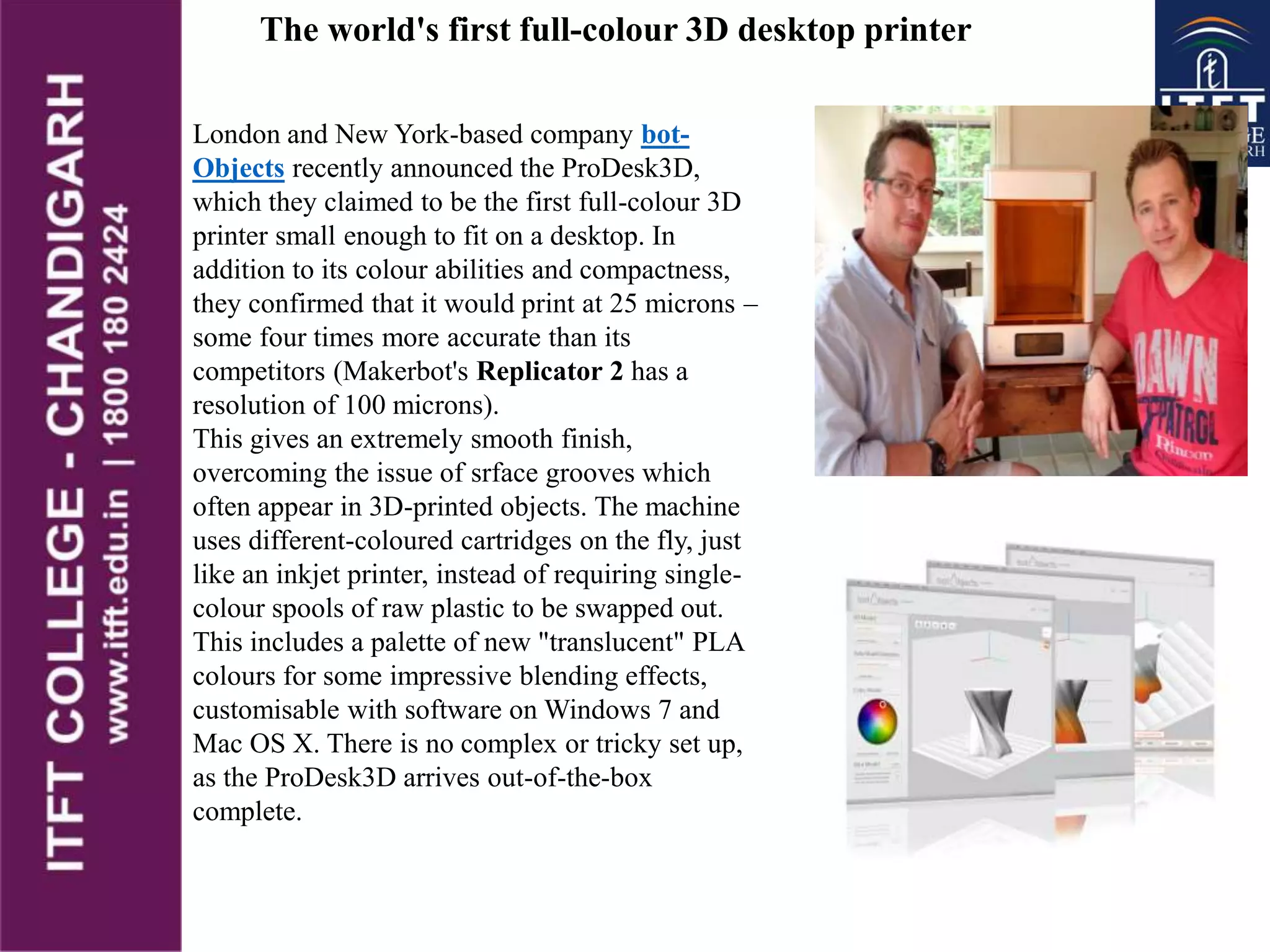
London and New York-based company bot-
Objects recently announced the ProDesk3D,
which they claimed to be the first full-colour 3D
printer small enough to fit on a desktop. In
addition to its colour abilities and compactness,
they confirmed that it would print at 25 microns –
some four times more accurate than its
competitors (Makerbot's Replicator 2 has a
resolution of 100 microns).
This gives an extremely smooth finish,
overcoming the issue of srface grooves which
often appear in 3D-printed objects. The machine
uses different-coloured cartridges on the fly, just
like an inkjet printer, instead of requiring single-
colour spools of raw plastic to be swapped out.
This includes a palette of new "translucent" PLA
colours for some impressive blending effects,
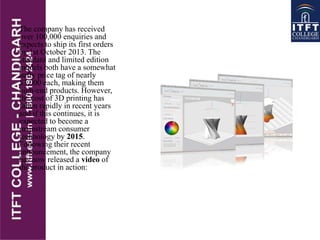
customisable with software on Windows 7 and
Mac OS X. There is no complex or tricky set up,
as the ProDesk3D arrives out-of-the-box
complete.
The company has received
over 100,000 enquiries and
expects to ship its first orders
by 1st October 2013. The
standard and limited edition
models both have a somewhat
hefty price tag of nearly
$3,000 each, making them
high-end products. However,
the cost of 3D printing has
fallen rapidly in recent years
and if this continues, it is
expected to become a
mainstream consumer
technology by 2015.
Following their recent
announcement, the company
has now released a video of
the product in action:
Faced with growing environmental
and economic pressures on
transportation, cities are
reexamining how and where
parking is provided, and
developing a more balanced view
to better manage parking supply
and demand.
Enabled by new technologies,
innovative approaches to parking
are becoming a cornerstone of
cities' mobility strategies.
According to a new report from
Navigant Research, the installed
base of on-street smart parking
spaces will surpass 950,000
worldwide by 2020, with a six-fold
increase in annual revenue
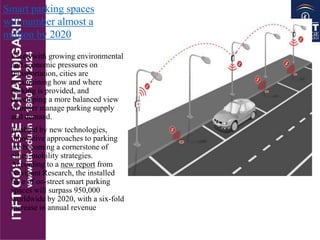
Smart parking spaces
will number almost a
million by 2020
MasterCard, in collaboration
with Standard Chartered Bank
Singapore, has unveiled
Singapore's first interactive
payment card, or security token
card, using MasterCard's
Display Card technology,
heralding the next generation of
payment cards.
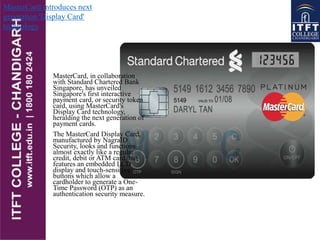
The MasterCard Display Card,
manufactured by NagraID
Security, looks and functions
almost exactly like a regular
credit, debit or ATM card, but
features an embedded LCD
display and touch-sensitive
buttons which allow a
cardholder to generate a One-
Time Password (OTP) as an
authentication security measure.
MasterCard introduces next
generation 'Display Card'
technology
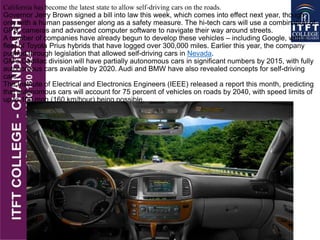
California has become the latest state to allow self-driving cars on the roads.
Governor Jerry Brown signed a bill into law this week, which comes into effect next year, though
only with a human passenger along as a safety measure. The hi-tech cars will use a combination of
GPS, cameras and advanced computer software to navigate their way around streets.
A number of companies have already begun to develop these vehicles – including Google, with a
fleet of Toyota Prius hybrids that have logged over 300,000 miles. Earlier this year, the company
pushed through legislation that allowed self-driving cars in Nevada.
GM's Cadillac division will have partially autonomous cars in significant numbers by 2015, with fully
autonomous cars available by 2020. Audi and BMW have also revealed concepts for self-driving
cars.
The Institute of Electrical and Electronics Engineers (IEEE) released a report this month, predicting
that autonomous cars will account for 75 percent of vehicles on roads by 2040, with speed limits of
up to 100 mph (160 km/hour) being possible.
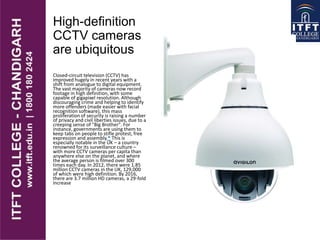
High-definition
CCTV cameras
are ubiquitous
Closed-circuit television (CCTV) has
improved hugely in recent years with a
shift from analogue to digital equipment.
The vast majority of cameras now record
footage in high definition, with some
capable of gigapixel resolution. Although
discouraging crime and helping to identify
more offenders (made easier with facial
recognition software), this mass
proliferation of security is raising a number
of privacy and civil liberties issues, due to a
creeping sense of "Big Brother". For
instance, governments are using them to
keep tabs on people to stifle protest, free
expression and assembly.* This is
especially notable in the UK – a country
renowned for its surveillance culture –
with more CCTV cameras per capita than
anywhere else on the planet, and where
the average person is filmed over 300
times each day. In 2012, there were 1.85
million CCTV cameras in the UK, 129,000
of which were high definition. By 2016,
there are 3.7 million HD cameras, a 29-fold
increase
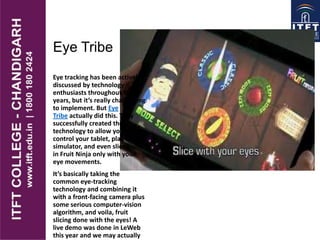
Eye Tribe
Eye tracking has been actively
discussed by technology
enthusiasts throughout these
years, but it’s really challenging
to implement. But Eye
Tribe actually did this. They
successfully created the
technology to allow you to
control your tablet, play flight
simulator, and even slice fruits
in Fruit Ninja only with your
eye movements.
It’s basically taking the
common eye-tracking
technology and combining it
with a front-facing camera plus
some serious computer-vision
algorithm, and voila, fruit
slicing done with the eyes! A
live demo was done in LeWeb
this year and we may actually
ITFT- new trends in information technology

ITFT- new trends in information technology

  • 1.
    The world's firstfull-colour 3D desktop printer London and New York-based company bot- Objects recently announced the ProDesk3D, which they claimed to be the first full-colour 3D printer small enough to fit on a desktop. In addition to its colour abilities and compactness, they confirmed that it would print at 25 microns – some four times more accurate than its competitors (Makerbot's Replicator 2 has a resolution of 100 microns). This gives an extremely smooth finish, overcoming the issue of srface grooves which often appear in 3D-printed objects. The machine uses different-coloured cartridges on the fly, just like an inkjet printer, instead of requiring single- colour spools of raw plastic to be swapped out. This includes a palette of new "translucent" PLA colours for some impressive blending effects, customisable with software on Windows 7 and Mac OS X. There is no complex or tricky set up, as the ProDesk3D arrives out-of-the-box complete.
  • 2.
    The company hasreceived over 100,000 enquiries and expects to ship its first orders by 1st October 2013. The standard and limited edition models both have a somewhat hefty price tag of nearly $3,000 each, making them high-end products. However, the cost of 3D printing has fallen rapidly in recent years and if this continues, it is expected to become a mainstream consumer technology by 2015. Following their recent announcement, the company has now released a video of the product in action:
  • 3.
    Faced with growingenvironmental and economic pressures on transportation, cities are reexamining how and where parking is provided, and developing a more balanced view to better manage parking supply and demand. Enabled by new technologies, innovative approaches to parking are becoming a cornerstone of cities' mobility strategies. According to a new report from Navigant Research, the installed base of on-street smart parking spaces will surpass 950,000 worldwide by 2020, with a six-fold increase in annual revenue Smart parking spaces will number almost a million by 2020
  • 4.
    MasterCard, in collaboration withStandard Chartered Bank Singapore, has unveiled Singapore's first interactive payment card, or security token card, using MasterCard's Display Card technology, heralding the next generation of payment cards. The MasterCard Display Card, manufactured by NagraID Security, looks and functions almost exactly like a regular credit, debit or ATM card, but features an embedded LCD display and touch-sensitive buttons which allow a cardholder to generate a One- Time Password (OTP) as an authentication security measure. MasterCard introduces next generation 'Display Card' technology
  • 5.
    California has becomethe latest state to allow self-driving cars on the roads. Governor Jerry Brown signed a bill into law this week, which comes into effect next year, though only with a human passenger along as a safety measure. The hi-tech cars will use a combination of GPS, cameras and advanced computer software to navigate their way around streets. A number of companies have already begun to develop these vehicles – including Google, with a fleet of Toyota Prius hybrids that have logged over 300,000 miles. Earlier this year, the company pushed through legislation that allowed self-driving cars in Nevada. GM's Cadillac division will have partially autonomous cars in significant numbers by 2015, with fully autonomous cars available by 2020. Audi and BMW have also revealed concepts for self-driving cars. The Institute of Electrical and Electronics Engineers (IEEE) released a report this month, predicting that autonomous cars will account for 75 percent of vehicles on roads by 2040, with speed limits of up to 100 mph (160 km/hour) being possible.
  • 6.
    High-definition CCTV cameras are ubiquitous Closed-circuittelevision (CCTV) has improved hugely in recent years with a shift from analogue to digital equipment. The vast majority of cameras now record footage in high definition, with some capable of gigapixel resolution. Although discouraging crime and helping to identify more offenders (made easier with facial recognition software), this mass proliferation of security is raising a number of privacy and civil liberties issues, due to a creeping sense of "Big Brother". For instance, governments are using them to keep tabs on people to stifle protest, free expression and assembly.* This is especially notable in the UK – a country renowned for its surveillance culture – with more CCTV cameras per capita than anywhere else on the planet, and where the average person is filmed over 300 times each day. In 2012, there were 1.85 million CCTV cameras in the UK, 129,000 of which were high definition. By 2016, there are 3.7 million HD cameras, a 29-fold increase
  • 7.
    Eye Tribe Eye trackinghas been actively discussed by technology enthusiasts throughout these years, but it’s really challenging to implement. But Eye Tribe actually did this. They successfully created the technology to allow you to control your tablet, play flight simulator, and even slice fruits in Fruit Ninja only with your eye movements. It’s basically taking the common eye-tracking technology and combining it with a front-facing camera plus some serious computer-vision algorithm, and voila, fruit slicing done with the eyes! A live demo was done in LeWeb this year and we may actually