2nd EUROSOLAN and AFRILAB meetings
Mrs. Nopmanee Suvannang
Chair GLOSOLAN
Item 1
Global Soil Laboratory Network updates
2nd EUROSOLAN and AFRILAB meetings
Established in November 2017 to:
1. Strenghten the performance of laboratories through the use of
standardized methods and protocols
2. Harmonize soil analysis methods so that soil information would be
comparable and interpretable across laboratories, countries and
regions
3. [Aspiration] provide a certification for technical competencies in
laboratory analysis
2nd EUROSOLAN and AFRILAB meetings
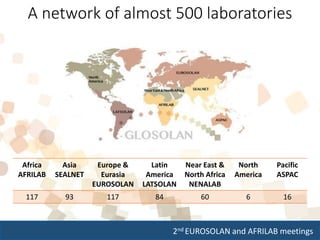
A network of almost 500 laboratories
Africa
AFRILAB
Asia
SEALNET
Europe &
Eurasia
EUROSOLAN
Latin
America
LATSOLAN
Near East &
North Africa
NENALAB
North
America
Pacific
ASPAC
117 93 117 84 60 6 16
2nd EUROSOLAN and AFRILAB meetings
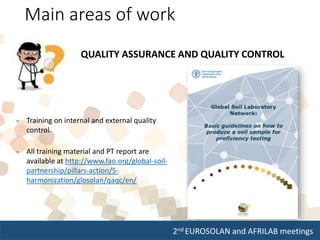
Main areas of work
QUALITY ASSURANCE AND QUALITY CONTROL
- Training on internal and external quality
control.
- All training material and PT report are
available at http://www.fao.org/global-soil-
partnership/pillars-action/5-
harmonization/glosolan/qaqc/en/
2nd EUROSOLAN and AFRILAB meetings
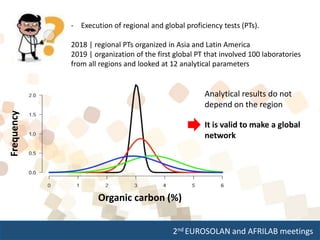
- Execution of regional and global proficiency tests (PTs).
2018 | regional PTs organized in Asia and Latin America
2019 | organization of the first global PT that involved 100 laboratories
from all regions and looked at 12 analytical parameters
Organic carbon (%)
Analytical results do not
depend on the region
It is valid to make a global
network
Frequency
2nd EUROSOLAN and AFRILAB meetings
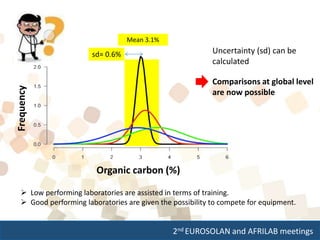
 Low performing laboratories are assisted in terms of training.
 Good performing laboratories are given the possibility to compete for equipment.
Mean 3.1%
sd= 0.6%
Organic carbon (%)
Uncertainty (sd) can be
calculated
Comparisons at global level
are now possible
Frequency
2nd EUROSOLAN and AFRILAB meetings
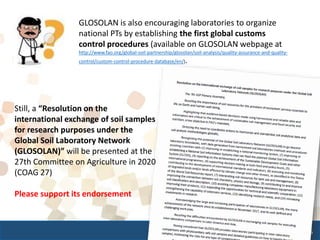
Still, a “Resolution on the
international exchange of soil samples
for research purposes under the
Global Soil Laboratory Network
(GLOSOLAN)” will be presented at the
27th Committee on Agriculture in 2020
(COAG 27)
Please support its endorsement
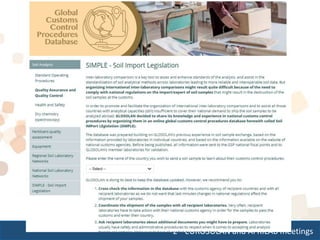
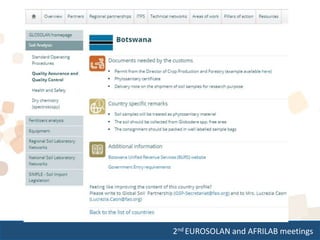
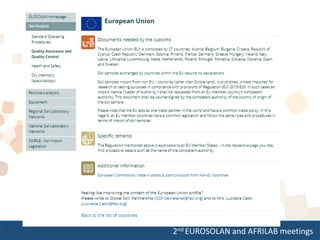
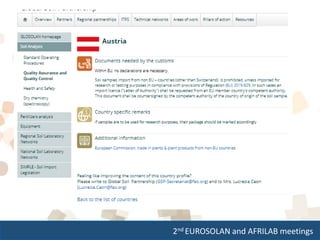
GLOSOLAN is also encouraging laboratories to organize
national PTs by establishing the first global customs
control procedures (available on GLOSOLAN webpage at
http://www.fao.org/global-soil-partnership/glosolan/soil-analysis/quality-assurance-and-quality-
control/custom-control-procedure-database/en/).
2nd EUROSOLAN and AFRILAB meetings
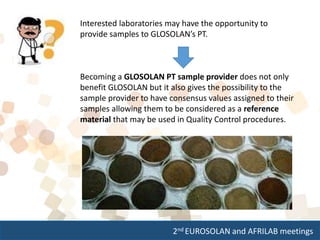
Interested laboratories may have the opportunity to
provide samples to GLOSOLAN’s PT.
Becoming a GLOSOLAN PT sample provider does not only
benefit GLOSOLAN but it also gives the possibility to the
sample provider to have consensus values assigned to their
samples allowing them to be considered as a reference
material that may be used in Quality Control procedures.
2nd EUROSOLAN and AFRILAB meetings
Main areas of work
STANDARD OPERATING PROCEDURES (SOPs)
SOPs go hand-in-hand with the execution of internal and
external quality control exercises
• GLOSOLAN is working to produce globally harmonized SOPs for known methods.
Priority is given to methods for the analysis of soil chemical parameters but we
will start to work on soil physical and biological parameters as well as on soil
contaminants soon.
• The methods to harmonize are decided at the annual meetings of GLOSOLAN
keeping into consideration regional priorities and requests
2nd EUROSOLAN and AFRILAB meetings
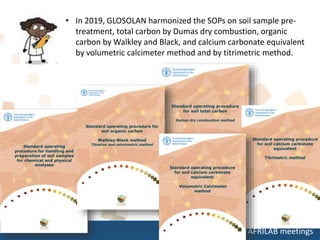
• In 2019, GLOSOLAN harmonized the SOPs on soil sample pre-
treatment, total carbon by Dumas dry combustion, organic
carbon by Walkley and Black, and calcium carbonate equivalent
by volumetric calcimeter method and by titrimetric method.
2nd EUROSOLAN and AFRILAB meetings
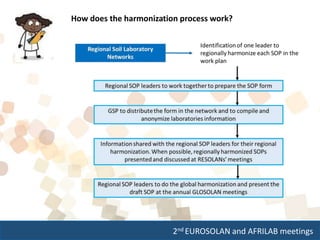
How does the harmonization process work?
2nd EUROSOLAN and AFRILAB meetings
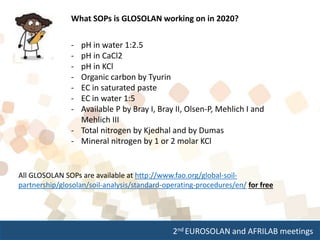
What SOPs is GLOSOLAN working on in 2020?
All GLOSOLAN SOPs are available at http://www.fao.org/global-soil-
partnership/glosolan/soil-analysis/standard-operating-procedures/en/ for free
- pH in water 1:2.5
- pH in CaCl2
- pH in KCl
- Organic carbon by Tyurin
- EC in saturated paste
- EC in water 1:5
- Available P by Bray I, Bray II, Olsen-P, Mehlich I and
Mehlich III
- Total nitrogen by Kjedhal and by Dumas
- Mineral nitrogen by 1 or 2 molar KCl
2nd EUROSOLAN and AFRILAB meetings
Main areas of work
LABORATORY EQUIPMENT
Equipment is an essential part of laboratory analysis but
remember that equipment alone does not make the
difference in getting reliable data.
GLOSOLAN believes in TRAINING FIRST! Before investing in new laboratory
equipment, lab managers should make sure that laboratory staff is properly and
regularly trained and that good laboratory practices, including equipment
maintenance and calibration, are implemented.
However, laboratories cannot work without equipment! GLOSOLAN will provide
laboratories that have a good proficiency in soil analysis with new equipment. The
proficiency of laboratories is assessed through the GLOSOLAN proficiency tests.
2nd EUROSOLAN and AFRILAB meetings
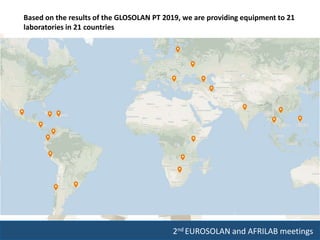
Based on the results of the GLOSOLAN PT 2019, we are providing equipment to 21
laboratories in 21 countries
2nd EUROSOLAN and AFRILAB meetings
GLOSOLAN work on equipment
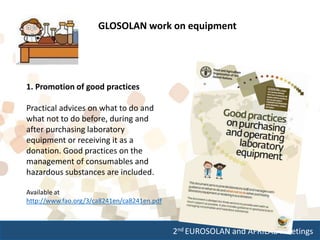
1. Promotion of good practices
Practical advices on what to do and
what not to do before, during and
after purchasing laboratory
equipment or receiving it as a
donation. Good practices on the
management of consumables and
hazardous substances are included.
Available at
http://www.fao.org/3/ca8241en/ca8241en.pdf
2nd EUROSOLAN and AFRILAB meetings
GLOSOLAN work on equipment
2. Establishment of a barter/donation system
• Several laboratories worldwide are asked to replace their still functioning equipment
on a regular basis. Instead of being disposed, this equipment can be donated to
laboratories in need
• Often, laboratories receiving donations are given equipment they are not in the
conditions to operate and/or well maintain because of several factors like the in-situ
availability of service providers for equipment maintenance, provision of consumables,
etc. for specific equipment brands. The same can happen to laboratories purchasing
new equipment themselves. This can result in the misuse, damage or disuse of the
equipment. GLOSOLAN is available to support laboratories willing to barter their well-
functioning equipment for free.
More information available at http://www.fao.org/global-soil-partnership/glosolan/equipment/en/ .
Interested laboratories can send an email to GSP-Secretariat@fao.org and Lucrezia.Caon@fao.org
2nd EUROSOLAN and AFRILAB meetings
GLOSOLAN work on equipment
3. Development of guidelines on procurement
• GLOSOLAN and FAO are working to develop guidelines on the
procurement of laboratory equipment. This would help laboratories to
better formulate their requests to vendors participating to the bid, get
the right equipment, get trained on its used and receive after-sale
services including remote support and maintenance services.
2nd EUROSOLAN and AFRILAB meetings
Main areas of work
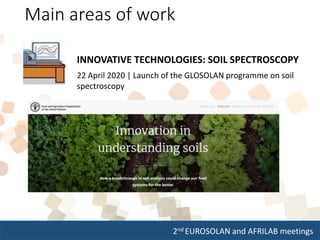
INNOVATIVE TECHNOLOGIES: SOIL SPECTROSCOPY
22 April 2020 | Launch of the GLOSOLAN programme on soil
spectroscopy
2nd EUROSOLAN and AFRILAB meetings
Main areas of work
INNOVATIVE TECHNOLOGIES: SOIL SPECTROSCOPY
23 -25 September 2020 | First Plenary Meeting on Soil
Spectroscopy
Main conclusions:
1. The concept notes written for the launch of the initiative were revised
2. The 2020-2021 work plan of GLOSOLAN on spectroscopy (main activities, timeline
and implementing partners) was defined. Special attention was given to the
establishment of the global spectral calibration library and the writing of
guidelines, protocols and manuals on spectroscopy
3. The modality by which GLOSOLAN will interact with other initiatives, and how
projects can contribute to GLOSOLAN was defined
4. The modality by which GLOSOLAN will interact with countries and laboratories,
institutions and organizations working on soil spectroscopy was defined
5. The governance of the initiative was defined
2nd EUROSOLAN and AFRILAB meetings
Main areas of work
FERTILIZERS ANALYSIS
GLOSOLAN received a request to look into fertilizers quality
assessment and it is now working on establishing the
International network on fertilizers analysis (INFA)
To be launched through an online meeting in 2020. Main
objectives of the meeting:
 Define the international role and the specific
objectives of INFA.
 Develop the INFA work plan
 Identify international organizations like The
Fertilizer Institute that INFA should connect to
(identification of cooperation opportunities)
2nd EUROSOLAN and AFRILAB meetings
In order to prepare to the meeting
- Laboratories and institute responsible for the assessment of fertilizers
quality in their country are being identified
- Regional and international organizations, associations and institutes working
on fertilizers quality assessment and with agendas compatible with that of
INFA are being identified. As per the principles of GLOSOLAN, INFA will try
cooperate and limit duplication of efforts as much as possible.
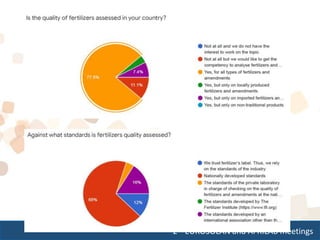
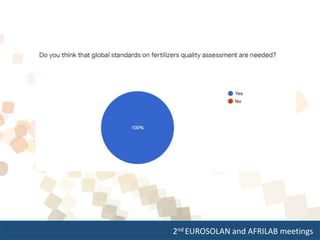
- All stakeholders working in the field of fertilizers quality assessment are
invited to complete the questionnaire at
https://forms.gle/Z5kYUpH5f6rpn6zUA. These inputs will be used to open
the discussion at the launch meeting of INFA.
Examples of the inputs we are collecting are herewith reported.
For more information on this activity and INFA or to get involved, please contact Lucrezia.caon@fao.org
2nd EUROSOLAN and AFRILAB meetings
Expectations
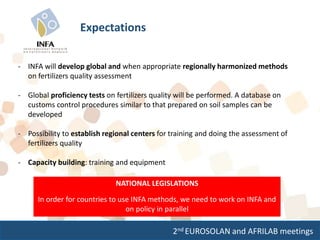
- INFA will develop global and when appropriate regionally harmonized methods
on fertilizers quality assessment
- Global proficiency tests on fertilizers quality will be performed. A database on
customs control procedures similar to that prepared on soil samples can be
developed
- Possibility to establish regional centers for training and doing the assessment of
fertilizers quality
- Capacity building: training and equipment
NATIONAL LEGISLATIONS
In order for countries to use INFA methods, we need to work on INFA and
on policy in parallel
2nd EUROSOLAN and AFRILAB meetings
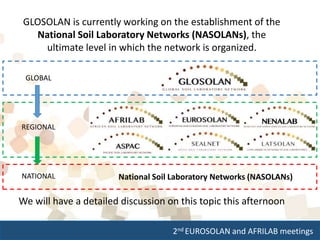
GLOSOLAN is currently working on the establishment of the
National Soil Laboratory Networks (NASOLANs), the
ultimate level in which the network is organized.
We will have a detailed discussion on this topic this afternoon
National Soil Laboratory Networks (NASOLANs)
GLOBAL
REGIONAL
NATIONAL
2nd EUROSOLAN and AFRILAB meetings
Thanks for your attention

Item 1. Global Soil Laboratory Network updates

  • 1.
    2nd EUROSOLAN andAFRILAB meetings Mrs. Nopmanee Suvannang Chair GLOSOLAN Item 1 Global Soil Laboratory Network updates
  • 2.
    2nd EUROSOLAN andAFRILAB meetings Established in November 2017 to: 1. Strenghten the performance of laboratories through the use of standardized methods and protocols 2. Harmonize soil analysis methods so that soil information would be comparable and interpretable across laboratories, countries and regions 3. [Aspiration] provide a certification for technical competencies in laboratory analysis
  • 3.
    2nd EUROSOLAN andAFRILAB meetings A network of almost 500 laboratories Africa AFRILAB Asia SEALNET Europe & Eurasia EUROSOLAN Latin America LATSOLAN Near East & North Africa NENALAB North America Pacific ASPAC 117 93 117 84 60 6 16
  • 4.
    2nd EUROSOLAN andAFRILAB meetings Main areas of work QUALITY ASSURANCE AND QUALITY CONTROL - Training on internal and external quality control. - All training material and PT report are available at http://www.fao.org/global-soil- partnership/pillars-action/5- harmonization/glosolan/qaqc/en/
  • 5.
    2nd EUROSOLAN andAFRILAB meetings - Execution of regional and global proficiency tests (PTs). 2018 | regional PTs organized in Asia and Latin America 2019 | organization of the first global PT that involved 100 laboratories from all regions and looked at 12 analytical parameters Organic carbon (%) Analytical results do not depend on the region It is valid to make a global network Frequency
  • 6.
    2nd EUROSOLAN andAFRILAB meetings  Low performing laboratories are assisted in terms of training.  Good performing laboratories are given the possibility to compete for equipment. Mean 3.1% sd= 0.6% Organic carbon (%) Uncertainty (sd) can be calculated Comparisons at global level are now possible Frequency
  • 7.
    2nd EUROSOLAN andAFRILAB meetings Still, a “Resolution on the international exchange of soil samples for research purposes under the Global Soil Laboratory Network (GLOSOLAN)” will be presented at the 27th Committee on Agriculture in 2020 (COAG 27) Please support its endorsement GLOSOLAN is also encouraging laboratories to organize national PTs by establishing the first global customs control procedures (available on GLOSOLAN webpage at http://www.fao.org/global-soil-partnership/glosolan/soil-analysis/quality-assurance-and-quality- control/custom-control-procedure-database/en/).
  • 8.
    2nd EUROSOLAN andAFRILAB meetings
  • 9.
    2nd EUROSOLAN andAFRILAB meetings
  • 10.
    2nd EUROSOLAN andAFRILAB meetings
  • 11.
    2nd EUROSOLAN andAFRILAB meetings
  • 12.
    2nd EUROSOLAN andAFRILAB meetings Interested laboratories may have the opportunity to provide samples to GLOSOLAN’s PT. Becoming a GLOSOLAN PT sample provider does not only benefit GLOSOLAN but it also gives the possibility to the sample provider to have consensus values assigned to their samples allowing them to be considered as a reference material that may be used in Quality Control procedures.
  • 13.
    2nd EUROSOLAN andAFRILAB meetings Main areas of work STANDARD OPERATING PROCEDURES (SOPs) SOPs go hand-in-hand with the execution of internal and external quality control exercises • GLOSOLAN is working to produce globally harmonized SOPs for known methods. Priority is given to methods for the analysis of soil chemical parameters but we will start to work on soil physical and biological parameters as well as on soil contaminants soon. • The methods to harmonize are decided at the annual meetings of GLOSOLAN keeping into consideration regional priorities and requests
  • 14.
    2nd EUROSOLAN andAFRILAB meetings • In 2019, GLOSOLAN harmonized the SOPs on soil sample pre- treatment, total carbon by Dumas dry combustion, organic carbon by Walkley and Black, and calcium carbonate equivalent by volumetric calcimeter method and by titrimetric method.
  • 15.
    2nd EUROSOLAN andAFRILAB meetings How does the harmonization process work?
  • 16.
    2nd EUROSOLAN andAFRILAB meetings What SOPs is GLOSOLAN working on in 2020? All GLOSOLAN SOPs are available at http://www.fao.org/global-soil- partnership/glosolan/soil-analysis/standard-operating-procedures/en/ for free - pH in water 1:2.5 - pH in CaCl2 - pH in KCl - Organic carbon by Tyurin - EC in saturated paste - EC in water 1:5 - Available P by Bray I, Bray II, Olsen-P, Mehlich I and Mehlich III - Total nitrogen by Kjedhal and by Dumas - Mineral nitrogen by 1 or 2 molar KCl
  • 17.
    2nd EUROSOLAN andAFRILAB meetings Main areas of work LABORATORY EQUIPMENT Equipment is an essential part of laboratory analysis but remember that equipment alone does not make the difference in getting reliable data. GLOSOLAN believes in TRAINING FIRST! Before investing in new laboratory equipment, lab managers should make sure that laboratory staff is properly and regularly trained and that good laboratory practices, including equipment maintenance and calibration, are implemented. However, laboratories cannot work without equipment! GLOSOLAN will provide laboratories that have a good proficiency in soil analysis with new equipment. The proficiency of laboratories is assessed through the GLOSOLAN proficiency tests.
  • 18.
    2nd EUROSOLAN andAFRILAB meetings Based on the results of the GLOSOLAN PT 2019, we are providing equipment to 21 laboratories in 21 countries
  • 19.
    2nd EUROSOLAN andAFRILAB meetings GLOSOLAN work on equipment 1. Promotion of good practices Practical advices on what to do and what not to do before, during and after purchasing laboratory equipment or receiving it as a donation. Good practices on the management of consumables and hazardous substances are included. Available at http://www.fao.org/3/ca8241en/ca8241en.pdf
  • 20.
    2nd EUROSOLAN andAFRILAB meetings GLOSOLAN work on equipment 2. Establishment of a barter/donation system • Several laboratories worldwide are asked to replace their still functioning equipment on a regular basis. Instead of being disposed, this equipment can be donated to laboratories in need • Often, laboratories receiving donations are given equipment they are not in the conditions to operate and/or well maintain because of several factors like the in-situ availability of service providers for equipment maintenance, provision of consumables, etc. for specific equipment brands. The same can happen to laboratories purchasing new equipment themselves. This can result in the misuse, damage or disuse of the equipment. GLOSOLAN is available to support laboratories willing to barter their well- functioning equipment for free. More information available at http://www.fao.org/global-soil-partnership/glosolan/equipment/en/ . Interested laboratories can send an email to GSP-Secretariat@fao.org and Lucrezia.Caon@fao.org
  • 21.
    2nd EUROSOLAN andAFRILAB meetings GLOSOLAN work on equipment 3. Development of guidelines on procurement • GLOSOLAN and FAO are working to develop guidelines on the procurement of laboratory equipment. This would help laboratories to better formulate their requests to vendors participating to the bid, get the right equipment, get trained on its used and receive after-sale services including remote support and maintenance services.
  • 22.
    2nd EUROSOLAN andAFRILAB meetings Main areas of work INNOVATIVE TECHNOLOGIES: SOIL SPECTROSCOPY 22 April 2020 | Launch of the GLOSOLAN programme on soil spectroscopy
  • 23.
    2nd EUROSOLAN andAFRILAB meetings Main areas of work INNOVATIVE TECHNOLOGIES: SOIL SPECTROSCOPY 23 -25 September 2020 | First Plenary Meeting on Soil Spectroscopy Main conclusions: 1. The concept notes written for the launch of the initiative were revised 2. The 2020-2021 work plan of GLOSOLAN on spectroscopy (main activities, timeline and implementing partners) was defined. Special attention was given to the establishment of the global spectral calibration library and the writing of guidelines, protocols and manuals on spectroscopy 3. The modality by which GLOSOLAN will interact with other initiatives, and how projects can contribute to GLOSOLAN was defined 4. The modality by which GLOSOLAN will interact with countries and laboratories, institutions and organizations working on soil spectroscopy was defined 5. The governance of the initiative was defined
  • 24.
    2nd EUROSOLAN andAFRILAB meetings Main areas of work FERTILIZERS ANALYSIS GLOSOLAN received a request to look into fertilizers quality assessment and it is now working on establishing the International network on fertilizers analysis (INFA) To be launched through an online meeting in 2020. Main objectives of the meeting:  Define the international role and the specific objectives of INFA.  Develop the INFA work plan  Identify international organizations like The Fertilizer Institute that INFA should connect to (identification of cooperation opportunities)
  • 25.
    2nd EUROSOLAN andAFRILAB meetings In order to prepare to the meeting - Laboratories and institute responsible for the assessment of fertilizers quality in their country are being identified - Regional and international organizations, associations and institutes working on fertilizers quality assessment and with agendas compatible with that of INFA are being identified. As per the principles of GLOSOLAN, INFA will try cooperate and limit duplication of efforts as much as possible. - All stakeholders working in the field of fertilizers quality assessment are invited to complete the questionnaire at https://forms.gle/Z5kYUpH5f6rpn6zUA. These inputs will be used to open the discussion at the launch meeting of INFA. Examples of the inputs we are collecting are herewith reported. For more information on this activity and INFA or to get involved, please contact Lucrezia.caon@fao.org
  • 26.
    2nd EUROSOLAN andAFRILAB meetings
  • 27.
    2nd EUROSOLAN andAFRILAB meetings
  • 28.
    2nd EUROSOLAN andAFRILAB meetings Expectations - INFA will develop global and when appropriate regionally harmonized methods on fertilizers quality assessment - Global proficiency tests on fertilizers quality will be performed. A database on customs control procedures similar to that prepared on soil samples can be developed - Possibility to establish regional centers for training and doing the assessment of fertilizers quality - Capacity building: training and equipment NATIONAL LEGISLATIONS In order for countries to use INFA methods, we need to work on INFA and on policy in parallel
  • 29.
    2nd EUROSOLAN andAFRILAB meetings GLOSOLAN is currently working on the establishment of the National Soil Laboratory Networks (NASOLANs), the ultimate level in which the network is organized. We will have a detailed discussion on this topic this afternoon National Soil Laboratory Networks (NASOLANs) GLOBAL REGIONAL NATIONAL
  • 30.
    2nd EUROSOLAN andAFRILAB meetings Thanks for your attention