FONDERIA OXFORD
POLITICHE PER L’ITALIA


 ITALY	
  AND	
  ENERGY	
  
 Where	
  we	
  are,	
  and	
  where	
  we	
  are	
  going	


 Simone	
  Falco	
                                               15	
  May	
  2011	
  
We will talk about:

•  How Italy produces energy
•  How other countries produce energy
•  Kyoto protocol
•  Blue Map Scenario
•  Classic energy sources
•  Alternative energy sources
•  The real green energy!


                                        Italy and Energy   15 May 2011
                                                           Page 2
Before starting

Unless is explicitly indicated all the data and the graphs in
the presentation refer only to electric energy!

The other kind of energies – mostly heating and transport –
are not considered because of the different mechanisms
and issues involved. Nevertheless they are massively
involved in the global warming and the CO2 production.


                                          Italy and Energy   15 May 2011
                                                             Page 3
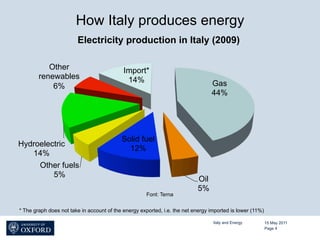
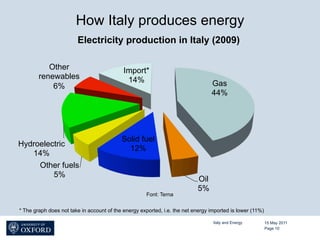
How Italy produces energy
                        Electricity production in Italy (2009)

           Other                            Import*
        renewables                           14%
            6%                                                                   Gas
                                                                                 44%


                                           Solid fuel
Hydroelectric
                                             12%
   14%
     Other fuels
         5%
                                                                           Oil
                                                                           5%
                                                      Font: Terna

* The graph does not take in account of the energy exported, i.e. the net energy imported is lower (11%)

                                                                                  Italy and Energy         15 May 2011
                                                                                                           Page 4
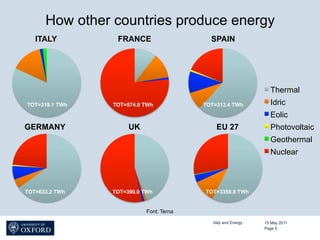
How other countries produce energy
   ITALY         FRANCE                   SPAIN


                                                                Thermal
TOT=319.1 TWh   TOT=574.0 TWh           TOT=313.4 TWh           Idric
                                                                Eolic
GERMANY              UK                     EU 27               Photovoltaic
                                                                Geothermal
                                                                Nuclear


TOT=633.2 TWh   TOT=390.0 TWh           TOT=3359.8 TWh


                          Font: Terna

                                           Italy and Energy   15 May 2011
                                                              Page 5
Kyoto protocol
Kyoto protocol commit the countries that have signed the
treaty (USA does not) to reduce – within 2012 – their
collective greenhouse gas emissions by 5.2% from the 1990
level.

Obviously this target pass through the production of greener
electric energy, but is not the only process involved, so it is
better to refer on a plan focused only on electric energy
production.

Just to know
For Italy that means a reduction of 6.5%
Italy was fined by €555 Million in 2010, that can become 840
in 2012 because is not in line with the reductions!!!
                                          Italy and Energy   15 May 2011
                                                             Page 6
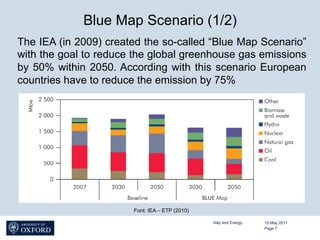
Blue Map Scenario (1/2)
The IEA (in 2009) created the so-called “Blue Map Scenario”
with the goal to reduce the global greenhouse gas emissions
by 50% within 2050. According with this scenario European
countries have to reduce the emission by 75%


                       Font: IEA – ETP (2010)

                                                Italy and Energy   15 May 2011
                                                                   Page 7
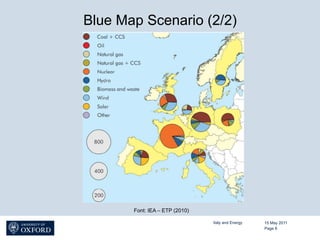
Blue Map Scenario (2/2)


       Font: IEA – ETP (2010)

                                Italy and Energy   15 May 2011
                                                   Page 8
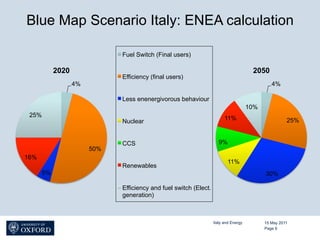
Blue Map Scenario Italy: ENEA calculation

                             Fuel Switch (Final users)

           2020                                                                       2050
                             Efficiency (final users)
                  4%                                                                          4%

                             Less enenergivorous behaviour
                                                                                     10%
 25%
                             Nuclear                                    11%                          25%


                             CCS                                    9%
                       50%
16%
                                                                         11%
                             Renewables
      5%                                                                                   30%

                             Efficiency and fuel switch (Elect.
                             generation)


                                                                  Italy and Energy         15 May 2011
                                                                                           Page 9
How Italy produces energy
                        Electricity production in Italy (2009)

           Other                            Import*
        renewables                           14%
            6%                                                                   Gas
                                                                                 44%


                                           Solid fuel
Hydroelectric
                                             12%
   14%
     Other fuels
         5%
                                                                           Oil
                                                                           5%
                                                      Font: Terna

* The graph does not take in account of the energy exported, i.e. the net energy imported is lower (11%)

                                                                                  Italy and Energy         15 May 2011
                                                                                                           Page 10
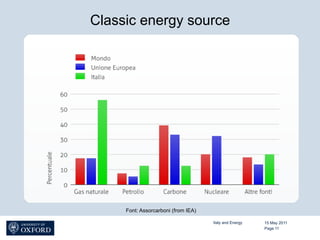
Classic energy source


     Font: Assorcarboni (from IEA)

                                     Italy and Energy   15 May 2011
                                                        Page 11
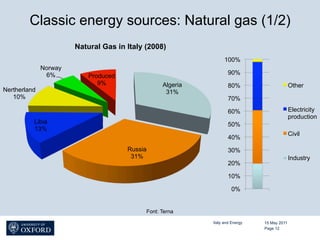
Classic energy sources: Natural gas (1/2)
                       Natural Gas in Italy (2008)
                                                                  100%
              Norway
               6%                                                   90%
                           Produced
                              9%                  Algeria           80%                      Other
Nertherland                                        31%
   10%                                                              70%

                                                                    60%                      Electricity
                                                                                             production
          Libia                                                     50%
          13%
                                                                                             Civil
                                                                    40%
                                      Russia                        30%
                                       31%                                                   Industry
                                                                    20%

                                                                    10%

                                                                     0%


                                            Font: Terna

                                                            Italy and Energy   15 May 2011
                                                                               Page 12
Classic energy sources: Natural gas (2/2)

•  For the same energy produced:
    Ø  Emits less CO2 (about 25%) than other fossil fuels
    Ø  Emits 1800 times less PM than coal
•  There could be underwater field than could be exploited as the
  deepwater mining technology improves


•  Gas reserves are concentrated in few - and politically instable –
  countries (Algeria, Russia, Libia)
•  Transport and storage are complex
•  It will finish in less than 100 years (63 according to BP statistics)

                                                       Italy and Energy   15 May 2011
                                                                          Page 13
Classic energy sources: Coal

•  Is the safer fossil fuel: nonflammable, not-explosive
•  Is not ground or water pollutant
•  Easy to transport and store
•  More than 100 countries can supply coal
•  Is the cheaper and more labor intensive fossil energy source
    Ø  (If Italy used as carbon as the rest of EU energy would cost 10% less, and
       would occupy 3 times more people in energy production)


•  It will finish in less than 200 years (160 according to BP statistics)
•  Emits higher quantities of PM and CO2 than natural gas

                                                       Italy and Energy   15 May 2011
                                                                          Page 14
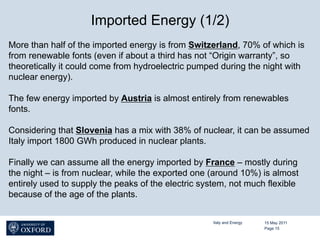
Imported Energy (1/2)
More than half of the imported energy is from Switzerland, 70% of which is
from renewable fonts (even if about a third has not “Origin warranty”, so
theoretically it could come from hydroelectric pumped during the night with
nuclear energy).

The few energy imported by Austria is almost entirely from renewables
fonts.

Considering that Slovenia has a mix with 38% of nuclear, it can be assumed
Italy import 1800 GWh produced in nuclear plants.

Finally we can assume all the energy imported by France – mostly during
the night – is from nuclear, while the exported one (around 10%) is almost
entirely used to supply the peaks of the electric system, not much flexible
because of the age of the plants.


                                                    Italy and Energy   15 May 2011
                                                                       Page 15
Imported Energy (2/2)
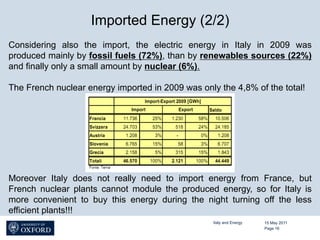
Considering also the import, the electric energy in Italy in 2009 was
produced mainly by fossil fuels (72%), than by renewables sources (22%)
and finally only a small amount by nuclear (6%).

The French nuclear energy imported in 2009 was only the 4,8% of the total!


Moreover Italy does not really need to import energy from France, but
French nuclear plants cannot module the produced energy, so for Italy is
more convenient to buy this energy during the night turning off the less
efficient plants!!!
                                                   Italy and Energy   15 May 2011
                                                                      Page 16
Eolic Energy

•  High energy yield ratio (80)
•  Amortization in 6-8 years


•  NIMBY politics (is noisy and disfigures the scenery)
•  Energy production variable and not manageable
•  Has not the same incentives of the photovoltaic energy (at the moment)


                                                  Italy and Energy   15 May 2011
                                                                     Page 17
Photovoltaic energy

•  Possibility to build small domestic plants
•  Low maintenance and no noise because there are not any moving part


•  Low voltage electricity (not suitable for industries)
•  Low energy yield ratio (4-7)
•  Low efficiency (10-20%)
•  Energy production extremely variable and not manageable
•  The “green certificate” system is being changed
    Ø  Energy was paid up to 4 time the usual price for 20 years: highest
       incentives in the world!!!

                                                       Italy and Energy   15 May 2011
                                                                          Page 18
Combined power plant (1/2)
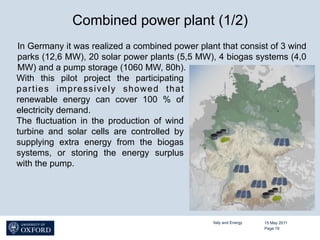
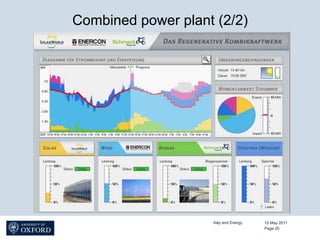
In Germany it was realized a combined power plant that consist of 3 wind
parks (12,6 MW), 20 solar power plants (5,5 MW), 4 biogas systems (4,0
MW) and a pump storage (1060 MW, 80h).
With this pilot project the participating
parties impressively showed that
renewable energy can cover 100 % of
electricity demand.
The fluctuation in the production of wind
turbine and solar cells are controlled by
supplying extra energy from the biogas
systems, or storing the energy surplus
with the pump.


                                                Italy and Energy   15 May 2011
                                                                   Page 19
Combined power plant (2/2)


                    Italy and Energy   15 May 2011
                                       Page 20
The real green energy

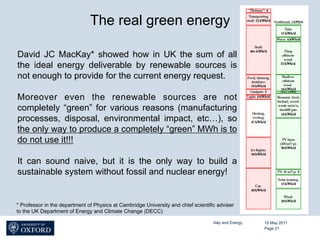
David JC MacKay* showed how in UK the sum of all
the ideal energy deliverable by renewable sources is
not enough to provide for the current energy request.

Moreover even the renewable sources are not
completely “green” for various reasons (manufacturing
processes, disposal, environmental impact, etc…), so
the only way to produce a completely “green” MWh is to
do not use it!!!

It can sound naive, but it is the only way to build a
sustainable system without fossil and nuclear energy!


* Professor in the department of Physics at Cambridge University and chief scientific adviser
to the UK Department of Energy and Climate Change (DECC)

                                                                                    Italy and Energy   15 May 2011
                                                                                                       Page 21
Italy and Energy   15 May 2011
                   Page 22

Italyandenergy

  • 1.
    FONDERIA OXFORD POLITICHE PERL’ITALIA ITALY  AND  ENERGY   Where  we  are,  and  where  we  are  going   Simone  Falco   15  May  2011  
  • 2.
    We will talkabout: •  How Italy produces energy •  How other countries produce energy •  Kyoto protocol •  Blue Map Scenario •  Classic energy sources •  Alternative energy sources •  The real green energy! Italy and Energy 15 May 2011 Page 2
  • 3.
    Before starting Unless isexplicitly indicated all the data and the graphs in the presentation refer only to electric energy! The other kind of energies – mostly heating and transport – are not considered because of the different mechanisms and issues involved. Nevertheless they are massively involved in the global warming and the CO2 production. Italy and Energy 15 May 2011 Page 3
  • 4.
    How Italy producesenergy Electricity production in Italy (2009) Other Import* renewables 14% 6% Gas 44% Solid fuel Hydroelectric 12% 14% Other fuels 5% Oil 5% Font: Terna * The graph does not take in account of the energy exported, i.e. the net energy imported is lower (11%) Italy and Energy 15 May 2011 Page 4
  • 5.
    How other countriesproduce energy ITALY FRANCE SPAIN Thermal TOT=319.1 TWh TOT=574.0 TWh TOT=313.4 TWh Idric Eolic GERMANY UK EU 27 Photovoltaic Geothermal Nuclear TOT=633.2 TWh TOT=390.0 TWh TOT=3359.8 TWh Font: Terna Italy and Energy 15 May 2011 Page 5
  • 6.
    Kyoto protocol Kyoto protocolcommit the countries that have signed the treaty (USA does not) to reduce – within 2012 – their collective greenhouse gas emissions by 5.2% from the 1990 level. Obviously this target pass through the production of greener electric energy, but is not the only process involved, so it is better to refer on a plan focused only on electric energy production. Just to know For Italy that means a reduction of 6.5% Italy was fined by €555 Million in 2010, that can become 840 in 2012 because is not in line with the reductions!!! Italy and Energy 15 May 2011 Page 6
  • 7.
    Blue Map Scenario(1/2) The IEA (in 2009) created the so-called “Blue Map Scenario” with the goal to reduce the global greenhouse gas emissions by 50% within 2050. According with this scenario European countries have to reduce the emission by 75% Font: IEA – ETP (2010) Italy and Energy 15 May 2011 Page 7
  • 8.
    Blue Map Scenario(2/2) Font: IEA – ETP (2010) Italy and Energy 15 May 2011 Page 8
  • 9.
    Blue Map ScenarioItaly: ENEA calculation Fuel Switch (Final users) 2020 2050 Efficiency (final users) 4% 4% Less enenergivorous behaviour 10% 25% Nuclear 11% 25% CCS 9% 50% 16% 11% Renewables 5% 30% Efficiency and fuel switch (Elect. generation) Italy and Energy 15 May 2011 Page 9
  • 10.
    How Italy producesenergy Electricity production in Italy (2009) Other Import* renewables 14% 6% Gas 44% Solid fuel Hydroelectric 12% 14% Other fuels 5% Oil 5% Font: Terna * The graph does not take in account of the energy exported, i.e. the net energy imported is lower (11%) Italy and Energy 15 May 2011 Page 10
  • 11.
    Classic energy source Font: Assorcarboni (from IEA) Italy and Energy 15 May 2011 Page 11
  • 12.
    Classic energy sources:Natural gas (1/2) Natural Gas in Italy (2008) 100% Norway 6% 90% Produced 9% Algeria 80% Other Nertherland 31% 10% 70% 60% Electricity production Libia 50% 13% Civil 40% Russia 30% 31% Industry 20% 10% 0% Font: Terna Italy and Energy 15 May 2011 Page 12
  • 13.
    Classic energy sources:Natural gas (2/2) •  For the same energy produced: Ø  Emits less CO2 (about 25%) than other fossil fuels Ø  Emits 1800 times less PM than coal •  There could be underwater field than could be exploited as the deepwater mining technology improves •  Gas reserves are concentrated in few - and politically instable – countries (Algeria, Russia, Libia) •  Transport and storage are complex •  It will finish in less than 100 years (63 according to BP statistics) Italy and Energy 15 May 2011 Page 13
  • 14.
    Classic energy sources:Coal •  Is the safer fossil fuel: nonflammable, not-explosive •  Is not ground or water pollutant •  Easy to transport and store •  More than 100 countries can supply coal •  Is the cheaper and more labor intensive fossil energy source Ø  (If Italy used as carbon as the rest of EU energy would cost 10% less, and would occupy 3 times more people in energy production) •  It will finish in less than 200 years (160 according to BP statistics) •  Emits higher quantities of PM and CO2 than natural gas Italy and Energy 15 May 2011 Page 14
  • 15.
    Imported Energy (1/2) Morethan half of the imported energy is from Switzerland, 70% of which is from renewable fonts (even if about a third has not “Origin warranty”, so theoretically it could come from hydroelectric pumped during the night with nuclear energy). The few energy imported by Austria is almost entirely from renewables fonts. Considering that Slovenia has a mix with 38% of nuclear, it can be assumed Italy import 1800 GWh produced in nuclear plants. Finally we can assume all the energy imported by France – mostly during the night – is from nuclear, while the exported one (around 10%) is almost entirely used to supply the peaks of the electric system, not much flexible because of the age of the plants. Italy and Energy 15 May 2011 Page 15
  • 16.
    Imported Energy (2/2) Consideringalso the import, the electric energy in Italy in 2009 was produced mainly by fossil fuels (72%), than by renewables sources (22%) and finally only a small amount by nuclear (6%). The French nuclear energy imported in 2009 was only the 4,8% of the total! Moreover Italy does not really need to import energy from France, but French nuclear plants cannot module the produced energy, so for Italy is more convenient to buy this energy during the night turning off the less efficient plants!!! Italy and Energy 15 May 2011 Page 16
  • 17.
    Eolic Energy •  Highenergy yield ratio (80) •  Amortization in 6-8 years •  NIMBY politics (is noisy and disfigures the scenery) •  Energy production variable and not manageable •  Has not the same incentives of the photovoltaic energy (at the moment) Italy and Energy 15 May 2011 Page 17
  • 18.
    Photovoltaic energy •  Possibilityto build small domestic plants •  Low maintenance and no noise because there are not any moving part •  Low voltage electricity (not suitable for industries) •  Low energy yield ratio (4-7) •  Low efficiency (10-20%) •  Energy production extremely variable and not manageable •  The “green certificate” system is being changed Ø  Energy was paid up to 4 time the usual price for 20 years: highest incentives in the world!!! Italy and Energy 15 May 2011 Page 18
  • 19.
    Combined power plant(1/2) In Germany it was realized a combined power plant that consist of 3 wind parks (12,6 MW), 20 solar power plants (5,5 MW), 4 biogas systems (4,0 MW) and a pump storage (1060 MW, 80h). With this pilot project the participating parties impressively showed that renewable energy can cover 100 % of electricity demand. The fluctuation in the production of wind turbine and solar cells are controlled by supplying extra energy from the biogas systems, or storing the energy surplus with the pump. Italy and Energy 15 May 2011 Page 19
  • 20.
    Combined power plant(2/2) Italy and Energy 15 May 2011 Page 20
  • 21.
    The real greenenergy David JC MacKay* showed how in UK the sum of all the ideal energy deliverable by renewable sources is not enough to provide for the current energy request. Moreover even the renewable sources are not completely “green” for various reasons (manufacturing processes, disposal, environmental impact, etc…), so the only way to produce a completely “green” MWh is to do not use it!!! It can sound naive, but it is the only way to build a sustainable system without fossil and nuclear energy! * Professor in the department of Physics at Cambridge University and chief scientific adviser to the UK Department of Energy and Climate Change (DECC) Italy and Energy 15 May 2011 Page 21
  • 22.
    Italy and Energy 15 May 2011 Page 22