

*
What is an Industry?
• Industry is the production of goods or services within
an economy. The major source of revenue of a group
or company is the indicator of its relevant industry.
When a large group has multiple sources of revenue
generation, it is considered to be working in different
industries. Manufacturing industry became a key
sector of production and labour in European and
North American countries during the Industrial
Revolution, upsetting previous mercantile and feudal
economies. This occurred through many successive
rapid advances in technology, such as the production
of steel and coal.
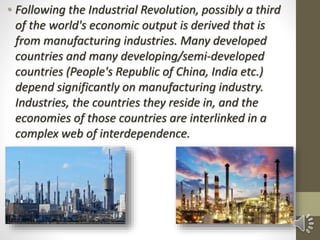
• Following the Industrial Revolution, possibly a third
of the world's economic output is derived that is
from manufacturing industries. Many developed
countries and many developing/semi-developed
countries (People's Republic of China, India etc.)
depend significantly on manufacturing industry.
Industries, the countries they reside in, and the
economies of those countries are interlinked in a
complex web of interdependence.
Factors:-
 Raw materials- Industries that use heavy and bulky raw materials
like coal and steel prefer location near sources of raw materials.
This is because the transportation of such materials over long
distances is difficult and expensive. Industries using perishable
raw materials are also usually located near sources of raw
materials, as perishable materials have to reach the factories
quickly.
 Power- An interrupted supply of power is essential for running
machines . Hence, regions rich in power resources are ideal
locations for industries.
 Labour- For industries that require plenty of labour, densely
populated areas are ideal locations, as labour is abundant and
cheap in such areas.
 Water- Industries need water for cooling machinery, for draining out
wastes and for various other purposes. So, most industries are
located near sources of water.
 Topography and climate- A flat topography and a moderate climate
are ideal for most industries. Hence, plains have the highest
concentration of industries.
 Market- Industries producing perishable or fragile goods are
usually located near their respective markets so that the products
can the reach the markets with minimum delay or damage.
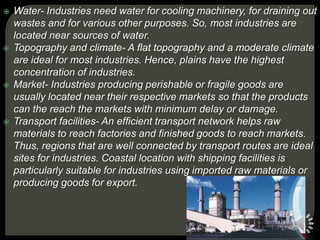
 Transport facilities- An efficient transport network helps raw
materials to reach factories and finished goods to reach markets.
Thus, regions that are well connected by transport routes are ideal
sites for industries. Coastal location with shipping facilities is
particularly suitable for industries using imported raw materials or
producing goods for export.
 Capital- Every industry needs capital for purchasing machines,
power and raw materials, and also for paying wages and
meeting transportation costs. Areas where money is readily
available and people are willing to invest in industries are,
therefore, ideal locations for industries.
 Government policy- Sometimes, the government makes a
particular location attractive to industries by providing land, tax
concessions and various facilities.
 Information technology (IT) is the application of
computers and telecommunications equipment to
store, retrieve, transmit and manipulate data, often in
the context of a business or other enterprise.
 The term is commonly used as a synonym for
computers and computer networks, but it also
encompasses other information distribution
technologies such as television and telephones. Several
industries are associated with information technology,
including computer hardware, software, electronics,
semiconductors, internet, telecom equipment,
engineering, healthcare, e-commerce and computer
services.
 Humans have been storing, retrieving, manipulating
and communicating information since the Sumerians in
Mesopotamia developed writing in about 3000 BC, but
the term information technology in its modern sense
first appeared in a 1958 article published in the
Harvard Business Review; authors Harold J. Leavitt and
Thomas L. Whisler commented that "the new
technology does not yet have a single established
name. We shall call it information technology (IT)."
Their definition consists of three categories:
techniques for processing, the application of statistical
and mathematical methods to decision-making, and
the simulation of higher-order thinking through
computer programs.
 Based on the storage and processing technologies
employed, it is possible to distinguish four distinct
phases of IT development: pre-mechanical (3000 BC –
1450 AD), mechanical (1450–1840), electromechanical
(1840–1940) and electronic (1940–present). This article
focuses on the most recent period (electronic), which
began in about 1940.
Main reason for the growth of IT
industry
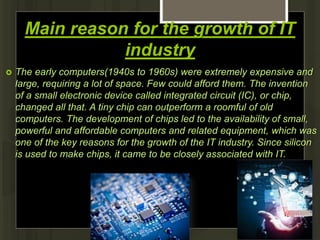
 The early computers(1940s to 1960s) were extremely expensive and
large, requiring a lot of space. Few could afford them. The invention
of a small electronic device called integrated circuit (IC), or chip,
changed all that. A tiny chip can outperform a roomful of old
computers. The development of chips led to the availability of small,
powerful and affordable computers and related equipment, which was
one of the key reasons for the growth of the IT industry. Since silicon
is used to make chips, it came to be closely associated with IT.
Requirements for a healthy
IT industry
 The IT industry is basically idea-driven. For it to succeed, you
need visionaries with ideas on how to use IT to change the way
we live and work. You also need those who are willing to risk
their money to develop an idea iinto a working product.
 The IT industry needs a large number of people trained in
engineering, computers and related fields. Therefore, it
succeeds at places where there are many good universities.
Also, research at these universities helps to generate ideas for
ne IT PRODUCTS.
 Besides these, the availability of telecommunication facilities,
relatively inexpensive manpower, and so on, helps in IT
activities.
Silicon Valley
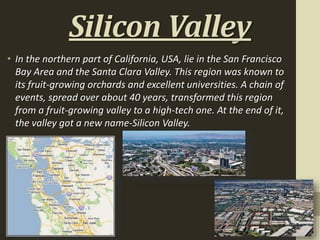
• In the northern part of California, USA, lie in the San Francisco
Bay Area and the Santa Clara Valley. This region was known to
its fruit-growing orchards and excellent universities. A chain of
events, spread over about 40 years, transformed this region
from a fruit-growing valley to a high-tech one. At the end of it,
the valley got a new name-Silicon Valley.
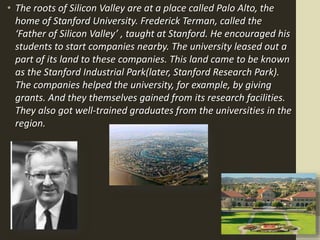
• The roots of Silicon Valley are at a place called Palo Alto, the
home of Stanford University. Frederick Terman, called the
‘Father of Silicon Valley’ , taught at Stanford. He encouraged his
students to start companies nearby. The university leased out a
part of its land to these companies. This land came to be known
as the Stanford Industrial Park(later, Stanford Research Park).
The companies helped the university, for example, by giving
grants. And they themselves gained from its research facilities.
They also got well-trained graduates from the universities in the
region.
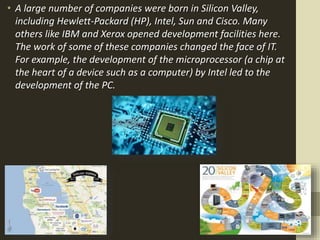
• A large number of companies were born in Silicon Valley,
including Hewlett-Packard (HP), Intel, Sun and Cisco. Many
others like IBM and Xerox opened development facilities here.
The work of some of these companies changed the face of IT.
For example, the development of the microprocessor (a chip at
the heart of a device such as a computer) by Intel led to the
development of the PC.
• The IT industry of Silicon Valley is diverse. Some companies
develop the building blocks of electronic devices (e.g., chips),
using which others make hardware (e.g., computers and
printers), while still others develop software. One of the reasons
of the success of Silicon Valley is the availability of funds to start
an IT company. There are many interesting cases. For example,
a man called Art Rock believed in the vision of Intel’s founders,
and arranged $2.5 million for them in two days!
• A new system was started in Silicon Valley, first at HP and then
at other companies. In this, a person working for the company
has a share in its profits. This new system and the agreeable
climate of the area attracted young, talented workers to Silicon
Valley. In Silicon Valley a number of companies often work
together on certain projects, bringing in their expertise. Also,
people keep moving between companies, bringing in new ideas.
All this helps Silicon Valley remain a leader in IT development.
Why to choose Silicon
Valley?
• Silicon Valley was built to start startups. The highest caliber
engineering talent is here. Early stage and late stage investors
are here. Support staff like lawyers and banks that work
specifically with startups are here. Conferences and tech meet
ups of the highest caliber are here. The wealth of talent and
resources is unmatched.
• Two of the top computer science schools in the world are in
Northern California. This means that there will always be fresh
talent, fresh ideas, and access to intellectuals unlike anywhere
in the world.
• Lots of investors nearby, especially investors who understand
startups and will be helpful
• Employees more willing to take a risk
• A general culture supporting startups; joining a startup is a
respectable thing to do rather than being viewed as reckless
• More qualified employees, especially engineers, to choose from
than other areas
• Employees with previous startup experience
 Social science book Our World: Then and Now
 https://en.wikipedia.org/wiki/Information_technology
 https://en.wikipedia.org/wiki/Industry
 https://www.quora.com/What-advantages-do-
startups-get-from-being-in-Silicon-Valley
 http://tech.co/top-5-benefits-growing-saas-startups-
outside-silicon-valley-2015-06
Made by-
Harshit Gupta

IT industry

  • 1.
  • 2.
    What is anIndustry? • Industry is the production of goods or services within an economy. The major source of revenue of a group or company is the indicator of its relevant industry. When a large group has multiple sources of revenue generation, it is considered to be working in different industries. Manufacturing industry became a key sector of production and labour in European and North American countries during the Industrial Revolution, upsetting previous mercantile and feudal economies. This occurred through many successive rapid advances in technology, such as the production of steel and coal.
  • 3.
    • Following theIndustrial Revolution, possibly a third of the world's economic output is derived that is from manufacturing industries. Many developed countries and many developing/semi-developed countries (People's Republic of China, India etc.) depend significantly on manufacturing industry. Industries, the countries they reside in, and the economies of those countries are interlinked in a complex web of interdependence.
  • 4.
    Factors:-  Raw materials-Industries that use heavy and bulky raw materials like coal and steel prefer location near sources of raw materials. This is because the transportation of such materials over long distances is difficult and expensive. Industries using perishable raw materials are also usually located near sources of raw materials, as perishable materials have to reach the factories quickly.  Power- An interrupted supply of power is essential for running machines . Hence, regions rich in power resources are ideal locations for industries.  Labour- For industries that require plenty of labour, densely populated areas are ideal locations, as labour is abundant and cheap in such areas.
  • 5.
     Water- Industriesneed water for cooling machinery, for draining out wastes and for various other purposes. So, most industries are located near sources of water.  Topography and climate- A flat topography and a moderate climate are ideal for most industries. Hence, plains have the highest concentration of industries.  Market- Industries producing perishable or fragile goods are usually located near their respective markets so that the products can the reach the markets with minimum delay or damage.  Transport facilities- An efficient transport network helps raw materials to reach factories and finished goods to reach markets. Thus, regions that are well connected by transport routes are ideal sites for industries. Coastal location with shipping facilities is particularly suitable for industries using imported raw materials or producing goods for export.
  • 6.
     Capital- Everyindustry needs capital for purchasing machines, power and raw materials, and also for paying wages and meeting transportation costs. Areas where money is readily available and people are willing to invest in industries are, therefore, ideal locations for industries.  Government policy- Sometimes, the government makes a particular location attractive to industries by providing land, tax concessions and various facilities.
  • 7.
     Information technology(IT) is the application of computers and telecommunications equipment to store, retrieve, transmit and manipulate data, often in the context of a business or other enterprise.  The term is commonly used as a synonym for computers and computer networks, but it also encompasses other information distribution technologies such as television and telephones. Several industries are associated with information technology, including computer hardware, software, electronics, semiconductors, internet, telecom equipment, engineering, healthcare, e-commerce and computer services.
  • 8.
     Humans havebeen storing, retrieving, manipulating and communicating information since the Sumerians in Mesopotamia developed writing in about 3000 BC, but the term information technology in its modern sense first appeared in a 1958 article published in the Harvard Business Review; authors Harold J. Leavitt and Thomas L. Whisler commented that "the new technology does not yet have a single established name. We shall call it information technology (IT)." Their definition consists of three categories: techniques for processing, the application of statistical and mathematical methods to decision-making, and the simulation of higher-order thinking through computer programs.
  • 9.
     Based onthe storage and processing technologies employed, it is possible to distinguish four distinct phases of IT development: pre-mechanical (3000 BC – 1450 AD), mechanical (1450–1840), electromechanical (1840–1940) and electronic (1940–present). This article focuses on the most recent period (electronic), which began in about 1940.
  • 10.
    Main reason forthe growth of IT industry  The early computers(1940s to 1960s) were extremely expensive and large, requiring a lot of space. Few could afford them. The invention of a small electronic device called integrated circuit (IC), or chip, changed all that. A tiny chip can outperform a roomful of old computers. The development of chips led to the availability of small, powerful and affordable computers and related equipment, which was one of the key reasons for the growth of the IT industry. Since silicon is used to make chips, it came to be closely associated with IT.
  • 11.
    Requirements for ahealthy IT industry  The IT industry is basically idea-driven. For it to succeed, you need visionaries with ideas on how to use IT to change the way we live and work. You also need those who are willing to risk their money to develop an idea iinto a working product.  The IT industry needs a large number of people trained in engineering, computers and related fields. Therefore, it succeeds at places where there are many good universities. Also, research at these universities helps to generate ideas for ne IT PRODUCTS.  Besides these, the availability of telecommunication facilities, relatively inexpensive manpower, and so on, helps in IT activities.
  • 12.
    Silicon Valley • Inthe northern part of California, USA, lie in the San Francisco Bay Area and the Santa Clara Valley. This region was known to its fruit-growing orchards and excellent universities. A chain of events, spread over about 40 years, transformed this region from a fruit-growing valley to a high-tech one. At the end of it, the valley got a new name-Silicon Valley.
  • 13.
    • The rootsof Silicon Valley are at a place called Palo Alto, the home of Stanford University. Frederick Terman, called the ‘Father of Silicon Valley’ , taught at Stanford. He encouraged his students to start companies nearby. The university leased out a part of its land to these companies. This land came to be known as the Stanford Industrial Park(later, Stanford Research Park). The companies helped the university, for example, by giving grants. And they themselves gained from its research facilities. They also got well-trained graduates from the universities in the region.
  • 14.
    • A largenumber of companies were born in Silicon Valley, including Hewlett-Packard (HP), Intel, Sun and Cisco. Many others like IBM and Xerox opened development facilities here. The work of some of these companies changed the face of IT. For example, the development of the microprocessor (a chip at the heart of a device such as a computer) by Intel led to the development of the PC.
  • 15.
    • The ITindustry of Silicon Valley is diverse. Some companies develop the building blocks of electronic devices (e.g., chips), using which others make hardware (e.g., computers and printers), while still others develop software. One of the reasons of the success of Silicon Valley is the availability of funds to start an IT company. There are many interesting cases. For example, a man called Art Rock believed in the vision of Intel’s founders, and arranged $2.5 million for them in two days!
  • 16.
    • A newsystem was started in Silicon Valley, first at HP and then at other companies. In this, a person working for the company has a share in its profits. This new system and the agreeable climate of the area attracted young, talented workers to Silicon Valley. In Silicon Valley a number of companies often work together on certain projects, bringing in their expertise. Also, people keep moving between companies, bringing in new ideas. All this helps Silicon Valley remain a leader in IT development.
  • 17.
    Why to chooseSilicon Valley? • Silicon Valley was built to start startups. The highest caliber engineering talent is here. Early stage and late stage investors are here. Support staff like lawyers and banks that work specifically with startups are here. Conferences and tech meet ups of the highest caliber are here. The wealth of talent and resources is unmatched. • Two of the top computer science schools in the world are in Northern California. This means that there will always be fresh talent, fresh ideas, and access to intellectuals unlike anywhere in the world.
  • 18.
    • Lots ofinvestors nearby, especially investors who understand startups and will be helpful • Employees more willing to take a risk • A general culture supporting startups; joining a startup is a respectable thing to do rather than being viewed as reckless • More qualified employees, especially engineers, to choose from than other areas • Employees with previous startup experience
  • 19.
     Social sciencebook Our World: Then and Now  https://en.wikipedia.org/wiki/Information_technology  https://en.wikipedia.org/wiki/Industry  https://www.quora.com/What-advantages-do- startups-get-from-being-in-Silicon-Valley  http://tech.co/top-5-benefits-growing-saas-startups- outside-silicon-valley-2015-06
  • 20.