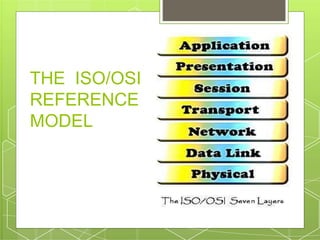
The ISO/OSI
REFERENCE MODEL
ISO
“International Organization for
Standardization”, an independent, non-
governmental international organization with a
membership of 162 national standards bodies.
OSI
“Open System Interconnection”,
a reference model for how applications can
communicate over a network
Feature of OSI Model
Big picture of communication over network is
understandable through this OSI model.
We see how hardware and software work together.
We can understand new technologies as they are
developed.
Troubleshooting is easier by separate networks.
Can be used to compare basic functional
relationships on different networks.
Principles of OSI Reference Model
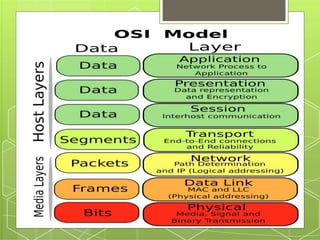
The OSI reference model has 7 layers. The principles that
were applied to arrive at the seven layers can be briefly
summarized as follows:
A layer should be created where a different abstraction is
needed.
Each layer should perform a well-defined function.
The function of each layer should be chosen with an eye
toward defining internationally standardized protocols.
The layer boundaries should be chosen to minimize the
information flow across the interfaces.
The number of layers should be large enough that distinct
functions need not be thrown together in the same layer out of
necessity and small enough that architecture does not
become unwieldly.
THE ISO/OSI
REFERENCE
MODEL
concerned with transmitting raw bits over a
communication channel.
concerned mainly with the hardware connection.
defines the mechanical and electrical
specification of a network medium and network
interface hardware.
responsible for the physical media connections
and specifications, data transmission, and
reception from media.
connects adjacent nodes physically and electrically
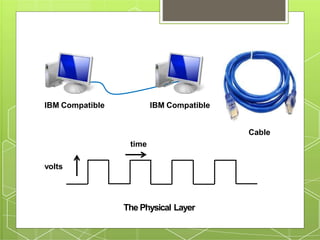
IBM Compatible IBM Compatible
Cable
volts
time
The Physical Layer
Data Link Layer
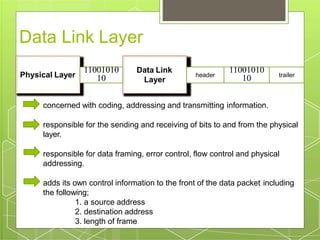
concerned with coding, addressing and transmitting information.
responsible for the sending and receiving of bits to and from the physical
layer.
responsible for data framing, error control, flow control and physical
addressing.
adds its own control information to the front of the data packet including
the following;
1. a source address
2. destination address
3. length of frame
Physical Layer
Data Link
Layer
11001010
10 trailer
header
11001010
10
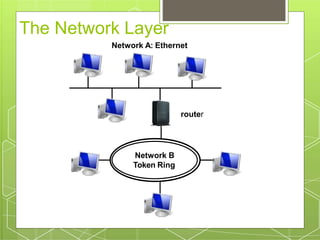
The Network Layer
Network B
Token Ring
Network A: Ethernet
router
The network layer is one layer above data link
later, which ensures that information arrive at its
intended destination at the desired format.
Its function is to establish, maintain and
provide an open path for information to travel across
the network and thus make the actual route
transparent and insignificant of any other layer.
The primary objective of network layer is to
move or route information across a network made up
of multiple network segments.
Functions;
transports, routes, message handling and
transfer of data.
Responsible for routing data across the link,
message fragmentation
Routes data in “packets” between source
destination.
Controls traffic and congestion in the network
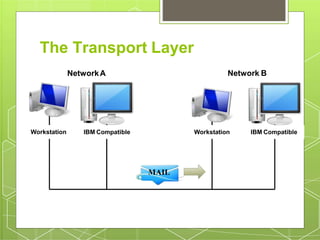
The Transport Layer
NetworkA Network B
MAIL
Workstation IBM Compatible Workstation IBM Compatible
The Transport Layer acts as the interface
between the higher layers and the lower three layers.
This layer ensures reliable data delivery often
compensating for the lack of reliability in the lower
layers.
places data exchange to match end-point
processing capacity and enciphers user data if
needed for security purposes.
Responsible for reliable end-to-end
communication
Implementations can usually confirm or deny data
delivery
The application software may take corrective action or
provide the user with options.
Makes use of a variety of mechanisms such us;
1. acknowledgement messages
2. sequence numbers
3. flow control
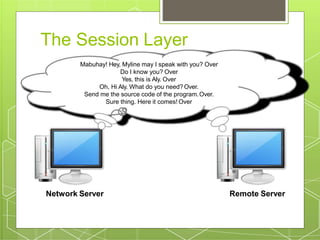
The Session Layer
Mabuhay! Hey, Myline may I speak with you? Over
Do I know you? Over
Yes, this is Aly. Over
Oh, Hi Aly. What do you need?Over.
Send me the source code of the program.Over.
Sure thing. Here it comes! Over
Network Server Remote Server
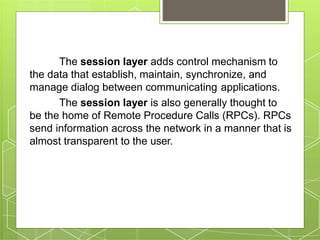
The session layer adds control mechanism to
the data that establish, maintain, synchronize, and
manage dialog between communicating applications.
The session layer is also generally thought to
be the home of Remote Procedure Calls (RPCs). RPCs
send information across the network in a manner that is
almost transparent to the user.
Handles the details that must be agreed upon and
followed by the communicating parties that
exchange the information.
Maintains the session between the devices for as
long as it is needed.
Coordinates and regulates the transfer of
information between them.
Responsible for establishing, maintaining and
coordinating communication.
Responsible for session management, session
error control, dialog control, (coordination and
synchronization) and remote procedure calls.
Synchronizes flow between end-points,
correlates exchanges and groups related data into
indivisible units
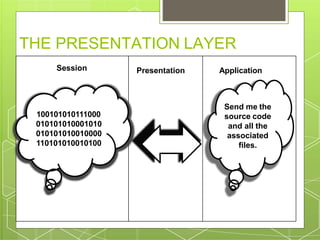
THE PRESENTATION LAYER
Session Presentation Application
100101010111000
010101010001010
010101010010000
110101010010100
Send me the
source code
and all the
associated
files.
The presentation layer transforms data into a
mutually agreed-upon format (transfer syntax) that
can be understood by each application and the
computers they run on.
responsible for the text formatting, code
conversion and display.
responsible for data formats, data format
translation, data compression and data encryption
and decryption.
formats data for different presentation media
and coordinates resource sharing.
the primary function is to present the data into
a form that can be understood by the user
the presentation layer’s tasks generally
include interpreting codes such as tabs and
other codes related to presentation.
it may also govern converting encryption and
other codes into a well-defined format.
responsible for translating and interpreting
different character sets so that they may be
presented in a manner that can be understood by
the end-users
The Application Layer
The Application Layer specifies the communication
interface with the user and manages communication
between computer applications.
The application layer contains variety of protocols that
are commonly needed for various applications.
Functions:
concerned with program to program transfer of
information
Provides application services such as distributed
database access and document interchange to network
users
Responsible for user interface and applications
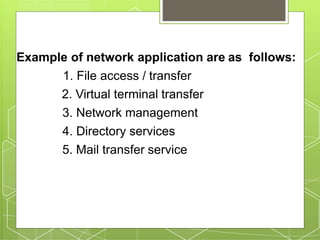
Example of network application are as follows:
1. File access / transfer
2. Virtual terminal transfer
3. Network management
4. Directory services
5. Mail transfer service
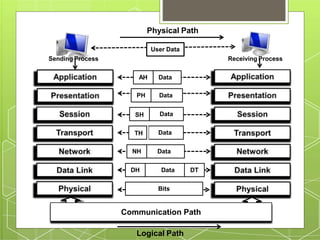
Physical Path
User Data
Communication Path
Logical Path
Sending Process Receiving Process
Bits
Data
DH DT
Data
NH
Data
Data
Data
TH
SH
PH
AH Data
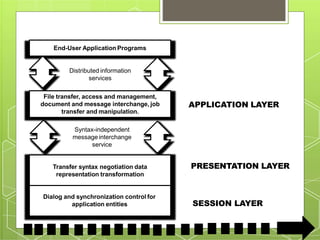
File transfer, access and management,
document and message interchange, job
transfer and manipulation.
Transfer syntax negotiation data
representation transformation
Dialog and synchronization control for
application entities
End-User Application Programs
Distributed information
services
Syntax-independent
message interchange
service
APPLICATION LAYER
PRESENTATION LAYER
SESSION LAYER
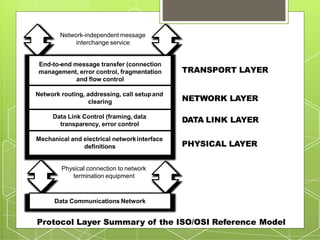
End-to-end message transfer (connection
management, error control, fragmentation
and flow control
Network routing, addressing, call setupand
clearing
Data Link Control (framing, data
transparency, error control
Mechanical and electrical networkinterface
definitions
Data Communications Network
Network-independent message
interchange service
TRANSPORT LAYER
NETWORK LAYER
DATA LINK LAYER
PHYSICAL LAYER
Physical connection to network
termination equipment
Protocol Layer Summary of the ISO/OSI Reference Model
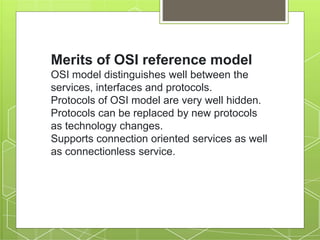
Merits of OSI reference model
OSI model distinguishes well between the
services, interfaces and protocols.
Protocols of OSI model are very well hidden.
Protocols can be replaced by new protocols
as technology changes.
Supports connection oriented services as well
as connectionless service.
Demerits of OSI reference model
Model was devised before the invention of protocols.
Fitting of protocols is tedious task.
It is just used as a reference model.
OSI Services
Two types of services to the layer of OSI
Reference Model:
 Connection-Oriented Service
- the service user first establishes a connection,
uses this connection and then terminates the
connection when it is no longer needed.
Reliable connection-oriented service has
two minor variations:
• Message sequences
• Byte streams
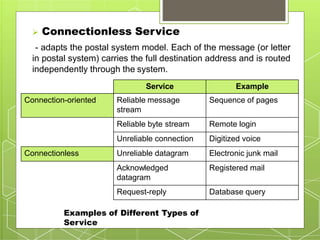
 Connectionless Service
- adapts the postal system model. Each of the message (or letter
in postal system) carries the full destination address and is routed
independently through the system.
Service Example
Connection-oriented Reliable message
stream
Sequence of pages
Reliable byte stream Remote login
Unreliable connection Digitized voice
Connectionless Unreliable datagram Electronic junk mail
Acknowledged
datagram
Registered mail
Request-reply Database query
Examples of Different Types of
Service
END

ISO-OSI reference model Computer Networks.pptx

  • 1.
  • 2.
    ISO “International Organization for Standardization”,an independent, non- governmental international organization with a membership of 162 national standards bodies. OSI “Open System Interconnection”, a reference model for how applications can communicate over a network
  • 3.
    Feature of OSIModel Big picture of communication over network is understandable through this OSI model. We see how hardware and software work together. We can understand new technologies as they are developed. Troubleshooting is easier by separate networks. Can be used to compare basic functional relationships on different networks.
  • 4.
    Principles of OSIReference Model The OSI reference model has 7 layers. The principles that were applied to arrive at the seven layers can be briefly summarized as follows: A layer should be created where a different abstraction is needed. Each layer should perform a well-defined function. The function of each layer should be chosen with an eye toward defining internationally standardized protocols. The layer boundaries should be chosen to minimize the information flow across the interfaces. The number of layers should be large enough that distinct functions need not be thrown together in the same layer out of necessity and small enough that architecture does not become unwieldly.
  • 5.
  • 6.
    concerned with transmittingraw bits over a communication channel. concerned mainly with the hardware connection. defines the mechanical and electrical specification of a network medium and network interface hardware. responsible for the physical media connections and specifications, data transmission, and reception from media. connects adjacent nodes physically and electrically
  • 7.
    IBM Compatible IBMCompatible Cable volts time The Physical Layer
  • 8.
    Data Link Layer concernedwith coding, addressing and transmitting information. responsible for the sending and receiving of bits to and from the physical layer. responsible for data framing, error control, flow control and physical addressing. adds its own control information to the front of the data packet including the following; 1. a source address 2. destination address 3. length of frame Physical Layer Data Link Layer 11001010 10 trailer header 11001010 10
  • 9.
    The Network Layer NetworkB Token Ring Network A: Ethernet router
  • 10.
    The network layeris one layer above data link later, which ensures that information arrive at its intended destination at the desired format. Its function is to establish, maintain and provide an open path for information to travel across the network and thus make the actual route transparent and insignificant of any other layer. The primary objective of network layer is to move or route information across a network made up of multiple network segments.
  • 11.
    Functions; transports, routes, messagehandling and transfer of data. Responsible for routing data across the link, message fragmentation Routes data in “packets” between source destination. Controls traffic and congestion in the network
  • 12.
    The Transport Layer NetworkANetwork B MAIL Workstation IBM Compatible Workstation IBM Compatible
  • 13.
    The Transport Layeracts as the interface between the higher layers and the lower three layers. This layer ensures reliable data delivery often compensating for the lack of reliability in the lower layers. places data exchange to match end-point processing capacity and enciphers user data if needed for security purposes. Responsible for reliable end-to-end communication
  • 14.
    Implementations can usuallyconfirm or deny data delivery The application software may take corrective action or provide the user with options. Makes use of a variety of mechanisms such us; 1. acknowledgement messages 2. sequence numbers 3. flow control
  • 15.
    The Session Layer Mabuhay!Hey, Myline may I speak with you? Over Do I know you? Over Yes, this is Aly. Over Oh, Hi Aly. What do you need?Over. Send me the source code of the program.Over. Sure thing. Here it comes! Over Network Server Remote Server
  • 16.
    The session layeradds control mechanism to the data that establish, maintain, synchronize, and manage dialog between communicating applications. The session layer is also generally thought to be the home of Remote Procedure Calls (RPCs). RPCs send information across the network in a manner that is almost transparent to the user.
  • 17.
    Handles the detailsthat must be agreed upon and followed by the communicating parties that exchange the information. Maintains the session between the devices for as long as it is needed. Coordinates and regulates the transfer of information between them. Responsible for establishing, maintaining and coordinating communication.
  • 18.
    Responsible for sessionmanagement, session error control, dialog control, (coordination and synchronization) and remote procedure calls. Synchronizes flow between end-points, correlates exchanges and groups related data into indivisible units
  • 19.
    THE PRESENTATION LAYER SessionPresentation Application 100101010111000 010101010001010 010101010010000 110101010010100 Send me the source code and all the associated files.
  • 20.
    The presentation layertransforms data into a mutually agreed-upon format (transfer syntax) that can be understood by each application and the computers they run on. responsible for the text formatting, code conversion and display. responsible for data formats, data format translation, data compression and data encryption and decryption. formats data for different presentation media and coordinates resource sharing. the primary function is to present the data into a form that can be understood by the user
  • 21.
    the presentation layer’stasks generally include interpreting codes such as tabs and other codes related to presentation. it may also govern converting encryption and other codes into a well-defined format. responsible for translating and interpreting different character sets so that they may be presented in a manner that can be understood by the end-users
  • 22.
  • 23.
    The Application Layerspecifies the communication interface with the user and manages communication between computer applications. The application layer contains variety of protocols that are commonly needed for various applications. Functions: concerned with program to program transfer of information Provides application services such as distributed database access and document interchange to network users Responsible for user interface and applications
  • 24.
    Example of networkapplication are as follows: 1. File access / transfer 2. Virtual terminal transfer 3. Network management 4. Directory services 5. Mail transfer service
  • 25.
    Physical Path User Data CommunicationPath Logical Path Sending Process Receiving Process Bits Data DH DT Data NH Data Data Data TH SH PH AH Data
  • 26.
    File transfer, accessand management, document and message interchange, job transfer and manipulation. Transfer syntax negotiation data representation transformation Dialog and synchronization control for application entities End-User Application Programs Distributed information services Syntax-independent message interchange service APPLICATION LAYER PRESENTATION LAYER SESSION LAYER
  • 27.
    End-to-end message transfer(connection management, error control, fragmentation and flow control Network routing, addressing, call setupand clearing Data Link Control (framing, data transparency, error control Mechanical and electrical networkinterface definitions Data Communications Network Network-independent message interchange service TRANSPORT LAYER NETWORK LAYER DATA LINK LAYER PHYSICAL LAYER Physical connection to network termination equipment Protocol Layer Summary of the ISO/OSI Reference Model
  • 29.
    Merits of OSIreference model OSI model distinguishes well between the services, interfaces and protocols. Protocols of OSI model are very well hidden. Protocols can be replaced by new protocols as technology changes. Supports connection oriented services as well as connectionless service.
  • 30.
    Demerits of OSIreference model Model was devised before the invention of protocols. Fitting of protocols is tedious task. It is just used as a reference model.
  • 31.
    OSI Services Two typesof services to the layer of OSI Reference Model:  Connection-Oriented Service - the service user first establishes a connection, uses this connection and then terminates the connection when it is no longer needed. Reliable connection-oriented service has two minor variations: • Message sequences • Byte streams
  • 32.
     Connectionless Service -adapts the postal system model. Each of the message (or letter in postal system) carries the full destination address and is routed independently through the system. Service Example Connection-oriented Reliable message stream Sequence of pages Reliable byte stream Remote login Unreliable connection Digitized voice Connectionless Unreliable datagram Electronic junk mail Acknowledged datagram Registered mail Request-reply Database query Examples of Different Types of Service
  • 33.