Quality Management
Systems, Standards, and
Benefits/Costing
1
QMS
A quality management system (QMS) is a system that
defines operations to achieve consistency and
creditability with customers
QMS refers to what the organization does to manage
its processes, or activities in order that the products
or services that it produces meet the objectives it has
set itself (ISO, 2004)
ISO 9000 series (International Standards
Organization standard on quality management)
2
ISO 9000
ISO 9000 is a generic standard - means that the
standard can be applied to any organization, large or
small, whatever its product in any sector of activity
ISO is an auditable system – organization may be
certified to a market standard by outside agency
(Weigers, 2001)
ISO 9000 predominant QMS today – adopted by 149
countries/economies (ISO, 2004)
3
4
Quality Management Principles of ISO 9000:2000 (ANSI, 2000; ANSI,
2000a)
Customer focus
Leadership
Involvement of people
Process Approach – A set of interrelated activities which transforms inputs
into outputs
System approach to management – Manage set of interrelated processes
Continual Improvement
Factual approach to decision making
Mutually beneficial supplier relationships
General Introduction
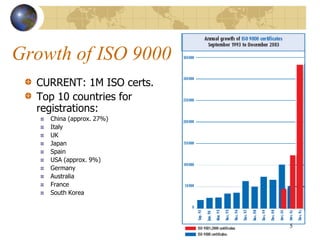
Growth of ISO 9000
CURRENT: 1M ISO certs.
Top 10 countries for
registrations:
China (approx. 27%)
Italy
UK
Japan
Spain
USA (approx. 9%)
Germany
Australia
France
South Korea
5
ISO 9000 Characteristics
Leadership demonstrates commitment to customer
requirements.
Policy and measurable quality objectives are set and
renewed.
Processes are identified, analyzed, and
managed.
Customer satisfaction is measured.
Data are collected, analyzed, and used.
System effectiveness is continually improved.
6
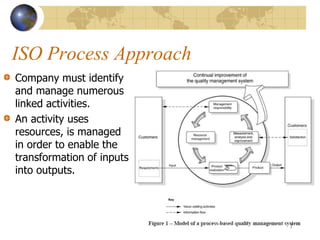
ISO Process Approach
Company must identify
and manage numerous
linked activities.
An activity uses
resources, is managed
in order to enable the
transformation of inputs
into outputs.
7
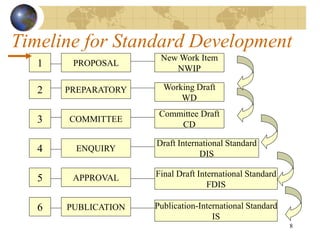
Timeline for Standard Development
1
6
5
4
3
2
PROPOSAL
PREPARATORY
COMMITTEE
ENQUIRY
APPROVAL
PUBLICATION
Working Draft
WD
Committee Draft
CD
Draft International Standard
DIS
Final Draft International Standard
FDIS
Publication-International Standard
IS
New Work Item
NWIP
8
Key Aspects of ISO Participation
Timely – prompt response to enquiries within the
accepted timeline
Consensus – all points of view are accepted in
forming the TAG position, majority support for the
position
Transparent – activities of the committee are open
and may be inspected by all interested parties
Traceable – all items must be accompanied by a
voting record
9
Dual Roles for ISO 9000/9004
QMS for fulfilling customer, regulatory, etc.,
requirements (ISO 9000)
“Management should consider development of
innovative financial methods to support and
encourage improvement of the organizational
performance” (ISO 9004 – Guidelines for
performance improvements)
10
Allocation of Costs: Process Approach
Early methods of tracking quality costs was too
limited “focus on cost of non-conformance i.e.
external and internal failure costs”.
Process-cost broadens economics of quality by
classifying cost of non-conformance and cost of
conformance I.e. “costs incurred when a process is
running without failure”
11
Process Approach: Added
Benefits
Utilize cost of non-conformance (often called
Cost of Poor Quality) and cost of
conformance = greater cost saving
opportunities may be available in reducing
cost of conformance
12
Process Costing
Allows the tracking and reduction of costs
normally associated with efficiency in addition
to effectiveness (quality)”
Process simplification in addition to reduction
of errors become objectives
Relate the economics of quality to the
amount of activity performed
13
Process Costs i.e. Costs of Inefficient Processes
Examples
Variation of product characteristics from optimum
Unplanned downtime and/or loss of
processing/storage capacity
Inventory shrinkage
Variation of process characteristics from ‘best
practices’ (cycle times from to start to finish of
activities)
Other non-value added activities
NOTE: Improvement is also an objective
14
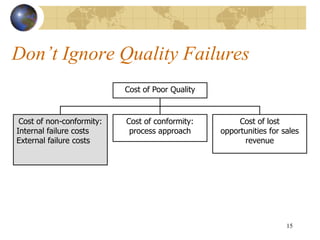
Don’t Ignore Quality Failures
Cost of non-conformity:
Internal failure costs
External failure costs
Cost of Poor Quality
Cost of lost
opportunities for sales
revenue
Cost of conformity:
process approach
15
Internal Failure Costs Examples
Labor and material overhead spent on defective
product – spoilage, defectives, scrap etc.
Correcting defectives in physical or service products
i.e. reworking product
Sorting bad/good product
Re-inspection, retest of product
Changing processes to correct deficiencies (CAR’s)
Downgrading product
16
External Failure Cost Examples
Costs involved in replacing/making repair for
warranty product
Investigation and adjustment costs to justified
complaints of quality defective product
Returned material
Concession costs due to substandard product
accepted by customer
Correcting errors on external supporting processes
Revenue losses in support operations
(Gyrna)
17
Allocation of Costs
The company must decide what to measure
depending upon circumstances, objectives,
etc.
However,
The overall idea is to “allocate costs and not
to absorb such costs into overhead” (ISO/TR
10014)
18
Deriving Benefits
Reduction of failures due to QMS
Improvement of process efficiencies due to QMS
Pre and post measures of implementation
However, improvements should be done as identified
Using quality tools such as flowcharting, value add
analysis, cycle time reduction, process
simplification, root cause investigation, etc.
19

ISO 9000 overview_operation standard.ppt

  • 1.
  • 2.
    QMS A quality managementsystem (QMS) is a system that defines operations to achieve consistency and creditability with customers QMS refers to what the organization does to manage its processes, or activities in order that the products or services that it produces meet the objectives it has set itself (ISO, 2004) ISO 9000 series (International Standards Organization standard on quality management) 2
  • 3.
    ISO 9000 ISO 9000is a generic standard - means that the standard can be applied to any organization, large or small, whatever its product in any sector of activity ISO is an auditable system – organization may be certified to a market standard by outside agency (Weigers, 2001) ISO 9000 predominant QMS today – adopted by 149 countries/economies (ISO, 2004) 3
  • 4.
    4 Quality Management Principlesof ISO 9000:2000 (ANSI, 2000; ANSI, 2000a) Customer focus Leadership Involvement of people Process Approach – A set of interrelated activities which transforms inputs into outputs System approach to management – Manage set of interrelated processes Continual Improvement Factual approach to decision making Mutually beneficial supplier relationships General Introduction
  • 5.
    Growth of ISO9000 CURRENT: 1M ISO certs. Top 10 countries for registrations: China (approx. 27%) Italy UK Japan Spain USA (approx. 9%) Germany Australia France South Korea 5
  • 6.
    ISO 9000 Characteristics Leadershipdemonstrates commitment to customer requirements. Policy and measurable quality objectives are set and renewed. Processes are identified, analyzed, and managed. Customer satisfaction is measured. Data are collected, analyzed, and used. System effectiveness is continually improved. 6
  • 7.
    ISO Process Approach Companymust identify and manage numerous linked activities. An activity uses resources, is managed in order to enable the transformation of inputs into outputs. 7
  • 8.
    Timeline for StandardDevelopment 1 6 5 4 3 2 PROPOSAL PREPARATORY COMMITTEE ENQUIRY APPROVAL PUBLICATION Working Draft WD Committee Draft CD Draft International Standard DIS Final Draft International Standard FDIS Publication-International Standard IS New Work Item NWIP 8
  • 9.
    Key Aspects ofISO Participation Timely – prompt response to enquiries within the accepted timeline Consensus – all points of view are accepted in forming the TAG position, majority support for the position Transparent – activities of the committee are open and may be inspected by all interested parties Traceable – all items must be accompanied by a voting record 9
  • 10.
    Dual Roles forISO 9000/9004 QMS for fulfilling customer, regulatory, etc., requirements (ISO 9000) “Management should consider development of innovative financial methods to support and encourage improvement of the organizational performance” (ISO 9004 – Guidelines for performance improvements) 10
  • 11.
    Allocation of Costs:Process Approach Early methods of tracking quality costs was too limited “focus on cost of non-conformance i.e. external and internal failure costs”. Process-cost broadens economics of quality by classifying cost of non-conformance and cost of conformance I.e. “costs incurred when a process is running without failure” 11
  • 12.
    Process Approach: Added Benefits Utilizecost of non-conformance (often called Cost of Poor Quality) and cost of conformance = greater cost saving opportunities may be available in reducing cost of conformance 12
  • 13.
    Process Costing Allows thetracking and reduction of costs normally associated with efficiency in addition to effectiveness (quality)” Process simplification in addition to reduction of errors become objectives Relate the economics of quality to the amount of activity performed 13
  • 14.
    Process Costs i.e.Costs of Inefficient Processes Examples Variation of product characteristics from optimum Unplanned downtime and/or loss of processing/storage capacity Inventory shrinkage Variation of process characteristics from ‘best practices’ (cycle times from to start to finish of activities) Other non-value added activities NOTE: Improvement is also an objective 14
  • 15.
    Don’t Ignore QualityFailures Cost of non-conformity: Internal failure costs External failure costs Cost of Poor Quality Cost of lost opportunities for sales revenue Cost of conformity: process approach 15
  • 16.
    Internal Failure CostsExamples Labor and material overhead spent on defective product – spoilage, defectives, scrap etc. Correcting defectives in physical or service products i.e. reworking product Sorting bad/good product Re-inspection, retest of product Changing processes to correct deficiencies (CAR’s) Downgrading product 16
  • 17.
    External Failure CostExamples Costs involved in replacing/making repair for warranty product Investigation and adjustment costs to justified complaints of quality defective product Returned material Concession costs due to substandard product accepted by customer Correcting errors on external supporting processes Revenue losses in support operations (Gyrna) 17
  • 18.
    Allocation of Costs Thecompany must decide what to measure depending upon circumstances, objectives, etc. However, The overall idea is to “allocate costs and not to absorb such costs into overhead” (ISO/TR 10014) 18
  • 19.
    Deriving Benefits Reduction offailures due to QMS Improvement of process efficiencies due to QMS Pre and post measures of implementation However, improvements should be done as identified Using quality tools such as flowcharting, value add analysis, cycle time reduction, process simplification, root cause investigation, etc. 19