1
ISO/PC 283
ISO 45001
Current status of
development
July 2015
2
Date:
ISO/PC
283
Disclaimers
 Verbal statements made by the presenter may
represent personal opinions and/or
interpretations
 The presentation includes information related to
the drafting process up to and including
July 2015
3
Date:
ISO/PC
283
International Organization for
Standardization (ISO)
 ISO is based in Geneva,
- with 165 member national standards bodies
- 20500 published standards
 All ISO standards are based on consensus
 ISO’s work involves all relevant stakeholders and
includes experts from: industry and commerce,
government, consumers, labour, academia, standards
applications, NGO’s.
4
Date:
ISO/PC
283
International Organization for
Standardization (ISO)
 ISO’s Project Committee No. 283 (ISO/PC 283) is
responsible for the development of ISO 45001
 ISO/PC 283’s membership currently includes:
- 59 participating countries,
- 15 observer countries,
- 16 liaison members.
5
Date:
ISO/PC
283
Key perspectives
This new standard is being developed to:
 Help organizations minimize the risk of harm to all those
working under their control (defined as “workers” within
the standard)
 Provide a platform for continual improvement in
occupational health and safety performance
 Integrate OH&S within an organization’s overall business
management system
6
Date:
ISO/PC
283
The draft standard puts emphasis on:
Top management :
- being accountable for OH&S management
- needing to demonstrate leadership.
 Worker participation in:
- the identification of hazards and risks
- the development and operation of the OH&S
management system,
and indicates these are essential for success.
Main focus
7
Date:
ISO/PC
283
The draft standard puts emphasis on:
 The need to prevent ill-health (including mental
ill-health), as well as injuries
The need to recognize that the causes of ill-health and
injuries can be through
- immediate impacts (e.g. accidents or epidemics)
- longer term impacts (such as repeated
exposure to radiation or carcinogenic chemicals, or to a
constantly stressful working environment)
Main focus
8
Date:
ISO/PC
283
High level structure
A new common format has been developed by ISO for use
in all its management system standards, and is being used
by ISO 45001. This is often referred to as “Annex SL”, and
gives:
̶ a common top level clause structure (or sequence)
̶ standardized core text
̶ standardized core definitions
The high level structure and common text is public information and can be found in Annex SL of the
ISO Supplement to the ISO/IEC Directives Part 1, see: www.iso.org/directives
It is intended to enable organizations to achieve easier
implementation and better integration of multiple management
systems (e.g. quality, environmental, information security)
9
Date:
ISO/PC
283
1 Scope
2 Normative references
3 Terms and definitions
4 Context of the organization
4.1 Understanding the organization and its context
4.2 Understanding the needs and expectations workers and other
interested parties
4.3 Determining the scope of OH&S management system
4.4 OH&S management system and its processes
5 Leadership, worker participation and consultation
5.1 Leadership and commitment
5.2 Policy
5.3 Organizational roles, responsibilities and authorities
5.4 Participation, consultation and representation
6 Planning
6.1 Actions to address risks and opportunities
6.2 OH&S objectives and planning to achieve them
Structure of ISO/CD 45001.2
10
Date:
ISO/PC
283
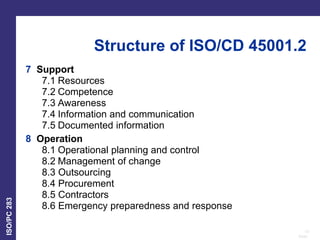
7 Support
7.1 Resources
7.2 Competence
7.3 Awareness
7.4 Information and communication
7.5 Documented information
8 Operation
8.1 Operational planning and control
8.2 Management of change
8.3 Outsourcing
8.4 Procurement
8.5 Contractors
8.6 Emergency preparedness and response
Structure of ISO/CD 45001.2
11
Date:
ISO/PC
283
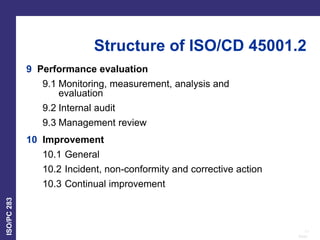
9 Performance evaluation
9.1 Monitoring, measurement, analysis and
evaluation
9.2 Internal audit
9.3 Management review
10 Improvement
10.1 General
10.2 Incident, non-conformity and corrective action
10.3 Continual improvement
Structure of ISO/CD 45001.2
12
Date:
ISO/PC
283
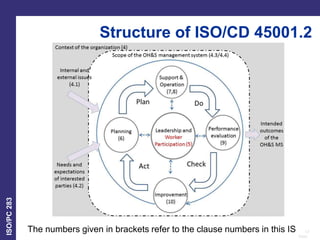
Structure of ISO/CD 45001.2
The numbers given in brackets refer to the clause numbers in this IS
13
Date:
ISO/PC
283
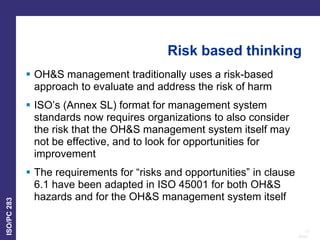
Risk based thinking
 OH&S management traditionally uses a risk-based
approach to evaluate and address the risk of harm
 ISO’s (Annex SL) format for management system
standards now requires organizations to also consider
the risk that the OH&S management system itself may
not be effective, and to look for opportunities for
improvement
 The requirements for “risks and opportunities” in clause
6.1 have been adapted in ISO 45001 for both OH&S
hazards and for the OH&S management system itself
14
Date:
ISO/PC
283
Risk based thinking
 ISO/CD 45001.2 uses the terms:
- “OH&S risk” and “OH&S opportunities” when it is
referring specifically to the control of hazards
- “risk” and “opportunities” when referring to the OH&S
management system

ISO 45001 Awarness.ppt

  • 1.
    1 ISO/PC 283 ISO 45001 Currentstatus of development July 2015
  • 2.
    2 Date: ISO/PC 283 Disclaimers  Verbal statementsmade by the presenter may represent personal opinions and/or interpretations  The presentation includes information related to the drafting process up to and including July 2015
  • 3.
    3 Date: ISO/PC 283 International Organization for Standardization(ISO)  ISO is based in Geneva, - with 165 member national standards bodies - 20500 published standards  All ISO standards are based on consensus  ISO’s work involves all relevant stakeholders and includes experts from: industry and commerce, government, consumers, labour, academia, standards applications, NGO’s.
  • 4.
    4 Date: ISO/PC 283 International Organization for Standardization(ISO)  ISO’s Project Committee No. 283 (ISO/PC 283) is responsible for the development of ISO 45001  ISO/PC 283’s membership currently includes: - 59 participating countries, - 15 observer countries, - 16 liaison members.
  • 5.
    5 Date: ISO/PC 283 Key perspectives This newstandard is being developed to:  Help organizations minimize the risk of harm to all those working under their control (defined as “workers” within the standard)  Provide a platform for continual improvement in occupational health and safety performance  Integrate OH&S within an organization’s overall business management system
  • 6.
    6 Date: ISO/PC 283 The draft standardputs emphasis on: Top management : - being accountable for OH&S management - needing to demonstrate leadership.  Worker participation in: - the identification of hazards and risks - the development and operation of the OH&S management system, and indicates these are essential for success. Main focus
  • 7.
    7 Date: ISO/PC 283 The draft standardputs emphasis on:  The need to prevent ill-health (including mental ill-health), as well as injuries The need to recognize that the causes of ill-health and injuries can be through - immediate impacts (e.g. accidents or epidemics) - longer term impacts (such as repeated exposure to radiation or carcinogenic chemicals, or to a constantly stressful working environment) Main focus
  • 8.
    8 Date: ISO/PC 283 High level structure Anew common format has been developed by ISO for use in all its management system standards, and is being used by ISO 45001. This is often referred to as “Annex SL”, and gives: ̶ a common top level clause structure (or sequence) ̶ standardized core text ̶ standardized core definitions The high level structure and common text is public information and can be found in Annex SL of the ISO Supplement to the ISO/IEC Directives Part 1, see: www.iso.org/directives It is intended to enable organizations to achieve easier implementation and better integration of multiple management systems (e.g. quality, environmental, information security)
  • 9.
    9 Date: ISO/PC 283 1 Scope 2 Normativereferences 3 Terms and definitions 4 Context of the organization 4.1 Understanding the organization and its context 4.2 Understanding the needs and expectations workers and other interested parties 4.3 Determining the scope of OH&S management system 4.4 OH&S management system and its processes 5 Leadership, worker participation and consultation 5.1 Leadership and commitment 5.2 Policy 5.3 Organizational roles, responsibilities and authorities 5.4 Participation, consultation and representation 6 Planning 6.1 Actions to address risks and opportunities 6.2 OH&S objectives and planning to achieve them Structure of ISO/CD 45001.2
  • 10.
    10 Date: ISO/PC 283 7 Support 7.1 Resources 7.2Competence 7.3 Awareness 7.4 Information and communication 7.5 Documented information 8 Operation 8.1 Operational planning and control 8.2 Management of change 8.3 Outsourcing 8.4 Procurement 8.5 Contractors 8.6 Emergency preparedness and response Structure of ISO/CD 45001.2
  • 11.
    11 Date: ISO/PC 283 9 Performance evaluation 9.1Monitoring, measurement, analysis and evaluation 9.2 Internal audit 9.3 Management review 10 Improvement 10.1 General 10.2 Incident, non-conformity and corrective action 10.3 Continual improvement Structure of ISO/CD 45001.2
  • 12.
    12 Date: ISO/PC 283 Structure of ISO/CD45001.2 The numbers given in brackets refer to the clause numbers in this IS
  • 13.
    13 Date: ISO/PC 283 Risk based thinking OH&S management traditionally uses a risk-based approach to evaluate and address the risk of harm  ISO’s (Annex SL) format for management system standards now requires organizations to also consider the risk that the OH&S management system itself may not be effective, and to look for opportunities for improvement  The requirements for “risks and opportunities” in clause 6.1 have been adapted in ISO 45001 for both OH&S hazards and for the OH&S management system itself
  • 14.
    14 Date: ISO/PC 283 Risk based thinking ISO/CD 45001.2 uses the terms: - “OH&S risk” and “OH&S opportunities” when it is referring specifically to the control of hazards - “risk” and “opportunities” when referring to the OH&S management system