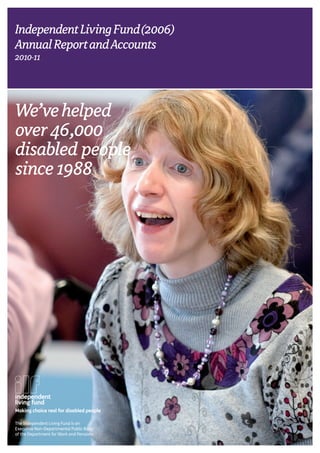
We’vehelped
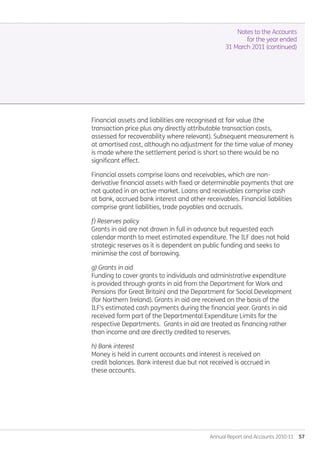
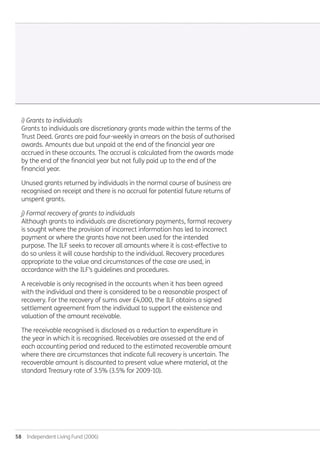
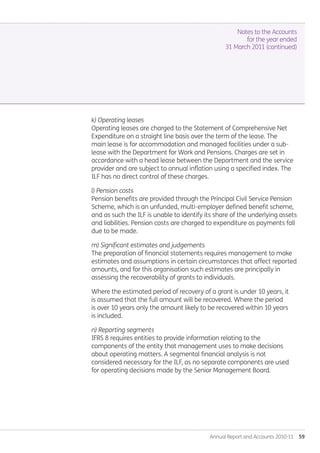
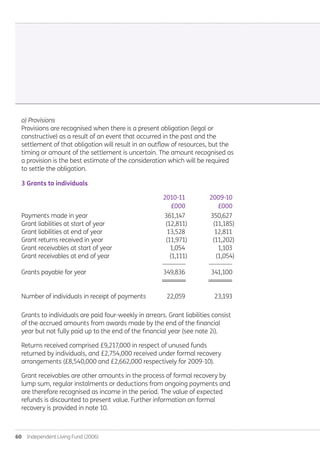
over46,000
disabled people
since1988
The Independent Living Fund is an
Executive Non-Departmental Public Body
of the Department for Work and Pensions
IndependentLivingFund(2006)
AnnualReportandAccounts
2010-11.
Published by TSO (The Stationery Office) and available from:
Online
www.tsoshop.co.uk
Mail, telephone, fax and email
TSO
PO Box 29, Norwich NR3 1GN
Telephone orders/general enquiries: 0870 600 5522
Order through the Parliamentary Hotline Lo-Call 0845 7 023474
Fax orders: 0870 600 5533
Email: customer.services@tso.co.uk
Textphone: 0870 240 3701
The Parliamentary Bookshop
12 Bridge Street, Parliament Square,
London SW1A 2JX
Telephone orders/general enquiries: 020 7219 3890
Fax orders: 020 7219 3866
Email: bookshop@parliament.uk
Internet: http://www.bookshop.parliament.uk
TSO@Blackwell and other accredited agents
Customers can also order publications from:
TSO Ireland
16 Arthur Street, Belfast BT1 4GD
Telephone orders/general enquiries: 028 9023 8451
Fax orders: 028 9023 5401
IndependentLivingFund(2006)AnnualReportandAccounts2010-11
15223_ILF_AR_2011_COVERS.indd 1 12/07/2011 14:18
Independent Living Fund (2006)
15223_ILF_AR_2011_COVERS.indd 2 12/07/2011 14:18
Annual Report and Accounts 2010-11  1
HC 1257. 	 London: The Stationery Office.
£20.50
Presented to Parliament pursuant to Article 3 of the
Government Resources and Accounts Act 2000 (Audit
of Public Bodies) Order 2008.
Ordered by the House of Commons to be printed on
18 July 2011.
IndependentLivingFund(2006).
AnnualReportandAccounts2010-11.
Annual-Report-2010-11.indd 1 12/07/2011 14:13
2  Independent Living Fund (2006)
© Independent Living Fund (2011)
The text of this document (this excludes, where
present, the Royal Arms and all departmental
and agency logos) may be reproduced free of
charge in any format or medium providing that it
is reproduced accurately and not in a misleading
context.
The material must be acknowledged as
Independent Living Fund copyright and the
document title specified. Where third party
material has been identified, permission from the
respective copyright holder must be sought.
Any enquiries regarding this publication should be
sent to us at
Independent Living Fund
Equinox House
Island Business Quarter
City Link
Nottingham
NG2 4LA
Tel: 0845 601 8815
or 0115 945 0700
Textphone: 0845 601 8816
Fax: 0115 945 0948
E-mail: funds@ilf.org.uk
This publication is also for download at www.
official-documents.gov.uk.
This document is also available from our website
at www.dwp.gov.uk/ilf
ISBN: 9780102973648
Printed in the UK by The Stationery Office Limited
on behalf of the Controller of Her Majesty’s
Stationery Office
ID: 2438372		 07/11
Printed on paper containing 75% recycled fibre
content minimum
Annual-Report-2010-11.indd 2 12/07/2011 14:13
Annual Report and Accounts 2010-11  3
Contents.
About us 	 4
Continuing to deliver:
A message from the Chairman and the Chief Executive 	 5
Strategic aims for 2010-11	 6
Introducing the people behind the ILF	 13
Management Commentary	 18
Statement of Accounting Officer’s and Trustees’ Responsibilities	 26
Remuneration Report for the year ended 31 March 2011 	 27
Statement on Internal Control for the year ended 31 March 2011	 38
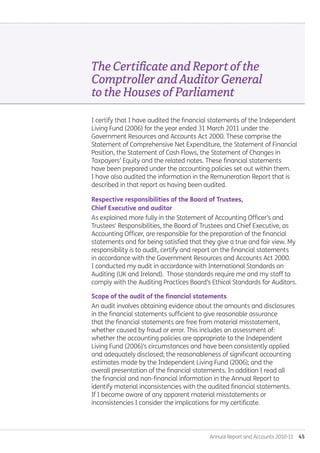
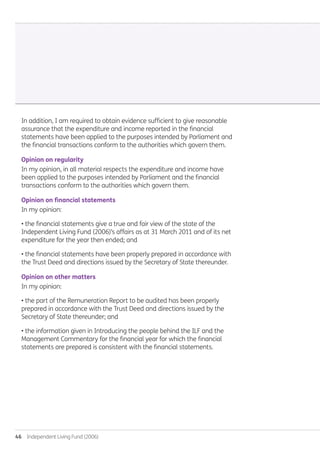
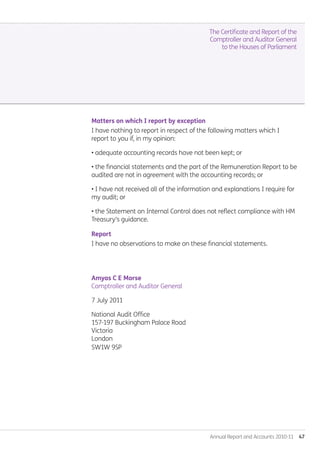
The Certificate and Report of the Comptroller and Auditor General
to the Houses of Parliament	 45
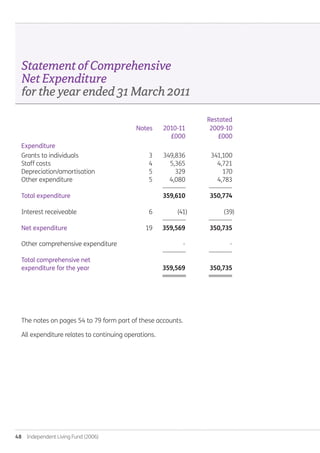
Statement of Comprehensive Net Expenditure	 48
Statement of Financial Position	 49
Statement of Cash Flows	 51
Statement of Changes in Taxpayers’ Equity	 52
Notes to the Accounts	 54
Annual-Report-2010-11.indd 3 12/07/2011 14:13
4  Independent Living Fund (2006)
The Independent Living Fund (ILF) is an
Executive Non-Departmental Public Body
of the Department for Work and Pensions
(DWP). Our role is to deliver discretionary
payments direct to over 21,000 disabled
people across the United Kingdom (UK),
allowing them the choice and control to
purchase personal care and domestic
assistance and live independent
lives in their communities.
We work in partnership with over 200 local
authorities, providing a nationally consistent
method for delivery of social care, achieving
better outcomes for disabled people and enabling
high quality independent living.
We operate from our office in Nottingham,
Equinox House, while also engaging over 70 self-
employed social care professionals across the UK.
Our assessors visit our users in their own homes
to identify their needs in conjunction with local
authority social services departments, and also
deliver customer service visits.
Over the past 22 years the Independent Living
Fund has made a significant contribution
to the lives of disabled people and has paid £3.6
billion to over 46,000 disabled people.
Office address.
Independent Living Fund
Equinox House
Island Business Quarter
City Link
Nottingham
NG2 4LA
Tel: 0845 601 8815.
or 0115 945 0700.
Textphone: 0845 601 8816.
Fax: 0115 945 0948.
E-mail: funds@ilf.org.uk.
Website: www.ilf.org.uk
Aboutus
Annual-Report-2010-11.indd 4 12/07/2011 14:13
Continuing to meet the Government’s Customer
Service Excellence standard has demonstrated
our commitment to maintain our quality
of service.
Overcoming challenges has not lessened
the strong contribution we make to the
personalisation agenda. We have made
great progress in developing outcome-based
assessments with our users and playing an
integral role in the Right to Control Trailblazers.
Engaging with our users through our
programme of UK wide consultation events,
and also through our Advisory Group has
ensured we continue to represent disabled
people’s views within the wider debate and
to Government.
We are committed to working proactively with
ministers and our sponsor department on the
future role of the ILF, involving our users, their
carers and families, and stakeholders along the
way.
We are very grateful for the support of
everyone involved with the ILF during a
challenging time for the organisation and the
people it supports.
Annual Report and Accounts 2010-11  5
Continuing
todeliver.
This year we have navigated the
organisation through what has been
a challenging period. In the face of
significant pressures we are pleased
to report that we have continued to
support those users who were with
us at the start of the year, managed
successfully our financial position and
met all of the performance targets
agreed with the DWP.
After careful consideration, in June 2010 we
took the difficult decision to close the ILF to new
applicants and to limit increases to our existing
users’ packages. This decision was driven by the
need to manage within a tight financial budget
and was only taken after much careful thought
and analysis.
We used our available budget to deliver the
best possible service and support to our existing
21,000 users, who as ever remained our very
first priority. We reduced our administration
expenditure, taking the difficult but necessary
step of launching a programme to reduce our
staff numbers and this has enabled us to direct
more resources directly to our users.
At the same time we strengthened our
operational model and our infrastructure in
order to increase our productivity and deliver
more for our users, and help them achieve the
independent living outcomes they seek.
A message from the Chairman
and the Chief Executive
Stephen Jack
Chairman.
Patrick Boyle
Chief Executive
Annual-Report-2010-11.indd 5 12/07/2011 14:13
6  Independent Living Fund (2006)
Strategicaims
for2010-11.
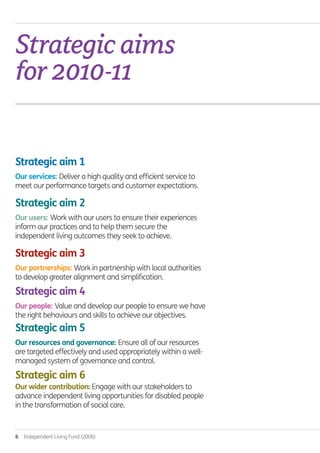
Strategic aim 1
Our services: Deliver a high quality and efficient service to
meet our performance targets and customer expectations.
Strategic aim 2
Our users: Work with our users to ensure their experiences
inform our practices and to help them secure the
independent living outcomes they seek to achieve.
Strategic aim 3
Our partnerships: Work in partnership with local authorities
to develop greater alignment and simplification.
Strategic aim 4
Our people: Value and develop our people to ensure we have
the right behaviours and skills to achieve our objectives.
Strategic aim 5
Our resources and governance: Ensure all of our resources
are targeted effectively and used appropriately within a well-
managed system of governance and control.
Strategic aim 6	
Our wider contribution: Engage with our stakeholders to
advance independent living opportunities for disabled people
in the transformation of social care.
Annual-Report-2010-11.indd 6 12/07/2011 14:13
Annual Report and Accounts 2010-11  7
During the year we undertook a
number of key projects aimed at
improving service provision:
• A new web-based portal for our
assessors to allow them to upload
their reports directly to our system;
• A new work management system,
which allowed us to streamline
administration and target key
resources, in order to improve our
customer service;
• A programme of staff visits to our
users remains in place to widen staff
awareness of the issues our users
face;
• A new quality assurance system
for our assessors, ready to be
implemented early in the next
financial year; and
• Using the Independent Case
Examiner as an additional level of
appeal for our users, ensuring any
complaints can be addressed quickly
and independently.
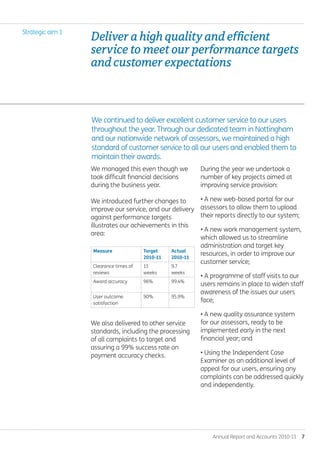
We managed this even though we
took difficult financial decisions
during the business year.
We introduced further changes to
improve our service, and our delivery
against performance targets
illustrates our achievements in this
area:
Measure Target
2010-11
Actual
2010-11
Clearance times of
reviews
11
weeks
9.7
weeks
Award accuracy 96% 99.4%
User outcome
satisfaction
90% 95.9%
We also delivered to other service
standards, including the processing
of all complaints to target and
assuring a 99% success rate on
payment accuracy checks.
We continued to deliver excellent customer service to our users
throughout the year. Through our dedicated team in Nottingham
and our nationwide network of assessors, we maintained a high
standard of customer service to all our users and enabled them to
maintain their awards.
Deliverahighqualityandefficient
servicetomeetourperformancetargets
andcustomerexpectations.
Strategic aim 1
Annual-Report-2010-11.indd 7 12/07/2011 14:13
8  Independent Living Fund (2006)
Strategic aim 2
Teams at our Nottingham office
processed over 135,000 individual
customer transactions. The time
spent with our users ensured
that they continued to receive
individualised packages of support
from the ILF.
We maintained active engagement
with our users through our ‘You
Tell Us’ events across the UK. This
programme enabled users, their
families and carers to voice their
ideas, recommendations and
concerns about the ILF, the service
it provides and its initiatives.
Through these meetings, users
were able to directly contribute to
a review of how we carry out our
biennial reassessments.
Our complaints and decision review
team ensured that complaints and
appeals continued to inform the
way we work and that we carry on
learning from users’ experiences.
The addition of the Independent
Case Examiner also presented an
opportunity for our processes to
be independently considered and
improved.
We met our duty towards equality
legislation, introduced this year.
Our newly formed Equality Impact
Assessment Board reviewed all our
user policies and any changes to our
staff policies. A number of our users
have been involved in the decisions
of this Board and we hope to build
on this success in the coming year.
Throughout the year we worked
to synchronise what we do with
the wider personalisation agenda
in adult social care. Working with
our assessors across the UK, we
researched and made preparations
to begin measuring our users’
support in terms of the outcomes
that are essential to them. We
plan to continue this change over
the coming year by working with
our users and their local authorities
to ensure people are in charge of
their support.
We completed the initial stage
of a research project to build
a more detailed profile of our
users, so we are able to make
ongoing improvements to what
we do. Our initial findings helped
us to identify future customer
service improvements.
During 2010-11, our network of independent assessors spent
approximately 22,000 hours (equivalent to 3,039 working days)
engaging directly with our users through our programme of visits.
Workwithouruserstoensuretheir
experiencesinformourpracticesandto
helpthemsecuretheindependentliving
outcomestheyseektoachieve.
Assessors' time
spent engaging with
our users
22,000
hours.
Customer transactions
by Nottingham office
135,000.
Annual-Report-2010-11.indd 8 12/07/2011 14:13
Annual Report and Accounts 2010-11  9
Strategic aim 3
By utilising our network of contact
officers we ensured that messages
were communicated quickly and
effectively to each local authority.
We played a positive role in planning
for the launch of the Right to Control
Trailblazers in England. We were
represented on the Right to Control
Advisory Group and the Project
Management Board and on the
boards of each of the Trailblazer
sites. This provided the opportunity
for our staff, our assessors and local
authority staff to work increasingly
closely on training, development
and understanding.
By changing the ILF governing
documents, we ensured that all
our existing users in the Trailblazer
areas had and will continue to have
the opportunity to participate in the
Right to Control.
We will test out a number of
potential improvements as the
Trailblazers develop, with an
emphasis on the best possible
customer journey for users,
including greater flexibility in the
use of local authority funding.
We began to explore the possibility
of a single assessment with one
of the Trailblazer sites. Our
intention is to offer users in this
area a choice of representative
to carry out their assessment.
Two other Trailblazer areas also
expressed an interest in testing
similar innovative approaches.
We continued to hold regional
contact officer meetings, visiting
eight locations throughout the UK
and meeting 108 local authority
representatives. These meetings
enabled us to have greater
dialogue with local authorities
about the changing scene of
social care as well as our policies
and processes.
We also met with Association
of Directors of Adult Social Ser-
vices (ADASS) representatives and
the National Director of Person-
alisation from the Department
of Health, and intend to further
develop these relationships. This
helped to ensure that we are
engaged with broader changes to
the adult social care system and
able to contribute on behalf of
our users.
This year has seen a necessary increase in the frequency of our
strategic communications with local authorities. We used a number
of methods to share the changes required with local authorities to
ensure the ILF remained within budget.
Workinpartnershipwithlocal
authoritiestodevelopgreater
alignmentandsimplification
Annual-Report-2010-11.indd 9 12/07/2011 14:13
10  Independent Living Fund (2006)
Strategic aim 4
Our learning and development plan
demonstrated our clear commitment
to invest in our people. We completed
our leadership training programmes
and our coaching scheme went from
strength to strength.
Many of our managers achieved
or worked towards professional
qualifications from the Institute of
Leadership and Management, and our
13 volunteer coaches mentored and
supported their colleagues. In addition,
13% of our workforce achieved or
worked towards a further or higher
education qualification.
We continued to help and encourage
our employees to better understand
the needs of disabled people, through
our close partnership with Portland
College (a specialist residential
college for people with disabilities
and learning difficulties) and our
work placements initiative.
We worked hard to support the health
and wellbeing of our workforce and
we continued to offer occupational
health services, health check days
and counselling sessions. Sickness
absence remained below our target of
nine days per person at 8.8 days and
we continued to offer a range of new
activities to promote healthy living.
We demonstrated our commitment
to diversity and equal opportunities by
delivering dignity and diversity training
courses and carrying out a full equal
pay audit.
Our commitment to our people
continued to be recognised both
internally and externally through
our Staff Awards programme and
Investors in People accreditation,
to the bronze standard. We also
maintained the ‘two tick’ symbol,
awarded by Jobcentre Plus to
employers who make positive
commitments towards employing
disabled people.
Due to a reduction in our workload and our pursuit of greater efficiency,
we launched a Voluntary Exit Scheme in February 2011 to reduce our
headcount, whilst ensuring that the key skills the organisation needs
would be retained. This scheme will be concluded in 2011-12.
Valueanddevelopourpeopletoensure
wehavetherightbehavioursandskills
toachieveourobjectives
Employees who
achieved or worked
towards further
and higher education
qualifications
13%.
Volunteer
coaches
13
Annual-Report-2010-11.indd 10 12/07/2011 14:13
Annual Report and Accounts 2010-11  11
Ensureallofourresourcesare
targetedeffectivelyandused
appropriatelywithinawell-managed
systemofgovernanceandcontrol
The year was extremely challenging in light of a difficult
financial position but we continued to deliver our services
within the funding available.
Strategic aim 5
In April 2010, we recognised that
increasing demand and price
pressures, if not addressed, would
result in the ILF overspending the
funding allocation provided by
government. As a result, we had to
close to new applications, and also
tighten our policy around inflationary
price changes and some discretionary
payments. These actions were
necessary to manage within our
available funding for the year and
also helped to maintain and secure
on-going payments for our existing
users during a time when there was
unprecedented pressure, nationally,
on public finances.
To help alleviate the financial position
we reviewed our administration costs
and generated significant savings.
We reduced our administration spend
to only 2.5% of the total expenditure
for the year and took actions to
reduce the budgeted non-staff costs
(excluding estates costs) by 26%.
We took the opportunity to reduce
supplier costs at every contract
renewal, improving value for money
throughout all aspects of contract and
supply chain management.
Where appropriate we ensured
compliance with new additional
central government procedures
and sought Ministerial oversight
approval where necessary. We
maintained comprehensive and
robust mechanisms for both
internal control and strategic risk
management. The Trustees Board
and Audit Committee regularly
reviewed the outcome of control
checks and our high level strategic
risk registers. These were in addition
to further risk management
processes at departmental and
project levels.
To further improve our IT systems,
we began work to retain all data
within secure centralised servers.
We also progressed work towards
introducing the Government Secure
Intranet (GSI), which will enhance
security further, particularly when
exchanging data with other parts of
government.
During the year our internal auditors
RSM Tenon undertook a planned
annual audit programme. They
produced audit reports graded
according to their findings and
made recommendations that were
reviewed by the Accounting Officer
and the Audit Committee. At the
year-end all significant or material
findings had been agreed and
implemented or were in the process
of evaluation as part of ongoing
organisational projects.
Annual-Report-2010-11.indd 11 12/07/2011 14:13
12  Independent Living Fund (2006)
Strategic aim 6
We made full use of our Advisory
Group, which is made up of trustees,
users and representatives from
disabled people’s organisations.
They provided information and
advice on our communications with
users, our planning, the issues faced
by disabled people, and how these
are impacted by changes in the
public sector.
Working closely with the
Government, we provided
information and evidence to various
consultations on issues affecting
our users.
Following a submission by the ILF
to the Dilnot Commission’s call for
evidence, a team of Advisory Group
members, users and management
also met Andrew Dilnot, Chair of the
Dilnot Commission, and his officials.
This gave us a great opportunity
to discuss our submission and the
wider concerns of disabled people
and ILF users.
Our submission to the DWP
consultation on reform of DLA was
based on the views of our users
about the proposals. We saw
the impact of these views in the
response made by the DWP.
We also provided a response to the
Joint Committee on Human Rights’
inquiry into the Implementation
of the Right of Disabled People to
Independent Living. This submission
directly presented the views and
responses of our users to the inquiry,
and also incorporated comments
from our Advisory Group.
We remained firmly committed to
improving the contribution that we
can make, in partnership with others,
towards fulfilling and inclusive lives
for our users. This required regular
involvement from disabled people and
from our partners in Local Authorities.
The DWP has committed to
consultation about the ILF following
the Dilnot Commission’s conclusions,
and we are committed to ensuring
that our users and wider stakeholders
have the opportunity and support to
fully respond to this consultation.
In 2010-11 there were a number of changes to the wider social care
landscape, with the launch of the Right to Control Trailblazers, the
Commission on Funding of Care and Support (the Dilnot Commission), and
the consultation regarding changes to Disability Living Allowance (DLA).
Engagewithourstakeholderstoadvance
independentlivingopportunitiesfor
disabledpeopleinthetransformationof
socialcare
Annual-Report-2010-11.indd 12 12/07/2011 14:13
Annual Report and Accounts 2010-11  13
Stephen Jack, Chairman of the Trustees
Stephen is a Chartered Accountant. He is Chief
Financial Officer of Compagnie Financiere
Tradition, a global broking business. He has
previously held senior financial management
positions in a number of international financial
services organisations. He is a Trustee and
Treasurer of the Greater London Fund for
the Blind.
Professor Peter N C Cooke, Vice Chairman
Peter is a Professor and Head of the Centre for
Automotive Management at the University of
Buckingham Business School. He is a consultant,
speaker, writer and broadcaster on automotive
and disability issues and was appointed a
Winston Churchill Memorial Fellow in 2002. He
is a governor of Motability, the charity which
oversees provision of cars for people with
disabilities. Peter was a Non-Executive Director
of Remploy for seven years.
Margaret McGlade, Trustee
Margaret is a freelance consultant in social
care, health and children’s services. She
was previously Director of Social Services for
Derby City Council and a senior manager for
Nottinghamshire County Council. She is a
Trustee of Nottingham Women’s Aid Integrated
Services and a qualified registered social worker.
Yogi Amin, Trustee
Yogi is a solicitor with specialism in Public
Law and Human Rights. He is a partner at
Irwin Mitchell Solicitors and practises in a
range of health, social care and other public
sector areas.
Susan Winterburn, Trustee
Susan qualified as a social worker in 1975
and worked in North Yorkshire. She was a
senior lecturer in Health and Social Care, at
York College of Further and Higher Education.
She is a retired Director of Family Services at
Family Fund Trust (a UK wide grant-making
organisation) and has experience of grant-
making criteria and developing/managing a
dispersed self-employed social care workforce.
The ILF Trustees..
Appointed by the Secretary of State for
Work and Pensions, the Trustees are
responsible for appointing the ILF Chief
Executive, keeping accurate records and
presenting the yearly accounts. They strictly
monitor the payments process, ensuring
that we spend money fairly and don’t
exceed our yearly budgets.
Introducingthe
peoplebehind
theILF.
Annual-Report-2010-11.indd 13 12/07/2011 14:13
14  Independent Living Fund (2006)
Nick Danagher, Trustee
Nick is a graduate in English and Media
Studies. He has developed and managed local
independent living schemes and organisations.
He is a former board member of Central Council
for Education and Training in Social Work
(CCETSW) and former Executive Director of the
National Centre for Independent Living. He is
currently a freelance consultant in disability
equality and a member of Equality 2025 – the UK
advisory network on disability equality.
Mike Boyall, Treasurer and Chairman of the
Audit Committee
Mike is an ombudsman at the Financial
Ombudsman Service and a qualified accountant.
He was formerly a Deputy Director in the DTI
and Official Receiver in the Insolvency Service,
managing and investigating Public Interest
Insolvencies. He is also a Magistrate.
Sally Sparrow, Chairman of the ILF Remuneration
Committee and User Personal Cases Committee
Sally was Director of Social Care at Witham
Braintree and Halstead Care Trust until March
2007. She qualified as a social worker in 1988 and
previously worked in social care and the voluntary
sector in a variety of posts with older people and
those with physical and sensory impairments.
Marie Martin, Trustee
Marie is currently a care manager for the
British Nursing Association and Chairman
of the Shooting Star Children’s Hospice and
Linden Hall Day Centre, as well as a trustee of
the Hampton Fuel Trust. She has previously
been a social services manager for Hounslow
& Kingston Upon Thames and has also
worked in the private sector.
The Audit Committee
To ensure our systems and services are
run effectively we are closely monitored by
internal and external auditors. Our Audit
Committee (made up of four Trustees) sets
out a specific monitoring programme each
year and closely reviews all ILF strategies and
processes to ensure the organisation is run
efficiently, safely and properly.
Mike Boyall, Chairman
Peter Cooke, Member
Margaret McGlade, Member
Yogi Amin, Member
Introducing the people behind the ILF
Annual-Report-2010-11.indd 14 12/07/2011 14:13
Annual Report and Accounts 2010-11  15
The Remuneration Committee
The Remuneration Committee oversees and
reports to the Trustees on the salaries, rewards
and conditions of service in place at the ILF.
It also makes sure that the ILF conducts
its employee relations fairly, efficiently and
effectively. For more information, see the
Remuneration Report on page 27.
Sally Sparrow, Chairman
Margaret McGlade, Member
Marie Martin, Member
Susan Winterburn, Member
The User Personal Cases Committee
The User Personal Cases Committee considers
cases referred by the Senior Management Panel
where a user has requested that Trustees make
an individual discretionary decision within their
powers as set out in the Trust Deed.
Sally Sparrow, Chairman
Yogi Amin, Member
Nick Danagher, Member
Marie Martin, Member
Peter Cooke, Member
Susan Winterburn, Member
The Senior Management
Board (SMB)
The SMB is responsible for the strategic
management of the ILF.
Patrick Boyle, Chief Executive
Patrick is accountable for all aspects of ILF
performance, reporting directly to the Board of
Trustees. As the Accounting Officer for the ILF,
Patrick also reports directly to DWP via senior
officials and the sponsor group.
James Sanderson, Chief Operating Officer and
Deputy Chief Executive
James oversees ILF operations including
service delivery, social work and performance
improvement functions. He is responsible for
ensuring that we continue to deliver excellent
standards of service to our users. James is
also heavily involved in ILF’s externally
focused agenda.
Steve Jarratt, Resources Director
Steve is responsible for all aspects of financial
management and control within the ILF;
including payment security, compliance and
debt recovery. The role includes close liaison
with internal and external audit plus the
oversight of the organisation’s key resources of
staff, IT and estates.
Introducing the people behind the ILF
Annual-Report-2010-11.indd 15 12/07/2011 14:13
16  Independent Living Fund (2006)
Jesse Harris, Social Work Director
Jesse is responsible for ensuring high standards
of social work and quality assurance with regard
to independent living outcomes. He is also
responsible for relationships with local authorities
and users, complaints, user personal case
hearings and the application review process, the
social work and complaints process, and biennial
review programme through the management of
operations teams and some 77 self-employed
assessors across the UK.
John Denore, Operations Director
John is responsible for service delivery and
the administration of all our user services,
incorporating: application processing, ongoing
casework, payments to users and on-going
customer service to users.
Gillian Smith, Human Resources Director
Gillian is responsible for developing and leading
HR strategy within the ILF. This includes
employment policy, employee relations, learning
and development and recruitment. Gillian
ensures that HR policies are legally compliant and
provides professional HR guidance and support to
Trustees and senior management.
John Fuller, Strategic Policy Director
John is responsible for developing options
for the role and contribution of the ILF in line
with Government strategy towards disabled
people, and for the development and
communication of policy.
Roland Knell, Information and Governance
Director
Roland is responsible for corporate
governance, risk management, the internal
audit programme, information technology,
data and physical security, estates and
facility management, contract management,
business continuity planning, records
management and business planning.
Introducing the people behind the ILF
Annual-Report-2010-11.indd 16 12/07/2011 14:13
Annual Report and Accounts 2010-11  17
Annual-Report-2010-11.indd 17 12/07/2011 14:13
18  Independent Living Fund (2006)
Principal activity and historical context
The role of the Independent Living Fund (2006) (‘the ILF’) is to deliver
discretionary cash payments directly to disabled people, allowing them
the choice and control to purchase personal support and live independent
lives in their communities. The ILF is an Executive Non-Departmental
Public Body of the Department for Work and Pensions (‘DWP’) and receives
funding in the form of grants in aid from DWP for Great Britain and from
the Department for Social Development (‘DSD’) for Northern Ireland. The
formal governance documents owned by DWP consist of a Management
Statement, the Trust Deed and the Conditions of Grant Agreement.
The original Independent Living Fund was established in 1988 and ran for
five years to March 1993. In April 1993 the Independent Living (Extension)
Fund was established to continue payments to the beneficiaries of the
original Independent Living Fund, and the Independent Living (1993) Fund
was established to take new applications. The current ILF commenced
operations from October 2007, continuing payments to beneficiaries of the
predecessor Funds and receiving the closing assets and liabilities of those
Funds. The ILF closed to applications in early 2010-11 in order to protect
funding for existing beneficiaries. The strategic aims are set out on page 6.
External auditor
Comptroller and Auditor General
National Audit Office
157-197 Buckingham Palace Road
London
SW1W 9SP
ManagementCommentary
Internal auditor
RSM Tenon
The Poynt
45 Wollaton Street
Nottingham
NG1 5FW
Solicitors
Harvey Ingram LLP
20 New Walk
Leicester
LE1 6TX
Bankers
Lloyds TSB Corporate
125 Colmore Row
Birmingham
B3 3SF
Fees paid to the National Audit Office were £53,750 for external audit
work (2009-10 £66,000 including £11,000 for work on compliance with
International Financial Reporting Standards).
Annual-Report-2010-11.indd 18 12/07/2011 14:13
Annual Report and Accounts 2010-11  19
Trustees’ appointments, training and remuneration
A minimum of three and a maximum of nine Trustees are appointed
for a term of five years by the Secretary of State for Work and Pensions,
following public advertisement and recruitment procedures in line
with Government guidance for Non-Departmental Public Bodies. The
Secretary of State under such guidance will also appoint the Chairman,
at such time as the current chair’s term of appointment ends. Trustees’
appointments can be extended for one further five-year term. Trustees
may elect individual board members to serve on sub-committees.
Appropriate training is provided to appointed Trustees on an individual
basis, following discussion with the Chairman. This includes amongst
other items; an induction pack, briefings from ILF staff, observing
Trustees’ meetings and visiting the ILF’s office in Nottingham.
The Trustees receive remuneration under arrangements agreed with
the Secretary of State. The ILF also reimburses Trustees for out-of-
pocket expenses.
Trustees for 2010-11 were Stephen Jack (Chairman), Peter Cooke (Vice
Chairman), Mike Boyall (Treasurer), Yogi Amin, Nick Danagher, Marie
Martin, Margaret McGlade, Sally Sparrow and Susan Winterburn. Sub-
committees operating in the year were the Audit Committee (Mike
Boyall as Chairman, Yogi Amin, Peter Cooke, and Margaret McGlade ),
the Remuneration Committee (Sally Sparrow as Chairman, Marie Martin,
Margaret McGlade and Susan Winterburn) and the User Personal Cases
Committee (Sally Sparrow as Chairman, Yogi Amin, Nick Danagher, Peter
Cooke, Susan Winterburn and Marie Martin). Background details of
Trustees are given on pages 13 and 14.
Annual-Report-2010-11.indd 19 12/07/2011 14:13
20  Independent Living Fund (2006)
Relationships and related parties
Trustees appointed by the Secretary of State for Work and Pensions
administer the ILF. Related parties are the Trustees, all parts of DWP
including its agencies (representing the Secretary of State) and the
Department for Social Development (DSD) in Northern Ireland which also
provides funding. The Trustees are the controlling party.
The Chief Executive is formally nominated as the Accounting Officer
for the ILF and as the Consolidation Officer for the purpose of Whole of
Government Accounts. His responsibilities are set out in the Trust Deed
and Management Statement. There is a Scheme of Delegated Authority
approved by Trustees and the Chief Executive for day-to-day operations
and responsibilities by the ILF’s staff.
One Trustee is a beneficiary of the ILF and receives payments under the
terms of the Fund. During the year no other related parties, including
Trustees and key management staff, have undertaken any material
transactions with the ILF.
Operating and performance review
The ILF funding is designated within the four-year Departmental
Expenditure Limit (DEL) for DWP and DSD. In order to protect funding for
existing beneficiaries the Fund closed to new applicants in early 2010-11.
The key performance targets for the ILF have been reviewed by DWP and
agreement has been reached on the main performance measures going
forward.
These measures were in existence as ILF targets during 2010-11 and the
results for the year were as follows:
• Clearance times of review visits on average in 9.7 weeks, against an 11-
week target (2009-10: 10.3 weeks).
• Award processing 99.4% accurate in all respects, amount and process –
against a 96% target (2009-10: 98.7%).
Annual-Report-2010-11.indd 20 12/07/2011 14:13
Annual Report and Accounts 2010-11  21
• Administration expenditure 2.5% of total ILF expenditure for the year,
against a 3% target (2009-10: 2.8%).
• Users rating their satisfaction with the outcomes they experience as
‘good’ or ‘excellent’ at a level of 95.9%, against a 90% target (2009-10:
94.1%).
A target to monitor the average time taken to manage applications for
funding was suspended during the year in light of the closure
to applications.
An average of 154 staff (full time equivalents) were employed during
the year. Staff receive salaries on the ILF scale and are entitled to be
members of the Principal Civil Service Pension Scheme – full details are
provided in the Remuneration Report on pages 27 to 37. In addition,
77 self-employed assessors were engaged under contract to carry out
visits to new applicants and existing beneficiaries under the ILF’s user
administration policies.
The ILF has increased its engagement with a range of stakeholders as
part of the ongoing involvement in the development of social care policy.
The ILF held a series of events entitled ‘You Tell Us’ in order to continue to
communicate directly with users of the Fund and other key stakeholders.
The ILF is a Charter Mark organisation, and has successfully retained the
accreditation during the year following reassessment against the criteria.
Governance and social responsibility
The ILF is committed to good employee relations and recognises the
Public and Civil Service Union as the trade union acting on behalf of
staff. In recognition of the continued good standards of HR policies, staff
information and consultation, the Fund has successfully retained the
Investors in People accreditation and the ‘Positive about Disabled People’
(two ticks) during the year. HR policies are regularly reviewed to ensure
full compliance with employment legislation.
Management Commentary
Annual-Report-2010-11.indd 21 12/07/2011 14:13
22  Independent Living Fund (2006)
The ILF seeks to actively manage sickness absences and has ‘return to
work’ meetings with staff to improve support on resumption of duties
and discuss absence patterns and causes. The average number of days
per annum lost to sickness absence was 8.8 days per employee against a
target of 9 days (2009-10: 8.4 days).
The ILF’s procurement policy ensures fair competition and value for money,
with specific arrangements to encourage tenders from employers of
disabled people in procurement exercises. The ILF is committed to prompt
payment of bills for goods and services received. Payments are normally
made within the period specified in the contract. Where there is no
contractual or other understanding, we endeavour to pay within 14 days of
the receipt of the goods or services, or the presentation of a valid invoice or
similar demand, whichever is later. During 2010-11 96% of invoices paid met
this target (98% met the target of 30 days in 2009-10).
The ILF has Corporate and Social Responsibility and Sustainable
Development policies, and has developed links with disabled people’s
groups. The Customer Service Excellence award for public service was
retained during 2010-11.
Financial review
The ILF is financed out of money voted by Parliament as grants in aid from
DWP and DSD for the purpose of making regular grants to individuals.
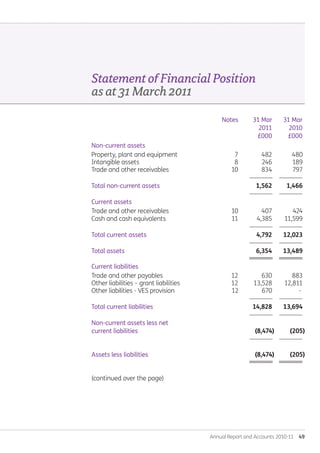
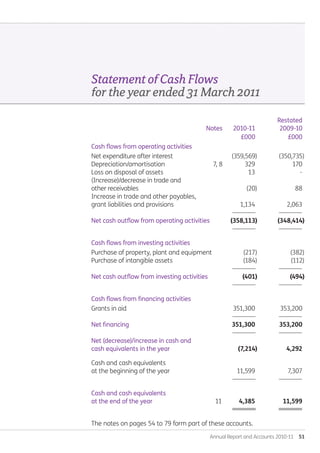
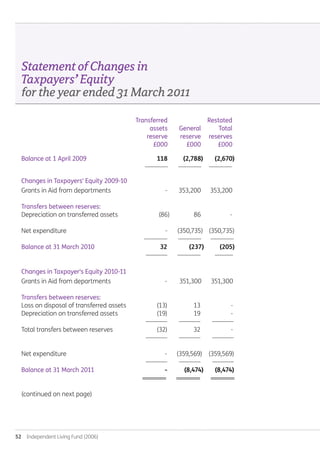
Grant in aid of £351.3 million, in addition to cash reserves brought forward
of £11.6 million, were utilised to meet the needs of users and related
administration costs.
Assets are held only for the purpose of managing the ILF. The Trust Deed
provides that the Trustees: (i) can borrow only with the specific agreement
of the Secretary of State; (ii) cannot lend; (iii) cannot issue guarantees or
indemnities; (iv) can only invest moneys in interest-bearing accounts.
Annual-Report-2010-11.indd 22 12/07/2011 14:13
Annual Report and Accounts 2010-11  23
The ILF requests and receives grant in aid on a monthly basis to meet
its immediate cash needs. Procurement policies are designed to secure
goods and services for immediate consumption during the year with best
value for money at current cost, and without setting up complex financial
instruments. The ILF’s exposure to financial instrument risk is therefore low
compared with non-public sector organisations. The policies on financial
instruments are provided in the Notes to the Accounts, and appropriate
disclosures are included.
The Accounts have been prepared in accordance with the Trust Deed
and directions made by the Secretary of State for Work and Pensions
thereunder. The Accounts have been prepared in compliance with
International Financial Reporting Standards as adapted or interpreted for
the public sector context.
All financial and other matters necessary for an effective external audit
have been disclosed to the auditors. As far as the Chief Executive and
Trustees are aware there is no relevant audit information of which the
auditors are unaware; the Chief Executive and Trustees have taken all the
steps that they ought to have taken to make themselves aware of any
relevant audit information and to establish that the auditors are aware of
that information.
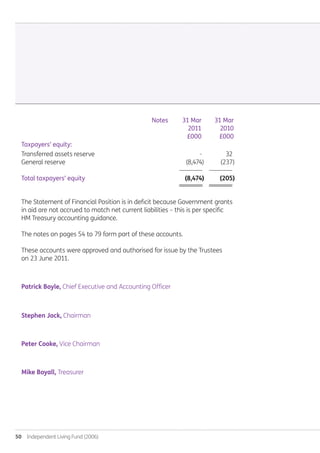
The Accounts are prepared on a ‘going concern’ basis. Grant in aid is
received on a cash basis to meet immediate need, and is not accrued to
match liabilities. Grants to individuals are paid in arrears and the Statement
of Financial Position at 31 March 2011 shows a net deficit. DWP has
provided a letter of comfort to Trustees to confirm that grant in aid will be
made available to cover the financial obligations of the ILF related to DWP-
funded activity and to continue the ILF’s activities up to March 2012.
There were no events after the end of the financial year that have any
material effect on these Reports and Accounts.
Management Commentary
Annual-Report-2010-11.indd 23 12/07/2011 14:13
24  Independent Living Fund (2006)
Future developments and organisational risks
The ILF provides estimates of expenditure to support the requests of grant
in aid. Trustees are required to take reasonable steps to ensure expenditure
does not exceed available funding.
The ILF operates a robust risk management programme, identifying
major risks against business objectives and implementing appropriate
risk management measures. The Senior Management Board reviews risks
and reports to the Audit Committee on a quarterly basis, and the Board of
Trustees reviews the risks five times a year. Appropriate controls and action
plans for risk management are put in place and these are reviewed at the
risk management meetings. A separate Statement on Internal Control is
provided in this document.
The Cabinet Office designates requirements for public bodies to provide
information on personal data related incidents. During 2010-11 and up to
the date of signing of these Accounts, no incidents have occurred for the
ILF that would require reporting under these provisions (there were none in
2009-10).
A number of Government reviews of social care delivery are ongoing and
the ILF is taking an active part in contributing to the ongoing debate and
the development of initiatives. This includes the Right to Control Trailblazers,
consultation on the changes to Disability Living Allowance, the Commission
on the Funding of Care and Support which is considering the funding of
adult social care and the Joint Committee on Human Rights inquiry into the
implementation of the right of disabled people to independent living.
A Written Ministerial Statement was laid before Parliament on 13 December
2010 confirming it remained the priority of the ILF to safeguard the position
of the existing recipients of the fund; to enable this the programme budget
for existing recipients has been protected throughout this Parliament.
Also, following the publication of the report by the Commission on the
Funding of Care and Support, a formal consultation on the future of the ILF
will be undertaken.
Management Commentary
Annual-Report-2010-11.indd 24 12/07/2011 14:13
Annual Report and Accounts 2010-11  25
The consultation is to inform decisions on determining how best to
continue to support existing users of the ILF in to a social care system
based on the principles of personalised budgets, the findings of the
commission and recognising the importance of the support that ILF users
have built their lives around. Disabled people, particularly current users of
the ILF and their families, local authorities and other interested parties,
including the devolved Administrations will be fully consulted.
Signed by the Accounting Officer and on behalf of the Trustees on 23
June 2011.
Patrick Boyle, Chief Executive and Accounting Officer.
Stephen Jack, Chairman.
Peter Cooke, Vice Chairman.
Mike Boyall, Treasurer.
Annual-Report-2010-11.indd 25 12/07/2011 14:13
26  Independent Living Fund (2006)
StatementofAccountingOfficer’s
andTrustees’Responsibilities.
The Accounting Officer is responsible for preparing the accounts in
accordance with the Trust Deed and directions made by the Secretary of
State thereunder. The accounts are prepared on an accruals basis and
must give a true and fair view of the state of affairs of the ILF and of its
comprehensive net expenditure, financial position, cash flows and changes
in taxpayers’ equity for the financial year. In preparing the accounts, the
Accounting Officer is required to comply with the requirements of the
Government Financial Reporting Manual and in particular to:
• Comply with relevant accounting and disclosure requirements, and apply
suitable accounting policies on a consistent basis;
• Make judgments and estimates on a reasonable basis;
• State whether applicable accounting standards as set out in the
Government Financial Reporting Manual have been followed, and disclose
and explain any material departures in the accounts; and
• Prepare the accounts on a ‘going concern’ basis.
The Principal Accounting Officer of DWP has appointed Patrick Boyle as
Accounting Officer of the ILF. The responsibilities of an Accounting Officer,
including responsibility for the propriety and regularity of the public finances
for which the Accounting Officer is answerable, for keeping proper records
and for safeguarding the ILF’s assets, are set out in the Management
Statement for the ILF issued by DWP.
The Management Statement also sets out the responsibilities of the
Trustees to ensure that the ILF fulfils its aims, objectives and key targets,
and prepares a statement of accounts for each financial year.
Signed by the Accounting Officer and on behalf of the Trustees on 23 June
2011.
Patrick Boyle, Chief Executive and Accounting Officer.
Stephen Jack, Chairman.
Peter Cooke, Vice Chairman.
Mike Boyall, Treasurer.
Annual-Report-2010-11.indd 26 12/07/2011 14:13
Annual Report and Accounts 2010-11  27
This report for the year ended 31 March 2011 deals with the
remuneration of the Chief Executive, Directors and Trustees of the
Independent Living Fund (2006) (‘the ILF’).
The ILF is managed by a Board of Trustees appointed by the Secretary of
State for Work and Pensions. The Trustees receive remuneration as post-
holders and are reimbursed for out-of-pocket expenses in line with the
ILF’s travel and subsistence policy. They do not receive any other benefit.
There are no unpaid persons or volunteers upon whose services the ILF
is dependent.
The Remuneration Committee
The Remuneration Committee is appointed by the Board of Trustees
and is established to independently review the salary of the Chief
Executive. The Chief Executive appraises the Committee of any annual
pay negotiations with the Public and Commercial Services Union (PCS) to
agree the salary levels for employees and Directors which will be set in
accordance with the requirements of the Trust Deed and the Conditions
of Grant Agreement.
Members of the Committee for the period of this report were:
Sally Sparrow, Chairman
Margaret McGlade, Member
Marie Martin, Member
Susan Winterburn, Member
The terms of reference of the Remuneration Committee in relation to
salary, rewards and conditions of service are:
• To ensure that the ILF Directors and staff are fairly, but responsibly
rewarded for their joint and individual contributions to the ILF’s
management and overall performance.
• To agree the Chief Executive’s remuneration in discussion with the
ILF Chair of Trustees, under the terms and conditions agreed with the
ILF. As a result of these discussions the Chair of Trustees in conjunction
with the Human Resources Director will make recommendations to the
Remuneration Committee.
Remuneration Report for the
year ended 31 March 2011
Annual-Report-2010-11.indd 27 12/07/2011 14:13
28  Independent Living Fund (2006)
• To review and where appropriate, approve the Chief Executive’s proposals
for the remuneration of the ILF Directors. This will include approval of the
annual Treasury pay remit, setting pay bands and individual bonuses.
• To review and where appropriate approve the Senior Management Board’s
remuneration proposals for all ILF staff below Director grade. This will
include approval of the annual Treasury pay remit and setting pay bands
and bonuses.
Remuneration policy
Trustees
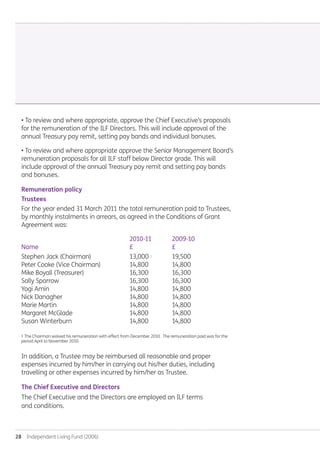
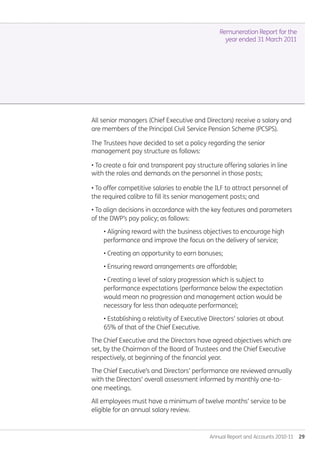
For the year ended 31 March 2011 the total remuneration paid to Trustees,
by monthly instalments in arrears, as agreed in the Conditions of Grant
Agreement was:
	 2010-11	 2009-10
Name	 £	 £
Stephen Jack (Chairman)	 13,000 1
	 19,500
Peter Cooke (Vice Chairman)	 14,800	 14,800
Mike Boyall (Treasurer)	 16,300	 16,300
Sally Sparrow	 16,300	 16,300
Yogi Amin 	 14,800	 14,800
Nick Danagher	 14,800	 14,800
Marie Martin	 14,800	 14,800
Margaret McGlade	 14,800	 14,800
Susan Winterburn	 14,800	 14,800
1 The Chairman waived his remuneration with effect from December 2010. The remuneration paid was for the
period April to November 2010.
In addition, a Trustee may be reimbursed all reasonable and proper
expenses incurred by him/her in carrying out his/her duties, including
travelling or other expenses incurred by him/her as Trustee.
The Chief Executive and Directors
The Chief Executive and the Directors are employed on ILF terms
and conditions.
Annual-Report-2010-11.indd 28 12/07/2011 14:13
Annual Report and Accounts 2010-11  29
All senior managers (Chief Executive and Directors) receive a salary and
are members of the Principal Civil Service Pension Scheme (PCSPS).
The Trustees have decided to set a policy regarding the senior
management pay structure as follows:
• To create a fair and transparent pay structure offering salaries in line
with the roles and demands on the personnel in those posts;
• To offer competitive salaries to enable the ILF to attract personnel of
the required calibre to fill its senior management posts; and
• To align decisions in accordance with the key features and parameters
of the DWP’s pay policy; as follows:
• Aligning reward with the business objectives to encourage high
performance and improve the focus on the delivery of service;
• Creating an opportunity to earn bonuses;
• Ensuring reward arrangements are affordable;
• Creating a level of salary progression which is subject to
performance expectations (performance below the expectation
would mean no progression and management action would be
necessary for less than adequate performance);
• Establishing a relativity of Executive Directors’ salaries at about
65% of that of the Chief Executive.
The Chief Executive and the Directors have agreed objectives which are
set, by the Chairman of the Board of Trustees and the Chief Executive
respectively, at beginning of the financial year.
The Chief Executive’s and Directors’ performance are reviewed annually
with the Directors’ overall assessment informed by monthly one-to-
one meetings.
All employees must have a minimum of twelve months’ service to be
eligible for an annual salary review.
Remuneration Report for the
year ended 31 March 2011
Annual-Report-2010-11.indd 29 12/07/2011 14:13
30  Independent Living Fund (2006)
In the event of early severance, compensation would be payable in
accordance with ILF terms and conditions, and paid in accordance with the
relevant provisions of the Civil Service Compensation Scheme.
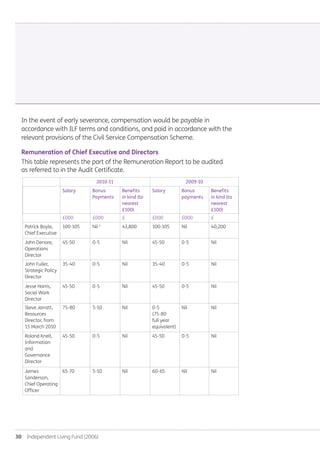
Remuneration of Chief Executive and Directors
This table represents the part of the Remuneration Report to be audited
as referred to in the Audit Certificate.
2010-11 2009-10
Salary Bonus
Payments
Benefits
in kind (to
nearest
£100)
Salary Bonus
payments
Benefits
in kind (to
nearest
£100)
£000 £000 £ £000 £000 £
Patrick Boyle,
Chief Executive
100-105 Nil 2
43,800 100-105 Nil 40,200
John Denore,
Operations
Director
45-50 0-5 Nil 45-50 0-5 Nil
John Fuller,
Strategic Policy
Director
35-40 0-5 Nil 35-40 0-5 Nil
Jesse Harris,
Social Work
Director
45-50 0-5 Nil 45-50 0-5 Nil
Steve Jarratt,
Resources
Director, from
15 March 2010
75-80 5-10 Nil 0-5
(75-80
full year
equivalent)
Nil Nil
Roland Knell,
Information
and
Governance
Director
45-50 0-5 Nil 45-50 0-5 Nil
James
Sanderson,
Chief Operating
Officer
65-70 5-10 Nil 60-65 Nil Nil
Annual-Report-2010-11.indd 30 12/07/2011 14:13
Annual Report and Accounts 2010-11  31
Remuneration Report for the
year ended 31 March 2011
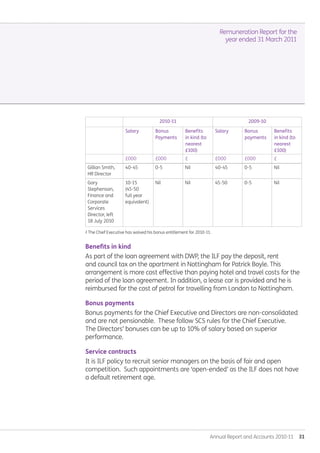
Gillian Smith,
HR Director
40-45 0-5 Nil 40-45 0-5 Nil
Gary
Stephenson,
Finance and
Corporate
Services
Director, left
18 July 2010
10-15
(45-50
full year
equivalent)
Nil Nil 45-50 0-5 Nil
2 The Chief Executive has waived his bonus entitlement for 2010-11.
Benefits in kind
As part of the loan agreement with DWP, the ILF pay the deposit, rent
and council tax on the apartment in Nottingham for Patrick Boyle. This
arrangement is more cost effective than paying hotel and travel costs for the
period of the loan agreement. In addition, a lease car is provided and he is
reimbursed for the cost of petrol for travelling from London to Nottingham.
Bonus payments
Bonus payments for the Chief Executive and Directors are non-consolidated
and are not pensionable. These follow SCS rules for the Chief Executive.
The Directors’ bonuses can be up to 10% of salary based on superior
performance.
Service contracts
It is ILF policy to recruit senior managers on the basis of fair and open
competition. Such appointments are ‘open-ended’ as the ILF does not have
a default retirement age.
2010-11 2009-10
Salary Bonus
Payments
Benefits
in kind (to
nearest
£100)
Salary Bonus
payments
Benefits
in kind (to
nearest
£100)
£000 £000 £ £000 £000 £
Annual-Report-2010-11.indd 31 12/07/2011 14:13
32  Independent Living Fund (2006)
The Chairman of the Board of Trustees appraises the Chief Executive’s
performance and the Chief Executive appraises the Directors’ performance.
Any issue arising in connection with individual performance, including
termination of appointment, would be dealt within this context.
Most members of the senior management team are employed under
permanent employment contracts with the two exceptions. Patrick Boyle,
Chief Executive, is on loan from DWP and his loan agreement was initially
for 2 years but was extended by one year in January 2011 to 9 January
2012. In addition, Roland Knell, Information and Governance Director is
also on loan from DWP and his loan period commenced on 1 February
2009 and was extended from January 2011 by one year.
The Chief Executive, Chief Operating Officer, Resources Director, Social Work
Director, Information and Governance Director and Operations Director
work for the ILF full time, that is 37 hours per week. The HR Director and
Strategic Policy Director work on a part-time basis of 34 and 30 hours per
week respectively.
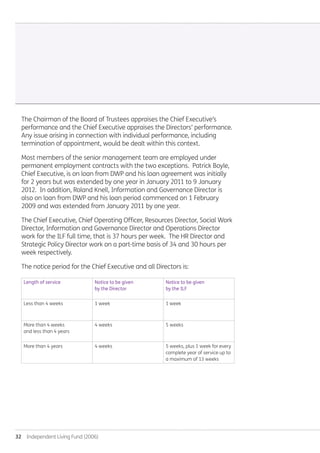
The notice period for the Chief Executive and all Directors is:
Length of service Notice to be given
by the Director
Notice to be given
by the ILF
Less than 4 weeks 1 week 1 week
More than 4 weeks
and less than 4 years
4 weeks 5 weeks
More than 4 years 4 weeks 5 weeks, plus 1 week for every
complete year of service up to
a maximum of 13 weeks
Annual-Report-2010-11.indd 32 12/07/2011 14:13
Annual Report and Accounts 2010-11  33
Remuneration Report for the
year ended 31 March 2011
Pension benefits
The Chief Executive and all Directors are members of the Principal Civil
Service Pension Scheme (PCSPS).
Pension benefits are provided through the Civil Service pension
arrangements. From 30 July 2007, civil servants may be in one of four
defined benefit schemes: either a ‘final salary’ scheme (classic, premium
or classic plus); or a ‘whole career’ scheme (nuvos). These statutory
arrangements are unfunded with the cost of benefits met by monies
voted by Parliament each year.
Pensions payable under classic, premium, classic plus and nuvos
are increased annually in line with changes in the Pensions Increase
legislation. Members joining from October 2002 may opt for either
the appropriate defined benefit arrangement or a ‘money purchase’
stakeholder pension with a significant employer contribution (partnership
pension account).
Employee contributions are set at the rate of 1.5% of pensionable
earnings for classic and 3.5% for premium, classic plus and nuvos.
Benefits in classic accrue at the rate of 1/80th of final pensionable
earnings for each year of service. In addition, a lump sum equivalent
to three years’ pension is payable on retirement. For premium, benefits
accrue at the rate of 1/60th of final pensionable earnings for each year
of service. Unlike classic, there is no automatic lump sum. Classic plus
is essentially a hybrid with benefits in respect of service before 1 October
2002 calculated broadly as per classic and benefits for service from
October 2002 calculated as in premium.
In nuvos a member builds up a pension based on his pensionable
earnings during their period of scheme membership. At the end of
the scheme year (31 March) the member’s earned pension account is
credited with 2.3% of their pensionable earnings in that scheme year and
the accrued pension is uprated in line with Pensions Increase legislation.
In all cases members may opt to give up (commute) their pension for a
lump sum up to the limits set by the Finance Act 2004.
Annual-Report-2010-11.indd 33 12/07/2011 14:13
34  Independent Living Fund (2006)
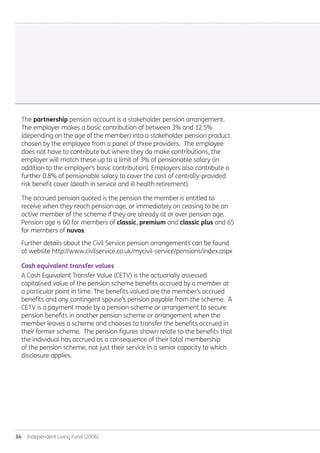
The partnership pension account is a stakeholder pension arrangement.
The employer makes a basic contribution of between 3% and 12.5%
(depending on the age of the member) into a stakeholder pension product
chosen by the employee from a panel of three providers. The employee
does not have to contribute but where they do make contributions, the
employer will match these up to a limit of 3% of pensionable salary (in
addition to the employer’s basic contribution). Employers also contribute a
further 0.8% of pensionable salary to cover the cost of centrally-provided
risk benefit cover (death in service and ill health retirement).
The accrued pension quoted is the pension the member is entitled to
receive when they reach pension age, or immediately on ceasing to be an
active member of the scheme if they are already at or over pension age.
Pension age is 60 for members of classic, premium and classic plus and 65
for members of nuvos.
Further details about the Civil Service pension arrangements can be found
at website http://www.civilservice.co.uk/mycivil-service/pensions/index.aspx
Cash equivalent transfer values
A Cash Equivalent Transfer Value (CETV) is the actuarially assessed
capitalised value of the pension scheme benefits accrued by a member at
a particular point in time. The benefits valued are the member’s accrued
benefits and any contingent spouse’s pension payable from the scheme. A
CETV is a payment made by a pension scheme or arrangement to secure
pension benefits in another pension scheme or arrangement when the
member leaves a scheme and chooses to transfer the benefits accrued in
their former scheme. The pension figures shown relate to the benefits that
the individual has accrued as a consequence of their total membership
of the pension scheme, not just their service in a senior capacity to which
disclosure applies.
Annual-Report-2010-11.indd 34 12/07/2011 14:13
Annual Report and Accounts 2010-11  35
Remuneration Report for the
year ended 31 March 2011
The figures include the value of any pension benefit in another scheme
or arrangement that the individual has transferred to the Civil Service
pension arrangements. They also include any additional pension benefit
accrued to the member as a result of their purchasing additional pension
benefits at their own cost. CETVs are calculated within the guidelines and
framework prescribed by the Institute and Faculty of Actuaries and do not
take account of any actual or potential reduction to benefits resulting from
Lifetime Allowance Tax which may be due when pension benefits are taken.
Real increase in CETV
This reflects the increase in CETV effectively funded by the employer.
It does not include the increase in accrued pension due to inflation,
contributions paid by the employee (including the value of any benefits
transferred from another pension scheme or arrangement) and uses
common market valuation factors for the start and end of the year.
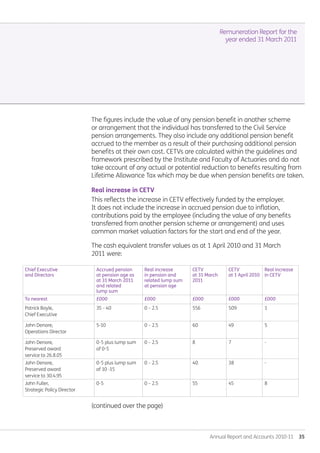
The cash equivalent transfer values as at 1 April 2010 and 31 March
2011 were:
Chief Executive
and Directors
Accrued pension
at pension age as
at 31 March 2011
and related
lump sum
Real increase
in pension and
related lump sum
at pension age
CETV
at 31 March
2011
CETV
at 1 April 2010
Real increase
in CETV
To nearest £000 £000 £000 £000 £000
Patrick Boyle,
Chief Executive
35 - 40 0 – 2.5 556 509 1
John Denore,
Operations Director
5-10 0 – 2.5 60 49 5
John Denore,
Preserved award
service to 26.8.05
0-5 plus lump sum
of 0-5
0 – 2.5 8 7 -
John Denore,
Preserved award
service to 30.4.95
0-5 plus lump sum
of 10 -15
0 – 2.5 40 38 -
John Fuller,
Strategic Policy Director
0-5 0 – 2.5 55 45 8
(continued over the page)
Annual-Report-2010-11.indd 35 12/07/2011 14:13
36  Independent Living Fund (2006)
Chief Executive
and Directors
Accrued pension
at pension age as
at 31 March 2011
and related
lump sum
Real increase
in pension and
related lump sum
at pension age
CETV
at 31 March
2011
CETV
at 1 April 2010
Real increase
in CETV
To nearest £000 £000 £000 £000 £000
Jesse Harris,
Social Work Director
0-5 0 – 2.5 51 36 11
Steve Jarratt,
Resources Director
10-15 0 – 2.5 171 134 25
Roland Knell,
Information and
Governance Director
0-5 0 – 2.5 13 2 8
Roland Knell,
Preserved award
0-5 plus lump sum
of 5 -10
0 – 2.5 27 26 -
James Sanderson,
Chief Operating Officer
5-10 0 – 2.5 57 42 9
Gillian Smith,
HR Director
15-20 0 – 2.5 268 245 1
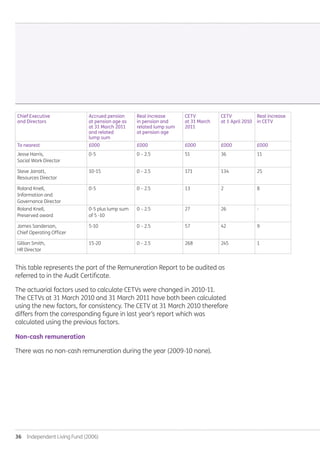
This table represents the part of the Remuneration Report to be audited as
referred to in the Audit Certificate.
The actuarial factors used to calculate CETVs were changed in 2010-11.
The CETVs at 31 March 2010 and 31 March 2011 have both been calculated
using the new factors, for consistency. The CETV at 31 March 2010 therefore
differs from the corresponding figure in last year’s report which was
calculated using the previous factors.
Non-cash remuneration
There was no non-cash remuneration during the year (2009-10 none).
Annual-Report-2010-11.indd 36 12/07/2011 14:13
Annual Report and Accounts 2010-11  37
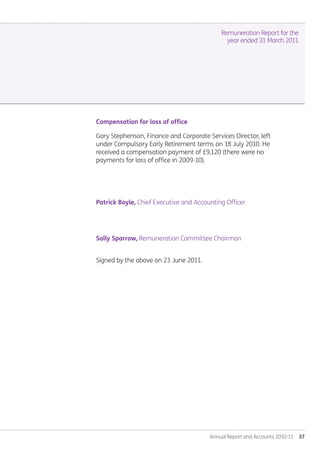
Compensation for loss of office
Gary Stephenson, Finance and Corporate Services Director, left
under Compulsory Early Retirement terms on 18 July 2010. He
received a compensation payment of £9,120 (there were no
payments for loss of office in 2009-10).
Patrick Boyle, Chief Executive and Accounting Officer
Sally Sparrow, Remuneration Committee Chairman
Signed by the above on 23 June 2011.
Remuneration Report for the
year ended 31 March 2011
Annual-Report-2010-11.indd 37 12/07/2011 14:13
38  Independent Living Fund (2006)
Scope of responsibility
As Accounting Officer for the Independent Living Fund (2006) (ILF), I
have responsibility for maintaining sound systems of internal control
that support the achievement of its policies, aims and objectives, whilst
safeguarding the public funds and assets for which I am personally
responsible, in accordance with the responsibilities assigned to me in
Managing Public Money, the Management Statement, Trust Deed and
Conditions of Grant Agreement for the ILF, and the letter of delegation
received from the Principal Accounting Officer of the Department for
Work and Pensions (DWP).
Strategic aims and objectives are agreed with the ILF Trustees and with
DWP as the sponsor Department. There is also a meeting twice a year
with the Senior Accounting Officer in DWP with responsibility for the ILF to
discuss ILF issues and address significant risks related to the ILF.
The Board of Trustees also has responsibility for maintaining a sound
system of control to address key financial and other risks, ensuring that
the requirements of the constituting Executive Non-Departmental Public
Body documents are met, that high standards of corporate governance
are demonstrated, and for reviewing the effectiveness of the internal
control system.
The purpose of the system of internal control
The system of internal control is designed to manage risk to a reasonable
level rather than to eliminate all risk of failure to achieve policies, aims
and objectives; it can therefore only provide reasonable and not absolute
assurance of effectiveness. The system of internal control is based on
an ongoing process designed to identify and prioritise the risks to the
achievement of both departmental and the ILF’s policies, aims and
objectives, to evaluate the likelihood of those risks being realised and the
impact should they be realised, and to manage them efficiently, effectively
and economically. The system of internal control has been in place in the
ILF for the year ended 31 March 2011 and up to the date of approval of the
Annual Report and Accounts, and accords with Treasury guidance.
StatementonInternalControl
fortheyearended31March2011
Annual-Report-2010-11.indd 38 12/07/2011 14:13
Annual Report and Accounts 2010-11  39
Capacity to handle risk
Whilst every member of staff within the ILF has a responsibility to ensure
that exposure to risk is minimised, overall leadership of the ILF risk
management processes rests with members of the Senior Management
Board (SMB) who are responsible for promoting and embedding a risk
management culture within the ILF, and setting the risk management
framework within which the ILF operates.
As Accounting Officer, I act as the Risk Champion for the ILF, whilst lead
responsibility for ensuring that appropriate mechanisms are in place
for identifying, monitoring and controlling risk, and advising SMB on
the actions needed in order to comply with our corporate governance
requirements rests with the Information and Governance Director.
The Trustees also consider risks at the strategic level and review the
strategic risk register at least quarterly or as often as required. Given the
significant challenges facing the organisation in 2010-11 the Trustees
requested the strategic risk register as a standing item for quarters 2
and 3.
The ILF Risk Management Framework document, sets out the
organisation’s attitude to risk and provides a consistent basis to capture,
monitor and report risks and to progress improvement strategies to
mitigate these.
The risk management processes are embedded at senior management
and middle management levels and have been audited as part of
the internal audit programme. In May 2010 the Internal Audit for Risk
Management reported an opinion of substantial assurance.
Annual-Report-2010-11.indd 39 12/07/2011 14:13
40  Independent Living Fund (2006)
The Risk Management Framework
The ILF’s risk appetite is ‘risk averse’. This is demonstrated in various
policies related to users (for example, payments to users, protection
of vulnerable adults and consent, capacity and capability) and
administration (for example, information security, control of intranet
and business email and hospitality rules), in the assignment of lead risk
owners at Director level, and in the management control processes.
The key strands of the ILF’s risk management strategy are:
• Ensuring there is ownership and awareness of risk throughout
the organisation;
• Ensuring a systematic process is in place for identifying, monitoring,
reporting and controlling the key risks faced by the ILF in delivering its
corporate agenda – this includes maintaining risk registers which log risks
at strategic, directorate and project levels;
• Managing risk in accordance with best practice;
• Providing risk management training;
• Promoting and communicating risk awareness to staff at every
available opportunity;
• Providing support and guidance to our staff and giving them the
confidence and the ability to manage risks at the appropriate level within
the ILF;
• Ensuring individual projects have their own distinct risk registers;
• Maintaining, reviewing, updating and testing the business continuity
plans that are in place for all areas of the ILF; and
• Operating a system of annual and mid-year Stewardship Reporting
whereby at the end of quarter two and quarter four, each Director
formally reports to the Accounting Officer on the effectiveness of the
systems of internal control and action that they have taken to manage
resources and risks within their Directorate.
Annual-Report-2010-11.indd 40 12/07/2011 14:13
Annual Report and Accounts 2010-11  41
During the year to ensure effective risk management throughout the
organisation we reviewed the strategic risk register monthly and sought
greater participation from each directorate team.
Prior to year end the ILF Senior Information and Risk Owner provides
an annual assurance review on the effective management and
governance of data security and handling issues, and compliance with
the Data Protection Act 1998 and Freedom of Information Act 2000.
The report is discussed and approved at Audit Committee and
subsequently signed by the Senior Information and Risk Owner and
the Audit Committee Chairman.
We continued to progress our readiness for GSI, which involved
“hardening” our systems, applying higher standards of security to
ongoing projects (ie web portals) and reviewing both our technical
safeguards and barriers and our information security policies and
processes. Although our GSI works in 2010-11 have mainly been
preparatory, they have improved our ICT controls and our capacity
to meet and exceed the required standards for data handling and
information and data security.
During the year, we upgraded our Business Continuity Plans and adopted
new technologies that enhance the effectiveness of our Disaster
Recovery Site, to ensure that in the event of the loss of essential facilities
and services at the ILF premises, we have the capability to continue
to deliver our business, to a predetermined and agreed level, from our
Disaster Recovery Site. These new technologies improve the recovery
times of our processes and systems by 50%.
Throughout the year we sought advice from our internal auditors on
emerging best practice for Corporate Governance and our internal
control mechanisms.
As an Executive Non-Departmental Public Body of DWP, our Risk Strategy
and performance is reported to the DWP sponsorship team, who will
refer relevant outputs to the Risk Assurance Division (RAD). RAD has the
right of access to ILF premises and systems as necessary where they
decide that they should audit aspects of the ILF operation.
Statement on Internal Control
for the year ended 31 March 2011
Annual-Report-2010-11.indd 41 12/07/2011 14:13
42  Independent Living Fund (2006)
Review of effectiveness
As Accounting Officer, I have responsibility for reviewing the effectiveness of
the system of internal control. My review of the effectiveness of the system
of internal control is informed by the work of the internal auditors and the
executive managers within the ILF who have responsibility for development
and maintenance of the internal control framework, and comments made
by the external auditors in their management letter and other reports.
The Senior Management Board (SMB) and the Audit Committee have
advised me on the implications of my review of the effectiveness of the
system of internal control, and a plan to address weaknesses and ensure
continuous improvement of the system is in place.
The processes that have been put in place to maintain an effective system
of internal control include:
• The SMB, which meets at least ten times a year and is comprised of the
ILF Directors, is responsible for ensuring that corporate risks are identified
as early as possible, are properly managed, that cross-directorate issues
are considered, and that risk management receives a high profile within
directorates and within individual Directorate Business Plans;
• The Operations Management Board (OMB), which meets at least ten times
a year provides a sharper and more detailed focus with both ILF Operations
and the overall ILF Change Management Programme including the various
working groups and sub-Boards;
• The Payments Security Board, is a sub-board of SMB, which meets at least
quarterly, provides additional assurance and clarity regarding the process
and effectiveness of recovering unspent, overpaid or fraudulently obtained
ILF monies;
• An Audit Committee, which meets at least three times a year and is
responsible for ensuring, as far as possible, that appropriate systems are
in place within the ILF for the assessment and management of risk and
advising the Accounting Officer on the effectiveness of the systems of
internal control prior to signing off the Statement on Internal Control;
• Regular reports by internal audit, to standards defined in Government
Annual-Report-2010-11.indd 42 12/07/2011 14:13
Annual Report and Accounts 2010-11  43
Internal Audit Standards, which includes the Head of Internal Audit’s
annual report on the adequacy and effectiveness of the ILF’s system of
internal control and recommendations for improvement;
• Regular reports to SMB and Trustees on progress against the ILF’s key
targets and business objectives;
• An appropriate delegated budget management framework;
• A system of mid-year (Quarter 2) and year-end (Quarter 4) Stewardship
Reports by Directors;
• A risk management strategy and risk management framework which
comply with best practice; and a strategic risk register which is reviewed
by Trustees at least quarterly; and
• The adoption of formal project management arrangements based on
PRINCE2 principles for all key projects, which includes the development
and maintenance of project risk registers.
The Head of Internal Audit’s Report to 31 March 2011 stated “We are
satisfied that sufficient internal audit work has been undertaken to allow
us to draw a reasonable conclusion on the adequacy and effectiveness
of the Independent Living Fund’s arrangements”.
For the 12 months ended 31 March 2011, based on the work we have
undertaken, our opinion regarding the adequacy and effectiveness
of Independent Living Fund’s arrangements for governance, risk
management and control is as follows: -
Statement on Internal Control
for the year ended 31 March 2011
Red Amber Green 3
Governance
A green light has been provided for the governance process of the ILF
Risk management
A green light has been provided for the risk management arrangements of the ILF
Control
A green light has been provided for the internal control framework of the ILF
3 A Green light indicates that, taking account of the issues identified, the Board can take reasonable assurance that the controls upon which the
organisation relies to manage this risk are suitably designed, consistently applied and effective.
Annual-Report-2010-11.indd 43 12/07/2011 14:13
44  Independent Living Fund (2006)
Significant internal control issues
Prior to the start of the financial year, the ILF Senior Management Board,
in discussion with DWP Officials, highlighted the fact that based on
financial forecasts demand for ILF monies would exceed the available
funding allocation within the current financial year.
In consultation with the Minister and DWP Officials, a decision was taken
to protect the packages of existing ILF users by closing the Fund to new
applications and limiting the provision of increasing awards to our users.
By taking this action, we were able to support existing users throughout
the period and manage the ILF within budget.
The Minister for Disabled People announced that the Fund would remain
closed to applications on 13 December 2010 and that consultation into
the future of support for existing users beyond 2015 would commence
during 2011-12.
ILF Grant Recovery was an area last year where I sought additional
assurance. However this year the introduction of more robust internal
monitoring and processes coupled with the continuing clarity and
confidence provided by the Payment Security Board, have enabled
consistent and substantial assurance to be provided.
This year there have been no significant control weaknesses reported
within in the ILF. Our audit and internal management reporting continue
to identify issues within normal day-to-day business and none of these
have been identified as significant.
Patrick Boyle, Chief Executive and Accounting Officer
23 June 2011
Annual-Report-2010-11.indd 44 12/07/2011 14:13
Annual Report and Accounts 2010-11  45
TheCertificateandReportofthe
ComptrollerandAuditorGeneral
totheHousesofParliament
I certify that I have audited the financial statements of the Independent
Living Fund (2006) for the year ended 31 March 2011 under the
Government Resources and Accounts Act 2000. These comprise the
Statement of Comprehensive Net Expenditure, the Statement of Financial
Position, the Statement of Cash Flows, the Statement of Changes in
Taxpayers’ Equity and the related notes. These financial statements
have been prepared under the accounting policies set out within them.
I have also audited the information in the Remuneration Report that is
described in that report as having been audited.
Respective responsibilities of the Board of Trustees,
Chief Executive and auditor
As explained more fully in the Statement of Accounting Officer’s and
Trustees' Responsibilities, the Board of Trustees and Chief Executive, as
Accounting Officer, are responsible for the preparation of the financial
statements and for being satisfied that they give a true and fair view. My
responsibility is to audit, certify and report on the financial statements
in accordance with the Government Resources and Accounts Act 2000.
I conducted my audit in accordance with International Standards on
Auditing (UK and Ireland). Those standards require me and my staff to
comply with the Auditing Practices Board’s Ethical Standards for Auditors.
Scope of the audit of the financial statements
An audit involves obtaining evidence about the amounts and disclosures
in the financial statements sufficient to give reasonable assurance
that the financial statements are free from material misstatement,
whether caused by fraud or error. This includes an assessment of:
whether the accounting policies are appropriate to the Independent
Living Fund (2006)’s circumstances and have been consistently applied
and adequately disclosed; the reasonableness of significant accounting
estimates made by the Independent Living Fund (2006); and the
overall presentation of the financial statements. In addition I read all
the financial and non-financial information in the Annual Report to
identify material inconsistencies with the audited financial statements.
If I become aware of any apparent material misstatements or
inconsistencies I consider the implications for my certificate.
Annual-Report-2010-11.indd 45 12/07/2011 14:13
46  Independent Living Fund (2006)
In addition, I am required to obtain evidence sufficient to give reasonable
assurance that the expenditure and income reported in the financial
statements have been applied to the purposes intended by Parliament and
the financial transactions conform to the authorities which govern them.
Opinion on regularity
In my opinion, in all material respects the expenditure and income have
been applied to the purposes intended by Parliament and the financial
transactions conform to the authorities which govern them.
Opinion on financial statements
In my opinion:
• the financial statements give a true and fair view of the state of the
Independent Living Fund (2006)’s affairs as at 31 March 2011 and of its net
expenditure for the year then ended; and
• the financial statements have been properly prepared in accordance with
the Trust Deed and directions issued by the Secretary of State thereunder.
Opinion on other matters
In my opinion:
• the part of the Remuneration Report to be audited has been properly
prepared in accordance with the Trust Deed and directions issued by the
Secretary of State thereunder; and
• the information given in Introducing the people behind the ILF and the
Management Commentary for the financial year for which the financial
statements are prepared is consistent with the financial statements.
Annual-Report-2010-11.indd 46 12/07/2011 14:13
Annual Report and Accounts 2010-11  47
Matters on which I report by exception
I have nothing to report in respect of the following matters which I
report to you if, in my opinion:
• adequate accounting records have not been kept; or
• the financial statements and the part of the Remuneration Report to be
audited are not in agreement with the accounting records; or
• I have not received all of the information and explanations I require for
my audit; or
• the Statement on Internal Control does not reflect compliance with HM
Treasury's guidance.
Report
I have no observations to make on these financial statements.
Amyas C E Morse
Comptroller and Auditor General
7 July 2011
National Audit Office
157-197 Buckingham Palace Road
Victoria
London
SW1W 9SP
The Certificate and Report of the
Comptroller and Auditor General
to the Houses of Parliament
Annual-Report-2010-11.indd 47 12/07/2011 14:13
48  Independent Living Fund (2006)
			 Restated
	 Notes	 2010-11	 2009-10
		 £000	 £000
Expenditure
Grants to individuals	 3	 349,836	 341,100
Staff costs	 4	 5,365	 4,721
Depreciation/amortisation	 5	 329	 170
Other expenditure	 5	 4,080	 4,783
		 --------------	 --------------
Total expenditure		 359,610	 350,774
Interest receiveable	 6	 (41)	 (39)
		 --------------	 --------------
Net expenditure	 19	 359,569	 350,735
Other comprehensive expenditure		 -	 -
		 --------------	 --------------
Total comprehensive net
expenditure for the year		 359,569	 350,735
		 ========	 ========
The notes on pages 54 to 79 form part of these accounts.
All expenditure relates to continuing operations.
StatementofComprehensive
NetExpenditure
fortheyearended31March2011
Annual-Report-2010-11.indd 48 12/07/2011 14:13
Annual Report and Accounts 2010-11  49
		 Notes	 31 Mar	 31 Mar
			 2011	 2010
			 £000	 £000
Non-current assets
Property, plant and equipment		 7	 482	 480
Intangible assets		 8	 246	 189
Trade and other receivables		 10	 834	 797
			 --------------	 --------------
Total non-current assets			 1,562	 1,466
			 --------------	 --------------
Current assets
Trade and other receivables		 10	 407	 424
Cash and cash equivalents		 11	 4,385	 11,599
			 --------------	 --------------
Total current assets			 4,792	 12,023
			 --------------	 --------------
Total assets			 6,354	 13,489	
			 ========	 ========
Current liabilities
Trade and other payables		 12	 630	 883
Other liabilities – grant liabilities		 12	 13,528	 12,811	
Other liabilities - VES provision		 	 12	 670	 -
			 --------------	 --------------
Total current liabilities			 14,828	 13,694
			 --------------	 --------------
Non-current assets less net
current liabilities			 (8,474)	 (205)
	 		 --------------	 --------------
Assets less liabilities			 (8,474)	 (205)
			 ========	 ========
(continued over the page)
StatementofFinancialPosition
asat31March2011.
Annual-Report-2010-11.indd 49 12/07/2011 14:13
50  Independent Living Fund (2006)
		 Notes	 31 Mar	 31 Mar	
			 2011	 2010	
			 £000	 £000	
Taxpayers’ equity:
Transferred assets reserve			 -	 32	
General reserve			 (8,474)	 (237)
			 --------------	 --------------
Total taxpayers’ equity			 (8,474)	 (205)	
			 ========	 ========
The Statement of Financial Position is in deficit because Government grants
in aid are not accrued to match net current liabilities – this is per specific
HM Treasury accounting guidance.
The notes on pages 54 to 79 form part of these accounts.
These accounts were approved and authorised for issue by the Trustees
on 23 June 2011.
Patrick Boyle, Chief Executive and Accounting Officer
Stephen Jack, Chairman.
Peter Cooke, Vice Chairman.
Mike Boyall, Treasurer
Annual-Report-2010-11.indd 50 12/07/2011 14:13
Annual Report and Accounts 2010-11  51
StatementofCashFlows
fortheyearended31March2011.
	 		 Restated 		
	 Notes	 2010-11	 2009-10
		 £000	 £000
Cash flows from operating activities
Net expenditure after interest	 (359,569)	 (350,735)
Depreciation/amortisation	 7, 8 329	 170
Loss on disposal of assets	 13	 -
(Increase)/decrease in trade and
other receivables	 (20)	 88
Increase in trade and other payables,
grant liabilities and provisions 	 1,134	 2,063
	 --------------	 --------------
Net cash outflow from operating activities	 (358,113)	 (348,414)
	 --------------	 --------------
Cash flows from investing activities
Purchase of property, plant and equipment	 (217)	 (382)
Purchase of intangible assets	 (184)	 (112)
	 --------------	 --------------
Net cash outflow from investing activities	 (401)	 (494)
	 --------------	 --------------
Cash flows from financing activities
Grants in aid 	 351,300	 353,200
	 --------------	 --------------
Net financing 	 351,300	 353,200
	 --------------	 --------------
Net (decrease)/increase in cash and
cash equivalents in the year 	 (7,214)	 4,292
Cash and cash equivalents
at the beginning of the year	 11,599	 7,307
	 --------------	 --------------
Cash and cash equivalents
at the end of the year 	 11 4,385	 11,599
	 ========	 ========
The notes on pages 54 to 79 form part of these accounts.
Annual-Report-2010-11.indd 51 12/07/2011 14:13
52  Independent Living Fund (2006)
StatementofChangesin
Taxpayers’Equity
fortheyearended31March2011.
		Transferred		 Restated
		 assets	 General	 Total
		 reserve	 reserve	 reserves
		 £000	 £000	 £000
Balance at 1 April 2009		 118	 (2,788)	 (2,670)
		 --------------	 --------------	 --------------
Changes in Taxpayers' Equity 2009-10
Grants in Aid from departments		 -	 353,200	 353,200
Transfers between reserves:
Depreciation on transferred assets		 (86)	 86	 -
Net expenditure		 -	 (350,735)	 (350,735)
						 --------------	 -------------- --------------
Balance at 31 March 2010				 32	 (237)	 (205)
						 -------------	 -------------- -----------
Changes in Taxpayer's Equity 2010-11
Grants in Aid from departments			 -	 351,300 351,300
Transfers between reserves:
Loss on disposal of transferred assets		 (13)	 13	 -
Depreciation on transferred assets			 (19)	 19	 -
						 -------------	 ------------- -------------
Total transfers between reserves			 (32)	 32	 -
						 -------------	 ------------- -------------
Net expenditure					 - (359,569) (359,569)
						 ------------- ------------- -------------
Balance at 31 March 2011	 			 -	 (8,474)	 (8,474)
					 ========	 ======== ========
(continued on next page)
Annual-Report-2010-11.indd 52 12/07/2011 14:13
Annual Report and Accounts 2010-11  53
Transferred Assets Reserve – relates to non-current assets transferred to
the ILF from the Independent Living (1993) Fund in October 2007. Trans-
fers are made from this reserve to general reserves to match the depre-
ciation charge on the transferred assets. The asset values are now fully
depreciated, as a result this reserve will not figure in future accounts.
General Reserve – relates to the ongoing operation of regular payments
to individuals and the associated administration costs, financed by
grants in aid. Grants in aid are not drawn in full in advance but requested
each calendar month to meet estimated cash payments during the
year. The ILF does not hold strategic reserves as it is dependent on public
funding and seeks to minimise the cost of borrowing. The net deficit
will be met by grants in aid for the following year. A letter of comfort
is provided by the Department for Work and Pensions to confirm that
future funding relating to Great Britain will be sufficient to meet liabilities
at the end of the financial year plus the forecast net expenditure for the
following year.
The notes on pages 54 to 79 form part of these accounts.
Annual-Report-2010-11.indd 53 12/07/2011 14:13
54  Independent Living Fund (2006)
NotestotheAccounts
fortheyearended31March2011.
1 Nature and purpose of the Independent Living Fund (2006)
The Independent Living Fund (2006) (the ILF) was established on 10 April
2006 with an initial endowment of £100 from the Secretary of State for
Work and Pensions. This money is held in perpetuity with any interest
earned being added to the original sum. At the end of the specified period
of operation of the ILF, all assets after payment of liabilities will be disposed
of as directed by the Secretary of State.
The predecessor Funds consisted of the Independent Living (Extension)
Fund and the Independent Living (1993) Fund. The ILF commenced
operations and took over the users of the predecessor Funds on 1 October
2007. Non-current assets of the Independent Living (1993) Fund were
transferred to the ILF on 1 October 2007, and other closing assets of the
predecessor Funds were transferred to the ILF on 31 December 2007.
The ILF is financed by grants in aid from the Department for Work and
Pensions (Great Britain) and the Department for Social Development
(Northern Ireland) in order to provide assistance with the cost of qualifying
support and services to disabled applicants meeting the terms of the Trust
Deed and to meet the operating costs of the ILF. Funding forms part of
Departmental four-year expenditure limits for the respective Departments –
these limits are agreed by Parliament in the annual Appropriation Act which
authorises Departments to use resources up to the amounts agreed.
2 Statement of Accounting Policies
These financial statements have been prepared in accordance with the
Government Financial Reporting Manual 2010-11 (the FReM) issued by HM
Treasury. The accounting policies contained in the FReM apply International
Financial Reporting Standards (IFRS) as adapted or interpreted for the public
sector context.
Where the FReM permits a choice of accounting policy, the accounting
policy which is judged to be most appropriate to the particular
circumstances of the ILF for the purpose of giving a true and fair view has
been selected. The particular policies adopted by the ILF are described
below. They have been applied consistently in dealing with items that are
considered material to the accounts.
Annual-Report-2010-11.indd 54 12/07/2011 14:13
Annual Report and Accounts 2010-11  55
The HM Treasury Clear Line of Sight Project aims to align budgets,
estimates and accounts. As a result of amendments to the budgetary
regime, cost of capital charges have been removed from financial
statements with effect from 1 April 2010 in line with corresponding
changes to budgets and estimates. The impact of this is shown in
Note 19.
International Financial Reporting Standards Amendments and
Interpretations effective in 2011-12
No Amendments or Interpretations that have been issued but are not
yet effective, and that are available for early adoption, have been applied
by the ILF in these financial statements. There are no Amendments or
Interpretations issued, but not yet effective, which are expected to have
a material effect on the financial statements in the future.
a) Accounting convention
These accounts have been prepared under the historical cost convention
modified for the revaluation of non-current assets.
b) Property, plant and equipment
Property, plant and equipment consists of IT hardware and equipment
held only for the purpose of managing the ILF. All property, plant and
equipment should be carried at valuation in accordance with the FReM.
The ILF does not have land or buildings, and has taken advantage of the
option available under the FReM to adopt a depreciated historical cost
basis as a proxy for fair value of its plant and equipment, as these are
assets that have short useful economic lives or low values (or both). The
ILF believes that the useful economic life is a realistic reflection of the life
of its plant and equipment, and the depreciated historical cost method
provides a realistic reflection of the consumption of those assets. The
ILF therefore carries plant and equipment at cost less accumulated
depreciation and any recognised impairment in value.
Annual-Report-2010-11.indd 55 12/07/2011 14:13
56  Independent Living Fund (2006)
c) Depreciation
Depreciation on property, plant and equipment is charged on a straight-
line basis to write off the cost less residual values over the useful life of
the asset: incepting at the purchase date or when the asset is bought
into use whichever is the later. IT hardware and equipment are generally
depreciated over a three- to five-year life span. Residual values, remaining
useful lives and depreciation methods are reviewed annually and adjusted
if appropriate.
d) Intangible assets
Intangible assets consist of bespoke software developed for the ILF and
software licences held only for the purpose of managing the ILF. All
intangible assets are carried at fair value in accordance with the FReM.
Bespoke software assets are capitalised in these accounts in the year of
implementation. Amortisation is on a straight line basis over the estimated
useful life of three years.
Software licences are capitalised in these accounts in the year of
acquisition. Amortisation is on a straight line basis over the estimated
useful life being the period of the software licences.
Amortisation periods and methods are reviewed annually and adjusted
if appropriate.
e) Financial instruments
The ILF’s procurement policy is to enter into contracts and framework
agreements for services and supplies at current agreed costs with annual
price reviews, rather than create complex financial instruments.
Financial assets and financial liabilities are recognised in the ILF’s Statement
of Financial Position when the ILF becomes party to the contractual
provisions of the instrument.
Annual-Report-2010-11.indd 56 12/07/2011 14:13
Annual Report and Accounts 2010-11  57
Notes to the Accounts
for the year ended
31 March 2011 (continued)
Financial assets and liabilities are recognised at fair value (the
transaction price plus any directly attributable transaction costs,
assessed for recoverability where relevant). Subsequent measurement is
at amortised cost, although no adjustment for the time value of money
is made where the settlement period is short so there would be no
significant effect.
Financial assets comprise loans and receivables, which are non-
derivative financial assets with fixed or determinable payments that are
not quoted in an active market. Loans and receivables comprise cash
at bank, accrued bank interest and other receivables. Financial liabilities
comprise grant liabilities, trade payables and accruals.
f) Reserves policy
Grants in aid are not drawn in full in advance but requested each
calendar month to meet estimated expenditure. The ILF does not hold
strategic reserves as it is dependent on public funding and seeks to
minimise the cost of borrowing.
g) Grants in aid
Funding to cover grants to individuals and administrative expenditure
is provided through grants in aid from the Department for Work and
Pensions (for Great Britain) and the Department for Social Development
(for Northern Ireland). Grants in aid are received on the basis of the
ILF's estimated cash payments during the financial year. Grants in aid
received form part of the Departmental Expenditure Limits for the
respective Departments. Grants in aid are treated as financing rather
than income and are directly credited to reserves.
h) Bank interest
Money is held in current accounts and interest is received on
credit balances. Bank interest due but not received is accrued in
these accounts.
Annual-Report-2010-11.indd 57 12/07/2011 14:13
58  Independent Living Fund (2006)
i) Grants to individuals
Grants to individuals are discretionary grants made within the terms of the
Trust Deed. Grants are paid four-weekly in arrears on the basis of authorised
awards. Amounts due but unpaid at the end of the financial year are
accrued in these accounts. The accrual is calculated from the awards made
by the end of the financial year but not fully paid up to the end of the
financial year.
Unused grants returned by individuals in the normal course of business are
recognised on receipt and there is no accrual for potential future returns of
unspent grants.
j) Formal recovery of grants to individuals
Although grants to individuals are discretionary payments, formal recovery
is sought where the provision of incorrect information has led to incorrect
payment or where the grants have not been used for the intended
purpose. The ILF seeks to recover all amounts where it is cost-effective to
do so unless it will cause hardship to the individual. Recovery procedures
appropriate to the value and circumstances of the case are used, in
accordance with the ILF’s guidelines and procedures.
A receivable is only recognised in the accounts when it has been agreed
with the individual and there is considered to be a reasonable prospect of
recovery. For the recovery of sums over £4,000, the ILF obtains a signed
settlement agreement from the individual to support the existence and
valuation of the amount receivable.
The receivable recognised is disclosed as a reduction to expenditure in
the year in which it is recognised. Receivables are assessed at the end of
each accounting period and reduced to the estimated recoverable amount
where there are circumstances that indicate full recovery is uncertain. The
recoverable amount is discounted to present value where material, at the
standard Treasury rate of 3.5% (3.5% for 2009-10).
Annual-Report-2010-11.indd 58 12/07/2011 14:13
Annual Report and Accounts 2010-11  59
Notes to the Accounts
for the year ended
31 March 2011 (continued)
k) Operating leases
Operating leases are charged to the Statement of Comprehensive Net
Expenditure on a straight line basis over the term of the lease. The
main lease is for accommodation and managed facilities under a sub-
lease with the Department for Work and Pensions. Charges are set in
accordance with a head lease between the Department and the service
provider and are subject to annual inflation using a specified index. The
ILF has no direct control of these charges.	
l) Pension costs
Pension benefits are provided through the Principal Civil Service Pension
Scheme, which is an unfunded, multi-employer defined benefit scheme,
and as such the ILF is unable to identify its share of the underlying assets
and liabilities. Pension costs are charged to expenditure as payments fall
due to be made.
m) Significant estimates and judgements
The preparation of financial statements requires management to make
estimates and assumptions in certain circumstances that affect reported
amounts, and for this organisation such estimates are principally in
assessing the recoverability of grants to individuals.
Where the estimated period of recovery of a grant is under 10 years, it
is assumed that the full amount will be recovered. Where the period
is over 10 years only the amount likely to be recovered within 10 years
is included.
n) Reporting segments
IFRS 8 requires entities to provide information relating to the
components of the entity that management uses to make decisions
about operating matters. A segmental financial analysis is not
considered necessary for the ILF, as no separate components are used
for operating decisions made by the Senior Management Board.
Annual-Report-2010-11.indd 59 12/07/2011 14:13
60  Independent Living Fund (2006)
o) Provisions
Provisions are recognised when there is a present obligation (legal or
constructive) as a result of an event that occurred in the past and the
settlement of that obligation will result in an outflow of resources, but the
timing or amount of the settlement is uncertain. The amount recognised as
a provision is the best estimate of the consideration which will be required
to settle the obligation.
3 Grants to individuals
	 	 2010-11	 2009-10
		 £000	 £000
Payments made in year	 361,147	 350,627
Grant liabilities at start of year	 (12,811)	 (11,185)
Grant liabilities at end of year 	 13,528	 12,811
Grant returns received in year	 (11,971)	 (11,202)
Grant receivables at start of year	 1,054	 1,103
Grant receivables at end of year	 (1,111)	 (1,054)
	 --------------	 --------------
Grants payable for year	 349,836	 341,100
	 ========	 ========
Number of individuals in receipt of payments	 22,059	 23,193
Grants to individuals are paid four-weekly in arrears. Grant liabilities consist
of the accrued amounts from awards made by the end of the financial
year but not fully paid up to the end of the financial year (see note 2i).
Returns received comprised £9,217,000 in respect of unused funds
returned by individuals, and £2,754,000 received under formal recovery
arrangements (£8,540,000 and £2,662,000 respectively for 2009-10).
Grant receivables are other amounts in the process of formal recovery by
lump sum, regular instalments or deductions from ongoing payments and
are therefore recognised as income in the period. The value of expected
refunds is discounted to present value. Further information on formal
recovery is provided in note 10.
Annual-Report-2010-11.indd 60 12/07/2011 14:13
Annual Report and Accounts 2010-11  61
Notes to the Accounts
for the year ended
31 March 2011 (continued)
4a Staff numbers and related costs
	 	 2010-11	 2009-10
		 £000	 £000
Directly employed staff:
Wages and salaries	 3,730	 3,806
Social security costs	 261	 274
Other pension costs (see below)	 619	 634
Provision for Voluntary Exit Scheme (VES)	 670	 -
	 --------------	 -------------
Total directly employed staff costs	 5,280	 4,714
Agency staff costs	 85	 7
	 --------------	 -------------
Total staff costs	 5,365	 4,721
	 ========	 ========
The VES provision is an estimate of the cost, based upon predicted staff
uptake, of the Voluntary Exit Scheme that the ILF had committed to and
that was in progress at 31 March 2011. The scheme was subsequently
completed in May 2011 and the economic outflows will be substantially
completed by September 2011.
The agency staff engaged were professionally qualified accountants to
strengthen financial management within the organisation.
	 2010-11	 2009-10
	 Number	 Number
Average number of whole-time equivalent
persons directly employed:
on permanent contract	 151	 150
on loan from DWP	 2	 2
on fixed-term contract	 1	 16
	 --------------	 --------------
	 154	 168
	 ========	 ========
Annual-Report-2010-11.indd 61 12/07/2011 14:13
62  Independent Living Fund (2006)
4b	Pension commitments
The Principal Civil Service Pension Scheme (PCSPS) is an unfunded multi-
employer defined benefit scheme and as such the Independent Living Fund
is unable to identify its share of the underlying assets and liabilities. The
scheme actuary valued the scheme as at 31 March 2007. You can find
details in the resource accounts of the Cabinet Office: Civil Superannuation
(www.civilservice.gov.uk/my-civil-service/pensions).
For 2010-11, employers’ contributions of £581,000 were payable to the
PCSPS at one of four rates in the range 16.7% to 24.3% of pensionable pay,
based on salary bands (2009-10 £591,000 in a range of 16.7% to 24.3%)
From 2011-12,the rates will be in the range 16.7% to 24.3%. The Scheme
Actuary reviews employer contributions usually every four years following a
full scheme valuation. The contribution rates are set to meet the cost of the
benefits accruing during 2010-11 to be paid when the member retires and
not the benefits paid during this period to existing pensioners.
Employees can opt to open a partnership pension account, a stakeholder
pension with an employer contribution. Employers’ contributions of
£35,000 (£40,000 in 2009-10) were paid to one or more of the panel of
three appointed stakeholder pension providers. Employer contributions are
age-related and range from 3% to 12.5% of pensionable pay. Employers
also match employee contributions up to 3% of pensionable pay. In
addition, employer contributions of £3,000, 0.8% of pensionable pay, were
payable to the PCSPS to cover the cost of the future provision of lump sum
benefits on death in service or ill health retirement of these employees
(£3,000 and 0.8% in 2009-10).
Contributions due to the pension providers were £60,000 at 31 March 2011
(nil at 31 March 2010). Contributions prepaid were nil at 31 March 2011 (nil
at 31 March 2010).
Annual-Report-2010-11.indd 62 12/07/2011 14:13
Annual Report and Accounts 2010-11  63
Notes to the Accounts
for the year ended
31 March 2011 (continued)
4c Reporting of Civil Service and other compensation schemes - exit
packages
			
Exit package	 Number of	 Number of	 Total number	
cost band	 compulsory	 other 	 of exit
	 redundancies	 departures	 packages
		 agreed	 by cost band
£10,000	 1	 0	 1
	 --------------	 --------------	 --------------	
Total number of exit packages	 1	 0	 1
	 ========	 ========	 ========
	 £	 £	 £
Total resource cost	 10,000	 0	 10,000
	 ========	 ========	 ========
Redundancy and other departure costs have been paid in accordance with
the provisions of the Civil Service Compensation Scheme, a statutory scheme
made under the Superannuation Act 1972. Exit costs are accounted for in
full in the year of departure. Where the ILF has agreed early retirements,
the additional costs are met by the ILF and not by the Civil Service pension
scheme. Ill-health retirement costs are met by the pension scheme and are
not included in the table.
In addition, provision has been made for the estimated cost of the Voluntary
Exit Scheme which was in progress at the year end. Details for the staff
involved were not finalised at that time, and so are not included in the
above table.
Annual-Report-2010-11.indd 63 12/07/2011 14:13
64  Independent Living Fund (2006)
5 Other expenditure and non cash items
	 	 2010-11	 2009-10
		 £000	 £000
Running costs:
Independent Assessor fees and expenses 	1,245	 1,409
IT and information security costs	 315	 378
Rates, utilities, and other estates costs 	 281	 401
Legal and professional costs 	 243	 220 	
Services, training, recruitment, travel and subsistence 	 195	 411
Trustees’ costs 	 180	 186
Communication and engagement	 141	 243
Postage costs	 132	 123
Printing costs	 113	 199	
Auditor’s remuneration 	 54	 66
Loss on disposal of plant and equipment	 13	 -
Consultancy costs 	 -	 64
	 --------------	 -------------
Total running costs	 2,912	 3,700
	 --------------	 -------------
Rentals under operating leases	 1,168	 1,083		
	 --------------	 --------------
Total other expenditure	 4,080	 4,783		
	 ========	 ========
Non-cash items
Depreciation	 202	 109
Amortisation	 127	 61		
	 --------------	 --------------
Total non-cash items	 329	 170		
	 ========	 ========
6 Interest receivable
	 2010-11 	 2009-10
	 £000	 £000
Bank interest 	 41	 39
	 ========	 ========
Annual-Report-2010-11.indd 64 12/07/2011 14:13
Annual Report and Accounts 2010-11  65
Notes to the Accounts
for the year ended
31 March 2011 (continued)
7 Property, plant and equipment
	 Information	 Assets under
	 Technology	 construction	 Total
	 £000	 £000	 £000
Cost
Balance at 1 April 2010	 891	 -	 891
Additions in year	 85	 132	 217
Disposals in year	 (258)	 -	 (258)
	 --------------	 --------------	 --------------
Balance at 31 March 2011	 718	 132	 850
	 --------------	 --------------	 --------------
Depreciation
Balance at 1 April 2010	 411	 -	 411
Charge for the year	 202	 -	 202
Disposals in year	 (245)	 -	 (245)
	 --------------	 --------------	 --------------
Balance at 31 March 2011	 368	 -	 368
	 --------------	 --------------	 --------------
Net book value
at 31 March 2011 	 350	 132	 482	
at 31 March 2010	 480	 -	 480
	 ========	 ========	 ========
	 Information	 Assets under
	 Technology	 Construction	 Total
	 £000	 £000	 £000
Cost
Balance at 1 April 2009	 543	 -	 543
Additions in year	 382	 -	 382
Disposals in year	 (34)	 -	 (34)		
	 --------------	 --------------	 --------------
Balance at 31 March 2010	 891	 -	 891
	 --------------	 --------------	 --------------
(continued over the page)
Annual-Report-2010-11.indd 65 12/07/2011 14:13
66  Independent Living Fund (2006)
	 Information	 Assets under
	 Technology	 Construction	 Total
	 £000	 £000	 £000
Depreciation
Balance at 1 April 2009	 336	 -	 336
Charge for the year	 109	 -	 109
Disposals in year	 (34)	 -	 (34)		
	 --------------	 --------------	 --------------
Balance at 31 March 2010	 411	 -	 411		
	 --------------	 --------------	 --------------
Net book value
at 31 March 2010	 480	 -	 480
at 31 March 2009	 207	 -	 207		
	 ========	 ========	 ========
All assets are owned by the ILF. Assets under construction relate to the
introduction of the Government Secure Intranet.
8 Intangible assets
				 Total
				 £000
Cost or valuation
Balance at 1 April 2010				 295
Additions in year				 184
				 --------------
Balance at 31 March 2011				 479
				 --------------
Amortisation
Balance at 1 April 2010				 106
Charge for the year				 127
				 --------------
Balance at 31 March 2011				 233
				 --------------
(continued on next page)
Annual-Report-2010-11.indd 66 12/07/2011 14:13
Annual Report and Accounts 2010-11  67
Notes to the Accounts
for the year ended
31 March 2011 (continued)
						 Total
						 £000
Net book values		
at 31 March 2011		 246
at 31 March 2010		 189
		 ========
	
Cost or valuation
Balance at 1 April 2009		 183
Additions in year		 112
		 --------------
Balance at 31 March 2010		 295
		 --------------
Amortisation
Balance at 1 April 2009		 45
Charge for the year		 61
		 --------------
Balance at 31 March 2010		 106
		 --------------
Net book values
at 31 March 2010		 189
at 31 March 2009		 138
		 ========
Intangible assets mainly comprise bespoke software, plus
software licences.
There is no significant difference between historic cost and fair value.
Annual-Report-2010-11.indd 67 12/07/2011 14:13
68  Independent Living Fund (2006)
9 Financial instruments and associated risks
As the majority of the ILF’s cash requirements are met through grants
in aid, financial instruments play a more limited role in creating and
managing risk than would apply to a non-public sector body. The majority
of financial instruments relate to contracts to purchase non-financial items
in line with the ILF’s expected usage requirements, so the ILF is exposed to
little credit, liquidity or market risk.
Financial assets – loans and receivables
	 	 31 Mar 2011	 31 Mar 2010
		 £000	 £000
Grants under formal recovery		 1,111	 1,054
Cash and cash equivalents		 4,385	 11,599
Other receivables		 5	 7		
		 --------------	 --------------
		 5,501	 12,660
		 ========	 ========
Grants under formal recovery: For individual amounts over £4,000, a signed
settlement agreement is held to minimise the risk of non-recovery. Further
details of the risks related to grants under formal recovery are provided in
note 10.
Cash and cash equivalents: Represents money with Lloyds TSB held in
current accounts to minimise the risk.
Other receivables: Represents moneys due in the short term and generally
expected to be received within three to six months.
Receivables are used to offset the amount of grant in aid required for
the following month. The ILF is therefore not exposed to risks related to
non-receipt whilst there is sufficient funding to meet the expected cash
requirements throughout the year. Forecast cash payments are monitored
actively in year to ensure demand remains within the available funding.
Annual-Report-2010-11.indd 68 12/07/2011 14:13
Annual Report and Accounts 2010-11  69
Notes to the Accounts
for the year ended
31 March 2011 (continued)
Financial liabilities
		 31 Mar 2011	 31 Mar 2010		
		 £000	 £000
Grant liabilities		 13,528	 12,811	
Trade payables and accruals		 630	 883	
		 --------------	 --------------	
		 14,158	 13,694		
		 ========	 ========
Grant liabilities: Represents awards authorised but unpaid at the year end,
which are due to be paid within one to two months out of the cash grant
in aid provision in the following year; a letter of comfort is provided by the
Department for Work and Pensions to confirm that funding is available to
meet payments due.
Trade payables and accruals: Represents amounts payable in the short
term, to be met out of cash held at the year-end.
10 Trade and other receivables
		 31 Mar 2011	 31 Mar 2010		
		 £000	 £000
Due within one year
Grants under formal recovery		 277	 257
Prepayments		 125	 160
Other receivables - bank interest		 5	 7
		 --------------	 --------------
		 407	 424
		 --------------	 --------------
Due after more than one year
Grants under formal recovery		 834	 797
		 --------------	 --------------
Total due		 1,241	 1,221
		 ========	 ========
Annual-Report-2010-11.indd 69 12/07/2011 14:13
70  Independent Living Fund (2006)
Formal recovery is managed by a specialist team within the ILF and
amounts with repayment arrangements in place are recorded for debt
management purposes. Unspent monies are returned outside the formal
recovery process. Unspent monies are not considered overpayments, these
arise predominantly as a consequence of periods of time when care is
not required or occasions when the award is not fully expended and are
surrendered voluntarily in line with the ILF policy.
Grants under formal recovery comprise amounts originally paid to
individuals, that are now under formal recovery, mostly by instalments
or deductions from ongoing payments. Recoveries are profiled over the
expected repayment period, and the amounts are discounted to present
day value. Impairment is also considered, in particular where there is
a probability that recovery arrangements may not be sustained for a
prolonged period.
Of the recoveries due over one year, £575,000 is expected to be received
within the next two to five years and £259,000 is expected to be received
within the next five to ten years (£510,000 and £257,000 respectively at 31
March 2010).
Formal recovery includes a number of processes, such as factual
investigation, identification of a presumed receivable, negotiation to achieve
acknowledgement of a formal receivable, civil proceedings for recovery, and
repayment in full or by agreed instalment schedule. A receivable is only
recognised in the accounts when it is probable that economic benefits will
flow to the ILF.
Annual-Report-2010-11.indd 70 12/07/2011 14:13
Annual Report and Accounts 2010-11  71
Notes to the Accounts
for the year ended
31 March 2011 (continued)
11 Cash and cash equivalents
	 	 2010-11	 2009-10
		 £000	 £000
Balance at 1 April 2010		 11,599	 7,307
Net cash (outflow)/inflow		 (7,214)	 4,292		
		 --------------	 --------------
Balance at 31 March 2011		 4,385	 11,599
		 -========	 ========
The following balances at 31 March 2011 were held:
		 31 Mar 2011	 31 Mar 2010	
		 £000	 £000	
Benefit account		 4,325	 11,412	
Administration account		 60	 187		
		 --------------	 --------------	
		 4,385	 11,599	
		 ========	 ========	
Cash and cash equivalents comprise bank balances which are held in
current accounts in a UK commercial bank.
12 Current liabilities
(a) Amounts falling due for payment within one year
		 31 Mar 2011	 31 Mar 2010		
		 £000	 £000
Grant liabilities		 13,528	 12,811	
Trade payables		 176	 533	
Other taxation and social security		 79	 -
Accruals		 375	 350
Provision for Voluntary Exit Scheme (VES)		 670	 -
		 --------------	 --------------		
		 14,828	 13,694
		 ========	 ========	
Annual-Report-2010-11.indd 71 12/07/2011 14:13
72  Independent Living Fund (2006)
(b) The VES provision is an estimate of the cost, based upon predicted staff
uptake, of the Voluntary Exit Scheme that the ILF had committed to and that
was in progress at 31 March 2011. The scheme was subsequently completed
in May 2011 and the economic outflows will be substantially completed by
September 2011.
		 31 Mar 2011	 31 Mar 2010		
		 £000	 £000
Balance at 1 April 2010		 -	 -	
Additional provision during the year		 670	 -
		 --------------	 --------------	 	
Balance at 31 March 2011		 670	 -
		 ========	 ========	
(c) There were no amounts falling due for payment after one year (2009-10
none).
13 Losses and special payments
Although grants to individuals are discretionary payments, formal recovery
is sought where the provision of incorrect information has led to incorrect
payment or where the grants have not been used for the intended purpose.
Where recovery is deemed to be unachievable, a loss is recorded. 234 losses
with a total value of £1,196,000 were recorded in 2010-11 (347 losses with a
total value of £1,151,000 for 2009-10). Losses relate to payments originally
made by the ILF and cases transferred from the Independent Living (1993)
Fund and the Independent Living (Extension) Fund on 1 October 2007.
These are losses that are recorded when it becomes evident that there are no
practical avenues remaining by which to pursue recovery, and therefore no
further action is taken by the specialist team. Being past payments that were
recorded as costs when originally advanced they do not represent a further
cost now they are deemed irrecoverable.
No other losses have been incurred by the ILF that require reporting in this
note.
No special payments, which fall to be reported under the disclosure
requirements of the FReM, were made during 2010-11 (2009-10 none).
Annual-Report-2010-11.indd 72 12/07/2011 14:13
Annual Report and Accounts 2010-11  73
Notes to the Accounts
for the year ended
31 March 2011 (continued)
14 Operating leases
There is a sub-lease for accommodation and facilities with the
Department for Work and Pensions that expires on 31 March 2018.
The charges to the ILF are set in the head lease between the
Department and Land Securities Trillium. The facilities element is
calculated quarterly and may be abated by penalties for failure to
deliver the agreed service level.
There is a software licence with Ceridian Centrefile Ltd for a HR payroll
system which expires on 2 March 2014.
There is an operating lease for a car for the use of the Chief Executive as
part of his loan agreement; allowable petrol costs are claimed as
expenses in accordance with ILF travel and expenses policy.
Total future minimum lease payments under operating leases for each of
the following periods were:
		 31 Mar 2011	 31 Mar 2010		
		 £000	 £000
Land and buildings (Equinox House)
within one year		 1,154	 1,068
within two to five years		 4,618	 4,272
after five years		 2,309	 3,204
		 --------------	 --------------		
		 8,081	 8,544
		 ========	 ========	
		 31 Mar 2011	 31 Mar 2010		
		 £000	 £000
Other leases
within one year		 24	 15
within two to five years		 37	 30
after five years		 -	 -
		 --------------	 --------------		
		 61	 45
		 ========	 ========	
Annual-Report-2010-11.indd 73 12/07/2011 14:13
74  Independent Living Fund (2006)
15 Trustees' remuneration, interests and indemnities
The Trustees receive remuneration from the Department for Work and
Pensions, which passes costs on to the ILF. The total remuneration paid
to nine Trustees was £134,000 for 2010-11 and further information is
provided in the Remuneration Report (£141,000 for 2009-10). Trustees
received reimbursement for travel and subsistence expenses amounting
to £9,000 for 2010-11 (£11,000 for 2009-10). For 2009-10 and 2010-
11, one Trustee was a beneficiary of the ILF and received payments
in accordance with the objects of the Fund; a procedure is in place to
manage actual or perceived conflicts of interest.
The Chairman took a personal decision to waive his salary, with effect
from December 2010, for the residual months of the year.
No other transactions were undertaken in which any Trustee or person
connected with any Trustee had a material interest.
There are no policies of insurance against loss arising from the neglect
or default of the Trustees, nor any policies providing an indemnity for
Trustees in respect of the consequences of any such loss.
By the terms of the Trust Deed, the Secretary of State for Work and
Pensions provides that Trustees are not personally liable for any loss
to the ILF other than that arising from wilful and individual fraud,
wrongdoing or omission on the part of a Trustee who is found to be liable.
16 Related party transactions
The ILF is administered by Trustees appointed by the Secretary of State
for Work and Pensions. Related parties are the Trustees, all parts of the
Department for Work and Pensions including its agencies (representing
the Secretary of State), and the Department for Social Development in
Northern Ireland. The Trustees are the controlling party.
For 2009-10 and 2010-11 one Trustee was a beneficiary of the ILF and
received discretionary grants in accordance with the objects of the Fund.
An appropriate procedure is in place to manage actual or perceived
conflicts of interest.
Annual-Report-2010-11.indd 74 12/07/2011 14:13
Notes to the Accounts
for the year ended
31 March 2011 (continued)
No other related parties, including the Trustees and key management
staff, have undertaken any transactions with the ILF during 2009-10 or
2010-11.
17 Capital commitments and contingent liabilities
There were no capital commitments or contingent liabilities at 31 March
2011 (none at 31 March 2010).
18 Endowment Trust Fund
The ILF was created by Trust Deed between the original Trustees and the
Secretary of State on 10 April 2006, who paid £100 into an endowment
trust fund on 13 April 2006. The original endowment is held on trust as
explained in note 1. The following statement is not in £000.
	 2010-11	 2009-10
	 £	 £
Balance at 1 April	 114	 113
Bank interest added in the year	 -	 1
	 --------------	 --------------
Balance at 31 March	 114	 114
	 ========	 ========
Annual Report and Accounts 2010-11  75
Annual-Report-2010-11.indd 75 12/07/2011 14:13
76  Independent Living Fund (2006)
19 Restatements
Restatement of Statement of Comprehensive Net Expenditure at 31
March 2010, Statement of Cash Flows at 31 March 2010 and Statement of
Taxpayers’ Equity at 31 March 2010.
(i) Statement of Comprehensive Net Expenditure
		 Published	 Change of	 Restated
		 Accounts	Accounting	 at 31		
		 as at 31 	 Policy	 March
		March 2010	 (a)	 2010
		 £000	 £000	 £000
Expenditure
Grants to individuals		 341,100	 -	 341,100
Staff costs		 4,721	 -	 4,721
Depreciation/amortisation		 170	 -	 170
Other expenditure		 4,783	 -	 4,783
						 --------------	 -------------- --------------
Total expenditure				 350,774	 - 350,774
						
Cost of capital (credit)				 (50)	 	 50 	 -
Interest receivable					 (39)	 -	 (39)
						 --------------	 -------------- ------------
Net expenditure			 350,685 	 50 350,735		
					 ========	 ======== ========
Annual-Report-2010-11.indd 76 12/07/2011 14:13
Annual Report and Accounts 2010-11  77
(ii) Statement of Cash Flows
		 Published	 Change of	 Restated
		 Accounts	Accounting	 at 31		
		 as at 31 	 Policy	 March
		March 2010	 (a)	 2010
		 £000	 £000	 £000
Cash flows from operating activities
Net expenditure after interest		 (350,685)	 (50)	 (350,735)
Depreciation/amortisation		 170	 -	 170
Cost of capital		 (50)	 50	 -
Decrease in trade and other receivables		 88	 -	 88
Increase in trade and other payables
and grant liabilities		 2,063	 -	 2,063
						 --------------	 -------------- -------------
Net cash outflow from
operating activities				 (348,414)	 - (348,414)	
						 --------------	 -------------- --------------
Cash flows from investing activities
Purchase of property plant and equipment	 (382)	 	 -	 (382)
Purchase of intangible assets			 (112)	 -	 (112)
						 --------------	 -------------- --------------
Net cash outflow from
investing activiites				 (494)	 	 - 	 (494)	
						 --------------	 -------------- -------------
Cash flows from financing activities
Grants in Aid					 353,200		 - 353,200
						 -------------	 -------------- -------------
Net financing					 353,200		 - 353,200
						 -------------	 -------------- -------------
(continued over the page)
Notes to the Accounts
for the year ended
31 March 2011 (continued)
Annual-Report-2010-11.indd 77 12/07/2011 14:13
78  Independent Living Fund (2006)
		 Published	 Change of	 Restated
		 Accounts	Accounting	 at 31		
		 as at 31 	 Policy	 March
		March 2010	 (a)	 2010
		 £000	 £000	 £000
Net increase in cash and cash
equivalents in the year			 4,292		 -	 4,292
Cash and cash equivalents
at the beginning of the year		 7,307		 -	 7,307
						 -------------	 -------------- -------------
Cash and cash equivalents
at the end of the year			 11,599 		 - 	 11,599
	 				 ========	 ======== ========
(iii) Statement of changes in Taxpayers' Equity (Total Reserves)
		 Published	 Change of	 Restated
		 Accounts	Accounting	 at 31		
		 as at 31 	 Policy	 March
		March 2010	 (a)	 2010
		 £000	 £000	 £000
Balance at 1 April 2009			 (2,670)		 -	 (2,670)
						 -------------	 -------------- -------------
Changes in Taxpayers' Equity
Grant in Aid from departments		 353,200 		 - 353,200
	 				
Transfers between reserves:
Depreciation on transferred assets			 -	 - -
(continued on next page)
Annual-Report-2010-11.indd 78 12/07/2011 14:13
Annual Report and Accounts 2010-11  79
		 Published	 Change of	 Restated
		 Accounts	Accounting	 at 31		
		 as at 31 	 Policy	 March
		March 2010	 (a)	 2010
		 £000	 £000	 £000
Net expenditure after cost of capital
and interest					 (350,685) 	 (50) (350,735)
Non-cash - cost of capital reversed		 (50)	 50 	 -
						 -------------	 -------------- -------------
Net expenditure				 (350,735)		 - (350,735)
						 -------------	 -------------- -------------
Balance at 31 March 2010			 	 (205)		 -	 (205)
		 ======== ========	 ========
(a) The change of accounting policy relates to the removal of the cost
of capital credit under the HM Treasury Clear Line of Sight Project in
accordance with the Government Financial Reporting Manual. This has no
effect on the General Fund balance as at 31 March 2010.
20 Events after the reporting period
There have been no events which affect these accounts since the reporting
date. IAS 10 requires the ILF to disclose the date on which the accounts
are authorised for issue. This is the date of the Certificate and Report of the
Comptroller and Auditor General. The authorised date for issue is
2011.
Notes to the Accounts
for the year ended
31 March 2011 (continued)
Annual-Report-2010-11.indd 79 12/07/2011 14:13
80  Independent Living Fund (2006)
Annual-Report-2010-11.indd 80 12/07/2011 14:13
Independent Living Fund (2006)
15223_ILF_AR_2011_COVERS.indd 2 12/07/2011 14:18
We’vehelped
over46,000
disabled people
since1988
The Independent Living Fund is an
Executive Non-Departmental Public Body
of the Department for Work and Pensions
IndependentLivingFund(2006)
AnnualReportandAccounts
2010-11.
Published by TSO (The Stationery Office) and available from:
Online
www.tsoshop.co.uk
Mail, telephone, fax and email
TSO
PO Box 29, Norwich NR3 1GN
Telephone orders/general enquiries: 0870 600 5522
Order through the Parliamentary Hotline Lo-Call 0845 7 023474
Fax orders: 0870 600 5533
Email: customer.services@tso.co.uk
Textphone: 0870 240 3701
The Parliamentary Bookshop
12 Bridge Street, Parliament Square,
London SW1A 2JX
Telephone orders/general enquiries: 020 7219 3890
Fax orders: 020 7219 3866
Email: bookshop@parliament.uk
Internet: http://www.bookshop.parliament.uk
TSO@Blackwell and other accredited agents
Customers can also order publications from:
TSO Ireland
16 Arthur Street, Belfast BT1 4GD
Telephone orders/general enquiries: 028 9023 8451
Fax orders: 028 9023 5401
IndependentLivingFund(2006)AnnualReportandAccounts2010-11
15223_ILF_AR_2011_COVERS.indd 1 12/07/2011 14:18

ILF Annual Report 2010-11

  • 1.
    We’vehelped over46,000 disabled people since1988 The IndependentLiving Fund is an Executive Non-Departmental Public Body of the Department for Work and Pensions IndependentLivingFund(2006) AnnualReportandAccounts 2010-11. Published by TSO (The Stationery Office) and available from: Online www.tsoshop.co.uk Mail, telephone, fax and email TSO PO Box 29, Norwich NR3 1GN Telephone orders/general enquiries: 0870 600 5522 Order through the Parliamentary Hotline Lo-Call 0845 7 023474 Fax orders: 0870 600 5533 Email: customer.services@tso.co.uk Textphone: 0870 240 3701 The Parliamentary Bookshop 12 Bridge Street, Parliament Square, London SW1A 2JX Telephone orders/general enquiries: 020 7219 3890 Fax orders: 020 7219 3866 Email: bookshop@parliament.uk Internet: http://www.bookshop.parliament.uk TSO@Blackwell and other accredited agents Customers can also order publications from: TSO Ireland 16 Arthur Street, Belfast BT1 4GD Telephone orders/general enquiries: 028 9023 8451 Fax orders: 028 9023 5401 IndependentLivingFund(2006)AnnualReportandAccounts2010-11 15223_ILF_AR_2011_COVERS.indd 1 12/07/2011 14:18
  • 2.
    Independent Living Fund(2006) 15223_ILF_AR_2011_COVERS.indd 2 12/07/2011 14:18
  • 3.
    Annual Report andAccounts 2010-11  1 HC 1257. London: The Stationery Office. £20.50 Presented to Parliament pursuant to Article 3 of the Government Resources and Accounts Act 2000 (Audit of Public Bodies) Order 2008. Ordered by the House of Commons to be printed on 18 July 2011. IndependentLivingFund(2006). AnnualReportandAccounts2010-11. Annual-Report-2010-11.indd 1 12/07/2011 14:13
  • 4.
    2  Independent LivingFund (2006) © Independent Living Fund (2011) The text of this document (this excludes, where present, the Royal Arms and all departmental and agency logos) may be reproduced free of charge in any format or medium providing that it is reproduced accurately and not in a misleading context. The material must be acknowledged as Independent Living Fund copyright and the document title specified. Where third party material has been identified, permission from the respective copyright holder must be sought. Any enquiries regarding this publication should be sent to us at Independent Living Fund Equinox House Island Business Quarter City Link Nottingham NG2 4LA Tel: 0845 601 8815 or 0115 945 0700 Textphone: 0845 601 8816 Fax: 0115 945 0948 E-mail: funds@ilf.org.uk This publication is also for download at www. official-documents.gov.uk. This document is also available from our website at www.dwp.gov.uk/ilf ISBN: 9780102973648 Printed in the UK by The Stationery Office Limited on behalf of the Controller of Her Majesty’s Stationery Office ID: 2438372 07/11 Printed on paper containing 75% recycled fibre content minimum Annual-Report-2010-11.indd 2 12/07/2011 14:13
  • 5.
    Annual Report andAccounts 2010-11  3 Contents. About us 4 Continuing to deliver: A message from the Chairman and the Chief Executive 5 Strategic aims for 2010-11 6 Introducing the people behind the ILF 13 Management Commentary 18 Statement of Accounting Officer’s and Trustees’ Responsibilities 26 Remuneration Report for the year ended 31 March 2011 27 Statement on Internal Control for the year ended 31 March 2011 38 The Certificate and Report of the Comptroller and Auditor General to the Houses of Parliament 45 Statement of Comprehensive Net Expenditure 48 Statement of Financial Position 49 Statement of Cash Flows 51 Statement of Changes in Taxpayers’ Equity 52 Notes to the Accounts 54 Annual-Report-2010-11.indd 3 12/07/2011 14:13
  • 6.
    4  Independent LivingFund (2006) The Independent Living Fund (ILF) is an Executive Non-Departmental Public Body of the Department for Work and Pensions (DWP). Our role is to deliver discretionary payments direct to over 21,000 disabled people across the United Kingdom (UK), allowing them the choice and control to purchase personal care and domestic assistance and live independent lives in their communities. We work in partnership with over 200 local authorities, providing a nationally consistent method for delivery of social care, achieving better outcomes for disabled people and enabling high quality independent living. We operate from our office in Nottingham, Equinox House, while also engaging over 70 self- employed social care professionals across the UK. Our assessors visit our users in their own homes to identify their needs in conjunction with local authority social services departments, and also deliver customer service visits. Over the past 22 years the Independent Living Fund has made a significant contribution to the lives of disabled people and has paid £3.6 billion to over 46,000 disabled people. Office address. Independent Living Fund Equinox House Island Business Quarter City Link Nottingham NG2 4LA Tel: 0845 601 8815. or 0115 945 0700. Textphone: 0845 601 8816. Fax: 0115 945 0948. E-mail: funds@ilf.org.uk. Website: www.ilf.org.uk Aboutus Annual-Report-2010-11.indd 4 12/07/2011 14:13
  • 7.
    Continuing to meetthe Government’s Customer Service Excellence standard has demonstrated our commitment to maintain our quality of service. Overcoming challenges has not lessened the strong contribution we make to the personalisation agenda. We have made great progress in developing outcome-based assessments with our users and playing an integral role in the Right to Control Trailblazers. Engaging with our users through our programme of UK wide consultation events, and also through our Advisory Group has ensured we continue to represent disabled people’s views within the wider debate and to Government. We are committed to working proactively with ministers and our sponsor department on the future role of the ILF, involving our users, their carers and families, and stakeholders along the way. We are very grateful for the support of everyone involved with the ILF during a challenging time for the organisation and the people it supports. Annual Report and Accounts 2010-11  5 Continuing todeliver. This year we have navigated the organisation through what has been a challenging period. In the face of significant pressures we are pleased to report that we have continued to support those users who were with us at the start of the year, managed successfully our financial position and met all of the performance targets agreed with the DWP. After careful consideration, in June 2010 we took the difficult decision to close the ILF to new applicants and to limit increases to our existing users’ packages. This decision was driven by the need to manage within a tight financial budget and was only taken after much careful thought and analysis. We used our available budget to deliver the best possible service and support to our existing 21,000 users, who as ever remained our very first priority. We reduced our administration expenditure, taking the difficult but necessary step of launching a programme to reduce our staff numbers and this has enabled us to direct more resources directly to our users. At the same time we strengthened our operational model and our infrastructure in order to increase our productivity and deliver more for our users, and help them achieve the independent living outcomes they seek. A message from the Chairman and the Chief Executive Stephen Jack Chairman. Patrick Boyle Chief Executive Annual-Report-2010-11.indd 5 12/07/2011 14:13
  • 8.
    6  Independent LivingFund (2006) Strategicaims for2010-11. Strategic aim 1 Our services: Deliver a high quality and efficient service to meet our performance targets and customer expectations. Strategic aim 2 Our users: Work with our users to ensure their experiences inform our practices and to help them secure the independent living outcomes they seek to achieve. Strategic aim 3 Our partnerships: Work in partnership with local authorities to develop greater alignment and simplification. Strategic aim 4 Our people: Value and develop our people to ensure we have the right behaviours and skills to achieve our objectives. Strategic aim 5 Our resources and governance: Ensure all of our resources are targeted effectively and used appropriately within a well- managed system of governance and control. Strategic aim 6 Our wider contribution: Engage with our stakeholders to advance independent living opportunities for disabled people in the transformation of social care. Annual-Report-2010-11.indd 6 12/07/2011 14:13
  • 9.
    Annual Report andAccounts 2010-11  7 During the year we undertook a number of key projects aimed at improving service provision: • A new web-based portal for our assessors to allow them to upload their reports directly to our system; • A new work management system, which allowed us to streamline administration and target key resources, in order to improve our customer service; • A programme of staff visits to our users remains in place to widen staff awareness of the issues our users face; • A new quality assurance system for our assessors, ready to be implemented early in the next financial year; and • Using the Independent Case Examiner as an additional level of appeal for our users, ensuring any complaints can be addressed quickly and independently. We managed this even though we took difficult financial decisions during the business year. We introduced further changes to improve our service, and our delivery against performance targets illustrates our achievements in this area: Measure Target 2010-11 Actual 2010-11 Clearance times of reviews 11 weeks 9.7 weeks Award accuracy 96% 99.4% User outcome satisfaction 90% 95.9% We also delivered to other service standards, including the processing of all complaints to target and assuring a 99% success rate on payment accuracy checks. We continued to deliver excellent customer service to our users throughout the year. Through our dedicated team in Nottingham and our nationwide network of assessors, we maintained a high standard of customer service to all our users and enabled them to maintain their awards. Deliverahighqualityandefficient servicetomeetourperformancetargets andcustomerexpectations. Strategic aim 1 Annual-Report-2010-11.indd 7 12/07/2011 14:13
  • 10.
    8  Independent LivingFund (2006) Strategic aim 2 Teams at our Nottingham office processed over 135,000 individual customer transactions. The time spent with our users ensured that they continued to receive individualised packages of support from the ILF. We maintained active engagement with our users through our ‘You Tell Us’ events across the UK. This programme enabled users, their families and carers to voice their ideas, recommendations and concerns about the ILF, the service it provides and its initiatives. Through these meetings, users were able to directly contribute to a review of how we carry out our biennial reassessments. Our complaints and decision review team ensured that complaints and appeals continued to inform the way we work and that we carry on learning from users’ experiences. The addition of the Independent Case Examiner also presented an opportunity for our processes to be independently considered and improved. We met our duty towards equality legislation, introduced this year. Our newly formed Equality Impact Assessment Board reviewed all our user policies and any changes to our staff policies. A number of our users have been involved in the decisions of this Board and we hope to build on this success in the coming year. Throughout the year we worked to synchronise what we do with the wider personalisation agenda in adult social care. Working with our assessors across the UK, we researched and made preparations to begin measuring our users’ support in terms of the outcomes that are essential to them. We plan to continue this change over the coming year by working with our users and their local authorities to ensure people are in charge of their support. We completed the initial stage of a research project to build a more detailed profile of our users, so we are able to make ongoing improvements to what we do. Our initial findings helped us to identify future customer service improvements. During 2010-11, our network of independent assessors spent approximately 22,000 hours (equivalent to 3,039 working days) engaging directly with our users through our programme of visits. Workwithouruserstoensuretheir experiencesinformourpracticesandto helpthemsecuretheindependentliving outcomestheyseektoachieve. Assessors' time spent engaging with our users 22,000 hours. Customer transactions by Nottingham office 135,000. Annual-Report-2010-11.indd 8 12/07/2011 14:13
  • 11.
    Annual Report andAccounts 2010-11  9 Strategic aim 3 By utilising our network of contact officers we ensured that messages were communicated quickly and effectively to each local authority. We played a positive role in planning for the launch of the Right to Control Trailblazers in England. We were represented on the Right to Control Advisory Group and the Project Management Board and on the boards of each of the Trailblazer sites. This provided the opportunity for our staff, our assessors and local authority staff to work increasingly closely on training, development and understanding. By changing the ILF governing documents, we ensured that all our existing users in the Trailblazer areas had and will continue to have the opportunity to participate in the Right to Control. We will test out a number of potential improvements as the Trailblazers develop, with an emphasis on the best possible customer journey for users, including greater flexibility in the use of local authority funding. We began to explore the possibility of a single assessment with one of the Trailblazer sites. Our intention is to offer users in this area a choice of representative to carry out their assessment. Two other Trailblazer areas also expressed an interest in testing similar innovative approaches. We continued to hold regional contact officer meetings, visiting eight locations throughout the UK and meeting 108 local authority representatives. These meetings enabled us to have greater dialogue with local authorities about the changing scene of social care as well as our policies and processes. We also met with Association of Directors of Adult Social Ser- vices (ADASS) representatives and the National Director of Person- alisation from the Department of Health, and intend to further develop these relationships. This helped to ensure that we are engaged with broader changes to the adult social care system and able to contribute on behalf of our users. This year has seen a necessary increase in the frequency of our strategic communications with local authorities. We used a number of methods to share the changes required with local authorities to ensure the ILF remained within budget. Workinpartnershipwithlocal authoritiestodevelopgreater alignmentandsimplification Annual-Report-2010-11.indd 9 12/07/2011 14:13
  • 12.
    10  Independent LivingFund (2006) Strategic aim 4 Our learning and development plan demonstrated our clear commitment to invest in our people. We completed our leadership training programmes and our coaching scheme went from strength to strength. Many of our managers achieved or worked towards professional qualifications from the Institute of Leadership and Management, and our 13 volunteer coaches mentored and supported their colleagues. In addition, 13% of our workforce achieved or worked towards a further or higher education qualification. We continued to help and encourage our employees to better understand the needs of disabled people, through our close partnership with Portland College (a specialist residential college for people with disabilities and learning difficulties) and our work placements initiative. We worked hard to support the health and wellbeing of our workforce and we continued to offer occupational health services, health check days and counselling sessions. Sickness absence remained below our target of nine days per person at 8.8 days and we continued to offer a range of new activities to promote healthy living. We demonstrated our commitment to diversity and equal opportunities by delivering dignity and diversity training courses and carrying out a full equal pay audit. Our commitment to our people continued to be recognised both internally and externally through our Staff Awards programme and Investors in People accreditation, to the bronze standard. We also maintained the ‘two tick’ symbol, awarded by Jobcentre Plus to employers who make positive commitments towards employing disabled people. Due to a reduction in our workload and our pursuit of greater efficiency, we launched a Voluntary Exit Scheme in February 2011 to reduce our headcount, whilst ensuring that the key skills the organisation needs would be retained. This scheme will be concluded in 2011-12. Valueanddevelopourpeopletoensure wehavetherightbehavioursandskills toachieveourobjectives Employees who achieved or worked towards further and higher education qualifications 13%. Volunteer coaches 13 Annual-Report-2010-11.indd 10 12/07/2011 14:13
  • 13.
    Annual Report andAccounts 2010-11  11 Ensureallofourresourcesare targetedeffectivelyandused appropriatelywithinawell-managed systemofgovernanceandcontrol The year was extremely challenging in light of a difficult financial position but we continued to deliver our services within the funding available. Strategic aim 5 In April 2010, we recognised that increasing demand and price pressures, if not addressed, would result in the ILF overspending the funding allocation provided by government. As a result, we had to close to new applications, and also tighten our policy around inflationary price changes and some discretionary payments. These actions were necessary to manage within our available funding for the year and also helped to maintain and secure on-going payments for our existing users during a time when there was unprecedented pressure, nationally, on public finances. To help alleviate the financial position we reviewed our administration costs and generated significant savings. We reduced our administration spend to only 2.5% of the total expenditure for the year and took actions to reduce the budgeted non-staff costs (excluding estates costs) by 26%. We took the opportunity to reduce supplier costs at every contract renewal, improving value for money throughout all aspects of contract and supply chain management. Where appropriate we ensured compliance with new additional central government procedures and sought Ministerial oversight approval where necessary. We maintained comprehensive and robust mechanisms for both internal control and strategic risk management. The Trustees Board and Audit Committee regularly reviewed the outcome of control checks and our high level strategic risk registers. These were in addition to further risk management processes at departmental and project levels. To further improve our IT systems, we began work to retain all data within secure centralised servers. We also progressed work towards introducing the Government Secure Intranet (GSI), which will enhance security further, particularly when exchanging data with other parts of government. During the year our internal auditors RSM Tenon undertook a planned annual audit programme. They produced audit reports graded according to their findings and made recommendations that were reviewed by the Accounting Officer and the Audit Committee. At the year-end all significant or material findings had been agreed and implemented or were in the process of evaluation as part of ongoing organisational projects. Annual-Report-2010-11.indd 11 12/07/2011 14:13
  • 14.
    12  Independent LivingFund (2006) Strategic aim 6 We made full use of our Advisory Group, which is made up of trustees, users and representatives from disabled people’s organisations. They provided information and advice on our communications with users, our planning, the issues faced by disabled people, and how these are impacted by changes in the public sector. Working closely with the Government, we provided information and evidence to various consultations on issues affecting our users. Following a submission by the ILF to the Dilnot Commission’s call for evidence, a team of Advisory Group members, users and management also met Andrew Dilnot, Chair of the Dilnot Commission, and his officials. This gave us a great opportunity to discuss our submission and the wider concerns of disabled people and ILF users. Our submission to the DWP consultation on reform of DLA was based on the views of our users about the proposals. We saw the impact of these views in the response made by the DWP. We also provided a response to the Joint Committee on Human Rights’ inquiry into the Implementation of the Right of Disabled People to Independent Living. This submission directly presented the views and responses of our users to the inquiry, and also incorporated comments from our Advisory Group. We remained firmly committed to improving the contribution that we can make, in partnership with others, towards fulfilling and inclusive lives for our users. This required regular involvement from disabled people and from our partners in Local Authorities. The DWP has committed to consultation about the ILF following the Dilnot Commission’s conclusions, and we are committed to ensuring that our users and wider stakeholders have the opportunity and support to fully respond to this consultation. In 2010-11 there were a number of changes to the wider social care landscape, with the launch of the Right to Control Trailblazers, the Commission on Funding of Care and Support (the Dilnot Commission), and the consultation regarding changes to Disability Living Allowance (DLA). Engagewithourstakeholderstoadvance independentlivingopportunitiesfor disabledpeopleinthetransformationof socialcare Annual-Report-2010-11.indd 12 12/07/2011 14:13
  • 15.
    Annual Report andAccounts 2010-11  13 Stephen Jack, Chairman of the Trustees Stephen is a Chartered Accountant. He is Chief Financial Officer of Compagnie Financiere Tradition, a global broking business. He has previously held senior financial management positions in a number of international financial services organisations. He is a Trustee and Treasurer of the Greater London Fund for the Blind. Professor Peter N C Cooke, Vice Chairman Peter is a Professor and Head of the Centre for Automotive Management at the University of Buckingham Business School. He is a consultant, speaker, writer and broadcaster on automotive and disability issues and was appointed a Winston Churchill Memorial Fellow in 2002. He is a governor of Motability, the charity which oversees provision of cars for people with disabilities. Peter was a Non-Executive Director of Remploy for seven years. Margaret McGlade, Trustee Margaret is a freelance consultant in social care, health and children’s services. She was previously Director of Social Services for Derby City Council and a senior manager for Nottinghamshire County Council. She is a Trustee of Nottingham Women’s Aid Integrated Services and a qualified registered social worker. Yogi Amin, Trustee Yogi is a solicitor with specialism in Public Law and Human Rights. He is a partner at Irwin Mitchell Solicitors and practises in a range of health, social care and other public sector areas. Susan Winterburn, Trustee Susan qualified as a social worker in 1975 and worked in North Yorkshire. She was a senior lecturer in Health and Social Care, at York College of Further and Higher Education. She is a retired Director of Family Services at Family Fund Trust (a UK wide grant-making organisation) and has experience of grant- making criteria and developing/managing a dispersed self-employed social care workforce. The ILF Trustees.. Appointed by the Secretary of State for Work and Pensions, the Trustees are responsible for appointing the ILF Chief Executive, keeping accurate records and presenting the yearly accounts. They strictly monitor the payments process, ensuring that we spend money fairly and don’t exceed our yearly budgets. Introducingthe peoplebehind theILF. Annual-Report-2010-11.indd 13 12/07/2011 14:13
  • 16.
    14  Independent LivingFund (2006) Nick Danagher, Trustee Nick is a graduate in English and Media Studies. He has developed and managed local independent living schemes and organisations. He is a former board member of Central Council for Education and Training in Social Work (CCETSW) and former Executive Director of the National Centre for Independent Living. He is currently a freelance consultant in disability equality and a member of Equality 2025 – the UK advisory network on disability equality. Mike Boyall, Treasurer and Chairman of the Audit Committee Mike is an ombudsman at the Financial Ombudsman Service and a qualified accountant. He was formerly a Deputy Director in the DTI and Official Receiver in the Insolvency Service, managing and investigating Public Interest Insolvencies. He is also a Magistrate. Sally Sparrow, Chairman of the ILF Remuneration Committee and User Personal Cases Committee Sally was Director of Social Care at Witham Braintree and Halstead Care Trust until March 2007. She qualified as a social worker in 1988 and previously worked in social care and the voluntary sector in a variety of posts with older people and those with physical and sensory impairments. Marie Martin, Trustee Marie is currently a care manager for the British Nursing Association and Chairman of the Shooting Star Children’s Hospice and Linden Hall Day Centre, as well as a trustee of the Hampton Fuel Trust. She has previously been a social services manager for Hounslow & Kingston Upon Thames and has also worked in the private sector. The Audit Committee To ensure our systems and services are run effectively we are closely monitored by internal and external auditors. Our Audit Committee (made up of four Trustees) sets out a specific monitoring programme each year and closely reviews all ILF strategies and processes to ensure the organisation is run efficiently, safely and properly. Mike Boyall, Chairman Peter Cooke, Member Margaret McGlade, Member Yogi Amin, Member Introducing the people behind the ILF Annual-Report-2010-11.indd 14 12/07/2011 14:13
  • 17.
    Annual Report andAccounts 2010-11  15 The Remuneration Committee The Remuneration Committee oversees and reports to the Trustees on the salaries, rewards and conditions of service in place at the ILF. It also makes sure that the ILF conducts its employee relations fairly, efficiently and effectively. For more information, see the Remuneration Report on page 27. Sally Sparrow, Chairman Margaret McGlade, Member Marie Martin, Member Susan Winterburn, Member The User Personal Cases Committee The User Personal Cases Committee considers cases referred by the Senior Management Panel where a user has requested that Trustees make an individual discretionary decision within their powers as set out in the Trust Deed. Sally Sparrow, Chairman Yogi Amin, Member Nick Danagher, Member Marie Martin, Member Peter Cooke, Member Susan Winterburn, Member The Senior Management Board (SMB) The SMB is responsible for the strategic management of the ILF. Patrick Boyle, Chief Executive Patrick is accountable for all aspects of ILF performance, reporting directly to the Board of Trustees. As the Accounting Officer for the ILF, Patrick also reports directly to DWP via senior officials and the sponsor group. James Sanderson, Chief Operating Officer and Deputy Chief Executive James oversees ILF operations including service delivery, social work and performance improvement functions. He is responsible for ensuring that we continue to deliver excellent standards of service to our users. James is also heavily involved in ILF’s externally focused agenda. Steve Jarratt, Resources Director Steve is responsible for all aspects of financial management and control within the ILF; including payment security, compliance and debt recovery. The role includes close liaison with internal and external audit plus the oversight of the organisation’s key resources of staff, IT and estates. Introducing the people behind the ILF Annual-Report-2010-11.indd 15 12/07/2011 14:13
  • 18.
    16  Independent LivingFund (2006) Jesse Harris, Social Work Director Jesse is responsible for ensuring high standards of social work and quality assurance with regard to independent living outcomes. He is also responsible for relationships with local authorities and users, complaints, user personal case hearings and the application review process, the social work and complaints process, and biennial review programme through the management of operations teams and some 77 self-employed assessors across the UK. John Denore, Operations Director John is responsible for service delivery and the administration of all our user services, incorporating: application processing, ongoing casework, payments to users and on-going customer service to users. Gillian Smith, Human Resources Director Gillian is responsible for developing and leading HR strategy within the ILF. This includes employment policy, employee relations, learning and development and recruitment. Gillian ensures that HR policies are legally compliant and provides professional HR guidance and support to Trustees and senior management. John Fuller, Strategic Policy Director John is responsible for developing options for the role and contribution of the ILF in line with Government strategy towards disabled people, and for the development and communication of policy. Roland Knell, Information and Governance Director Roland is responsible for corporate governance, risk management, the internal audit programme, information technology, data and physical security, estates and facility management, contract management, business continuity planning, records management and business planning. Introducing the people behind the ILF Annual-Report-2010-11.indd 16 12/07/2011 14:13
  • 19.
    Annual Report andAccounts 2010-11  17 Annual-Report-2010-11.indd 17 12/07/2011 14:13
  • 20.
    18  Independent LivingFund (2006) Principal activity and historical context The role of the Independent Living Fund (2006) (‘the ILF’) is to deliver discretionary cash payments directly to disabled people, allowing them the choice and control to purchase personal support and live independent lives in their communities. The ILF is an Executive Non-Departmental Public Body of the Department for Work and Pensions (‘DWP’) and receives funding in the form of grants in aid from DWP for Great Britain and from the Department for Social Development (‘DSD’) for Northern Ireland. The formal governance documents owned by DWP consist of a Management Statement, the Trust Deed and the Conditions of Grant Agreement. The original Independent Living Fund was established in 1988 and ran for five years to March 1993. In April 1993 the Independent Living (Extension) Fund was established to continue payments to the beneficiaries of the original Independent Living Fund, and the Independent Living (1993) Fund was established to take new applications. The current ILF commenced operations from October 2007, continuing payments to beneficiaries of the predecessor Funds and receiving the closing assets and liabilities of those Funds. The ILF closed to applications in early 2010-11 in order to protect funding for existing beneficiaries. The strategic aims are set out on page 6. External auditor Comptroller and Auditor General National Audit Office 157-197 Buckingham Palace Road London SW1W 9SP ManagementCommentary Internal auditor RSM Tenon The Poynt 45 Wollaton Street Nottingham NG1 5FW Solicitors Harvey Ingram LLP 20 New Walk Leicester LE1 6TX Bankers Lloyds TSB Corporate 125 Colmore Row Birmingham B3 3SF Fees paid to the National Audit Office were £53,750 for external audit work (2009-10 £66,000 including £11,000 for work on compliance with International Financial Reporting Standards). Annual-Report-2010-11.indd 18 12/07/2011 14:13
  • 21.
    Annual Report andAccounts 2010-11  19 Trustees’ appointments, training and remuneration A minimum of three and a maximum of nine Trustees are appointed for a term of five years by the Secretary of State for Work and Pensions, following public advertisement and recruitment procedures in line with Government guidance for Non-Departmental Public Bodies. The Secretary of State under such guidance will also appoint the Chairman, at such time as the current chair’s term of appointment ends. Trustees’ appointments can be extended for one further five-year term. Trustees may elect individual board members to serve on sub-committees. Appropriate training is provided to appointed Trustees on an individual basis, following discussion with the Chairman. This includes amongst other items; an induction pack, briefings from ILF staff, observing Trustees’ meetings and visiting the ILF’s office in Nottingham. The Trustees receive remuneration under arrangements agreed with the Secretary of State. The ILF also reimburses Trustees for out-of- pocket expenses. Trustees for 2010-11 were Stephen Jack (Chairman), Peter Cooke (Vice Chairman), Mike Boyall (Treasurer), Yogi Amin, Nick Danagher, Marie Martin, Margaret McGlade, Sally Sparrow and Susan Winterburn. Sub- committees operating in the year were the Audit Committee (Mike Boyall as Chairman, Yogi Amin, Peter Cooke, and Margaret McGlade ), the Remuneration Committee (Sally Sparrow as Chairman, Marie Martin, Margaret McGlade and Susan Winterburn) and the User Personal Cases Committee (Sally Sparrow as Chairman, Yogi Amin, Nick Danagher, Peter Cooke, Susan Winterburn and Marie Martin). Background details of Trustees are given on pages 13 and 14. Annual-Report-2010-11.indd 19 12/07/2011 14:13
  • 22.
    20  Independent LivingFund (2006) Relationships and related parties Trustees appointed by the Secretary of State for Work and Pensions administer the ILF. Related parties are the Trustees, all parts of DWP including its agencies (representing the Secretary of State) and the Department for Social Development (DSD) in Northern Ireland which also provides funding. The Trustees are the controlling party. The Chief Executive is formally nominated as the Accounting Officer for the ILF and as the Consolidation Officer for the purpose of Whole of Government Accounts. His responsibilities are set out in the Trust Deed and Management Statement. There is a Scheme of Delegated Authority approved by Trustees and the Chief Executive for day-to-day operations and responsibilities by the ILF’s staff. One Trustee is a beneficiary of the ILF and receives payments under the terms of the Fund. During the year no other related parties, including Trustees and key management staff, have undertaken any material transactions with the ILF. Operating and performance review The ILF funding is designated within the four-year Departmental Expenditure Limit (DEL) for DWP and DSD. In order to protect funding for existing beneficiaries the Fund closed to new applicants in early 2010-11. The key performance targets for the ILF have been reviewed by DWP and agreement has been reached on the main performance measures going forward. These measures were in existence as ILF targets during 2010-11 and the results for the year were as follows: • Clearance times of review visits on average in 9.7 weeks, against an 11- week target (2009-10: 10.3 weeks). • Award processing 99.4% accurate in all respects, amount and process – against a 96% target (2009-10: 98.7%). Annual-Report-2010-11.indd 20 12/07/2011 14:13
  • 23.
    Annual Report andAccounts 2010-11  21 • Administration expenditure 2.5% of total ILF expenditure for the year, against a 3% target (2009-10: 2.8%). • Users rating their satisfaction with the outcomes they experience as ‘good’ or ‘excellent’ at a level of 95.9%, against a 90% target (2009-10: 94.1%). A target to monitor the average time taken to manage applications for funding was suspended during the year in light of the closure to applications. An average of 154 staff (full time equivalents) were employed during the year. Staff receive salaries on the ILF scale and are entitled to be members of the Principal Civil Service Pension Scheme – full details are provided in the Remuneration Report on pages 27 to 37. In addition, 77 self-employed assessors were engaged under contract to carry out visits to new applicants and existing beneficiaries under the ILF’s user administration policies. The ILF has increased its engagement with a range of stakeholders as part of the ongoing involvement in the development of social care policy. The ILF held a series of events entitled ‘You Tell Us’ in order to continue to communicate directly with users of the Fund and other key stakeholders. The ILF is a Charter Mark organisation, and has successfully retained the accreditation during the year following reassessment against the criteria. Governance and social responsibility The ILF is committed to good employee relations and recognises the Public and Civil Service Union as the trade union acting on behalf of staff. In recognition of the continued good standards of HR policies, staff information and consultation, the Fund has successfully retained the Investors in People accreditation and the ‘Positive about Disabled People’ (two ticks) during the year. HR policies are regularly reviewed to ensure full compliance with employment legislation. Management Commentary Annual-Report-2010-11.indd 21 12/07/2011 14:13
  • 24.
    22  Independent LivingFund (2006) The ILF seeks to actively manage sickness absences and has ‘return to work’ meetings with staff to improve support on resumption of duties and discuss absence patterns and causes. The average number of days per annum lost to sickness absence was 8.8 days per employee against a target of 9 days (2009-10: 8.4 days). The ILF’s procurement policy ensures fair competition and value for money, with specific arrangements to encourage tenders from employers of disabled people in procurement exercises. The ILF is committed to prompt payment of bills for goods and services received. Payments are normally made within the period specified in the contract. Where there is no contractual or other understanding, we endeavour to pay within 14 days of the receipt of the goods or services, or the presentation of a valid invoice or similar demand, whichever is later. During 2010-11 96% of invoices paid met this target (98% met the target of 30 days in 2009-10). The ILF has Corporate and Social Responsibility and Sustainable Development policies, and has developed links with disabled people’s groups. The Customer Service Excellence award for public service was retained during 2010-11. Financial review The ILF is financed out of money voted by Parliament as grants in aid from DWP and DSD for the purpose of making regular grants to individuals. Grant in aid of £351.3 million, in addition to cash reserves brought forward of £11.6 million, were utilised to meet the needs of users and related administration costs. Assets are held only for the purpose of managing the ILF. The Trust Deed provides that the Trustees: (i) can borrow only with the specific agreement of the Secretary of State; (ii) cannot lend; (iii) cannot issue guarantees or indemnities; (iv) can only invest moneys in interest-bearing accounts. Annual-Report-2010-11.indd 22 12/07/2011 14:13
  • 25.
    Annual Report andAccounts 2010-11  23 The ILF requests and receives grant in aid on a monthly basis to meet its immediate cash needs. Procurement policies are designed to secure goods and services for immediate consumption during the year with best value for money at current cost, and without setting up complex financial instruments. The ILF’s exposure to financial instrument risk is therefore low compared with non-public sector organisations. The policies on financial instruments are provided in the Notes to the Accounts, and appropriate disclosures are included. The Accounts have been prepared in accordance with the Trust Deed and directions made by the Secretary of State for Work and Pensions thereunder. The Accounts have been prepared in compliance with International Financial Reporting Standards as adapted or interpreted for the public sector context. All financial and other matters necessary for an effective external audit have been disclosed to the auditors. As far as the Chief Executive and Trustees are aware there is no relevant audit information of which the auditors are unaware; the Chief Executive and Trustees have taken all the steps that they ought to have taken to make themselves aware of any relevant audit information and to establish that the auditors are aware of that information. The Accounts are prepared on a ‘going concern’ basis. Grant in aid is received on a cash basis to meet immediate need, and is not accrued to match liabilities. Grants to individuals are paid in arrears and the Statement of Financial Position at 31 March 2011 shows a net deficit. DWP has provided a letter of comfort to Trustees to confirm that grant in aid will be made available to cover the financial obligations of the ILF related to DWP- funded activity and to continue the ILF’s activities up to March 2012. There were no events after the end of the financial year that have any material effect on these Reports and Accounts. Management Commentary Annual-Report-2010-11.indd 23 12/07/2011 14:13
  • 26.
    24  Independent LivingFund (2006) Future developments and organisational risks The ILF provides estimates of expenditure to support the requests of grant in aid. Trustees are required to take reasonable steps to ensure expenditure does not exceed available funding. The ILF operates a robust risk management programme, identifying major risks against business objectives and implementing appropriate risk management measures. The Senior Management Board reviews risks and reports to the Audit Committee on a quarterly basis, and the Board of Trustees reviews the risks five times a year. Appropriate controls and action plans for risk management are put in place and these are reviewed at the risk management meetings. A separate Statement on Internal Control is provided in this document. The Cabinet Office designates requirements for public bodies to provide information on personal data related incidents. During 2010-11 and up to the date of signing of these Accounts, no incidents have occurred for the ILF that would require reporting under these provisions (there were none in 2009-10). A number of Government reviews of social care delivery are ongoing and the ILF is taking an active part in contributing to the ongoing debate and the development of initiatives. This includes the Right to Control Trailblazers, consultation on the changes to Disability Living Allowance, the Commission on the Funding of Care and Support which is considering the funding of adult social care and the Joint Committee on Human Rights inquiry into the implementation of the right of disabled people to independent living. A Written Ministerial Statement was laid before Parliament on 13 December 2010 confirming it remained the priority of the ILF to safeguard the position of the existing recipients of the fund; to enable this the programme budget for existing recipients has been protected throughout this Parliament. Also, following the publication of the report by the Commission on the Funding of Care and Support, a formal consultation on the future of the ILF will be undertaken. Management Commentary Annual-Report-2010-11.indd 24 12/07/2011 14:13
  • 27.
    Annual Report andAccounts 2010-11  25 The consultation is to inform decisions on determining how best to continue to support existing users of the ILF in to a social care system based on the principles of personalised budgets, the findings of the commission and recognising the importance of the support that ILF users have built their lives around. Disabled people, particularly current users of the ILF and their families, local authorities and other interested parties, including the devolved Administrations will be fully consulted. Signed by the Accounting Officer and on behalf of the Trustees on 23 June 2011. Patrick Boyle, Chief Executive and Accounting Officer. Stephen Jack, Chairman. Peter Cooke, Vice Chairman. Mike Boyall, Treasurer. Annual-Report-2010-11.indd 25 12/07/2011 14:13
  • 28.
    26  Independent LivingFund (2006) StatementofAccountingOfficer’s andTrustees’Responsibilities. The Accounting Officer is responsible for preparing the accounts in accordance with the Trust Deed and directions made by the Secretary of State thereunder. The accounts are prepared on an accruals basis and must give a true and fair view of the state of affairs of the ILF and of its comprehensive net expenditure, financial position, cash flows and changes in taxpayers’ equity for the financial year. In preparing the accounts, the Accounting Officer is required to comply with the requirements of the Government Financial Reporting Manual and in particular to: • Comply with relevant accounting and disclosure requirements, and apply suitable accounting policies on a consistent basis; • Make judgments and estimates on a reasonable basis; • State whether applicable accounting standards as set out in the Government Financial Reporting Manual have been followed, and disclose and explain any material departures in the accounts; and • Prepare the accounts on a ‘going concern’ basis. The Principal Accounting Officer of DWP has appointed Patrick Boyle as Accounting Officer of the ILF. The responsibilities of an Accounting Officer, including responsibility for the propriety and regularity of the public finances for which the Accounting Officer is answerable, for keeping proper records and for safeguarding the ILF’s assets, are set out in the Management Statement for the ILF issued by DWP. The Management Statement also sets out the responsibilities of the Trustees to ensure that the ILF fulfils its aims, objectives and key targets, and prepares a statement of accounts for each financial year. Signed by the Accounting Officer and on behalf of the Trustees on 23 June 2011. Patrick Boyle, Chief Executive and Accounting Officer. Stephen Jack, Chairman. Peter Cooke, Vice Chairman. Mike Boyall, Treasurer. Annual-Report-2010-11.indd 26 12/07/2011 14:13
  • 29.
    Annual Report andAccounts 2010-11  27 This report for the year ended 31 March 2011 deals with the remuneration of the Chief Executive, Directors and Trustees of the Independent Living Fund (2006) (‘the ILF’). The ILF is managed by a Board of Trustees appointed by the Secretary of State for Work and Pensions. The Trustees receive remuneration as post- holders and are reimbursed for out-of-pocket expenses in line with the ILF’s travel and subsistence policy. They do not receive any other benefit. There are no unpaid persons or volunteers upon whose services the ILF is dependent. The Remuneration Committee The Remuneration Committee is appointed by the Board of Trustees and is established to independently review the salary of the Chief Executive. The Chief Executive appraises the Committee of any annual pay negotiations with the Public and Commercial Services Union (PCS) to agree the salary levels for employees and Directors which will be set in accordance with the requirements of the Trust Deed and the Conditions of Grant Agreement. Members of the Committee for the period of this report were: Sally Sparrow, Chairman Margaret McGlade, Member Marie Martin, Member Susan Winterburn, Member The terms of reference of the Remuneration Committee in relation to salary, rewards and conditions of service are: • To ensure that the ILF Directors and staff are fairly, but responsibly rewarded for their joint and individual contributions to the ILF’s management and overall performance. • To agree the Chief Executive’s remuneration in discussion with the ILF Chair of Trustees, under the terms and conditions agreed with the ILF. As a result of these discussions the Chair of Trustees in conjunction with the Human Resources Director will make recommendations to the Remuneration Committee. Remuneration Report for the year ended 31 March 2011 Annual-Report-2010-11.indd 27 12/07/2011 14:13
  • 30.
    28  Independent LivingFund (2006) • To review and where appropriate, approve the Chief Executive’s proposals for the remuneration of the ILF Directors. This will include approval of the annual Treasury pay remit, setting pay bands and individual bonuses. • To review and where appropriate approve the Senior Management Board’s remuneration proposals for all ILF staff below Director grade. This will include approval of the annual Treasury pay remit and setting pay bands and bonuses. Remuneration policy Trustees For the year ended 31 March 2011 the total remuneration paid to Trustees, by monthly instalments in arrears, as agreed in the Conditions of Grant Agreement was: 2010-11 2009-10 Name £ £ Stephen Jack (Chairman) 13,000 1 19,500 Peter Cooke (Vice Chairman) 14,800 14,800 Mike Boyall (Treasurer) 16,300 16,300 Sally Sparrow 16,300 16,300 Yogi Amin 14,800 14,800 Nick Danagher 14,800 14,800 Marie Martin 14,800 14,800 Margaret McGlade 14,800 14,800 Susan Winterburn 14,800 14,800 1 The Chairman waived his remuneration with effect from December 2010. The remuneration paid was for the period April to November 2010. In addition, a Trustee may be reimbursed all reasonable and proper expenses incurred by him/her in carrying out his/her duties, including travelling or other expenses incurred by him/her as Trustee. The Chief Executive and Directors The Chief Executive and the Directors are employed on ILF terms and conditions. Annual-Report-2010-11.indd 28 12/07/2011 14:13
  • 31.
    Annual Report andAccounts 2010-11  29 All senior managers (Chief Executive and Directors) receive a salary and are members of the Principal Civil Service Pension Scheme (PCSPS). The Trustees have decided to set a policy regarding the senior management pay structure as follows: • To create a fair and transparent pay structure offering salaries in line with the roles and demands on the personnel in those posts; • To offer competitive salaries to enable the ILF to attract personnel of the required calibre to fill its senior management posts; and • To align decisions in accordance with the key features and parameters of the DWP’s pay policy; as follows: • Aligning reward with the business objectives to encourage high performance and improve the focus on the delivery of service; • Creating an opportunity to earn bonuses; • Ensuring reward arrangements are affordable; • Creating a level of salary progression which is subject to performance expectations (performance below the expectation would mean no progression and management action would be necessary for less than adequate performance); • Establishing a relativity of Executive Directors’ salaries at about 65% of that of the Chief Executive. The Chief Executive and the Directors have agreed objectives which are set, by the Chairman of the Board of Trustees and the Chief Executive respectively, at beginning of the financial year. The Chief Executive’s and Directors’ performance are reviewed annually with the Directors’ overall assessment informed by monthly one-to- one meetings. All employees must have a minimum of twelve months’ service to be eligible for an annual salary review. Remuneration Report for the year ended 31 March 2011 Annual-Report-2010-11.indd 29 12/07/2011 14:13
  • 32.
    30  Independent LivingFund (2006) In the event of early severance, compensation would be payable in accordance with ILF terms and conditions, and paid in accordance with the relevant provisions of the Civil Service Compensation Scheme. Remuneration of Chief Executive and Directors This table represents the part of the Remuneration Report to be audited as referred to in the Audit Certificate. 2010-11 2009-10 Salary Bonus Payments Benefits in kind (to nearest £100) Salary Bonus payments Benefits in kind (to nearest £100) £000 £000 £ £000 £000 £ Patrick Boyle, Chief Executive 100-105 Nil 2 43,800 100-105 Nil 40,200 John Denore, Operations Director 45-50 0-5 Nil 45-50 0-5 Nil John Fuller, Strategic Policy Director 35-40 0-5 Nil 35-40 0-5 Nil Jesse Harris, Social Work Director 45-50 0-5 Nil 45-50 0-5 Nil Steve Jarratt, Resources Director, from 15 March 2010 75-80 5-10 Nil 0-5 (75-80 full year equivalent) Nil Nil Roland Knell, Information and Governance Director 45-50 0-5 Nil 45-50 0-5 Nil James Sanderson, Chief Operating Officer 65-70 5-10 Nil 60-65 Nil Nil Annual-Report-2010-11.indd 30 12/07/2011 14:13
  • 33.
    Annual Report andAccounts 2010-11  31 Remuneration Report for the year ended 31 March 2011 Gillian Smith, HR Director 40-45 0-5 Nil 40-45 0-5 Nil Gary Stephenson, Finance and Corporate Services Director, left 18 July 2010 10-15 (45-50 full year equivalent) Nil Nil 45-50 0-5 Nil 2 The Chief Executive has waived his bonus entitlement for 2010-11. Benefits in kind As part of the loan agreement with DWP, the ILF pay the deposit, rent and council tax on the apartment in Nottingham for Patrick Boyle. This arrangement is more cost effective than paying hotel and travel costs for the period of the loan agreement. In addition, a lease car is provided and he is reimbursed for the cost of petrol for travelling from London to Nottingham. Bonus payments Bonus payments for the Chief Executive and Directors are non-consolidated and are not pensionable. These follow SCS rules for the Chief Executive. The Directors’ bonuses can be up to 10% of salary based on superior performance. Service contracts It is ILF policy to recruit senior managers on the basis of fair and open competition. Such appointments are ‘open-ended’ as the ILF does not have a default retirement age. 2010-11 2009-10 Salary Bonus Payments Benefits in kind (to nearest £100) Salary Bonus payments Benefits in kind (to nearest £100) £000 £000 £ £000 £000 £ Annual-Report-2010-11.indd 31 12/07/2011 14:13
  • 34.
    32  Independent LivingFund (2006) The Chairman of the Board of Trustees appraises the Chief Executive’s performance and the Chief Executive appraises the Directors’ performance. Any issue arising in connection with individual performance, including termination of appointment, would be dealt within this context. Most members of the senior management team are employed under permanent employment contracts with the two exceptions. Patrick Boyle, Chief Executive, is on loan from DWP and his loan agreement was initially for 2 years but was extended by one year in January 2011 to 9 January 2012. In addition, Roland Knell, Information and Governance Director is also on loan from DWP and his loan period commenced on 1 February 2009 and was extended from January 2011 by one year. The Chief Executive, Chief Operating Officer, Resources Director, Social Work Director, Information and Governance Director and Operations Director work for the ILF full time, that is 37 hours per week. The HR Director and Strategic Policy Director work on a part-time basis of 34 and 30 hours per week respectively. The notice period for the Chief Executive and all Directors is: Length of service Notice to be given by the Director Notice to be given by the ILF Less than 4 weeks 1 week 1 week More than 4 weeks and less than 4 years 4 weeks 5 weeks More than 4 years 4 weeks 5 weeks, plus 1 week for every complete year of service up to a maximum of 13 weeks Annual-Report-2010-11.indd 32 12/07/2011 14:13
  • 35.
    Annual Report andAccounts 2010-11  33 Remuneration Report for the year ended 31 March 2011 Pension benefits The Chief Executive and all Directors are members of the Principal Civil Service Pension Scheme (PCSPS). Pension benefits are provided through the Civil Service pension arrangements. From 30 July 2007, civil servants may be in one of four defined benefit schemes: either a ‘final salary’ scheme (classic, premium or classic plus); or a ‘whole career’ scheme (nuvos). These statutory arrangements are unfunded with the cost of benefits met by monies voted by Parliament each year. Pensions payable under classic, premium, classic plus and nuvos are increased annually in line with changes in the Pensions Increase legislation. Members joining from October 2002 may opt for either the appropriate defined benefit arrangement or a ‘money purchase’ stakeholder pension with a significant employer contribution (partnership pension account). Employee contributions are set at the rate of 1.5% of pensionable earnings for classic and 3.5% for premium, classic plus and nuvos. Benefits in classic accrue at the rate of 1/80th of final pensionable earnings for each year of service. In addition, a lump sum equivalent to three years’ pension is payable on retirement. For premium, benefits accrue at the rate of 1/60th of final pensionable earnings for each year of service. Unlike classic, there is no automatic lump sum. Classic plus is essentially a hybrid with benefits in respect of service before 1 October 2002 calculated broadly as per classic and benefits for service from October 2002 calculated as in premium. In nuvos a member builds up a pension based on his pensionable earnings during their period of scheme membership. At the end of the scheme year (31 March) the member’s earned pension account is credited with 2.3% of their pensionable earnings in that scheme year and the accrued pension is uprated in line with Pensions Increase legislation. In all cases members may opt to give up (commute) their pension for a lump sum up to the limits set by the Finance Act 2004. Annual-Report-2010-11.indd 33 12/07/2011 14:13
  • 36.
    34  Independent LivingFund (2006) The partnership pension account is a stakeholder pension arrangement. The employer makes a basic contribution of between 3% and 12.5% (depending on the age of the member) into a stakeholder pension product chosen by the employee from a panel of three providers. The employee does not have to contribute but where they do make contributions, the employer will match these up to a limit of 3% of pensionable salary (in addition to the employer’s basic contribution). Employers also contribute a further 0.8% of pensionable salary to cover the cost of centrally-provided risk benefit cover (death in service and ill health retirement). The accrued pension quoted is the pension the member is entitled to receive when they reach pension age, or immediately on ceasing to be an active member of the scheme if they are already at or over pension age. Pension age is 60 for members of classic, premium and classic plus and 65 for members of nuvos. Further details about the Civil Service pension arrangements can be found at website http://www.civilservice.co.uk/mycivil-service/pensions/index.aspx Cash equivalent transfer values A Cash Equivalent Transfer Value (CETV) is the actuarially assessed capitalised value of the pension scheme benefits accrued by a member at a particular point in time. The benefits valued are the member’s accrued benefits and any contingent spouse’s pension payable from the scheme. A CETV is a payment made by a pension scheme or arrangement to secure pension benefits in another pension scheme or arrangement when the member leaves a scheme and chooses to transfer the benefits accrued in their former scheme. The pension figures shown relate to the benefits that the individual has accrued as a consequence of their total membership of the pension scheme, not just their service in a senior capacity to which disclosure applies. Annual-Report-2010-11.indd 34 12/07/2011 14:13
  • 37.
    Annual Report andAccounts 2010-11  35 Remuneration Report for the year ended 31 March 2011 The figures include the value of any pension benefit in another scheme or arrangement that the individual has transferred to the Civil Service pension arrangements. They also include any additional pension benefit accrued to the member as a result of their purchasing additional pension benefits at their own cost. CETVs are calculated within the guidelines and framework prescribed by the Institute and Faculty of Actuaries and do not take account of any actual or potential reduction to benefits resulting from Lifetime Allowance Tax which may be due when pension benefits are taken. Real increase in CETV This reflects the increase in CETV effectively funded by the employer. It does not include the increase in accrued pension due to inflation, contributions paid by the employee (including the value of any benefits transferred from another pension scheme or arrangement) and uses common market valuation factors for the start and end of the year. The cash equivalent transfer values as at 1 April 2010 and 31 March 2011 were: Chief Executive and Directors Accrued pension at pension age as at 31 March 2011 and related lump sum Real increase in pension and related lump sum at pension age CETV at 31 March 2011 CETV at 1 April 2010 Real increase in CETV To nearest £000 £000 £000 £000 £000 Patrick Boyle, Chief Executive 35 - 40 0 – 2.5 556 509 1 John Denore, Operations Director 5-10 0 – 2.5 60 49 5 John Denore, Preserved award service to 26.8.05 0-5 plus lump sum of 0-5 0 – 2.5 8 7 - John Denore, Preserved award service to 30.4.95 0-5 plus lump sum of 10 -15 0 – 2.5 40 38 - John Fuller, Strategic Policy Director 0-5 0 – 2.5 55 45 8 (continued over the page) Annual-Report-2010-11.indd 35 12/07/2011 14:13
  • 38.
    36  Independent LivingFund (2006) Chief Executive and Directors Accrued pension at pension age as at 31 March 2011 and related lump sum Real increase in pension and related lump sum at pension age CETV at 31 March 2011 CETV at 1 April 2010 Real increase in CETV To nearest £000 £000 £000 £000 £000 Jesse Harris, Social Work Director 0-5 0 – 2.5 51 36 11 Steve Jarratt, Resources Director 10-15 0 – 2.5 171 134 25 Roland Knell, Information and Governance Director 0-5 0 – 2.5 13 2 8 Roland Knell, Preserved award 0-5 plus lump sum of 5 -10 0 – 2.5 27 26 - James Sanderson, Chief Operating Officer 5-10 0 – 2.5 57 42 9 Gillian Smith, HR Director 15-20 0 – 2.5 268 245 1 This table represents the part of the Remuneration Report to be audited as referred to in the Audit Certificate. The actuarial factors used to calculate CETVs were changed in 2010-11. The CETVs at 31 March 2010 and 31 March 2011 have both been calculated using the new factors, for consistency. The CETV at 31 March 2010 therefore differs from the corresponding figure in last year’s report which was calculated using the previous factors. Non-cash remuneration There was no non-cash remuneration during the year (2009-10 none). Annual-Report-2010-11.indd 36 12/07/2011 14:13
  • 39.
    Annual Report andAccounts 2010-11  37 Compensation for loss of office Gary Stephenson, Finance and Corporate Services Director, left under Compulsory Early Retirement terms on 18 July 2010. He received a compensation payment of £9,120 (there were no payments for loss of office in 2009-10). Patrick Boyle, Chief Executive and Accounting Officer Sally Sparrow, Remuneration Committee Chairman Signed by the above on 23 June 2011. Remuneration Report for the year ended 31 March 2011 Annual-Report-2010-11.indd 37 12/07/2011 14:13
  • 40.
    38  Independent LivingFund (2006) Scope of responsibility As Accounting Officer for the Independent Living Fund (2006) (ILF), I have responsibility for maintaining sound systems of internal control that support the achievement of its policies, aims and objectives, whilst safeguarding the public funds and assets for which I am personally responsible, in accordance with the responsibilities assigned to me in Managing Public Money, the Management Statement, Trust Deed and Conditions of Grant Agreement for the ILF, and the letter of delegation received from the Principal Accounting Officer of the Department for Work and Pensions (DWP). Strategic aims and objectives are agreed with the ILF Trustees and with DWP as the sponsor Department. There is also a meeting twice a year with the Senior Accounting Officer in DWP with responsibility for the ILF to discuss ILF issues and address significant risks related to the ILF. The Board of Trustees also has responsibility for maintaining a sound system of control to address key financial and other risks, ensuring that the requirements of the constituting Executive Non-Departmental Public Body documents are met, that high standards of corporate governance are demonstrated, and for reviewing the effectiveness of the internal control system. The purpose of the system of internal control The system of internal control is designed to manage risk to a reasonable level rather than to eliminate all risk of failure to achieve policies, aims and objectives; it can therefore only provide reasonable and not absolute assurance of effectiveness. The system of internal control is based on an ongoing process designed to identify and prioritise the risks to the achievement of both departmental and the ILF’s policies, aims and objectives, to evaluate the likelihood of those risks being realised and the impact should they be realised, and to manage them efficiently, effectively and economically. The system of internal control has been in place in the ILF for the year ended 31 March 2011 and up to the date of approval of the Annual Report and Accounts, and accords with Treasury guidance. StatementonInternalControl fortheyearended31March2011 Annual-Report-2010-11.indd 38 12/07/2011 14:13
  • 41.
    Annual Report andAccounts 2010-11  39 Capacity to handle risk Whilst every member of staff within the ILF has a responsibility to ensure that exposure to risk is minimised, overall leadership of the ILF risk management processes rests with members of the Senior Management Board (SMB) who are responsible for promoting and embedding a risk management culture within the ILF, and setting the risk management framework within which the ILF operates. As Accounting Officer, I act as the Risk Champion for the ILF, whilst lead responsibility for ensuring that appropriate mechanisms are in place for identifying, monitoring and controlling risk, and advising SMB on the actions needed in order to comply with our corporate governance requirements rests with the Information and Governance Director. The Trustees also consider risks at the strategic level and review the strategic risk register at least quarterly or as often as required. Given the significant challenges facing the organisation in 2010-11 the Trustees requested the strategic risk register as a standing item for quarters 2 and 3. The ILF Risk Management Framework document, sets out the organisation’s attitude to risk and provides a consistent basis to capture, monitor and report risks and to progress improvement strategies to mitigate these. The risk management processes are embedded at senior management and middle management levels and have been audited as part of the internal audit programme. In May 2010 the Internal Audit for Risk Management reported an opinion of substantial assurance. Annual-Report-2010-11.indd 39 12/07/2011 14:13
  • 42.
    40  Independent LivingFund (2006) The Risk Management Framework The ILF’s risk appetite is ‘risk averse’. This is demonstrated in various policies related to users (for example, payments to users, protection of vulnerable adults and consent, capacity and capability) and administration (for example, information security, control of intranet and business email and hospitality rules), in the assignment of lead risk owners at Director level, and in the management control processes. The key strands of the ILF’s risk management strategy are: • Ensuring there is ownership and awareness of risk throughout the organisation; • Ensuring a systematic process is in place for identifying, monitoring, reporting and controlling the key risks faced by the ILF in delivering its corporate agenda – this includes maintaining risk registers which log risks at strategic, directorate and project levels; • Managing risk in accordance with best practice; • Providing risk management training; • Promoting and communicating risk awareness to staff at every available opportunity; • Providing support and guidance to our staff and giving them the confidence and the ability to manage risks at the appropriate level within the ILF; • Ensuring individual projects have their own distinct risk registers; • Maintaining, reviewing, updating and testing the business continuity plans that are in place for all areas of the ILF; and • Operating a system of annual and mid-year Stewardship Reporting whereby at the end of quarter two and quarter four, each Director formally reports to the Accounting Officer on the effectiveness of the systems of internal control and action that they have taken to manage resources and risks within their Directorate. Annual-Report-2010-11.indd 40 12/07/2011 14:13
  • 43.
    Annual Report andAccounts 2010-11  41 During the year to ensure effective risk management throughout the organisation we reviewed the strategic risk register monthly and sought greater participation from each directorate team. Prior to year end the ILF Senior Information and Risk Owner provides an annual assurance review on the effective management and governance of data security and handling issues, and compliance with the Data Protection Act 1998 and Freedom of Information Act 2000. The report is discussed and approved at Audit Committee and subsequently signed by the Senior Information and Risk Owner and the Audit Committee Chairman. We continued to progress our readiness for GSI, which involved “hardening” our systems, applying higher standards of security to ongoing projects (ie web portals) and reviewing both our technical safeguards and barriers and our information security policies and processes. Although our GSI works in 2010-11 have mainly been preparatory, they have improved our ICT controls and our capacity to meet and exceed the required standards for data handling and information and data security. During the year, we upgraded our Business Continuity Plans and adopted new technologies that enhance the effectiveness of our Disaster Recovery Site, to ensure that in the event of the loss of essential facilities and services at the ILF premises, we have the capability to continue to deliver our business, to a predetermined and agreed level, from our Disaster Recovery Site. These new technologies improve the recovery times of our processes and systems by 50%. Throughout the year we sought advice from our internal auditors on emerging best practice for Corporate Governance and our internal control mechanisms. As an Executive Non-Departmental Public Body of DWP, our Risk Strategy and performance is reported to the DWP sponsorship team, who will refer relevant outputs to the Risk Assurance Division (RAD). RAD has the right of access to ILF premises and systems as necessary where they decide that they should audit aspects of the ILF operation. Statement on Internal Control for the year ended 31 March 2011 Annual-Report-2010-11.indd 41 12/07/2011 14:13
  • 44.
    42  Independent LivingFund (2006) Review of effectiveness As Accounting Officer, I have responsibility for reviewing the effectiveness of the system of internal control. My review of the effectiveness of the system of internal control is informed by the work of the internal auditors and the executive managers within the ILF who have responsibility for development and maintenance of the internal control framework, and comments made by the external auditors in their management letter and other reports. The Senior Management Board (SMB) and the Audit Committee have advised me on the implications of my review of the effectiveness of the system of internal control, and a plan to address weaknesses and ensure continuous improvement of the system is in place. The processes that have been put in place to maintain an effective system of internal control include: • The SMB, which meets at least ten times a year and is comprised of the ILF Directors, is responsible for ensuring that corporate risks are identified as early as possible, are properly managed, that cross-directorate issues are considered, and that risk management receives a high profile within directorates and within individual Directorate Business Plans; • The Operations Management Board (OMB), which meets at least ten times a year provides a sharper and more detailed focus with both ILF Operations and the overall ILF Change Management Programme including the various working groups and sub-Boards; • The Payments Security Board, is a sub-board of SMB, which meets at least quarterly, provides additional assurance and clarity regarding the process and effectiveness of recovering unspent, overpaid or fraudulently obtained ILF monies; • An Audit Committee, which meets at least three times a year and is responsible for ensuring, as far as possible, that appropriate systems are in place within the ILF for the assessment and management of risk and advising the Accounting Officer on the effectiveness of the systems of internal control prior to signing off the Statement on Internal Control; • Regular reports by internal audit, to standards defined in Government Annual-Report-2010-11.indd 42 12/07/2011 14:13
  • 45.
    Annual Report andAccounts 2010-11  43 Internal Audit Standards, which includes the Head of Internal Audit’s annual report on the adequacy and effectiveness of the ILF’s system of internal control and recommendations for improvement; • Regular reports to SMB and Trustees on progress against the ILF’s key targets and business objectives; • An appropriate delegated budget management framework; • A system of mid-year (Quarter 2) and year-end (Quarter 4) Stewardship Reports by Directors; • A risk management strategy and risk management framework which comply with best practice; and a strategic risk register which is reviewed by Trustees at least quarterly; and • The adoption of formal project management arrangements based on PRINCE2 principles for all key projects, which includes the development and maintenance of project risk registers. The Head of Internal Audit’s Report to 31 March 2011 stated “We are satisfied that sufficient internal audit work has been undertaken to allow us to draw a reasonable conclusion on the adequacy and effectiveness of the Independent Living Fund’s arrangements”. For the 12 months ended 31 March 2011, based on the work we have undertaken, our opinion regarding the adequacy and effectiveness of Independent Living Fund’s arrangements for governance, risk management and control is as follows: - Statement on Internal Control for the year ended 31 March 2011 Red Amber Green 3 Governance A green light has been provided for the governance process of the ILF Risk management A green light has been provided for the risk management arrangements of the ILF Control A green light has been provided for the internal control framework of the ILF 3 A Green light indicates that, taking account of the issues identified, the Board can take reasonable assurance that the controls upon which the organisation relies to manage this risk are suitably designed, consistently applied and effective. Annual-Report-2010-11.indd 43 12/07/2011 14:13
  • 46.
    44  Independent LivingFund (2006) Significant internal control issues Prior to the start of the financial year, the ILF Senior Management Board, in discussion with DWP Officials, highlighted the fact that based on financial forecasts demand for ILF monies would exceed the available funding allocation within the current financial year. In consultation with the Minister and DWP Officials, a decision was taken to protect the packages of existing ILF users by closing the Fund to new applications and limiting the provision of increasing awards to our users. By taking this action, we were able to support existing users throughout the period and manage the ILF within budget. The Minister for Disabled People announced that the Fund would remain closed to applications on 13 December 2010 and that consultation into the future of support for existing users beyond 2015 would commence during 2011-12. ILF Grant Recovery was an area last year where I sought additional assurance. However this year the introduction of more robust internal monitoring and processes coupled with the continuing clarity and confidence provided by the Payment Security Board, have enabled consistent and substantial assurance to be provided. This year there have been no significant control weaknesses reported within in the ILF. Our audit and internal management reporting continue to identify issues within normal day-to-day business and none of these have been identified as significant. Patrick Boyle, Chief Executive and Accounting Officer 23 June 2011 Annual-Report-2010-11.indd 44 12/07/2011 14:13
  • 47.
    Annual Report andAccounts 2010-11  45 TheCertificateandReportofthe ComptrollerandAuditorGeneral totheHousesofParliament I certify that I have audited the financial statements of the Independent Living Fund (2006) for the year ended 31 March 2011 under the Government Resources and Accounts Act 2000. These comprise the Statement of Comprehensive Net Expenditure, the Statement of Financial Position, the Statement of Cash Flows, the Statement of Changes in Taxpayers’ Equity and the related notes. These financial statements have been prepared under the accounting policies set out within them. I have also audited the information in the Remuneration Report that is described in that report as having been audited. Respective responsibilities of the Board of Trustees, Chief Executive and auditor As explained more fully in the Statement of Accounting Officer’s and Trustees' Responsibilities, the Board of Trustees and Chief Executive, as Accounting Officer, are responsible for the preparation of the financial statements and for being satisfied that they give a true and fair view. My responsibility is to audit, certify and report on the financial statements in accordance with the Government Resources and Accounts Act 2000. I conducted my audit in accordance with International Standards on Auditing (UK and Ireland). Those standards require me and my staff to comply with the Auditing Practices Board’s Ethical Standards for Auditors. Scope of the audit of the financial statements An audit involves obtaining evidence about the amounts and disclosures in the financial statements sufficient to give reasonable assurance that the financial statements are free from material misstatement, whether caused by fraud or error. This includes an assessment of: whether the accounting policies are appropriate to the Independent Living Fund (2006)’s circumstances and have been consistently applied and adequately disclosed; the reasonableness of significant accounting estimates made by the Independent Living Fund (2006); and the overall presentation of the financial statements. In addition I read all the financial and non-financial information in the Annual Report to identify material inconsistencies with the audited financial statements. If I become aware of any apparent material misstatements or inconsistencies I consider the implications for my certificate. Annual-Report-2010-11.indd 45 12/07/2011 14:13
  • 48.
    46  Independent LivingFund (2006) In addition, I am required to obtain evidence sufficient to give reasonable assurance that the expenditure and income reported in the financial statements have been applied to the purposes intended by Parliament and the financial transactions conform to the authorities which govern them. Opinion on regularity In my opinion, in all material respects the expenditure and income have been applied to the purposes intended by Parliament and the financial transactions conform to the authorities which govern them. Opinion on financial statements In my opinion: • the financial statements give a true and fair view of the state of the Independent Living Fund (2006)’s affairs as at 31 March 2011 and of its net expenditure for the year then ended; and • the financial statements have been properly prepared in accordance with the Trust Deed and directions issued by the Secretary of State thereunder. Opinion on other matters In my opinion: • the part of the Remuneration Report to be audited has been properly prepared in accordance with the Trust Deed and directions issued by the Secretary of State thereunder; and • the information given in Introducing the people behind the ILF and the Management Commentary for the financial year for which the financial statements are prepared is consistent with the financial statements. Annual-Report-2010-11.indd 46 12/07/2011 14:13
  • 49.
    Annual Report andAccounts 2010-11  47 Matters on which I report by exception I have nothing to report in respect of the following matters which I report to you if, in my opinion: • adequate accounting records have not been kept; or • the financial statements and the part of the Remuneration Report to be audited are not in agreement with the accounting records; or • I have not received all of the information and explanations I require for my audit; or • the Statement on Internal Control does not reflect compliance with HM Treasury's guidance. Report I have no observations to make on these financial statements. Amyas C E Morse Comptroller and Auditor General 7 July 2011 National Audit Office 157-197 Buckingham Palace Road Victoria London SW1W 9SP The Certificate and Report of the Comptroller and Auditor General to the Houses of Parliament Annual-Report-2010-11.indd 47 12/07/2011 14:13
  • 50.
    48  Independent LivingFund (2006) Restated Notes 2010-11 2009-10 £000 £000 Expenditure Grants to individuals 3 349,836 341,100 Staff costs 4 5,365 4,721 Depreciation/amortisation 5 329 170 Other expenditure 5 4,080 4,783 -------------- -------------- Total expenditure 359,610 350,774 Interest receiveable 6 (41) (39) -------------- -------------- Net expenditure 19 359,569 350,735 Other comprehensive expenditure - - -------------- -------------- Total comprehensive net expenditure for the year 359,569 350,735 ======== ======== The notes on pages 54 to 79 form part of these accounts. All expenditure relates to continuing operations. StatementofComprehensive NetExpenditure fortheyearended31March2011 Annual-Report-2010-11.indd 48 12/07/2011 14:13
  • 51.
    Annual Report andAccounts 2010-11  49 Notes 31 Mar 31 Mar 2011 2010 £000 £000 Non-current assets Property, plant and equipment 7 482 480 Intangible assets 8 246 189 Trade and other receivables 10 834 797 -------------- -------------- Total non-current assets 1,562 1,466 -------------- -------------- Current assets Trade and other receivables 10 407 424 Cash and cash equivalents 11 4,385 11,599 -------------- -------------- Total current assets 4,792 12,023 -------------- -------------- Total assets 6,354 13,489 ======== ======== Current liabilities Trade and other payables 12 630 883 Other liabilities – grant liabilities 12 13,528 12,811 Other liabilities - VES provision 12 670 - -------------- -------------- Total current liabilities 14,828 13,694 -------------- -------------- Non-current assets less net current liabilities (8,474) (205) -------------- -------------- Assets less liabilities (8,474) (205) ======== ======== (continued over the page) StatementofFinancialPosition asat31March2011. Annual-Report-2010-11.indd 49 12/07/2011 14:13
  • 52.
    50  Independent LivingFund (2006) Notes 31 Mar 31 Mar 2011 2010 £000 £000 Taxpayers’ equity: Transferred assets reserve - 32 General reserve (8,474) (237) -------------- -------------- Total taxpayers’ equity (8,474) (205) ======== ======== The Statement of Financial Position is in deficit because Government grants in aid are not accrued to match net current liabilities – this is per specific HM Treasury accounting guidance. The notes on pages 54 to 79 form part of these accounts. These accounts were approved and authorised for issue by the Trustees on 23 June 2011. Patrick Boyle, Chief Executive and Accounting Officer Stephen Jack, Chairman. Peter Cooke, Vice Chairman. Mike Boyall, Treasurer Annual-Report-2010-11.indd 50 12/07/2011 14:13
  • 53.
    Annual Report andAccounts 2010-11  51 StatementofCashFlows fortheyearended31March2011. Restated Notes 2010-11 2009-10 £000 £000 Cash flows from operating activities Net expenditure after interest (359,569) (350,735) Depreciation/amortisation 7, 8 329 170 Loss on disposal of assets 13 - (Increase)/decrease in trade and other receivables (20) 88 Increase in trade and other payables, grant liabilities and provisions 1,134 2,063 -------------- -------------- Net cash outflow from operating activities (358,113) (348,414) -------------- -------------- Cash flows from investing activities Purchase of property, plant and equipment (217) (382) Purchase of intangible assets (184) (112) -------------- -------------- Net cash outflow from investing activities (401) (494) -------------- -------------- Cash flows from financing activities Grants in aid 351,300 353,200 -------------- -------------- Net financing 351,300 353,200 -------------- -------------- Net (decrease)/increase in cash and cash equivalents in the year (7,214) 4,292 Cash and cash equivalents at the beginning of the year 11,599 7,307 -------------- -------------- Cash and cash equivalents at the end of the year 11 4,385 11,599 ======== ======== The notes on pages 54 to 79 form part of these accounts. Annual-Report-2010-11.indd 51 12/07/2011 14:13
  • 54.
    52  Independent LivingFund (2006) StatementofChangesin Taxpayers’Equity fortheyearended31March2011. Transferred Restated assets General Total reserve reserve reserves £000 £000 £000 Balance at 1 April 2009 118 (2,788) (2,670) -------------- -------------- -------------- Changes in Taxpayers' Equity 2009-10 Grants in Aid from departments - 353,200 353,200 Transfers between reserves: Depreciation on transferred assets (86) 86 - Net expenditure - (350,735) (350,735) -------------- -------------- -------------- Balance at 31 March 2010 32 (237) (205) ------------- -------------- ----------- Changes in Taxpayer's Equity 2010-11 Grants in Aid from departments - 351,300 351,300 Transfers between reserves: Loss on disposal of transferred assets (13) 13 - Depreciation on transferred assets (19) 19 - ------------- ------------- ------------- Total transfers between reserves (32) 32 - ------------- ------------- ------------- Net expenditure - (359,569) (359,569) ------------- ------------- ------------- Balance at 31 March 2011 - (8,474) (8,474) ======== ======== ======== (continued on next page) Annual-Report-2010-11.indd 52 12/07/2011 14:13
  • 55.
    Annual Report andAccounts 2010-11  53 Transferred Assets Reserve – relates to non-current assets transferred to the ILF from the Independent Living (1993) Fund in October 2007. Trans- fers are made from this reserve to general reserves to match the depre- ciation charge on the transferred assets. The asset values are now fully depreciated, as a result this reserve will not figure in future accounts. General Reserve – relates to the ongoing operation of regular payments to individuals and the associated administration costs, financed by grants in aid. Grants in aid are not drawn in full in advance but requested each calendar month to meet estimated cash payments during the year. The ILF does not hold strategic reserves as it is dependent on public funding and seeks to minimise the cost of borrowing. The net deficit will be met by grants in aid for the following year. A letter of comfort is provided by the Department for Work and Pensions to confirm that future funding relating to Great Britain will be sufficient to meet liabilities at the end of the financial year plus the forecast net expenditure for the following year. The notes on pages 54 to 79 form part of these accounts. Annual-Report-2010-11.indd 53 12/07/2011 14:13
  • 56.
    54  Independent LivingFund (2006) NotestotheAccounts fortheyearended31March2011. 1 Nature and purpose of the Independent Living Fund (2006) The Independent Living Fund (2006) (the ILF) was established on 10 April 2006 with an initial endowment of £100 from the Secretary of State for Work and Pensions. This money is held in perpetuity with any interest earned being added to the original sum. At the end of the specified period of operation of the ILF, all assets after payment of liabilities will be disposed of as directed by the Secretary of State. The predecessor Funds consisted of the Independent Living (Extension) Fund and the Independent Living (1993) Fund. The ILF commenced operations and took over the users of the predecessor Funds on 1 October 2007. Non-current assets of the Independent Living (1993) Fund were transferred to the ILF on 1 October 2007, and other closing assets of the predecessor Funds were transferred to the ILF on 31 December 2007. The ILF is financed by grants in aid from the Department for Work and Pensions (Great Britain) and the Department for Social Development (Northern Ireland) in order to provide assistance with the cost of qualifying support and services to disabled applicants meeting the terms of the Trust Deed and to meet the operating costs of the ILF. Funding forms part of Departmental four-year expenditure limits for the respective Departments – these limits are agreed by Parliament in the annual Appropriation Act which authorises Departments to use resources up to the amounts agreed. 2 Statement of Accounting Policies These financial statements have been prepared in accordance with the Government Financial Reporting Manual 2010-11 (the FReM) issued by HM Treasury. The accounting policies contained in the FReM apply International Financial Reporting Standards (IFRS) as adapted or interpreted for the public sector context. Where the FReM permits a choice of accounting policy, the accounting policy which is judged to be most appropriate to the particular circumstances of the ILF for the purpose of giving a true and fair view has been selected. The particular policies adopted by the ILF are described below. They have been applied consistently in dealing with items that are considered material to the accounts. Annual-Report-2010-11.indd 54 12/07/2011 14:13
  • 57.
    Annual Report andAccounts 2010-11  55 The HM Treasury Clear Line of Sight Project aims to align budgets, estimates and accounts. As a result of amendments to the budgetary regime, cost of capital charges have been removed from financial statements with effect from 1 April 2010 in line with corresponding changes to budgets and estimates. The impact of this is shown in Note 19. International Financial Reporting Standards Amendments and Interpretations effective in 2011-12 No Amendments or Interpretations that have been issued but are not yet effective, and that are available for early adoption, have been applied by the ILF in these financial statements. There are no Amendments or Interpretations issued, but not yet effective, which are expected to have a material effect on the financial statements in the future. a) Accounting convention These accounts have been prepared under the historical cost convention modified for the revaluation of non-current assets. b) Property, plant and equipment Property, plant and equipment consists of IT hardware and equipment held only for the purpose of managing the ILF. All property, plant and equipment should be carried at valuation in accordance with the FReM. The ILF does not have land or buildings, and has taken advantage of the option available under the FReM to adopt a depreciated historical cost basis as a proxy for fair value of its plant and equipment, as these are assets that have short useful economic lives or low values (or both). The ILF believes that the useful economic life is a realistic reflection of the life of its plant and equipment, and the depreciated historical cost method provides a realistic reflection of the consumption of those assets. The ILF therefore carries plant and equipment at cost less accumulated depreciation and any recognised impairment in value. Annual-Report-2010-11.indd 55 12/07/2011 14:13
  • 58.
    56  Independent LivingFund (2006) c) Depreciation Depreciation on property, plant and equipment is charged on a straight- line basis to write off the cost less residual values over the useful life of the asset: incepting at the purchase date or when the asset is bought into use whichever is the later. IT hardware and equipment are generally depreciated over a three- to five-year life span. Residual values, remaining useful lives and depreciation methods are reviewed annually and adjusted if appropriate. d) Intangible assets Intangible assets consist of bespoke software developed for the ILF and software licences held only for the purpose of managing the ILF. All intangible assets are carried at fair value in accordance with the FReM. Bespoke software assets are capitalised in these accounts in the year of implementation. Amortisation is on a straight line basis over the estimated useful life of three years. Software licences are capitalised in these accounts in the year of acquisition. Amortisation is on a straight line basis over the estimated useful life being the period of the software licences. Amortisation periods and methods are reviewed annually and adjusted if appropriate. e) Financial instruments The ILF’s procurement policy is to enter into contracts and framework agreements for services and supplies at current agreed costs with annual price reviews, rather than create complex financial instruments. Financial assets and financial liabilities are recognised in the ILF’s Statement of Financial Position when the ILF becomes party to the contractual provisions of the instrument. Annual-Report-2010-11.indd 56 12/07/2011 14:13
  • 59.
    Annual Report andAccounts 2010-11  57 Notes to the Accounts for the year ended 31 March 2011 (continued) Financial assets and liabilities are recognised at fair value (the transaction price plus any directly attributable transaction costs, assessed for recoverability where relevant). Subsequent measurement is at amortised cost, although no adjustment for the time value of money is made where the settlement period is short so there would be no significant effect. Financial assets comprise loans and receivables, which are non- derivative financial assets with fixed or determinable payments that are not quoted in an active market. Loans and receivables comprise cash at bank, accrued bank interest and other receivables. Financial liabilities comprise grant liabilities, trade payables and accruals. f) Reserves policy Grants in aid are not drawn in full in advance but requested each calendar month to meet estimated expenditure. The ILF does not hold strategic reserves as it is dependent on public funding and seeks to minimise the cost of borrowing. g) Grants in aid Funding to cover grants to individuals and administrative expenditure is provided through grants in aid from the Department for Work and Pensions (for Great Britain) and the Department for Social Development (for Northern Ireland). Grants in aid are received on the basis of the ILF's estimated cash payments during the financial year. Grants in aid received form part of the Departmental Expenditure Limits for the respective Departments. Grants in aid are treated as financing rather than income and are directly credited to reserves. h) Bank interest Money is held in current accounts and interest is received on credit balances. Bank interest due but not received is accrued in these accounts. Annual-Report-2010-11.indd 57 12/07/2011 14:13
  • 60.
    58  Independent LivingFund (2006) i) Grants to individuals Grants to individuals are discretionary grants made within the terms of the Trust Deed. Grants are paid four-weekly in arrears on the basis of authorised awards. Amounts due but unpaid at the end of the financial year are accrued in these accounts. The accrual is calculated from the awards made by the end of the financial year but not fully paid up to the end of the financial year. Unused grants returned by individuals in the normal course of business are recognised on receipt and there is no accrual for potential future returns of unspent grants. j) Formal recovery of grants to individuals Although grants to individuals are discretionary payments, formal recovery is sought where the provision of incorrect information has led to incorrect payment or where the grants have not been used for the intended purpose. The ILF seeks to recover all amounts where it is cost-effective to do so unless it will cause hardship to the individual. Recovery procedures appropriate to the value and circumstances of the case are used, in accordance with the ILF’s guidelines and procedures. A receivable is only recognised in the accounts when it has been agreed with the individual and there is considered to be a reasonable prospect of recovery. For the recovery of sums over £4,000, the ILF obtains a signed settlement agreement from the individual to support the existence and valuation of the amount receivable. The receivable recognised is disclosed as a reduction to expenditure in the year in which it is recognised. Receivables are assessed at the end of each accounting period and reduced to the estimated recoverable amount where there are circumstances that indicate full recovery is uncertain. The recoverable amount is discounted to present value where material, at the standard Treasury rate of 3.5% (3.5% for 2009-10). Annual-Report-2010-11.indd 58 12/07/2011 14:13
  • 61.
    Annual Report andAccounts 2010-11  59 Notes to the Accounts for the year ended 31 March 2011 (continued) k) Operating leases Operating leases are charged to the Statement of Comprehensive Net Expenditure on a straight line basis over the term of the lease. The main lease is for accommodation and managed facilities under a sub- lease with the Department for Work and Pensions. Charges are set in accordance with a head lease between the Department and the service provider and are subject to annual inflation using a specified index. The ILF has no direct control of these charges. l) Pension costs Pension benefits are provided through the Principal Civil Service Pension Scheme, which is an unfunded, multi-employer defined benefit scheme, and as such the ILF is unable to identify its share of the underlying assets and liabilities. Pension costs are charged to expenditure as payments fall due to be made. m) Significant estimates and judgements The preparation of financial statements requires management to make estimates and assumptions in certain circumstances that affect reported amounts, and for this organisation such estimates are principally in assessing the recoverability of grants to individuals. Where the estimated period of recovery of a grant is under 10 years, it is assumed that the full amount will be recovered. Where the period is over 10 years only the amount likely to be recovered within 10 years is included. n) Reporting segments IFRS 8 requires entities to provide information relating to the components of the entity that management uses to make decisions about operating matters. A segmental financial analysis is not considered necessary for the ILF, as no separate components are used for operating decisions made by the Senior Management Board. Annual-Report-2010-11.indd 59 12/07/2011 14:13
  • 62.
    60  Independent LivingFund (2006) o) Provisions Provisions are recognised when there is a present obligation (legal or constructive) as a result of an event that occurred in the past and the settlement of that obligation will result in an outflow of resources, but the timing or amount of the settlement is uncertain. The amount recognised as a provision is the best estimate of the consideration which will be required to settle the obligation. 3 Grants to individuals 2010-11 2009-10 £000 £000 Payments made in year 361,147 350,627 Grant liabilities at start of year (12,811) (11,185) Grant liabilities at end of year 13,528 12,811 Grant returns received in year (11,971) (11,202) Grant receivables at start of year 1,054 1,103 Grant receivables at end of year (1,111) (1,054) -------------- -------------- Grants payable for year 349,836 341,100 ======== ======== Number of individuals in receipt of payments 22,059 23,193 Grants to individuals are paid four-weekly in arrears. Grant liabilities consist of the accrued amounts from awards made by the end of the financial year but not fully paid up to the end of the financial year (see note 2i). Returns received comprised £9,217,000 in respect of unused funds returned by individuals, and £2,754,000 received under formal recovery arrangements (£8,540,000 and £2,662,000 respectively for 2009-10). Grant receivables are other amounts in the process of formal recovery by lump sum, regular instalments or deductions from ongoing payments and are therefore recognised as income in the period. The value of expected refunds is discounted to present value. Further information on formal recovery is provided in note 10. Annual-Report-2010-11.indd 60 12/07/2011 14:13
  • 63.
    Annual Report andAccounts 2010-11  61 Notes to the Accounts for the year ended 31 March 2011 (continued) 4a Staff numbers and related costs 2010-11 2009-10 £000 £000 Directly employed staff: Wages and salaries 3,730 3,806 Social security costs 261 274 Other pension costs (see below) 619 634 Provision for Voluntary Exit Scheme (VES) 670 - -------------- ------------- Total directly employed staff costs 5,280 4,714 Agency staff costs 85 7 -------------- ------------- Total staff costs 5,365 4,721 ======== ======== The VES provision is an estimate of the cost, based upon predicted staff uptake, of the Voluntary Exit Scheme that the ILF had committed to and that was in progress at 31 March 2011. The scheme was subsequently completed in May 2011 and the economic outflows will be substantially completed by September 2011. The agency staff engaged were professionally qualified accountants to strengthen financial management within the organisation. 2010-11 2009-10 Number Number Average number of whole-time equivalent persons directly employed: on permanent contract 151 150 on loan from DWP 2 2 on fixed-term contract 1 16 -------------- -------------- 154 168 ======== ======== Annual-Report-2010-11.indd 61 12/07/2011 14:13
  • 64.
    62  Independent LivingFund (2006) 4b Pension commitments The Principal Civil Service Pension Scheme (PCSPS) is an unfunded multi- employer defined benefit scheme and as such the Independent Living Fund is unable to identify its share of the underlying assets and liabilities. The scheme actuary valued the scheme as at 31 March 2007. You can find details in the resource accounts of the Cabinet Office: Civil Superannuation (www.civilservice.gov.uk/my-civil-service/pensions). For 2010-11, employers’ contributions of £581,000 were payable to the PCSPS at one of four rates in the range 16.7% to 24.3% of pensionable pay, based on salary bands (2009-10 £591,000 in a range of 16.7% to 24.3%) From 2011-12,the rates will be in the range 16.7% to 24.3%. The Scheme Actuary reviews employer contributions usually every four years following a full scheme valuation. The contribution rates are set to meet the cost of the benefits accruing during 2010-11 to be paid when the member retires and not the benefits paid during this period to existing pensioners. Employees can opt to open a partnership pension account, a stakeholder pension with an employer contribution. Employers’ contributions of £35,000 (£40,000 in 2009-10) were paid to one or more of the panel of three appointed stakeholder pension providers. Employer contributions are age-related and range from 3% to 12.5% of pensionable pay. Employers also match employee contributions up to 3% of pensionable pay. In addition, employer contributions of £3,000, 0.8% of pensionable pay, were payable to the PCSPS to cover the cost of the future provision of lump sum benefits on death in service or ill health retirement of these employees (£3,000 and 0.8% in 2009-10). Contributions due to the pension providers were £60,000 at 31 March 2011 (nil at 31 March 2010). Contributions prepaid were nil at 31 March 2011 (nil at 31 March 2010). Annual-Report-2010-11.indd 62 12/07/2011 14:13
  • 65.
    Annual Report andAccounts 2010-11  63 Notes to the Accounts for the year ended 31 March 2011 (continued) 4c Reporting of Civil Service and other compensation schemes - exit packages Exit package Number of Number of Total number cost band compulsory other of exit redundancies departures packages agreed by cost band £10,000 1 0 1 -------------- -------------- -------------- Total number of exit packages 1 0 1 ======== ======== ======== £ £ £ Total resource cost 10,000 0 10,000 ======== ======== ======== Redundancy and other departure costs have been paid in accordance with the provisions of the Civil Service Compensation Scheme, a statutory scheme made under the Superannuation Act 1972. Exit costs are accounted for in full in the year of departure. Where the ILF has agreed early retirements, the additional costs are met by the ILF and not by the Civil Service pension scheme. Ill-health retirement costs are met by the pension scheme and are not included in the table. In addition, provision has been made for the estimated cost of the Voluntary Exit Scheme which was in progress at the year end. Details for the staff involved were not finalised at that time, and so are not included in the above table. Annual-Report-2010-11.indd 63 12/07/2011 14:13
  • 66.
    64  Independent LivingFund (2006) 5 Other expenditure and non cash items 2010-11 2009-10 £000 £000 Running costs: Independent Assessor fees and expenses 1,245 1,409 IT and information security costs 315 378 Rates, utilities, and other estates costs 281 401 Legal and professional costs 243 220 Services, training, recruitment, travel and subsistence 195 411 Trustees’ costs 180 186 Communication and engagement 141 243 Postage costs 132 123 Printing costs 113 199 Auditor’s remuneration 54 66 Loss on disposal of plant and equipment 13 - Consultancy costs - 64 -------------- ------------- Total running costs 2,912 3,700 -------------- ------------- Rentals under operating leases 1,168 1,083 -------------- -------------- Total other expenditure 4,080 4,783 ======== ======== Non-cash items Depreciation 202 109 Amortisation 127 61 -------------- -------------- Total non-cash items 329 170 ======== ======== 6 Interest receivable 2010-11 2009-10 £000 £000 Bank interest 41 39 ======== ======== Annual-Report-2010-11.indd 64 12/07/2011 14:13
  • 67.
    Annual Report andAccounts 2010-11  65 Notes to the Accounts for the year ended 31 March 2011 (continued) 7 Property, plant and equipment Information Assets under Technology construction Total £000 £000 £000 Cost Balance at 1 April 2010 891 - 891 Additions in year 85 132 217 Disposals in year (258) - (258) -------------- -------------- -------------- Balance at 31 March 2011 718 132 850 -------------- -------------- -------------- Depreciation Balance at 1 April 2010 411 - 411 Charge for the year 202 - 202 Disposals in year (245) - (245) -------------- -------------- -------------- Balance at 31 March 2011 368 - 368 -------------- -------------- -------------- Net book value at 31 March 2011 350 132 482 at 31 March 2010 480 - 480 ======== ======== ======== Information Assets under Technology Construction Total £000 £000 £000 Cost Balance at 1 April 2009 543 - 543 Additions in year 382 - 382 Disposals in year (34) - (34) -------------- -------------- -------------- Balance at 31 March 2010 891 - 891 -------------- -------------- -------------- (continued over the page) Annual-Report-2010-11.indd 65 12/07/2011 14:13
  • 68.
    66  Independent LivingFund (2006) Information Assets under Technology Construction Total £000 £000 £000 Depreciation Balance at 1 April 2009 336 - 336 Charge for the year 109 - 109 Disposals in year (34) - (34) -------------- -------------- -------------- Balance at 31 March 2010 411 - 411 -------------- -------------- -------------- Net book value at 31 March 2010 480 - 480 at 31 March 2009 207 - 207 ======== ======== ======== All assets are owned by the ILF. Assets under construction relate to the introduction of the Government Secure Intranet. 8 Intangible assets Total £000 Cost or valuation Balance at 1 April 2010 295 Additions in year 184 -------------- Balance at 31 March 2011 479 -------------- Amortisation Balance at 1 April 2010 106 Charge for the year 127 -------------- Balance at 31 March 2011 233 -------------- (continued on next page) Annual-Report-2010-11.indd 66 12/07/2011 14:13
  • 69.
    Annual Report andAccounts 2010-11  67 Notes to the Accounts for the year ended 31 March 2011 (continued) Total £000 Net book values at 31 March 2011 246 at 31 March 2010 189 ======== Cost or valuation Balance at 1 April 2009 183 Additions in year 112 -------------- Balance at 31 March 2010 295 -------------- Amortisation Balance at 1 April 2009 45 Charge for the year 61 -------------- Balance at 31 March 2010 106 -------------- Net book values at 31 March 2010 189 at 31 March 2009 138 ======== Intangible assets mainly comprise bespoke software, plus software licences. There is no significant difference between historic cost and fair value. Annual-Report-2010-11.indd 67 12/07/2011 14:13
  • 70.
    68  Independent LivingFund (2006) 9 Financial instruments and associated risks As the majority of the ILF’s cash requirements are met through grants in aid, financial instruments play a more limited role in creating and managing risk than would apply to a non-public sector body. The majority of financial instruments relate to contracts to purchase non-financial items in line with the ILF’s expected usage requirements, so the ILF is exposed to little credit, liquidity or market risk. Financial assets – loans and receivables 31 Mar 2011 31 Mar 2010 £000 £000 Grants under formal recovery 1,111 1,054 Cash and cash equivalents 4,385 11,599 Other receivables 5 7 -------------- -------------- 5,501 12,660 ======== ======== Grants under formal recovery: For individual amounts over £4,000, a signed settlement agreement is held to minimise the risk of non-recovery. Further details of the risks related to grants under formal recovery are provided in note 10. Cash and cash equivalents: Represents money with Lloyds TSB held in current accounts to minimise the risk. Other receivables: Represents moneys due in the short term and generally expected to be received within three to six months. Receivables are used to offset the amount of grant in aid required for the following month. The ILF is therefore not exposed to risks related to non-receipt whilst there is sufficient funding to meet the expected cash requirements throughout the year. Forecast cash payments are monitored actively in year to ensure demand remains within the available funding. Annual-Report-2010-11.indd 68 12/07/2011 14:13
  • 71.
    Annual Report andAccounts 2010-11  69 Notes to the Accounts for the year ended 31 March 2011 (continued) Financial liabilities 31 Mar 2011 31 Mar 2010 £000 £000 Grant liabilities 13,528 12,811 Trade payables and accruals 630 883 -------------- -------------- 14,158 13,694 ======== ======== Grant liabilities: Represents awards authorised but unpaid at the year end, which are due to be paid within one to two months out of the cash grant in aid provision in the following year; a letter of comfort is provided by the Department for Work and Pensions to confirm that funding is available to meet payments due. Trade payables and accruals: Represents amounts payable in the short term, to be met out of cash held at the year-end. 10 Trade and other receivables 31 Mar 2011 31 Mar 2010 £000 £000 Due within one year Grants under formal recovery 277 257 Prepayments 125 160 Other receivables - bank interest 5 7 -------------- -------------- 407 424 -------------- -------------- Due after more than one year Grants under formal recovery 834 797 -------------- -------------- Total due 1,241 1,221 ======== ======== Annual-Report-2010-11.indd 69 12/07/2011 14:13
  • 72.
    70  Independent LivingFund (2006) Formal recovery is managed by a specialist team within the ILF and amounts with repayment arrangements in place are recorded for debt management purposes. Unspent monies are returned outside the formal recovery process. Unspent monies are not considered overpayments, these arise predominantly as a consequence of periods of time when care is not required or occasions when the award is not fully expended and are surrendered voluntarily in line with the ILF policy. Grants under formal recovery comprise amounts originally paid to individuals, that are now under formal recovery, mostly by instalments or deductions from ongoing payments. Recoveries are profiled over the expected repayment period, and the amounts are discounted to present day value. Impairment is also considered, in particular where there is a probability that recovery arrangements may not be sustained for a prolonged period. Of the recoveries due over one year, £575,000 is expected to be received within the next two to five years and £259,000 is expected to be received within the next five to ten years (£510,000 and £257,000 respectively at 31 March 2010). Formal recovery includes a number of processes, such as factual investigation, identification of a presumed receivable, negotiation to achieve acknowledgement of a formal receivable, civil proceedings for recovery, and repayment in full or by agreed instalment schedule. A receivable is only recognised in the accounts when it is probable that economic benefits will flow to the ILF. Annual-Report-2010-11.indd 70 12/07/2011 14:13
  • 73.
    Annual Report andAccounts 2010-11  71 Notes to the Accounts for the year ended 31 March 2011 (continued) 11 Cash and cash equivalents 2010-11 2009-10 £000 £000 Balance at 1 April 2010 11,599 7,307 Net cash (outflow)/inflow (7,214) 4,292 -------------- -------------- Balance at 31 March 2011 4,385 11,599 -======== ======== The following balances at 31 March 2011 were held: 31 Mar 2011 31 Mar 2010 £000 £000 Benefit account 4,325 11,412 Administration account 60 187 -------------- -------------- 4,385 11,599 ======== ======== Cash and cash equivalents comprise bank balances which are held in current accounts in a UK commercial bank. 12 Current liabilities (a) Amounts falling due for payment within one year 31 Mar 2011 31 Mar 2010 £000 £000 Grant liabilities 13,528 12,811 Trade payables 176 533 Other taxation and social security 79 - Accruals 375 350 Provision for Voluntary Exit Scheme (VES) 670 - -------------- -------------- 14,828 13,694 ======== ======== Annual-Report-2010-11.indd 71 12/07/2011 14:13
  • 74.
    72  Independent LivingFund (2006) (b) The VES provision is an estimate of the cost, based upon predicted staff uptake, of the Voluntary Exit Scheme that the ILF had committed to and that was in progress at 31 March 2011. The scheme was subsequently completed in May 2011 and the economic outflows will be substantially completed by September 2011. 31 Mar 2011 31 Mar 2010 £000 £000 Balance at 1 April 2010 - - Additional provision during the year 670 - -------------- -------------- Balance at 31 March 2011 670 - ======== ======== (c) There were no amounts falling due for payment after one year (2009-10 none). 13 Losses and special payments Although grants to individuals are discretionary payments, formal recovery is sought where the provision of incorrect information has led to incorrect payment or where the grants have not been used for the intended purpose. Where recovery is deemed to be unachievable, a loss is recorded. 234 losses with a total value of £1,196,000 were recorded in 2010-11 (347 losses with a total value of £1,151,000 for 2009-10). Losses relate to payments originally made by the ILF and cases transferred from the Independent Living (1993) Fund and the Independent Living (Extension) Fund on 1 October 2007. These are losses that are recorded when it becomes evident that there are no practical avenues remaining by which to pursue recovery, and therefore no further action is taken by the specialist team. Being past payments that were recorded as costs when originally advanced they do not represent a further cost now they are deemed irrecoverable. No other losses have been incurred by the ILF that require reporting in this note. No special payments, which fall to be reported under the disclosure requirements of the FReM, were made during 2010-11 (2009-10 none). Annual-Report-2010-11.indd 72 12/07/2011 14:13
  • 75.
    Annual Report andAccounts 2010-11  73 Notes to the Accounts for the year ended 31 March 2011 (continued) 14 Operating leases There is a sub-lease for accommodation and facilities with the Department for Work and Pensions that expires on 31 March 2018. The charges to the ILF are set in the head lease between the Department and Land Securities Trillium. The facilities element is calculated quarterly and may be abated by penalties for failure to deliver the agreed service level. There is a software licence with Ceridian Centrefile Ltd for a HR payroll system which expires on 2 March 2014. There is an operating lease for a car for the use of the Chief Executive as part of his loan agreement; allowable petrol costs are claimed as expenses in accordance with ILF travel and expenses policy. Total future minimum lease payments under operating leases for each of the following periods were: 31 Mar 2011 31 Mar 2010 £000 £000 Land and buildings (Equinox House) within one year 1,154 1,068 within two to five years 4,618 4,272 after five years 2,309 3,204 -------------- -------------- 8,081 8,544 ======== ======== 31 Mar 2011 31 Mar 2010 £000 £000 Other leases within one year 24 15 within two to five years 37 30 after five years - - -------------- -------------- 61 45 ======== ======== Annual-Report-2010-11.indd 73 12/07/2011 14:13
  • 76.
    74  Independent LivingFund (2006) 15 Trustees' remuneration, interests and indemnities The Trustees receive remuneration from the Department for Work and Pensions, which passes costs on to the ILF. The total remuneration paid to nine Trustees was £134,000 for 2010-11 and further information is provided in the Remuneration Report (£141,000 for 2009-10). Trustees received reimbursement for travel and subsistence expenses amounting to £9,000 for 2010-11 (£11,000 for 2009-10). For 2009-10 and 2010- 11, one Trustee was a beneficiary of the ILF and received payments in accordance with the objects of the Fund; a procedure is in place to manage actual or perceived conflicts of interest. The Chairman took a personal decision to waive his salary, with effect from December 2010, for the residual months of the year. No other transactions were undertaken in which any Trustee or person connected with any Trustee had a material interest. There are no policies of insurance against loss arising from the neglect or default of the Trustees, nor any policies providing an indemnity for Trustees in respect of the consequences of any such loss. By the terms of the Trust Deed, the Secretary of State for Work and Pensions provides that Trustees are not personally liable for any loss to the ILF other than that arising from wilful and individual fraud, wrongdoing or omission on the part of a Trustee who is found to be liable. 16 Related party transactions The ILF is administered by Trustees appointed by the Secretary of State for Work and Pensions. Related parties are the Trustees, all parts of the Department for Work and Pensions including its agencies (representing the Secretary of State), and the Department for Social Development in Northern Ireland. The Trustees are the controlling party. For 2009-10 and 2010-11 one Trustee was a beneficiary of the ILF and received discretionary grants in accordance with the objects of the Fund. An appropriate procedure is in place to manage actual or perceived conflicts of interest. Annual-Report-2010-11.indd 74 12/07/2011 14:13
  • 77.
    Notes to theAccounts for the year ended 31 March 2011 (continued) No other related parties, including the Trustees and key management staff, have undertaken any transactions with the ILF during 2009-10 or 2010-11. 17 Capital commitments and contingent liabilities There were no capital commitments or contingent liabilities at 31 March 2011 (none at 31 March 2010). 18 Endowment Trust Fund The ILF was created by Trust Deed between the original Trustees and the Secretary of State on 10 April 2006, who paid £100 into an endowment trust fund on 13 April 2006. The original endowment is held on trust as explained in note 1. The following statement is not in £000. 2010-11 2009-10 £ £ Balance at 1 April 114 113 Bank interest added in the year - 1 -------------- -------------- Balance at 31 March 114 114 ======== ======== Annual Report and Accounts 2010-11  75 Annual-Report-2010-11.indd 75 12/07/2011 14:13
  • 78.
    76  Independent LivingFund (2006) 19 Restatements Restatement of Statement of Comprehensive Net Expenditure at 31 March 2010, Statement of Cash Flows at 31 March 2010 and Statement of Taxpayers’ Equity at 31 March 2010. (i) Statement of Comprehensive Net Expenditure Published Change of Restated Accounts Accounting at 31 as at 31 Policy March March 2010 (a) 2010 £000 £000 £000 Expenditure Grants to individuals 341,100 - 341,100 Staff costs 4,721 - 4,721 Depreciation/amortisation 170 - 170 Other expenditure 4,783 - 4,783 -------------- -------------- -------------- Total expenditure 350,774 - 350,774 Cost of capital (credit) (50) 50 - Interest receivable (39) - (39) -------------- -------------- ------------ Net expenditure 350,685 50 350,735 ======== ======== ======== Annual-Report-2010-11.indd 76 12/07/2011 14:13
  • 79.
    Annual Report andAccounts 2010-11  77 (ii) Statement of Cash Flows Published Change of Restated Accounts Accounting at 31 as at 31 Policy March March 2010 (a) 2010 £000 £000 £000 Cash flows from operating activities Net expenditure after interest (350,685) (50) (350,735) Depreciation/amortisation 170 - 170 Cost of capital (50) 50 - Decrease in trade and other receivables 88 - 88 Increase in trade and other payables and grant liabilities 2,063 - 2,063 -------------- -------------- ------------- Net cash outflow from operating activities (348,414) - (348,414) -------------- -------------- -------------- Cash flows from investing activities Purchase of property plant and equipment (382) - (382) Purchase of intangible assets (112) - (112) -------------- -------------- -------------- Net cash outflow from investing activiites (494) - (494) -------------- -------------- ------------- Cash flows from financing activities Grants in Aid 353,200 - 353,200 ------------- -------------- ------------- Net financing 353,200 - 353,200 ------------- -------------- ------------- (continued over the page) Notes to the Accounts for the year ended 31 March 2011 (continued) Annual-Report-2010-11.indd 77 12/07/2011 14:13
  • 80.
    78  Independent LivingFund (2006) Published Change of Restated Accounts Accounting at 31 as at 31 Policy March March 2010 (a) 2010 £000 £000 £000 Net increase in cash and cash equivalents in the year 4,292 - 4,292 Cash and cash equivalents at the beginning of the year 7,307 - 7,307 ------------- -------------- ------------- Cash and cash equivalents at the end of the year 11,599 - 11,599 ======== ======== ======== (iii) Statement of changes in Taxpayers' Equity (Total Reserves) Published Change of Restated Accounts Accounting at 31 as at 31 Policy March March 2010 (a) 2010 £000 £000 £000 Balance at 1 April 2009 (2,670) - (2,670) ------------- -------------- ------------- Changes in Taxpayers' Equity Grant in Aid from departments 353,200 - 353,200 Transfers between reserves: Depreciation on transferred assets - - - (continued on next page) Annual-Report-2010-11.indd 78 12/07/2011 14:13
  • 81.
    Annual Report andAccounts 2010-11  79 Published Change of Restated Accounts Accounting at 31 as at 31 Policy March March 2010 (a) 2010 £000 £000 £000 Net expenditure after cost of capital and interest (350,685) (50) (350,735) Non-cash - cost of capital reversed (50) 50 - ------------- -------------- ------------- Net expenditure (350,735) - (350,735) ------------- -------------- ------------- Balance at 31 March 2010 (205) - (205) ======== ======== ======== (a) The change of accounting policy relates to the removal of the cost of capital credit under the HM Treasury Clear Line of Sight Project in accordance with the Government Financial Reporting Manual. This has no effect on the General Fund balance as at 31 March 2010. 20 Events after the reporting period There have been no events which affect these accounts since the reporting date. IAS 10 requires the ILF to disclose the date on which the accounts are authorised for issue. This is the date of the Certificate and Report of the Comptroller and Auditor General. The authorised date for issue is 2011. Notes to the Accounts for the year ended 31 March 2011 (continued) Annual-Report-2010-11.indd 79 12/07/2011 14:13
  • 82.
    80  Independent LivingFund (2006) Annual-Report-2010-11.indd 80 12/07/2011 14:13
  • 83.
    Independent Living Fund(2006) 15223_ILF_AR_2011_COVERS.indd 2 12/07/2011 14:18
  • 84.
    We’vehelped over46,000 disabled people since1988 The IndependentLiving Fund is an Executive Non-Departmental Public Body of the Department for Work and Pensions IndependentLivingFund(2006) AnnualReportandAccounts 2010-11. Published by TSO (The Stationery Office) and available from: Online www.tsoshop.co.uk Mail, telephone, fax and email TSO PO Box 29, Norwich NR3 1GN Telephone orders/general enquiries: 0870 600 5522 Order through the Parliamentary Hotline Lo-Call 0845 7 023474 Fax orders: 0870 600 5533 Email: customer.services@tso.co.uk Textphone: 0870 240 3701 The Parliamentary Bookshop 12 Bridge Street, Parliament Square, London SW1A 2JX Telephone orders/general enquiries: 020 7219 3890 Fax orders: 020 7219 3866 Email: bookshop@parliament.uk Internet: http://www.bookshop.parliament.uk TSO@Blackwell and other accredited agents Customers can also order publications from: TSO Ireland 16 Arthur Street, Belfast BT1 4GD Telephone orders/general enquiries: 028 9023 8451 Fax orders: 028 9023 5401 IndependentLivingFund(2006)AnnualReportandAccounts2010-11 15223_ILF_AR_2011_COVERS.indd 1 12/07/2011 14:18