Summary of ISA 540 (Revised) and
Conforming and Consequential Amendments to Other
International Standards
1
Information
Gathering
Project
Proposal
Exposure
Draft
Final
Standard
Effective Date
Project Timeline
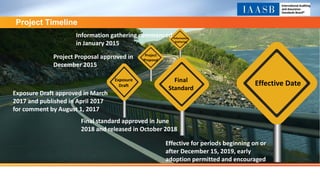
Information gathering commenced
in January 2015
Exposure Draft approved in March
2017 and published in April 2017
for comment by August 1, 2017
Final standard approved in June
2018 and released in October 2018
Project Proposal approved in
December 2015
Effective for periods beginning on or
after December 15, 2019, early
adoption permitted and encouraged
Public Interest Issues Addressed
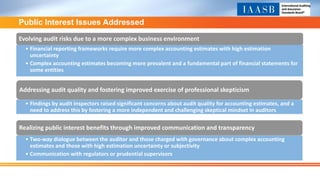
Evolving audit risks due to a more complex business environment
• Financial reporting frameworks require more complex accounting estimates with high estimation
uncertainty
• Complex accounting estimates becoming more prevalent and a fundamental part of financial statements for
some entities
Addressing audit quality and fostering improved exercise of professional skepticism
• Findings by audit inspectors raised significant concerns about audit quality for accounting estimates, and a
need to address this by fostering a more independent and challenging skeptical mindset in auditors
Realizing public interest benefits through improved communication and transparency
• Two-way dialogue between the auditor and those charged with governance about complex accounting
estimates and those with high estimation uncertainty or subjectivity
• Communication with regulators or prudential supervisors
4
Key Enhancements
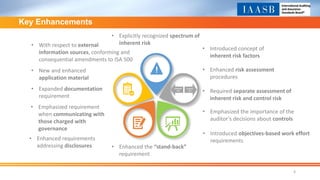
• Introduced objectives-based work effort
requirements
• Emphasized the importance of the
auditor’s decisions about controls
• Enhanced requirements
addressing disclosures
• New and enhanced
application material
• With respect to external
information sources, conforming and
consequential amendments to ISA 500
• Explicitly recognized spectrum of
inherent risk
• Introduced concept of
inherent risk factors
• Enhanced risk assessment
procedures
• Required separate assessment of
inherent risk and control risk
• Enhanced the “stand-back”
requirement
• Emphasized requirement
when communicating with
those charged with
governance
Inherent
risk
Control
risk• Expanded documentation
requirement
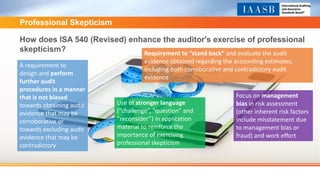
Professional Skepticism
How does ISA 540 (Revised) enhance the auditor's exercise of professional
skepticism?
A requirement to
design and perform
further audit
procedures in a manner
that is not biased
towards obtaining audit
evidence that may be
corroborative or
towards excluding audit
evidence that may be
contradictory
Use of stronger language
(“challenge”, “question” and
“reconsider”) in application
material to reinforce the
importance of exercising
professional skepticism
Requirement to “stand back” and evaluate the audit
evidence obtained regarding the accounting estimates,
including both corroborative and contradictory audit
evidence
Focus on management
bias in risk assessment
(other inherent risk factors
include misstatement due
to management bias or
fraud) and work effort
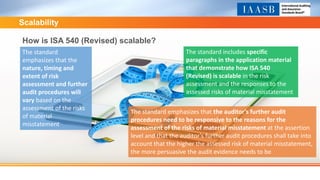
Scalability
How is ISA 540 (Revised) scalable?
The standard
emphasizes that the
nature, timing and
extent of risk
assessment and further
audit procedures will
vary based on the
assessment of the risks
of material
misstatement
The standard includes specific
paragraphs in the application material
that demonstrate how ISA 540
(Revised) is scalable in the risk
assessment and the responses to the
assessed risks of material misstatement
The standard emphasizes that the auditor’s further audit
procedures need to be responsive to the reasons for the
assessment of the risks of material misstatement at the assertion
level and that the auditor’s further audit procedures shall take into
account that the higher the assessed risk of material misstatement,
the more persuasive the audit evidence needs to be
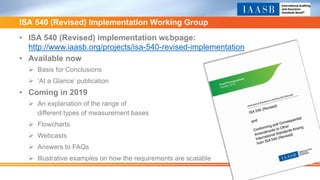
ISA 540 (Revised) Implementation Working Group
• ISA 540 (Revised) implementation webpage:
http://www.iaasb.org/projects/isa-540-revised-implementation
• Available now
 Basis for Conclusions
 ‘At a Glance’ publication
• Coming in 2019
 An explanation of the range of
different types of measurement bases
 Flowcharts
 Webcasts
 Answers to FAQs
 Illustrative examples on how the requirements are scalable
• .
For copyright, trademark, and permissions information, please go to permissions or contact permissions@ifac.org.
www.iaasb.org
8

ISA 540 (Revised) - Summary

  • 1.
    Summary of ISA540 (Revised) and Conforming and Consequential Amendments to Other International Standards 1
  • 2.
    Information Gathering Project Proposal Exposure Draft Final Standard Effective Date Project Timeline Informationgathering commenced in January 2015 Exposure Draft approved in March 2017 and published in April 2017 for comment by August 1, 2017 Final standard approved in June 2018 and released in October 2018 Project Proposal approved in December 2015 Effective for periods beginning on or after December 15, 2019, early adoption permitted and encouraged
  • 3.
    Public Interest IssuesAddressed Evolving audit risks due to a more complex business environment • Financial reporting frameworks require more complex accounting estimates with high estimation uncertainty • Complex accounting estimates becoming more prevalent and a fundamental part of financial statements for some entities Addressing audit quality and fostering improved exercise of professional skepticism • Findings by audit inspectors raised significant concerns about audit quality for accounting estimates, and a need to address this by fostering a more independent and challenging skeptical mindset in auditors Realizing public interest benefits through improved communication and transparency • Two-way dialogue between the auditor and those charged with governance about complex accounting estimates and those with high estimation uncertainty or subjectivity • Communication with regulators or prudential supervisors
  • 4.
    4 Key Enhancements • Introducedobjectives-based work effort requirements • Emphasized the importance of the auditor’s decisions about controls • Enhanced requirements addressing disclosures • New and enhanced application material • With respect to external information sources, conforming and consequential amendments to ISA 500 • Explicitly recognized spectrum of inherent risk • Introduced concept of inherent risk factors • Enhanced risk assessment procedures • Required separate assessment of inherent risk and control risk • Enhanced the “stand-back” requirement • Emphasized requirement when communicating with those charged with governance Inherent risk Control risk• Expanded documentation requirement
  • 5.
    Professional Skepticism How doesISA 540 (Revised) enhance the auditor's exercise of professional skepticism? A requirement to design and perform further audit procedures in a manner that is not biased towards obtaining audit evidence that may be corroborative or towards excluding audit evidence that may be contradictory Use of stronger language (“challenge”, “question” and “reconsider”) in application material to reinforce the importance of exercising professional skepticism Requirement to “stand back” and evaluate the audit evidence obtained regarding the accounting estimates, including both corroborative and contradictory audit evidence Focus on management bias in risk assessment (other inherent risk factors include misstatement due to management bias or fraud) and work effort
  • 6.
    Scalability How is ISA540 (Revised) scalable? The standard emphasizes that the nature, timing and extent of risk assessment and further audit procedures will vary based on the assessment of the risks of material misstatement The standard includes specific paragraphs in the application material that demonstrate how ISA 540 (Revised) is scalable in the risk assessment and the responses to the assessed risks of material misstatement The standard emphasizes that the auditor’s further audit procedures need to be responsive to the reasons for the assessment of the risks of material misstatement at the assertion level and that the auditor’s further audit procedures shall take into account that the higher the assessed risk of material misstatement, the more persuasive the audit evidence needs to be
  • 7.
    ISA 540 (Revised)Implementation Working Group • ISA 540 (Revised) implementation webpage: http://www.iaasb.org/projects/isa-540-revised-implementation • Available now  Basis for Conclusions  ‘At a Glance’ publication • Coming in 2019  An explanation of the range of different types of measurement bases  Flowcharts  Webcasts  Answers to FAQs  Illustrative examples on how the requirements are scalable • .
  • 8.
    For copyright, trademark,and permissions information, please go to permissions or contact permissions@ifac.org. www.iaasb.org 8