Is Malaria Really Spread by
Mosquitos?
Examining the Evidence and Alternate
Theories
Ulick Stafford PhD
https://usmalaria.com/
“What gets us into trouble
is not what we don’t
know. It’s what we know
for sure that just ain’t so”.
Mark Twain
“It is difficult to get a man
to understand something,
when his salary depends
on his not understanding
it.”
Upton Sinclair
Outline of
Presentation
1. Malaria and its History
2. Transmission Hypothesis
3. Supposed Cures
4. Benefits of Stopping the
‘Cures’
5. Nutrition and Clean
Water
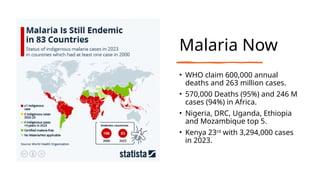
Malaria Now
• WHO claim 600,000 annual
deaths and 263 million cases.
• 570,000 Deaths (95%) and 246 M
cases (94%) in Africa.
• Nigeria, DRC, Uganda, Ethiopia
and Mozambique top 5.
• Kenya 23rd
with 3,294,000 cases
in 2023.
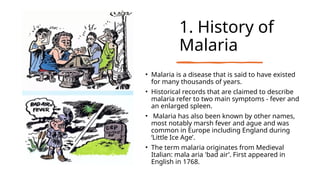
1. History of
Malaria
• Malaria is a disease that is said to have existed
for many thousands of years.
• Historical records that are claimed to describe
malaria refer to two main symptoms - fever and
an enlarged spleen.
• Malaria has also been known by other names,
most notably marsh fever and ague and was
common in Europe including England during
‘Little Ice Age’.
• The term malaria originates from Medieval
Italian: mala aria 'bad air’. First appeared in
English in 1768.
Ague (Malaria) in Shakespeare
Play Quotation
1H4 III.i.65 [Hotspur to all, of King Henry] How scapes he agues
1H4 IV.i.112 [Hotspur to Vernon] This praise doth nourish agues
H8 I.i.4.2 [Buckingham to Norfolk] An untimely ague / Stayed me a prisoner in my chamber
JC II.ii.113 [Caesar to Ligarius] Caesar was ne'er so much your enemy / As that same ague which hath made you lean
KJ III.iv.85 [Constance to Cardinal Pandulph, of Arthur] As dim and meagre as an ague's fit
Mac V.v.4 [Macbeth to all, of the besieging troops] Here let them lie / Till famine and the ague eat them up
MV I.i.23 [Salerio to Antonio] My wind cooling my broth / Would blow me to an ague
R2 II.i.116 [King Richard to and of John of Gaunt] a lunatic, lean-witted fool, / Presuming on an ague's privilege
TC III.iii.232 [Patroclus to Achilles] danger, like an ague, subtly taints / Even then when we sit idly in the sun
Tem II.ii.133 [Stephano to Caliban] How does thine ague?
Tem II.ii.65 [Stephano to himself] This is some monster of the isle with four legs, who hath got ... an ague
Tem II.ii.92 [Stephano to himself, of the monster] I will help his ague
Tim IV.iii.138
[Timon to Phrynia and Timandra] I know you'll swear ... / Into strong shudders and to heavenly agues /
Th'immortal gods that hear you
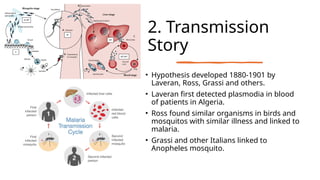
2. Transmission
Story
• Hypothesis developed 1880-1901 by
Laveran, Ross, Grassi and others.
• Laveran first detected plasmodia in blood
of patients in Algeria.
• Ross found similar organisms in birds and
mosquitos with similar illness and linked to
malaria.
• Grassi and other Italians linked to
Anopheles mosquito.
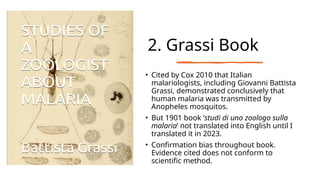
2. Grassi Book
• Cited by Cox 2010 that Italian
malariologists, including Giovanni Battista
Grassi, demonstrated conclusively that
human malaria was transmitted by
Anopheles mosquitos.
• But 1901 book ‘studi di uno zoologo sulla
malaria’ not translated into English until I
translated it in 2023.
• Confirmation bias throughout book.
Evidence cited does not conform to
scientific method.
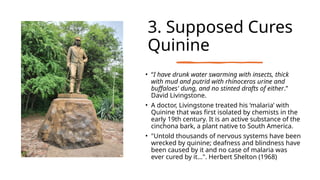
3. Supposed Cures
Quinine
• “I have drunk water swarming with insects, thick
with mud and putrid with rhinoceros urine and
buffaloes' dung, and no stinted drafts of either.”
David Livingstone.
• A doctor, Livingstone treated his ‘malaria’ with
Quinine that was first isolated by chemists in the
early 19th century. It is an active substance of the
cinchona bark, a plant native to South America.
• "Untold thousands of nervous systems have been
wrecked by quinine; deafness and blindness have
been caused by it and no case of malaria was
ever cured by it...". Herbert Shelton (1968)
3. Supposed Cures
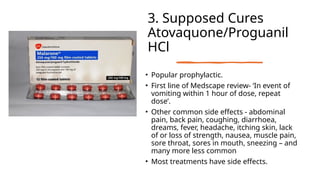
Atovaquone/Proguanil
HCl
• Popular prophylactic.
• First line of Medscape review- ‘In event of
vomiting within 1 hour of dose, repeat
dose’.
• Other common side effects - abdominal
pain, back pain, coughing, diarrhoea,
dreams, fever, headache, itching skin, lack
of or loss of strength, nausea, muscle pain,
sore throat, sores in mouth, sneezing – and
many more less common
• Most treatments have side effects.
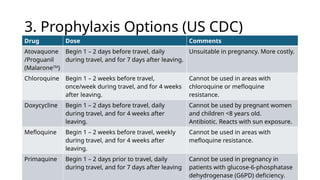
3. Prophylaxis Options (US CDC)
Drug Dose Comments
Atovaquone
/Proguanil
(MalaroneTM
)
Begin 1 – 2 days before travel, daily
during travel, and for 7 days after leaving.
Unsuitable in pregnancy. More costly.
Chloroquine Begin 1 – 2 weeks before travel,
once/week during travel, and for 4 weeks
after leaving.
Cannot be used in areas with
chloroquine or mefloquine
resistance.
Doxycycline Begin 1 – 2 days before travel, daily
during travel, and for 4 weeks after
leaving.
Cannot be used by pregnant women
and children <8 years old.
Antibiotic. Reacts with sun exposure.
Mefloquine Begin 1 – 2 weeks before travel, weekly
during travel, and for 4 weeks after
leaving.
Cannot be used in areas with
mefloquine resistance.
Primaquine Begin 1 – 2 days prior to travel, daily
during travel, and for 7 days after leaving
Cannot be used in pregnancy in
patients with glucose-6-phosphatase
dehydrogenase (G6PD) deficiency.
3. Supposed Cures
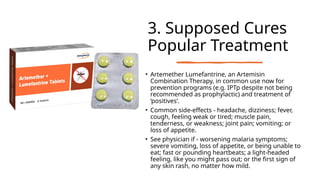
Popular Treatment
• Artemether Lumefantrine, an Artemisin
Combination Therapy, in common use now for
prevention programs (e.g. IPTp despite not being
recommended as prophylactic) and treatment of
‘positives’.
• Common side-effects - headache, dizziness; fever,
cough, feeling weak or tired; muscle pain,
tenderness, or weakness; joint pain; vomiting; or
loss of appetite.
• See physician if - worsening malaria symptoms;
severe vomiting, loss of appetite, or being unable to
eat; fast or pounding heartbeats; a light-headed
feeling, like you might pass out; or the first sign of
any skin rash, no matter how mild.
3. Supposed Cures
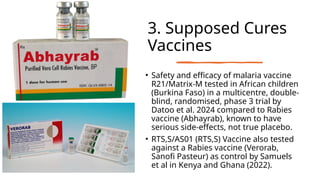
Vaccines
• Safety and efficacy of malaria vaccine
R21/Matrix-M tested in African children
(Burkina Faso) in a multicentre, double-
blind, randomised, phase 3 trial by
Datoo et al. 2024 compared to Rabies
vaccine (Abhayrab), known to have
serious side-effects, not true placebo.
• RTS,S/AS01 (RTS,S) Vaccine also tested
against a Rabies vaccine (Verorab,
Sanofi Pasteur) as control by Samuels
et al in Kenya and Ghana (2022).
3. Supposed Cures
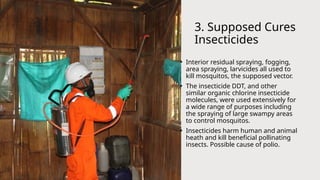
Insecticides
• Interior residual spraying, fogging,
area spraying, larvicides all used to
kill mosquitos, the supposed vector.
• The insecticide DDT, and other
similar organic chlorine insecticide
molecules, were used extensively for
a wide range of purposes including
the spraying of large swampy areas
to control mosquitos.
• Insecticides harm human and animal
heath and kill beneficial pollinating
insects. Possible cause of polio.
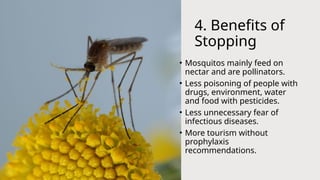
4. Benefits of
Stopping
• Mosquitos mainly feed on
nectar and are pollinators.
• Less poisoning of people with
drugs, environment, water
and food with pesticides.
• Less unnecessary fear of
infectious diseases.
• More tourism without
prophylaxis
recommendations.
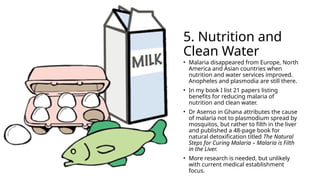
5. Nutrition and
Clean Water
• Malaria disappeared from Europe, North
America and Asian countries when
nutrition and water services improved.
Anopheles and plasmodia are still there.
• In my book I list 21 papers listing
benefits for reducing malaria of
nutrition and clean water.
• Dr Asenso in Ghana attributes the cause
of malaria not to plasmodium spread by
mosquitos, but rather to filth in the liver
and published a 48-page book for
natural detoxification titled The Natural
Steps for Curing Malaria – Malaria is Filth
in the Liver.
• More research is needed, but unlikely
with current medical establishment
focus.
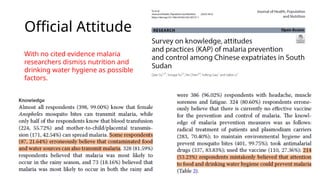
Official Attitude
With no cited evidence malaria
researchers dismiss nutrition and
drinking water hygiene as possible
factors.
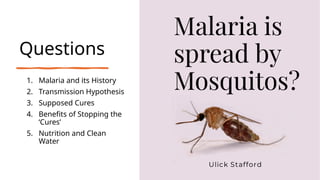
Questions
1. Malaria and its History
2. Transmission Hypothesis
3. Supposed Cures
4. Benefits of Stopping the
‘Cures’
5. Nutrition and Clean
Water

Is Malaria really spread by mosquitos.pptx

  • 1.
    Is Malaria ReallySpread by Mosquitos? Examining the Evidence and Alternate Theories Ulick Stafford PhD https://usmalaria.com/
  • 2.
    “What gets usinto trouble is not what we don’t know. It’s what we know for sure that just ain’t so”. Mark Twain “It is difficult to get a man to understand something, when his salary depends on his not understanding it.” Upton Sinclair
  • 3.
    Outline of Presentation 1. Malariaand its History 2. Transmission Hypothesis 3. Supposed Cures 4. Benefits of Stopping the ‘Cures’ 5. Nutrition and Clean Water
  • 4.
    Malaria Now • WHOclaim 600,000 annual deaths and 263 million cases. • 570,000 Deaths (95%) and 246 M cases (94%) in Africa. • Nigeria, DRC, Uganda, Ethiopia and Mozambique top 5. • Kenya 23rd with 3,294,000 cases in 2023.
  • 5.
    1. History of Malaria •Malaria is a disease that is said to have existed for many thousands of years. • Historical records that are claimed to describe malaria refer to two main symptoms - fever and an enlarged spleen. • Malaria has also been known by other names, most notably marsh fever and ague and was common in Europe including England during ‘Little Ice Age’. • The term malaria originates from Medieval Italian: mala aria 'bad air’. First appeared in English in 1768.
  • 6.
    Ague (Malaria) inShakespeare Play Quotation 1H4 III.i.65 [Hotspur to all, of King Henry] How scapes he agues 1H4 IV.i.112 [Hotspur to Vernon] This praise doth nourish agues H8 I.i.4.2 [Buckingham to Norfolk] An untimely ague / Stayed me a prisoner in my chamber JC II.ii.113 [Caesar to Ligarius] Caesar was ne'er so much your enemy / As that same ague which hath made you lean KJ III.iv.85 [Constance to Cardinal Pandulph, of Arthur] As dim and meagre as an ague's fit Mac V.v.4 [Macbeth to all, of the besieging troops] Here let them lie / Till famine and the ague eat them up MV I.i.23 [Salerio to Antonio] My wind cooling my broth / Would blow me to an ague R2 II.i.116 [King Richard to and of John of Gaunt] a lunatic, lean-witted fool, / Presuming on an ague's privilege TC III.iii.232 [Patroclus to Achilles] danger, like an ague, subtly taints / Even then when we sit idly in the sun Tem II.ii.133 [Stephano to Caliban] How does thine ague? Tem II.ii.65 [Stephano to himself] This is some monster of the isle with four legs, who hath got ... an ague Tem II.ii.92 [Stephano to himself, of the monster] I will help his ague Tim IV.iii.138 [Timon to Phrynia and Timandra] I know you'll swear ... / Into strong shudders and to heavenly agues / Th'immortal gods that hear you
  • 7.
    2. Transmission Story • Hypothesisdeveloped 1880-1901 by Laveran, Ross, Grassi and others. • Laveran first detected plasmodia in blood of patients in Algeria. • Ross found similar organisms in birds and mosquitos with similar illness and linked to malaria. • Grassi and other Italians linked to Anopheles mosquito.
  • 8.
    2. Grassi Book •Cited by Cox 2010 that Italian malariologists, including Giovanni Battista Grassi, demonstrated conclusively that human malaria was transmitted by Anopheles mosquitos. • But 1901 book ‘studi di uno zoologo sulla malaria’ not translated into English until I translated it in 2023. • Confirmation bias throughout book. Evidence cited does not conform to scientific method.
  • 9.
    3. Supposed Cures Quinine •“I have drunk water swarming with insects, thick with mud and putrid with rhinoceros urine and buffaloes' dung, and no stinted drafts of either.” David Livingstone. • A doctor, Livingstone treated his ‘malaria’ with Quinine that was first isolated by chemists in the early 19th century. It is an active substance of the cinchona bark, a plant native to South America. • "Untold thousands of nervous systems have been wrecked by quinine; deafness and blindness have been caused by it and no case of malaria was ever cured by it...". Herbert Shelton (1968)
  • 10.
    3. Supposed Cures Atovaquone/Proguanil HCl •Popular prophylactic. • First line of Medscape review- ‘In event of vomiting within 1 hour of dose, repeat dose’. • Other common side effects - abdominal pain, back pain, coughing, diarrhoea, dreams, fever, headache, itching skin, lack of or loss of strength, nausea, muscle pain, sore throat, sores in mouth, sneezing – and many more less common • Most treatments have side effects.
  • 11.
    3. Prophylaxis Options(US CDC) Drug Dose Comments Atovaquone /Proguanil (MalaroneTM ) Begin 1 – 2 days before travel, daily during travel, and for 7 days after leaving. Unsuitable in pregnancy. More costly. Chloroquine Begin 1 – 2 weeks before travel, once/week during travel, and for 4 weeks after leaving. Cannot be used in areas with chloroquine or mefloquine resistance. Doxycycline Begin 1 – 2 days before travel, daily during travel, and for 4 weeks after leaving. Cannot be used by pregnant women and children <8 years old. Antibiotic. Reacts with sun exposure. Mefloquine Begin 1 – 2 weeks before travel, weekly during travel, and for 4 weeks after leaving. Cannot be used in areas with mefloquine resistance. Primaquine Begin 1 – 2 days prior to travel, daily during travel, and for 7 days after leaving Cannot be used in pregnancy in patients with glucose-6-phosphatase dehydrogenase (G6PD) deficiency.
  • 12.
    3. Supposed Cures PopularTreatment • Artemether Lumefantrine, an Artemisin Combination Therapy, in common use now for prevention programs (e.g. IPTp despite not being recommended as prophylactic) and treatment of ‘positives’. • Common side-effects - headache, dizziness; fever, cough, feeling weak or tired; muscle pain, tenderness, or weakness; joint pain; vomiting; or loss of appetite. • See physician if - worsening malaria symptoms; severe vomiting, loss of appetite, or being unable to eat; fast or pounding heartbeats; a light-headed feeling, like you might pass out; or the first sign of any skin rash, no matter how mild.
  • 13.
    3. Supposed Cures Vaccines •Safety and efficacy of malaria vaccine R21/Matrix-M tested in African children (Burkina Faso) in a multicentre, double- blind, randomised, phase 3 trial by Datoo et al. 2024 compared to Rabies vaccine (Abhayrab), known to have serious side-effects, not true placebo. • RTS,S/AS01 (RTS,S) Vaccine also tested against a Rabies vaccine (Verorab, Sanofi Pasteur) as control by Samuels et al in Kenya and Ghana (2022).
  • 14.
    3. Supposed Cures Insecticides •Interior residual spraying, fogging, area spraying, larvicides all used to kill mosquitos, the supposed vector. • The insecticide DDT, and other similar organic chlorine insecticide molecules, were used extensively for a wide range of purposes including the spraying of large swampy areas to control mosquitos. • Insecticides harm human and animal heath and kill beneficial pollinating insects. Possible cause of polio.
  • 15.
    4. Benefits of Stopping •Mosquitos mainly feed on nectar and are pollinators. • Less poisoning of people with drugs, environment, water and food with pesticides. • Less unnecessary fear of infectious diseases. • More tourism without prophylaxis recommendations.
  • 16.
    5. Nutrition and CleanWater • Malaria disappeared from Europe, North America and Asian countries when nutrition and water services improved. Anopheles and plasmodia are still there. • In my book I list 21 papers listing benefits for reducing malaria of nutrition and clean water. • Dr Asenso in Ghana attributes the cause of malaria not to plasmodium spread by mosquitos, but rather to filth in the liver and published a 48-page book for natural detoxification titled The Natural Steps for Curing Malaria – Malaria is Filth in the Liver. • More research is needed, but unlikely with current medical establishment focus.
  • 17.
    Official Attitude With nocited evidence malaria researchers dismiss nutrition and drinking water hygiene as possible factors.
  • 18.
    Questions 1. Malaria andits History 2. Transmission Hypothesis 3. Supposed Cures 4. Benefits of Stopping the ‘Cures’ 5. Nutrition and Clean Water