Flotation Flowsheets for Copper
Ores in Mineral Processing
Introduction
• Overview of global copper production and key
producers (e.g., Chile, China, Peru).
• Importance of flotation in processing low-
grade copper sulfide deposits.
• Impact of flotation technology on copper
industry.
Types of Copper Ores and Processing
Techniques
• Overview of copper sulfide and secondary
copper minerals (malachite, azurite).
• Influence of oxidation and reduction zones in
ore bodies.
• Importance of flotation for porphyry copper
deposits.
Basics of Flotation in Copper Processing
• Description of the flotation process for copper
sulfides.
• Common reagents used: thiol collectors
(xanthates), frothers, and pH control.
• Importance of grinding to optimize liberation.
Copper-Molybdenum Separation Techniques
• Overview of molybdenite flotation post-
copper flotation.
• Challenges in molybdenite flotation: slime
production, fine particle behavior.
• Reagents used for copper depression: sodium
hydrosulfide, nitrogen gas.
Case Study: Highland Valley Copper (Teck
Resources)
• Overview of the operation: ore grade,
processing capacity, and outputs.
• Simplified flowsheet and equipment used.
• Details on bulk Cu-Mo rougher-scavenger-
cleaner circuits.
Grasberg Operation: A World Leader in
Copper and Gold Production
• Overview of the Grasberg flotation circuit and
its capacity.
• Key minerals processed: chalcopyrite, gold,
and silver.
• Flowsheet of the flotation process: roughers,
cleaners, and scavengers.
Technological Advances in Flotation
• Introduction to larger flotation cells (e.g.,
Outotec tank cells at Chuquicamata).
• Benefits of using advanced flotation
technologies in large-scale operations.
By-Product Recovery: Case of Palabora
Mining Co.
• Overview of by-products: magnetite, uranium,
zirconium.
• Flowsheet of the Palabora operation and its
multi-product strategy.
• Role of coarse flotation feed in downstream
recovery processes.
Common Challenges in Copper Ore Flotation
• Issues with slime production and fine particle
recovery.
• Impact of reagent selection and usage on
flotation efficiency.
• Strategies for overcoming challenges in
different ore types.
Case Study Discussion: Improving Flotation
Efficiency
• Present a hypothetical scenario where
students must suggest improvements to a
flotation circuit.
• Discuss potential solutions and their impacts
on recovery rates and concentrate grades.
Summary and Key Takeaways
• Recap of the key points covered in the
presentation.
• Importance of selecting the right flotation
flowsheet for specific ore types.
• Future trends in flotation technology for
copper ores.
Questions and Open Discussion
• Invite questions from students to clarify any
points.
• Encourage discussion on the application of
flotation technologies in different scenarios.
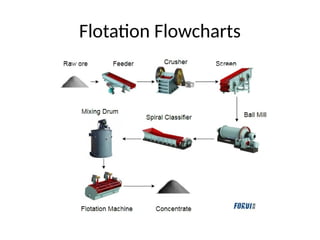
Flotation Flowcharts: Copper
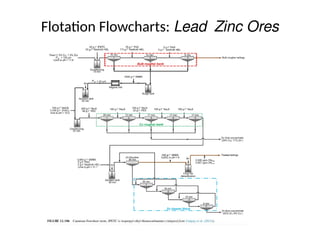
Flotation Flowcharts: Lead Zinc Ores
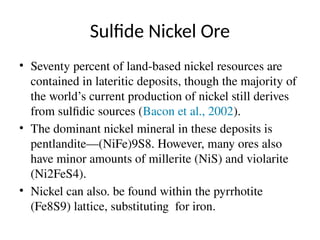
Sulfide Nickel Ore
• Seventy percent of land-based nickel resources are
contained in lateritic deposits, though the majority of
the world’s current production of nickel still derives
from sulfidic sources (Bacon et al., 2002).
• The dominant nickel mineral in these deposits is
pentlandite—(NiFe)9S8. However, many ores also
have minor amounts of millerite (NiS) and violarite
(Ni2FeS4).
• Nickel can also. be found within the pyrrhotite
(Fe8S9) lattice, substituting for iron.
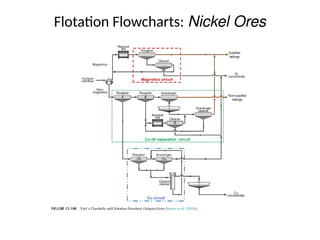
Flotation Flowcharts: Nickel Ores
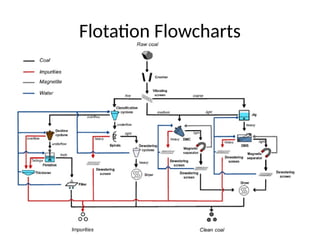
Flotation Flowcharts: Coal
Coal Flotation
An Overview of Coal Flotation
Processes and Products
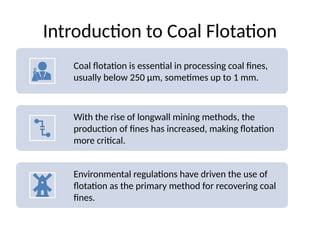
Introduction to Coal Flotation
Coal flotation is essential in processing coal fines,
usually below 250 μm, sometimes up to 1 mm.
With the rise of longwall mining methods, the
production of fines has increased, making flotation
more critical.
Environmental regulations have driven the use of
flotation as the primary method for recovering coal
fines.
Coal
Flotation
Circuits
Coal flotation circuits are
typically simple, involving
roughing and scavenging
stages.
In some cases, only
roughing is required to
achieve the desired
recovery.
Mass recovery in coal
flotation can be high, up
to 70%, with significant
frother usage due to
adsorption by coal.
Collectors
and
Frothers
in Coal
Flotation
Petrochemical products
like diesel oil, liquid
paraffin, and kerosene are
commonly used as
collectors in coal flotation.
Mechanical paddles are
often used to remove
heavy froth from flotation
cells.
Products
of Coal
Flotation
Coal operations can produce
two main products: high-
value coking coal and lower-
value thermal coal.
Coking coal is used in
pyrometallurgical industries
and requires low impurity
levels (5% to 8% ash content).
Thermal coal is used for
power generation, with
flotation concentrates ranging
from 8% to 14% ash content.
Flotation
Technologies
for Coking
Coal
Coking coals often
require froth washing
due to their need for
low impurity levels.
The use of Jameson
cells and flotation
columns is increasing
for producing high-
quality coking coal.
Flotation
Technologies
for Thermal
Coal
Thermal coals typically
achieve the desired
ash content without
froth washing.
Mechanical flotation
cells remain common
in processing thermal
coals.
Conclusion
Coal flotation is a
critical process in
recovering fines and
producing coking and
thermal coals.
The choice of flotation
technology and circuit
design depends on the
type of coal and desired
product specifications.
Flotation Flowcharts
Flotation Flowcharts: Coal Washing
Flotation Flowcharts

Chapter 11 Part 3Flotation_Flowsheets_Copper_Ores_Presentation.pptx

  • 1.
    Flotation Flowsheets forCopper Ores in Mineral Processing
  • 2.
    Introduction • Overview ofglobal copper production and key producers (e.g., Chile, China, Peru). • Importance of flotation in processing low- grade copper sulfide deposits. • Impact of flotation technology on copper industry.
  • 3.
    Types of CopperOres and Processing Techniques • Overview of copper sulfide and secondary copper minerals (malachite, azurite). • Influence of oxidation and reduction zones in ore bodies. • Importance of flotation for porphyry copper deposits.
  • 4.
    Basics of Flotationin Copper Processing • Description of the flotation process for copper sulfides. • Common reagents used: thiol collectors (xanthates), frothers, and pH control. • Importance of grinding to optimize liberation.
  • 5.
    Copper-Molybdenum Separation Techniques •Overview of molybdenite flotation post- copper flotation. • Challenges in molybdenite flotation: slime production, fine particle behavior. • Reagents used for copper depression: sodium hydrosulfide, nitrogen gas.
  • 6.
    Case Study: HighlandValley Copper (Teck Resources) • Overview of the operation: ore grade, processing capacity, and outputs. • Simplified flowsheet and equipment used. • Details on bulk Cu-Mo rougher-scavenger- cleaner circuits.
  • 7.
    Grasberg Operation: AWorld Leader in Copper and Gold Production • Overview of the Grasberg flotation circuit and its capacity. • Key minerals processed: chalcopyrite, gold, and silver. • Flowsheet of the flotation process: roughers, cleaners, and scavengers.
  • 8.
    Technological Advances inFlotation • Introduction to larger flotation cells (e.g., Outotec tank cells at Chuquicamata). • Benefits of using advanced flotation technologies in large-scale operations.
  • 9.
    By-Product Recovery: Caseof Palabora Mining Co. • Overview of by-products: magnetite, uranium, zirconium. • Flowsheet of the Palabora operation and its multi-product strategy. • Role of coarse flotation feed in downstream recovery processes.
  • 10.
    Common Challenges inCopper Ore Flotation • Issues with slime production and fine particle recovery. • Impact of reagent selection and usage on flotation efficiency. • Strategies for overcoming challenges in different ore types.
  • 11.
    Case Study Discussion:Improving Flotation Efficiency • Present a hypothetical scenario where students must suggest improvements to a flotation circuit. • Discuss potential solutions and their impacts on recovery rates and concentrate grades.
  • 12.
    Summary and KeyTakeaways • Recap of the key points covered in the presentation. • Importance of selecting the right flotation flowsheet for specific ore types. • Future trends in flotation technology for copper ores.
  • 13.
    Questions and OpenDiscussion • Invite questions from students to clarify any points. • Encourage discussion on the application of flotation technologies in different scenarios.
  • 14.
  • 15.
  • 16.
  • 17.
  • 18.
    Sulfide Nickel Ore •Seventy percent of land-based nickel resources are contained in lateritic deposits, though the majority of the world’s current production of nickel still derives from sulfidic sources (Bacon et al., 2002). • The dominant nickel mineral in these deposits is pentlandite—(NiFe)9S8. However, many ores also have minor amounts of millerite (NiS) and violarite (Ni2FeS4). • Nickel can also. be found within the pyrrhotite (Fe8S9) lattice, substituting for iron.
  • 19.
  • 20.
  • 21.
    Coal Flotation An Overviewof Coal Flotation Processes and Products
  • 22.
    Introduction to CoalFlotation Coal flotation is essential in processing coal fines, usually below 250 μm, sometimes up to 1 mm. With the rise of longwall mining methods, the production of fines has increased, making flotation more critical. Environmental regulations have driven the use of flotation as the primary method for recovering coal fines.
  • 23.
    Coal Flotation Circuits Coal flotation circuitsare typically simple, involving roughing and scavenging stages. In some cases, only roughing is required to achieve the desired recovery. Mass recovery in coal flotation can be high, up to 70%, with significant frother usage due to adsorption by coal.
  • 24.
    Collectors and Frothers in Coal Flotation Petrochemical products likediesel oil, liquid paraffin, and kerosene are commonly used as collectors in coal flotation. Mechanical paddles are often used to remove heavy froth from flotation cells.
  • 25.
    Products of Coal Flotation Coal operationscan produce two main products: high- value coking coal and lower- value thermal coal. Coking coal is used in pyrometallurgical industries and requires low impurity levels (5% to 8% ash content). Thermal coal is used for power generation, with flotation concentrates ranging from 8% to 14% ash content.
  • 26.
    Flotation Technologies for Coking Coal Coking coalsoften require froth washing due to their need for low impurity levels. The use of Jameson cells and flotation columns is increasing for producing high- quality coking coal.
  • 27.
    Flotation Technologies for Thermal Coal Thermal coalstypically achieve the desired ash content without froth washing. Mechanical flotation cells remain common in processing thermal coals.
  • 28.
    Conclusion Coal flotation isa critical process in recovering fines and producing coking and thermal coals. The choice of flotation technology and circuit design depends on the type of coal and desired product specifications.
  • 29.
  • 30.
  • 31.