International Research Journal of Engineering and Technology (IRJET) e-ISSN: 2395-0056
Volume: 06 Issue: 05 | May 2019 www.irjet.net p-ISSN: 2395-0072
© 2019, IRJET | Impact Factor value: 7.211 | ISO 9001:2008 Certified Journal | Page 5373
Review on Mechanisms of Vibration based Energy Harvesters
Devanshu Bhatt1, Ravi Chandra Joshi2, Shubham Sharma3, Tarun Kumar4
1,2,3,4Student, Mechanical Engineering, Uttaranchal University, Uttarakhand, India
---------------------------------------------------------------------***----------------------------------------------------------------------
Abstract:- In search of an alternative to the limitations of
wire powered supply and energy storage there has been a
rapid growth in ambient energy harvesting technologies.
Vibration energy is abundantly available and has the
potential to be harvested by different mechanism. Vibration
energy harvesters (VEHs) mostly use Piezoelectric and
electromagnetic means for energy harvesting. Each
mechanism comes with certain advantages and
disadvantages and improvement so ideas are elaboratedand
discussed upon in this current research review.
Key Words: (Size 10 & Bold) Key word1, Key word2, Key
word3, etc (Minimum 5 to 8 key words)…
1. INTRODUCTION
Due to the implementation of modern advancement the
various technique are step forward to upcoming growth of
new creation like Wireless Sensor Network (wsn’s), MEM’s
and the interconnection via the internet of computing
devices.1,3 Every harvesting technique help us to eliminate
the battery connected or wired connection and reduces the
maintenance, labour cost, limited energy density,
unavoidable periodic replacement, current leakage.4,5,6.
Energy harvester is the best suitable as a substituted for
battery and wired connection power supply7.
Energy harvester is helpful forconvertingtheenvironmental
energy into useful work it is cheapest andcontinuoussource
of energy with higher efficient of work. Energy harvester
based on vibration in WSN find its application in mining and
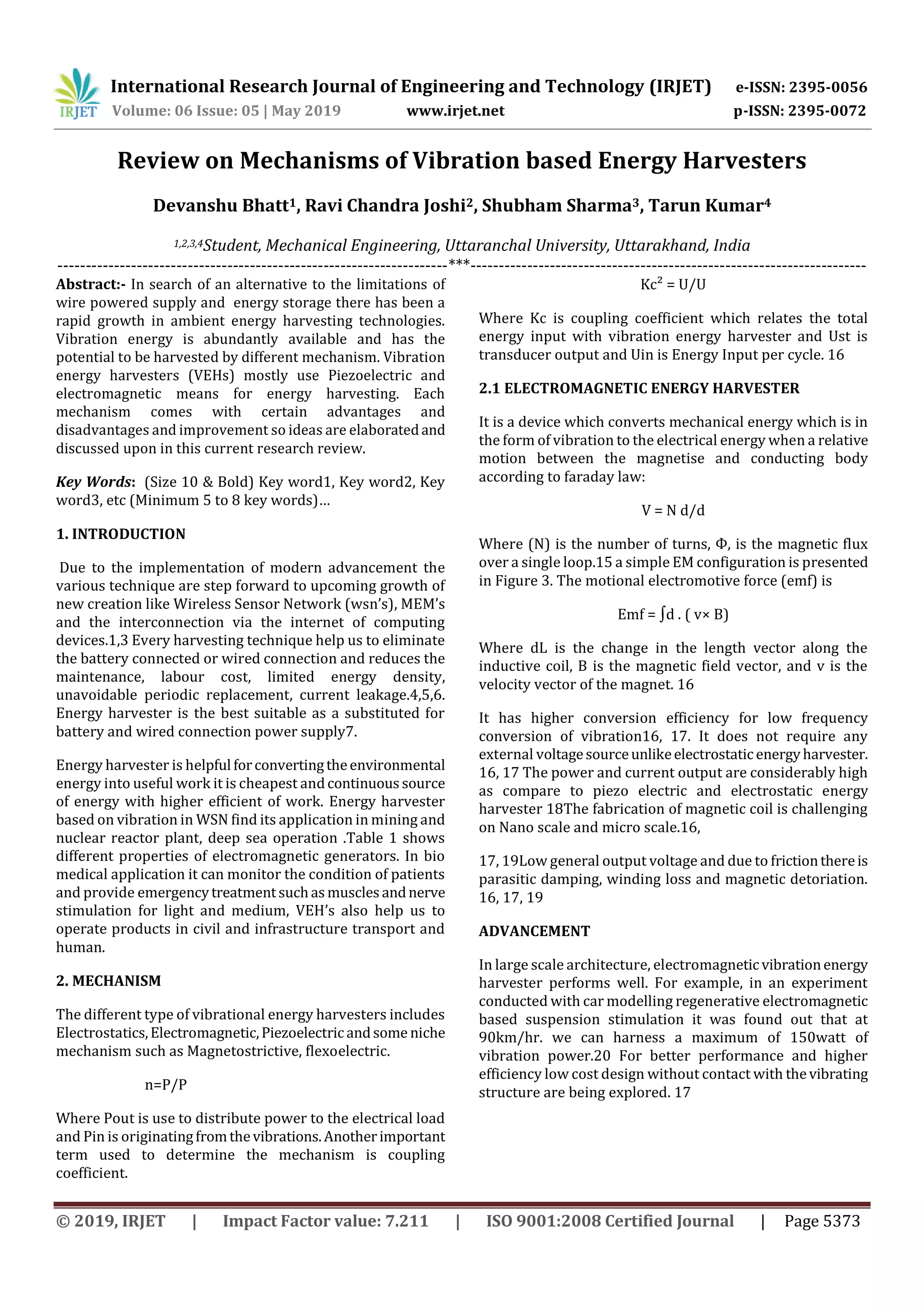
nuclear reactor plant, deep sea operation .Table 1 shows
different properties of electromagnetic generators. In bio
medical application it can monitor the condition of patients
and provide emergencytreatmentsuchasmusclesandnerve
stimulation for light and medium, VEH’s also help us to
operate products in civil and infrastructure transport and
human.
2. MECHANISM
The different type of vibrational energy harvesters includes
Electrostatics,Electromagnetic,Piezoelectric andsome niche
mechanism such as Magnetostrictive, flexoelectric.
n=P/P
Where Pout is use to distribute power to the electrical load
and Pin is originatingfromthevibrations.Anotherimportant
term used to determine the mechanism is coupling
coefficient.
Kc² = U/U
Where Kc is coupling coefficient which relates the total
energy input with vibration energy harvester and Ust is
transducer output and Uin is Energy Input per cycle. 16
2.1 ELECTROMAGNETIC ENERGY HARVESTER
It is a device which converts mechanical energy which is in
the form of vibration to the electrical energy when a relative
motion between the magnetise and conducting body
according to faraday law:
V = N d/d
Where (N) is the number of turns, Ф, is the magnetic flux
over a single loop.15 a simple EM configuration is presented
in Figure 3. The motional electromotive force (emf) is
Emf = ∫d . ( v× B)
Where dL is the change in the length vector along the
inductive coil, B is the magnetic field vector, and v is the
velocity vector of the magnet. 16
It has higher conversion efficiency for low frequency
conversion of vibration16, 17. It does not require any
external voltagesourceunlikeelectrostaticenergyharvester.
16, 17 The power and current output are considerably high
as compare to piezo electric and electrostatic energy
harvester 18The fabrication of magnetic coil is challenging
on Nano scale and micro scale.16,
17, 19Low general output voltage and due to frictionthereis
parasitic damping, winding loss and magnetic detoriation.
16, 17, 19
ADVANCEMENT
In large scale architecture, electromagneticvibrationenergy
harvester performs well. For example, in an experiment
conducted with car modelling regenerative electromagnetic
based suspension stimulation it was found out that at
90km/hr. we can harness a maximum of 150watt of
vibration power.20 For better performance and higher
efficiency low cost design without contact with thevibrating
structure are being explored. 17
International Research Journal of Engineering and Technology (IRJET) e-ISSN: 2395-0056
Volume: 06 Issue: 05 | May 2019 www.irjet.net p-ISSN: 2395-0072
© 2019, IRJET | Impact Factor value: 7.211 | ISO 9001:2008 Certified Journal | Page 5374
Fig. 2. A rudimentary electromagnetic energy harvester
configuration. 16
2.2 PIEZOELECTRIC ENERGY HARVESTER
FIGURE 3: Electromechanical conversion of piezoelectric
phenomena. 9
The Piezoelectric materials are those materials which
convert Mechanical stresses or Strains into electricity or
voltage.6, 15
Some Piezoelectric materialsareAluminium Nitride,Gallium
Arsenide, and Lead Zirconate. There are also some recently
discovered Piezoelectric Nano generators Zinc nanowires.6,
21Simple structure which have thin layer that are
considerably lower in size compared to Electromagnetic
Energy Harvester.17 Lower tendency effect by external or
internal electromagnetic waves.17
ELECTRIC FATIGUE: - The polarity decreases after number
of switching cycle.17, 22. Ceramic Piezoelectric Materialsare
brittle and has lower coupling coefficients.17, 23
Piezoelectric materials performance at high temperature
condition is compromised.17, 22
ADVANCEMENT
Lead Zirconate titanate is a ceramic Piezoelectric material
which is preferred by researchers due to its various
characteristics like:-
Higher coupling coefficient as compared to other
piezoelectric materials.23, 24
Has a resonator construction synchronousswitchharvesting
inductor circuit as it reduces internal capacitive impedance
effect and can balance the fluctuation in vibration frequency
and amplitude.25
Bismuth scandium lead titanate is again a piezoelectric
ceramic which is suitable for high temperature (upto
450C).26
2.3 ELECTROSTATIC ENERGY HARVESTER
It is a triboelectric or capacitive technique in which the
motion in between of two surfaces of charged capacitor
results in change of potential difference between them and
hence giving static electricity6, 15 .The two surface made of
different materials are in contact the mechanical vibrations
separations results in the decrease in capacitive potential
difference which in form causes the flow of electrons
between the two electrodes attached to the surface
connected to the circuit.27
Electrostatic Energy harvester is able to operate without
smart materials unlike Piezoelectric and Electromagnetic
harvester thus making less concern for systems life
span.17Due to its relatively small energy density generation
an external voltage source is required for energy harvesting
operation.17For wireless sensing network and micro
electro-mechanical systems this approach islesscompatible
as the output voltage is extremely high.17
ADVANCEMENT
In an experiment a vibration energy harvester achieved top
voltage of 34.06V and a peak output power density of
0.77W/m².30 So to be used for harvesting energy from
movement of a human stretchable and scalable electrostatic
vibration energy harvesting system made of silicon and
rubber coated stainless steel32 which has a combine teeth
line hierarchical structure that minimise thin film air
damping and further reduces the relative velocity between
electrode surfaces. 8, 31
The combination of F-As2S3 and PEI VEH we can
theoretically maximise the electrostatic effects as these two
materials have high polarity difference. The peak power
recorded for this combination was 1.23 and generation of
current of 1.62mA at 2.5Hz with peak to peak voltage of
396V at 7.5Hz.33 figure 4 and 5 shows comparision of
experimentally measured and theoretically derived voltage
to base acceleration frequency.
International Research Journal of Engineering and Technology (IRJET) e-ISSN: 2395-0056
Volume: 06 Issue: 05 | May 2019 www.irjet.net p-ISSN: 2395-0072
© 2019, IRJET | Impact Factor value: 7.211 | ISO 9001:2008 Certified Journal | Page 5375
2.4 MAGNETOSTRICTIVE ENERGY HARVESTER
The iron gallium alloy are magnetostrictive materials which
experiences strain when a magnetic flux is induced, and
further applying stress to a Piezoelectric materialsgenerates
electricity.15, 34 When the electron spins on its own axis
orbital magnetic moment is super positioned into atomic
magnetic moment due to this internal electronic motion of
the atoms all ferromagnetic magnetic materials possess
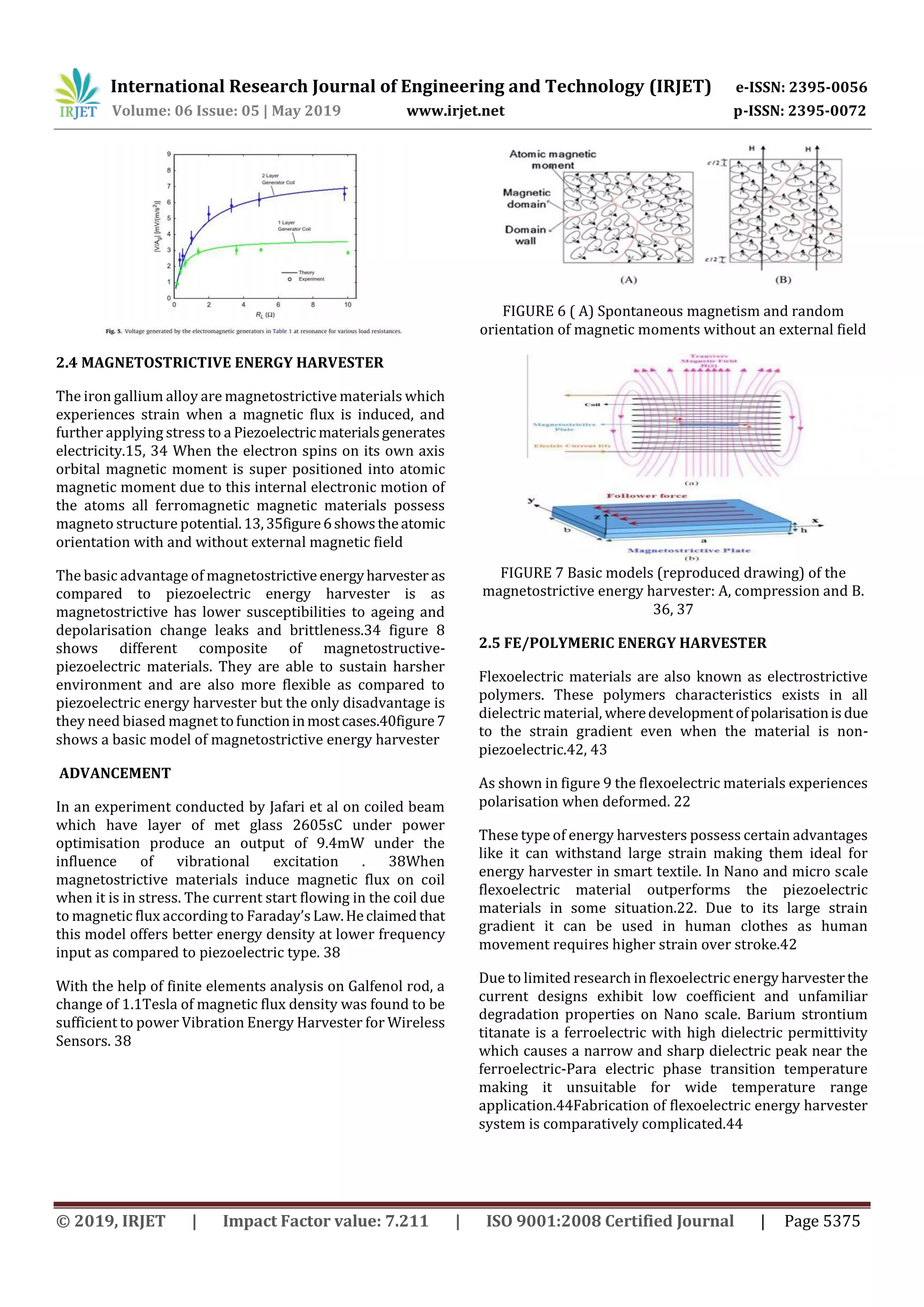
magneto structure potential.13,35figure6showstheatomic
orientation with and without external magnetic field
The basic advantage of magnetostrictive energyharvester as
compared to piezoelectric energy harvester is as
magnetostrictive has lower susceptibilities to ageing and
depolarisation change leaks and brittleness.34 figure 8
shows different composite of magnetostructive-
piezoelectric materials. They are able to sustain harsher
environment and are also more flexible as compared to
piezoelectric energy harvester but the only disadvantage is
they need biased magnet tofunctioninmostcases.40figure7
shows a basic model of magnetostrictive energy harvester
ADVANCEMENT
In an experiment conducted by Jafari et al on coiled beam
which have layer of met glass 2605sC under power
optimisation produce an output of 9.4mW under the
influence of vibrational excitation . 38When
magnetostrictive materials induce magnetic flux on coil
when it is in stress. The current start flowing in the coil due
to magnetic flux according to Faraday’s Law.Heclaimedthat
this model offers better energy density at lower frequency
input as compared to piezoelectric type. 38
With the help of finite elements analysis on Galfenol rod, a
change of 1.1Tesla of magnetic flux density was found to be
sufficient to power Vibration Energy Harvester for Wireless
Sensors. 38
FIGURE 6 ( A) Spontaneous magnetism and random
orientation of magnetic moments without an external field
FIGURE 7 Basic models (reproduced drawing) of the
magnetostrictive energy harvester: A, compression and B.
36, 37
2.5 FE/POLYMERIC ENERGY HARVESTER
Flexoelectric materials are also known as electrostrictive
polymers. These polymers characteristics exists in all
dielectric material, wheredevelopmentofpolarisationisdue
to the strain gradient even when the material is non-
piezoelectric.42, 43
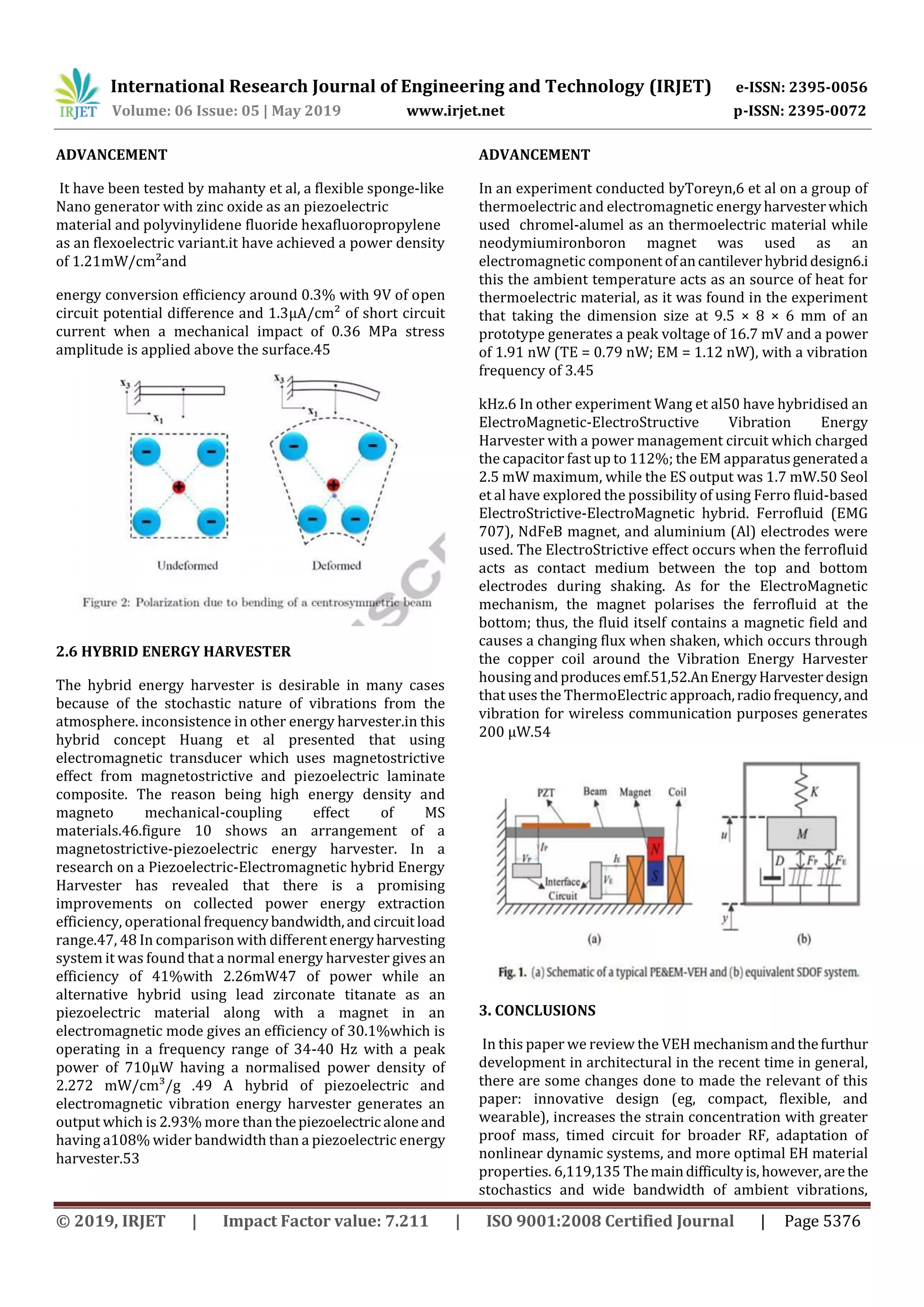
As shown in figure 9 the flexoelectric materials experiences
polarisation when deformed. 22
These type of energy harvesters possess certain advantages
like it can withstand large strain making them ideal for
energy harvester in smart textile. In Nano and micro scale
flexoelectric material outperforms the piezoelectric
materials in some situation.22. Due to its large strain
gradient it can be used in human clothes as human
movement requires higher strain over stroke.42
Due to limited research in flexoelectric energy harvesterthe
current designs exhibit low coefficient and unfamiliar
degradation properties on Nano scale. Barium strontium
titanate is a ferroelectric with high dielectric permittivity
which causes a narrow and sharp dielectric peak near the
ferroelectric-Para electric phase transition temperature
making it unsuitable for wide temperature range
application.44Fabrication of flexoelectric energy harvester
system is comparatively complicated.44
International Research Journal of Engineering and Technology (IRJET) e-ISSN: 2395-0056
Volume: 06 Issue: 05 | May 2019 www.irjet.net p-ISSN: 2395-0072
© 2019, IRJET | Impact Factor value: 7.211 | ISO 9001:2008 Certified Journal | Page 5376
ADVANCEMENT
It have been tested by mahanty et al, a flexible sponge-like
Nano generator with zinc oxide as an piezoelectric
material and polyvinylidene fluoride hexafluoropropylene
as an flexoelectric variant.it have achieved a power density
of 1.21mW/cm²and
energy conversion efficiency around 0.3% with 9V of open
circuit potential difference and 1.3μA/cm² of short circuit
current when a mechanical impact of 0.36 MPa stress
amplitude is applied above the surface.45
2.6 HYBRID ENERGY HARVESTER
The hybrid energy harvester is desirable in many cases
because of the stochastic nature of vibrations from the
atmosphere. inconsistence in other energy harvester.in this
hybrid concept Huang et al presented that using
electromagnetic transducer which uses magnetostrictive
effect from magnetostrictive and piezoelectric laminate
composite. The reason being high energy density and
magneto mechanical‐coupling effect of MS
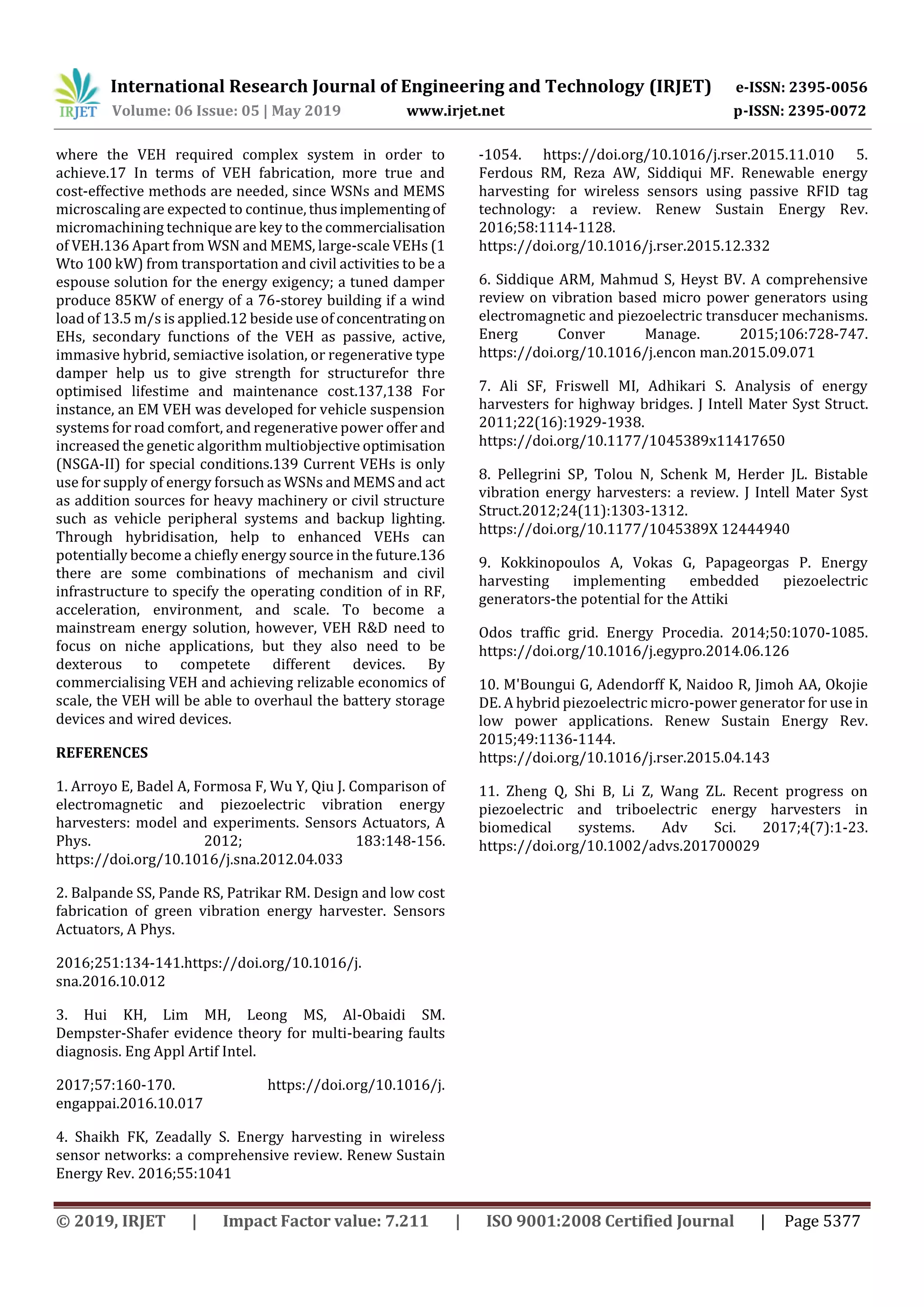
materials.46.figure 10 shows an arrangement of a
magnetostrictive-piezoelectric energy harvester. In a
research on a Piezoelectric-Electromagnetic hybrid Energy
Harvester has revealed that there is a promising
improvements on collected power energy extraction
efficiency, operational frequencybandwidth,andcircuitload
range.47, 48 In comparison with differentenergyharvesting
system it was found that a normal energy harvester gives an
efficiency of 41%with 2.26mW47 of power while an
alternative hybrid using lead zirconate titanate as an
piezoelectric material along with a magnet in an
electromagnetic mode gives an efficiency of 30.1%which is
operating in a frequency range of 34-40 Hz with a peak
power of 710μW having a normalised power density of
2.272 mW/cm³/g .49 A hybrid of piezoelectric and
electromagnetic vibration energy harvester generates an
output which is 2.93% more than thepiezoelectric aloneand
having a108% wider bandwidth than a piezoelectric energy
harvester.53
ADVANCEMENT
In an experiment conducted byToreyn,6 et al on a group of
thermoelectric and electromagnetic energyharvesterwhich
used chromel-alumel as an thermoelectric material while
neodymiumironboron magnet was used as an
electromagnetic componentofancantileverhybriddesign6.i
this the ambient temperature acts as an source of heat for
thermoelectric material, as it was found in the experiment
that taking the dimension size at 9.5 × 8 × 6 mm of an
prototype generates a peak voltage of 16.7 mV and a power
of 1.91 nW (TE = 0.79 nW; EM = 1.12 nW), with a vibration
frequency of 3.45
kHz.6 In other experiment Wang et al50 have hybridised an
ElectroMagnetic‐ElectroStructive Vibration Energy
Harvester with a power management circuit which charged
the capacitor fast up to 112%; the EM apparatusgenerateda
2.5 mW maximum, while the ES output was 1.7 mW.50 Seol
et al have explored the possibility of using Ferro fluid‐based
ElectroStrictive‐ElectroMagnetic hybrid. Ferrofluid (EMG
707), NdFeB magnet, and aluminium (Al) electrodes were
used. The ElectroStrictive effect occurs when the ferrofluid
acts as contact medium between the top and bottom
electrodes during shaking. As for the ElectroMagnetic
mechanism, the magnet polarises the ferrofluid at the
bottom; thus, the fluid itself contains a magnetic field and
causes a changing flux when shaken, which occurs through
the copper coil around the Vibration Energy Harvester
housing andproducesemf.51,52.AnEnergyHarvesterdesign
that uses the ThermoElectric approach,radiofrequency,and
vibration for wireless communication purposes generates
200 μW.54
3. CONCLUSIONS
In this paper we review the VEH mechanismandthefurthur
development in architectural in the recent time in general,
there are some changes done to made the relevant of this
paper: innovative design (eg, compact, flexible, and
wearable), increases the strain concentration with greater
proof mass, timed circuit for broader RF, adaptation of
nonlinear dynamic systems, and more optimal EH material
properties. 6,119,135 Themaindifficultyis,however,are the
stochastics and wide bandwidth of ambient vibrations,
International Research Journal of Engineering and Technology (IRJET) e-ISSN: 2395-0056
Volume: 06 Issue: 05 | May 2019 www.irjet.net p-ISSN: 2395-0072
© 2019, IRJET | Impact Factor value: 7.211 | ISO 9001:2008 Certified Journal | Page 5377
where the VEH required complex system in order to
achieve.17 In terms of VEH fabrication, more true and
cost‐effective methods are needed, since WSNs and MEMS
microscaling are expected to continue, thusimplementing of
micromachining technique are key to the commercialisation
of VEH.136 Apart from WSN and MEMS, large‐scale VEHs (1
Wto 100 kW) from transportation and civil activities to be a
espouse solution for the energy exigency; a tuned damper
produce 85KW of energy of a 76‐storey building if a wind
load of 13.5 m/s is applied.12 beside use of concentrating on
EHs, secondary functions of the VEH as passive, active,
immasive hybrid, semiactive isolation, or regenerative type
damper help us to give strength for structurefor thre
optimised lifestime and maintenance cost.137,138 For
instance, an EM VEH was developed for vehicle suspension
systems for road comfort, and regenerative power offer and
increased the genetic algorithm multiobjective optimisation
(NSGA‐II) for special conditions.139 Current VEHs is only
use for supply of energy forsuch as WSNs and MEMS and act
as addition sources for heavy machinery or civil structure
such as vehicle peripheral systems and backup lighting.
Through hybridisation, help to enhanced VEHs can
potentially become a chiefly energy source in the future.136
there are some combinations of mechanism and civil
infrastructure to specify the operating condition of in RF,
acceleration, environment, and scale. To become a
mainstream energy solution, however, VEH R&D need to
focus on niche applications, but they also need to be
dexterous to competete different devices. By
commercialising VEH and achieving relizable economics of
scale, the VEH will be able to overhaul the battery storage
devices and wired devices.
REFERENCES
1. Arroyo E, Badel A, Formosa F, Wu Y, Qiu J. Comparison of
electromagnetic and piezoelectric vibration energy
harvesters: model and experiments. Sensors Actuators, A
Phys. 2012; 183:148‐156.
https://doi.org/10.1016/j.sna.2012.04.033
2. Balpande SS, Pande RS, Patrikar RM. Design and low cost
fabrication of green vibration energy harvester. Sensors
Actuators, A Phys.
2016;251:134‐141.https://doi.org/10.1016/j.
sna.2016.10.012
3. Hui KH, Lim MH, Leong MS, Al‐Obaidi SM.
Dempster‐Shafer evidence theory for multi‐bearing faults
diagnosis. Eng Appl Artif Intel.
2017;57:160‐170. https://doi.org/10.1016/j.
engappai.2016.10.017
4. Shaikh FK, Zeadally S. Energy harvesting in wireless
sensor networks: a comprehensive review. Renew Sustain
Energy Rev. 2016;55:1041
‐1054. https://doi.org/10.1016/j.rser.2015.11.010 5.
Ferdous RM, Reza AW, Siddiqui MF. Renewable energy
harvesting for wireless sensors using passive RFID tag
technology: a review. Renew Sustain Energy Rev.
2016;58:1114‐1128.
https://doi.org/10.1016/j.rser.2015.12.332
6. Siddique ARM, Mahmud S, Heyst BV. A comprehensive
review on vibration based micro power generators using
electromagnetic and piezoelectric transducer mechanisms.
Energ Conver Manage. 2015;106:728‐747.
https://doi.org/10.1016/j.encon man.2015.09.071
7. Ali SF, Friswell MI, Adhikari S. Analysis of energy
harvesters for highway bridges. J Intell Mater Syst Struct.
2011;22(16):1929‐1938.
https://doi.org/10.1177/1045389x11417650
8. Pellegrini SP, Tolou N, Schenk M, Herder JL. Bistable
vibration energy harvesters: a review. J Intell Mater Syst
Struct.2012;24(11):1303‐1312.
https://doi.org/10.1177/1045389X 12444940
9. Kokkinopoulos A, Vokas G, Papageorgas P. Energy
harvesting implementing embedded piezoelectric
generators‐the potential for the Attiki
Odos traffic grid. Energy Procedia. 2014;50:1070‐1085.
https://doi.org/10.1016/j.egypro.2014.06.126
10. M'Boungui G, Adendorff K, Naidoo R, Jimoh AA, Okojie
DE. A hybrid piezoelectric micro‐power generator for use in
low power applications. Renew Sustain Energy Rev.
2015;49:1136‐1144.
https://doi.org/10.1016/j.rser.2015.04.143
11. Zheng Q, Shi B, Li Z, Wang ZL. Recent progress on
piezoelectric and triboelectric energy harvesters in
biomedical systems. Adv Sci. 2017;4(7):1‐23.
https://doi.org/10.1002/advs.201700029

IRJET- Review on Mechanisms of Vibration based Energy Harvesters

  • 1.
    International Research Journalof Engineering and Technology (IRJET) e-ISSN: 2395-0056 Volume: 06 Issue: 05 | May 2019 www.irjet.net p-ISSN: 2395-0072 © 2019, IRJET | Impact Factor value: 7.211 | ISO 9001:2008 Certified Journal | Page 5373 Review on Mechanisms of Vibration based Energy Harvesters Devanshu Bhatt1, Ravi Chandra Joshi2, Shubham Sharma3, Tarun Kumar4 1,2,3,4Student, Mechanical Engineering, Uttaranchal University, Uttarakhand, India ---------------------------------------------------------------------***---------------------------------------------------------------------- Abstract:- In search of an alternative to the limitations of wire powered supply and energy storage there has been a rapid growth in ambient energy harvesting technologies. Vibration energy is abundantly available and has the potential to be harvested by different mechanism. Vibration energy harvesters (VEHs) mostly use Piezoelectric and electromagnetic means for energy harvesting. Each mechanism comes with certain advantages and disadvantages and improvement so ideas are elaboratedand discussed upon in this current research review. Key Words: (Size 10 & Bold) Key word1, Key word2, Key word3, etc (Minimum 5 to 8 key words)… 1. INTRODUCTION Due to the implementation of modern advancement the various technique are step forward to upcoming growth of new creation like Wireless Sensor Network (wsn’s), MEM’s and the interconnection via the internet of computing devices.1,3 Every harvesting technique help us to eliminate the battery connected or wired connection and reduces the maintenance, labour cost, limited energy density, unavoidable periodic replacement, current leakage.4,5,6. Energy harvester is the best suitable as a substituted for battery and wired connection power supply7. Energy harvester is helpful forconvertingtheenvironmental energy into useful work it is cheapest andcontinuoussource of energy with higher efficient of work. Energy harvester based on vibration in WSN find its application in mining and nuclear reactor plant, deep sea operation .Table 1 shows different properties of electromagnetic generators. In bio medical application it can monitor the condition of patients and provide emergencytreatmentsuchasmusclesandnerve stimulation for light and medium, VEH’s also help us to operate products in civil and infrastructure transport and human. 2. MECHANISM The different type of vibrational energy harvesters includes Electrostatics,Electromagnetic,Piezoelectric andsome niche mechanism such as Magnetostrictive, flexoelectric. n=P/P Where Pout is use to distribute power to the electrical load and Pin is originatingfromthevibrations.Anotherimportant term used to determine the mechanism is coupling coefficient. Kc² = U/U Where Kc is coupling coefficient which relates the total energy input with vibration energy harvester and Ust is transducer output and Uin is Energy Input per cycle. 16 2.1 ELECTROMAGNETIC ENERGY HARVESTER It is a device which converts mechanical energy which is in the form of vibration to the electrical energy when a relative motion between the magnetise and conducting body according to faraday law: V = N d/d Where (N) is the number of turns, Ф, is the magnetic flux over a single loop.15 a simple EM configuration is presented in Figure 3. The motional electromotive force (emf) is Emf = ∫d . ( v× B) Where dL is the change in the length vector along the inductive coil, B is the magnetic field vector, and v is the velocity vector of the magnet. 16 It has higher conversion efficiency for low frequency conversion of vibration16, 17. It does not require any external voltagesourceunlikeelectrostaticenergyharvester. 16, 17 The power and current output are considerably high as compare to piezo electric and electrostatic energy harvester 18The fabrication of magnetic coil is challenging on Nano scale and micro scale.16, 17, 19Low general output voltage and due to frictionthereis parasitic damping, winding loss and magnetic detoriation. 16, 17, 19 ADVANCEMENT In large scale architecture, electromagneticvibrationenergy harvester performs well. For example, in an experiment conducted with car modelling regenerative electromagnetic based suspension stimulation it was found out that at 90km/hr. we can harness a maximum of 150watt of vibration power.20 For better performance and higher efficiency low cost design without contact with thevibrating structure are being explored. 17
  • 2.
    International Research Journalof Engineering and Technology (IRJET) e-ISSN: 2395-0056 Volume: 06 Issue: 05 | May 2019 www.irjet.net p-ISSN: 2395-0072 © 2019, IRJET | Impact Factor value: 7.211 | ISO 9001:2008 Certified Journal | Page 5374 Fig. 2. A rudimentary electromagnetic energy harvester configuration. 16 2.2 PIEZOELECTRIC ENERGY HARVESTER FIGURE 3: Electromechanical conversion of piezoelectric phenomena. 9 The Piezoelectric materials are those materials which convert Mechanical stresses or Strains into electricity or voltage.6, 15 Some Piezoelectric materialsareAluminium Nitride,Gallium Arsenide, and Lead Zirconate. There are also some recently discovered Piezoelectric Nano generators Zinc nanowires.6, 21Simple structure which have thin layer that are considerably lower in size compared to Electromagnetic Energy Harvester.17 Lower tendency effect by external or internal electromagnetic waves.17 ELECTRIC FATIGUE: - The polarity decreases after number of switching cycle.17, 22. Ceramic Piezoelectric Materialsare brittle and has lower coupling coefficients.17, 23 Piezoelectric materials performance at high temperature condition is compromised.17, 22 ADVANCEMENT Lead Zirconate titanate is a ceramic Piezoelectric material which is preferred by researchers due to its various characteristics like:- Higher coupling coefficient as compared to other piezoelectric materials.23, 24 Has a resonator construction synchronousswitchharvesting inductor circuit as it reduces internal capacitive impedance effect and can balance the fluctuation in vibration frequency and amplitude.25 Bismuth scandium lead titanate is again a piezoelectric ceramic which is suitable for high temperature (upto 450C).26 2.3 ELECTROSTATIC ENERGY HARVESTER It is a triboelectric or capacitive technique in which the motion in between of two surfaces of charged capacitor results in change of potential difference between them and hence giving static electricity6, 15 .The two surface made of different materials are in contact the mechanical vibrations separations results in the decrease in capacitive potential difference which in form causes the flow of electrons between the two electrodes attached to the surface connected to the circuit.27 Electrostatic Energy harvester is able to operate without smart materials unlike Piezoelectric and Electromagnetic harvester thus making less concern for systems life span.17Due to its relatively small energy density generation an external voltage source is required for energy harvesting operation.17For wireless sensing network and micro electro-mechanical systems this approach islesscompatible as the output voltage is extremely high.17 ADVANCEMENT In an experiment a vibration energy harvester achieved top voltage of 34.06V and a peak output power density of 0.77W/m².30 So to be used for harvesting energy from movement of a human stretchable and scalable electrostatic vibration energy harvesting system made of silicon and rubber coated stainless steel32 which has a combine teeth line hierarchical structure that minimise thin film air damping and further reduces the relative velocity between electrode surfaces. 8, 31 The combination of F-As2S3 and PEI VEH we can theoretically maximise the electrostatic effects as these two materials have high polarity difference. The peak power recorded for this combination was 1.23 and generation of current of 1.62mA at 2.5Hz with peak to peak voltage of 396V at 7.5Hz.33 figure 4 and 5 shows comparision of experimentally measured and theoretically derived voltage to base acceleration frequency.
  • 3.
    International Research Journalof Engineering and Technology (IRJET) e-ISSN: 2395-0056 Volume: 06 Issue: 05 | May 2019 www.irjet.net p-ISSN: 2395-0072 © 2019, IRJET | Impact Factor value: 7.211 | ISO 9001:2008 Certified Journal | Page 5375 2.4 MAGNETOSTRICTIVE ENERGY HARVESTER The iron gallium alloy are magnetostrictive materials which experiences strain when a magnetic flux is induced, and further applying stress to a Piezoelectric materialsgenerates electricity.15, 34 When the electron spins on its own axis orbital magnetic moment is super positioned into atomic magnetic moment due to this internal electronic motion of the atoms all ferromagnetic magnetic materials possess magneto structure potential.13,35figure6showstheatomic orientation with and without external magnetic field The basic advantage of magnetostrictive energyharvester as compared to piezoelectric energy harvester is as magnetostrictive has lower susceptibilities to ageing and depolarisation change leaks and brittleness.34 figure 8 shows different composite of magnetostructive- piezoelectric materials. They are able to sustain harsher environment and are also more flexible as compared to piezoelectric energy harvester but the only disadvantage is they need biased magnet tofunctioninmostcases.40figure7 shows a basic model of magnetostrictive energy harvester ADVANCEMENT In an experiment conducted by Jafari et al on coiled beam which have layer of met glass 2605sC under power optimisation produce an output of 9.4mW under the influence of vibrational excitation . 38When magnetostrictive materials induce magnetic flux on coil when it is in stress. The current start flowing in the coil due to magnetic flux according to Faraday’s Law.Heclaimedthat this model offers better energy density at lower frequency input as compared to piezoelectric type. 38 With the help of finite elements analysis on Galfenol rod, a change of 1.1Tesla of magnetic flux density was found to be sufficient to power Vibration Energy Harvester for Wireless Sensors. 38 FIGURE 6 ( A) Spontaneous magnetism and random orientation of magnetic moments without an external field FIGURE 7 Basic models (reproduced drawing) of the magnetostrictive energy harvester: A, compression and B. 36, 37 2.5 FE/POLYMERIC ENERGY HARVESTER Flexoelectric materials are also known as electrostrictive polymers. These polymers characteristics exists in all dielectric material, wheredevelopmentofpolarisationisdue to the strain gradient even when the material is non- piezoelectric.42, 43 As shown in figure 9 the flexoelectric materials experiences polarisation when deformed. 22 These type of energy harvesters possess certain advantages like it can withstand large strain making them ideal for energy harvester in smart textile. In Nano and micro scale flexoelectric material outperforms the piezoelectric materials in some situation.22. Due to its large strain gradient it can be used in human clothes as human movement requires higher strain over stroke.42 Due to limited research in flexoelectric energy harvesterthe current designs exhibit low coefficient and unfamiliar degradation properties on Nano scale. Barium strontium titanate is a ferroelectric with high dielectric permittivity which causes a narrow and sharp dielectric peak near the ferroelectric-Para electric phase transition temperature making it unsuitable for wide temperature range application.44Fabrication of flexoelectric energy harvester system is comparatively complicated.44
  • 4.
    International Research Journalof Engineering and Technology (IRJET) e-ISSN: 2395-0056 Volume: 06 Issue: 05 | May 2019 www.irjet.net p-ISSN: 2395-0072 © 2019, IRJET | Impact Factor value: 7.211 | ISO 9001:2008 Certified Journal | Page 5376 ADVANCEMENT It have been tested by mahanty et al, a flexible sponge-like Nano generator with zinc oxide as an piezoelectric material and polyvinylidene fluoride hexafluoropropylene as an flexoelectric variant.it have achieved a power density of 1.21mW/cm²and energy conversion efficiency around 0.3% with 9V of open circuit potential difference and 1.3μA/cm² of short circuit current when a mechanical impact of 0.36 MPa stress amplitude is applied above the surface.45 2.6 HYBRID ENERGY HARVESTER The hybrid energy harvester is desirable in many cases because of the stochastic nature of vibrations from the atmosphere. inconsistence in other energy harvester.in this hybrid concept Huang et al presented that using electromagnetic transducer which uses magnetostrictive effect from magnetostrictive and piezoelectric laminate composite. The reason being high energy density and magneto mechanical‐coupling effect of MS materials.46.figure 10 shows an arrangement of a magnetostrictive-piezoelectric energy harvester. In a research on a Piezoelectric-Electromagnetic hybrid Energy Harvester has revealed that there is a promising improvements on collected power energy extraction efficiency, operational frequencybandwidth,andcircuitload range.47, 48 In comparison with differentenergyharvesting system it was found that a normal energy harvester gives an efficiency of 41%with 2.26mW47 of power while an alternative hybrid using lead zirconate titanate as an piezoelectric material along with a magnet in an electromagnetic mode gives an efficiency of 30.1%which is operating in a frequency range of 34-40 Hz with a peak power of 710μW having a normalised power density of 2.272 mW/cm³/g .49 A hybrid of piezoelectric and electromagnetic vibration energy harvester generates an output which is 2.93% more than thepiezoelectric aloneand having a108% wider bandwidth than a piezoelectric energy harvester.53 ADVANCEMENT In an experiment conducted byToreyn,6 et al on a group of thermoelectric and electromagnetic energyharvesterwhich used chromel-alumel as an thermoelectric material while neodymiumironboron magnet was used as an electromagnetic componentofancantileverhybriddesign6.i this the ambient temperature acts as an source of heat for thermoelectric material, as it was found in the experiment that taking the dimension size at 9.5 × 8 × 6 mm of an prototype generates a peak voltage of 16.7 mV and a power of 1.91 nW (TE = 0.79 nW; EM = 1.12 nW), with a vibration frequency of 3.45 kHz.6 In other experiment Wang et al50 have hybridised an ElectroMagnetic‐ElectroStructive Vibration Energy Harvester with a power management circuit which charged the capacitor fast up to 112%; the EM apparatusgenerateda 2.5 mW maximum, while the ES output was 1.7 mW.50 Seol et al have explored the possibility of using Ferro fluid‐based ElectroStrictive‐ElectroMagnetic hybrid. Ferrofluid (EMG 707), NdFeB magnet, and aluminium (Al) electrodes were used. The ElectroStrictive effect occurs when the ferrofluid acts as contact medium between the top and bottom electrodes during shaking. As for the ElectroMagnetic mechanism, the magnet polarises the ferrofluid at the bottom; thus, the fluid itself contains a magnetic field and causes a changing flux when shaken, which occurs through the copper coil around the Vibration Energy Harvester housing andproducesemf.51,52.AnEnergyHarvesterdesign that uses the ThermoElectric approach,radiofrequency,and vibration for wireless communication purposes generates 200 μW.54 3. CONCLUSIONS In this paper we review the VEH mechanismandthefurthur development in architectural in the recent time in general, there are some changes done to made the relevant of this paper: innovative design (eg, compact, flexible, and wearable), increases the strain concentration with greater proof mass, timed circuit for broader RF, adaptation of nonlinear dynamic systems, and more optimal EH material properties. 6,119,135 Themaindifficultyis,however,are the stochastics and wide bandwidth of ambient vibrations,
  • 5.
    International Research Journalof Engineering and Technology (IRJET) e-ISSN: 2395-0056 Volume: 06 Issue: 05 | May 2019 www.irjet.net p-ISSN: 2395-0072 © 2019, IRJET | Impact Factor value: 7.211 | ISO 9001:2008 Certified Journal | Page 5377 where the VEH required complex system in order to achieve.17 In terms of VEH fabrication, more true and cost‐effective methods are needed, since WSNs and MEMS microscaling are expected to continue, thusimplementing of micromachining technique are key to the commercialisation of VEH.136 Apart from WSN and MEMS, large‐scale VEHs (1 Wto 100 kW) from transportation and civil activities to be a espouse solution for the energy exigency; a tuned damper produce 85KW of energy of a 76‐storey building if a wind load of 13.5 m/s is applied.12 beside use of concentrating on EHs, secondary functions of the VEH as passive, active, immasive hybrid, semiactive isolation, or regenerative type damper help us to give strength for structurefor thre optimised lifestime and maintenance cost.137,138 For instance, an EM VEH was developed for vehicle suspension systems for road comfort, and regenerative power offer and increased the genetic algorithm multiobjective optimisation (NSGA‐II) for special conditions.139 Current VEHs is only use for supply of energy forsuch as WSNs and MEMS and act as addition sources for heavy machinery or civil structure such as vehicle peripheral systems and backup lighting. Through hybridisation, help to enhanced VEHs can potentially become a chiefly energy source in the future.136 there are some combinations of mechanism and civil infrastructure to specify the operating condition of in RF, acceleration, environment, and scale. To become a mainstream energy solution, however, VEH R&D need to focus on niche applications, but they also need to be dexterous to competete different devices. By commercialising VEH and achieving relizable economics of scale, the VEH will be able to overhaul the battery storage devices and wired devices. REFERENCES 1. Arroyo E, Badel A, Formosa F, Wu Y, Qiu J. Comparison of electromagnetic and piezoelectric vibration energy harvesters: model and experiments. Sensors Actuators, A Phys. 2012; 183:148‐156. https://doi.org/10.1016/j.sna.2012.04.033 2. Balpande SS, Pande RS, Patrikar RM. Design and low cost fabrication of green vibration energy harvester. Sensors Actuators, A Phys. 2016;251:134‐141.https://doi.org/10.1016/j. sna.2016.10.012 3. Hui KH, Lim MH, Leong MS, Al‐Obaidi SM. Dempster‐Shafer evidence theory for multi‐bearing faults diagnosis. Eng Appl Artif Intel. 2017;57:160‐170. https://doi.org/10.1016/j. engappai.2016.10.017 4. Shaikh FK, Zeadally S. Energy harvesting in wireless sensor networks: a comprehensive review. Renew Sustain Energy Rev. 2016;55:1041 ‐1054. https://doi.org/10.1016/j.rser.2015.11.010 5. Ferdous RM, Reza AW, Siddiqui MF. Renewable energy harvesting for wireless sensors using passive RFID tag technology: a review. Renew Sustain Energy Rev. 2016;58:1114‐1128. https://doi.org/10.1016/j.rser.2015.12.332 6. Siddique ARM, Mahmud S, Heyst BV. A comprehensive review on vibration based micro power generators using electromagnetic and piezoelectric transducer mechanisms. Energ Conver Manage. 2015;106:728‐747. https://doi.org/10.1016/j.encon man.2015.09.071 7. Ali SF, Friswell MI, Adhikari S. Analysis of energy harvesters for highway bridges. J Intell Mater Syst Struct. 2011;22(16):1929‐1938. https://doi.org/10.1177/1045389x11417650 8. Pellegrini SP, Tolou N, Schenk M, Herder JL. Bistable vibration energy harvesters: a review. J Intell Mater Syst Struct.2012;24(11):1303‐1312. https://doi.org/10.1177/1045389X 12444940 9. Kokkinopoulos A, Vokas G, Papageorgas P. Energy harvesting implementing embedded piezoelectric generators‐the potential for the Attiki Odos traffic grid. Energy Procedia. 2014;50:1070‐1085. https://doi.org/10.1016/j.egypro.2014.06.126 10. M'Boungui G, Adendorff K, Naidoo R, Jimoh AA, Okojie DE. A hybrid piezoelectric micro‐power generator for use in low power applications. Renew Sustain Energy Rev. 2015;49:1136‐1144. https://doi.org/10.1016/j.rser.2015.04.143 11. Zheng Q, Shi B, Li Z, Wang ZL. Recent progress on piezoelectric and triboelectric energy harvesters in biomedical systems. Adv Sci. 2017;4(7):1‐23. https://doi.org/10.1002/advs.201700029