International Research Journal of Engineering and Technology (IRJET) e-ISSN: 2395-0056
Volume: 07 Issue: 02 | Feb 2020 www.irjet.net p-ISSN: 2395-0072
© 2020, IRJET | Impact Factor value: 7.34 | ISO 9001:2008 Certified Journal | Page 707
Health Record Transaction in Hospital Management Using Blockchain
D. Anto Sahaya Vinotha1, G.Monisha2
1PG Student, Department of CSE, DMI Engineering College, Tamilnadu, India
2Assistant Professor, Computer Science & Engg., DMI Engineering College, Tamilnadu, India
---------------------------------------------------------------------***----------------------------------------------------------------------
Abstract - In recent years, the block chain innovation
considered as versatile contrastedwith differentprocedures. A
significant number of the business, understanding the block
chain innovation is using for monetaryadministrationsandits
exchanges yet it likewise successful in different divisions like
social insurance industry. Existing strategies are unsafe;
where, information put away in untouchable servers may be
listened stealthily, taken, orrealway. Allthingsconsidered, the
reliability of capacity server design endless supply of single
specialist organization. The security supervisor's identify
which are client(s) can get to a particular piece of the
information. Be that as it may, the current strategy is
progressively neglected to keep up get to control, record
exchange validations with unknown interferences. The paper
proposes a safe and proficient wellbeing record exchange
using square chain (SEHRTB) calculation for tending to
wellbeing record data exchange between the patient,
specialist, specialist organizations, and establishments in a
protection safeguarding way. The work furnishes a human
services area with square chain innovation. In medicinal
services, the work empowers the patient to control and share
their wellbeing record into distributed storage effectively in a
verified way with no infringement of protection. It gives a
compelling method to guarantee the patient information
secretly in wise social insurance frameworks. Thepapershows
the framework worked in a decentralized processing
framework to guarantee confided in outsider for leading
calculation over patient informationwithout disregardingthe
security. In light of Experimental outcome, the SEHRTB
calculation lessens 2.05 dormancy, 1.08 ET (execution time),
and improves 30.5% throughput thought about than existing
methodologies.
Key Words: Block chain technology, Health records,
Privacy, Latency, Execution time, Throughput, Secure
and efficient health record transaction utilizing block
chain (SEHRTB) algorithm.
1. INTRODUCTION
Block chain has gotten a genuine promotion and
inspiration in the innovation than some other system. The
block chain has begun its new upheaval in innovation,which
will have at any rate as significant an impact on society as
the innovative advancement. Block chain was at first made
for the advanced cash Bitcoin and first depicted by Satoshi
Nakamoto's whitepaper in 2008. In the record, Nakamoto
particularly brings up the difficulties that happen in
proprietorship related to cutting edge computerized money
related frames and creates a few arrangements using a
square chain going before the exchanges. The possession
testing lies in uniting all essential data in a solitarydatabase,
which is further conveyed openly.Thedatabaseisn't worked
with any different proprietorship however at the same time
possessed by everybody. The database was decentralized
and made accessible to all gatherings included.
1.1 BLOCK CHAIN
The idea of Blockchain first came to distinction in
October 2008, as a feature of a proposition for Bitcoin, with
the plan to make P2P cash withoutbanks.Bitcoinacquainted
a novel arrangement with the deep rooted human issue of
trust. The basic blockchain innovation enables us to confide
in the yields of the framework without confiding in any
entertainer inside it. Individuals and organizations who
don't have the foggiest idea or trust one another, dwell in
various nations, aredependentuponvariouswards,andwho
have no lawfully authoritative concurrences with one
another, would now be able to interface over the Internet
without the requirement for believed outsiders like banks,
Internet stages, or different sorts of clearingestablishments.
In any case, the Bitcoin white paper didn't leave slender
air, and P2P systems are not another wonder. They are
established in the early history of the PC and Internet,
expanding on many years of research of PC systems,
cryptography, and game hypothesis (see Appendix: Origins
of Bitcoin). The Bitcoin white paper settled the issue of
incorporated information stockpiling and data theboard. All
PCs in the system hold an indistinguishable duplicate of the
record of exchanges, which goes about as a solitary
perspective. Putting away information over a P2P organize
takes out issues emerging from the powerlessness of
concentrated servers while utilizing distinctive
cryptographic strategies to verify the system.
2. PROBLEM DEFINITION
The block chain technology is highly utilized in many
sectors like Internet of Things (IoT), finances, protectionand
many. Various public sectors and private businesses relied
highly on the block chain technology in building the IoT
system. Huh et al. (2017) managed the IoT system with the
block chain technology by framing the keys in RSApublickey
cryptography systems. The work stored the public keys and
privatekeys in Ethereumandindividualdevicesrespectively.
Where, the Ethereum was a distributed computing platform,
an open source for block chain technology due to the
International Research Journal of Engineering and Technology (IRJET) e-ISSN: 2395-0056
Volume: 07 Issue: 02 | Feb 2020 www.irjet.net p-ISSN: 2395-0072
© 2020, IRJET | Impact Factor value: 7.34 | ISO 9001:2008 Certified Journal | Page 708
advantage of the smart contract it possesses. Cha and Yeh
(2018) described communicationarchitecturewiththeblock
chain network technique and the construction of ISO/IEC
15408-2, which was a complaint security based auditing
system. Intelligent applications comprisedInternetofThings
(IoT) and Artificial Intelligence (AI) robots were highly
suitable to adopt the security auditing system. Iansiti and
Lakhani (2017) explained a framework for block chain
adoption with the analysis that suggested the two-
dimensional effect for how a functional technology and the
business uses evolved.
3. PROPOSED WORK
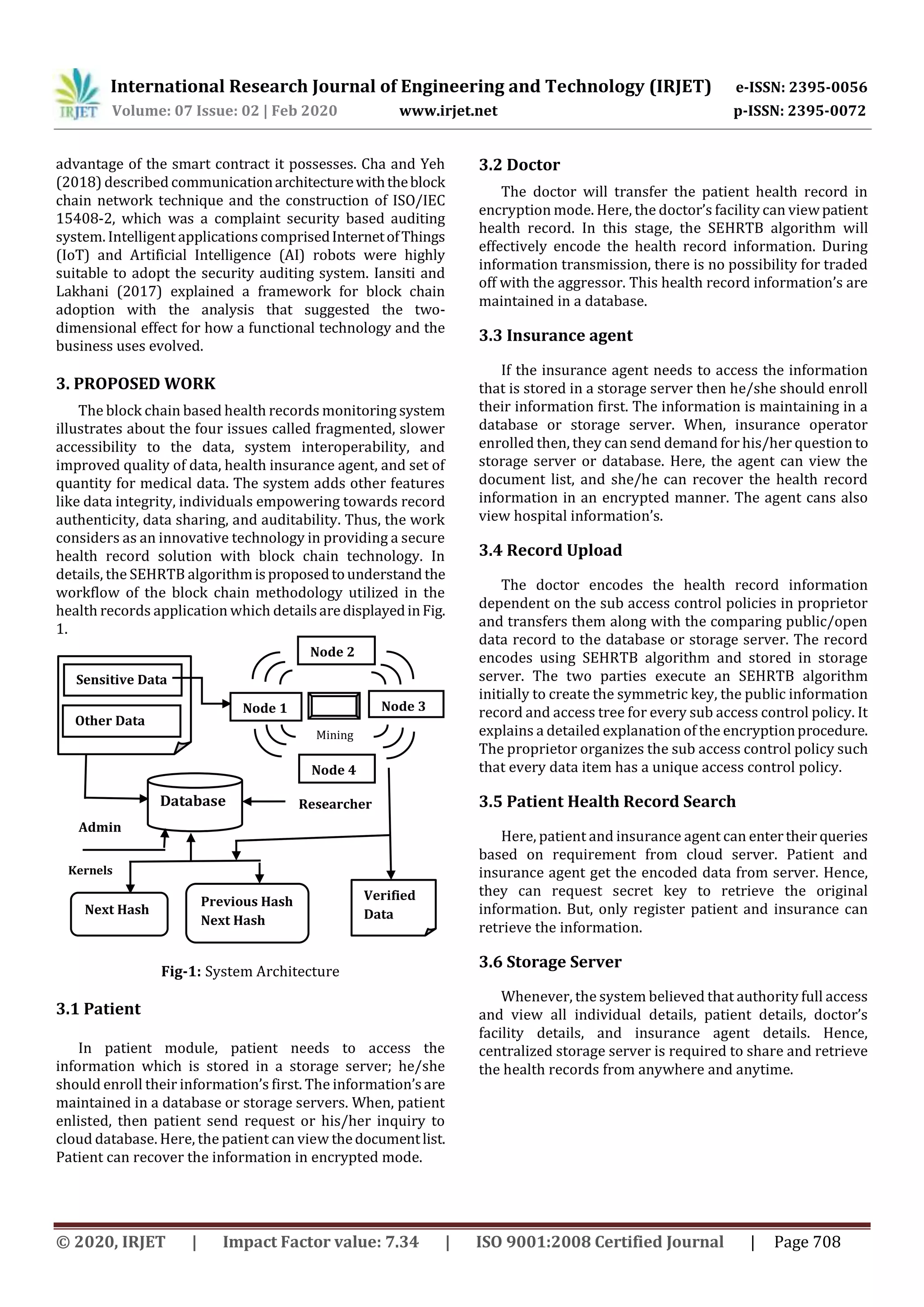
The block chain based health records monitoring system
illustrates about the four issues called fragmented, slower
accessibility to the data, system interoperability, and
improved quality of data, health insurance agent, and set of
quantity for medical data. The system adds other features
like data integrity, individuals empowering towards record
authenticity, data sharing, and auditability. Thus, the work
considers as an innovative technology in providing a secure
health record solution with block chain technology. In
details, the SEHRTB algorithmisproposedtounderstand the
workflow of the block chain methodology utilized in the
health records application which detailsaredisplayedinFig.
1.
Fig-1: System Architecture
3.1 Patient
In patient module, patient needs to access the
information which is stored in a storage server; he/she
should enroll their information’s first. The information’sare
maintained in a database or storage servers. When, patient
enlisted, then patient send request or his/her inquiry to
cloud database. Here, the patient can view thedocumentlist.
Patient can recover the information in encrypted mode.
3.2 Doctor
The doctor will transfer the patient health record in
encryption mode. Here, the doctor’s facility can viewpatient
health record. In this stage, the SEHRTB algorithm will
effectively encode the health record information. During
information transmission, there is no possibility for traded
off with the aggressor. This health record information’s are
maintained in a database.
3.3 Insurance agent
If the insurance agent needs to access the information
that is stored in a storage server then he/she should enroll
their information first. The information is maintaining in a
database or storage server. When, insurance operator
enrolled then, they can send demand for his/her question to
storage server or database. Here, the agent can view the
document list, and she/he can recover the health record
information in an encrypted manner. The agent cans also
view hospital information’s.
3.4 Record Upload
The doctor encodes the health record information
dependent on the sub access control policies in proprietor
and transfers them along with the comparing public/open
data record to the database or storage server. The record
encodes using SEHRTB algorithm and stored in storage
server. The two parties execute an SEHRTB algorithm
initially to create the symmetric key, the public information
record and access tree for every sub access control policy. It
explains a detailed explanation of the encryptionprocedure.
The proprietor organizes the sub access control policy such
that every data item has a unique access control policy.
3.5 Patient Health Record Search
Here, patient and insurance agent can entertheir queries
based on requirement from cloud server. Patient and
insurance agent get the encoded data from server. Hence,
they can request secret key to retrieve the original
information. But, only register patient and insurance can
retrieve the information.
3.6 Storage Server
Whenever, the system believed that authority full access
and view all individual details, patient details, doctor’s
facility details, and insurance agent details. Hence,
centralized storage server is required to share and retrieve
the health records from anywhere and anytime.
Node 4
Sensitive Data
Other Data
Node 2
Node 1 Node 3
Database
Next Hash
Previous Hash
Next Hash
Verified
Data
Admin
Researcher
Mining
Kernels
International Research Journal of Engineering and Technology (IRJET) e-ISSN: 2395-0056
Volume: 07 Issue: 02 | Feb 2020 www.irjet.net p-ISSN: 2395-0072
© 2020, IRJET | Impact Factor value: 7.34 | ISO 9001:2008 Certified Journal | Page 709
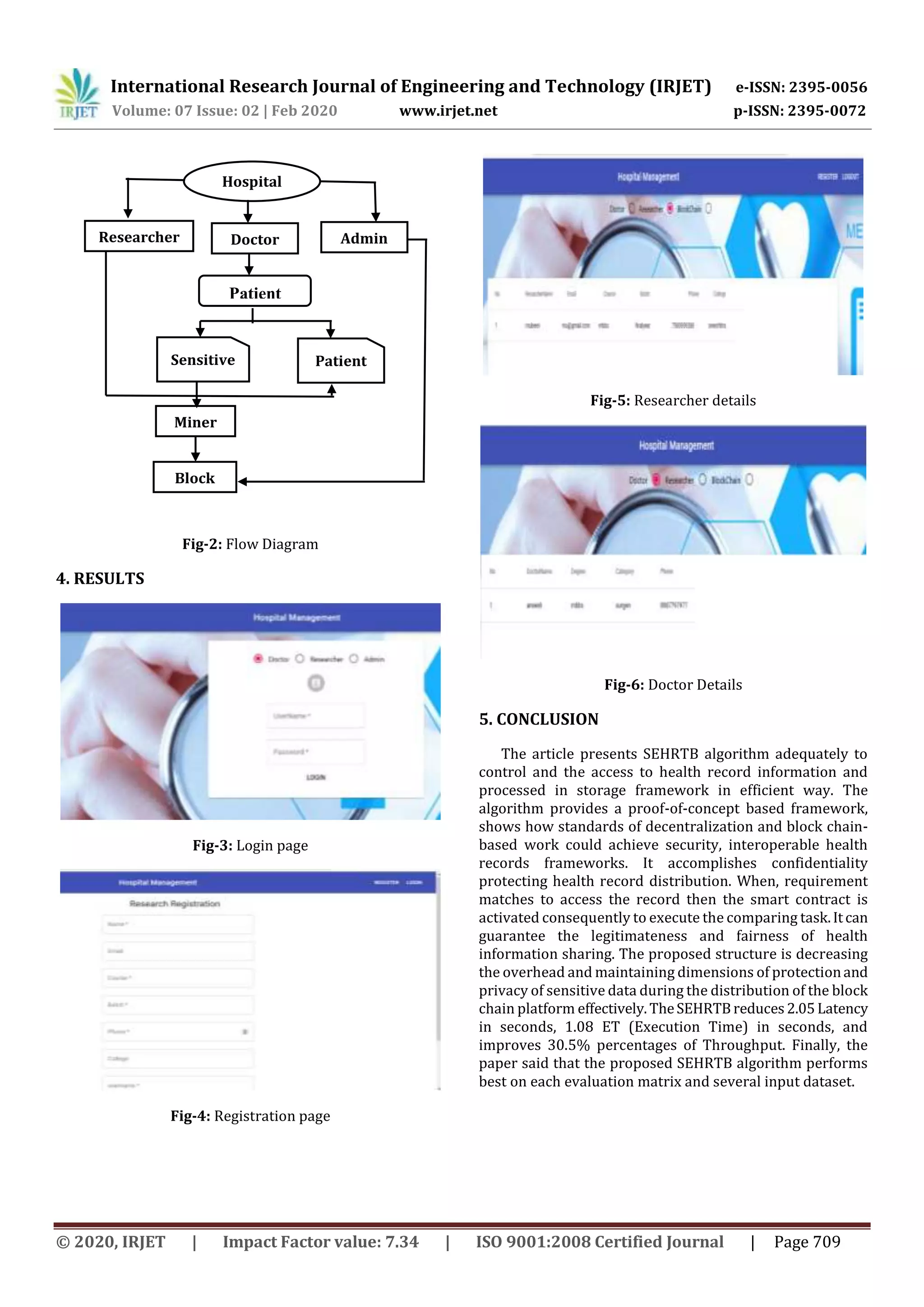
Fig-2: Flow Diagram
4. RESULTS
Fig-3: Login page
Fig-4: Registration page
Fig-5: Researcher details
Fig-6: Doctor Details
5. CONCLUSION
The article presents SEHRTB algorithm adequately to
control and the access to health record information and
processed in storage framework in efficient way. The
algorithm provides a proof-of-concept based framework,
shows how standards of decentralization and block chain-
based work could achieve security, interoperable health
records frameworks. It accomplishes confidentiality
protecting health record distribution. When, requirement
matches to access the record then the smart contract is
activated consequently to execute the comparing task.Itcan
guarantee the legitimateness and fairness of health
information sharing. The proposed structure is decreasing
the overhead and maintaining dimensions of protectionand
privacy of sensitive data during the distribution of the block
chain platform effectively.TheSEHRTBreduces2.05Latency
in seconds, 1.08 ET (Execution Time) in seconds, and
improves 30.5% percentages of Throughput. Finally, the
paper said that the proposed SEHRTB algorithm performs
best on each evaluation matrix and several input dataset.
Hospital
Researcher Doctor Admin
Patient
Sensitive Patient
Miner
Block
International Research Journal of Engineering and Technology (IRJET) e-ISSN: 2395-0056
Volume: 07 Issue: 02 | Feb 2020 www.irjet.net p-ISSN: 2395-0072
© 2020, IRJET | Impact Factor value: 7.34 | ISO 9001:2008 Certified Journal | Page 710
REFERENCES
[1] Aitzhan NZ, Svetinovic D (2016) Security and
privacy in decentralized energy trading through
multi-signatures, block chain, and anonymous
messaging streams. IEEE Trans Dependable Secure
Comput 15(5):840–852. https
://doi.org/10.1109/TDSC.2016.26168 61.
[2] Iansiti M, Lakhani KR (2017) The truth about block
chain. Harvard Business Rev 95(1):118–127.
[3] Kiayias A, Panagiotakos G (2015) Speed-security
tradeoffs in block chain protocols. IACR Cryptology
ePrint Archive, pp 1–19 Kosba A, Miller A, Shi E,
Wen Z, Papamanthou C (2016) Hawk: the block
chain model of cryptography and privacy-
preserving smart contracts. IEEE Symp Security
Privacy SP. https ://doi. org/10.1109/sp.2016.55.
[4] Qu C, Tao M, Zhang J, Hong X, Yuan R (2018) Block
chainbased credibility verification method for IoT
entities. Security Commun Netw. https
://doi.org/10.1155/2018/78176 14.
[5] Shafagh H, Burkhalter L, Hithnawi A, Duquennoy S
(2017) Towards block chain-based auditable
storage and sharing of IoT data. Proc Cloud Comput
Security Workshop. https
://doi.org/10.1145/31406 49.31406 56.
[6] Tian F (2016) An agri-food supplychaintraceability
system for China based on RFID and block chain
technology. Int Conf Service Syst Service Manag
ICSSSM. https
://doi.org/10.1109/ICSSSM.2016.75384 24.
[7] Tosh DK, Shetty S, Liang X, Kamhoua CA, Kwiat KA,
Njilla L (2017) Security implications of block chain
cloud with analysis of block withholding attack.
Proc IEEE/ACM Int Symp Cluster Cloud Grid
Comput. https ://doi.org/10.1109/CCGRI
D.2017.111.
[8] Vukolić M (2015) The quest for scalable block chain
fabric: proofof-work vs. BFT replication.
International Workshop on Open Problems in
Network Security, pp 112–125.
[9] Xu X, Weber I, Staples M, Zhu L, Bosch J, Bass L,
Rimba P (2017) A taxonomy of block chain-based
systems for architecture design.IEEEIntConf Softw
Archit ICSA. https ://doi.org/10.1109/
ICSA.2017.33.
[10] Yu X, Tan Y, Sun Z, Liu J, Liang C, Zhang Q (2019) A
fault-tolerant and energy-efficient continuous data
protection system. J Ambient Intell Hum Comput
10(8):2945–2954. https ://doi.org/10.1007/s1265
2-018-0726-2.
[11] Zheng Z, Xie S, Dai HN, Wang H (2016) Block chain
challenges and opportunities: a survey. Int J Web
Grid Serv 14(4):352–375. https
://doi.org/10.1504/IJWGS .2018.09564 7.
[12] Cha SC, Yeh KH (2018) An ISO/IEC 15408-2
compliant security auditing system with block chain
technology. IEEE Conf Commun Netw Security CNS.
https ://doi.org/10.1109/CNS.2018.84331 85.
[13] Christidis K, Devetsikiotis M (2016) block chains
and smart contracts for the internet of things. IEEE
Access. https ://doi.org/10.1109/ ACCES
S.2016.25663 39.
[14] D’Arienzo MP, Dudin AN, Dudin SA, ManzoR(2019)
Analysis of a retrial queue with group service of
impatient customers. J Ambient Intell Hum Comput.
https ://doi.org/10.1007/s1265 2-019-01318.
ANTO SAHAYA VINOTHA.D
Pursuing M.E in computer science
and Engineering at DMI
engineering college, Aralvoimozhi,
KanyaKumari, Tamilnadu.
MONISHA.G, currently working as
Assistant Professor, Department of
Computer Science & Engineeringat
DMI Engineering College,
Aralvoimozhi, Tamilnadu, India.
AUTHORS

IRJET - Health Record Transaction in Hospital Management using Blockchain

  • 1.
    International Research Journalof Engineering and Technology (IRJET) e-ISSN: 2395-0056 Volume: 07 Issue: 02 | Feb 2020 www.irjet.net p-ISSN: 2395-0072 © 2020, IRJET | Impact Factor value: 7.34 | ISO 9001:2008 Certified Journal | Page 707 Health Record Transaction in Hospital Management Using Blockchain D. Anto Sahaya Vinotha1, G.Monisha2 1PG Student, Department of CSE, DMI Engineering College, Tamilnadu, India 2Assistant Professor, Computer Science & Engg., DMI Engineering College, Tamilnadu, India ---------------------------------------------------------------------***---------------------------------------------------------------------- Abstract - In recent years, the block chain innovation considered as versatile contrastedwith differentprocedures. A significant number of the business, understanding the block chain innovation is using for monetaryadministrationsandits exchanges yet it likewise successful in different divisions like social insurance industry. Existing strategies are unsafe; where, information put away in untouchable servers may be listened stealthily, taken, orrealway. Allthingsconsidered, the reliability of capacity server design endless supply of single specialist organization. The security supervisor's identify which are client(s) can get to a particular piece of the information. Be that as it may, the current strategy is progressively neglected to keep up get to control, record exchange validations with unknown interferences. The paper proposes a safe and proficient wellbeing record exchange using square chain (SEHRTB) calculation for tending to wellbeing record data exchange between the patient, specialist, specialist organizations, and establishments in a protection safeguarding way. The work furnishes a human services area with square chain innovation. In medicinal services, the work empowers the patient to control and share their wellbeing record into distributed storage effectively in a verified way with no infringement of protection. It gives a compelling method to guarantee the patient information secretly in wise social insurance frameworks. Thepapershows the framework worked in a decentralized processing framework to guarantee confided in outsider for leading calculation over patient informationwithout disregardingthe security. In light of Experimental outcome, the SEHRTB calculation lessens 2.05 dormancy, 1.08 ET (execution time), and improves 30.5% throughput thought about than existing methodologies. Key Words: Block chain technology, Health records, Privacy, Latency, Execution time, Throughput, Secure and efficient health record transaction utilizing block chain (SEHRTB) algorithm. 1. INTRODUCTION Block chain has gotten a genuine promotion and inspiration in the innovation than some other system. The block chain has begun its new upheaval in innovation,which will have at any rate as significant an impact on society as the innovative advancement. Block chain was at first made for the advanced cash Bitcoin and first depicted by Satoshi Nakamoto's whitepaper in 2008. In the record, Nakamoto particularly brings up the difficulties that happen in proprietorship related to cutting edge computerized money related frames and creates a few arrangements using a square chain going before the exchanges. The possession testing lies in uniting all essential data in a solitarydatabase, which is further conveyed openly.Thedatabaseisn't worked with any different proprietorship however at the same time possessed by everybody. The database was decentralized and made accessible to all gatherings included. 1.1 BLOCK CHAIN The idea of Blockchain first came to distinction in October 2008, as a feature of a proposition for Bitcoin, with the plan to make P2P cash withoutbanks.Bitcoinacquainted a novel arrangement with the deep rooted human issue of trust. The basic blockchain innovation enables us to confide in the yields of the framework without confiding in any entertainer inside it. Individuals and organizations who don't have the foggiest idea or trust one another, dwell in various nations, aredependentuponvariouswards,andwho have no lawfully authoritative concurrences with one another, would now be able to interface over the Internet without the requirement for believed outsiders like banks, Internet stages, or different sorts of clearingestablishments. In any case, the Bitcoin white paper didn't leave slender air, and P2P systems are not another wonder. They are established in the early history of the PC and Internet, expanding on many years of research of PC systems, cryptography, and game hypothesis (see Appendix: Origins of Bitcoin). The Bitcoin white paper settled the issue of incorporated information stockpiling and data theboard. All PCs in the system hold an indistinguishable duplicate of the record of exchanges, which goes about as a solitary perspective. Putting away information over a P2P organize takes out issues emerging from the powerlessness of concentrated servers while utilizing distinctive cryptographic strategies to verify the system. 2. PROBLEM DEFINITION The block chain technology is highly utilized in many sectors like Internet of Things (IoT), finances, protectionand many. Various public sectors and private businesses relied highly on the block chain technology in building the IoT system. Huh et al. (2017) managed the IoT system with the block chain technology by framing the keys in RSApublickey cryptography systems. The work stored the public keys and privatekeys in Ethereumandindividualdevicesrespectively. Where, the Ethereum was a distributed computing platform, an open source for block chain technology due to the
  • 2.
    International Research Journalof Engineering and Technology (IRJET) e-ISSN: 2395-0056 Volume: 07 Issue: 02 | Feb 2020 www.irjet.net p-ISSN: 2395-0072 © 2020, IRJET | Impact Factor value: 7.34 | ISO 9001:2008 Certified Journal | Page 708 advantage of the smart contract it possesses. Cha and Yeh (2018) described communicationarchitecturewiththeblock chain network technique and the construction of ISO/IEC 15408-2, which was a complaint security based auditing system. Intelligent applications comprisedInternetofThings (IoT) and Artificial Intelligence (AI) robots were highly suitable to adopt the security auditing system. Iansiti and Lakhani (2017) explained a framework for block chain adoption with the analysis that suggested the two- dimensional effect for how a functional technology and the business uses evolved. 3. PROPOSED WORK The block chain based health records monitoring system illustrates about the four issues called fragmented, slower accessibility to the data, system interoperability, and improved quality of data, health insurance agent, and set of quantity for medical data. The system adds other features like data integrity, individuals empowering towards record authenticity, data sharing, and auditability. Thus, the work considers as an innovative technology in providing a secure health record solution with block chain technology. In details, the SEHRTB algorithmisproposedtounderstand the workflow of the block chain methodology utilized in the health records application which detailsaredisplayedinFig. 1. Fig-1: System Architecture 3.1 Patient In patient module, patient needs to access the information which is stored in a storage server; he/she should enroll their information’s first. The information’sare maintained in a database or storage servers. When, patient enlisted, then patient send request or his/her inquiry to cloud database. Here, the patient can view thedocumentlist. Patient can recover the information in encrypted mode. 3.2 Doctor The doctor will transfer the patient health record in encryption mode. Here, the doctor’s facility can viewpatient health record. In this stage, the SEHRTB algorithm will effectively encode the health record information. During information transmission, there is no possibility for traded off with the aggressor. This health record information’s are maintained in a database. 3.3 Insurance agent If the insurance agent needs to access the information that is stored in a storage server then he/she should enroll their information first. The information is maintaining in a database or storage server. When, insurance operator enrolled then, they can send demand for his/her question to storage server or database. Here, the agent can view the document list, and she/he can recover the health record information in an encrypted manner. The agent cans also view hospital information’s. 3.4 Record Upload The doctor encodes the health record information dependent on the sub access control policies in proprietor and transfers them along with the comparing public/open data record to the database or storage server. The record encodes using SEHRTB algorithm and stored in storage server. The two parties execute an SEHRTB algorithm initially to create the symmetric key, the public information record and access tree for every sub access control policy. It explains a detailed explanation of the encryptionprocedure. The proprietor organizes the sub access control policy such that every data item has a unique access control policy. 3.5 Patient Health Record Search Here, patient and insurance agent can entertheir queries based on requirement from cloud server. Patient and insurance agent get the encoded data from server. Hence, they can request secret key to retrieve the original information. But, only register patient and insurance can retrieve the information. 3.6 Storage Server Whenever, the system believed that authority full access and view all individual details, patient details, doctor’s facility details, and insurance agent details. Hence, centralized storage server is required to share and retrieve the health records from anywhere and anytime. Node 4 Sensitive Data Other Data Node 2 Node 1 Node 3 Database Next Hash Previous Hash Next Hash Verified Data Admin Researcher Mining Kernels
  • 3.
    International Research Journalof Engineering and Technology (IRJET) e-ISSN: 2395-0056 Volume: 07 Issue: 02 | Feb 2020 www.irjet.net p-ISSN: 2395-0072 © 2020, IRJET | Impact Factor value: 7.34 | ISO 9001:2008 Certified Journal | Page 709 Fig-2: Flow Diagram 4. RESULTS Fig-3: Login page Fig-4: Registration page Fig-5: Researcher details Fig-6: Doctor Details 5. CONCLUSION The article presents SEHRTB algorithm adequately to control and the access to health record information and processed in storage framework in efficient way. The algorithm provides a proof-of-concept based framework, shows how standards of decentralization and block chain- based work could achieve security, interoperable health records frameworks. It accomplishes confidentiality protecting health record distribution. When, requirement matches to access the record then the smart contract is activated consequently to execute the comparing task.Itcan guarantee the legitimateness and fairness of health information sharing. The proposed structure is decreasing the overhead and maintaining dimensions of protectionand privacy of sensitive data during the distribution of the block chain platform effectively.TheSEHRTBreduces2.05Latency in seconds, 1.08 ET (Execution Time) in seconds, and improves 30.5% percentages of Throughput. Finally, the paper said that the proposed SEHRTB algorithm performs best on each evaluation matrix and several input dataset. Hospital Researcher Doctor Admin Patient Sensitive Patient Miner Block
  • 4.
    International Research Journalof Engineering and Technology (IRJET) e-ISSN: 2395-0056 Volume: 07 Issue: 02 | Feb 2020 www.irjet.net p-ISSN: 2395-0072 © 2020, IRJET | Impact Factor value: 7.34 | ISO 9001:2008 Certified Journal | Page 710 REFERENCES [1] Aitzhan NZ, Svetinovic D (2016) Security and privacy in decentralized energy trading through multi-signatures, block chain, and anonymous messaging streams. IEEE Trans Dependable Secure Comput 15(5):840–852. https ://doi.org/10.1109/TDSC.2016.26168 61. [2] Iansiti M, Lakhani KR (2017) The truth about block chain. Harvard Business Rev 95(1):118–127. [3] Kiayias A, Panagiotakos G (2015) Speed-security tradeoffs in block chain protocols. IACR Cryptology ePrint Archive, pp 1–19 Kosba A, Miller A, Shi E, Wen Z, Papamanthou C (2016) Hawk: the block chain model of cryptography and privacy- preserving smart contracts. IEEE Symp Security Privacy SP. https ://doi. org/10.1109/sp.2016.55. [4] Qu C, Tao M, Zhang J, Hong X, Yuan R (2018) Block chainbased credibility verification method for IoT entities. Security Commun Netw. https ://doi.org/10.1155/2018/78176 14. [5] Shafagh H, Burkhalter L, Hithnawi A, Duquennoy S (2017) Towards block chain-based auditable storage and sharing of IoT data. Proc Cloud Comput Security Workshop. https ://doi.org/10.1145/31406 49.31406 56. [6] Tian F (2016) An agri-food supplychaintraceability system for China based on RFID and block chain technology. Int Conf Service Syst Service Manag ICSSSM. https ://doi.org/10.1109/ICSSSM.2016.75384 24. [7] Tosh DK, Shetty S, Liang X, Kamhoua CA, Kwiat KA, Njilla L (2017) Security implications of block chain cloud with analysis of block withholding attack. Proc IEEE/ACM Int Symp Cluster Cloud Grid Comput. https ://doi.org/10.1109/CCGRI D.2017.111. [8] Vukolić M (2015) The quest for scalable block chain fabric: proofof-work vs. BFT replication. International Workshop on Open Problems in Network Security, pp 112–125. [9] Xu X, Weber I, Staples M, Zhu L, Bosch J, Bass L, Rimba P (2017) A taxonomy of block chain-based systems for architecture design.IEEEIntConf Softw Archit ICSA. https ://doi.org/10.1109/ ICSA.2017.33. [10] Yu X, Tan Y, Sun Z, Liu J, Liang C, Zhang Q (2019) A fault-tolerant and energy-efficient continuous data protection system. J Ambient Intell Hum Comput 10(8):2945–2954. https ://doi.org/10.1007/s1265 2-018-0726-2. [11] Zheng Z, Xie S, Dai HN, Wang H (2016) Block chain challenges and opportunities: a survey. Int J Web Grid Serv 14(4):352–375. https ://doi.org/10.1504/IJWGS .2018.09564 7. [12] Cha SC, Yeh KH (2018) An ISO/IEC 15408-2 compliant security auditing system with block chain technology. IEEE Conf Commun Netw Security CNS. https ://doi.org/10.1109/CNS.2018.84331 85. [13] Christidis K, Devetsikiotis M (2016) block chains and smart contracts for the internet of things. IEEE Access. https ://doi.org/10.1109/ ACCES S.2016.25663 39. [14] D’Arienzo MP, Dudin AN, Dudin SA, ManzoR(2019) Analysis of a retrial queue with group service of impatient customers. J Ambient Intell Hum Comput. https ://doi.org/10.1007/s1265 2-019-01318. ANTO SAHAYA VINOTHA.D Pursuing M.E in computer science and Engineering at DMI engineering college, Aralvoimozhi, KanyaKumari, Tamilnadu. MONISHA.G, currently working as Assistant Professor, Department of Computer Science & Engineeringat DMI Engineering College, Aralvoimozhi, Tamilnadu, India. AUTHORS