Modelling
the General Data Protection Regulation
Sushant Agarwal, Sabrina Kirrane and Johannes Scharf
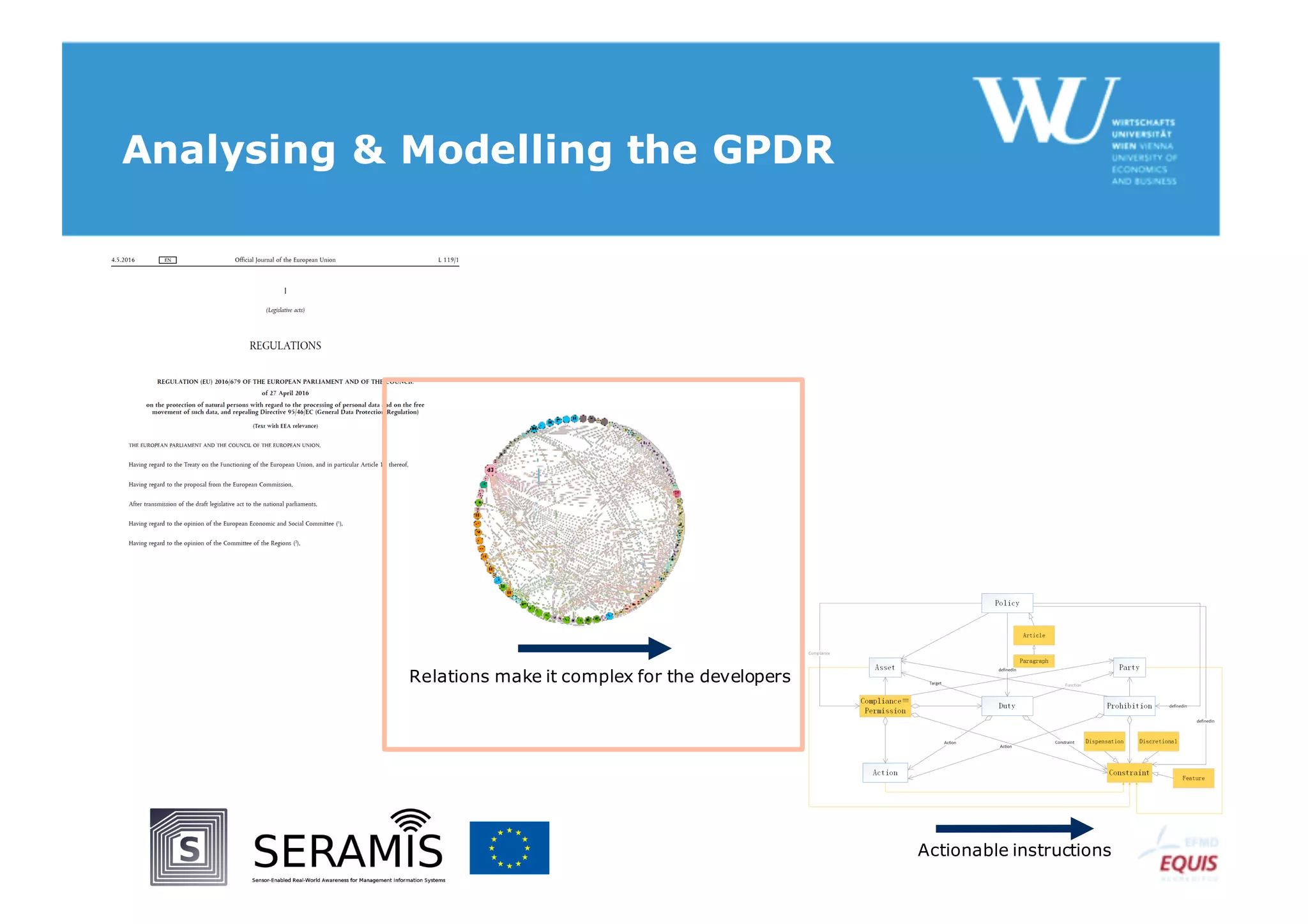
Analysing & Modelling the GPDR
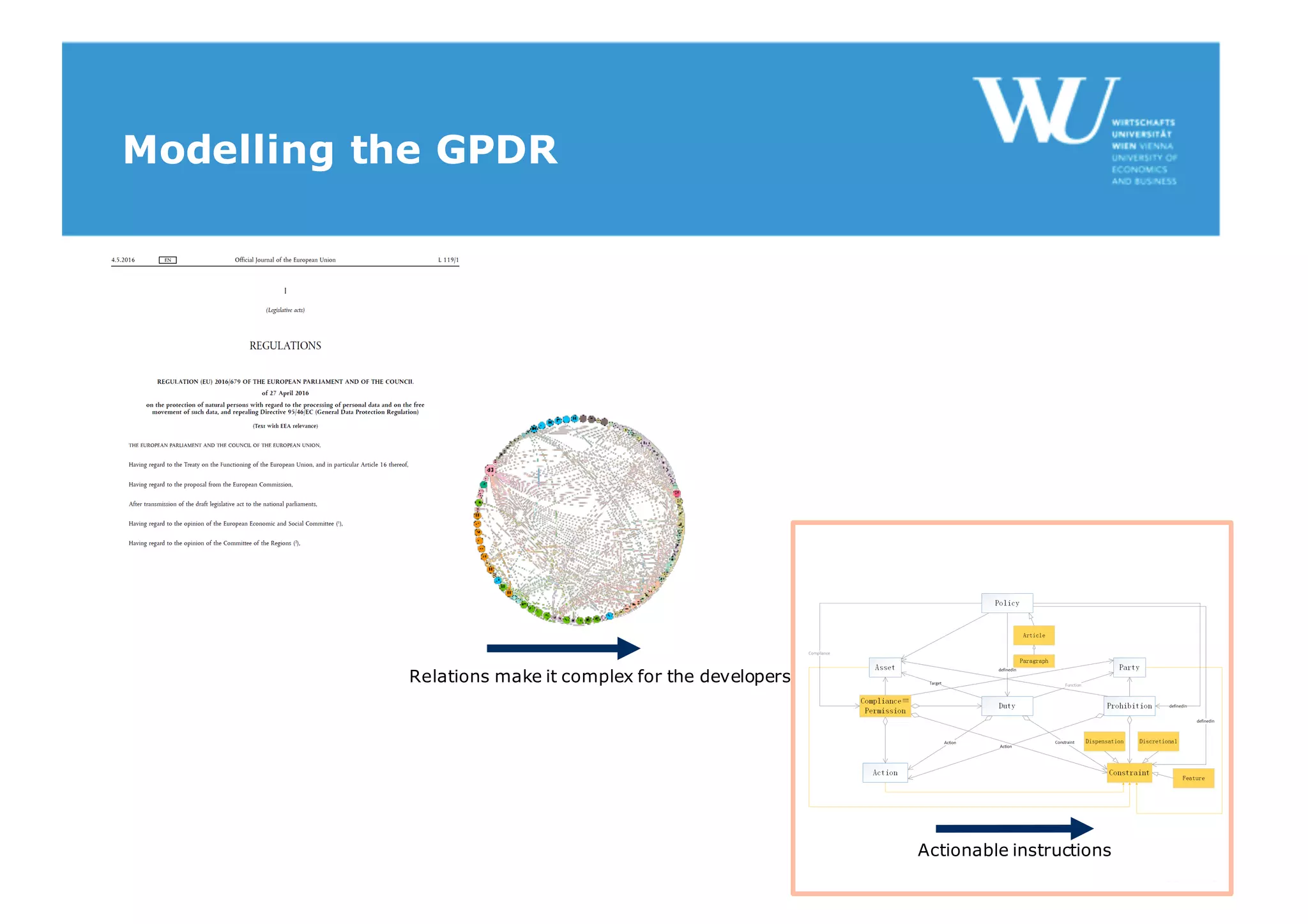
Relations make it complex for the developers
Actionable instructions
Analysing the GDPR
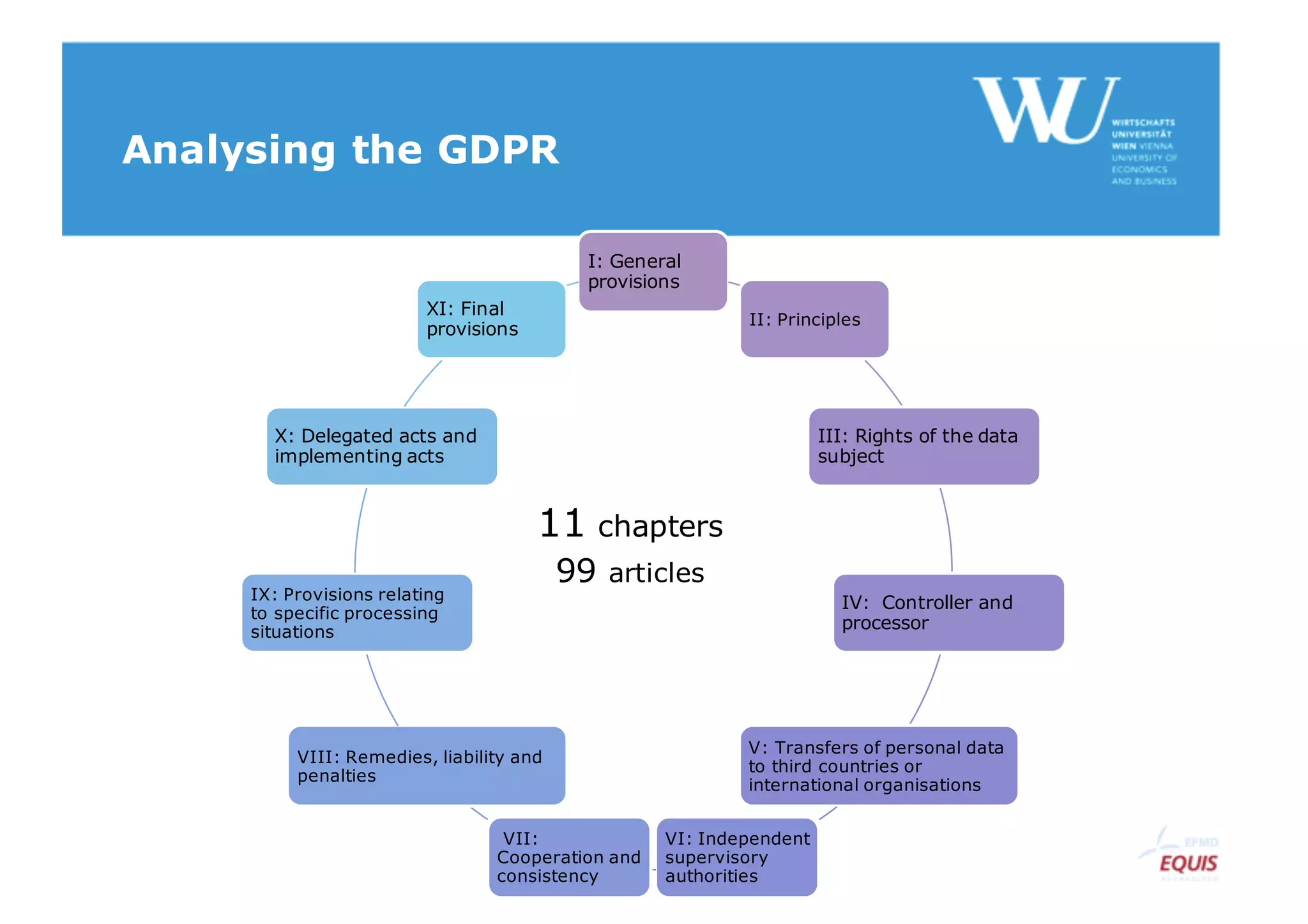
I: General
provisions
II: Principles
III: Rights of the data
subject
IV: Controller and
processor
V: Transfers of personal data
to third countries or
international organisations
VI: Independent
supervisory
authorities
VII:
Cooperation and
consistency
VIII: Remedies, liability and
penalties
IX: Provisions relating
to specific processing
situations
X: Delegated acts and
implementing acts
XI: Final
provisions
99 articles
11 chapters
Analysing the GDPR –
Articles are not Isolated
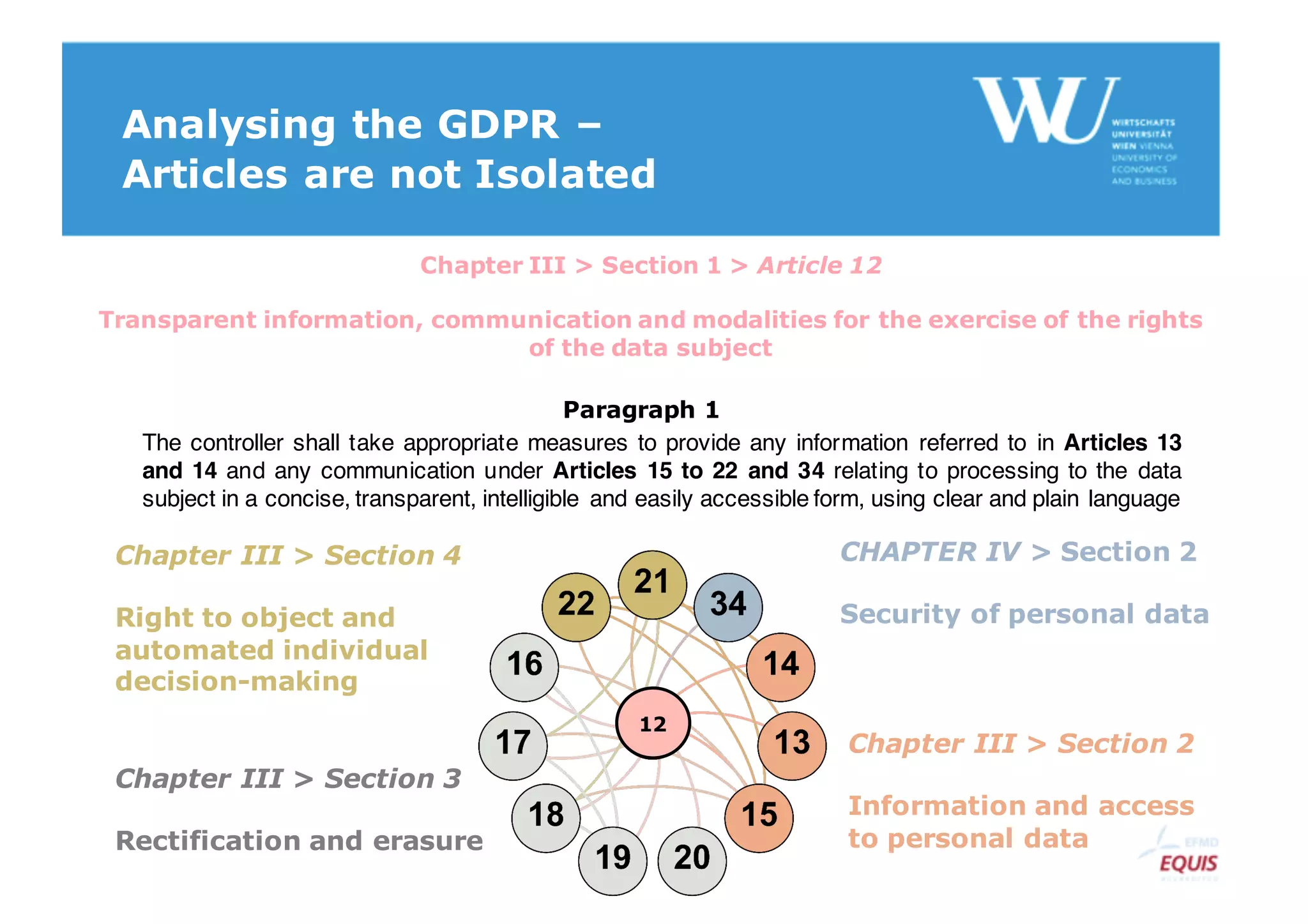
The controller shall take appropriate measures to provide any information referred to in Articles 13
and 14 and any communication under Articles 15 to 22 and 34 relating to processing to the data
subject in a concise, transparent, intelligible and easily accessible form, using clear and plain language
Paragraph 1
Chapter III > Section 1 > Article 12
Transparent information, communication and modalities for the exercise of the rights
of the data subject
12
Chapter III > Section 2
Information and access
to personal data
Chapter III > Section 3
Rectification and erasure
Chapter III > Section 4
Right to object and
automated individual
decision-making
CHAPTER IV > Section 2
Security of personal data
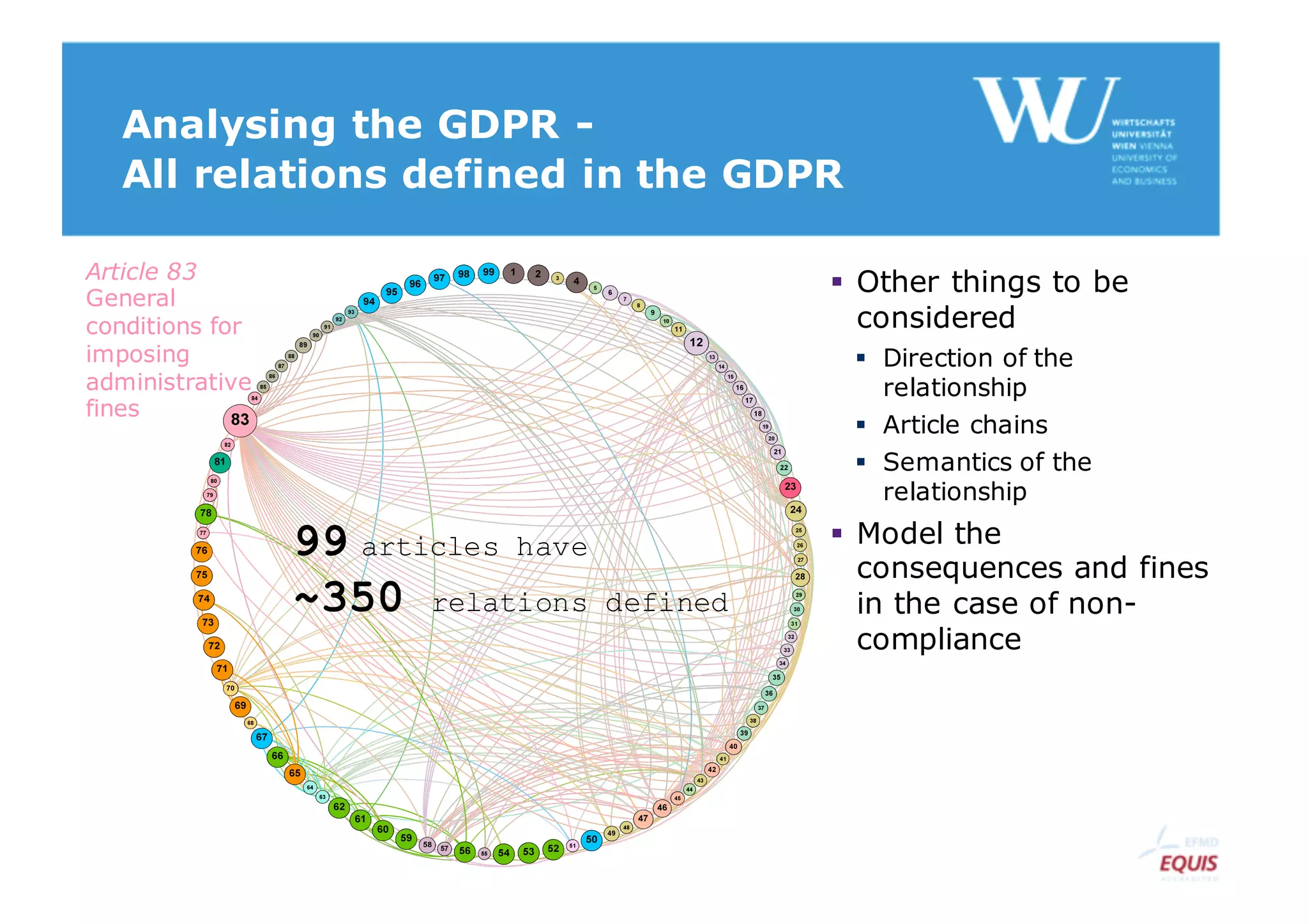
99 articles have
~350 relations defined
Analysing the GDPR -
All relations defined in the GDPR
§ Other things to be
considered
§ Direction of the
relationship
§ Article chains
§ Semantics of the
relationship
§ Model the
consequences and fines
in the case of non-
compliance
Article 83
General
conditions for
imposing
administrative
fines
Modelling the GPDR
Relations make it complex for the developers
Actionable instructions
Modelling the GDPR -
Open Digital Rights Language Model
ODRL designed
to define rules for the
publishing,distribution,
and consumption of
digital media.
Modelling the GDPR -
Open Digital Rights Language Model
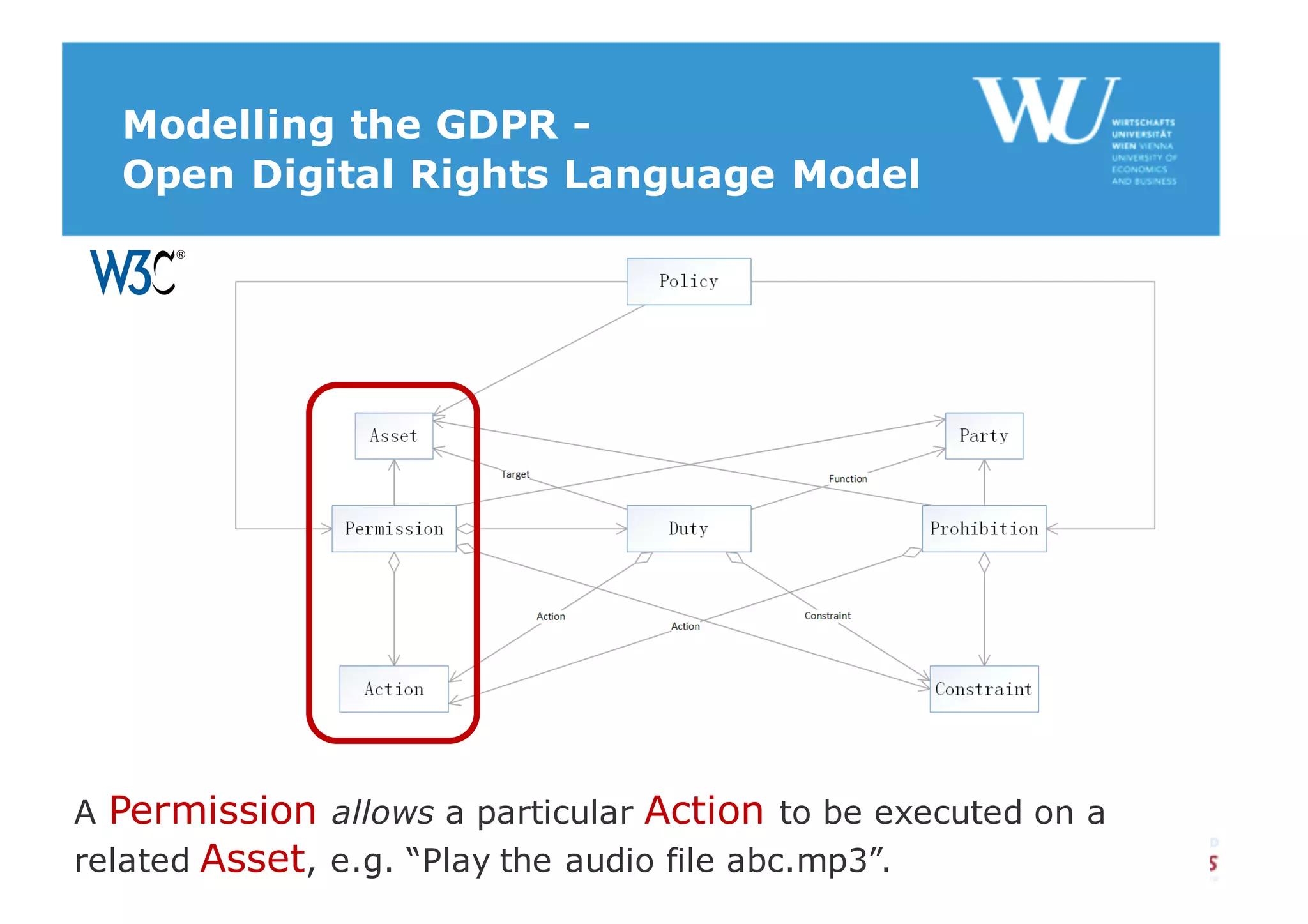
A Permission allows a particular Action to be executed on a
related Asset, e.g. “Play the audio file abc.mp3”.
Modelling the GDPR -
Open Digital Rights Language Model
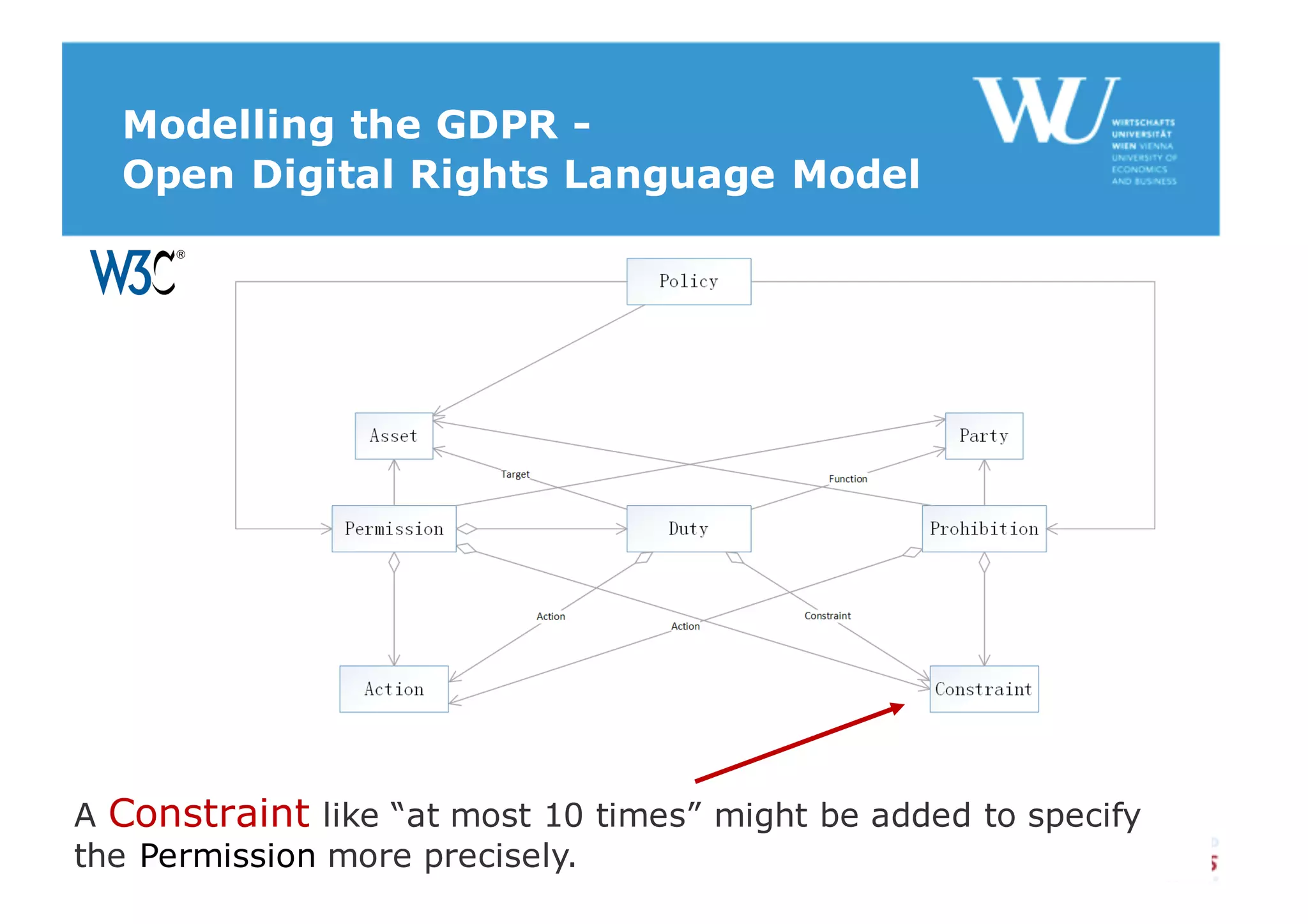
A Constraint like “at most 10 times” might be added to specify
the Permission more precisely.
Modelling the GDPR -
Open Digital Rights Language Model
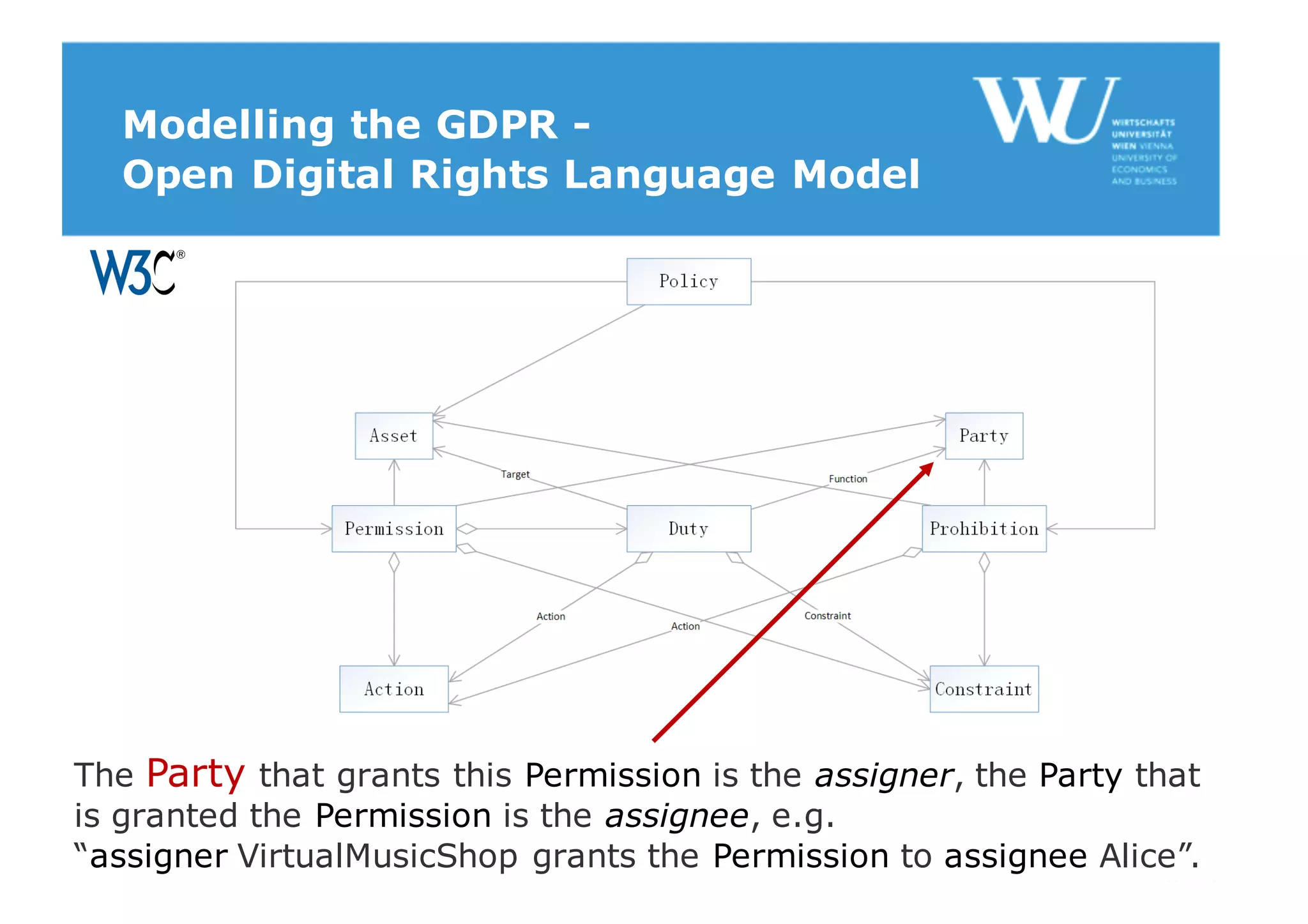
The Party that grants this Permission is the assigner, the Party that
is granted the Permission is the assignee, e.g.
“assigner VirtualMusicShop grants the Permission to assignee Alice”.
Modelling the GDPR -
Open Digital Rights Language Model
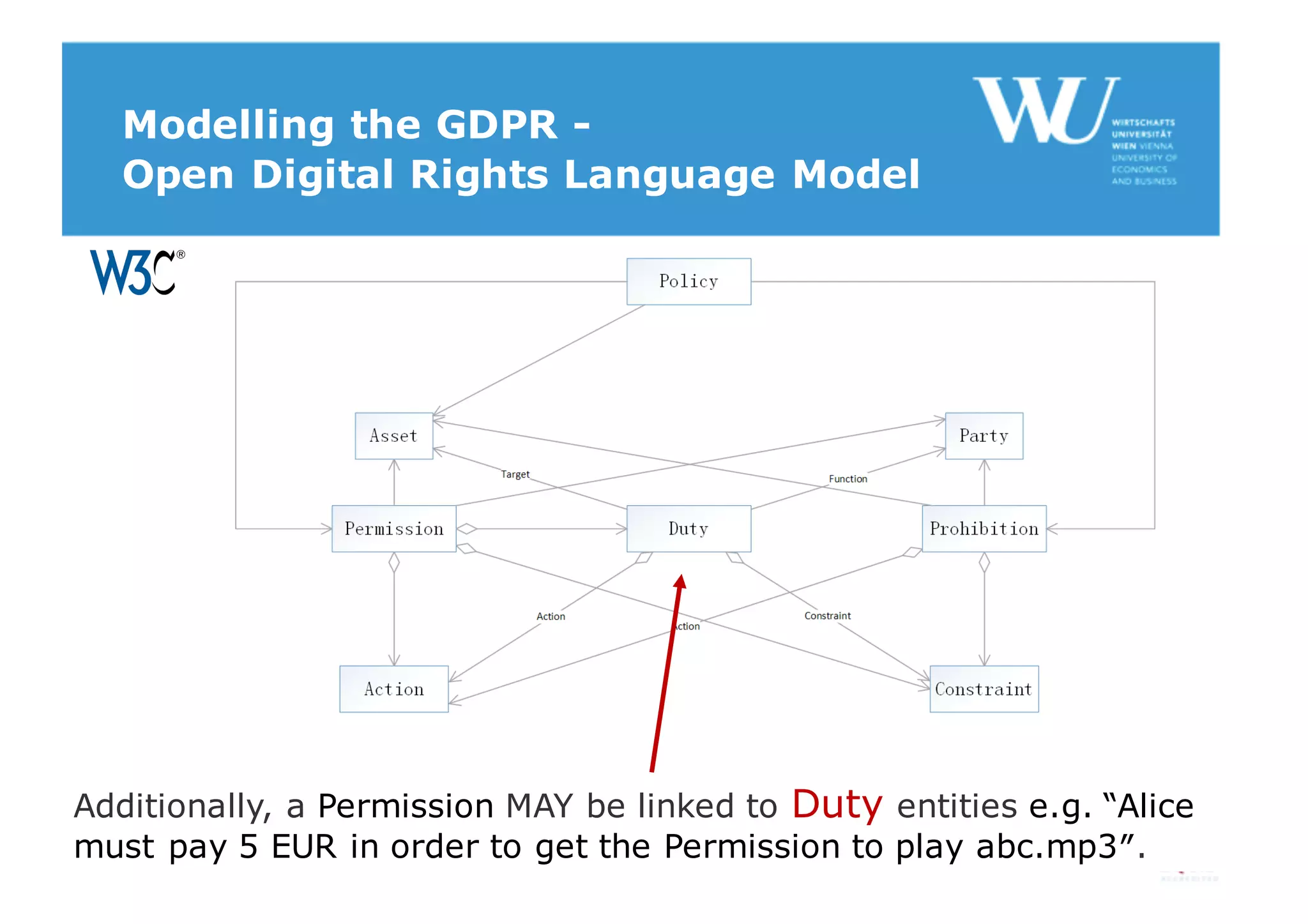
Additionally, a Permission MAY be linked to Duty entities e.g. “Alice
must pay 5 EUR in order to get the Permission to play abc.mp3″.
Modelling the GDPR -
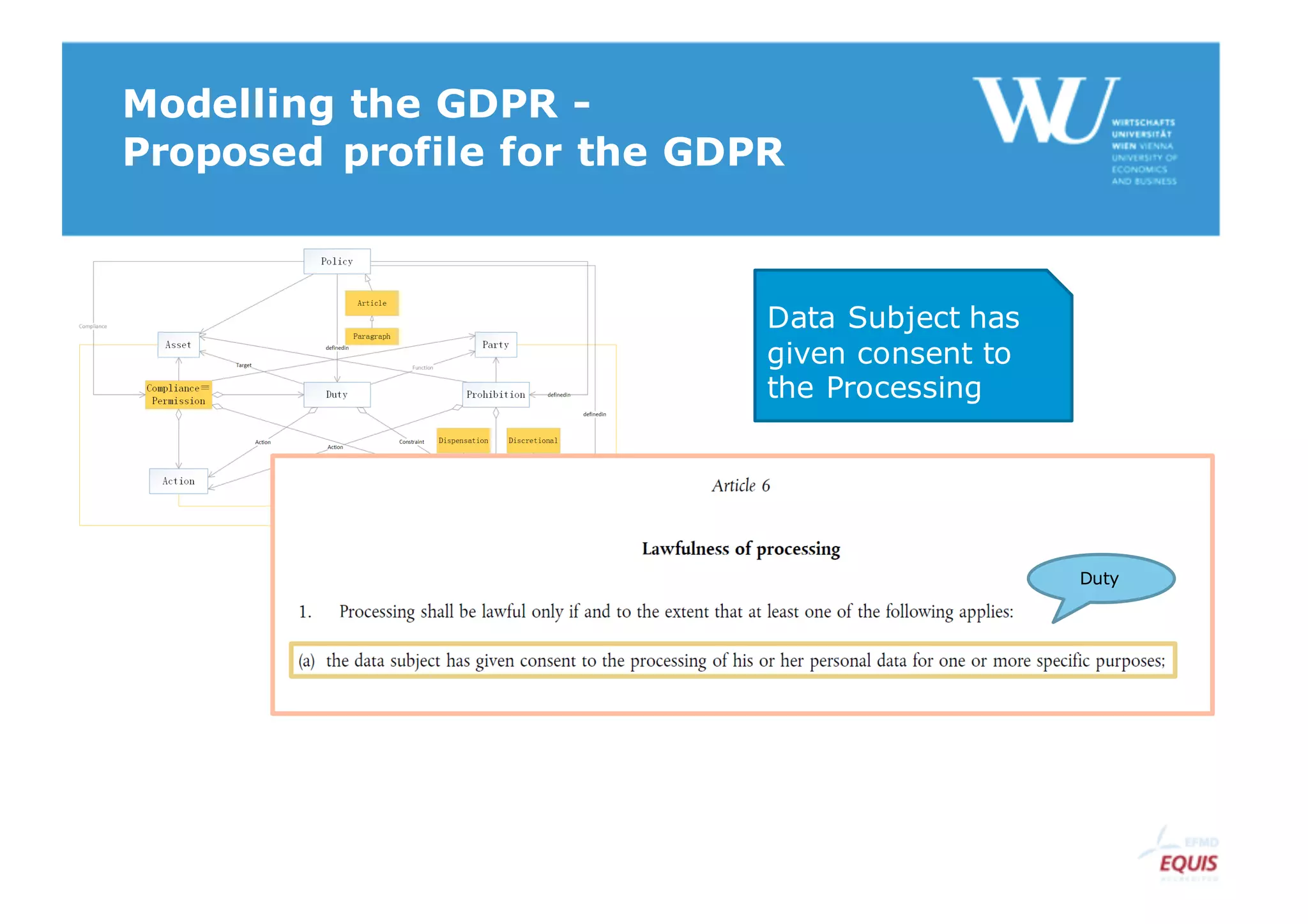
Proposed profile for the GDPR
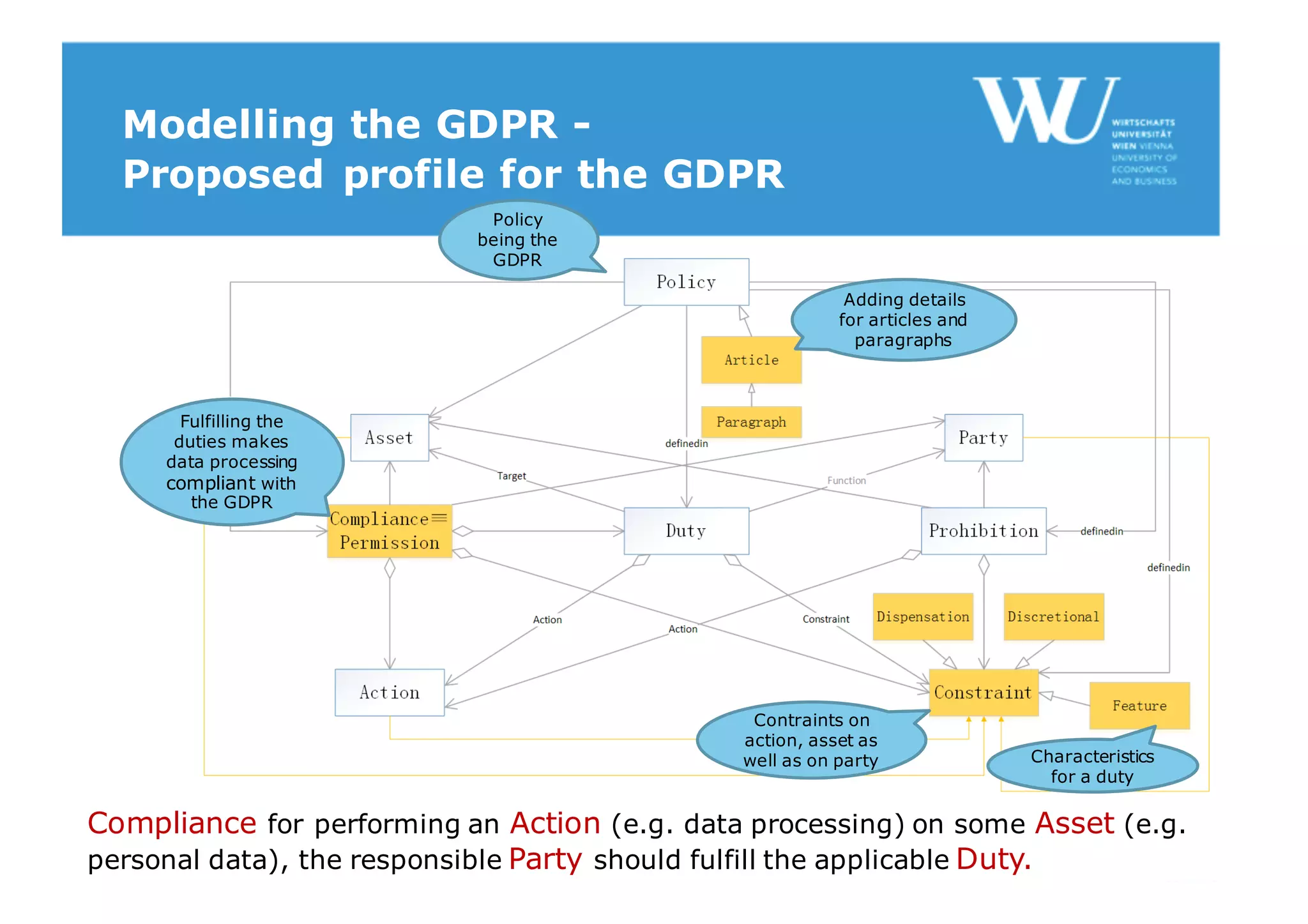
Policy
being the
GDPR
Adding details
for articles and
paragraphs
Characteristics
for a duty
Fulfilling the
duties makes
data processing
compliant with
the GDPR
Contraints on
action, asset as
well as on party
Compliance for performing an Action (e.g. data processing) on some Asset (e.g.
personal data), the responsible Party should fulfill the applicable Duty.
Modelling the GDPR -
Proposed profile for the GDPR
Duty
Data Subject has
given consent to
the Processing
Modelling the GDPR -
Proposed profile for the GDPR
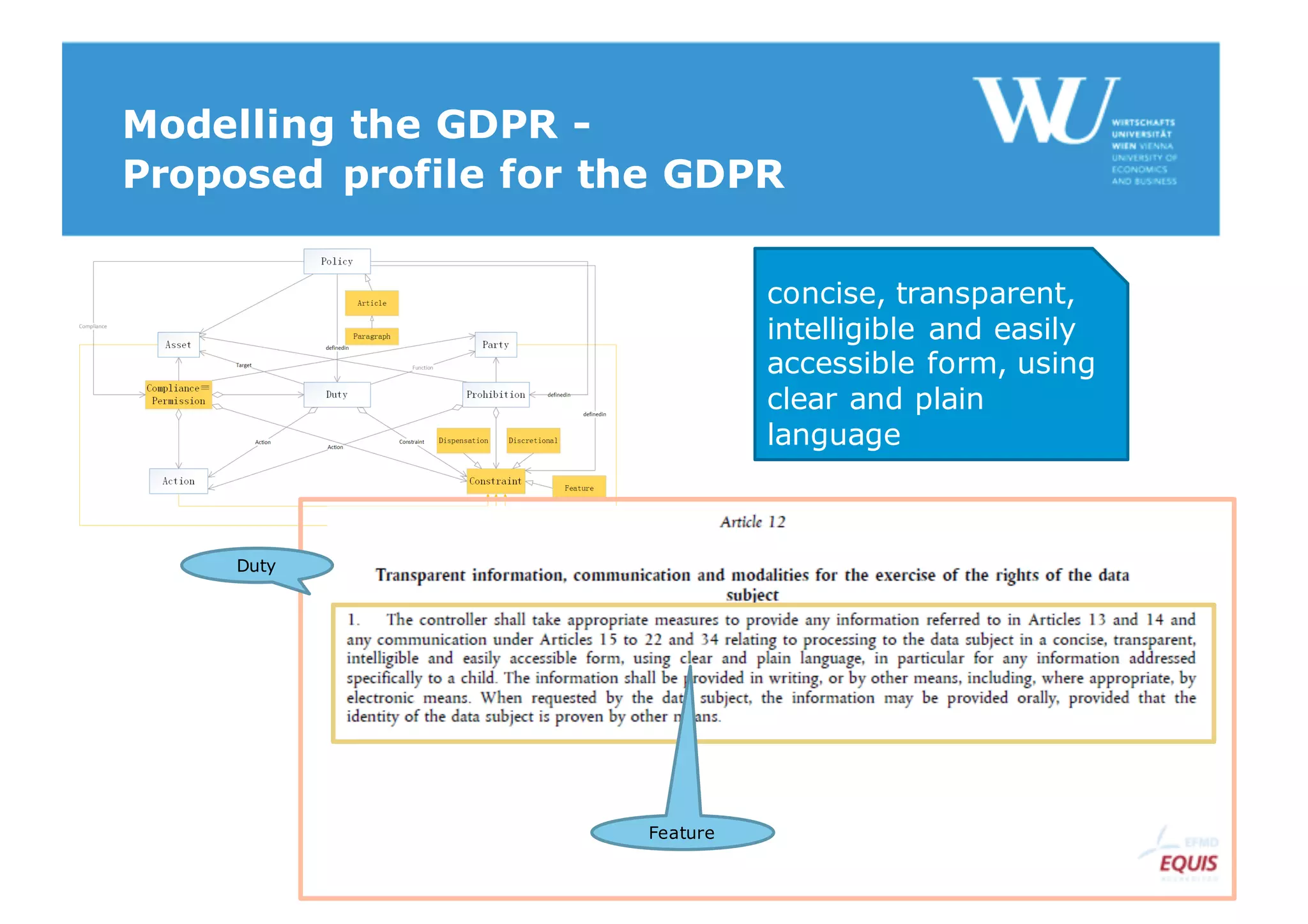
Duty
concise, transparent,
intelligible and easily
accessible form, using
clear and plain
language
Feature
Modelling the GDPR -
Proposed profile for the GDPR
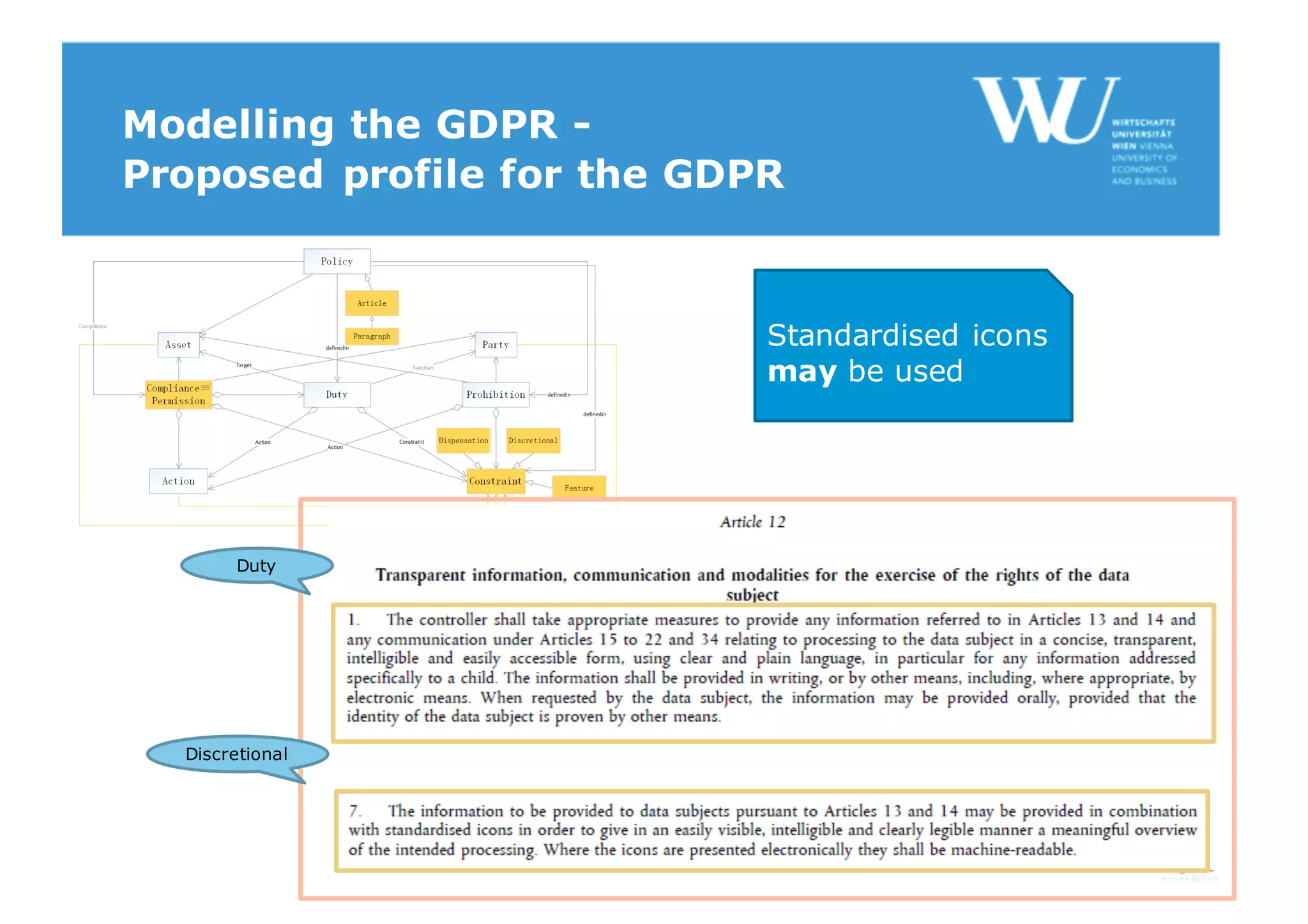
Discretional
Duty
Standardised icons
may be used
Modelling the GDPR -
Proposed profile for the GDPR
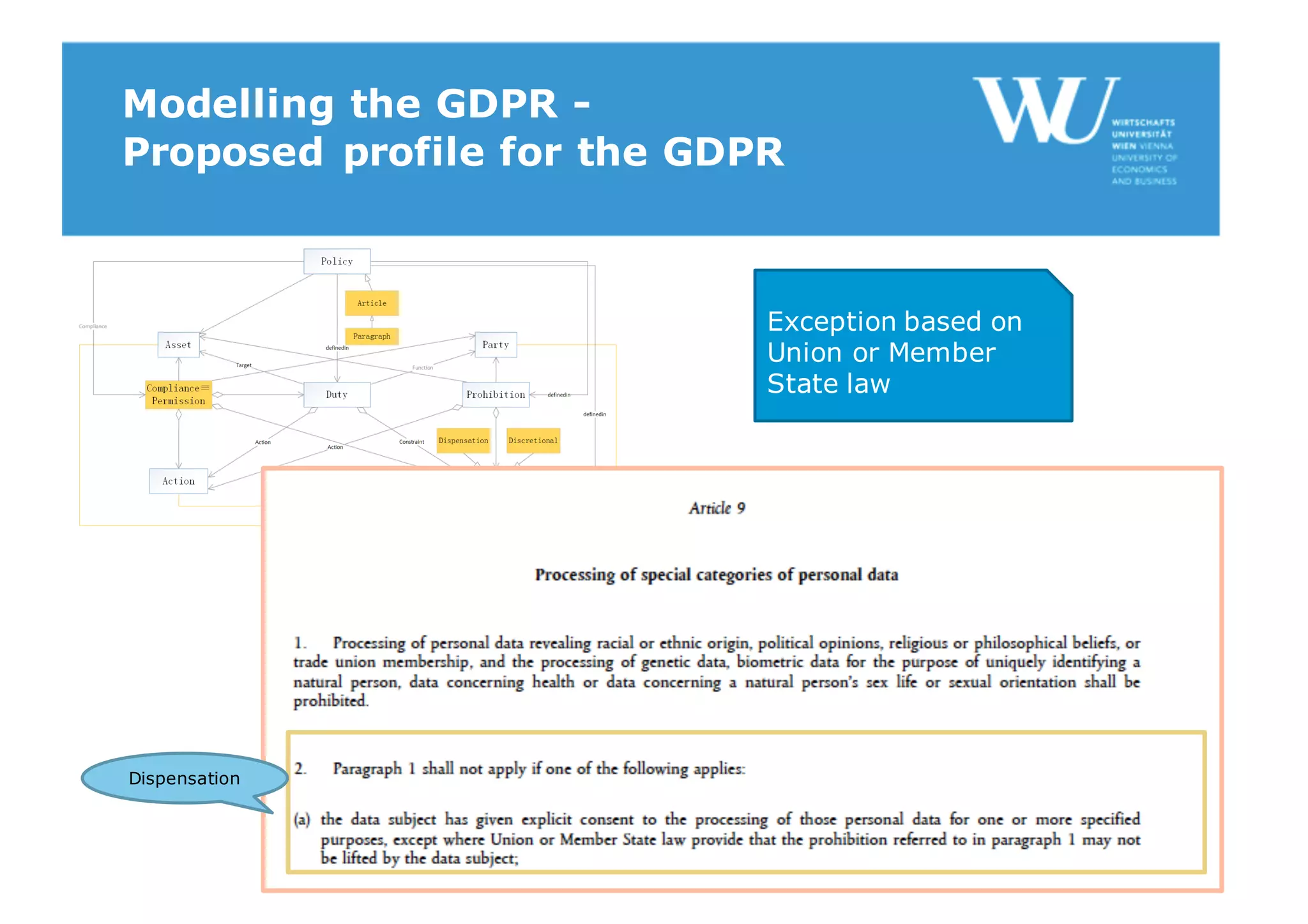
Dispensation
Exception based on
Union or Member
State law
Modelling the GDPR -
Proposed profile for the GDPR
§ Not all of the 99 articles define obligations (e.g. objectives,
definitions, GDPR’s entry into force etc.)
§ We also omit articles defining obligations for other parties like
the Supervisory Authorities and European Data Protection Board
can be neglected.
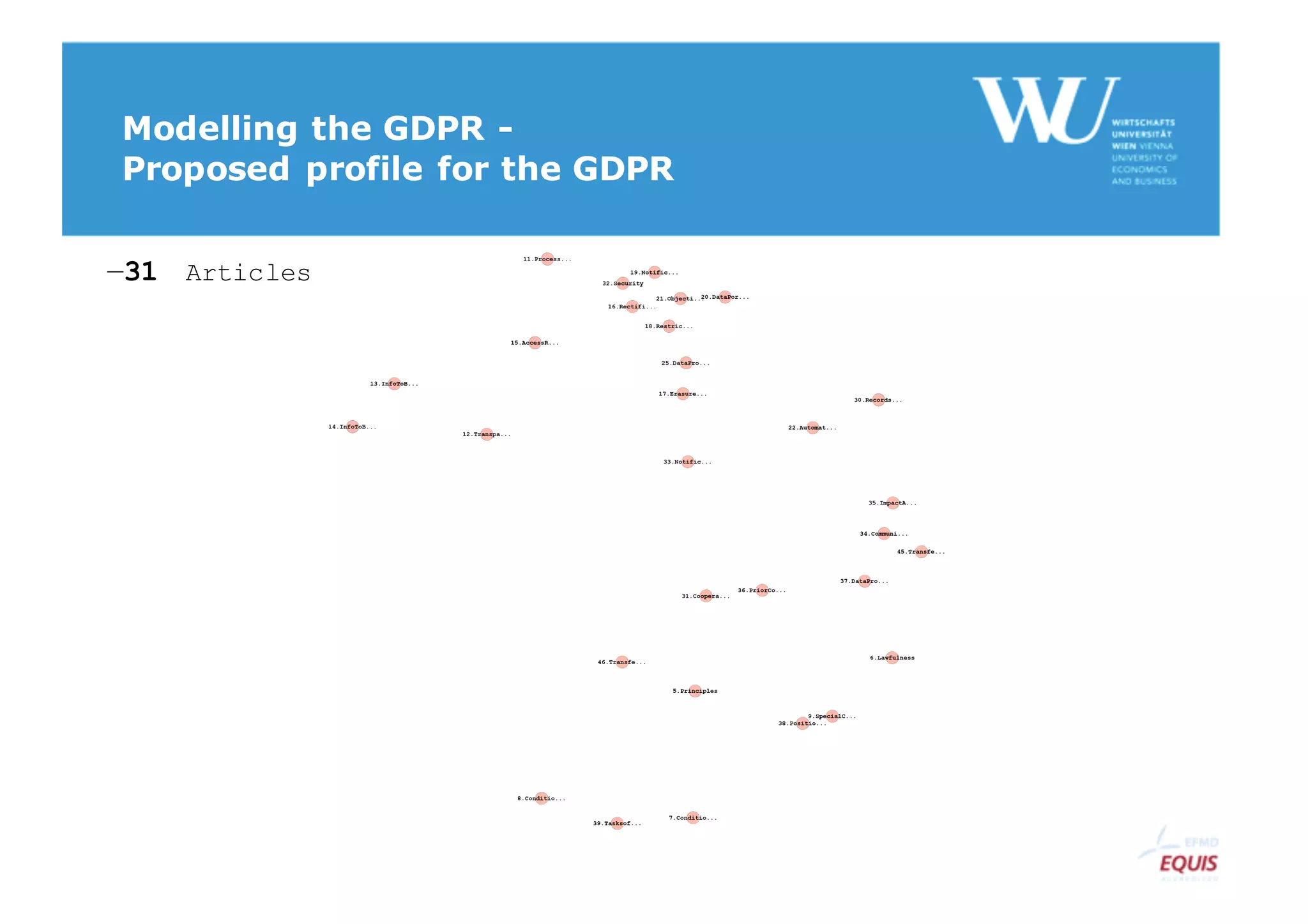
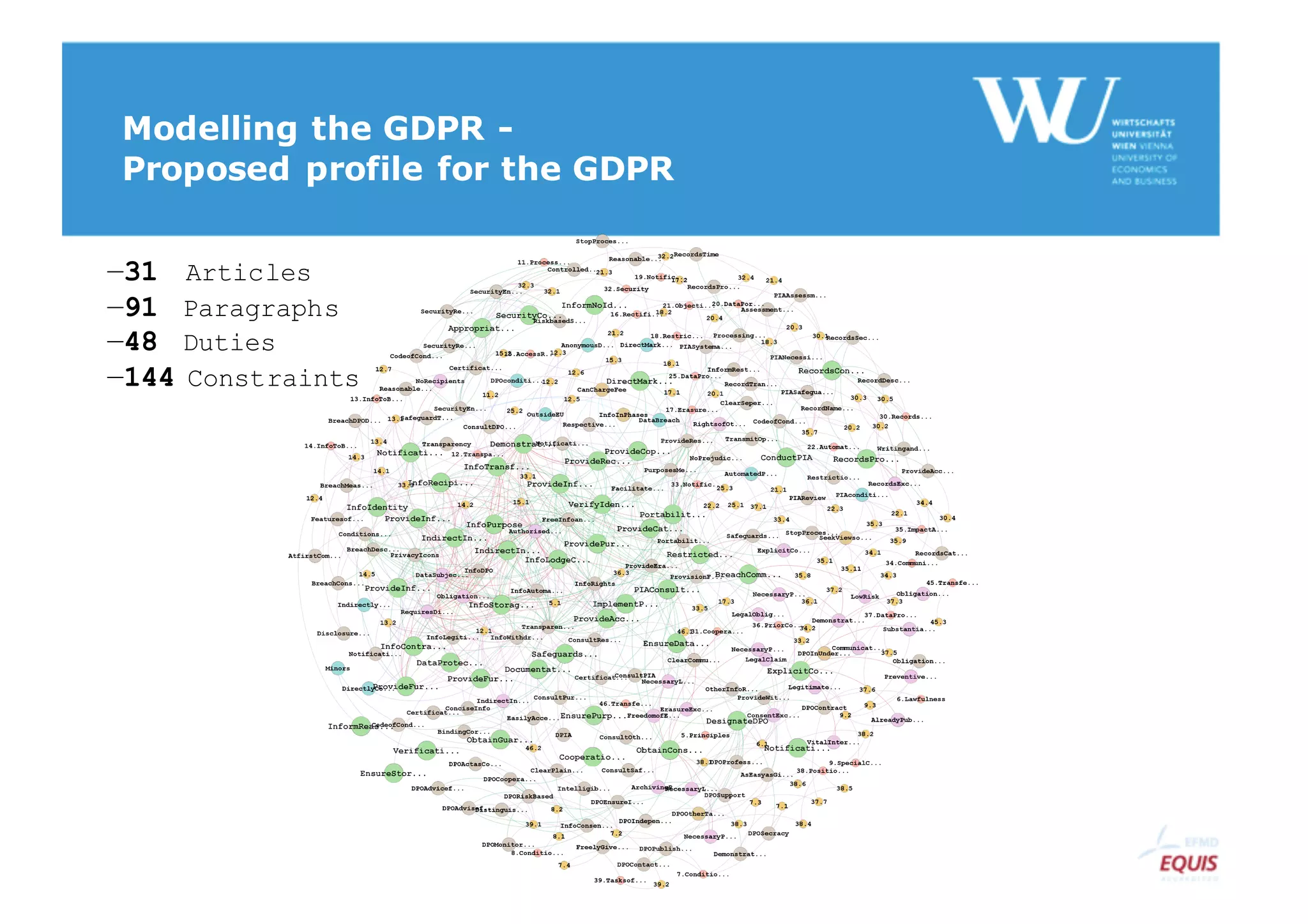
‒31 Articles
Modelling the GDPR -
Proposed profile for the GDPR
‒31 Articles
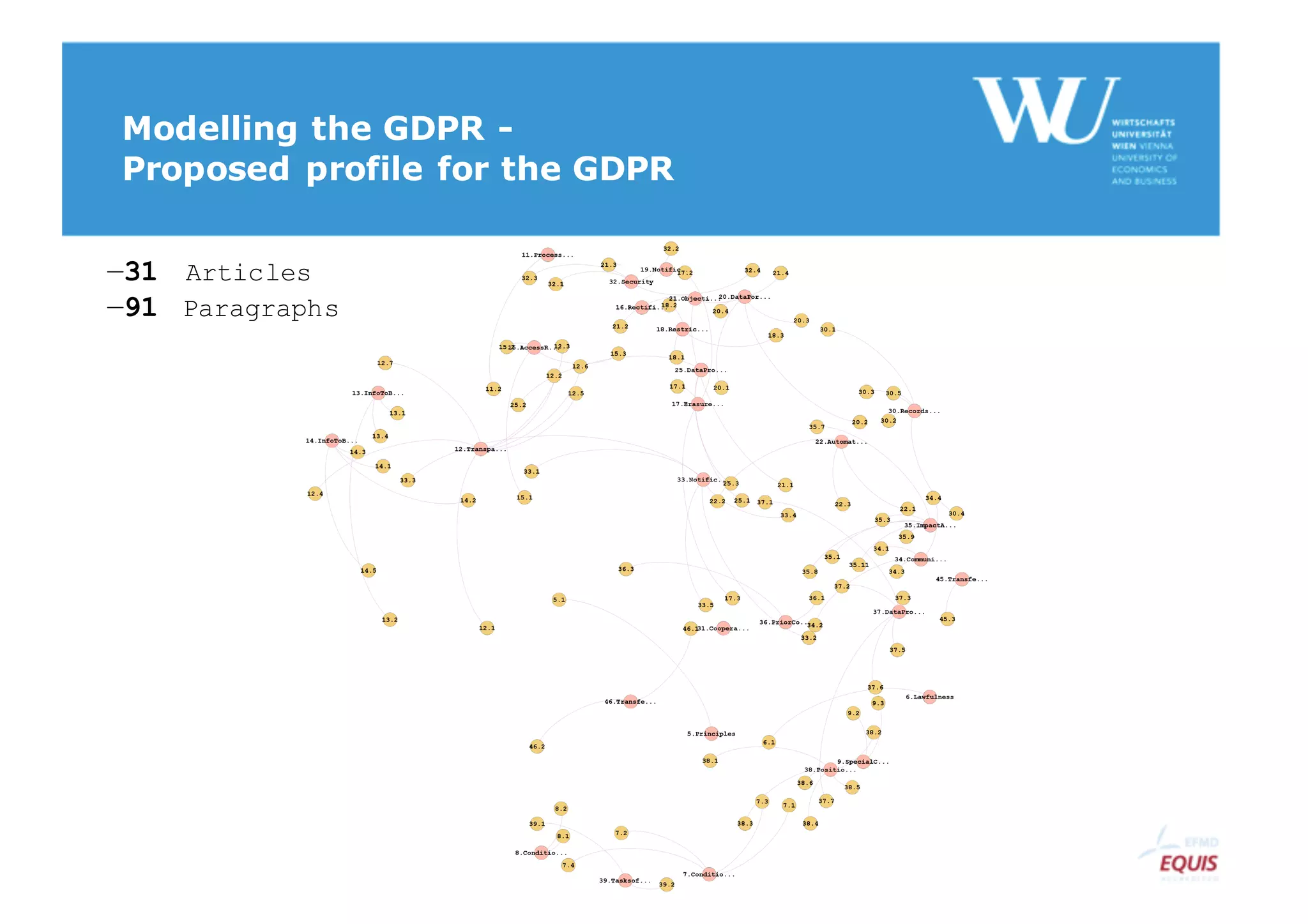
‒91 Paragraphs
Modelling the GDPR -
Proposed profile for the GDPR
‒31 Articles
‒91 Paragraphs
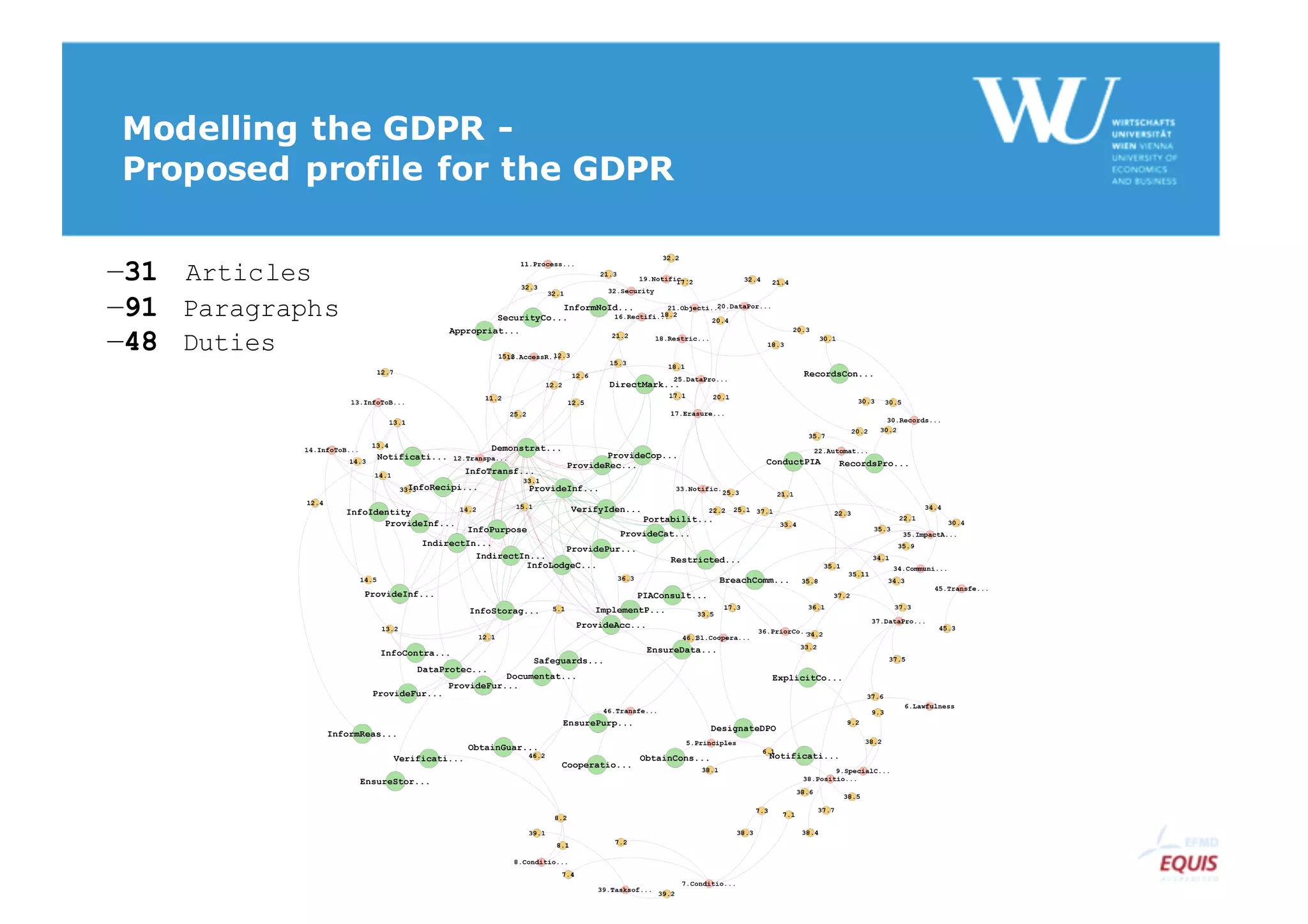
‒48 Duties
Modelling the GDPR -
Proposed profile for the GDPR
‒31 Articles
‒91 Paragraphs
‒48 Duties
‒144 Constraints
Modelling the GDPR -
Proposed profile for the GDPR
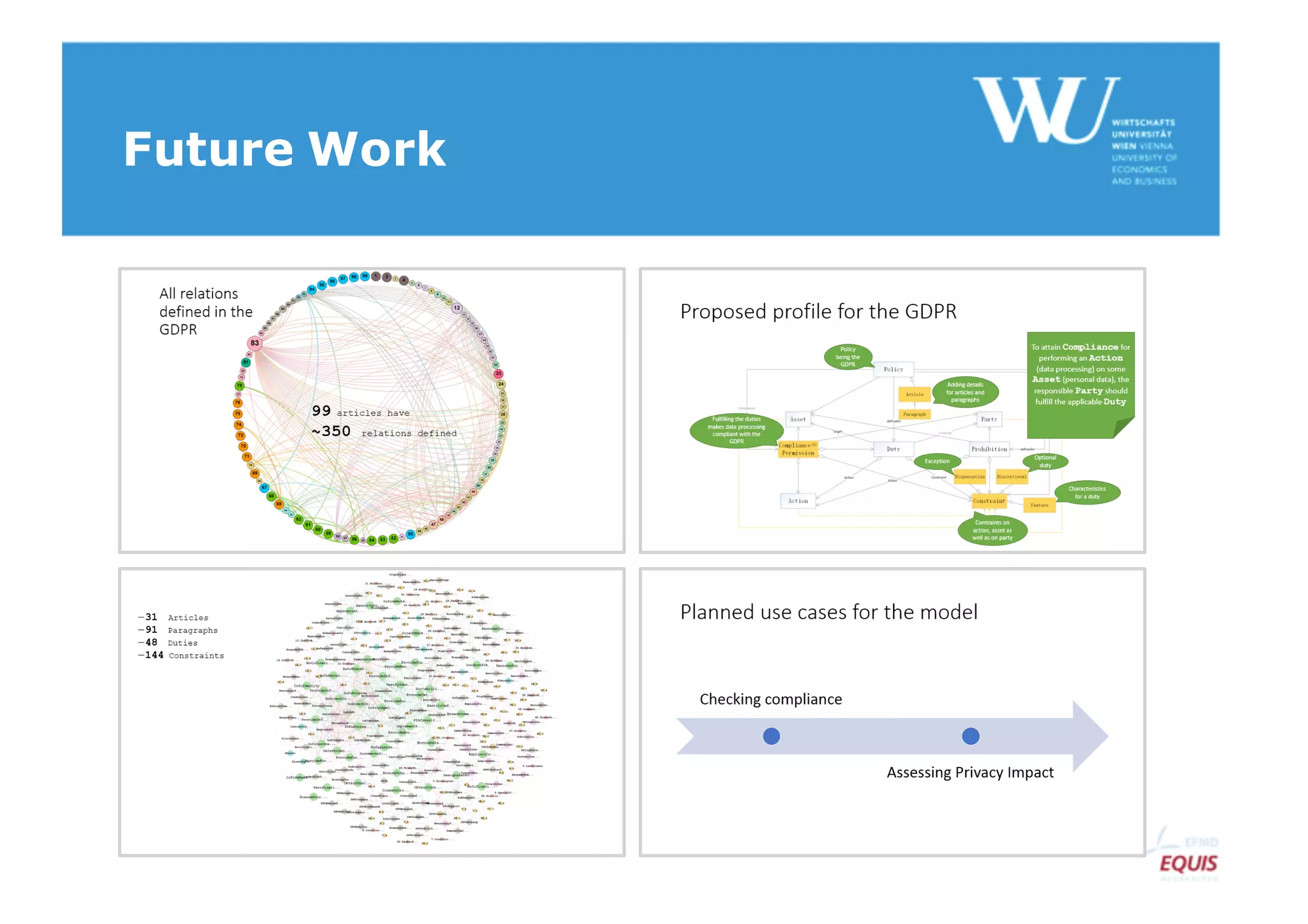
Future Work

Modelling the General Data Protection Regulation

  • 1.
    Modelling the General DataProtection Regulation Sushant Agarwal, Sabrina Kirrane and Johannes Scharf
  • 2.
    Analysing & Modellingthe GPDR Relations make it complex for the developers Actionable instructions
  • 3.
    Analysing the GDPR I:General provisions II: Principles III: Rights of the data subject IV: Controller and processor V: Transfers of personal data to third countries or international organisations VI: Independent supervisory authorities VII: Cooperation and consistency VIII: Remedies, liability and penalties IX: Provisions relating to specific processing situations X: Delegated acts and implementing acts XI: Final provisions 99 articles 11 chapters
  • 4.
    Analysing the GDPR– Articles are not Isolated The controller shall take appropriate measures to provide any information referred to in Articles 13 and 14 and any communication under Articles 15 to 22 and 34 relating to processing to the data subject in a concise, transparent, intelligible and easily accessible form, using clear and plain language Paragraph 1 Chapter III > Section 1 > Article 12 Transparent information, communication and modalities for the exercise of the rights of the data subject 12 Chapter III > Section 2 Information and access to personal data Chapter III > Section 3 Rectification and erasure Chapter III > Section 4 Right to object and automated individual decision-making CHAPTER IV > Section 2 Security of personal data
  • 5.
    99 articles have ~350relations defined Analysing the GDPR - All relations defined in the GDPR § Other things to be considered § Direction of the relationship § Article chains § Semantics of the relationship § Model the consequences and fines in the case of non- compliance Article 83 General conditions for imposing administrative fines
  • 6.
    Modelling the GPDR Relationsmake it complex for the developers Actionable instructions
  • 7.
    Modelling the GDPR- Open Digital Rights Language Model ODRL designed to define rules for the publishing,distribution, and consumption of digital media.
  • 8.
    Modelling the GDPR- Open Digital Rights Language Model A Permission allows a particular Action to be executed on a related Asset, e.g. “Play the audio file abc.mp3”.
  • 9.
    Modelling the GDPR- Open Digital Rights Language Model A Constraint like “at most 10 times” might be added to specify the Permission more precisely.
  • 10.
    Modelling the GDPR- Open Digital Rights Language Model The Party that grants this Permission is the assigner, the Party that is granted the Permission is the assignee, e.g. “assigner VirtualMusicShop grants the Permission to assignee Alice”.
  • 11.
    Modelling the GDPR- Open Digital Rights Language Model Additionally, a Permission MAY be linked to Duty entities e.g. “Alice must pay 5 EUR in order to get the Permission to play abc.mp3″.
  • 12.
    Modelling the GDPR- Proposed profile for the GDPR Policy being the GDPR Adding details for articles and paragraphs Characteristics for a duty Fulfilling the duties makes data processing compliant with the GDPR Contraints on action, asset as well as on party Compliance for performing an Action (e.g. data processing) on some Asset (e.g. personal data), the responsible Party should fulfill the applicable Duty.
  • 13.
    Modelling the GDPR- Proposed profile for the GDPR Duty Data Subject has given consent to the Processing
  • 14.
    Modelling the GDPR- Proposed profile for the GDPR Duty concise, transparent, intelligible and easily accessible form, using clear and plain language Feature
  • 15.
    Modelling the GDPR- Proposed profile for the GDPR Discretional Duty Standardised icons may be used
  • 16.
    Modelling the GDPR- Proposed profile for the GDPR Dispensation Exception based on Union or Member State law
  • 17.
    Modelling the GDPR- Proposed profile for the GDPR § Not all of the 99 articles define obligations (e.g. objectives, definitions, GDPR’s entry into force etc.) § We also omit articles defining obligations for other parties like the Supervisory Authorities and European Data Protection Board can be neglected.
  • 18.
    ‒31 Articles Modelling theGDPR - Proposed profile for the GDPR
  • 19.
    ‒31 Articles ‒91 Paragraphs Modellingthe GDPR - Proposed profile for the GDPR
  • 20.
    ‒31 Articles ‒91 Paragraphs ‒48Duties Modelling the GDPR - Proposed profile for the GDPR
  • 21.
    ‒31 Articles ‒91 Paragraphs ‒48Duties ‒144 Constraints Modelling the GDPR - Proposed profile for the GDPR
  • 22.