IRELAND
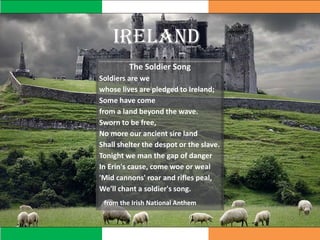
The Soldier Song
Soldiers are we
whose lives are pledged to Ireland;
Some have come
from a land beyond the wave.
Sworn to be free,
No more our ancient sire land
Shall shelter the despot or the slave.
Tonight we man the gap of danger
In Erin's cause, come woe or weal
'Mid cannons' roar and rifles peal,
We'll chant a soldier's song.
from the Irish National Anthem
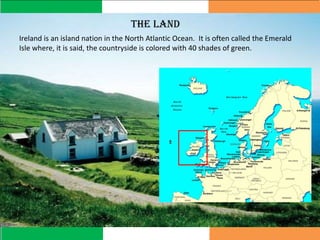
Ireland is an island nation in the North Atlantic Ocean. It is often called the Emerald
Isle where, it is said, the countryside is colored with 40 shades of green.
The Land
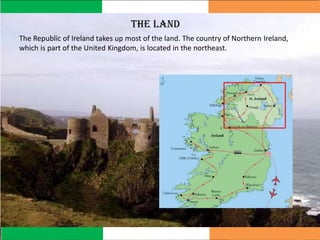
The Republic of Ireland takes up most of the land. The country of Northern Ireland,
which is part of the United Kingdom, is located in the northeast.
The Land
The counties
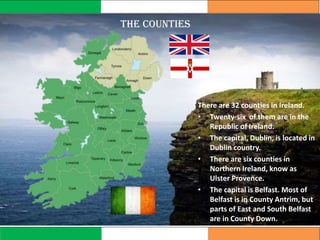
There are 32 counties in Ireland.
• Twenty-six of them are in the
Republic of Ireland.
• The capital, Dublin, is located in
Dublin country.
• There are six counties in
Northern Ireland, know as
Ulster Provence.
• The capital is Belfast. Most of
Belfast is in County Antrim, but
parts of East and South Belfast
are in County Down.
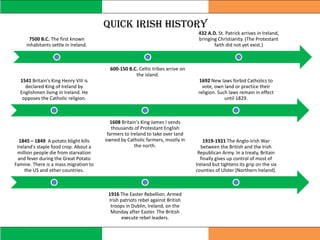
Quick Irish History
7500 B.C. The first known
inhabitants settle in Ireland.
600-150 B.C. Celtic tribes arrive on
the island.
432 A.D. St. Patrick arrives in Ireland,
bringing Christianity. (The Protestant
faith did not yet exist.)
1541 Britain's King Henry VIII is
declared King of Ireland by
Englishmen living in Ireland. He
opposes the Catholic religion.
1608 Britain's King James I sends
thousands of Protestant English
farmers to Ireland to take over land
owned by Catholic farmers, mostly in
the north.
1692 New laws forbid Catholics to
vote, own land or practice their
religion. Such laws remain in effect
until 1829.
1845 – 1849 A potato blight kills
Ireland's staple food crop. About a
million people die from starvation
and fever during the Great Potato
Famine. There is a mass migration to
the US and other countries.
1916 The Easter Rebellion. Armed
Irish patriots rebel against British
troops in Dublin, Ireland, on the
Monday after Easter. The British
execute rebel leaders.
1919-1921 The Anglo-Irish War
between the British and the Irish
Republican Army. In a treaty, Britain
finally gives up control of most of
Ireland but tightens its grip on the six
counties of Ulster (Northern Ireland).
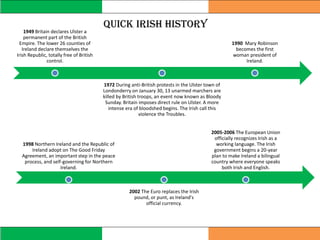
Quick Irish History
1949 Britain declares Ulster a
permanent part of the British
Empire. The lower 26 counties of
Ireland declare themselves the
Irish Republic, totally free of British
control.
1972 During anti-British protests in the Ulster town of
Londonderry on January 30, 13 unarmed marchers are
killed by British troops, an event now known as Bloody
Sunday. Britain imposes direct rule on Ulster. A more
intense era of bloodshed begins. The Irish call this
violence the Troubles.
1990 Mary Robinson
becomes the first
woman president of
Ireland.
1998 Northern Ireland and the Republic of
Ireland adopt on The Good Friday
Agreement, an important step in the peace
process, and self-governing for Northern
Ireland.
2002 The Euro replaces the Irish
pound, or punt, as Ireland's
official currency.
2005-2006 The European Union
officially recognizes Irish as a
working language. The Irish
government begins a 20-year
plan to make Ireland a bilingual
country where everyone speaks
both Irish and English.
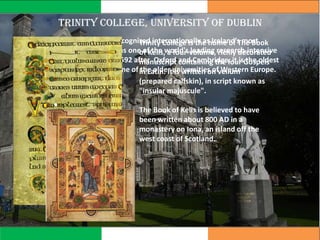
Trinity college, University of Dublin
Trinity College Dublin is recognized internationally as Ireland’s most
important university and as one of the world's leading research-intensive
universities. Founded in 1592 after Oxford and Cambridge, it is the oldest
university in Ireland and one of the older universities of Western Europe.
Trinity College is the home of The Book
of Kells, a four-volume, richly decorated
manuscript containing the four Gospels
in Latin. It is written on vellum
(prepared calfskin), in script known as
"insular majuscule".
The Book of Kells is believed to have
been written about 800 AD in a
monastery on Iona, an island off the
west coast of Scotland.
A land of musicians
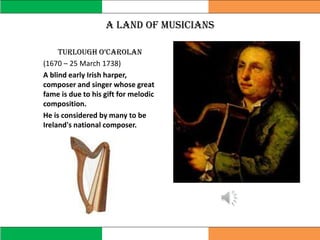
Turlough o’carolan
(1670 – 25 March 1738)
A blind early Irish harper,
composer and singer whose great
fame is due to his gift for melodic
composition.
He is considered by many to be
Ireland's national composer.
Irish Legends
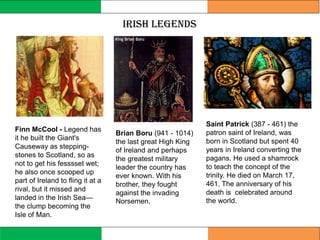
Saint Patrick (387 - 461) the
patron saint of Ireland, was
born in Scotland but spent 40
years in Ireland converting the
pagans. He used a shamrock
to teach the concept of the
trinity. He died on March 17,
461. The anniversary of his
death is celebrated around
the world.
Brian Boru (941 - 1014)
the last great High King
of Ireland and perhaps
the greatest military
leader the country has
ever known. With his
brother, they fought
against the invading
Norsemen.
Finn McCool - Legend has
it he built the Giant's
Causeway as stepping-
stones to Scotland, so as
not to get his fesssset wet;
he also once scooped up
part of Ireland to fling it at a
rival, but it missed and
landed in the Irish Sea—
the clump becoming the
Isle of Man.
Irish Rulers
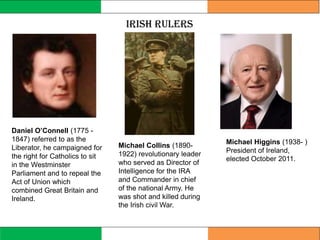
Michael Collins (1890-
1922) revolutionary leader
who served as Director of
Intelligence for the IRA
and Commander in chief
of the national Army. He
was shot and killed during
the Irish civil War.
Michael Higgins (1938- )
President of Ireland,
elected October 2011.
Daniel O’Connell (1775 -
1847) referred to as the
Liberator, he campaigned for
the right for Catholics to sit
in the Westminster
Parliament and to repeal the
Act of Union which
combined Great Britain and
Ireland.
There are 34.5 million Americans who list their heritage as either primarily or partially Irish.
That number is seven times larger than the population of Ireland itself (4.5 million). Irish is the
second-most common ancestry among Americans, falling just behind German.
Irish Americans
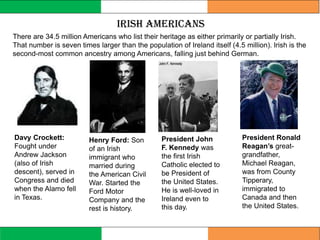
Henry Ford: Son
of an Irish
immigrant who
married during
the American Civil
War. Started the
Ford Motor
Company and the
rest is history.
Davy Crockett:
Fought under
Andrew Jackson
(also of Irish
descent), served in
Congress and died
when the Alamo fell
in Texas.
President John
F. Kennedy was
the first Irish
Catholic elected to
be President of
the United States.
He is well-loved in
Ireland even to
this day.
President Ronald
Reagan’s great-
grandfather,
Michael Reagan,
was from County
Tipperary,
immigrated to
Canada and then
the United States.
Irish Sweaters
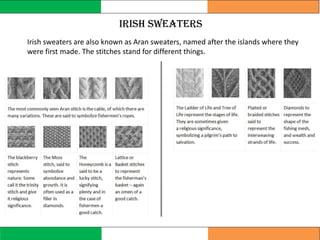
Irish sweaters are also known as Aran sweaters, named after the islands where they
were first made. The stitches stand for different things.
Irish sweaters
Ireland vs. San Diego
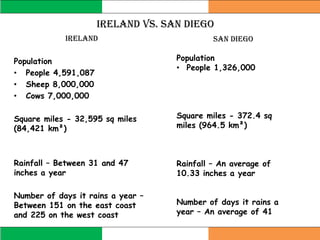
Ireland
Population
• People 4,591,087
• Sheep 8,000,000
• Cows 7,000,000
Square miles - 32,595 sq miles
(84,421 km²)
Rainfall – Between 31 and 47
inches a year
Number of days it rains a year –
Between 151 on the east coast
and 225 on the west coast
San Diego
Population
• People 1,326,000
Square miles - 372.4 sq
miles (964.5 km²)
Rainfall – An average of
10.33 inches a year
Number of days it rains a
year – An average of 41
WhaT’s cool In Ireland Today
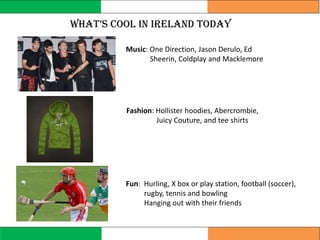
Fun: Hurling, X box or play station, football (soccer),
rugby, tennis and bowling
Hanging out with their friends
Music: One Direction, Jason Derulo, Ed
Sheerin, Coldplay and Macklemore
Fashion: Hollister hoodies, Abercrombie,
Juicy Couture, and tee shirts
Irish sports
Sports are a way of life in Ireland, and they have some great ones! Ireland's national
pastime, hurling, is one of the more popular sports, as is Gaelic Football, soccer and
rugby. So, here is a breakdown of the most popular sports in Ireland.
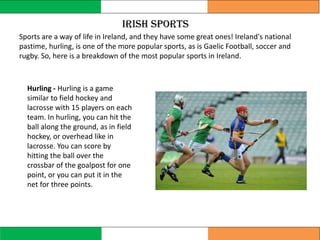
Hurling - Hurling is a game
similar to field hockey and
lacrosse with 15 players on each
team. In hurling, you can hit the
ball along the ground, as in field
hockey, or overhead like in
lacrosse. You can score by
hitting the ball over the
crossbar of the goalpost for one
point, or you can put it in the
net for three points.
Irish sports
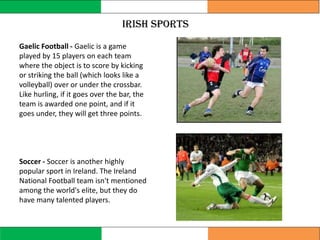
Gaelic Football - Gaelic is a game
played by 15 players on each team
where the object is to score by kicking
or striking the ball (which looks like a
volleyball) over or under the crossbar.
Like hurling, if it goes over the bar, the
team is awarded one point, and if it
goes under, they will get three points.
Soccer - Soccer is another highly
popular sport in Ireland. The Ireland
National Football team isn't mentioned
among the world's elite, but they do
have many talented players.
food
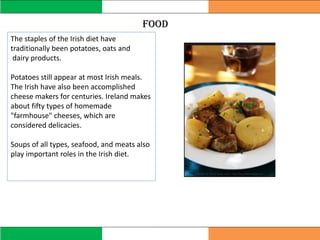
The staples of the Irish diet have
traditionally been potatoes, oats and
dairy products.
Potatoes still appear at most Irish meals.
The Irish have also been accomplished
cheese makers for centuries. Ireland makes
about fifty types of homemade
"farmhouse" cheeses, which are
considered delicacies.
Soups of all types, seafood, and meats also
play important roles in the Irish diet.
food
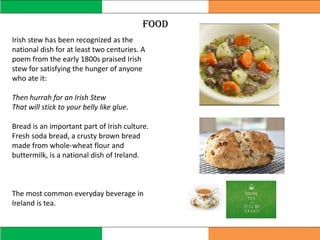
Irish stew has been recognized as the
national dish for at least two centuries. A
poem from the early 1800s praised Irish
stew for satisfying the hunger of anyone
who ate it:
Then hurrah for an Irish Stew
That will stick to your belly like glue.
Bread is an important part of Irish culture.
Fresh soda bread, a crusty brown bread
made from whole-wheat flour and
buttermilk, is a national dish of Ireland.
The most common everyday beverage in
Ireland is tea.
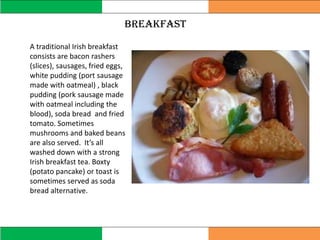
breakfast
A traditional Irish breakfast
consists are bacon rashers
(slices), sausages, fried eggs,
white pudding (port sausage
made with oatmeal) , black
pudding (pork sausage made
with oatmeal including the
blood), soda bread and fried
tomato. Sometimes
mushrooms and baked beans
are also served. It’s all
washed down with a strong
Irish breakfast tea. Boxty
(potato pancake) or toast is
sometimes served as soda
bread alternative.
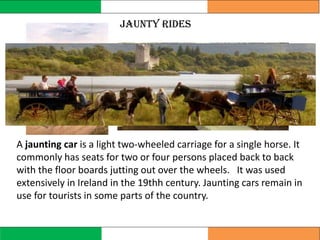
Jaunty Rides
A jaunting car is a light two-wheeled carriage for a single horse. It
commonly has seats for two or four persons placed back to back
with the floor boards jutting out over the wheels. It was used
extensively in Ireland in the 19thh century. Jaunting cars remain in
use for tourists in some parts of the country.
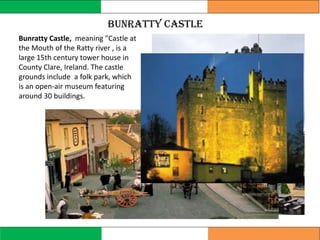
Bunratty Castle
Bunratty Castle, meaning "Castle at
the Mouth of the Ratty river , is a
large 15th century tower house in
County Clare, Ireland. The castle
grounds include a folk park, which
is an open-air museum featuring
around 30 buildings.
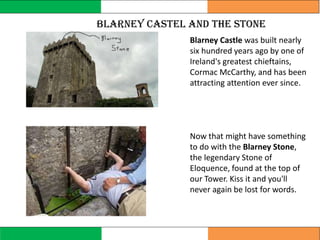
Blarney Castle was built nearly
six hundred years ago by one of
Ireland's greatest chieftains,
Cormac McCarthy, and has been
attracting attention ever since.
Now that might have something
to do with the Blarney Stone,
the legendary Stone of
Eloquence, found at the top of
our Tower. Kiss it and you'll
never again be lost for words.
blarney Castel and the stone
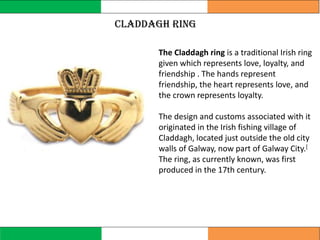
The Claddagh ring is a traditional Irish ring
given which represents love, loyalty, and
friendship . The hands represent
friendship, the heart represents love, and
the crown represents loyalty.
The design and customs associated with it
originated in the Irish fishing village of
Claddagh, located just outside the old city
walls of Galway, now part of Galway City.[
The ring, as currently known, was first
produced in the 17th century.
claddagh ring
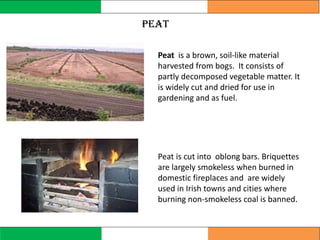
Peat is a brown, soil-like material
harvested from bogs. It consists of
partly decomposed vegetable matter. It
is widely cut and dried for use in
gardening and as fuel.
Peat is cut into oblong bars. Briquettes
are largely smokeless when burned in
domestic fireplaces and are widely
used in Irish towns and cities where
burning non-smokeless coal is banned.
peat
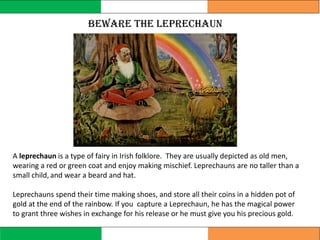
A leprechaun is a type of fairy in Irish folklore. They are usually depicted as old men,
wearing a red or green coat and enjoy making mischief. Leprechauns are no taller than a
small child, and wear a beard and hat.
Leprechauns spend their time making shoes, and store all their coins in a hidden pot of
gold at the end of the rainbow. If you capture a Leprechaun, he has the magical power
to grant three wishes in exchange for his release or he must give you his precious gold.
Beware the leprechaun
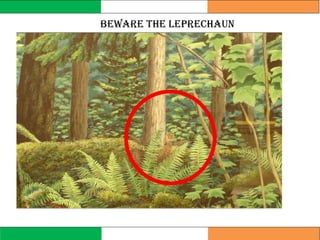
When you find a leprechaun, you must not
take your eyes off him if you want your
three wishes. This is much harder than it
seems. Leprechauns are accomplished
ventriloquists, and will try to make you
look away by sounding like your mother or
pet. When you turn around to look, the
leprechaun will vanish.
Or, a leprechaun might offer to play his
bagpipes for you; but his music will carry a
special spell with it, and get your feet to
dancing all on their own, so that
he’ll send you down the street doing a silly
jig to the “Leprechaun’s Reel”, while he
waltzes merrily home.
Dublin City
Cliffs of Mohr, Claire
Giants Causeway, Antrim
Dingle Peninsula, Kerry
Rock of Cashel,
Tipperary
Blarney Castle, Cork
DUNluce castle, antrim
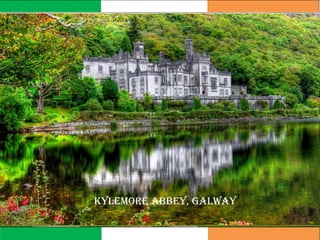
Kylemore Abbey, Galway
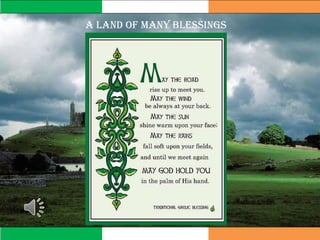
A land of Many Blessings

Ireland april 30

  • 1.
    IRELAND The Soldier Song Soldiersare we whose lives are pledged to Ireland; Some have come from a land beyond the wave. Sworn to be free, No more our ancient sire land Shall shelter the despot or the slave. Tonight we man the gap of danger In Erin's cause, come woe or weal 'Mid cannons' roar and rifles peal, We'll chant a soldier's song. from the Irish National Anthem
  • 2.
    Ireland is anisland nation in the North Atlantic Ocean. It is often called the Emerald Isle where, it is said, the countryside is colored with 40 shades of green. The Land
  • 3.
    The Republic ofIreland takes up most of the land. The country of Northern Ireland, which is part of the United Kingdom, is located in the northeast. The Land
  • 4.
    The counties There are32 counties in Ireland. • Twenty-six of them are in the Republic of Ireland. • The capital, Dublin, is located in Dublin country. • There are six counties in Northern Ireland, know as Ulster Provence. • The capital is Belfast. Most of Belfast is in County Antrim, but parts of East and South Belfast are in County Down.
  • 5.
    Quick Irish History 7500B.C. The first known inhabitants settle in Ireland. 600-150 B.C. Celtic tribes arrive on the island. 432 A.D. St. Patrick arrives in Ireland, bringing Christianity. (The Protestant faith did not yet exist.) 1541 Britain's King Henry VIII is declared King of Ireland by Englishmen living in Ireland. He opposes the Catholic religion. 1608 Britain's King James I sends thousands of Protestant English farmers to Ireland to take over land owned by Catholic farmers, mostly in the north. 1692 New laws forbid Catholics to vote, own land or practice their religion. Such laws remain in effect until 1829. 1845 – 1849 A potato blight kills Ireland's staple food crop. About a million people die from starvation and fever during the Great Potato Famine. There is a mass migration to the US and other countries. 1916 The Easter Rebellion. Armed Irish patriots rebel against British troops in Dublin, Ireland, on the Monday after Easter. The British execute rebel leaders. 1919-1921 The Anglo-Irish War between the British and the Irish Republican Army. In a treaty, Britain finally gives up control of most of Ireland but tightens its grip on the six counties of Ulster (Northern Ireland).
  • 6.
    Quick Irish History 1949Britain declares Ulster a permanent part of the British Empire. The lower 26 counties of Ireland declare themselves the Irish Republic, totally free of British control. 1972 During anti-British protests in the Ulster town of Londonderry on January 30, 13 unarmed marchers are killed by British troops, an event now known as Bloody Sunday. Britain imposes direct rule on Ulster. A more intense era of bloodshed begins. The Irish call this violence the Troubles. 1990 Mary Robinson becomes the first woman president of Ireland. 1998 Northern Ireland and the Republic of Ireland adopt on The Good Friday Agreement, an important step in the peace process, and self-governing for Northern Ireland. 2002 The Euro replaces the Irish pound, or punt, as Ireland's official currency. 2005-2006 The European Union officially recognizes Irish as a working language. The Irish government begins a 20-year plan to make Ireland a bilingual country where everyone speaks both Irish and English.
  • 8.
    Trinity college, Universityof Dublin Trinity College Dublin is recognized internationally as Ireland’s most important university and as one of the world's leading research-intensive universities. Founded in 1592 after Oxford and Cambridge, it is the oldest university in Ireland and one of the older universities of Western Europe. Trinity College is the home of The Book of Kells, a four-volume, richly decorated manuscript containing the four Gospels in Latin. It is written on vellum (prepared calfskin), in script known as "insular majuscule". The Book of Kells is believed to have been written about 800 AD in a monastery on Iona, an island off the west coast of Scotland.
  • 9.
    A land ofmusicians Turlough o’carolan (1670 – 25 March 1738) A blind early Irish harper, composer and singer whose great fame is due to his gift for melodic composition. He is considered by many to be Ireland's national composer.
  • 10.
    Irish Legends Saint Patrick(387 - 461) the patron saint of Ireland, was born in Scotland but spent 40 years in Ireland converting the pagans. He used a shamrock to teach the concept of the trinity. He died on March 17, 461. The anniversary of his death is celebrated around the world. Brian Boru (941 - 1014) the last great High King of Ireland and perhaps the greatest military leader the country has ever known. With his brother, they fought against the invading Norsemen. Finn McCool - Legend has it he built the Giant's Causeway as stepping- stones to Scotland, so as not to get his fesssset wet; he also once scooped up part of Ireland to fling it at a rival, but it missed and landed in the Irish Sea— the clump becoming the Isle of Man.
  • 11.
    Irish Rulers Michael Collins(1890- 1922) revolutionary leader who served as Director of Intelligence for the IRA and Commander in chief of the national Army. He was shot and killed during the Irish civil War. Michael Higgins (1938- ) President of Ireland, elected October 2011. Daniel O’Connell (1775 - 1847) referred to as the Liberator, he campaigned for the right for Catholics to sit in the Westminster Parliament and to repeal the Act of Union which combined Great Britain and Ireland.
  • 12.
    There are 34.5million Americans who list their heritage as either primarily or partially Irish. That number is seven times larger than the population of Ireland itself (4.5 million). Irish is the second-most common ancestry among Americans, falling just behind German. Irish Americans Henry Ford: Son of an Irish immigrant who married during the American Civil War. Started the Ford Motor Company and the rest is history. Davy Crockett: Fought under Andrew Jackson (also of Irish descent), served in Congress and died when the Alamo fell in Texas. President John F. Kennedy was the first Irish Catholic elected to be President of the United States. He is well-loved in Ireland even to this day. President Ronald Reagan’s great- grandfather, Michael Reagan, was from County Tipperary, immigrated to Canada and then the United States.
  • 13.
  • 14.
    Irish sweaters arealso known as Aran sweaters, named after the islands where they were first made. The stitches stand for different things. Irish sweaters
  • 15.
    Ireland vs. SanDiego Ireland Population • People 4,591,087 • Sheep 8,000,000 • Cows 7,000,000 Square miles - 32,595 sq miles (84,421 km²) Rainfall – Between 31 and 47 inches a year Number of days it rains a year – Between 151 on the east coast and 225 on the west coast San Diego Population • People 1,326,000 Square miles - 372.4 sq miles (964.5 km²) Rainfall – An average of 10.33 inches a year Number of days it rains a year – An average of 41
  • 16.
    WhaT’s cool InIreland Today Fun: Hurling, X box or play station, football (soccer), rugby, tennis and bowling Hanging out with their friends Music: One Direction, Jason Derulo, Ed Sheerin, Coldplay and Macklemore Fashion: Hollister hoodies, Abercrombie, Juicy Couture, and tee shirts
  • 17.
    Irish sports Sports area way of life in Ireland, and they have some great ones! Ireland's national pastime, hurling, is one of the more popular sports, as is Gaelic Football, soccer and rugby. So, here is a breakdown of the most popular sports in Ireland. Hurling - Hurling is a game similar to field hockey and lacrosse with 15 players on each team. In hurling, you can hit the ball along the ground, as in field hockey, or overhead like in lacrosse. You can score by hitting the ball over the crossbar of the goalpost for one point, or you can put it in the net for three points.
  • 18.
    Irish sports Gaelic Football- Gaelic is a game played by 15 players on each team where the object is to score by kicking or striking the ball (which looks like a volleyball) over or under the crossbar. Like hurling, if it goes over the bar, the team is awarded one point, and if it goes under, they will get three points. Soccer - Soccer is another highly popular sport in Ireland. The Ireland National Football team isn't mentioned among the world's elite, but they do have many talented players.
  • 19.
    food The staples ofthe Irish diet have traditionally been potatoes, oats and dairy products. Potatoes still appear at most Irish meals. The Irish have also been accomplished cheese makers for centuries. Ireland makes about fifty types of homemade "farmhouse" cheeses, which are considered delicacies. Soups of all types, seafood, and meats also play important roles in the Irish diet.
  • 20.
    food Irish stew hasbeen recognized as the national dish for at least two centuries. A poem from the early 1800s praised Irish stew for satisfying the hunger of anyone who ate it: Then hurrah for an Irish Stew That will stick to your belly like glue. Bread is an important part of Irish culture. Fresh soda bread, a crusty brown bread made from whole-wheat flour and buttermilk, is a national dish of Ireland. The most common everyday beverage in Ireland is tea.
  • 21.
    breakfast A traditional Irishbreakfast consists are bacon rashers (slices), sausages, fried eggs, white pudding (port sausage made with oatmeal) , black pudding (pork sausage made with oatmeal including the blood), soda bread and fried tomato. Sometimes mushrooms and baked beans are also served. It’s all washed down with a strong Irish breakfast tea. Boxty (potato pancake) or toast is sometimes served as soda bread alternative.
  • 22.
    Jaunty Rides A jauntingcar is a light two-wheeled carriage for a single horse. It commonly has seats for two or four persons placed back to back with the floor boards jutting out over the wheels. It was used extensively in Ireland in the 19thh century. Jaunting cars remain in use for tourists in some parts of the country.
  • 23.
    Bunratty Castle Bunratty Castle,meaning "Castle at the Mouth of the Ratty river , is a large 15th century tower house in County Clare, Ireland. The castle grounds include a folk park, which is an open-air museum featuring around 30 buildings.
  • 24.
    Blarney Castle wasbuilt nearly six hundred years ago by one of Ireland's greatest chieftains, Cormac McCarthy, and has been attracting attention ever since. Now that might have something to do with the Blarney Stone, the legendary Stone of Eloquence, found at the top of our Tower. Kiss it and you'll never again be lost for words. blarney Castel and the stone
  • 25.
    The Claddagh ringis a traditional Irish ring given which represents love, loyalty, and friendship . The hands represent friendship, the heart represents love, and the crown represents loyalty. The design and customs associated with it originated in the Irish fishing village of Claddagh, located just outside the old city walls of Galway, now part of Galway City.[ The ring, as currently known, was first produced in the 17th century. claddagh ring
  • 26.
    Peat is abrown, soil-like material harvested from bogs. It consists of partly decomposed vegetable matter. It is widely cut and dried for use in gardening and as fuel. Peat is cut into oblong bars. Briquettes are largely smokeless when burned in domestic fireplaces and are widely used in Irish towns and cities where burning non-smokeless coal is banned. peat
  • 27.
    A leprechaun isa type of fairy in Irish folklore. They are usually depicted as old men, wearing a red or green coat and enjoy making mischief. Leprechauns are no taller than a small child, and wear a beard and hat. Leprechauns spend their time making shoes, and store all their coins in a hidden pot of gold at the end of the rainbow. If you capture a Leprechaun, he has the magical power to grant three wishes in exchange for his release or he must give you his precious gold. Beware the leprechaun
  • 28.
    Beware the leprechaun Whenyou find a leprechaun, you must not take your eyes off him if you want your three wishes. This is much harder than it seems. Leprechauns are accomplished ventriloquists, and will try to make you look away by sounding like your mother or pet. When you turn around to look, the leprechaun will vanish. Or, a leprechaun might offer to play his bagpipes for you; but his music will carry a special spell with it, and get your feet to dancing all on their own, so that he’ll send you down the street doing a silly jig to the “Leprechaun’s Reel”, while he waltzes merrily home.
  • 29.
    Dublin City Cliffs ofMohr, Claire Giants Causeway, Antrim Dingle Peninsula, Kerry Rock of Cashel, Tipperary Blarney Castle, Cork DUNluce castle, antrim Kylemore Abbey, Galway
  • 30.
    A land ofMany Blessings