INSPIRE @ IPSSW 2014
Willkommen!
22 April 2014
Wien, Österreich
Todd P Chang, MD - Das Krankenhaus für Kinder Los Angeles
International Network for Simulation-based Pediatric Innovation, Research and Education
Unzer Zeitplan
Ur
1800 – 1830 Willkommen und Einführung
1830 – 1900 FACTS & die internationale Traumaforschung mit Ralph MacKinnon
1900 – 1930 ALERT Präsentationen
1930 – 2030 ALERT kleine Sitzungen
2030 – 2100 Einbetten Simulation in der Praxis "ohne sich in der Übersetzung
verloren“ mit Vinay Nadkarni
2100 – 2200 Gruppe-Mentoring
International Network for Simulation-based Pediatric Innovation, Research and Education
Unzer Zeitplan
Ur
1800 – 1830 Willkommen und Einführung
1830 – 1900 FACTS & die internationale Traumaforschung mit Ralph MacKinnon
1900 – 1930 ALERT Präsentationen
1930 – 2030 ALERT kleine Sitzungen
2030 – 2100 Einbetten Simulation in der Praxis "ohne sich in der Übersetzung
verloren“ mit Vinay Nadkarni
2100 – 2200 Gruppe-Mentoring
International Network for Simulation-based Pediatric Innovation, Research and Education
Unzer Zeitplan
Ur
1800 – 1830 Willkommen und Einführung
1830 – 1900 FACTS & die internationale Traumaforschung mit Ralph MacKinnon
1900 – 1930 ALERT Präsentationen
1930 – 2030 ALERT kleine Sitzungen
2030 – 2100 Einbetten Simulation in der Praxis "ohne sich in der Übersetzung
verloren“ mit Vinay Nadkarni
2100 – 2200 Gruppe-Mentoring
International Network for Simulation-based Pediatric Innovation, Research and Education
Unzer Zeitplan
Ur
1800 – 1830 Willkommen und Einführung
1830 – 1900 FACTS & die internationale Traumaforschung mit Ralph MacKinnon
1900 – 1930 ALERT Präsentationen
1930 – 2030 ALERT kleine Sitzungen
2030 – 2100 Einbetten Simulation in der Praxis "ohne sich in der Übersetzung
verloren“ mit Vinay Nadkarni
2100 – 2200 Gruppe-Mentoring
International Network for Simulation-based Pediatric Innovation, Research and Education
Leadership
International Network for Simulation-based Pediatric Innovation, Research and Education
Was sind Wir?
2 Types of Organizing
• Governance
Documents
• Review Committees
• Executive Liaisons
• Contracts
Top-Down
Promotes:
• Infrastructure
• Professionalism and
Maintenance of
Quality
• Longevity
Top-Down
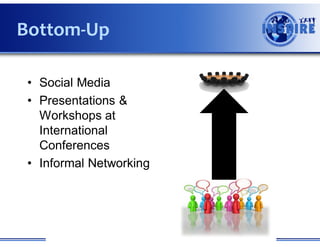
• Social Media
• Presentations &
Workshops at
International
Conferences
• Informal Networking
Bottom-Up
Promotes:
• Novelty
• Ingenuity
• Technological
Advancement
• Growth
Bottom-Up
International Network for Simulation-based Pediatric Innovation, Research and Education
Growth
0
20
40
60
80
100
120
140
160
180
2011 2012 2013 2014
Sites
International Network for Simulation-based Pediatric Innovation, Research and Education
Growth
0
100
200
300
400
500
600
2011 2012 2013 2014
Members
International Network for Simulation-based Pediatric Innovation, Research and Education
Mission
We aim to improve the delivery of medical care to acutely ill children
by answering important research questions pertaining to resuscitation,
technical skills, behavioural skills, debriefing and simulation-based
education
International Network for Simulation-based Pediatric Innovation, Research and Education
Consensus on simulation research priorities
Merlin exercise (2012), Consensus (2013)
Research Themes
International Network for Simulation-based Pediatric Innovation, Research and Education
INSPIRE Research Themes
TRAINING AND ASSESSMENT
Debriefing
Develop/assess/implement effective techniques for debriefing
real/sim events
IPE, Teamwork,
Communication
Develop/assess/implement effective techniques for team
training
Procedural,
Psychomotor Skills
Develop/assess/implement effective techniques for skills
development retention
HEALTH CARE INNOVATIONS
Technology
Develop/assess/implement novel technologies designed to
improve processes of care and pediatric patient outcomes
Acute Care and
Resuscitation
Develop/assess/implement novel techniques for improving care
of pediatric patients
Human Factors
Assess the role of human factors when providing care to
pediatric patients
Patient Safety
Explore the key variables that influence patient safety and
assess strategies to mitigate
Current INSPIRE Projects
TRAINING AND ASSESSMENT * new projects
Debriefing • Cheng: Co-Debriefing in Simulation-based Education*
• Halamek: DART- Debriefing Assessment
IPE, Teamwork,
Communication
• Knight: Improving Code Team Performance and Survival Outcomes: Implementation of Pediatric Composite
Resuscitation Training*
• Hunt/Rosen: Team Leadership Under Stress
• Overly: Structured-patient encounter
• Tensing Maa- PALS performance tool
Procedural,
Psychomotor
Skills
• Pusic: Learning Retention/Refreshers After DP of Radiograph Interpretation*
• Dadiz: Exploring Facilitators/Barriers to Implementing Competency Assessments*
• Arnold: Simulation to teach management of tracheostomy emergencies *
• White M. Development of a Standardized Process for INSPIRE Procedure Kits*
• Byrne: Comparison of ETI + UVC vs. LMA + IO Needle in NRP*
• Mehta: The effect of Simulation to determine Frequency for Competency Skill Training*
• Smith: Pediatric Simulation and the Milestones*
• Sawyer: Neonatal Intuabation
• Chang: Train-the-trainer LP, Script Concordance LP
• Brown: PRIDE Disaster Triage
• Barry: BVM training
• Kummett: Neonatal Skills
HEALTH CARE INNOVATIONS
Technology • Kessler: Randomized Trial of Continuous Capnography During Simulated Arrests*
• Burhop: The Difficult Pediatric Airway: A Simulation study examining the Efficacy of Videolaryngoscopy in Trisomy 21*
• Gee: Hybrid-simulator
Acute Care and
Resuscitation
• Lemke: Rapid Cycle Deliberate Practice for Resuscitation Teams*
• Meyer: Donation after Circulatory Death*
• Auerbach: GED-PED Disparities
• McKinnon: Critical Neurotrauma Sim
• Mehta: Health literacy
• Levy: PALS tool validation
Human Factors • Sens: Handoff Assessment
Patient Safety • Fiedor-Hamilton: EpiPen
• Sherzer: Epi pen community
International Network for Simulation-based Pediatric Innovation, Research and Education
What do we provide?
International Network for Simulation-based Pediatric Innovation, Research and Education
How have we done well?
1. Consultation
2. Research Structure
3. Mentorship
4. Multi-center Strength & Productivity
International Network for Simulation-based Pediatric Innovation, Research and Education
1. Consultation
Study protocol
Specific Consultative
Questions
Online submission
(http://www.INSPIRESim.com/)
Online submission
(http://www.INSPIRESim.com/)
Research Design
Committee feedback
Any grant proposal Grant feedback
One-time access to
Experts and feedback
International Network for Simulation-based Pediatric Innovation, Research and Education
2. Research Structure
Young
Investigator with
Research Idea
•Online Research Series
•Senior INSPIRE mentor (via online mentor match) to help with establishing research goals and
development of 1 page “specific aims” page
Systematic
Review or Needs
Assessment
•INSPIRE Research Coordinator to assist with methodology for systematic review
•INSPIRE Librarian to assist with literature search
Pilot Study
•Review and revise study protocol with INSPIRE mentor
•Review study protocol with INSPIRE technology director to discuss possible tech-assisted outcome
measures
•Review with INSPIRE statistical consultant to solidify analysis plan, feasibility, and power analysis
Multicenter Study
•INSPIRE scientific committee to review protocol and grant proposal
•INSPIRE website to assist in finding collaborators and recruitment sites
•INSPIRE research portal for data collection
•Data analysis and submission to Manuscript Oversight Committee (MOC)
Knowledge
Translation
•INSPIRE research assistant and graphic designer to assist with poster preparation
•INSPIRE writing group and scientific committee to assist with review of manuscripts and mitigation of
authorship issues and byline
•Submission of manuscript for peer review, amend with mentor and writing group, publish
Publication
Publication
Publication
International Network for Simulation-based Pediatric Innovation, Research and Education
3. Mentorship
International Network for Simulation-based Pediatric Innovation, Research and Education
4. Strength in Numbers
International Network for Simulation-based Pediatric Innovation, Research and Education
Upcoming
• Consultations
– Technology
– Statistical support
– Psychometric support
• Mentorship / Idea Exchange
• Video Capture Centralization
inspireSim.com
International Network for Simulation-based Pediatric Innovation, Research and Education
Our schedule
Hour
1800 – 1830 Welcome & Introduction
1830 – 1900 FACTS & International Trauma Research - Ralph MacKinnon
1900 – 1930 ALERT Presentations
1930 – 2030 ALERT Breakout Sessions
2030 – 2100 Embedding Simulation into Practice ‘without getting lost in the
translation’ - Vinay Nadkarni
2100 – 2200 Informal Group Mentoring
!
!
INSPIRE INSPIRE INSPIRE INSPIRE INSPIRE INSPIRE INSPIRE
INSPIRE INSPIRE PIRE INSPIRE INSPIRE INSPIRE INSPIRE INSPIRE
INSPIRE INSPIRE INSPIRE INS INSPIRE INSPIRE INSPIRE INSPIRE
SPIRE
INSPIR
INSPIR
E
INSPIR
E
International*Network*for*Simulation2based*Pediatric*Innovation,*Research*and*Education*
!
3*
Writing Group Procedures
This document describes the writing process, including roles, expectations, and procedures for writing
papers related to studies conducted through INSPIRE. This writing process was developed to facilitate
the timely dissemination of research findings in the academic press, to reduce stress, and to increase
communication among INSPIRE members.
Key Roles in the Writing Process
Primary Author: This person is responsible for the main writing task and is the corresponding author for
the paper.
Production Manager/Research Assistant: This person will manage the entire writing process. S/he is
responsible for setting appropriate deadlines, maintaining progress, compiling sections written by
others into a single draft, setting up a document template, and formatting the paper in accordance with
the journal’s style.
Core Writing Group: This group of 3-5 people is responsible for the content of the paper, including the
main outcomes and messages reported there. They make decisions concerning the manuscript. If
conflict arises, this group must reach consensus.
Steps in Writing Process:
1. The Writing Group identifies the main outcome of the paper.
2. The Primary Author writes a 200-300 word abstract and shares it with Writing Group
3. The Production Manager works with Primary Author to identify a timeline for the project and divide up
writing tasks. If an author misses a deadline for the same product twice in a row then the Production
Manager has the authority to reassign this work product and adjust that person’s authorship status.
4. All manuscripts must receive final approval of the INSPIRE MOC prior to submission
5. Primary author submits for publication
7. Once submitted, production manager is responsible for coordinating all replies to peer reviewers,
though it is expected that the Primary Author will take the major responsibility in preparing these
replies. Any secondary submission that requires re-analysis of data or re-interpretation of the primary
findings of the paper should be done within 2 weeks of receipt of the comments.
8. Re-submissions are to be completed within 4 weeks of receipt of comments.
International Network for Simulation-based Pediatric Innovation, Research and Education
Productivity
• Publications- 22
• Manuscripts in progress- 31
• Abstracts/Presentations- 81
• Grants- 27
• Awards- 10
International Network for Simulation-based Pediatric Innovation, Research and Education
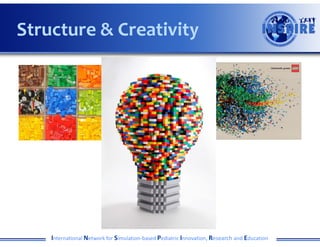
Structure & Creativity
International Network for Simulation-based Pediatric Innovation, Research and Education
Dan so…was sind Wir?
• Visionary Collaborators
– Answering important questions
– Developing pillars of research
• Building programs of simulation research
– Sharing resources
• Connecting mentors, institutions, collaborators
International Network for Simulation-based Pediatric Innovation, Research and Education
Let’s meet!
International Network for Simulation-based Pediatric Innovation, Research and Education
Project Presentations
Ralph MacKinnon FACTS & International Trauma Research
Donna Moro-Sutherland Low-cost Simulation in Global Health Arena
Marjorie White,
Taylor Sawyer
INSPIRE Procedures Working Group –
Development of a Standardized Process for
Procedure Kits
Leah Mallory Using Simulation for Competency-based
Assessment of Pediatric Resident / Registrar
performance
Burkhard Wermter Improving Realism of PALS-courses with smart
simulation tools & children
Paul Simonson Evaluation of a drug prescribing app in a
simulated scenario
Kevin Ching Effectiveness Of A Simulation Curriculum
On Clinical Execution
(Informal) Group Mentoring
22 April 2014
Vienna, Austria
International Network for Simulation-based Pediatric Innovation, Research and Education
Group Mentoring Instructions
1. Relax and let’s chat
2. Write down 2 or more questions /
topics about simulation as a career that
you would like to talk about
3. Place these in a hat
4. Form groups of 3 – 6 to talk about the
various topics

Ipssw2014 welcome

  • 1.
    INSPIRE @ IPSSW2014 Willkommen! 22 April 2014 Wien, Österreich Todd P Chang, MD - Das Krankenhaus für Kinder Los Angeles International Network for Simulation-based Pediatric Innovation, Research and Education
  • 2.
    International Network forSimulation-based Pediatric Innovation, Research and Education Unzer Zeitplan Ur 1800 – 1830 Willkommen und Einführung 1830 – 1900 FACTS & die internationale Traumaforschung mit Ralph MacKinnon 1900 – 1930 ALERT Präsentationen 1930 – 2030 ALERT kleine Sitzungen 2030 – 2100 Einbetten Simulation in der Praxis "ohne sich in der Übersetzung verloren“ mit Vinay Nadkarni 2100 – 2200 Gruppe-Mentoring
  • 3.
    International Network forSimulation-based Pediatric Innovation, Research and Education Unzer Zeitplan Ur 1800 – 1830 Willkommen und Einführung 1830 – 1900 FACTS & die internationale Traumaforschung mit Ralph MacKinnon 1900 – 1930 ALERT Präsentationen 1930 – 2030 ALERT kleine Sitzungen 2030 – 2100 Einbetten Simulation in der Praxis "ohne sich in der Übersetzung verloren“ mit Vinay Nadkarni 2100 – 2200 Gruppe-Mentoring
  • 4.
    International Network forSimulation-based Pediatric Innovation, Research and Education Unzer Zeitplan Ur 1800 – 1830 Willkommen und Einführung 1830 – 1900 FACTS & die internationale Traumaforschung mit Ralph MacKinnon 1900 – 1930 ALERT Präsentationen 1930 – 2030 ALERT kleine Sitzungen 2030 – 2100 Einbetten Simulation in der Praxis "ohne sich in der Übersetzung verloren“ mit Vinay Nadkarni 2100 – 2200 Gruppe-Mentoring
  • 5.
    International Network forSimulation-based Pediatric Innovation, Research and Education Unzer Zeitplan Ur 1800 – 1830 Willkommen und Einführung 1830 – 1900 FACTS & die internationale Traumaforschung mit Ralph MacKinnon 1900 – 1930 ALERT Präsentationen 1930 – 2030 ALERT kleine Sitzungen 2030 – 2100 Einbetten Simulation in der Praxis "ohne sich in der Übersetzung verloren“ mit Vinay Nadkarni 2100 – 2200 Gruppe-Mentoring
  • 6.
    International Network forSimulation-based Pediatric Innovation, Research and Education Leadership
  • 7.
    International Network forSimulation-based Pediatric Innovation, Research and Education Was sind Wir?
  • 8.
    2 Types ofOrganizing
  • 9.
    • Governance Documents • ReviewCommittees • Executive Liaisons • Contracts Top-Down
  • 10.
    Promotes: • Infrastructure • Professionalismand Maintenance of Quality • Longevity Top-Down
  • 11.
    • Social Media •Presentations & Workshops at International Conferences • Informal Networking Bottom-Up
  • 12.
    Promotes: • Novelty • Ingenuity •Technological Advancement • Growth Bottom-Up
  • 13.
    International Network forSimulation-based Pediatric Innovation, Research and Education Growth 0 20 40 60 80 100 120 140 160 180 2011 2012 2013 2014 Sites
  • 14.
    International Network forSimulation-based Pediatric Innovation, Research and Education Growth 0 100 200 300 400 500 600 2011 2012 2013 2014 Members
  • 15.
    International Network forSimulation-based Pediatric Innovation, Research and Education Mission We aim to improve the delivery of medical care to acutely ill children by answering important research questions pertaining to resuscitation, technical skills, behavioural skills, debriefing and simulation-based education
  • 16.
    International Network forSimulation-based Pediatric Innovation, Research and Education Consensus on simulation research priorities Merlin exercise (2012), Consensus (2013) Research Themes
  • 17.
    International Network forSimulation-based Pediatric Innovation, Research and Education INSPIRE Research Themes TRAINING AND ASSESSMENT Debriefing Develop/assess/implement effective techniques for debriefing real/sim events IPE, Teamwork, Communication Develop/assess/implement effective techniques for team training Procedural, Psychomotor Skills Develop/assess/implement effective techniques for skills development retention HEALTH CARE INNOVATIONS Technology Develop/assess/implement novel technologies designed to improve processes of care and pediatric patient outcomes Acute Care and Resuscitation Develop/assess/implement novel techniques for improving care of pediatric patients Human Factors Assess the role of human factors when providing care to pediatric patients Patient Safety Explore the key variables that influence patient safety and assess strategies to mitigate
  • 18.
    Current INSPIRE Projects TRAININGAND ASSESSMENT * new projects Debriefing • Cheng: Co-Debriefing in Simulation-based Education* • Halamek: DART- Debriefing Assessment IPE, Teamwork, Communication • Knight: Improving Code Team Performance and Survival Outcomes: Implementation of Pediatric Composite Resuscitation Training* • Hunt/Rosen: Team Leadership Under Stress • Overly: Structured-patient encounter • Tensing Maa- PALS performance tool Procedural, Psychomotor Skills • Pusic: Learning Retention/Refreshers After DP of Radiograph Interpretation* • Dadiz: Exploring Facilitators/Barriers to Implementing Competency Assessments* • Arnold: Simulation to teach management of tracheostomy emergencies * • White M. Development of a Standardized Process for INSPIRE Procedure Kits* • Byrne: Comparison of ETI + UVC vs. LMA + IO Needle in NRP* • Mehta: The effect of Simulation to determine Frequency for Competency Skill Training* • Smith: Pediatric Simulation and the Milestones* • Sawyer: Neonatal Intuabation • Chang: Train-the-trainer LP, Script Concordance LP • Brown: PRIDE Disaster Triage • Barry: BVM training • Kummett: Neonatal Skills HEALTH CARE INNOVATIONS Technology • Kessler: Randomized Trial of Continuous Capnography During Simulated Arrests* • Burhop: The Difficult Pediatric Airway: A Simulation study examining the Efficacy of Videolaryngoscopy in Trisomy 21* • Gee: Hybrid-simulator Acute Care and Resuscitation • Lemke: Rapid Cycle Deliberate Practice for Resuscitation Teams* • Meyer: Donation after Circulatory Death* • Auerbach: GED-PED Disparities • McKinnon: Critical Neurotrauma Sim • Mehta: Health literacy • Levy: PALS tool validation Human Factors • Sens: Handoff Assessment Patient Safety • Fiedor-Hamilton: EpiPen • Sherzer: Epi pen community
  • 19.
    International Network forSimulation-based Pediatric Innovation, Research and Education What do we provide?
  • 20.
    International Network forSimulation-based Pediatric Innovation, Research and Education How have we done well? 1. Consultation 2. Research Structure 3. Mentorship 4. Multi-center Strength & Productivity
  • 21.
    International Network forSimulation-based Pediatric Innovation, Research and Education 1. Consultation Study protocol Specific Consultative Questions Online submission (http://www.INSPIRESim.com/) Online submission (http://www.INSPIRESim.com/) Research Design Committee feedback Any grant proposal Grant feedback One-time access to Experts and feedback
  • 22.
    International Network forSimulation-based Pediatric Innovation, Research and Education 2. Research Structure Young Investigator with Research Idea •Online Research Series •Senior INSPIRE mentor (via online mentor match) to help with establishing research goals and development of 1 page “specific aims” page Systematic Review or Needs Assessment •INSPIRE Research Coordinator to assist with methodology for systematic review •INSPIRE Librarian to assist with literature search Pilot Study •Review and revise study protocol with INSPIRE mentor •Review study protocol with INSPIRE technology director to discuss possible tech-assisted outcome measures •Review with INSPIRE statistical consultant to solidify analysis plan, feasibility, and power analysis Multicenter Study •INSPIRE scientific committee to review protocol and grant proposal •INSPIRE website to assist in finding collaborators and recruitment sites •INSPIRE research portal for data collection •Data analysis and submission to Manuscript Oversight Committee (MOC) Knowledge Translation •INSPIRE research assistant and graphic designer to assist with poster preparation •INSPIRE writing group and scientific committee to assist with review of manuscripts and mitigation of authorship issues and byline •Submission of manuscript for peer review, amend with mentor and writing group, publish Publication Publication Publication
  • 23.
    International Network forSimulation-based Pediatric Innovation, Research and Education 3. Mentorship
  • 24.
    International Network forSimulation-based Pediatric Innovation, Research and Education 4. Strength in Numbers
  • 25.
    International Network forSimulation-based Pediatric Innovation, Research and Education Upcoming • Consultations – Technology – Statistical support – Psychometric support • Mentorship / Idea Exchange • Video Capture Centralization
  • 26.
  • 27.
    International Network forSimulation-based Pediatric Innovation, Research and Education Our schedule Hour 1800 – 1830 Welcome & Introduction 1830 – 1900 FACTS & International Trauma Research - Ralph MacKinnon 1900 – 1930 ALERT Presentations 1930 – 2030 ALERT Breakout Sessions 2030 – 2100 Embedding Simulation into Practice ‘without getting lost in the translation’ - Vinay Nadkarni 2100 – 2200 Informal Group Mentoring
  • 28.
    ! ! INSPIRE INSPIRE INSPIREINSPIRE INSPIRE INSPIRE INSPIRE INSPIRE INSPIRE PIRE INSPIRE INSPIRE INSPIRE INSPIRE INSPIRE INSPIRE INSPIRE INSPIRE INS INSPIRE INSPIRE INSPIRE INSPIRE SPIRE INSPIR INSPIR E INSPIR E International*Network*for*Simulation2based*Pediatric*Innovation,*Research*and*Education* ! 3* Writing Group Procedures This document describes the writing process, including roles, expectations, and procedures for writing papers related to studies conducted through INSPIRE. This writing process was developed to facilitate the timely dissemination of research findings in the academic press, to reduce stress, and to increase communication among INSPIRE members. Key Roles in the Writing Process Primary Author: This person is responsible for the main writing task and is the corresponding author for the paper. Production Manager/Research Assistant: This person will manage the entire writing process. S/he is responsible for setting appropriate deadlines, maintaining progress, compiling sections written by others into a single draft, setting up a document template, and formatting the paper in accordance with the journal’s style. Core Writing Group: This group of 3-5 people is responsible for the content of the paper, including the main outcomes and messages reported there. They make decisions concerning the manuscript. If conflict arises, this group must reach consensus. Steps in Writing Process: 1. The Writing Group identifies the main outcome of the paper. 2. The Primary Author writes a 200-300 word abstract and shares it with Writing Group 3. The Production Manager works with Primary Author to identify a timeline for the project and divide up writing tasks. If an author misses a deadline for the same product twice in a row then the Production Manager has the authority to reassign this work product and adjust that person’s authorship status. 4. All manuscripts must receive final approval of the INSPIRE MOC prior to submission 5. Primary author submits for publication 7. Once submitted, production manager is responsible for coordinating all replies to peer reviewers, though it is expected that the Primary Author will take the major responsibility in preparing these replies. Any secondary submission that requires re-analysis of data or re-interpretation of the primary findings of the paper should be done within 2 weeks of receipt of the comments. 8. Re-submissions are to be completed within 4 weeks of receipt of comments.
  • 29.
    International Network forSimulation-based Pediatric Innovation, Research and Education Productivity • Publications- 22 • Manuscripts in progress- 31 • Abstracts/Presentations- 81 • Grants- 27 • Awards- 10
  • 30.
    International Network forSimulation-based Pediatric Innovation, Research and Education Structure & Creativity
  • 31.
    International Network forSimulation-based Pediatric Innovation, Research and Education Dan so…was sind Wir? • Visionary Collaborators – Answering important questions – Developing pillars of research • Building programs of simulation research – Sharing resources • Connecting mentors, institutions, collaborators
  • 32.
    International Network forSimulation-based Pediatric Innovation, Research and Education Let’s meet!
  • 33.
    International Network forSimulation-based Pediatric Innovation, Research and Education Project Presentations Ralph MacKinnon FACTS & International Trauma Research Donna Moro-Sutherland Low-cost Simulation in Global Health Arena Marjorie White, Taylor Sawyer INSPIRE Procedures Working Group – Development of a Standardized Process for Procedure Kits Leah Mallory Using Simulation for Competency-based Assessment of Pediatric Resident / Registrar performance Burkhard Wermter Improving Realism of PALS-courses with smart simulation tools & children Paul Simonson Evaluation of a drug prescribing app in a simulated scenario Kevin Ching Effectiveness Of A Simulation Curriculum On Clinical Execution
  • 34.
    (Informal) Group Mentoring 22April 2014 Vienna, Austria
  • 35.
    International Network forSimulation-based Pediatric Innovation, Research and Education Group Mentoring Instructions 1. Relax and let’s chat 2. Write down 2 or more questions / topics about simulation as a career that you would like to talk about 3. Place these in a hat 4. Form groups of 3 – 6 to talk about the various topics