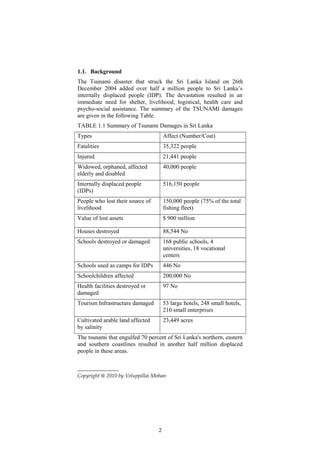
This document discusses public procurement reform and modernization in Sri Lanka after the 2004 tsunami. It aims to contribute to improved capacity and conceptualization of procurement by implementing environmental and social considerations in line with international standards to help recover the economy. Sustainable procurement can promote sustainable development by ensuring better value, efficiency, reduced corruption, and transparency. The tsunami displaced over 500,000 people in Sri Lanka and caused extensive damage. The government's recovery plan focuses on rebuilding infrastructure, housing, tourism, and fisheries. Sustainable procurement and tendering are identified as key issues to maximize employment opportunities in infrastructure reconstruction.
![damaged homes also needs to be looked into. This is a very
employment intensive activity.
6. RESULTS/OUTCOMES OF THE TSUNAMI AFFECTED AREA
PROJECT THROUGH SUSTAINABLE PROCUREMENT
Scale of the recovery and reconstruction process are estimated total
need for long-term recovery: US$ 2.1 billion province wise- East:
45%, South: 25.9%, North: 19% and West: 10.1% and transitional
shelters completed: 53,221 units.
6.1 World Bank Assistance by funding of US$150 million from:
$30 million in an emergency grant $75 million through portfolio
restructuring and $45 million in credit for Industry and trade
(Housing construction) (55%), Transportation (Roads and highways)
(35%) and Public Administration, Law, and Justice (General public
administration sector) (10%)
6.1.1 Housing: Home Owner Driven Program A house is either
classified as a partially damaged house (33,208) or a fully damaged
house (21,355). Grants provide US$2,500 [LKR 250,000] for a fully
damaged house paid in four installments and $ US1000 [LKR
100,000] for a partly damaged house paid in two equal installments,
allowing people to rebuild or repair their homes.
6.1.2 Livelihood Support-commitment of US$ 34.4 Million
6.1.3 Roads US$ 33 million [40% of which is in grants, with 60%
in credit) rehabilitated the A2 main Southern coastal road from
Kalutara to Matara.
6.1.4 Health-to fill gaps in the government- designed plans for
post-tsunami rehabilitation of the health sector. IDA provided
$500,000 for the design and construction supervision of four health
administrative buildings
6.1.5 Water -$US 104,000 [LKR Rs.10, 520,719] for the relief
activities of the Ministry of Urban Development and Water Supply to
purchase water pumps to clean shallow wells contaminated with
saline water; provide safe drinking water tanks to temporary and
transition camps; and sleeping mattresses.
6.2 Rebuilding Community Infrastructure & Shelter Project -
Japanese Funded by: Government of Japan; US $ 3,000,000 for
Housing Located in Galle -701, Batticoloa - 158, Kattankudy -- 238,
Jaffna - 40 houses and Killinochchi- 43.
6.3 Spain funded a soft loan € 21.6 million Major bridges have been
erected in the north-eastern coastal region of Sri Lanka, three located
north of Trincomalee in, Irakkakandy, Pudavakattu and Yan Oya,
and one just north of Batticaloa in Oddamavadi by improving access
9](https://image.slidesharecdn.com/a688ebc7-adce-4697-aa58-14a0799d0de6-150612084627-lva1-app6891/85/IPPF-2010-beijing-9-320.jpg)