Peace Processes as Joint Learning Processes of Stakeholders
and Insider Peacebuilders: A Case Study on Southern
Thailand
Norbert Ropers – Berghof Foundation/ Center for Conflict Studies and Cultural Diversity (CSCD)
Mathus Anuvatudom – King Prajadhipok’s Institute (KPI)
November 2013
Points to Share
1. Why is the Insider Peacebuilders Platform (IPP) needed?
2. How did we do during nine months (September 2011 –
June 2012)?
3. What are the outcomes?
4. What are the challenges?
5. What are the lessons learnt from the process?
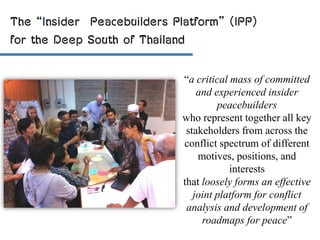
“a critical mass of committed
and experienced insider
peacebuilders
who represent together all key
stakeholders from across the
conflict spectrum of different
motives, positions, and
interests
that loosely forms an effective
joint platform for conflict
analysis and development of
roadmaps for peace”
Basic Assumptions on IPP (phase 1-2)
1. A network for active engagement to transform the
conflict by stakeholders across the divide was needed.
• In the past 7 years, few efforts on peacebuilding involved inclusive
collaboration of stakeholders. Most networks are like-minded.
• Public discourse on peace process in the south was very limited.

2. Conflict transformation based on collective action is
unlikely to achieve without common understanding on
the conflict.
• Any approach regarding on political solution (i.e. research papers, 50
forums on decentralization) was not seriously considered due to
different understandings on the cause of violence.
Basic Assumptions on IPP (phase 1-2)
3. Joint conflict analysis could be a learning process where
trust can be gradually built and pave the way for future
collaboration.
• A starting point to engage fundamentally different groups of people
together is to provide a safe space for learning.
• Sound solutions can only come from proper analysis. Practical
solutions can only then come from joint analysis.
• There is no analysis of the conflict done by insider stakeholders
released to the public realm.
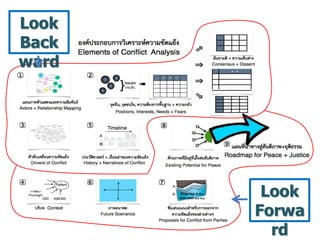
Look
Back
ward

Look
Forwa
rd
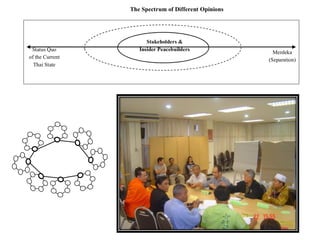
The Formation and Activities of IPP
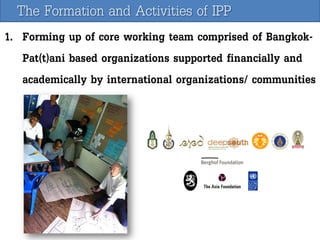
1. Forming up of core working team comprised of BangkokPat(t)ani based organizations supported financially and
academically by international organizations/ communities
The Formation and Activities of IPP
2. Venue – Prince Songkla University, Pattani Campus
3. 5 workshops – 3 days each/ plenary and break out group
sessions from September 2011 – June 2012
4. Selection of participants
• Multipliers
• Representation of different opinions
• Approximately 50 persons ranging from military officers, civil
servants, local politicians, monks, imams, Thai Buddhist and Malay
Muslim teachers, youth and women leaders, journalists, academics,
community leaders, and local intellectuals
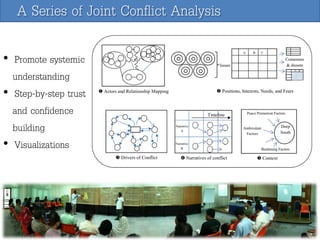
A Series of Joint Conflict Analysis
• Promote systemic
understanding
• Step-by-step trust
and confidence
building
• Visualizations
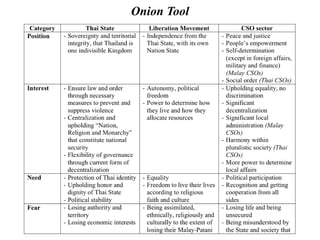
Onion Tool
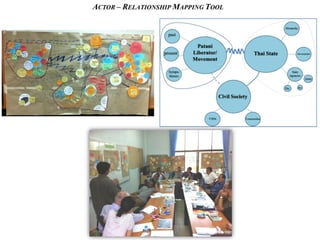
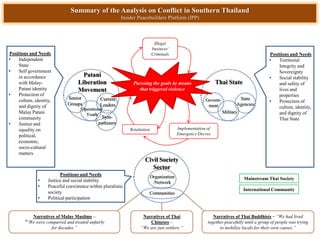
Summary of the Analysis on Conflict in Southern Thailand
Insider Peacebuilders Platform (IPP)

Positions and Needs
•
Independent
State
•
Self government
in accordance
with MalayPatani identity
•
Protection of
culture, identity,
and dignity of
Malay Patani
community
•
Justice and
equality on
political,
economic,
socio-cultural
matters

Illegal
business/
Criminals

Patani
Liberation
Movement
Senior
Groups

Thai State

Pursuing the goals by means
that triggered violence

Current
Leaders

Government

Operational
Youth

State
Agencies
Military

Sympathizers

Positions and Needs
•
Territorial
Integrity and
Sovereignty
•
Social stability
and safety of
lives and
properties
•
Protection of
culture, identity,
and dignity of
Thai State

Implementation of
Emergency Decree

Retaliation

Civil Society
Sector
•
•
•

Positions and Needs
Justice and social stability
Peaceful coexistence within pluralistic
society
Political participation

Narratives of Malay Muslims –

““We were conquered and treated unfairly
for decades.”

Organization
/Network
Communities

Narratives of Thai
Chineses –
“We are just settlers.”

Mainstream Thai Society
International Community

Narratives of Thai Buddhists - “We had lived
together peacefully until a group of people was trying
to mobilize locals for their own causes.”
Outcomes from IPP Process
1. Common analysis of and understanding on the conflict done by
various stakeholders
• Joint comprehensive conflict analysis
• Thai Buddhists realized strong sentiments for liberation/independence
• BRN – Liberation movement emerged as a main party (before the
official peace dialogue)

2. A physical and psychological space/network where fundamentally
differences can be safely discussed, tolerated, and co-exist.
• Participants are enthusiastic to meet, discuss, and update situation
• Participants were more cautious not to over-generalize the others
• Participants acknowledged different perspectives and their rationales
and realized that they can actually “work” together (i.e. military officer)
Outcomes from IPP Process
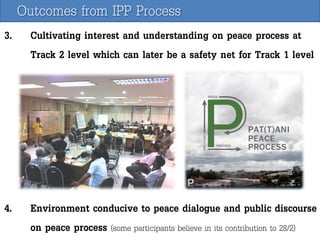
3.

Cultivating interest and understanding on peace process at
Track 2 level which can later be a safety net for Track 1 level

4.

Environment conducive to peace dialogue and public discourse
on peace process (some participants believe in its contribution to 28/2)
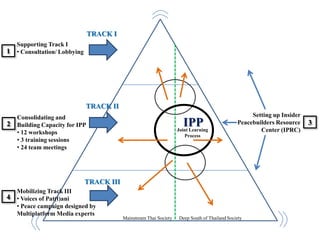
TRACK I
Supporting Track I

1 • Consultation/ Lobbying

TRACK II
2

Consolidating and
Building Capacity for IPP
• 12 workshops
• 3 training sessions
• 24 team meetings

IPP

Joint Learning
Process

Setting up Insider
Peacebuilders Resource
Center (IPRC)

TRACK III
4

Mobilizing Track III
• Voices of Pat(t)ani
• Peace campaign designed by
Multiplatform Media experts

Mainstream Thai Society

Deep South of Thailand Society

3
Challenges of IPP Process
1. Turning joint learning into joint action
2. Difficulty of inviting more military officers and politicallydriven Thai Buddhists on board
3. Open question on whether multiplying this type of work as
several IPPs or strengthening the original group
4. Limitation on measuring impact at macro level
Some Lessons Learnt from IPP Process
1. An inclusive platform/network where all key actors are adequately
present is critical to a meaningful transformation – Internal
dialogue within groups of stakeholders is necessary to prepare for
engagement
2. Joint learning based on sound tools, knowledge and experiences
from elsewhere with good facilitation and safe environment can
disseminate expertise and skills, build trust and confidence, and
lay a foundation for public peace process
3. Although track 2 and 3 are critical, linkage of IPP with track 1
will make the work of IPP and the peace process in general more
holistic and create more immediate impacts.

Ipp as joint learning process

  • 1.
    Peace Processes asJoint Learning Processes of Stakeholders and Insider Peacebuilders: A Case Study on Southern Thailand Norbert Ropers – Berghof Foundation/ Center for Conflict Studies and Cultural Diversity (CSCD) Mathus Anuvatudom – King Prajadhipok’s Institute (KPI) November 2013
  • 2.
    Points to Share 1.Why is the Insider Peacebuilders Platform (IPP) needed? 2. How did we do during nine months (September 2011 – June 2012)? 3. What are the outcomes? 4. What are the challenges? 5. What are the lessons learnt from the process?
  • 3.
    “a critical massof committed and experienced insider peacebuilders who represent together all key stakeholders from across the conflict spectrum of different motives, positions, and interests that loosely forms an effective joint platform for conflict analysis and development of roadmaps for peace”
  • 4.
    Basic Assumptions onIPP (phase 1-2) 1. A network for active engagement to transform the conflict by stakeholders across the divide was needed. • In the past 7 years, few efforts on peacebuilding involved inclusive collaboration of stakeholders. Most networks are like-minded. • Public discourse on peace process in the south was very limited. 2. Conflict transformation based on collective action is unlikely to achieve without common understanding on the conflict. • Any approach regarding on political solution (i.e. research papers, 50 forums on decentralization) was not seriously considered due to different understandings on the cause of violence.
  • 5.
    Basic Assumptions onIPP (phase 1-2) 3. Joint conflict analysis could be a learning process where trust can be gradually built and pave the way for future collaboration. • A starting point to engage fundamentally different groups of people together is to provide a safe space for learning. • Sound solutions can only come from proper analysis. Practical solutions can only then come from joint analysis. • There is no analysis of the conflict done by insider stakeholders released to the public realm.
  • 6.
  • 7.
    The Formation andActivities of IPP 1. Forming up of core working team comprised of BangkokPat(t)ani based organizations supported financially and academically by international organizations/ communities
  • 8.
    The Formation andActivities of IPP 2. Venue – Prince Songkla University, Pattani Campus 3. 5 workshops – 3 days each/ plenary and break out group sessions from September 2011 – June 2012 4. Selection of participants • Multipliers • Representation of different opinions • Approximately 50 persons ranging from military officers, civil servants, local politicians, monks, imams, Thai Buddhist and Malay Muslim teachers, youth and women leaders, journalists, academics, community leaders, and local intellectuals
  • 10.
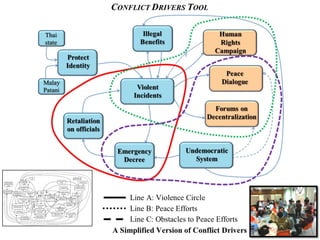
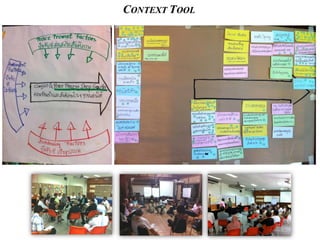
    A Series ofJoint Conflict Analysis • Promote systemic understanding • Step-by-step trust and confidence building • Visualizations
  • 12.
  • 16.
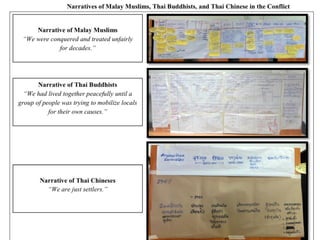
    Summary of theAnalysis on Conflict in Southern Thailand Insider Peacebuilders Platform (IPP) Positions and Needs • Independent State • Self government in accordance with MalayPatani identity • Protection of culture, identity, and dignity of Malay Patani community • Justice and equality on political, economic, socio-cultural matters Illegal business/ Criminals Patani Liberation Movement Senior Groups Thai State Pursuing the goals by means that triggered violence Current Leaders Government Operational Youth State Agencies Military Sympathizers Positions and Needs • Territorial Integrity and Sovereignty • Social stability and safety of lives and properties • Protection of culture, identity, and dignity of Thai State Implementation of Emergency Decree Retaliation Civil Society Sector • • • Positions and Needs Justice and social stability Peaceful coexistence within pluralistic society Political participation Narratives of Malay Muslims – ““We were conquered and treated unfairly for decades.” Organization /Network Communities Narratives of Thai Chineses – “We are just settlers.” Mainstream Thai Society International Community Narratives of Thai Buddhists - “We had lived together peacefully until a group of people was trying to mobilize locals for their own causes.”
  • 17.
    Outcomes from IPPProcess 1. Common analysis of and understanding on the conflict done by various stakeholders • Joint comprehensive conflict analysis • Thai Buddhists realized strong sentiments for liberation/independence • BRN – Liberation movement emerged as a main party (before the official peace dialogue) 2. A physical and psychological space/network where fundamentally differences can be safely discussed, tolerated, and co-exist. • Participants are enthusiastic to meet, discuss, and update situation • Participants were more cautious not to over-generalize the others • Participants acknowledged different perspectives and their rationales and realized that they can actually “work” together (i.e. military officer)
  • 18.
    Outcomes from IPPProcess 3. Cultivating interest and understanding on peace process at Track 2 level which can later be a safety net for Track 1 level 4. Environment conducive to peace dialogue and public discourse on peace process (some participants believe in its contribution to 28/2)
  • 19.
    TRACK I Supporting TrackI 1 • Consultation/ Lobbying TRACK II 2 Consolidating and Building Capacity for IPP • 12 workshops • 3 training sessions • 24 team meetings IPP Joint Learning Process Setting up Insider Peacebuilders Resource Center (IPRC) TRACK III 4 Mobilizing Track III • Voices of Pat(t)ani • Peace campaign designed by Multiplatform Media experts Mainstream Thai Society Deep South of Thailand Society 3
  • 20.
    Challenges of IPPProcess 1. Turning joint learning into joint action 2. Difficulty of inviting more military officers and politicallydriven Thai Buddhists on board 3. Open question on whether multiplying this type of work as several IPPs or strengthening the original group 4. Limitation on measuring impact at macro level
  • 21.
    Some Lessons Learntfrom IPP Process 1. An inclusive platform/network where all key actors are adequately present is critical to a meaningful transformation – Internal dialogue within groups of stakeholders is necessary to prepare for engagement 2. Joint learning based on sound tools, knowledge and experiences from elsewhere with good facilitation and safe environment can disseminate expertise and skills, build trust and confidence, and lay a foundation for public peace process 3. Although track 2 and 3 are critical, linkage of IPP with track 1 will make the work of IPP and the peace process in general more holistic and create more immediate impacts.