Generation of Computers
Presented By
Kabeer, Navya, Sidhant, Priyaansh, Aayush
There are five generations of
computers:-
1. First Generation
(1946 – 1955)
2. Second Generation
(1956 – 1963)
3. Third Generation
(1966 – 1975)
4. Fourth Generation
(1976 – 1985)
5. Fifth Generation
(1986 – onward)
First Generation Computers
1946 - 1955
ENIAC (Electronic Numeric Integrator
And Calculator) was the first electronic
digital computer.
It uses about 18,000 vacuum tubes and
magnetic tape.
It was very large in size and produced a
lot of heat.
This was very hard read and write
programs by every person.
Advantages Disadvantages
 They could perform
thousands of
calculations each
second making it
possible to decode
messages in a few
hours.
 They were
expensive.
 Contained
thousands of
valves (vacuum
tubes) making them
unreliable.
 Memory was
practically non-
existent.
Computer Generations
The Computer Generations
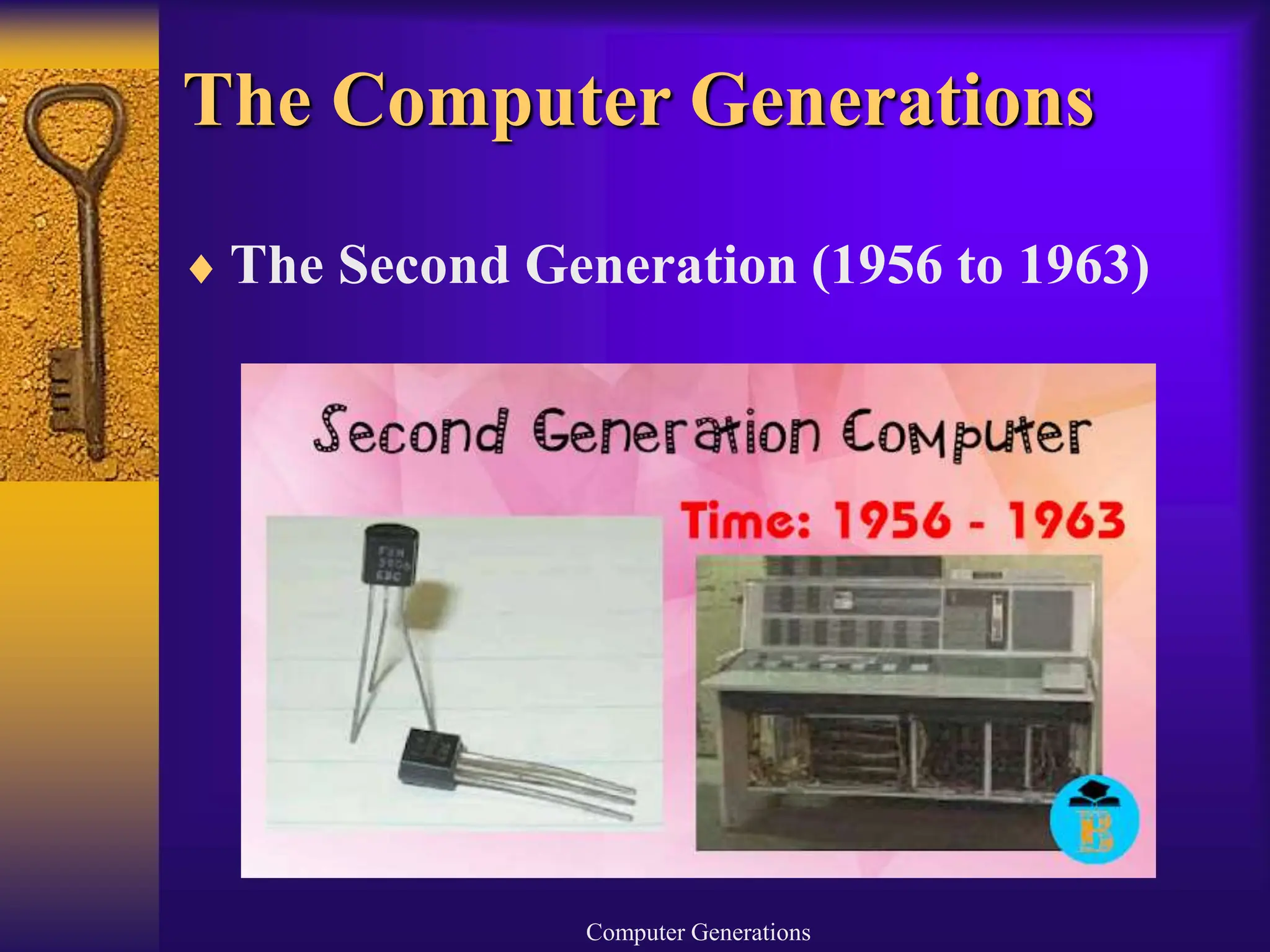
 The Second Generation (1956 to 1963)
Computer Generations
Second Generation
1956-1963
 The period of second generation was from
1959-1965. In this generation, transistors
were used that were cheaper, consumed less
power, more compact in size, more reliable
and faster than the first generation machines
made of vacuum tubes.
 In this generation, magnetic cores were used
as the primary memory and magnetic tape
and magnetic disks as secondary storage
devices.
Advantages
 Uses less power and
generates less heat.
 The speed of the
second generation is
faster as compared to
the first generation.
 Second generation
computers have
improved accuracy and
offer better portability.
Disadvantages
 Programming is
expressed in terms of
individual processor
instructions, rather
than higher level logic.
 Low-level memory and
hardware details must
be manually managed
which is often bug-
prone .
Computer Generations
The Computer Generations
 The Third Generation (1966 to 1975)
Computer Generations
Third Generation
1966-1975
 The computers of third generation used Integrated
Circuits (ICs) in place of transistors. The
integrated circuit (IC) is a semiconductor material,
that contains thousands of transistors miniaturized
in it.
 With the help of IC, the computer becomes more
reliable, fast, required less maintenance, small in
size, generates less heat, and is less expensive.
 It was developed by Robert Noyce of Fairchild
Semiconductor and Jack Kilby (American
electrical engineer) of Texas Instruments in 1958.
 Computer required less space
due to the use of integrated
circuits (IC). A single integrated
circuit (IC) contains transistors,
resistors, condensers,
condensers, etc. on a piece of
the silicon semiconductor
substrate.
 In third generation computers,
the punch cards were removed
and the input was taken with the
help of a mouse and keyboards.
 They have high storage capacity
and give more accurate results,
which helps to store and
compute and calculate more
precise operations.
Disadvantages
 These computers
still required air
conditioning.
 To manufacture IC,
highly sophisticated
technology was
required.
 Maintaining IC
chips were difficult.
Computer Generations
Advantages
Computer Generations
The Computer Generations
 The Fourth Generation (1976 to 1985)
Computer Generations 13
Fourth Generation
1976 – 1985
 The period of fourth generation was from 1976-
1985. Computers of fourth generation used Very
Large Scale Integrated (VLSI) circuits.
 VLSI and LSI circuits having about 5000
transistors and other circuit elements with their
associated circuits on a single chip made it
possible to have microcomputers of fourth
generation.
 VLSI short for Very Large-Scale Integration, and
LSI stands for Large Scale Integration.
Advantages
 The size of fourth-generation
computers decreased because of
the high density of components.
 They are more reliable, and the
heat generation of these
computers was negligible.
 The Fourth-generation
computers were inexpensive and
portable as compared to
previous versions .
 These computers need minimum
maintenance.
 In this generation of computers,
all kinds of High-level
languages can be used.
Disadvantages
 The manufacturing of VLSI
(Very Large-Scale Integration)
Chip was needed very advanced
technology.
 One of the other limitations of
these computers; they were
highly sophisticated.
 They required a fan for cooling
the system.
 Also, the manufacturing of
Microprocessors needed high
technical knowledge.
 The fabrication of ICs can be
made by high quality and
reliable system or technology.
Computer Generations 14
Computer Generations
Fifth Generation Computers
(1986 - onward)
Computer Generations
5th Generation
(1986 – onward)
 VLSI technology was replaced by Ultra
Large Scale Integration (ULSI) technology.
 Helped to develop very small but extremely
powerful and fast computers known as
Robots.
 The 5th generation computers are under AI.
 Idea was introduced by Japan’s Ministry of
International Trade and Industry in 1982.
Fifth Generation Languages
(abbreviated as 5GL)
Computer Generations
 Fifth generation
languages are
currently being used
for neural networks.
 A neural network is a
form of artificial
intelligence that
attempts to imitate
how the human mind
works.
Advantages Disadvantages
 More reliable and
work faster.
 Available in diff.
sizes and features
and diff. affordable
prices.
 Wireless hence
easily portable and
have extra high
processing speed.
 These computers
have their own
brain so they can
harm the humanity.
Thank You
Computer Generations

IP Generation of Computers (1) (1) (1).pptx

  • 1.
    Generation of Computers PresentedBy Kabeer, Navya, Sidhant, Priyaansh, Aayush
  • 2.
    There are fivegenerations of computers:- 1. First Generation (1946 – 1955) 2. Second Generation (1956 – 1963) 3. Third Generation (1966 – 1975) 4. Fourth Generation (1976 – 1985) 5. Fifth Generation (1986 – onward)
  • 3.
    First Generation Computers 1946- 1955 ENIAC (Electronic Numeric Integrator And Calculator) was the first electronic digital computer. It uses about 18,000 vacuum tubes and magnetic tape. It was very large in size and produced a lot of heat. This was very hard read and write programs by every person.
  • 5.
    Advantages Disadvantages  Theycould perform thousands of calculations each second making it possible to decode messages in a few hours.  They were expensive.  Contained thousands of valves (vacuum tubes) making them unreliable.  Memory was practically non- existent.
  • 6.
    Computer Generations The ComputerGenerations  The Second Generation (1956 to 1963)
  • 7.
    Computer Generations Second Generation 1956-1963 The period of second generation was from 1959-1965. In this generation, transistors were used that were cheaper, consumed less power, more compact in size, more reliable and faster than the first generation machines made of vacuum tubes.  In this generation, magnetic cores were used as the primary memory and magnetic tape and magnetic disks as secondary storage devices.
  • 8.
    Advantages  Uses lesspower and generates less heat.  The speed of the second generation is faster as compared to the first generation.  Second generation computers have improved accuracy and offer better portability. Disadvantages  Programming is expressed in terms of individual processor instructions, rather than higher level logic.  Low-level memory and hardware details must be manually managed which is often bug- prone . Computer Generations
  • 9.
    Computer Generations The ComputerGenerations  The Third Generation (1966 to 1975)
  • 10.
    Computer Generations Third Generation 1966-1975 The computers of third generation used Integrated Circuits (ICs) in place of transistors. The integrated circuit (IC) is a semiconductor material, that contains thousands of transistors miniaturized in it.  With the help of IC, the computer becomes more reliable, fast, required less maintenance, small in size, generates less heat, and is less expensive.  It was developed by Robert Noyce of Fairchild Semiconductor and Jack Kilby (American electrical engineer) of Texas Instruments in 1958.
  • 11.
     Computer requiredless space due to the use of integrated circuits (IC). A single integrated circuit (IC) contains transistors, resistors, condensers, condensers, etc. on a piece of the silicon semiconductor substrate.  In third generation computers, the punch cards were removed and the input was taken with the help of a mouse and keyboards.  They have high storage capacity and give more accurate results, which helps to store and compute and calculate more precise operations. Disadvantages  These computers still required air conditioning.  To manufacture IC, highly sophisticated technology was required.  Maintaining IC chips were difficult. Computer Generations Advantages
  • 12.
    Computer Generations The ComputerGenerations  The Fourth Generation (1976 to 1985)
  • 13.
    Computer Generations 13 FourthGeneration 1976 – 1985  The period of fourth generation was from 1976- 1985. Computers of fourth generation used Very Large Scale Integrated (VLSI) circuits.  VLSI and LSI circuits having about 5000 transistors and other circuit elements with their associated circuits on a single chip made it possible to have microcomputers of fourth generation.  VLSI short for Very Large-Scale Integration, and LSI stands for Large Scale Integration.
  • 14.
    Advantages  The sizeof fourth-generation computers decreased because of the high density of components.  They are more reliable, and the heat generation of these computers was negligible.  The Fourth-generation computers were inexpensive and portable as compared to previous versions .  These computers need minimum maintenance.  In this generation of computers, all kinds of High-level languages can be used. Disadvantages  The manufacturing of VLSI (Very Large-Scale Integration) Chip was needed very advanced technology.  One of the other limitations of these computers; they were highly sophisticated.  They required a fan for cooling the system.  Also, the manufacturing of Microprocessors needed high technical knowledge.  The fabrication of ICs can be made by high quality and reliable system or technology. Computer Generations 14
  • 15.
    Computer Generations Fifth GenerationComputers (1986 - onward)
  • 16.
    Computer Generations 5th Generation (1986– onward)  VLSI technology was replaced by Ultra Large Scale Integration (ULSI) technology.  Helped to develop very small but extremely powerful and fast computers known as Robots.  The 5th generation computers are under AI.  Idea was introduced by Japan’s Ministry of International Trade and Industry in 1982.
  • 17.
    Fifth Generation Languages (abbreviatedas 5GL) Computer Generations  Fifth generation languages are currently being used for neural networks.  A neural network is a form of artificial intelligence that attempts to imitate how the human mind works.
  • 18.
    Advantages Disadvantages  Morereliable and work faster.  Available in diff. sizes and features and diff. affordable prices.  Wireless hence easily portable and have extra high processing speed.  These computers have their own brain so they can harm the humanity.
  • 19.