The Fog Around the CloudMyths and Realities of Cloud Computing StandardsNathaniel S. Borenstein, Ph.D.Chief ScientistMimecast
OutlineCloud computing isn’t right for everythingBut standards-centric objections are mostly wrongMuch standards work is pointless wasted effortCloud computing’s needs are specific, not vagueFor most services, there are simpler ways to avoid lock-inWe need accountable, well-behaved vendorsEvaluative standards would be helpful, but aren’t criticalFor most applications, there’s no reason to wait for standardsThe Fog Around the Cloud -- Nathaniel Borenstein, Mimecast
Cloud Computing: Threat or Menace?It’s natural to seek an excuse to say “No.”For some paradigms, the cloud really is wrongConsider the implantable defibrillatorNo argument could convince me to go cloud-basedBut standards are the least of the problemsThat last fact is surprisingly typical – standards don’t magically solve most problems.  But yes, it’s pretty cool when they do…The Fog Around the Cloud -- Nathaniel Borenstein, Mimecast
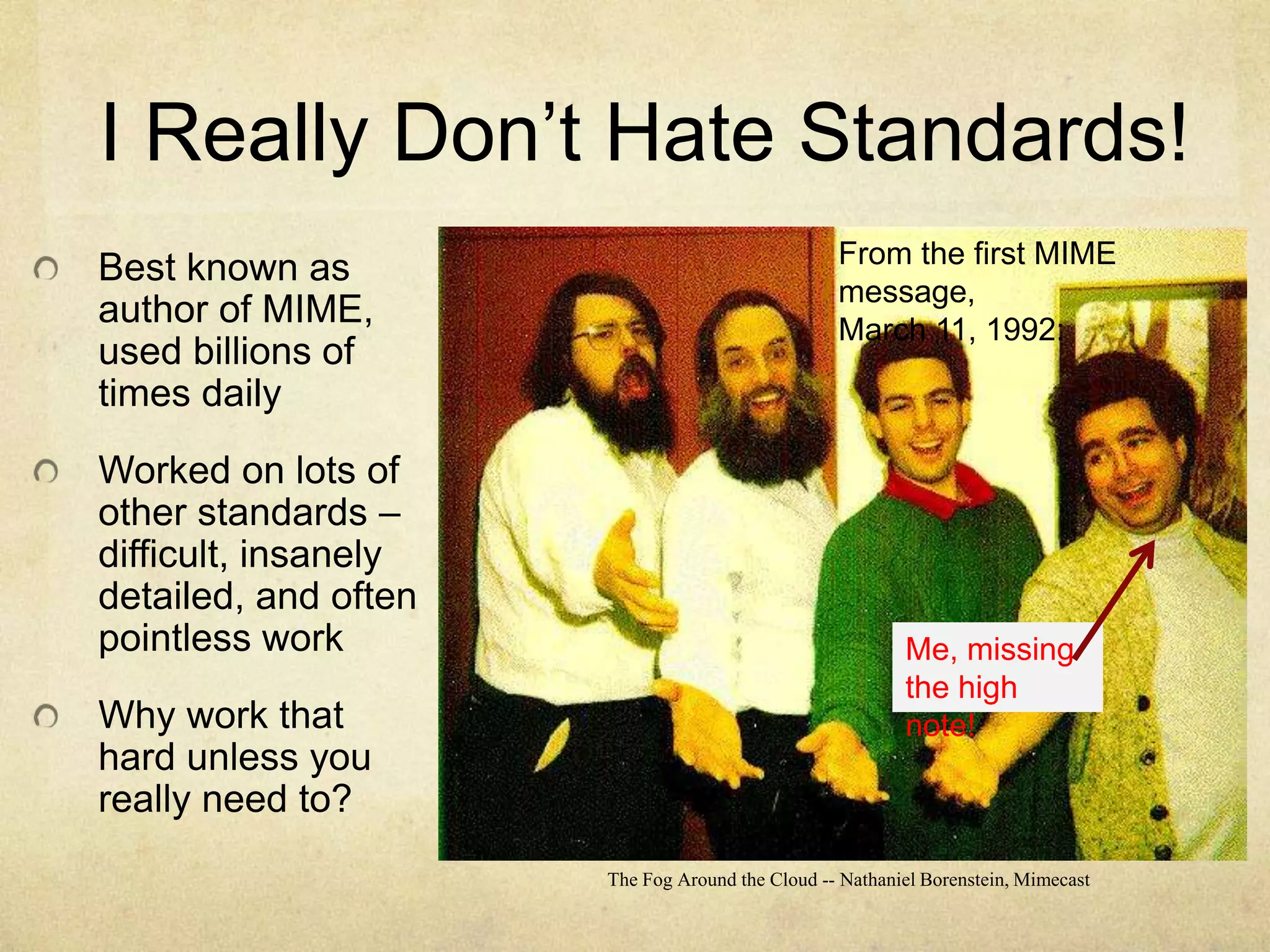
I Really Don’t Hate Standards!Best known as author of MIME, used billions of times dailyWorked on lots of other standards – difficult, insanely detailed, and often pointless workWhy work that hard unless you really need to?The Fog Around the Cloud -- Nathaniel Borenstein, MimecastFrom the first MIME message,March 11, 1992:Me, missing the high note!
Godot May Not Be ComingDelaying cloud computing – or nearly anything else -- for “lack of standards” is wrong 90% of the time.“Standards” are categorically useless.  Particular standards can be very useful.The generic objection is lazy; for some specific  applications, the objection can be validDistinguish two types of standards:Definitional standards can be show-stoppersEvaluative standards are often desirableThe Fog Around the Cloud -- Nathaniel Borenstein, Mimecast
The Devil in the DetailsMyriad details make standards work excruciatingRecently:  in internationalized email, UTF8 or UTF-8?Weeks of discussion behind “US-ASCII” in MIME:Content-type: text/plain; charset=“us-ascii”Significant “worth the bother?” thresholdMost worthwhile for:Data formatsInterchange protocolThe Fog Around the Cloud -- Nathaniel Borenstein, Mimecast
What Standards are Needed for Cloud Computing?Stated that generically:  None!What standards might improve the cloud generally?Evaluative standards: security/compliance/best practicesWhat standards does a particular application need to be acceptably moved to the cloud?That depends on the application.Let’s look at a couple of examples.The Fog Around the Cloud -- Nathaniel Borenstein, Mimecast
What Standards are Needed for VM Hosting in the Cloud?For a definition of “needed” that stresses portability…A clear data format specificationA clear data model definitionAddresses situations genuinely new with the cloudProbably worth the pain of standards work!But still might not justify avoiding the cloudWorks fine todayMigration is still possible without itThe Fog Around the Cloud -- Nathaniel Borenstein, Mimecast
What Standards are Needed for Email Archiving?Disclaimer:Intuitive guess:  Data export formatsBut must the cloud be better than current data centers?Could standardize on PST (Microsoft) or NSF (Lotus)…But… Surprise!  It’s the least of your problemsMoving terabytes between vendors is the hard partBy comparison, format conversion is a piece of cakeNo new standards are critically needed for the cloud.This is typical.The Fog Around the Cloud -- Nathaniel Borenstein, Mimecast
The Fear of Vendor Lock-inStandards are part of the solution for some applicationsBut good vendor behavior always matters moreCan be locked in by terms of serviceCan be verified with past customersCan be documented with evaluative standardsCan become the industry norm or even the law“If you ever leave us, we promise to help.”A new kind of customer reference – the ex-customer!But recognize the essential difficulty of terabyte migrationThe Fog Around the Cloud -- Nathaniel Borenstein, Mimecast
Even the IETF is FlounderingInternet Engineering Task Force (IETF): home of TCP/IP, SMTP, MIME, XMPP, SNMP, etc.Has gone nowhere fast with cloud computingCan’t even get a BOF approvedDozens of ideas, including:Telecom net virtualization Cloud resource mobilityHTTP enhancements VPN extension to Private CloudCloud P2P Video StreamingIt’s a good thing you probably don’t need any of them.The Fog Around the Cloud -- Nathaniel Borenstein, Mimecast
The Real Role of Standardsin Cloud ComputingAt a minimum:  Same as anywhere else!Data formats, interchange protocolsFor example, a PST/NSF-like standard is neither more nor less needed than ten years agoService quality evaluative standards, a la ISO 9000Possibly some service management standards, e.g. SNMP MIBsBut in general, nothing that should be holding you up.The Fog Around the Cloud -- Nathaniel Borenstein, Mimecast
SummaryFuzzy talk about “standards” isn’t helpful; there are no shortcuts to real understanding.With a few exceptions, standards aren’t a major impediment to migrating to the cloudSpecific applications will need new standards; a few of these will even be specific to the cloudFocus on the vendor:  commitment to quality, portability, recognition of data ownershipOver time, evaluative standards a la ISO 9000 should make it easier to evaluate vendorsBut don’t postpone dinner until every restaurant is reviewed!The Fog Around the Cloud -- Nathaniel Borenstein, Mimecast
Any Questions?The Fog Around the Cloud -- Nathaniel Borenstein, MimecastNathaniel Borenstein<nsb@mimecast.com>The first MIME message, with audio:  http://www.guppylake.com/nsb/mime.html

The Fog Around the Cloud- Nathaniel Borenstein

  • 1.
    The Fog Aroundthe CloudMyths and Realities of Cloud Computing StandardsNathaniel S. Borenstein, Ph.D.Chief ScientistMimecast
  • 2.
    OutlineCloud computing isn’tright for everythingBut standards-centric objections are mostly wrongMuch standards work is pointless wasted effortCloud computing’s needs are specific, not vagueFor most services, there are simpler ways to avoid lock-inWe need accountable, well-behaved vendorsEvaluative standards would be helpful, but aren’t criticalFor most applications, there’s no reason to wait for standardsThe Fog Around the Cloud -- Nathaniel Borenstein, Mimecast
  • 3.
    Cloud Computing: Threator Menace?It’s natural to seek an excuse to say “No.”For some paradigms, the cloud really is wrongConsider the implantable defibrillatorNo argument could convince me to go cloud-basedBut standards are the least of the problemsThat last fact is surprisingly typical – standards don’t magically solve most problems. But yes, it’s pretty cool when they do…The Fog Around the Cloud -- Nathaniel Borenstein, Mimecast
  • 4.
    I Really Don’tHate Standards!Best known as author of MIME, used billions of times dailyWorked on lots of other standards – difficult, insanely detailed, and often pointless workWhy work that hard unless you really need to?The Fog Around the Cloud -- Nathaniel Borenstein, MimecastFrom the first MIME message,March 11, 1992:Me, missing the high note!
  • 5.
    Godot May NotBe ComingDelaying cloud computing – or nearly anything else -- for “lack of standards” is wrong 90% of the time.“Standards” are categorically useless. Particular standards can be very useful.The generic objection is lazy; for some specific applications, the objection can be validDistinguish two types of standards:Definitional standards can be show-stoppersEvaluative standards are often desirableThe Fog Around the Cloud -- Nathaniel Borenstein, Mimecast
  • 6.
    The Devil inthe DetailsMyriad details make standards work excruciatingRecently: in internationalized email, UTF8 or UTF-8?Weeks of discussion behind “US-ASCII” in MIME:Content-type: text/plain; charset=“us-ascii”Significant “worth the bother?” thresholdMost worthwhile for:Data formatsInterchange protocolThe Fog Around the Cloud -- Nathaniel Borenstein, Mimecast
  • 7.
    What Standards areNeeded for Cloud Computing?Stated that generically: None!What standards might improve the cloud generally?Evaluative standards: security/compliance/best practicesWhat standards does a particular application need to be acceptably moved to the cloud?That depends on the application.Let’s look at a couple of examples.The Fog Around the Cloud -- Nathaniel Borenstein, Mimecast
  • 8.
    What Standards areNeeded for VM Hosting in the Cloud?For a definition of “needed” that stresses portability…A clear data format specificationA clear data model definitionAddresses situations genuinely new with the cloudProbably worth the pain of standards work!But still might not justify avoiding the cloudWorks fine todayMigration is still possible without itThe Fog Around the Cloud -- Nathaniel Borenstein, Mimecast
  • 9.
    What Standards areNeeded for Email Archiving?Disclaimer:Intuitive guess: Data export formatsBut must the cloud be better than current data centers?Could standardize on PST (Microsoft) or NSF (Lotus)…But… Surprise! It’s the least of your problemsMoving terabytes between vendors is the hard partBy comparison, format conversion is a piece of cakeNo new standards are critically needed for the cloud.This is typical.The Fog Around the Cloud -- Nathaniel Borenstein, Mimecast
  • 10.
    The Fear ofVendor Lock-inStandards are part of the solution for some applicationsBut good vendor behavior always matters moreCan be locked in by terms of serviceCan be verified with past customersCan be documented with evaluative standardsCan become the industry norm or even the law“If you ever leave us, we promise to help.”A new kind of customer reference – the ex-customer!But recognize the essential difficulty of terabyte migrationThe Fog Around the Cloud -- Nathaniel Borenstein, Mimecast
  • 11.
    Even the IETFis FlounderingInternet Engineering Task Force (IETF): home of TCP/IP, SMTP, MIME, XMPP, SNMP, etc.Has gone nowhere fast with cloud computingCan’t even get a BOF approvedDozens of ideas, including:Telecom net virtualization Cloud resource mobilityHTTP enhancements VPN extension to Private CloudCloud P2P Video StreamingIt’s a good thing you probably don’t need any of them.The Fog Around the Cloud -- Nathaniel Borenstein, Mimecast
  • 12.
    The Real Roleof Standardsin Cloud ComputingAt a minimum: Same as anywhere else!Data formats, interchange protocolsFor example, a PST/NSF-like standard is neither more nor less needed than ten years agoService quality evaluative standards, a la ISO 9000Possibly some service management standards, e.g. SNMP MIBsBut in general, nothing that should be holding you up.The Fog Around the Cloud -- Nathaniel Borenstein, Mimecast
  • 13.
    SummaryFuzzy talk about“standards” isn’t helpful; there are no shortcuts to real understanding.With a few exceptions, standards aren’t a major impediment to migrating to the cloudSpecific applications will need new standards; a few of these will even be specific to the cloudFocus on the vendor: commitment to quality, portability, recognition of data ownershipOver time, evaluative standards a la ISO 9000 should make it easier to evaluate vendorsBut don’t postpone dinner until every restaurant is reviewed!The Fog Around the Cloud -- Nathaniel Borenstein, Mimecast
  • 14.
    Any Questions?The FogAround the Cloud -- Nathaniel Borenstein, MimecastNathaniel Borenstein<nsb@mimecast.com>The first MIME message, with audio: http://www.guppylake.com/nsb/mime.html