Download free for 30 days
Sign in
Upload
Language (EN)
Support
Business
Mobile
Social Media
Marketing
Technology
Art & Photos
Career
Design
Education
Presentations & Public Speaking
Government & Nonprofit
Healthcare
Internet
Law
Leadership & Management
Automotive
Engineering
Software
Recruiting & HR
Retail
Sales
Services
Science
Small Business & Entrepreneurship
Food
Environment
Economy & Finance
Data & Analytics
Investor Relations
Sports
Spiritual
News & Politics
Travel
Self Improvement
Real Estate
Entertainment & Humor
Health & Medicine
Devices & Hardware
Lifestyle
Change Language
Language
English
Español
Português
Français
Deutsche
Cancel
Save
EN
Uploaded by
dipakraut82
76 views
IoT - Unit 1 Chapter 1 (Introduction to Embedded Systems) - PPT.pdf
TE SPPU 2019 IOT&ES
Engineering
◦
Read more
0
Save
Share
Embed
Embed presentation
Download
Download to read offline
1
/ 23
2
/ 23
3
/ 23
4
/ 23
5
/ 23
6
/ 23
Most read
7
/ 23
Most read
8
/ 23
9
/ 23
10
/ 23
Most read
11
/ 23
12
/ 23
13
/ 23
14
/ 23
15
/ 23
16
/ 23
17
/ 23
18
/ 23
19
/ 23
20
/ 23
21
/ 23
22
/ 23
23
/ 23
More Related Content
PPTX
unit1-iot introduction,logical design ,physical design
by
thirupathireddy80
PPTX
Chapter-1 - Internet of Things: A Hands-on Approach
by
YtubegamesTechknowle
PPTX
IoT heap 1
by
SushrutaMishra1
PDF
IoT material revised edition
by
pavan penugonda
DOCX
U 1 Physical and logical.RGPV internet of things notes
by
sunnyphotography601
PDF
Chapter 1 updated.pdf
by
YashWaghmare20
PPTX
Introduction to Internet of things Introduction to Internet of things
by
sharada3
PDF
intro to iot.pdf
by
DaisyFrancis9
unit1-iot introduction,logical design ,physical design
by
thirupathireddy80
Chapter-1 - Internet of Things: A Hands-on Approach
by
YtubegamesTechknowle
IoT heap 1
by
SushrutaMishra1
IoT material revised edition
by
pavan penugonda
U 1 Physical and logical.RGPV internet of things notes
by
sunnyphotography601
Chapter 1 updated.pdf
by
YashWaghmare20
Introduction to Internet of things Introduction to Internet of things
by
sharada3
intro to iot.pdf
by
DaisyFrancis9
Similar to IoT - Unit 1 Chapter 1 (Introduction to Embedded Systems) - PPT.pdf
PPTX
iot iot iot iot iot iot iot iot iot iot iot iot iot iot iot iot iot iot iot i...
by
divyafinalit
PPT
IOT UNIT 1B.ppt
by
madhavanmohan1
PPTX
chapter-1_iot.pptx
by
RAHULRAJ438202
PPTX
1427264023243345TGFGBBGHGJKU6Y767GGGBGGH
by
arcse1
PPTX
Chapter - 1.pptx
by
DrFaridaAshrafAli
PPTX
unit-1 BASICS,ARCHITECTURE,MODEL,API.pptx
by
Ajay Kumar
PPTX
Chapter-1.pptx
by
الحسيني خطاب
PPTX
Iot unit i
by
VenkatRaoJ
PPTX
Iot unit i present by JAVVAJI VENKATRAO SVEC,TIRUPATI
by
VenkatRaoJ
PPTX
IoT.pptx
by
sateeshka
PPTX
Introduction to Internet of thingsT-Unit-1.pptx
by
Siva Krishna Prasad
PPTX
1. Introduction to IoT
by
Abhishek Das
PDF
Internet Of Things is Fully Networked and Connected Devices sending analytics...
by
moaminmarey2001
PPTX
iot.pptx related to technology which exist
by
VINODN33
PDF
Unit 1 Introduction to IoT.pdf Introduction
by
achsah15
PPTX
IoT IoT_Frameworks_and_Architectureintro.pptx
by
Victor 1688
DOCX
Unit III.docx
by
KavithaK23
PDF
Iot lecture notes_hyd
by
Kishore5511
PDF
IOT.pdf
by
HarshNagda5
PPTX
IoT [Internet of Things]
by
Er. Arpit Sharma
iot iot iot iot iot iot iot iot iot iot iot iot iot iot iot iot iot iot iot i...
by
divyafinalit
IOT UNIT 1B.ppt
by
madhavanmohan1
chapter-1_iot.pptx
by
RAHULRAJ438202
1427264023243345TGFGBBGHGJKU6Y767GGGBGGH
by
arcse1
Chapter - 1.pptx
by
DrFaridaAshrafAli
unit-1 BASICS,ARCHITECTURE,MODEL,API.pptx
by
Ajay Kumar
Chapter-1.pptx
by
الحسيني خطاب
Iot unit i
by
VenkatRaoJ
Iot unit i present by JAVVAJI VENKATRAO SVEC,TIRUPATI
by
VenkatRaoJ
IoT.pptx
by
sateeshka
Introduction to Internet of thingsT-Unit-1.pptx
by
Siva Krishna Prasad
1. Introduction to IoT
by
Abhishek Das
Internet Of Things is Fully Networked and Connected Devices sending analytics...
by
moaminmarey2001
iot.pptx related to technology which exist
by
VINODN33
Unit 1 Introduction to IoT.pdf Introduction
by
achsah15
IoT IoT_Frameworks_and_Architectureintro.pptx
by
Victor 1688
Unit III.docx
by
KavithaK23
Iot lecture notes_hyd
by
Kishore5511
IOT.pdf
by
HarshNagda5
IoT [Internet of Things]
by
Er. Arpit Sharma
Recently uploaded
PPT
Oracle Advanced subquery and types of subquery
by
tejaswinikulkarni549
PDF
Chemical Hazards at Workplace – Types, Properties & Exposure Routes, CORE-EHS
by
CORE EHS
PPTX
How Does LNG Regasification Work | INOXCVA
by
INOXCVA
PDF
Shear Strength of Soil/Mohr Coulomb Failure Criteria-1.pdf
by
MahmoodKhalid11
PDF
Plasticity and Structure of Soil/Atterberg Limits.pdf
by
MahmoodKhalid11
PDF
Ericsson 6230 Training Module Document.pdf
by
Md Bellal Hossain
PPTX
Value engineering and cost analysis with case study
by
hp9879098082
PPTX
traffic safety section seven (Traffic Control and Management) of Act
by
azeRakeshSunariMagar
PDF
engineering management chapter 5 ppt presentation
by
ericaangelatoledo06
PPTX
ME3592 - Metrology and Measurements - Unit - 1 - Lecture Notes
by
pprakash21252
PPTX
Why TPM Succeeds in Some Plants and Struggles in Others | MaintWiz
by
MaintWiz Technologies Private Limited
PPT
Integer , Goal and Non linear Programming Model
by
OcheriCyril2
PPTX
Presentation-WPS Office.pptx afgouvhyhgfccf
by
EndaleTimerga
PDF
Computer Network Lab Manual ssit -kavya r.pdf or Computer Network Lab Manual ...
by
kavya R
PDF
Basics of Electronics Task by Vivaan Jo Varghese.pdf
by
Vivaan Jo Varghese
PPTX
Batch-1(End Semester) Student Of Shree Durga Tech. PPT.pptx
by
rashesw1122s
PDF
PROBLEM SLOVING AND PYTHON PROGRAMMING UNIT 3.pdf
by
A R SIVANESH M.E., QIP-PG (Cyber Security)., (Ph.D)
PPTX
Designing Work for Humans, Not Machines: Human-Centered Maintenance Excellence
by
MaintWiz Technologies Private Limited
PDF
AWS Re:Invent 2025 Recap by FivexL - Guilherme, Vladimir, Andrey
by
Andrey Devyatkin
PDF
Weak Incentives (WINK): The Agent Definition Layer
by
Andrei Savu
Oracle Advanced subquery and types of subquery
by
tejaswinikulkarni549
Chemical Hazards at Workplace – Types, Properties & Exposure Routes, CORE-EHS
by
CORE EHS
How Does LNG Regasification Work | INOXCVA
by
INOXCVA
Shear Strength of Soil/Mohr Coulomb Failure Criteria-1.pdf
by
MahmoodKhalid11
Plasticity and Structure of Soil/Atterberg Limits.pdf
by
MahmoodKhalid11
Ericsson 6230 Training Module Document.pdf
by
Md Bellal Hossain
Value engineering and cost analysis with case study
by
hp9879098082
traffic safety section seven (Traffic Control and Management) of Act
by
azeRakeshSunariMagar
engineering management chapter 5 ppt presentation
by
ericaangelatoledo06
ME3592 - Metrology and Measurements - Unit - 1 - Lecture Notes
by
pprakash21252
Why TPM Succeeds in Some Plants and Struggles in Others | MaintWiz
by
MaintWiz Technologies Private Limited
Integer , Goal and Non linear Programming Model
by
OcheriCyril2
Presentation-WPS Office.pptx afgouvhyhgfccf
by
EndaleTimerga
Computer Network Lab Manual ssit -kavya r.pdf or Computer Network Lab Manual ...
by
kavya R
Basics of Electronics Task by Vivaan Jo Varghese.pdf
by
Vivaan Jo Varghese
Batch-1(End Semester) Student Of Shree Durga Tech. PPT.pptx
by
rashesw1122s
PROBLEM SLOVING AND PYTHON PROGRAMMING UNIT 3.pdf
by
A R SIVANESH M.E., QIP-PG (Cyber Security)., (Ph.D)
Designing Work for Humans, Not Machines: Human-Centered Maintenance Excellence
by
MaintWiz Technologies Private Limited
AWS Re:Invent 2025 Recap by FivexL - Guilherme, Vladimir, Andrey
by
Andrey Devyatkin
Weak Incentives (WINK): The Agent Definition Layer
by
Andrei Savu
IoT - Unit 1 Chapter 1 (Introduction to Embedded Systems) - PPT.pdf
1.
Chapter 1 Introduction to
IoT Bahga & Madisetti, © 2015 Book website: http://www.internet-of-things-book.com
2.
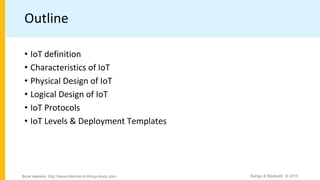
Outline • IoT definition •
Characteristics of IoT • Physical Design of IoT • Logical Design of IoT • IoT Protocols • IoT Levels & Deployment Templates Bahga & Madisetti, © 2015 Book website: http://www.internet-of-things-book.com
3.
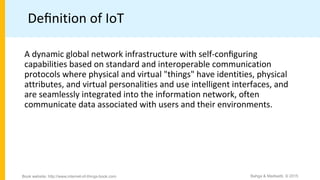
Definition of IoT A
dynamic global network infrastructure with self-configuring capabilities based on standard and interoperable communication protocols where physical and virtual "things" have identities, physical attributes, and virtual personalities and use intelligent interfaces, and are seamlessly integrated into the information network, often communicate data associated with users and their environments. Bahga & Madisetti, © 2015 Book website: http://www.internet-of-things-book.com
4.
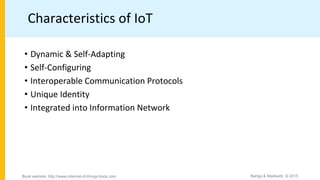
Characteristics of IoT •
Dynamic & Self-Adapting • Self-Configuring • Interoperable Communication Protocols • Unique Identity • Integrated into Information Network Bahga & Madisetti, © 2015 Book website: http://www.internet-of-things-book.com
5.
Physical Design of
IoT • The "Things" in IoT usually refers to IoT devices which have unique identities and can perform remote sensing, actuating and monitoring capabilities. • IoT devices can: • Exchange data with other connected devices and applications (directly or indirectly), or • Collect data from other devices and process the data locally or • Send the data to centralized servers or cloud-based application back-ends for processing the data, or • Perform some tasks locally and other tasks within the IoT infrastructure, based on temporal and space constraints Bahga & Madisetti, © 2015 Book website: http://www.internet-of-things-book.com
6.
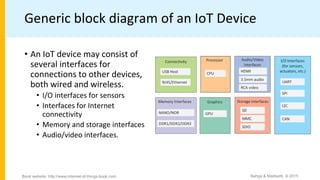
Generic block diagram
of an IoT Device • An IoT device may consist of several interfaces for connections to other devices, both wired and wireless. • I/O interfaces for sensors • Interfaces for Internet connectivity • Memory and storage interfaces • Audio/video interfaces. Bahga & Madisetti, © 2015 Book website: http://www.internet-of-things-book.com
7.
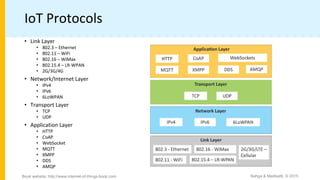
IoT Protocols • Link
Layer • 802.3 – Ethernet • 802.11 – WiFi • 802.16 – WiMax • 802.15.4 – LR-WPAN • 2G/3G/4G • Network/Internet Layer • IPv4 • IPv6 • 6LoWPAN • Transport Layer • TCP • UDP • Application Layer • HTTP • CoAP • WebSocket • MQTT • XMPP • DDS • AMQP Bahga & Madisetti, © 2015 Book website: http://www.internet-of-things-book.com
8.
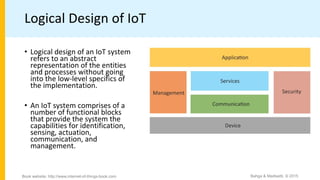
Logical Design of
IoT • Logical design of an IoT system refers to an abstract representation of the entities and processes without going into the low-level specifics of the implementation. • An IoT system comprises of a number of functional blocks that provide the system the capabilities for identification, sensing, actuation, communication, and management. Bahga & Madisetti, © 2015 Book website: http://www.internet-of-things-book.com
9.
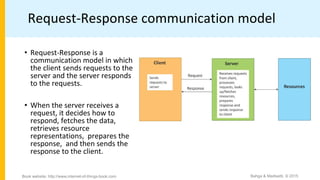
Request-Response communication model •
Request-Response is a communication model in which the client sends requests to the server and the server responds to the requests. • When the server receives a request, it decides how to respond, fetches the data, retrieves resource representations, prepares the response, and then sends the response to the client. Bahga & Madisetti, © 2015 Book website: http://www.internet-of-things-book.com
10.
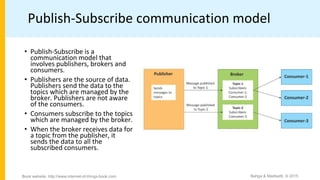
Publish-Subscribe communication model •
Publish-Subscribe is a communication model that involves publishers, brokers and consumers. • Publishers are the source of data. Publishers send the data to the topics which are managed by the broker. Publishers are not aware of the consumers. • Consumers subscribe to the topics which are managed by the broker. • When the broker receives data for a topic from the publisher, it sends the data to all the subscribed consumers. Bahga & Madisetti, © 2015 Book website: http://www.internet-of-things-book.com
11.
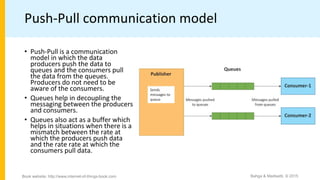
Push-Pull communication model •
Push-Pull is a communication model in which the data producers push the data to queues and the consumers pull the data from the queues. Producers do not need to be aware of the consumers. • Queues help in decoupling the messaging between the producers and consumers. • Queues also act as a buffer which helps in situations when there is a mismatch between the rate at which the producers push data and the rate rate at which the consumers pull data. Bahga & Madisetti, © 2015 Book website: http://www.internet-of-things-book.com
12.
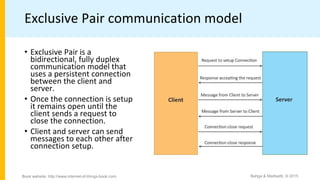
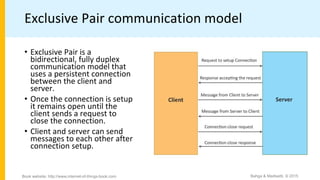
Exclusive Pair communication
model • Exclusive Pair is a bidirectional, fully duplex communication model that uses a persistent connection between the client and server. • Once the connection is setup it remains open until the client sends a request to close the connection. • Client and server can send messages to each other after connection setup. Bahga & Madisetti, © 2015 Book website: http://www.internet-of-things-book.com
13.
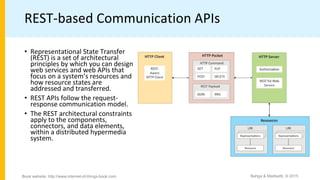
REST-based Communication APIs •
Representational State Transfer (REST) is a set of architectural principles by which you can design web services and web APIs that focus on a system’s resources and how resource states are addressed and transferred. • REST APIs follow the request- response communication model. • The REST architectural constraints apply to the components, connectors, and data elements, within a distributed hypermedia system. Bahga & Madisetti, © 2015 Book website: http://www.internet-of-things-book.com
14.
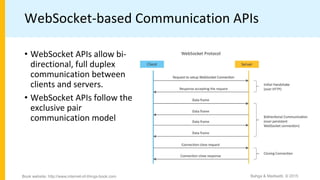
WebSocket-based Communication APIs •
WebSocket APIs allow bi- directional, full duplex communication between clients and servers. • WebSocket APIs follow the exclusive pair communication model Bahga & Madisetti, © 2015 Book website: http://www.internet-of-things-book.com
15.
Exclusive Pair communication
model • Exclusive Pair is a bidirectional, fully duplex communication model that uses a persistent connection between the client and server. • Once the connection is setup it remains open until the client sends a request to close the connection. • Client and server can send messages to each other after connection setup. Bahga & Madisetti, © 2015 Book website: http://www.internet-of-things-book.com
16.
IoT Levels &
Deployment Templates An IoT system comprises of the following components: • Device: An IoT device allows identification, remote sensing, actuating and remote monitoring capabilities. You learned about various examples of IoT devices in section • Resource: Resources are software components on the IoT device for accessing, processing, and storing sensor information, or controlling actuators connected to the device. Resources also include the software components that enable network access for the device. • Controller Service: Controller service is a native service that runs on the device and interacts with the web services. Controller service sends data from the device to the web service and receives commands from the application (via web services) for controlling the device. Bahga & Madisetti, © 2015 Book website: http://www.internet-of-things-book.com
17.
IoT Levels &
Deployment Templates • Database: Database can be either local or in the cloud and stores the data generated by the IoT device. • Web Service: Web services serve as a link between the IoT device, application, database and analysis components. Web service can be either implemented using HTTP and REST principles (REST service) or using WebSocket protocol (WebSocket service). • Analysis Component: The Analysis Component is responsible for analyzing the IoT data and generate results in a form which are easy for the user to understand. • Application: IoT applications provide an interface that the users can use to control and monitor various aspects of the IoT system. Applications also allow users to view the system status and view the processed data. Bahga & Madisetti, © 2015 Book website: http://www.internet-of-things-book.com
18.
IoT Level-1 • A
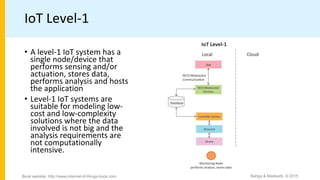
level-1 IoT system has a single node/device that performs sensing and/or actuation, stores data, performs analysis and hosts the application • Level-1 IoT systems are suitable for modeling low- cost and low-complexity solutions where the data involved is not big and the analysis requirements are not computationally intensive. Bahga & Madisetti, © 2015 Book website: http://www.internet-of-things-book.com
19.
IoT Level-2 • A
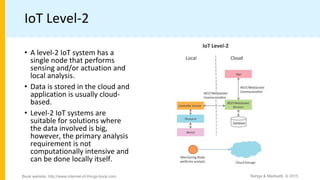
level-2 IoT system has a single node that performs sensing and/or actuation and local analysis. • Data is stored in the cloud and application is usually cloud- based. • Level-2 IoT systems are suitable for solutions where the data involved is big, however, the primary analysis requirement is not computationally intensive and can be done locally itself. Bahga & Madisetti, © 2015 Book website: http://www.internet-of-things-book.com
20.
IoT Level-3 • A
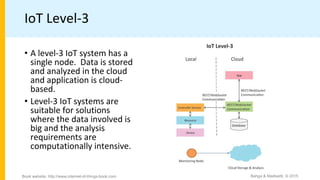
level-3 IoT system has a single node. Data is stored and analyzed in the cloud and application is cloud- based. • Level-3 IoT systems are suitable for solutions where the data involved is big and the analysis requirements are computationally intensive. Bahga & Madisetti, © 2015 Book website: http://www.internet-of-things-book.com
21.
IoT Level-4 • A
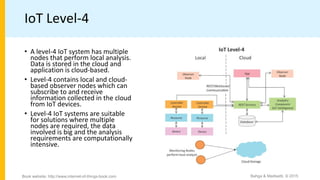
level-4 IoT system has multiple nodes that perform local analysis. Data is stored in the cloud and application is cloud-based. • Level-4 contains local and cloud- based observer nodes which can subscribe to and receive information collected in the cloud from IoT devices. • Level-4 IoT systems are suitable for solutions where multiple nodes are required, the data involved is big and the analysis requirements are computationally intensive. Bahga & Madisetti, © 2015 Book website: http://www.internet-of-things-book.com
22.
IoT Level-5 • A
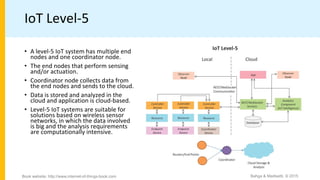
level-5 IoT system has multiple end nodes and one coordinator node. • The end nodes that perform sensing and/or actuation. • Coordinator node collects data from the end nodes and sends to the cloud. • Data is stored and analyzed in the cloud and application is cloud-based. • Level-5 IoT systems are suitable for solutions based on wireless sensor networks, in which the data involved is big and the analysis requirements are computationally intensive. Bahga & Madisetti, © 2015 Book website: http://www.internet-of-things-book.com
23.
IoT Level-6 • A
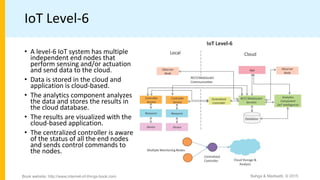
level-6 IoT system has multiple independent end nodes that perform sensing and/or actuation and send data to the cloud. • Data is stored in the cloud and application is cloud-based. • The analytics component analyzes the data and stores the results in the cloud database. • The results are visualized with the cloud-based application. • The centralized controller is aware of the status of all the end nodes and sends control commands to the nodes. Bahga & Madisetti, © 2015 Book website: http://www.internet-of-things-book.com
Download



![IoT [Internet of Things]](https://cdn.slidesharecdn.com/ss_thumbnails/unit-1stiot-200703030527-thumbnail.jpg?width=640&height=640&fit=bounds)


