1 © NEC Corporation 2023
Investing in Aviation’s
Identity-First Future
An NEC Corporation of America eBook
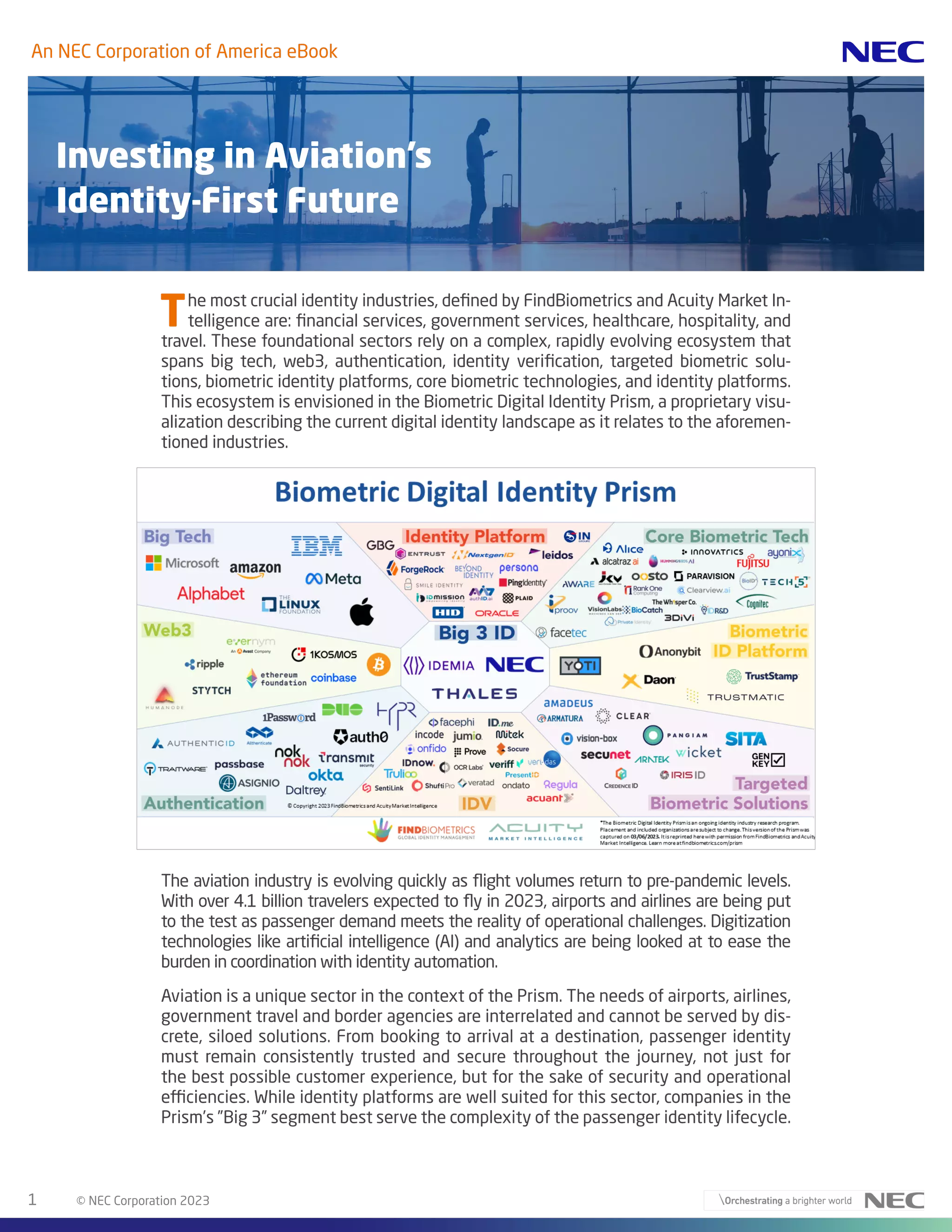
The most crucial identity industries, defined by FindBiometrics and Acuity Market In-
telligence are: financial services, government services, healthcare, hospitality, and
travel. These foundational sectors rely on a complex, rapidly evolving ecosystem that
spans big tech, web3, authentication, identity verification, targeted biometric solu-
tions, biometric identity platforms, core biometric technologies, and identity platforms.
This ecosystem is envisioned in the Biometric Digital Identity Prism, a proprietary visu-
alization describing the current digital identity landscape as it relates to the aforemen-
tioned industries.
The aviation industry is evolving quickly as flight volumes return to pre-pandemic levels.
With over 4.1 billion travelers expected to fly in 2023, airports and airlines are being put
to the test as passenger demand meets the reality of operational challenges. Digitization
technologies like artificial intelligence (AI) and analytics are being looked at to ease the
burden in coordination with identity automation.
Aviation is a unique sector in the context of the Prism. The needs of airports, airlines,
government travel and border agencies are interrelated and cannot be served by dis-
crete, siloed solutions. From booking to arrival at a destination, passenger identity
must remain consistently trusted and secure throughout the journey, not just for
the best possible customer experience, but for the sake of security and operational
efficiencies. While identity platforms are well suited for this sector, companies in the
Prism’s ”Big 3” segment best serve the complexity of the passenger identity lifecycle.
2 © NEC Corporation 2023
The passenger experience is the catalyst for evolution in the aviation sector.
Today’s passenger is a technology-literate traveler who expects a mobile-first
experience and is not accustomed to delays. Operational struggles experienced by
airlines and airports in 2022—from misplaced baggage to significant delays and can-
cellations—have marred the travel experience in mainstream and social media. Thank-
fully, enhancing the customer experience by reducing friction within the passenger
journey has the effect of improving operations through streamlined throughput, au-
tomation, and enhanced security.
Following the passenger journey, one sees a map of identity transactions: booking,
check-in, bag check, security, boarding, flight, customs, and baggage pickup. And
that’s not including the retail and service transactions along the way. Every time a
passenger interacts with an airline, agency, retailer, or other stakeholder during their
travel journey, they must prove who they are. The easier that is, the less friction and
stress they experience.
According to SITA—the world’s leading aviation IT services provider with deployments
in over 200 countries—the most pressing pain points for passengers are the touch-
points with the most friction: health checks, security screening, and bag collection.
Invasive, time-consuming, and out of the passenger’s control, these three processes
are in opposition to on-demand services. Thankfully, they are also the areas seeing
the highest levels of innovation, and therefore the greatest rate of improvement.
Following passenger demand, we see the evolution of aviation trending toward fric-
tionless, identity-first gateways that leverage consumer mobile technology and ro-
bust IT infrastructure to allow for fast and reliable identity checks at every touch-
point. By the end of the decade, the travel experience will allow travelers to enroll
their biometrics and identity data when they book a trip on their phone, check-in and
drop-off their bag in a fully automated fashion, speed through security without in-
vasive measures, purchase food, retail items and airport amenities with their face or
their phone, and board their plane in record time without having to dig through their
belongings for their physical ID.
And while that’s all great for the customer, it’s even better for the airlines and airports.
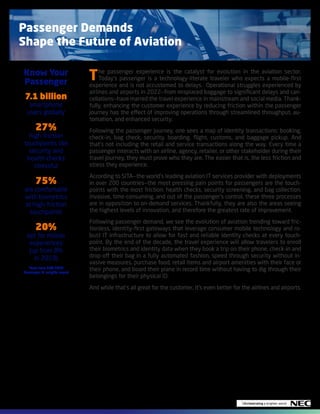
Know Your
Passenger
7.1 billion
smartphone
users globally
27%
high-friction
touchpoints like
security and
health checks
stressful
75%
are comfortable
with biometrics
at high-friction
touchpoints
20%
opt for mobile
experiences
(up from 8%
in 2019)
*data from SITA 2022
Passenger IT Insights report
Passenger Demands
Shape the Future of Aviation

Investing in Aviation's Identity First Future (preview)

  • 1.
    1 © NECCorporation 2023 Investing in Aviation’s Identity-First Future An NEC Corporation of America eBook The most crucial identity industries, defined by FindBiometrics and Acuity Market In- telligence are: financial services, government services, healthcare, hospitality, and travel. These foundational sectors rely on a complex, rapidly evolving ecosystem that spans big tech, web3, authentication, identity verification, targeted biometric solu- tions, biometric identity platforms, core biometric technologies, and identity platforms. This ecosystem is envisioned in the Biometric Digital Identity Prism, a proprietary visu- alization describing the current digital identity landscape as it relates to the aforemen- tioned industries. The aviation industry is evolving quickly as flight volumes return to pre-pandemic levels. With over 4.1 billion travelers expected to fly in 2023, airports and airlines are being put to the test as passenger demand meets the reality of operational challenges. Digitization technologies like artificial intelligence (AI) and analytics are being looked at to ease the burden in coordination with identity automation. Aviation is a unique sector in the context of the Prism. The needs of airports, airlines, government travel and border agencies are interrelated and cannot be served by dis- crete, siloed solutions. From booking to arrival at a destination, passenger identity must remain consistently trusted and secure throughout the journey, not just for the best possible customer experience, but for the sake of security and operational efficiencies. While identity platforms are well suited for this sector, companies in the Prism’s ”Big 3” segment best serve the complexity of the passenger identity lifecycle.
  • 2.
    2 © NECCorporation 2023 The passenger experience is the catalyst for evolution in the aviation sector. Today’s passenger is a technology-literate traveler who expects a mobile-first experience and is not accustomed to delays. Operational struggles experienced by airlines and airports in 2022—from misplaced baggage to significant delays and can- cellations—have marred the travel experience in mainstream and social media. Thank- fully, enhancing the customer experience by reducing friction within the passenger journey has the effect of improving operations through streamlined throughput, au- tomation, and enhanced security. Following the passenger journey, one sees a map of identity transactions: booking, check-in, bag check, security, boarding, flight, customs, and baggage pickup. And that’s not including the retail and service transactions along the way. Every time a passenger interacts with an airline, agency, retailer, or other stakeholder during their travel journey, they must prove who they are. The easier that is, the less friction and stress they experience. According to SITA—the world’s leading aviation IT services provider with deployments in over 200 countries—the most pressing pain points for passengers are the touch- points with the most friction: health checks, security screening, and bag collection. Invasive, time-consuming, and out of the passenger’s control, these three processes are in opposition to on-demand services. Thankfully, they are also the areas seeing the highest levels of innovation, and therefore the greatest rate of improvement. Following passenger demand, we see the evolution of aviation trending toward fric- tionless, identity-first gateways that leverage consumer mobile technology and ro- bust IT infrastructure to allow for fast and reliable identity checks at every touch- point. By the end of the decade, the travel experience will allow travelers to enroll their biometrics and identity data when they book a trip on their phone, check-in and drop-off their bag in a fully automated fashion, speed through security without in- vasive measures, purchase food, retail items and airport amenities with their face or their phone, and board their plane in record time without having to dig through their belongings for their physical ID. And while that’s all great for the customer, it’s even better for the airlines and airports. Know Your Passenger 7.1 billion smartphone users globally 27% high-friction touchpoints like security and health checks stressful 75% are comfortable with biometrics at high-friction touchpoints 20% opt for mobile experiences (up from 8% in 2019) *data from SITA 2022 Passenger IT Insights report Passenger Demands Shape the Future of Aviation