1Invest in the UK: your springboard for global growth
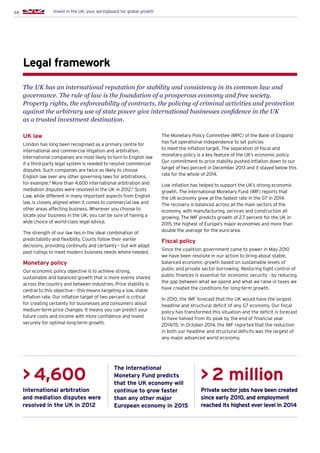
Invest in the UK:
your springboard for
global growth
The UK is the number one destination
for foreign direct investment in Europe
– second in the world only to the USA. A
recent survey of international business
leaders found investor confidence in
the UK is the strongest in Europe,1
while
the World Bank has said it is easier
to do business here than any other
major economy in the continent. Put
simply, if you are an overseas business
wanting to drive up your profitability
and increase your competitiveness,
Britain is the place to be. And for me
there are several big reasons why.
First, we are committed to making this
the most open, welcoming, business-
friendly country in the world. We’ve
cut our corporation tax to a record
low – it stands at 20 percent from April
2015, the lowest rate in the G7 and the
G20. For those developing intellectual
property here, we are lowering
corporation tax further; to those
investing in research and development,
we are giving tax relief. What’s more,
we are the sixth biggest exporter in the
world, we have made record investment
in infrastructure, and our world-
class supply chains are helping small
businesses export their products to big
international companies – all of which
says to investors around the world: ‘if
you want to expand your businesses
internationally, this is the place to do it’.
Second, we have an increasingly strong
economy – one which the International
Monetary Fund says will continue to
grow faster than any other major
European economy in 2015,2
and is
set to become the largest in Europe
by 2030. We are working to a long-
term economic plan which is backing
business, creating jobs, reducing the
deficit, boosting infrastructure and
delivering the skills for our young
people that businesses need. So
investors can be confident in our
continued economic strength and
stability – and they can be a part of
this great global success story too.
Third, we have one of the world’s
leading financial centres, not just
helping to finance business expansion
but also enabling London to become
Europe’s premier centre for Islamic
finance and the Western hub for
offshore Renminbi trading.
Fourth, we have a large, highly-
skilled labour force: more adults have
completed higher education than
anywhere else in in Western Europe.3
Finally, we have UKTI – the UK
Government’s award-winning trade
and investment agency. UKTI had
a hand in more than 80 percent
of the inward investment projects
landing in the UK in 2013/14.
And their service doesn’t stop once you
are established in the UK; it continues as
your business expands internationally,
supporting foreign investors with
the same range of services as any
other UK-based company – including
support to export around the world.
There is more information about how
you can work with UKTI on page 52.
So our message is clear: if
you want to invest, if you
want to expand, if you want
great incentives and an
economy that’s going from
strength to strength, then
come to the UK – our door
is firmly open for business.
ForewordDavid Cameron, Prime Minister
Find out more about what makes the UK the first choice for investment.
Invest in the UK: your springboard for global growth
Contact UKTI
We are ready to make your UK
investment work. You can contact
our Investment Services Team to
discuss your plans by telephone
+44 (0)20 7333 5442 or email
at enquiries@ukti-invest.com.
Investment staff at a British
embassy, high commission or trade
office can also put you in touch with
the Investment Services Team.
Sources:
1.	 A.T. Kearney 201 4. Foreign Direct Investment Confidence Index: Ready for Takeoff
2.	 International Monetary Fund 2015. World Economic Outlook – Update January 2015
3.	 OECD 2014. Education at a glance (data refers to 2012)
1Invest in the UK: your springboard for global growth
Contents
Gateway to the World	 2
Centre for Global Trading	 4
Magnet for Talent	 6
Hub of Innovation	 8
Talent		 10
Skills for the 21st
Century	 13
Labour Market	 16
Tax			 20
Finance and Banking	 25
Property and Planning	 28
Ease of Doing Business	 32
Infrastructure 	 36
		Transport	 36
		Digital 	 39
		Utilities	 42
Innovation Ecosystem	 44
Industrial Strategy & Capability	 49
UK Trade & Investment	 52
2 Invest in the UK: your springboard for global growth
A Gateway
to the World
Invest in the UK as the springboard
for exporting and global growth.
No.
1
economy in
Western Europe
by 2030
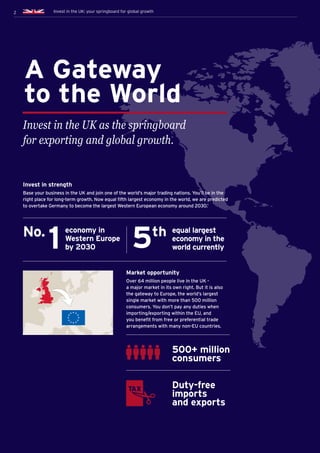
Invest in strength
Base your business in the UK and join one of the world’s major trading nations. You’ll be in the
right place for long-term growth. Now equal fifth largest economy in the world, we are predicted
to overtake Germany to become the largest Western European economy around 2030.1
Market opportunity
Over 64 million people live in the UK -
a major market in its own right. But it is also
the gateway to Europe, the world’s largest
single market with more than 500 million
consumers. You don’t pay any duties when
importing/exporting within the EU, and
you benefit from free or preferential trade
arrangements with many non-EU countries.
500+ million
consumers
Duty-free
imports
and exports
2
5th equal largest
economy in the
world currently
Invest in the UK: your springboard for global growth
3Invest in the UK: your springboard for global growth
Sources:
1.	 Centre for Economics and Business Research 2014. World Economic League Table 2015
2.	 Eurostat 2014. Maritime ports freight and passenger statistics 2012: gross weight of seaborne goods
	 handled by main ports by type of cargo
3.	 CAA 2014
4.	 European Commission 2013
1st
1st
Major trading nation
Exports of £500 billion
in goods and services in
20145
place the UK sixth
in UNCTAD’s index of top
exporting countries.6
We
have the infrastructure,
logistics and routes into
established and emerging
markets to match your
trade ambitions.
Your long-term export adviser
Locate your business in the UK and you can benefit from the same support to increase exports as
domestic firms. UKTI can provide bespoke market research, news of trade opportunities and support to
help you win high value contracts. Our global network of advisers have the connections that open doors to
new trade opportunities. See page 52 for more detail on how UKTI can help you.
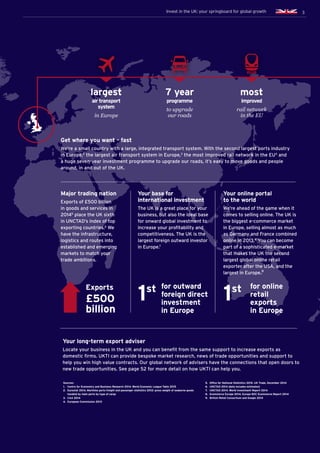
Get where you want – fast
We’re a small country with a large, integrated transport system. With the second largest ports industry
in Europe,2
the largest air transport system in Europe,3
the most improved rail network in the EU4
and
a huge seven-year investment programme to upgrade our roads, it’s easy to move goods and people
around, in and out of the UK.
Your base for
international investment
The UK is a great place for your
business, but also the ideal base
for onward global investment to
increase your profitability and
competitiveness. The UK is the
largest foreign outward investor
in Europe.7
Your online portal
to the world
We’re ahead of the game when it
comes to selling online. The UK is
the biggest e-commerce market
in Europe, selling almost as much
as Germany and France combined
online in 2013.8
You can become
part of a sophisticated e-market
that makes the UK the second
largest global online retail
exporter after the USA, and the
largest in Europe.9
5.	 Office for National Statistics 2015. UK Trade, December 2014
6.	 UNCTAD 2014 (data includes estimates)
7.	 UNCTAD 2014. World Investment Report 2014
8.	 Ecommerce Europe 2014. Europe B2C Ecommerce Report 2014
9.	 British Retail Consortium and Google 2014
3
Exports
£500
billion
for outward
foreign direct
investment
in Europe
for online
retail
exports
in Europe
in Europe
largest
air transport
system to upgrade
our roads
rail network
in the EU
7 year
programme
most
improved
Invest in the UK: your springboard for global growth
4 Invest in the UK: your springboard for global growth
Centre for Global Trading
Invest in the UK as the number one location for European
headquarters and holding companies.
Low tax burden
Our low corporate taxes and
competitive rules for taxing the profits
of multinationals attract the biggest
global enterprises to the UK. The UK’s
corporation tax rate falls to 20 percent
in April 2015, by far the lowest in the G7
and the joint lowest in the G20.
The World Bank rates our
tax system as the most
business-friendly of the ten
largest economies in Europe,
both in terms of rates and
administrative burdens.1
Transparent, flexible company law and
corporate governance
It’s fast and simple to set up a company in the UK and
there is flexibility to choose and shape the corporate structure
to suit your needs. The UK provides companies and their
investors with a framework of law and best practice giving the
certainty needed to support investment, innovation and trade.
Stock market strength
Listing in London allows you to tap into one of the deepest
pools of international equity assets anywhere. As well as
being the fourth-largest stock exchange in the world, the
London Stock Exchange is the most international, with
around 3,000 companies from over 70 countries.2
Professional strength
We are world leaders in professional and business
services such as accountancy, law and audit – services
that provide essential expertise to underpin your
innovation, export and expansion plans. Our share of
global exports of financial and business services was
second only to the US in 2012.4
We host six of the top ten
international networks of accountancy firms,5
four of the
ten biggest law firms6
and the world’s largest advertising
group. The creative brilliance of our advertising agencies
can propel your brand around the world – only the USA
won more creative awards than us in 2014.7
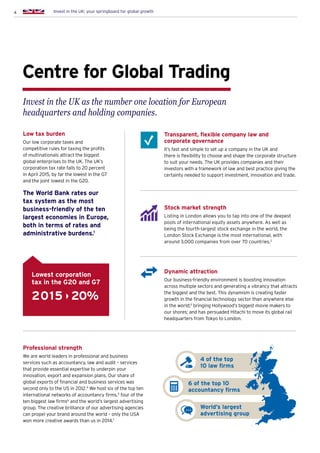
Lowest corporation
tax in the G20 and G7
2015	 20%
Dynamic attraction
Our business-friendly environment is boosting innovation
across multiple sectors and generating a vibrancy that attracts
the biggest and the best. This dynamism is creating faster
growth in the financial technology sector than anywhere else
in the world;3
bringing Hollywood’s biggest movie makers to
our shores; and has persuaded Hitachi to move its global rail
headquarters from Tokyo to London.
6 of the top 10
accountancy firms
4 of the top
10 law firms
World’s largest
advertising group
5Invest in the UK: your springboard for global growth
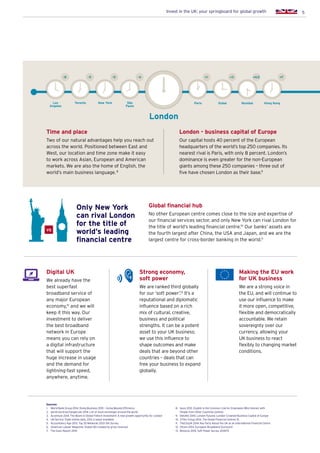
Time and place
Two of our natural advantages help you reach out
across the world. Positioned between East and
West, our location and time zone make it easy
to work across Asian, European and American
markets. We are also the home of English, the
world’s main business language. 8
Global financial hub
No other European centre comes close to the size and expertise of
our financial services sector, and only New York can rival London for
the title of world’s leading financial centre.10
Our banks’ assets are
the fourth largest after China, the USA and Japan, and we are the
largest centre for cross-border banking in the world.11
London - business capital of Europe
Our capital hosts 40 percent of the European
headquarters of the world’s top 250 companies. Its
nearest rival is Paris, with only 8 percent. London’s
dominance is even greater for the non-European
giants among these 250 companies – three out of
five have chosen London as their base.9
London
ParisSão
Paulo
Dubai Mumbai Hong KongNew YorkLos
Angeles
+1-5 -4-8 +3 +4.5 +7
Digital UK
We already have the
best superfast
broadband service of
any major European
economy,12
and we will
keep it this way. Our
investment to deliver
the best broadband
network in Europe
means you can rely on
a digital infrastructure
that will support the
huge increase in usage
and the demand for
lightning-fast speed,
anywhere, anytime.
Strong economy,
soft power
We are ranked third globally
for our ‘soft power’.13
It’s a
reputational and diplomatic
influence based on a rich
mix of cultural, creative,
business and political
strengths. It can be a potent
asset to your UK business;
we use this influence to
shape outcomes and make
deals that are beyond other
countries – deals that can
free your business to expand
globally.
Making the EU work
for UK business
We are a strong voice in
the EU, and will continue to
use our influence to make
it more open, competitive,
flexible and democratically
accountable. We retain
sovereignty over our
currency, allowing your
UK business to react
flexibly to changing market
conditions.
VS
Only New York
can rival London
for the title of
world’s leading
financial centre
Sources:
1.	 World Bank Group 2014. Doing Business 2015 – Going Beyond Efficiency
2.	 world-stock-exchanges.net 2014. List of stock exchanges around the world
3.	Accenture 2014. The Boom in Global Fintech Investment: A new growth opportunity for London
4.	 UN Service Trade (online data, 2012 is latest available)
5.	 Accountancy Age 2013. Top 35 Networks 2013: the Survey
6.	 American Lawyer Magazine. Global 100 (ranked by gross revenue)
7.	 The Gunn Report 2014
8.	Ipsos 2012. English is the Common Link for Employees Who Interact with
People from Other Countries (online)
9.	Deloitte 2014. London Futures: London Crowned Business Capital of Europe
10.	 Z/Yen Group 2014. The Global Financial Centres 15
11.	 TheCityUK 2014. Key Facts About the UK as an International Financial Centre
12.	 Ofcom 2014. European Broadband Scorecard
13.	 Monocle 2014. Soft Power Survey 2014/15
Toronto
-5
6 Invest in the UK: your springboard for global growth
Magnet for Talent
Invest in the UK to access global talent
and high-level skills.
Global talent hub
The USA is the only powerhouse economy
rated above the UK in the Global Talent
Competitiveness Index. Our ranking of 7th
is testament to our success at attracting,
growing and retaining talent and the quality
of our skills base.1
Excluding the USA, our
population is bigger than the combined total
of the other five countries ranked above
us. Investors choose the UK because of the
breadth of skills across multiple industry
sectors in a very large workforce.
The era of ‘talentism’
Access to talent is now the driver of economic
growth. While many parts of the world face
labour shortages, global migration trends
favour the UK. Locate here and you’ll be in
one of the few European countries expected
to experience labour supply growth in the next
15 years.2
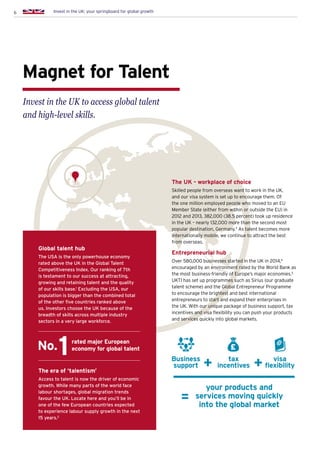
rated major European
economy for global talent
Business
support
your products and
services moving quickly
into the global market
tax
incentives
visa
flexibility
The UK - workplace of choice
Skilled people from overseas want to work in the UK,
and our visa system is set up to encourage them. Of
the one million employed people who moved to an EU
Member State (either from within or outside the EU) in
2012 and 2013, 382,000 (38.5 percent) took up residence
in the UK – nearly 132,000 more than the second most
popular destination, Germany.3
As talent becomes more
internationally mobile, we continue to attract the best
from overseas.
Entrepreneurial hub
Over 580,000 businesses started in the UK in 2014,4
encouraged by an environment rated by the World Bank as
the most business-friendly of Europe’s major economies.5
UKTI has set up programmes such as Sirius (our graduate
talent scheme) and the Global Entrepreneur Programme
to encourage the brightest and best international
entrepreneurs to start and expand their enterprises in
the UK. With our unique package of business support, tax
incentives and visa flexibility you can push your products
and services quickly into global markets.
=
£No.
7Invest in the UK: your springboard for global growth
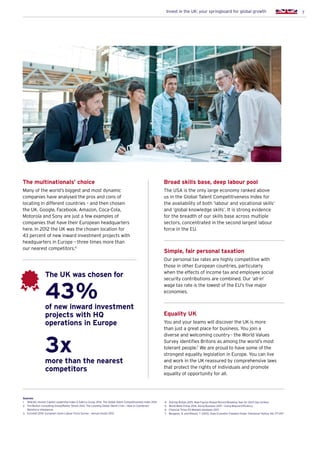
The multinationals’ choice
Many of the world’s biggest and most dynamic
companies have analysed the pros and cons of
locating in different countries – and then chosen
the UK. Google, Facebook, Amazon, Coca-Cola,
Motorola and Sony are just a few examples of
companies that have their European headquarters
here. In 2012 the UK was the chosen location for
43 percent of new inward investment projects with
headquarters in Europe – three times more than
our nearest competitors.6
Broad skills base, deep labour pool
The USA is the only large economy ranked above
us in the Global Talent Competitiveness Index for
the availability of both ‘labour and vocational skills’
and ‘global knowledge skills’. It is strong evidence
for the breadth of our skills base across multiple
sectors, concentrated in the second largest labour
force in the EU.
43%
3x
of new inward investment
projects with HQ
operations in Europe
The UK was chosen for
more than the nearest
competitors
Simple, fair personal taxation
Our personal tax rates are highly competitive with
those in other European countries, particularly
when the effects of income tax and employee social
security contributions are combined. Our ‘all-in’
wage tax rate is the lowest of the EU’s five major
economies.
Equality UK
You and your teams will discover the UK is more
than just a great place for business. You join a
diverse and welcoming country - the World Values
Survey identifies Britons as among the world’s most
tolerant people.7
We are proud to have some of the
strongest equality legislation in Europe. You can live
and work in the UK reassured by comprehensive laws
that protect the rights of individuals and promote
equality of opportunity for all.
Sources:
1.	INSEAD, Human Capital Leadership Index  Adecco Group 2014. The Global Talent Competitiveness Index 2014
2.	The Boston Consulting Group/Rainer Strack 2013. The Looming Global Talent Crisis – How to Counteract
Workforce Imbalances
3.	 Eurostat 2014. European Union Labour Force Survey – annual results 2013
4.	 StartUp Britain 2015. New Figures Reveal Record-Breaking Year for Start-Ups (online)
5.	 World Bank Group 2014. Doing Business 2015 – Going Beyond Efficiency
6.	 Financial Times fDi Markets database 2013
7.	Berggren, N. and Nilsson, T. (2013), Does Economic Freedom Foster Tolerance? Kyklos, 66: 177–207
8 Invest in the UK: your springboard for global growth
Hub of Innovation
Invest in the UK to bring innovative products and services to global markets.
World leading RD
environment
Our partnership with
industry creates a thriving
innovation ecosystem
for turning ideas into
commercial success. We
are second overall, and
the top rated major world
economy, in the Global
Innovation Index. This
index identifies particular
strengths in the quality
of our universities, our
knowledge-intensive
labour force and the
impact of university-
business collaboration.1
Innovation
incentives
Our generous tax credits
cut the cost of leading-
edge research and high-
tech commercialisation
processes. The Patent
Box lowers the rate of
corporation tax you will
pay on profits earned
from qualifying patented
inventions to ten percent
– half the headline tax rate
that applies from April
2015. RD tax credits can
reduce the cost of RD by
up to 29 percent for large
businesses and up to 46
percent for small ones.
Nobel brilliance
The UK has produced 78
Nobel Prize winners in
natural and physical sciences,
more than any other country
apart from the USA. UK
scientists whose advances
have changed the world
include Sir Robert Edwards
who (along with surgeon
Patrick Steptoe) pioneered
conception through IVF,
Francis Crick and James
Watson who discovered
the structure of the DNA
molecule, and Peter Higgs
in 2013 for his theoretical
work on the existence of the
subatomic particle we now
call the ‘Higgs boson’.
Global research
influence
The output of our research
community is prodigious.
With less than one percent
of the global population the
UK accounts for 6.4 percent
of global journal articles,
11.6 percent of citations and
15.9 percent of the world’s
most highly cited articles.2
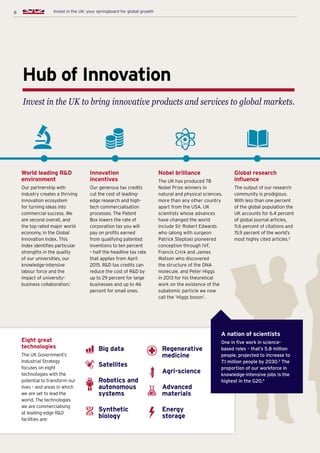
Eight great
technologies
The UK Government’s
Industrial Strategy
focuses on eight
technologies with the
potential to transform our
lives – and areas in which
we are set to lead the
world. The technologies
we are commercialising
at leading-edge RD
facilities are:
Big data
Satellites
Robotics and
autonomous
systems
Synthetic
biology
Regenerative
medicine
Agri-science
Advanced
materials
Energy
storage
A nation of scientists
One in five work in science-
based roles – that’s 5.8 million
people, projected to increase to
7.1 million people by 2030.3
The
proportion of our workforce in
knowledge-intensive jobs is the
highest in the G20.4
8 Invest in the UK: your springboard for global growth
9Invest in the UK: your springboard for global growth
The European
destination for
innovation
Choose to innovate in
the UK and you’re in
good company. In 2012
we attracted almost
US$7.7 billion of overseas-
financed RD. This is the
same as Canada, Finland,
Japan, China, Russia and
Denmark combined.5
Digital capital
of Europe
East London’s Tech City
symbolises the vibrant
entrepreneurial spirit in
the UK. It is now Europe’s
largest digital cluster and
a hotbed of fast-growth
start-ups and disruptive
technologies. You don’t
have to be in East London
to benefit from this hub
of innovation – Tech City
works with digital clusters
across the UK.
Turning ideas into
new products and
services
Catapult Centres bring
the UK’s very best
businesses, scientists
and engineers to
work side by side on
late-stage research
and development.
A wide range of
support, facilities and
opportunities for
collaboration exist at over
100 science parks and
300 business incubators.
Government-industry
partnership
Two-thirds of RD
expenditure in the UK is
contributed by industry,6
and more than half of
business RD expenditure
is by foreign-owned
firms – proof of the
attraction of our innovation
environment. By improving
access to finance, offering
generous tax incentives
and investing in RD
infrastructure we free
companies to innovate in
ways that might be beyond
them otherwise.
Sources:
1.	 Cornell University, INSEAD  World Intellectual Property Organisation 2014. Global Innovation Index 2014
2.	Elsevier BV 2013. International Comparative Performance of the UK Research Base
3.	 Science Council 2011. Shape of the UK Science Workforce
4.	 OECD 2013. STI Scoreboard
5.	 OECD 2012. OECD Science, Technology  Industry Outlook 2012
6.	 Office for National Statistics 2014. Business Enterprise RD - 2013
7.	 OECD 2014; International co-operation in patents: foreign ownership of domestic inventions
Need support for your UK-based innovation?
Innovate UK can help you to:
• Bring products and services more
quickly to market.
• Access research  development (RD) facilities.
• Connect with research or business partners.
• Win funding to reduce the risk from
innovation projects.
Dynamic
innovation
agency
9
Protect your
intellectual property
International innovators clearly
trust our robust intellectual
property system. They own
41.5 percent of patents in the
UK, compared to 17.4 percent
in Germany, 12.6 percent in the
USA and 2.4 percent in Japan.7
Smart cities
Our London-based Future Cities
Catapult is developing solutions
for international cities that want
smarter ways to improve quality
of life, strengthen their economy
and protect the environment.
It’s our mission to unlock global
urban innovation markets for
UK-based businesses by helping
them create the products
and services that
transform city life.
Invest in the UK: your springboard for global growth
www.innovateuk.org
10 Invest in the UK: your springboard for global growth
The UK ranks second only to the USA among the powerhouse economies for growing, retaining
and attracting talent according to the Global Talent Competitiveness Index (GTCI).1
It’s a vital
asset in an era where human capital is the engine of economic growth. Talent, creativity and the
ability to innovate are the game-changers.
Talent
1	 Switzerland	 8.1
2	 Singapore	 5.4
3	 Luxembourg	 0.5
4	 USA	
5	 Canada	 35.7
6	 Sweden	 9.7
7	 UK	 64.1
12	 Netherlands
14	 Germany
23	 France
30	 Spain
36	 Italy
2014 Global Talent
Competitiveness Index
Population
(millions)
The highest proportion
of adults with tertiary
education in Western
Europe
Top rated for growing,
retaining and attracting
talent among the major
European economies
The only major European
economy expecting an
increase in labour supply
up to 2030
More employed people
moved to the UK in
2012 and 2013 than any
other EU Member State
Half of Europe’s
graduates willing to
relocate to find work
would choose the UK
UK talent: the headlines Access to talent is more important
than ever at a time when many parts
of the world face shortages in labour
supply. The Boston Consulting Group
estimates that Western Europe will
need to increase its workforce over the
next 15 years by 45 million – equivalent
to the working population of Germany.2
From culture, sport and entertainment
to food, design and technology,
the impact of our talent and
entrepreneurial spirit is felt in every
corner of the globe. This will continue.
We invest heavily in the strengths
that combine to make the UK such
a magnet for talent - areas such
as education, skills, management,
research and innovation.
The depth of our talent shows through
in the broad range of indicators used
by the GTCI. We rate fourth in the world
for ‘brain gain’ based on our success
at attracting talented people from
across the world, the highest placed
powerhouse economy. The UK’s long-
standing attraction as a great place to
be undoubtedly helps. Talented people
are drawn by our rich mix of culture,
heritage, vibrant cities and varied
countryside. But we also work very
hard to create a learning, business and
innovation environment that attracts
and keeps skilled people.
Top seven plus
selected rankings
Excluding the USA,
the UK’s population
is greater than the
combined total of the
other countries in the
top six – giving you
access to a bigger
pool of talent.
The UK’s ranking in the world
for ‘brain gain’ based on our
success at attracting talented
people from across the world best universities in the world4th 4 of the top 6
11Invest in the UK: your springboard for global growth
Educational excellence
The GTCI rates the UK first globally for the quality of
its universities, third for its management schools and
eighth for both lifelong learning and ‘higher skills and
competencies’.
Universities produce the creative and critical thinking
skills that can transform business performance and the
UK has some of the very best, including four of the
top six universities in the world - Oxford, Cambridge,
University College London and Imperial College
London.3
Add this to the fact we have the highest
number of leading MBA institutions in Europe, and it’s no
surprise that over 435,000 international students came
for higher education study in 2013/14 – more than any
country apart from the USA.4
This focus on university excellence is a key reason why
we have the highest proportion of adults with tertiary
education in Western Europe,5
creating a concentrated
pool of people for professional and knowledge-based
jobs. The UK is also a magnet for graduate talent – half
of Europe’s graduates who are willing to relocate in
search of their first professional role would prefer to
emigrate to the UK.6
Research and innovation.
International companies invest billions of pounds each
year in the UK’s science and innovation ecosystem.
More than half of all UK-based business expenditure on
research and development (RD) activity is undertaken
by foreign-owned companies.7
They are attracted by
the expertise and leading-edge technologies available
in our academic and research facilities – rated as the
second best in the world by the World Economic Forum,
higher than any other major world economy.8
Our world-
class universities are the foundation for this expertise,
supported by investment in new RD facilities that focus
on turning ideas in to commercial success.
“Basing ourselves in the UK is a no-brainer. As much
as anything, it makes sense to be here for the sheer
entrepreneurial spirit and sense of adventure.”
- Gerry Sutton – CEO of Adstream (advertising services provider and part of the Paul Ramsay Group, Australia)
INSEAD ranks us higher than any other major world
economy for innovation output, a reflection of our success at
producing new products and services.9
By improving access
to finance, offering generous tax incentives and investing in
RD infrastructure, the UK opens up a whole range of new
innovation possibilities for you.
“The London Innovation Centre will bring
together ‘the best talent.’ It will house
science and technology experts with board
expertise in developing new solutions and
products, and will have local deal-making
capabilities to flexibly adapt deal structures
to match early-stage opportunities.”
- Patrick Verheyen, Head of Johnson  Johnson’s
Innovation Centre, London
The UK’s life science discoveries have
transformed scientific knowledge and continue
to unlock clinical and commercial opportunities.
All of the world’s top ten pharmaceuticals
companies have operations in the UK, including
several with both RD and manufacturing
capabilities. The talent pipeline continues – we
have both the highest number of life science
graduates in Europe and three of the top four
universities for medicine.10
Our universities research solutions to the
biggest problems facing humankind today. The
London Centre for Nanotechnology, a joint
venture between two of the top universities
in the world, University College London and
Imperial College London, is tackling global
problems in information processing, healthcare,
energy and environment through the
application of nanoscience and nanotechnology.
12 Invest in the UK: your springboard for global growth
Sources:
1.	INSEAD, Human Capital Leadership Index  Adecco Group 2014. The Global Talent
Competitiveness Index 2014
2.	The Boston Consulting Group/World Economic Forum 2011. Global Talent Risk – Seven Responses
3.	 QS Quacquarelli Symonds Limited 2014. QS World University Rankings 2014/15
4.	UK Council for International Student Affairs 2015. International Student Statistics: Higher
Education 2013/14
5.	 OECD 2015. Education at a glance 2014 (data refers to 2012)
6.	 trendence 2013. Graduate Barometer 2013
7.	 ONS 2014. Statistical Bulletin: Business Enterprise Research and Development, 2013
8.	World Economic Forum 2014, Global Competitiveness Report 2014-15 (data from Executive
Opinion Survey)
9.	 INSEAD and World Intellectual Property Organization. The Global Innovation Index 2014
10.	Times Higher Education 2014. The World University Rankings: Top 100 Universities for Clinical,
Pre-clinical and Health 2014-15
11.	 Eurostat 2014. European Union Labour Force Survey – annual results 2013
12.	Gill and Raiser 2012. Golden growth: restoring the lustre of the European mode. Washington, DC:
The World Bank
13.	 StartUp Britain 2015. New Figures Reveal Record-Breaking Year for Start-Ups (online)
14.	 World Bank Group 2014. Doing Business 2015 – Going Beyond Efficiency
15.	 Ernst  Young 2014. UK Attractiveness Survey 2014
16.	 British Fashion Council 2012. London Fashion Week Facts  Figures SS13 (online).
17.	 TIGA 2014. UK Video Games Industry (online)
18.	 The Gunn Report 2014
The UK television and film industry is a major
international success story. Our television programmes
are watched around the world. The 50th
anniversary
Doctor Who special was broadcast in 94 countries across
six continents – the largest-ever simultaneous broadcast
of a television drama. Downton Abbey has been sold in
over 220 territories.
The world’s six largest film studios - Disney, Paramount,
Sony, Twentieth Century Fox, Universal and Warner Bros.
- have a presence in London; and Warner Bros. also has
a state-of-the-art film production facility in Hertfordshire
and a leading post-production house in London.
British visual effects facilities have received numerous
Oscar nominations in recent years, and have won three
times for The Golden Compass, Inception and Life of
Pi. British success continued when the 2014 Oscar
for visual effects went to the film Gravity and its UK
production team.
“The amazing know-how, quality and
sophistication of the British film
industry made this film happen.”
- Alfonso Cuaron, Director of Gravity
Some of the most iconic brands in contemporary fashion
hail from the UK. Designers such as Stella McCartney,
Jimmy Choo and Paul Smith help ensure that fashion is
one of our biggest export successes. UK designers export
two-thirds of their output, and it’s estimated that orders
of over £100 million are placed during London Fashion
Week each season.16
The UK video games development sector is the largest in
Europe,17
employing 28,000 people directly and indirectly.
UK-made games, such as Grand Theft Auto, are some
of the biggest grossing sensations in the world. We
excel at mobile content too. The most downloaded free
iPhone App in 2013 was Candy Crush Saga. Published
by UK company King.com, the game is one of the largest
interactive entertainment franchises of all time.
Our advertising sector punches above its weight –
the UK is second in the world for the number of creative
awards won (behind the USA).18
Welcoming overseas talent
Global migration flows tell you a lot about which
countries are attractive to internationally mobile
talent. More employed people moved to the UK in
2012 and 2013 than any other EU Member State.11
We also host the third largest number of highly skilled
immigrants seeking employment in the world (after
Ireland and Canada).12
Our flexible visa system is set
up to welcome skilled workers, international students,
academics, entrepreneurs and investors. You can find
out more on page 18.
Entrepreneurship
We are a nation of entrepreneurs. A record 580,000
businesses started up in the UK in 2014,13
helped by
the most business-friendly environment of Europe’s
major economies.14
We want the brightest and best
international entrepreneurs to start and expand their
business ventures in the UK, and programmes such
as Sirius and the Global Entrepreneur Scheme are
making this happen. Find out more on page 55.
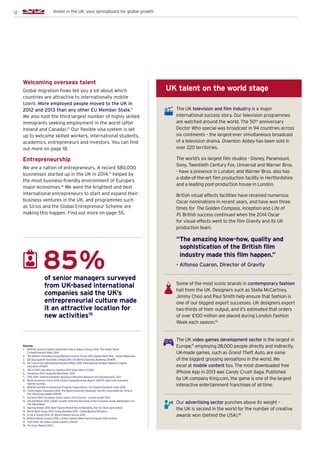
of senior managers surveyed
from UK-based international
companies said the UK’s
entrepreneurial culture made
it an attractive location for
new activities15
85%
UK talent on the world stage
13Invest in the UK: your springboard for global growth
Skills for the 21st
Century
A highly skilled workforce is the foundation for a strong, dynamic economy. This is why skills
is one of the five central themes of our industrial strategy, our whole-of-government approach
to supporting economic growth. Our skills strategy is based on a strong, long-term partnership
between government and business. It focuses on the rigour needed to develop skills that create
business innovation and expansion, and the responsiveness to adapt to employers’ needs.
We build from a position of strength.
Our higher education institutions are
world class; the UK is home to four of
the top six universities globally, with
29 in the top 200 - more than any
other country apart from the USA.1
This quality attracts students from all
over the world, an inflow of talent that
helps us produce the highest number
of graduates in Europe.2
The UK is the
second most popular destination after
the USA for international students,
with an estimated 13 percent of the
international student market share.3
Home to four of the
top six universities
in the world
The highest number
of leading MBA
institutions in Europe
Highest proportion
of the workforce in
professional occupations
of all the world’s major
economies
An employer-led
Apprenticeship
Programme that
tailors skills to your
precise needs
UK skills: the headlines We have 150 universities working with
business on research and development
projects – expertise you too can benefit
from. University capability feeds
into our network of prestigious and
dynamic research institutions, ranked
second globally for quality in a survey
of businesses.4
Examples include the
network of scientific researchers at
Oxford Science Vale, the state-of-the-
art facilities for advanced engineering
technology at Sci-Tech Daresbury in
Cheshire, and for transport systems
technology at MIRA Technology Park in
Leicestershire.
Loughborough University and engineering company Caterpillar
work together to investigate low-emissions technologies for
internal combustion engines. The Caterpillar Innovation and
Research Centre has developed new technologies to improve
engine and machine performance, reduce exhaust emissions and
improve fuel efficiency.
Liverpool University and Inditherm plc collaborated in the
design of an award-winning trolley which enables the immediate
resuscitation of newborns whilst the umbilical cord is still intact
– a product with the potential to save the lives of thousands of
vulnerable babies.
A multi-million pound commitment from Siemens supported the
University of Lincoln’s new School of Engineering - the first
dedicated facility of its kind to be built in the UK for more than
20 years. Steve Middlebrough, Director of Engineering, Siemens
(Lincoln), said: ‘Our collaboration with the University is ground-
breaking in many ways. It represents a new model of industry/
educational collaboration providing clear benefits for both
Siemens and the University. It’s a true partnership.’
Case study
Business-university collaboration in action
“We could outsource to
Russia or India, but the
quality of programmers
in the UK is excellent,
and we prefer to have
our contractors nearby
so we can work closely
with them.”
-Kate Lewis, Commercial Director
of Frog Trade, owned by Malaysia’s
YTL Corporation.
14 Invest in the UK: your springboard for global growth
You can lead a partnership with an education provider and reap
the benefits of a training programme designed specifically to
meet your skills needs.
With every apprentice training to an employer-designed
standard by 2017, you can take advantage of the growing
talent pool with the relevant skills and knowledge for your
sector. The pool is growing fast – over 850,000 people were in
apprenticeships in 2013/14, and there have been more than 2.1
million apprenticeship starts since 2010.8
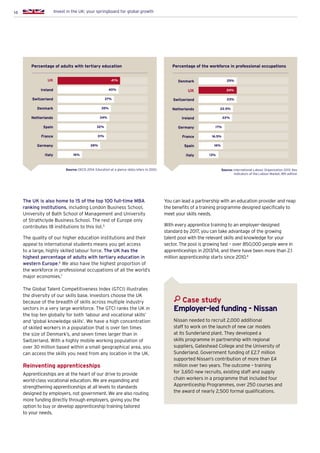
Percentage of adults with tertiary education
Source: OECD 2014. Education at a glance (data refers to 2012)
41%
40%
37%
35%
34%
32%
31%
28%
16%
UK
Ireland
Switzerland
Denmark
Netherlands
Spain
France
Germany
Italy
Percentage of the workforce in professional occupations
Source: International Labour Organization 2013. Key
Indicators of the Labour Market, 8th edition
UK
Ireland
Germany
France
Spain
Switzerland
Denmark
Netherlands
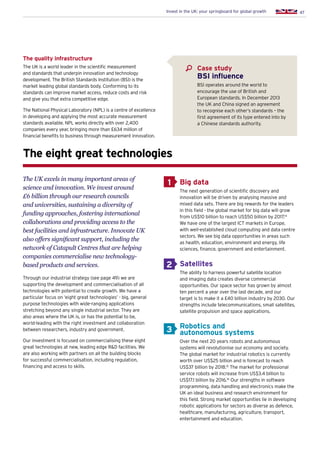
Italy
23%
22.5%
22%
17%
16.5%
16%
13%
24%
The UK is also home to 15 of the top 100 full-time MBA
ranking institutions, including London Business School,
University of Bath School of Management and University
of Strathclyde Business School. The rest of Europe only
contributes 18 institutions to this list.5
The quality of our higher education institutions and their
appeal to international students means you get access
to a large, highly skilled labour force. The UK has the
highest percentage of adults with tertiary education in
western Europe.6
We also have the highest proportion of
the workforce in professional occupations of all the world’s
major economies.7
The Global Talent Competitiveness Index (GTCI) illustrates
the diversity of our skills base. Investors choose the UK
because of the breadth of skills across multiple industry
sectors in a very large workforce. The GTCI ranks the UK in
the top ten globally for both ‘labour and vocational skills’
and ‘global knowledge skills’. We have a high concentration
of skilled workers in a population that is over ten times
the size of Denmark’s, and seven times larger than in
Switzerland. With a highly mobile working population of
over 30 million based within a small geographical area, you
can access the skills you need from any location in the UK.
Reinventing apprenticeships
Apprenticeships are at the heart of our drive to provide
world-class vocational education. We are expanding and
strengthening apprenticeships at all levels to standards
designed by employers, not government. We are also routing
more funding directly through employers, giving you the
option to buy or develop apprenticeship training tailored
to your needs.
Case study
Employer-led funding - Nissan
Nissan needed to recruit 2,000 additional
staff to work on the launch of new car models
at its Sunderland plant. They developed a
skills programme in partnership with regional
suppliers, Gateshead College and the University of
Sunderland. Government funding of £2.7 million
supported Nissan’s contribution of more than £4
million over two years. The outcome – training
for 3,650 new recruits, existing staff and supply
chain workers in a programme that included four
Apprenticeship Programmes, over 250 courses and
the award of nearly 2,500 formal qualifications.
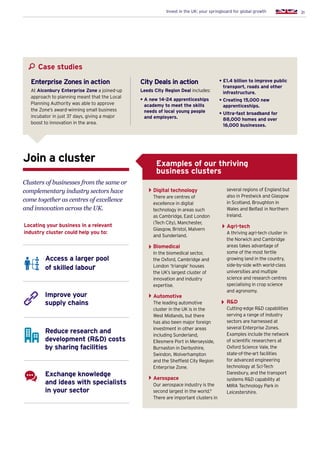
25%
15Invest in the UK: your springboard for global growth
Ready for new technologies
New industries and technologies are opening up global
opportunities - but only for countries with the advanced skills
to lead the field. You can invest in the UK confident that we
are ready for these opportunities. We are investing in the skills
needed for growth technologies, joint-funded with employers
so that training is directly tied to their needs in strategic,
high-value industries.
National colleges
Our new generation of national colleges are producing
specialists in key technical sectors. Examples include the
Manufacturing Training Centre in Coventry that develops
cutting-edge skills in advanced engineering, and a new High
Speed Rail college to provide the very best training in rail
engineering, environmental science and construction.
Bringing the best talent to the UK
Our continuing appeal as a destination for international
workers and a proactive migration policy will help you
bring skilled staff in to the UK. Our visa system is set up to
welcome skilled workers, international students, academics,
entrepreneurs and investors. In the year ending September
2014, the number of work visas we issued increased by six
percent, with skilled work visas up 13 percent.9
You may be
surprised how fast and straightforward this system can be
– find out more on page 18.
Sources:
1.	 QS Quacquarelli Symonds Limited 2014. QS World University Rankings 2014/15
2.	 OECD StatExtracts – Education and Training: Graduates by Field of Education (data from 2012)
3.	 OECD 2013 – data from 2012
4.	 World Economic Forum 2014. Global Competitiveness Report 2014-15 (data from Executive Opinion Survey)
5.	 The Economist 2014. Which MBA?
6.	 OECD 2014. Education at a glance (data refers to 2012)
7.	 International Labour Organization 2013. Key Indicators of the Labour Market, 8th edition
8.	 Skills Funding Agency and Department for Business, Innovation  Skills 2015. Apprenticeship vacancy report data
9.	 ONS 2014. Migration Statistics Quarterly Report, November 2014
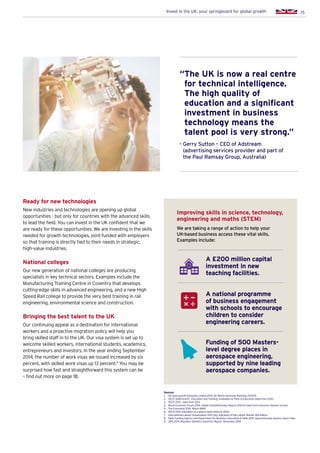
“The UK is now a real centre
for technical intelligence.
The high quality of
education and a significant
investment in business
technology means the
talent pool is very strong.”
- Gerry Sutton – CEO of Adstream
(advertising services provider and part of
the Paul Ramsay Group, Australia)
A £200 million capital
investment in new
teaching facilities.
Improving skills in science, technology,
engineering and maths (STEM)
We are taking a range of action to help your
UK-based business access these vital skills.
Examples include:
A national programme
of business engagement
with schools to encourage
children to consider
engineering careers.
Funding of 500 Masters-
level degree places in
aerospace engineering,
supported by nine leading
aerospace companies.
16 Invest in the UK: your springboard for global growth
Labour Market
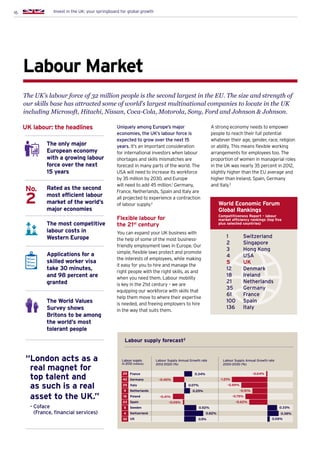
The UK’s labour force of 32 million people is the second largest in the EU. The size and strength of
our skills base has attracted some of world’s largest multinational companies to locate in the UK
including Microsoft, Hitachi, Nissan, Coca-Cola, Motorola, Sony, Ford and Johnson  Johnson.
Uniquely among Europe’s major
economies, the UK’s labour force is
expected to grow over the next 15
years. It’s an important consideration
for international investors when labour
shortages and skills mismatches are
forecast in many parts of the world. The
USA will need to increase its workforce
by 35 million by 2030, and Europe
will need to add 45 million.1
Germany,
France, Netherlands, Spain and Italy are
all projected to experience a contraction
of labour supply.2
Flexible labour for
the 21st
century
You can expand your UK business with
the help of some of the most business-
friendly employment laws in Europe. Our
simple, flexible laws protect and promote
the interests of employees, while making
it easy for you to hire and manage the
right people with the right skills, as and
when you need them. Labour mobility
is key in the 21st century – we are
equipping our workforce with skills that
help them move to where their expertise
is needed, and freeing employers to hire
in the way that suits them.
1	 Switzerland
2	 Singapore
3	 Hong Kong
4	 USA
5 	 UK
12	 Denmark
18	 Ireland
21	 Netherlands
35	 Germany
61	 France	
100	 Spain
136	 Italy
The only major
European economy
with a growing labour
force over the next
15 years
Rated as the second
most efficient labour
market of the world’s
major economies
The most competitive
labour costs in
Western Europe
Applications for a
skilled worker visa
take 30 minutes,
and 98 percent are
granted
The World Values
Survey shows
Britons to be among
the world’s most
tolerant people
UK labour: the headlines
No.
2
“London acts as a
real magnet for
top talent and
as such is a real
asset to the UK.”
- Coface
(France, financial services)
A strong economy needs to empower
people to reach their full potential
whatever their age, gender, race, religion
or ability. This means flexible working
arrangements for employees too. The
proportion of women in managerial roles
in the UK was nearly 35 percent in 2012,
slightly higher than the EU average and
higher than Ireland, Spain, Germany
and Italy.3
World Economic Forum
Global Rankings
Competitiveness Report – labour
market efficiency rankings (top five
plus selected countries)
Labour supply
in 2012 (millions)
Labour Supply Annual Growth rate
2012-2020 (%)
Labour Supply Annual Growth rate
2020-2030 (%)
0.33%
0.08%
-0.62%
-0.75%
-0.51%
-0.89%
-1.21%
-0.04%
Labour supply forecast2
	 Germany
	 France
	 Italy
	 Netherlands
	 Poland
	 Spain
	 Sweden
	 Switzerland
	 UK
-0.40%
-0.41%
0.34%
0.07%
0.25%
0.52%
0.5%
0.82%
29
42
25
9
18
23
5
4
32
-0.05%
0.38%
17Invest in the UK: your springboard for global growth
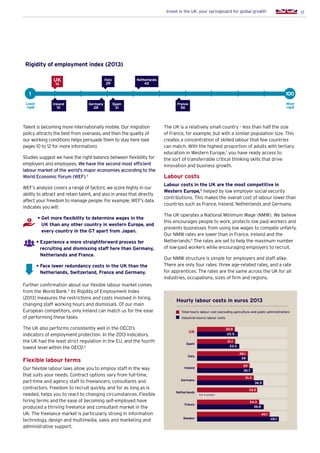
Rigidity of employment index (2013)
Hourly labour costs in euros 2013
Total hourly labour cost (excluding agriculture and public administration)
Industrial hourly labour costs
Spain
21.1
23.3
UK
20.9
22.5
Italy
28.1
28
Ireland
29
30.7
Germany
31.3
36.5
France
34.3
36.8
Sweden
40.1
45.1
Netherlands
33.2
Not Available
Talent is becoming more internationally mobile. Our migration
policy attracts the best from overseas, and then the quality of
our working conditions helps persuade them to stay here (see
pages 10 to 12 for more information).
Studies suggest we have the right balance between flexibility for
employers and employees. We have the second most efficient
labour market of the world’s major economies according to the
World Economic Forum (WEF).4
WEF’s analysis covers a range of factors; we score highly in our
ability to attract and retain talent, and also in areas that directly
affect your freedom to manage people. For example, WEF’s data
indicates you will:
	 • Get more flexibility to determine wages in the
UK than any other country in western Europe, and
every country in the G7 apart from Japan.
	• Experience a more straightforward process for
recruiting and dismissing staff here than Germany,
Netherlands and France.
	• Face lower redundancy costs in the UK than the
Netherlands, Switzerland, France and Germany.
Further confirmation about our flexible labour market comes
from the World Bank.5
Its Rigidity of Employment Index
(2013) measures the restrictions and costs involved in hiring,
changing staff working hours and dismissals. Of our main
European competitors, only Ireland can match us for the ease
of performing these tasks.
The UK also performs consistently well in the OECD’s
indicators of employment protection. In the 2013 indicators,
the UK had the least strict regulation in the EU, and the fourth
lowest level within the OECD.6
Flexible labour terms
Our flexible labour laws allow you to employ staff in the way
that suits your needs. Contract options vary from full-time,
part-time and agency staff to freelancers, consultants and
contractors. Freedom to recruit quickly, and for as long as is
needed, helps you to react to changing circumstances. Flexible
hiring terms and the ease of becoming self-employed have
produced a thriving freelance and consultant market in the
UK. The freelance market is particularly strong in information
technology, design and multimedia, sales and marketing and
administrative support.
The UK is a relatively small country - less than half the size
of France, for example, but with a similar population size. This
creates a concentration of skilled labour that few countries
can match. With the highest proportion of adults with tertiary
education in Western Europe,7
you have ready access to
the sort of transferrable critical thinking skills that drive
innovation and business growth.
Labour costs
Labour costs in the UK are the most competitive in
Western Europe,8
helped by low employer social security
contributions. This makes the overall cost of labour lower than
countries such as France, Ireland, Netherlands and Germany.
The UK operates a National Minimum Wage (NMW). We believe
this encourages people to work, protects low paid workers and
prevents businesses from using low wages to compete unfairly.
Our NMW rates are lower than in France, Ireland and the
Netherlands.9
The rates are set to help the maximum number
of low-paid workers while encouraging employers to recruit.
Our NMW structure is simple for employers and staff alike.
There are only four rates: three age-related rates, and a rate
for apprentices. The rates are the same across the UK for all
industries, occupations, sizes of firm and regions.
1 100
Least
rigid
Most
rigid
UK
10
Ireland
10
Germany
28
Spain
31
France
56
Italy
29
Netherlands
42
18 Invest in the UK: your springboard for global growth
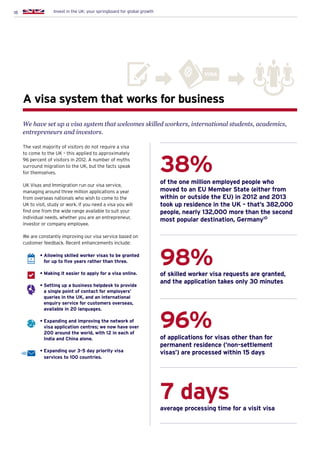
The vast majority of visitors do not require a visa
to come to the UK – this applied to approximately
96 percent of visitors in 2012. A number of myths
surround migration to the UK, but the facts speak
for themselves.
UK Visas and Immigration run our visa service,
managing around three million applications a year
from overseas nationals who wish to come to the
UK to visit, study or work. If you need a visa you will
find one from the wide range available to suit your
individual needs, whether you are an entrepreneur,
investor or company employee.
We are constantly improving our visa service based on
customer feedback. Recent enhancements include:
	 • Allowing skilled worker visas to be granted
for up to five years rather than three.
	 • Making it easier to apply for a visa online.
	 • Setting up a business helpdesk to provide
a single point of contact for employers’
queries in the UK, and an international
enquiry service for customers overseas,
available in 20 languages.
	 • Expanding and improving the network of
visa application centres; we now have over
200 around the world, with 12 in each of
India and China alone.
	• Expanding our 3-5 day priority visa
services to 100 countries.
5
Years
38%
98%
96%
7 days
of the one million employed people who
moved to an EU Member State (either from
within or outside the EU) in 2012 and 2013
took up residence in the UK – that’s 382,000
people, nearly 132,000 more than the second
most popular destination, Germany10
of skilled worker visa requests are granted,
and the application takes only 30 minutes
of applications for visas other than for
permanent residence (‘non-settlement
visas’) are processed within 15 days
average processing time for a visit visa
A visa system that works for business
We have set up a visa system that welcomes skilled workers, international students, academics,
entrepreneurs and investors.
19Invest in the UK: your springboard for global growth
Diversity in the UK
Your staff will find the UK is more than just a great
place for business. They will join a diverse, welcoming
and tolerant country. In a survey of senior managers of
international companies already established here, 93
percent said the UK’s quality of life, diversity, culture and
language make it an attractive location for new activities.11
At least 300 languages are spoken in London, making it
one of the most ethnically diverse cities in the world.12
We have comprehensive laws that protect the rights of
individuals and promote equality of opportunity for all.
The World Values Survey revealed the open nature of
our society, identifying Britons as among the world’s
most tolerant people.13
Industrial relations
Our flexible employment relations laws enable all
parties to work together towards long-term business
viability. Industrial action is at an historic low, compared
to the 1970s and 1980s, and more managers are now
recognising the positive role that trade unions play in
the workplace.14
The pay and conditions of most employees in the UK
are not negotiated, as not all of the UK’s workforce are
subject to collective bargaining. In fact, 29 percent are,
falling to 17 percent in the private sector,15
which is low
compared to other European countries.
Sources:
1.	 The Boston Consulting Group/World Economic Forum 2011. Global Talent Risk – Seven Responses
2.	 The Boston Consulting Group 2014. The Global Workforce Crisis: $10 Trillion at Stake
3.	 ONS 2013. Women in the Labour Market, 2013
4.	 World Economic Forum 2014. Global Competitiveness Report 2014-15
5.	 World Bank 2012. Doing Business 2012: fDi Intelligence, from the Financial Times Ltd (2013)
6.	Department for Business, Innovation  Skills calculations based on established OECD methodology (OECD
indicators no longer provide an overall index)
7.	 OECD 2014. Education at a glance (data refers to 2012)
8.	 Eurostat 2014. News release: labour costs in the EU 28
9.	Eurostat calculations 2014. Minimum wage statistics. For most countries, the minimum wage is agreed in terms
of a monthly rate. For Ireland, France, the UK and the USA, the minimum wage is fixed at an hourly rate. For
purposes of comparison, these hourly or weekly rates have been converted to a monthly rate, using factors
supplied by the countries concerned
10.	 Eurostat 2014. European Union Labour Force Survey – annual results 2013
11.	 Ernst  Young 2014. UK Attractiveness Survey 2014
12.	Von Ahn, N., Lupton, R., Greenwood, C. and Wiggins, D., 2010. Languages, Ethnicity and Education in London.
London: Institute of Education
13.	 Berggren, N. and Nilsson, T., 2013. Does Economic Freedom Foster Tolerance? Kyklos, 66: 177–207
14.	 Workplace Employment Relations Survey 2011
15.	 Department for Business, Innovation and Skills 2014. Trade Union Membership 2013: Statistical Bulletin
“We feel very welcome in the UK as a foreign investor. It is a very
open market and a great place to do business.”
- Jaspal Singh, Chief Executive of ComfortDelGro UK and Ireland
(Singapore-based transport services company)
20 Invest in the UK: your springboard for global growth
Tax
Tax is central to our drive to make the UK the best place in the world to locate an international
business. We have a low tax burden, flexible and competitive rules, and generous reliefs for
innovation – essential conditions for successful and profitable businesses.
Corporation tax
The UK’s corporation tax rate is 20
percent from April 2015. That’s by far
the lowest among the six biggest EU
economies and the G7, and the joint
lowest in the G20. The UK does not
have any additional local taxation on
companies’ profits.
A territorial tax system
Our territorial tax system makes
the UK a great location for your
international headquarters or holding
company. Our ‘Controlled Foreign
Company’ (CFC) regime protects
our tax base, but helps UK-based
companies compete in international
markets by giving more freedom
to manage overseas trading and
financing operations. Profits earned
by overseas companies controlled
from a UK base are exempt from tax,
providing they have not been diverted
from the UK into a low-tax jurisdiction.
The CFC regime includes specific rules
for group finance companies. To avoid
complex tracing rules for the source
of funds for overseas intra-group
lending, we take a pragmatic approach
to the treatment of the profits from
the lending of money between group
companies. The effect is to exempt 75
percent of the relevant finance profits,
equivalent to a 5 percent effective UK
tax rate for these profits from April
2015. In limited circumstances, there is
also scope for the exempt proportion
to increase to 100 percent.
We operate an ‘elective tax exemption’
for overseas trading branches of UK
companies. This gives you the choice
between potential UK loss relief (and
taxation of profits, with double tax
relief) and exemption for both profits
and losses.
Our distribution exemption regime
means that, in most cases, UK
companies can also benefit from
a complete exemption from tax on
dividends.
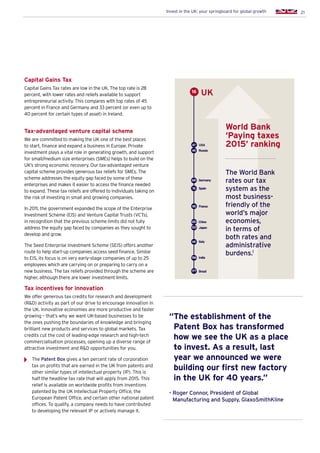
G20 corporation
tax rates 2015*
Source: KPMG Global Tax Rates Online
*Based on announced plans
UK 20%
Russia 20%
Saudi Arabia 20%
Turkey 20%
Korea 24%
China 25%
Indonesia 25%
Canada 26%
South Africa 28%
Mexico 30%
Germany 29%
Australia 30%
Italy 31%
India 34%
France 33%
Brazil 34%
Argentina 35%
Japan 36%
USA 40%
Corporation tax rate
of 20 percent from
April 2015 is the
lowest in the G7 and
joint lowest in the G20
A tax system
rated as the most
business-friendly
of the ten largest
economies in Europe
Generous tax
reductions available
for research and
development (RD)
and commercialisation
activity
Lowest employer
social security
contributions among
the EU’s five largest
economies
New private pension
system that is
simple and flexible
for employers and
employees alike
UK tax: the headlines
20%
£
21Invest in the UK: your springboard for global growth
Capital Gains Tax
Capital Gains Tax rates are low in the UK. The top rate is 28
percent, with lower rates and reliefs available to support
entrepreneurial activity. This compares with top rates of 45
percent in France and Germany and 33 percent (or even up to
40 percent for certain types of asset) in Ireland.
Tax-advantaged venture capital scheme
We are committed to making the UK one of the best places
to start, finance and expand a business in Europe. Private
investment plays a vital role in generating growth, and support
for small/medium size enterprises (SMEs) helps to build on the
UK’s strong economic recovery. Our tax-advantaged venture
capital scheme provides generous tax reliefs for SMEs. The
scheme addresses the equity gap faced by some of these
enterprises and makes it easier to access the finance needed
to expand. These tax reliefs are offered to individuals taking on
the risk of investing in small and growing companies.
In 2011, the government expanded the scope of the Enterprise
Investment Scheme (EIS) and Venture Capital Trusts (VCTs),
in recognition that the previous scheme limits did not fully
address the equity gap faced by companies as they sought to
develop and grow.
The Seed Enterprise Investment Scheme (SEIS) offers another
route to help start-up companies access seed finance. Similar
to EIS, its focus is on very early-stage companies of up to 25
employees which are carrying on or preparing to carry on a
new business. The tax reliefs provided through the scheme are
higher, although there are lower investment limits.
Tax incentives for innovation
We offer generous tax credits for research and development
(RD) activity as part of our drive to encourage innovation in
the UK. Innovative economies are more productive and faster
growing – that’s why we want UK-based businesses to be
the ones pushing the boundaries of knowledge and bringing
brilliant new products and services to global markets. Tax
credits cut the cost of leading-edge research and high-tech
commercialisation processes, opening up a diverse range of
attractive investment and RD opportunities for you.
The Patent Box gives a ten percent rate of corporation
tax on profits that are earned in the UK from patents and
other similar types of intellectual property (IP). This is
half the headline tax rate that will apply from 2015. This
relief is available on worldwide profits from inventions
patented by the UK Intellectual Property Office, the
European Patent Office, and certain other national patent
offices. To qualify, a company needs to have contributed
to developing the relevant IP or actively manage it.
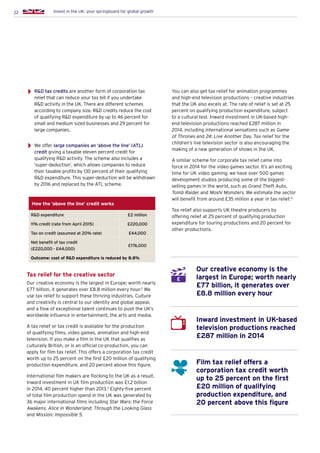
The World Bank
rates our tax
system as the
most business-
friendly of the
world’s major
economies,
in terms of
both rates and
administrative
burdens.1
World Bank
‘Paying taxes
2015’ ranking
Russia
Spain
Germany
Italy
China
Japan
India
Brazil
49
76
68
120
141
122
156
177
UK16
“The establishment of the
Patent Box has transformed
how we see the UK as a place
to invest. As a result, last
year we announced we were
building our first new factory
in the UK for 40 years.”
- Roger Connor, President of Global
Manufacturing and Supply, GlaxoSmithKline
95 France
USA47
22 Invest in the UK: your springboard for global growth
RD tax credits are another form of corporation tax
relief that can reduce your tax bill if you undertake
RD activity in the UK. There are different schemes
according to company size. RD credits reduce the cost
of qualifying RD expenditure by up to 46 percent for
small and medium sized businesses and 29 percent for
large companies.
We offer large companies an ‘above the line’ (ATL)
credit giving a taxable eleven percent credit for
qualifying RD activity. The scheme also includes a
‘super-deduction’, which allows companies to reduce
their taxable profits by 130 percent of their qualifying
RD expenditure. This super-deduction will be withdrawn
by 2016 and replaced by the ATL scheme.
Tax relief for the creative sector
Our creative economy is the largest in Europe; worth nearly
£77 billion, it generates over £8.8 million every hour.2
We
use tax relief to support these thriving industries. Culture
and creativity is central to our identity and global appeal,
and a flow of exceptional talent continues to push the UK’s
worldwide influence in entertainment, the arts and media.
A tax relief or tax credit is available for the production
of qualifying films, video games, animation and high-end
television. If you make a film in the UK that qualifies as
culturally British, or is an official co-production, you can
apply for film tax relief. This offers a corporation tax credit
worth up to 25 percent on the first £20 million of qualifying
production expenditure, and 20 percent above this figure.
International film makers are flocking to the UK as a result.
Inward investment in UK film production was £1.2 billion
in 2014, 40 percent higher than 2013.3
Eighty-five percent
of total film production spend in the UK was generated by
36 major international films including Star Wars: the Force
Awakens, Alice in Wonderland: Through the Looking Glass
and Mission: Impossible 5.
How the ‘above the line’ credit works
RD expenditure £2 million
11% credit (rate from April 2015) £220,000
Tax on credit (assumed at 20% rate) £44,000
Net benefit of tax credit
(£220,000 - £44,000)
£176,000
Outcome: cost of RD expenditure is reduced by 8.8%
You can also get tax relief for animation programmes
and high-end television productions – creative industries
that the UK also excels at. The rate of relief is set at 25
percent on qualifying production expenditure, subject
to a cultural test. Inward investment in UK-based high-
end television productions reached £287 million in
2014, including international sensations such as Game
of Thrones and 24: Live Another Day. Tax relief for the
children’s live television sector is also encouraging the
making of a new generation of shows in the UK.
A similar scheme for corporate tax relief came into
force in 2014 for the video games sector. It’s an exciting
time for UK video gaming; we have over 500 games
development studios producing some of the biggest-
selling games in the world, such as Grand Theft Auto,
Tomb Raider and Moshi Monsters. We estimate the sector
will benefit from around £35 million a year in tax relief.4
Tax relief also supports UK theatre producers by
offering relief at 25 percent of qualifying production
expenditure for touring productions and 20 percent for
other productions.
Our creative economy is the
largest in Europe; worth nearly
£77 billion, it generates over
£8.8 million every hour
Inward investment in UK-based
television productions reached
£287 million in 2014
Film tax relief offers a
corporation tax credit worth
up to 25 percent on the first
£20 million of qualifying
production expenditure, and
20 percent above this figure
£
23Invest in the UK: your springboard for global growth
Personal taxes
Income tax rates in the UK are
highly competitive with those in
other European countries.
Pensions
Our state pension provision is complemented by a
modernised private workplace pension system, the largest
in Europe and collectively worth in excess of £1.6 trillion.7
In response to longer life expectancy and a fall in the
number of people saving for retirement, we are introducing
automatic enrolment into workplace pensions. Due for
completion in 2018, it will mean millions more people are
saving privately for their retirement.
We are also giving people more choice over the use of
their pension savings. From April 2015, savers will get total
freedom over how they withdraw pension money - for
example they could take it all as a lump sum, draw it down
Top income tax rates
in selected European
countries6
41.8%
Employer social security costs
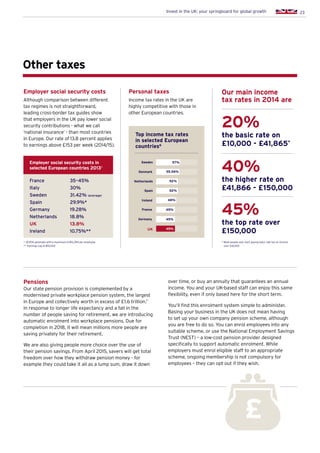
Although comparison between different
tax regimes is not straightforward,
leading cross-border tax guides show
that employers in the UK pay lower social
security contributions - what we call
‘national insurance’ - than most countries
in Europe. Our rate of 13.8 percent applies
to earnings above £153 per week (2014/15).
Other taxes
Employer social security costs in
selected European countries 20135
* 30.15% generally with a maximum of €12,394 per employee
** Earnings cap at €51,000
France	 35–45%
Italy	 30%
Sweden	 31.42% (average)
Spain	 29.9%*
Germany	 19.28%
Netherlands	 18.8%
UK	 13.8%
Ireland	 10.75%**
Sweden 57%
Netherlands 52%
Spain 52%
Ireland 48%
Germany 45%
45%UK
Denmark 55.56%
Our main income
tax rates in 2014 are
over time, or buy an annuity that guarantees an annual
income. You and your UK-based staff can enjoy this same
flexibility, even if only based here for the short term.
You’ll find this enrolment system simple to administer.
Basing your business in the UK does not mean having
to set up your own company pension scheme, although
you are free to do so. You can enrol employees into any
suitable scheme, or use the National Employment Savings
Trust (NEST) – a low-cost pension provider designed
specifically to support automatic enrolment. While
employers must enrol eligible staff to an appropriate
scheme, ongoing membership is not compulsory for
employees – they can opt out if they wish.
45%France
20%
the basic rate on
£10,000 - £41,865*
45%
the top rate over
£150,000
40%
the higher rate on
£41,866 - £150,000
£
* Most people only start paying basic rate tax on income
over £10,000
24 Invest in the UK: your springboard for global growth
Indirect taxes
Value Added Tax (VAT)
VAT is the principal indirect tax and
applies in all EU countries. The UK rate of
20 percent is in line with the average EU
standard rate and applies to both goods
and services. VAT is primarily a tax on
consumption, so as a general rule it will
not affect your business if not an end
consumer. Businesses that are taxable
for VAT are normally able to recover any
VAT incurred.
The UK is unique in having a broad range
of zero-rate supplies, meaning that VAT
on the supply is zero percent but input
VAT can still be reclaimed. Examples of
goods and services that may be zero-
rated (depending on the product and
the circumstances of the sale) are some
food categories, books and newspapers,
children’s clothes and shoes.
Importing and exporting
Your UK-based business can take
advantage of the EU’s extensive
system of Free Trade Agreements
and other preferential arrangements.
There is no duty to pay if you import
from or export to another EU
country. Regulations will vary if you
are exporting to a non-EU country,
but in many cases preferential
arrangements are in place that mean
you benefit from reduced or nil rates
of duty. If no such arrangements
exist, you might be eligible for one
of many duty relief schemes. Our
tax authority, HM Revenue and
Customs, provides an excise and
customs telephone advice line and
extensive online guidance to help
you understand these issues.
UK export
strength
Our EU trading
advantages help to
make the UK one
of the six biggest
exporters of goods
and services in the
world, with exports
of £500 billion in
2014.8
We are also
the second largest
global online retail
exporter after
the USA.9
Sources:
1.	 The World Bank Group  PwC 2014. Paying Taxes 2015
2.	 Department for Culture, Media  Sport January 2015. Creative Industries Economic Estimates – January 2015
3.	 British Film Institute 2015. 2014 Production Statistics
4.	 HM Treasury April 2014
5.	 Ernst  Young. 2013-14 The Worldwide Personal Guide  KPMG ‘Highest Employer Social Security Rates Tax Table’
6.	 KPMG 2014. Individual income tax rates table (online). 2014 rates where available – otherwise 2013
7.	 IMA 2013. Asset Management in the UK 2012-13: the IMA Annual Survey
8.	 UNCTAD 2014 (data includes estimates)
9.	 British Retail Consortium and Google 2014
Note: Effective corporate tax rates. The rates do not reflect payroll taxes, social security taxes, net wealth taxes, turnover/sales taxes and other taxes not levied on income.
Income Tax Rate selected is the highest rate payable The United States does not levy a federal value added tax. Individual states levy sales tax at various rates subject to
state-set requirements. E.g. a 4% Sales Tax in New York is used as a proxy. Employer social security rates for France and Italy are set at the mid-point of the existing range.
The big
picture
Our highly
competitive
overall tax
position is clear
when corporate,
income, social
security and
indirect taxes
are compared
Corporate Tax Rate % VAT/GST Tax Rate % Income Tax Rate % Employer Social Security Tax Rate %
International Tax Comparison
0 15025 50 75 100 125
Italy 31.4 22 43 32.5
Germany 18.75451929.6
UK 20 20 45 13.8
Ireland 10.75482312.5
United States 40 4 39.6 6.2
Netherlands 25 21 52 10.15
Spain 30 21 52 30.15
France 20 45 40.533.33
17Singapore 7 20 1617
Source: Data from Ernst  Young 2013-14 The Worldwide Personal Guide, KPMG Global Tax Rates Online, KPMG 2014. Individual income tax rates table (online), HMRC data
25Invest in the UK: your springboard for global growth
Financial and related professional
services contributed £180 billion to
the UK economy in 2013. We are the
leading exporter of financial services in
the world. Our financial services sector
made a trade surplus of US$71 billion in
2013 - more than twice the next largest
trade surpluses recorded by the US,
Luxembourg and Switzerland.1
London is the beating heart of our
thriving finance industry. Our capital
vies with New York for the status of
the world’s leading financial centre,
with the Global Financial Centres
Index barely able to separate the
two cities in its assessment of their
competitive strengths.
Two centres that have pushed their
way up this index in recent years
- Hong Kong and Singapore – are
examples of financial centres that
have modelled themselves on
UK practices.
Finance and Banking
1	 New York	 778
2	 London	 777
3	 Hong Kong	 756
4	 Singapore	 746
5	 San Francisco	 719
6	 Tokyo	 718
7	 Zurich	 717
8	 Seoul	 715
9	 Boston	 705
10	 Washington DC	 704
Financial centre
Index
score/1000Ranking
Global Financial Centres
Index 16 (September 2014)
London competes with
New York for the title of
the world’s number one
financial centre
The largest centre for
cross-border banking
Accounts for 41
percent of global
foreign exchange
Largest exporter of
financial and related
professional services
in the world
Europe’s premier centre
for Islamic finance
Fastest-growing
financial technology
sector in the world
UK finance: the headlines
The UK is Europe’s leading financial services hub. Secure, stable yet constantly innovating, the sector
creates a wealth of new business opportunities. Foreign companies invested around £100 billion into
UK financial services between 2007 and 2014 – close to a third of total foreign direct investment,
and more than any other sector in the UK.
Banking
The UK is the largest centre for
cross-border banking with 17
percent of the outstanding value
of international bank lending in
September 2013. We are also the
largest centre for cross-border
borrowing.
The UK’s banking sector is truly
international in nature. Over 250
foreign banks operate in London.
Our banks’ assets are the fourth
largest in the world behind China, the
USA and Japan. International banks
hold nearly half of the UK’s banking
sector assets.
The monetary and financial stability
of our system is maintained by the
Bank of England, the independent
central bank of the UK.
Investors can access a wide variety
of finance providers and options.
The World Bank rates the UK as the
joint easiest place in Western Europe
to get credit.2
Foreign currency trading is the
cornerstone of international trade.
The UK accounted for 41 percent
of global foreign exchange (forex)
trading in April 2013, well ahead of the
USA (19 percent), Japan (6 percent)
and Singapore (6 percent). Twice as
many US dollars are traded on the
forex market in the UK than in the
USA, and more than twice as many
euros are traded in the UK than in all
the euro-area countries combined.3
International businesses are attracted
by the stability that this huge
market provides, and the diversity of
providers to meet every need.
“It is inarguable that
London is the leading
offshore renminbi centre
in Europe. The trends
are strong... it (London)
is building on the
strengths it has.”
- Wenjian Fang, chief executive
of Bank of China UK
26 Invest in the UK: your springboard for global growth
Largest banking centres (assets, $billion, 2011/12)
International influence:
two examples
China US Japan France Germany CanadaUK
16,200
14,336
12,593
10,950
8,942
5,104
3,611
* Total assets of commercial banks, including subsidiaries
Our status as a leading global financial
centre allows us to create international
opportunities that others cannot match.
Islamic finance
By opening up the market for Islamic products the
UK is the leading Western country and Europe’s
premier centre for Islamic finance, with US$19
billion of reported assets.5
Six banks offer fully
Sharia compliant services and at least 20 other
financial firms offer Sharia compliant windows.
In 2014 we became the first country outside the
Islamic world to issue an Islamic bond. The £200
million Sharia-compliant ‘Sukuk’ opened up a
further route for investment in infrastructure
projects and attracted orders from investors in
the UK, Middle East and Asia worth more than
ten times its value.
RMB business hub
London is established as the Western hub for
offshore renminbi (RMB) trading, and agreements
are in place that lay the groundwork for London to
become the Western hub for investment into China
too. Not only is the flow of RMB funds through
London expected to increase, but doing business in
China will become easier for UK-based companies.
Almost two-thirds of all RMB payments outside
China and Hong Kong now take place in London and
28 percent of all international RMB payments are
made in the UK, the most outside Hong Kong and
mainland China.
Stock exchange listing
Listing in London allows you to tap into one
of the deepest pools of international equity assets
in the world.
The London Stock Exchange (LSE) is the oldest and fourth-
largest stock exchange in the world. It is also the most
international,4
with around 3,000 companies from over 70
countries. You can list on a number of different stock exchanges
designed to cater for different needs. Examples include:
• The LSE’s Main Market, Europe’s largest listings market
for established companies.
• The LSE’s Alternative Investment Market (AIM), a leading
growth market and popular choice for international
companies for its capital-and profile-raising opportunities.
• London Metal Exchange, where over 80 percent of the
world’s non-ferrous metal futures are traded.
• ICE Futures Europe, the largest regulated energy futures
exchange in Europe, and the second largest in the world.
• techMARK and techMARK mediscience are specially
developed segments of the Main Market designed for
companies at the forefront of innovative technology.
International bank lending (% share of total, end-2012)
UK
US
Japan
Germany
France
Netherlands
Hong Kong
Luxembourg
Others
Borrowing Lending
Source: BIS
39
2
3
5
5
5
14
19 18
11
11
8
8
4
3
3
34
8
2014 was the London Stock
Exchange’s best year for flotations
since 2007, with 138 companies
raising a combined £16.9 billion
from initial public offerings (IPOs).
Source: IMF, TheCityUK estimates
27Invest in the UK: your springboard for global growth
Innovation in financial services
Technology is transforming the financial services
industry – and we lead the way. Our expertise in ‘fintech’
has helped make the UK the biggest e-commerce
market in Europe6
and the second largest data centre
market in the world. Management consulting firm
Accenture reports that investment in fintech is growing
faster in the UK and Ireland than anywhere else in
the world. The volume of deals, mostly connected to
London, has grown at an annualised rate of 74 percent
since 2008, compared with 27 percent globally and 13
percent in Silicon Valley. London alone accounts for 53
percent of total European investment in the sector.7
Access to finance
UKTI Financial Services
Organisation
The UKTI Financial Services Organisation (FSO)
is available to help you find the right investment
opportunities in the UK and expand your business
internationally. You can draw on their in-depth
industry expertise, teams of specialists and extensive
networks across the globe. The FSO also focuses on
key UK strengths, including investment management,
insurance, financial technology, Islamic finance and
RMB trading.
For more information contact FSO by email:
enquiries@ukti-invest.com or telephone:
+44 (0)207 215 5152.
A new business bank to
support smaller businesses
Smaller businesses need finance markets to work for them
if they are to act as drivers of innovation and economic
recovery. Access to finance has not been easy for smaller
companies in recent years, with a lack of diversity of
financing options and a reluctance to lend to certain types
of businesses.
We have created a British Business Bank to tackle these
issues, a state-backed economic development bank which
aims to unlock £10 billion of finance over the next three
years by making finance markets work more effectively
for smaller UK businesses. Working with over 80 partners,
the British Business Bank uses government funding and
targeted guarantees to encourage the private sector to
increase lending and investment. Forty-eight thousand
UK-based businesses were benefiting from British Business
Bank programmes at the end of 2014.8
Competitive export finance
UK businesses benefit from the support of UK Export
Finance, the UK’s export credit agency (ECA). It is
committed to being one of the most competitive ECAs
in the global marketplace and helps UK exporters offer
competitive finance to overseas buyers of UK goods and
services, with generous rules on supporting foreign content
(up to 80 percent). Its services include providing direct
loans to export buyers, insurance against non-payment
under export contracts, and guarantees to help banks
provide working capital loans and contract bonds for their
exporter customers.
The world’s first investment bank
dedicated to greening the economy
We have set up the UK Green Investment Bank (GIB) with
funding of £3.8 billion to invest in innovative, environmentally
friendly projects that lack support from private markets. GIB
invests in UK projects which are both green and commercial
in areas such as offshore wind, energy efficiency and waste
and bioenergy.
Improving the supply of business finance is one of the five
strands of our Industrial Strategy - a long-term, whole-of-
government approach to support economic growth. You can
find out more in on page 49.
“London has emerged as the
fintech capital of Europe.”
- The Boom in Global Fintech Investment: A new
growth opportunity for London, Accenture 2014
Sources:
1.	 TheCityUK 2014. Key facts about the UK as an international financial centre
2.	 World Bank Group 2014. Doing Business 2015: Going Beyond Efficiency
3.	 TheCityUK2014. Key Facts About the UK as an International Financial Centre
4.	 World Stock Exchanges.net 2014. List of stock exchanges around the world. Available from world-stock-exchanges.net/
5.	 TheCityUK 2014. Key facts about the UK as an international financial centre
6.	 Ecommerce Europe 2014. The Europe B2C ecommerce report 2014
7.	 Accenture 2014. The Boom in Global Fintech Investment: a new growth opportunity for London
8.	 British Business Bank 2014 (online)
28 Invest in the UK: your springboard for global growth
London is the UK’s capital city and
the largest in Europe, a world within
a city where around 230 languages
are spoken. With four UNESCO
World Heritage Sites and the crown
as the shopping capital of the
world,2
London attracted a record
16.8 million international visitors in
2013, a 43 percent increase over ten
years.3
It competes with New York
for the status as the world’s leading
financial centre, and hosts Tech City,
the technology cluster that includes
giants such as Facebook, Google,
Intel and Cisco.
Belfast is the capital city of
Northern Ireland. It was named as
one of the ‘Best of the World Must-
See Places’ for 2012,4
and described
as ‘a capital that is redefining itself
in the eyes of the world’. The city is
the gateway to Northern Ireland’s
beautiful scenery and attractions
that include the world famous
Giant’s Causeway. Belfast’s economy
is dominated by hi-tech, service
sector companies, and has a fast-
growing creative industries sector.
The capital of Wales, Cardiff, has a
rich cultural and sporting heritage
that helped National Geographic
Magazine choose it as one of the
ten best places in the world to visit.5
It has more green space than any
other major city in the UK and is
home to Cardiff Bay, Europe’s largest
waterfront regeneration project. The
city has a growing reputation in the
professional and financial services
sector, and has a strong biosciences
cluster linked with Cardiff University.
Edinburgh is Scotland’s capital,
and the UK’s second most popular
destination for international visitors
after London. Edinburgh can claim
to be one of the cultural capitals of
the world – it is UNESCO’s first City
of Literature, and hosts the world’s
largest book and performing arts
festivals. It is the UK’s second
largest financial centre and is
renowned for the quality of its
research base in areas that include
stem cell research and regenerative
medicine, biotechnology, genomics
and renewable energy.
Property and Planning
A national planning
policy with a
presumption in
favour of sustainable
development
More certainty over
planning applications,
less risk of wasting
time and money
A more efficient
planning process
than Switzerland, the
Netherlands, France
and Ireland
79 percent of major
building projects
decided within 13 weeks
Faster application
process for major
infrastructure
projects with a 96
percent consent rate
Designated areas
with simpler and
more flexible planning
processes
UK property: the headlines Choose the UK as the place to start
or expand your business and you will
find a great place to live and work in
our dynamic and transparent property
market. The UK is a land of contrasting
landscapes. We have some of the
world’s great metropolises, including
three of Europe’s ten most populated
urban areas - London, Manchester and
Birmingham.
If you need to build or extend premises, the simplicity of our planning process may surprise you.
The World Bank rates our process for obtaining construction permits (including gaining planning
permission) as one of the most efficient in the EU - higher than Switzerland, the Netherlands,
France and Ireland.1
Four iconic capital cities
Yet all of our cities lie within easy reach
of beautiful countryside - all within an
area less than half that of France.
A wide range of commercial property
options exists across the country
with stable rents and flexible lease
arrangements. There are no restrictions
on overseas companies either buying or
renting property in the UK.
29Invest in the UK: your springboard for global growth
At the heart of the National Planning
Policy Framework is a presumption in
favour of sustainable development.
This means if your building plans fit
with the Local Plan, permission should
be granted without delay. This plan-led
approach has two major advantages:
A clear steer on the sort of
developments likely to be
approved gives you more
certainty over the outcome
and less risk of wasting time
and money on lengthy or
unsuccessful applications.
Faster decision-making.
You might also benefit from ‘permitted
development rights’ that allow the
conversion of existing agricultural, retail
and commercial buildings without the
need to submit a planning application.
The National Planning
Policy Framework
In 2012 we introduced a new single
document setting out how the planning
system in England should promote
sustainable development - the National
Planning Policy Framework. This
framework is a radically simplified
statement which places emphasis on
clear and up-to-date local plans. These
plans are drawn up by Local Planning
Authorities and set clear frameworks
for how their areas will develop
over time.
Scotland, Wales and Northern Ireland
are responsible for their own land use
planning and their systems operate
along similar lines (Northern Ireland’s
single planning document takes effect
from April 2015).
 3/4
of major projects are now decided
on time (within 13 weeks) and the
majority of smaller projects are
decided within eight weeks with
approval rates at 88 percent6
 178,000
new homes were approved on
major residential schemes in
England during 2013/14, 23
percent up on the previous year7
This new process is
already making an impact:
Making major infrastructure projects happen
We take a more centralised approach to planning applications
for critical infrastructure developments. Decisions on projects
of national significance (including energy, transport, water
and waste proposals) are made by government ministers in
line with official policy after examination by our Planning
Inspectorate. Time limits for the whole process enable
investors and developers to plan more effectively.
We have given planning consent for 96 percent of
applications for major infrastructure projects under this
process and in shorter timescales.8
Our new Specialist Planning Court also speeds up the handling
of legal challenges to major infrastructure consents, removing
some of the risk and uncertainty that can threaten a minority
of investment decisions.
“Receiving permission to construct a
new nuclear power station at Hinkley
Point C is a huge achievement… it
reflects an extraordinary level of
professionalism and work from EDF
Energy’s planning team, the Planning
Inspectorate, local authorities and a
wide range of stakeholders.”
- Vincent de Rivaz, EDF Energy Chief Executive, at the
time EDF Energy gained planning consent for
a new Nuclear Power Station at Hinkley Point C
within 17 months of submitting application to the
Planning Inspectorate.
30 Invest in the UK: your springboard for global growth
The UK has one of the most active property and
mortgage markets in the world.
Her Majesty’s Land Registry provides the assurances
you need if you invest in property in England and Wales.
Elsewhere in the UK this service is provided by Registers of
Scotland and by Land and Property Services in Northern
Ireland. Land Registry has over 150 years’ experience in
registering land and property, managing over 23 million
titles (the evidence of ownership). Its expertise is recognised
worldwide and called upon to help develop registration
systems in other countries.
Land Registry’s drive to become a leader in digitised land and
property services means you benefit from:
• Reduced costs and processing times as their services
move online.
• More user-friendly services, including a centralised
access point for local land charge searches.
Local Enterprise Partnerships (LEPs) are partnerships
between local authorities and businesses that decide on
local economic priorities and infrastructure needs. There are
39 LEPs across England, all with different offers to investors
depending on local industry sector strengths.
Enterprise Zones in England and Wales offer a wide range
of support to help establish and expand your business and
create jobs. Their simplified planning application process
includes Local Development Orders, used to grant automatic
planning permission for specified types of development.
You can access similar benefits in Scotland’s Enterprise
Areas. These are sector focused (life sciences, low carbon/
renewables, general manufacturing and growth sectors) and
based in 16 strategic locations across the country.
City Deals empower cities to take local control of their
economic opportunities and challenges. There are 28 cities
in England with deals planned or in place, giving them new
powers in exchange for greater responsibility to stimulate and
support economic growth in their area.
By locating in one of the 31 Enterprise Zones in
England and Wales you can also benefit from:
Financial benefits
You could claim up to 100 percent business rates
relief (worth up to £275,000 over a five-year period).
A business-ready infrastructure
The zones have access to good transport links and
superfast broadband.
An on-site customer and supply base
Many businesses choose Enterprise Zones that can
provide the goods and services they need, meaning
increased sales and reduced distribution costs.
Long-term local investment
All business rates growth generated within a zone
for a period of at least 25 years will be reinvested to
support local economic growth.
Sources:
1.	 World Bank Group 2014. Doing Business 2015: Going Beyond Efficiency
2.	 Centre for Retail Research 2011. World Shopping Capitals 2011 Survey
3.	 ONS 2013. Travel Trends, 2013 release
4.	 National Geographic Traveler
5.	 National Geographic 2011
6.	Department for Communities and Local Government 2014 (data includes applications determined within
timescales agreed with the applicant)
7.	 Home Builders Federation New Housing Pipeline Report June 2014: January to March 2014
8.	Figure correct as at October 2014; 27 out of 28 applications for Nationally Significant Infrastructure projects
that have reached the decision stage have been approved
9.	 ADS Group 2014
Growth-boosting areas
We have given certain areas of the UK greater flexibility to take action needed to create jobs
and economic growth. These are great places to locate a business – you benefit from a range of
practical support, including simplified planning procedures.
Buying land and property
31Invest in the UK: your springboard for global growth
Clusters of businesses from the same or
complementary industry sectors have
come together as centres of excellence
and innovation across the UK.
Join a cluster
Locating your business in a relevant
industry cluster could help you to:
Access a larger pool
of skilled labour
Improve your
supply chains
Exchange knowledge
and ideas with specialists
in your sector
Reduce research and
development (RD) costs
by sharing facilities
Digital technology
There are centres of
excellence in digital
technology in areas such
as Cambridge, East London
(Tech City), Manchester,
Glasgow, Bristol, Malvern
and Sunderland.
Biomedical
In the biomedical sector,
the Oxford, Cambridge and
London ‘triangle’ houses
the UK’s largest cluster of
innovation and industry
expertise.
Automotive
The leading automotive
cluster in the UK is in the
West Midlands, but there
has also been major foreign
investment in other areas
including Sunderland,
Ellesmere Port in Merseyside,
Burnaston in Derbyshire,
Swindon, Wolverhampton
and the Sheffield City Region
Enterprise Zone.
Aerospace
Our aerospace industry is the
second largest in the world.9
There are important clusters in
several regions of England but
also in Prestwick and Glasgow
in Scotland, Broughton in
Wales and Belfast in Northern
Ireland.
Agri-tech
A thriving agri-tech cluster in
the Norwich and Cambridge
areas takes advantage of
some of the most fertile
growing land in the country,
side-by-side with world-class
universities and multiple
science and research centres
specialising in crop science
and agronomy.
RD
Cutting-edge RD capabilities
serving a range of industry
sectors are harnessed at
several Enterprise Zones.
Examples include the network
of scientific researchers at
Oxford Science Vale, the
state-of-the-art facilities
for advanced engineering
technology at Sci-Tech
Daresbury, and the transport
systems RD capability at
MIRA Technology Park in
Leicestershire.
Examples of our thriving
business clusters
Case studies
City Deals in action
Leeds City Region Deal includes:
• A new 14-24 apprenticeships
academy to meet the skills
needs of local young people
and employers.
• £1.4 billion to improve public
transport, roads and other
infrastructure.
• Creating 15,000 new
apprenticeships.
• Ultra-fast broadband for
88,000 homes and over
16,000 businesses.
Enterprise Zones in action
At Alconbury Enterprise Zone a joined-up
approach to planning meant that the Local
Planning Authority was able to approve
the Zone’s award-winning small business
incubator in just 37 days, giving a major
boost to innovation in the area.
32 Invest in the UK: your springboard for global growth
Ease of Doing Business
Easiest major economy
in Europe to do
business in
Economy grew at
the fastest rate in the
G7 in 2014
Largest deficit
reduction of any major
advanced economy
Flexibility to choose
a company structure
that suits your needs
Corporate governance
based on principles, not
burdensome regulation
Fair and open
public procurement
procedures
London is the world’s
leading centre for
commercial litigation
and arbitration
Ground-breaking
approach to reducing
regulatory burdens is
saving business time
and money
UK ease of doing
business: the headlines
The entrepreneurial spirit is stronger than ever in the UK. New businesses are being set up
in record numbers – over half a million in 2014.1
Many factors come together to create our
business-friendly environment.
The World Bank reports that
it’s easier to do business in
the UK than any other major
European economy.2
Their
assessment includes factors such
as a regulatory environment
conducive to starting a business,
the ability to enforce contracts
and general legal protection.
We are constantly improving our
business environment, adapting
the market frameworks that
protect your business and free it
from unnecessary regulation and
administrative burdens.
Company law
The UK is an international standard
setter for company law. We developed
some of the key features of our
current legal framework over 150
years ago, and the influence of this
first modern company law can be
seen all around the world.
Ultimately our legal and regulatory
framework is about enabling business
to succeed; it provides the certainty
needed to facilitate trade and attract
investment to the UK.
In a survey of senior managers from
UK-based international companies,
90 percent said the stability and
transparency of our political, legal and
regulatory environment make the UK
an attractive location for new activities.3
The core principles of
our legal and regulatory
framework are:
Flexibility
You can decide the
ownership, finance
and decision-making
structures that work
best for you.
Transparency
and accountability
Requirements to maintain
public records and report
information are based on
the principle that trust is
key to business success.
Proportionality
These requirements are
appropriate to the size of
the business and nature
of ownership.
33Invest in the UK: your springboard for global growth
This means the organisation can do business and enter into
contracts in its own name. Incorporating makes it easier to
raise finance, in particular because investors enjoy limited
liability. The company’s finances are separate from their own,
so personal assets are not at risk. The limited company is the
most commonly used incorporated legal form, but UKTI can
advise on other options (see page 52).
The process of incorporating a company in the UK is quick,
easy and can be done electronically. For a small additional fee
this process can be completed on the same day. Companies
House, our registrar of UK companies, also now offers
incorporation online.
One of the advantages of the company model is the freedom to
agree your own rules and structures, provided these are within
the law. UK legislation provides model ‘articles’ for different
types of company which you can adopt or modify as needed.
If you run an incorporated company you will need to provide
financial and other information each year. The process for
filing these documents is simple and can be completed
electronically, saving you time and money.
The UK Corporate Governance Code
Our legal and regulatory framework is supplemented by the UK
Corporate Governance Code. The Code is not a rigid set of rules;
it sets out good practice for companies on issues such as board
leadership and effectiveness, pay, accountability and relations
with shareholders. At the heart of its flexibility is the trademark
‘comply or explain’ approach. UK listed companies are required
either to comply with the provisions of the Code, or explain to
investors in their next annual report why they have not done so.
This approach, widely admired and imitated internationally, gives
you flexibility to adopt a governance framework that fits your
specific circumstances.
Competition law
Our competition regime has a strong global reputation, and the
UK is seen as having open and fair markets which work well.
If you are looking to start or expand your business in the UK,
competition law protects you from anti-competitive practice
in the market. We want the best and most efficient businesses
to thrive, and for consumers to feel the benefit in the process.
UK competition law is a flexible instrument. In most areas the
Setting up a business in the UK
An individual can set up a business very easily in the UK without formal registration or regulation.
Most businesses however, choose to ‘incorporate’ and adopt one of a number of legal forms which
give the business a separate legal personality.
legislation is based on the premise that each case should be
judged by the actual effect that a practice has on competition
and whether it is against the public interest.
If you are an entrepreneur or innovator in the UK, our robust
intellectual property system will help you protect your
innovations and creativity. Find out more on page 46.
Procurement policy
When you come to the UK you can be sure that public sector
procurement is open, fair and transparent. You can bid to
provide goods or services either through a direct contract or
by becoming a subcontractor. Public procurement in the UK is
governed by EU Procurement Directives. This legal framework
helps to make public procurement a fair and open process
across the EU.
We are making this process even more transparent, giving
you the confidence and time to invest in the resources to
win contracts. In England a free online tool called ‘Contracts
Finder’ will help you find information about current, future
and past contracts with government and its agencies, as
well as sub-contracting opportunities. Scotland, Wales and
Northern Ireland also have their own dedicated public sector
procurement websites.
Contract notices and bid documents explain the bidding
process and the supporting documentation needed, and a
guide is available for small businesses on tendering for public
sector contracts.
Information about contracts is subject to the Freedom of
Information Act 2000. You have a right to ask for detailed
information about the bidding process. If your bid is
unsuccessful, public sector organisations must give you
feedback if requested.
Under the Freedom of Information Act, information in your
tender can be disclosed to anyone who asks for it unless it is
exempt. Guidance is available on exemptions. If any information
in your tender is commercially confidential you can ask for a
non-disclosure agreement.
We run a ‘Mystery Shopper’ service that provides a direct route
for suppliers to feedback on public procurement practice and
spot-checks public bodies to make sure their procurement is
small-business friendly.
34 Invest in the UK: your springboard for global growth
Legal framework
The UK has an international reputation for stability and consistency in its common law and
governance. The rule of law is the foundation of a prosperous economy and free society.
Property rights, the enforceability of contracts, the policing of criminal activities and protection
against the arbitrary use of state power give international businesses confidence in the UK
as a trusted investment destination.
UK law
London has long been recognised as a primary centre for
international and commercial litigation and arbitration.
International companies are most likely to turn to English law
if a third-party legal system is needed to resolve commercial
disputes. Such companies are twice as likely to choose
English law over any other governing laws for arbitrations,
for example.4
More than 4,600 international arbitration and
mediation disputes were resolved in the UK in 2012.5
Scots
Law, while different in many important aspects from English
law, is closely aligned when it comes to commercial law and
other areas affecting business. Wherever you choose to
locate your business in the UK, you can be sure of having a
wide choice of world-class legal advice.
The strength of our law lies in the ideal combination of
predictability and flexibility. Courts follow their earlier
decisions, providing continuity and certainty – but will adapt
past rulings to meet modern business needs where needed.
Monetary policy
Our economic policy objective is to achieve strong,
sustainable and balanced growth that is more evenly shared
across the country and between industries. Price stability is
central to this objective – this means targeting a low, stable
inflation rate. Our inflation target of two percent is critical
for creating certainty for businesses and consumers about
medium-term price changes. It means you can predict your
future costs and income with more confidence and invest
securely for optimal long-term growth.
The Monetary Policy Committee (MPC) of the Bank of England
has full operational independence to set policies
to meet the inflation target. The separation of fiscal and
monetary policy is a key feature of the UK’s economic policy.
Our commitment to price stability pushed inflation down to our
target of two percent in December 2013 and it stayed below this
rate for the whole of 2014.
Low inflation has helped to support the UK’s strong economic
growth. The International Monetary Fund (IMF) reports that
the UK economy grew at the fastest rate in the G7 in 2014.
The recovery is balanced across all the main sectors of the
economy, with manufacturing, services and construction all
growing. The IMF predicts growth of 2.7 percent for the UK in
2015, the highest of Europe’s major economies and more than
double the average for the euro-area.
Fiscal policy
Since the coalition government came to power in May 2010
we have been resolute in our action to bring about stable,
balanced economic growth based on sustainable levels of
public and private sector borrowing. Restoring tight control of
public finances is essential for economic security - by reducing
the gap between what we spend and what we raise in taxes we
have created the conditions for long-term growth.
In 2010, the IMF forecast that the UK would have the largest
headline and structural deficit of any G7 economy. Our fiscal
policy has transformed this situation and the deficit is forecast
to have halved from its peak by the end of financial year
2014/15. In October 2014, the IMF reported that the reduction
in both our headline and structural deficits was the largest of
any major advanced world economy.
International arbitration
and mediation disputes were
resolved in the UK in 2012
Private sector jobs have been created
since early 2010, and employment
reached its highest ever level in 2014
The International
Monetary Fund predicts
that the UK economy will
continue to grow faster
than any other major
European economy in 2015
 4,600  2 million
35Invest in the UK: your springboard for global growth
Based on UK Government policy as at February
2015, the independent Office of Budget
Responsibility predicts we will run our first surplus
for 18 years by 2018/19. Reducing and then
eliminating the deficit in this way helps to reduce
interest payments for consumers and business,
create jobs and boost prosperity – important factors
for a strong investment environment. Over 2.1
million private sector jobs have been created since
early 2010, and employment reached its highest
ever level in the three months ending in November
2014.
Regulatory policy
Getting rid of unnecessary regulations is central
to our drive to make the UK the best place for
investors to start, finance and expand their
businesses. We consider regulation to be a last
resort, an approach that will save your business
time and money. We will keep or introduce
regulations that help markets function effectively,
and remove those that impose unnecessary costs
and hinder competitiveness. Our review of existing
regulations has identified over 3,000 that can be
removed or improved.
Just a few examples from thousands of
measures that benefit business.
Company law
We are giving 100,000 more businesses flexibility to
decide whether their accounts should be audited.
From 2015 small companies can file their company
accounts and annual returns together, online and
just the once.
Employment law
We increased the qualification period for the right to
claim unfair dismissal from one to two years. Businesses
get more flexibility to make difficult decisions while
fundamental employee protections are retained.
Our Employer’s Charter dispels the myths about
what employers can and can’t do when managing
their workforce.
Medicines
Movement towards a ‘one stop’ principle for approving
changes to medicine licences should save business at
least £25 million per year.
Aviation
Better use of UK airspace will enable more direct
flight routes, bringing benefits to airlines, airports and
passengers.
Health and safety
Nearly 90 percent of health and safety regulations
will be scrapped or improved.Sources:
1.	 Start Up Britain 2015. New Figures Reveal Record-Breaking Year for Start-Ups (online)
2.	 World Bank Group 2014. Doing Business 2015: Going Beyond Efficiency
3.	 Ernst  Young 2014. UK Attractiveness Survey 2014
4.	 TheCityUK 2014. Professional Services Series: Legal Services January 2014
5.	 TheCityUK 2014. Key Facts about the UK as an International Financial Centre
Saving you time and money
Other countries are seeking to emulate the UK’s pioneering approach;
France, Italy and Spain are introducing a ‘One-In, One-Out’ scheme to
boost their competitiveness.
Our ground-breaking approach to
reducing regulatory burdens is the
‘One-In, Two-Out’ rule. Any increase
in the cost of regulation requires
us to save twice this amount
through the removal of regulations
elsewhere. This approach is saving
UK businesses over £2 billion a year.
36 Invest in the UK: your springboard for global growth
Transport
Infrastructure
£140 billion investment
is transforming the
speed and reliability of
our transport systems
The largest air
transport system in
Europe
The second largest
ports industry in
Europe
The most improved rail
network in the EU
London ranked top
globally for the
efficiency, reliability
and safety of its
transport network
UK transport: the headlines Keeping your business moving
We are investing record amounts of money to enhance a transport system
that supports 21st century business. A huge pipeline of transport
improvements worth over £140 billion is either underway or planned.1
Nearly
200 projects are scheduled for completion in 2014-15, with another 150 due
to start over the same period.2
It’s already easier to get around; London, for
example, has even better transport connections after a £6.5 billion upgrade
was completed before the 2012 Olympic and Paralympic Games. Our capital
is ranked top for the efficiency, reliability and safety of its public transport
network in a study of 30 of the world’s greatest cities.3
The UK – small nation, big workforce, fast transport. The perfect combination to help you move
goods and people quickly around the country. With over 70 airports, 40 major ports, excellent rail
links and toll-free motorways, getting to, from and around the UK is both simple and affordable.
Sea
• 95 percent of the volume of all
the UK’s import/export trade
travels through our ports.4
• The UK ports industry is the
second largest in Europe in
terms of total tonnage handled.5
• The UK hosts three of the
twenty biggest ports in the
EU by tonnage handled.6
We have over 100 commercial
ports in the UK, with 40 major
ports providing the capacity to
handle cargo of every size and
type. There are large all-purpose
ports such as Liverpool, ferry
ports such as Dover, specialised
container ports such as
Felixstowe, and ports catering for
bulk traffic such as coal or oil.
We have a vibrant port infrastructure, just as you’d expect for an
island country with our long and proud maritime heritage.
London Gateway is combined
with Europe’s biggest logistics
park and will provide 2,700
metres of quay, six deep-water
berths and 24 giant quay cranes
when completed.
The Port of Liverpool’s new
deep water container terminal
(‘Liverpool 2’, due to open
in 2015) will attract some of
the world’s largest container
vessels to a distribution hub
with a population of 35 million
consumers within a 150 mile
radius.
Port of Milford Haven in Wales
is a natural deep water port that
handles 20 percent of Britain’s
seaborne traffic of oil and gas.
UK deep water ports –
three examples
37Invest in the UK: your springboard for global growth
The UK aviation sector has more seats available
and serves more destinations on a daily basis
than any other European country.8
You can
enjoy the flexibility of multiple daily direct
flights to the world’s major cities.
London is a better connected city than Paris,
Frankfurt and Amsterdam. The combined
direct weekly services from London’s five
airports go to more destinations than from
Paris (two airports), Frankfurt (two airports)
and Amsterdam. London Heathrow has more
flights to many major international cities than
these three major EU hubs. Heathrow had over
twice as many direct scheduled flights in 2013
to New York, Chicago, Los Angeles, Washington,
Boston, Toronto, Dubai, Hong Kong, Mumbai,
Delhi and Johannesburg.
Business aviation
You can enjoy the flexibility of private business
flights from a network of airports across the
UK. There are over 3,000 airports in Europe
which private jets can use, ten times the
number available to airliners. Three of the
busiest 25 private business airports in Europe
are in London, with more private flights to and
from our capital than any other European city.9
City	 London	 London 	 Manchester	 Birmingham	 Glasgow/
	 Heathrow	 City			 Edinburgh
Paris	 18	 6	 7	 6	 5
Amsterdam	 21	 12	 7	 8	 12
Frankfurt	 20	 6	 4	 4	 3
Brussels	 9	 -	 4	 4	 3
Milan	 11	 3	 2	 1	 1
Barcelona	 6	 -	 2	 1	 1
New York	 29	 1	 2	 1	 2
Los Angeles	 7	 -	 -	 -	 -
Chicago	 8	 -	 1	 -	 1
Tokyo	 4	 -	 -	 -	 -
Delhi	 6	 -	 -	 -	 -
Mumbai	 5	 -	 -	 -	 -
Beijing	 3	 -	 -	 -	 -
Shanghai	 3	 -	 -	 -	 -
Average journey times by air from the
UK to key European destinations
Amsterdam	 1 hour
Berlin	 1 hour, 45 minutes
Zurich	 1 hour, 30 minutes
Prague	 1 hour, 45 minutes
Rome	 2 hours, 20 minutes
Madrid	 2 hours, 15 minutes
Istanbul	 3 hours, 35 minutes
London to	 Duration by air (hours and minutes)
Source: skyscanner.net
Air
The UK has excellent international connectivity from major airports distributed across the country.
We have the largest air transport system in Europe, handling 238 million passengers in 2014.7
Daily direct flights to the world’s major cities
(Average number of direct passenger flight departures per day – data extracted in January 2015)
Source: skyscanner.net plus information from UK airports
38 Invest in the UK: your springboard for global growth
Our reformed rail industry is delivering. The European
Commission found the UK network to be the most improved
in the EU, coming top in four of the 14 factors considered
(including growth of overall customer satisfaction and
safety).10
Our railways also rank as one of the best major
networks in the EU according to a major passenger survey
conducted by the European Commission in 2013. We topped
Europe’s seven major railways in punctuality and reliability,
information during journeys and accessibility.
The Eurostar connection provides a fast route to mainland
Europe. You can be in Brussels or Paris in just over two
hours after leaving London – a similar journey time as
London to Manchester.
You can connect easily with the Eurostar from most major
UK towns. Onward travel from the direct Eurostar
destinations enables you to reach up to 100 towns and
cities throughout Europe.
We are spending £38 billion from 2014 to 2019 to make our
railways even better – the biggest modernisation programme
since Victorian times. This means capacity for more trains,
more seats, faster journeys and bigger, better stations.
Major projects include:
• The Northern Hub - major upgrades across the north of
England with capacity for hundreds more trains and 44
million more passengers.
• Crossrail - the new high frequency railway that will bring
an extra 1.5 million people to within a 45 minute commuting
distance of central London.
• High Speed 2 - a high-speed railway that will link eight of
Britain’s ten largest cities, serving one in five of the population.
Rail
Road
Sources:
1.	 HMT December 2014. National Infrastructure Plan 2014
2.	 HM Treasury 2014. Projected infrastructure starts and completions in 2014-15
3.	 PwC 2014. Cities of Opportunity 6
4.	 United Kingdom Major Ports Group Ltd 2014. The UK ports industry – a profile (online)
5.	 Eurostat 2014. Maritime ports freight and passenger statistics 2012: gross weight of seaborne goods
handled by main ports by type of cargo
Fastest current journey times by rail from
London to key destinations
Birmingham	 1 hour, 22 minutes
Manchester	 2 hours, 7 minutes
Edinburgh	 4 hours, 20 minutes
Brussels	 2 hours, 1 minute
Paris	 2 hours, 16 minutes
Amsterdam	 4 hours, 38 minutes
London to	 Duration by rail (hours and minutes)
With 64 million people living in a relatively
small country, you’d expect our roads to be busy.
But we are taking unprecedented action to keep
traffic flowing.
We are carrying out an ambitious £15 billion investment
programme for our motorways and major roads between
2015 and 2021. By tripling our spending on major projects and
investing in hundreds of smaller schemes, we are creating a
world-class, strategic road network that helps stimulate local
economic growth, relieve congestion and improve safety and
environmental outcomes. Safety is something we take very
seriously – only Sweden and Iceland have safer roads than
us in Europe.11
Wherever you need to go in the UK, the chances are a train can take you there. Rail coverage is
one of the most intensive in the EU – while only the eighth largest member state by area we have
the fourth longest rail network.
6.	 Eurostat 2014. Maritime ports freight and passenger statistics 2012: top 20 cargo ports in 2012 on the basis
of gross weight of goods handled
7. 	 CAA 2015
8.	Airports Commission 2013. Interim Report. Data is from CAA analysis based on OAG data
9.	 Private Fly website
10.	 European Commission 2013
11.	World Health Organisation 2013. Global Status Report on Road Safety 2013. Statistic based on estimated
road traffic death rate per 100,000 of population
Source: National Rail and Eurostar 2014
39Invest in the UK: your springboard for global growth
Digital
Infrastructure
The best superfast
broadband service of
any major European
economy
More ‘network ready’
than any other major
European economy
Hosting the world’s
first test bed for 5G
technologies and
services
Open and competitive
broadband and
telecoms markets
means lower prices
and more choice
Biggest e-commerce
market in Europe
UK digital infrastructure:
the headlines
“The UK continues to exhibit a very strong performance. The
country recognised the importance of ICT to support innovation
and competitiveness early. As a result, it has a well-developed ICT
infrastructure, with one of the highest population uptakes and well-
developed e-commerce.” - World Economic Forum
We already have the best superfast broadband service of any major European economy - but our
focus is not on today. We are building a digital infrastructure for a super-connected future, capable
of supporting the huge increase in usage and the demand for lightning-fast speed.
World Economic Forum Networked
Readiness Index 2014…
…with the UK in the top five for
eleven WEF indicators, including
It is estimated that some 40 billion ‘connected devices’ will be in use globally
by 20201
– an ‘internet of things’ that will drive innovation, productivity and
economic growth. It is a vision we are ready for.
The World Economic Forum (WEF) confirms the strength of our foundations. We
are ranked ahead of all the other major European economies in the Networked
Readiness Index, a measure of capacity to use information and communication
technology to promote growth and social wellbeing.2
WEF Indicator Rank
Business to consumer internet use 1
Use of virtual social networks 2
Accessibility of digital content 4
Availability of latest technologies 5
Business-to-business internet use 5
Population e-participation 5
Our broadband commitment
Our commitment to maintaining our
status as a leading digital nation means
that 95 percent of UK homes and
businesses will have access to superfast
broadband by 2017. This coverage is
surging ahead, reaching 80-85 percent
of households by September 2014 –
higher than France, Germany, Italy
and Spain.3
We are ranked joint seventh overall in the
EU for superfast broadband coverage – a
position that speaks volumes about the
scale of our infrastructure investment.
There are more people living in areas of
the UK served by superfast broadband
than the combined populations of the
eight countries ranked equal to or above
us. This infrastructure also connects
businesses and communities over an
area more than twice that of Portugal,
the largest of these eight countries.
London’s digital status illustrates the
pace of change in the UK. It is rated top
for ‘technology readiness’ in a study of
30 of the world’s most dynamic cities.4
This puts our capital above cities such
as Seoul, Stockholm and Hong Kong
for the strength of its digital economy
and infrastructure.
Finland 1
Singapore 2
Sweden 3
USA 7
UK 9
South Korea 10
Germany 12
France 25
Ireland 26
Spain 34
Italy 58
40 Invest in the UK: your springboard for global growth
Aberdeen
Birmingham
Derby
Leeds
York
Newcastle
Coventry
London
Cambridge
Cardiff
Portsmouth
Oxford
Newport
Bristol
Brighton  Hove
Bradford
Salford Manchester
Edinburgh
Perth
Belfast
Derry/Londonderry
Super-connected cities
Businesses get an additional online boost in 22 ‘super-
connected cities’ across the UK where extra fast and reliable
broadband and wireless connectivity is available. You will
also find superfast broadband increasingly available on
planes, trains and ferries in the UK as travel operators take
advantage of new antenna technology that makes broadband
speeds up to ten times faster.
Cloud computing
Work more efficiently by accessing data or
software from any internet enabled device.
Large files
Easier, faster handling.
Flexible working
Work where and when you want.
Wide Area Network connectivity
Faster file sharing and data transfer
across multiple sites.
Internet Protocol (IP) telephony
Better integration of voice
communications.
Real time information sharing
Social media
New opportunities to communicate
with customers and suppliers.
Software as a service application
Reliability and reduced cost.
Online sales
New service opportunities and
handling high-volume traffic.
Percentage of households in areas served by superfast broadband
100%
90%
80%
70%
60%
50%
40%
30%
20%
10%
0%
A survey of managers from UK-based international companies found that 90
percent feel our technology and telecommunications infrastructure makes the UK an
attractive location for undertaking new activities.5
What does high speed connectivity
mean for me?
Source: Ofcom 2014. European Broadband Scorecard.
Luxembourg
65-70%
70-75%
95-100%
Croatia
France
Poland
Ireland
Slovakia
Israel
CzechRepublic
Spain
Bulgaria
Estonia
Sweden
Finland
Slovenia
Austria
Germany
Romania
Denmark
Portugal
Latvia
Lithuania
Belgium
Netherlands
Malta
UK
Cyprus
Hungary
Norway
Greece
Italy
95-100%
95-100%
95-100%
90-95%
90-95%
80-85%
80-85%
80-85%
75-80%
75-80%
75-80%
70-75%
70-75%
70-75%
70-75%
70-75%
70-75%
65-70%
65-70%
60-65%
60-65%
60-65%
55-60%
50-55%
45-50%
45-50%
45-50%
40-45%
20-25%
41Invest in the UK: your springboard for global growth
Keeping ahead in mobile
A survey of managers from UK-based international
companies found that 90 percent feel our technology and
telecommunications infrastructure makes the UK an attractive
location for undertaking new activities.5
4G internet is now widely available in the UK. Network
operators are expecting to cover 98 percent of the UK
population by the end of 2015.
To prepare for even faster mobile coverage we are supporting
a university/industry partnership to develop the world’s first
test bed for 5G technologies and services. This paves the way
for ‘always sufficient’ bandwidth that gives the perception of
infinite capacity. 5G is predicted to be 1,000 times faster than
4G, making it possible to download a feature-length film to a
wireless device in one second. This is the sort of connectivity
The UK online
We are enthusiastic adopters of internet
technologies in the UK. The take-up of both fixed
and mobile broadband is the fourth highest in the
EU – and take-up of superfast broadband is the
highest in the five largest economies in the EU.7
This love of online technology, combined with
huge market demand, makes the UK the biggest
e-commerce market in Europe – with Europe being
the biggest e-commerce market in the world.8
Source: Ofcom, using data supplied by Teligen
Weighted average single-service pricing for fixed
broadband and fixed voice services
8Mbit/s, 25GB and
250 mins (Basket 1)
16Mbit/s, 50GB and
250 mins (Basket 2)
30Mbit/s, 75GB and
250 mins (Basket 3)
UK France Germany Spain Italy
£42
£42
£47
010203040506070
£47
£47
£51
£52
£52
£65
£65
£66
£52
£51
£56
Sources:
1.	ABI Research 2014. The Internet of Things will Drive Wireless Connected Devices to 40.9 billion in 2020
(online)
2.	 World Economic Forum 2014. Global Information Technology Report
3.	 Ofcom 2014. European Broadband Scorecard – December 2014 update
4.	 PwC 2014. Cities of Opportunity
5.	 Ernst  Young 2014
6.	Ofcom 2014. European Broadband Scorecard (December 2014 update). For detailed notes accompanying
this data, see page 22 of this report at: http://stakeholders.ofcom.org.uk/binaries/research/cmr/cmr14/icmr/
EU_Scorecard_2014.pdf. While Ofcom note that none of the available pricing metrics is perfect in isolation,
they state that weighted average pricing measures generally offer a more accurate reflection of the prices
consumers are paying in a given market
7.	 Ofcom 2014. European Broadband Scorecard - December 2014 update
8.	 Ecommerce Europe 2014. Europe B2C Ecommerce Report 2014
we expect UK-based business to benefit from before their
overseas competitors. It will give you the platform to
develop new products and services that are simply not
possible today.
More choice, less cost
Our open and highly competitive telecoms and broadband
market means you benefit from lower prices and a wide
choice of providers and tariffs to suit your needs. Effective
deregulation has also set industry free to innovate as our
digital infrastructure opens up new possibilities.
In a comparison of the average of the three lowest available
prices for standalone fixed broadband and fixed voice
services, costs in the UK were the cheapest of the five
largest EU economies at three different levels of broadband
speed and data use.6
£62
42 Invest in the UK: your springboard for global growth
Like many countries, we face
challenges in the shape of binding
low-carbon targets and declining
fossil fuel reserves. Our response
has been one of the most radical
overhauls of the UK’s energy
infrastructure and markets since the
1980s. The reforms we have put in
place are driving the huge amount
of investment required, giving you
continued access to the energy you
need at stable, competitive prices.
The UK is one of only three countries
to receive a World Energy Council
(WEC) ‘AAA’ rating. This assessment
is based on the security and
reliability of energy infrastructure;
the accessibility and affordability
of supply; and environmental
sustainability. WEC report that: ‘the
UK remains a “pack leader” with
excellent performance on all three
energy dimensions’.
Utilities
Infrastructure
One of only three
countries worldwide
with a World Energy
Council ‘AAA’ rating
Privatisation of the
major utilities means
greater choice and
lower prices for
industrial energy
consumers
Investment in ‘smart
grid’ technology will
support the security
of our energy supply
for future decades
UK utilities: the headlines
World Energy Council Energy Sustainability Index 2014
Energy security
The effective management of primary
energy supply, the reliability of energy
infrastructure, and the ability to meet
current and future demand
Energy equity
The accessibility and affordability of
energy supply across the population
Environmental sustainability
The impact of supply and demand-side
energy efficiencies and the development
of energy supply from renewable and
other low-carbon sources.
The UK is one of the most energy secure countries in the world. We maintain this status thanks to
the combination of our own reserves, effective regulation of competitive markets, diverse sources
of imported energy and our focus on increasing clean energy – which includes nuclear, renewables
and carbon capture and storage.
Smart grid
Our investment in ‘smart grid’
technology helps to safeguard
the security of our energy
supply for decades to come.
With better monitoring and
control of the power network,
electricity companies will identify
fluctuations in demand and route
power to where it is needed
most. You get the reassurance
of a reliable energy supply, and
cheaper prices through savings on
network costs.
Energy costs
Privatisation of the major utilities
has led to greater choice and
lower prices for industrial energy
consumers. Our energy costs
are competitive with those in
other major economies in the EU,
particularly for gas prices.
United States	 1
Switzerland	 5
France	 11
UK	 22
Netherlands	 33
Singapore	 35
Ireland	 39
Germany	 42
Spain	 46
Denmark	 47
Italy	 48
Switzerland	 1
Denmark	 9
France	 10
Ireland	 13
UK	 18
Italy	 21
Spain	 24
Germany	 27
Netherlands	 31
Singapore	 50
United States	 83
Denmark	 6
United States	 8
UK	 9
Switzerland	 22
Germany	 27
Spain	 37
France	 41
Netherlands	 55
Ireland	 69
Italy	 70
Singapore	 124
43Invest in the UK: your springboard for global growth
Coal
20.1%
Gas
38.6%
Nuclear
20.8
Oil and other
2.7%
Renewables
17.8%
Source: DECC January 2015. Energy Trends section 5: electricity
Gas and electricity prices represent average national prices
including non-recoverable taxes
Gas prices for industrial
consumers 20142
Electricity prices for industrial
consumers 20143
Cutting energy costs for UK-based manufacturers
In March 2014 we brought in a £7 billion package to cut energy bills for
manufacturers, with benefits for other businesses too.
• We have capped for the rest of the decade the minimum price a
company must pay for each tonne of carbon dioxide emitted. If you’re
running a mid-sized manufacturing business in the UK this will save almost
£50,000 on your annual energy bill.
• We have also extended our compensation scheme for energy intensive
industries for a further four years to 2019-20, protecting the
competitiveness of steel makers, chemical plants, paper mills and
other heavy energy users.
• Users of energy from Combined Heat and Power plants are exempt
from the tax on fossil fuels used to generate electricity.
of electricity generated from low
carbon sources in September 201439%
Sources:
1.	 DECC January 2015. Energy Trends section 5: electricity
2.	 Eurostat 2014. Gas prices for industrial consumers
3.	 Eurostat 2014. Electricity prices for industrial consumers
Country	 Cost (€/kWh)
Denmark	 0.084
France	 0.096
Netherlands	 0.103
Spain	 0.125
UK	 0.129
Ireland	 0.134
Germany	 0.159
Italy	 0.172
Country	 Cost (€/gigajoule)
UK	 10.24
Denmark	 10.37
Spain	 10.38
Italy	 10.51
France	 10.74
Ireland	 11.46
Netherlands	 11.66
Germany	 12.47
Electricity generation
in the UK
The security of our power
supply is aided by a healthy
mix of energy sources. Low
carbon electricity’s share of
generation stood at nearly 39
percent in September 2014,
with 18 percent coming from
renewable resources.1
44 Invest in the UK: your springboard for global growth
Innovation Ecosystem
Innovation makes business more
productive – which in turn makes our
economy more competitive and more
responsive to change. From robotics
to life sciences, and from aerospace to
the creative industries, international
companies use this environment to
develop market-leading products and
services.
Innovation performance
International benchmarking
studies confirm the strength of our
innovation environment. We are the
top-rated major world economy in
the Global Innovation Index.1
This
index highlights particular strengths
in our higher education sector, the
ease with which firms can access
credit, the proportion of knowledge-
intensive employment and university-
business collaboration.
The level of investment in UK-based
research and development (RD) by
foreign-owned companies shows just
how competitive our offer is.
In 2012 the UK attracted almost
US$7.7 billion of overseas-financed
RD. This is:
• The same as Canada, Finland,
Japan, China, Russia and Denmark
combined.
• More than either France or Germany.
• Just under half that of the USA.2
The highest rated major
economy in the Global
Innovation Index
Over half of business
RD expenditure in the
UK is by foreign-owned
businesses
Collaboration between
universities and
business rated as
the most effective
among Europe’s major
economies
Highest research
productivity among the
top research nations
Highest proportion
of the workforce in
knowledge-intensive
jobs in the G20
Ranked ahead of
all of our major
competitors for the
quality and security
of our intellectual
property system
UK innovation: the headlines
“The RD landscape
in the UK is good and
getting stronger. We
have great linkages with
RD institutions and
networks.”
- Airbus, world leading
commercial aircraft
manufacturer
The UK has a rich heritage of discovery and innovation – the UK has produced 78 Nobel Prize
winners in scientific disciplines, more than any other country apart from the USA. But we are not
simply a nation of inventors. We continue to invest heavily in an innovation system that turns
ideas into commercial success.
Global Innovation Index
2014 – top eight and
selected rankings
1	 Switzerland
2	 UK
3	 Sweden
4	 Finland
5	 Netherlands
6	 USA
7	 Singapore
8	 Denmark
11	 Ireland
13	 Germany
22	 France
27	 Spain
31	 Italy
Over half of business RD
expenditure in the UK was by
foreign-owned businesses in 20133
Investments in UK-based RD made
by international companies in 2013/14
– the highest ever annual total4
54%
312
Source: Cornell University/INSEAD/WIPO
45Invest in the UK: your springboard for global growth
Figure 1. Ownership of RD performed by businesses in the UK (1993-2013)3
80%
70%
60%
50%
40%
30%
20%
10%
0%
1993 1994 1995 1996 1997 1998 1999 2000 2001 2002 2003 2004 2005 2006 2007 2008 2009 2010 2011 2012 2013
UK Rest of the world
Access to a world-class
academic and research
environment…
Our science and research institutions
generate the knowledge that drives
innovation, using talent from all over
the world.
• The UK has over 170 universities
and institutes of higher education
carrying out different combinations
of teaching and research.
• Our universities include some of the
very best in the world – four of the
top six according to the QS World
Universities Rankings.5
You can benefit from the UK’s
university expertise through access
to leading scientists, designers
and next generation technologies.
In 2012-13 UK universities earned
nearly £3.6 billion from services to
business and others, including the
commercialisation of new technology.6
The World Economic Forum rates the
collaboration between universities
and business in the UK as the most
effective of Europe’s major economies.7
… and a labour force geared
up for RD
The UK has 250,000 active researchers
working either in higher education
or business.8
Science has become
increasingly important across all sectors
of our economy; 5.8 million people work
in science-based roles, one in five of
the labour force. This is projected to
increase to 7.1 million people by 2030.9
The proportion of our workforce in
knowledge-intensive jobs is the highest
in the G20.10
Our influence in the research world is
disproportionate to our size. With less
than one percent of the global population,
the UK accounts for:
• 6.4 percent of global journal articles.
• 11.6 percent of citations.
• 15.9 percent of the world’s most
highly cited articles.
Our research productivity is the highest
and rising among top research nations
both in terms of publications and
citations per unit of spend.11
Case study
University of Liverpool
and Unilever
In a £33 million partnership,
the University of Liverpool
and Unilever are developing
a state-of-the-art materials
chemistry research hub with
open-access facilities. The
hub will accelerate research
and reduce new product
discovery times in sectors
such as sustainable energy,
pharmaceutical and paint
and coatings.
The Research Councils UK’s
online gateway to publicly
funded research enables you
to search for and analyse
information on the latest
innovative research in the UK
(http://gtr.rcuk.ac.uk/).
46 Invest in the UK: your springboard for global growth
Helping you turn
ideas into products
Innovate UK is our innovation agency
and our main way of supporting
business-led technology innovation.
Innovate UK can help you to:
• Bring products and services
more quickly to market.
• Access RD facilities.
• Connect with research or
business partners.
• Access funding through
competitions to reduce the risk
from innovation projects.
Innovate UK’s network of Catapult
Centres help businesses access advice
and cutting-edge facilities – allowing
you to take advantage of equipment and
expertise that might otherwise be out
of reach.
Our two national science and innovation
campuses (Harwell Oxford and Sci-Tech
Daresbury) are world-leading centres
for science, technology and innovation.
They are home to a large and diverse
range of science and technology-based
organisations, including large-scale
research organisations and innovative
commercial companies and start-ups.
They also give UK-based researchers
and businesses access to leading-edge
technology facilities that support all
scientific disciplines.
You can also get support for RD
activity at a range of other facilities
across the UK.
• More than 100 science parks give over
3,100 companies access to leading-
edge technology and research skills at
a nearby university or research centre.
• A network of over 300 business
incubators supports over 12,000
high-growth technology businesses in
sectors such as biomedical, IT and the
creative industries.
• Clusters of businesses from
similar industry sectors exist as
centres of excellence and innovation
across the UK.
• University Enterprise Zones
create premises for early-stage high-
tech companies to aid collaboration
with universities.
Tax incentives
Don’t let concerns about the cost and risk
of RD threaten the commercialisation
of your innovations. Our tax incentives
encourage innovation in businesses
of every size, from start-ups to global
enterprises. You can find out more about
these incentives on page 20.
Protecting your
intellectual property
The UK Intellectual Property Office
(IPO) helps businesses, innovators
and entrepreneurs understand how
intellectual property (IP) can create
value from their ideas, turning
inspiration into sustainable business
Our Catapult Centres
•	 High Value Manufacturing
•	 Cell Therapy
•	 Offshore Renewable Energy
•	 Satellite Applications
•	 Connected Digital Economy
•	 Future Cities
•	 Transport Systems
Opening in 2015
•	 Energy Systems
•	 Precision Medicine
success. In addition to granting patents,
registering trade marks and designs, the
IPO can help you to use, manage and
enforce your IP to achieve its full potential.
We are ranked first in a comparison of
36 country IP systems that assesses
cost, speed, quality of judges/tribunals,
quality of advice and the fairness and
predictability of decisions.12
International innovators clearly trust
our intellectual property system. They
own 41.5 percent of patents in the UK,
compared to 17.4 percent in Germany,
12.6 percent in the USA and 2.4 percent
in Japan.13
1	 UK
2	 Germany
3	 Netherlands
4	 Sweden
5	 Australia
6	 New Zealand
7	 Switzerland
8	 France
9	 Austria
10	 USA
11	 Canada
12	 Ireland
12	 Singapore
14	 Spain
21	 Italy
Global Intellectual
Property Index 2013
47Invest in the UK: your springboard for global growth
The quality infrastructure
The UK is a world leader in the scientific measurement
and standards that underpin innovation and technology
development. The British Standards Institution (BSI) is the
market leading global standards body. Conforming to its
standards can improve market access, reduce costs and risk
and give you that extra competitive edge.
The National Physical Laboratory (NPL) is a centre of excellence
in developing and applying the most accurate measurement
standards available. NPL works directly with over 2,400
companies every year, bringing more than £634 million of
financial benefits to business through measurement innovation.
The eight great technologies
The UK excels in many important areas of
science and innovation. We invest around
£6 billion through our research councils
and universities, sustaining a diversity of
funding approaches, fostering international
collaborations and providing access to the
best facilities and infrastructure. Innovate UK
also offers significant support, including the
network of Catapult Centres that are helping
companies commercialise new technology-
based products and services.
Through our industrial strategy (see page 49) we are
supporting the development and commercialisation of all
technologies with potential to create growth. We have a
particular focus on ‘eight great technologies’ - big, general
purpose technologies with wide-ranging applications
stretching beyond any single industrial sector. They are
also areas where the UK is, or has the potential to be,
world-leading with the right investment and collaboration
between researchers, industry and government.
Our investment is focused on commercialising these eight
great technologies at new, leading edge RD facilities. We
are also working with partners on all the building blocks
for successful commercialisation, including regulation,
financing and access to skills.
Big data
The next generation of scientific discovery and
innovation will be driven by analysing massive and
mixed data sets. There are big rewards for the leaders
in this field - the global market for big data will grow
from US$10 billion to reach US$50 billion by 2017.14
We have one of the largest ICT markets in Europe,
with well-established cloud computing and data centre
sectors. We see big data opportunities in areas such
as health, education, environment and energy, life
sciences, finance, government and entertainment.
Satellites
The ability to harness powerful satellite location
and imaging data creates diverse commercial
opportunities. Our space sector has grown by almost
ten percent a year over the last decade, and our
target is to make it a £40 billion industry by 2030. Our
strengths include telecommunications, small satellites,
satellite propulsion and space applications.
Robotics and
autonomous systems
Over the next 20 years robots and autonomous
systems will revolutionise our economy and society.
The global market for industrial robotics is currently
worth over US$25 billion and is forecast to reach
US$37 billion by 2018.15
The market for professional
service robots will increase from US$3.4 billion to
US$17.1 billion by 2016.16
Our strengths in software
programming, data handling and electronics make the
UK an ideal business and research environment for
this field. Strong market opportunities lie in developing
robotic applications for sectors as diverse as defence,
healthcare, manufacturing, agriculture, transport,
entertainment and education.
1
2
3
Case study
BSI influence
BSI operates around the world to
encourage the use of British and
European standards. In December 2013
the UK and China signed an agreement
to recognise each other’s standards – the
first agreement of its type entered into by
a Chinese standards authority.
48 Invest in the UK: your springboard for global growth
4
5
6
7
8Synthetic biology
Synthetic biology - the redesign and engineering
of biological systems and processes for new uses –
has wide-ranging applications in sectors including
healthcare, pharmaceuticals, chemicals, energy,
environment, renewables, materials, food and
agriculture. We are investing to take a leading share
of a global market that is forecast to increase from
US$2.1 billion in 2012 to over US$16.7 billion by 2018.17
We have a thriving research base – only the USA
publishes more scientific papers in this sector.
Regenerative medicine
An increasing range of medical conditions are
treatable by regenerative medicine – healing by
replacing or restoring human cells, tissues or
organs. We plan to take full advantage of the
global growth in this sector, forecast to reach
US$35 billion by 201918
- 35 times higher than
2012. Our ability to turn ideas into products is
enhanced by a large clinical trials infrastructure,
strong government research funding and a well-
established regulatory framework. UK-based
biotechnology companies have the highest number
of drugs in clinical development in Europe.19
Agri-science
We have a long history of innovation in the food
and drink sector – over 8,500 new food and drink
products are created in the UK each year, driven by
our strong research base in agriculture, bioscience
and food technologies.20
Our research priorities
include developing technologies to:
• Improve the quality, sustainability, resilience and
yield-led profitability of crops and farm animals.
• Improve the efficiency of agricultural practices.
• Manage the interactions between soil, water and
crop/animal processes.
• Reduce the impact of weeds, pests and diseases.
Advanced materials
Advanced materials technology has applications in
every industrial sector. It includes the technology
to build material from the atom up, designed with
characteristics not found naturally. We are building
on particular strengths in composites, graphene,
nanotechnology and additive layer manufacturing
(3D printing). Our composites sector, for example,
is forecast to grow by eight percent a year to reach
£20 billion by 2020.21
Energy storage
Our commitment to producing 15 percent of energy
from renewable sources by 2020 creates major
opportunities for energy storage technologies.
Innovation in this sector could create £12 billion of new
business revenue in the UK.22
We are strong in areas
such as ‘mobile’, ‘small scale’ and ‘grid-scale’ energy
storage technology solutions. These technologies
can be applied to many sectors including automotive,
aerospace, infrastructure, renewables, portable
computing, medical, leisure and defence.
Sources:
1.	 Cornell University, INSEAD  World Intellectual Property Organisation 2014.Global Innovation Index 2014
2.	 OECD Main Science  Technology Indicators (2014/2). Purchasing power parity dollars at 2005 prices
3.	 ONS 2014. Business enterprise research and development, 2013
4.	 UKTI 2014. Inward Investment Report 2013/14
5.	 QS Quacquarelli Symonds Limited 2014. QS World University Rankings 2014/15
6.	 Analysis by HEFCE of the 2012-11 Higher Education – Business and Community Interaction (HE-BCI) survey
7.	 World Economic Forum 2013. Global Competitiveness Report 2013-14
8.	 OECD MSTI (2014/2) Researcher employment measured in full-time equivalent
9.	 Science Council 2011. The Current and Future UK Science Workforce by Trends Business Research
10.	 OECD 2013. STI Scoreboard
11.	 Elsevier BV 2013. International Comparative Performance of the UK Research Base
12.	 TaylorWessing 2013. Global Intellectual Property Index
13.	 OECD 2014. International co-operation in patents: foreign ownership of domestic inventions
14.	 Frost and Sullivan 2012. Big Data: The 9 Dimensional Dossier on Revolutionizing Data Management
15.	 TechSci Research 2014. Global Industrial Robotics Market Forecast  Opportunities, 2018
16.	 International Federation of Robotics. World Robotics 2013 Service robots
17.	Transparency Market Research 2013. Synthetic Biology Market, Global Industry Analysis, Size, Growth, Share
and Forecast, 2012 – 2018
18.	 TriMark Publications 2013. Regenerative Medicine Markets
19.	 Ernst  Young 2013. Beyond Borders – biotechnology industry report 2014
20.	 Food and Drink Federation 2011. Business Confidence Survey published December 2011
21.	Ernst  Young scoping study undertaken for UKTI/BIS
22.	Low Carbon Coordination Innovation Group 2012. Technology Innovation Needs Assessment –
Heat Summary Report
The UK has everything you need
for successful, commercialised
innovation.
With so many potential places and
partners to help you develop market-
leading products and services,
UKTI’s Innovation Gateway can help
by introducing selected investment
and RD opportunities in science
and innovation to large international
funds and corporates. You can find
more information about the UKTI
Innovation Gateway on page 54.
UKTI Innovation
Gateway
49Invest in the UK: your springboard for global growth
• We create market opportunities – by investing in high-
growth technologies and markets we provide the conditions
for you to thrive in sectors that will be the engines of
tomorrow’s economy.
• We make it easy to do business - low taxes, minimum
regulation and free and efficient markets create a pro-
business environment that helps you start your business
quickly and expand on the global stage.
• We provide a rich and diverse ecosystem - leading
universities, a dynamic research base, market maturity
and top talent drawn from Europe’s 500 million population
combine to make the UK the number one destination for any
high value, technology-driven investment.
Businesses are seen as partners in the UK, and this is
reflected in our industrial strategy - a long-term, whole-of-
government approach to support economic growth. This
strategy gives you the confidence to invest for the long term
based on the benefits of joining an economy that creates more
opportunities, more jobs and a competitive edge on the world
stage. Government and business have together allocated more
than £2 billion to industrial strategy objectives over ten years,
a clear indicator of commitment to the success of UK-based
business in a period of fiscal constraint.
}} Skills: We are giving employers more direct control
over how training funding is spent so they can access
the skills they need. More information on accessing
skilled labour can be found on page 13.
}} Technologies: We are supporting the development and
commercialisation of technologies in which the UK can
lead the world. We have a particular focus on ‘eight
great technologies’ with wide ranging potential and
actual industrial applications and where our advanced
research expertise gives us the edge. See page 47.
}} Access to finance: We are removing barriers to the
supply of business finance by creating a new business
bank, helping smaller businesses invest to succeed and
expand. See page 27.
}} Procurement: We are giving as much advance warning
as possible about our plans to buy goods and services
and seek investment in infrastructure projects. This
gives you more confidence to plan ahead and invest in
the resources needed to win these contracts. We are
also developing more robust supply chains. You can
find out more about our approach to procurement on
page 33.
}} Industry sector partnerships: We are supporting
all sectors of the economy to become more
competitive, innovative and export-focused. Intensive
work is underway in 11 sectors where long-term
partnership between business and government is
particularly beneficial.
Industrial Strategy
and Capability
The eleven sector partnership strategies:
Aerospace
There is a predicted global need for US$4.6 trillion
worth of new passenger aircraft and freighters
between now and 2033.1
The UK has the second
largest aerospace industry in the world.
Supported by the Aerospace Growth Partnership,
you can benefit from:
• A joint £2 billion funding commitment between
government and industry.
• A new Aerospace Technology Institute to advance
the development of faster, quieter, greener planes.
• Funding for 500 Masters degrees in Aerospace
Engineering.
Our strategy has five main strands:
Industry sector partnerships
The 11 sector partnership strategies tell you much about the
advantages of investing in the UK. They demonstrate the
scale of the investment in the skills, research and technology
pushing UK-based business to the front of these markets. They
also set out how your business can benefit from our concerted
efforts to help UK companies export their goods and services.
All the strategies are business-led. Each sector strategy
is overseen by a council chaired jointly by government
and industry, and five of the sectors have industry-led
organisations steering government activity.
As global competition intensifies we are focused on economic growth as the route to enhance our
status as the most attractive destination for Foreign Direct Investment (FDI) in Europe. Our offer to
you as an investor is based on three commitments.
50 Invest in the UK: your springboard for global growth
Construction
There are big opportunities to capitalise on demand
for our expertise in architecture, design and
engineering - the global construction market is
forecast to grow by 70 percent to reach US$15 trillion
by 2025.2
We are making our construction industry
more efficient, sustainable and competitive.
We are also:
• Extending trade credit schemes to improve access
to finance.
• Publishing news of future construction projects to
help companies plan and invest.
Agricultural technology
Climate change and the growing global population
creates major opportunities for our agricultural
technology sector. The global agricultural
technology sector is currently worth US$400 billion3
and projected to be worth US$1 trillion by 2030.4
Supported by the Agri-Tech Leadership Council, you
can benefit from:
• Our research expertise – the UK is ranked as second
only to the USA for plant and veterinary sciences.
• Support from the industry-led Agri-Tech
Organisation to help you invest, expand your
business and export.
• A £70 million Agri-Tech Catalyst supporting
industry-led ‘proof of concept’ development of
near-market innovations. In the first phase
announced in March 2014, 11 projects benefited
from £2.8 million from Government alongside £1.4
million from industry.
Information economy
Digital technology is revolutionising the way the
world does business. Being left behind is not an
option. We are helping UK-based companies develop
and adopt new technologies to make them more
efficient and to drive faster economic growth.
Action includes:
• Supporting 1.6 million businesses to trade online.
• Establishing the world’s first test facility for
5G mobile technology.
• Promoting online learning platforms for use
in schools.
Automotive
Our automotive sector is thriving. It produced more than
1.5 million cars in 2014, nearly 80 percent of which were
exported. Industry analysts predict that output will reach
record levels of around two million units by 2017.5
Our
partnership with the automotive industry means you can
benefit from:
• The creation of an Advanced Propulsion Centre
with an initial £75 million to develop next generation
technologies.
• Plans to create 7,600 apprenticeships and recruit 1,700
university graduates over the next five years.
• Support from the Automotive Organisation to help you
invest, grow and export. The organisation is led by Joe
Greenwell (formerly Chair of Ford UK).
International education
The education sector is still in the early stages of
globalisation and opportunities are growing. The appeal
of our world-class universities to international students
is a big advantage. Areas for growth include education
technology and transnational education, where a higher
education institution in one country offers programmes
of study in another. We have set up UKTI Education to
help UK-based businesses win high-value opportunities
in overseas markets.
Life sciences
Seventeen of the 20 biggest pharmaceutical companies
in the world have research and development (RD),
manufacturing and sales sites in the UK.6
Our life
sciences strategy is creating an unrivalled ecosystem
that brings together businesses, researchers, clinicians
and patients to translate discovery into clinical use.
This ecosystem supports pioneers to bring innovation
to market earlier and more easily, making the UK the
location of choice for investment. Key actions include:
• Major investment to support the commercialisation of
promising research.
• A new scheme to provide tax relief for smaller, early-
stage companies.
• An above the line RD tax credit to encourage large-
scale investment in innovation.
• A new industry-led Life Science Organisation
which can support your investment, growth and
export activity.
51Invest in the UK: your springboard for global growth
Oil and gas
Our world-class offshore oil and gas industry
gives us a major natural advantage. The sector
is Britain’s largest industrial investor (with £14.4
billion of capital investment in 2013)and employs
450,000 people.7
We are working in partnership
with industry to maximise the value from these
resources and support innovation, skills and growth
in the supply chain. Steps taken to achieve this
include:
• Establishing a National Centre of Excellence for
oil and gas technology.
• Funding for an ‘extreme’ engineering centre that
will develop technology to withstand the world’s
toughest environments.
Nuclear
The UK was the first country to develop and
operate nuclear power stations successfully,
and we are now at the forefront of the renewed
global interest in this energy source. We are
working with industry to exploit the opportunities
arising from the anticipated global investment
of US$1.2 trillion in new reactors by 2030.8
It is
also forecast that £250 billion will be spent on
decommissioning reactors over the same period.9
Our investment includes:
• Funding for the National Nuclear Users Facility to
support research into nuclear technology.
• Joining a test reactor programme in France to
develop advanced fuels.
Offshore Wind
The UK is the global leader in offshore wind
power, with the largest fully operational capacity
in the world. We have the infrastructure and the
natural environment to maintain this position,
with the fastest wind speeds in Europe and a large
number of suitable port sites for supply chain
manufacturing and operation and maintenance
facilities. The industry has the potential to create
30,000 jobs by 2030. Steps to achieve this include:
• Funding to help UK-based companies take
advantage of supply chain opportunities.
• A new Offshore Renewable Catapult Centre to
help take innovative products from development
to market.
• Dedicated support for investors.
Professional and business services
UK exports of professional business services (including
law, accountancy, architecture and advertising) have
doubled in the last decade10
and we are the second
largest exporter of financial and other business
services in the world after the USA.11
We are increasing
our exports to emerging markets and boosting the
number of people qualified to work in the sector by:
• Recruiting 10,000 Higher Apprenticeships in areas
like law and accountancy by 2018.
• Using trade delegations and a network of senior
business envoys to promote these services overseas.
Our industrial strategy will benefit
all UK-based businesses by
providing long-term solutions to
the issues that have the greatest
impact on economic growth. You
can invest in the UK safe in the
knowledge that our business
environment is geared up to help
you thrive and expand.
UKTI is connected to, and
influences, every aspect of the
whole of Government approach
to the industrial strategy.
This means we can make your
investment work by taking
the same long-term strategic
approach to your business needs.
Find out how we can work together
on page 52.
Sources:
1.	 Airbus 2014. Global Market Forecast 2014-2033
2.	 Oxford Economics 2013. Global Construction 2025
3.	BIS analysis and Fuglie et al 2011. Research investments and Market Structure in the Food
Processing, Agricultural Input, and Biofuel industries worldwide
4.	 OECD 2009, The Bioeconomy to 2030: Designing a Policy Agenda
5.	 SMMT 2014. UK car manufacturing hits six-year high (online)
6.	 HM Government 2012. Strength and Opportunity – annual update December 2012
7.	 Oil and Gas UK 2014. Economic Report 2014
8.	 World Nuclear Association 2014. The World Nuclear Supply Chain: Outlook 2030
9.	 Sherry, A.H. et al, Technology Strategy Board 2010. A Review of the UK’s Nuclear RD Capability
10.	 Office for National Statistics
11.	 UN Service Trade Data
52 Invest in the UK: your springboard for global growth
UK Trade  Investment
Whether you are a start-up, a medium-sized or family business, a corporate or an institutional investor,
UK Trade  Investment (UKTI) supports the realisation of your international business ambitions.
Not sure which country
is best for your business?
Comparing the benefits of locating
in different countries is complicated.
It is our job to explain the business
environment in competitor countries.
We provide the detailed factual
information and market insights that
let you draw meaningful conclusions
about the UK’s competitiveness.
UKTI offers flexible support packages for every aspect of your investment. Our service
doesn’t stop once you are based in the UK – it continues as your business expands
internationally. We have helped thousands of businesses locate and expand in the UK.
We listen to their feedback to help strengthen and improve our services.
Already decided to bring
your business to the UK?
We help you set up business quickly
and efficiently, saving valuable time
and money by guiding you through
essential steps such as choosing
the right location, finding premises,
recruiting staff and connecting with
the value chain. We have specialists
covering all the industry sectors,
as well as key issues such as visas,
taxation, skills, planning permission
and financial analysis.
Already established here,
but looking to expand your
business?
We can help you develop the
necessary relationships to expand
your business in the UK and export
into European and global markets. This
could include: connecting you with
innovation support for new products
and services; using our overseas
network to increase your exports;
or helping you access the finance to
support your expansion plans.
?
We base our services around
you. UKTI may be big, but
you get our full attention. A
dedicated account manager will
act as a single point of contact
and the gateway to a large
network of specialist advisers
and policy influencers.
We understand your business
sector. Whatever industry you
work in, we have people who
have worked in your industry
and understand it. Our sector
specialists know the market
opportunities and have the
contacts to help you succeed.
We know the UK business
environment inside out. We have
specialists on every aspect of the
policies and procedures that affect
business – such as tax, planning
permission, employment law, visas
and grant opportunities - giving you
access to straightforward advice
when you need it.
We have a big, influential network.
With UKTI offices operating in 107
markets around the world you get
easy access to our pool of expertise
both in your home market and when
based in the UK. UKTI advisers and
account managers throughout
the UK offer expertise in every
aspect of setting up and expanding
a business. Through our embassies,
high commissions and trade and
investment offices, we have dedicated
representation at the major economic
organisations, including the EU, World
Bank, IMF and United Nations.
Your long-term success
matters to us. It’s not just about
bringing you here. Our service is
based on building an understanding
of your long-term strategic
objectives and helping you achieve
them. Once established you can
benefit from all the services and
support that UK businesses get to
succeed in overseas markets.
The UK is the number one destination for international business in Europe.
UKTI makes your investment work because…No.1
53Invest in the UK: your springboard for global growth
Our services to international investors in the UK are free of charge and commercial-in-confidence. You
can contact our Investment Services Team to discuss your plans via email at enquiries@ukti-invest.com
or by telephone +44(0)20 7333 5442. Investment staff at a British embassy, high commission
or trade office can also put you in touch with the Investment Services Team.
Investment services
Our tailored service supports you with every aspect of starting and expanding a business.
Some of our most frequently provided services are set out below.
}} Accessing market opportunities.
We can help you assess and quantify
market opportunities in the UK and
target the right channels for growth.
}} Relationship building. We can
introduce you to the people and
organisations that can take your
business forward, including industry
leaders, service suppliers and centres
of research and development (RD)
excellence.
}} Setting up in the UK. We can help
you to register your company and
advise on the type of structure that
suits your needs.
}} Finding/expanding your UK base.
With access to detailed regional
and local information we can help
you identify the right location for
your business, and even organise
visits so you can compare different
options. If you are thinking of building
new premises we can also advise on
planning procedures.
}} Tax support. We will explain how our
tax system affects your business,
and how to benefit from the various
incentives and allowances on offer. Our
tax specialist can also help you compare
the tax regimes of different countries.
}} Visa applications. We will explain
how the UK visa system works, and
provide information and guidance on
the different visas available, whether
you are an investor, entrepreneur,
business visitor or company employee.
Our visa specialist can also help you to
understand how to bring skilled workers
to the UK from overseas.
}} Recruiting skilled staff. We will
advise you on the most effective
recruitment routes, using our
knowledge of recruitment agencies
and contacts with top universities.
We will also direct you to government
programmes and funding that
support workforce training and
can help maintain your long-term
competitiveness.
}} Accessing finance. We will guide
you through the many options for
raising finance in the UK, including
banks, business angels (high net
worth individuals who provide capital
for businesses), private equity and
venture capital and stock exchange
listing.
Creating value from start ups to corporates
UKTI develops bespoke programmes in support of each segment of the
inward investor value chain
Creating value from start ups to corporates
UKTI Services
Sirius Programme
Global Entrepreneurs Programme
Access to networks and the
entrepreneur ecosystem
International trade (export) advice
UK Product offer
Seed Enterprise Investment Scheme
Enterprise Investment Scheme
RD Tax Credit /Corporate Tax Relief
Catapult Centres
High Growth Potential
Medium and Large
UKTI Services
Relationship management
International trade (export) advice
Sector Trade  Investment
Organisations
Access to industry networks and
sector ecosystems
UK Product offer
Enterprise Investment Scheme
RD Tax Credit/Corporate Tax Relief
Enterprise Zones
Catapult Centres
Innovation Gateway
Institutional Investors
UKTI Services
Relationship management
Regeneration Investment
Organisation/ online platform
Infrastructure and regeneration
pitch books
Infrastructure and regeneration
pipelines
UK Product offer
Regeneration Investment Plan
UK Infrastructure Guarantee
Enterprise Zones
National Infrastructure Plan
Innovation Gateway
UKTI develops bespoke programmes in support of each segment
of the inward investor value chain.
54 Invest in the UK: your springboard for global growth
Market opportunity and sector
specialist support
• UKTI can support your expansion into the UK
from 51 markets
• Market opportunity assessment
• Supply chain and market introductions
• Connection to service providers
Export development
• Access our UKTI global export expansion
support in 107 markets
• Market opportunity assessment
• Tradeshow access
• Export communications review
• Overseas market introduction service
• Market visit support
• Export Finance Guarantee
People and accessing Talent
• Visa guidance
• Locating workforce and accessing skills
• Training and development guidance
• Employment regulations guidance
• Location identification and development
• Site location support
Planning Permission Process Guidance
• Relocation support
• Free access to serviced office whilst you
establish your operations*
• Introduction to local government and
business authorities
Location identification and
development
• Site location support
• Planning permission process guidance
• Relocation support
• Free access to serviced office whilst you
establish your operations*
• Introduction to local government and business
authorities
UKTI: a platform for growth
Specialist services
and programmes
For all new and existing UK-based businesses
Financial guidance
• Sign post to grants
• Taxation guidance and interpretation
• Network to intermediaries
• Financial modelling support
UK’s Innovation Gateway
• Access to an exclusive pool of commercial UK
innovation projects and companies
• Navigate UK research councils and universities
State aid funding guidance
•Signposting to state aid funding options available
including access to finance for start ups and SMEs
• Research, development and innovation.
• Training
• Di minimis aid
• Business expansion into assisted areas
• Environmental protection and remediation
We offer specific types of support for the
biggest investment opportunities, or where
targeted action helps to remove barriers to
new business investment.
Industry-led sector organisations
As part of our partnership approach to our industrial
strategy we have set up industry-led organisations for
six sectors: agricultural technology, automotive, financial
and professional services, life science, offshore wind and
regeneration. These organisations are led by figures with
a wealth of industry experience, and can provide hands-on
support to help you invest, expand your business in the UK
and export.
The infrastructure and regeneration pipelines
We can direct you to credible, UK industry-backed
development infrastructure and regeneration
opportunities throughout the country. To help investors
plan ahead we publish a ‘pipeline’ of current and future
investment opportunities in our regeneration and
infrastructure sectors - a schedule that sets out the value
and development stages of the various projects.* Conditions apply. Not available in all areas.
55Invest in the UK: your springboard for global growth
Regeneration
The vast majority of large regeneration schemes are
private-sector led, with financial returns generated
through new residential, commercial, retail or office
developments. We encourage investment by pushing
decision-making to the appropriate local level,
providing financial incentives, removing barriers to
development and investing in the infrastructure vital
to regeneration projects.
Key investment opportunities in the pipeline include:
• Titanic Quarter, Belfast – £1 billion mixed use
waterfront project.
• Paramount London, Ebbsfleet - £1.9 billion
leisure resort with studio-based theme park.
• Clyde Gateway, Glasgow - £5.9 billion
commercial, residential and leisure development.
• Circuit of Wales – £300 million automotive-
centred project including international
motorsports track.
Infrastructure
UK infrastructure (including energy, water and
transport projects) has proved an attractive
market for global investors, with foreign ownership
standing at about 40 percent. There are huge
opportunities in the pipeline, supported by a stable
regulatory environment and a range of market
support mechanisms. We have published plans to
complete projects and programmes worth over
£375 billion over the next 20 years.
Key investment opportunities in the pipeline include:
• Offshore wind - a potential investment
programme of up to £75 billion.
• Nuclear – up to eight individual sites with a
capital value per project of £8-9 billion.
• High Speed 2 – a high speed rail line from
London to the North of England with a potential
investment value estimated at £32 billion.
• Airports – upgrades at Heathrow and Gatwick
worth £5.5 billion and £900 million respectively,
as well as Manchester International Airport and
Birmingham.
The regeneration and
infrastructure pipeline
Manufacturing Advisory Service –
bringing production back to the UK
Our Manufacturing Advisory Service (MAS) is opening up
new business opportunities. Instead of outsourcing work
overseas, companies are bringing production and service
provision back to the UK. Manufacturing, textiles, software
production and call centre work are just some examples of
the activity attracted by our healthy and stable economy
and strong business environment. If you are looking to
bring supply chain activity to the UK, or to take advantage
of contracts in the UK created by reshoring, MAS is your
one-stop service.
Considering bringing your supply chain activity
to the UK? MAS can:
•	 Help you develop the business case for reshoring.
•	 Match you with UK-based suppliers who meet
your needs.
Based in the UK and ready to take advantage of supply
chain contracts created by reshoring? MAS can:
•	 Evaluate your capability to meet contractors’ needs.
•	 Help you overcome barriers to exploiting reshoring
opportunities.
•	 Tell you about appropriate reshoring opportunities.
A dedicated MAS adviser will co-ordinate the support you
need, when you need it. Advice and expertise is available
in areas such as new market opportunities, product and
process innovation, technology and skills development
and financing options.
The UK - home of innovative start-ups
If you are an entrepreneur leading an early-stage
technology company overseas, we have a great offer for
you. Come and set up your global headquarters in the
UK. In return, UKTI’s Global Entrepreneur Programme
(GEP) will help you accelerate your products and services
into global markets. This support is provided by a group
of internationally successful entrepreneurs – ‘dealmakers’
with expertise and a network of contacts to make things
happen. Our GEP companies have raised approximately
£1 billion of venture capital since the programme began
eight years ago.
The UK also welcomes the world’s most talented
graduate entrepreneurs. Under UKTI’s pioneering Sirius
Programme, students and recent graduates with an
early-stage business idea can apply to relocate to the
UK and get support to fast-track their business from
idea to reality. The package includes funding, a place
on a programme to speed up commercialisation and
mentoring support.
56 Invest in the UK: your springboard for global growth
Advice on grants and other incentives
UK-based businesses can access a
wide range of grant funding and other
support from different organisations,
often depending on the nature and
location of their investment. We can help
you understand your eligibility for this
support and target your applications
effectively. The UK’s well-established
grants and incentives include:
Regional Growth Fund and Local
Growth Deals. Invest in certain areas
of England and you could be eligible for
a grant. The fund’s aim is to create a
more resilient local economy by creating
jobs, supporting regional expansion of
targeted industries, and encouraging
investment in skills and training and
research and development.
Regional Aid funding in Scotland,
Northern Ireland and Wales supports
investment in each region, with similar
objectives to RGF in England.
Advanced Manufacturing Supply
Chain Initiative (AMSCI). We set up
AMSCI as a funding scheme to enhance
the global competitiveness of our
advanced manufacturing supply chains.
If you locate in the UK as a supplier to
the manufacturing industry you can
apply for funding to support research
and development, skills training and the
purchase of capital equipment.
The Manufacturing Advisory Service.
If you’re bringing a manufacturing
business to the UK, the Manufacturing
Advisory Service (MAS) is ready to help.
MAS has a team of specialist advisers
to support you with business planning,
innovation, manufacturing processes
and supply chains.
Contact UKTI
We are ready to make
your UK investment work.
You can contact our
Investment Services Team to
discuss your plans via email at
enquiries@ukti-invest.com
or by telephone
+44(0)20 7333 5442.
Investment staff at a British
embassy, high commission or
trade office can also put you
in touch with the Investment
Services Team.
Case study
Carbon Clean Solutions
Originally based in Mumbai,
Carbon Clean Solutions used
the GEP to set up the strategic
headquarters for its carbon
capture technology business in
the UK. The support received
resulted in the company
being awarded a £3.6 million
government innovation grant.
The funding has enabled them
to work with two universities
and an engineering firm to
commercialise their technology.
Export services
Once established in the UK we can
help you make the most of your export
opportunities. Whatever the size of
your company, our trade advisers can
help you sell successfully to overseas
markets for the first time, or expand
into new markets.
Services you can access to boost your
exports include:
• Bespoke market and sector research.
• The latest intelligence on business
opportunities, including tailored
email alerts from the thousands of
leads we identify every month.
• A ‘High Value Opportunities
Programme’ to help you win large
contracts.
• Advice and support from our
international trade advisers.
• Opportunities to take part in
overseas trade missions, visits
and trade shows.
You can also access support from
UK Export Finance, our export credit
agency. UK Export Finance can provide
guarantees and insurance policies in
challenging or high-growth markets
where private insurers and banks lack
the capacity to take on the risks.
UK Export Finance works closely with
exporters, banks, buyers and project
sponsors to support exports worldwide.
They can:
• Insure exporters against non-
payment by overseas buyers
where private sector insurance is
unavailable.
• Share credit risks with banks
to help exporters raise tender
and contract bonds, working
capital finance and securing
confirmations of letters of
credit from overseas banks.
• Support loans to overseas buyers
to purchase capital/semi-capital
goods and services from exporters.
You can discuss any eligibility
requirements for these services directly
with UK Export Finance:
gov.uk/government/publications/
uk-regional-export-finance-advisors.
Alternatively, UKTI international
trade advisers in the UK, or trade and
investment staff at your nearest British
embassy, high commission or trade
office can put you in touch.
With a 10% corporate tax rate on
patented inventions, the UK is the
perfect location to develop new ideas
and drive your business.
1Invest in the UK: your springboard for global growth
UKTI
UK Trade  Investment is the Government Department that helps UK-based
companies succeed in the global economy. We also help overseas companies
bring their high-quality investment to the UK’s dynamic economy, acknowledged
as Europe’s best place from which to succeed in global business.
Disclaimer
Whereas every effort has been made to ensure that the information in
this document is accurate, neither UK Trade  Investment nor its parent
departments (the Department for Business, Innovation and Skills, and the
Foreign and Commonwealth Office) accept liability for any errors, omissions or
misleading statements, and no warranty is given or responsibility accepted as to
the standing of any individual, firm, company or other organisation mentioned.
© Crown copyright 2014
You may re-use this information free of charge in any format or medium, strictly
in accordance with the terms of the Open Government Licence.
To view this licence, visit:
www.nationalarchives.gov.uk/doc/open-government-licence or email:
psi@nationalarchives.gsi.gov.uk. Where we have identified any third party
copyright information in the material that you wish to use, you will need to
obtain permission from the copyright holder(s) concerned.
Any enquiries regarding this material should be sent to us at
enquiries@ukti.gsi.gov.uk or telephone +44 (0)20 7215 5000.
This document is also available on our website at www.gov.uk/ukti
Production details
The paper in this document is made of 50 percent recycled waste pulp with
50 percent pulp from well-managed forests. This is a combination of Totally
Chlorine Free and Elemental Chlorine Free. The inks are vegetable oil-based and
contain resins from plants/trees, and the laminate on the cover is sustainable,
compostable and can be recycled.
Published April 2015
by UK Trade  Investment
URN UKTI/14/968
Image Credits: Front cover: © Felix Mackel / Getty Images, Inside front cover: Justin
Lightley / Getty Images, p.7: © Hero Images / Getty Images, p.15: Tom Merton /
Getty Images, p.19: David Lees / Getty Images, p.31: Blend Images/John Fedele /
Getty Images, p. 41: AMV Photo / Getty Images, p. 46: Sturti / Getty Images
gov.uk/ukti
To find out more,
scan this code with
your smartphone
www.gov.uk/ukti

Invest in the UK

  • 1.
    1Invest in theUK: your springboard for global growth Invest in the UK: your springboard for global growth
  • 2.
    The UK isthe number one destination for foreign direct investment in Europe – second in the world only to the USA. A recent survey of international business leaders found investor confidence in the UK is the strongest in Europe,1 while the World Bank has said it is easier to do business here than any other major economy in the continent. Put simply, if you are an overseas business wanting to drive up your profitability and increase your competitiveness, Britain is the place to be. And for me there are several big reasons why. First, we are committed to making this the most open, welcoming, business- friendly country in the world. We’ve cut our corporation tax to a record low – it stands at 20 percent from April 2015, the lowest rate in the G7 and the G20. For those developing intellectual property here, we are lowering corporation tax further; to those investing in research and development, we are giving tax relief. What’s more, we are the sixth biggest exporter in the world, we have made record investment in infrastructure, and our world- class supply chains are helping small businesses export their products to big international companies – all of which says to investors around the world: ‘if you want to expand your businesses internationally, this is the place to do it’. Second, we have an increasingly strong economy – one which the International Monetary Fund says will continue to grow faster than any other major European economy in 2015,2 and is set to become the largest in Europe by 2030. We are working to a long- term economic plan which is backing business, creating jobs, reducing the deficit, boosting infrastructure and delivering the skills for our young people that businesses need. So investors can be confident in our continued economic strength and stability – and they can be a part of this great global success story too. Third, we have one of the world’s leading financial centres, not just helping to finance business expansion but also enabling London to become Europe’s premier centre for Islamic finance and the Western hub for offshore Renminbi trading. Fourth, we have a large, highly- skilled labour force: more adults have completed higher education than anywhere else in in Western Europe.3 Finally, we have UKTI – the UK Government’s award-winning trade and investment agency. UKTI had a hand in more than 80 percent of the inward investment projects landing in the UK in 2013/14. And their service doesn’t stop once you are established in the UK; it continues as your business expands internationally, supporting foreign investors with the same range of services as any other UK-based company – including support to export around the world. There is more information about how you can work with UKTI on page 52. So our message is clear: if you want to invest, if you want to expand, if you want great incentives and an economy that’s going from strength to strength, then come to the UK – our door is firmly open for business. ForewordDavid Cameron, Prime Minister Find out more about what makes the UK the first choice for investment. Invest in the UK: your springboard for global growth Contact UKTI We are ready to make your UK investment work. You can contact our Investment Services Team to discuss your plans by telephone +44 (0)20 7333 5442 or email at enquiries@ukti-invest.com. Investment staff at a British embassy, high commission or trade office can also put you in touch with the Investment Services Team. Sources: 1. A.T. Kearney 201 4. Foreign Direct Investment Confidence Index: Ready for Takeoff 2. International Monetary Fund 2015. World Economic Outlook – Update January 2015 3. OECD 2014. Education at a glance (data refers to 2012)
  • 3.
    1Invest in theUK: your springboard for global growth Contents Gateway to the World 2 Centre for Global Trading 4 Magnet for Talent 6 Hub of Innovation 8 Talent 10 Skills for the 21st Century 13 Labour Market 16 Tax 20 Finance and Banking 25 Property and Planning 28 Ease of Doing Business 32 Infrastructure 36 Transport 36 Digital 39 Utilities 42 Innovation Ecosystem 44 Industrial Strategy & Capability 49 UK Trade & Investment 52
  • 4.
    2 Invest inthe UK: your springboard for global growth A Gateway to the World Invest in the UK as the springboard for exporting and global growth. No. 1 economy in Western Europe by 2030 Invest in strength Base your business in the UK and join one of the world’s major trading nations. You’ll be in the right place for long-term growth. Now equal fifth largest economy in the world, we are predicted to overtake Germany to become the largest Western European economy around 2030.1 Market opportunity Over 64 million people live in the UK - a major market in its own right. But it is also the gateway to Europe, the world’s largest single market with more than 500 million consumers. You don’t pay any duties when importing/exporting within the EU, and you benefit from free or preferential trade arrangements with many non-EU countries. 500+ million consumers Duty-free imports and exports 2 5th equal largest economy in the world currently Invest in the UK: your springboard for global growth
  • 5.
    3Invest in theUK: your springboard for global growth Sources: 1. Centre for Economics and Business Research 2014. World Economic League Table 2015 2. Eurostat 2014. Maritime ports freight and passenger statistics 2012: gross weight of seaborne goods handled by main ports by type of cargo 3. CAA 2014 4. European Commission 2013 1st 1st Major trading nation Exports of £500 billion in goods and services in 20145 place the UK sixth in UNCTAD’s index of top exporting countries.6 We have the infrastructure, logistics and routes into established and emerging markets to match your trade ambitions. Your long-term export adviser Locate your business in the UK and you can benefit from the same support to increase exports as domestic firms. UKTI can provide bespoke market research, news of trade opportunities and support to help you win high value contracts. Our global network of advisers have the connections that open doors to new trade opportunities. See page 52 for more detail on how UKTI can help you. Get where you want – fast We’re a small country with a large, integrated transport system. With the second largest ports industry in Europe,2 the largest air transport system in Europe,3 the most improved rail network in the EU4 and a huge seven-year investment programme to upgrade our roads, it’s easy to move goods and people around, in and out of the UK. Your base for international investment The UK is a great place for your business, but also the ideal base for onward global investment to increase your profitability and competitiveness. The UK is the largest foreign outward investor in Europe.7 Your online portal to the world We’re ahead of the game when it comes to selling online. The UK is the biggest e-commerce market in Europe, selling almost as much as Germany and France combined online in 2013.8 You can become part of a sophisticated e-market that makes the UK the second largest global online retail exporter after the USA, and the largest in Europe.9 5. Office for National Statistics 2015. UK Trade, December 2014 6. UNCTAD 2014 (data includes estimates) 7. UNCTAD 2014. World Investment Report 2014 8. Ecommerce Europe 2014. Europe B2C Ecommerce Report 2014 9. British Retail Consortium and Google 2014 3 Exports £500 billion for outward foreign direct investment in Europe for online retail exports in Europe in Europe largest air transport system to upgrade our roads rail network in the EU 7 year programme most improved Invest in the UK: your springboard for global growth
  • 6.
    4 Invest inthe UK: your springboard for global growth Centre for Global Trading Invest in the UK as the number one location for European headquarters and holding companies. Low tax burden Our low corporate taxes and competitive rules for taxing the profits of multinationals attract the biggest global enterprises to the UK. The UK’s corporation tax rate falls to 20 percent in April 2015, by far the lowest in the G7 and the joint lowest in the G20. The World Bank rates our tax system as the most business-friendly of the ten largest economies in Europe, both in terms of rates and administrative burdens.1 Transparent, flexible company law and corporate governance It’s fast and simple to set up a company in the UK and there is flexibility to choose and shape the corporate structure to suit your needs. The UK provides companies and their investors with a framework of law and best practice giving the certainty needed to support investment, innovation and trade. Stock market strength Listing in London allows you to tap into one of the deepest pools of international equity assets anywhere. As well as being the fourth-largest stock exchange in the world, the London Stock Exchange is the most international, with around 3,000 companies from over 70 countries.2 Professional strength We are world leaders in professional and business services such as accountancy, law and audit – services that provide essential expertise to underpin your innovation, export and expansion plans. Our share of global exports of financial and business services was second only to the US in 2012.4 We host six of the top ten international networks of accountancy firms,5 four of the ten biggest law firms6 and the world’s largest advertising group. The creative brilliance of our advertising agencies can propel your brand around the world – only the USA won more creative awards than us in 2014.7 Lowest corporation tax in the G20 and G7 2015 20% Dynamic attraction Our business-friendly environment is boosting innovation across multiple sectors and generating a vibrancy that attracts the biggest and the best. This dynamism is creating faster growth in the financial technology sector than anywhere else in the world;3 bringing Hollywood’s biggest movie makers to our shores; and has persuaded Hitachi to move its global rail headquarters from Tokyo to London. 6 of the top 10 accountancy firms 4 of the top 10 law firms World’s largest advertising group
  • 7.
    5Invest in theUK: your springboard for global growth Time and place Two of our natural advantages help you reach out across the world. Positioned between East and West, our location and time zone make it easy to work across Asian, European and American markets. We are also the home of English, the world’s main business language. 8 Global financial hub No other European centre comes close to the size and expertise of our financial services sector, and only New York can rival London for the title of world’s leading financial centre.10 Our banks’ assets are the fourth largest after China, the USA and Japan, and we are the largest centre for cross-border banking in the world.11 London - business capital of Europe Our capital hosts 40 percent of the European headquarters of the world’s top 250 companies. Its nearest rival is Paris, with only 8 percent. London’s dominance is even greater for the non-European giants among these 250 companies – three out of five have chosen London as their base.9 London ParisSão Paulo Dubai Mumbai Hong KongNew YorkLos Angeles +1-5 -4-8 +3 +4.5 +7 Digital UK We already have the best superfast broadband service of any major European economy,12 and we will keep it this way. Our investment to deliver the best broadband network in Europe means you can rely on a digital infrastructure that will support the huge increase in usage and the demand for lightning-fast speed, anywhere, anytime. Strong economy, soft power We are ranked third globally for our ‘soft power’.13 It’s a reputational and diplomatic influence based on a rich mix of cultural, creative, business and political strengths. It can be a potent asset to your UK business; we use this influence to shape outcomes and make deals that are beyond other countries – deals that can free your business to expand globally. Making the EU work for UK business We are a strong voice in the EU, and will continue to use our influence to make it more open, competitive, flexible and democratically accountable. We retain sovereignty over our currency, allowing your UK business to react flexibly to changing market conditions. VS Only New York can rival London for the title of world’s leading financial centre Sources: 1. World Bank Group 2014. Doing Business 2015 – Going Beyond Efficiency 2. world-stock-exchanges.net 2014. List of stock exchanges around the world 3. Accenture 2014. The Boom in Global Fintech Investment: A new growth opportunity for London 4. UN Service Trade (online data, 2012 is latest available) 5. Accountancy Age 2013. Top 35 Networks 2013: the Survey 6. American Lawyer Magazine. Global 100 (ranked by gross revenue) 7. The Gunn Report 2014 8. Ipsos 2012. English is the Common Link for Employees Who Interact with People from Other Countries (online) 9. Deloitte 2014. London Futures: London Crowned Business Capital of Europe 10. Z/Yen Group 2014. The Global Financial Centres 15 11. TheCityUK 2014. Key Facts About the UK as an International Financial Centre 12. Ofcom 2014. European Broadband Scorecard 13. Monocle 2014. Soft Power Survey 2014/15 Toronto -5
  • 8.
    6 Invest inthe UK: your springboard for global growth Magnet for Talent Invest in the UK to access global talent and high-level skills. Global talent hub The USA is the only powerhouse economy rated above the UK in the Global Talent Competitiveness Index. Our ranking of 7th is testament to our success at attracting, growing and retaining talent and the quality of our skills base.1 Excluding the USA, our population is bigger than the combined total of the other five countries ranked above us. Investors choose the UK because of the breadth of skills across multiple industry sectors in a very large workforce. The era of ‘talentism’ Access to talent is now the driver of economic growth. While many parts of the world face labour shortages, global migration trends favour the UK. Locate here and you’ll be in one of the few European countries expected to experience labour supply growth in the next 15 years.2 rated major European economy for global talent Business support your products and services moving quickly into the global market tax incentives visa flexibility The UK - workplace of choice Skilled people from overseas want to work in the UK, and our visa system is set up to encourage them. Of the one million employed people who moved to an EU Member State (either from within or outside the EU) in 2012 and 2013, 382,000 (38.5 percent) took up residence in the UK – nearly 132,000 more than the second most popular destination, Germany.3 As talent becomes more internationally mobile, we continue to attract the best from overseas. Entrepreneurial hub Over 580,000 businesses started in the UK in 2014,4 encouraged by an environment rated by the World Bank as the most business-friendly of Europe’s major economies.5 UKTI has set up programmes such as Sirius (our graduate talent scheme) and the Global Entrepreneur Programme to encourage the brightest and best international entrepreneurs to start and expand their enterprises in the UK. With our unique package of business support, tax incentives and visa flexibility you can push your products and services quickly into global markets. = £No.
  • 9.
    7Invest in theUK: your springboard for global growth The multinationals’ choice Many of the world’s biggest and most dynamic companies have analysed the pros and cons of locating in different countries – and then chosen the UK. Google, Facebook, Amazon, Coca-Cola, Motorola and Sony are just a few examples of companies that have their European headquarters here. In 2012 the UK was the chosen location for 43 percent of new inward investment projects with headquarters in Europe – three times more than our nearest competitors.6 Broad skills base, deep labour pool The USA is the only large economy ranked above us in the Global Talent Competitiveness Index for the availability of both ‘labour and vocational skills’ and ‘global knowledge skills’. It is strong evidence for the breadth of our skills base across multiple sectors, concentrated in the second largest labour force in the EU. 43% 3x of new inward investment projects with HQ operations in Europe The UK was chosen for more than the nearest competitors Simple, fair personal taxation Our personal tax rates are highly competitive with those in other European countries, particularly when the effects of income tax and employee social security contributions are combined. Our ‘all-in’ wage tax rate is the lowest of the EU’s five major economies. Equality UK You and your teams will discover the UK is more than just a great place for business. You join a diverse and welcoming country - the World Values Survey identifies Britons as among the world’s most tolerant people.7 We are proud to have some of the strongest equality legislation in Europe. You can live and work in the UK reassured by comprehensive laws that protect the rights of individuals and promote equality of opportunity for all. Sources: 1. INSEAD, Human Capital Leadership Index Adecco Group 2014. The Global Talent Competitiveness Index 2014 2. The Boston Consulting Group/Rainer Strack 2013. The Looming Global Talent Crisis – How to Counteract Workforce Imbalances 3. Eurostat 2014. European Union Labour Force Survey – annual results 2013 4. StartUp Britain 2015. New Figures Reveal Record-Breaking Year for Start-Ups (online) 5. World Bank Group 2014. Doing Business 2015 – Going Beyond Efficiency 6. Financial Times fDi Markets database 2013 7. Berggren, N. and Nilsson, T. (2013), Does Economic Freedom Foster Tolerance? Kyklos, 66: 177–207
  • 10.
    8 Invest inthe UK: your springboard for global growth Hub of Innovation Invest in the UK to bring innovative products and services to global markets. World leading RD environment Our partnership with industry creates a thriving innovation ecosystem for turning ideas into commercial success. We are second overall, and the top rated major world economy, in the Global Innovation Index. This index identifies particular strengths in the quality of our universities, our knowledge-intensive labour force and the impact of university- business collaboration.1 Innovation incentives Our generous tax credits cut the cost of leading- edge research and high- tech commercialisation processes. The Patent Box lowers the rate of corporation tax you will pay on profits earned from qualifying patented inventions to ten percent – half the headline tax rate that applies from April 2015. RD tax credits can reduce the cost of RD by up to 29 percent for large businesses and up to 46 percent for small ones. Nobel brilliance The UK has produced 78 Nobel Prize winners in natural and physical sciences, more than any other country apart from the USA. UK scientists whose advances have changed the world include Sir Robert Edwards who (along with surgeon Patrick Steptoe) pioneered conception through IVF, Francis Crick and James Watson who discovered the structure of the DNA molecule, and Peter Higgs in 2013 for his theoretical work on the existence of the subatomic particle we now call the ‘Higgs boson’. Global research influence The output of our research community is prodigious. With less than one percent of the global population the UK accounts for 6.4 percent of global journal articles, 11.6 percent of citations and 15.9 percent of the world’s most highly cited articles.2 Eight great technologies The UK Government’s Industrial Strategy focuses on eight technologies with the potential to transform our lives – and areas in which we are set to lead the world. The technologies we are commercialising at leading-edge RD facilities are: Big data Satellites Robotics and autonomous systems Synthetic biology Regenerative medicine Agri-science Advanced materials Energy storage A nation of scientists One in five work in science- based roles – that’s 5.8 million people, projected to increase to 7.1 million people by 2030.3 The proportion of our workforce in knowledge-intensive jobs is the highest in the G20.4 8 Invest in the UK: your springboard for global growth
  • 11.
    9Invest in theUK: your springboard for global growth The European destination for innovation Choose to innovate in the UK and you’re in good company. In 2012 we attracted almost US$7.7 billion of overseas- financed RD. This is the same as Canada, Finland, Japan, China, Russia and Denmark combined.5 Digital capital of Europe East London’s Tech City symbolises the vibrant entrepreneurial spirit in the UK. It is now Europe’s largest digital cluster and a hotbed of fast-growth start-ups and disruptive technologies. You don’t have to be in East London to benefit from this hub of innovation – Tech City works with digital clusters across the UK. Turning ideas into new products and services Catapult Centres bring the UK’s very best businesses, scientists and engineers to work side by side on late-stage research and development. A wide range of support, facilities and opportunities for collaboration exist at over 100 science parks and 300 business incubators. Government-industry partnership Two-thirds of RD expenditure in the UK is contributed by industry,6 and more than half of business RD expenditure is by foreign-owned firms – proof of the attraction of our innovation environment. By improving access to finance, offering generous tax incentives and investing in RD infrastructure we free companies to innovate in ways that might be beyond them otherwise. Sources: 1. Cornell University, INSEAD World Intellectual Property Organisation 2014. Global Innovation Index 2014 2. Elsevier BV 2013. International Comparative Performance of the UK Research Base 3. Science Council 2011. Shape of the UK Science Workforce 4. OECD 2013. STI Scoreboard 5. OECD 2012. OECD Science, Technology Industry Outlook 2012 6. Office for National Statistics 2014. Business Enterprise RD - 2013 7. OECD 2014; International co-operation in patents: foreign ownership of domestic inventions Need support for your UK-based innovation? Innovate UK can help you to: • Bring products and services more quickly to market. • Access research development (RD) facilities. • Connect with research or business partners. • Win funding to reduce the risk from innovation projects. Dynamic innovation agency 9 Protect your intellectual property International innovators clearly trust our robust intellectual property system. They own 41.5 percent of patents in the UK, compared to 17.4 percent in Germany, 12.6 percent in the USA and 2.4 percent in Japan.7 Smart cities Our London-based Future Cities Catapult is developing solutions for international cities that want smarter ways to improve quality of life, strengthen their economy and protect the environment. It’s our mission to unlock global urban innovation markets for UK-based businesses by helping them create the products and services that transform city life. Invest in the UK: your springboard for global growth www.innovateuk.org
  • 12.
    10 Invest inthe UK: your springboard for global growth The UK ranks second only to the USA among the powerhouse economies for growing, retaining and attracting talent according to the Global Talent Competitiveness Index (GTCI).1 It’s a vital asset in an era where human capital is the engine of economic growth. Talent, creativity and the ability to innovate are the game-changers. Talent 1 Switzerland 8.1 2 Singapore 5.4 3 Luxembourg 0.5 4 USA 5 Canada 35.7 6 Sweden 9.7 7 UK 64.1 12 Netherlands 14 Germany 23 France 30 Spain 36 Italy 2014 Global Talent Competitiveness Index Population (millions) The highest proportion of adults with tertiary education in Western Europe Top rated for growing, retaining and attracting talent among the major European economies The only major European economy expecting an increase in labour supply up to 2030 More employed people moved to the UK in 2012 and 2013 than any other EU Member State Half of Europe’s graduates willing to relocate to find work would choose the UK UK talent: the headlines Access to talent is more important than ever at a time when many parts of the world face shortages in labour supply. The Boston Consulting Group estimates that Western Europe will need to increase its workforce over the next 15 years by 45 million – equivalent to the working population of Germany.2 From culture, sport and entertainment to food, design and technology, the impact of our talent and entrepreneurial spirit is felt in every corner of the globe. This will continue. We invest heavily in the strengths that combine to make the UK such a magnet for talent - areas such as education, skills, management, research and innovation. The depth of our talent shows through in the broad range of indicators used by the GTCI. We rate fourth in the world for ‘brain gain’ based on our success at attracting talented people from across the world, the highest placed powerhouse economy. The UK’s long- standing attraction as a great place to be undoubtedly helps. Talented people are drawn by our rich mix of culture, heritage, vibrant cities and varied countryside. But we also work very hard to create a learning, business and innovation environment that attracts and keeps skilled people. Top seven plus selected rankings Excluding the USA, the UK’s population is greater than the combined total of the other countries in the top six – giving you access to a bigger pool of talent. The UK’s ranking in the world for ‘brain gain’ based on our success at attracting talented people from across the world best universities in the world4th 4 of the top 6
  • 13.
    11Invest in theUK: your springboard for global growth Educational excellence The GTCI rates the UK first globally for the quality of its universities, third for its management schools and eighth for both lifelong learning and ‘higher skills and competencies’. Universities produce the creative and critical thinking skills that can transform business performance and the UK has some of the very best, including four of the top six universities in the world - Oxford, Cambridge, University College London and Imperial College London.3 Add this to the fact we have the highest number of leading MBA institutions in Europe, and it’s no surprise that over 435,000 international students came for higher education study in 2013/14 – more than any country apart from the USA.4 This focus on university excellence is a key reason why we have the highest proportion of adults with tertiary education in Western Europe,5 creating a concentrated pool of people for professional and knowledge-based jobs. The UK is also a magnet for graduate talent – half of Europe’s graduates who are willing to relocate in search of their first professional role would prefer to emigrate to the UK.6 Research and innovation. International companies invest billions of pounds each year in the UK’s science and innovation ecosystem. More than half of all UK-based business expenditure on research and development (RD) activity is undertaken by foreign-owned companies.7 They are attracted by the expertise and leading-edge technologies available in our academic and research facilities – rated as the second best in the world by the World Economic Forum, higher than any other major world economy.8 Our world- class universities are the foundation for this expertise, supported by investment in new RD facilities that focus on turning ideas in to commercial success. “Basing ourselves in the UK is a no-brainer. As much as anything, it makes sense to be here for the sheer entrepreneurial spirit and sense of adventure.” - Gerry Sutton – CEO of Adstream (advertising services provider and part of the Paul Ramsay Group, Australia) INSEAD ranks us higher than any other major world economy for innovation output, a reflection of our success at producing new products and services.9 By improving access to finance, offering generous tax incentives and investing in RD infrastructure, the UK opens up a whole range of new innovation possibilities for you. “The London Innovation Centre will bring together ‘the best talent.’ It will house science and technology experts with board expertise in developing new solutions and products, and will have local deal-making capabilities to flexibly adapt deal structures to match early-stage opportunities.” - Patrick Verheyen, Head of Johnson Johnson’s Innovation Centre, London The UK’s life science discoveries have transformed scientific knowledge and continue to unlock clinical and commercial opportunities. All of the world’s top ten pharmaceuticals companies have operations in the UK, including several with both RD and manufacturing capabilities. The talent pipeline continues – we have both the highest number of life science graduates in Europe and three of the top four universities for medicine.10 Our universities research solutions to the biggest problems facing humankind today. The London Centre for Nanotechnology, a joint venture between two of the top universities in the world, University College London and Imperial College London, is tackling global problems in information processing, healthcare, energy and environment through the application of nanoscience and nanotechnology.
  • 14.
    12 Invest inthe UK: your springboard for global growth Sources: 1. INSEAD, Human Capital Leadership Index Adecco Group 2014. The Global Talent Competitiveness Index 2014 2. The Boston Consulting Group/World Economic Forum 2011. Global Talent Risk – Seven Responses 3. QS Quacquarelli Symonds Limited 2014. QS World University Rankings 2014/15 4. UK Council for International Student Affairs 2015. International Student Statistics: Higher Education 2013/14 5. OECD 2015. Education at a glance 2014 (data refers to 2012) 6. trendence 2013. Graduate Barometer 2013 7. ONS 2014. Statistical Bulletin: Business Enterprise Research and Development, 2013 8. World Economic Forum 2014, Global Competitiveness Report 2014-15 (data from Executive Opinion Survey) 9. INSEAD and World Intellectual Property Organization. The Global Innovation Index 2014 10. Times Higher Education 2014. The World University Rankings: Top 100 Universities for Clinical, Pre-clinical and Health 2014-15 11. Eurostat 2014. European Union Labour Force Survey – annual results 2013 12. Gill and Raiser 2012. Golden growth: restoring the lustre of the European mode. Washington, DC: The World Bank 13. StartUp Britain 2015. New Figures Reveal Record-Breaking Year for Start-Ups (online) 14. World Bank Group 2014. Doing Business 2015 – Going Beyond Efficiency 15. Ernst Young 2014. UK Attractiveness Survey 2014 16. British Fashion Council 2012. London Fashion Week Facts Figures SS13 (online). 17. TIGA 2014. UK Video Games Industry (online) 18. The Gunn Report 2014 The UK television and film industry is a major international success story. Our television programmes are watched around the world. The 50th anniversary Doctor Who special was broadcast in 94 countries across six continents – the largest-ever simultaneous broadcast of a television drama. Downton Abbey has been sold in over 220 territories. The world’s six largest film studios - Disney, Paramount, Sony, Twentieth Century Fox, Universal and Warner Bros. - have a presence in London; and Warner Bros. also has a state-of-the-art film production facility in Hertfordshire and a leading post-production house in London. British visual effects facilities have received numerous Oscar nominations in recent years, and have won three times for The Golden Compass, Inception and Life of Pi. British success continued when the 2014 Oscar for visual effects went to the film Gravity and its UK production team. “The amazing know-how, quality and sophistication of the British film industry made this film happen.” - Alfonso Cuaron, Director of Gravity Some of the most iconic brands in contemporary fashion hail from the UK. Designers such as Stella McCartney, Jimmy Choo and Paul Smith help ensure that fashion is one of our biggest export successes. UK designers export two-thirds of their output, and it’s estimated that orders of over £100 million are placed during London Fashion Week each season.16 The UK video games development sector is the largest in Europe,17 employing 28,000 people directly and indirectly. UK-made games, such as Grand Theft Auto, are some of the biggest grossing sensations in the world. We excel at mobile content too. The most downloaded free iPhone App in 2013 was Candy Crush Saga. Published by UK company King.com, the game is one of the largest interactive entertainment franchises of all time. Our advertising sector punches above its weight – the UK is second in the world for the number of creative awards won (behind the USA).18 Welcoming overseas talent Global migration flows tell you a lot about which countries are attractive to internationally mobile talent. More employed people moved to the UK in 2012 and 2013 than any other EU Member State.11 We also host the third largest number of highly skilled immigrants seeking employment in the world (after Ireland and Canada).12 Our flexible visa system is set up to welcome skilled workers, international students, academics, entrepreneurs and investors. You can find out more on page 18. Entrepreneurship We are a nation of entrepreneurs. A record 580,000 businesses started up in the UK in 2014,13 helped by the most business-friendly environment of Europe’s major economies.14 We want the brightest and best international entrepreneurs to start and expand their business ventures in the UK, and programmes such as Sirius and the Global Entrepreneur Scheme are making this happen. Find out more on page 55. of senior managers surveyed from UK-based international companies said the UK’s entrepreneurial culture made it an attractive location for new activities15 85% UK talent on the world stage
  • 15.
    13Invest in theUK: your springboard for global growth Skills for the 21st Century A highly skilled workforce is the foundation for a strong, dynamic economy. This is why skills is one of the five central themes of our industrial strategy, our whole-of-government approach to supporting economic growth. Our skills strategy is based on a strong, long-term partnership between government and business. It focuses on the rigour needed to develop skills that create business innovation and expansion, and the responsiveness to adapt to employers’ needs. We build from a position of strength. Our higher education institutions are world class; the UK is home to four of the top six universities globally, with 29 in the top 200 - more than any other country apart from the USA.1 This quality attracts students from all over the world, an inflow of talent that helps us produce the highest number of graduates in Europe.2 The UK is the second most popular destination after the USA for international students, with an estimated 13 percent of the international student market share.3 Home to four of the top six universities in the world The highest number of leading MBA institutions in Europe Highest proportion of the workforce in professional occupations of all the world’s major economies An employer-led Apprenticeship Programme that tailors skills to your precise needs UK skills: the headlines We have 150 universities working with business on research and development projects – expertise you too can benefit from. University capability feeds into our network of prestigious and dynamic research institutions, ranked second globally for quality in a survey of businesses.4 Examples include the network of scientific researchers at Oxford Science Vale, the state-of-the- art facilities for advanced engineering technology at Sci-Tech Daresbury in Cheshire, and for transport systems technology at MIRA Technology Park in Leicestershire. Loughborough University and engineering company Caterpillar work together to investigate low-emissions technologies for internal combustion engines. The Caterpillar Innovation and Research Centre has developed new technologies to improve engine and machine performance, reduce exhaust emissions and improve fuel efficiency. Liverpool University and Inditherm plc collaborated in the design of an award-winning trolley which enables the immediate resuscitation of newborns whilst the umbilical cord is still intact – a product with the potential to save the lives of thousands of vulnerable babies. A multi-million pound commitment from Siemens supported the University of Lincoln’s new School of Engineering - the first dedicated facility of its kind to be built in the UK for more than 20 years. Steve Middlebrough, Director of Engineering, Siemens (Lincoln), said: ‘Our collaboration with the University is ground- breaking in many ways. It represents a new model of industry/ educational collaboration providing clear benefits for both Siemens and the University. It’s a true partnership.’ Case study Business-university collaboration in action “We could outsource to Russia or India, but the quality of programmers in the UK is excellent, and we prefer to have our contractors nearby so we can work closely with them.” -Kate Lewis, Commercial Director of Frog Trade, owned by Malaysia’s YTL Corporation.
  • 16.
    14 Invest inthe UK: your springboard for global growth You can lead a partnership with an education provider and reap the benefits of a training programme designed specifically to meet your skills needs. With every apprentice training to an employer-designed standard by 2017, you can take advantage of the growing talent pool with the relevant skills and knowledge for your sector. The pool is growing fast – over 850,000 people were in apprenticeships in 2013/14, and there have been more than 2.1 million apprenticeship starts since 2010.8 Percentage of adults with tertiary education Source: OECD 2014. Education at a glance (data refers to 2012) 41% 40% 37% 35% 34% 32% 31% 28% 16% UK Ireland Switzerland Denmark Netherlands Spain France Germany Italy Percentage of the workforce in professional occupations Source: International Labour Organization 2013. Key Indicators of the Labour Market, 8th edition UK Ireland Germany France Spain Switzerland Denmark Netherlands Italy 23% 22.5% 22% 17% 16.5% 16% 13% 24% The UK is also home to 15 of the top 100 full-time MBA ranking institutions, including London Business School, University of Bath School of Management and University of Strathclyde Business School. The rest of Europe only contributes 18 institutions to this list.5 The quality of our higher education institutions and their appeal to international students means you get access to a large, highly skilled labour force. The UK has the highest percentage of adults with tertiary education in western Europe.6 We also have the highest proportion of the workforce in professional occupations of all the world’s major economies.7 The Global Talent Competitiveness Index (GTCI) illustrates the diversity of our skills base. Investors choose the UK because of the breadth of skills across multiple industry sectors in a very large workforce. The GTCI ranks the UK in the top ten globally for both ‘labour and vocational skills’ and ‘global knowledge skills’. We have a high concentration of skilled workers in a population that is over ten times the size of Denmark’s, and seven times larger than in Switzerland. With a highly mobile working population of over 30 million based within a small geographical area, you can access the skills you need from any location in the UK. Reinventing apprenticeships Apprenticeships are at the heart of our drive to provide world-class vocational education. We are expanding and strengthening apprenticeships at all levels to standards designed by employers, not government. We are also routing more funding directly through employers, giving you the option to buy or develop apprenticeship training tailored to your needs. Case study Employer-led funding - Nissan Nissan needed to recruit 2,000 additional staff to work on the launch of new car models at its Sunderland plant. They developed a skills programme in partnership with regional suppliers, Gateshead College and the University of Sunderland. Government funding of £2.7 million supported Nissan’s contribution of more than £4 million over two years. The outcome – training for 3,650 new recruits, existing staff and supply chain workers in a programme that included four Apprenticeship Programmes, over 250 courses and the award of nearly 2,500 formal qualifications. 25%
  • 17.
    15Invest in theUK: your springboard for global growth Ready for new technologies New industries and technologies are opening up global opportunities - but only for countries with the advanced skills to lead the field. You can invest in the UK confident that we are ready for these opportunities. We are investing in the skills needed for growth technologies, joint-funded with employers so that training is directly tied to their needs in strategic, high-value industries. National colleges Our new generation of national colleges are producing specialists in key technical sectors. Examples include the Manufacturing Training Centre in Coventry that develops cutting-edge skills in advanced engineering, and a new High Speed Rail college to provide the very best training in rail engineering, environmental science and construction. Bringing the best talent to the UK Our continuing appeal as a destination for international workers and a proactive migration policy will help you bring skilled staff in to the UK. Our visa system is set up to welcome skilled workers, international students, academics, entrepreneurs and investors. In the year ending September 2014, the number of work visas we issued increased by six percent, with skilled work visas up 13 percent.9 You may be surprised how fast and straightforward this system can be – find out more on page 18. Sources: 1. QS Quacquarelli Symonds Limited 2014. QS World University Rankings 2014/15 2. OECD StatExtracts – Education and Training: Graduates by Field of Education (data from 2012) 3. OECD 2013 – data from 2012 4. World Economic Forum 2014. Global Competitiveness Report 2014-15 (data from Executive Opinion Survey) 5. The Economist 2014. Which MBA? 6. OECD 2014. Education at a glance (data refers to 2012) 7. International Labour Organization 2013. Key Indicators of the Labour Market, 8th edition 8. Skills Funding Agency and Department for Business, Innovation Skills 2015. Apprenticeship vacancy report data 9. ONS 2014. Migration Statistics Quarterly Report, November 2014 “The UK is now a real centre for technical intelligence. The high quality of education and a significant investment in business technology means the talent pool is very strong.” - Gerry Sutton – CEO of Adstream (advertising services provider and part of the Paul Ramsay Group, Australia) A £200 million capital investment in new teaching facilities. Improving skills in science, technology, engineering and maths (STEM) We are taking a range of action to help your UK-based business access these vital skills. Examples include: A national programme of business engagement with schools to encourage children to consider engineering careers. Funding of 500 Masters- level degree places in aerospace engineering, supported by nine leading aerospace companies.
  • 18.
    16 Invest inthe UK: your springboard for global growth Labour Market The UK’s labour force of 32 million people is the second largest in the EU. The size and strength of our skills base has attracted some of world’s largest multinational companies to locate in the UK including Microsoft, Hitachi, Nissan, Coca-Cola, Motorola, Sony, Ford and Johnson Johnson. Uniquely among Europe’s major economies, the UK’s labour force is expected to grow over the next 15 years. It’s an important consideration for international investors when labour shortages and skills mismatches are forecast in many parts of the world. The USA will need to increase its workforce by 35 million by 2030, and Europe will need to add 45 million.1 Germany, France, Netherlands, Spain and Italy are all projected to experience a contraction of labour supply.2 Flexible labour for the 21st century You can expand your UK business with the help of some of the most business- friendly employment laws in Europe. Our simple, flexible laws protect and promote the interests of employees, while making it easy for you to hire and manage the right people with the right skills, as and when you need them. Labour mobility is key in the 21st century – we are equipping our workforce with skills that help them move to where their expertise is needed, and freeing employers to hire in the way that suits them. 1 Switzerland 2 Singapore 3 Hong Kong 4 USA 5 UK 12 Denmark 18 Ireland 21 Netherlands 35 Germany 61 France 100 Spain 136 Italy The only major European economy with a growing labour force over the next 15 years Rated as the second most efficient labour market of the world’s major economies The most competitive labour costs in Western Europe Applications for a skilled worker visa take 30 minutes, and 98 percent are granted The World Values Survey shows Britons to be among the world’s most tolerant people UK labour: the headlines No. 2 “London acts as a real magnet for top talent and as such is a real asset to the UK.” - Coface (France, financial services) A strong economy needs to empower people to reach their full potential whatever their age, gender, race, religion or ability. This means flexible working arrangements for employees too. The proportion of women in managerial roles in the UK was nearly 35 percent in 2012, slightly higher than the EU average and higher than Ireland, Spain, Germany and Italy.3 World Economic Forum Global Rankings Competitiveness Report – labour market efficiency rankings (top five plus selected countries) Labour supply in 2012 (millions) Labour Supply Annual Growth rate 2012-2020 (%) Labour Supply Annual Growth rate 2020-2030 (%) 0.33% 0.08% -0.62% -0.75% -0.51% -0.89% -1.21% -0.04% Labour supply forecast2 Germany France Italy Netherlands Poland Spain Sweden Switzerland UK -0.40% -0.41% 0.34% 0.07% 0.25% 0.52% 0.5% 0.82% 29 42 25 9 18 23 5 4 32 -0.05% 0.38%
  • 19.
    17Invest in theUK: your springboard for global growth Rigidity of employment index (2013) Hourly labour costs in euros 2013 Total hourly labour cost (excluding agriculture and public administration) Industrial hourly labour costs Spain 21.1 23.3 UK 20.9 22.5 Italy 28.1 28 Ireland 29 30.7 Germany 31.3 36.5 France 34.3 36.8 Sweden 40.1 45.1 Netherlands 33.2 Not Available Talent is becoming more internationally mobile. Our migration policy attracts the best from overseas, and then the quality of our working conditions helps persuade them to stay here (see pages 10 to 12 for more information). Studies suggest we have the right balance between flexibility for employers and employees. We have the second most efficient labour market of the world’s major economies according to the World Economic Forum (WEF).4 WEF’s analysis covers a range of factors; we score highly in our ability to attract and retain talent, and also in areas that directly affect your freedom to manage people. For example, WEF’s data indicates you will: • Get more flexibility to determine wages in the UK than any other country in western Europe, and every country in the G7 apart from Japan. • Experience a more straightforward process for recruiting and dismissing staff here than Germany, Netherlands and France. • Face lower redundancy costs in the UK than the Netherlands, Switzerland, France and Germany. Further confirmation about our flexible labour market comes from the World Bank.5 Its Rigidity of Employment Index (2013) measures the restrictions and costs involved in hiring, changing staff working hours and dismissals. Of our main European competitors, only Ireland can match us for the ease of performing these tasks. The UK also performs consistently well in the OECD’s indicators of employment protection. In the 2013 indicators, the UK had the least strict regulation in the EU, and the fourth lowest level within the OECD.6 Flexible labour terms Our flexible labour laws allow you to employ staff in the way that suits your needs. Contract options vary from full-time, part-time and agency staff to freelancers, consultants and contractors. Freedom to recruit quickly, and for as long as is needed, helps you to react to changing circumstances. Flexible hiring terms and the ease of becoming self-employed have produced a thriving freelance and consultant market in the UK. The freelance market is particularly strong in information technology, design and multimedia, sales and marketing and administrative support. The UK is a relatively small country - less than half the size of France, for example, but with a similar population size. This creates a concentration of skilled labour that few countries can match. With the highest proportion of adults with tertiary education in Western Europe,7 you have ready access to the sort of transferrable critical thinking skills that drive innovation and business growth. Labour costs Labour costs in the UK are the most competitive in Western Europe,8 helped by low employer social security contributions. This makes the overall cost of labour lower than countries such as France, Ireland, Netherlands and Germany. The UK operates a National Minimum Wage (NMW). We believe this encourages people to work, protects low paid workers and prevents businesses from using low wages to compete unfairly. Our NMW rates are lower than in France, Ireland and the Netherlands.9 The rates are set to help the maximum number of low-paid workers while encouraging employers to recruit. Our NMW structure is simple for employers and staff alike. There are only four rates: three age-related rates, and a rate for apprentices. The rates are the same across the UK for all industries, occupations, sizes of firm and regions. 1 100 Least rigid Most rigid UK 10 Ireland 10 Germany 28 Spain 31 France 56 Italy 29 Netherlands 42
  • 20.
    18 Invest inthe UK: your springboard for global growth The vast majority of visitors do not require a visa to come to the UK – this applied to approximately 96 percent of visitors in 2012. A number of myths surround migration to the UK, but the facts speak for themselves. UK Visas and Immigration run our visa service, managing around three million applications a year from overseas nationals who wish to come to the UK to visit, study or work. If you need a visa you will find one from the wide range available to suit your individual needs, whether you are an entrepreneur, investor or company employee. We are constantly improving our visa service based on customer feedback. Recent enhancements include: • Allowing skilled worker visas to be granted for up to five years rather than three. • Making it easier to apply for a visa online. • Setting up a business helpdesk to provide a single point of contact for employers’ queries in the UK, and an international enquiry service for customers overseas, available in 20 languages. • Expanding and improving the network of visa application centres; we now have over 200 around the world, with 12 in each of India and China alone. • Expanding our 3-5 day priority visa services to 100 countries. 5 Years 38% 98% 96% 7 days of the one million employed people who moved to an EU Member State (either from within or outside the EU) in 2012 and 2013 took up residence in the UK – that’s 382,000 people, nearly 132,000 more than the second most popular destination, Germany10 of skilled worker visa requests are granted, and the application takes only 30 minutes of applications for visas other than for permanent residence (‘non-settlement visas’) are processed within 15 days average processing time for a visit visa A visa system that works for business We have set up a visa system that welcomes skilled workers, international students, academics, entrepreneurs and investors.
  • 21.
    19Invest in theUK: your springboard for global growth Diversity in the UK Your staff will find the UK is more than just a great place for business. They will join a diverse, welcoming and tolerant country. In a survey of senior managers of international companies already established here, 93 percent said the UK’s quality of life, diversity, culture and language make it an attractive location for new activities.11 At least 300 languages are spoken in London, making it one of the most ethnically diverse cities in the world.12 We have comprehensive laws that protect the rights of individuals and promote equality of opportunity for all. The World Values Survey revealed the open nature of our society, identifying Britons as among the world’s most tolerant people.13 Industrial relations Our flexible employment relations laws enable all parties to work together towards long-term business viability. Industrial action is at an historic low, compared to the 1970s and 1980s, and more managers are now recognising the positive role that trade unions play in the workplace.14 The pay and conditions of most employees in the UK are not negotiated, as not all of the UK’s workforce are subject to collective bargaining. In fact, 29 percent are, falling to 17 percent in the private sector,15 which is low compared to other European countries. Sources: 1. The Boston Consulting Group/World Economic Forum 2011. Global Talent Risk – Seven Responses 2. The Boston Consulting Group 2014. The Global Workforce Crisis: $10 Trillion at Stake 3. ONS 2013. Women in the Labour Market, 2013 4. World Economic Forum 2014. Global Competitiveness Report 2014-15 5. World Bank 2012. Doing Business 2012: fDi Intelligence, from the Financial Times Ltd (2013) 6. Department for Business, Innovation Skills calculations based on established OECD methodology (OECD indicators no longer provide an overall index) 7. OECD 2014. Education at a glance (data refers to 2012) 8. Eurostat 2014. News release: labour costs in the EU 28 9. Eurostat calculations 2014. Minimum wage statistics. For most countries, the minimum wage is agreed in terms of a monthly rate. For Ireland, France, the UK and the USA, the minimum wage is fixed at an hourly rate. For purposes of comparison, these hourly or weekly rates have been converted to a monthly rate, using factors supplied by the countries concerned 10. Eurostat 2014. European Union Labour Force Survey – annual results 2013 11. Ernst Young 2014. UK Attractiveness Survey 2014 12. Von Ahn, N., Lupton, R., Greenwood, C. and Wiggins, D., 2010. Languages, Ethnicity and Education in London. London: Institute of Education 13. Berggren, N. and Nilsson, T., 2013. Does Economic Freedom Foster Tolerance? Kyklos, 66: 177–207 14. Workplace Employment Relations Survey 2011 15. Department for Business, Innovation and Skills 2014. Trade Union Membership 2013: Statistical Bulletin “We feel very welcome in the UK as a foreign investor. It is a very open market and a great place to do business.” - Jaspal Singh, Chief Executive of ComfortDelGro UK and Ireland (Singapore-based transport services company)
  • 22.
    20 Invest inthe UK: your springboard for global growth Tax Tax is central to our drive to make the UK the best place in the world to locate an international business. We have a low tax burden, flexible and competitive rules, and generous reliefs for innovation – essential conditions for successful and profitable businesses. Corporation tax The UK’s corporation tax rate is 20 percent from April 2015. That’s by far the lowest among the six biggest EU economies and the G7, and the joint lowest in the G20. The UK does not have any additional local taxation on companies’ profits. A territorial tax system Our territorial tax system makes the UK a great location for your international headquarters or holding company. Our ‘Controlled Foreign Company’ (CFC) regime protects our tax base, but helps UK-based companies compete in international markets by giving more freedom to manage overseas trading and financing operations. Profits earned by overseas companies controlled from a UK base are exempt from tax, providing they have not been diverted from the UK into a low-tax jurisdiction. The CFC regime includes specific rules for group finance companies. To avoid complex tracing rules for the source of funds for overseas intra-group lending, we take a pragmatic approach to the treatment of the profits from the lending of money between group companies. The effect is to exempt 75 percent of the relevant finance profits, equivalent to a 5 percent effective UK tax rate for these profits from April 2015. In limited circumstances, there is also scope for the exempt proportion to increase to 100 percent. We operate an ‘elective tax exemption’ for overseas trading branches of UK companies. This gives you the choice between potential UK loss relief (and taxation of profits, with double tax relief) and exemption for both profits and losses. Our distribution exemption regime means that, in most cases, UK companies can also benefit from a complete exemption from tax on dividends. G20 corporation tax rates 2015* Source: KPMG Global Tax Rates Online *Based on announced plans UK 20% Russia 20% Saudi Arabia 20% Turkey 20% Korea 24% China 25% Indonesia 25% Canada 26% South Africa 28% Mexico 30% Germany 29% Australia 30% Italy 31% India 34% France 33% Brazil 34% Argentina 35% Japan 36% USA 40% Corporation tax rate of 20 percent from April 2015 is the lowest in the G7 and joint lowest in the G20 A tax system rated as the most business-friendly of the ten largest economies in Europe Generous tax reductions available for research and development (RD) and commercialisation activity Lowest employer social security contributions among the EU’s five largest economies New private pension system that is simple and flexible for employers and employees alike UK tax: the headlines 20% £
  • 23.
    21Invest in theUK: your springboard for global growth Capital Gains Tax Capital Gains Tax rates are low in the UK. The top rate is 28 percent, with lower rates and reliefs available to support entrepreneurial activity. This compares with top rates of 45 percent in France and Germany and 33 percent (or even up to 40 percent for certain types of asset) in Ireland. Tax-advantaged venture capital scheme We are committed to making the UK one of the best places to start, finance and expand a business in Europe. Private investment plays a vital role in generating growth, and support for small/medium size enterprises (SMEs) helps to build on the UK’s strong economic recovery. Our tax-advantaged venture capital scheme provides generous tax reliefs for SMEs. The scheme addresses the equity gap faced by some of these enterprises and makes it easier to access the finance needed to expand. These tax reliefs are offered to individuals taking on the risk of investing in small and growing companies. In 2011, the government expanded the scope of the Enterprise Investment Scheme (EIS) and Venture Capital Trusts (VCTs), in recognition that the previous scheme limits did not fully address the equity gap faced by companies as they sought to develop and grow. The Seed Enterprise Investment Scheme (SEIS) offers another route to help start-up companies access seed finance. Similar to EIS, its focus is on very early-stage companies of up to 25 employees which are carrying on or preparing to carry on a new business. The tax reliefs provided through the scheme are higher, although there are lower investment limits. Tax incentives for innovation We offer generous tax credits for research and development (RD) activity as part of our drive to encourage innovation in the UK. Innovative economies are more productive and faster growing – that’s why we want UK-based businesses to be the ones pushing the boundaries of knowledge and bringing brilliant new products and services to global markets. Tax credits cut the cost of leading-edge research and high-tech commercialisation processes, opening up a diverse range of attractive investment and RD opportunities for you. The Patent Box gives a ten percent rate of corporation tax on profits that are earned in the UK from patents and other similar types of intellectual property (IP). This is half the headline tax rate that will apply from 2015. This relief is available on worldwide profits from inventions patented by the UK Intellectual Property Office, the European Patent Office, and certain other national patent offices. To qualify, a company needs to have contributed to developing the relevant IP or actively manage it. The World Bank rates our tax system as the most business- friendly of the world’s major economies, in terms of both rates and administrative burdens.1 World Bank ‘Paying taxes 2015’ ranking Russia Spain Germany Italy China Japan India Brazil 49 76 68 120 141 122 156 177 UK16 “The establishment of the Patent Box has transformed how we see the UK as a place to invest. As a result, last year we announced we were building our first new factory in the UK for 40 years.” - Roger Connor, President of Global Manufacturing and Supply, GlaxoSmithKline 95 France USA47
  • 24.
    22 Invest inthe UK: your springboard for global growth RD tax credits are another form of corporation tax relief that can reduce your tax bill if you undertake RD activity in the UK. There are different schemes according to company size. RD credits reduce the cost of qualifying RD expenditure by up to 46 percent for small and medium sized businesses and 29 percent for large companies. We offer large companies an ‘above the line’ (ATL) credit giving a taxable eleven percent credit for qualifying RD activity. The scheme also includes a ‘super-deduction’, which allows companies to reduce their taxable profits by 130 percent of their qualifying RD expenditure. This super-deduction will be withdrawn by 2016 and replaced by the ATL scheme. Tax relief for the creative sector Our creative economy is the largest in Europe; worth nearly £77 billion, it generates over £8.8 million every hour.2 We use tax relief to support these thriving industries. Culture and creativity is central to our identity and global appeal, and a flow of exceptional talent continues to push the UK’s worldwide influence in entertainment, the arts and media. A tax relief or tax credit is available for the production of qualifying films, video games, animation and high-end television. If you make a film in the UK that qualifies as culturally British, or is an official co-production, you can apply for film tax relief. This offers a corporation tax credit worth up to 25 percent on the first £20 million of qualifying production expenditure, and 20 percent above this figure. International film makers are flocking to the UK as a result. Inward investment in UK film production was £1.2 billion in 2014, 40 percent higher than 2013.3 Eighty-five percent of total film production spend in the UK was generated by 36 major international films including Star Wars: the Force Awakens, Alice in Wonderland: Through the Looking Glass and Mission: Impossible 5. How the ‘above the line’ credit works RD expenditure £2 million 11% credit (rate from April 2015) £220,000 Tax on credit (assumed at 20% rate) £44,000 Net benefit of tax credit (£220,000 - £44,000) £176,000 Outcome: cost of RD expenditure is reduced by 8.8% You can also get tax relief for animation programmes and high-end television productions – creative industries that the UK also excels at. The rate of relief is set at 25 percent on qualifying production expenditure, subject to a cultural test. Inward investment in UK-based high- end television productions reached £287 million in 2014, including international sensations such as Game of Thrones and 24: Live Another Day. Tax relief for the children’s live television sector is also encouraging the making of a new generation of shows in the UK. A similar scheme for corporate tax relief came into force in 2014 for the video games sector. It’s an exciting time for UK video gaming; we have over 500 games development studios producing some of the biggest- selling games in the world, such as Grand Theft Auto, Tomb Raider and Moshi Monsters. We estimate the sector will benefit from around £35 million a year in tax relief.4 Tax relief also supports UK theatre producers by offering relief at 25 percent of qualifying production expenditure for touring productions and 20 percent for other productions. Our creative economy is the largest in Europe; worth nearly £77 billion, it generates over £8.8 million every hour Inward investment in UK-based television productions reached £287 million in 2014 Film tax relief offers a corporation tax credit worth up to 25 percent on the first £20 million of qualifying production expenditure, and 20 percent above this figure £
  • 25.
    23Invest in theUK: your springboard for global growth Personal taxes Income tax rates in the UK are highly competitive with those in other European countries. Pensions Our state pension provision is complemented by a modernised private workplace pension system, the largest in Europe and collectively worth in excess of £1.6 trillion.7 In response to longer life expectancy and a fall in the number of people saving for retirement, we are introducing automatic enrolment into workplace pensions. Due for completion in 2018, it will mean millions more people are saving privately for their retirement. We are also giving people more choice over the use of their pension savings. From April 2015, savers will get total freedom over how they withdraw pension money - for example they could take it all as a lump sum, draw it down Top income tax rates in selected European countries6 41.8% Employer social security costs Although comparison between different tax regimes is not straightforward, leading cross-border tax guides show that employers in the UK pay lower social security contributions - what we call ‘national insurance’ - than most countries in Europe. Our rate of 13.8 percent applies to earnings above £153 per week (2014/15). Other taxes Employer social security costs in selected European countries 20135 * 30.15% generally with a maximum of €12,394 per employee ** Earnings cap at €51,000 France 35–45% Italy 30% Sweden 31.42% (average) Spain 29.9%* Germany 19.28% Netherlands 18.8% UK 13.8% Ireland 10.75%** Sweden 57% Netherlands 52% Spain 52% Ireland 48% Germany 45% 45%UK Denmark 55.56% Our main income tax rates in 2014 are over time, or buy an annuity that guarantees an annual income. You and your UK-based staff can enjoy this same flexibility, even if only based here for the short term. You’ll find this enrolment system simple to administer. Basing your business in the UK does not mean having to set up your own company pension scheme, although you are free to do so. You can enrol employees into any suitable scheme, or use the National Employment Savings Trust (NEST) – a low-cost pension provider designed specifically to support automatic enrolment. While employers must enrol eligible staff to an appropriate scheme, ongoing membership is not compulsory for employees – they can opt out if they wish. 45%France 20% the basic rate on £10,000 - £41,865* 45% the top rate over £150,000 40% the higher rate on £41,866 - £150,000 £ * Most people only start paying basic rate tax on income over £10,000
  • 26.
    24 Invest inthe UK: your springboard for global growth Indirect taxes Value Added Tax (VAT) VAT is the principal indirect tax and applies in all EU countries. The UK rate of 20 percent is in line with the average EU standard rate and applies to both goods and services. VAT is primarily a tax on consumption, so as a general rule it will not affect your business if not an end consumer. Businesses that are taxable for VAT are normally able to recover any VAT incurred. The UK is unique in having a broad range of zero-rate supplies, meaning that VAT on the supply is zero percent but input VAT can still be reclaimed. Examples of goods and services that may be zero- rated (depending on the product and the circumstances of the sale) are some food categories, books and newspapers, children’s clothes and shoes. Importing and exporting Your UK-based business can take advantage of the EU’s extensive system of Free Trade Agreements and other preferential arrangements. There is no duty to pay if you import from or export to another EU country. Regulations will vary if you are exporting to a non-EU country, but in many cases preferential arrangements are in place that mean you benefit from reduced or nil rates of duty. If no such arrangements exist, you might be eligible for one of many duty relief schemes. Our tax authority, HM Revenue and Customs, provides an excise and customs telephone advice line and extensive online guidance to help you understand these issues. UK export strength Our EU trading advantages help to make the UK one of the six biggest exporters of goods and services in the world, with exports of £500 billion in 2014.8 We are also the second largest global online retail exporter after the USA.9 Sources: 1. The World Bank Group PwC 2014. Paying Taxes 2015 2. Department for Culture, Media Sport January 2015. Creative Industries Economic Estimates – January 2015 3. British Film Institute 2015. 2014 Production Statistics 4. HM Treasury April 2014 5. Ernst Young. 2013-14 The Worldwide Personal Guide KPMG ‘Highest Employer Social Security Rates Tax Table’ 6. KPMG 2014. Individual income tax rates table (online). 2014 rates where available – otherwise 2013 7. IMA 2013. Asset Management in the UK 2012-13: the IMA Annual Survey 8. UNCTAD 2014 (data includes estimates) 9. British Retail Consortium and Google 2014 Note: Effective corporate tax rates. The rates do not reflect payroll taxes, social security taxes, net wealth taxes, turnover/sales taxes and other taxes not levied on income. Income Tax Rate selected is the highest rate payable The United States does not levy a federal value added tax. Individual states levy sales tax at various rates subject to state-set requirements. E.g. a 4% Sales Tax in New York is used as a proxy. Employer social security rates for France and Italy are set at the mid-point of the existing range. The big picture Our highly competitive overall tax position is clear when corporate, income, social security and indirect taxes are compared Corporate Tax Rate % VAT/GST Tax Rate % Income Tax Rate % Employer Social Security Tax Rate % International Tax Comparison 0 15025 50 75 100 125 Italy 31.4 22 43 32.5 Germany 18.75451929.6 UK 20 20 45 13.8 Ireland 10.75482312.5 United States 40 4 39.6 6.2 Netherlands 25 21 52 10.15 Spain 30 21 52 30.15 France 20 45 40.533.33 17Singapore 7 20 1617 Source: Data from Ernst Young 2013-14 The Worldwide Personal Guide, KPMG Global Tax Rates Online, KPMG 2014. Individual income tax rates table (online), HMRC data
  • 27.
    25Invest in theUK: your springboard for global growth Financial and related professional services contributed £180 billion to the UK economy in 2013. We are the leading exporter of financial services in the world. Our financial services sector made a trade surplus of US$71 billion in 2013 - more than twice the next largest trade surpluses recorded by the US, Luxembourg and Switzerland.1 London is the beating heart of our thriving finance industry. Our capital vies with New York for the status of the world’s leading financial centre, with the Global Financial Centres Index barely able to separate the two cities in its assessment of their competitive strengths. Two centres that have pushed their way up this index in recent years - Hong Kong and Singapore – are examples of financial centres that have modelled themselves on UK practices. Finance and Banking 1 New York 778 2 London 777 3 Hong Kong 756 4 Singapore 746 5 San Francisco 719 6 Tokyo 718 7 Zurich 717 8 Seoul 715 9 Boston 705 10 Washington DC 704 Financial centre Index score/1000Ranking Global Financial Centres Index 16 (September 2014) London competes with New York for the title of the world’s number one financial centre The largest centre for cross-border banking Accounts for 41 percent of global foreign exchange Largest exporter of financial and related professional services in the world Europe’s premier centre for Islamic finance Fastest-growing financial technology sector in the world UK finance: the headlines The UK is Europe’s leading financial services hub. Secure, stable yet constantly innovating, the sector creates a wealth of new business opportunities. Foreign companies invested around £100 billion into UK financial services between 2007 and 2014 – close to a third of total foreign direct investment, and more than any other sector in the UK. Banking The UK is the largest centre for cross-border banking with 17 percent of the outstanding value of international bank lending in September 2013. We are also the largest centre for cross-border borrowing. The UK’s banking sector is truly international in nature. Over 250 foreign banks operate in London. Our banks’ assets are the fourth largest in the world behind China, the USA and Japan. International banks hold nearly half of the UK’s banking sector assets. The monetary and financial stability of our system is maintained by the Bank of England, the independent central bank of the UK. Investors can access a wide variety of finance providers and options. The World Bank rates the UK as the joint easiest place in Western Europe to get credit.2 Foreign currency trading is the cornerstone of international trade. The UK accounted for 41 percent of global foreign exchange (forex) trading in April 2013, well ahead of the USA (19 percent), Japan (6 percent) and Singapore (6 percent). Twice as many US dollars are traded on the forex market in the UK than in the USA, and more than twice as many euros are traded in the UK than in all the euro-area countries combined.3 International businesses are attracted by the stability that this huge market provides, and the diversity of providers to meet every need. “It is inarguable that London is the leading offshore renminbi centre in Europe. The trends are strong... it (London) is building on the strengths it has.” - Wenjian Fang, chief executive of Bank of China UK
  • 28.
    26 Invest inthe UK: your springboard for global growth Largest banking centres (assets, $billion, 2011/12) International influence: two examples China US Japan France Germany CanadaUK 16,200 14,336 12,593 10,950 8,942 5,104 3,611 * Total assets of commercial banks, including subsidiaries Our status as a leading global financial centre allows us to create international opportunities that others cannot match. Islamic finance By opening up the market for Islamic products the UK is the leading Western country and Europe’s premier centre for Islamic finance, with US$19 billion of reported assets.5 Six banks offer fully Sharia compliant services and at least 20 other financial firms offer Sharia compliant windows. In 2014 we became the first country outside the Islamic world to issue an Islamic bond. The £200 million Sharia-compliant ‘Sukuk’ opened up a further route for investment in infrastructure projects and attracted orders from investors in the UK, Middle East and Asia worth more than ten times its value. RMB business hub London is established as the Western hub for offshore renminbi (RMB) trading, and agreements are in place that lay the groundwork for London to become the Western hub for investment into China too. Not only is the flow of RMB funds through London expected to increase, but doing business in China will become easier for UK-based companies. Almost two-thirds of all RMB payments outside China and Hong Kong now take place in London and 28 percent of all international RMB payments are made in the UK, the most outside Hong Kong and mainland China. Stock exchange listing Listing in London allows you to tap into one of the deepest pools of international equity assets in the world. The London Stock Exchange (LSE) is the oldest and fourth- largest stock exchange in the world. It is also the most international,4 with around 3,000 companies from over 70 countries. You can list on a number of different stock exchanges designed to cater for different needs. Examples include: • The LSE’s Main Market, Europe’s largest listings market for established companies. • The LSE’s Alternative Investment Market (AIM), a leading growth market and popular choice for international companies for its capital-and profile-raising opportunities. • London Metal Exchange, where over 80 percent of the world’s non-ferrous metal futures are traded. • ICE Futures Europe, the largest regulated energy futures exchange in Europe, and the second largest in the world. • techMARK and techMARK mediscience are specially developed segments of the Main Market designed for companies at the forefront of innovative technology. International bank lending (% share of total, end-2012) UK US Japan Germany France Netherlands Hong Kong Luxembourg Others Borrowing Lending Source: BIS 39 2 3 5 5 5 14 19 18 11 11 8 8 4 3 3 34 8 2014 was the London Stock Exchange’s best year for flotations since 2007, with 138 companies raising a combined £16.9 billion from initial public offerings (IPOs). Source: IMF, TheCityUK estimates
  • 29.
    27Invest in theUK: your springboard for global growth Innovation in financial services Technology is transforming the financial services industry – and we lead the way. Our expertise in ‘fintech’ has helped make the UK the biggest e-commerce market in Europe6 and the second largest data centre market in the world. Management consulting firm Accenture reports that investment in fintech is growing faster in the UK and Ireland than anywhere else in the world. The volume of deals, mostly connected to London, has grown at an annualised rate of 74 percent since 2008, compared with 27 percent globally and 13 percent in Silicon Valley. London alone accounts for 53 percent of total European investment in the sector.7 Access to finance UKTI Financial Services Organisation The UKTI Financial Services Organisation (FSO) is available to help you find the right investment opportunities in the UK and expand your business internationally. You can draw on their in-depth industry expertise, teams of specialists and extensive networks across the globe. The FSO also focuses on key UK strengths, including investment management, insurance, financial technology, Islamic finance and RMB trading. For more information contact FSO by email: enquiries@ukti-invest.com or telephone: +44 (0)207 215 5152. A new business bank to support smaller businesses Smaller businesses need finance markets to work for them if they are to act as drivers of innovation and economic recovery. Access to finance has not been easy for smaller companies in recent years, with a lack of diversity of financing options and a reluctance to lend to certain types of businesses. We have created a British Business Bank to tackle these issues, a state-backed economic development bank which aims to unlock £10 billion of finance over the next three years by making finance markets work more effectively for smaller UK businesses. Working with over 80 partners, the British Business Bank uses government funding and targeted guarantees to encourage the private sector to increase lending and investment. Forty-eight thousand UK-based businesses were benefiting from British Business Bank programmes at the end of 2014.8 Competitive export finance UK businesses benefit from the support of UK Export Finance, the UK’s export credit agency (ECA). It is committed to being one of the most competitive ECAs in the global marketplace and helps UK exporters offer competitive finance to overseas buyers of UK goods and services, with generous rules on supporting foreign content (up to 80 percent). Its services include providing direct loans to export buyers, insurance against non-payment under export contracts, and guarantees to help banks provide working capital loans and contract bonds for their exporter customers. The world’s first investment bank dedicated to greening the economy We have set up the UK Green Investment Bank (GIB) with funding of £3.8 billion to invest in innovative, environmentally friendly projects that lack support from private markets. GIB invests in UK projects which are both green and commercial in areas such as offshore wind, energy efficiency and waste and bioenergy. Improving the supply of business finance is one of the five strands of our Industrial Strategy - a long-term, whole-of- government approach to support economic growth. You can find out more in on page 49. “London has emerged as the fintech capital of Europe.” - The Boom in Global Fintech Investment: A new growth opportunity for London, Accenture 2014 Sources: 1. TheCityUK 2014. Key facts about the UK as an international financial centre 2. World Bank Group 2014. Doing Business 2015: Going Beyond Efficiency 3. TheCityUK2014. Key Facts About the UK as an International Financial Centre 4. World Stock Exchanges.net 2014. List of stock exchanges around the world. Available from world-stock-exchanges.net/ 5. TheCityUK 2014. Key facts about the UK as an international financial centre 6. Ecommerce Europe 2014. The Europe B2C ecommerce report 2014 7. Accenture 2014. The Boom in Global Fintech Investment: a new growth opportunity for London 8. British Business Bank 2014 (online)
  • 30.
    28 Invest inthe UK: your springboard for global growth London is the UK’s capital city and the largest in Europe, a world within a city where around 230 languages are spoken. With four UNESCO World Heritage Sites and the crown as the shopping capital of the world,2 London attracted a record 16.8 million international visitors in 2013, a 43 percent increase over ten years.3 It competes with New York for the status as the world’s leading financial centre, and hosts Tech City, the technology cluster that includes giants such as Facebook, Google, Intel and Cisco. Belfast is the capital city of Northern Ireland. It was named as one of the ‘Best of the World Must- See Places’ for 2012,4 and described as ‘a capital that is redefining itself in the eyes of the world’. The city is the gateway to Northern Ireland’s beautiful scenery and attractions that include the world famous Giant’s Causeway. Belfast’s economy is dominated by hi-tech, service sector companies, and has a fast- growing creative industries sector. The capital of Wales, Cardiff, has a rich cultural and sporting heritage that helped National Geographic Magazine choose it as one of the ten best places in the world to visit.5 It has more green space than any other major city in the UK and is home to Cardiff Bay, Europe’s largest waterfront regeneration project. The city has a growing reputation in the professional and financial services sector, and has a strong biosciences cluster linked with Cardiff University. Edinburgh is Scotland’s capital, and the UK’s second most popular destination for international visitors after London. Edinburgh can claim to be one of the cultural capitals of the world – it is UNESCO’s first City of Literature, and hosts the world’s largest book and performing arts festivals. It is the UK’s second largest financial centre and is renowned for the quality of its research base in areas that include stem cell research and regenerative medicine, biotechnology, genomics and renewable energy. Property and Planning A national planning policy with a presumption in favour of sustainable development More certainty over planning applications, less risk of wasting time and money A more efficient planning process than Switzerland, the Netherlands, France and Ireland 79 percent of major building projects decided within 13 weeks Faster application process for major infrastructure projects with a 96 percent consent rate Designated areas with simpler and more flexible planning processes UK property: the headlines Choose the UK as the place to start or expand your business and you will find a great place to live and work in our dynamic and transparent property market. The UK is a land of contrasting landscapes. We have some of the world’s great metropolises, including three of Europe’s ten most populated urban areas - London, Manchester and Birmingham. If you need to build or extend premises, the simplicity of our planning process may surprise you. The World Bank rates our process for obtaining construction permits (including gaining planning permission) as one of the most efficient in the EU - higher than Switzerland, the Netherlands, France and Ireland.1 Four iconic capital cities Yet all of our cities lie within easy reach of beautiful countryside - all within an area less than half that of France. A wide range of commercial property options exists across the country with stable rents and flexible lease arrangements. There are no restrictions on overseas companies either buying or renting property in the UK.
  • 31.
    29Invest in theUK: your springboard for global growth At the heart of the National Planning Policy Framework is a presumption in favour of sustainable development. This means if your building plans fit with the Local Plan, permission should be granted without delay. This plan-led approach has two major advantages: A clear steer on the sort of developments likely to be approved gives you more certainty over the outcome and less risk of wasting time and money on lengthy or unsuccessful applications. Faster decision-making. You might also benefit from ‘permitted development rights’ that allow the conversion of existing agricultural, retail and commercial buildings without the need to submit a planning application. The National Planning Policy Framework In 2012 we introduced a new single document setting out how the planning system in England should promote sustainable development - the National Planning Policy Framework. This framework is a radically simplified statement which places emphasis on clear and up-to-date local plans. These plans are drawn up by Local Planning Authorities and set clear frameworks for how their areas will develop over time. Scotland, Wales and Northern Ireland are responsible for their own land use planning and their systems operate along similar lines (Northern Ireland’s single planning document takes effect from April 2015). 3/4 of major projects are now decided on time (within 13 weeks) and the majority of smaller projects are decided within eight weeks with approval rates at 88 percent6 178,000 new homes were approved on major residential schemes in England during 2013/14, 23 percent up on the previous year7 This new process is already making an impact: Making major infrastructure projects happen We take a more centralised approach to planning applications for critical infrastructure developments. Decisions on projects of national significance (including energy, transport, water and waste proposals) are made by government ministers in line with official policy after examination by our Planning Inspectorate. Time limits for the whole process enable investors and developers to plan more effectively. We have given planning consent for 96 percent of applications for major infrastructure projects under this process and in shorter timescales.8 Our new Specialist Planning Court also speeds up the handling of legal challenges to major infrastructure consents, removing some of the risk and uncertainty that can threaten a minority of investment decisions. “Receiving permission to construct a new nuclear power station at Hinkley Point C is a huge achievement… it reflects an extraordinary level of professionalism and work from EDF Energy’s planning team, the Planning Inspectorate, local authorities and a wide range of stakeholders.” - Vincent de Rivaz, EDF Energy Chief Executive, at the time EDF Energy gained planning consent for a new Nuclear Power Station at Hinkley Point C within 17 months of submitting application to the Planning Inspectorate.
  • 32.
    30 Invest inthe UK: your springboard for global growth The UK has one of the most active property and mortgage markets in the world. Her Majesty’s Land Registry provides the assurances you need if you invest in property in England and Wales. Elsewhere in the UK this service is provided by Registers of Scotland and by Land and Property Services in Northern Ireland. Land Registry has over 150 years’ experience in registering land and property, managing over 23 million titles (the evidence of ownership). Its expertise is recognised worldwide and called upon to help develop registration systems in other countries. Land Registry’s drive to become a leader in digitised land and property services means you benefit from: • Reduced costs and processing times as their services move online. • More user-friendly services, including a centralised access point for local land charge searches. Local Enterprise Partnerships (LEPs) are partnerships between local authorities and businesses that decide on local economic priorities and infrastructure needs. There are 39 LEPs across England, all with different offers to investors depending on local industry sector strengths. Enterprise Zones in England and Wales offer a wide range of support to help establish and expand your business and create jobs. Their simplified planning application process includes Local Development Orders, used to grant automatic planning permission for specified types of development. You can access similar benefits in Scotland’s Enterprise Areas. These are sector focused (life sciences, low carbon/ renewables, general manufacturing and growth sectors) and based in 16 strategic locations across the country. City Deals empower cities to take local control of their economic opportunities and challenges. There are 28 cities in England with deals planned or in place, giving them new powers in exchange for greater responsibility to stimulate and support economic growth in their area. By locating in one of the 31 Enterprise Zones in England and Wales you can also benefit from: Financial benefits You could claim up to 100 percent business rates relief (worth up to £275,000 over a five-year period). A business-ready infrastructure The zones have access to good transport links and superfast broadband. An on-site customer and supply base Many businesses choose Enterprise Zones that can provide the goods and services they need, meaning increased sales and reduced distribution costs. Long-term local investment All business rates growth generated within a zone for a period of at least 25 years will be reinvested to support local economic growth. Sources: 1. World Bank Group 2014. Doing Business 2015: Going Beyond Efficiency 2. Centre for Retail Research 2011. World Shopping Capitals 2011 Survey 3. ONS 2013. Travel Trends, 2013 release 4. National Geographic Traveler 5. National Geographic 2011 6. Department for Communities and Local Government 2014 (data includes applications determined within timescales agreed with the applicant) 7. Home Builders Federation New Housing Pipeline Report June 2014: January to March 2014 8. Figure correct as at October 2014; 27 out of 28 applications for Nationally Significant Infrastructure projects that have reached the decision stage have been approved 9. ADS Group 2014 Growth-boosting areas We have given certain areas of the UK greater flexibility to take action needed to create jobs and economic growth. These are great places to locate a business – you benefit from a range of practical support, including simplified planning procedures. Buying land and property
  • 33.
    31Invest in theUK: your springboard for global growth Clusters of businesses from the same or complementary industry sectors have come together as centres of excellence and innovation across the UK. Join a cluster Locating your business in a relevant industry cluster could help you to: Access a larger pool of skilled labour Improve your supply chains Exchange knowledge and ideas with specialists in your sector Reduce research and development (RD) costs by sharing facilities Digital technology There are centres of excellence in digital technology in areas such as Cambridge, East London (Tech City), Manchester, Glasgow, Bristol, Malvern and Sunderland. Biomedical In the biomedical sector, the Oxford, Cambridge and London ‘triangle’ houses the UK’s largest cluster of innovation and industry expertise. Automotive The leading automotive cluster in the UK is in the West Midlands, but there has also been major foreign investment in other areas including Sunderland, Ellesmere Port in Merseyside, Burnaston in Derbyshire, Swindon, Wolverhampton and the Sheffield City Region Enterprise Zone. Aerospace Our aerospace industry is the second largest in the world.9 There are important clusters in several regions of England but also in Prestwick and Glasgow in Scotland, Broughton in Wales and Belfast in Northern Ireland. Agri-tech A thriving agri-tech cluster in the Norwich and Cambridge areas takes advantage of some of the most fertile growing land in the country, side-by-side with world-class universities and multiple science and research centres specialising in crop science and agronomy. RD Cutting-edge RD capabilities serving a range of industry sectors are harnessed at several Enterprise Zones. Examples include the network of scientific researchers at Oxford Science Vale, the state-of-the-art facilities for advanced engineering technology at Sci-Tech Daresbury, and the transport systems RD capability at MIRA Technology Park in Leicestershire. Examples of our thriving business clusters Case studies City Deals in action Leeds City Region Deal includes: • A new 14-24 apprenticeships academy to meet the skills needs of local young people and employers. • £1.4 billion to improve public transport, roads and other infrastructure. • Creating 15,000 new apprenticeships. • Ultra-fast broadband for 88,000 homes and over 16,000 businesses. Enterprise Zones in action At Alconbury Enterprise Zone a joined-up approach to planning meant that the Local Planning Authority was able to approve the Zone’s award-winning small business incubator in just 37 days, giving a major boost to innovation in the area.
  • 34.
    32 Invest inthe UK: your springboard for global growth Ease of Doing Business Easiest major economy in Europe to do business in Economy grew at the fastest rate in the G7 in 2014 Largest deficit reduction of any major advanced economy Flexibility to choose a company structure that suits your needs Corporate governance based on principles, not burdensome regulation Fair and open public procurement procedures London is the world’s leading centre for commercial litigation and arbitration Ground-breaking approach to reducing regulatory burdens is saving business time and money UK ease of doing business: the headlines The entrepreneurial spirit is stronger than ever in the UK. New businesses are being set up in record numbers – over half a million in 2014.1 Many factors come together to create our business-friendly environment. The World Bank reports that it’s easier to do business in the UK than any other major European economy.2 Their assessment includes factors such as a regulatory environment conducive to starting a business, the ability to enforce contracts and general legal protection. We are constantly improving our business environment, adapting the market frameworks that protect your business and free it from unnecessary regulation and administrative burdens. Company law The UK is an international standard setter for company law. We developed some of the key features of our current legal framework over 150 years ago, and the influence of this first modern company law can be seen all around the world. Ultimately our legal and regulatory framework is about enabling business to succeed; it provides the certainty needed to facilitate trade and attract investment to the UK. In a survey of senior managers from UK-based international companies, 90 percent said the stability and transparency of our political, legal and regulatory environment make the UK an attractive location for new activities.3 The core principles of our legal and regulatory framework are: Flexibility You can decide the ownership, finance and decision-making structures that work best for you. Transparency and accountability Requirements to maintain public records and report information are based on the principle that trust is key to business success. Proportionality These requirements are appropriate to the size of the business and nature of ownership.
  • 35.
    33Invest in theUK: your springboard for global growth This means the organisation can do business and enter into contracts in its own name. Incorporating makes it easier to raise finance, in particular because investors enjoy limited liability. The company’s finances are separate from their own, so personal assets are not at risk. The limited company is the most commonly used incorporated legal form, but UKTI can advise on other options (see page 52). The process of incorporating a company in the UK is quick, easy and can be done electronically. For a small additional fee this process can be completed on the same day. Companies House, our registrar of UK companies, also now offers incorporation online. One of the advantages of the company model is the freedom to agree your own rules and structures, provided these are within the law. UK legislation provides model ‘articles’ for different types of company which you can adopt or modify as needed. If you run an incorporated company you will need to provide financial and other information each year. The process for filing these documents is simple and can be completed electronically, saving you time and money. The UK Corporate Governance Code Our legal and regulatory framework is supplemented by the UK Corporate Governance Code. The Code is not a rigid set of rules; it sets out good practice for companies on issues such as board leadership and effectiveness, pay, accountability and relations with shareholders. At the heart of its flexibility is the trademark ‘comply or explain’ approach. UK listed companies are required either to comply with the provisions of the Code, or explain to investors in their next annual report why they have not done so. This approach, widely admired and imitated internationally, gives you flexibility to adopt a governance framework that fits your specific circumstances. Competition law Our competition regime has a strong global reputation, and the UK is seen as having open and fair markets which work well. If you are looking to start or expand your business in the UK, competition law protects you from anti-competitive practice in the market. We want the best and most efficient businesses to thrive, and for consumers to feel the benefit in the process. UK competition law is a flexible instrument. In most areas the Setting up a business in the UK An individual can set up a business very easily in the UK without formal registration or regulation. Most businesses however, choose to ‘incorporate’ and adopt one of a number of legal forms which give the business a separate legal personality. legislation is based on the premise that each case should be judged by the actual effect that a practice has on competition and whether it is against the public interest. If you are an entrepreneur or innovator in the UK, our robust intellectual property system will help you protect your innovations and creativity. Find out more on page 46. Procurement policy When you come to the UK you can be sure that public sector procurement is open, fair and transparent. You can bid to provide goods or services either through a direct contract or by becoming a subcontractor. Public procurement in the UK is governed by EU Procurement Directives. This legal framework helps to make public procurement a fair and open process across the EU. We are making this process even more transparent, giving you the confidence and time to invest in the resources to win contracts. In England a free online tool called ‘Contracts Finder’ will help you find information about current, future and past contracts with government and its agencies, as well as sub-contracting opportunities. Scotland, Wales and Northern Ireland also have their own dedicated public sector procurement websites. Contract notices and bid documents explain the bidding process and the supporting documentation needed, and a guide is available for small businesses on tendering for public sector contracts. Information about contracts is subject to the Freedom of Information Act 2000. You have a right to ask for detailed information about the bidding process. If your bid is unsuccessful, public sector organisations must give you feedback if requested. Under the Freedom of Information Act, information in your tender can be disclosed to anyone who asks for it unless it is exempt. Guidance is available on exemptions. If any information in your tender is commercially confidential you can ask for a non-disclosure agreement. We run a ‘Mystery Shopper’ service that provides a direct route for suppliers to feedback on public procurement practice and spot-checks public bodies to make sure their procurement is small-business friendly.
  • 36.
    34 Invest inthe UK: your springboard for global growth Legal framework The UK has an international reputation for stability and consistency in its common law and governance. The rule of law is the foundation of a prosperous economy and free society. Property rights, the enforceability of contracts, the policing of criminal activities and protection against the arbitrary use of state power give international businesses confidence in the UK as a trusted investment destination. UK law London has long been recognised as a primary centre for international and commercial litigation and arbitration. International companies are most likely to turn to English law if a third-party legal system is needed to resolve commercial disputes. Such companies are twice as likely to choose English law over any other governing laws for arbitrations, for example.4 More than 4,600 international arbitration and mediation disputes were resolved in the UK in 2012.5 Scots Law, while different in many important aspects from English law, is closely aligned when it comes to commercial law and other areas affecting business. Wherever you choose to locate your business in the UK, you can be sure of having a wide choice of world-class legal advice. The strength of our law lies in the ideal combination of predictability and flexibility. Courts follow their earlier decisions, providing continuity and certainty – but will adapt past rulings to meet modern business needs where needed. Monetary policy Our economic policy objective is to achieve strong, sustainable and balanced growth that is more evenly shared across the country and between industries. Price stability is central to this objective – this means targeting a low, stable inflation rate. Our inflation target of two percent is critical for creating certainty for businesses and consumers about medium-term price changes. It means you can predict your future costs and income with more confidence and invest securely for optimal long-term growth. The Monetary Policy Committee (MPC) of the Bank of England has full operational independence to set policies to meet the inflation target. The separation of fiscal and monetary policy is a key feature of the UK’s economic policy. Our commitment to price stability pushed inflation down to our target of two percent in December 2013 and it stayed below this rate for the whole of 2014. Low inflation has helped to support the UK’s strong economic growth. The International Monetary Fund (IMF) reports that the UK economy grew at the fastest rate in the G7 in 2014. The recovery is balanced across all the main sectors of the economy, with manufacturing, services and construction all growing. The IMF predicts growth of 2.7 percent for the UK in 2015, the highest of Europe’s major economies and more than double the average for the euro-area. Fiscal policy Since the coalition government came to power in May 2010 we have been resolute in our action to bring about stable, balanced economic growth based on sustainable levels of public and private sector borrowing. Restoring tight control of public finances is essential for economic security - by reducing the gap between what we spend and what we raise in taxes we have created the conditions for long-term growth. In 2010, the IMF forecast that the UK would have the largest headline and structural deficit of any G7 economy. Our fiscal policy has transformed this situation and the deficit is forecast to have halved from its peak by the end of financial year 2014/15. In October 2014, the IMF reported that the reduction in both our headline and structural deficits was the largest of any major advanced world economy. International arbitration and mediation disputes were resolved in the UK in 2012 Private sector jobs have been created since early 2010, and employment reached its highest ever level in 2014 The International Monetary Fund predicts that the UK economy will continue to grow faster than any other major European economy in 2015 4,600 2 million
  • 37.
    35Invest in theUK: your springboard for global growth Based on UK Government policy as at February 2015, the independent Office of Budget Responsibility predicts we will run our first surplus for 18 years by 2018/19. Reducing and then eliminating the deficit in this way helps to reduce interest payments for consumers and business, create jobs and boost prosperity – important factors for a strong investment environment. Over 2.1 million private sector jobs have been created since early 2010, and employment reached its highest ever level in the three months ending in November 2014. Regulatory policy Getting rid of unnecessary regulations is central to our drive to make the UK the best place for investors to start, finance and expand their businesses. We consider regulation to be a last resort, an approach that will save your business time and money. We will keep or introduce regulations that help markets function effectively, and remove those that impose unnecessary costs and hinder competitiveness. Our review of existing regulations has identified over 3,000 that can be removed or improved. Just a few examples from thousands of measures that benefit business. Company law We are giving 100,000 more businesses flexibility to decide whether their accounts should be audited. From 2015 small companies can file their company accounts and annual returns together, online and just the once. Employment law We increased the qualification period for the right to claim unfair dismissal from one to two years. Businesses get more flexibility to make difficult decisions while fundamental employee protections are retained. Our Employer’s Charter dispels the myths about what employers can and can’t do when managing their workforce. Medicines Movement towards a ‘one stop’ principle for approving changes to medicine licences should save business at least £25 million per year. Aviation Better use of UK airspace will enable more direct flight routes, bringing benefits to airlines, airports and passengers. Health and safety Nearly 90 percent of health and safety regulations will be scrapped or improved.Sources: 1. Start Up Britain 2015. New Figures Reveal Record-Breaking Year for Start-Ups (online) 2. World Bank Group 2014. Doing Business 2015: Going Beyond Efficiency 3. Ernst Young 2014. UK Attractiveness Survey 2014 4. TheCityUK 2014. Professional Services Series: Legal Services January 2014 5. TheCityUK 2014. Key Facts about the UK as an International Financial Centre Saving you time and money Other countries are seeking to emulate the UK’s pioneering approach; France, Italy and Spain are introducing a ‘One-In, One-Out’ scheme to boost their competitiveness. Our ground-breaking approach to reducing regulatory burdens is the ‘One-In, Two-Out’ rule. Any increase in the cost of regulation requires us to save twice this amount through the removal of regulations elsewhere. This approach is saving UK businesses over £2 billion a year.
  • 38.
    36 Invest inthe UK: your springboard for global growth Transport Infrastructure £140 billion investment is transforming the speed and reliability of our transport systems The largest air transport system in Europe The second largest ports industry in Europe The most improved rail network in the EU London ranked top globally for the efficiency, reliability and safety of its transport network UK transport: the headlines Keeping your business moving We are investing record amounts of money to enhance a transport system that supports 21st century business. A huge pipeline of transport improvements worth over £140 billion is either underway or planned.1 Nearly 200 projects are scheduled for completion in 2014-15, with another 150 due to start over the same period.2 It’s already easier to get around; London, for example, has even better transport connections after a £6.5 billion upgrade was completed before the 2012 Olympic and Paralympic Games. Our capital is ranked top for the efficiency, reliability and safety of its public transport network in a study of 30 of the world’s greatest cities.3 The UK – small nation, big workforce, fast transport. The perfect combination to help you move goods and people quickly around the country. With over 70 airports, 40 major ports, excellent rail links and toll-free motorways, getting to, from and around the UK is both simple and affordable. Sea • 95 percent of the volume of all the UK’s import/export trade travels through our ports.4 • The UK ports industry is the second largest in Europe in terms of total tonnage handled.5 • The UK hosts three of the twenty biggest ports in the EU by tonnage handled.6 We have over 100 commercial ports in the UK, with 40 major ports providing the capacity to handle cargo of every size and type. There are large all-purpose ports such as Liverpool, ferry ports such as Dover, specialised container ports such as Felixstowe, and ports catering for bulk traffic such as coal or oil. We have a vibrant port infrastructure, just as you’d expect for an island country with our long and proud maritime heritage. London Gateway is combined with Europe’s biggest logistics park and will provide 2,700 metres of quay, six deep-water berths and 24 giant quay cranes when completed. The Port of Liverpool’s new deep water container terminal (‘Liverpool 2’, due to open in 2015) will attract some of the world’s largest container vessels to a distribution hub with a population of 35 million consumers within a 150 mile radius. Port of Milford Haven in Wales is a natural deep water port that handles 20 percent of Britain’s seaborne traffic of oil and gas. UK deep water ports – three examples
  • 39.
    37Invest in theUK: your springboard for global growth The UK aviation sector has more seats available and serves more destinations on a daily basis than any other European country.8 You can enjoy the flexibility of multiple daily direct flights to the world’s major cities. London is a better connected city than Paris, Frankfurt and Amsterdam. The combined direct weekly services from London’s five airports go to more destinations than from Paris (two airports), Frankfurt (two airports) and Amsterdam. London Heathrow has more flights to many major international cities than these three major EU hubs. Heathrow had over twice as many direct scheduled flights in 2013 to New York, Chicago, Los Angeles, Washington, Boston, Toronto, Dubai, Hong Kong, Mumbai, Delhi and Johannesburg. Business aviation You can enjoy the flexibility of private business flights from a network of airports across the UK. There are over 3,000 airports in Europe which private jets can use, ten times the number available to airliners. Three of the busiest 25 private business airports in Europe are in London, with more private flights to and from our capital than any other European city.9 City London London Manchester Birmingham Glasgow/ Heathrow City Edinburgh Paris 18 6 7 6 5 Amsterdam 21 12 7 8 12 Frankfurt 20 6 4 4 3 Brussels 9 - 4 4 3 Milan 11 3 2 1 1 Barcelona 6 - 2 1 1 New York 29 1 2 1 2 Los Angeles 7 - - - - Chicago 8 - 1 - 1 Tokyo 4 - - - - Delhi 6 - - - - Mumbai 5 - - - - Beijing 3 - - - - Shanghai 3 - - - - Average journey times by air from the UK to key European destinations Amsterdam 1 hour Berlin 1 hour, 45 minutes Zurich 1 hour, 30 minutes Prague 1 hour, 45 minutes Rome 2 hours, 20 minutes Madrid 2 hours, 15 minutes Istanbul 3 hours, 35 minutes London to Duration by air (hours and minutes) Source: skyscanner.net Air The UK has excellent international connectivity from major airports distributed across the country. We have the largest air transport system in Europe, handling 238 million passengers in 2014.7 Daily direct flights to the world’s major cities (Average number of direct passenger flight departures per day – data extracted in January 2015) Source: skyscanner.net plus information from UK airports
  • 40.
    38 Invest inthe UK: your springboard for global growth Our reformed rail industry is delivering. The European Commission found the UK network to be the most improved in the EU, coming top in four of the 14 factors considered (including growth of overall customer satisfaction and safety).10 Our railways also rank as one of the best major networks in the EU according to a major passenger survey conducted by the European Commission in 2013. We topped Europe’s seven major railways in punctuality and reliability, information during journeys and accessibility. The Eurostar connection provides a fast route to mainland Europe. You can be in Brussels or Paris in just over two hours after leaving London – a similar journey time as London to Manchester. You can connect easily with the Eurostar from most major UK towns. Onward travel from the direct Eurostar destinations enables you to reach up to 100 towns and cities throughout Europe. We are spending £38 billion from 2014 to 2019 to make our railways even better – the biggest modernisation programme since Victorian times. This means capacity for more trains, more seats, faster journeys and bigger, better stations. Major projects include: • The Northern Hub - major upgrades across the north of England with capacity for hundreds more trains and 44 million more passengers. • Crossrail - the new high frequency railway that will bring an extra 1.5 million people to within a 45 minute commuting distance of central London. • High Speed 2 - a high-speed railway that will link eight of Britain’s ten largest cities, serving one in five of the population. Rail Road Sources: 1. HMT December 2014. National Infrastructure Plan 2014 2. HM Treasury 2014. Projected infrastructure starts and completions in 2014-15 3. PwC 2014. Cities of Opportunity 6 4. United Kingdom Major Ports Group Ltd 2014. The UK ports industry – a profile (online) 5. Eurostat 2014. Maritime ports freight and passenger statistics 2012: gross weight of seaborne goods handled by main ports by type of cargo Fastest current journey times by rail from London to key destinations Birmingham 1 hour, 22 minutes Manchester 2 hours, 7 minutes Edinburgh 4 hours, 20 minutes Brussels 2 hours, 1 minute Paris 2 hours, 16 minutes Amsterdam 4 hours, 38 minutes London to Duration by rail (hours and minutes) With 64 million people living in a relatively small country, you’d expect our roads to be busy. But we are taking unprecedented action to keep traffic flowing. We are carrying out an ambitious £15 billion investment programme for our motorways and major roads between 2015 and 2021. By tripling our spending on major projects and investing in hundreds of smaller schemes, we are creating a world-class, strategic road network that helps stimulate local economic growth, relieve congestion and improve safety and environmental outcomes. Safety is something we take very seriously – only Sweden and Iceland have safer roads than us in Europe.11 Wherever you need to go in the UK, the chances are a train can take you there. Rail coverage is one of the most intensive in the EU – while only the eighth largest member state by area we have the fourth longest rail network. 6. Eurostat 2014. Maritime ports freight and passenger statistics 2012: top 20 cargo ports in 2012 on the basis of gross weight of goods handled 7. CAA 2015 8. Airports Commission 2013. Interim Report. Data is from CAA analysis based on OAG data 9. Private Fly website 10. European Commission 2013 11. World Health Organisation 2013. Global Status Report on Road Safety 2013. Statistic based on estimated road traffic death rate per 100,000 of population Source: National Rail and Eurostar 2014
  • 41.
    39Invest in theUK: your springboard for global growth Digital Infrastructure The best superfast broadband service of any major European economy More ‘network ready’ than any other major European economy Hosting the world’s first test bed for 5G technologies and services Open and competitive broadband and telecoms markets means lower prices and more choice Biggest e-commerce market in Europe UK digital infrastructure: the headlines “The UK continues to exhibit a very strong performance. The country recognised the importance of ICT to support innovation and competitiveness early. As a result, it has a well-developed ICT infrastructure, with one of the highest population uptakes and well- developed e-commerce.” - World Economic Forum We already have the best superfast broadband service of any major European economy - but our focus is not on today. We are building a digital infrastructure for a super-connected future, capable of supporting the huge increase in usage and the demand for lightning-fast speed. World Economic Forum Networked Readiness Index 2014… …with the UK in the top five for eleven WEF indicators, including It is estimated that some 40 billion ‘connected devices’ will be in use globally by 20201 – an ‘internet of things’ that will drive innovation, productivity and economic growth. It is a vision we are ready for. The World Economic Forum (WEF) confirms the strength of our foundations. We are ranked ahead of all the other major European economies in the Networked Readiness Index, a measure of capacity to use information and communication technology to promote growth and social wellbeing.2 WEF Indicator Rank Business to consumer internet use 1 Use of virtual social networks 2 Accessibility of digital content 4 Availability of latest technologies 5 Business-to-business internet use 5 Population e-participation 5 Our broadband commitment Our commitment to maintaining our status as a leading digital nation means that 95 percent of UK homes and businesses will have access to superfast broadband by 2017. This coverage is surging ahead, reaching 80-85 percent of households by September 2014 – higher than France, Germany, Italy and Spain.3 We are ranked joint seventh overall in the EU for superfast broadband coverage – a position that speaks volumes about the scale of our infrastructure investment. There are more people living in areas of the UK served by superfast broadband than the combined populations of the eight countries ranked equal to or above us. This infrastructure also connects businesses and communities over an area more than twice that of Portugal, the largest of these eight countries. London’s digital status illustrates the pace of change in the UK. It is rated top for ‘technology readiness’ in a study of 30 of the world’s most dynamic cities.4 This puts our capital above cities such as Seoul, Stockholm and Hong Kong for the strength of its digital economy and infrastructure. Finland 1 Singapore 2 Sweden 3 USA 7 UK 9 South Korea 10 Germany 12 France 25 Ireland 26 Spain 34 Italy 58
  • 42.
    40 Invest inthe UK: your springboard for global growth Aberdeen Birmingham Derby Leeds York Newcastle Coventry London Cambridge Cardiff Portsmouth Oxford Newport Bristol Brighton Hove Bradford Salford Manchester Edinburgh Perth Belfast Derry/Londonderry Super-connected cities Businesses get an additional online boost in 22 ‘super- connected cities’ across the UK where extra fast and reliable broadband and wireless connectivity is available. You will also find superfast broadband increasingly available on planes, trains and ferries in the UK as travel operators take advantage of new antenna technology that makes broadband speeds up to ten times faster. Cloud computing Work more efficiently by accessing data or software from any internet enabled device. Large files Easier, faster handling. Flexible working Work where and when you want. Wide Area Network connectivity Faster file sharing and data transfer across multiple sites. Internet Protocol (IP) telephony Better integration of voice communications. Real time information sharing Social media New opportunities to communicate with customers and suppliers. Software as a service application Reliability and reduced cost. Online sales New service opportunities and handling high-volume traffic. Percentage of households in areas served by superfast broadband 100% 90% 80% 70% 60% 50% 40% 30% 20% 10% 0% A survey of managers from UK-based international companies found that 90 percent feel our technology and telecommunications infrastructure makes the UK an attractive location for undertaking new activities.5 What does high speed connectivity mean for me? Source: Ofcom 2014. European Broadband Scorecard. Luxembourg 65-70% 70-75% 95-100% Croatia France Poland Ireland Slovakia Israel CzechRepublic Spain Bulgaria Estonia Sweden Finland Slovenia Austria Germany Romania Denmark Portugal Latvia Lithuania Belgium Netherlands Malta UK Cyprus Hungary Norway Greece Italy 95-100% 95-100% 95-100% 90-95% 90-95% 80-85% 80-85% 80-85% 75-80% 75-80% 75-80% 70-75% 70-75% 70-75% 70-75% 70-75% 70-75% 65-70% 65-70% 60-65% 60-65% 60-65% 55-60% 50-55% 45-50% 45-50% 45-50% 40-45% 20-25%
  • 43.
    41Invest in theUK: your springboard for global growth Keeping ahead in mobile A survey of managers from UK-based international companies found that 90 percent feel our technology and telecommunications infrastructure makes the UK an attractive location for undertaking new activities.5 4G internet is now widely available in the UK. Network operators are expecting to cover 98 percent of the UK population by the end of 2015. To prepare for even faster mobile coverage we are supporting a university/industry partnership to develop the world’s first test bed for 5G technologies and services. This paves the way for ‘always sufficient’ bandwidth that gives the perception of infinite capacity. 5G is predicted to be 1,000 times faster than 4G, making it possible to download a feature-length film to a wireless device in one second. This is the sort of connectivity The UK online We are enthusiastic adopters of internet technologies in the UK. The take-up of both fixed and mobile broadband is the fourth highest in the EU – and take-up of superfast broadband is the highest in the five largest economies in the EU.7 This love of online technology, combined with huge market demand, makes the UK the biggest e-commerce market in Europe – with Europe being the biggest e-commerce market in the world.8 Source: Ofcom, using data supplied by Teligen Weighted average single-service pricing for fixed broadband and fixed voice services 8Mbit/s, 25GB and 250 mins (Basket 1) 16Mbit/s, 50GB and 250 mins (Basket 2) 30Mbit/s, 75GB and 250 mins (Basket 3) UK France Germany Spain Italy £42 £42 £47 010203040506070 £47 £47 £51 £52 £52 £65 £65 £66 £52 £51 £56 Sources: 1. ABI Research 2014. The Internet of Things will Drive Wireless Connected Devices to 40.9 billion in 2020 (online) 2. World Economic Forum 2014. Global Information Technology Report 3. Ofcom 2014. European Broadband Scorecard – December 2014 update 4. PwC 2014. Cities of Opportunity 5. Ernst Young 2014 6. Ofcom 2014. European Broadband Scorecard (December 2014 update). For detailed notes accompanying this data, see page 22 of this report at: http://stakeholders.ofcom.org.uk/binaries/research/cmr/cmr14/icmr/ EU_Scorecard_2014.pdf. While Ofcom note that none of the available pricing metrics is perfect in isolation, they state that weighted average pricing measures generally offer a more accurate reflection of the prices consumers are paying in a given market 7. Ofcom 2014. European Broadband Scorecard - December 2014 update 8. Ecommerce Europe 2014. Europe B2C Ecommerce Report 2014 we expect UK-based business to benefit from before their overseas competitors. It will give you the platform to develop new products and services that are simply not possible today. More choice, less cost Our open and highly competitive telecoms and broadband market means you benefit from lower prices and a wide choice of providers and tariffs to suit your needs. Effective deregulation has also set industry free to innovate as our digital infrastructure opens up new possibilities. In a comparison of the average of the three lowest available prices for standalone fixed broadband and fixed voice services, costs in the UK were the cheapest of the five largest EU economies at three different levels of broadband speed and data use.6 £62
  • 44.
    42 Invest inthe UK: your springboard for global growth Like many countries, we face challenges in the shape of binding low-carbon targets and declining fossil fuel reserves. Our response has been one of the most radical overhauls of the UK’s energy infrastructure and markets since the 1980s. The reforms we have put in place are driving the huge amount of investment required, giving you continued access to the energy you need at stable, competitive prices. The UK is one of only three countries to receive a World Energy Council (WEC) ‘AAA’ rating. This assessment is based on the security and reliability of energy infrastructure; the accessibility and affordability of supply; and environmental sustainability. WEC report that: ‘the UK remains a “pack leader” with excellent performance on all three energy dimensions’. Utilities Infrastructure One of only three countries worldwide with a World Energy Council ‘AAA’ rating Privatisation of the major utilities means greater choice and lower prices for industrial energy consumers Investment in ‘smart grid’ technology will support the security of our energy supply for future decades UK utilities: the headlines World Energy Council Energy Sustainability Index 2014 Energy security The effective management of primary energy supply, the reliability of energy infrastructure, and the ability to meet current and future demand Energy equity The accessibility and affordability of energy supply across the population Environmental sustainability The impact of supply and demand-side energy efficiencies and the development of energy supply from renewable and other low-carbon sources. The UK is one of the most energy secure countries in the world. We maintain this status thanks to the combination of our own reserves, effective regulation of competitive markets, diverse sources of imported energy and our focus on increasing clean energy – which includes nuclear, renewables and carbon capture and storage. Smart grid Our investment in ‘smart grid’ technology helps to safeguard the security of our energy supply for decades to come. With better monitoring and control of the power network, electricity companies will identify fluctuations in demand and route power to where it is needed most. You get the reassurance of a reliable energy supply, and cheaper prices through savings on network costs. Energy costs Privatisation of the major utilities has led to greater choice and lower prices for industrial energy consumers. Our energy costs are competitive with those in other major economies in the EU, particularly for gas prices. United States 1 Switzerland 5 France 11 UK 22 Netherlands 33 Singapore 35 Ireland 39 Germany 42 Spain 46 Denmark 47 Italy 48 Switzerland 1 Denmark 9 France 10 Ireland 13 UK 18 Italy 21 Spain 24 Germany 27 Netherlands 31 Singapore 50 United States 83 Denmark 6 United States 8 UK 9 Switzerland 22 Germany 27 Spain 37 France 41 Netherlands 55 Ireland 69 Italy 70 Singapore 124
  • 45.
    43Invest in theUK: your springboard for global growth Coal 20.1% Gas 38.6% Nuclear 20.8 Oil and other 2.7% Renewables 17.8% Source: DECC January 2015. Energy Trends section 5: electricity Gas and electricity prices represent average national prices including non-recoverable taxes Gas prices for industrial consumers 20142 Electricity prices for industrial consumers 20143 Cutting energy costs for UK-based manufacturers In March 2014 we brought in a £7 billion package to cut energy bills for manufacturers, with benefits for other businesses too. • We have capped for the rest of the decade the minimum price a company must pay for each tonne of carbon dioxide emitted. If you’re running a mid-sized manufacturing business in the UK this will save almost £50,000 on your annual energy bill. • We have also extended our compensation scheme for energy intensive industries for a further four years to 2019-20, protecting the competitiveness of steel makers, chemical plants, paper mills and other heavy energy users. • Users of energy from Combined Heat and Power plants are exempt from the tax on fossil fuels used to generate electricity. of electricity generated from low carbon sources in September 201439% Sources: 1. DECC January 2015. Energy Trends section 5: electricity 2. Eurostat 2014. Gas prices for industrial consumers 3. Eurostat 2014. Electricity prices for industrial consumers Country Cost (€/kWh) Denmark 0.084 France 0.096 Netherlands 0.103 Spain 0.125 UK 0.129 Ireland 0.134 Germany 0.159 Italy 0.172 Country Cost (€/gigajoule) UK 10.24 Denmark 10.37 Spain 10.38 Italy 10.51 France 10.74 Ireland 11.46 Netherlands 11.66 Germany 12.47 Electricity generation in the UK The security of our power supply is aided by a healthy mix of energy sources. Low carbon electricity’s share of generation stood at nearly 39 percent in September 2014, with 18 percent coming from renewable resources.1
  • 46.
    44 Invest inthe UK: your springboard for global growth Innovation Ecosystem Innovation makes business more productive – which in turn makes our economy more competitive and more responsive to change. From robotics to life sciences, and from aerospace to the creative industries, international companies use this environment to develop market-leading products and services. Innovation performance International benchmarking studies confirm the strength of our innovation environment. We are the top-rated major world economy in the Global Innovation Index.1 This index highlights particular strengths in our higher education sector, the ease with which firms can access credit, the proportion of knowledge- intensive employment and university- business collaboration. The level of investment in UK-based research and development (RD) by foreign-owned companies shows just how competitive our offer is. In 2012 the UK attracted almost US$7.7 billion of overseas-financed RD. This is: • The same as Canada, Finland, Japan, China, Russia and Denmark combined. • More than either France or Germany. • Just under half that of the USA.2 The highest rated major economy in the Global Innovation Index Over half of business RD expenditure in the UK is by foreign-owned businesses Collaboration between universities and business rated as the most effective among Europe’s major economies Highest research productivity among the top research nations Highest proportion of the workforce in knowledge-intensive jobs in the G20 Ranked ahead of all of our major competitors for the quality and security of our intellectual property system UK innovation: the headlines “The RD landscape in the UK is good and getting stronger. We have great linkages with RD institutions and networks.” - Airbus, world leading commercial aircraft manufacturer The UK has a rich heritage of discovery and innovation – the UK has produced 78 Nobel Prize winners in scientific disciplines, more than any other country apart from the USA. But we are not simply a nation of inventors. We continue to invest heavily in an innovation system that turns ideas into commercial success. Global Innovation Index 2014 – top eight and selected rankings 1 Switzerland 2 UK 3 Sweden 4 Finland 5 Netherlands 6 USA 7 Singapore 8 Denmark 11 Ireland 13 Germany 22 France 27 Spain 31 Italy Over half of business RD expenditure in the UK was by foreign-owned businesses in 20133 Investments in UK-based RD made by international companies in 2013/14 – the highest ever annual total4 54% 312 Source: Cornell University/INSEAD/WIPO
  • 47.
    45Invest in theUK: your springboard for global growth Figure 1. Ownership of RD performed by businesses in the UK (1993-2013)3 80% 70% 60% 50% 40% 30% 20% 10% 0% 1993 1994 1995 1996 1997 1998 1999 2000 2001 2002 2003 2004 2005 2006 2007 2008 2009 2010 2011 2012 2013 UK Rest of the world Access to a world-class academic and research environment… Our science and research institutions generate the knowledge that drives innovation, using talent from all over the world. • The UK has over 170 universities and institutes of higher education carrying out different combinations of teaching and research. • Our universities include some of the very best in the world – four of the top six according to the QS World Universities Rankings.5 You can benefit from the UK’s university expertise through access to leading scientists, designers and next generation technologies. In 2012-13 UK universities earned nearly £3.6 billion from services to business and others, including the commercialisation of new technology.6 The World Economic Forum rates the collaboration between universities and business in the UK as the most effective of Europe’s major economies.7 … and a labour force geared up for RD The UK has 250,000 active researchers working either in higher education or business.8 Science has become increasingly important across all sectors of our economy; 5.8 million people work in science-based roles, one in five of the labour force. This is projected to increase to 7.1 million people by 2030.9 The proportion of our workforce in knowledge-intensive jobs is the highest in the G20.10 Our influence in the research world is disproportionate to our size. With less than one percent of the global population, the UK accounts for: • 6.4 percent of global journal articles. • 11.6 percent of citations. • 15.9 percent of the world’s most highly cited articles. Our research productivity is the highest and rising among top research nations both in terms of publications and citations per unit of spend.11 Case study University of Liverpool and Unilever In a £33 million partnership, the University of Liverpool and Unilever are developing a state-of-the-art materials chemistry research hub with open-access facilities. The hub will accelerate research and reduce new product discovery times in sectors such as sustainable energy, pharmaceutical and paint and coatings. The Research Councils UK’s online gateway to publicly funded research enables you to search for and analyse information on the latest innovative research in the UK (http://gtr.rcuk.ac.uk/).
  • 48.
    46 Invest inthe UK: your springboard for global growth Helping you turn ideas into products Innovate UK is our innovation agency and our main way of supporting business-led technology innovation. Innovate UK can help you to: • Bring products and services more quickly to market. • Access RD facilities. • Connect with research or business partners. • Access funding through competitions to reduce the risk from innovation projects. Innovate UK’s network of Catapult Centres help businesses access advice and cutting-edge facilities – allowing you to take advantage of equipment and expertise that might otherwise be out of reach. Our two national science and innovation campuses (Harwell Oxford and Sci-Tech Daresbury) are world-leading centres for science, technology and innovation. They are home to a large and diverse range of science and technology-based organisations, including large-scale research organisations and innovative commercial companies and start-ups. They also give UK-based researchers and businesses access to leading-edge technology facilities that support all scientific disciplines. You can also get support for RD activity at a range of other facilities across the UK. • More than 100 science parks give over 3,100 companies access to leading- edge technology and research skills at a nearby university or research centre. • A network of over 300 business incubators supports over 12,000 high-growth technology businesses in sectors such as biomedical, IT and the creative industries. • Clusters of businesses from similar industry sectors exist as centres of excellence and innovation across the UK. • University Enterprise Zones create premises for early-stage high- tech companies to aid collaboration with universities. Tax incentives Don’t let concerns about the cost and risk of RD threaten the commercialisation of your innovations. Our tax incentives encourage innovation in businesses of every size, from start-ups to global enterprises. You can find out more about these incentives on page 20. Protecting your intellectual property The UK Intellectual Property Office (IPO) helps businesses, innovators and entrepreneurs understand how intellectual property (IP) can create value from their ideas, turning inspiration into sustainable business Our Catapult Centres • High Value Manufacturing • Cell Therapy • Offshore Renewable Energy • Satellite Applications • Connected Digital Economy • Future Cities • Transport Systems Opening in 2015 • Energy Systems • Precision Medicine success. In addition to granting patents, registering trade marks and designs, the IPO can help you to use, manage and enforce your IP to achieve its full potential. We are ranked first in a comparison of 36 country IP systems that assesses cost, speed, quality of judges/tribunals, quality of advice and the fairness and predictability of decisions.12 International innovators clearly trust our intellectual property system. They own 41.5 percent of patents in the UK, compared to 17.4 percent in Germany, 12.6 percent in the USA and 2.4 percent in Japan.13 1 UK 2 Germany 3 Netherlands 4 Sweden 5 Australia 6 New Zealand 7 Switzerland 8 France 9 Austria 10 USA 11 Canada 12 Ireland 12 Singapore 14 Spain 21 Italy Global Intellectual Property Index 2013
  • 49.
    47Invest in theUK: your springboard for global growth The quality infrastructure The UK is a world leader in the scientific measurement and standards that underpin innovation and technology development. The British Standards Institution (BSI) is the market leading global standards body. Conforming to its standards can improve market access, reduce costs and risk and give you that extra competitive edge. The National Physical Laboratory (NPL) is a centre of excellence in developing and applying the most accurate measurement standards available. NPL works directly with over 2,400 companies every year, bringing more than £634 million of financial benefits to business through measurement innovation. The eight great technologies The UK excels in many important areas of science and innovation. We invest around £6 billion through our research councils and universities, sustaining a diversity of funding approaches, fostering international collaborations and providing access to the best facilities and infrastructure. Innovate UK also offers significant support, including the network of Catapult Centres that are helping companies commercialise new technology- based products and services. Through our industrial strategy (see page 49) we are supporting the development and commercialisation of all technologies with potential to create growth. We have a particular focus on ‘eight great technologies’ - big, general purpose technologies with wide-ranging applications stretching beyond any single industrial sector. They are also areas where the UK is, or has the potential to be, world-leading with the right investment and collaboration between researchers, industry and government. Our investment is focused on commercialising these eight great technologies at new, leading edge RD facilities. We are also working with partners on all the building blocks for successful commercialisation, including regulation, financing and access to skills. Big data The next generation of scientific discovery and innovation will be driven by analysing massive and mixed data sets. There are big rewards for the leaders in this field - the global market for big data will grow from US$10 billion to reach US$50 billion by 2017.14 We have one of the largest ICT markets in Europe, with well-established cloud computing and data centre sectors. We see big data opportunities in areas such as health, education, environment and energy, life sciences, finance, government and entertainment. Satellites The ability to harness powerful satellite location and imaging data creates diverse commercial opportunities. Our space sector has grown by almost ten percent a year over the last decade, and our target is to make it a £40 billion industry by 2030. Our strengths include telecommunications, small satellites, satellite propulsion and space applications. Robotics and autonomous systems Over the next 20 years robots and autonomous systems will revolutionise our economy and society. The global market for industrial robotics is currently worth over US$25 billion and is forecast to reach US$37 billion by 2018.15 The market for professional service robots will increase from US$3.4 billion to US$17.1 billion by 2016.16 Our strengths in software programming, data handling and electronics make the UK an ideal business and research environment for this field. Strong market opportunities lie in developing robotic applications for sectors as diverse as defence, healthcare, manufacturing, agriculture, transport, entertainment and education. 1 2 3 Case study BSI influence BSI operates around the world to encourage the use of British and European standards. In December 2013 the UK and China signed an agreement to recognise each other’s standards – the first agreement of its type entered into by a Chinese standards authority.
  • 50.
    48 Invest inthe UK: your springboard for global growth 4 5 6 7 8Synthetic biology Synthetic biology - the redesign and engineering of biological systems and processes for new uses – has wide-ranging applications in sectors including healthcare, pharmaceuticals, chemicals, energy, environment, renewables, materials, food and agriculture. We are investing to take a leading share of a global market that is forecast to increase from US$2.1 billion in 2012 to over US$16.7 billion by 2018.17 We have a thriving research base – only the USA publishes more scientific papers in this sector. Regenerative medicine An increasing range of medical conditions are treatable by regenerative medicine – healing by replacing or restoring human cells, tissues or organs. We plan to take full advantage of the global growth in this sector, forecast to reach US$35 billion by 201918 - 35 times higher than 2012. Our ability to turn ideas into products is enhanced by a large clinical trials infrastructure, strong government research funding and a well- established regulatory framework. UK-based biotechnology companies have the highest number of drugs in clinical development in Europe.19 Agri-science We have a long history of innovation in the food and drink sector – over 8,500 new food and drink products are created in the UK each year, driven by our strong research base in agriculture, bioscience and food technologies.20 Our research priorities include developing technologies to: • Improve the quality, sustainability, resilience and yield-led profitability of crops and farm animals. • Improve the efficiency of agricultural practices. • Manage the interactions between soil, water and crop/animal processes. • Reduce the impact of weeds, pests and diseases. Advanced materials Advanced materials technology has applications in every industrial sector. It includes the technology to build material from the atom up, designed with characteristics not found naturally. We are building on particular strengths in composites, graphene, nanotechnology and additive layer manufacturing (3D printing). Our composites sector, for example, is forecast to grow by eight percent a year to reach £20 billion by 2020.21 Energy storage Our commitment to producing 15 percent of energy from renewable sources by 2020 creates major opportunities for energy storage technologies. Innovation in this sector could create £12 billion of new business revenue in the UK.22 We are strong in areas such as ‘mobile’, ‘small scale’ and ‘grid-scale’ energy storage technology solutions. These technologies can be applied to many sectors including automotive, aerospace, infrastructure, renewables, portable computing, medical, leisure and defence. Sources: 1. Cornell University, INSEAD World Intellectual Property Organisation 2014.Global Innovation Index 2014 2. OECD Main Science Technology Indicators (2014/2). Purchasing power parity dollars at 2005 prices 3. ONS 2014. Business enterprise research and development, 2013 4. UKTI 2014. Inward Investment Report 2013/14 5. QS Quacquarelli Symonds Limited 2014. QS World University Rankings 2014/15 6. Analysis by HEFCE of the 2012-11 Higher Education – Business and Community Interaction (HE-BCI) survey 7. World Economic Forum 2013. Global Competitiveness Report 2013-14 8. OECD MSTI (2014/2) Researcher employment measured in full-time equivalent 9. Science Council 2011. The Current and Future UK Science Workforce by Trends Business Research 10. OECD 2013. STI Scoreboard 11. Elsevier BV 2013. International Comparative Performance of the UK Research Base 12. TaylorWessing 2013. Global Intellectual Property Index 13. OECD 2014. International co-operation in patents: foreign ownership of domestic inventions 14. Frost and Sullivan 2012. Big Data: The 9 Dimensional Dossier on Revolutionizing Data Management 15. TechSci Research 2014. Global Industrial Robotics Market Forecast Opportunities, 2018 16. International Federation of Robotics. World Robotics 2013 Service robots 17. Transparency Market Research 2013. Synthetic Biology Market, Global Industry Analysis, Size, Growth, Share and Forecast, 2012 – 2018 18. TriMark Publications 2013. Regenerative Medicine Markets 19. Ernst Young 2013. Beyond Borders – biotechnology industry report 2014 20. Food and Drink Federation 2011. Business Confidence Survey published December 2011 21. Ernst Young scoping study undertaken for UKTI/BIS 22. Low Carbon Coordination Innovation Group 2012. Technology Innovation Needs Assessment – Heat Summary Report The UK has everything you need for successful, commercialised innovation. With so many potential places and partners to help you develop market- leading products and services, UKTI’s Innovation Gateway can help by introducing selected investment and RD opportunities in science and innovation to large international funds and corporates. You can find more information about the UKTI Innovation Gateway on page 54. UKTI Innovation Gateway
  • 51.
    49Invest in theUK: your springboard for global growth • We create market opportunities – by investing in high- growth technologies and markets we provide the conditions for you to thrive in sectors that will be the engines of tomorrow’s economy. • We make it easy to do business - low taxes, minimum regulation and free and efficient markets create a pro- business environment that helps you start your business quickly and expand on the global stage. • We provide a rich and diverse ecosystem - leading universities, a dynamic research base, market maturity and top talent drawn from Europe’s 500 million population combine to make the UK the number one destination for any high value, technology-driven investment. Businesses are seen as partners in the UK, and this is reflected in our industrial strategy - a long-term, whole-of- government approach to support economic growth. This strategy gives you the confidence to invest for the long term based on the benefits of joining an economy that creates more opportunities, more jobs and a competitive edge on the world stage. Government and business have together allocated more than £2 billion to industrial strategy objectives over ten years, a clear indicator of commitment to the success of UK-based business in a period of fiscal constraint. }} Skills: We are giving employers more direct control over how training funding is spent so they can access the skills they need. More information on accessing skilled labour can be found on page 13. }} Technologies: We are supporting the development and commercialisation of technologies in which the UK can lead the world. We have a particular focus on ‘eight great technologies’ with wide ranging potential and actual industrial applications and where our advanced research expertise gives us the edge. See page 47. }} Access to finance: We are removing barriers to the supply of business finance by creating a new business bank, helping smaller businesses invest to succeed and expand. See page 27. }} Procurement: We are giving as much advance warning as possible about our plans to buy goods and services and seek investment in infrastructure projects. This gives you more confidence to plan ahead and invest in the resources needed to win these contracts. We are also developing more robust supply chains. You can find out more about our approach to procurement on page 33. }} Industry sector partnerships: We are supporting all sectors of the economy to become more competitive, innovative and export-focused. Intensive work is underway in 11 sectors where long-term partnership between business and government is particularly beneficial. Industrial Strategy and Capability The eleven sector partnership strategies: Aerospace There is a predicted global need for US$4.6 trillion worth of new passenger aircraft and freighters between now and 2033.1 The UK has the second largest aerospace industry in the world. Supported by the Aerospace Growth Partnership, you can benefit from: • A joint £2 billion funding commitment between government and industry. • A new Aerospace Technology Institute to advance the development of faster, quieter, greener planes. • Funding for 500 Masters degrees in Aerospace Engineering. Our strategy has five main strands: Industry sector partnerships The 11 sector partnership strategies tell you much about the advantages of investing in the UK. They demonstrate the scale of the investment in the skills, research and technology pushing UK-based business to the front of these markets. They also set out how your business can benefit from our concerted efforts to help UK companies export their goods and services. All the strategies are business-led. Each sector strategy is overseen by a council chaired jointly by government and industry, and five of the sectors have industry-led organisations steering government activity. As global competition intensifies we are focused on economic growth as the route to enhance our status as the most attractive destination for Foreign Direct Investment (FDI) in Europe. Our offer to you as an investor is based on three commitments.
  • 52.
    50 Invest inthe UK: your springboard for global growth Construction There are big opportunities to capitalise on demand for our expertise in architecture, design and engineering - the global construction market is forecast to grow by 70 percent to reach US$15 trillion by 2025.2 We are making our construction industry more efficient, sustainable and competitive. We are also: • Extending trade credit schemes to improve access to finance. • Publishing news of future construction projects to help companies plan and invest. Agricultural technology Climate change and the growing global population creates major opportunities for our agricultural technology sector. The global agricultural technology sector is currently worth US$400 billion3 and projected to be worth US$1 trillion by 2030.4 Supported by the Agri-Tech Leadership Council, you can benefit from: • Our research expertise – the UK is ranked as second only to the USA for plant and veterinary sciences. • Support from the industry-led Agri-Tech Organisation to help you invest, expand your business and export. • A £70 million Agri-Tech Catalyst supporting industry-led ‘proof of concept’ development of near-market innovations. In the first phase announced in March 2014, 11 projects benefited from £2.8 million from Government alongside £1.4 million from industry. Information economy Digital technology is revolutionising the way the world does business. Being left behind is not an option. We are helping UK-based companies develop and adopt new technologies to make them more efficient and to drive faster economic growth. Action includes: • Supporting 1.6 million businesses to trade online. • Establishing the world’s first test facility for 5G mobile technology. • Promoting online learning platforms for use in schools. Automotive Our automotive sector is thriving. It produced more than 1.5 million cars in 2014, nearly 80 percent of which were exported. Industry analysts predict that output will reach record levels of around two million units by 2017.5 Our partnership with the automotive industry means you can benefit from: • The creation of an Advanced Propulsion Centre with an initial £75 million to develop next generation technologies. • Plans to create 7,600 apprenticeships and recruit 1,700 university graduates over the next five years. • Support from the Automotive Organisation to help you invest, grow and export. The organisation is led by Joe Greenwell (formerly Chair of Ford UK). International education The education sector is still in the early stages of globalisation and opportunities are growing. The appeal of our world-class universities to international students is a big advantage. Areas for growth include education technology and transnational education, where a higher education institution in one country offers programmes of study in another. We have set up UKTI Education to help UK-based businesses win high-value opportunities in overseas markets. Life sciences Seventeen of the 20 biggest pharmaceutical companies in the world have research and development (RD), manufacturing and sales sites in the UK.6 Our life sciences strategy is creating an unrivalled ecosystem that brings together businesses, researchers, clinicians and patients to translate discovery into clinical use. This ecosystem supports pioneers to bring innovation to market earlier and more easily, making the UK the location of choice for investment. Key actions include: • Major investment to support the commercialisation of promising research. • A new scheme to provide tax relief for smaller, early- stage companies. • An above the line RD tax credit to encourage large- scale investment in innovation. • A new industry-led Life Science Organisation which can support your investment, growth and export activity.
  • 53.
    51Invest in theUK: your springboard for global growth Oil and gas Our world-class offshore oil and gas industry gives us a major natural advantage. The sector is Britain’s largest industrial investor (with £14.4 billion of capital investment in 2013)and employs 450,000 people.7 We are working in partnership with industry to maximise the value from these resources and support innovation, skills and growth in the supply chain. Steps taken to achieve this include: • Establishing a National Centre of Excellence for oil and gas technology. • Funding for an ‘extreme’ engineering centre that will develop technology to withstand the world’s toughest environments. Nuclear The UK was the first country to develop and operate nuclear power stations successfully, and we are now at the forefront of the renewed global interest in this energy source. We are working with industry to exploit the opportunities arising from the anticipated global investment of US$1.2 trillion in new reactors by 2030.8 It is also forecast that £250 billion will be spent on decommissioning reactors over the same period.9 Our investment includes: • Funding for the National Nuclear Users Facility to support research into nuclear technology. • Joining a test reactor programme in France to develop advanced fuels. Offshore Wind The UK is the global leader in offshore wind power, with the largest fully operational capacity in the world. We have the infrastructure and the natural environment to maintain this position, with the fastest wind speeds in Europe and a large number of suitable port sites for supply chain manufacturing and operation and maintenance facilities. The industry has the potential to create 30,000 jobs by 2030. Steps to achieve this include: • Funding to help UK-based companies take advantage of supply chain opportunities. • A new Offshore Renewable Catapult Centre to help take innovative products from development to market. • Dedicated support for investors. Professional and business services UK exports of professional business services (including law, accountancy, architecture and advertising) have doubled in the last decade10 and we are the second largest exporter of financial and other business services in the world after the USA.11 We are increasing our exports to emerging markets and boosting the number of people qualified to work in the sector by: • Recruiting 10,000 Higher Apprenticeships in areas like law and accountancy by 2018. • Using trade delegations and a network of senior business envoys to promote these services overseas. Our industrial strategy will benefit all UK-based businesses by providing long-term solutions to the issues that have the greatest impact on economic growth. You can invest in the UK safe in the knowledge that our business environment is geared up to help you thrive and expand. UKTI is connected to, and influences, every aspect of the whole of Government approach to the industrial strategy. This means we can make your investment work by taking the same long-term strategic approach to your business needs. Find out how we can work together on page 52. Sources: 1. Airbus 2014. Global Market Forecast 2014-2033 2. Oxford Economics 2013. Global Construction 2025 3. BIS analysis and Fuglie et al 2011. Research investments and Market Structure in the Food Processing, Agricultural Input, and Biofuel industries worldwide 4. OECD 2009, The Bioeconomy to 2030: Designing a Policy Agenda 5. SMMT 2014. UK car manufacturing hits six-year high (online) 6. HM Government 2012. Strength and Opportunity – annual update December 2012 7. Oil and Gas UK 2014. Economic Report 2014 8. World Nuclear Association 2014. The World Nuclear Supply Chain: Outlook 2030 9. Sherry, A.H. et al, Technology Strategy Board 2010. A Review of the UK’s Nuclear RD Capability 10. Office for National Statistics 11. UN Service Trade Data
  • 54.
    52 Invest inthe UK: your springboard for global growth UK Trade Investment Whether you are a start-up, a medium-sized or family business, a corporate or an institutional investor, UK Trade Investment (UKTI) supports the realisation of your international business ambitions. Not sure which country is best for your business? Comparing the benefits of locating in different countries is complicated. It is our job to explain the business environment in competitor countries. We provide the detailed factual information and market insights that let you draw meaningful conclusions about the UK’s competitiveness. UKTI offers flexible support packages for every aspect of your investment. Our service doesn’t stop once you are based in the UK – it continues as your business expands internationally. We have helped thousands of businesses locate and expand in the UK. We listen to their feedback to help strengthen and improve our services. Already decided to bring your business to the UK? We help you set up business quickly and efficiently, saving valuable time and money by guiding you through essential steps such as choosing the right location, finding premises, recruiting staff and connecting with the value chain. We have specialists covering all the industry sectors, as well as key issues such as visas, taxation, skills, planning permission and financial analysis. Already established here, but looking to expand your business? We can help you develop the necessary relationships to expand your business in the UK and export into European and global markets. This could include: connecting you with innovation support for new products and services; using our overseas network to increase your exports; or helping you access the finance to support your expansion plans. ? We base our services around you. UKTI may be big, but you get our full attention. A dedicated account manager will act as a single point of contact and the gateway to a large network of specialist advisers and policy influencers. We understand your business sector. Whatever industry you work in, we have people who have worked in your industry and understand it. Our sector specialists know the market opportunities and have the contacts to help you succeed. We know the UK business environment inside out. We have specialists on every aspect of the policies and procedures that affect business – such as tax, planning permission, employment law, visas and grant opportunities - giving you access to straightforward advice when you need it. We have a big, influential network. With UKTI offices operating in 107 markets around the world you get easy access to our pool of expertise both in your home market and when based in the UK. UKTI advisers and account managers throughout the UK offer expertise in every aspect of setting up and expanding a business. Through our embassies, high commissions and trade and investment offices, we have dedicated representation at the major economic organisations, including the EU, World Bank, IMF and United Nations. Your long-term success matters to us. It’s not just about bringing you here. Our service is based on building an understanding of your long-term strategic objectives and helping you achieve them. Once established you can benefit from all the services and support that UK businesses get to succeed in overseas markets. The UK is the number one destination for international business in Europe. UKTI makes your investment work because…No.1
  • 55.
    53Invest in theUK: your springboard for global growth Our services to international investors in the UK are free of charge and commercial-in-confidence. You can contact our Investment Services Team to discuss your plans via email at enquiries@ukti-invest.com or by telephone +44(0)20 7333 5442. Investment staff at a British embassy, high commission or trade office can also put you in touch with the Investment Services Team. Investment services Our tailored service supports you with every aspect of starting and expanding a business. Some of our most frequently provided services are set out below. }} Accessing market opportunities. We can help you assess and quantify market opportunities in the UK and target the right channels for growth. }} Relationship building. We can introduce you to the people and organisations that can take your business forward, including industry leaders, service suppliers and centres of research and development (RD) excellence. }} Setting up in the UK. We can help you to register your company and advise on the type of structure that suits your needs. }} Finding/expanding your UK base. With access to detailed regional and local information we can help you identify the right location for your business, and even organise visits so you can compare different options. If you are thinking of building new premises we can also advise on planning procedures. }} Tax support. We will explain how our tax system affects your business, and how to benefit from the various incentives and allowances on offer. Our tax specialist can also help you compare the tax regimes of different countries. }} Visa applications. We will explain how the UK visa system works, and provide information and guidance on the different visas available, whether you are an investor, entrepreneur, business visitor or company employee. Our visa specialist can also help you to understand how to bring skilled workers to the UK from overseas. }} Recruiting skilled staff. We will advise you on the most effective recruitment routes, using our knowledge of recruitment agencies and contacts with top universities. We will also direct you to government programmes and funding that support workforce training and can help maintain your long-term competitiveness. }} Accessing finance. We will guide you through the many options for raising finance in the UK, including banks, business angels (high net worth individuals who provide capital for businesses), private equity and venture capital and stock exchange listing. Creating value from start ups to corporates UKTI develops bespoke programmes in support of each segment of the inward investor value chain Creating value from start ups to corporates UKTI Services Sirius Programme Global Entrepreneurs Programme Access to networks and the entrepreneur ecosystem International trade (export) advice UK Product offer Seed Enterprise Investment Scheme Enterprise Investment Scheme RD Tax Credit /Corporate Tax Relief Catapult Centres High Growth Potential Medium and Large UKTI Services Relationship management International trade (export) advice Sector Trade Investment Organisations Access to industry networks and sector ecosystems UK Product offer Enterprise Investment Scheme RD Tax Credit/Corporate Tax Relief Enterprise Zones Catapult Centres Innovation Gateway Institutional Investors UKTI Services Relationship management Regeneration Investment Organisation/ online platform Infrastructure and regeneration pitch books Infrastructure and regeneration pipelines UK Product offer Regeneration Investment Plan UK Infrastructure Guarantee Enterprise Zones National Infrastructure Plan Innovation Gateway UKTI develops bespoke programmes in support of each segment of the inward investor value chain.
  • 56.
    54 Invest inthe UK: your springboard for global growth Market opportunity and sector specialist support • UKTI can support your expansion into the UK from 51 markets • Market opportunity assessment • Supply chain and market introductions • Connection to service providers Export development • Access our UKTI global export expansion support in 107 markets • Market opportunity assessment • Tradeshow access • Export communications review • Overseas market introduction service • Market visit support • Export Finance Guarantee People and accessing Talent • Visa guidance • Locating workforce and accessing skills • Training and development guidance • Employment regulations guidance • Location identification and development • Site location support Planning Permission Process Guidance • Relocation support • Free access to serviced office whilst you establish your operations* • Introduction to local government and business authorities Location identification and development • Site location support • Planning permission process guidance • Relocation support • Free access to serviced office whilst you establish your operations* • Introduction to local government and business authorities UKTI: a platform for growth Specialist services and programmes For all new and existing UK-based businesses Financial guidance • Sign post to grants • Taxation guidance and interpretation • Network to intermediaries • Financial modelling support UK’s Innovation Gateway • Access to an exclusive pool of commercial UK innovation projects and companies • Navigate UK research councils and universities State aid funding guidance •Signposting to state aid funding options available including access to finance for start ups and SMEs • Research, development and innovation. • Training • Di minimis aid • Business expansion into assisted areas • Environmental protection and remediation We offer specific types of support for the biggest investment opportunities, or where targeted action helps to remove barriers to new business investment. Industry-led sector organisations As part of our partnership approach to our industrial strategy we have set up industry-led organisations for six sectors: agricultural technology, automotive, financial and professional services, life science, offshore wind and regeneration. These organisations are led by figures with a wealth of industry experience, and can provide hands-on support to help you invest, expand your business in the UK and export. The infrastructure and regeneration pipelines We can direct you to credible, UK industry-backed development infrastructure and regeneration opportunities throughout the country. To help investors plan ahead we publish a ‘pipeline’ of current and future investment opportunities in our regeneration and infrastructure sectors - a schedule that sets out the value and development stages of the various projects.* Conditions apply. Not available in all areas.
  • 57.
    55Invest in theUK: your springboard for global growth Regeneration The vast majority of large regeneration schemes are private-sector led, with financial returns generated through new residential, commercial, retail or office developments. We encourage investment by pushing decision-making to the appropriate local level, providing financial incentives, removing barriers to development and investing in the infrastructure vital to regeneration projects. Key investment opportunities in the pipeline include: • Titanic Quarter, Belfast – £1 billion mixed use waterfront project. • Paramount London, Ebbsfleet - £1.9 billion leisure resort with studio-based theme park. • Clyde Gateway, Glasgow - £5.9 billion commercial, residential and leisure development. • Circuit of Wales – £300 million automotive- centred project including international motorsports track. Infrastructure UK infrastructure (including energy, water and transport projects) has proved an attractive market for global investors, with foreign ownership standing at about 40 percent. There are huge opportunities in the pipeline, supported by a stable regulatory environment and a range of market support mechanisms. We have published plans to complete projects and programmes worth over £375 billion over the next 20 years. Key investment opportunities in the pipeline include: • Offshore wind - a potential investment programme of up to £75 billion. • Nuclear – up to eight individual sites with a capital value per project of £8-9 billion. • High Speed 2 – a high speed rail line from London to the North of England with a potential investment value estimated at £32 billion. • Airports – upgrades at Heathrow and Gatwick worth £5.5 billion and £900 million respectively, as well as Manchester International Airport and Birmingham. The regeneration and infrastructure pipeline Manufacturing Advisory Service – bringing production back to the UK Our Manufacturing Advisory Service (MAS) is opening up new business opportunities. Instead of outsourcing work overseas, companies are bringing production and service provision back to the UK. Manufacturing, textiles, software production and call centre work are just some examples of the activity attracted by our healthy and stable economy and strong business environment. If you are looking to bring supply chain activity to the UK, or to take advantage of contracts in the UK created by reshoring, MAS is your one-stop service. Considering bringing your supply chain activity to the UK? MAS can: • Help you develop the business case for reshoring. • Match you with UK-based suppliers who meet your needs. Based in the UK and ready to take advantage of supply chain contracts created by reshoring? MAS can: • Evaluate your capability to meet contractors’ needs. • Help you overcome barriers to exploiting reshoring opportunities. • Tell you about appropriate reshoring opportunities. A dedicated MAS adviser will co-ordinate the support you need, when you need it. Advice and expertise is available in areas such as new market opportunities, product and process innovation, technology and skills development and financing options. The UK - home of innovative start-ups If you are an entrepreneur leading an early-stage technology company overseas, we have a great offer for you. Come and set up your global headquarters in the UK. In return, UKTI’s Global Entrepreneur Programme (GEP) will help you accelerate your products and services into global markets. This support is provided by a group of internationally successful entrepreneurs – ‘dealmakers’ with expertise and a network of contacts to make things happen. Our GEP companies have raised approximately £1 billion of venture capital since the programme began eight years ago. The UK also welcomes the world’s most talented graduate entrepreneurs. Under UKTI’s pioneering Sirius Programme, students and recent graduates with an early-stage business idea can apply to relocate to the UK and get support to fast-track their business from idea to reality. The package includes funding, a place on a programme to speed up commercialisation and mentoring support.
  • 58.
    56 Invest inthe UK: your springboard for global growth Advice on grants and other incentives UK-based businesses can access a wide range of grant funding and other support from different organisations, often depending on the nature and location of their investment. We can help you understand your eligibility for this support and target your applications effectively. The UK’s well-established grants and incentives include: Regional Growth Fund and Local Growth Deals. Invest in certain areas of England and you could be eligible for a grant. The fund’s aim is to create a more resilient local economy by creating jobs, supporting regional expansion of targeted industries, and encouraging investment in skills and training and research and development. Regional Aid funding in Scotland, Northern Ireland and Wales supports investment in each region, with similar objectives to RGF in England. Advanced Manufacturing Supply Chain Initiative (AMSCI). We set up AMSCI as a funding scheme to enhance the global competitiveness of our advanced manufacturing supply chains. If you locate in the UK as a supplier to the manufacturing industry you can apply for funding to support research and development, skills training and the purchase of capital equipment. The Manufacturing Advisory Service. If you’re bringing a manufacturing business to the UK, the Manufacturing Advisory Service (MAS) is ready to help. MAS has a team of specialist advisers to support you with business planning, innovation, manufacturing processes and supply chains. Contact UKTI We are ready to make your UK investment work. You can contact our Investment Services Team to discuss your plans via email at enquiries@ukti-invest.com or by telephone +44(0)20 7333 5442. Investment staff at a British embassy, high commission or trade office can also put you in touch with the Investment Services Team. Case study Carbon Clean Solutions Originally based in Mumbai, Carbon Clean Solutions used the GEP to set up the strategic headquarters for its carbon capture technology business in the UK. The support received resulted in the company being awarded a £3.6 million government innovation grant. The funding has enabled them to work with two universities and an engineering firm to commercialise their technology. Export services Once established in the UK we can help you make the most of your export opportunities. Whatever the size of your company, our trade advisers can help you sell successfully to overseas markets for the first time, or expand into new markets. Services you can access to boost your exports include: • Bespoke market and sector research. • The latest intelligence on business opportunities, including tailored email alerts from the thousands of leads we identify every month. • A ‘High Value Opportunities Programme’ to help you win large contracts. • Advice and support from our international trade advisers. • Opportunities to take part in overseas trade missions, visits and trade shows. You can also access support from UK Export Finance, our export credit agency. UK Export Finance can provide guarantees and insurance policies in challenging or high-growth markets where private insurers and banks lack the capacity to take on the risks. UK Export Finance works closely with exporters, banks, buyers and project sponsors to support exports worldwide. They can: • Insure exporters against non- payment by overseas buyers where private sector insurance is unavailable. • Share credit risks with banks to help exporters raise tender and contract bonds, working capital finance and securing confirmations of letters of credit from overseas banks. • Support loans to overseas buyers to purchase capital/semi-capital goods and services from exporters. You can discuss any eligibility requirements for these services directly with UK Export Finance: gov.uk/government/publications/ uk-regional-export-finance-advisors. Alternatively, UKTI international trade advisers in the UK, or trade and investment staff at your nearest British embassy, high commission or trade office can put you in touch.
  • 59.
    With a 10%corporate tax rate on patented inventions, the UK is the perfect location to develop new ideas and drive your business.
  • 60.
    1Invest in theUK: your springboard for global growth UKTI UK Trade Investment is the Government Department that helps UK-based companies succeed in the global economy. We also help overseas companies bring their high-quality investment to the UK’s dynamic economy, acknowledged as Europe’s best place from which to succeed in global business. Disclaimer Whereas every effort has been made to ensure that the information in this document is accurate, neither UK Trade Investment nor its parent departments (the Department for Business, Innovation and Skills, and the Foreign and Commonwealth Office) accept liability for any errors, omissions or misleading statements, and no warranty is given or responsibility accepted as to the standing of any individual, firm, company or other organisation mentioned. © Crown copyright 2014 You may re-use this information free of charge in any format or medium, strictly in accordance with the terms of the Open Government Licence. To view this licence, visit: www.nationalarchives.gov.uk/doc/open-government-licence or email: psi@nationalarchives.gsi.gov.uk. Where we have identified any third party copyright information in the material that you wish to use, you will need to obtain permission from the copyright holder(s) concerned. Any enquiries regarding this material should be sent to us at enquiries@ukti.gsi.gov.uk or telephone +44 (0)20 7215 5000. This document is also available on our website at www.gov.uk/ukti Production details The paper in this document is made of 50 percent recycled waste pulp with 50 percent pulp from well-managed forests. This is a combination of Totally Chlorine Free and Elemental Chlorine Free. The inks are vegetable oil-based and contain resins from plants/trees, and the laminate on the cover is sustainable, compostable and can be recycled. Published April 2015 by UK Trade Investment URN UKTI/14/968 Image Credits: Front cover: © Felix Mackel / Getty Images, Inside front cover: Justin Lightley / Getty Images, p.7: © Hero Images / Getty Images, p.15: Tom Merton / Getty Images, p.19: David Lees / Getty Images, p.31: Blend Images/John Fedele / Getty Images, p. 41: AMV Photo / Getty Images, p. 46: Sturti / Getty Images gov.uk/ukti To find out more, scan this code with your smartphone www.gov.uk/ukti