Intuitive Eating
● “Intuitive Eaters march to their inner hunger signals, and
eat whatever they choose without experiencing guilt or
an ethical dilemma” Tribole & Resch
● Also called non-dieting or mindful eating
Intuitive Eating Principles
● Reject diet mentality
● Honor your hunger
● Make peace with food
● Challenge the food
police
● Feel your fullness
● Discover satisfaction
● Cope without food
● Respect your body
● Enjoy exercise
● Honor health
Tribole 2010
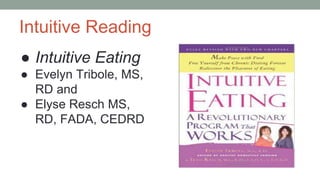
Intuitive Reading
● Intuitive Eating
● Evelyn Tribole, MS,
RD and
● Elyse Resch MS,
RD, FADA, CEDRD
Three Pillars of Intuitive Eating
● Reliance on internal hunger and satiety cues
● Unconditional permission to eat
● Eating for physical, not emotional reasons
Tylka 2006 and Augustus-Horvath & Tylka 2011
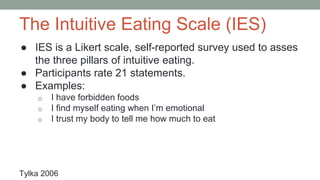
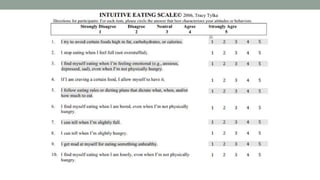
The Intuitive Eating Scale (IES)
● IES is a Likert scale, self-reported survey used to asses
the three pillars of intuitive eating.
● Participants rate 21 statements.
● Examples:
o I have forbidden foods
o I find myself eating when I’m emotional
o I trust my body to tell me how much to eat
Tylka 2006
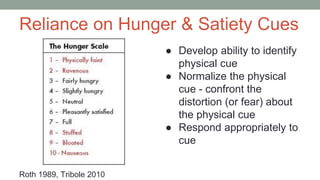
Reliance on Hunger & Satiety Cues
● Develop ability to identify
physical cue
● Normalize the physical
cue - confront the
distortion (or fear) about
the physical cue
● Respond appropriately to
cue
Roth 1989, Tribole 2010
Readiness for Intuitive Eating
● Patient recognizes that eating disorder is deeper than
just eating
● Patient is able to deal with new behaviors
● Patient is able to identify needs and feelings
● Patient values the importance of self-care
Tribole 2010
Promotion of Intuitive Eating
● Develop a flexible, scheduled eating pattern to help
establish self-care practices
● Paying attention to the range of hunger and satiety
cues, then responding appropriately
Tribole 2010
Outcomes of Intuitive Eating
● Ability to normalize hunger and satiety cues
● Ability to adopt a flexible diet
● Values and practices self-care
● Practices 10 intuitive eating principles
Tribole 2010

Intuitive Eating

  • 1.
    Intuitive Eating ● “IntuitiveEaters march to their inner hunger signals, and eat whatever they choose without experiencing guilt or an ethical dilemma” Tribole & Resch ● Also called non-dieting or mindful eating
  • 2.
    Intuitive Eating Principles ●Reject diet mentality ● Honor your hunger ● Make peace with food ● Challenge the food police ● Feel your fullness ● Discover satisfaction ● Cope without food ● Respect your body ● Enjoy exercise ● Honor health Tribole 2010
  • 3.
    Intuitive Reading ● IntuitiveEating ● Evelyn Tribole, MS, RD and ● Elyse Resch MS, RD, FADA, CEDRD
  • 4.
    Three Pillars ofIntuitive Eating ● Reliance on internal hunger and satiety cues ● Unconditional permission to eat ● Eating for physical, not emotional reasons Tylka 2006 and Augustus-Horvath & Tylka 2011
  • 5.
    The Intuitive EatingScale (IES) ● IES is a Likert scale, self-reported survey used to asses the three pillars of intuitive eating. ● Participants rate 21 statements. ● Examples: o I have forbidden foods o I find myself eating when I’m emotional o I trust my body to tell me how much to eat Tylka 2006
  • 7.
    Reliance on Hunger& Satiety Cues ● Develop ability to identify physical cue ● Normalize the physical cue - confront the distortion (or fear) about the physical cue ● Respond appropriately to cue Roth 1989, Tribole 2010
  • 8.
    Readiness for IntuitiveEating ● Patient recognizes that eating disorder is deeper than just eating ● Patient is able to deal with new behaviors ● Patient is able to identify needs and feelings ● Patient values the importance of self-care Tribole 2010
  • 9.
    Promotion of IntuitiveEating ● Develop a flexible, scheduled eating pattern to help establish self-care practices ● Paying attention to the range of hunger and satiety cues, then responding appropriately Tribole 2010
  • 10.
    Outcomes of IntuitiveEating ● Ability to normalize hunger and satiety cues ● Ability to adopt a flexible diet ● Values and practices self-care ● Practices 10 intuitive eating principles Tribole 2010

Editor's Notes

  • #2 -Becoming an intuitive eater in this day in age can be challenging. Social media is a huge part of adolescents’ and adults’ lives. They are constantly be bombarded with questionable nutrition information and the pressures to obtain the thin/fit ideal body type.