Syllabus
• Unit 1
•Introduction to Bioinformatics: Definition - Computational
Biology; Biological Data Acquisition: The form of biological
information Retrieval methods for DNA sequence, protein
sequence, and protein structure information; Databases –
Format and Annotation: Conventions for database indexing
and specification of search terms, Common sequence file
formats. Annotated sequence databases - primary sequence
databases, protein sequence, and structure databases;
Organism-specific databases; Data – Access
3.
• Unit 2
Biocomputing:Introduction to String Matching Algorithms.
Database Search Techniques - Local versus global- Sequence
Comparison and Alignment Techniques - Pairwise and
Multiple sequence alignment. - Use of Scoring Matrices-
Dynamic programming algorithms, Needleman-Wunsch and
Smith-waterman. Heuristic Methods of sequence alignment,
BLAST, and PSI-BLAST. Multiple Sequence Alignment and
software tools for pairwise and multiple sequence alignment;
– Phylogenetics analysis- Phylip.
4.
• Unit 3
•Profiles, motifs, and features identification using tools like
Prosite. Automated Gene Prediction - ORF finding;
Visualization tool- Pymol. Introduction to Signaling
Pathways. Machine Learning Methods in Bioinformatics -
Introduction to Matlab.
5.
Books to Refer
•Bioinformatics: Concepts, Skills & Applications – Rastogi
et al.
• Essential Bioinformatics – Xiong
• Developing Bioinformatics Computer Skills – Gibas &
Jambeck
• An Introduction to Bioinformatics Algorithms – Jones and
Pevzner
• Introduction to Bioinformatics-Krawetz Womble
• Introduction to Bioinformatics- V Kothekar
Computer Science
It appliestechniques from
machine learning, data
mining, AI, optimization,
visualization and simulation
and develops new techniques
as required
8.
Computational
Biology
• Bioinformatics islimited to sequence,
structural and functional analysis of
genes and genomes and statistics.
• Computational Biology encompasses
all biological areas that involve model
building, simulations and theoretical
methods.
• Eg: Mathematical modelling of
population dynamics, ADME, organ
functioning
9.
Biology
• Bioinformatics involvesthe application of computational and statistical
techniques to the analysis and interpretation of biological data.
• Various types of biological data are used in bioinformatics, providing
insights into the structure, function, and relationships of biological entities.
• Genomic Data
• Transcriptomic Data
• Proteomic Data
• Metabolomic Data
• Structural Data
• Functional Genomics Data
• Phylogenetic Data
• Biological Literature and Annotations
10.
Omics in Bioinformatics
•Bioinformatics plays a crucial role in processing, analyzing, and interpreting
these massive data sets generated by high-throughput techniques.
• Genomics: study of the entire set of genes (genome)
• DNA sequences, genome assemblies, gene annotations, and SNPs
• Transcriptomics: study of all RNA molecules (gene expression and regulation)
• RNA sequencing (RNA-Seq) data, microarray data, and information on alternative
splicing and isoform expression
• Proteomics: study of the entire set of proteins
• Mass spectrometry data, protein-protein interaction networks, and protein structural
information
• Metabolomics: study of metabolites in biological systems
• Mass spectrometry and nuclear magnetic resonance (NMR) spectroscopy data on
metabolite concentrations and profiles
11.
• Epigenomics: heritablechanges in gene function that do not involve alterations to the
underlying DNA sequence
• DNA methylation, histone modifications, and chromatin structure
• Pharmacogenomics: genetic variations in individual responses to drugs, aiming to
personalize medicine
• Genetic variations relevant to drug metabolism, efficacy, and adverse reactions
• Metagenomics: study of the structure and function of entire nucleotide sequences isolated
and analyzed from all the organisms (typically microbes) in a bulk sample.
• DNA sequences from mixed microbial populations, functional gene annotations, and taxonomic
information
• Immunomics: study of the immune system
• immune system components, antibody-antigen interactions, vaccine generation and immune cell
signaling
• Interactomics: explores the interactions between biomolecules, such as protein-protein
interactions, to understand cellular functions and signaling pathways
• Protein-protein interaction networks, signaling pathway data, and information on molecular
interactions
Omics in Bioinformatics
13.
Data Acquisition
• Systematiccollection of biological data from various sources for analysis,
interpretation, and further investigation.
• Different sections of Data Acquisition
• Data Generation: Obtaining raw biological data through experimental methods
(Sequencing, microarray, x-ray diffraction, mass spec etc )
• Data Retrieval: Collecting existing biological data from public repositories (genomic,
proteomic and expression).
• Data Integration: Combining data from multiple sources to create a unified dataset.
(Composite databases)
• Data Cleaning and Preprocessing: Preparing data for analysis by addressing issues
such as missing values, outliers, and normalization.
• Data Annotation: is the process of the categorization, describing or labeling of data
• Metadata Collection: additional contextual information (Patient metadata)
• Data Storage and sharing: Storing acquired data in a structured and accessible
manner.
14.
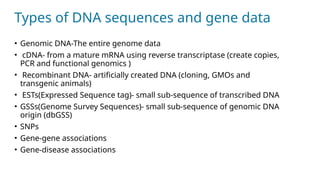
Types of DNAsequences and gene data
• Genomic DNA-The entire genome data
• cDNA- from a mature mRNA using reverse transcriptase (create copies,
PCR and functional genomics )
• Recombinant DNA- artificially created DNA (cloning, GMOs and
transgenic animals)
• ESTs(Expressed Sequence tag)- small sub-sequence of transcribed DNA
• GSSs(Genome Survey Sequences)- small sub-sequence of genomic DNA
origin (dbGSS)
• SNPs
• Gene-gene associations
• Gene-disease associations