To accompany Quantitative Analysis for
Management, 9e
by Render/Stair/Hanna
2-1 © 2006 by Prentice Hall, Inc.,
Upper Saddle River, NJ 07458
Introduction
 Life is uncertain!
 We must deal with risk!
 A probability is a numerical statement
about the likelihood that an event will
occur.
To accompany Quantitative Analysis for
Management, 9e
by Render/Stair/Hanna
2-2 © 2006 by Prentice Hall, Inc.,
Upper Saddle River, NJ 07458
Basic Statements about Probability
1. The probability, P, of any event or state of
nature occurring is greater than or equal to
0 and less than or equal to 1.
That is: 0  P(event)  1
2. The sum of the simple probabilities for all
possible outcomes of an activity must
equal 1.
To accompany Quantitative Analysis for
Management, 9e
by Render/Stair/Hanna
2-3 © 2006 by Prentice Hall, Inc.,
Upper Saddle River, NJ 07458
Diversey Paint Example
Demand for white latex paint at Diversey
Paint and Supply has always been either 0,
1, 2, 3, or 4 gallons per day. Over the past
200 days, the frequencies of demand are
represented in the following table:
Qty Demanded No. of Days
0 40
1 80
2 50
3 20
4 10
Total 200
To accompany Quantitative Analysis for
Management, 9e
by Render/Stair/Hanna
2-4 © 2006 by Prentice Hall, Inc.,
Upper Saddle River, NJ 07458
Diversey Paint Example (continued)
Quantity Freq.
Demand (days)
0 40
1 80
2 50
3 20
4 10
Total days = 200
Probability
(Relative Freq)
(40/200) = 0.20
(80/200) = 0.40
(50/200) = 0.25
(20/200) = 0.10
(10/200) = 0.05
Total Prob =1.00
Probabilities of Demand
Note: 0  P(event)  1
and P(event) = 1

To accompany Quantitative Analysis for
Management, 9e
by Render/Stair/Hanna
2-5 © 2006 by Prentice Hall, Inc.,
Upper Saddle River, NJ 07458
Types of Probability
Objective probability is based on
logical observations:
Determined by:
 Relative frequency – Obtained using historical data
(Diversey Paint)
 Classical method – Known probability for each
outcome (tossing a coin)
occurrences
or
outcomes
of
number
Total
occurs
event
times
of
Number
)
( =
event
P
To accompany Quantitative Analysis for
Management, 9e
by Render/Stair/Hanna
2-6 © 2006 by Prentice Hall, Inc.,
Upper Saddle River, NJ 07458
Types of Probability
Subjective probability is based on
personal experiences.
Determined by:
 Judgment of experts
 Opinion polls
 Delphi method
 Others
To accompany Quantitative Analysis for
Management, 9e
by Render/Stair/Hanna
2-7 © 2006 by Prentice Hall, Inc.,
Upper Saddle River, NJ 07458
Mutually Exclusive Events
 Events are said to be mutually exclusive if
only one of the events can occur on any one
trial.
Example: a fair coin toss results in either a heads or a
tails.
To accompany Quantitative Analysis for
Management, 9e
by Render/Stair/Hanna
2-8 © 2006 by Prentice Hall, Inc.,
Upper Saddle River, NJ 07458
Collectively Exhaustive Events
 Events are said to be collectively exhaustive if the
list of outcomes includes every possible outcome.
 Heads and tails as possible outcomes of coin flip.
Example: a collectively exhaustive list of possible
outcomes for a fair coin toss includes heads and
tails.
To accompany Quantitative Analysis for
Management, 9e
by Render/Stair/Hanna
2-9 © 2006 by Prentice Hall, Inc.,
Upper Saddle River, NJ 07458
Die Roll Example
Outcome
of Roll
1
2
3
4
5
6
Probability
1/6
1/6
1/6
1/6
1/6
1/6
Total = 1
This is a collectively
exhaustive list of potential
outcomes for a single die
roll.
The outcome is a mutually exclusive event because only one
event can occur (a 1, 2, 3, 4, 5, or 6) on any single roll.
To accompany Quantitative Analysis for
Management, 9e
by Render/Stair/Hanna
2-10 © 2006 by Prentice Hall, Inc.,
Upper Saddle River, NJ 07458
Twin Birth Example
A woman is pregnant with non- identical twins.
Following is a list of collectively exhaustive,
mutually exclusive possible outcomes:
Outcome Probability
of Birth
Boy/Boy ¼
Boy/Girl ¼
Girl/Girl ¼
Girl/Boy ¼
What is the probability that both babies will
To accompany Quantitative Analysis for
Management, 9e
by Render/Stair/Hanna
2-11 © 2006 by Prentice Hall, Inc.,
Upper Saddle River, NJ 07458
In-Class Practice
 Draw a spade and a club
 Draw a face card and a number card
 Draw an ace and a 3
 Draw a club and a nonclub
 Draw a 5 and a diamond
 Draw a red card and a diamond
Assuming a traditional 52-card deck, can you identify if
these outcomes are mutually exclusive and/or collectively
exhaustive ??
To accompany Quantitative Analysis for
Management, 9e
by Render/Stair/Hanna
2-12 © 2006 by Prentice Hall, Inc.,
Upper Saddle River, NJ 07458
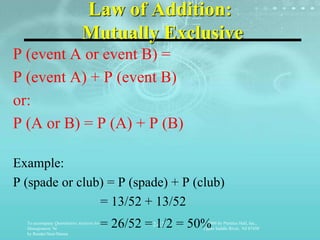
Law of Addition:
Mutually Exclusive
P (event A or event B) =
P (event A) + P (event B)
or:
P (A or B) = P (A) + P (B)
Example:
P (spade or club) = P (spade) + P (club)
= 13/52 + 13/52
= 26/52 = 1/2 = 50%
To accompany Quantitative Analysis for
Management, 9e
by Render/Stair/Hanna
2-13 © 2006 by Prentice Hall, Inc.,
Upper Saddle River, NJ 07458
Law of Addition:
not Mutually Exclusive
P(event A or event B) =
P(event A) + P(event B) -
P(event A and event B both
occurring)
or
P(A or B) = P(A)+P(B) - P(A and B)
To accompany Quantitative Analysis for
Management, 9e
by Render/Stair/Hanna
2-14 © 2006 by Prentice Hall, Inc.,
Upper Saddle River, NJ 07458
Venn Diagram
P(A) P(B)
To accompany Quantitative Analysis for
Management, 9e
by Render/Stair/Hanna
2-15 © 2006 by Prentice Hall, Inc.,
Upper Saddle River, NJ 07458
Venn Diagram
P(A or B)
+ -
=
P(A) P(B) P(A and B)
P(A or B)
To accompany Quantitative Analysis for
Management, 9e
by Render/Stair/Hanna
2-16 © 2006 by Prentice Hall, Inc.,
Upper Saddle River, NJ 07458
In-Class Example: Specialized
University
Specialized University offers four different graduate
degrees: business, education, accounting, and science.
Enrollment figures show 25% of their graduate students
are in each specialty. Although 50% of the students are
female, only 15% are female business majors. If a student
is randomly selected from the University’s registration
database:
 What is the probability the student is a business or
education major?
 What is the probability the student is a female or a business
major?
To accompany Quantitative Analysis for
Management, 9e
by Render/Stair/Hanna
2-17 © 2006 by Prentice Hall, Inc.,
Upper Saddle River, NJ 07458
Specialized University Solution
The probability that the student is a business or education
major is mutually exclusive event. Thus:
P(Bus or Edu) = P(Bus) + P(Edu)
= .25 + .25
= .50 or 50%
The probability that the student is a female or a business
major is not mutually exclusive because the student could be
a female business major. Thus:
P(Fem or Bus) = P(Fem) + P(Bus)
– P(Fem and Bus)
= .50 + .25 - .15
= .60 or 60%
To accompany Quantitative Analysis for
Management, 9e
by Render/Stair/Hanna
2-18 © 2006 by Prentice Hall, Inc.,
Upper Saddle River, NJ 07458
Statistical Dependence
 Events are either
 statistically independent (the occurrence of one
event has no effect on the probability of
occurrence of the other), or
statistically dependent (the occurrence of one
event gives information about the occurrence of
the other).
To accompany Quantitative Analysis for
Management, 9e
by Render/Stair/Hanna
2-19 © 2006 by Prentice Hall, Inc.,
Upper Saddle River, NJ 07458
Which Are Independent?
(a) Your education
(b) Your income level
(a) Draw a jack of hearts from a full 52-card
deck
(b) Draw a jack of clubs from a full 52-card
deck
(a) Chicago Cubs win the National League
pennant
(b) Chicago Cubs win the World Series
To accompany Quantitative Analysis for
Management, 9e
by Render/Stair/Hanna
2-20 © 2006 by Prentice Hall, Inc.,
Upper Saddle River, NJ 07458
Probabilities: Independent
Events
 Marginal probability: the probability of an event
occurring: P(A)
 Joint probability: the probability of multiple,
independent events, occurring at the same time:
P(AB) = P(A)*P(B)
 Conditional probability (for independent events):
the probability of event B given that event A has
occurred:
P(B|A) = P(B)
 or, the probability of event A given that event B
has occurred:
To accompany Quantitative Analysis for
Management, 9e
by Render/Stair/Hanna
2-21 © 2006 by Prentice Hall, Inc.,
Upper Saddle River, NJ 07458
Venn Diagram: P(A|B)
P(B
)
P(A|B)
P(B|A)
To accompany Quantitative Analysis for
Management, 9e
by Render/Stair/Hanna
2-22 © 2006 by Prentice Hall, Inc.,
Upper Saddle River, NJ 07458
Independent Events
Example
1. P(black ball drawn on first
draw)
• P(B) = 0.30
(marginal probability)
2. P(two green balls drawn)
• P(GG) = P(G)*P(G) =
0.70*0.70 = 0.49 (joint
probability for two
independent events)
A bucket contains 3
black balls and 7
green balls. We draw
a ball from the
bucket, replace it, and
draw a second ball.
To accompany Quantitative Analysis for
Management, 9e
by Render/Stair/Hanna
2-23 © 2006 by Prentice Hall, Inc.,
Upper Saddle River, NJ 07458
Independent Events Example continued
1. P(black ball drawn on second draw, first
draw was green)
P(B|G) = P(B) = 0.30
(conditional probability)
2. P(green ball drawn on second draw, first
draw was green)
P(G|G) = 0.70
(conditional probability)
To accompany Quantitative Analysis for
Management, 9e
by Render/Stair/Hanna
2-24 © 2006 by Prentice Hall, Inc.,
Upper Saddle River, NJ 07458
Probabilities: Dependent Events
 Marginal probability: probability of an event
occurring: P(A)
 Conditional probability (for dependent events):
The probability of event B given that event A has
occurred:
P(B|A) = P(AB)/P(A)
The probability of event A given that event B has
occurred:
P(A|B) = P(AB)/P(B)
 Joint probability: The probability of
multiple events occurring at the same
time: P(AB) = P(B|A)*P(A)
To accompany Quantitative Analysis for
Management, 9e
by Render/Stair/Hanna
2-25 © 2006 by Prentice Hall, Inc.,
Upper Saddle River, NJ 07458
/
P(B|A) = P(AB)/P(A)
P(AB) P(A)
P(B)
P(A) P(B)
Venn Diagram: P(B|A)
To accompany Quantitative Analysis for
Management, 9e
by Render/Stair/Hanna
2-26 © 2006 by Prentice Hall, Inc.,
Upper Saddle River, NJ 07458
/
P(A|B) = P(AB)/P(B)
P(AB) P(B)
P(A)
P(A) P(B)
Venn Diagram: P(A|B)
To accompany Quantitative Analysis for
Management, 9e
by Render/Stair/Hanna
2-27 © 2006 by Prentice Hall, Inc.,
Upper Saddle River, NJ 07458
Dependent Events Example
Assume that we have an
urn containing 10 balls of
the following descriptions:
4 are white (W) and
lettered (L)
2 are white (W) and
numbered (N)
3 are yellow (Y) and
lettered (L)
1 is yellow (Y) and
numbered (N)
Then:
 P(WL) = 4/10 = 0.40
 P(WN) = 2/10 = 0.20
 P(W) = 6/10 = 0.60
 P(YL) = 3/10 = 0.3
 P(YN) = 1/10 = 0.1
 P(Y) = 4/10 = 0.4
To accompany Quantitative Analysis for
Management, 9e
by Render/Stair/Hanna
2-28 © 2006 by Prentice Hall, Inc.,
Upper Saddle River, NJ 07458
Dependent Events Example
(continued)
Then:
 P(Y) = .4
- marginal probability
 P(L|Y) = P(YL)/P(Y)
= 0.3/0.4 = 0.75
- conditional probability
 P(W|L) = P(WL)/P(L)
= 0.4/0.7 = 0.57 - conditional
probability
To accompany Quantitative Analysis for
Management, 9e
by Render/Stair/Hanna
2-29 © 2006 by Prentice Hall, Inc.,
Upper Saddle River, NJ 07458
Dependent Events: Joint
Probability Example
Your stockbroker informs you that if the stock
market reaches the 10,500 point level by January,
there is a 70% probability that Tubeless Electronics
will go up in value. Your own feeling is that there
is only a 40% chance of the market reaching
10,500 by January.
What is the probability that both the stock market
will reach 10,500 points, and the price of Tubeless
will go up in value?
To accompany Quantitative Analysis for
Management, 9e
by Render/Stair/Hanna
2-30 © 2006 by Prentice Hall, Inc.,
Upper Saddle River, NJ 07458
Dependent Events: Joint Probabilities
Solution
Then:
P(MT) =P(T|M)P(M)
= (0.70)(0.40)
= 0.28
Let M represent the
event of the stock
market reaching the
10,500 point level,
and T represent the
event that Tubeless
goes up.
To accompany Quantitative Analysis for
Management, 9e
by Render/Stair/Hanna
2-31 © 2006 by Prentice Hall, Inc.,
Upper Saddle River, NJ 07458
Revising Probabilities: Bayes’
Theorem
Bayes’ theorem can be used to calculate
revised or posterior probabilities.
Prior
Probabilities
Bayes’
Process
Posterior
Probabilities
New Information
To accompany Quantitative Analysis for
Management, 9e
by Render/Stair/Hanna
2-32 © 2006 by Prentice Hall, Inc.,
Upper Saddle River, NJ 07458
General Form of Bayes’
Theorem
A
event
the
of
complement
A
where
)
(
)
|
(
)
(
)
|
(
)
(
)
|
(
)
|
(
)
(
)
(
)
|
(
=

=
=
A
P
A
B
P
A
P
A
B
P
A
P
A
B
P
B
A
P
or
B
P
AB
P
B
A
P
die.
unfair"
"
is
A
event
then the
die,
fair"
"
is
A
event
the
if
example,
For
To accompany Quantitative Analysis for
Management, 9e
by Render/Stair/Hanna
2-33 © 2006 by Prentice Hall, Inc.,
Upper Saddle River, NJ 07458
Posterior Probabilities
Example
A cup contains two dice identical in
appearance. One, however, is fair
(unbiased), the other is loaded (biased).
The probability of rolling a 3 on the fair
die is 1/6 or 0.166. The probability of
tossing the same number on the loaded
die is 0.60. We have no idea which die
is which, but we select one by chance,
and toss it. The result is a 3.
What is the probability that the die
To accompany Quantitative Analysis for
Management, 9e
by Render/Stair/Hanna
2-34 © 2006 by Prentice Hall, Inc.,
Upper Saddle River, NJ 07458
Posterior Probabilities Example
(continued)
 We know that:
P(fair) = 0.50 P(loaded) = 0.50
P(3|fair) = 0.166 P(3|loaded) = 0.60
 Then:
P(3 and fair) = P(3|fair)P(fair)
= (0.166)(0.50)
= 0.083
P(3 and loaded) = P(3|loaded)P(loaded)
= (0.60)(0.50)
- marginal probability
- joint probability
To accompany Quantitative Analysis for
Management, 9e
by Render/Stair/Hanna
2-35 © 2006 by Prentice Hall, Inc.,
Upper Saddle River, NJ 07458
Posterior Probabilities
Example continued
A 3 can occur in combination with the
state “fair die” or in combination with
the state ”loaded die.” The sum of their
probabilities gives the marginal
probability of a 3 on a toss:
P(3) = 0.083 + 0.0300 = 0.383
Then, the probability that the die rolled
was the fair one is given by:
0.22
0.383
0.083
P(3)
3)
and
P(Fair
3)
|
P(Fair =
=
=
- marginal probability
- conditional probability
To accompany Quantitative Analysis for
Management, 9e
by Render/Stair/Hanna
2-36 © 2006 by Prentice Hall, Inc.,
Upper Saddle River, NJ 07458
Further Probability Revisions
To obtain further information as to
whether the die just rolled is fair or
loaded, let’s roll it again….
Again we get a 3.
Given that we have now rolled two 3s,
what is the probability that the die
rolled is fair?
To accompany Quantitative Analysis for
Management, 9e
by Render/Stair/Hanna
2-37 © 2006 by Prentice Hall, Inc.,
Upper Saddle River, NJ 07458
Further Probability Revisions
continued
 We know from before that:
P(fair) = 0.50, P(loaded) = 0.50
 Then:
P(3,3|fair) = P(3|fair)*P(3|fair)
= (0.166)(0.166) = 0.027
P(3,3|loaded) = P(3|loaded)*P(3|loaded)
= (0.60)(0.60) = 0.36
 So:
P(3,3 and fair) = P(3,3|fair)*P(fair)
= (0.027)(0.05) = 0.013
P(3,3 and loaded) = P(3,3|loaded)P(loaded)
= (0.36)(0.5) = 0.18
Thus, the probability of getting two 3s is a marginal
probability obtained from the sum of the probability
To accompany Quantitative Analysis for
Management, 9e
by Render/Stair/Hanna
2-38 © 2006 by Prentice Hall, Inc.,
Upper Saddle River, NJ 07458
Further Probability Revisions
continued
933
.
0
0.193
0.18
P(3,3)
Loaded)
and
P(3,3
3,3)
|
P(Loaded
067
.
0
0.193
0.013
P(3,3)
Fair)
and
P(3,3
3,3)
|
P(Fair
=
=
=
=
=
=
 Using the probabilities from the
previous slide:
To accompany Quantitative Analysis for
Management, 9e
by Render/Stair/Hanna
2-39 © 2006 by Prentice Hall, Inc.,
Upper Saddle River, NJ 07458
To give the final comparison:
P(fair|3) = 0.22
P(loaded|3) = 0.78
P(fair|3,3) = 0.067
P(loaded|3,3) = 0.933
Further Probability Revisions
continued

Introduction-to-Probability.pptx

  • 1.
    To accompany QuantitativeAnalysis for Management, 9e by Render/Stair/Hanna 2-1 © 2006 by Prentice Hall, Inc., Upper Saddle River, NJ 07458 Introduction  Life is uncertain!  We must deal with risk!  A probability is a numerical statement about the likelihood that an event will occur.
  • 2.
    To accompany QuantitativeAnalysis for Management, 9e by Render/Stair/Hanna 2-2 © 2006 by Prentice Hall, Inc., Upper Saddle River, NJ 07458 Basic Statements about Probability 1. The probability, P, of any event or state of nature occurring is greater than or equal to 0 and less than or equal to 1. That is: 0  P(event)  1 2. The sum of the simple probabilities for all possible outcomes of an activity must equal 1.
  • 3.
    To accompany QuantitativeAnalysis for Management, 9e by Render/Stair/Hanna 2-3 © 2006 by Prentice Hall, Inc., Upper Saddle River, NJ 07458 Diversey Paint Example Demand for white latex paint at Diversey Paint and Supply has always been either 0, 1, 2, 3, or 4 gallons per day. Over the past 200 days, the frequencies of demand are represented in the following table: Qty Demanded No. of Days 0 40 1 80 2 50 3 20 4 10 Total 200
  • 4.
    To accompany QuantitativeAnalysis for Management, 9e by Render/Stair/Hanna 2-4 © 2006 by Prentice Hall, Inc., Upper Saddle River, NJ 07458 Diversey Paint Example (continued) Quantity Freq. Demand (days) 0 40 1 80 2 50 3 20 4 10 Total days = 200 Probability (Relative Freq) (40/200) = 0.20 (80/200) = 0.40 (50/200) = 0.25 (20/200) = 0.10 (10/200) = 0.05 Total Prob =1.00 Probabilities of Demand Note: 0  P(event)  1 and P(event) = 1 
  • 5.
    To accompany QuantitativeAnalysis for Management, 9e by Render/Stair/Hanna 2-5 © 2006 by Prentice Hall, Inc., Upper Saddle River, NJ 07458 Types of Probability Objective probability is based on logical observations: Determined by:  Relative frequency – Obtained using historical data (Diversey Paint)  Classical method – Known probability for each outcome (tossing a coin) occurrences or outcomes of number Total occurs event times of Number ) ( = event P
  • 6.
    To accompany QuantitativeAnalysis for Management, 9e by Render/Stair/Hanna 2-6 © 2006 by Prentice Hall, Inc., Upper Saddle River, NJ 07458 Types of Probability Subjective probability is based on personal experiences. Determined by:  Judgment of experts  Opinion polls  Delphi method  Others
  • 7.
    To accompany QuantitativeAnalysis for Management, 9e by Render/Stair/Hanna 2-7 © 2006 by Prentice Hall, Inc., Upper Saddle River, NJ 07458 Mutually Exclusive Events  Events are said to be mutually exclusive if only one of the events can occur on any one trial. Example: a fair coin toss results in either a heads or a tails.
  • 8.
    To accompany QuantitativeAnalysis for Management, 9e by Render/Stair/Hanna 2-8 © 2006 by Prentice Hall, Inc., Upper Saddle River, NJ 07458 Collectively Exhaustive Events  Events are said to be collectively exhaustive if the list of outcomes includes every possible outcome.  Heads and tails as possible outcomes of coin flip. Example: a collectively exhaustive list of possible outcomes for a fair coin toss includes heads and tails.
  • 9.
    To accompany QuantitativeAnalysis for Management, 9e by Render/Stair/Hanna 2-9 © 2006 by Prentice Hall, Inc., Upper Saddle River, NJ 07458 Die Roll Example Outcome of Roll 1 2 3 4 5 6 Probability 1/6 1/6 1/6 1/6 1/6 1/6 Total = 1 This is a collectively exhaustive list of potential outcomes for a single die roll. The outcome is a mutually exclusive event because only one event can occur (a 1, 2, 3, 4, 5, or 6) on any single roll.
  • 10.
    To accompany QuantitativeAnalysis for Management, 9e by Render/Stair/Hanna 2-10 © 2006 by Prentice Hall, Inc., Upper Saddle River, NJ 07458 Twin Birth Example A woman is pregnant with non- identical twins. Following is a list of collectively exhaustive, mutually exclusive possible outcomes: Outcome Probability of Birth Boy/Boy ¼ Boy/Girl ¼ Girl/Girl ¼ Girl/Boy ¼ What is the probability that both babies will
  • 11.
    To accompany QuantitativeAnalysis for Management, 9e by Render/Stair/Hanna 2-11 © 2006 by Prentice Hall, Inc., Upper Saddle River, NJ 07458 In-Class Practice  Draw a spade and a club  Draw a face card and a number card  Draw an ace and a 3  Draw a club and a nonclub  Draw a 5 and a diamond  Draw a red card and a diamond Assuming a traditional 52-card deck, can you identify if these outcomes are mutually exclusive and/or collectively exhaustive ??
  • 12.
    To accompany QuantitativeAnalysis for Management, 9e by Render/Stair/Hanna 2-12 © 2006 by Prentice Hall, Inc., Upper Saddle River, NJ 07458 Law of Addition: Mutually Exclusive P (event A or event B) = P (event A) + P (event B) or: P (A or B) = P (A) + P (B) Example: P (spade or club) = P (spade) + P (club) = 13/52 + 13/52 = 26/52 = 1/2 = 50%
  • 13.
    To accompany QuantitativeAnalysis for Management, 9e by Render/Stair/Hanna 2-13 © 2006 by Prentice Hall, Inc., Upper Saddle River, NJ 07458 Law of Addition: not Mutually Exclusive P(event A or event B) = P(event A) + P(event B) - P(event A and event B both occurring) or P(A or B) = P(A)+P(B) - P(A and B)
  • 14.
    To accompany QuantitativeAnalysis for Management, 9e by Render/Stair/Hanna 2-14 © 2006 by Prentice Hall, Inc., Upper Saddle River, NJ 07458 Venn Diagram P(A) P(B)
  • 15.
    To accompany QuantitativeAnalysis for Management, 9e by Render/Stair/Hanna 2-15 © 2006 by Prentice Hall, Inc., Upper Saddle River, NJ 07458 Venn Diagram P(A or B) + - = P(A) P(B) P(A and B) P(A or B)
  • 16.
    To accompany QuantitativeAnalysis for Management, 9e by Render/Stair/Hanna 2-16 © 2006 by Prentice Hall, Inc., Upper Saddle River, NJ 07458 In-Class Example: Specialized University Specialized University offers four different graduate degrees: business, education, accounting, and science. Enrollment figures show 25% of their graduate students are in each specialty. Although 50% of the students are female, only 15% are female business majors. If a student is randomly selected from the University’s registration database:  What is the probability the student is a business or education major?  What is the probability the student is a female or a business major?
  • 17.
    To accompany QuantitativeAnalysis for Management, 9e by Render/Stair/Hanna 2-17 © 2006 by Prentice Hall, Inc., Upper Saddle River, NJ 07458 Specialized University Solution The probability that the student is a business or education major is mutually exclusive event. Thus: P(Bus or Edu) = P(Bus) + P(Edu) = .25 + .25 = .50 or 50% The probability that the student is a female or a business major is not mutually exclusive because the student could be a female business major. Thus: P(Fem or Bus) = P(Fem) + P(Bus) – P(Fem and Bus) = .50 + .25 - .15 = .60 or 60%
  • 18.
    To accompany QuantitativeAnalysis for Management, 9e by Render/Stair/Hanna 2-18 © 2006 by Prentice Hall, Inc., Upper Saddle River, NJ 07458 Statistical Dependence  Events are either  statistically independent (the occurrence of one event has no effect on the probability of occurrence of the other), or statistically dependent (the occurrence of one event gives information about the occurrence of the other).
  • 19.
    To accompany QuantitativeAnalysis for Management, 9e by Render/Stair/Hanna 2-19 © 2006 by Prentice Hall, Inc., Upper Saddle River, NJ 07458 Which Are Independent? (a) Your education (b) Your income level (a) Draw a jack of hearts from a full 52-card deck (b) Draw a jack of clubs from a full 52-card deck (a) Chicago Cubs win the National League pennant (b) Chicago Cubs win the World Series
  • 20.
    To accompany QuantitativeAnalysis for Management, 9e by Render/Stair/Hanna 2-20 © 2006 by Prentice Hall, Inc., Upper Saddle River, NJ 07458 Probabilities: Independent Events  Marginal probability: the probability of an event occurring: P(A)  Joint probability: the probability of multiple, independent events, occurring at the same time: P(AB) = P(A)*P(B)  Conditional probability (for independent events): the probability of event B given that event A has occurred: P(B|A) = P(B)  or, the probability of event A given that event B has occurred:
  • 21.
    To accompany QuantitativeAnalysis for Management, 9e by Render/Stair/Hanna 2-21 © 2006 by Prentice Hall, Inc., Upper Saddle River, NJ 07458 Venn Diagram: P(A|B) P(B ) P(A|B) P(B|A)
  • 22.
    To accompany QuantitativeAnalysis for Management, 9e by Render/Stair/Hanna 2-22 © 2006 by Prentice Hall, Inc., Upper Saddle River, NJ 07458 Independent Events Example 1. P(black ball drawn on first draw) • P(B) = 0.30 (marginal probability) 2. P(two green balls drawn) • P(GG) = P(G)*P(G) = 0.70*0.70 = 0.49 (joint probability for two independent events) A bucket contains 3 black balls and 7 green balls. We draw a ball from the bucket, replace it, and draw a second ball.
  • 23.
    To accompany QuantitativeAnalysis for Management, 9e by Render/Stair/Hanna 2-23 © 2006 by Prentice Hall, Inc., Upper Saddle River, NJ 07458 Independent Events Example continued 1. P(black ball drawn on second draw, first draw was green) P(B|G) = P(B) = 0.30 (conditional probability) 2. P(green ball drawn on second draw, first draw was green) P(G|G) = 0.70 (conditional probability)
  • 24.
    To accompany QuantitativeAnalysis for Management, 9e by Render/Stair/Hanna 2-24 © 2006 by Prentice Hall, Inc., Upper Saddle River, NJ 07458 Probabilities: Dependent Events  Marginal probability: probability of an event occurring: P(A)  Conditional probability (for dependent events): The probability of event B given that event A has occurred: P(B|A) = P(AB)/P(A) The probability of event A given that event B has occurred: P(A|B) = P(AB)/P(B)  Joint probability: The probability of multiple events occurring at the same time: P(AB) = P(B|A)*P(A)
  • 25.
    To accompany QuantitativeAnalysis for Management, 9e by Render/Stair/Hanna 2-25 © 2006 by Prentice Hall, Inc., Upper Saddle River, NJ 07458 / P(B|A) = P(AB)/P(A) P(AB) P(A) P(B) P(A) P(B) Venn Diagram: P(B|A)
  • 26.
    To accompany QuantitativeAnalysis for Management, 9e by Render/Stair/Hanna 2-26 © 2006 by Prentice Hall, Inc., Upper Saddle River, NJ 07458 / P(A|B) = P(AB)/P(B) P(AB) P(B) P(A) P(A) P(B) Venn Diagram: P(A|B)
  • 27.
    To accompany QuantitativeAnalysis for Management, 9e by Render/Stair/Hanna 2-27 © 2006 by Prentice Hall, Inc., Upper Saddle River, NJ 07458 Dependent Events Example Assume that we have an urn containing 10 balls of the following descriptions: 4 are white (W) and lettered (L) 2 are white (W) and numbered (N) 3 are yellow (Y) and lettered (L) 1 is yellow (Y) and numbered (N) Then:  P(WL) = 4/10 = 0.40  P(WN) = 2/10 = 0.20  P(W) = 6/10 = 0.60  P(YL) = 3/10 = 0.3  P(YN) = 1/10 = 0.1  P(Y) = 4/10 = 0.4
  • 28.
    To accompany QuantitativeAnalysis for Management, 9e by Render/Stair/Hanna 2-28 © 2006 by Prentice Hall, Inc., Upper Saddle River, NJ 07458 Dependent Events Example (continued) Then:  P(Y) = .4 - marginal probability  P(L|Y) = P(YL)/P(Y) = 0.3/0.4 = 0.75 - conditional probability  P(W|L) = P(WL)/P(L) = 0.4/0.7 = 0.57 - conditional probability
  • 29.
    To accompany QuantitativeAnalysis for Management, 9e by Render/Stair/Hanna 2-29 © 2006 by Prentice Hall, Inc., Upper Saddle River, NJ 07458 Dependent Events: Joint Probability Example Your stockbroker informs you that if the stock market reaches the 10,500 point level by January, there is a 70% probability that Tubeless Electronics will go up in value. Your own feeling is that there is only a 40% chance of the market reaching 10,500 by January. What is the probability that both the stock market will reach 10,500 points, and the price of Tubeless will go up in value?
  • 30.
    To accompany QuantitativeAnalysis for Management, 9e by Render/Stair/Hanna 2-30 © 2006 by Prentice Hall, Inc., Upper Saddle River, NJ 07458 Dependent Events: Joint Probabilities Solution Then: P(MT) =P(T|M)P(M) = (0.70)(0.40) = 0.28 Let M represent the event of the stock market reaching the 10,500 point level, and T represent the event that Tubeless goes up.
  • 31.
    To accompany QuantitativeAnalysis for Management, 9e by Render/Stair/Hanna 2-31 © 2006 by Prentice Hall, Inc., Upper Saddle River, NJ 07458 Revising Probabilities: Bayes’ Theorem Bayes’ theorem can be used to calculate revised or posterior probabilities. Prior Probabilities Bayes’ Process Posterior Probabilities New Information
  • 32.
    To accompany QuantitativeAnalysis for Management, 9e by Render/Stair/Hanna 2-32 © 2006 by Prentice Hall, Inc., Upper Saddle River, NJ 07458 General Form of Bayes’ Theorem A event the of complement A where ) ( ) | ( ) ( ) | ( ) ( ) | ( ) | ( ) ( ) ( ) | ( =  = = A P A B P A P A B P A P A B P B A P or B P AB P B A P die. unfair" " is A event then the die, fair" " is A event the if example, For
  • 33.
    To accompany QuantitativeAnalysis for Management, 9e by Render/Stair/Hanna 2-33 © 2006 by Prentice Hall, Inc., Upper Saddle River, NJ 07458 Posterior Probabilities Example A cup contains two dice identical in appearance. One, however, is fair (unbiased), the other is loaded (biased). The probability of rolling a 3 on the fair die is 1/6 or 0.166. The probability of tossing the same number on the loaded die is 0.60. We have no idea which die is which, but we select one by chance, and toss it. The result is a 3. What is the probability that the die
  • 34.
    To accompany QuantitativeAnalysis for Management, 9e by Render/Stair/Hanna 2-34 © 2006 by Prentice Hall, Inc., Upper Saddle River, NJ 07458 Posterior Probabilities Example (continued)  We know that: P(fair) = 0.50 P(loaded) = 0.50 P(3|fair) = 0.166 P(3|loaded) = 0.60  Then: P(3 and fair) = P(3|fair)P(fair) = (0.166)(0.50) = 0.083 P(3 and loaded) = P(3|loaded)P(loaded) = (0.60)(0.50) - marginal probability - joint probability
  • 35.
    To accompany QuantitativeAnalysis for Management, 9e by Render/Stair/Hanna 2-35 © 2006 by Prentice Hall, Inc., Upper Saddle River, NJ 07458 Posterior Probabilities Example continued A 3 can occur in combination with the state “fair die” or in combination with the state ”loaded die.” The sum of their probabilities gives the marginal probability of a 3 on a toss: P(3) = 0.083 + 0.0300 = 0.383 Then, the probability that the die rolled was the fair one is given by: 0.22 0.383 0.083 P(3) 3) and P(Fair 3) | P(Fair = = = - marginal probability - conditional probability
  • 36.
    To accompany QuantitativeAnalysis for Management, 9e by Render/Stair/Hanna 2-36 © 2006 by Prentice Hall, Inc., Upper Saddle River, NJ 07458 Further Probability Revisions To obtain further information as to whether the die just rolled is fair or loaded, let’s roll it again…. Again we get a 3. Given that we have now rolled two 3s, what is the probability that the die rolled is fair?
  • 37.
    To accompany QuantitativeAnalysis for Management, 9e by Render/Stair/Hanna 2-37 © 2006 by Prentice Hall, Inc., Upper Saddle River, NJ 07458 Further Probability Revisions continued  We know from before that: P(fair) = 0.50, P(loaded) = 0.50  Then: P(3,3|fair) = P(3|fair)*P(3|fair) = (0.166)(0.166) = 0.027 P(3,3|loaded) = P(3|loaded)*P(3|loaded) = (0.60)(0.60) = 0.36  So: P(3,3 and fair) = P(3,3|fair)*P(fair) = (0.027)(0.05) = 0.013 P(3,3 and loaded) = P(3,3|loaded)P(loaded) = (0.36)(0.5) = 0.18 Thus, the probability of getting two 3s is a marginal probability obtained from the sum of the probability
  • 38.
    To accompany QuantitativeAnalysis for Management, 9e by Render/Stair/Hanna 2-38 © 2006 by Prentice Hall, Inc., Upper Saddle River, NJ 07458 Further Probability Revisions continued 933 . 0 0.193 0.18 P(3,3) Loaded) and P(3,3 3,3) | P(Loaded 067 . 0 0.193 0.013 P(3,3) Fair) and P(3,3 3,3) | P(Fair = = = = = =  Using the probabilities from the previous slide:
  • 39.
    To accompany QuantitativeAnalysis for Management, 9e by Render/Stair/Hanna 2-39 © 2006 by Prentice Hall, Inc., Upper Saddle River, NJ 07458 To give the final comparison: P(fair|3) = 0.22 P(loaded|3) = 0.78 P(fair|3,3) = 0.067 P(loaded|3,3) = 0.933 Further Probability Revisions continued