HISTORY
SUBJECT ORIENTATION
Hi!
Mr. Leo D. Dioneda
Subject Teacher
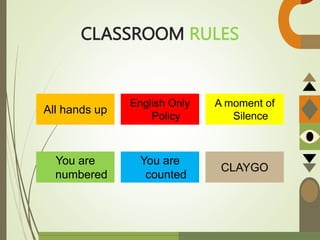
CLASSROOM RULES
English Only
Policy
All hands up
A moment of
Silence
You are
counted
You are
numbered
CLAYGO
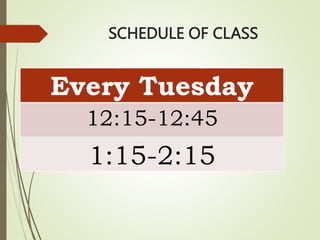
SCHEDULE OF CLASS
Every Tuesday
12:15-12:45
1:15-2:15
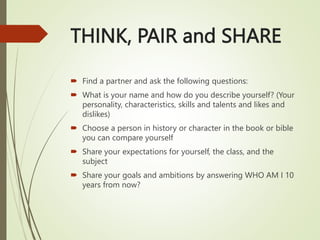
THINK, PAIR and SHARE
 Find a partner and ask the following questions:
 What is your name and how do you describe yourself? (Your
personality, characteristics, skills and talents and likes and
dislikes)
 Choose a person in history or character in the book or bible
you can compare yourself
 Share your expectations for yourself, the class, and the
subject
 Share your goals and ambitions by answering WHO AM I 10
years from now?
What comes into your
mind when you hear the
word history?
What is History?
 A chronological record of significant
events.
 A study of the events of the past, how
andwhy they happened, as well as
what happened as a result
 A branch of knowledge that records and
explains past events
 The history of historical study and the
important debates occurring in the field
The Term - History
 The short version is that the term history
has evolved from an ancient Greek verb
that means “to know,” .
 The Greek word historia originally meant
inquiry, the act of seeking knowledge, as
well as the knowledge that results from
inquiry.
Father of History
 He was a Greek historian born in Halicarnassus
in the Persian Empire (c. 484–c. 425 BC), a
contemporary of Thucydides, Socrates.
 He is often referred to as "The Father of
History", a title first conferred by Cicero; he
was the first historian known to have broken
from Homeric tradition to treat historical
subjects as
a method
specifically,
materials systematically
of investigation—
by collecting his
and
critically, and then arranging them
into a historiographic narrative.
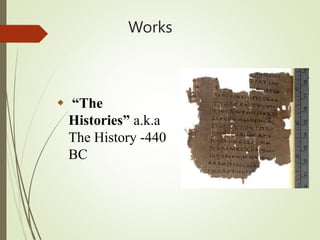
Works
 “The
Histories” a.k.a
The History -440
BC
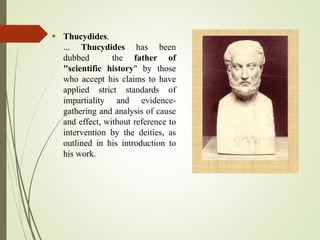
 Thucydides.
... Thucydides has been
dubbed the father of
"scientific history" by those
who accept his claims to have
applied strict standards of
impartiality and evidence-
gathering and analysis of cause
and effect, without reference to
intervention by the deities, as
outlined in his introduction to
his work.
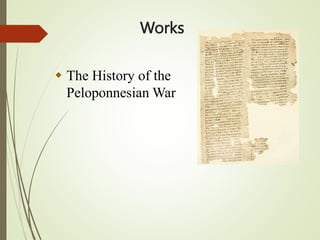
Works
 The History of the
Peloponnesian War
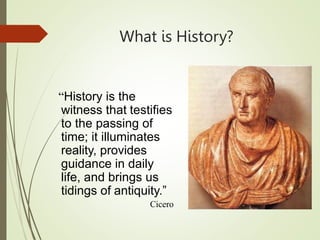
What is History?
“History is the
witness that testifies
to the passing of
time; it illuminates
reality, provides
guidance in daily
life, and brings us
tidings of antiquity.”
Cicero
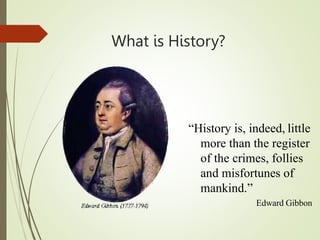
What is History?
“History is, indeed, little
more than the register
of the crimes, follies
and misfortunes of
mankind.”
Edward Gibbon
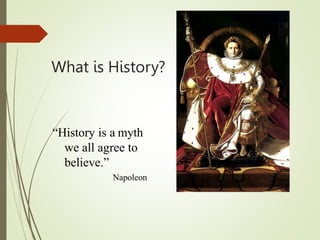
What is History?
“History is a myth
we all agree to
believe.”
Napoleon
Why Study History?
“What is past is
prologue.”
William Shakespeare
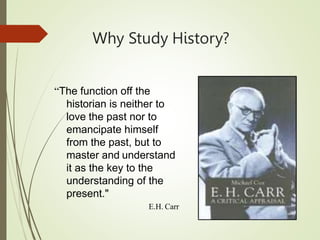
Why Study History?
“The function off the
historian is neither to
love the past nor to
emancipate himself
from the past, but to
master and understand
it as the key to the
understanding of the
present."
E.H. Carr
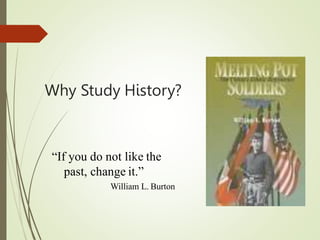
Why Study History?
“If you do not like the
past, change it.”
William L. Burton
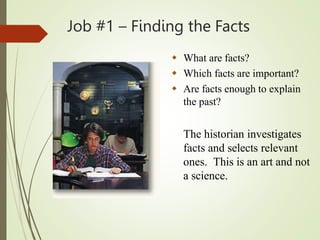
Job #1 – Finding the Facts
 What are facts?
 Which facts are important?
 Are facts enough to explain
the past?
The historian investigates
facts and selects relevant
ones. This is an art and not
a science.
What is the job of a historian?
A. To find the facts
B. To create new facts
C.To analyze opinions
D.To ignore facts
Correct answer: A
Job #2 – Identifying Bias
 Bias is the slant one puts onthings.
– It can be deliberate or unintentional.
– All writing contains bias.
 Identify it by looking at the types of wordsused.
How are the words meant?
 Every age contains its own biases. These make
understanding past thinking difficult – but not
impossible. Historical imagination is needed.
According to the text, bias can be ______.
A. deliberate or unintentional
B. intentional only
C.unintentional only
D.negative or positive
Correct answer: A
Job #3 – Dispensing With the
Rubbish – Identifying Important
and Answerable Questions.
 Sources must be selected critically.
 Topics need to be limited.
 Primary and secondary sources must be
consulted.
 Value judgments are made.
 Conclusions must be based on the weightof
evidence.
 Variations in interpretations should be
understood and accepted.
Which step in the process requires selecting
sources critically?
A. Limiting topics
B. Consulting primary and secondary sources
C.Making value judgments
D.Understanding and accepting variations in interpretations
Correct answer: B
What is the first step in identifying important and
answerable questions?
A. Select sources critically
B. Limit topics
C.Consult primary and secondary sources
D.Make value judgments
Correct answer: C
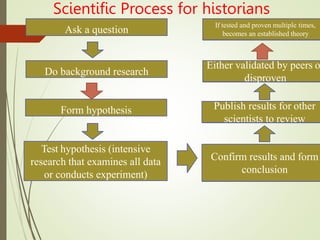
Scientific Process for historians
Ask a question
Do background research
Form hypothesis
Test hypothesis (intensive
research that examines all data
or conducts experiment)
Confirm results and form
conclusion
Publish results for other
scientists to review
Either validated by peers o
disproven
If tested and proven multiple times,
becomes an established theory
Measuring HistoricalTime
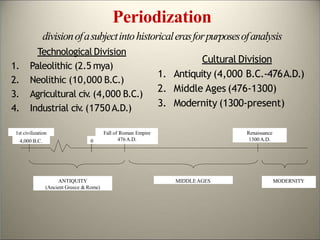
Periodization
divisionofasubjectintohistoricalerasforpurposesofanalysis
Technological Division
1. Paleolithic (2.5 mya)
2. Neolithic (10,000 B.C.)
3. Agricultural civ
. (4,000 B.C.)
4. Industrial civ
. (1750 A.D.)
Cultural Division
1. Antiquity (4,000 B.C.-476A.D.)
2. Middle Ages (476-1300)
3. Modernity (1300-present)
0
Fall of Roman Empire
476A.D.
Renaissance
1300A.D.
ANTIQUITY
(Ancient Greece &Rome)
MIDDLEAGES MODERNITY
4,000 B.C.
1st civilization
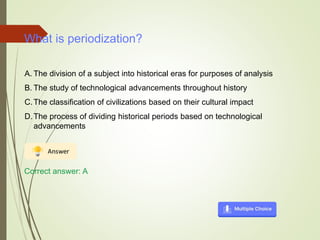
What is periodization?
A. The division of a subject into historical eras for purposes of analysis
B. The study of technological advancements throughout history
C.The classification of civilizations based on their cultural impact
D.The process of dividing historical periods based on technological
advancements
Correct answer: A
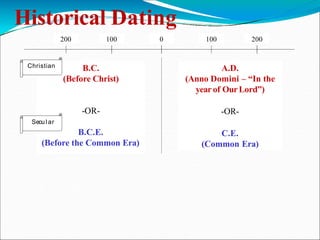
Historical Dating
200 200
100 100
0
B.C.
(Before Christ)
-OR-
B.C.E.
(Before the Common Era)
A.D.
(Anno Domini – “In the
year of OurLord”)
-OR-
C.E.
(Common Era)
Christian
Secular
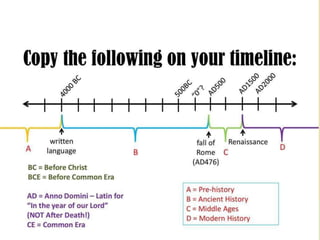
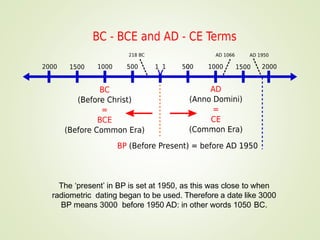
The ‘present’ in BP is set at 1950, as this was close to when
radiometric dating began to be used. Therefore a date like 3000
BP means 3000 before 1950 AD: in other words 1050 BC.
Historical Dating
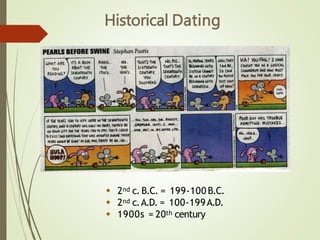
 2nd c. B.C. = 199-100 B.C.
 2nd c.A.D. = 100-199A.D.
 1900s = 20th century
Thank You !!!
View publication stats

INTRODUCTIONTOHISTORY-PART-1.pptx

  • 1.
  • 2.
    Hi! Mr. Leo D.Dioneda Subject Teacher
  • 3.
    CLASSROOM RULES English Only Policy Allhands up A moment of Silence You are counted You are numbered CLAYGO
  • 4.
    SCHEDULE OF CLASS EveryTuesday 12:15-12:45 1:15-2:15
  • 5.
    THINK, PAIR andSHARE  Find a partner and ask the following questions:  What is your name and how do you describe yourself? (Your personality, characteristics, skills and talents and likes and dislikes)  Choose a person in history or character in the book or bible you can compare yourself  Share your expectations for yourself, the class, and the subject  Share your goals and ambitions by answering WHO AM I 10 years from now?
  • 7.
    What comes intoyour mind when you hear the word history?
  • 8.
    What is History? A chronological record of significant events.  A study of the events of the past, how andwhy they happened, as well as what happened as a result  A branch of knowledge that records and explains past events  The history of historical study and the important debates occurring in the field
  • 9.
    The Term -History  The short version is that the term history has evolved from an ancient Greek verb that means “to know,” .  The Greek word historia originally meant inquiry, the act of seeking knowledge, as well as the knowledge that results from inquiry.
  • 10.
    Father of History He was a Greek historian born in Halicarnassus in the Persian Empire (c. 484–c. 425 BC), a contemporary of Thucydides, Socrates.  He is often referred to as "The Father of History", a title first conferred by Cicero; he was the first historian known to have broken from Homeric tradition to treat historical subjects as a method specifically, materials systematically of investigation— by collecting his and critically, and then arranging them into a historiographic narrative.
  • 11.
  • 12.
     Thucydides. ... Thucydideshas been dubbed the father of "scientific history" by those who accept his claims to have applied strict standards of impartiality and evidence- gathering and analysis of cause and effect, without reference to intervention by the deities, as outlined in his introduction to his work.
  • 13.
    Works  The Historyof the Peloponnesian War
  • 14.
    What is History? “Historyis the witness that testifies to the passing of time; it illuminates reality, provides guidance in daily life, and brings us tidings of antiquity.” Cicero
  • 15.
    What is History? “Historyis, indeed, little more than the register of the crimes, follies and misfortunes of mankind.” Edward Gibbon
  • 16.
    What is History? “Historyis a myth we all agree to believe.” Napoleon
  • 17.
    Why Study History? “Whatis past is prologue.” William Shakespeare
  • 18.
    Why Study History? “Thefunction off the historian is neither to love the past nor to emancipate himself from the past, but to master and understand it as the key to the understanding of the present." E.H. Carr
  • 19.
    Why Study History? “Ifyou do not like the past, change it.” William L. Burton
  • 20.
    Job #1 –Finding the Facts  What are facts?  Which facts are important?  Are facts enough to explain the past? The historian investigates facts and selects relevant ones. This is an art and not a science.
  • 21.
    What is thejob of a historian? A. To find the facts B. To create new facts C.To analyze opinions D.To ignore facts Correct answer: A
  • 22.
    Job #2 –Identifying Bias  Bias is the slant one puts onthings. – It can be deliberate or unintentional. – All writing contains bias.  Identify it by looking at the types of wordsused. How are the words meant?  Every age contains its own biases. These make understanding past thinking difficult – but not impossible. Historical imagination is needed.
  • 23.
    According to thetext, bias can be ______. A. deliberate or unintentional B. intentional only C.unintentional only D.negative or positive Correct answer: A
  • 24.
    Job #3 –Dispensing With the Rubbish – Identifying Important and Answerable Questions.  Sources must be selected critically.  Topics need to be limited.  Primary and secondary sources must be consulted.  Value judgments are made.  Conclusions must be based on the weightof evidence.  Variations in interpretations should be understood and accepted.
  • 25.
    Which step inthe process requires selecting sources critically? A. Limiting topics B. Consulting primary and secondary sources C.Making value judgments D.Understanding and accepting variations in interpretations Correct answer: B
  • 26.
    What is thefirst step in identifying important and answerable questions? A. Select sources critically B. Limit topics C.Consult primary and secondary sources D.Make value judgments Correct answer: C
  • 27.
    Scientific Process forhistorians Ask a question Do background research Form hypothesis Test hypothesis (intensive research that examines all data or conducts experiment) Confirm results and form conclusion Publish results for other scientists to review Either validated by peers o disproven If tested and proven multiple times, becomes an established theory
  • 28.
  • 29.
    Periodization divisionofasubjectintohistoricalerasforpurposesofanalysis Technological Division 1. Paleolithic(2.5 mya) 2. Neolithic (10,000 B.C.) 3. Agricultural civ . (4,000 B.C.) 4. Industrial civ . (1750 A.D.) Cultural Division 1. Antiquity (4,000 B.C.-476A.D.) 2. Middle Ages (476-1300) 3. Modernity (1300-present) 0 Fall of Roman Empire 476A.D. Renaissance 1300A.D. ANTIQUITY (Ancient Greece &Rome) MIDDLEAGES MODERNITY 4,000 B.C. 1st civilization
  • 30.
    What is periodization? A.The division of a subject into historical eras for purposes of analysis B. The study of technological advancements throughout history C.The classification of civilizations based on their cultural impact D.The process of dividing historical periods based on technological advancements Correct answer: A
  • 31.
    Historical Dating 200 200 100100 0 B.C. (Before Christ) -OR- B.C.E. (Before the Common Era) A.D. (Anno Domini – “In the year of OurLord”) -OR- C.E. (Common Era) Christian Secular
  • 33.
    The ‘present’ inBP is set at 1950, as this was close to when radiometric dating began to be used. Therefore a date like 3000 BP means 3000 before 1950 AD: in other words 1050 BC.
  • 34.
    Historical Dating  2ndc. B.C. = 199-100 B.C.  2nd c.A.D. = 100-199A.D.  1900s = 20th century
  • 35.
    Thank You !!! Viewpublication stats