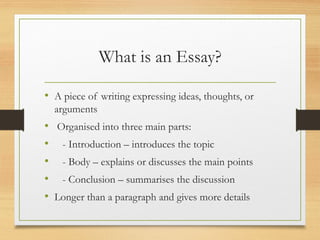
What is anEssay?
• A piece of writing expressing ideas, thoughts, or
arguments
• Organised into three main parts:
• - Introduction – introduces the topic
• - Body – explains or discusses the main points
• - Conclusion – summarises the discussion
• Longer than a paragraph and gives more details
3.
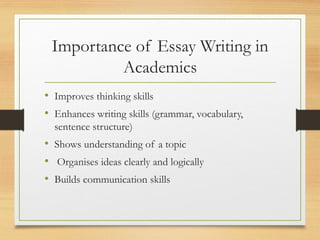
Importance of EssayWriting in
Academics
• Improves thinking skills
• Enhances writing skills (grammar, vocabulary,
sentence structure)
• Shows understanding of a topic
• Organises ideas clearly and logically
• Builds communication skills
4.
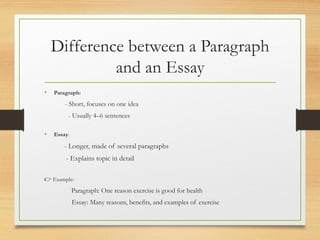
Difference between aParagraph
and an Essay
• Paragraph:
- Short, focuses on one idea
- Usually 4–6 sentences
• Essay:
- Longer, made of several paragraphs
- Explains topic in detail
👉 Example:
Paragraph: One reason exercise is good for health
Essay: Many reasons, benefits, and examples of exercise
5.
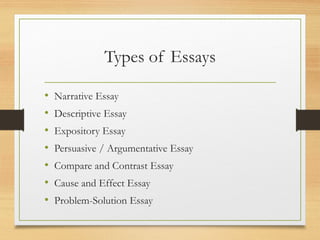
Types of Essays
•Narrative Essay
• Descriptive Essay
• Expository Essay
• Persuasive / Argumentative Essay
• Compare and Contrast Essay
• Cause and Effect Essay
• Problem-Solution Essay
6.
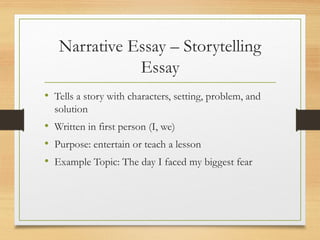
Narrative Essay –Storytelling
Essay
• Tells a story with characters, setting, problem, and
solution
• Written in first person (I, we)
• Purpose: entertain or teach a lesson
• Example Topic: The day I faced my biggest fear
7.
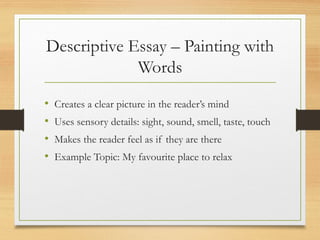
Descriptive Essay –Painting with
Words
• Creates a clear picture in the reader’s mind
• Uses sensory details: sight, sound, smell, taste, touch
• Makes the reader feel as if they are there
• Example Topic: My favourite place to relax
8.
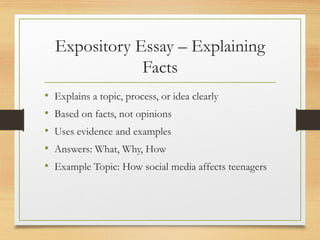
Expository Essay –Explaining
Facts
• Explains a topic, process, or idea clearly
• Based on facts, not opinions
• Uses evidence and examples
• Answers: What, Why, How
• Example Topic: How social media affects teenagers
9.
Persuasive / ArgumentativeEssay
– Convincing the Reader
• Aims to convince the reader
• Uses strong reasoning, facts, and evidence
• May present and refute the opposite opinion
• Example Topic: Why schools should start later in the
morning
10.
Compare and ContrastEssay –
Finding Similarities and Differences
• Compares two subjects (similarities + differences)
• Organises ideas in a balanced way
• Example Topic: Traditional books vs. E-books
11.
Cause and EffectEssay – Explaining
Why and What Happened
• Explains reasons (causes) and results (effects)
• Shows connection between actions and outcomes
• Example Topic: Causes and effects of deforestation
12.
Problem-Solution Essay –
Identifyingand Fixing Issues
• Explains a problem in detail
• Suggests one or more solutions
• Discusses the effectiveness of solutions
• Example Topic: How to control traffic problems in
big cities
13.
Paragraphs
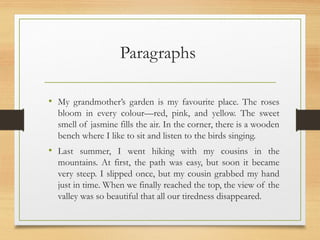
• My grandmother’sgarden is my favourite place. The roses
bloom in every colour—red, pink, and yellow. The sweet
smell of jasmine fills the air. In the corner, there is a wooden
bench where I like to sit and listen to the birds singing.
• Last summer, I went hiking with my cousins in the
mountains. At first, the path was easy, but soon it became
very steep. I slipped once, but my cousin grabbed my hand
just in time. When we finally reached the top, the view of the
valley was so beautiful that all our tiredness disappeared.
14.
Paragraphs
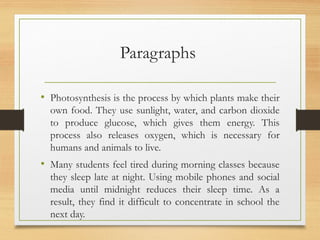
• Photosynthesis isthe process by which plants make their
own food. They use sunlight, water, and carbon dioxide
to produce glucose, which gives them energy. This
process also releases oxygen, which is necessary for
humans and animals to live.
• Many students feel tired during morning classes because
they sleep late at night. Using mobile phones and social
media until midnight reduces their sleep time. As a
result, they find it difficult to concentrate in school the
next day.
15.
Paragraphs
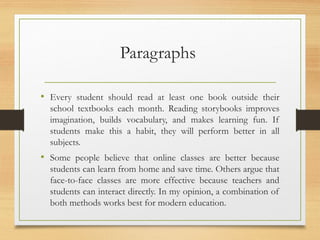
• Every studentshould read at least one book outside their
school textbooks each month. Reading storybooks improves
imagination, builds vocabulary, and makes learning fun. If
students make this a habit, they will perform better in all
subjects.
• Some people believe that online classes are better because
students can learn from home and save time. Others argue that
face-to-face classes are more effective because teachers and
students can interact directly. In my opinion, a combination of
both methods works best for modern education.
16.
Paragraphs
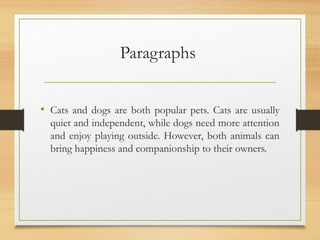
• Cats anddogs are both popular pets. Cats are usually
quiet and independent, while dogs need more attention
and enjoy playing outside. However, both animals can
bring happiness and companionship to their owners.
17.
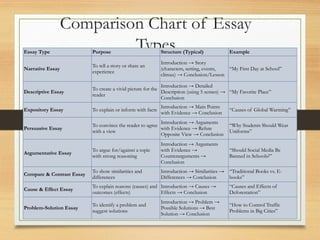
Comparison Chart ofEssay
Types
Essay Type Purpose Structure (Typical) Example
Narrative Essay
To tell a story or share an
experience
Introduction → Story
(characters, setting, events,
climax) → Conclusion/Lesson
“My First Day at School”
Descriptive Essay
To create a vivid picture for the
reader
Introduction → Detailed
Description (using 5 senses) →
Conclusion
“My Favorite Place”
Expository Essay To explain or inform with facts
Introduction → Main Points
with Evidence → Conclusion
“Causes of Global Warming”
Persuasive Essay
To convince the reader to agree
with a view
Introduction → Arguments
with Evidence → Refute
Opposite View → Conclusion
“Why Students Should Wear
Uniforms”
Argumentative Essay
To argue for/against a topic
with strong reasoning
Introduction → Arguments
with Evidence →
Counterarguments →
Conclusion
“Should Social Media Be
Banned in Schools?”
Compare & Contrast Essay
To show similarities and
differences
Introduction → Similarities →
Differences → Conclusion
“Traditional Books vs. E-
books”
Cause & Effect Essay
To explain reasons (causes) and
outcomes (effects)
Introduction → Causes →
Effects → Conclusion
“Causes and Effects of
Deforestation”
Problem-Solution Essay
To identify a problem and
suggest solutions
Introduction → Problem →
Possible Solutions → Best
Solution → Conclusion
“How to Control Traffic
Problems in Big Cities”
18.
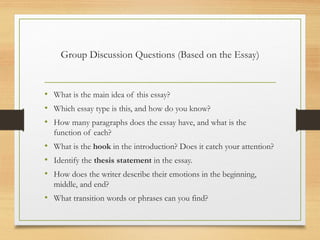
Group Discussion Questions(Based on the Essay)
• What is the main idea of this essay?
• Which essay type is this, and how do you know?
• How many paragraphs does the essay have, and what is the
function of each?
• What is the hook in the introduction? Does it catch your attention?
• Identify the thesis statement in the essay.
• How does the writer describe their emotions in the beginning,
middle, and end?
• What transition words or phrases can you find?
19.
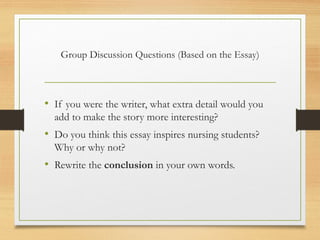
Group Discussion Questions(Based on the Essay)
• If you were the writer, what extra detail would you
add to make the story more interesting?
• Do you think this essay inspires nursing students?
Why or why not?
• Rewrite the conclusion in your own words.