1-1
Copyright © The McGraw-Hill Companies, Inc. Permission required for reproduction or display.
Introduction to Computing Systems:
From Bits and Gates to C and Beyond
2nd
Edition
Yale N. Patt
Sanjay J. Patel
Slides prepared by
Gregory T. Byrd, North Carolina State University
Chapter 1
Welcome Aboard
1-3
Copyright © The McGraw-Hill Companies, Inc. Permission required for reproduction or display.
Introduction to the World of Computing
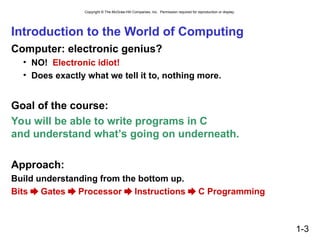
Computer: electronic genius?
• NO! Electronic idiot!
• Does exactly what we tell it to, nothing more.
Goal of the course:
You will be able to write programs in C
and understand what’s going on underneath.
Approach:
Build understanding from the bottom up.
Bits  Gates  Processor  Instructions  C Programming
1-4
Copyright © The McGraw-Hill Companies, Inc. Permission required for reproduction or display.
Two Recurring Themes
Abstraction
• Productivity enhancer – don’t need to worry about details…
Can drive a car without knowing how
the internal combustion engine works.
• …until something goes wrong!
Where’s the dipstick? What’s a spark plug?
• Important to understand the components and
how they work together.
Hardware vs. Software
• It’s not either/or – both are components of a computer system.
• Even if you specialize in one,
you should understand capabilities and limitations of both.
1-5
Copyright © The McGraw-Hill Companies, Inc. Permission required for reproduction or display.
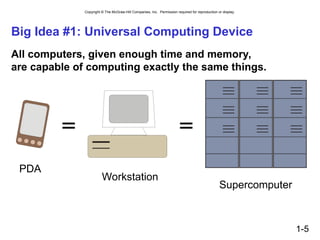
Big Idea #1: Universal Computing Device
All computers, given enough time and memory,
are capable of computing exactly the same things.
= =
PDA
Workstation
Supercomputer
1-6
Copyright © The McGraw-Hill Companies, Inc. Permission required for reproduction or display.
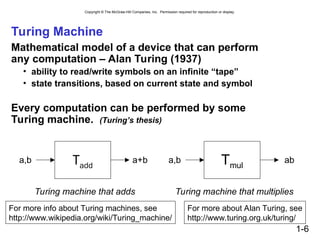
Turing Machine
Mathematical model of a device that can perform
any computation – Alan Turing (1937)
• ability to read/write symbols on an infinite “tape”
• state transitions, based on current state and symbol
Every computation can be performed by some
Turing machine. (Turing’s thesis)
Tadd
a,b a+b
Turing machine that adds
Tmul
a,b ab
Turing machine that multiplies
For more info about Turing machines, see
http://www.wikipedia.org/wiki/Turing_machine/
For more about Alan Turing, see
http://www.turing.org.uk/turing/
1-7
Copyright © The McGraw-Hill Companies, Inc. Permission required for reproduction or display.
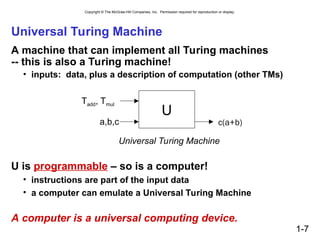
Universal Turing Machine
A machine that can implement all Turing machines
-- this is also a Turing machine!
• inputs: data, plus a description of computation (other TMs)
U
a,b,c c(a+b)
Universal Turing Machine
Tadd, Tmul
U is programmable – so is a computer!
• instructions are part of the input data
• a computer can emulate a Universal Turing Machine
A computer is a universal computing device.
1-8
Copyright © The McGraw-Hill Companies, Inc. Permission required for reproduction or display.
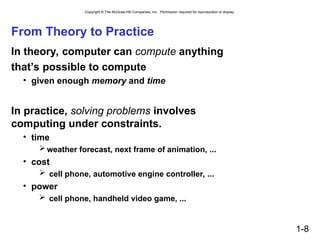
From Theory to Practice
In theory, computer can compute anything
that’s possible to compute
• given enough memory and time
In practice, solving problems involves
computing under constraints.
• time
 weather forecast, next frame of animation, ...
• cost
 cell phone, automotive engine controller, ...
• power
 cell phone, handheld video game, ...
1-9
Copyright © The McGraw-Hill Companies, Inc. Permission required for reproduction or display.
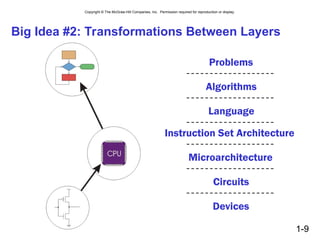
Big Idea #2: Transformations Between Layers
Problems
Language
Instruction Set Architecture
Microarchitecture
Circuits
Devices
Algorithms
1-10
Copyright © The McGraw-Hill Companies, Inc. Permission required for reproduction or display.
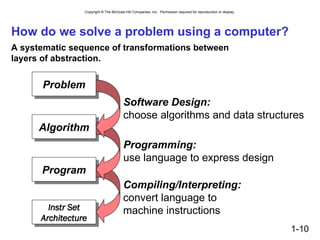
How do we solve a problem using a computer?
A systematic sequence of transformations between
layers of abstraction.
Problem
Algorithm
Program
Software Design:
choose algorithms and data structures
Programming:
use language to express design
Instr Set
Architecture
Compiling/Interpreting:
convert language to
machine instructions
1-11
Copyright © The McGraw-Hill Companies, Inc. Permission required for reproduction or display.
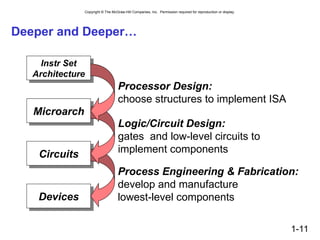
Deeper and Deeper…
Instr Set
Architecture
Microarch
Circuits
Processor Design:
choose structures to implement ISA
Logic/Circuit Design:
gates and low-level circuits to
implement components
Devices
Process Engineering & Fabrication:
develop and manufacture
lowest-level components
1-12
Copyright © The McGraw-Hill Companies, Inc. Permission required for reproduction or display.
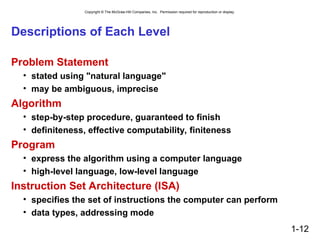
Descriptions of Each Level
Problem Statement
• stated using "natural language"
• may be ambiguous, imprecise
Algorithm
• step-by-step procedure, guaranteed to finish
• definiteness, effective computability, finiteness
Program
• express the algorithm using a computer language
• high-level language, low-level language
Instruction Set Architecture (ISA)
• specifies the set of instructions the computer can perform
• data types, addressing mode
1-13
Copyright © The McGraw-Hill Companies, Inc. Permission required for reproduction or display.
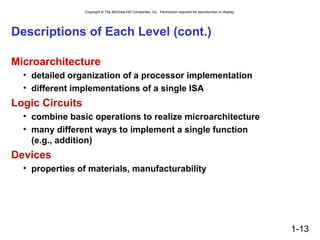
Descriptions of Each Level (cont.)
Microarchitecture
• detailed organization of a processor implementation
• different implementations of a single ISA
Logic Circuits
• combine basic operations to realize microarchitecture
• many different ways to implement a single function
(e.g., addition)
Devices
• properties of materials, manufacturability
1-14
Copyright © The McGraw-Hill Companies, Inc. Permission required for reproduction or display.
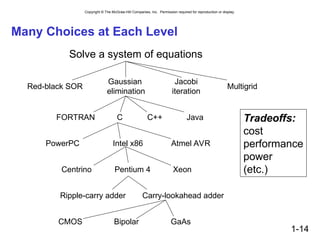
Many Choices at Each Level
Solve a system of equations
Gaussian
elimination
Jacobi
iteration
Red-black SOR Multigrid
FORTRAN C C++ Java
Intel x86
PowerPC Atmel AVR
Centrino Pentium 4 Xeon
Ripple-carry adder Carry-lookahead adder
CMOS Bipolar GaAs
Tradeoffs:
cost
performance
power
(etc.)
1-15
Copyright © The McGraw-Hill Companies, Inc. Permission required for reproduction or display.
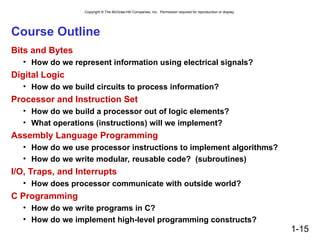
Course Outline
Bits and Bytes
• How do we represent information using electrical signals?
Digital Logic
• How do we build circuits to process information?
Processor and Instruction Set
• How do we build a processor out of logic elements?
• What operations (instructions) will we implement?
Assembly Language Programming
• How do we use processor instructions to implement algorithms?
• How do we write modular, reusable code? (subroutines)
I/O, Traps, and Interrupts
• How does processor communicate with outside world?
C Programming
• How do we write programs in C?
• How do we implement high-level programming constructs?

Introduction_to_computing_system_form_bits.ppt

  • 1.
    1-1 Copyright © TheMcGraw-Hill Companies, Inc. Permission required for reproduction or display. Introduction to Computing Systems: From Bits and Gates to C and Beyond 2nd Edition Yale N. Patt Sanjay J. Patel Slides prepared by Gregory T. Byrd, North Carolina State University
  • 2.
  • 3.
    1-3 Copyright © TheMcGraw-Hill Companies, Inc. Permission required for reproduction or display. Introduction to the World of Computing Computer: electronic genius? • NO! Electronic idiot! • Does exactly what we tell it to, nothing more. Goal of the course: You will be able to write programs in C and understand what’s going on underneath. Approach: Build understanding from the bottom up. Bits  Gates  Processor  Instructions  C Programming
  • 4.
    1-4 Copyright © TheMcGraw-Hill Companies, Inc. Permission required for reproduction or display. Two Recurring Themes Abstraction • Productivity enhancer – don’t need to worry about details… Can drive a car without knowing how the internal combustion engine works. • …until something goes wrong! Where’s the dipstick? What’s a spark plug? • Important to understand the components and how they work together. Hardware vs. Software • It’s not either/or – both are components of a computer system. • Even if you specialize in one, you should understand capabilities and limitations of both.
  • 5.
    1-5 Copyright © TheMcGraw-Hill Companies, Inc. Permission required for reproduction or display. Big Idea #1: Universal Computing Device All computers, given enough time and memory, are capable of computing exactly the same things. = = PDA Workstation Supercomputer
  • 6.
    1-6 Copyright © TheMcGraw-Hill Companies, Inc. Permission required for reproduction or display. Turing Machine Mathematical model of a device that can perform any computation – Alan Turing (1937) • ability to read/write symbols on an infinite “tape” • state transitions, based on current state and symbol Every computation can be performed by some Turing machine. (Turing’s thesis) Tadd a,b a+b Turing machine that adds Tmul a,b ab Turing machine that multiplies For more info about Turing machines, see http://www.wikipedia.org/wiki/Turing_machine/ For more about Alan Turing, see http://www.turing.org.uk/turing/
  • 7.
    1-7 Copyright © TheMcGraw-Hill Companies, Inc. Permission required for reproduction or display. Universal Turing Machine A machine that can implement all Turing machines -- this is also a Turing machine! • inputs: data, plus a description of computation (other TMs) U a,b,c c(a+b) Universal Turing Machine Tadd, Tmul U is programmable – so is a computer! • instructions are part of the input data • a computer can emulate a Universal Turing Machine A computer is a universal computing device.
  • 8.
    1-8 Copyright © TheMcGraw-Hill Companies, Inc. Permission required for reproduction or display. From Theory to Practice In theory, computer can compute anything that’s possible to compute • given enough memory and time In practice, solving problems involves computing under constraints. • time  weather forecast, next frame of animation, ... • cost  cell phone, automotive engine controller, ... • power  cell phone, handheld video game, ...
  • 9.
    1-9 Copyright © TheMcGraw-Hill Companies, Inc. Permission required for reproduction or display. Big Idea #2: Transformations Between Layers Problems Language Instruction Set Architecture Microarchitecture Circuits Devices Algorithms
  • 10.
    1-10 Copyright © TheMcGraw-Hill Companies, Inc. Permission required for reproduction or display. How do we solve a problem using a computer? A systematic sequence of transformations between layers of abstraction. Problem Algorithm Program Software Design: choose algorithms and data structures Programming: use language to express design Instr Set Architecture Compiling/Interpreting: convert language to machine instructions
  • 11.
    1-11 Copyright © TheMcGraw-Hill Companies, Inc. Permission required for reproduction or display. Deeper and Deeper… Instr Set Architecture Microarch Circuits Processor Design: choose structures to implement ISA Logic/Circuit Design: gates and low-level circuits to implement components Devices Process Engineering & Fabrication: develop and manufacture lowest-level components
  • 12.
    1-12 Copyright © TheMcGraw-Hill Companies, Inc. Permission required for reproduction or display. Descriptions of Each Level Problem Statement • stated using "natural language" • may be ambiguous, imprecise Algorithm • step-by-step procedure, guaranteed to finish • definiteness, effective computability, finiteness Program • express the algorithm using a computer language • high-level language, low-level language Instruction Set Architecture (ISA) • specifies the set of instructions the computer can perform • data types, addressing mode
  • 13.
    1-13 Copyright © TheMcGraw-Hill Companies, Inc. Permission required for reproduction or display. Descriptions of Each Level (cont.) Microarchitecture • detailed organization of a processor implementation • different implementations of a single ISA Logic Circuits • combine basic operations to realize microarchitecture • many different ways to implement a single function (e.g., addition) Devices • properties of materials, manufacturability
  • 14.
    1-14 Copyright © TheMcGraw-Hill Companies, Inc. Permission required for reproduction or display. Many Choices at Each Level Solve a system of equations Gaussian elimination Jacobi iteration Red-black SOR Multigrid FORTRAN C C++ Java Intel x86 PowerPC Atmel AVR Centrino Pentium 4 Xeon Ripple-carry adder Carry-lookahead adder CMOS Bipolar GaAs Tradeoffs: cost performance power (etc.)
  • 15.
    1-15 Copyright © TheMcGraw-Hill Companies, Inc. Permission required for reproduction or display. Course Outline Bits and Bytes • How do we represent information using electrical signals? Digital Logic • How do we build circuits to process information? Processor and Instruction Set • How do we build a processor out of logic elements? • What operations (instructions) will we implement? Assembly Language Programming • How do we use processor instructions to implement algorithms? • How do we write modular, reusable code? (subroutines) I/O, Traps, and Interrupts • How does processor communicate with outside world? C Programming • How do we write programs in C? • How do we implement high-level programming constructs?

Editor's Notes

  • #14 Sun and Java are trademarks of Sun Microsystems, Inc. Intel, Pentium, Centrino, and Xeon are trademarks of Intel Corporation. AMD and Athlon and trademarks of Advanced Micro Devices, Inc. Atmel and AVR are registered trademarks of Atmel Corporation. PowerPC is a trademark of International Business Machines Corporation.