CHRISTIANITY
FACTS ABOUT
CHRISTIANITY
CHRISTIANITY
Christianity is the most widely practiced
religion in the world, with more than 2 billion
followers. The Christian faith centers on beliefs
regarding the birth, life, death and resurrection of
Jesus Christ. While it started with a small group
of adherents, many historians regard the spread
and adoption of Christianity throughout the world
as one of the most successful spiritual missions in
human history.
SYMBOLS
•Christian Cross
- The Latin cross is the most
familiar and widely recognized
symbol of Christianity today. In
all likelihood, It was the
shape of the structure upon
which Jesus Christ was crucified.
SYMBOLS
•Christian Fish or Ichthys
The Christian Fish, also called the Jesus
Fish or Ichthys, was a secret symbol of early
Christianity. The Ichthys or fish symbol was
used by early Christians to identify themselves
as followers of Jesus Christ and to express
their affinity to Christianity. Ichthys is the
Ancient Greek word for fish& quot; symbol
consists of two intersecting arcs tracing
the outline of a fish
Iseous
Christos
Theou Yios
Soter
SYMBOLS
•Angels
In the past, the angels also served as
protectors and executioners, making them a
powerful symbol of protection in some faiths.
Orthodox Christians believe in guardian angels
and believe that these spiritual beings are
watching over and protecting them from harm.
SYMBOLS
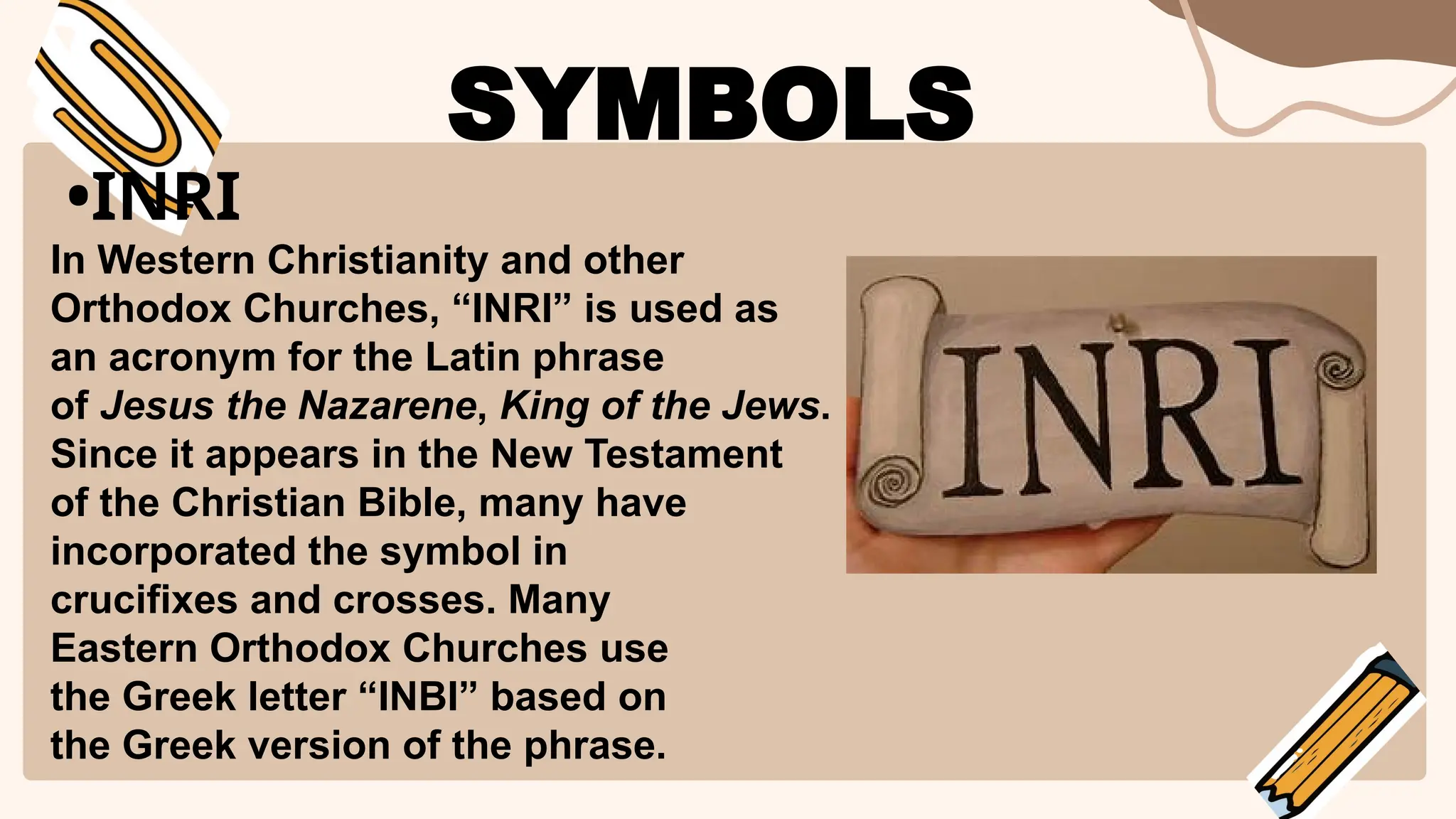
•INRI
In Western Christianity and other
Orthodox Churches, “INRI” is used as
an acronym for the Latin phrase
of Jesus the Nazarene, King of the Jews.
Since it appears in the New Testament
of the Christian Bible, many have
incorporated the symbol in
crucifixes and crosses. Many
Eastern Orthodox Churches use
the Greek letter “INBI” based on
the Greek version of the phrase.
HISTORICAL
BACKGROUND
At its most basic, Christianity is
the faith tradition that focuses on
the figure of Jesus Christ. In this
context, faith refers both to the
believers’ act of trust and to the
content of their faith. As a tradition,
Christianity is more than a system of
religious belief.
HISTORICAL CONTEXT OF
CHRISTIANITY
Christianity is a monotheistic religion founded on the :
birth
life
death
resurrection
of Jesus Christ, believed to be the Son of God.
Here’s a Brief Historically Context:
1. Origins
2. Crucifixion and Resurrection
3.Spread of Christianity
4. Persecution and Legalization
5. Councils and Doctrinal Development
6. Schisms and Denominational Split
Here’s a Brief Historically Context:
Medieval Christianity
Protestant Reformation
Colonialism and Global Expansion
Modern Christianity
Jesus the Founder of
Christianity
Jesus, the founder of Christianity, began
his ministry in his early thirties, preaching
revolutionary teachings that criticized
Judaism. He criticized religious officials’
insincerity and emphasized God’s
importance of service and love.
RELIGIOUS
LEADERS
Religious Leaders
The Catholic Church follows a certain
hierarchy based on the Canon Law of the
Catholic Church. At the top of the hierarchy is
the pope, considered as Peter’s successor.
The hierarchy also includes the cardinals,
archbishops, bishops, priests, and deacons.
Each member of the hierarchy has his own
function for the efficiency of the church.
Religious Leaders
- Pope
- Cardinals
- Archbishops
- Bishops
- Priest
- Deacons
DEITY/GOD
- Deity comes from the latin word for
“god”;deus.the devine nature of deities is
believe to be immortal
goodness and powerfulness.
SACRED
SCRIPTURES
THE HOLY TRINITY
• CREATOR/ FATHER
• SON
• HOLY SPIRIT
THE OLD AND NEW
TESTAMENT
THE SUMMARY OF OLD TESTAMENT
• There are 39 books in the Old generally
separated into 4 divisions.
• The Pentateuch, traditionally designated
as the 5 books of Moses.
THE SUMMARY OF OLD TESTAMENT
• Historical Books, numbering 12 from
Joshua to Esther.
• Poetical Books, numbering 5 from Job
to Song of Solomon.
THE SUMMARY OF OLD TESTAMENT
• Prophetical Books, including the
writings of the 4 Major Prophets, ,from
Isaiah to Daniel, and the 12 Minor
Prophets from. Hosea to Malachi
THE SUMMARY OF NEW TESTAMENT
• THE GOSPEL
• HISTORY
• EPISTLES
• PROPHETICAL BOOK
BELIEFS AND
DOCTRINES OF
CHRISTIANITY
FIVE BASIC BELIEFS OF CHRISTIANITY
• Habit No. 1: Strong Christians Feed
Their Spirit
• Habit No. 2: Strong Christians Build
Their Faith
FIVE BASIC BELIEFS OF CHRISTIANITY
• Habit No. 3: Strong Christians
Speak the Word
• Habit No. 4: Strong Christians
Control Their Thought/Life
FIVE BASIC BELIEFS OF CHRISTIANITY
• Habit No. 5: Strong Christians
Anchor Their Heart Through Praise
What are the six doctrines of Christianity?
These 'Six Foundational Truths' of
Hebrews Chapter Six:
What are the six doctrines of Christianity?
• Repentance
• Faith
• Baptisms
• Laying on of hands
• Resurrection of the dead
• Eternal judgment
SEVEN
SACRAMENTS
Seven Sacraments
The Catholic Church has seven sacraments which
are considered signs of innerkindness given by
God for Christians to live a genuine human life.
The seven sacraments include Baptism,
Confirmation, Holy Communion, Confession,
Matrimony, Holy Orders, and the Anointing of the
Sick. The first three sacraments are Baptism,
Confirmation, and Holy Communion, which are
considered the sacraments of initiation.
Seven Sacraments
• BAPTISM is meant to remove the guilt and effects
of Original Sin and welcome the baptized to the
Church.
• Holy Communion entails the reception of Christ’s
body and blood which helps Christians grow in
the likeness of Jesus Christ.
Seven Sacraments
• Confirmation which should be administered
right after baptism, is meant to complete
baptism and baptized the grace of holy
spirit.
• Confession is considered the fourth
sacrament, which is meant to reconcile
Christians with God by confessing their
sins.
Seven Sacraments
• The Sacrament of Marriage comes next, with the
union of a man and a woman for the purpose of
procreation and mutual support. It also reflects
the union of Jesus Christ with His Church.
• The Sacrament of Holy Orders is considered the
continuation of Christ’s priesthood which He
passed on to His apostles. And the last
sacrament is the
Seven Sacraments
• Anointing of the Sick, also known as
Extreme Unction or Last Rites, which
is administered to those who are on
the verge of death or are seriously
ill, or about to undergo a serious
operation, for physical and moral
strength.
8 BEATITUDES
EIGHT BEATITUDES
And seeing the multitudes he went up into a
mountain and when he was set, his disciples came unto
him:
And he opened his mouth, and taught them saying,
Blessed are the poor in spirit for theirs is the kingdom
of heaven.
Blessed are they that moum: for they shall comforted.
Blessed are the meek for they shall inherit the earth.
Blessed are they which do hunger and thirst after
righteousness for they shall be filled.
EIGHT BEATITUDES
Blessed are the merciful: for they shall obtain
mercy.
Blessed are the pure in heart for they shall see
god.
Blessed are the peacemakers for they shall be
called the children of god.
Blessed are the they which are persecuted for
righteousness’ sake: for theirs is the kingdom of
heaven.
EIGHT BEATITUDES
Blessed are ye, when men shall revile you,and
persecuted you, and shall say all manner of evil
against you falsely,for the sake.
Rejoice, and be exceeding glad for great is your
reward in heaven: for so persecuted they the
prophets
which were before you.
Matthew 5:1-12, New testament king James
Version
APOSTLES’ CREED
Apostles' Creed
The Apostles' Creed is believed to have
developed in the 100 or 200 C.E. and was
influenced later by the Nicene Creed. A letter
written by the Council of Milan in 390 C.E. is
the earliest historical evidence of the
existence of the Apostles' Creed. It is not
written by the apostles themselves but it
serves as a summary of their basic
teachings.
QUIZ TIME!
1. It is the most widely practiced religion in the world, with
more than 2 billion followers.
2. It is the most familiar and widely recognized symbol of
Christianity today. In all likelihood, It was the shape of the
structure upon which Jesus Christ was crucified.
DIRECTION: READ AND CAREFULLY ANALYZE
EACH QUESTION. ANSWER THE FOLLOWING:
3. It was used by early Christians to identify themselves as
followers of Jesus Christ and to express their affinity to
Christianity.
4. It served as protectors and executioners, making them a
powerful symbol of protection in some faiths.
5. ________ is the faith tradition that focuses on the figure
of Jesus Christ.
6. The _________ represent the Pope and the Roman
Catholic Church in different parts of the world.
7. It began with the ministry of __________, whose
teachings emphasized love, forgiveness, and salvation.
8. The principal author of the Bible is ________, who
inspired human writers by directing their minds, wills,
memories and mental faculties.
9. ___________ is a collection of ancient writings that
Christians believe are inspired by God to reveal Him to us.
10. The message of the _____ Testament is that God created
the world and has a plan for it through the People of Israel.
11. The Great Schism of 1054 CE led to the split between
the Western Roman Catholic Church and the Eastern
Orthodox Church, largely over theological and jurisdictional
differences.
12. Considered as Peter’s successor.
13. Worshipped by people who believe it controls or exerts
force over some aspect of the world.
14- 15. What are the other two terms for Christian fish?
16-18. Who is the Trinity?
19-20. The Catholic Church has seven sacraments which are
considered signs of inner kindness given by God for
Christians to live a genuine human life. Give at least two
(2).
ANSWERS:
1. Christianity
2. Christian Cross or Latin Cross
3. Christian Fish, Ichthys, or Jesus Fish
4. Angels
5. Christianity
6. Cardinals
7. Pope
8. God
9. Sacred Scripture
10. Old
11. Schisms and Denominational Split
12. Deity or God
13. Pope
14-15. - Jesus’ Fish
- Ichthys
16-18. - Creator or Father
- Son
- Holy Spirit
19-20.
Baptism, Confirmation, Holy Communion,
Confession, Matrimony, Holy Orders, and the Anointing of
the Sick.
THANK YOU!

Introduction to World Religions and Belief Systems Subject. Toipic:CHRISTIANITY.pptx

  • 1.
  • 3.
  • 4.
    CHRISTIANITY Christianity is themost widely practiced religion in the world, with more than 2 billion followers. The Christian faith centers on beliefs regarding the birth, life, death and resurrection of Jesus Christ. While it started with a small group of adherents, many historians regard the spread and adoption of Christianity throughout the world as one of the most successful spiritual missions in human history.
  • 5.
    SYMBOLS •Christian Cross - TheLatin cross is the most familiar and widely recognized symbol of Christianity today. In all likelihood, It was the shape of the structure upon which Jesus Christ was crucified.
  • 6.
    SYMBOLS •Christian Fish orIchthys The Christian Fish, also called the Jesus Fish or Ichthys, was a secret symbol of early Christianity. The Ichthys or fish symbol was used by early Christians to identify themselves as followers of Jesus Christ and to express their affinity to Christianity. Ichthys is the Ancient Greek word for fish& quot; symbol consists of two intersecting arcs tracing the outline of a fish Iseous Christos Theou Yios Soter
  • 7.
    SYMBOLS •Angels In the past,the angels also served as protectors and executioners, making them a powerful symbol of protection in some faiths. Orthodox Christians believe in guardian angels and believe that these spiritual beings are watching over and protecting them from harm.
  • 8.
    SYMBOLS •INRI In Western Christianityand other Orthodox Churches, “INRI” is used as an acronym for the Latin phrase of Jesus the Nazarene, King of the Jews. Since it appears in the New Testament of the Christian Bible, many have incorporated the symbol in crucifixes and crosses. Many Eastern Orthodox Churches use the Greek letter “INBI” based on the Greek version of the phrase.
  • 9.
  • 10.
    At its mostbasic, Christianity is the faith tradition that focuses on the figure of Jesus Christ. In this context, faith refers both to the believers’ act of trust and to the content of their faith. As a tradition, Christianity is more than a system of religious belief.
  • 11.
    HISTORICAL CONTEXT OF CHRISTIANITY Christianityis a monotheistic religion founded on the : birth life death resurrection of Jesus Christ, believed to be the Son of God.
  • 12.
    Here’s a BriefHistorically Context: 1. Origins 2. Crucifixion and Resurrection 3.Spread of Christianity 4. Persecution and Legalization 5. Councils and Doctrinal Development 6. Schisms and Denominational Split
  • 13.
    Here’s a BriefHistorically Context: Medieval Christianity Protestant Reformation Colonialism and Global Expansion Modern Christianity
  • 14.
    Jesus the Founderof Christianity Jesus, the founder of Christianity, began his ministry in his early thirties, preaching revolutionary teachings that criticized Judaism. He criticized religious officials’ insincerity and emphasized God’s importance of service and love.
  • 15.
  • 16.
    Religious Leaders The CatholicChurch follows a certain hierarchy based on the Canon Law of the Catholic Church. At the top of the hierarchy is the pope, considered as Peter’s successor. The hierarchy also includes the cardinals, archbishops, bishops, priests, and deacons. Each member of the hierarchy has his own function for the efficiency of the church.
  • 17.
    Religious Leaders - Pope -Cardinals - Archbishops - Bishops - Priest - Deacons
  • 18.
    DEITY/GOD - Deity comesfrom the latin word for “god”;deus.the devine nature of deities is believe to be immortal goodness and powerfulness.
  • 19.
  • 20.
  • 21.
    • CREATOR/ FATHER •SON • HOLY SPIRIT
  • 22.
    THE OLD ANDNEW TESTAMENT
  • 23.
    THE SUMMARY OFOLD TESTAMENT • There are 39 books in the Old generally separated into 4 divisions. • The Pentateuch, traditionally designated as the 5 books of Moses.
  • 24.
    THE SUMMARY OFOLD TESTAMENT • Historical Books, numbering 12 from Joshua to Esther. • Poetical Books, numbering 5 from Job to Song of Solomon.
  • 25.
    THE SUMMARY OFOLD TESTAMENT • Prophetical Books, including the writings of the 4 Major Prophets, ,from Isaiah to Daniel, and the 12 Minor Prophets from. Hosea to Malachi
  • 26.
    THE SUMMARY OFNEW TESTAMENT • THE GOSPEL • HISTORY • EPISTLES • PROPHETICAL BOOK
  • 27.
  • 28.
    FIVE BASIC BELIEFSOF CHRISTIANITY • Habit No. 1: Strong Christians Feed Their Spirit • Habit No. 2: Strong Christians Build Their Faith
  • 29.
    FIVE BASIC BELIEFSOF CHRISTIANITY • Habit No. 3: Strong Christians Speak the Word • Habit No. 4: Strong Christians Control Their Thought/Life
  • 30.
    FIVE BASIC BELIEFSOF CHRISTIANITY • Habit No. 5: Strong Christians Anchor Their Heart Through Praise
  • 31.
    What are thesix doctrines of Christianity? These 'Six Foundational Truths' of Hebrews Chapter Six:
  • 32.
    What are thesix doctrines of Christianity? • Repentance • Faith • Baptisms • Laying on of hands • Resurrection of the dead • Eternal judgment
  • 33.
  • 34.
    Seven Sacraments The CatholicChurch has seven sacraments which are considered signs of innerkindness given by God for Christians to live a genuine human life. The seven sacraments include Baptism, Confirmation, Holy Communion, Confession, Matrimony, Holy Orders, and the Anointing of the Sick. The first three sacraments are Baptism, Confirmation, and Holy Communion, which are considered the sacraments of initiation.
  • 35.
    Seven Sacraments • BAPTISMis meant to remove the guilt and effects of Original Sin and welcome the baptized to the Church. • Holy Communion entails the reception of Christ’s body and blood which helps Christians grow in the likeness of Jesus Christ.
  • 36.
    Seven Sacraments • Confirmationwhich should be administered right after baptism, is meant to complete baptism and baptized the grace of holy spirit. • Confession is considered the fourth sacrament, which is meant to reconcile Christians with God by confessing their sins.
  • 37.
    Seven Sacraments • TheSacrament of Marriage comes next, with the union of a man and a woman for the purpose of procreation and mutual support. It also reflects the union of Jesus Christ with His Church. • The Sacrament of Holy Orders is considered the continuation of Christ’s priesthood which He passed on to His apostles. And the last sacrament is the
  • 38.
    Seven Sacraments • Anointingof the Sick, also known as Extreme Unction or Last Rites, which is administered to those who are on the verge of death or are seriously ill, or about to undergo a serious operation, for physical and moral strength.
  • 39.
  • 40.
    EIGHT BEATITUDES And seeingthe multitudes he went up into a mountain and when he was set, his disciples came unto him: And he opened his mouth, and taught them saying, Blessed are the poor in spirit for theirs is the kingdom of heaven. Blessed are they that moum: for they shall comforted. Blessed are the meek for they shall inherit the earth. Blessed are they which do hunger and thirst after righteousness for they shall be filled.
  • 41.
    EIGHT BEATITUDES Blessed arethe merciful: for they shall obtain mercy. Blessed are the pure in heart for they shall see god. Blessed are the peacemakers for they shall be called the children of god. Blessed are the they which are persecuted for righteousness’ sake: for theirs is the kingdom of heaven.
  • 42.
    EIGHT BEATITUDES Blessed areye, when men shall revile you,and persecuted you, and shall say all manner of evil against you falsely,for the sake. Rejoice, and be exceeding glad for great is your reward in heaven: for so persecuted they the prophets which were before you. Matthew 5:1-12, New testament king James Version
  • 43.
  • 44.
    Apostles' Creed The Apostles'Creed is believed to have developed in the 100 or 200 C.E. and was influenced later by the Nicene Creed. A letter written by the Council of Milan in 390 C.E. is the earliest historical evidence of the existence of the Apostles' Creed. It is not written by the apostles themselves but it serves as a summary of their basic teachings.
  • 46.
  • 47.
    1. It isthe most widely practiced religion in the world, with more than 2 billion followers. 2. It is the most familiar and widely recognized symbol of Christianity today. In all likelihood, It was the shape of the structure upon which Jesus Christ was crucified. DIRECTION: READ AND CAREFULLY ANALYZE EACH QUESTION. ANSWER THE FOLLOWING:
  • 48.
    3. It wasused by early Christians to identify themselves as followers of Jesus Christ and to express their affinity to Christianity. 4. It served as protectors and executioners, making them a powerful symbol of protection in some faiths.
  • 49.
    5. ________ isthe faith tradition that focuses on the figure of Jesus Christ. 6. The _________ represent the Pope and the Roman Catholic Church in different parts of the world. 7. It began with the ministry of __________, whose teachings emphasized love, forgiveness, and salvation.
  • 50.
    8. The principalauthor of the Bible is ________, who inspired human writers by directing their minds, wills, memories and mental faculties. 9. ___________ is a collection of ancient writings that Christians believe are inspired by God to reveal Him to us. 10. The message of the _____ Testament is that God created the world and has a plan for it through the People of Israel.
  • 51.
    11. The GreatSchism of 1054 CE led to the split between the Western Roman Catholic Church and the Eastern Orthodox Church, largely over theological and jurisdictional differences. 12. Considered as Peter’s successor. 13. Worshipped by people who believe it controls or exerts force over some aspect of the world.
  • 52.
    14- 15. Whatare the other two terms for Christian fish? 16-18. Who is the Trinity? 19-20. The Catholic Church has seven sacraments which are considered signs of inner kindness given by God for Christians to live a genuine human life. Give at least two (2).
  • 53.
    ANSWERS: 1. Christianity 2. ChristianCross or Latin Cross 3. Christian Fish, Ichthys, or Jesus Fish 4. Angels 5. Christianity 6. Cardinals 7. Pope
  • 54.
    8. God 9. SacredScripture 10. Old 11. Schisms and Denominational Split 12. Deity or God 13. Pope 14-15. - Jesus’ Fish - Ichthys
  • 55.
    16-18. - Creatoror Father - Son - Holy Spirit 19-20. Baptism, Confirmation, Holy Communion, Confession, Matrimony, Holy Orders, and the Anointing of the Sick.
  • 56.