LINGUISTICS
Linguistics
- The science of language (Robins 1980)
- The scientific study of language (Lyons 1981)
- The study of language as a system of human
communication (Richards 1992)
THE NATURE and
CHARACTERISTICS of
LANGUAGE
Language Defined
Language is a system of arbitrary
vocal symbols by means of which a
social group cooperates.
(Trager and Bloch 1942)
Language Defined
A language is an arbitrary system of
articulated sounds made use of by a group
of humans as a means of carrying on the
affairs of society.
(Francis 1958)
Language Defined
Language is a system of arbitrary
vocal symbols used for human
communication.
(Wardhaugh 1982)
Characteristics of Language
1. Creative
2. Arbitrary
3. Shared
4. Dynamic
5. Composed of FORM, MEANING, and USE
6. Systematic
Language is creative.
Set of sounds
Set of words
Set of sentences
They were never said before but they are
grammatical and have meaning.
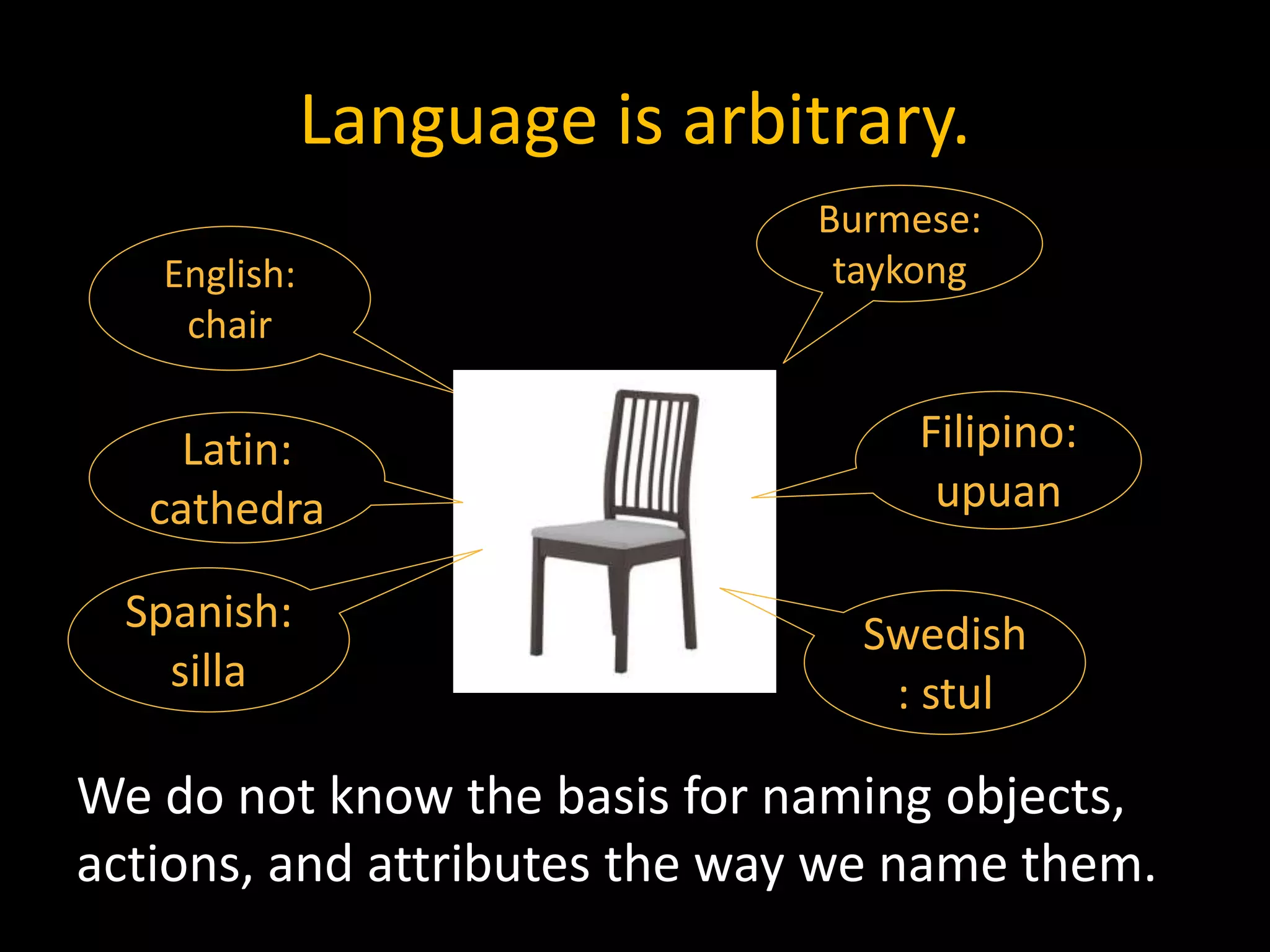
Language is arbitrary.
We do not know the basis for naming objects,
actions, and attributes the way we name them.
English:
chair
Burmese:
taykong
Filipino:
upuan
Spanish:
silla
Swedish
: stul
Latin:
cathedra
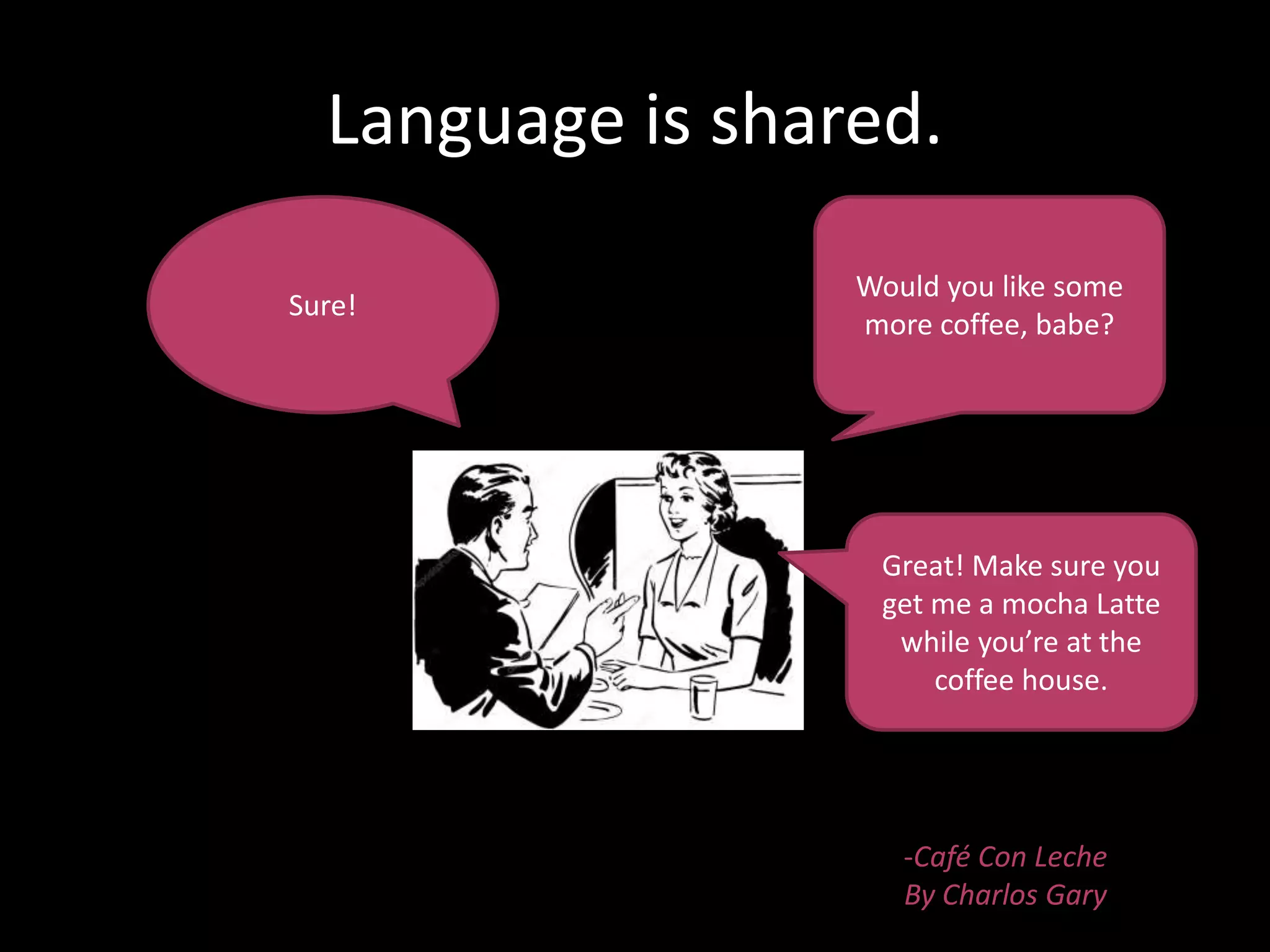
Language is shared.
Would you like some
more coffee, babe?
Sure!
Great! Make sure you
get me a mocha Latte
while you’re at the
coffee house.
-Café Con Leche
By Charlos Gary
Language is shared.
In order to understand each other, speakers of a
language must agree regarding the meaning of a
particular construction (such as a sentence), and
the purpose or function of a particular
utterance.
>Language is systemic.
>Language is a social phenomenon.
Language is dynamic.
Hebrew 1:1
New Living Translation (1996)
“Long ago God spoke
many times and in many
ways to our ancestors
through the prophets. And
now in these final days, he
has spoken to us through
his Son.”
Hebrew 1:1
King James Version (1611)
“God, who at sundry
times and in divers
manners spake in time
past unto the fathers by
the prophets, hath in
these last days spoken
unto us by his Son.”
Language is composed of FORM,
MEANING, and USE.
Form is a perceptible part of a language.
spoken word
written word
signed word
Meaning is the idea or function triggered in the
mind of a speaker and a listener.
Use refers to a particular function of a particular
utterance.
Language is systematic.
Language follows an orderly, proper system for
arranging sounds, groups of sounds, words,
sentences, utterances, and even paragraphs.
Language is systematic.
No limit to the length or number of sentences:
This is the house.
This is the house that Jack built.
This is the malt that lay in the house that Jack
built.
This is the dog that worried the cat that killed
the rat that ate the malt that lay in the house
that Jack built.
Very long sentences are theoretically possible,
but they are highly improbable.
LINGUISTIC KNOWLEDGE
Linguistic competence (what you know)
- knowledge necessary to produce
sentences of a language
Linguistic performance (how you use)
- actual speech production and
comprehension
- applying the knowledge
Ling 21:
LANGUAGE & THE BRAIN
Neurolinguistics: The study
of how language is
represented and processed
in the brain
ROAD MAP
Now that we’ve:
Defined critical thinking
Identified traits of a
critical thinker
Identified some of the
barriers to critical thinking
and
Defined and analyzed
arguments in terms of
their component parts, . . .
ROAD MAP
We will turn our
attention briefly to
some things that
we know about
language in the
brain, in particular:
The structure of
the brain
Aphasia
Signed languages
Language in the Brain
• Have you ever
– Observed children learning learn their first
language?
– Known anyone who has suffered a stroke?
• How are humans and other animals similar?
• How do we communicate differently from
other animals?
• How do researchers investigate how the brain
is organized and how it works?
Language in the brain
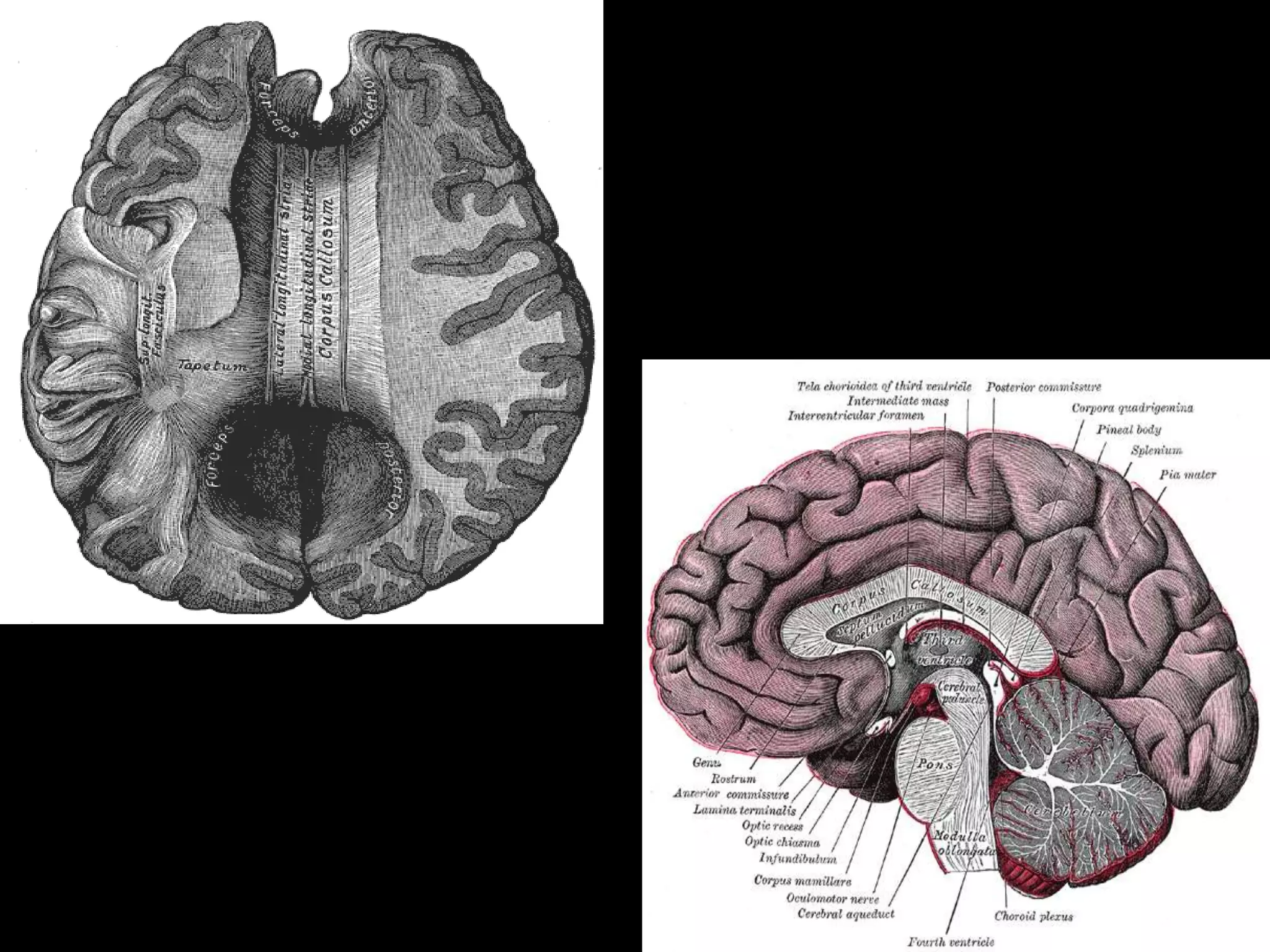
THE HUMAN BRAIN
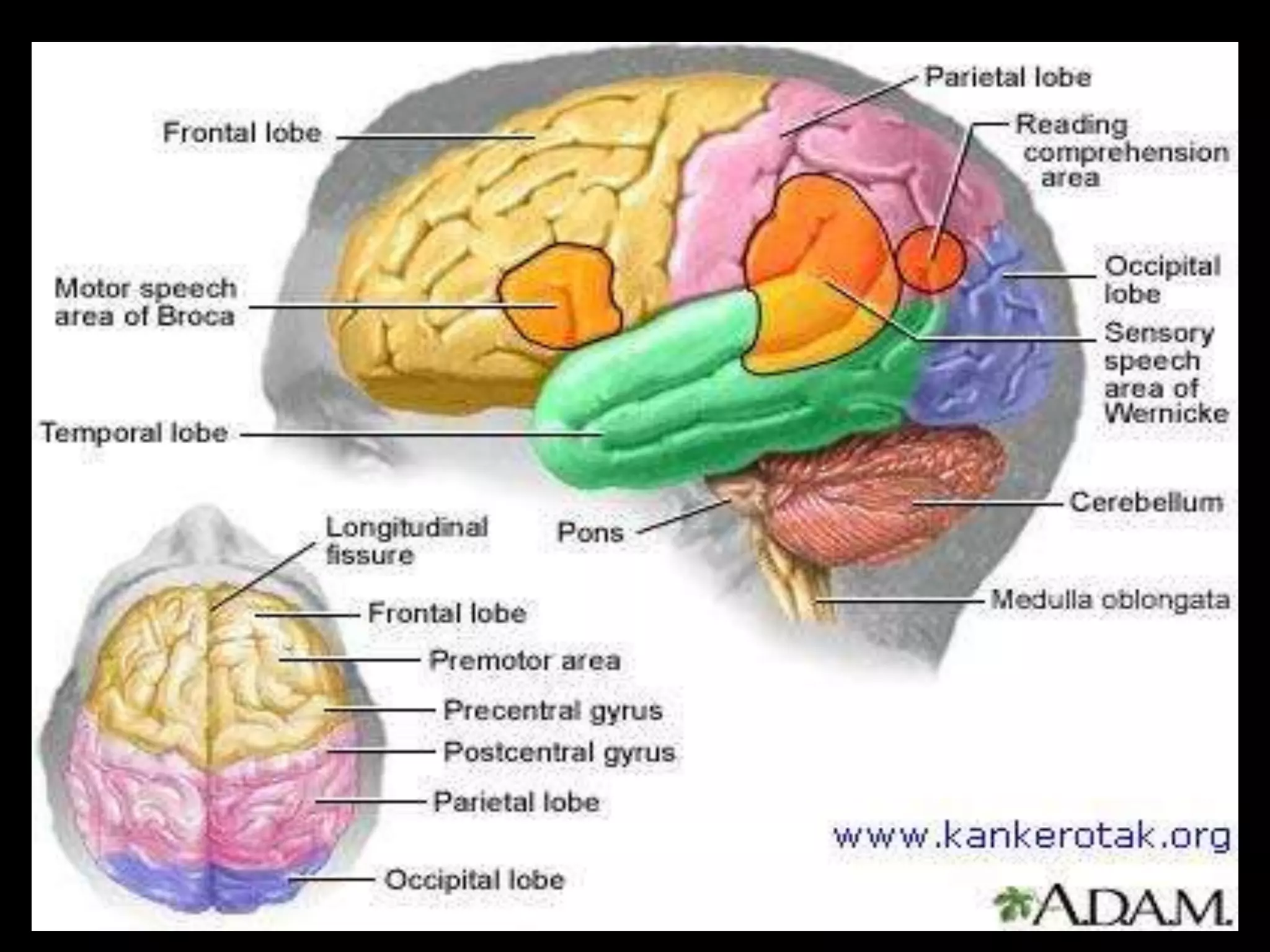
• The brain is composed of neurons, nerve cells
that are the basic information processing units
of the nervous system.
• The cerebral cortex is the gray wrinkled mass
that sits over the rest of the brain and accounts
for language representation and processing.
• The longitudinal fissure separates the left and
right hemispheres of the brain.
• The corpus callosum is the bundle of nerve
fibers that connects the two hemispheres.
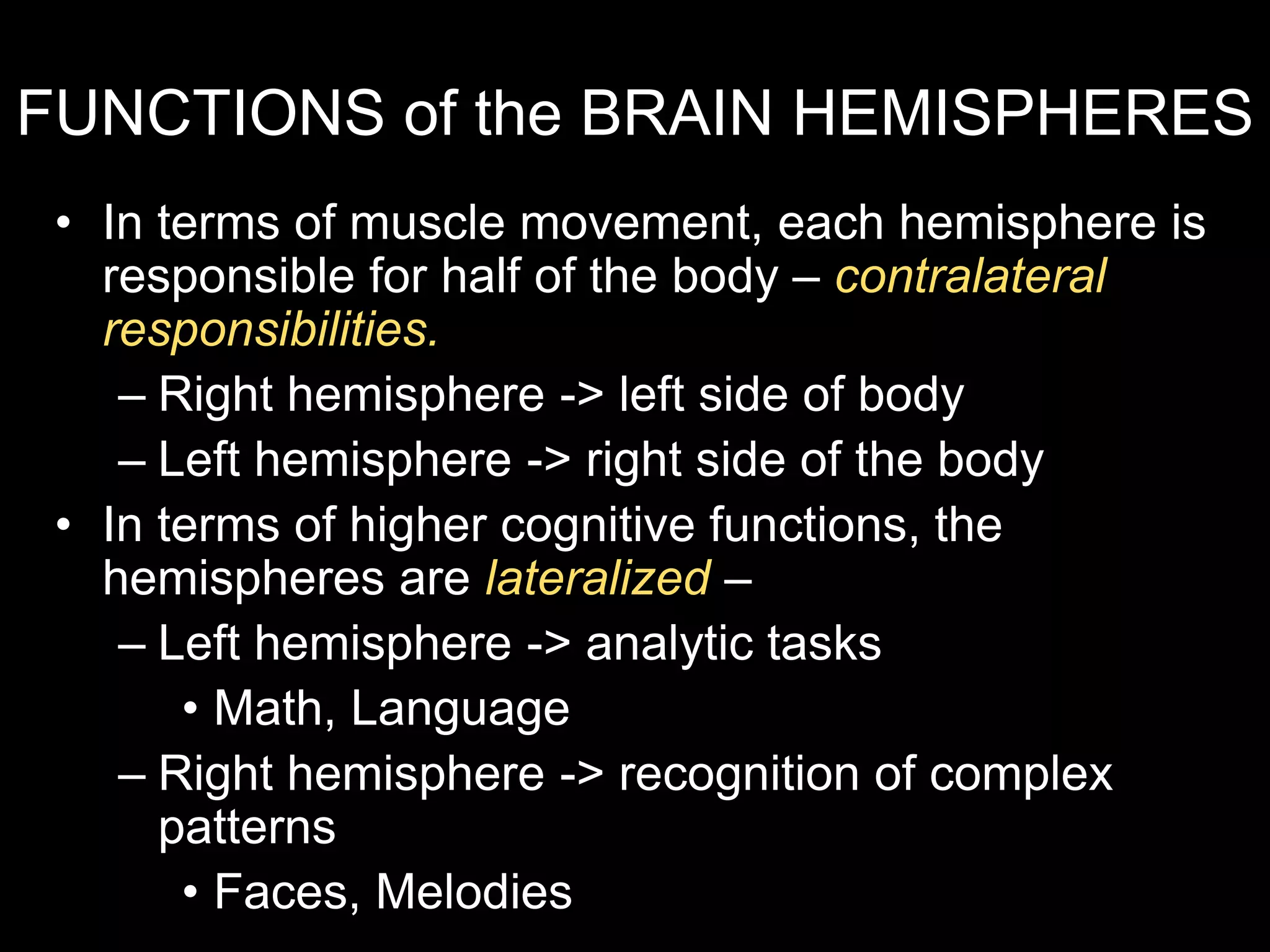
FUNCTIONS of the BRAIN HEMISPHERES
• In terms of muscle movement, each hemisphere is
responsible for half of the body – contralateral
responsibilities.
– Right hemisphere -> left side of body
– Left hemisphere -> right side of the body
• In terms of higher cognitive functions, the
hemispheres are lateralized –
– Left hemisphere -> analytic tasks
• Math, Language
– Right hemisphere -> recognition of complex
patterns
• Faces, Melodies
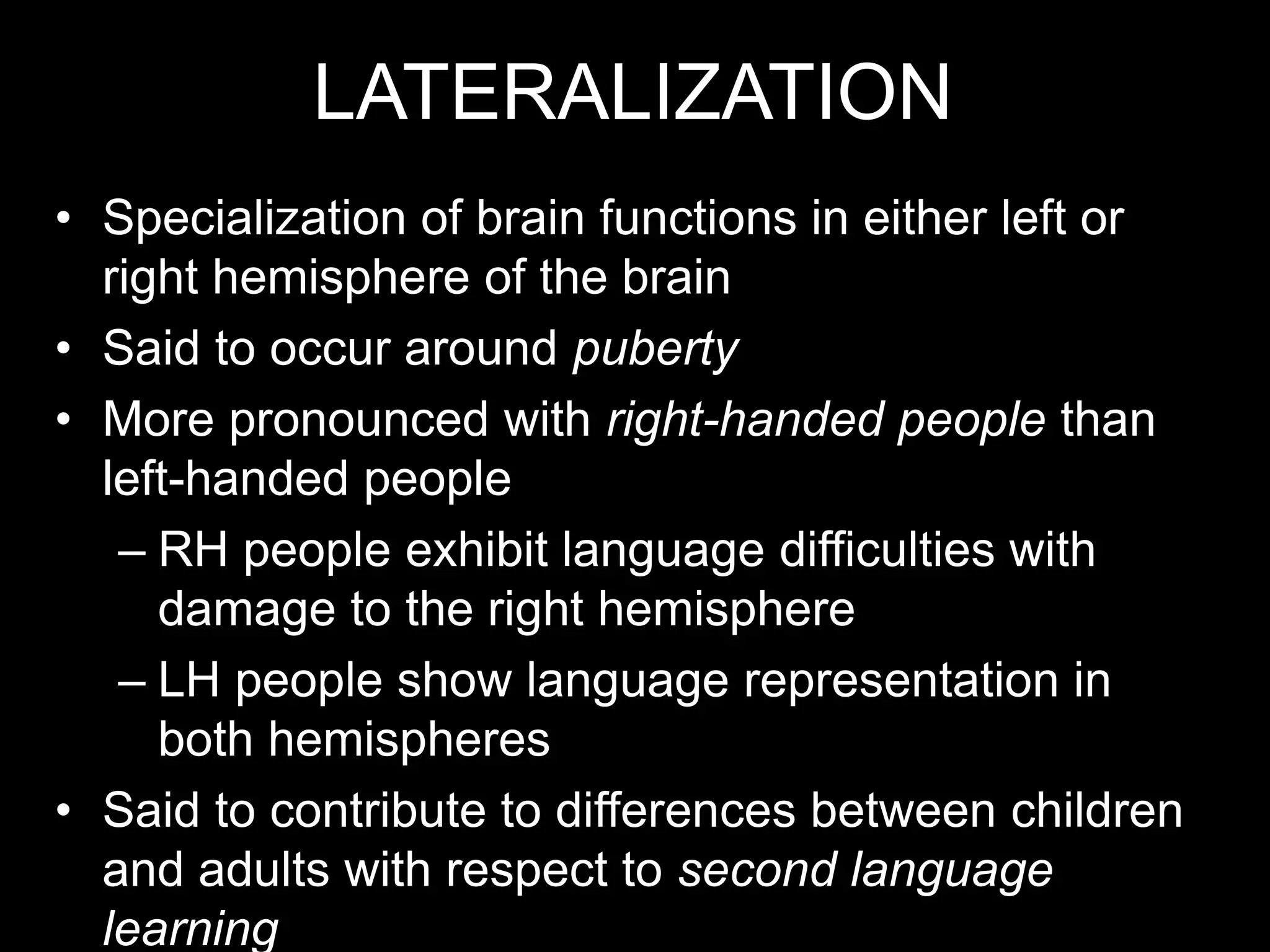
LATERALIZATION
• Specialization of brain functions in either left or
right hemisphere of the brain
• Said to occur around puberty
• More pronounced with right-handed people than
left-handed people
– RH people exhibit language difficulties with
damage to the right hemisphere
– LH people show language representation in
both hemispheres
• Said to contribute to differences between children
and adults with respect to second language
learning
INVESTIGATING THE BRAIN
• Autopsy studies –
– Broca’s area: lower rear of left frontal lobe
• Images of the living brain
– Computerized axial tomography (CAT scan)
– Positron emission tomography (PET)
• What does PET do?
• How does it do that?
• Describe the experiment – what the subject was asked
to do (three tasks) and what it showed
– Functional magnetic resonance imaging (fMRI)
INVESTIGATING THE BRAIN
(continued)
• Learning from hemispheric connections
and disconnections
– Dichotic listening studies show that we
process language better through right ear
– Split brain studies – ‘key’ experiment
APHASIA
A language deficit caused by damage to the
brain, often be a stroke or an accident
• Nonfluent (motor) aphasia – front of left cortex
– results in either slow effortful speech or complete
speechlessness
– Broca’s aphasia –
• Speech is very halting
• Function words are omitted (it, is, to, a, etc.)
• Pronunciation is simplified (spoon > poon, etc.)
• Inflectional endings are omitted (running > run,
etc.)
– Broca’ aphasics are aware of their language deficit
APHASIA
• Fluent (sensory) aphasia – rear of left cortex
–No difficulty producing language
–Great difficulty selecting, organizing and
monitoring language
–Wernicke’s aphasia
• Generally unaware of their deficit
• Patient rarely makes any sense
YouTube - Wernicke's and Broca's Aphasia
LANGUAGE as FORM &
CONTENT
• Non-fluent aphasia – Form is
compromised but the content of language
remains relatively intact.
• Fluent aphasia – Characterized by a rapid
flow of form with little content.
• Working with aphasics
• Exercise: O’Grady, p. 534-535, questions
1, 2, 4, 5, 6 & 7.
VISUAL LANGUAGE
• Deafness is not a language
impairment.
• Language vs. speech
–Language = an abstract cognitive
system
–Speech = an action using the vocal-
auditory mode
• Deafness requires a language in a
different (i.e., non-vocal) mode
VISUAL LANGUAGES
• Sign languages differ from one culture to
another.
• They are NOT mutually intelligible.
SIGNED LANGUAGES vs.
PANTOMIME
• Pantomime = iconic
• Signed languages = abstract
• Three levels of iconicity for signs
– Transparent: Understood by untrained
observers – eat, food
– Translucent: Easy to recognize when they are
explained – wonder (OSU LF, p. 405)
– Opaque: Have no recognizable relationship to
their referent – onion (OSU LF, p. 405)
SIGNED LANGUAGE
vs. MANUAL CODES
• Manual code: An artificially contrived system
for representing a natural language (e.g.,
Manually Coded English)
– Has no syntax or structure of its own
– Created by hearing people for the deaf
• Signed language: a natural language not
based on the spoken language used around it
– Has a distinct structure and syntax
– Is created by deaf people
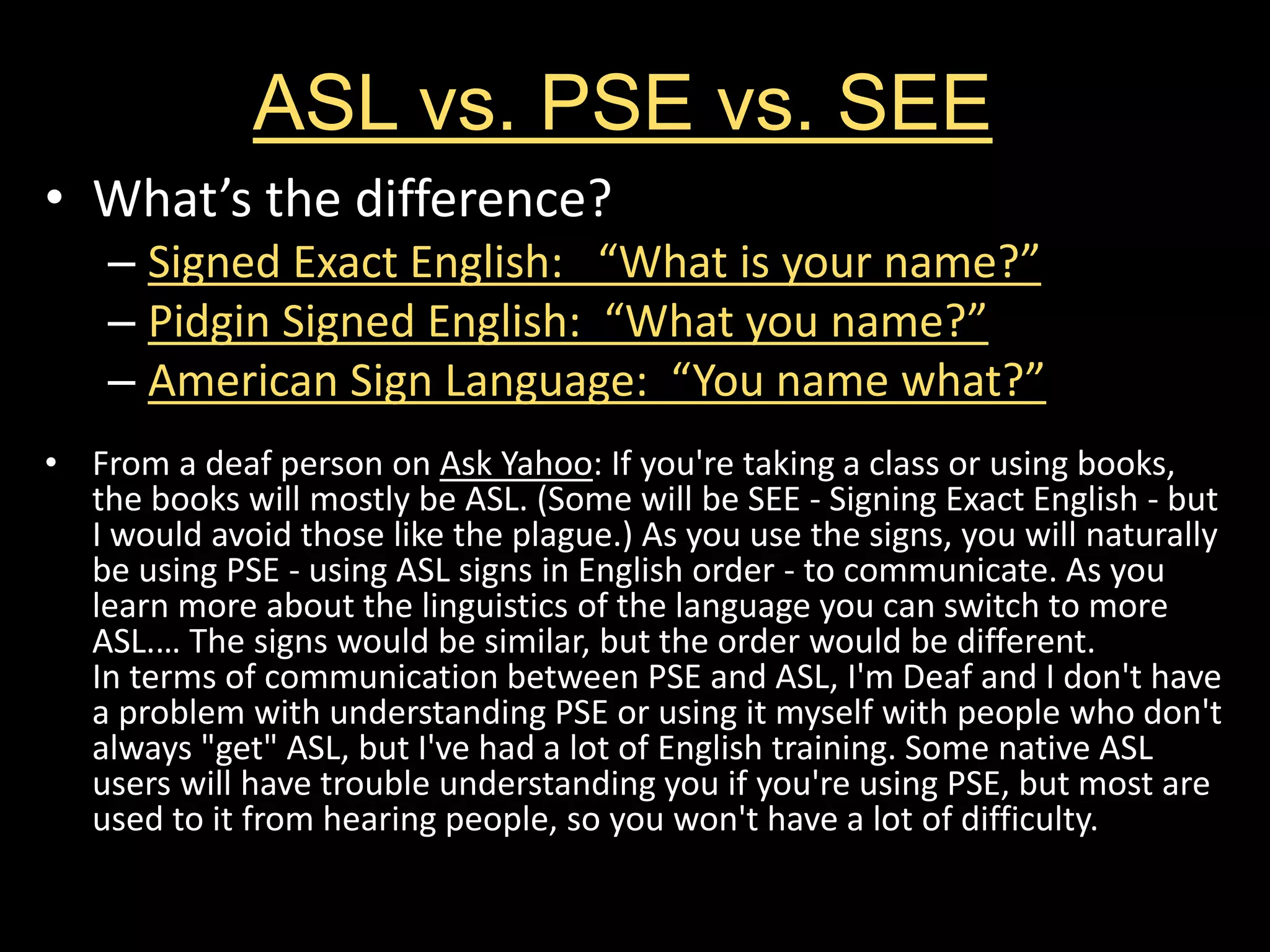
ASL vs. PSE vs. SEE
• What’s the difference?
– Signed Exact English: “What is your name?”
– Pidgin Signed English: “What you name?”
– American Sign Language: “You name what?”
• From a deaf person on Ask Yahoo: If you're taking a class or using books,
the books will mostly be ASL. (Some will be SEE - Signing Exact English - but
I would avoid those like the plague.) As you use the signs, you will naturally
be using PSE - using ASL signs in English order - to communicate. As you
learn more about the linguistics of the language you can switch to more
ASL.… The signs would be similar, but the order would be different.
In terms of communication between PSE and ASL, I'm Deaf and I don't have
a problem with understanding PSE or using it myself with people who don't
always "get" ASL, but I've had a lot of English training. Some native ASL
users will have trouble understanding you if you're using PSE, but most are
used to it from hearing people, so you won't have a lot of difficulty.
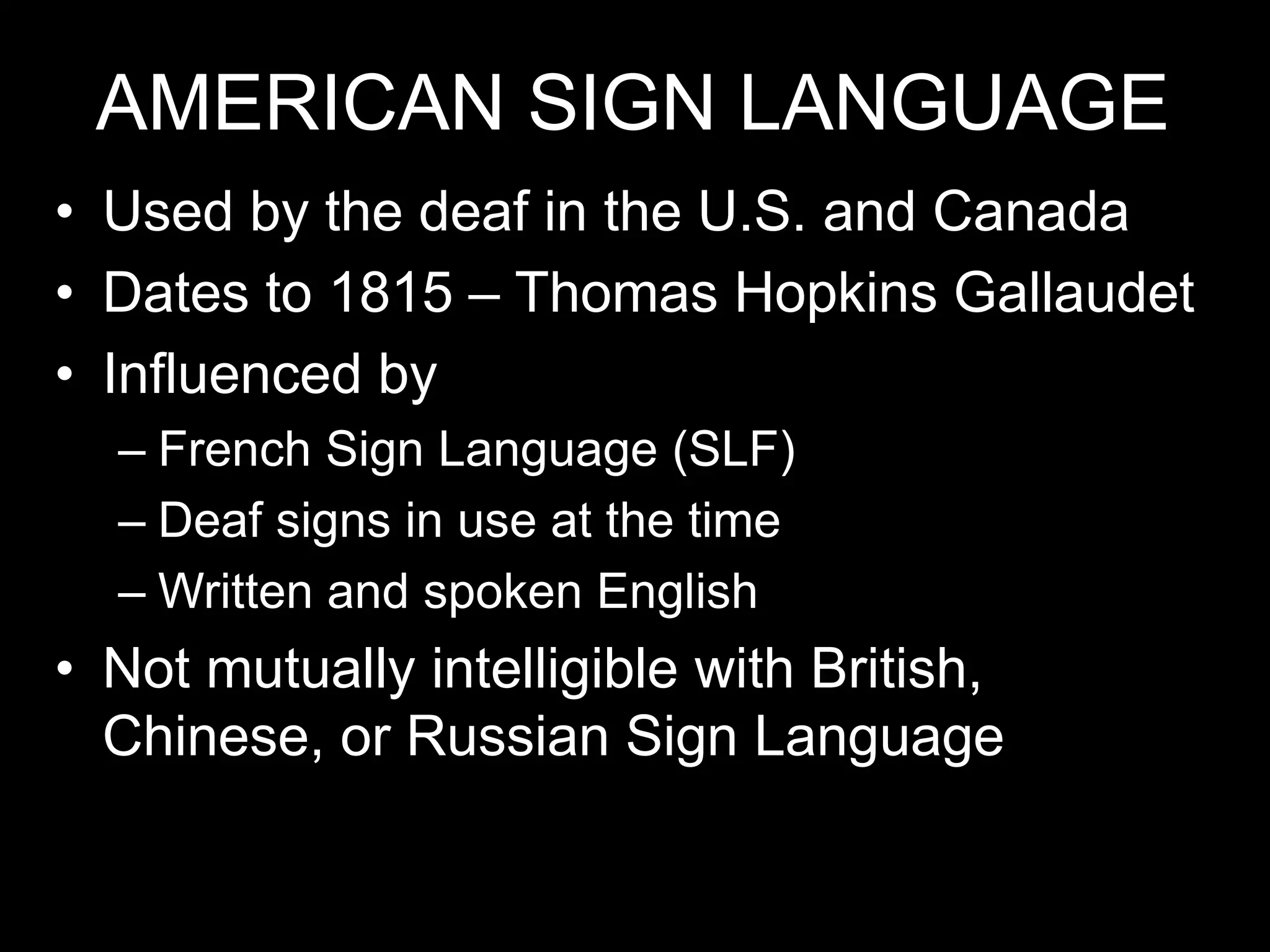
AMERICAN SIGN LANGUAGE
• Used by the deaf in the U.S. and Canada
• Dates to 1815 – Thomas Hopkins Gallaudet
• Influenced by
– French Sign Language (SLF)
– Deaf signs in use at the time
– Written and spoken English
• Not mutually intelligible with British,
Chinese, or Russian Sign Language
DICTIONARY OF ASL
• Sign structure consists of 3 formational
elements (Parameters)
• The shape of the hand used in the sign (which
fingers are used, whether fingers are extended or
bent, the general configuration of the hand; E.G.,
‘apple’ vs. ‘candy’)
• The place of articulation of the sign in space or
on the signer’s body (temple, ear, chest, e.g.,
‘apple’ vs. ‘onion’)
• The particular movement associated with the
sign (repeated circular motion, slow elliptical motion,
e.g., ‘think’ vs. ‘wonder’)
PHONEMES, CHEREMES
• Alone they are meaningless (like letters)
• Together they form different words when combined in
different ways (like tan & pan)
• If I make the same movement at the same point of
articulation, but change the hand shape, the sign has
a different meaning (apple & candy, p. 405)
• If I make the same movement with the same
handshape at a different point of articulation, the sign
has a different meaning (apple & onion, p. 405)
• Think and wonder have the same handshape and
point of articulation, but differ in movement (p. 405).
PROSODY
In spoken languages, intonation affects
sentence meaning. Rising intonation often
indicates a yes-no question.
John fed the cat.
John fed the cat?
In signed languages, facial expressions have
the same function.
A yes-no question is accompanied by a
raised brow.
PRONOUNS
The signer first signs the person or object
being discussed, then points or gazes to a
point in space in front of his or her body.
When the signer wants to refer again in the
conversation to the person or object, the
signer points to that location.
This is the equivalent of the spoken he/she/it,
him/her/it, etc.
STRESS & COMPOUNDING
• In spoken English, the stress pattern of a compound
word distinguishes it from a mere combination of its
components.
– BLACK BIRD vs. BLACKbird
• In ASL, the equivalent to vocal stress is duration; the
second element in a compound is always stressed –
the first is signed quicker.
– BLUE SPOT vs. blueSPOT
ASL SOCIOLINGUISTICS
• Dialect differences exist,
– due to geographic isolation
– ‘accents’ as well as vocabulary differences
• Borrowing from English exists, due to
– Bilingualism
– Large specialized vocabulary of English
– Linguistic oppression against the deaf
– Struggle between pro-English & pro-ASL
factions among the deaf
SL NEUROLINGUISTICS
Deaf people who suffer damage to the left hemisphere
of their brains will, like hearing people, suffer from
aphasia- they may have slow awkward signing
(Broca’s aphasia) or may produce ‘sign salad’
(Wernicke’s aphasia)
Damage to the right hemisphere frequently results in the
loss of some spatial functioning. Patients asked to
draw a clock, for example, may draw only a semicircle,
neglecting the left side.
Deaf people who suffer damage to the right hemisphere
of their brains will not lose their ability to sign.
Conclusion: Sign language is controlled by the same
regions of the brain that control spoken language, not
by the visuo-spatial centers.
American Sign Language
Pair Work
• In your first essay, you are asked to describe
your strengths and weaknesses as a critical
thinker, providing specific exam[ples to
illustrate. In pairs, describe to your partner the
situation you are planning to write about.

13-Ling-21---Lecture-3---neurolinguistics.ppt

  • 1.
  • 2.
    Linguistics - The scienceof language (Robins 1980) - The scientific study of language (Lyons 1981) - The study of language as a system of human communication (Richards 1992)
  • 3.
  • 4.
    Language Defined Language isa system of arbitrary vocal symbols by means of which a social group cooperates. (Trager and Bloch 1942)
  • 5.
    Language Defined A languageis an arbitrary system of articulated sounds made use of by a group of humans as a means of carrying on the affairs of society. (Francis 1958)
  • 6.
    Language Defined Language isa system of arbitrary vocal symbols used for human communication. (Wardhaugh 1982)
  • 7.
    Characteristics of Language 1.Creative 2. Arbitrary 3. Shared 4. Dynamic 5. Composed of FORM, MEANING, and USE 6. Systematic
  • 8.
    Language is creative. Setof sounds Set of words Set of sentences They were never said before but they are grammatical and have meaning.
  • 9.
    Language is arbitrary. Wedo not know the basis for naming objects, actions, and attributes the way we name them. English: chair Burmese: taykong Filipino: upuan Spanish: silla Swedish : stul Latin: cathedra
  • 10.
    Language is shared. Wouldyou like some more coffee, babe? Sure! Great! Make sure you get me a mocha Latte while you’re at the coffee house. -Café Con Leche By Charlos Gary
  • 11.
    Language is shared. Inorder to understand each other, speakers of a language must agree regarding the meaning of a particular construction (such as a sentence), and the purpose or function of a particular utterance. >Language is systemic. >Language is a social phenomenon.
  • 12.
    Language is dynamic. Hebrew1:1 New Living Translation (1996) “Long ago God spoke many times and in many ways to our ancestors through the prophets. And now in these final days, he has spoken to us through his Son.” Hebrew 1:1 King James Version (1611) “God, who at sundry times and in divers manners spake in time past unto the fathers by the prophets, hath in these last days spoken unto us by his Son.”
  • 13.
    Language is composedof FORM, MEANING, and USE. Form is a perceptible part of a language. spoken word written word signed word Meaning is the idea or function triggered in the mind of a speaker and a listener. Use refers to a particular function of a particular utterance.
  • 14.
    Language is systematic. Languagefollows an orderly, proper system for arranging sounds, groups of sounds, words, sentences, utterances, and even paragraphs.
  • 15.
    Language is systematic. Nolimit to the length or number of sentences: This is the house. This is the house that Jack built. This is the malt that lay in the house that Jack built. This is the dog that worried the cat that killed the rat that ate the malt that lay in the house that Jack built.
  • 16.
    Very long sentencesare theoretically possible, but they are highly improbable.
  • 17.
  • 18.
    Linguistic competence (whatyou know) - knowledge necessary to produce sentences of a language Linguistic performance (how you use) - actual speech production and comprehension - applying the knowledge
  • 19.
    Ling 21: LANGUAGE &THE BRAIN Neurolinguistics: The study of how language is represented and processed in the brain
  • 20.
    ROAD MAP Now thatwe’ve: Defined critical thinking Identified traits of a critical thinker Identified some of the barriers to critical thinking and Defined and analyzed arguments in terms of their component parts, . . .
  • 21.
    ROAD MAP We willturn our attention briefly to some things that we know about language in the brain, in particular: The structure of the brain Aphasia Signed languages
  • 22.
    Language in theBrain • Have you ever – Observed children learning learn their first language? – Known anyone who has suffered a stroke? • How are humans and other animals similar? • How do we communicate differently from other animals? • How do researchers investigate how the brain is organized and how it works? Language in the brain
  • 23.
    THE HUMAN BRAIN •The brain is composed of neurons, nerve cells that are the basic information processing units of the nervous system. • The cerebral cortex is the gray wrinkled mass that sits over the rest of the brain and accounts for language representation and processing. • The longitudinal fissure separates the left and right hemispheres of the brain. • The corpus callosum is the bundle of nerve fibers that connects the two hemispheres.
  • 25.
    FUNCTIONS of theBRAIN HEMISPHERES • In terms of muscle movement, each hemisphere is responsible for half of the body – contralateral responsibilities. – Right hemisphere -> left side of body – Left hemisphere -> right side of the body • In terms of higher cognitive functions, the hemispheres are lateralized – – Left hemisphere -> analytic tasks • Math, Language – Right hemisphere -> recognition of complex patterns • Faces, Melodies
  • 26.
    LATERALIZATION • Specialization ofbrain functions in either left or right hemisphere of the brain • Said to occur around puberty • More pronounced with right-handed people than left-handed people – RH people exhibit language difficulties with damage to the right hemisphere – LH people show language representation in both hemispheres • Said to contribute to differences between children and adults with respect to second language learning
  • 27.
    INVESTIGATING THE BRAIN •Autopsy studies – – Broca’s area: lower rear of left frontal lobe • Images of the living brain – Computerized axial tomography (CAT scan) – Positron emission tomography (PET) • What does PET do? • How does it do that? • Describe the experiment – what the subject was asked to do (three tasks) and what it showed – Functional magnetic resonance imaging (fMRI)
  • 28.
    INVESTIGATING THE BRAIN (continued) •Learning from hemispheric connections and disconnections – Dichotic listening studies show that we process language better through right ear – Split brain studies – ‘key’ experiment
  • 29.
    APHASIA A language deficitcaused by damage to the brain, often be a stroke or an accident • Nonfluent (motor) aphasia – front of left cortex – results in either slow effortful speech or complete speechlessness – Broca’s aphasia – • Speech is very halting • Function words are omitted (it, is, to, a, etc.) • Pronunciation is simplified (spoon > poon, etc.) • Inflectional endings are omitted (running > run, etc.) – Broca’ aphasics are aware of their language deficit
  • 30.
    APHASIA • Fluent (sensory)aphasia – rear of left cortex –No difficulty producing language –Great difficulty selecting, organizing and monitoring language –Wernicke’s aphasia • Generally unaware of their deficit • Patient rarely makes any sense YouTube - Wernicke's and Broca's Aphasia
  • 32.
    LANGUAGE as FORM& CONTENT • Non-fluent aphasia – Form is compromised but the content of language remains relatively intact. • Fluent aphasia – Characterized by a rapid flow of form with little content. • Working with aphasics • Exercise: O’Grady, p. 534-535, questions 1, 2, 4, 5, 6 & 7.
  • 33.
    VISUAL LANGUAGE • Deafnessis not a language impairment. • Language vs. speech –Language = an abstract cognitive system –Speech = an action using the vocal- auditory mode • Deafness requires a language in a different (i.e., non-vocal) mode
  • 34.
    VISUAL LANGUAGES • Signlanguages differ from one culture to another. • They are NOT mutually intelligible.
  • 35.
    SIGNED LANGUAGES vs. PANTOMIME •Pantomime = iconic • Signed languages = abstract • Three levels of iconicity for signs – Transparent: Understood by untrained observers – eat, food – Translucent: Easy to recognize when they are explained – wonder (OSU LF, p. 405) – Opaque: Have no recognizable relationship to their referent – onion (OSU LF, p. 405)
  • 36.
    SIGNED LANGUAGE vs. MANUALCODES • Manual code: An artificially contrived system for representing a natural language (e.g., Manually Coded English) – Has no syntax or structure of its own – Created by hearing people for the deaf • Signed language: a natural language not based on the spoken language used around it – Has a distinct structure and syntax – Is created by deaf people
  • 37.
    ASL vs. PSEvs. SEE • What’s the difference? – Signed Exact English: “What is your name?” – Pidgin Signed English: “What you name?” – American Sign Language: “You name what?” • From a deaf person on Ask Yahoo: If you're taking a class or using books, the books will mostly be ASL. (Some will be SEE - Signing Exact English - but I would avoid those like the plague.) As you use the signs, you will naturally be using PSE - using ASL signs in English order - to communicate. As you learn more about the linguistics of the language you can switch to more ASL.… The signs would be similar, but the order would be different. In terms of communication between PSE and ASL, I'm Deaf and I don't have a problem with understanding PSE or using it myself with people who don't always "get" ASL, but I've had a lot of English training. Some native ASL users will have trouble understanding you if you're using PSE, but most are used to it from hearing people, so you won't have a lot of difficulty.
  • 38.
    AMERICAN SIGN LANGUAGE •Used by the deaf in the U.S. and Canada • Dates to 1815 – Thomas Hopkins Gallaudet • Influenced by – French Sign Language (SLF) – Deaf signs in use at the time – Written and spoken English • Not mutually intelligible with British, Chinese, or Russian Sign Language
  • 39.
    DICTIONARY OF ASL •Sign structure consists of 3 formational elements (Parameters) • The shape of the hand used in the sign (which fingers are used, whether fingers are extended or bent, the general configuration of the hand; E.G., ‘apple’ vs. ‘candy’) • The place of articulation of the sign in space or on the signer’s body (temple, ear, chest, e.g., ‘apple’ vs. ‘onion’) • The particular movement associated with the sign (repeated circular motion, slow elliptical motion, e.g., ‘think’ vs. ‘wonder’)
  • 40.
    PHONEMES, CHEREMES • Alonethey are meaningless (like letters) • Together they form different words when combined in different ways (like tan & pan) • If I make the same movement at the same point of articulation, but change the hand shape, the sign has a different meaning (apple & candy, p. 405) • If I make the same movement with the same handshape at a different point of articulation, the sign has a different meaning (apple & onion, p. 405) • Think and wonder have the same handshape and point of articulation, but differ in movement (p. 405).
  • 41.
    PROSODY In spoken languages,intonation affects sentence meaning. Rising intonation often indicates a yes-no question. John fed the cat. John fed the cat? In signed languages, facial expressions have the same function. A yes-no question is accompanied by a raised brow.
  • 42.
    PRONOUNS The signer firstsigns the person or object being discussed, then points or gazes to a point in space in front of his or her body. When the signer wants to refer again in the conversation to the person or object, the signer points to that location. This is the equivalent of the spoken he/she/it, him/her/it, etc.
  • 43.
    STRESS & COMPOUNDING •In spoken English, the stress pattern of a compound word distinguishes it from a mere combination of its components. – BLACK BIRD vs. BLACKbird • In ASL, the equivalent to vocal stress is duration; the second element in a compound is always stressed – the first is signed quicker. – BLUE SPOT vs. blueSPOT
  • 44.
    ASL SOCIOLINGUISTICS • Dialectdifferences exist, – due to geographic isolation – ‘accents’ as well as vocabulary differences • Borrowing from English exists, due to – Bilingualism – Large specialized vocabulary of English – Linguistic oppression against the deaf – Struggle between pro-English & pro-ASL factions among the deaf
  • 45.
    SL NEUROLINGUISTICS Deaf peoplewho suffer damage to the left hemisphere of their brains will, like hearing people, suffer from aphasia- they may have slow awkward signing (Broca’s aphasia) or may produce ‘sign salad’ (Wernicke’s aphasia) Damage to the right hemisphere frequently results in the loss of some spatial functioning. Patients asked to draw a clock, for example, may draw only a semicircle, neglecting the left side. Deaf people who suffer damage to the right hemisphere of their brains will not lose their ability to sign. Conclusion: Sign language is controlled by the same regions of the brain that control spoken language, not by the visuo-spatial centers.
  • 46.
  • 47.
    Pair Work • Inyour first essay, you are asked to describe your strengths and weaknesses as a critical thinker, providing specific exam[ples to illustrate. In pairs, describe to your partner the situation you are planning to write about.

Editor's Notes

  • #10 Exception: onomatopoeic words