Introduction to scientific
publishing
Dr. Dario Cottafava
dario.cottafava@gmail.com
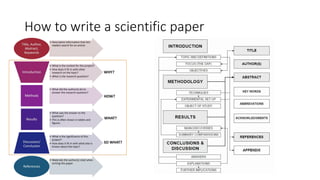
How to write a scientific paper
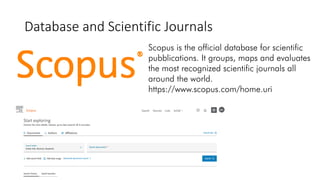
Database and Scientific Journals
Scopus is the official database for scientific
pubblications. It groups, maps and evaluates
the most recognized scientific journals all
around the world.
https://www.scopus.com/home.uri
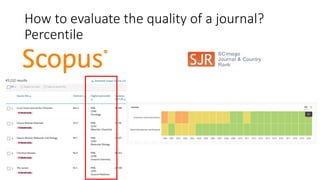
How to evaluate the quality of a journal?
Percentile
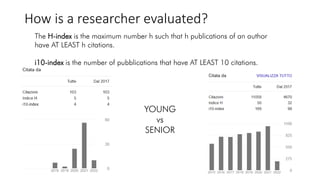
How is a researcher evaluated?
The H-index is the maximum number h such that h publications of an author
have AT LEAST h citations.
i10-index is the number of pubblications that have AT LEAST 10 citations.
YOUNG
vs
SENIOR
How is a researcher evaluated?
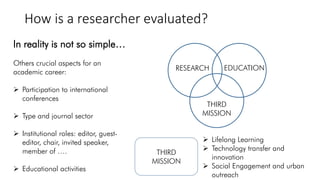
In reality is not so simple…
Others crucial aspects for an
academic career:
 Participation to international
conferences
 Type and journal sector
 Institutional roles: editor, guest-
editor, chair, invited speaker,
member of ….
 Educational activities
RESEARCH EDUCATION
THIRD
MISSION
THIRD
MISSION
 Lifelong Learning
 Technology transfer and
innovation
 Social Engagement and urban
outreach
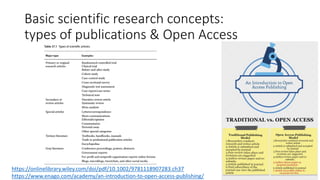
Basic scientific research concepts:
types of publications & Open Access
https://onlinelibrary.wiley.com/doi/pdf/10.1002/9781118907283.ch37
https://www.enago.com/academy/an-introduction-to-open-access-publishing/
Basic scientific research concepts:
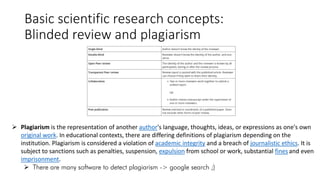
Blinded review and plagiarism
 Plagiarism is the representation of another author's language, thoughts, ideas, or expressions as one's own
original work. In educational contexts, there are differing definitions of plagiarism depending on the
institution. Plagiarism is considered a violation of academic integrity and a breach of journalistic ethics. It is
subject to sanctions such as penalties, suspension, expulsion from school or work, substantial fines and even
imprisonment.
 There are many software to detect plagiarism -> google search ;)
Funny parenthesis:
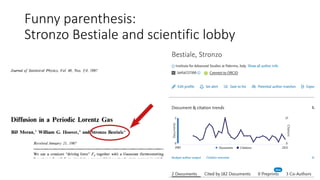
Stronzo Bestiale and scientific lobby
Basic phd survival tools:
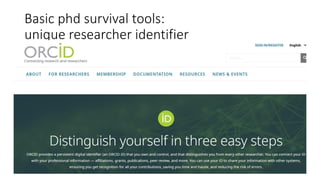
unique researcher identifier
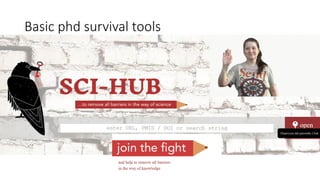
Basic phd survival tools
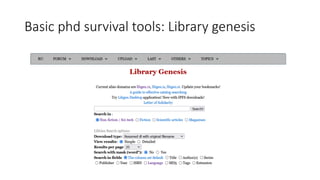
Basic phd survival tools: Library genesis
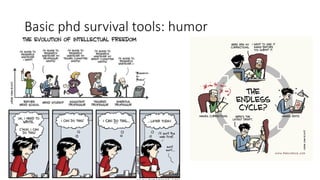
Basic phd survival tools: humor
Thank you for your attention

Introduction to scientific publishing.pdf

  • 1.
    Introduction to scientific publishing Dr.Dario Cottafava dario.cottafava@gmail.com
  • 2.
    How to writea scientific paper
  • 3.
    Database and ScientificJournals Scopus is the official database for scientific pubblications. It groups, maps and evaluates the most recognized scientific journals all around the world. https://www.scopus.com/home.uri
  • 4.
    How to evaluatethe quality of a journal? Percentile
  • 5.
    How is aresearcher evaluated? The H-index is the maximum number h such that h publications of an author have AT LEAST h citations. i10-index is the number of pubblications that have AT LEAST 10 citations. YOUNG vs SENIOR
  • 6.
    How is aresearcher evaluated? In reality is not so simple… Others crucial aspects for an academic career:  Participation to international conferences  Type and journal sector  Institutional roles: editor, guest- editor, chair, invited speaker, member of ….  Educational activities RESEARCH EDUCATION THIRD MISSION THIRD MISSION  Lifelong Learning  Technology transfer and innovation  Social Engagement and urban outreach
  • 7.
    Basic scientific researchconcepts: types of publications & Open Access https://onlinelibrary.wiley.com/doi/pdf/10.1002/9781118907283.ch37 https://www.enago.com/academy/an-introduction-to-open-access-publishing/
  • 8.
    Basic scientific researchconcepts: Blinded review and plagiarism  Plagiarism is the representation of another author's language, thoughts, ideas, or expressions as one's own original work. In educational contexts, there are differing definitions of plagiarism depending on the institution. Plagiarism is considered a violation of academic integrity and a breach of journalistic ethics. It is subject to sanctions such as penalties, suspension, expulsion from school or work, substantial fines and even imprisonment.  There are many software to detect plagiarism -> google search ;)
  • 9.
  • 10.
    Basic phd survivaltools: unique researcher identifier
  • 11.
  • 13.
    Basic phd survivaltools: Library genesis
  • 14.
    Basic phd survivaltools: humor
  • 15.
    Thank you foryour attention