Scala Type Classes
Prateek Gupta
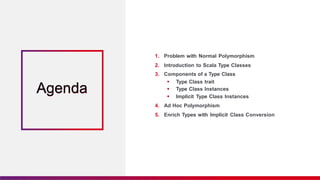
Agenda
1. Problem with Normal Polymorphism
2. Introduction to Scala Type Classes
3. Components of a Type Class
 Type Class trait
 Type Class Instances
 Implicit Type Class Instances
4. Ad Hoc Polymorphism
5. Enrich Types with Implicit Class Conversion
KnolX Etiquettes
Lack of etiquette and manners is a huge turn off.
 Punctuality
Join the session5 minutes prior to the sessionstart time. We start on
time and conclude on time!
 Feedback
Make sure to submit a constructive feedbackfor all sessions as it is very
helpful for the presenter.
 Silent Mode
Keep your mobile devices in silent mode,feel free to move out of session
in case you need to attend an urgent call.
 Avoid Disturbance
Avoid unwanted chit chat during the session.
Problem with Norma
Polymorphism
Problem with Normal Polymorphism
 Traditional polymorphism has limitations:
– Requires inheritance or modifying existing types.
– Difficulty when adding new behaviors to existing types.
 Real-world scenario:
– Adding new serialization formats to existing types.
 Type classes offer a flexible alternative.
ntroduction to
Scala Type Classes
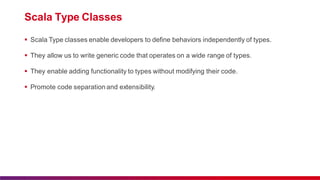
Scala Type Classes
 Scala Type classes enable developers to define behaviors independently of types.
 They allow us to write generic code that operates on a wide range of types.
 They enable adding functionality to types without modifying their code.
 Promote code separation and extensibility.
Components of a Type Class
 Type class trait with abstract methods.
 Instances for different types.
 Implicit resolution mechanism.
Type Class trait
 A type class is represented by a parameterized trait that defines a set of operations.
 The trait itself does not provide any implementations.
Type Class Instances
 Type class instances provide the implementations of the behaviors specified by
the type class trait.
 These instances are created for specific types and define how the behavior works for
those types.
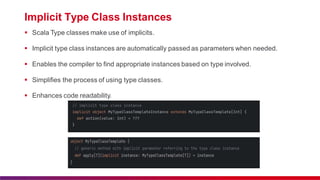
Implicit Type Class Instances
 Scala Type classes make use of implicits.
 Implicit type class instances are automatically passed as parameters when needed.
 Enables the compiler to find appropriate instances based on type involved.
 Simplifies the process of using type classes.
 Enhances code readability.
Ad Hoc Polymorphism
 Type classes enable ad hoc polymorphism.
 Flexible Behavior for the same or across different types.
 Ideal for extending third-party or built-in types.
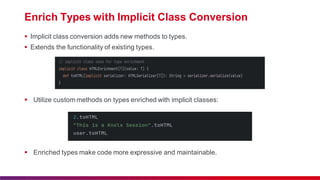
Enrich Types with Implicit Class Conversion
 Implicit class conversion adds new methods to types.
 Extends the functionality of existing types.
 Utilize custom methods on types enriched with implicit classes:
 Enriched types make code more expressive and maintainable.
Recap
Thank you

Introduction to Scala Type Classes Presentation

  • 1.
  • 2.
    Agenda 1. Problem withNormal Polymorphism 2. Introduction to Scala Type Classes 3. Components of a Type Class  Type Class trait  Type Class Instances  Implicit Type Class Instances 4. Ad Hoc Polymorphism 5. Enrich Types with Implicit Class Conversion
  • 3.
    KnolX Etiquettes Lack ofetiquette and manners is a huge turn off.  Punctuality Join the session5 minutes prior to the sessionstart time. We start on time and conclude on time!  Feedback Make sure to submit a constructive feedbackfor all sessions as it is very helpful for the presenter.  Silent Mode Keep your mobile devices in silent mode,feel free to move out of session in case you need to attend an urgent call.  Avoid Disturbance Avoid unwanted chit chat during the session.
  • 4.
  • 5.
    Problem with NormalPolymorphism  Traditional polymorphism has limitations: – Requires inheritance or modifying existing types. – Difficulty when adding new behaviors to existing types.  Real-world scenario: – Adding new serialization formats to existing types.  Type classes offer a flexible alternative.
  • 6.
  • 7.
    Scala Type Classes Scala Type classes enable developers to define behaviors independently of types.  They allow us to write generic code that operates on a wide range of types.  They enable adding functionality to types without modifying their code.  Promote code separation and extensibility.
  • 8.
    Components of aType Class
  • 9.
    Components of aType Class  Type class trait with abstract methods.  Instances for different types.  Implicit resolution mechanism.
  • 10.
    Type Class trait A type class is represented by a parameterized trait that defines a set of operations.  The trait itself does not provide any implementations.
  • 11.
    Type Class Instances Type class instances provide the implementations of the behaviors specified by the type class trait.  These instances are created for specific types and define how the behavior works for those types.
  • 12.
    Implicit Type ClassInstances  Scala Type classes make use of implicits.  Implicit type class instances are automatically passed as parameters when needed.  Enables the compiler to find appropriate instances based on type involved.  Simplifies the process of using type classes.  Enhances code readability.
  • 13.
    Ad Hoc Polymorphism Type classes enable ad hoc polymorphism.  Flexible Behavior for the same or across different types.  Ideal for extending third-party or built-in types.
  • 14.
    Enrich Types withImplicit Class Conversion  Implicit class conversion adds new methods to types.  Extends the functionality of existing types.  Utilize custom methods on types enriched with implicit classes:  Enriched types make code more expressive and maintainable.
  • 15.
  • 16.