Introduction to SAP Signavio Process Transformation Suite
1
TEOMAN SOYTÜRK
Senior Project Manager
https://www.linkedin.com/in/teosoy/
teosoy18@gmail.com
Agenda
Agenda
➢ SAP Signavio Process Transformation Suite
➢ Summary
➢ Agenda
➢ (BPM) Business Process Management
➢ BPM Overview
➢ Three-Level Focus of BPM (on processes)
➢ BPM Goal and BPM Software
➢ Business Process Management Advantages
➢ Benefits of BPM
➢ Process Architecture
➢ Value Chain
➢ Process Areas
➢ End-to-End Processes
➢ Sub-Processes
➢ A Value Chain Example
➢ SAP Signavio
➢ What Is SAP Signavio?
➢ Capabilites of the SAP Signavio
➢ Limited Practice Capabilities with SAP Signavio Trial
➢ SAP Activate Accelarator v3.4 in SAP Signavio
➢ SAP Activate Accelerator Installed in My Workspace
➢ SAP Activate Accelerator Dictionary Entries
➢ Links to SAP Activate-New Implementation & System
Conversion Diagrams
➢ Access Limitations
➢ References
Agenda
2
Agenda
Agenda
(BPM) Business Process Management
3
Agenda
Agenda
BPM Overview
4
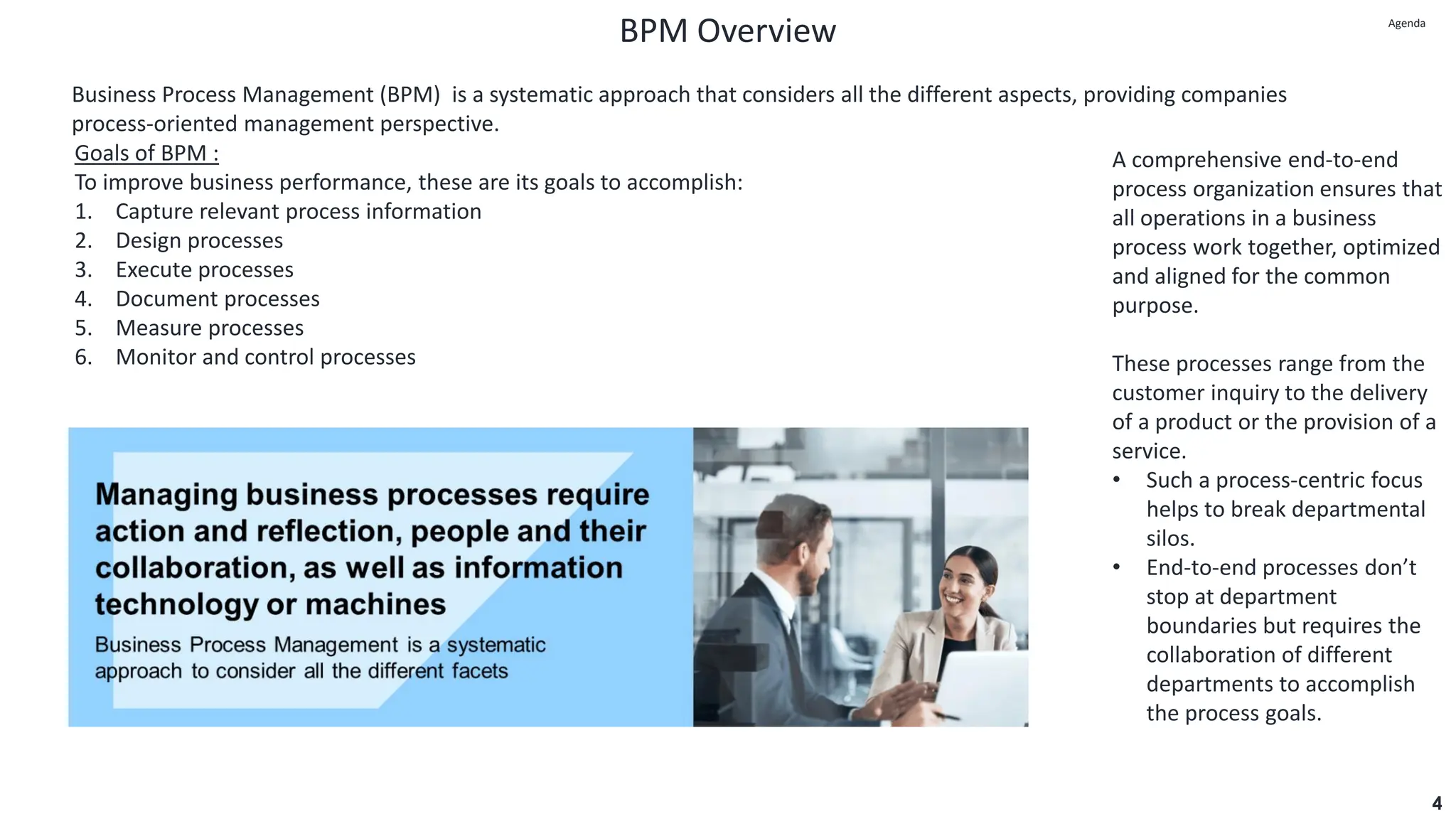
Business Process Management (BPM) is a systematic approach that considers all the different aspects, providing companies
process-oriented management perspective.
A comprehensive end-to-end
process organization ensures that
all operations in a business
process work together, optimized
and aligned for the common
purpose.
These processes range from the
customer inquiry to the delivery
of a product or the provision of a
service.
• Such a process-centric focus
helps to break departmental
silos.
• End-to-end processes don’t
stop at department
boundaries but requires the
collaboration of different
departments to accomplish
the process goals.
Goals of BPM :
To improve business performance, these are its goals to accomplish:
1. Capture relevant process information
2. Design processes
3. Execute processes
4. Document processes
5. Measure processes
6. Monitor and control processes
Agenda
Agenda
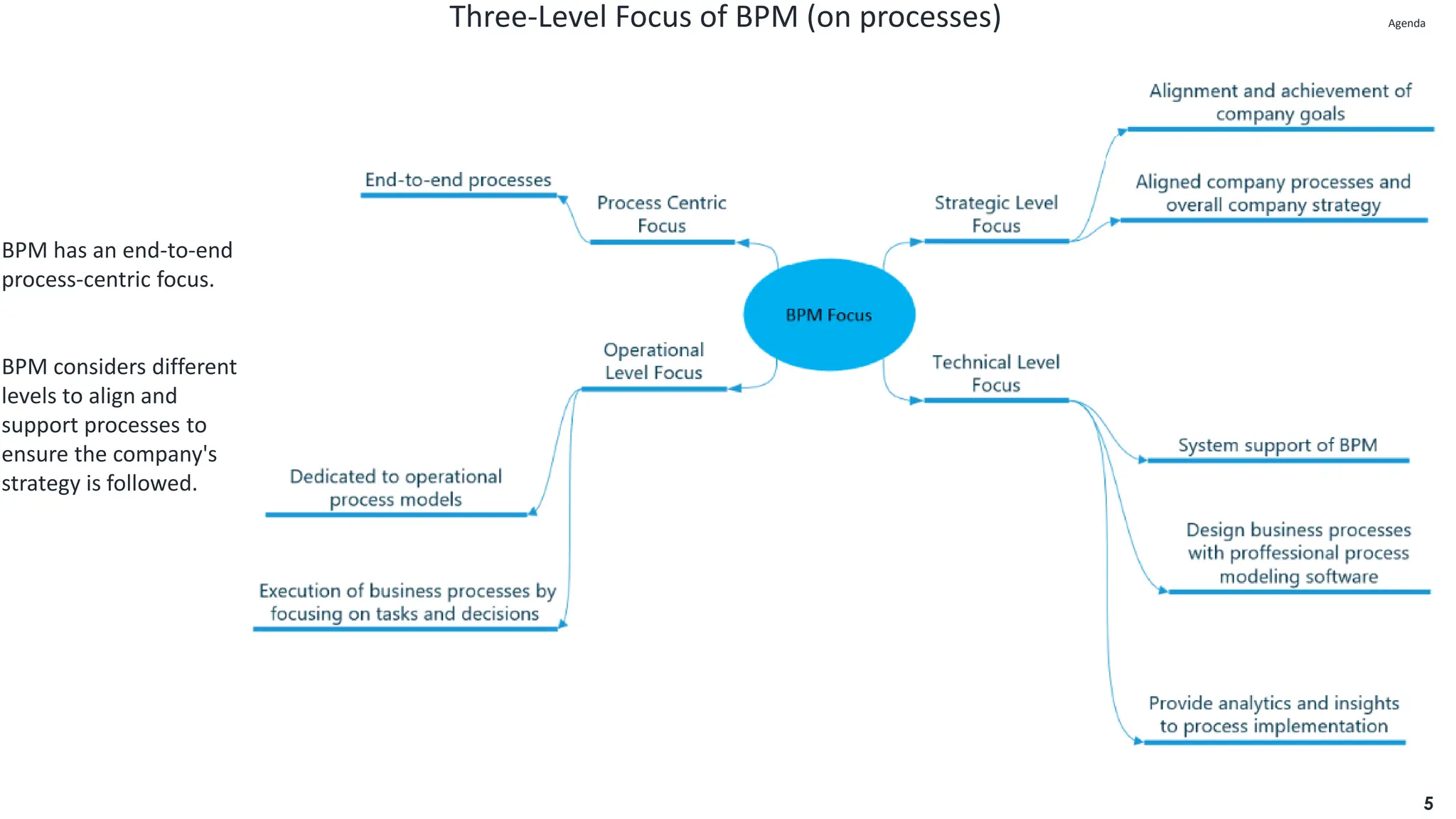
Three-Level Focus of BPM (on processes)
5
BPM has an end-to-end
process-centric focus.
BPM considers different
levels to align and
support processes to
ensure the company's
strategy is followed.
Agenda
Agenda
BPM Goal and BPM Software
6
The overall goal of business process management is to improve business performance. This can only be achieved by using a BPM
software solution (e.g. SAP Signavio Process Manager), which provides features to structure, model, and analyze business processe
Process Management Software Requirements:
A good BPM software solution supports process management with:
• A central object repository for reusing the same business terms across all processes
• A (folder) structure to store and find processes
• A reporting functionality, which aggregates all information on selected processes
• A version control of processes if changes need to be reversed
• A diagram comparison (As-Is vs. To-Be comparison)
• Collaboration / commenting features to get feedback and collaborate on processes
• Functionality to capture additional information on processes and tasks, like risks &
controls.
Agenda
Agenda
Business Process Management Advantages
7
In which business areas can a good BPM help?
Successfully applied, BPM can improve business operations and create
a company-wide understanding of end-to-end processes. This leads to
an increased transparency of those business operations, process
comprehension and better and directed communication across
departmental boundaries.
There are three process-related areas, which are in focus for BPM:
1) Process Improvement
• Identify pain points and tasks in a process that require
improvement
• Identify the right stakeholders of a process and evaluate areas
for improvements together
• Prepare the change / training for process participants
2) Process Transparency
• Modelling and designing processes, thus information grasped at
a glance. Structuring processes
• Providing drill-down navigation from the value chain to the
actual process
• In practice, very often a certain level of process transparency is
required for external certification, compliance with risk
management, and regulations.
3) Process Implementation
• Implement processes into the company process structure (value
chain)
• Publish them to all internal employees (in a process portal, like SAP
Signavio Process Collaboration Hub
• Automate tasks/processes which have been done manually before
Agenda
Agenda
Benefits of BPM
8
If applied correctly, BPM provides huge benefits to companies. Here are the top seven:
1) Agility
The design of processes is quite flexible. Based on necessary changes to adjust to market needs, the impacted processes can be identified quickly due to high
process transparency.
2) Productivity
Process improvements like removal of bottlenecks, parallel processing and elimination of redundant steps can be easily achieved with BPM.
3) Efficiency & Reduced Risks
The visibility of processes allows focusing on inefficiencies. This includes also checking uncovered risks and controls on certain tasks in a process - and adding
them where necessary.
4) Compliance & Transparency
BPM ensures that organizations can implement regulatory requirements quickly. Compliance can be integrated easily into the process lifecycle, as visualized
processes also reveal potential (or uncovered) risks.
5) Employee Satisfaction
BPM allows employees to focus 100% on their work as process automation cuts down a lot of repetitive work and makes it easier to access information.
6) Measurability
Due to its end-to-end process focus, processes can be compared to an expected result. This helps to streamline and quantify how well a process supports the
operational business.
7) Technology Integration
BPM software solutions bridge the gap between IT and business users, thanks to process modeling standards like BPMN 2.0. The focus is not only on integrating
systems applications anymore but equally on processes along with applications to accomplish the overall process goal.
Agenda
Agenda
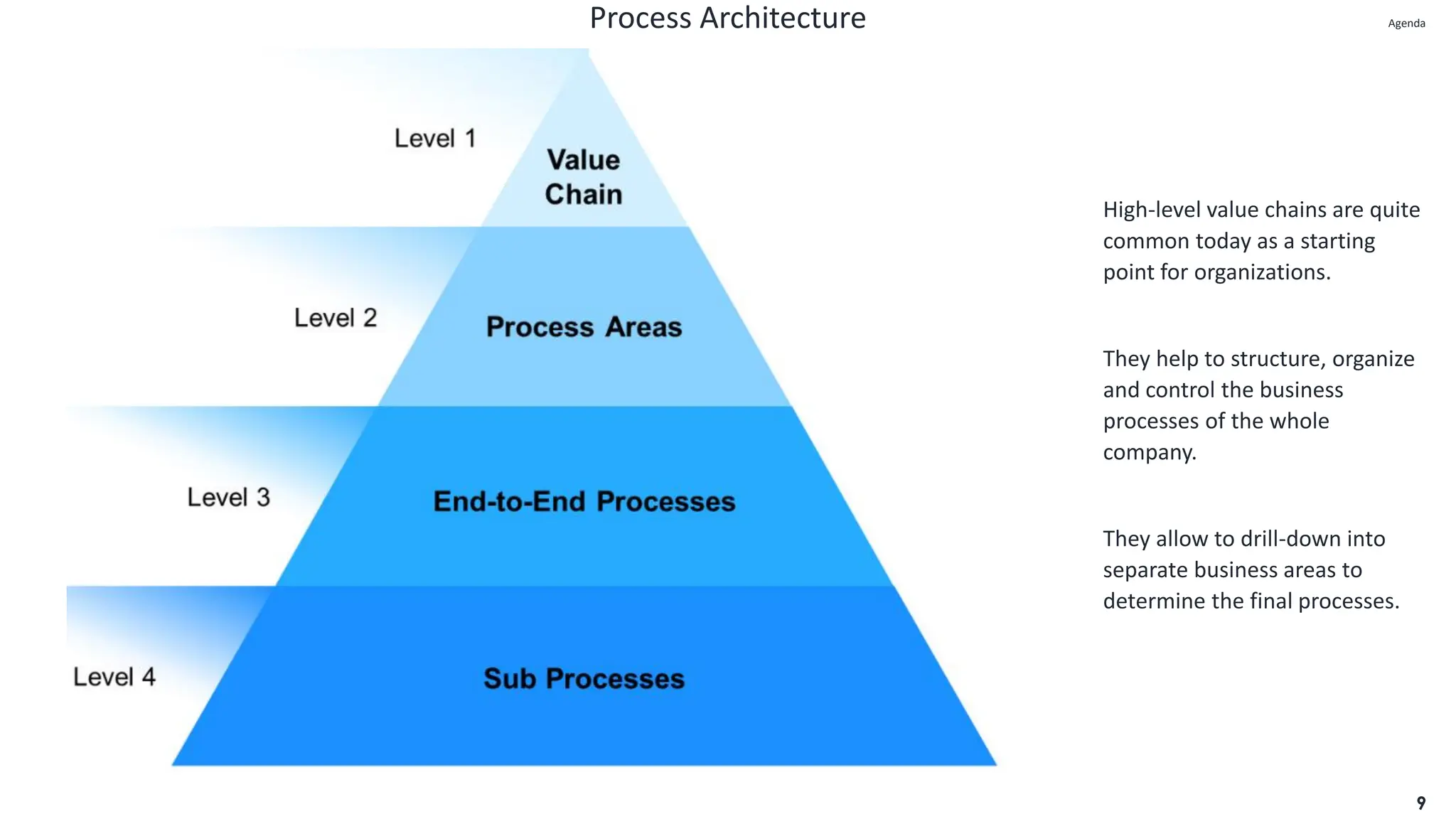
Process Architecture
9
High-level value chains are quite
common today as a starting
point for organizations.
They help to structure, organize
and control the business
processes of the whole
company.
They allow to drill-down into
separate business areas to
determine the final processes.
Agenda
Agenda
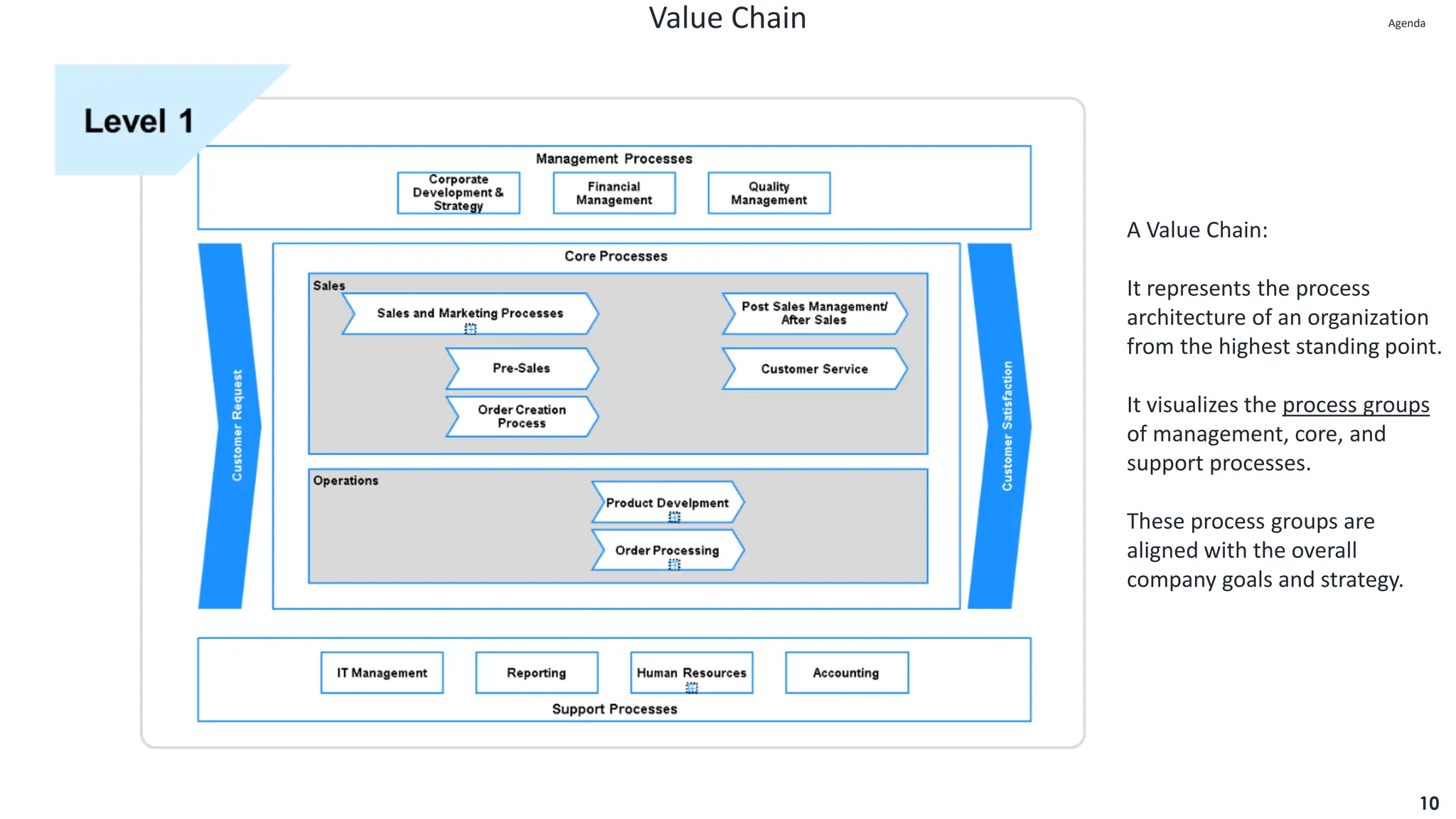
Value Chain
10
A Value Chain:
It represents the process
architecture of an organization
from the highest standing point.
It visualizes the process groups
of management, core, and
support processes.
These process groups are
aligned with the overall
company goals and strategy.
Agenda
Agenda
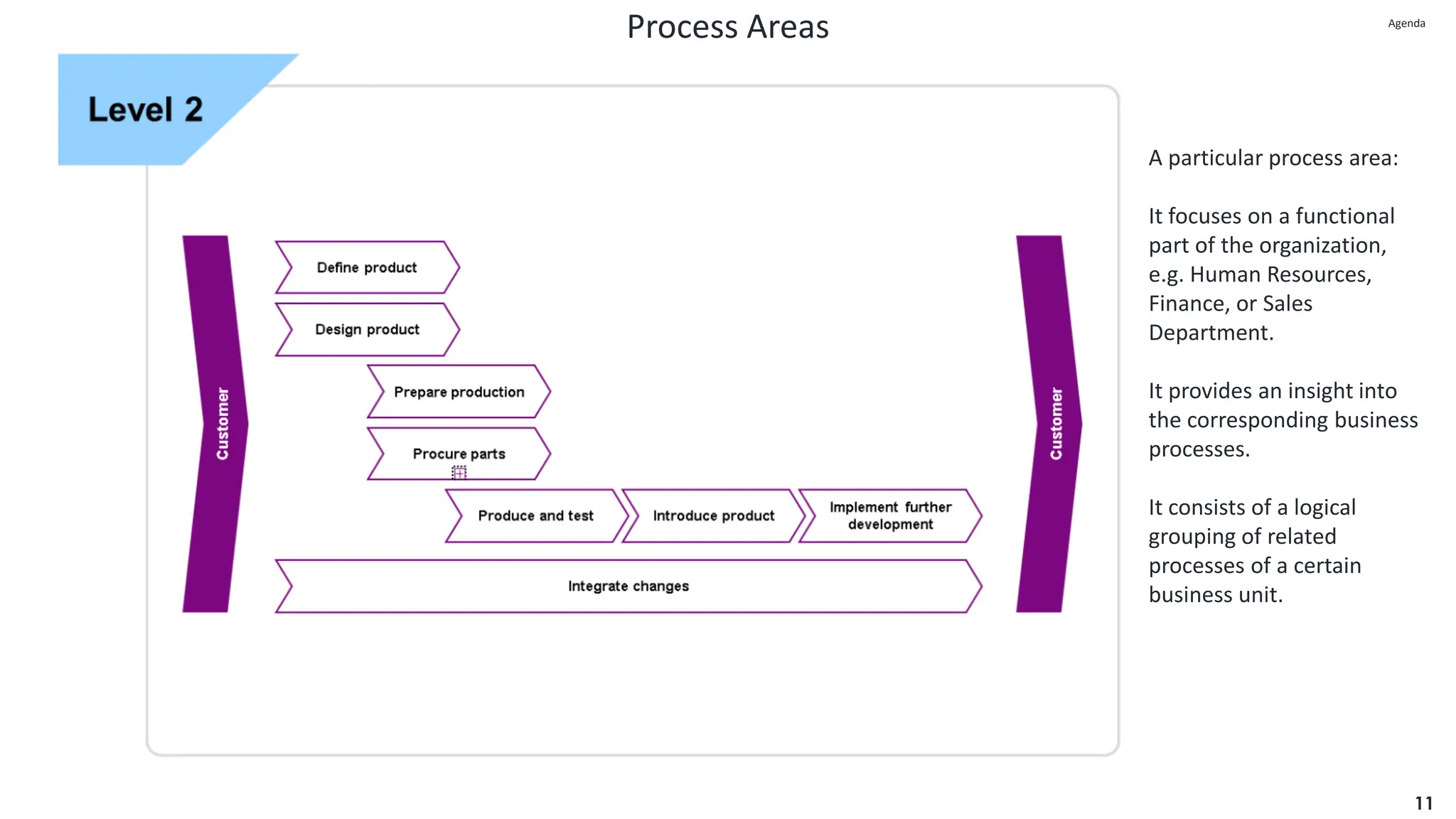
Process Areas
11
A particular process area:
It focuses on a functional
part of the organization,
e.g. Human Resources,
Finance, or Sales
Department.
It provides an insight into
the corresponding business
processes.
It consists of a logical
grouping of related
processes of a certain
business unit.
Agenda
Agenda
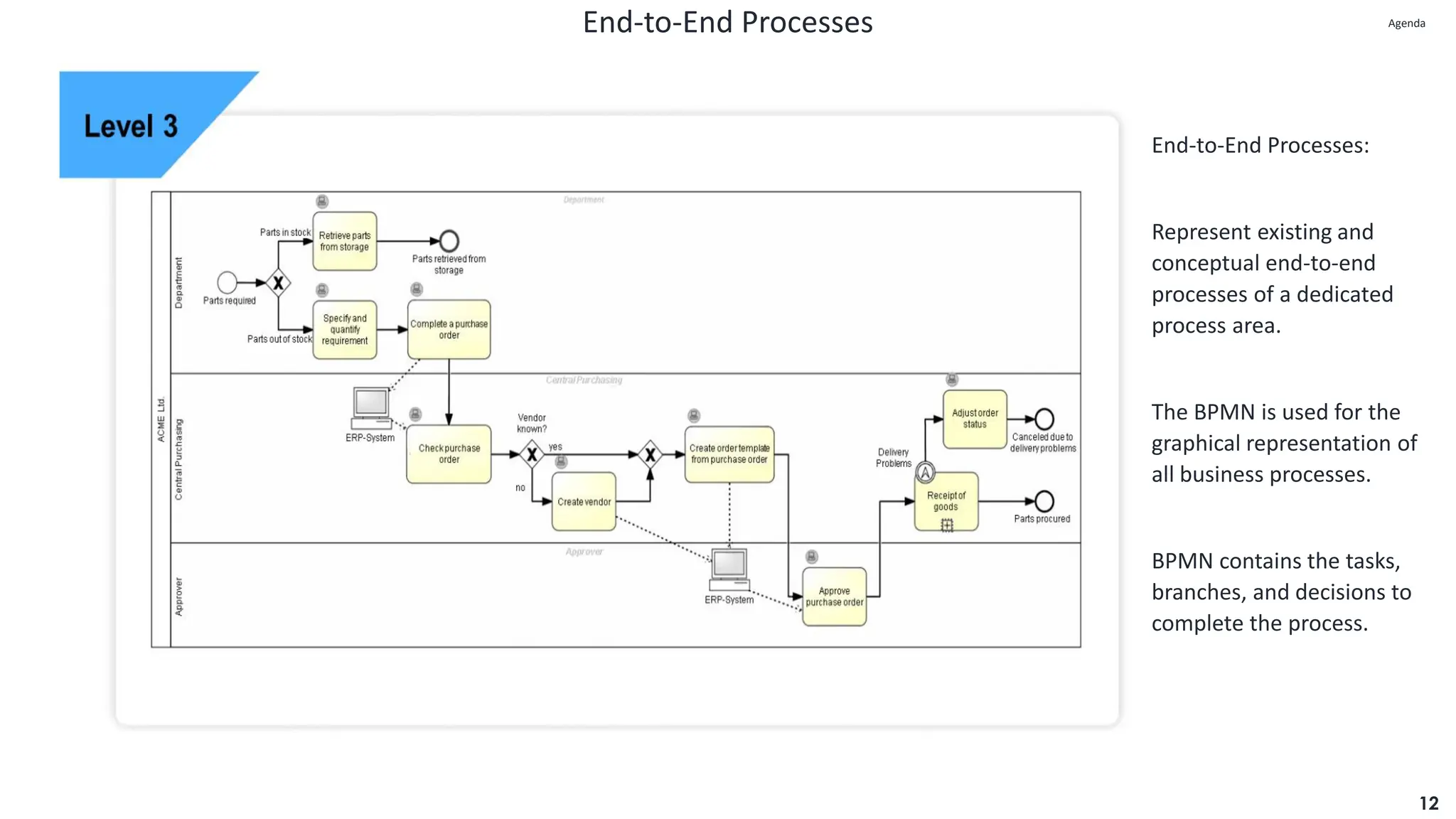
End-to-End Processes
12
End-to-End Processes:
Represent existing and
conceptual end-to-end
processes of a dedicated
process area.
The BPMN is used for the
graphical representation of
all business processes.
BPMN contains the tasks,
branches, and decisions to
complete the process.
Agenda
Agenda
Sub-Processes
13
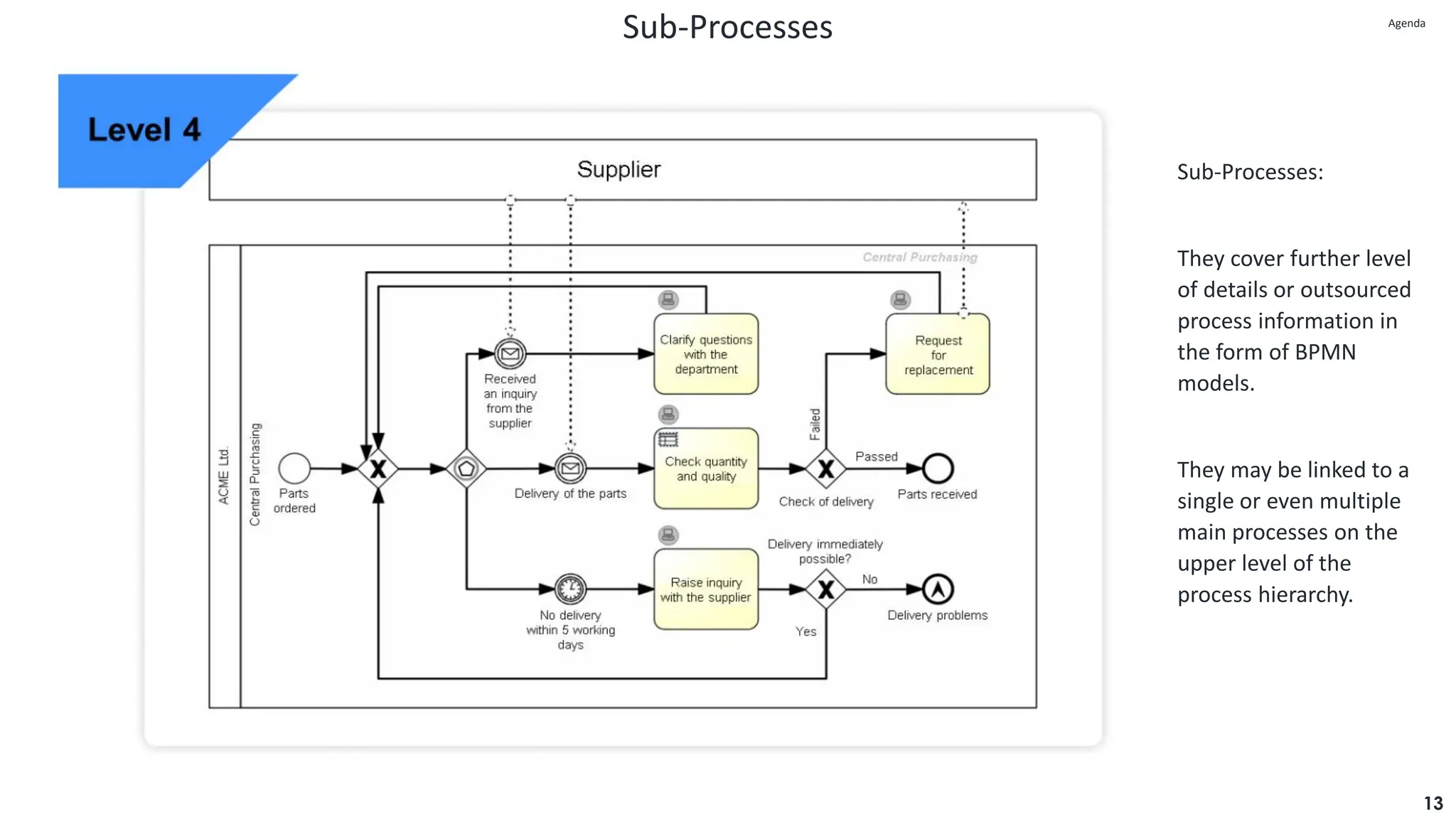
Sub-Processes:
They cover further level
of details or outsourced
process information in
the form of BPMN
models.
They may be linked to a
single or even multiple
main processes on the
upper level of the
process hierarchy.
Agenda
Agenda
A Value Chain Example
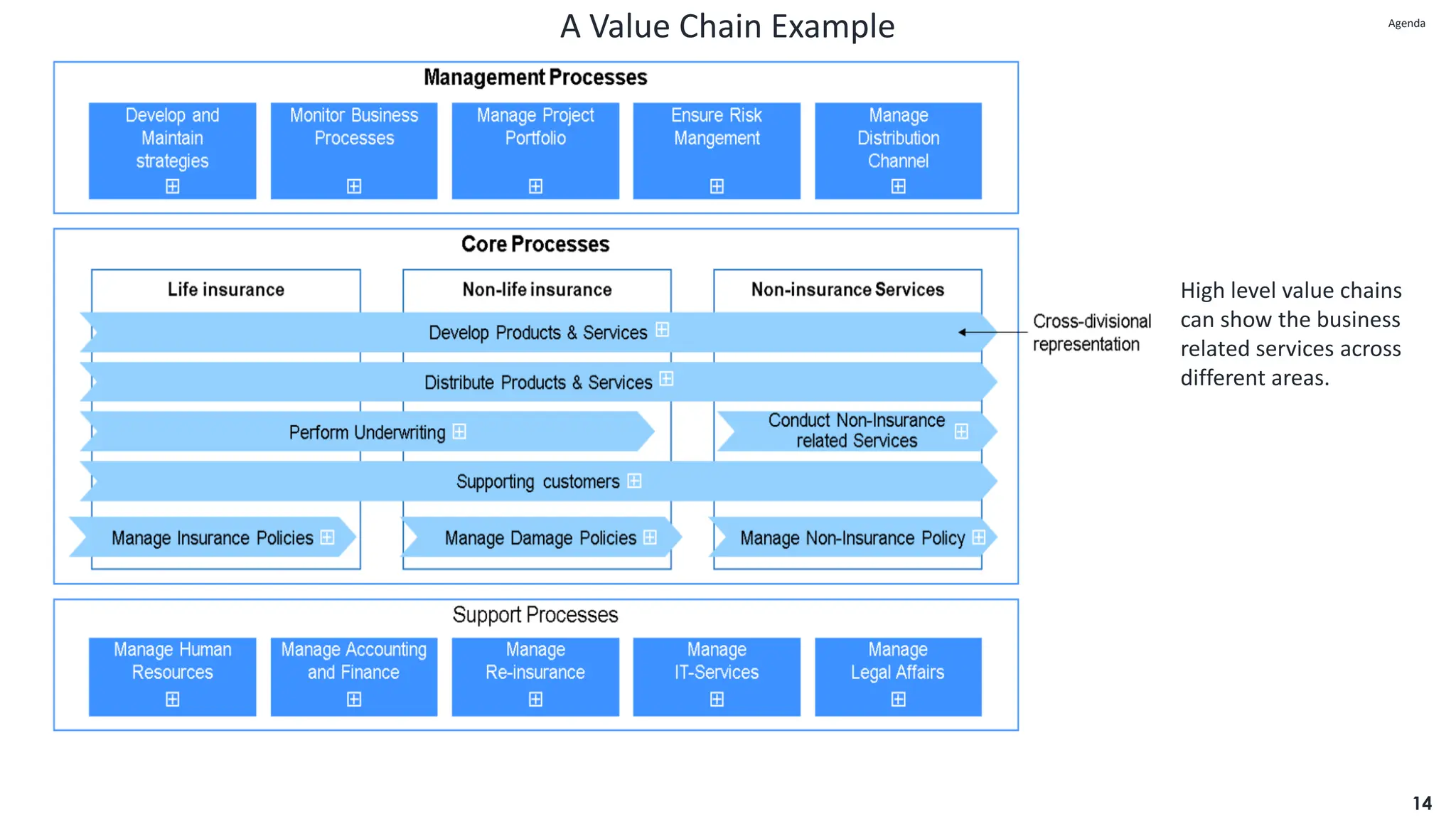
14
High level value chains
can show the business
related services across
different areas.
Agenda
Agenda
SAP Signavio
15
Agenda
Agenda
What Is SAP Signavio?
16
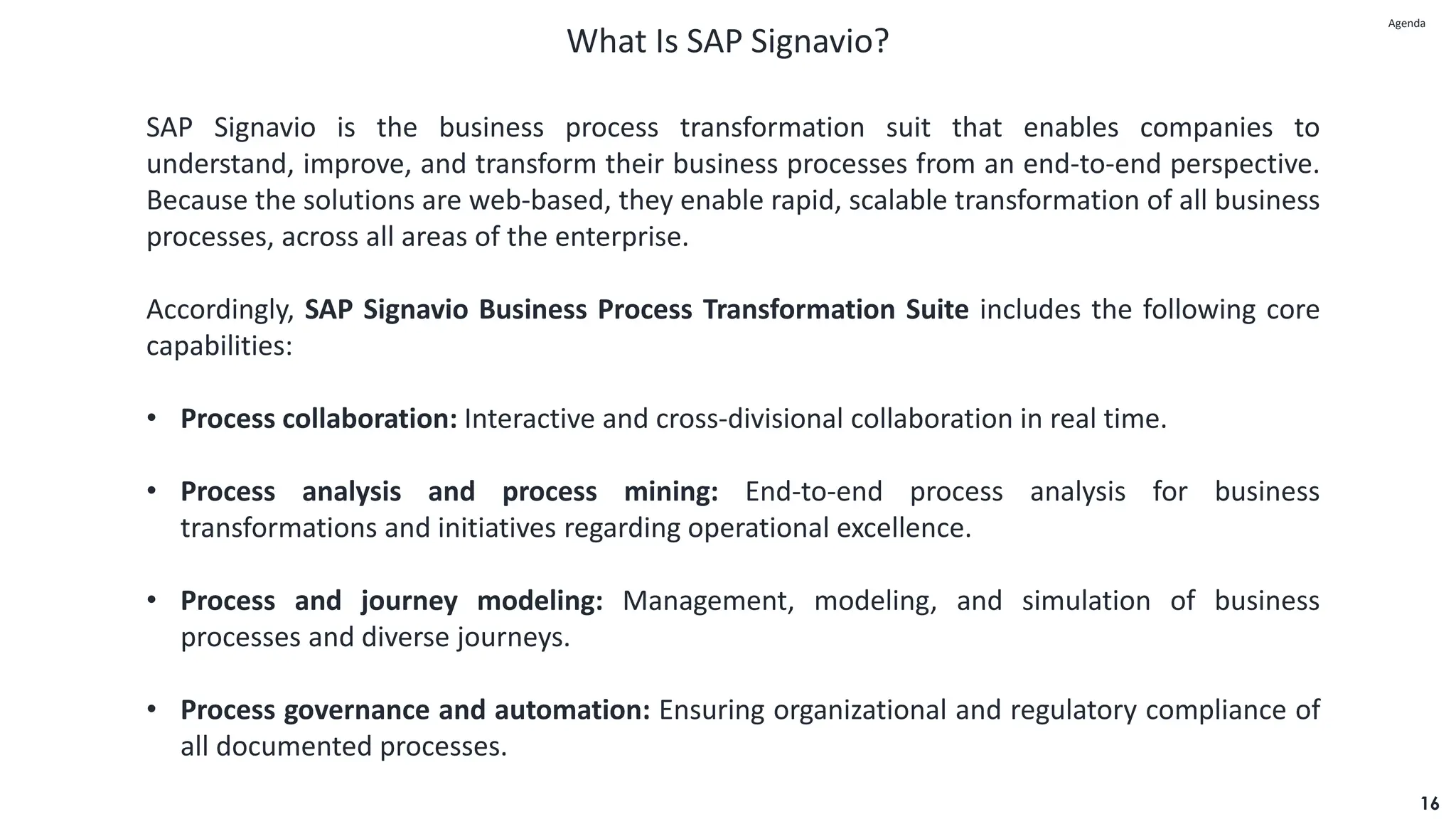
SAP Signavio is the business process transformation suit that enables companies to
understand, improve, and transform their business processes from an end-to-end perspective.
Because the solutions are web-based, they enable rapid, scalable transformation of all business
processes, across all areas of the enterprise.
Accordingly, SAP Signavio Business Process Transformation Suite includes the following core
capabilities:
• Process collaboration: Interactive and cross-divisional collaboration in real time.
• Process analysis and process mining: End-to-end process analysis for business
transformations and initiatives regarding operational excellence.
• Process and journey modeling: Management, modeling, and simulation of business
processes and diverse journeys.
• Process governance and automation: Ensuring organizational and regulatory compliance of
all documented processes.
Agenda
Agenda
Capabilites of the SAP Signavio
17
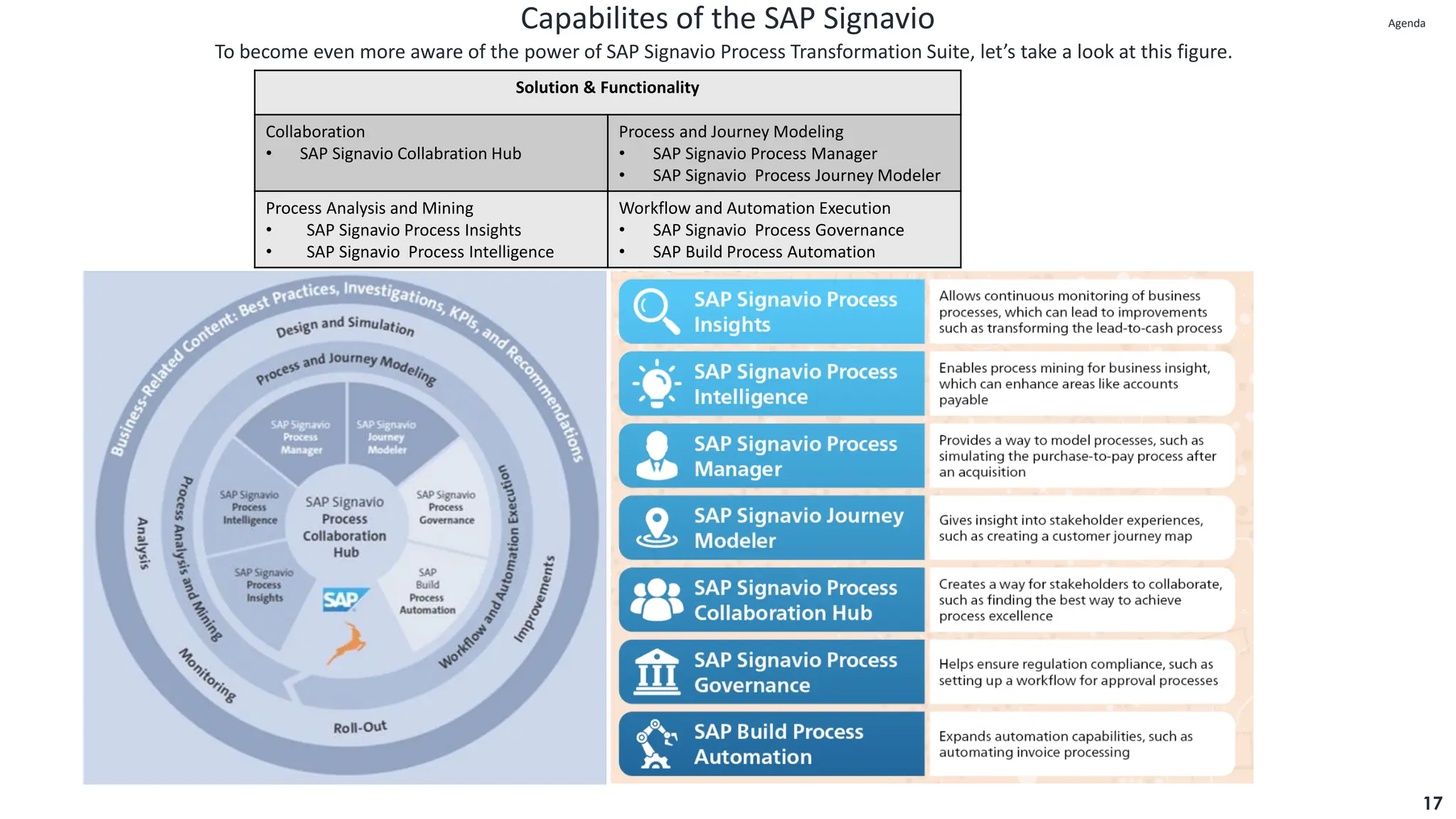
To become even more aware of the power of SAP Signavio Process Transformation Suite, let’s take a look at this figure.
Solution & Functionality
Collaboration
• SAP Signavio Collabration Hub
Process and Journey Modeling
• SAP Signavio Process Manager
• SAP Signavio Process Journey Modeler
Process Analysis and Mining
• SAP Signavio Process Insights
• SAP Signavio Process Intelligence
Workflow and Automation Execution
• SAP Signavio Process Governance
• SAP Build Process Automation
Agenda
Agenda
THANK YOU
TEOMAN SOYTÜRK
+90 0505 680 12 92
https://www.linkedin.com/in/teosoy/
teosoy18@gmail.com
Agenda
Agenda
18

Introduction to SAP Signavio Buiness Transformation Suite

  • 1.
    Introduction to SAPSignavio Process Transformation Suite 1 TEOMAN SOYTÜRK Senior Project Manager https://www.linkedin.com/in/teosoy/ teosoy18@gmail.com Agenda Agenda
  • 2.
    ➢ SAP SignavioProcess Transformation Suite ➢ Summary ➢ Agenda ➢ (BPM) Business Process Management ➢ BPM Overview ➢ Three-Level Focus of BPM (on processes) ➢ BPM Goal and BPM Software ➢ Business Process Management Advantages ➢ Benefits of BPM ➢ Process Architecture ➢ Value Chain ➢ Process Areas ➢ End-to-End Processes ➢ Sub-Processes ➢ A Value Chain Example ➢ SAP Signavio ➢ What Is SAP Signavio? ➢ Capabilites of the SAP Signavio ➢ Limited Practice Capabilities with SAP Signavio Trial ➢ SAP Activate Accelarator v3.4 in SAP Signavio ➢ SAP Activate Accelerator Installed in My Workspace ➢ SAP Activate Accelerator Dictionary Entries ➢ Links to SAP Activate-New Implementation & System Conversion Diagrams ➢ Access Limitations ➢ References Agenda 2 Agenda Agenda
  • 3.
    (BPM) Business ProcessManagement 3 Agenda Agenda
  • 4.
    BPM Overview 4 Business ProcessManagement (BPM) is a systematic approach that considers all the different aspects, providing companies process-oriented management perspective. A comprehensive end-to-end process organization ensures that all operations in a business process work together, optimized and aligned for the common purpose. These processes range from the customer inquiry to the delivery of a product or the provision of a service. • Such a process-centric focus helps to break departmental silos. • End-to-end processes don’t stop at department boundaries but requires the collaboration of different departments to accomplish the process goals. Goals of BPM : To improve business performance, these are its goals to accomplish: 1. Capture relevant process information 2. Design processes 3. Execute processes 4. Document processes 5. Measure processes 6. Monitor and control processes Agenda Agenda
  • 5.
    Three-Level Focus ofBPM (on processes) 5 BPM has an end-to-end process-centric focus. BPM considers different levels to align and support processes to ensure the company's strategy is followed. Agenda Agenda
  • 6.
    BPM Goal andBPM Software 6 The overall goal of business process management is to improve business performance. This can only be achieved by using a BPM software solution (e.g. SAP Signavio Process Manager), which provides features to structure, model, and analyze business processe Process Management Software Requirements: A good BPM software solution supports process management with: • A central object repository for reusing the same business terms across all processes • A (folder) structure to store and find processes • A reporting functionality, which aggregates all information on selected processes • A version control of processes if changes need to be reversed • A diagram comparison (As-Is vs. To-Be comparison) • Collaboration / commenting features to get feedback and collaborate on processes • Functionality to capture additional information on processes and tasks, like risks & controls. Agenda Agenda
  • 7.
    Business Process ManagementAdvantages 7 In which business areas can a good BPM help? Successfully applied, BPM can improve business operations and create a company-wide understanding of end-to-end processes. This leads to an increased transparency of those business operations, process comprehension and better and directed communication across departmental boundaries. There are three process-related areas, which are in focus for BPM: 1) Process Improvement • Identify pain points and tasks in a process that require improvement • Identify the right stakeholders of a process and evaluate areas for improvements together • Prepare the change / training for process participants 2) Process Transparency • Modelling and designing processes, thus information grasped at a glance. Structuring processes • Providing drill-down navigation from the value chain to the actual process • In practice, very often a certain level of process transparency is required for external certification, compliance with risk management, and regulations. 3) Process Implementation • Implement processes into the company process structure (value chain) • Publish them to all internal employees (in a process portal, like SAP Signavio Process Collaboration Hub • Automate tasks/processes which have been done manually before Agenda Agenda
  • 8.
    Benefits of BPM 8 Ifapplied correctly, BPM provides huge benefits to companies. Here are the top seven: 1) Agility The design of processes is quite flexible. Based on necessary changes to adjust to market needs, the impacted processes can be identified quickly due to high process transparency. 2) Productivity Process improvements like removal of bottlenecks, parallel processing and elimination of redundant steps can be easily achieved with BPM. 3) Efficiency & Reduced Risks The visibility of processes allows focusing on inefficiencies. This includes also checking uncovered risks and controls on certain tasks in a process - and adding them where necessary. 4) Compliance & Transparency BPM ensures that organizations can implement regulatory requirements quickly. Compliance can be integrated easily into the process lifecycle, as visualized processes also reveal potential (or uncovered) risks. 5) Employee Satisfaction BPM allows employees to focus 100% on their work as process automation cuts down a lot of repetitive work and makes it easier to access information. 6) Measurability Due to its end-to-end process focus, processes can be compared to an expected result. This helps to streamline and quantify how well a process supports the operational business. 7) Technology Integration BPM software solutions bridge the gap between IT and business users, thanks to process modeling standards like BPMN 2.0. The focus is not only on integrating systems applications anymore but equally on processes along with applications to accomplish the overall process goal. Agenda Agenda
  • 9.
    Process Architecture 9 High-level valuechains are quite common today as a starting point for organizations. They help to structure, organize and control the business processes of the whole company. They allow to drill-down into separate business areas to determine the final processes. Agenda Agenda
  • 10.
    Value Chain 10 A ValueChain: It represents the process architecture of an organization from the highest standing point. It visualizes the process groups of management, core, and support processes. These process groups are aligned with the overall company goals and strategy. Agenda Agenda
  • 11.
    Process Areas 11 A particularprocess area: It focuses on a functional part of the organization, e.g. Human Resources, Finance, or Sales Department. It provides an insight into the corresponding business processes. It consists of a logical grouping of related processes of a certain business unit. Agenda Agenda
  • 12.
    End-to-End Processes 12 End-to-End Processes: Representexisting and conceptual end-to-end processes of a dedicated process area. The BPMN is used for the graphical representation of all business processes. BPMN contains the tasks, branches, and decisions to complete the process. Agenda Agenda
  • 13.
    Sub-Processes 13 Sub-Processes: They cover furtherlevel of details or outsourced process information in the form of BPMN models. They may be linked to a single or even multiple main processes on the upper level of the process hierarchy. Agenda Agenda
  • 14.
    A Value ChainExample 14 High level value chains can show the business related services across different areas. Agenda Agenda
  • 15.
  • 16.
    What Is SAPSignavio? 16 SAP Signavio is the business process transformation suit that enables companies to understand, improve, and transform their business processes from an end-to-end perspective. Because the solutions are web-based, they enable rapid, scalable transformation of all business processes, across all areas of the enterprise. Accordingly, SAP Signavio Business Process Transformation Suite includes the following core capabilities: • Process collaboration: Interactive and cross-divisional collaboration in real time. • Process analysis and process mining: End-to-end process analysis for business transformations and initiatives regarding operational excellence. • Process and journey modeling: Management, modeling, and simulation of business processes and diverse journeys. • Process governance and automation: Ensuring organizational and regulatory compliance of all documented processes. Agenda Agenda
  • 17.
    Capabilites of theSAP Signavio 17 To become even more aware of the power of SAP Signavio Process Transformation Suite, let’s take a look at this figure. Solution & Functionality Collaboration • SAP Signavio Collabration Hub Process and Journey Modeling • SAP Signavio Process Manager • SAP Signavio Process Journey Modeler Process Analysis and Mining • SAP Signavio Process Insights • SAP Signavio Process Intelligence Workflow and Automation Execution • SAP Signavio Process Governance • SAP Build Process Automation Agenda Agenda
  • 18.
    THANK YOU TEOMAN SOYTÜRK +900505 680 12 92 https://www.linkedin.com/in/teosoy/ teosoy18@gmail.com Agenda Agenda 18