Warmer – Self-Introduction
[20 mins]
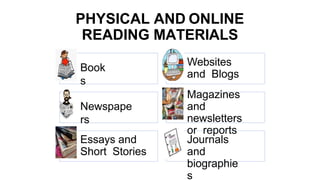
PHYSICAL AND ONLINE
READING MATERIALS
Book
s
Websites
and Blogs
Newspape
rs
Magazines
and
newsletters
or reports
Essays and
Short Stories
Journals
and
biographie
s
01
02
03
04
05
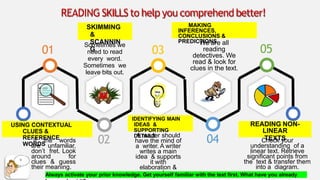
READINGSKILLSto help you comprehendbetter!
USING CONTEXTUAL
CLUES &
REFERENCE
WORDS
If the words
are unfamiliar,
don’t fret. Look
around for
clues & guess
their meaning.
SKIMMING
&
SCANNIN
G
Sometimes we
need to read
every word.
Sometimes we
leave bits out.
IDENTIFYING MAIN
IDEAS &
SUPPORTING
DETAILS
A reader should
have the mind of
a writer. A writer
writes a main
idea & supports
it with
elaboration &
examples.
MAKING
INFERENCES,
CONCLUSIONS &
PREDICTIONS
We are all
reading
detectives. We
read & look for
clues in the text.
READING NON-
LINEAR
TEXTS
Check your
understanding of a
linear text. Retrieve
significant points from
the text & transfer them
into a diagram.
Always activate your prior knowledge. Get yourself familiar with the text first. What have you already
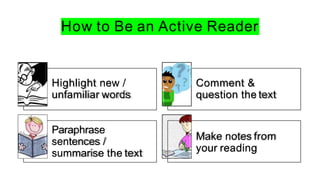
How to Be an Active Reader
Highlight new /
unfamiliar words
Paraphrase
sentences /
summarise the text
Comment &
question the text
Make notes from
your reading
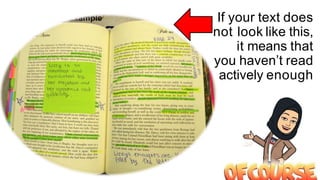
If your text does
not look like this,
it means that
you haven’t read
actively enough
Let’s do something….
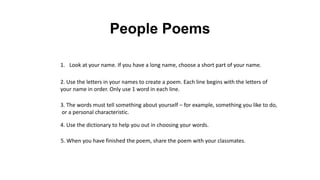
People Poems
1. Look at your name. If you have a long name, choose a short part of your name.
2. Use the letters in your names to create a poem. Each line begins with the letters of
your name in order. Only use 1 word in each line.
3. The words must tell something about yourself – for example, something you like to do,
or a personal characteristic.
4. Use the dictionary to help you out in choosing your words.
5. When you have finished the poem, share the poem with your classmates.

INTRODUCTION TO READING SKILLS FOR BEGINNERS

  • 1.
  • 3.
    PHYSICAL AND ONLINE READINGMATERIALS Book s Websites and Blogs Newspape rs Magazines and newsletters or reports Essays and Short Stories Journals and biographie s
  • 5.
    01 02 03 04 05 READINGSKILLSto help youcomprehendbetter! USING CONTEXTUAL CLUES & REFERENCE WORDS If the words are unfamiliar, don’t fret. Look around for clues & guess their meaning. SKIMMING & SCANNIN G Sometimes we need to read every word. Sometimes we leave bits out. IDENTIFYING MAIN IDEAS & SUPPORTING DETAILS A reader should have the mind of a writer. A writer writes a main idea & supports it with elaboration & examples. MAKING INFERENCES, CONCLUSIONS & PREDICTIONS We are all reading detectives. We read & look for clues in the text. READING NON- LINEAR TEXTS Check your understanding of a linear text. Retrieve significant points from the text & transfer them into a diagram. Always activate your prior knowledge. Get yourself familiar with the text first. What have you already
  • 7.
    How to Bean Active Reader Highlight new / unfamiliar words Paraphrase sentences / summarise the text Comment & question the text Make notes from your reading
  • 8.
    If your textdoes not look like this, it means that you haven’t read actively enough
  • 9.
  • 10.
    People Poems 1. Lookat your name. If you have a long name, choose a short part of your name. 2. Use the letters in your names to create a poem. Each line begins with the letters of your name in order. Only use 1 word in each line. 3. The words must tell something about yourself – for example, something you like to do, or a personal characteristic. 4. Use the dictionary to help you out in choosing your words. 5. When you have finished the poem, share the poem with your classmates.