Introduction to Quantum Computing
from Math perspective
Pavel Belevich
New York Quantum Computing Meetup
March 28, 2018
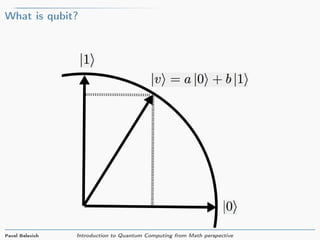
What is qubit?
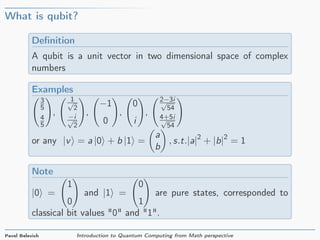
Definition
A qubit is a unit vector in two dimensional space of complex
numbers
Examples
3
5
4
5
,
1√
2
−i√
2
,
−1
0
,
0
i
,
2−3i√
54
4+5i√
54
or any |v = a |0 + b |1 =
a
b
, s.t.|a|2
+ |b|2
= 1
Note
|0 =
1
0
and |1 =
0
1
are pure states, corresponded to
classical bit values "0" and "1".
Pavel Belevich Introduction to Quantum Computing from Math perspective
What is qubit?
Pavel Belevich Introduction to Quantum Computing from Math perspective
Tossing a coin analogy
Tossing coin(“0” is head, “1” is tail) is a perfect analogy of su-
perposition state
Until it’s stopped by observer it is in 50% of “0” and 50% of “1”
state
We need something that is between “0” and “1” or rather some-
thing that is partially “0” and partially “1”
Pavel Belevich Introduction to Quantum Computing from Math perspective
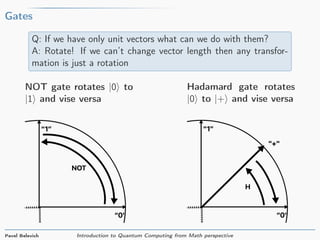
Gates
Q: If we have only unit vectors what can we do with them?
A: Rotate! If we can’t change vector length then any transfor-
mation is just a rotation
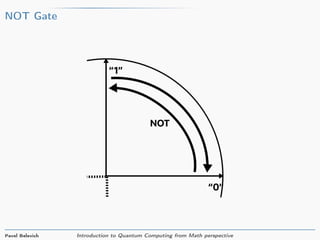
NOT gate rotates |0 to
|1 and vise versa
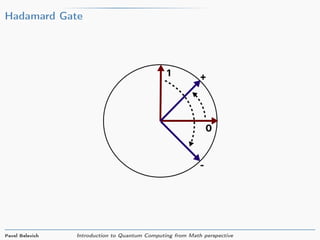
Hadamard gate rotates
|0 to |+ and vise versa
Pavel Belevich Introduction to Quantum Computing from Math perspective
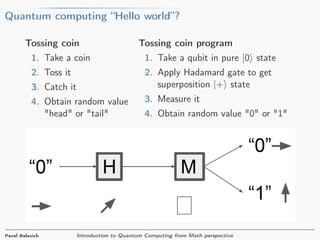
Quantum computing “Hello world”?
Tossing coin
1. Take a coin
2. Toss it
3. Catch it
4. Obtain random value
"head" or "tail"
Tossing coin program
1. Take a qubit in pure |0 state
2. Apply Hadamard gate to get
superposition |+ state
3. Measure it
4. Obtain random value "0" or "1"
Pavel Belevich Introduction to Quantum Computing from Math perspective
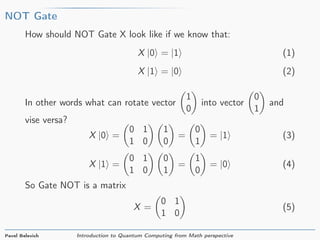
NOT Gate
How should NOT Gate X look like if we know that:
X |0 = |1 (1)
X |1 = |0 (2)
In other words what can rotate vector
1
0
into vector
0
1
and
vise versa?
X |0 =
0 1
1 0
1
0
=
0
1
= |1 (3)
X |1 =
0 1
1 0
0
1
=
1
0
= |0 (4)
So Gate NOT is a matrix
X =
0 1
1 0
(5)
Pavel Belevich Introduction to Quantum Computing from Math perspective
NOT Gate
Pavel Belevich Introduction to Quantum Computing from Math perspective
Hadamard Gate
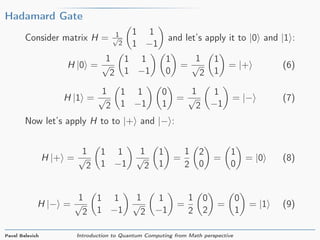
Consider matrix H = 1√
2
1 1
1 −1
and let’s apply it to |0 and |1 :
H |0 =
1
√
2
1 1
1 −1
1
0
=
1
√
2
1
1
= |+ (6)
H |1 =
1
√
2
1 1
1 −1
0
1
=
1
√
2
1
−1
= |− (7)
Now let’s apply H to to |+ and |− :
H |+ =
1
√
2
1 1
1 −1
1
√
2
1
1
=
1
2
2
0
=
1
0
= |0 (8)
H |− =
1
√
2
1 1
1 −1
1
√
2
1
−1
=
1
2
0
2
=
0
1
= |1 (9)
Pavel Belevich Introduction to Quantum Computing from Math perspective
Hadamard Gate
Pavel Belevich Introduction to Quantum Computing from Math perspective
What do we know so far?
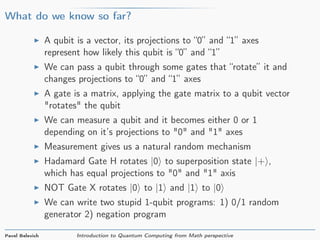
A qubit is a vector, its projections to “0” and “1” axes
represent how likely this qubit is “0” and “1”
We can pass a qubit through some gates that “rotate” it and
changes projections to “0” and “1” axes
A gate is a matrix, applying the gate matrix to a qubit vector
"rotates" the qubit
We can measure a qubit and it becomes either 0 or 1
depending on it’s projections to "0" and "1" axes
Measurement gives us a natural random mechanism
Hadamard Gate H rotates |0 to superposition state |+ ,
which has equal projections to "0" and "1" axis
NOT Gate X rotates |0 to |1 and |1 to |0
We can write two stupid 1-qubit programs: 1) 0/1 random
generator 2) negation program
Pavel Belevich Introduction to Quantum Computing from Math perspective
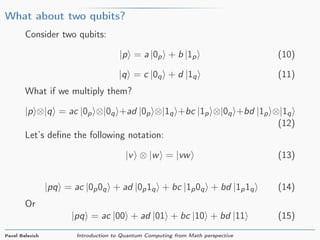
What about two qubits?
Consider two qubits:
|p = a |0p + b |1p (10)
|q = c |0q + d |1q (11)
What if we multiply them?
|p ⊗|q = ac |0p ⊗|0q +ad |0p ⊗|1q +bc |1p ⊗|0q +bd |1p ⊗|1q
(12)
Let’s define the following notation:
|v ⊗ |w = |vw (13)
|pq = ac |0p0q + ad |0p1q + bc |1p0q + bd |1p1q (14)
Or
|pq = ac |00 + ad |01 + bc |10 + bd |11 (15)
Pavel Belevich Introduction to Quantum Computing from Math perspective
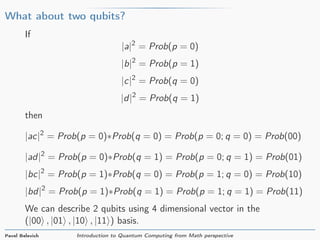
What about two qubits?
If
|a|2
= Prob(p = 0)
|b|2
= Prob(p = 1)
|c|2
= Prob(q = 0)
|d|2
= Prob(q = 1)
then
|ac|2
= Prob(p = 0)∗Prob(q = 0) = Prob(p = 0; q = 0) = Prob(00)
|ad|2
= Prob(p = 0)∗Prob(q = 1) = Prob(p = 0; q = 1) = Prob(01)
|bc|2
= Prob(p = 1)∗Prob(q = 0) = Prob(p = 1; q = 0) = Prob(10)
|bd|2
= Prob(p = 1)∗Prob(q = 1) = Prob(p = 1; q = 1) = Prob(11)
We can describe 2 qubits using 4 dimensional vector in the
(|00 , |01 , |10 , |11 ) basis.
Pavel Belevich Introduction to Quantum Computing from Math perspective
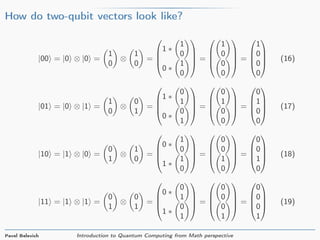
How do two-qubit vectors look like?
|00 = |0 ⊗ |0 =
1
0
⊗
1
0
=




1 ∗
1
0
0 ∗
1
0



 =




1
0
0
0



 =




1
0
0
0



 (16)
|01 = |0 ⊗ |1 =
1
0
⊗
0
1
=




1 ∗
0
1
0 ∗
0
1



 =




0
1
0
0



 =




0
1
0
0



 (17)
|10 = |1 ⊗ |0 =
0
1
⊗
1
0
=




0 ∗
1
0
1 ∗
1
0



 =




0
0
1
0



 =




0
0
1
0



 (18)
|11 = |1 ⊗ |1 =
0
1
⊗
0
1
=




0 ∗
0
1
1 ∗
0
1



 =




0
0
0
1



 =




0
0
0
1



 (19)
Pavel Belevich Introduction to Quantum Computing from Math perspective
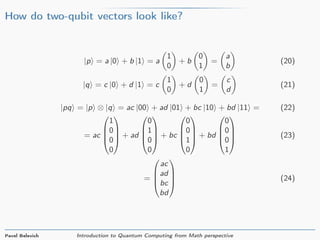
How do two-qubit vectors look like?
|p = a |0 + b |1 = a
1
0
+ b
0
1
=
a
b
(20)
|q = c |0 + d |1 = c
1
0
+ d
0
1
=
c
d
(21)
|pq = |p ⊗ |q = ac |00 + ad |01 + bc |10 + bd |11 = (22)
= ac




1
0
0
0



 + ad




0
1
0
0



 + bc




0
0
1
0



 + bd




0
0
0
1



 (23)
=




ac
ad
bc
bd



 (24)
Pavel Belevich Introduction to Quantum Computing from Math perspective
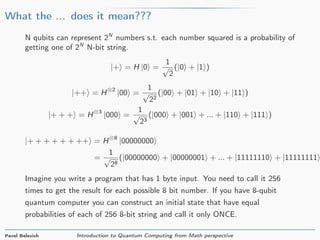
What the ... does it mean???
N qubits can represent 2N
numbers s.t. each number squared is a probability of
getting one of 2N
N-bit string.
|+ = H |0 =
1
√
2
(|0 + |1 )
|++ = H⊗2
|00 =
1
√
22
(|00 + |01 + |10 + |11 )
|+ + + = H⊗3
|000 =
1
√
23
(|000 + |001 + ... + |110 + |111 )
|+ + + + + + ++ = H⊗8
|00000000
=
1
√
28
(|00000000 + |00000001 + ... + |11111110 + |11111111
Imagine you write a program that has 1 byte input. You need to call it 256
times to get the result for each possible 8 bit number. If you have 8-qubit
quantum computer you can construct an initial state that have equal
probabilities of each of 256 8-bit string and call it only ONCE.
Pavel Belevich Introduction to Quantum Computing from Math perspective
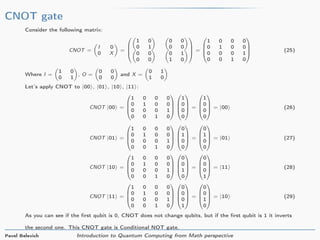
CNOT gate
Consider the following matrix:
CNOT =
I 0
0 X
=




1 0
0 1
0 0
0 0
0 0
0 0
0 1
1 0



 =




1 0 0 0
0 1 0 0
0 0 0 1
0 0 1 0



 (25)
Where I =
1 0
0 1
, O =
0 0
0 0
and X =
0 1
1 0
Let’s apply CNOT to |00 , |01 , |10 , |11 :
CNOT |00 =




1 0 0 0
0 1 0 0
0 0 0 1
0 0 1 0








1
0
0
0



 =




1
0
0
0



 = |00 (26)
CNOT |01 =




1 0 0 0
0 1 0 0
0 0 0 1
0 0 1 0








0
1
0
0



 =




0
1
0
0



 = |01 (27)
CNOT |10 =




1 0 0 0
0 1 0 0
0 0 0 1
0 0 1 0








0
0
1
0



 =




0
0
0
1



 = |11 (28)
CNOT |11 =




1 0 0 0
0 1 0 0
0 0 0 1
0 0 1 0








0
0
0
1



 =




0
0
1
0



 = |10 (29)
As you can see if the first qubit is 0, CNOT does not change qubits, but if the first qubit is 1 it inverts
the second one. This CNOT gate is Conditional NOT gate.
Pavel Belevich Introduction to Quantum Computing from Math perspective
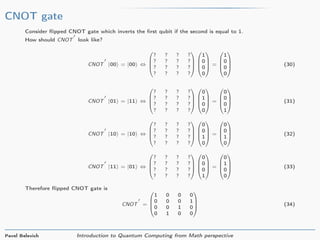
CNOT gate
Consider flipped CNOT gate which inverts the first qubit if the second is equal to 1.
How should CNOT look like?
CNOT |00 = |00 ⇔




? ? ? ?
? ? ? ?
? ? ? ?
? ? ? ?








1
0
0
0



 =




1
0
0
0



 (30)
CNOT |01 = |11 ⇔




? ? ? ?
? ? ? ?
? ? ? ?
? ? ? ?








0
1
0
0



 =




0
0
0
1



 (31)
CNOT |10 = |10 ⇔




? ? ? ?
? ? ? ?
? ? ? ?
? ? ? ?








0
0
1
0



 =




0
0
1
0



 (32)
CNOT |11 = |01 ⇔




? ? ? ?
? ? ? ?
? ? ? ?
? ? ? ?








0
0
0
1



 =




0
1
0
0



 (33)
Therefore flipped CNOT gate is
CNOT =




1 0 0 0
0 0 0 1
0 0 1 0
0 1 0 0



 (34)
Pavel Belevich Introduction to Quantum Computing from Math perspective
SWAP gate
What if we apply CNOT, flipped CNOT and CNOT consequently?
Figure: SWAP circuit [I. Chuang(2004b)]
SWAP =




1 0 0 0
0 1 0 0
0 0 0 1
0 0 1 0








1 0 0 0
0 0 0 1
0 0 1 0
0 1 0 0








1 0 0 0
0 1 0 0
0 0 0 1
0 0 1 0



 =




1 0 0 0
0 0 1 0
0 1 0 0
0 0 0 1




(35)
Pavel Belevich Introduction to Quantum Computing from Math perspective
SWAP gate
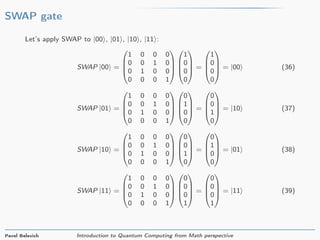
Let’s apply SWAP to |00 , |01 , |10 , |11 :
SWAP |00 =




1 0 0 0
0 0 1 0
0 1 0 0
0 0 0 1








1
0
0
0



 =




1
0
0
0



 = |00 (36)
SWAP |01 =




1 0 0 0
0 0 1 0
0 1 0 0
0 0 0 1








0
1
0
0



 =




0
0
1
0



 = |10 (37)
SWAP |10 =




1 0 0 0
0 0 1 0
0 1 0 0
0 0 0 1








0
0
1
0



 =




0
1
0
0



 = |01 (38)
SWAP |11 =




1 0 0 0
0 0 1 0
0 1 0 0
0 0 0 1








0
0
0
1



 =




0
0
0
1



 = |11 (39)
Pavel Belevich Introduction to Quantum Computing from Math perspective
Creating Bell state
Consider two qubits and let’s apply H to the first and CNOT to both:
Figure: EPR Creation [I. Chuang(2004a)]
CNOT(H ⊗ I) |00 =




1 0 0 0
0 1 0 0
0 0 0 1
0 0 1 0




1
√
2
1 1
1 −1
⊗
1 0
0 1




1
0
0
0




=
1
√
2




1 0 0 0
0 1 0 0
0 0 0 1
0 0 1 0








1 0 1 0
0 1 0 1
1 0 −1 0
0 1 0 −1








1
0
0
0




=
1
√
2




1
0
0
1



 =
1
√
2




1
0
0
0



 +




0
0
0
1



 =
1
√
2
(|00 + |11 )
Pavel Belevich Introduction to Quantum Computing from Math perspective
What is it important?
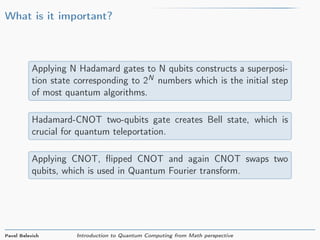
Applying N Hadamard gates to N qubits constructs a superposi-
tion state corresponding to 2N numbers which is the initial step
of most quantum algorithms.
Hadamard-CNOT two-qubits gate creates Bell state, which is
crucial for quantum teleportation.
Applying CNOT, flipped CNOT and again CNOT swaps two
qubits, which is used in Quantum Fourier transform.
Pavel Belevich Introduction to Quantum Computing from Math perspective
References
I. Chuang.
Epr creation, 2004a.
URL https://www.media.mit.edu/quanta/qasm2circ/test1.png.
I. Chuang.
Swap circuit, 2004b.
URL https://www.media.mit.edu/quanta/qasm2circ/test3.png.
Pavel Belevich Introduction to Quantum Computing from Math perspective
Thank you!
Pavel Belevich Introduction to Quantum Computing from Math perspective

Introduction to Quantum Computing from Math perspective

  • 1.
    Introduction to QuantumComputing from Math perspective Pavel Belevich New York Quantum Computing Meetup March 28, 2018
  • 2.
    What is qubit? Definition Aqubit is a unit vector in two dimensional space of complex numbers Examples 3 5 4 5 , 1√ 2 −i√ 2 , −1 0 , 0 i , 2−3i√ 54 4+5i√ 54 or any |v = a |0 + b |1 = a b , s.t.|a|2 + |b|2 = 1 Note |0 = 1 0 and |1 = 0 1 are pure states, corresponded to classical bit values "0" and "1". Pavel Belevich Introduction to Quantum Computing from Math perspective
  • 3.
    What is qubit? PavelBelevich Introduction to Quantum Computing from Math perspective
  • 4.
    Tossing a coinanalogy Tossing coin(“0” is head, “1” is tail) is a perfect analogy of su- perposition state Until it’s stopped by observer it is in 50% of “0” and 50% of “1” state We need something that is between “0” and “1” or rather some- thing that is partially “0” and partially “1” Pavel Belevich Introduction to Quantum Computing from Math perspective
  • 5.
    Gates Q: If wehave only unit vectors what can we do with them? A: Rotate! If we can’t change vector length then any transfor- mation is just a rotation NOT gate rotates |0 to |1 and vise versa Hadamard gate rotates |0 to |+ and vise versa Pavel Belevich Introduction to Quantum Computing from Math perspective
  • 6.
    Quantum computing “Helloworld”? Tossing coin 1. Take a coin 2. Toss it 3. Catch it 4. Obtain random value "head" or "tail" Tossing coin program 1. Take a qubit in pure |0 state 2. Apply Hadamard gate to get superposition |+ state 3. Measure it 4. Obtain random value "0" or "1" Pavel Belevich Introduction to Quantum Computing from Math perspective
  • 7.
    NOT Gate How shouldNOT Gate X look like if we know that: X |0 = |1 (1) X |1 = |0 (2) In other words what can rotate vector 1 0 into vector 0 1 and vise versa? X |0 = 0 1 1 0 1 0 = 0 1 = |1 (3) X |1 = 0 1 1 0 0 1 = 1 0 = |0 (4) So Gate NOT is a matrix X = 0 1 1 0 (5) Pavel Belevich Introduction to Quantum Computing from Math perspective
  • 8.
    NOT Gate Pavel BelevichIntroduction to Quantum Computing from Math perspective
  • 9.
    Hadamard Gate Consider matrixH = 1√ 2 1 1 1 −1 and let’s apply it to |0 and |1 : H |0 = 1 √ 2 1 1 1 −1 1 0 = 1 √ 2 1 1 = |+ (6) H |1 = 1 √ 2 1 1 1 −1 0 1 = 1 √ 2 1 −1 = |− (7) Now let’s apply H to to |+ and |− : H |+ = 1 √ 2 1 1 1 −1 1 √ 2 1 1 = 1 2 2 0 = 1 0 = |0 (8) H |− = 1 √ 2 1 1 1 −1 1 √ 2 1 −1 = 1 2 0 2 = 0 1 = |1 (9) Pavel Belevich Introduction to Quantum Computing from Math perspective
  • 10.
    Hadamard Gate Pavel BelevichIntroduction to Quantum Computing from Math perspective
  • 11.
    What do weknow so far? A qubit is a vector, its projections to “0” and “1” axes represent how likely this qubit is “0” and “1” We can pass a qubit through some gates that “rotate” it and changes projections to “0” and “1” axes A gate is a matrix, applying the gate matrix to a qubit vector "rotates" the qubit We can measure a qubit and it becomes either 0 or 1 depending on it’s projections to "0" and "1" axes Measurement gives us a natural random mechanism Hadamard Gate H rotates |0 to superposition state |+ , which has equal projections to "0" and "1" axis NOT Gate X rotates |0 to |1 and |1 to |0 We can write two stupid 1-qubit programs: 1) 0/1 random generator 2) negation program Pavel Belevich Introduction to Quantum Computing from Math perspective
  • 12.
    What about twoqubits? Consider two qubits: |p = a |0p + b |1p (10) |q = c |0q + d |1q (11) What if we multiply them? |p ⊗|q = ac |0p ⊗|0q +ad |0p ⊗|1q +bc |1p ⊗|0q +bd |1p ⊗|1q (12) Let’s define the following notation: |v ⊗ |w = |vw (13) |pq = ac |0p0q + ad |0p1q + bc |1p0q + bd |1p1q (14) Or |pq = ac |00 + ad |01 + bc |10 + bd |11 (15) Pavel Belevich Introduction to Quantum Computing from Math perspective
  • 13.
    What about twoqubits? If |a|2 = Prob(p = 0) |b|2 = Prob(p = 1) |c|2 = Prob(q = 0) |d|2 = Prob(q = 1) then |ac|2 = Prob(p = 0)∗Prob(q = 0) = Prob(p = 0; q = 0) = Prob(00) |ad|2 = Prob(p = 0)∗Prob(q = 1) = Prob(p = 0; q = 1) = Prob(01) |bc|2 = Prob(p = 1)∗Prob(q = 0) = Prob(p = 1; q = 0) = Prob(10) |bd|2 = Prob(p = 1)∗Prob(q = 1) = Prob(p = 1; q = 1) = Prob(11) We can describe 2 qubits using 4 dimensional vector in the (|00 , |01 , |10 , |11 ) basis. Pavel Belevich Introduction to Quantum Computing from Math perspective
  • 14.
    How do two-qubitvectors look like? |00 = |0 ⊗ |0 = 1 0 ⊗ 1 0 =     1 ∗ 1 0 0 ∗ 1 0     =     1 0 0 0     =     1 0 0 0     (16) |01 = |0 ⊗ |1 = 1 0 ⊗ 0 1 =     1 ∗ 0 1 0 ∗ 0 1     =     0 1 0 0     =     0 1 0 0     (17) |10 = |1 ⊗ |0 = 0 1 ⊗ 1 0 =     0 ∗ 1 0 1 ∗ 1 0     =     0 0 1 0     =     0 0 1 0     (18) |11 = |1 ⊗ |1 = 0 1 ⊗ 0 1 =     0 ∗ 0 1 1 ∗ 0 1     =     0 0 0 1     =     0 0 0 1     (19) Pavel Belevich Introduction to Quantum Computing from Math perspective
  • 15.
    How do two-qubitvectors look like? |p = a |0 + b |1 = a 1 0 + b 0 1 = a b (20) |q = c |0 + d |1 = c 1 0 + d 0 1 = c d (21) |pq = |p ⊗ |q = ac |00 + ad |01 + bc |10 + bd |11 = (22) = ac     1 0 0 0     + ad     0 1 0 0     + bc     0 0 1 0     + bd     0 0 0 1     (23) =     ac ad bc bd     (24) Pavel Belevich Introduction to Quantum Computing from Math perspective
  • 16.
    What the ...does it mean??? N qubits can represent 2N numbers s.t. each number squared is a probability of getting one of 2N N-bit string. |+ = H |0 = 1 √ 2 (|0 + |1 ) |++ = H⊗2 |00 = 1 √ 22 (|00 + |01 + |10 + |11 ) |+ + + = H⊗3 |000 = 1 √ 23 (|000 + |001 + ... + |110 + |111 ) |+ + + + + + ++ = H⊗8 |00000000 = 1 √ 28 (|00000000 + |00000001 + ... + |11111110 + |11111111 Imagine you write a program that has 1 byte input. You need to call it 256 times to get the result for each possible 8 bit number. If you have 8-qubit quantum computer you can construct an initial state that have equal probabilities of each of 256 8-bit string and call it only ONCE. Pavel Belevich Introduction to Quantum Computing from Math perspective
  • 17.
    CNOT gate Consider thefollowing matrix: CNOT = I 0 0 X =     1 0 0 1 0 0 0 0 0 0 0 0 0 1 1 0     =     1 0 0 0 0 1 0 0 0 0 0 1 0 0 1 0     (25) Where I = 1 0 0 1 , O = 0 0 0 0 and X = 0 1 1 0 Let’s apply CNOT to |00 , |01 , |10 , |11 : CNOT |00 =     1 0 0 0 0 1 0 0 0 0 0 1 0 0 1 0         1 0 0 0     =     1 0 0 0     = |00 (26) CNOT |01 =     1 0 0 0 0 1 0 0 0 0 0 1 0 0 1 0         0 1 0 0     =     0 1 0 0     = |01 (27) CNOT |10 =     1 0 0 0 0 1 0 0 0 0 0 1 0 0 1 0         0 0 1 0     =     0 0 0 1     = |11 (28) CNOT |11 =     1 0 0 0 0 1 0 0 0 0 0 1 0 0 1 0         0 0 0 1     =     0 0 1 0     = |10 (29) As you can see if the first qubit is 0, CNOT does not change qubits, but if the first qubit is 1 it inverts the second one. This CNOT gate is Conditional NOT gate. Pavel Belevich Introduction to Quantum Computing from Math perspective
  • 18.
    CNOT gate Consider flippedCNOT gate which inverts the first qubit if the second is equal to 1. How should CNOT look like? CNOT |00 = |00 ⇔     ? ? ? ? ? ? ? ? ? ? ? ? ? ? ? ?         1 0 0 0     =     1 0 0 0     (30) CNOT |01 = |11 ⇔     ? ? ? ? ? ? ? ? ? ? ? ? ? ? ? ?         0 1 0 0     =     0 0 0 1     (31) CNOT |10 = |10 ⇔     ? ? ? ? ? ? ? ? ? ? ? ? ? ? ? ?         0 0 1 0     =     0 0 1 0     (32) CNOT |11 = |01 ⇔     ? ? ? ? ? ? ? ? ? ? ? ? ? ? ? ?         0 0 0 1     =     0 1 0 0     (33) Therefore flipped CNOT gate is CNOT =     1 0 0 0 0 0 0 1 0 0 1 0 0 1 0 0     (34) Pavel Belevich Introduction to Quantum Computing from Math perspective
  • 19.
    SWAP gate What ifwe apply CNOT, flipped CNOT and CNOT consequently? Figure: SWAP circuit [I. Chuang(2004b)] SWAP =     1 0 0 0 0 1 0 0 0 0 0 1 0 0 1 0         1 0 0 0 0 0 0 1 0 0 1 0 0 1 0 0         1 0 0 0 0 1 0 0 0 0 0 1 0 0 1 0     =     1 0 0 0 0 0 1 0 0 1 0 0 0 0 0 1     (35) Pavel Belevich Introduction to Quantum Computing from Math perspective
  • 20.
    SWAP gate Let’s applySWAP to |00 , |01 , |10 , |11 : SWAP |00 =     1 0 0 0 0 0 1 0 0 1 0 0 0 0 0 1         1 0 0 0     =     1 0 0 0     = |00 (36) SWAP |01 =     1 0 0 0 0 0 1 0 0 1 0 0 0 0 0 1         0 1 0 0     =     0 0 1 0     = |10 (37) SWAP |10 =     1 0 0 0 0 0 1 0 0 1 0 0 0 0 0 1         0 0 1 0     =     0 1 0 0     = |01 (38) SWAP |11 =     1 0 0 0 0 0 1 0 0 1 0 0 0 0 0 1         0 0 0 1     =     0 0 0 1     = |11 (39) Pavel Belevich Introduction to Quantum Computing from Math perspective
  • 21.
    Creating Bell state Considertwo qubits and let’s apply H to the first and CNOT to both: Figure: EPR Creation [I. Chuang(2004a)] CNOT(H ⊗ I) |00 =     1 0 0 0 0 1 0 0 0 0 0 1 0 0 1 0     1 √ 2 1 1 1 −1 ⊗ 1 0 0 1     1 0 0 0     = 1 √ 2     1 0 0 0 0 1 0 0 0 0 0 1 0 0 1 0         1 0 1 0 0 1 0 1 1 0 −1 0 0 1 0 −1         1 0 0 0     = 1 √ 2     1 0 0 1     = 1 √ 2     1 0 0 0     +     0 0 0 1     = 1 √ 2 (|00 + |11 ) Pavel Belevich Introduction to Quantum Computing from Math perspective
  • 22.
    What is itimportant? Applying N Hadamard gates to N qubits constructs a superposi- tion state corresponding to 2N numbers which is the initial step of most quantum algorithms. Hadamard-CNOT two-qubits gate creates Bell state, which is crucial for quantum teleportation. Applying CNOT, flipped CNOT and again CNOT swaps two qubits, which is used in Quantum Fourier transform. Pavel Belevich Introduction to Quantum Computing from Math perspective
  • 23.
    References I. Chuang. Epr creation,2004a. URL https://www.media.mit.edu/quanta/qasm2circ/test1.png. I. Chuang. Swap circuit, 2004b. URL https://www.media.mit.edu/quanta/qasm2circ/test3.png. Pavel Belevich Introduction to Quantum Computing from Math perspective
  • 24.
    Thank you! Pavel BelevichIntroduction to Quantum Computing from Math perspective