Introduction to OSGi
Kishanthan Thangarajah
The Problem ?
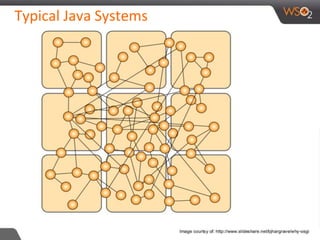
Typical Java Systems
What we need is … Modular Systems
Dividing a complex software system into small
parts/modules.
Allows us to understand the system easily.
Allows us to develop part by part by different team.
Allows us to reuse already developed modules.
Can we build a pure modular system
with Java?
What are the limitations?
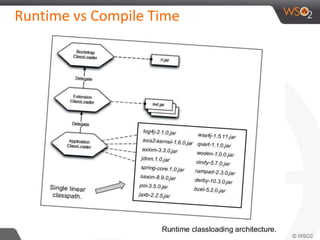
➔ Runtime vs Compile time difference.
● Flat, single classpath.
➔ No standard way of building a modular system.
● Class loader based techniques.
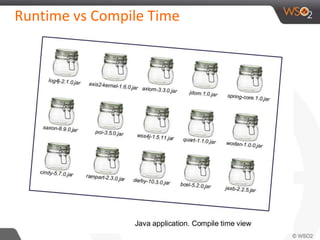
Runtime vs Compile Time
JAR (Java Archive)
➔ JAR is unit of deployment in Java.
➔ Typical Java application consists a set of JAR files.
➔ No runtime representation for a JAR.
➔ At runtime contents of all JAR files are treated as a
single, ordered and global list which is called the class
path
Problem with JAR
➔ Multiple versions of JAR files cannot be loaded
simultaneously
➔ A JAR cannot declare dependencies on other JARs.
➔ No mechanism for information hiding
➔ Hence, JARs cannot be considered as modules
Java for Modular System
➔ Can you update a part(can be a JAR file) of a
running Java application?
➔ Can you add new functionality to a new Java
application at runtime?
➔ If you need to add new functionality or update
existing functionality, JVM needed to be
restarted.
➔ Java lacks dynamism
What’s Next?
➔ How about an abstraction where you can work at
the package level as opposed to class/object level?
◆ Importing packages.
◆ Exporting packages.
◆ A way to have private packages.
➔ Can we achieve the limitations that we discussed
in Java from this model?
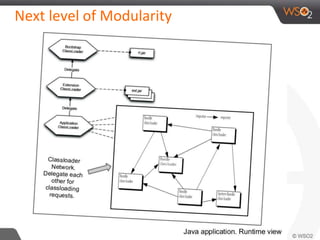
Next Level of Modularity
➔ Separate class loader per module.
◆ creating a class-space per module.
◆ delegate class loading to other modules when necessary.
➔ Solves the single class path problem.
➔ Now you have a class loader network formed from
classloader delegation.
➔ This network is formed with import/export
package restrictions.
➔ Now we have modularity at runtime as well as
compile time.
Next level of Modularity
What is OSGi?
"The OSGi framework is a module system and
service platform for the Java programming
language that implements a complete and dynamic
component model, something that as of 2012 does
not exist in standalone Java/VM environments."
--Wikipedia
What is OSGi?
➔ Widely accepted specification which introduces a
standard way of building dynamic, modular
systems with Java.
➔ OSGi framework implementations.(Open source)
◆ Eclipse Equinox.
◆ Apache Felix.
◆ Knopflerfish.
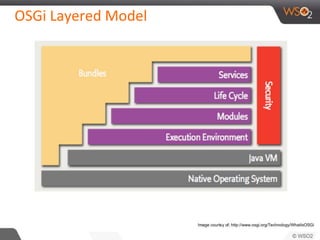
OSGi Layered Model
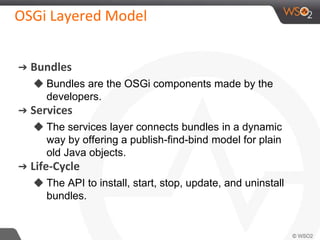
OSGi Layered Model
➔ Bundles
◆ Bundles are the OSGi components made by the
developers.
➔ Services
◆ The services layer connects bundles in a dynamic
way by offering a publish-find-bind model for plain
old Java objects.
➔ Life-Cycle
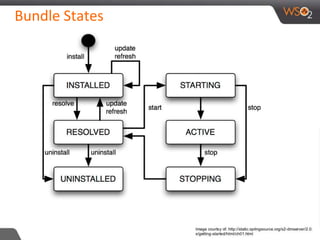
◆ The API to install, start, stop, update, and uninstall
bundles.
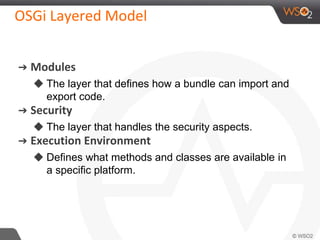
OSGi Layered Model
➔ Modules
◆ The layer that defines how a bundle can import and
export code.
➔ Security
◆ The layer that handles the security aspects.
➔ Execution Environment
◆ Defines what methods and classes are available in
a specific platform.
Bundles
➔ Bundle is the unit of modularization in OSGi
➔ OSGi based application can be considered as a
collection of Bundle
➔ Bundles can share packages with other bundles
and hide packages from other bundles
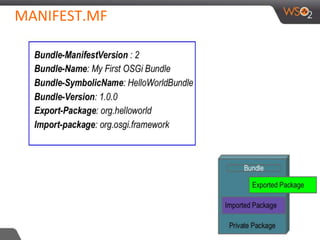
➔ How does a bundle differs from a normal jar file ?
MANIFEST.MF
Bundle States
Demo
Dynamism
Modularity achieved. But what about dynamism?
Can bundle alone solve the big problem?
Dynamism
➔ The moment your instantiate a new object tight
coupling among modules occurs.
➔ What if I want to update the platform or part of
the platform during runtime.
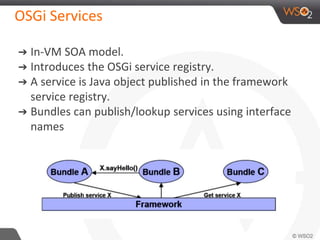
OSGi Services
➔ In-VM SOA model.
➔ Introduces the OSGi service registry.
➔ A service is Java object published in the framework
service registry.
➔ Bundles can publish/lookup services using interface
names
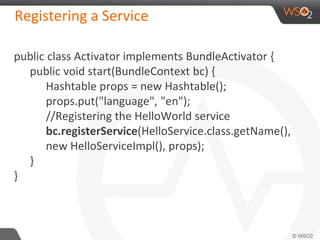
Registering a Service
public class Activator implements BundleActivator {
public void start(BundleContext bc) {
Hashtable props = new Hashtable();
props.put("language", "en");
//Registering the HelloWorld service
bc.registerService(HelloService.class.getName(),
new HelloServiceImpl(), props);
}
}
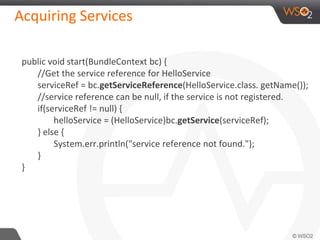
Acquiring Services
public void start(BundleContext bc) {
//Get the service reference for HelloService
serviceRef = bc.getServiceReference(HelloService.class. getName());
//service reference can be null, if the service is not registered.
if(serviceRef != null) {
helloService = (HelloService)bc.getService(serviceRef);
} else {
System.err.println("service reference not found.");
}
}
Demo
Services are Dynamic
➔ A service can register/unregister itself at any time.
➔ Bundle can decide to withdraw its service from the
registry while other bundles are still using this
service.
➔ A Service may not be registered when the other
bundles trying to use it.
◆ this depends on the start order of bundles.
➔ Bundle developer should write code to handle this
dynamic behavior of services.
Monitoring Services
➔Bundle Listeners
➔Service Listeners
➔Service Trackers
➔Declarative Services
Questions?

Introduction to OSGi - Part-1

  • 1.
  • 2.
  • 3.
  • 4.
    What we needis … Modular Systems Dividing a complex software system into small parts/modules. Allows us to understand the system easily. Allows us to develop part by part by different team. Allows us to reuse already developed modules.
  • 5.
    Can we builda pure modular system with Java?
  • 6.
    What are thelimitations? ➔ Runtime vs Compile time difference. ● Flat, single classpath. ➔ No standard way of building a modular system. ● Class loader based techniques.
  • 7.
  • 8.
  • 9.
    JAR (Java Archive) ➔JAR is unit of deployment in Java. ➔ Typical Java application consists a set of JAR files. ➔ No runtime representation for a JAR. ➔ At runtime contents of all JAR files are treated as a single, ordered and global list which is called the class path
  • 10.
    Problem with JAR ➔Multiple versions of JAR files cannot be loaded simultaneously ➔ A JAR cannot declare dependencies on other JARs. ➔ No mechanism for information hiding ➔ Hence, JARs cannot be considered as modules
  • 11.
    Java for ModularSystem ➔ Can you update a part(can be a JAR file) of a running Java application? ➔ Can you add new functionality to a new Java application at runtime? ➔ If you need to add new functionality or update existing functionality, JVM needed to be restarted. ➔ Java lacks dynamism
  • 12.
    What’s Next? ➔ Howabout an abstraction where you can work at the package level as opposed to class/object level? ◆ Importing packages. ◆ Exporting packages. ◆ A way to have private packages. ➔ Can we achieve the limitations that we discussed in Java from this model?
  • 13.
    Next Level ofModularity ➔ Separate class loader per module. ◆ creating a class-space per module. ◆ delegate class loading to other modules when necessary. ➔ Solves the single class path problem. ➔ Now you have a class loader network formed from classloader delegation. ➔ This network is formed with import/export package restrictions. ➔ Now we have modularity at runtime as well as compile time.
  • 14.
    Next level ofModularity
  • 15.
    What is OSGi? "TheOSGi framework is a module system and service platform for the Java programming language that implements a complete and dynamic component model, something that as of 2012 does not exist in standalone Java/VM environments." --Wikipedia
  • 16.
    What is OSGi? ➔Widely accepted specification which introduces a standard way of building dynamic, modular systems with Java. ➔ OSGi framework implementations.(Open source) ◆ Eclipse Equinox. ◆ Apache Felix. ◆ Knopflerfish.
  • 17.
  • 18.
    OSGi Layered Model ➔Bundles ◆ Bundles are the OSGi components made by the developers. ➔ Services ◆ The services layer connects bundles in a dynamic way by offering a publish-find-bind model for plain old Java objects. ➔ Life-Cycle ◆ The API to install, start, stop, update, and uninstall bundles.
  • 19.
    OSGi Layered Model ➔Modules ◆ The layer that defines how a bundle can import and export code. ➔ Security ◆ The layer that handles the security aspects. ➔ Execution Environment ◆ Defines what methods and classes are available in a specific platform.
  • 20.
    Bundles ➔ Bundle isthe unit of modularization in OSGi ➔ OSGi based application can be considered as a collection of Bundle ➔ Bundles can share packages with other bundles and hide packages from other bundles ➔ How does a bundle differs from a normal jar file ?
  • 21.
  • 22.
  • 23.
  • 24.
    Dynamism Modularity achieved. Butwhat about dynamism? Can bundle alone solve the big problem?
  • 25.
    Dynamism ➔ The momentyour instantiate a new object tight coupling among modules occurs. ➔ What if I want to update the platform or part of the platform during runtime.
  • 26.
    OSGi Services ➔ In-VMSOA model. ➔ Introduces the OSGi service registry. ➔ A service is Java object published in the framework service registry. ➔ Bundles can publish/lookup services using interface names
  • 27.
    Registering a Service publicclass Activator implements BundleActivator { public void start(BundleContext bc) { Hashtable props = new Hashtable(); props.put("language", "en"); //Registering the HelloWorld service bc.registerService(HelloService.class.getName(), new HelloServiceImpl(), props); } }
  • 28.
    Acquiring Services public voidstart(BundleContext bc) { //Get the service reference for HelloService serviceRef = bc.getServiceReference(HelloService.class. getName()); //service reference can be null, if the service is not registered. if(serviceRef != null) { helloService = (HelloService)bc.getService(serviceRef); } else { System.err.println("service reference not found."); } }
  • 29.
  • 30.
    Services are Dynamic ➔A service can register/unregister itself at any time. ➔ Bundle can decide to withdraw its service from the registry while other bundles are still using this service. ➔ A Service may not be registered when the other bundles trying to use it. ◆ this depends on the start order of bundles. ➔ Bundle developer should write code to handle this dynamic behavior of services.
  • 31.
    Monitoring Services ➔Bundle Listeners ➔ServiceListeners ➔Service Trackers ➔Declarative Services
  • 32.