Introduction to Linux and Open
Source Software
Ehren J. Brav
What is Linux?
● An operating system
● It's free!
● It can run pretty much on anything
● Infinitely customizable
● The ultimate Swiss Army Knife of software
What is Linux?
An operating system
– Originally based on Unix
– Does all the normal stuff you'd expect an operating
system to do
– Works on basically anything with a processor and
some memory
What is Linux?
It's free!
– Anyone can install, run, and
customize Linux completely for free
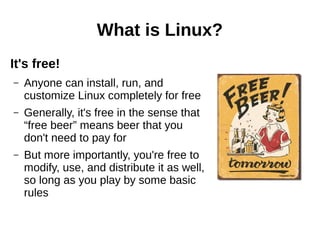
– Generally, it's free in the sense that
“free beer” means beer that you
don't need to pay for
– But more importantly, you're free to
modify, use, and distribute it as well,
so long as you play by some basic
rules
What is Linux?
It can run pretty much on anything
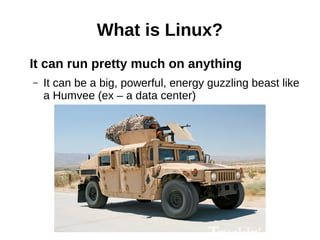
– It can be a big, powerful, energy guzzling beast like
a Humvee (ex – a data center)
What is Linux?
It can run pretty much on anything
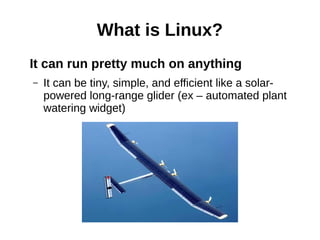
– It can be tiny, simple, and efficient like a solar-
powered long-range glider (ex – automated plant
watering widget)
What is Linux?
It can run pretty much on anything
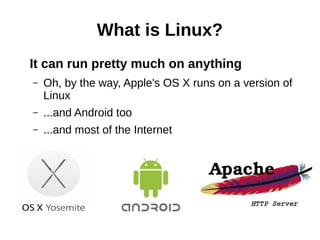
– Oh, by the way, Apple's OS X runs on a version of
Linux
– ...and Android too
– ...and most of the Internet
What is Linux?
Infinitely customizable
– Because Linux is open source, you can make any
changes you want
– But you don't need to be a software engineer to
customize it – there's a huge community of users
out there who have tweaked Linux in numerous
ways
– If you want change something about how your
computer works, chances are someone out there
has already done it and published his or her work
What is Linux?
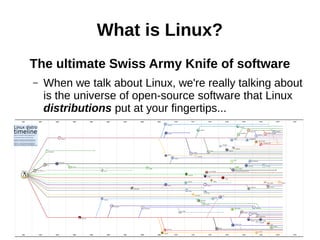
The ultimate Swiss Army Knife of software
– When we talk about Linux, we're really talking about
is the universe of open-source software that Linux
distributions put at your fingertips...
The Distribution System
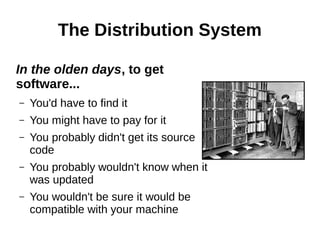
In the olden days, to get
software...
– You'd have to find it
– You might have to pay for it
– You probably didn't get its source
code
– You probably wouldn't know when it
was updated
– You wouldn't be sure it would be
compatible with your machine
The Distribution System
● The Linux “distro” system largely solves these
problems
● A distro is a huge collection of free, open-
source software that is kept up-to-date by a
community of users much like us
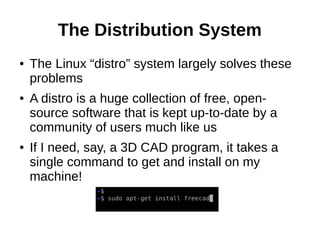
● If I need, say, a 3D CAD program, it takes a
single command to get and install on my
machine!
The Distribution System
There are a number of popular distros out
there, each with its own personality:
● Stability
● Philosophical Purity
The Distribution System
There are a number of popular distros out
there, each with its own personality:
● User-Friendly
● Great for Beginners
The Distribution System
There are a number of popular distros out
there, each with its own personality:
● “Woah – I'm compiling
everything!
The Distribution System
There are a number of popular distros out
there, each with its own personality:
● Lean and mean
● Focus on performance
The Distribution System
There are a number of popular distros out
there, each with its own personality:
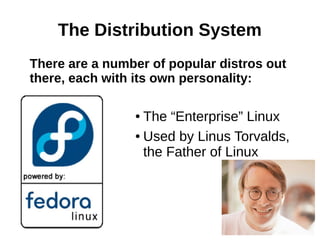
● The “Enterprise” Linux
● Used by Linus Torvalds,
the Father of Linux
The Distribution System
There are a number of popular distros out
there, each with its own personality:
● Easy to Learn
● Fun
The Distribution System
There are a number of popular distros out
there, each with its own personality:
● Security Testing
● The Hacker's Distro
Installing Linux
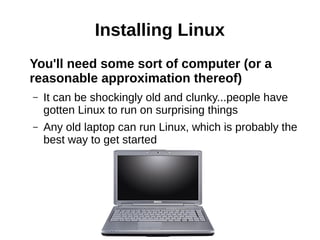
You'll need some sort of computer (or a
reasonable approximation thereof)
– It can be shockingly old and clunky...people have
gotten Linux to run on surprising things
– Any old laptop can run Linux, which is probably the
best way to get started
Installing Linux
You'll need some sort of computer (or a
reasonable approximation thereof)
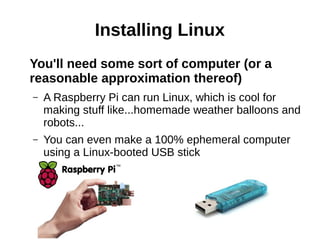
– A Raspberry Pi can run Linux, which is cool for
making stuff like...homemade weather balloons and
robots...
– You can even make a 100% ephemeral computer
using a Linux-booted USB stick
So Why Use Linux?
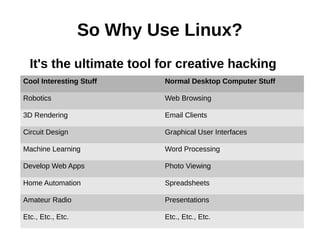
It's the ultimate tool for creative hacking
Cool Interesting Stuff Normal Desktop Computer Stuff
Robotics Web Browsing
3D Rendering Email Clients
Circuit Design Graphical User Interfaces
Machine Learning Word Processing
Develop Web Apps Photo Viewing
Home Automation Spreadsheets
Amateur Radio Presentations
Etc., Etc., Etc. Etc., Etc., Etc.
So Why Use Linux?
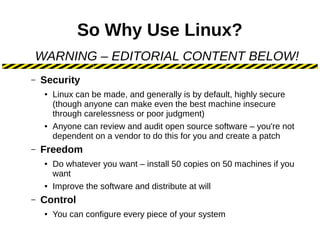
– Security
● Linux can be made, and generally is by default, highly secure
(though anyone can make even the best machine insecure
through carelessness or poor judgment)
● Anyone can review and audit open source software – you're not
dependent on a vendor to do this for you and create a patch
– Freedom
● Do whatever you want – install 50 copies on 50 machines if you
want
● Improve the software and distribute at will
– Control
● You can configure every piece of your system
WARNING – EDITORIAL CONTENT BELOW!
So Why Use Linux?
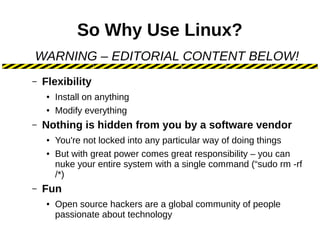
– Flexibility
● Install on anything
● Modify everything
– Nothing is hidden from you by a software vendor
● You're not locked into any particular way of doing things
● But with great power comes great responsibility – you can
nuke your entire system with a single command (“sudo rm -rf
/*)
– Fun
● Open source hackers are a global community of people
passionate about technology
WARNING – EDITORIAL CONTENT BELOW!
Where To Go From Here
● Once you get Linux installed, you'll have a bit of
a learning curve
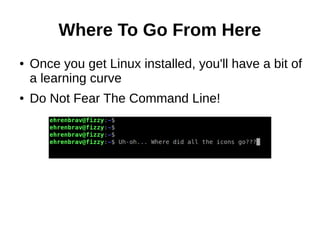
● Do Not Fear The Command Line!
Where To Go From Here
● Start Here: linuxsurvival.com
● Next, learn the basics of the package
management system of your chosen distro (ie –
apt-get, yum, portage, etc.)
● Google is your friend – pay attention to
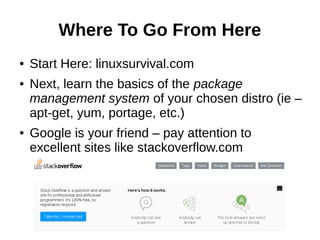
excellent sites like stackoverflow.com
So Why Use Linux?
OK enough with these stupid slides – let's
see some demos!

Introduction to Linux

  • 1.
    Introduction to Linuxand Open Source Software Ehren J. Brav
  • 2.
    What is Linux? ●An operating system ● It's free! ● It can run pretty much on anything ● Infinitely customizable ● The ultimate Swiss Army Knife of software
  • 3.
    What is Linux? Anoperating system – Originally based on Unix – Does all the normal stuff you'd expect an operating system to do – Works on basically anything with a processor and some memory
  • 4.
    What is Linux? It'sfree! – Anyone can install, run, and customize Linux completely for free – Generally, it's free in the sense that “free beer” means beer that you don't need to pay for – But more importantly, you're free to modify, use, and distribute it as well, so long as you play by some basic rules
  • 5.
    What is Linux? Itcan run pretty much on anything – It can be a big, powerful, energy guzzling beast like a Humvee (ex – a data center)
  • 6.
    What is Linux? Itcan run pretty much on anything – It can be tiny, simple, and efficient like a solar- powered long-range glider (ex – automated plant watering widget)
  • 7.
    What is Linux? Itcan run pretty much on anything – Oh, by the way, Apple's OS X runs on a version of Linux – ...and Android too – ...and most of the Internet
  • 8.
    What is Linux? Infinitelycustomizable – Because Linux is open source, you can make any changes you want – But you don't need to be a software engineer to customize it – there's a huge community of users out there who have tweaked Linux in numerous ways – If you want change something about how your computer works, chances are someone out there has already done it and published his or her work
  • 9.
    What is Linux? Theultimate Swiss Army Knife of software – When we talk about Linux, we're really talking about is the universe of open-source software that Linux distributions put at your fingertips...
  • 10.
    The Distribution System Inthe olden days, to get software... – You'd have to find it – You might have to pay for it – You probably didn't get its source code – You probably wouldn't know when it was updated – You wouldn't be sure it would be compatible with your machine
  • 11.
    The Distribution System ●The Linux “distro” system largely solves these problems ● A distro is a huge collection of free, open- source software that is kept up-to-date by a community of users much like us ● If I need, say, a 3D CAD program, it takes a single command to get and install on my machine!
  • 12.
    The Distribution System Thereare a number of popular distros out there, each with its own personality: ● Stability ● Philosophical Purity
  • 13.
    The Distribution System Thereare a number of popular distros out there, each with its own personality: ● User-Friendly ● Great for Beginners
  • 14.
    The Distribution System Thereare a number of popular distros out there, each with its own personality: ● “Woah – I'm compiling everything!
  • 15.
    The Distribution System Thereare a number of popular distros out there, each with its own personality: ● Lean and mean ● Focus on performance
  • 16.
    The Distribution System Thereare a number of popular distros out there, each with its own personality: ● The “Enterprise” Linux ● Used by Linus Torvalds, the Father of Linux
  • 17.
    The Distribution System Thereare a number of popular distros out there, each with its own personality: ● Easy to Learn ● Fun
  • 18.
    The Distribution System Thereare a number of popular distros out there, each with its own personality: ● Security Testing ● The Hacker's Distro
  • 19.
    Installing Linux You'll needsome sort of computer (or a reasonable approximation thereof) – It can be shockingly old and clunky...people have gotten Linux to run on surprising things – Any old laptop can run Linux, which is probably the best way to get started
  • 20.
    Installing Linux You'll needsome sort of computer (or a reasonable approximation thereof) – A Raspberry Pi can run Linux, which is cool for making stuff like...homemade weather balloons and robots... – You can even make a 100% ephemeral computer using a Linux-booted USB stick
  • 21.
    So Why UseLinux? It's the ultimate tool for creative hacking Cool Interesting Stuff Normal Desktop Computer Stuff Robotics Web Browsing 3D Rendering Email Clients Circuit Design Graphical User Interfaces Machine Learning Word Processing Develop Web Apps Photo Viewing Home Automation Spreadsheets Amateur Radio Presentations Etc., Etc., Etc. Etc., Etc., Etc.
  • 22.
    So Why UseLinux? – Security ● Linux can be made, and generally is by default, highly secure (though anyone can make even the best machine insecure through carelessness or poor judgment) ● Anyone can review and audit open source software – you're not dependent on a vendor to do this for you and create a patch – Freedom ● Do whatever you want – install 50 copies on 50 machines if you want ● Improve the software and distribute at will – Control ● You can configure every piece of your system WARNING – EDITORIAL CONTENT BELOW!
  • 23.
    So Why UseLinux? – Flexibility ● Install on anything ● Modify everything – Nothing is hidden from you by a software vendor ● You're not locked into any particular way of doing things ● But with great power comes great responsibility – you can nuke your entire system with a single command (“sudo rm -rf /*) – Fun ● Open source hackers are a global community of people passionate about technology WARNING – EDITORIAL CONTENT BELOW!
  • 24.
    Where To GoFrom Here ● Once you get Linux installed, you'll have a bit of a learning curve ● Do Not Fear The Command Line!
  • 25.
    Where To GoFrom Here ● Start Here: linuxsurvival.com ● Next, learn the basics of the package management system of your chosen distro (ie – apt-get, yum, portage, etc.) ● Google is your friend – pay attention to excellent sites like stackoverflow.com
  • 26.
    So Why UseLinux? OK enough with these stupid slides – let's see some demos!