Kilkari and Mobile Academy: an approach towards empowerment,
improving skills and care
The Ministry of Health & Family Welfare, introduced
centralized, interactive voice response (IVR) based
mobile health services.
Kilkari and Mobile Academy are one of the largest m-health
programs globally
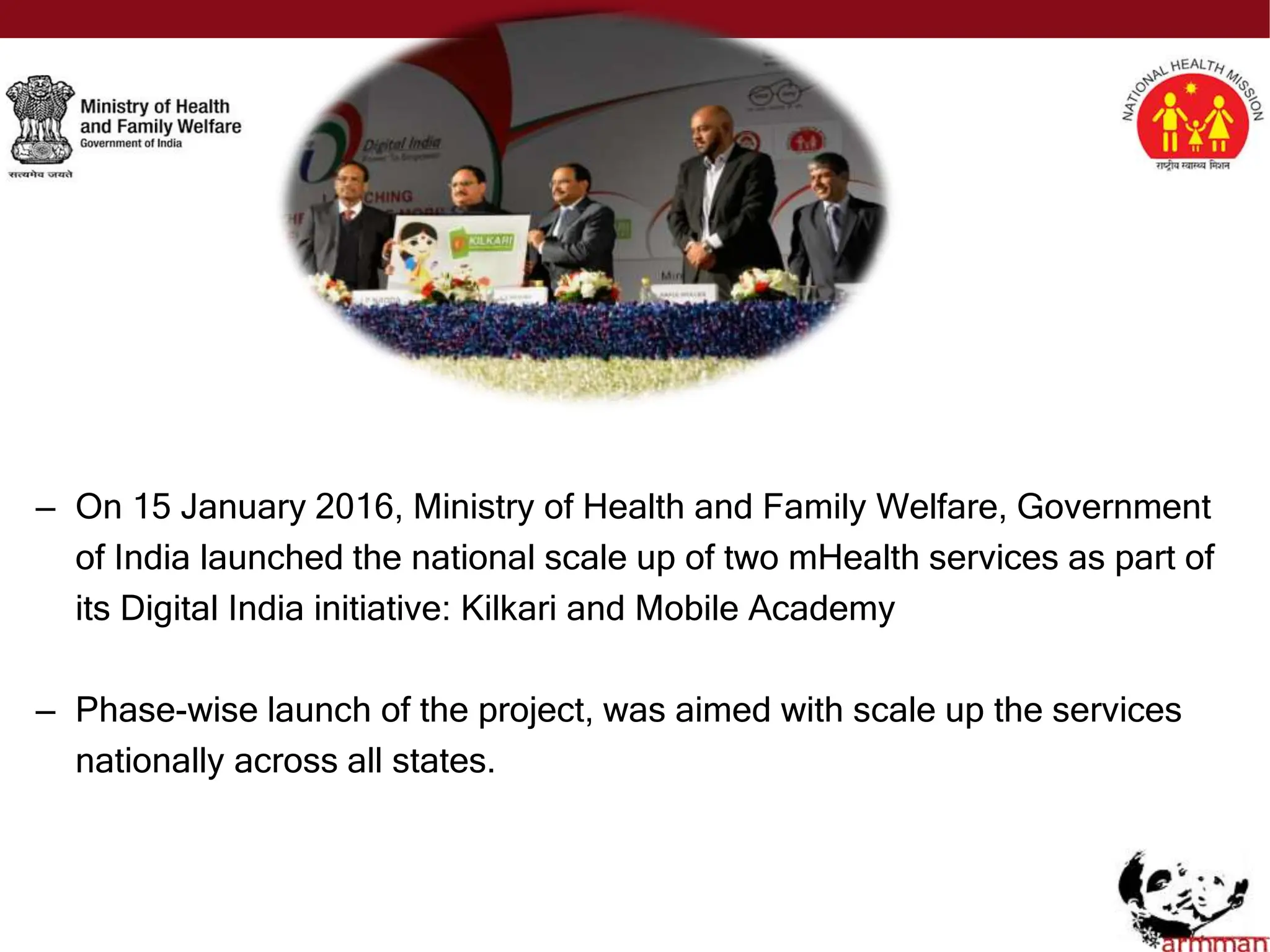
– On 15 January 2016, Ministry of Health and Family Welfare, Government
of India launched the national scale up of two mHealth services as part of
its Digital India initiative: Kilkari and Mobile Academy
– Phase-wise launch of the project, was aimed with scale up the services
nationally across all states.
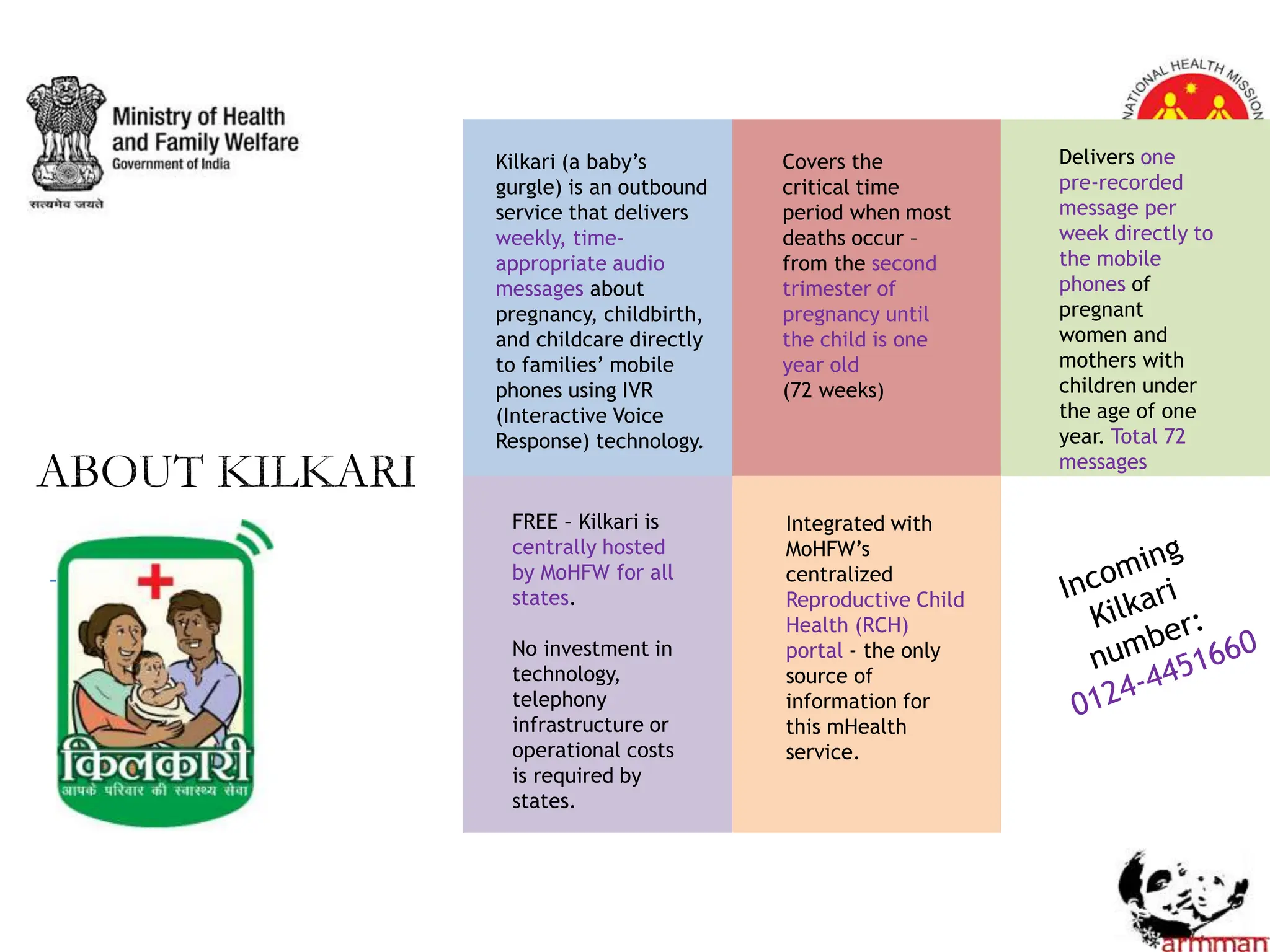
Kilkari (a baby’s
gurgle) is an outbound
service that delivers
weekly, time-
appropriate audio
messages about
pregnancy, childbirth,
and childcare directly
to families’ mobile
phones using IVR
(Interactive Voice
Response) technology.
Covers the
critical time
period when most
deaths occur –
from the second
trimester of
pregnancy until
the child is one
year old
(72 weeks)
Delivers one
pre-recorded
message per
week directly to
the mobile
phones of
pregnant
women and
mothers with
children under
the age of one
year. Total 72
messages
FREE – Kilkari is
centrally hosted
by MoHFW for all
states.
No investment in
technology,
telephony
infrastructure or
operational costs
is required by
states.
Integrated with
MoHFW’s
centralized
Reproductive Child
Health (RCH)
portal - the only
source of
information for
this mHealth
service.
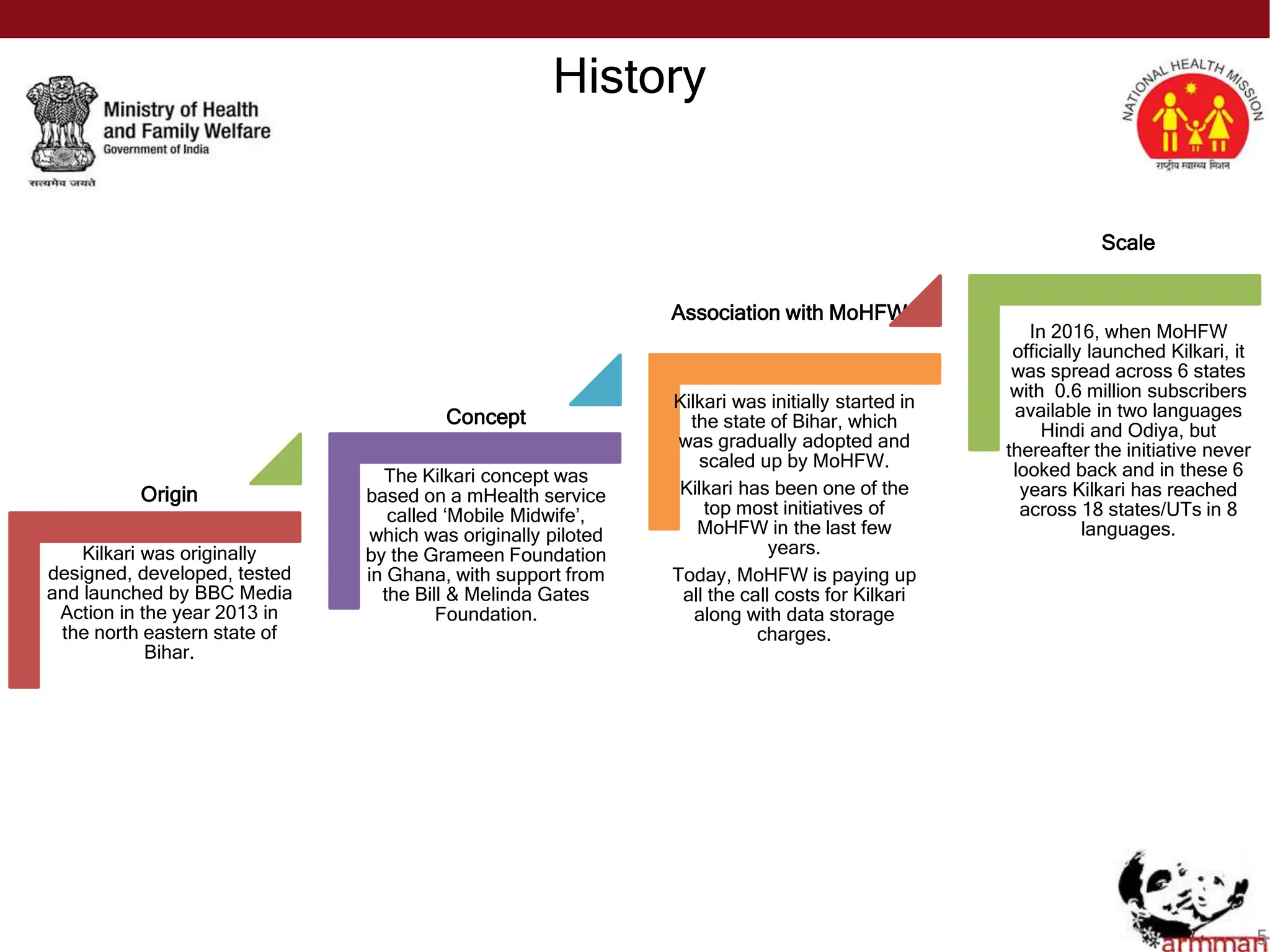
History
Origin
Kilkari was originally
designed, developed, tested
and launched by BBC Media
Action in the year 2013 in
the north eastern state of
Bihar.
Concept
The Kilkari concept was
based on a mHealth service
called ‘Mobile Midwife’,
which was originally piloted
by the Grameen Foundation
in Ghana, with support from
the Bill & Melinda Gates
Foundation.
Association with MoHFW
Kilkari was initially started in
the state of Bihar, which
was gradually adopted and
scaled up by MoHFW.
Kilkari has been one of the
top most initiatives of
MoHFW in the last few
years.
Today, MoHFW is paying up
all the call costs for Kilkari
along with data storage
charges.
Scale
In 2016, when MoHFW
officially launched Kilkari, it
was spread across 6 states
with 0.6 million subscribers
available in two languages
Hindi and Odiya, but
thereafter the initiative never
looked back and in these 6
years Kilkari has reached
across 18 states/UTs in 8
languages.
5
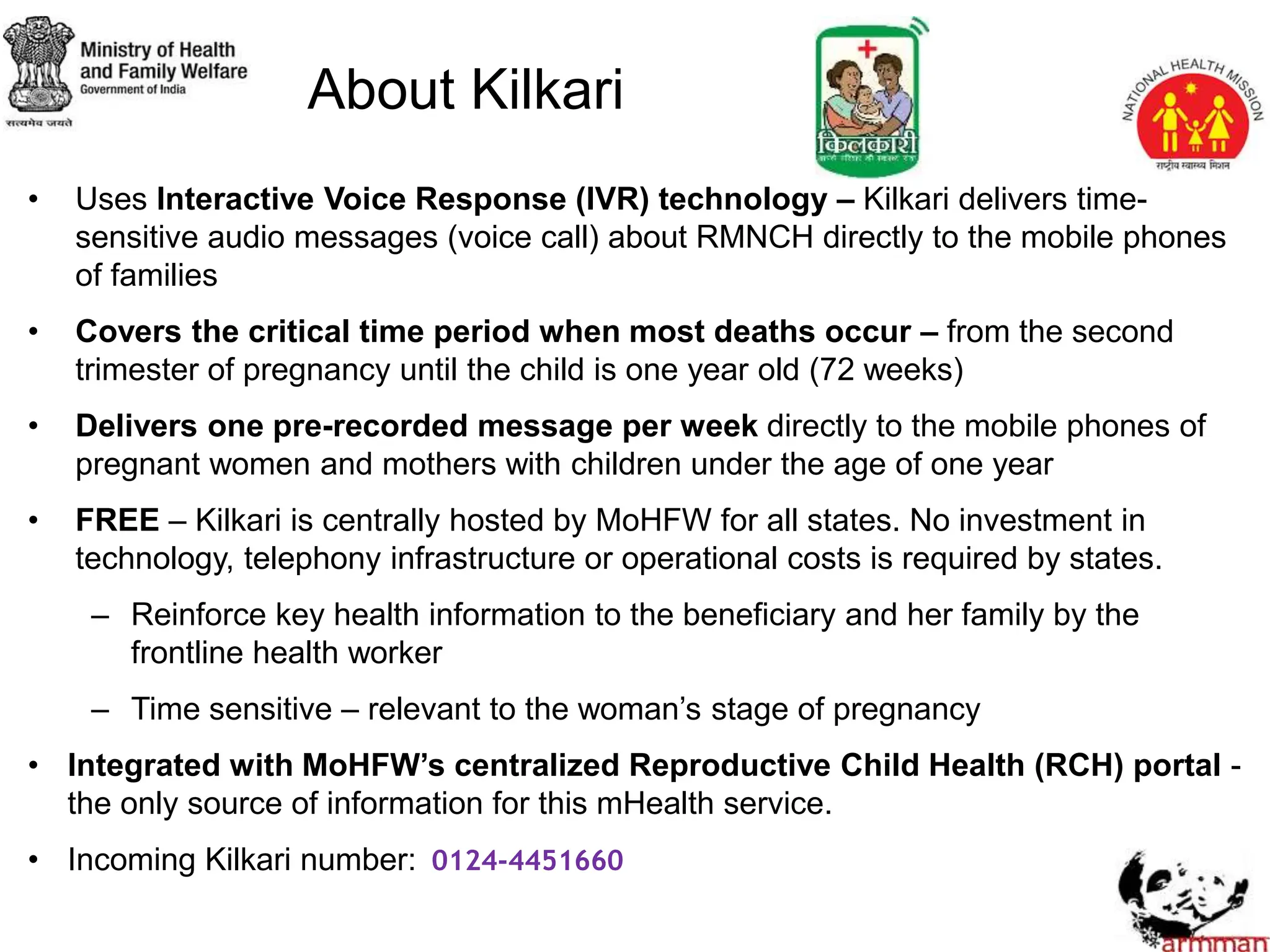
• Uses Interactive Voice Response (IVR) technology – Kilkari delivers time-
sensitive audio messages (voice call) about RMNCH directly to the mobile phones
of families
• Covers the critical time period when most deaths occur – from the second
trimester of pregnancy until the child is one year old (72 weeks)
• Delivers one pre-recorded message per week directly to the mobile phones of
pregnant women and mothers with children under the age of one year
• FREE – Kilkari is centrally hosted by MoHFW for all states. No investment in
technology, telephony infrastructure or operational costs is required by states.
– Reinforce key health information to the beneficiary and her family by the
frontline health worker
– Time sensitive – relevant to the woman’s stage of pregnancy
• Integrated with MoHFW’s centralized Reproductive Child Health (RCH) portal -
the only source of information for this mHealth service.
• Incoming Kilkari number: 0124-4451660
About Kilkari
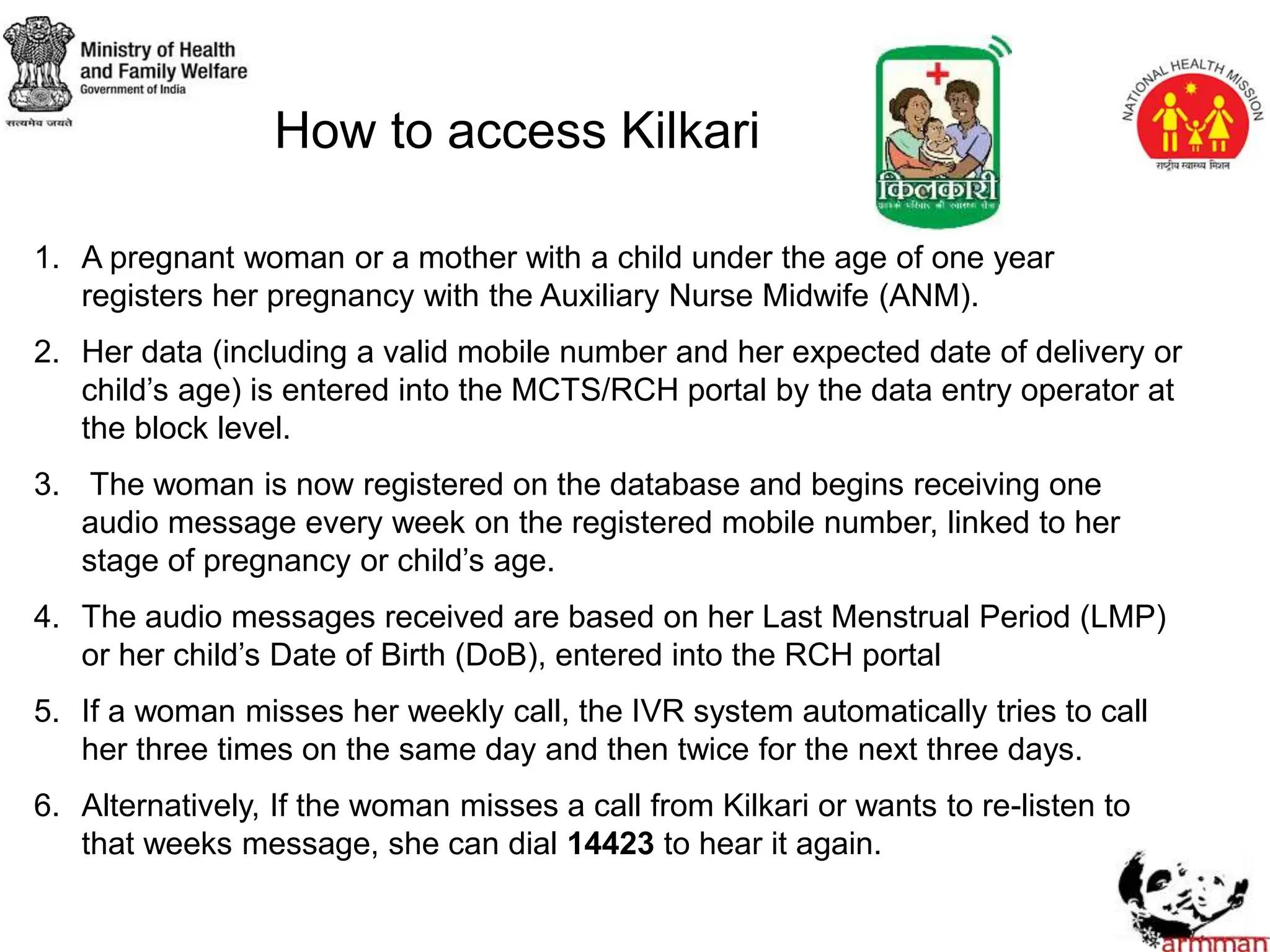
How to access Kilkari
1. A pregnant woman or a mother with a child under the age of one year
registers her pregnancy with the Auxiliary Nurse Midwife (ANM).
2. Her data (including a valid mobile number and her expected date of delivery or
child’s age) is entered into the MCTS/RCH portal by the data entry operator at
the block level.
3. The woman is now registered on the database and begins receiving one
audio message every week on the registered mobile number, linked to her
stage of pregnancy or child’s age.
4. The audio messages received are based on her Last Menstrual Period (LMP)
or her child’s Date of Birth (DoB), entered into the RCH portal
5. If a woman misses her weekly call, the IVR system automatically tries to call
her three times on the same day and then twice for the next three days.
6. Alternatively, If the woman misses a call from Kilkari or wants to re-listen to
that weeks message, she can dial 14423 to hear it again.
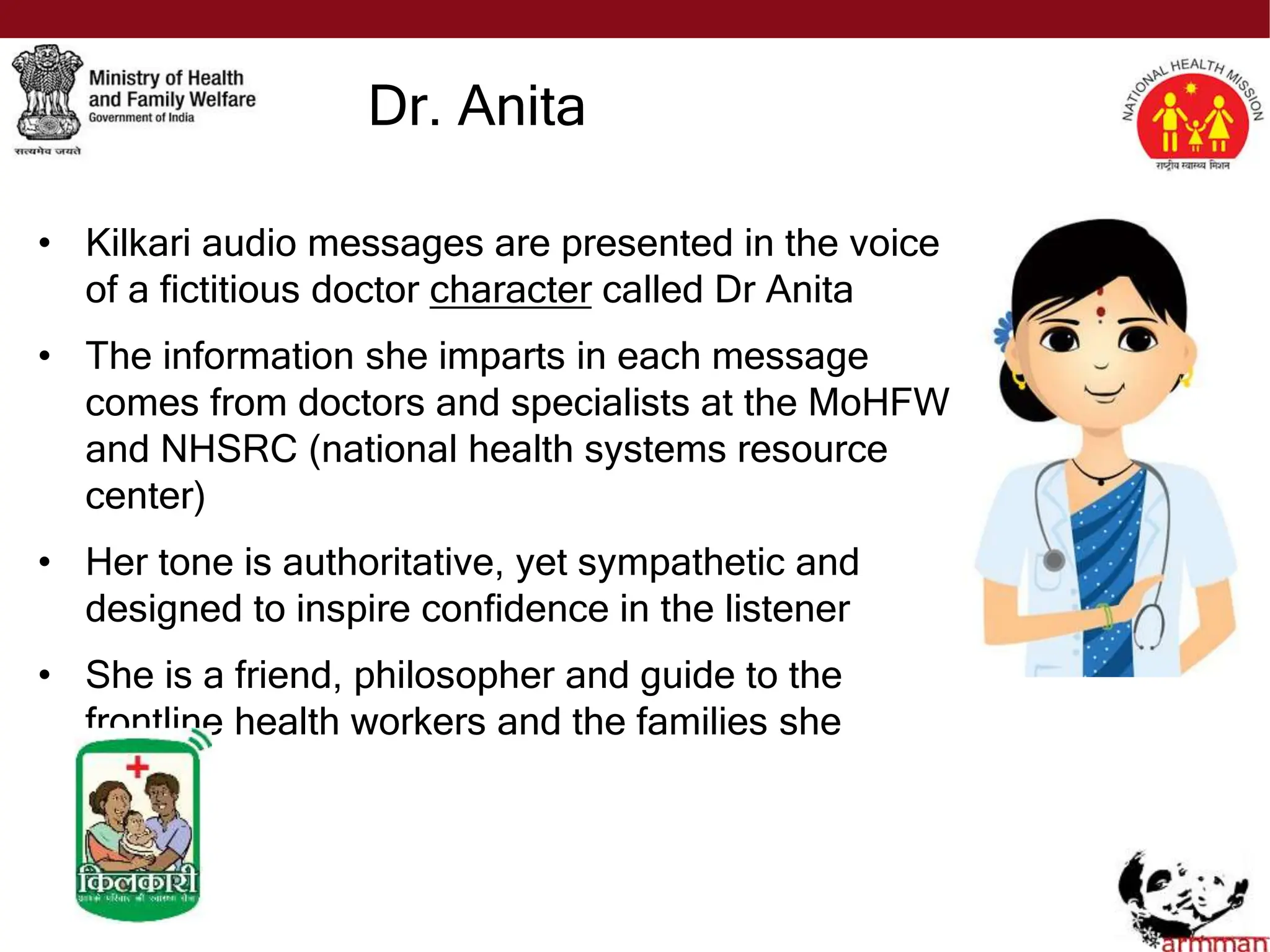
• Kilkari audio messages are presented in the voice
of a fictitious doctor character called Dr Anita
• The information she imparts in each message
comes from doctors and specialists at the MoHFW
and NHSRC (national health systems resource
center)
• Her tone is authoritative, yet sympathetic and
designed to inspire confidence in the listener
• She is a friend, philosopher and guide to the
frontline health workers and the families she
serves
Dr. Anita
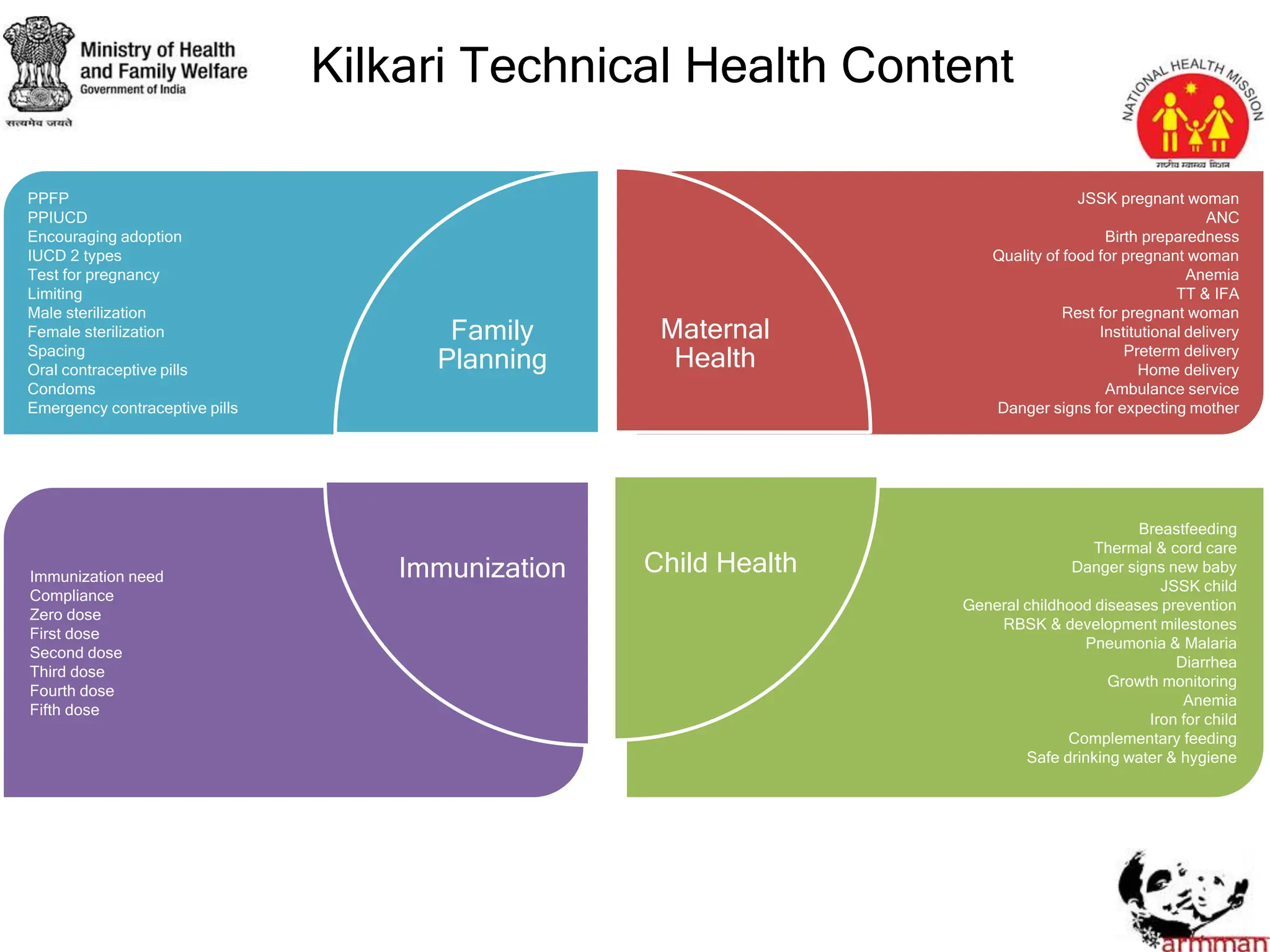
PPFP
PPIUCD
Encouraging adoption
IUCD 2 types
Test for pregnancy
Limiting
Male sterilization
Female sterilization
Spacing
Oral contraceptive pills
Condoms
Emergency contraceptive pills
JSSK pregnant woman
ANC
Birth preparedness
Quality of food for pregnant woman
Anemia
TT & IFA
Rest for pregnant woman
Institutional delivery
Preterm delivery
Home delivery
Ambulance service
Danger signs for expecting mother
Breastfeeding
Thermal & cord care
Danger signs new baby
JSSK child
General childhood diseases prevention
RBSK & development milestones
Pneumonia & Malaria
Diarrhea
Growth monitoring
Anemia
Iron for child
Complementary feeding
Safe drinking water & hygiene
Immunization need
Compliance
Zero dose
First dose
Second dose
Third dose
Fourth dose
Fifth dose
Kilkari Technical Health Content
Maternal
Health
Child Health
Immunization
Family
Planning
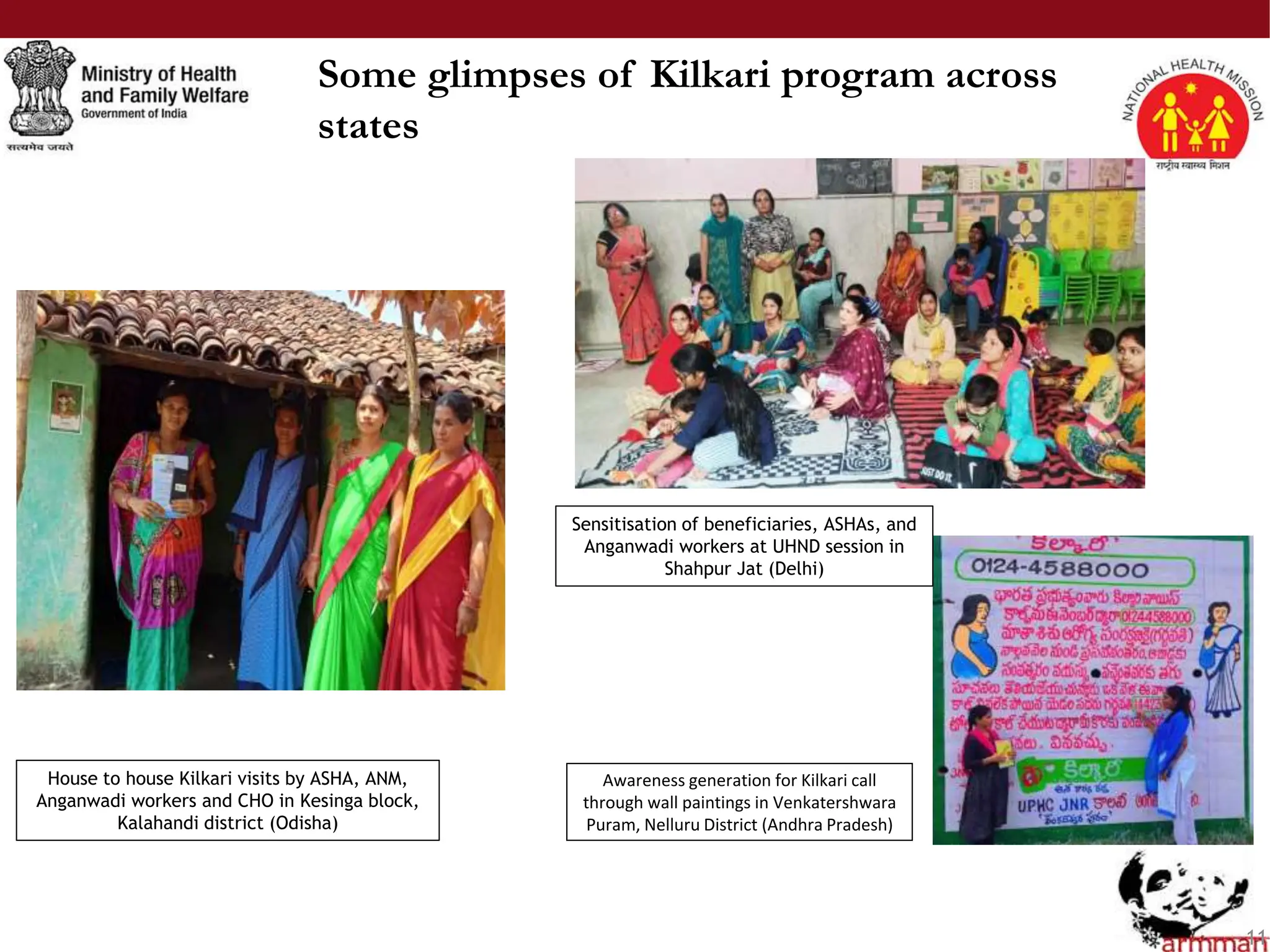
Some glimpses of Kilkari program across
states
11
House to house Kilkari visits by ASHA, ANM,
Anganwadi workers and CHO in Kesinga block,
Kalahandi district (Odisha)
Sensitisation of beneficiaries, ASHAs, and
Anganwadi workers at UHND session in
Shahpur Jat (Delhi)
Awareness generation for Kilkari call
through wall paintings in Venkatershwara
Puram, Nelluru District (Andhra Pradesh)
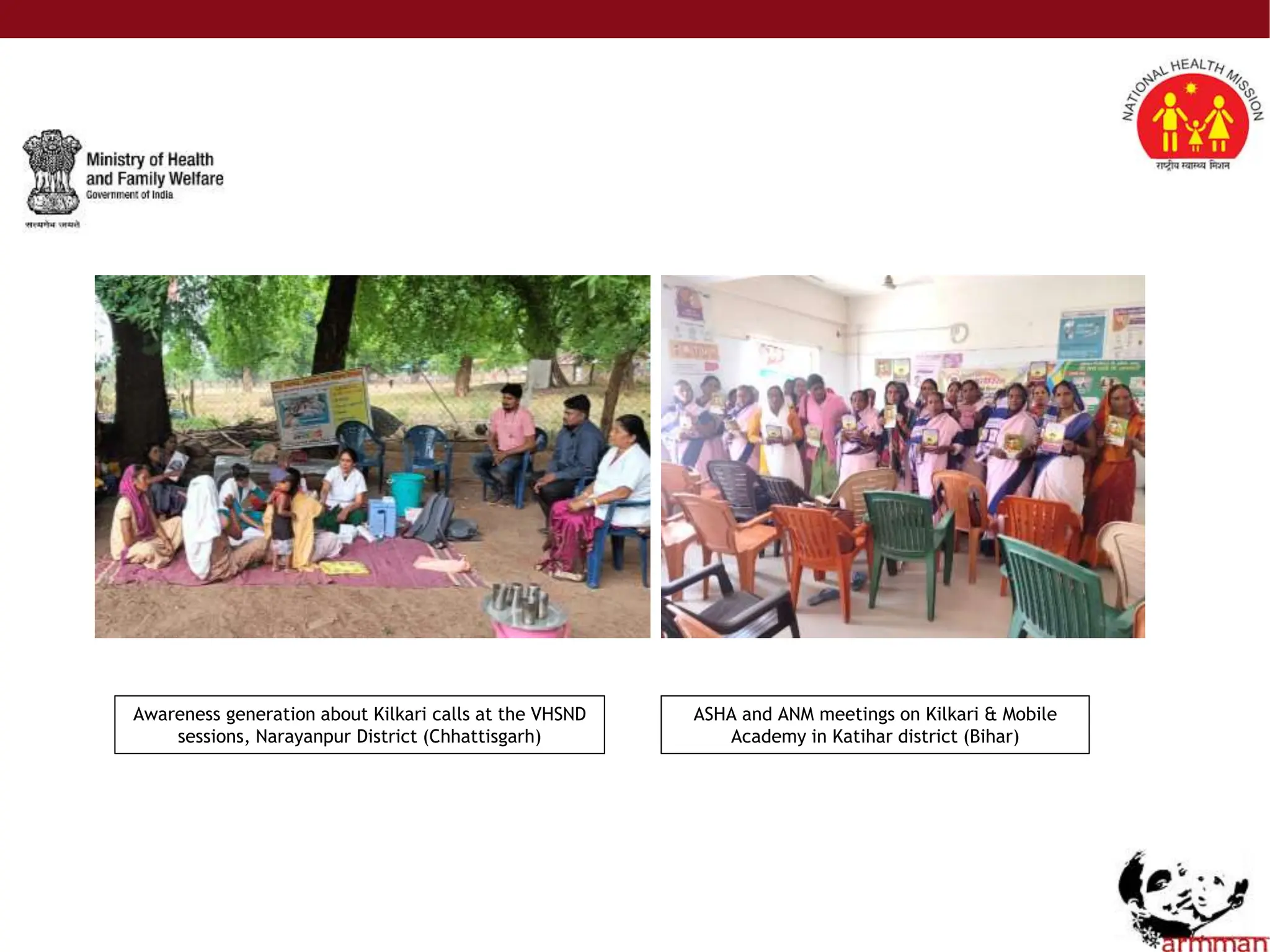
Awareness generation about Kilkari calls at the VHSND
sessions, Narayanpur District (Chhattisgarh)
ASHA and ANM meetings on Kilkari & Mobile
Academy in Katihar district (Bihar)
A reproductive maternal neonatal and child health (RMNCH)
mobile-based training course designed to refresh frontline
health workers’ knowledge of life-saving preventative health
behaviors and improve the quality of their engagement with new
and expecting mothers and their families.
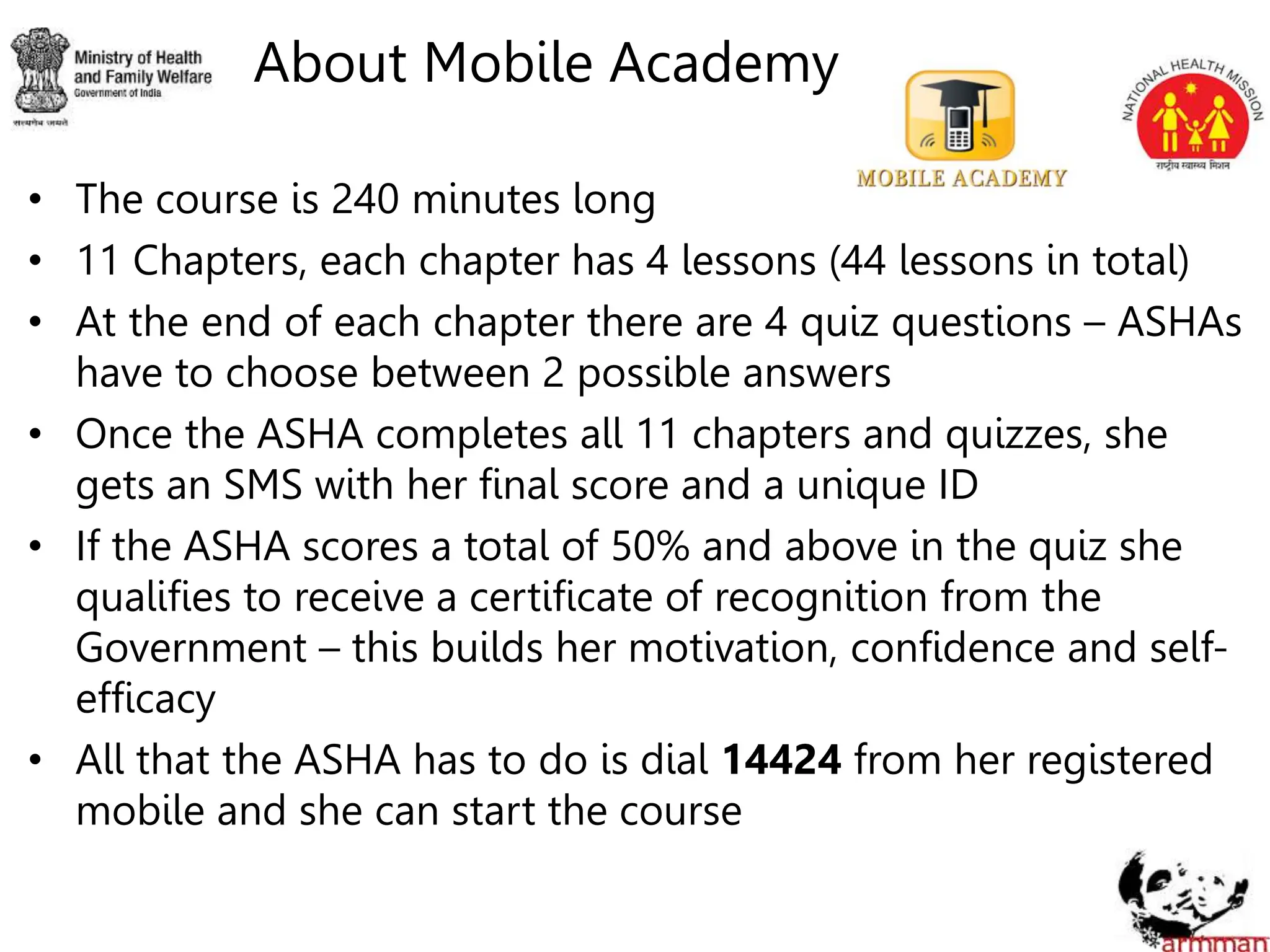
About Mobile Academy
• The course is 240 minutes long
• 11 Chapters, each chapter has 4 lessons (44 lessons in total)
• At the end of each chapter there are 4 quiz questions – ASHAs
have to choose between 2 possible answers
• Once the ASHA completes all 11 chapters and quizzes, she
gets an SMS with her final score and a unique ID
• If the ASHA scores a total of 50% and above in the quiz she
qualifies to receive a certificate of recognition from the
Government – this builds her motivation, confidence and self-
efficacy
• All that the ASHA has to do is dial 14424 from her registered
mobile and she can start the course
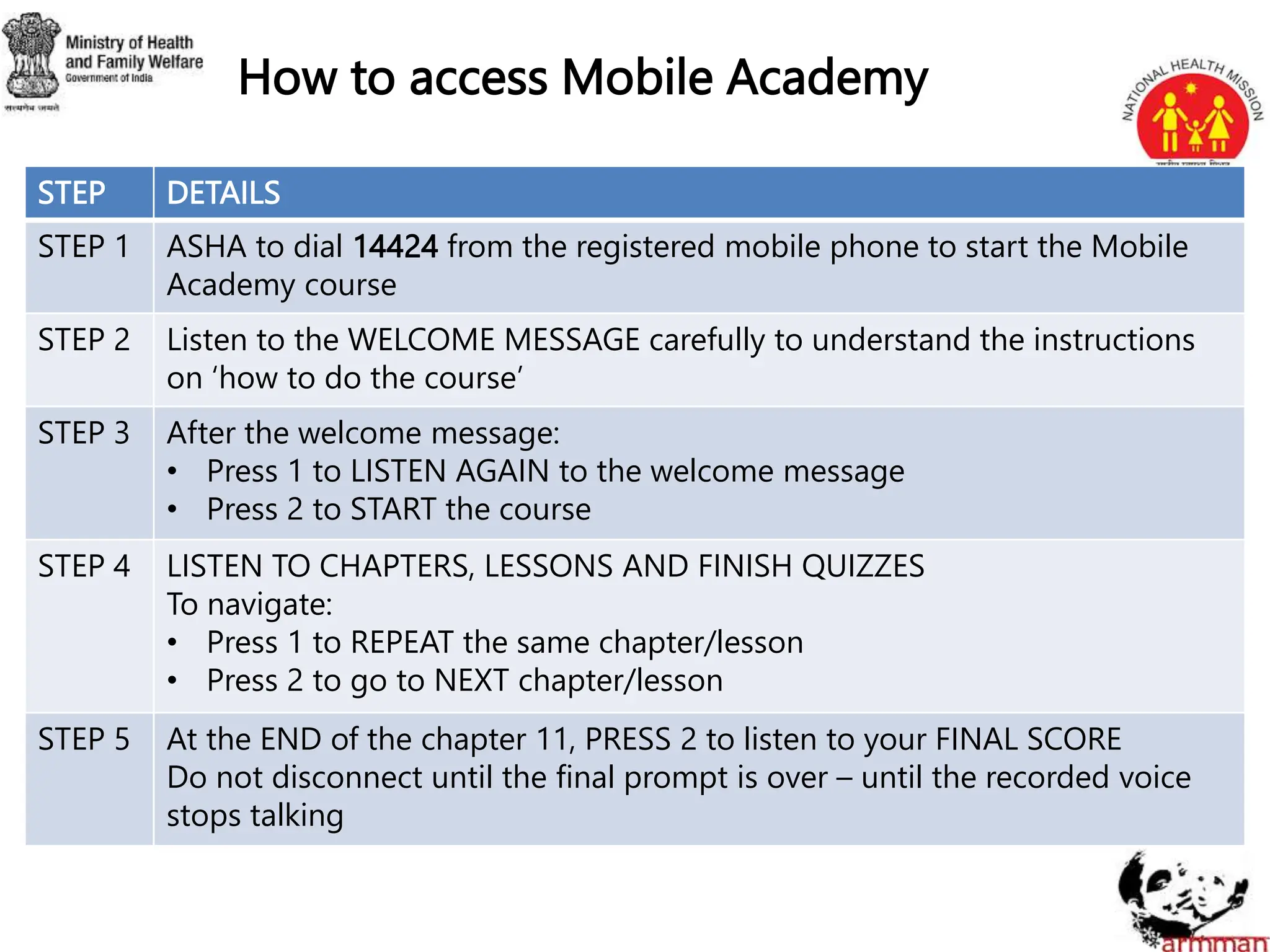
How to access Mobile Academy
STEP DETAILS
STEP 1 ASHA to dial 14424 from the registered mobile phone to start the Mobile
Academy course
STEP 2 Listen to the WELCOME MESSAGE carefully to understand the instructions
on ‘how to do the course’
STEP 3 After the welcome message:
• Press 1 to LISTEN AGAIN to the welcome message
• Press 2 to START the course
STEP 4 LISTEN TO CHAPTERS, LESSONS AND FINISH QUIZZES
To navigate:
• Press 1 to REPEAT the same chapter/lesson
• Press 2 to go to NEXT chapter/lesson
STEP 5 At the END of the chapter 11, PRESS 2 to listen to your FINAL SCORE
Do not disconnect until the final prompt is over – until the recorded voice
stops talking
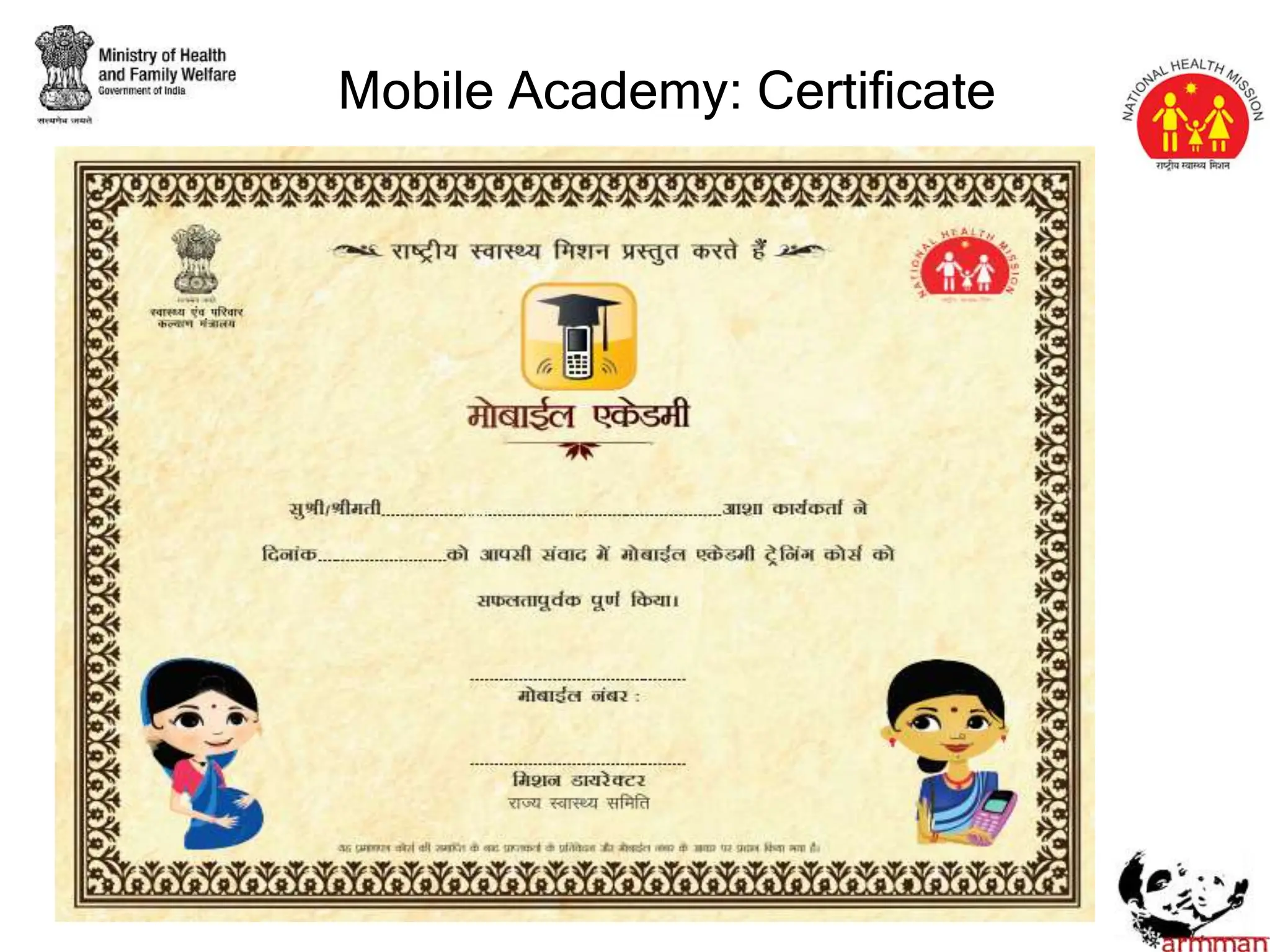
Mobile Academy: Certificate
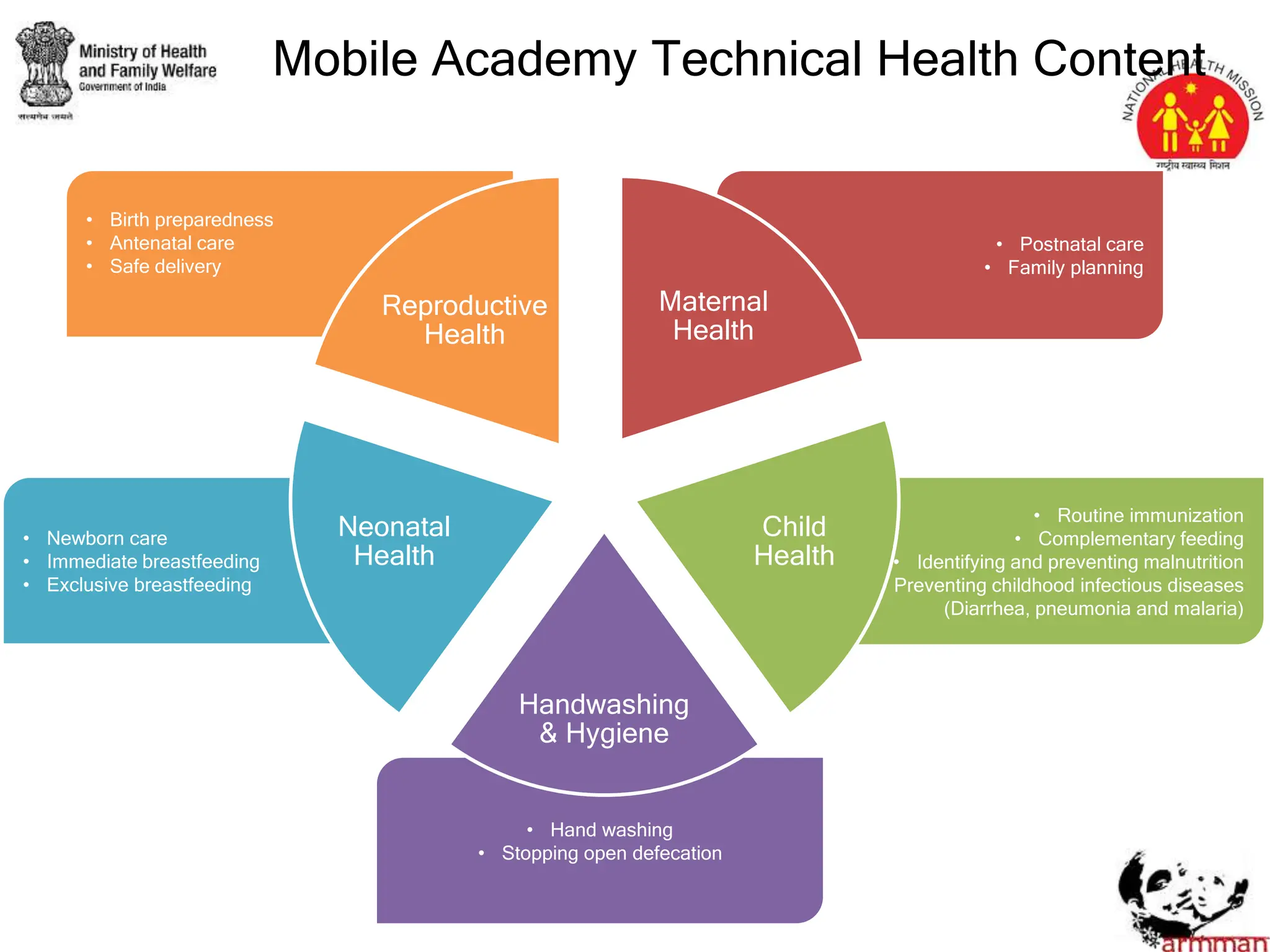
• Hand washing
• Stopping open defecation
• Birth preparedness
• Antenatal care
• Safe delivery
• Postnatal care
• Family planning
• Routine immunization
• Complementary feeding
• Identifying and preventing malnutrition
• Preventing childhood infectious diseases
(Diarrhea, pneumonia and malaria)
• Newborn care
• Immediate breastfeeding
• Exclusive breastfeeding
Mobile Academy Technical Health Content
Maternal
Health
Child
Health
Handwashing
& Hygiene
Neonatal
Health
Reproductive
Health
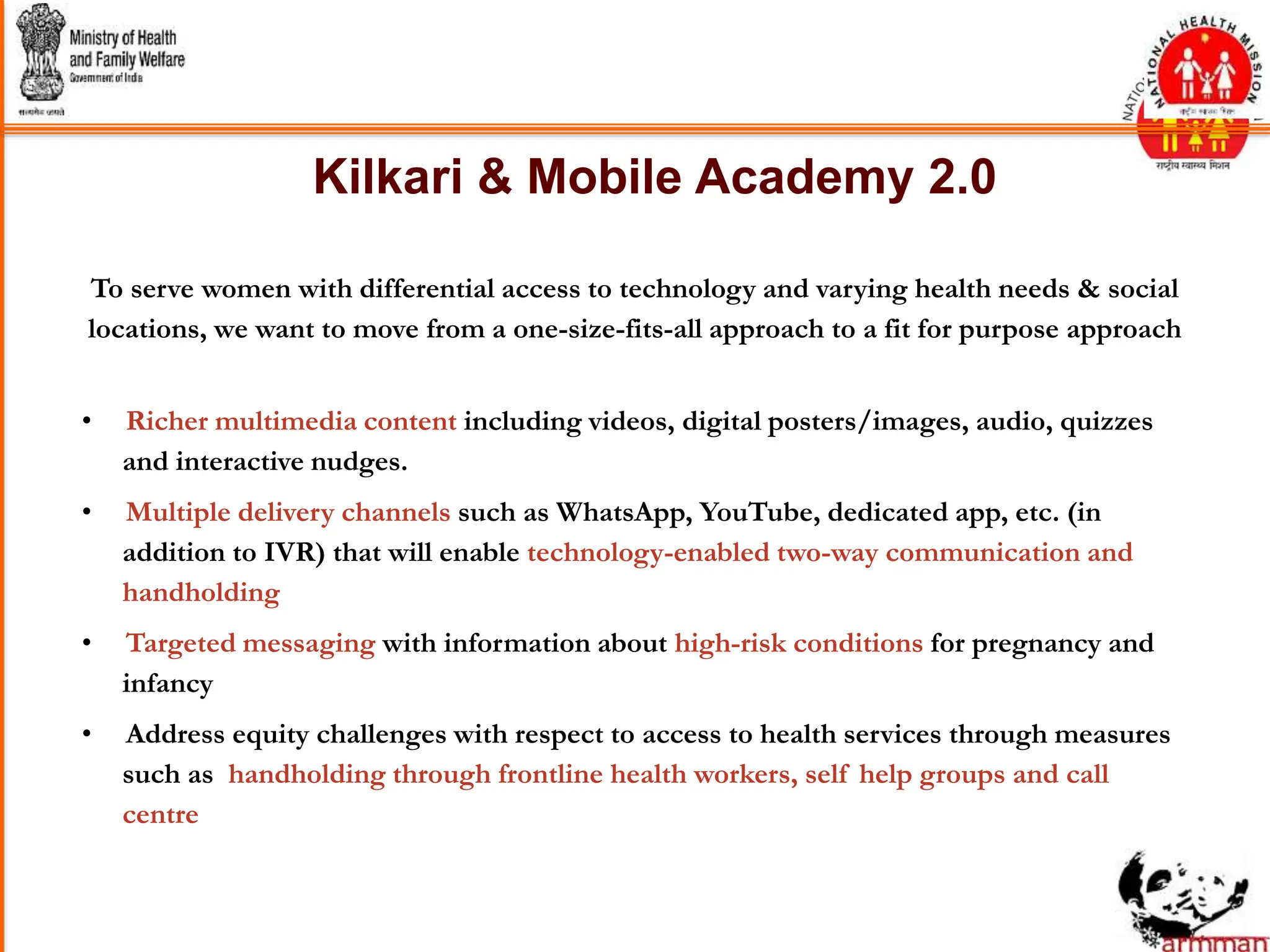
Kilkari & Mobile Academy 2.0
• Richer multimedia content including videos, digital posters/images, audio, quizzes
and interactive nudges.
• Multiple delivery channels such as WhatsApp, YouTube, dedicated app, etc. (in
addition to IVR) that will enable technology-enabled two-way communication and
handholding
• Targeted messaging with information about high-risk conditions for pregnancy and
infancy
• Address equity challenges with respect to access to health services through measures
such as handholding through frontline health workers, self help groups and call
centre
To serve women with differential access to technology and varying health needs & social
locations, we want to move from a one-size-fits-all approach to a fit for purpose approach
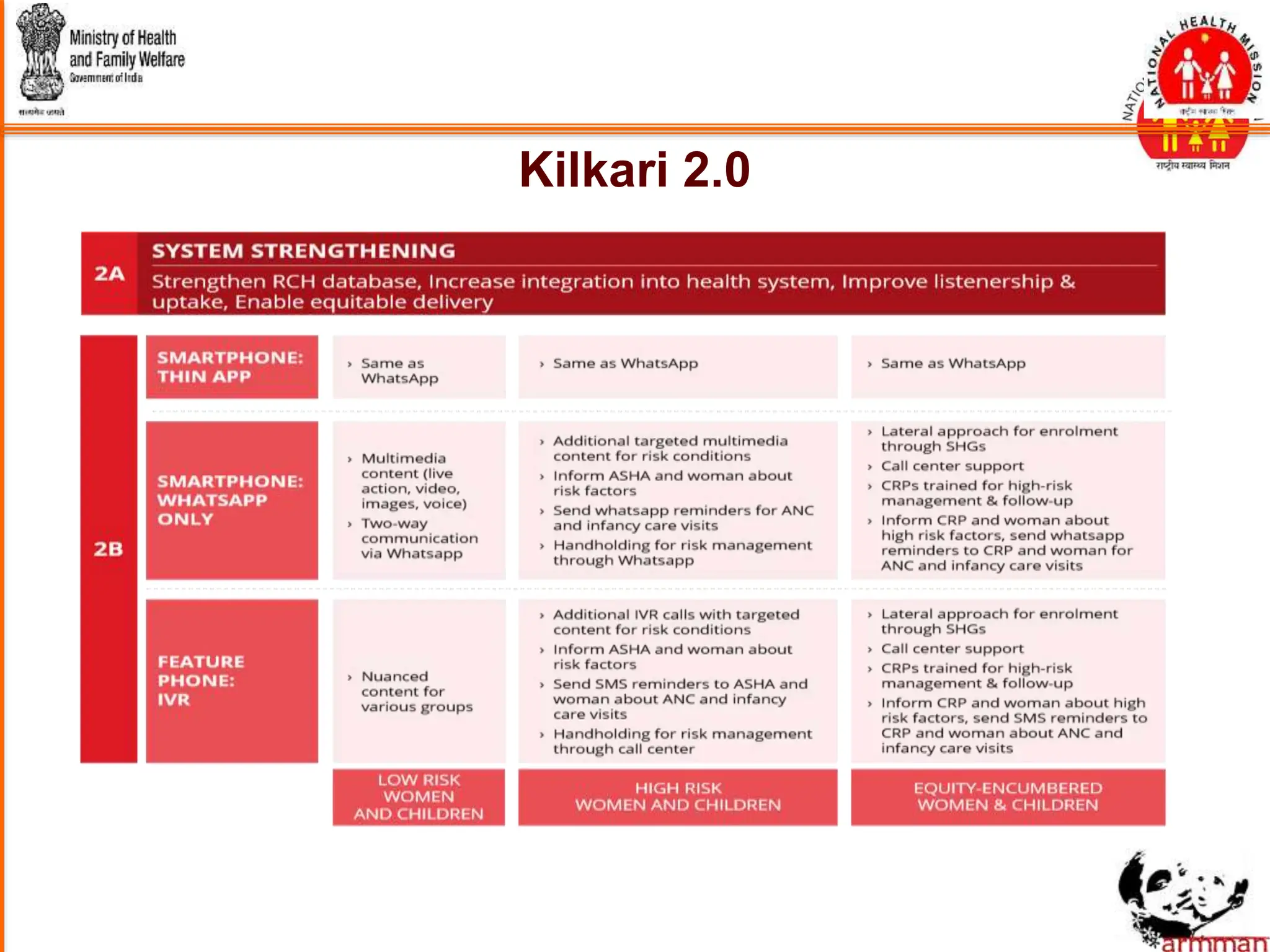
Kilkari 2.0
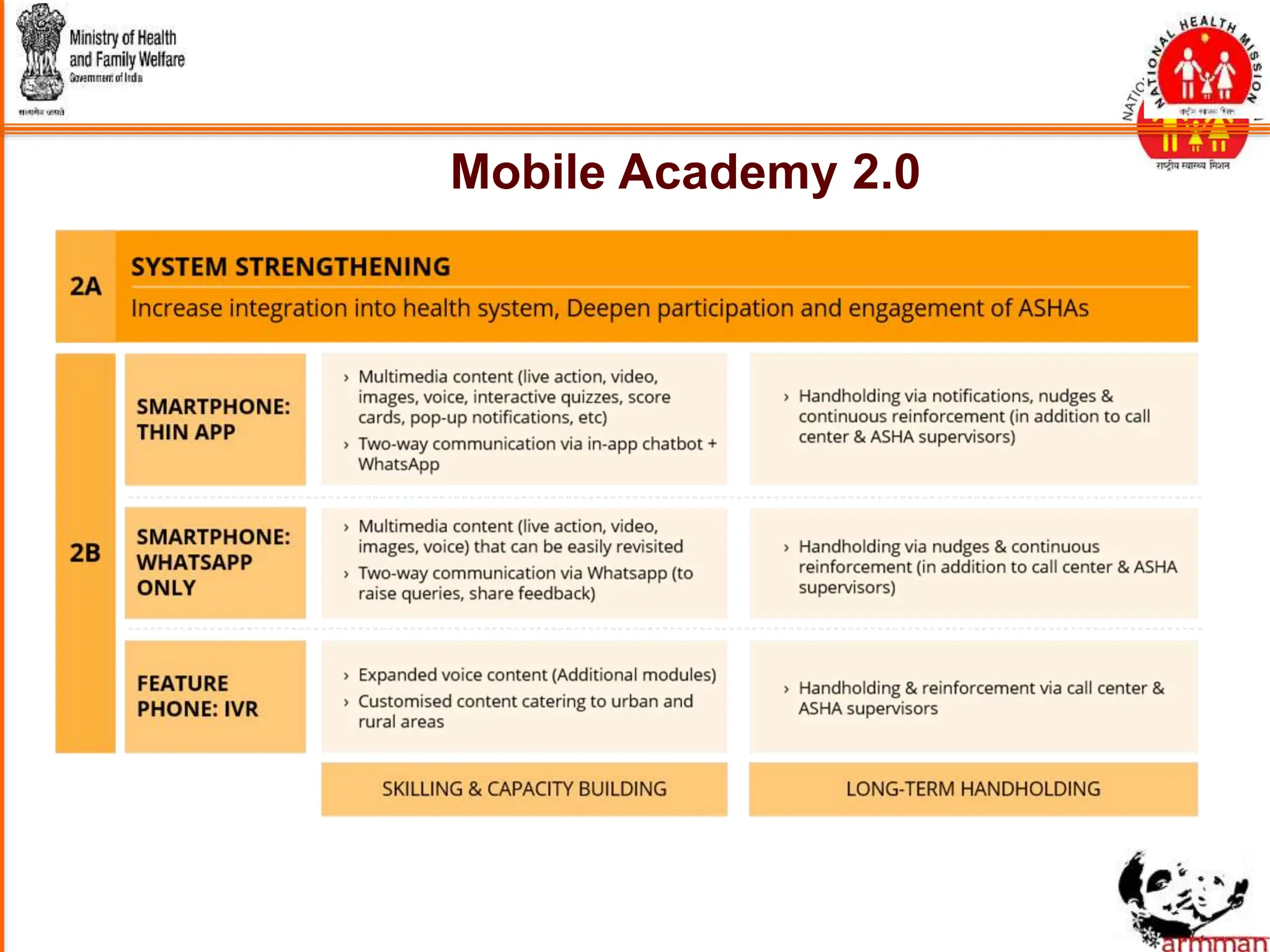
Mobile Academy 2.0
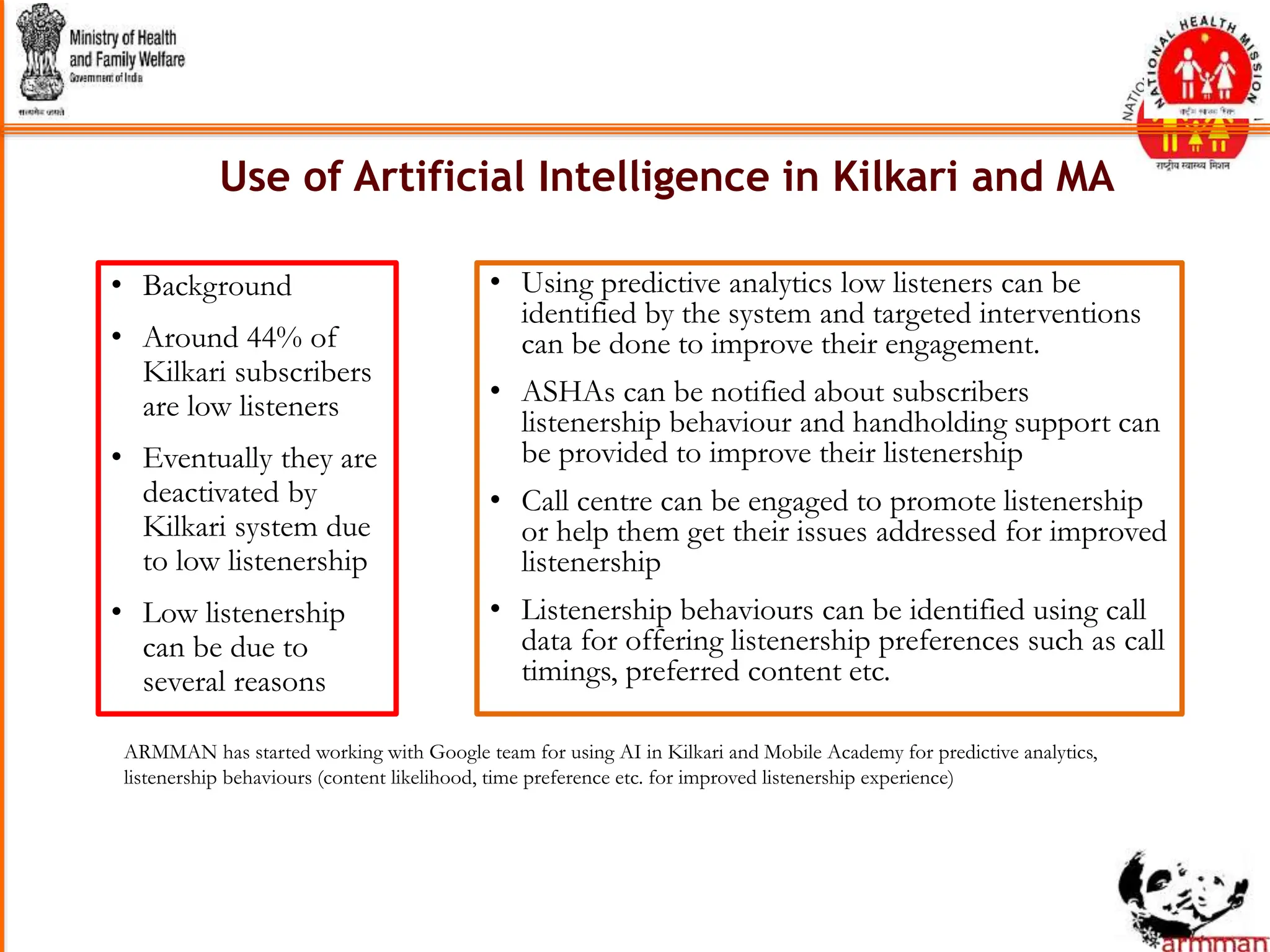
• Using predictive analytics low listeners can be
identified by the system and targeted interventions
can be done to improve their engagement.
• ASHAs can be notified about subscribers
listenership behaviour and handholding support can
be provided to improve their listenership
• Call centre can be engaged to promote listenership
or help them get their issues addressed for improved
listenership
• Listenership behaviours can be identified using call
data for offering listenership preferences such as call
timings, preferred content etc.
• Background
• Around 44% of
Kilkari subscribers
are low listeners
• Eventually they are
deactivated by
Kilkari system due
to low listenership
• Low listenership
can be due to
several reasons
ARMMAN has started working with Google team for using AI in Kilkari and Mobile Academy for predictive analytics,
listenership behaviours (content likelihood, time preference etc. for improved listenership experience)
Use of Artificial Intelligence in Kilkari and MA
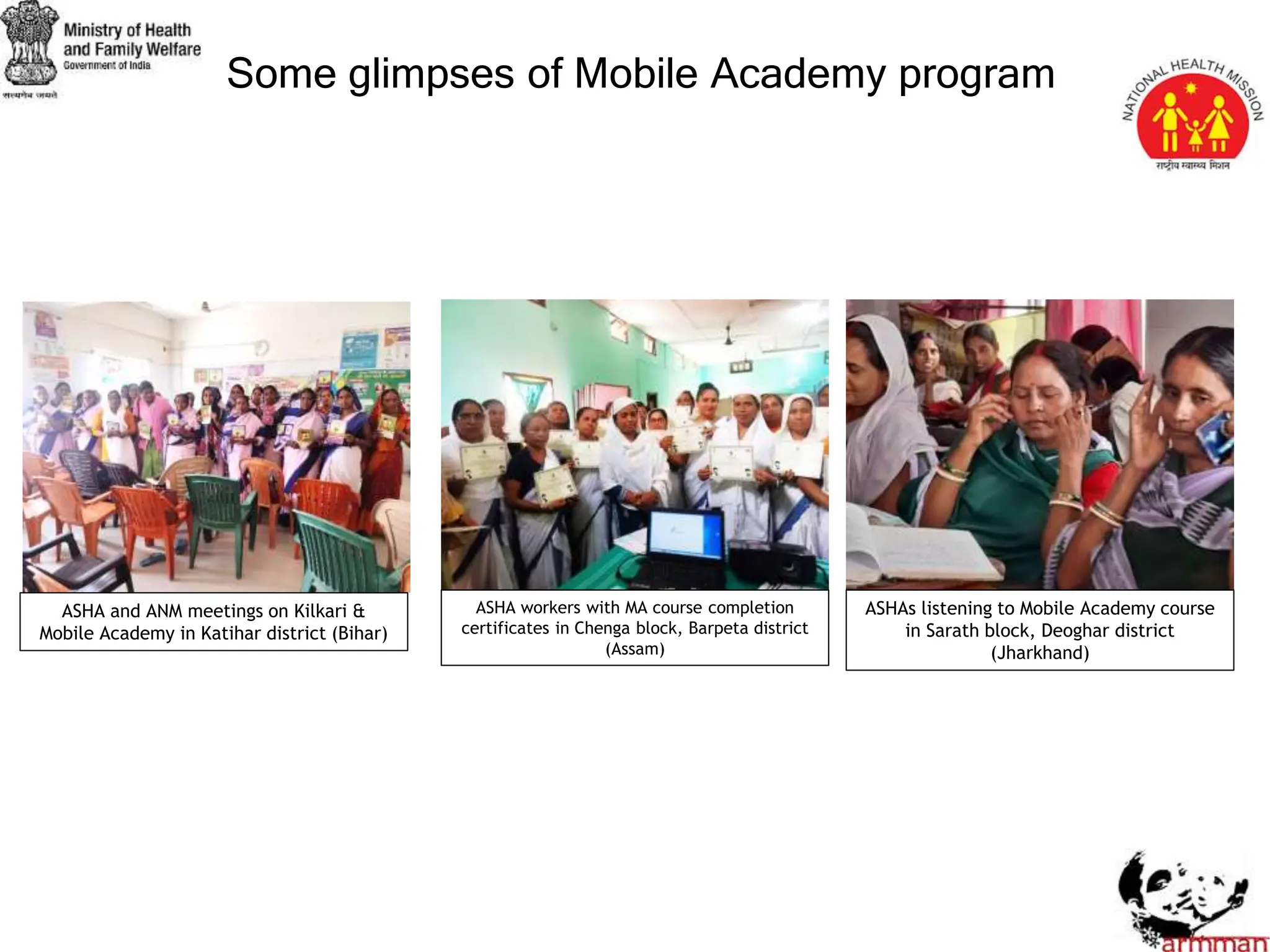
Some glimpses of Mobile Academy program
ASHA and ANM meetings on Kilkari &
Mobile Academy in Katihar district (Bihar)
ASHA workers with MA course completion
certificates in Chenga block, Barpeta district
(Assam)
ASHAs listening to Mobile Academy course
in Sarath block, Deoghar district
(Jharkhand)
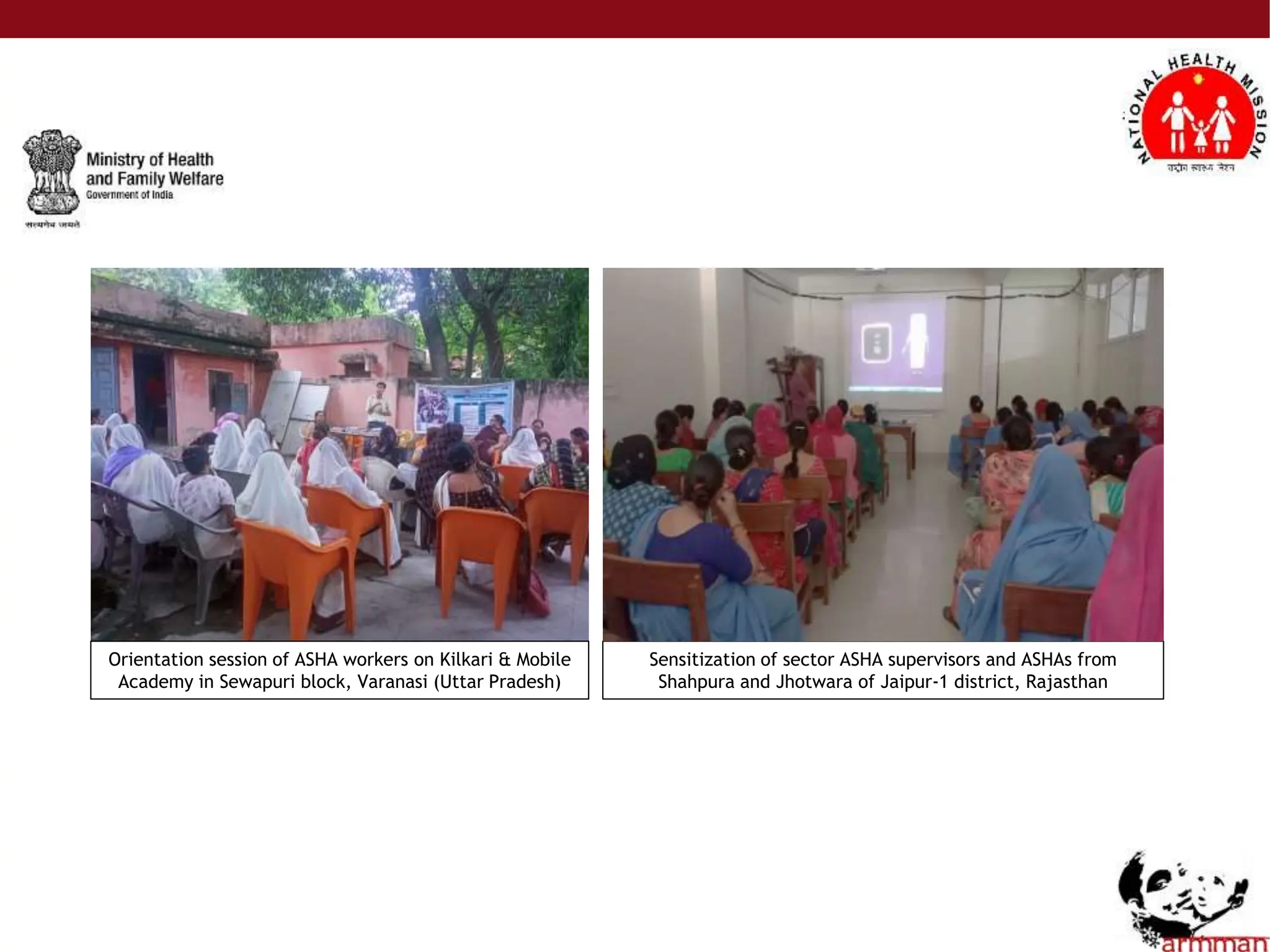
Sensitization of sector ASHA supervisors and ASHAs from
Shahpura and Jhotwara of Jaipur-1 district, Rajasthan
Orientation session of ASHA workers on Kilkari & Mobile
Academy in Sewapuri block, Varanasi (Uttar Pradesh)
THANK YOU!
For any queries, please write to
www.armman.org

Introduction to KMA Program.pptx.........

  • 1.
    Kilkari and MobileAcademy: an approach towards empowerment, improving skills and care
  • 2.
    The Ministry ofHealth & Family Welfare, introduced centralized, interactive voice response (IVR) based mobile health services. Kilkari and Mobile Academy are one of the largest m-health programs globally
  • 3.
    – On 15January 2016, Ministry of Health and Family Welfare, Government of India launched the national scale up of two mHealth services as part of its Digital India initiative: Kilkari and Mobile Academy – Phase-wise launch of the project, was aimed with scale up the services nationally across all states.
  • 4.
    Kilkari (a baby’s gurgle)is an outbound service that delivers weekly, time- appropriate audio messages about pregnancy, childbirth, and childcare directly to families’ mobile phones using IVR (Interactive Voice Response) technology. Covers the critical time period when most deaths occur – from the second trimester of pregnancy until the child is one year old (72 weeks) Delivers one pre-recorded message per week directly to the mobile phones of pregnant women and mothers with children under the age of one year. Total 72 messages FREE – Kilkari is centrally hosted by MoHFW for all states. No investment in technology, telephony infrastructure or operational costs is required by states. Integrated with MoHFW’s centralized Reproductive Child Health (RCH) portal - the only source of information for this mHealth service.
  • 5.
    History Origin Kilkari was originally designed,developed, tested and launched by BBC Media Action in the year 2013 in the north eastern state of Bihar. Concept The Kilkari concept was based on a mHealth service called ‘Mobile Midwife’, which was originally piloted by the Grameen Foundation in Ghana, with support from the Bill & Melinda Gates Foundation. Association with MoHFW Kilkari was initially started in the state of Bihar, which was gradually adopted and scaled up by MoHFW. Kilkari has been one of the top most initiatives of MoHFW in the last few years. Today, MoHFW is paying up all the call costs for Kilkari along with data storage charges. Scale In 2016, when MoHFW officially launched Kilkari, it was spread across 6 states with 0.6 million subscribers available in two languages Hindi and Odiya, but thereafter the initiative never looked back and in these 6 years Kilkari has reached across 18 states/UTs in 8 languages. 5
  • 6.
    • Uses InteractiveVoice Response (IVR) technology – Kilkari delivers time- sensitive audio messages (voice call) about RMNCH directly to the mobile phones of families • Covers the critical time period when most deaths occur – from the second trimester of pregnancy until the child is one year old (72 weeks) • Delivers one pre-recorded message per week directly to the mobile phones of pregnant women and mothers with children under the age of one year • FREE – Kilkari is centrally hosted by MoHFW for all states. No investment in technology, telephony infrastructure or operational costs is required by states. – Reinforce key health information to the beneficiary and her family by the frontline health worker – Time sensitive – relevant to the woman’s stage of pregnancy • Integrated with MoHFW’s centralized Reproductive Child Health (RCH) portal - the only source of information for this mHealth service. • Incoming Kilkari number: 0124-4451660 About Kilkari
  • 7.
    How to accessKilkari 1. A pregnant woman or a mother with a child under the age of one year registers her pregnancy with the Auxiliary Nurse Midwife (ANM). 2. Her data (including a valid mobile number and her expected date of delivery or child’s age) is entered into the MCTS/RCH portal by the data entry operator at the block level. 3. The woman is now registered on the database and begins receiving one audio message every week on the registered mobile number, linked to her stage of pregnancy or child’s age. 4. The audio messages received are based on her Last Menstrual Period (LMP) or her child’s Date of Birth (DoB), entered into the RCH portal 5. If a woman misses her weekly call, the IVR system automatically tries to call her three times on the same day and then twice for the next three days. 6. Alternatively, If the woman misses a call from Kilkari or wants to re-listen to that weeks message, she can dial 14423 to hear it again.
  • 8.
    • Kilkari audiomessages are presented in the voice of a fictitious doctor character called Dr Anita • The information she imparts in each message comes from doctors and specialists at the MoHFW and NHSRC (national health systems resource center) • Her tone is authoritative, yet sympathetic and designed to inspire confidence in the listener • She is a friend, philosopher and guide to the frontline health workers and the families she serves Dr. Anita
  • 9.
    PPFP PPIUCD Encouraging adoption IUCD 2types Test for pregnancy Limiting Male sterilization Female sterilization Spacing Oral contraceptive pills Condoms Emergency contraceptive pills JSSK pregnant woman ANC Birth preparedness Quality of food for pregnant woman Anemia TT & IFA Rest for pregnant woman Institutional delivery Preterm delivery Home delivery Ambulance service Danger signs for expecting mother Breastfeeding Thermal & cord care Danger signs new baby JSSK child General childhood diseases prevention RBSK & development milestones Pneumonia & Malaria Diarrhea Growth monitoring Anemia Iron for child Complementary feeding Safe drinking water & hygiene Immunization need Compliance Zero dose First dose Second dose Third dose Fourth dose Fifth dose Kilkari Technical Health Content Maternal Health Child Health Immunization Family Planning
  • 10.
    Some glimpses ofKilkari program across states 11 House to house Kilkari visits by ASHA, ANM, Anganwadi workers and CHO in Kesinga block, Kalahandi district (Odisha) Sensitisation of beneficiaries, ASHAs, and Anganwadi workers at UHND session in Shahpur Jat (Delhi) Awareness generation for Kilkari call through wall paintings in Venkatershwara Puram, Nelluru District (Andhra Pradesh)
  • 11.
    Awareness generation aboutKilkari calls at the VHSND sessions, Narayanpur District (Chhattisgarh) ASHA and ANM meetings on Kilkari & Mobile Academy in Katihar district (Bihar)
  • 12.
    A reproductive maternalneonatal and child health (RMNCH) mobile-based training course designed to refresh frontline health workers’ knowledge of life-saving preventative health behaviors and improve the quality of their engagement with new and expecting mothers and their families.
  • 13.
    About Mobile Academy •The course is 240 minutes long • 11 Chapters, each chapter has 4 lessons (44 lessons in total) • At the end of each chapter there are 4 quiz questions – ASHAs have to choose between 2 possible answers • Once the ASHA completes all 11 chapters and quizzes, she gets an SMS with her final score and a unique ID • If the ASHA scores a total of 50% and above in the quiz she qualifies to receive a certificate of recognition from the Government – this builds her motivation, confidence and self- efficacy • All that the ASHA has to do is dial 14424 from her registered mobile and she can start the course
  • 14.
    How to accessMobile Academy STEP DETAILS STEP 1 ASHA to dial 14424 from the registered mobile phone to start the Mobile Academy course STEP 2 Listen to the WELCOME MESSAGE carefully to understand the instructions on ‘how to do the course’ STEP 3 After the welcome message: • Press 1 to LISTEN AGAIN to the welcome message • Press 2 to START the course STEP 4 LISTEN TO CHAPTERS, LESSONS AND FINISH QUIZZES To navigate: • Press 1 to REPEAT the same chapter/lesson • Press 2 to go to NEXT chapter/lesson STEP 5 At the END of the chapter 11, PRESS 2 to listen to your FINAL SCORE Do not disconnect until the final prompt is over – until the recorded voice stops talking
  • 15.
  • 16.
    • Hand washing •Stopping open defecation • Birth preparedness • Antenatal care • Safe delivery • Postnatal care • Family planning • Routine immunization • Complementary feeding • Identifying and preventing malnutrition • Preventing childhood infectious diseases (Diarrhea, pneumonia and malaria) • Newborn care • Immediate breastfeeding • Exclusive breastfeeding Mobile Academy Technical Health Content Maternal Health Child Health Handwashing & Hygiene Neonatal Health Reproductive Health
  • 17.
    Kilkari & MobileAcademy 2.0 • Richer multimedia content including videos, digital posters/images, audio, quizzes and interactive nudges. • Multiple delivery channels such as WhatsApp, YouTube, dedicated app, etc. (in addition to IVR) that will enable technology-enabled two-way communication and handholding • Targeted messaging with information about high-risk conditions for pregnancy and infancy • Address equity challenges with respect to access to health services through measures such as handholding through frontline health workers, self help groups and call centre To serve women with differential access to technology and varying health needs & social locations, we want to move from a one-size-fits-all approach to a fit for purpose approach
  • 18.
  • 19.
  • 20.
    • Using predictiveanalytics low listeners can be identified by the system and targeted interventions can be done to improve their engagement. • ASHAs can be notified about subscribers listenership behaviour and handholding support can be provided to improve their listenership • Call centre can be engaged to promote listenership or help them get their issues addressed for improved listenership • Listenership behaviours can be identified using call data for offering listenership preferences such as call timings, preferred content etc. • Background • Around 44% of Kilkari subscribers are low listeners • Eventually they are deactivated by Kilkari system due to low listenership • Low listenership can be due to several reasons ARMMAN has started working with Google team for using AI in Kilkari and Mobile Academy for predictive analytics, listenership behaviours (content likelihood, time preference etc. for improved listenership experience) Use of Artificial Intelligence in Kilkari and MA
  • 21.
    Some glimpses ofMobile Academy program ASHA and ANM meetings on Kilkari & Mobile Academy in Katihar district (Bihar) ASHA workers with MA course completion certificates in Chenga block, Barpeta district (Assam) ASHAs listening to Mobile Academy course in Sarath block, Deoghar district (Jharkhand)
  • 22.
    Sensitization of sectorASHA supervisors and ASHAs from Shahpura and Jhotwara of Jaipur-1 district, Rajasthan Orientation session of ASHA workers on Kilkari & Mobile Academy in Sewapuri block, Varanasi (Uttar Pradesh)
  • 23.
    THANK YOU! For anyqueries, please write to www.armman.org

Editor's Notes

  • #11 Facilitators are requested to share only the relevant state data
  • #22 Some of the salient features of Kilkari 2.0 will be: Enhanced content, with a focus on more targeted content for women and children with high-risk factors such as anaemia Expanded delivery channels, including Whatsapp, dedicated app, etc. which will allow for richer content and communication Technology-enabled two-way communication and handholding An increased focus on equity-encumbered women, through lateral approaches for enrolling and engaging beneficiaries through self-help groups (SHGs) and their community resource persons (CRPs) in equity encumbered areas Relevant messaging for husbands/fathers and family members, who are the secondary beneficiaries of the service and play an important role in the woman’s health behaviour