Introduction to Ion
Exchange Method
The ion exchange method is a powerful water treatment technique that
uses specialized resins to selectively remove or exchange ions in a
solution. This process is widely used in various industries, from water
purification to chemical processing, to achieve precise control over the
ionic composition of liquids.
Principles of Ion Exchange
1
Ion Exchange Resin
The ion exchange process relies on a resin
material that contains charged functional groups
capable of exchanging ions with the solution
being treated.
2
Ion Selectivity
Each type of resin is designed to preferentially
exchange specific ions, allowing for targeted
removal or exchange of unwanted ions.
3
Reversible Process
The ion exchange process is reversible, allowing
the resin to be regenerated and reused, making
it an efficient and economical water treatment
solution.
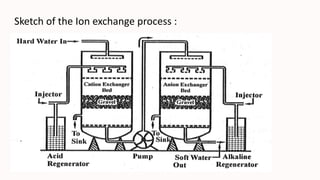
Sketch of the Ion exchange process :
Types of Ion Exchange Resins
Cation Exchange
Resins
These resins exchange
positively charged ions, such as
calcium, magnesium, and
sodium, for other positive ions
in the solution.
Anion Exchange Resins
These resins exchange
negatively charged ions, such
as chloride, sulfate, and nitrate,
for other negative ions in the
solution.
Specialty Resins
Advanced resins designed for
specific applications, such as
removing heavy metals or
organic contaminants, are also
available.
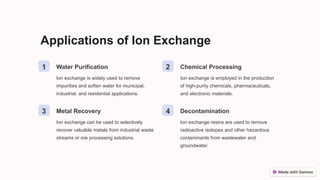
Applications of Ion Exchange
1 Water Purification
Ion exchange is widely used to remove
impurities and soften water for municipal,
industrial, and residential applications.
2 Chemical Processing
Ion exchange is employed in the production
of high-purity chemicals, pharmaceuticals,
and electronic materials.
3 Metal Recovery
Ion exchange can be used to selectively
recover valuable metals from industrial waste
streams or ore processing solutions.
4 Decontamination
Ion exchange resins are used to remove
radioactive isotopes and other hazardous
contaminants from wastewater and
groundwater.
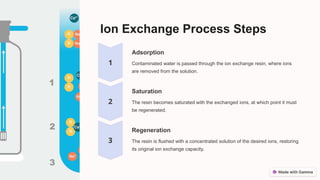
Ion Exchange Process Steps
Adsorption
Contaminated water is passed through the ion exchange resin, where ions
are removed from the solution.
Saturation
The resin becomes saturated with the exchanged ions, at which point it must
be regenerated.
Regeneration
The resin is flushed with a concentrated solution of the desired ions, restoring
its original ion exchange capacity.
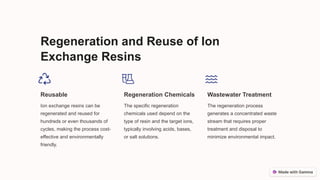
Regeneration and Reuse of Ion
Exchange Resins
Reusable
Ion exchange resins can be
regenerated and reused for
hundreds or even thousands of
cycles, making the process cost-
effective and environmentally
friendly.
Regeneration Chemicals
The specific regeneration
chemicals used depend on the
type of resin and the target ions,
typically involving acids, bases,
or salt solutions.
Wastewater Treatment
The regeneration process
generates a concentrated waste
stream that requires proper
treatment and disposal to
minimize environmental impact.
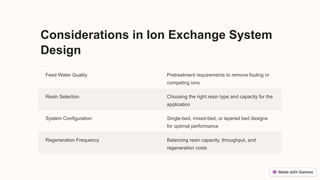
Considerations in Ion Exchange System
Design
Feed Water Quality Pretreatment requirements to remove fouling or
competing ions
Resin Selection Choosing the right resin type and capacity for the
application
System Configuration Single-bed, mixed-bed, or layered bed designs
for optimal performance
Regeneration Frequency Balancing resin capacity, throughput, and
regeneration costs
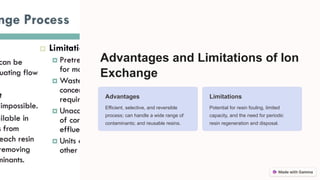
Advantages and Limitations of Ion
Exchange
Advantages
Efficient, selective, and reversible
process; can handle a wide range of
contaminants; and reusable resins.
Limitations
Potential for resin fouling, limited
capacity, and the need for periodic
resin regeneration and disposal.
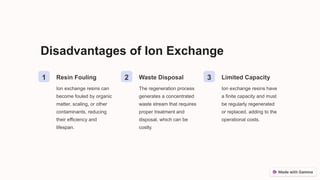
Disadvantages of Ion Exchange
1 Resin Fouling
Ion exchange resins can
become fouled by organic
matter, scaling, or other
contaminants, reducing
their efficiency and
lifespan.
2 Waste Disposal
The regeneration process
generates a concentrated
waste stream that requires
proper treatment and
disposal, which can be
costly.
3 Limited Capacity
Ion exchange resins have
a finite capacity and must
be regularly regenerated
or replaced, adding to the
operational costs.

Introduction-to-Ion-Exchange-Method.pptx

  • 1.
    Introduction to Ion ExchangeMethod The ion exchange method is a powerful water treatment technique that uses specialized resins to selectively remove or exchange ions in a solution. This process is widely used in various industries, from water purification to chemical processing, to achieve precise control over the ionic composition of liquids.
  • 2.
    Principles of IonExchange 1 Ion Exchange Resin The ion exchange process relies on a resin material that contains charged functional groups capable of exchanging ions with the solution being treated. 2 Ion Selectivity Each type of resin is designed to preferentially exchange specific ions, allowing for targeted removal or exchange of unwanted ions. 3 Reversible Process The ion exchange process is reversible, allowing the resin to be regenerated and reused, making it an efficient and economical water treatment solution.
  • 3.
    Sketch of theIon exchange process :
  • 8.
    Types of IonExchange Resins Cation Exchange Resins These resins exchange positively charged ions, such as calcium, magnesium, and sodium, for other positive ions in the solution. Anion Exchange Resins These resins exchange negatively charged ions, such as chloride, sulfate, and nitrate, for other negative ions in the solution. Specialty Resins Advanced resins designed for specific applications, such as removing heavy metals or organic contaminants, are also available.
  • 9.
    Applications of IonExchange 1 Water Purification Ion exchange is widely used to remove impurities and soften water for municipal, industrial, and residential applications. 2 Chemical Processing Ion exchange is employed in the production of high-purity chemicals, pharmaceuticals, and electronic materials. 3 Metal Recovery Ion exchange can be used to selectively recover valuable metals from industrial waste streams or ore processing solutions. 4 Decontamination Ion exchange resins are used to remove radioactive isotopes and other hazardous contaminants from wastewater and groundwater.
  • 10.
    Ion Exchange ProcessSteps Adsorption Contaminated water is passed through the ion exchange resin, where ions are removed from the solution. Saturation The resin becomes saturated with the exchanged ions, at which point it must be regenerated. Regeneration The resin is flushed with a concentrated solution of the desired ions, restoring its original ion exchange capacity.
  • 11.
    Regeneration and Reuseof Ion Exchange Resins Reusable Ion exchange resins can be regenerated and reused for hundreds or even thousands of cycles, making the process cost- effective and environmentally friendly. Regeneration Chemicals The specific regeneration chemicals used depend on the type of resin and the target ions, typically involving acids, bases, or salt solutions. Wastewater Treatment The regeneration process generates a concentrated waste stream that requires proper treatment and disposal to minimize environmental impact.
  • 12.
    Considerations in IonExchange System Design Feed Water Quality Pretreatment requirements to remove fouling or competing ions Resin Selection Choosing the right resin type and capacity for the application System Configuration Single-bed, mixed-bed, or layered bed designs for optimal performance Regeneration Frequency Balancing resin capacity, throughput, and regeneration costs
  • 13.
    Advantages and Limitationsof Ion Exchange Advantages Efficient, selective, and reversible process; can handle a wide range of contaminants; and reusable resins. Limitations Potential for resin fouling, limited capacity, and the need for periodic resin regeneration and disposal.
  • 14.
    Disadvantages of IonExchange 1 Resin Fouling Ion exchange resins can become fouled by organic matter, scaling, or other contaminants, reducing their efficiency and lifespan. 2 Waste Disposal The regeneration process generates a concentrated waste stream that requires proper treatment and disposal, which can be costly. 3 Limited Capacity Ion exchange resins have a finite capacity and must be regularly regenerated or replaced, adding to the operational costs.