AFRO-ASIAN LITERATURE
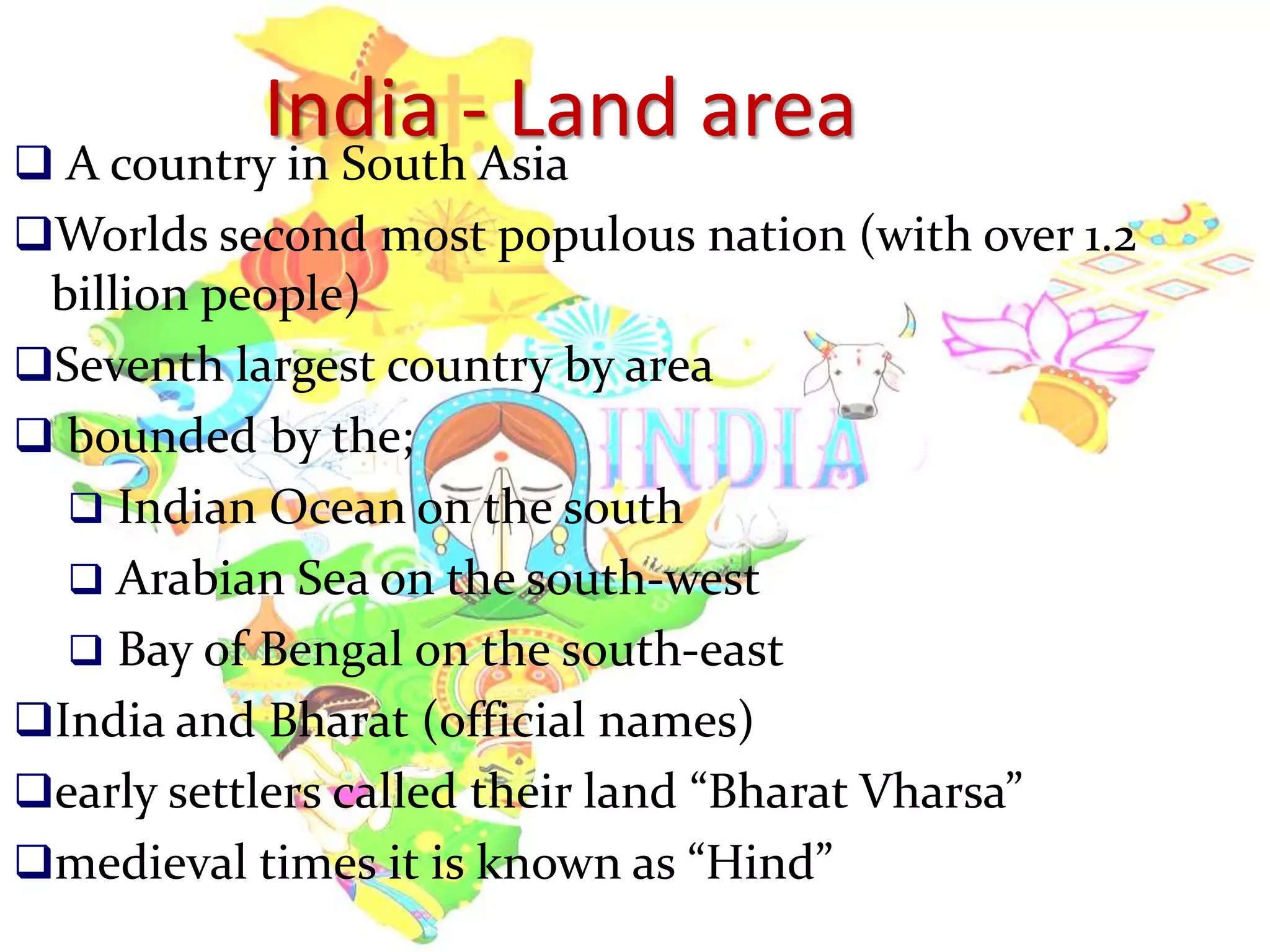
India - Land area
 A country in South Asia
Worlds second most populous nation (with over 1.2
billion people)
Seventh largest country by area
 bounded by the;
 Indian Ocean on the south
 Arabian Sea on the south-west
 Bay of Bengal on the south-east
India and Bharat (official names)
early settlers called their land “Bharat Vharsa”
medieval times it is known as “Hind”
India
 derives from Indus River
 Indian civilization grew up in Indus
Valley from 4000 to 2500 B.C.
 Foundation of Indian Society,
including Hinduism and caste system
were established by Buddhism and
Jainism groups that begins in Ancient
India.
Three Main Topographic Region
A. Himalayan Mountain (north)
divided into elongated valleys and
mountain ranges
Greatest Himalayas which include;
a. Nanda Devi highest peak in
the country
B.Northern Plains
 formed by the interplay of 3 major
systems:
 Indus river
 Ganges river
 Brahmaputra river
 the plain is formed by alluvial soil
C. Peninsular India
South India is bounded
by the Bay of Bengal in
the east, the Arabian Sea
in the west and
the Indian Ocean in the
south.
PEOPLE IN INDIA
 most diverse population
Indians are citizens of India
"Indian" refers to nationality, but
not ethnicity or language.
 Currency Indian rupee (₹) (INR)
 Capital New Delhi
 Largest City Mumbai
LANGUAGES IN INDIA
 four major language groups:
a. Indo-Aryan languages spoken by 75% of
Indians
 Assamese, Bengali, Bodo, Dogri, Gondi,
Gujarati, Hindi, Kashmiri, Konkani, Maithili,
Marathi, Meitei, Nepali, Oriya, Eastern
Panjabi, Sanskrit, Sindhi, Urdu
 Hindi
 The 4th most spoken language in the world and
30% of population and official language of India.
LANGUAGES IN INDIA
b. Dravidian languages spoken by
20% of Indians
 Telugu, Tamil, Malayalam, and
Kannada
c. Austro-Asiatic languages spoken
in isolated regions
d. Sino-Tibetan languages spoken
in small regions
1%
83% of population
11% are Islam followers
 Literacy of men is higher
among women
 Free and open to all
children
• Primary education - 8 years
• Lower secondary education – 2 years
• Upper secondary education – 2 years
• in 2 states education is compulsory to students
ages 6 to 14.
Government of India
• Federal system (1950) with a
parliamentary form of government
• President Pranad Mukherjee
• Vice-President Mohammad Hamid
Ansari
• Prime Minister Narendra Modi
• Chief Justice T. S. Thakur
• Speaker of the Lower House Sumitra
Mahajan
• Legislature Parliament of India
• Upper house Rajya Sabha
• Lower house Lok Sabha
August 15, 1947 as a
sovereign state under its
own constitutional
government
 two states:
Pakistan – Islamic
state
India – secular state
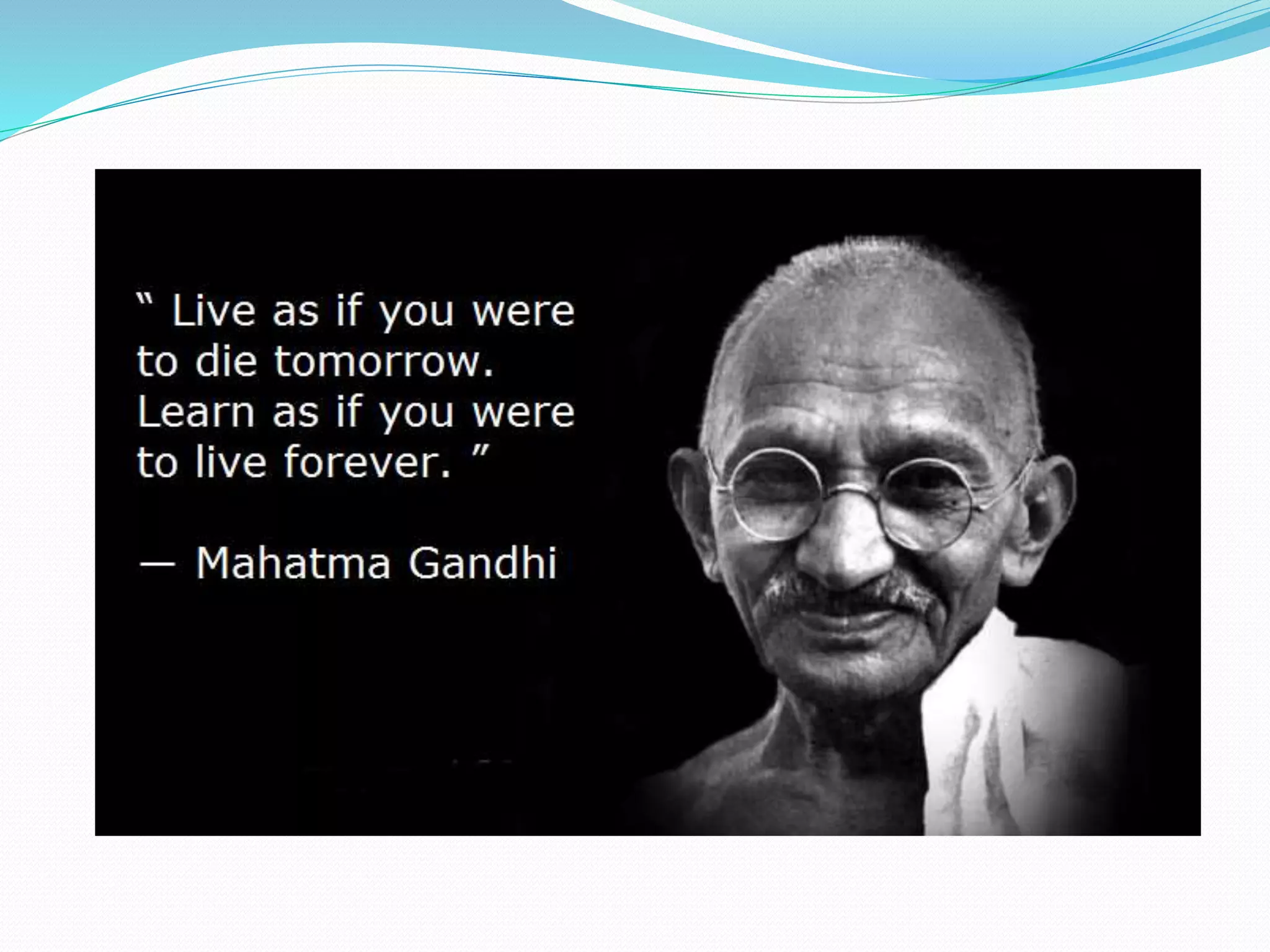
 Mahatma Gandhi
 revered father of modern India
 assassinated by a militant Hindu who
believed him to be too kind to Muslim on
1948.
 Born: October 2, 1869, Porbandar, India
 Assassinated: January 30, 1948, New Delhi, India
 Awards: Time's Person of the Year
 Mahatma (great soul), Gandhi (grocer)
 One of the great nationalist leader of 20th century
 Methods and philosophy of non-violent
confrontation, or civil disobedience, led his
country to independence (August 1, 1947) and
influenced activist throughout the world.
 Influenced by his mother who is a devout of
Jainism – a religion in which ideas of non-violence
and vegetarianism whose life “was an endless chain
of fast and vows”.
 married by arrangement at 13, Studied law in London at 18
 Admitted to the bar in 1891 and Practiced law in Bombay
 Worked for Indian Firm in South Africa (1893 – 1914)
 Gandhi’s humiliating experiences of overt racial
discrimination propelled him into agitation on behalf of
the Indian community of South Africa.
 He assumed leadership of protest
 Developed his techniques and tenets of nonviolence
resistance known as satyaghara (literally,
“steadfastness in truth”)
 He also fought to improve the status of the lowest classes
society, the casteless Untouchables whom he called
harijans (“children of God”).
Thank you!
धन्यवाद (dhanyavaad)

INTRODUCTION TO INDIA.pptx

  • 1.
  • 2.
    India - Landarea  A country in South Asia Worlds second most populous nation (with over 1.2 billion people) Seventh largest country by area  bounded by the;  Indian Ocean on the south  Arabian Sea on the south-west  Bay of Bengal on the south-east India and Bharat (official names) early settlers called their land “Bharat Vharsa” medieval times it is known as “Hind”
  • 3.
    India  derives fromIndus River  Indian civilization grew up in Indus Valley from 4000 to 2500 B.C.  Foundation of Indian Society, including Hinduism and caste system were established by Buddhism and Jainism groups that begins in Ancient India.
  • 5.
    Three Main TopographicRegion A. Himalayan Mountain (north) divided into elongated valleys and mountain ranges Greatest Himalayas which include; a. Nanda Devi highest peak in the country
  • 6.
    B.Northern Plains  formedby the interplay of 3 major systems:  Indus river  Ganges river  Brahmaputra river  the plain is formed by alluvial soil
  • 7.
    C. Peninsular India SouthIndia is bounded by the Bay of Bengal in the east, the Arabian Sea in the west and the Indian Ocean in the south.
  • 8.
    PEOPLE IN INDIA most diverse population Indians are citizens of India "Indian" refers to nationality, but not ethnicity or language.  Currency Indian rupee (₹) (INR)  Capital New Delhi  Largest City Mumbai
  • 9.
    LANGUAGES IN INDIA four major language groups: a. Indo-Aryan languages spoken by 75% of Indians  Assamese, Bengali, Bodo, Dogri, Gondi, Gujarati, Hindi, Kashmiri, Konkani, Maithili, Marathi, Meitei, Nepali, Oriya, Eastern Panjabi, Sanskrit, Sindhi, Urdu  Hindi  The 4th most spoken language in the world and 30% of population and official language of India.
  • 10.
    LANGUAGES IN INDIA b.Dravidian languages spoken by 20% of Indians  Telugu, Tamil, Malayalam, and Kannada c. Austro-Asiatic languages spoken in isolated regions d. Sino-Tibetan languages spoken in small regions
  • 11.
    1% 83% of population 11%are Islam followers
  • 12.
     Literacy ofmen is higher among women  Free and open to all children • Primary education - 8 years • Lower secondary education – 2 years • Upper secondary education – 2 years • in 2 states education is compulsory to students ages 6 to 14.
  • 13.
    Government of India •Federal system (1950) with a parliamentary form of government • President Pranad Mukherjee • Vice-President Mohammad Hamid Ansari • Prime Minister Narendra Modi • Chief Justice T. S. Thakur • Speaker of the Lower House Sumitra Mahajan • Legislature Parliament of India • Upper house Rajya Sabha • Lower house Lok Sabha
  • 14.
    August 15, 1947as a sovereign state under its own constitutional government  two states: Pakistan – Islamic state India – secular state  Mahatma Gandhi  revered father of modern India  assassinated by a militant Hindu who believed him to be too kind to Muslim on 1948.
  • 16.
     Born: October2, 1869, Porbandar, India  Assassinated: January 30, 1948, New Delhi, India  Awards: Time's Person of the Year  Mahatma (great soul), Gandhi (grocer)  One of the great nationalist leader of 20th century  Methods and philosophy of non-violent confrontation, or civil disobedience, led his country to independence (August 1, 1947) and influenced activist throughout the world.  Influenced by his mother who is a devout of Jainism – a religion in which ideas of non-violence and vegetarianism whose life “was an endless chain of fast and vows”.
  • 17.
     married byarrangement at 13, Studied law in London at 18  Admitted to the bar in 1891 and Practiced law in Bombay  Worked for Indian Firm in South Africa (1893 – 1914)  Gandhi’s humiliating experiences of overt racial discrimination propelled him into agitation on behalf of the Indian community of South Africa.  He assumed leadership of protest  Developed his techniques and tenets of nonviolence resistance known as satyaghara (literally, “steadfastness in truth”)  He also fought to improve the status of the lowest classes society, the casteless Untouchables whom he called harijans (“children of God”).
  • 21.